HAL Id: hal-01026084
https://hal.archives-ouvertes.fr/hal-01026084
Submitted on 19 Jul 2014HAL is a multi-disciplinary open access archive for the deposit and dissemination of sci-entific research documents, whether they are pub-lished or not. The documents may come from teaching and research institutions in France or abroad, or from public or private research centers.
L’archive ouverte pluridisciplinaire HAL, est destinée au dépôt et à la diffusion de documents scientifiques de niveau recherche, publiés ou non, émanant des établissements d’enseignement et de recherche français ou étrangers, des laboratoires publics ou privés.
Teachers’ conceptions of biological determinism in five
countries: Denmark, Estonia, Finland, France and Italy
Pierre Clément, Jérémy Castéra
To cite this version:
Pierre Clément, Jérémy Castéra. Teachers’ conceptions of biological determinism in five countries: Denmark, Estonia, Finland, France and Italy. ESERA 2013 / Strand 12: Cultural, social and gender issues in science and technology education, 2013, Nicosia, Cyprus. 10 p. �hal-01026084�
TEACHERS’ CONCEPTIONS OF BIOLOGICAL
DETERMINISM IN FIVE COUNTRIES:
DENMARK, ESTONIA, FINLAND, FRANCE AND ITALY
Pierre Clément 1and Jérémy Castéra 2
1
University of Lyon, France
2 Université d’Aix-Marseille, France
In collaboration, for gathering the data, with Anna Liisa Kosonen , Adriana Valente and their
groups in University of Joensuu (Finland) and C.N.R., Rome (Italy)
Abstract: The interaction between the genome and its environment (epigenetics) is a new
paradigm in biology. Nevertheless, the notion of genetic determinism is still present in
syllabuses and textbooks. What about teachers’ conceptions?
We analyzed the teachers’ conceptions related to the genetic determinism of human
performances in five European countries, using 24 questions of the Biohead-Citizen questionnaire.
The conceptions of the 2038 teachers, when grouped by country, show clear and significant differences, being more deterministic in the three countries of North Europe (Finland, Estonia, Denmark) than in Italy and France, and more sexist for only some of the related questions.
When grouped by religion, the differences are significant but disappear after suppression of the country effect, while this last one does not disappear after suppression of the religion effect: there is no specific religion effect. There is a gender effect (female teachers being more feminist), an effect of the level of instruction at University (the most instructed teachers having more knowledge but also some more tolerant attitudes), and an effect of age (the oldest believing more in genetic determinism).
A Co-Inertia analysis shows significant correlations between teachers’ answers on genetic determinism with their political opinions: genetic determinism (as belief of heredity of intelligence) and intolerant attitudes (as sexism and racism) are correlated with the most conservative political opinions.
Finally, we found a specific and paradoxical effect of biology training of teachers: biologist teachers have, without surprise, more knowledge than their colleagues, but are also more convinced of the importance of genetic determinism: their training in biology still needs to be improved by introducing the most recent concepts of genetics, as epigenetics.
Keywords: Genetic determinism, Epigenetics, Teachers’ conceptions, International
THEORETICAL BACKGROUND
The debate between nature and nurture is outdated, both being necessarily in constant interaction (Jacquard, 1972; Atlan, 1999; Lewontin, 2000; etc.). The interaction between the genome and its environment (called "Epigenetics": Wu & Morris, 2001) is a new paradigm in biology. Nevertheless the syllabuses and school textbooks are just starting to change (Castéra et al, 2008; Clément & Castéra, 2013; Gericke et al, 2012). What about the teachers’
conceptions?
Outdated knowledge can be used to justify a pre-determinism of individual performances
(intelligence, music, …) or of social intolerant attitudes as sexism or racism (Keller, 2005).
A previous communication (Castéra & Clément, 2009a) showed that more Finnish than French teachers were convinced of a genetic determinism. In consequence, we decided to extend this comparison to more countries in North and South of Europe.
Our general theoretical background is the KVP model (Clément, 2006, 2010), analyzing the
conceptions as possible interaction between scientific knowledge (K), values (V) and social practices (P). A comparison between countries differing by their socio-cultural contexts can help to identify the difficulties of some teachers to change their conceptions after a renewal of the scientific knowledge, as it is the case by the emergence of epigenetics in biology.
This new paradigm is concerning all the teachers, not only biology teachers, because the way
of teaching is not the same when you consider students’ performances as genetically
determined (innatism) or when you know that the genetic characteristics of any person is strongly interacting with their environment along their singular history (epigenetics).
RESEARCH QUESTIONS
We wish to compare teachers’ conceptions of biological determinism of human performances
in five European countries. Do they differ among countries, or among groups of countries? Three of them are in Northern Europe, the two others in Southern Europe. Moreover, the results of PISA before our research (2006) showed that Finland obtained the best score on the scale of the “scientific literacy” while France and Denmark obtained a score just under the OECD average, and Italy a lower score.
When teachers were trained in biology (teaching biology, or teaching in primary schools after
a training in biology: we call them “biologist teachers”), do their conceptions differ from
those of their non-biologist colleagues?
Teachers’ religions differ among these countries (Table 1): is there a religion effect
independent to the country effect?
Do the teachers’ conceptions vary with other controlled parameters, independently to their
nationality, as gender, age, level of instruction, political opinions?
METHODOLOGY
Our sampling (Table 1) comes from five countries, three in Northern Europe, two in Southern Europe. In each country, the questionnaire was completed by a balance of in-service teachers (i.e. currently active) and pre-service teachers (i.e. adults in their last year of teacher training). Six categories of samples were defined: in-service primary school teachers (inP), in-service secondary school biology teachers (inB), in-service secondary school language teachers (inL), pre-service primary school teachers (preP), pre-service secondary school biology teachers
(preB) and pre-service secondary school language teachers (preL). Each sample was about 50 teachers but only 30 in a small country as Estonia, and more in France and Italy where
complementary hypotheses were tested. A total of 2038 teachers completed the questionnaire. Table 1
Our sampling (Others = no answer + minority religions)
Country Total Including Biologists % Agnostic % Catholic % Protestant % Others
DK Denmark 259 111 44,8 1,9 34,4 18.9 EE Estonia 182 108 43,4 7,7 14,8 34.1 FI Finland 306 121 15,0 1,0 66,3 17.6 FR France 732 319 50,5 38,1 1,9 9.4 IT Italy 559 150 12,3 78,7 0,5 8.4 Total 2038 809
The research design and the questionnaire were defined and validated during the BIOHEAD-Citizen project (Clément & Carvalho, 2007; Munoz et al., 2009, Castéra & Clément, 2012). Teachers anonymously answered to a large questionnaire (144 questions) translated in their language (parallel independent translations followed by a retro-translation into English). Pre-service teachers filled out the questionnaire at the end of a course concerning all a promotion, and the questionnaire was immediately collected to have no bias of sampling. Some in-service teachers also filled out the questionnaire after a course or a meeting, but some others did that inside their school, after being gathered in a group. In each case, the researcher was present, explaining in the beginning that the process is totally anonymous and free, but also that the teachers had to answer to all the questions, because the questionnaires with more than 5% of not filled questions are then withdrawn.
We analyze here the teachers’ answers to 24 questions related to genetic determinism. All these questions are reproduced in Castéra & Clément (2012), and the main important of them (those differentiating the most the teachers’ conceptions) are reproduced below inside the
results. These questions can be grouped into five different categories:
(1) Genetic determinism of personal or individual features: questions about clones and twins (A3, A6, A19, A24, A43 and A53).
(2) Genetic predisposition of children’ performances (B8, B10, B11, B14, B20)
(3) Genetic/biological differences related to gender (A2, A9, A14, A21, A25, A30, A36, A38 and A46).
(4) Genetic differences among ethnic groups (A35) or among social behaviour (B4). (5) A more general knowledge of genetics (A27, A31), although recognizing that question A27 can also be influenced by innatism.
We also use here teachers’ answers to 17 questions related to their personal characteristics,
and to their political or religious opinions.
The data were then analysed with appropriate multivariate analyses (Munoz et al, 2009;
Castéra & Clément, 2012), using the software “R”. We also used t-tests with Bonferroni’s
correction.
RESULTS AND DISCUSSION
The country effect
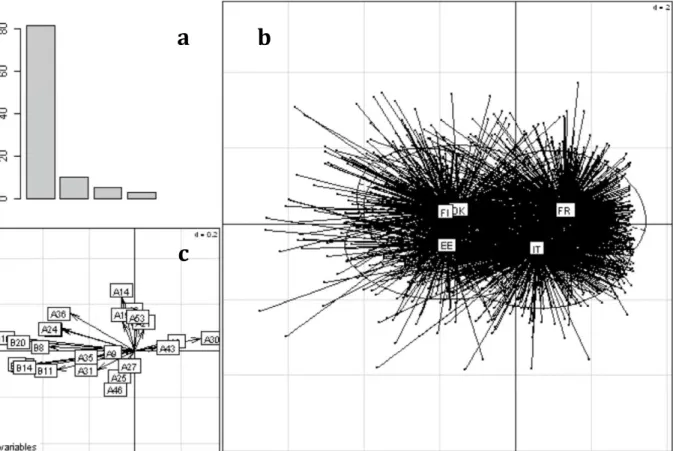
A between-class analysis (Fig. 1) clearly opposes Northern to Southern European countries. These differences are very significant (p<0.001: test of randomization).
The questions differentiating the most the five countries are (Fig. 1c):
The seven questions related to genetic pre-determinism of individual performances:
“There are genetic factors in parents that predispose their children to become: good in school” (B10, Figure 2), “very good violinists” (B20), “aggressive” (B14), “alcoholics” (B8), “homosexual” (B11), and two questions related to similarity of
human clones of “Einstein” (A3) and “Mozart” (A24). “Human social behaviour is partly directed by genes” (B4).
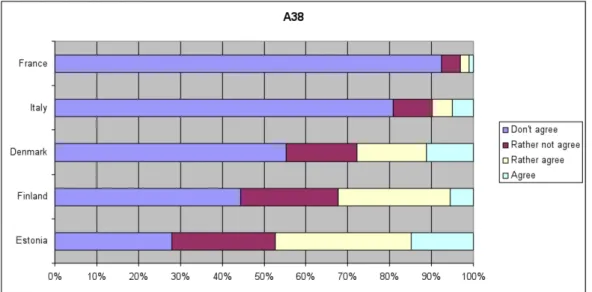
Two questions related to a biological justification of gender differences: “to take care
of housekeeping” (A38, Figure 3); “to think logically because men might have different brain bilateral symmetry.” (A36), and two questions related to the gender
equality of rights (A30, A2).
And, with a less weight, the question related to racism: “Ethnic groups are genetically different and that is why some are superior to others” (A35) and a question related to knowledge (role of chance for the child’s sex: A31).
For most of these questions, the t-tests with Bonferroni’s correction show significant differences between each pair of countries, with only some exceptions (as between some pairs of Northern countries).
There is no significant difference between countries for five other questions related to a biological justification of sexist gender differences. Globally, in the three Northern countries, the teachers’ conceptions are more in favour of a genetic determinism of human features, behaviours or performances, including to justify some (but not all) sexist or racist propositions.
Figure 1. Between-class Analysis differentiating the five countries.
a – The first component expresses more than 80% of the total variance.
b – Each point represents a teacher’s conceptions, and is linked to the centre of gravity of his / her country (FI= Finland; DK=Denmark; EE=Estonia; IT = Italia; FR= France).
c – The answers expalining this difference among countries: see the text for explanations.
Figure 2. Teachers’ answers (grouped by country) to the question B10:
There are genetic factors in parents that predispose
their children to be good in school. I agree
I don’t
agree
a
b
Figure 3. Teachers’ answers (grouped by country) to the question A38 :
It is for biological reasons that women more often
than men take care of housekeeping. I agree
I don’t
agree
Absence of a specific religion effect
After grouping the 2038 teachers into four groups depending their religion (Table 1), a between-class analysis shows significant difference between the four groups, but this difference disappears after suppression of the country effect, while this country effect does not disappear after suppression of the religion effect.
That means there is no specific religion effect.
A paradoxical effect of training in Biology
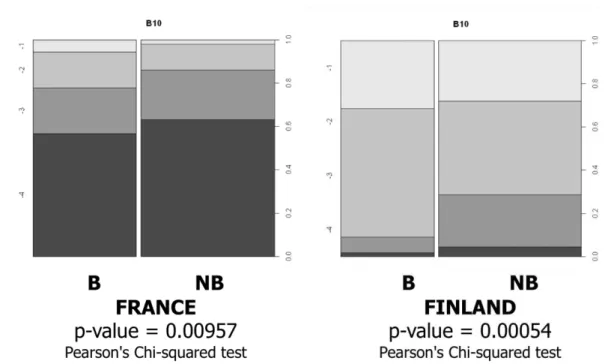
A between-class analysis shows a very significant difference between biologist teachers (Table 1) and other teachers, persisting after suppression of the country effect. This difference is paradoxical: biologist teachers have more knowledge than their colleagues, but are also more convinced of a genetic determinism. The figure 4 illustrates this effect for two countries
(France and Finland): the great difference between the two countries is the “country effect”,
described above. Nevertheless, inside each country, there is a significant difference between teachers trained in biology at University (B) and other teachers (NB). That suggests the way biology is taught at University induces more conviction in a genetic determinism, while it is now outdated with the emergence of epigenetics.
Figure 4. Answering to the question B10 (There are genetic factors in parents that predispose
their children to be good in school), the difference between B and NB is significant in France as well as in Finland: Biologist Teachers (B) are more innatist than their Colleagues (NB). The shades of grey correspond with the answers on the Likert scale: Light grey (agree) to dark grey (do not agree)
Other effects
There is a fine gender effect, still significant after suppression of the country effect: female teachers are less sexist (more feminist) than their male colleagues. That is not a surprise: this
effect was previously analysed in some of our precedent works (Castéra & Clément, 2009b). There is also a significant effect of the teachers’ level of training at University. The most
instructed teachers have more knowledge and often more tolerant attitudes. This effect is very interesting to encourage a longest initial training of teachers at University.
The effect of teachers’ age is also significant; it is partly similar to the precedent effect but oldest teachers believe more in genetic determinism. That is probably a consequence of the great prevalence of innatist ideas during the second half of the 20th Century (Atlan, 1999), and a difficulty of oldest teachers to change then their conceptions. It is also interesting to see that the youngest teachers are less influenced by the conceptions related to a dominant influence of the genetic determinism (innatism).
Figure 5. A Co-Inertia analysis shows significant correlations between a PCA from answers
related to biological determinism (24 questions – red circles around the questions which more differentiate the teachers) and a PCA from teachers’ socio-political opinions (17 questions - blue circles around the questions which more differentiate the teachers).
The graph “Eigenvalues” shows that the main oppositions inside teachers’ conceptions are related to the component 1 (the horizontal axis).
The graph “Histogram of sim”, coming from the randomization test (Monte Carlo), shows that the observed distribution (the trait on the right) is entirely outside the histogram built from 1000 essays by chance (on the left): the correlation between the two PCA is very significant (p<0.001).
A Co-Inertia analysis (Figure 5) shows significant correlations between two PCA, from answers related to biological determinism (24 questions: B10, B20, B14, A38, A35, ...) and
from teachers’ socio-political opinions (17 questions): the belief in genetic determinism is
correlated with the most conservative political opinions (e.g. less access to health care for
pensions, against the separation between science and religion, and also between religion and politics, …).
CONCLUSION
Our results show two opposite trends:
(1) A global link between belief in genetic determinism, intolerant attitudes as sexism or racism and conservative socio-political opinions. And reciprocally, a link between belief / knowledge related to less genetic determinism, and more tolerant attitudes. That is a confirmation of works in social psychology (Dambrun & Taylor 2005, Keller 2005). That is also an illustration of interaction between knowledge, values and social practices (the KVP model).
(2) Nevertheless, in the three Northern Europe countries, teachers mainly believe into a genetic determinism of human performances, but express sexist views only for some questions. Five of the nine questions related to gender differences show a very little amount of sexism, without any difference between Northern and Southern European countries, showing the same feminist conceptions of the interviewed teachers. Concerning our initial questions of research, the most important differences among the
teachers’ conceptions oppose the countries, mainly North to South of Europe. Why these
differences is not so easy to explain. The differences are mainly dealing with the questions
related to genetic predisposition of children’ performances (as illustrated for instance in the
figures 2 and 4). A possible interpretation could be that the meaning of “predisposition” is not the same in the Northern languages than in the Latine languages of Italy and France, where it
is synonymous to “predestination”. Nevertheless, when working in Denmark (three months in
Copenhagen for Pierre Clément) or in Estonia (three years in Tartu for Jérémy Castéra), we discussed several times with biology teachers who are really convinced that the human intelligence and other performances are strongly linked to a genetic determinism. While it is not the case in France or Italy, probably as a consequence of historical features of these
countries, with more social influence (through medias, conferences, …) of philosophers or
scientists strongly opposed the ideologies as innatism. It would be interesting to document more this hypothesis of socio-cultural difference between Northern and Southern European countries.
These conceptions also vary with other teachers’ characteristics: their gender, age, level of
training in University. We proposed inside these results some possible explanations. In the perspective of improving science education, important is the paradoxical difference between biologist and other teachers: their biology training seems to be still structured by the notion of genetic determinism, and poorly related to the most recent genetic knowledge. That is
possibly easier to change in each of the five countries of our sample, than the deep socio-cultural context of these countries.
REFERENCES
Atlan, H. (1999). La fin du tout-génétique. Paris: INRA
Castéra J., Clément P., Abrougui M., Nisiforou O., Valanides N., Sarapuu T., Turcinaciciene
J., Agorram B., Calado F., Bogner F. & Carvalho G. (2008). Genetic determinism is school textbooks: a comparative study conducted among sixteen countries. Science
Castéra J. & Clément P. (2009a). The genetic determinism of human performances. A
comparison between teachers' conceptions in Finland and France. in M.F.Tasar & G.Cakmakci (eds), Contemporary Science Education Research: International
Perspectives. (pp. 459-466), Ankara, Turkey: Pegem Akademi.
Castéra J. & Clément P. (2009b). A gender effect related to teachers' conceptions on
biological gender differences. A survey in 14 countries. In M. Hammann, A.J. Waarlo & K.Th. Boersma (eds.), The Nature of Research in Biological Education: Old and New
Perspectives on Theoretical and Methodological Issues (pp.343-360), Utrecht (The
Netherlands): CD-B Press
Castéra J. & Clément P. (2012). Teachers’ conceptions about genetic determinism of human
behaviour: a survey in 23 Countries. Science & Education, DOI 10.1007/s11191-012-9494-0.
Clément P. (2006). Didactic transposition and the KVP model : conceptions as interactions
between scientific knowledge, values and social practices. Proceedings of ESERA
Summer School 2006, IEC, Braga (Portugal), p.9-18.
Clément P. (2010). Conceptions, représentations sociales et modèle KVP. Skholê (Univ. de Provence, IUFM), 16, p. 55-70.
Clément P. & Carvalho G. (2007). Biology, Health and Environmental Education for better
Citizenship: teachers' conceptions and textbook analysis in 19 countries. Proceedings
WCCES XIII (World Council of Comparative Education Societies), Sarajevo, CD-Rom,
15 pp.
Clément P. & Castéra J. (2013). Multiple representations of human genetics in biology
textbooks. In D.F. Treagust and C.-Y. Tsui (eds.), Multiple Representations in Biological
Education. Springer, Models and Modeling in Science Education, 7 (pp.147-164), DOI
10.1007/978-94-007-4192-8_9, # Springer Science+Business Media B.V.
Dambrun, M., & Taylor, D. M. (2005). ‘‘‘Race’’ sex and social class differences in cognitive
ability: Towards a contextual rather than genetic explanation. Current Research in Social
Psychology, 10, 188–202.
Gericke, N.M., Hagberg, M., Santos, V.C., Joaquim, L.M., & El-Hani, C.N. (2012). Conceptual variation or incoherence? Textbook discourse on genes in six countries.
Science & Education, doi: 10.1007/s11191-012-9499-8.
Jacquard, A. (1972). Eloge de la Différence. Paris: Le Seuil.
Keller, J. (2005). In genes we trust. Journal of Personality and Social Psychology, 88(4), 686–702.
Lewontin, R. (2000). The triple helix: Gene, organism, environment. Cambridge, MA: Harvard University Press
Munoz, F., Bogner F., Clément P. & Carvalho G.S. (2009). Teachers' conceptions of nature and environment in 16 countries. Journal of Environmental Psychology, 29: 407-413. PISA (2006). Learning for tomorrow's world. Paris: OECD.
Wu, C.-T., & Morris, J. R. (2001). Genes, Genetics, and Epigenetics. Science, 293, 1103– 1105.