HAL Id: tel-01661604
https://tel.archives-ouvertes.fr/tel-01661604
Submitted on 12 Dec 2017
HAL is a multi-disciplinary open access archive for the deposit and dissemination of sci-entific research documents, whether they are pub-lished or not. The documents may come from teaching and research institutions in France or abroad, or from public or private research centers.
L’archive ouverte pluridisciplinaire HAL, est destinée au dépôt et à la diffusion de documents scientifiques de niveau recherche, publiés ou non, émanant des établissements d’enseignement et de recherche français ou étrangers, des laboratoires publics ou privés.
Degeneracy of Potassium-40 and All-solid-state Laser
Sources for Lithium
Norman Kretzschmar
To cite this version:
Norman Kretzschmar. Experiments with Ultracold Fermi Gases : quantum Degeneracy of Potassium-40 and All-solid-state Laser Sources for Lithium. Physics [physics]. Ecole normale supérieure - ENS PARIS, 2015. English. �NNT : 2015ENSU0012�. �tel-01661604�
D´epartement de physique Laboratoire Kastler Brossel ´
Ecole Normale Sup´erieure
THÉSE de DOCTORAT de l’ÉCOLE NORMALE SUPÉRIEURE Sp´ecialit´e : Physique Quantique
pr´esent´ee par
Norman KRETZSCHMAR
pour obtenir le grade de Docteur de l’´Ecole Normale Sup´erieure
Experiments with Ultracold Fermi Gases: Quantum Degeneracy
of Potassium-40 and All-solid-state Laser Sources for Lithium
Soutenue le 26 Juin 2015 devant le jury compos´e de :
Robin Kaiser . . . Rapporteur
Kai Bongs . . . Rapporteur
Denis Boiron . . . Examinateur
J´erˆome Tignon . . . Examinateur
Christophe Salomon . . . Directeur de th`ese
`
Contents
1. Introduction 1
1.1. Ultracold quantum gases . . . 1
1.2. Quantum degenerate Fermi gases . . . 3
1.3. Fermi-Fermi mixtures . . . 4
1.4. Thesis outline . . . 5
I. 6Li-40K Experiment 9 2. Experimental setup 11 2.1. General design approach . . . 11
2.2. Vacuum chamber . . . 12 2.3. Laser systems . . . 13 2.3.1. D2 laser system . . . 15 2.3.2. D1 laser system . . . 16 2.4. 6Li Zeeman slower . . . 18 2.5. 40K 2D-MOT . . . 19 2.5.1. Principle of a 2D-MOT . . . 19 2.5.2. Experimental setup . . . 20
2.5.3. Characterization of the 2D-MOT upgrade . . . 21
2.6. 6Li-40K dual-species MOT . . . . 24
2.6.1. Experimental setup . . . 24
2.7. CMOT and gray molasses cooling. . . 26
2.7.1. Compressed MOT . . . 26
2.7.2. Implementation of the D1 molasses . . . 26
2.8. Magnetic trapping . . . 27
2.9. Magnetic transport . . . 28
2.10. Optically plugged magnetic quadrupole trap . . . 28
2.10.1. Coils . . . 28
2.10.2. Optical plug . . . 29
2.11. RF evaporative cooling . . . 30
2.13. Optical dipole trap . . . 31
2.13.1. Power stabilization . . . 32
2.13.2. ODT2 . . . 33
2.14. Optical setup of Science cell . . . 33
2.15. Computer control system . . . 35
2.16. Imaging and data acquisition . . . 36
2.16.1. Absorption imaging . . . 36
2.16.2. Auxiliary fluorescence monitoring. . . 39
2.17. Conclusion . . . 39
3. Sub-Doppler laser cooling of alkalines on the D1-transition 41 Appendix 3.A Publications . . . 45
4. Evaporative cooling to quantum degeneracy in magnetic and optical traps 65 4.1. Introduction. . . 65
4.2. Principle of evaporative cooling . . . 65
4.3. Experimental approach and results . . . 66
4.3.1. RF evaporation . . . 66
4.3.2. Optical dipole trap . . . 67
II. Multi-watt level 671-nm laser source 73 Introduction 75 5. Fundamental laser source at 1342 nm 77 5.1. Nd:YVO4 as laser gain medium . . . 80
5.1.1. Crystal structure . . . 80
5.1.2. Emission . . . 81
5.1.3. Absorption . . . 83
5.2. Laser cavity design: Theory and realization . . . 86
5.2.1. Hermite-Gaussian beam modes and resonators . . . 87
5.2.2. Thermal effects and power scaling . . . 90
5.2.3. Characteristic curve and output power . . . 95
5.2.4. Laser cavity design . . . 96
5.3. Single-mode operation and frequency tuning . . . 101
5.3.1. Unidirectional operation via Faraday rotator . . . 102
5.3.2. Frequency-selective filtering via Etalons . . . 103
5.3.3. Etalon parameters . . . 104
5.3.4. Etalon temperature tuning . . . 106
5.4. Characterization of performance . . . 106
5.4.1. Output power. . . 106
Contents
5.4.3. Spatial mode . . . 110
5.5. Conclusion . . . 114
6. Second harmonic generation 115 6.1. Theory of second-harmonic generation . . . 116
6.1.1. Nonlinear conversion . . . 116
6.1.2. Quasi-phase matching . . . 117
6.1.3. Physical properties of the selected nonlinear media . . . 119
6.2. Enhancement cavity . . . 120
6.2.1. Mode matching and intra-cavity loss . . . 123
6.2.2. Impedance matching . . . 124
6.2.3. Locking scheme . . . 126
6.2.4. Cavity characterization and SH output power . . . 127
6.3. Intracavity frequency-doubling . . . 129
6.3.1. The fundamental laser . . . 129
6.3.2. Efficient intracavity second-harmonic generation . . . 133
6.3.3. Tuning behavior and nonlinear-Kerr-lens mode locking . . . 135
6.3.4. Conclusion . . . 138
6.4. Waveguide . . . 139
6.4.1. Setup and characterization . . . 139
6.4.2. Theoretical model . . . 143
6.5. Conclusion . . . 145
Appendix 6.A Publications . . . 147
General conclusion and outlook 161
A. Publications 165
Abstract
This thesis presents novel techniques for the experimental study of ultracold quantum gases of fermionic lithium and potassium atoms.
In the first part of this thesis, we describe the design and characterization of the new compo-nents of our experimental apparatus capable of trapping and cooling simultaneously6Li and 40K atoms to ultracold temperatures. We report on a novel sub-Doppler cooling mechanism,
operating on the D1line transition of alkali atoms, for laser cooling of lithium and potassium.
The measured phase space densities after this molasses phase are on the order of 10−4 for
both 6Li and 40K. We present the forced evaporative cooling of 40K atoms, starting in an optically plugged magnetic quadrupole trap and continuing in an optical dipole trap. In this context, we report on the production of a quantum degenerate Fermi gas of 1.5 × 10⁵ atoms 40K in a crossed dipole trap with T /T
F = 0.17, paving the way for the study of strongly interacting superfluids of40K.
In the second part of this thesis, we present a narrow-linewidth, all-solid-state laser source, emitting 5.2 W in the vicinity of the lithium D-line transitions at 671 nm. The source is based on a diode-end-pumped unidirectional ring laser operating on the 1342 nm transition of Nd:YVO4, capable of producing 6.5 W of single-mode light delivered in a diffraction-limited
beam. We report on three different approaches for second-haromonic generation of its output beam, namely by employing an enhancement cavity containing a ppKTP crystal, intracavity frequency doubling and a ppZnO:LN waveguide structure.
Résumé
Cette th`ese pr´esente de nouvelles techniques pour l’´etude exp´erimentale des gaz quantique ultrafroids d’atomes fermioniques de lithium et de potassium.
Dans la premi`ere partie de cette th`ese, nous d´ecrivons la conception et la caract´erisation des nouveaux composants de notre dispositif exp´erimental capable de pi´eger et refroidir simul-tan´ement des atomes de6Li et de 40K `a des temp´eratures ultrabasses. Nous rendons compte d’une nouvelle technique de refroidissement sub-Doppler, reposant sur la transition de la raie D1 des atomes alcalins, pour refroidir des atomes de lithium et de potassium par laser. Apr`es
cette ´etape de m´elasse, nous avons mesur´e une densit´e dans l’espace des phases de l’ordre de 10−4 `a la fois pour le6Li et le40K. Nous pr´esentons le refroidissement par ´evaporation forc´ee
d’atomes de 40K qui commence dans un pi`ege magn´etique quadripolaire plugg´e et continue
dans un pi`ege optique dipolaire. Dans ce contexte, nous rendons compte de la production d’un gaz quantique de Fermi d´eg´en´er´e de 1.5 × 10⁵ atomes de 40K dans un pi`ege dipolaire crois´e avec T /TF = 0.17, ce qui ouvre la voie `a l’´etude des superfluides de40K en interaction
forte.
Dans la deuxi`eme partie de cette th`ese, nous pr´esentons une source laser `a ´etat solide, de faible largeur spectrale et capable d’´emettre 5.2 W de puissance autour de 671 nm, dans la gamme des longueurs d’onde des transitions de la raie D du lithium. La source repose sur un laser en anneau pomp´e par diode, ´emettant sur la transition `a 1342 nm de Nd:YVO4, capable
de produire 6.5 W de lumi`ere dans un faisceau monomode limit´e par la diffraction. Nous rendons compte de trois diff´erentes approches pour la g´en´eration de seconde harmonique du faisceau de sortie, `a savoir en utilisant une cavit´e amplificatrice comprenant un cristal ppKTP, par doublage de fr´equence intracavit´e et par un structure de guide d’onde de ppZnO:LN.
Acknowledgments
The work presented in this thesis would not have been possible without the support of many people. In the following I would like to express my thanks to all of those who were involved in the realization of this project.
In the beginning, I would like to thank Robin Kaiser, Kai Bongs, Denis Boiron and J´erˆome Tignon, for having accepted to assist in my thesis committee, for their useful remarks about the present dissertation and the inspiring discussion during my defense.
I am deeply indebted to my thesis supervisor, Christophe Salomon, for having given me the opportunity to work in his research group and for his support of my thesis project. Through-out my thesis I have been impressed by his profound knowledge of experimental physics, his scientific intuition and his talent in leading our team with engaging optimism. The discus-sions with Christophe about physics were always extraordinarily fruitful and his approach to science had a major influence on my understanding of physical research. I will always re-member the moments he spontaneously came by the lab to work with us on the experiment, each time making the crucial suggestions for overcoming any experimental problem.
Equivalently, I am deeply indebted to my co-supervisor, Fr´ed´eric Chevy. I very much appre-ciated his exceptional theoretical understanding, his critical mind and his original teaching of physics. His constant availability, his founded advice as well as his patience gave us a strong support in mastering the daily challenges of laboratory work.
In particular, I would like to thank my fellow lab-mates Diogo Fernandes, Franz Sievers, Daniel Suchet, Mihail Rabinovic and Thomas Reimann for the time we spent together in the lab. Diogo amazed me with his great enthusiasm in planning and realizing new projects, thus pushing the experiment always one step further. I was impressed by Franz tenacity as well as his technical skills and experimental rigor, especially in the context of our joined6Li cooling and laser project. I thank Daniel for his support of my teaching activities at the UPMC and for sharing his extraordinary motivation for presenting modern physics to a broad public. I also enjoyed to work with Mihail whose patience, critical mind and systematic approach helped me a lot during the last year of my thesis, and who is sharing with me the interest in developing electronics. In addition, I thank Daniel, Mihail and Thomas for having taken over the experiment and for the future I wish them many new technical ideas and scientific
I am grateful that I could take over the laser project of Ulrich Eismann and Andrea Bergschnei-der, and I thank them both for their support and for sharing their experience with me. In particular, I admire Ulrich’s exceptional knowledge about laser physics and nonlinear optics. I also wish to thank my former colleagues Arimin Ridinger, Saptarishi Chaudhuri and Thomas Salez. Although they have always been very busy, they found the time to give me my first lessons in operating the Li-K machine and to discuss physics and lab problems. I am grateful for the fruitful collaboration with Saijun Wu, who suggested cooling on the D1 line transition
of 6Li, thus initiating the gray molasses project and supporting it from a theoretical point of view. I would like to express my gratitude to Lev Khaykovich who joined our group as a visiting professor for several months. His extraordinary capability of putting a physical idea in simple equations was as impressive as his determination to achieve valuable experimental results. Moreover, I had the pleasure to work with Colin Parker, who joined our group as a visitor for a couple of months. All of us were astonished by his outstanding intellectual and experimental skills. His persistent and systematic approach allowed us to solve some of the long-standing technical problems of our setup.
I would like to thank the Lithium team, Sylvain Nascimb`ene, Nir Navon, Igor Ferrier-Barbut, Benno Rem, Andrew Grier, Marion Delehaye and S´ebastien Laurent. They all were of great help during my thesis and I was impressed by the exceptional technical expertise of all mem-bers of this research group. Additionally, I thank my colleagues from the other cold atoms groups at the LKB: Alexandre, Christof, Claire, Daniel, David, Dominik, Fabrice, Felix, Florian, Francesco, Hadrien, Jakob, Jean, J´erˆome, Katharina, Kenneth, Konstantin, Laura, Lauriane, Leander, Matthias, Ramon, R´emi, Sanjukta, Sebastian, Sebastien, Shao, Sylvain, Tilman, Tim and Vincent. In particular, I appreciated their kind support, for example con-cerning our frequent request of laboratory material, and I thank them for creating such a stimulating research atmosphere inside our institute.
It is a pleasure to express my gratitude to the LKB administrative services, namely to Christophe Bernard, Thierry Tardieu, Dominique Giafferi, Audrey Gohlke and Monique Gra-non. I am particularly indebted to the electronics technicians and engineers, namely Toufik El Atmani, Lionel P´erenes and Bernard Tr´egon, for their indispensable work. Furthermore I thank the informatics service and the workshop staff, namely Saysavanh Sourasing, Thierry Bastien and Jean-Michel Isac.
Apart from my colleagues, I would like to thank my family and friends, in particular my parents who have always provided me with invaluable support and encouragement.
Finally, I wish to thank my wonderful wife, Nadja, for her unconditional support and for the happiness she brings in my life. I dedicate this thesis to her.
1
Introduction
1.1. Ultracold quantum gases
The experimental and theoretical investigation of ultracold quantum gases has become one of the most active research fields in contemporary quantum physics, an evolution that has still been accelerated since the first observation of Bose-Einstein condensation (BEC) in 1995 [1,2]. The motivation to study dilute atomic gases at very low temperatures, typically on the order of 100 nK, is given by the possibility to observe quantum phenomena in this regime. At ul-tracold temperatures, the description of atoms as distinguishable, point-like particles looses its validity, as a consequence of the emerging fundamental wave nature of the particles. In particular, when the de Broglie wavelength of atoms reaches a size comparable to the inter-particle distance inside the atomic ensemble, atoms have to be treated as indistinguishable objects whose physical behavior is governed by the rules of quantum statistics.
There are two distinct classes of particles corresponding to their intrinsic angular moment, the spin. On the one hand, bosons have a spin that is an integer multiple of ~ and are subject to Bose–Einstein statistics urging them to occupy the same lowest energy quantum state. At ultracold temperatures this results in a phase-transition to a Bose-Einstein condensate [1–5], in which all atoms occupy the motional ground state of the system and can be described by a single macroscopic wave function. One consequence of the coherence of atoms in a BEC is superfluidity, the frictionless motion of particles that can be directly observed by the creation of vortices [6,7]. On the other hand, fermions have a half-integer spin and are governed by Fermi-Dirac statistics. In particular, they underlie the Pauli exclusion principle which forbids two identical fermions to occupy the same motional and internal quantum state. At zero temperature they behave therefore fundamentally different from bosons, filling up the lowest-lying motional quantum states of the confining potential to the Fermi energy, and forming thus the so-called Fermi sea. The transition from the classical to the quantum degenerate Fermi gas occurs gradually and is, in contrast to bosons, not accompanied by a phase transition. The onset of quantum degeneracy in a trapped gas of fermionic atoms was first observed in 1999 [8].
Bose-Einstein condensation does not rely on interaction effects, since it is a purely statistical phenomenon [3,4]. As mentioned above, the first BEC was experimentally realized with weakly-interacting alkali atoms in 1995 [1,5,9]. A review of experiments on BEC can be found in [10–13]. These experiments include, besides the mentioned creation of vortices [6,7], the observation of macroscopic matter wave interference [14], the realization of two-dimensional
gases [15–18], the creation of dark and bright solitons [19–22], and the observation of the superfluid-to-Mott insulator transition in an optical lattice [23].
In the low-energy regime, also the physics of atomic collisions are modified by the wave nature of particles and quantum statistics [24]. In particular, Feshbach resonances [25,26] allow to tune the collision cross section of a quantum gas and were first observed for bosonic atoms [27]. These resonances occur when two scattering atoms in the open channel resonantly couple to a molecular bound state belonging to a different molecular potential. Tuning the energy spacing between the open and closed channels allows to control their coupling and, as a result, the elastic scattering cross section. Typically, this tuning is achieved by addressing molecular potentials with different magnetic moments, such that their energy spacing can be modified by simply varying the magnetic field [28].
In consequence, Feshbach resonances offer the possibility to enter the regime of strong interac-tions, which is defined as n|a|3 &1, where n is the atomic density and a the scattering length,
characterizing the two-body interaction and the scattering cross section at low temperatures. The regime of strong interactions is an extremely active research field, since the investigation of strongly interacting quantum matter is at the basis of a better understanding of a large spectrum of systems like high-temperature superconductors, quark-gluon plasmas, neutron stars or white dwarfs. As the theoretical models are too complex to be solved numerically, or even analytically, experimental model systems with highly controllable parameters are re-quired, serving ultimately as analogue simulators [29–32]. Moreover, the obtained knowledge might in future lead to new technological developments.
Ultracold Fermi gases are an ideal model system to investigate quantum many body phe-nomena, also in the strongly interacting regime, since they feature a remarkable degree of control over many system parameters. This can be illustrated by the example of an exper-iment with a two components mixture. The different components could be represented by two different atomic species or two distinct internal states of a single atomic species. The various controllable parameters of the two component system, range from the species and states of the components, the populations of the components, the temperature, the sign and strength of the interatomic interaction, the species-specific confinement over the mass ratio, to the species-specific dimensionality of the system.
An advantage of ultracold atom experiments is that most of these parameters can be varied between two subsequent experimental cycles. As the cycling time for an ultracold atom experiment usually ranges from some seconds to some tens of seconds, it becomes possible to examine the thermodynamic equation of state of a system and to investigate full phase diagrams.
Another convenience of ultracold atom experiments is the large spectrum of available tools to probe the state of the gas, ranging from time of flight (TOF) measurements [33], where the initial momentum distribution of the gas is obtained after it has been released from the trap and expanded freely, over Bragg spectroscopy [34], radio-frequency (RF) spectroscopy [35], Ramsey interference [36], quantum noise correlations [37–40], to single side imaging in optical lattices [41–43]. Most often absorption and fluorescence imaging of the atoms is performed,
1.2 Quantum degenerate Fermi gases yielding the essential information about each component, namely the overall atom number and the sample’s distribution functions in real- and momentum space. Most of the data points presented in the first part of this thesis are obtained by a series of runs, each run consisting in parameter setting, experimental sequence, gas probing and absorption image analysis.
1.2. Quantum degenerate Fermi gases
Quantum degeneracy of a Fermi gas is reached as soon as its temperature becomes lower than the Fermi temperature TF = EF/kB, where EF is the Fermi energy and kB the Boltzmann
constant. The first degenerate Fermi gas of atoms was realized in 1999 with40K [8], by adapt-ing the cooladapt-ing methods developed to reach BEC with bosonic atoms to a two-component fermionic system. At ultracold temperatures, it was possible to observe significant deviations of the Fermi gas from the classical behaviour, thus substantiating the Fermi-Dirac distribu-tion of the fermions over the low-lying trap states. Fermionic quantum degeneracy has, as of this writing, also been reached for 6Li [44,45], metastable3He∗[46], the alkaline earth
ele-ment87Sr [47,48], the rare earth elements173Yb [49],161Dy [50] and recently167Er [51]. Early experiments cooled the atoms to temperatures of about T = 0.2 −0.3 T/TF. Current
state-of-the-art experiments reach even temperatures below one tenth the Fermi temperature [52,53]. Reaching quantum degeneracy requires in general an evaporative process as last cooling stage. The evaporative cooling techniques rely fundamentally on the fast rethermalization of the gas by elastic collisions. The cooling of Fermi gases is challenging in this context, since in the ultracold temperature limit gases can only collide via s-wave collisions, whereas the Pauli exclusion principle forbids these collisions for indistinguishable fermions. A gas of single-state fermionic particles thus becomes collisionless at low temperatures. Therefore, the gas has either to be cooled sympathetically or prepared in two different internal states. Furthermore, the collision rate of fermions decreases in the degenerate regime due to Pauli blocking, meaning that it becomes less likely that scattering into empty low-lying momentum states can occur [8,54]. Moreover, inelastic collisions can additionally reduce the cooling efficiency and create hole excitations located deep inside the Fermi sea [55,56].
Several experimental approaches have been applied in order to attain the quantum degenerate regime. The single-species evaporation scheme using two different internal states has been employed for 40K [8], 6Li [57,58] and 173Yb [49]. Sympathetic cooling with bosonic isotopes
has been applied for 6Li-7Li [44,45], 6Li-23Na [52], 6Li-87Rb [59], 6Li-40K-87Rb [60], 6Li-40
K-41K [61], 3He∗-4He∗[46] and 40K-87Rb [62–66]. Also for the Fermi-Fermi mixture 6Li-40K
several approaches have been validated. In Amsterdam, a 40K spin-mixture was evaporated
in a magnetic trap, sympathetically cooling6Li [67]. The Innsbruck group prepared6Li in two spin states, evaporatively cooled it in an optical trap, while sympathetically cooling40K [68]. Historically, the first experiments investigated nearly ideal, non-interacting, one-component Fermi gases and their related thermodynamics [8,44,69]. Interacting Fermi gases could be realized by tuning the interactions between atoms belonging to different internal states by means of Feshbach resonances. The first investigations on strongly interacting Fermi gases
dealt with the characterization of Feshbach resonances in fermionic systems, for instance for40K [70–72] and6Li [73–75]. Contrary to bosonic atoms, fermions are surprisingly stable
in the vicinity of a Feshbach resonance, which is due to the fact that the Pauli exclusion principle prohibits three-body relaxation [76] thus increasing the lifetime of the fermion dimers considerably. It was therefore possible to observe Bose-Einstein condensates of weakly bound Feshbach molecules [77–79]. Shortly afterwards also the Bardeen-Cooper-Schriefer (BCS)-regime could be probed and the corresponding superfluid was realized [80–82], proving that in the case of weakly attractive interactions the pairing mechanism is based on Cooper pairing and not on formation of molecules. Moreover, the crossover from the BEC- to the BCS-regime could be investigated [82–84], this crossover smoothly connecting the two limiting cases of superfluid states across the strongly interacting regime.
The superfluid character of strongly interacting Fermi gases was demonstrated by the creation of vortices [85], the phase separation between paired and unpaired fermions in fermionic mixtures with population imbalance [86,87], the determination of the speed of sound [88] and the critical velocities [89] related to a fermionic superfluid. Moreover, a Mott insulator state was realized with fermions [90,91] and the equation of state of a strongly interacting Fermi gas could be measured directly [53,92,93]. Interestingly, the transition to a superfluid of paired fermions occurs at a relatively high critical temperature for a strongly interacting Fermi gas, namely at TC ≃ 0.17 TF[94,95]. In this context, future experiments with strongly interacting
Fermi gases might play an important role for the understanding of high-TC superconductivity
and give new insights into the underlying physics [96].
The preceding list is only a selection of examples and far from exhaustive, but illustrates the research activity in the field of quantum degenerate Fermi gases.
1.3. Fermi-Fermi mixtures
The investigation of mixtures of different fermionic species promises interesting prospects for the future, since these systems offer a large number of controllable parameters, such as the dimensionality of the system and the mass-imbalance of its components.
Systems in mixed dimensions, where the particles of one species evolve in three dimensions whereas the second species evolves in two, one or zero dimensions [97], can be created by the application of species-selective potentials [98,99]. The two-body interaction being altered by the mixed dimensionality, this can result in confinement induced resonances [100–104]. Few-body effects, for instance the Efimov-effect in mixed dimensions [105] or p-wave resonances between interspecies dimers and single atoms [106] that are tuned by the lattice depth, can be investigated. The particularly appealing case of 3D-0D confinement is equivalent to the Anderson impurity model and allows the study of Kondo correlated states [107–109]. in addition, Anderson localization can be observed in such a dilute gas of trapped impurity scatterers [110–112]. Moreover, new many-body quantum phases are predicted for the case in which one freely evolving species mediates interactions between a second atomic species confined in different layers, which might lead to interlayer superfluidity [113].
1.4 Thesis outline Furthermore, the mass imbalance of the two fermionic species results in unmatched Fermi surfaces, which means that symmetric BCS pairing is not possible any more. Different pairing mechanisms leading to new quantum phases are predicted for this case [114]. Examples of these exotic phases are the Fulde-Ferrell-Larkin-Ovchinnikov (FFLO) state [115–117] and the breached pair state [118,119]. The formation of long-lived trimers [106] and a crystalline phase transition [120] are also in the scope of new phenomena that might arise. Another important motivation for the use of different fermionic species is certainly the possibility to form bosonic polar molecules providing long-range, anisotropic dipole-dipole interaction [121,122], which may lead to qualitatively new quantum regimes.
The 6Li-40K mixture is an evident candidate for realizing these studies, since lithium and potassium are widely used and experimentally well mastered atoms possessing the only stable, fermionic isotopes among the alkali metals. Both elements have been used in a large spectrum of applications ranging from Bose-Einstein condensation and atom interferometry to fermionic pairing. They possess fermionic and bosonic isotopes which can be conveniently trapped and cooled with laser light delivered by affordable laser sources. Furthermore, the bosonic and fermionic isotopes can also be mixed in order to study Bose-Fermi mixtures, for example in optical lattices [123,124] or in order to study the dynamics of two interacting superfluids [125]. As of this writing, all research groups intending to study Fermi-Fermi mixtures with different atomic species have employed the6Li-40K mixture [61,67,68,126,127]. To date, three groups
in Munich, Innsbruck and at MIT have reported on double quantum degeneracy of this mixture [60,61,68]. Characterizations of the interspecies Feshbach resonances have been performed [128–132] and weakly bound Feshbach molecules could be observed [68,133]. In particular, the Innsbruck group investigated the hydrodynamic expansion of 6Li and 40K in the strong interaction regime [134], measured the excitation spectrum of 40K impurities interacting with a Fermi sea of 6Li[135] and observed a strong attraction between atoms
and dimers in the mass-imbalanced two-component fermionic gas [136]. By now, the unitary regime has only been reached for the single species6Li [137] and40K [138]. However, it might be possible to attain this regime also for the 6Li-40K-mixture, by using the 1.5 Gauss-wide
Feshbach resonance at B0 ∼ 115 G [130].
1.4. Thesis outline
This thesis reports on novel techniques for the experimental investigation of ultracold fermionic quantum gas mixtures of lithium and potassium, the further design, construction and charac-terization of our 6Li- 40K experimental setup and the development of powerful laser sources
for laser cooling of lithium.
At the beginning of my thesis, a partially functional experiment including an operational dual-species MOT had already been constructed. It could produce large atomic gas samples of 6Li and 40K, with atom numbers on the order of 109 for both species, and temperatures of several hundreds of microkelvins. Furthermore, we were able to perform the first magnetic transport sequences in order to transfer the atomic samples to a high vacuum region. During
my thesis work, all subsequent stages for achieving quantum degeneracy had to be developed, technically implemented and characterized. This comprised the D1 cooling technique, the
development of appropriate laser sources for this cooling scheme, the optimization of the magnetic transport, the revision of the vacuum assembly and the complete setup for forced evaporative cooling in a plugged optical quadrupole magnetic trap as well as in different optical dipole trap configurations.
This manuscript is divided into two parts. In PartI, we present first the experimental setup (Chapter2), then introduce the simultaneous D1 sub-Doppler laser cooling of 6Li and 40K
(Chapter3) and conclude with a description of the evaporative cooling of 40K to quantum degeneracy (Chapter4). In PartII, we present an all solid-state laser source emitting up to 5.2 W output power of 671-nm single-mode light frequency-locked to the Lithium D-line transitions. We detail the design of the fundamental infrared laser source at 1342 nm (Chap-ter5) and report on three different technical approaches for second-harmonic generation via an enhancement cavity, intracavity doubling, and a nonlinear waveguide module (Chapter6).
Chapter2– Experimental setup
In this chapter we present the central components of the experimental apparatus, while con-centrating on the new subsystems that were implemented in the setup. This includes the laser systems and optical arrangements for the D1 sub-Doppler cooling, the improved 2D-MOT for 40K, a revision of the vacuum assembly, comprising new coated parts for the transport region
and the ultra-high vacuum chamber, new magnetic trap coils, the components required to perform forced evaporative cooling in an optically plugged magnetic quadrupole trap and in a single-beam, and subsequently crossed, optical dipole trap as well as the implementation of an experimental control.
Chapter3– Sub-Doppler laser cooling of alkalines on the D1-transition
This chapter reports on a central scientific result during my thesis work, namely a novel optical molasses scheme for simultaneous sub-Doppler laser cooling of fermionic6Li and 40K
implemented on the D1 line transition. This cooling strategy is in principle suitable for all
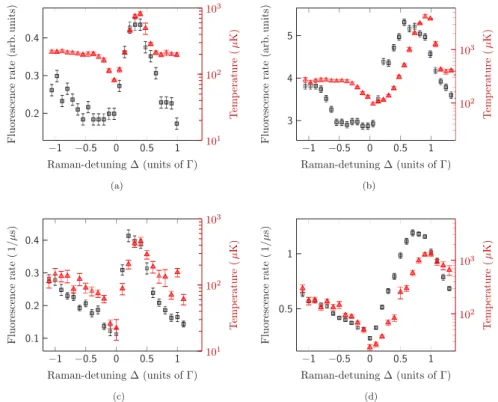
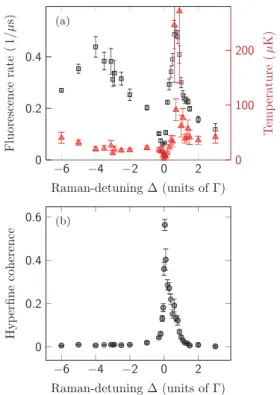
alkali atoms, relies on gray optical molasses and yields phase-space densities on the order of 10−4 for both 6Li and 40K. First of all, we will motivate the necessity of implementing
a sub-Doppler cooling stage in our setup and introduce the main performance numbers of the D1 molasses scheme. Subsequently, we will present the published articles concerning our
experimental and theoretical findings [139,140] for 40K and 6Li in single species and
dual-species operation.
Chapter4– Evaporative cooling to quantum degeneracy in magnetic and optical traps
In this chapter we present our current forced evaporative cooling approach. After briefly summarizing the main ideas behind evaporative cooling, we will describe the evaporative
1.4 Thesis outline
cooling sequence employed for40K in a plugged magnetic quadrupole trap, the transfer into an optical dipole trap and the optical evaporation to quantum degeneracy inside a crossed dipole trap. As of this writing, we achieved a degenerate spin mixture of 40K in the
spin-states F = 9/2, mF = −9/2 and
F = 9/2, mF = −7/2 , counting ∼ 1.5 × 10⁵ atoms in each
of both states, with a temperature of 64 nK and T /TF ≃ 0.17.
Chapter5– Fundamental laser source at 1342 nm
This chapter describes in detail the design of the fundamental near-infrared laser emitting up to 6.5 W at 1342 nm. We present the thermo-optical properties of the gain medium and the available pumping schemes, and show that considering these parameters is essential for the power scaling of the laser system. The laser is based on a diode end-pumped neodymium-doped yttrium orthovanadate (Nd:YVO4) gain medium pumped at a wavelength of 888 nm,
thus reducing detrimental thermal effects. The bow-tie cavity is formed by four mirrors providing a stable, Gaussian cavity eigenmode. One convex mirror is used to pass the pumping light to the laser crystal and to compensate for the thermal lens that is induced in the laser crystal during operation. Unidirectionality of the traveling-wave ring resonator is achieved by introducing a Faraday rotator and a λ/2 wave plate. Single-longitudinal-mode operation and wavelength tuning are provided using two intra-cavity etalons.
Chapter6– Second harmonic generation
This chapter will present three different frequency-doubling approaches that we realized for second-harmonic generation of the available laser radiation at 1342 nm in order to obtain light at the lithium D-line transition wavelengths next to 671 nm. The first approach consists in employing a resonant enhancement cavity containing a periodically-poled potassium titanyl phosphate (ppKTP) crystal as the nonlinear medium. This technique yielded our record output power of 5.2 W at 671 nm. Furthermore, we used this all-solid-state laser source for our measurements on the D1 sub-Doppler laser cooling of 6Li. As second doubling method,
we investigated intracavity-frequency doubling and achieved output powers of up to 2.1 W. The third approach uses a wavelength conversion module including a nonlinear waveguide structure. This device generates up to 2.4 W of second-harmonic light and is technically the simplest solution to be implemented.
Part I.
6
2
Experimental setup
In this chapter we will present the different technical parts of the experimental apperatus associated with the Fermix experiment, while concentrating on the further developments and technical upgrades of the experimental setup that has already been described at an earlier stage in [127,141,142]. The main objective of this experiment is to produce mixtures of ultracold fermions containing two different atomic species, namely6Li and 40K, that are si-multaneously cooled down to degeneracy. Important performance goals for the experimental design are in this context the production of large atom numbers and achieving short experi-mental cycling times for high experiment repetition rates. Dual-species experiments have in general a higher level of complexity than the simple combination of two single-species setups. Subtle strategies need to be realized in order to meet the prerequisites of implementing cer-tain techniques for both atomic species and to circumvent the constraints imposed by the dual-species operation. With our chosen approach we finally obtained large atom numbers for both species while reducing the complexity of the experimental setup to a minimum.
2.1. General design approach
Quantum degeneracy is reached as soon as the thermal deBroglie wavelength of the atomic wavepackages is on the same order of magnitude as the inter-particle distances. An equivalent criterion states that the phase space density (PSD) has to reach the order of unity. This means that the atoms need to be cooled down as low as possible while remaining confined in a trap that should be as tight as possible. In order to meet these goals we follow the common pathway to quantum degeneracy, which consists in a first laser cooling stage followed by a further stage of forced evaporative cooling.
The laser cooling stage is provided by two techniques, a magneto-optical trap (MOT), see Section2.6, and a gray optical molasses, presented in Chapter3. The MOT is simultaneously loaded with both atomic species via two distinct and continuous beams of pre-slowed atoms. This loading method is advantageous for several reasons. Firstly, in contrast to loading from a background vapor, the MOT can be operated in an ultra-high vacuum (UHV) environment, see Section 2.2. Secondly, the atomic beam flux and consequently the MOT loading rate are larger than for pulsed loading schemes using alkali getter dispensers [143] or employing ultraviolet light-induced absorption [144,145]. Finally, we are able to utilize distinct sources for both species employing even different pre-cooling techniques, namely a Zeeman slower for
loading phase, a three dimensional gray optical molasses is performed cooling the atoms of both species down to sub-Doppler temperatures.
The cloud is then magnetically transported to an ultra-high vacuum glass cell, see Section2.9
and [146]. The improved vacuum quality leads to a longer lifetime of the trapped atoms and therefore a higher efficiency of the evaporative cooling process can be achieved. During a first phase, evaporative cooling induced by driving radio-frequency (RF) transitions in an optically plugged magnetic quadrupole trap is performed. The use of a magnetic quadrupole trap has the advantage of offering large optical access in comparison to other magnetic traps designs. It combines a large trapping volume with tight linear confinement and thus offers the conditions for fast evaporation dynamics. The RF evaporation is performed with 40K being prepared in three different spin states, whereas 6Li in its single spin state is cooled
sympathetically.
Subsequently, the pre-cooled, dense atomic cloud is loaded into an optical dipole trap, where we continue to increase the phase space density of the atoms by means of optical evaporation and varying trap geometries, as presented in Chapter4.
2.2. Vacuum chamber
Figure2.1 shows a 3D-CAD scheme of our vacuum assembly. The design of our vacuum chamber was optimized in order to provide ultra-high vacuum and a large optical access to the region, the so-called science cell, in which the experiments with quantum degenerate atoms ultimately take place. The vacuum assembly includes two branches for the atom sources, namely the6Li Zeeman slower and the 40K 2D-MOT, the octagonal MOT-chamber
containing the6Li-40K dual-species MOT, a magnetic transport arm with a 90◦ elbow, and
the science cell, where the measurements on ultracold quantum gases are performed.
The MOT-chamber can be separated from the transport and atom source branches by the integrated all-metal vacuum valves, thus permitting independent bake-out procedures and technical interventions. Differential pumping tubes between the vapor regions of the atom sources and the MOT-chamber were installed in order to improve the vacuum quality inside the MOT-chamber considerably. A further differential pumping stage in the first arm of the transport contains a tube with inner diameter of 1 cm, allowing to increase the vacuum quality in the transport and science cell by another order of magnitude. To pump the MOT-chamber we use a 40 l/s ion pump and an active getter tape (SAES, St 707 strips) that both were installed opposite the Zeeman slower branch. The 2D-MOT and Zeeman slower branches are pumped by one and three 20 l/s ion pumps, respectively. We installed a new vacuum assembly for the transport arm consisting of CF16 vacuum parts replacing completely the setup described in [141]. In particular, the transport tubes and the science cell are now pumped by a 40 l/s ion pump, that is situated at the elbow of both magnetic transport arms, as well as by a 20 l/s ion pump and active getter tape next to the science cell. Furthermore, the tubes of the second transport arm are coated with a Titanium-Zirconium-Vanadium alloy, which is thermally activated and serves as a non-evaporable getter with high pumping speed.
2.3 Laser systems
The new vacuum assembly improved the vacuum quality, such that the 1/e-lifetime of 40K in the science cell increased from ∼25 s, measured for the old setup, to more than 100 s, and solved thus one of the main drawbacks of the former experimental apparatus.
56 cm 6Li Zeeman slower 40 K 2D-MOT Dual-species MOT Magnetic transport Science Cell
Figure 2.1: 3D-CAD model of the vacuum assembly. A Zeeman slower for6Li and a 2D-MOT for 40K serve as atom sources for the dual-species MOT contained in the octagonal MOT-chamber. A
magnetic transport transfers the cloud to the glass science cell featuring improved vacuum quality and large mechanical and optical access.
The glass science cell was designed to meet the requirements necessary for preparing and investigating samples of ultracold atoms. It was fabricated by Hellma and consists of Vycor, which is a synthetic fused silica. The inner dimensions of the cell are 23 × 23 × 10 mm3 and the glass walls have a diameter of 4 mm. A glass-metal junction connects the glass cell to the magnetic transport vacuum tube. The small size of the cell provides large mechanical and optical access, allowing the magnetic quadrupole coils or a future high-resolution objective to be placed close to the atoms. This permits an increased magnetic trap confinement and hence a better evaporative cooling efficiency. Furthermore, high-resolution imaging relying on an objective with large numerical aperture, becomes possible.
2.3. Laser systems
The laser systems that we realized provide light for manipulating and probing 6Li and 40K
atoms. The laser light is applied to slow atoms down and to trap them, but also their internal degrees of freedom like the spin state can be manipulated. In this context, usually the D2line
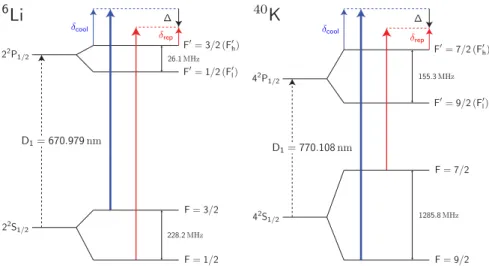
MHz F’= 1/ 2 (2.8) F’= 3/ 2 (1.1) F’= 5/ 2 (-1.7) F= 3/ 2 (76.1) F= 1/ 2 (-152.1) F’= 3/ 2 (8.7) F’= 1/ 2 (-17.4) 26.1 MHz 228.2 MHz 155.3 MHz 1285.8 MHz MHz F’= 1/ 2 (2.8) F’= 3/ 2 (1.1) F’= 3/ 2(0.7) F’= 5/ 2 (-1.7) F= 3/ 2 (76.1) F= 1/ 2 (-152.1) F’= 3/ 2(-38.0) Im a g in g D2 C ro ss o ve r F’= 5/ 2(-446) Cooling Repumping M O T Z ee m a n
Figure 2.2: (left) Level diagram for the D2and D1lines of6Li including the hyperfine structure. The
D-lines of lithium lie in the visible red spectral region. Note the small hyperfine splitting of the 22P 3/2
manifold of6Li. (right) D
2laser transition scheme for6Li. Solid arrows indicate the frequencies applied
for the MOT operation. Dashed arrows illustrate the detunings from the corresponding transitions. The diode laser is locked to the saturated absorption crossover signal 22S
1/2( F = 1/2 , F = 3/2 ) → 22P 3/2 of6Li. F’= 7/ 2 (86.3) F’= 9/ 2 (-69.0) MHz F’= 5/ 2 (54.5) F’= 7/ 2 (30.6) F’= 9/ 2 (-2.3) F= 7/ 2 (714.3) F= 9/ 2 (-571.5) F’= 11/ 2 (-45.7) 155.3 MHz 1285.8 MHz MHz F’= 5/ 2 (54.5) F’= 7/ 2 (30.6) F’= 3/ 2(-78.2) F’= 9/ 2 (-2.3) F= 7/ 2 (714.3) F= 9/ 2 (-571.5) F’= 3/ 2(0) Im a g in g D2 C ro ss o ve r 3 9K F’= 11/ 2 (-45.7) Cooling Repumping M O T 2 D -M O T
Figure 2.3: (left) Level diagram for the D2 and D1 lines of40K including the hyperfine structure.
The D-lines of potassium lie in the visible near-infrared spectral region. Note the inverted hyperfine structure. (right) D2laser transition scheme for40K. Solid arrows indicate the frequencies applied for
the MOT operation. Dashed arrows illustrate the detunings from the corresponding transitions. The diode laser is locked to the saturated absorption crossover signal 42S
1/2 (|F = 1i , |F = 2i) → 42P3/2
2.3 Laser systems of each alkaline species is addressed. In our experiment we also exploit the D1 line transition,
namely for sub-Doppler cooling, see Chapter3, and for spin polarization of6Li, see Section2.8.
Figure2.2(left) and Figure2.3(left) show the level diagrams corresponding to both D-line transitions of 6Li and 40K, respectively. Since the transition wavelengths of both species differ by ∼ 100 nm, distinct laser systems and optical setups are required. Additionally, several beams with different frequency shifts and intensities are required, corresponding to the different applications for each atomic species.
2.3.1. D2 laser system
Figure2.2(right) and Figure2.3(right) illustrate the used laser frequency shifts and their application close to the D2 lines of 6Li and 40K, respectively. The D2 laser systems for
Figure 2.4: Laser systems for addressing the D2line tranistions of6Li and40K. The frequencies and
amplitudes for the different beams are controlled by AOMs in single pass (sp) or double pass (dp) configuration. The EOMs modulate the phase of the spectroscopy beam for frequency stabilization of the diode lasers. Single-mode polarization maintaining fibers (FI) clean the beams spatially. The indicated AOM frequencies correspond to the beam frequencies required for the MOT operation, see Figures2.2and2.3.
6Li and 40K are designed in an analogous manner. Figure2.4 presents a simplified scheme
of the realized laser systems. We constructed them on individual optical tables for each atomic species. Low power diode lasers (DL), namely a DL Pro laser from Toptica for
The laser frequencies are stabilized by means of saturated absorption spectroscopy and lock circuits acting on the tilt angle of the diode gratings. The master laser beams are amplified by tapered amplifier (TA) chips (Toptica TA-0675-0500-1 and Eagleyard EYP-TPA-0765-01500-3006-CMT03-0000) which are installed in home made mounts [141]. Subsequently, they are coupled into single-mode polarization maintaining optical fibers for the purpose of mode cleaning. The fiber output powers are split up by a combination of λ/2 waveplates and polarizing beam splitters into the different laser beams required for the experiment. Acousto-optical modulators (AOMs) are employed to shift the frequencies and to control the intensities of these beams. The cooling and repumping beams are superimposed and injected into the TAs with orthogonal polarization. As a result the TAs deliver linearly polarized bichromatic output beams, containing both the cooling and repumping frequencies. However, the injection of a TA with two different frequencies creates sidebands due to non-linearities [147]. Fortunately, the power losses are in our case negligible, being on the order of ∼ 5% for 6Li and ∼ 0.2% for 40K. Furthermore, these sidebands do not address undesirable transitions. Yet there is one exception concerning one of the sidebands of the bichromatic Zeeman slower beam. Since this sideband would be near-resonant with the6Li atoms trapped
in the MOT, we solely amplify the Zeeman cooling beam and combine it with the repumping beam only after the Zeeman TA. All generated laser beams are finally injected into single-mode polarization maintaining fibers leading to the main experimental table.
2.3.2. D1 laser system
Figure2.5presents the level schemes corresponding to the D1 line transitions of6Li and40K,
together with the molasses beams driving these transitions. The AOMs of the D2 systems
cannot be employed for shifting to the D1 wavelengths, since they operate only in the range
of hundreds of MHz, see Figure2.4. However, the frequencies of the D1 and D2 lines for 6Li and 40K, are separated by ∼ 10 GHz and ∼ 11 THz, respectively, see Figure2.2 and2.3.
Therefore two additional laser systems were required for the implementation of the D1
sub-Doppler cooling scheme in our experimental setup.
The D1 laser systems for 6Li and 40K are presented in Figure2.6. For both setups the
frequency-lock point can be shifted by tuning the double-pass AOM in the path of the satu-rated absorption spectroscopy.
For the40K D
1 system, the repumping frequency is generated by an electro-optic modulator
(EOM). In general, a EOM creates two sidebands separated from the original carrier fre-quency by the modulation frefre-quency of the EOM. In our case the sideband with the lower frequency constitutes the repumping component. The power loss due to the unused second sideband can be neglected, since only low modulation amplitudes are required for the D1
cooling scheme operating with relatively low repumping power. Furthermore, this second sideband does not address the atoms by exciting unwanted transitions.
The source for the6Li D1molasses light was, at least for for the experimental studies presented
2.3 Laser systems MHz F=3/2 (76.1) F=1/2 (-152.1) F’=3/2(-38.0) Molasses F’=3/2 (8.7) F’=1/2 (-17.4) Cooling Repumping D1 Crossover F’=3/2(0) D1 Crossover 39K MHz F=7/2 (714.3) F=9/2 (-571.5) F’=3/2(0) F’=7/2 (86.3) F’=9/2 (-69.0) Cooling Repumping Molasses F’=3/2(-47.1)
Figure 2.5: Level schemes corresponding to the D1 line transitions of 6Li and 40K, as presented
in [148]. Solid and dashed arrows illustrate the frequencies and detunings required for the sub-Doppler cooling, respectively. The lasers are frequency locked to the saturated absorption crossover signals 22S 1/2 ( F = 1/2 , F = 3/2 ) → 22P 1/2 of6Li and 42S1/2 (|F = 1i , |F = 2i) → 42P1/2 F′ = 2 of 39K. The D
1 sub-Doppler cooling is presented in Chapter3.
6
Li
40K
DL T A AOM –256 MH z dp EOM Spectroscopy +22 0 MH z sp EOM 1285.8 MH z AOM D1Molasses SSL AOM + 100 MH z dp EOM Spectroscopy +10 0 MH z sp +114. 1 MH z dp AOM D1Molasses AOM Repumper Cooling Cooling Cooling +Repumper DL T A Ref. D2 EOM 228.2 MHz AOM D1Molasses –109.7 MHz sp AOM +100 MHz sp Optical PumpingFigure 2.6: Laser systems of the D1 molasses cooling schemes for 6Li and 40K. The frequencies
and amplitudes of the various beams are controlled by AOMs in single pass (sp) or double pass (dp) configuration. EOMs creates the repumping frequency in the40K setup and in the diode laser (DL)6Li
setup. The EOMs in the spectroscopy phase modulate a sample of the beam for the frequency-lock of the lasers. Single mode polarization maintaining fibers transmit the beams to the main experimental table. The indicated AOM frequencies correspond to the beam frequencies required for the molasses cooling, see Figure2.5.
presented in PartII. Its high power output of 5.2 W allowed us to employ a flexible setup for the characterization of the D1molasses. In particular, we could scan the power and frequency
of the repumping component independently from the cooling component.
To operate the6Li molasses on a daily basis, it is however sufficient to use a 500 mW master oscillator power amplifier (MOPA) setup based on semiconductor laser sources. It consists of a master diode and a tapered amplifier (TA). As for40K, the repumping frequency component is generated with an EOM. Reasonable atom transfer efficiencies from the compressed MOT (CMOT) to the D1 molasses are achieved with the available power of PMOPA,fiber∼ 150mW
after the optical fiber, as long as an appropriately small beam diameter of the molasses beams is chosen for reaching the required intensities, see Chapter3.
2.4.
6Li Zeeman slower
The atom source of the 6Li-MOT is a Zeeman slower [149,150]. It includes an oven, pro-ducing a thermal beam of 6Li atoms, an assembly of magnetic field coils and a laser beam
counter-propagating the atomic beam. The counter-propagating laser beam need to be kept close to the atomic resonance along the entire length of the slower in order to provide a con-tinuous deceleration. The changing Doppler shift of the decelerating atoms has therefore to be compensated by a corresponding Zeeman shift, which is induced by the spatially varying magnetic field of the coil assembly. A sign-changing field Zeeman slower was implemented
MOT position calculation measurement –200 0 200 400 600 Magnetic field (G) 0 20 40 60 80 Position (cm)
Figure 2.7: Coil assembly of the6Li Zeeman slower (top) and generated axial magnetic field profile
(bottom), as presented in [141] and illustrated in [148]. The thermal atom beam produced by the
6Li-oven enters the coil assembly at position 0, and a fraction of the atoms is decelerated and finally
captured in the 6Li-MOT, which is located at position 71.4 cm. A compensation coil, called
anti-Zeeman coil, is located on the opposite side of the MOT chamber (at position 84.1 cm) ensuring that the magnetic field at the position of the MOT is cancelled. The whole coil assembly extends over 55 cm.
because of certain advantages in comparison to a positive-field Zeeman slower. In particular, the applied laser beam is non-resonant with the 6Li-MOT atoms, the magnetic field
2.540K 2D-MOT access. However, a small amount of repumping light is then needed due to the region with changing magnetic field sign.
At this point we only review the most crucial parameters and performance values of our
6Li Zeeman slower. A detailed characterization was presented in [141]. Figure2.7 illustrates
the coil assembly and the generated axial magnetic field profile of the Zeeman slower. The
6Li-MOT is situated 71.4 cm away from the entry point of the slower. The compensation
coil placed at 84.1 cm is supposed to cancel the magnetic field at the MOT position. The optimal parameters of the Zeeman slower are summarized in Table2.1. With the oven heated to ∼ 500◦C, we obtain a6Li-MOT capture rate of ∼ 1.2 × 10⁹atoms/s.
6Li Zeeman slower Pfiber [mW] 50 ∆ωslow [Γ] -75 ∆ωrep [Γ] -75 Irep/Islow 1/8 Bmax [G] 570
Table 2.1. – Optimal values for the 6Li Zeeman slower parameters. ∆ω
slow and ∆ωrep
correspond to the detunings of the slowing and repumping beams, respectively. The natural linewidth of6Li is Γ/(2π) = 5.87 MHz. An oven temperature of ∼ 500◦C leads to a6Li-MOT
capture rate of ∼ 1.2 × 10⁹atoms/s.
2.5.
40K 2D-MOT
A two-dimensional magneto-optical trap (2D-MOT) serves as atom source for our 40K
3D-MOT. A 2D-MOT is a high flux cold atom source, that was realized for rubidium [151–
153], potassium [154], cesium [155] and lithium [156]. Even though the atom fluxes generated by Zeeman slowers are generally higher, they are also sources of magnetic fields and hot atom jets in the MOT region. In comparison, 2D-MOTs have a more compact design and can be operated at lower temperatures, being thus more economic with regard to sample consumption. This is an important point for fermionic potassium, since the 4% enriched40K samples that we use are quite expensive. In addition, the 2D-MOT separates the40K isotope from the more abundant39K, since only the40K atoms are cooled and form the atomic beam,
thus reducing the thermal background considerably.
2.5.1. Principle of a 2D-MOT
A 2D-MOT captures atoms from a background vapor, confines and cools them in the transver-sal directions, and out-couples a pre-cooled atomic beam in the axial direction passing through a differential pumping tube. At the same time this tube serves as a velocity filter, resulting in a transversally and longitudinally cold atomic beam arriving in the 3D-MOT chamber. Additional axial molasses cooling significantly increases the output flux of a 2D-MOT [151], since the atoms are hold in the transverse cooling region for a longer time. In our old setup we
employed two independent, counter propagating, axial molasses beams, labelled axial+ and axial- in Figure2.8, injected by means of a 45◦-angled mirror inside the vacuum chamber. For
the upgraded setup we added an independent pushing beam, out-coupling the atomic beam more efficiently through the small hole in the center of the 45◦-angled mirror.
2.5.2. Experimental setup
The central part of the 2D-MOT vacuum assembly consists of a glass cell with dimensions 110 × 55 × 55 mm3 illustrated in Figure2.8. A polished stainless steel 45◦-angled mirror is
attached to the differential pumping tube inside the vacuum chamber. It has a reflectivity of 50% and is chemically inert to potassium exposure. The distance between the centers of the 2D- and 3D-MOT is 55 cm and the pressure ratio between the corresponding vacuum regions is ∼ 103.
Pushing
Axial+
Transversal
Differential
pumping tube
Mirror hole
110mmAxial-Figure 2.8: Scheme of the 40K 2D-MOT and illustration of the light beams. The elliptic beams
transversally cool the atoms. The alignment of the axial molasses beam pair is provided by a 45◦
-angled mirror placed inside the vacuum chamber. The pushing beam axially out-couples an atomic beam through the mirror hole. The optimal beam parameters are given in Table2.2.
The potassium sample, which is enriched to 4% of 40K, is situated at a cold point next to
the glass-metal junction of the glass cell, see page21. The cold point is created by a water cooled plastic tube that was winded around this point, see Figure2.9. The temperature of the cold point is regulated by a water chiller and can be varied in order to set an appropriate potassium pressure in the glass cell. Usually we work at a cold point water temperature of ∼ 40◦C, corresponding to a total potassium pressure of ∼ 2 × 10⁻⁷mbar and a partial 40K
pressure of ∼ 1 × 10⁻⁸mbar.
The bichromatic laser beam used for the 2D-MOT has a total power of Pfiber = 350 mW at
2.540K 2D-MOT
F = 9/2 → F′ = 11/2 transition whereas the frequency of the repumper component is
red-detuned by ∼ 2.5Γ from the F = 7/2 → F′ = 9/2 transition, see Figure 2.3. This beam is
split up into five beams, two transverse and three axial 2D-MOT beams, see Figure2.8. The beams are circularly polarized and expanded by spherical and/or cylindrical telescopes. The transverse beams are expanded to an elliptical shape with 1/e2-diameters of 27.5 mm and 55 mm. They are retro-reflected by right-angled prisms, such preserving their polarization helicity. The axial cooling beams have a round shape with a 1/e2-diameter of 27.5 mm,
whereas the 1/e2-diameter of the pushing beam is 3.8 mm. 87% of the fiber output power is utilized for the transverse cooling beams, 11% for the axial cooling beams and 2% for the pushing beam. A racetrack coil geometry is employed to create a two dimensional quadrupole magnetic field with cylindrical symmetry around the horizontal 2D-MOT axis where the magnetic field is zero. The optimum for the magnetic field gradients was found to be ∂xB =
∂yB = 11 G/cm. A summary of the optimal values for the essential 2D-MOT parameters is given in Table2.2. Using these parameters yields a 40K-MOT loading rate of ∼ 3 × 10⁸atoms/s. 40K 2D-MOT Pfiber [mW] 350 ∆ωcool [Γ] -3.5 ∆ωrep [Γ] -2.5 Irep/Icool 0.5 Itrans+/Itrans− 2.4 Ppush [mW] 8.6 ∂xB, ∂yB [G/cm] 11
K vapor Pressure [mbar] 2.3 × 10⁻⁷
Table 2.2. –Optimal values for the parameters of the40K 2D-MOT, resulting in a40K MOT loading rate of 3 × 10⁸atoms/s. The definitions of the symbols are given in the text. The natural linewidth of40K is Γ/(2π) = 6.04 MHz.
2.5.3. Characterization of the 2D-MOT upgrade
The performance of the 2D-MOT can be characterised by measuring the loading rate of the
40K-MOT as a function of the 2D-MOT parameters that are at our disposal. The impact
of several parameters, as for example the light intensity ratios, frequency detunings and the vapor pressure in the 2D-MOT cell, have already been studied in [141]. In the following we concentrate on the improvements that have been made on the 2D-MOT setup, namely the new approach to control the pressure in the 2D-MOT glass cell and the implementation of an additional pushing beam whose intensity can be controlled independently.
Cold point
Figure2.9 illustrates the vacuum assembly of the 2D-MOT. In the old setup the potassium sample was situated in a CF16 bellow 20 cm away from the glass cell. In this bellow a small
ampoule with the isotopically enriched potassium sample had been broken under vacuum. Overheating of this source region caused the potassium sample to migrate to other regions of the vacuum assembly and depleted the old source completely. In order keep the ability to control the potassium vapor pressure, a cold point was created near the glass cell to serve as a new accumulation region for the sample. A water cooled plastic tube is encompassing the glass tube of the 2D-MOT cell, see Figure2.8. A chiller regulates the water temperature which allows to control the cold point temperature. In the current setup the old source region is heated to ∼ 120◦C, the glass cell to ∼ 80◦C and all other parts, except for the cold point,
to at least 100◦C. During operation of the 2D-MOT we set the cold point water temperature
to 40◦C. Otherwise, it is cooled down to 12◦C in order to re-accumulate potassium crystals.
Cold point (new source)
110 mm
Sample bellow (old source)
Figure 2.9: The 40K 2D-MOT vacuum assembly. The cold point serves as new potassium source, since the bellow originally containing the sample became depleted. The old source region is heated to ∼ 120◦C, the glass cell to ∼ 80◦C and all intermediate parts to at least 100◦C to establish a
temperature gradient. The cold point water temperature can be regulated by means of a chiller in order to control the 2D-MOT pressure, see Figure2.10.
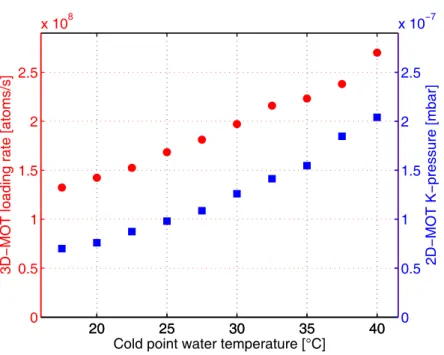
The actual vapor pressure of potassium can be determined by a measurement of the resonance absorption profile of a low intensity probe beam that is passed through the 2D-MOT cell over a path length of 10.5 cm, see Appendix A of [141] for a detailed description. Figure2.10present the dependence of the 3D-MOT loading rate and the 2D-MOT pressure on the cold point water temperature. A cold point water temperature of 40◦C results in to a total potassium
pressure of ∼ 2 × 10⁻⁷mbar, corresponding to a partial pressure of ∼ 1 × 10⁻⁸mbar for40K.
Additional pushing beam
In order to increase the flux of the 2D-MOT an independent pushing beam was added whose 1/e2-diameter of 3.8 mm approximately fits the size of the mirror hole, see Figure2.8. This additional beam offers a further parameter for optimization of the atomic beam out-coupling
2.540K 2D-MOT 20 25 30 35 40 0 0.5 1 1.5 2 2.5 x 10⁸
Cold point water temperature [°C]
3D
−
MOT loading rate [atoms/s]
20 25 30 35 40 0 0.5 1 1.5 2 2.5 x 10⁻⁷ 2D − MOT K − pressure [mbar]
Figure 2.10: 40K 3D-MOT loading rate (red circles) and total potassium 2D-MOT pressure (blue
squares) as a functions of the cold point water temperature. The pressure is deduced from the absorption of a weak probe beam which is resonant with the D2transition of39K and passes through
the 2D-MOT cell.
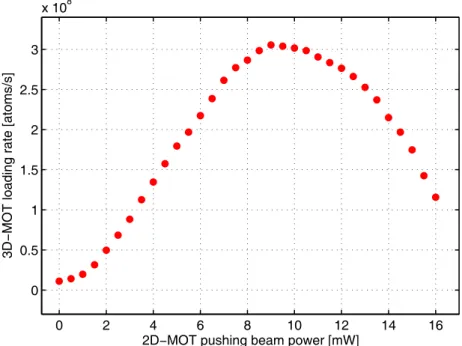
and the related axial 2D-MOT molasses. As a consequence, the power of the axial molasses beams could be reduced from 90mW to 40mW, thus allowing for higher transversal beam powers. In comparison to the old setup, meaning the optimized 2D-MOT setup without independent pushing beam, we were able to increase the flux of the 2D-MOT measured via the 3D-MOT loading rate by a factor of two. The best performance was achieved using a circularly polarized pushing beam and a longitudinal molasses in σ+–σ− configuration,
whereas the old setup employed a lin⊥lin configuration. Figure2.11presents the dependence of the 3D-MOT loading rate on the pushing beam power. For this measurement, the powers of the other 2D-MOT beams were kept constant. The maximal loading rate was found to be ∼ 3 × 10⁸atoms/s for Ppush= 9 mW.
0 2 4 6 8 10 12 14 16 0 0.5 1 1.5 2 2.5 3 x 10⁸
2D−MOT pushing beam power [mW]
3D
−
MOT loading rate [atoms/s]
Figure 2.11: 3D-MOT loading rate as a function of the 2D-MOT pushing beam power. The maximal loading rate of ∼ 3 × 10⁸atoms/s was found for P
push= 9 mW.
2.6.
6Li-
40K dual-species MOT
This section deals with the technical implementation and performance of the 6Li-40K dual-species MOT. A magneto-optical trap relies on the combination of a magnetic quadrupole field with three orthogonal pairs of counter-propagating red-detuned laser beams leading to cooling and magneto-optical confinement of atoms around the magnetic field zero [150]. For both 6Li and 40K, bichromatic MOT beams with a cooling and repumping frequency
component are needed. The repumping component is in general required for all alkali atoms and ensures that the atoms are kept in the nearly cycling cooling transition. In particular
6Li atoms very likely leave the cooling transition due to the very narrow hyperfine structure
of the excited-state. Thus the relatively large repumping component even contributes to the cooling of 6Li. For a dual-species MOT it is crucial to minimize light-induced interspecies collisions, since they lead to atom losses. We were able to limit these losses to less than 10%, by employing low magnetic field gradients and relatively low repumping light intensities for both atomic species, as detailed in [127].
2.6.1. Experimental setup
The 6Li-40K dual-species MOT requires a bichromatic laser beams for each species. Both beams are transferred onto the main experimental table via optical fibers. The optical setup, superimposing and expanding the MOT beams, is presented in Section2.7.2and Figure2.12. We note that the MOT beams have a 1/e2-diameter of 22 mm.


![Figure 2.7: Coil assembly of the 6 Li Zeeman slower (top) and generated axial magnetic field profile (bottom), as presented in [141] and illustrated in [148]](https://thumb-eu.123doks.com/thumbv2/123doknet/14615906.733077/35.892.221.660.644.869/figure-assembly-zeeman-generated-magnetic-profile-presented-illustrated.webp)
![Figure 2.13: Technical drawing of the quadrupole coils which also serve as Feshbach coils (from [148]).](https://thumb-eu.123doks.com/thumbv2/123doknet/14615906.733077/46.892.229.712.139.401/figure-technical-drawing-quadrupole-coils-serve-feshbach-coils.webp)