HAL Id: hal-01633717
https://hal-amu.archives-ouvertes.fr/hal-01633717
Submitted on 13 Nov 2017
HAL is a multi-disciplinary open access archive for the deposit and dissemination of sci-entific research documents, whether they are pub-lished or not. The documents may come from teaching and research institutions in France or abroad, or from public or private research centers.
L’archive ouverte pluridisciplinaire HAL, est destinée au dépôt et à la diffusion de documents scientifiques de niveau recherche, publiés ou non, émanant des établissements d’enseignement et de recherche français ou étrangers, des laboratoires publics ou privés.
A New Active Organic Component for Flexible
Ammonia Gas Sensors
T. Fiorido, Sandrine Bernardini, Marc Bendahan, Khalifa Aguir, H. Brisset,
C. Videlot-Ackermann, J. Ackermann
To cite this version:
T. Fiorido, Sandrine Bernardini, Marc Bendahan, Khalifa Aguir, H. Brisset, et al.. A New Active Organic Component for Flexible Ammonia Gas Sensors. Procedia Engineering, Elsevier, 2011, 25, pp.1069-1072. �10.1016/j.proeng.2011.12.263�. �hal-01633717�
Procedia Engineering 25 (2011) 1069 – 1072
1877-7058 © 2011 Published by Elsevier Ltd. doi:10.1016/j.proeng.2011.12.263
* Corresponding author.
E-mail address: [email protected]; [email protected]
Proc. Eurosensors XXV, September 4-7, 2011, Athens, Greece
A New Active Organic Component for Flexible Ammonia Gas
Sensors
T.Fiorido
a,b, S.Bernardini*
a,b, M.Bendahan*
a,b, K.Aguir
a,b, H.Brisset
c,
C.Videlot-Ackermann
a, c, J.Ackermann
a,caAix-Marseille Université, Marseille, France
bCNRS, IM2NP (UMR 6242), Campus de St Jérôme, service 152, Marseille, France
cCINaM (Centre Interdisciplinaire de Nanoscience de Marseille) – UPR 3118 CNRS – Campus de Luminy, Case 913, Marseille, France
Abstract
The objective of this study was to realize flexible gas sensors using low cost solution processing such as drop casting. As active sensor material, a p-type organic semiconductor, Dѽ-Z-hexyl-distyrylbithiophene (DH-DS2T), was used. DS2T based transistors exhibit high mobility together with a good air stability. As a chemical compound, DH-DS2T presents a good solubility in common organic solvent, which means thin films could also processed by solution fabrication. Sensor responses were studied by measuring the current through the semiconductor organic film as an ammonia gas concentration function (NH3: 25, 50, and 100 ppm). We demonstrate here that DH-DS2T has efficient
sensor responses and leads to an efficient fully solution processed gas sensor on flexible substrate.
© 2011 Published by Elsevier Ltd.
Keywords : flexible gas sensor, oligomers, organic semiconductors, ammonia detection.
1. Introduction
Flexible electronic structures with the potential to bend, expand and manipulate electronic devices are wide-open and rapidly developing field of academic and industrial research. Low-cost, ruggedness, light weight and ease of manufacturability are just some of the important advantages over their conventional rigid-substrate counterparts. Flexible electronics development began with the first flexible solar cell arrays on a plastic substrate in 1967 to provide flexibility [1, 2]. Afterwards, flexible electronics was driven by solar cell research, then by other applications as organic light emitting diodes, thin film transistors, photovoltaic cells and sensors [3, 4, 5]. Nowadays, sensor fabrication on flexible substrates, including robustness and low cost, is a research field of increasing industry demands [6]. Such novel sensor generation is aimed to open new applications in environmental monitoring, or food and medical industry such as detection directly on food surface or as flexible plasters on the skin [7]. In order to produce flexible low cost sensors, solution processing, soluble
Open access under CC BY-NC-ND license. Open access under CC BY-NC-ND license.
1070 T. Fiorido et al. / Procedia Engineering 25 (2011) 1069 – 1072
electronic materials and plastic substrate have to be combined to drastically lower the device fabrication cost, compared to conventional silicon processing [8, 9]. Fabrication of these devices on flexible substrates, particularly on plastic, brings with it new challenges. One way is to use soluble small-molecules, so called oligomers, which were developed as semiconductors providing higher electronic performances than polymers. Such oligomers can be dissolved in common organic solvents and be processed from liquid solution at room temperature. Based on previous work [10], we proposed flexible sensor process based on distyrylbithiophene oligomeres. Oligomer layers used are discussed in terms of their properties, as well as their sensitivity towards the detection of NH3.
2. Experiment details
Several series of simple structurally and readily available oligothiophene derivatives end-capped with styryl units, DSnTs (n = 2-4) were synthesised. Due to their low solubility in common organic solvents, we applied substitution of hexyl chains on Dѽ-Z-end positions of DS2T (Figure 1a) as simple approach to increase their solubility (Dѽ-Z-hexyl-distyrylbithiophene: DH-DS2T) [11]. Thus, DH-DS2T oligomers can be processed from liquid solution at room temperature. In order to realize fully solution-processed gas sensor, DH-DS2T films were realized by solution drop casting on a polymer flexible substrate bearing printing metal electrodes. Polyethylene terephthalate (PET) sheets were used as flexible substrate. We use a solution containing DH-DS2T in chlorobenzene at 1,5u10-3 mol/l. Finally, DH-DS2T was drop casted on a PET substrate where
metallic ink, purchased from CABOT was prior printed by inkjet printing methods to performed Silver (Ag) interdigitated electrode arrays (Figure 1b). Then, gas sensing experiments were performed by measuring the sensor electrical resistance upon exposing to four controlled gas concentrations (ammonia NH3, ozone O3,
nitrogen dioxide NO2, carbon monoxide CO). At room temperature, sensors were exposed to the desired
ammonia concentrations which are obtained by mixing a standard gas known volume with dry air.
(a) (b)
Figure 1: (a) Molecular structures of distyryl-bithiophene (DS2T) and D,Z-hexyl-distyryl-bithiophene (DH-DS2T). (b) Optical microscopy images of DH-DS2T based thin films deposited by drop-casting on Si/SiO2 substrates.
3. Results and discussion
First, sensors were exposed at room temperature to four gases separately (NH3, O3, NO2, CO) at the same
concentration level. DH-DS2T sensors showed a visible response only to NH3, suggesting its sensitivity and
potential application in monitoring NH3.Therefore, our discussion will concern sensor response to ammonia
which it is one of the most important industrial chemicals, used as precursor of various nitrogen compounds, including fertilizers, and as refrigerant gas. Sensors were exposed during two minutes to NH3 concentrations
between 25 and 100 ppm at room temperature. Figure 2 represents the sensor response over time of the DH-DS2T device at three ammonia concentrations [11]. DH-DH-DS2T is a p-type semiconductor and the stake in touch with electron gas donors (NH3) is increasing the resistance due to the holes recombination with electrons gas
relatively fast decrease when cutting off NH3. The changes upon gas exposure are reversible and proportional
to ammonia concentrations. The normalized response Rgas/Rair defined as the sensor resistance ratio at various
ammonia concentrations (Rgas) to that in synthetic dry air (Rair) at 25 ppm shows value of 3.2 which indicate
the high potential of DH-DS2T sensors for gas detection below this threshold. Indeed, as a consequence of its large toxicity, the acceptable ammonia concentration at the working place is very low, only 25 ppm for 8 h exposure. 0 5E+ 10 1E+ 11 1,5E+ 11 2E+ 11 2,5E+ 11 3E+ 11 3,5E+ 11 0 20 40 60 80 100 120 140 160 180 time (m in) resi stan ce ( O h m ) 50 ppm : Rg az/Rair= 4,3 25ppm : Rg az/Rai r= 3,2 100ppm : Rga z/Rair= 6,3 40 min 3.5E+11 3.0E+11 2.5E+11 2.0E+11 1.5E+11 1.0E+11 5.0E+10 0 NH3 OFF 6.3 4.3 3.2 NH3 ON
Figure 2: Ammonia sensor response of a sensor based on DH-DS2T drop casted layer on flexible PET substrate (NH3 exposition time = 2
min). Rgaz/Rair : normalised response defined as the sensor resistance ratio (Rgas) to that in synthetic dry air (Rair).
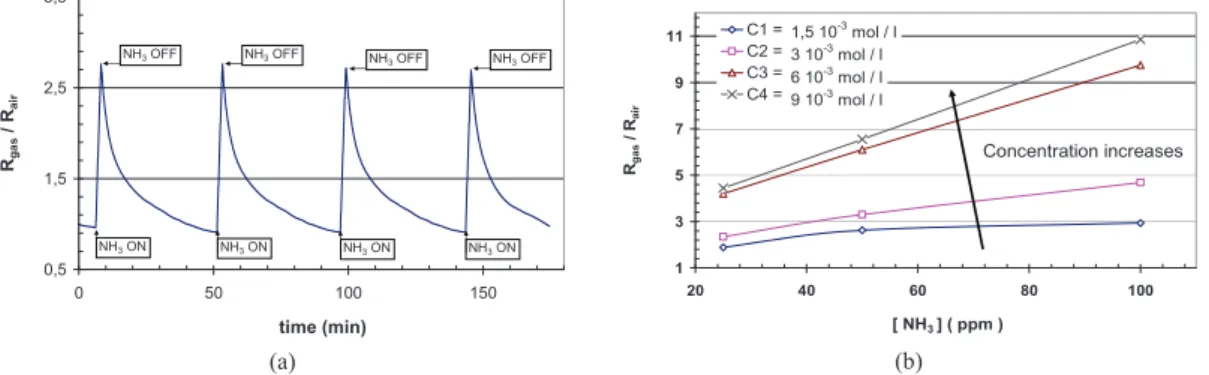
A relevant ammonia chemical gas sensor must therefore detect ammonia concentrations below these thresholds. Moreover, four gas cycles produced similar responses (Figure 3a). Some results have also indicated that the solution concentration influences the sensitivity which is calculated from the following expression:
S = Rgas / Rair (1)
where Rgas is the sensor resistance during vapor exposure, and Rair the initial resistance. To check the mass
concentration effect on the sensor response, various DH-DS2T solutions were exposed to ammonia. The sensitivity variations as function of four mass concentrations under three NH3 concentrations are presented on
figure 3b. This could be explaining by better sensitive layer conduction due to the higher oligomer crystal numbers. Therefore, in dilute DH-DS2T solution, less charge remained on the previously grown layer, and so less NH3 molecule is adsorbed on the DH-DS2T layer, causing a lower sensitivity.
0,5 1,5 2,5 3,5 0 50 100 150 time (min) Rga s / R ai r NH3 ON NH3 ON NH3 ON NH3 ON
NH3 OFF NH3 OFF NH3 OFF NH3 OFF
(a) 1 3 5 7 9 11 20 40 60 80 100 [ NH3] ( ppm ) Rga s / R ai r C1 = C2 = C3 = C4 = Concentration increases 1,5 10-3 mol / l 3 10-3 mol / l 6 10-3 mol / l 9 10-3 mol / l (b)
Figure 3: (a) Repetitive sensor response unnder100 ppm NH3. (b) Sensitivity Evolution according to four concentrations of DH-DS2T
1072 T. Fiorido et al. / Procedia Engineering 25 (2011) 1069 – 1072 4. Conclusion
A simple and effective method to fabricate flexible gas sensors based on DH-DS2T for ammonia gas detection has been demonstrated. These sensors are simply realized, fairly cheap and operate at room temperature with very low power consumption. This work reports electrical resistance measurements for sensors fabricated from an organic compound and tested at room temperature against ammonia at several concentration level. The sensors, obtained by drop coating on interdigitated electrodes, exhibited potential applications for sensitivity ammonia measurements.
Acknowledgements
The authors would like to thank FSE (Fonds Social Européen), REGION PACA CapGOSS project for their financial supports, S. Sanaur (CMP-Gardanne), Y. Didane (CINaM-Marseille), P. Raynal (CINaM-Marseille) and A. Combes (IM2NP-Marseille) for their contributions.
References
[1] R..L Crabb and F.C. Treble, Thin silicon solar cells for large flexible arrays. Nature, 213, (1967), p. 1223–1224
[2] K.A. Ray, Flexible solar cell arrays for increased space power. IEEE Trans Aerosp Electron Syst v AES-3, (1967), p. 107–115 [3] K. Soo Yook, S. Ok Jeon, C. Woog Joo, J. Yeob Lee, Fabrication of high efficiency and color stable white organic light-emiting diodes
by an alignment free mask patterning, Oganic Electronics 10 (2009), p. 384-387
[4] Y. Chen, I. Shih, Fabrication of vertical channel top contact organic thin film transistors, Organic Electronics 8 (2007) p. 655-661. [5] X. Ju, W. Feng, X. Zhang, V. Kittichungchit, T. Hori, H. Moritou, Fabrication of organic photovoltaic cells with double-layer ZnO
structure, Solar energy materials & solar cells 93 (2009), p. 1562-1567
[6] W.S. Wong and A. Salleo (eds.), Vol. 11, XVIII, 462 p. 245 illus., Hardcover, 2009, ISBN: 978-0-387-74362-2
[7] T. Someya, Y. Kato, T. Sekitani, S. Iba, Y. Noguchi, Y. Murase, Conformable, flexible, large-area networks of pressure and thermalsensors with organic transistor active matrixes, Proceedings of the National Academy of Science United States of America 102 (2005) 12321.
[8] U. Lange and V.M. Mirsky, Analytica Chimica Acta 687 (2011), p. 105-113
[9] R. W. C. Li, L. Ventura, J. Gruber, Y. Kawano, L. R. F. Carvalho, A selective conductive polymer-based sensor for volatile halogenated organic compounds (VHOC), Sensors and Actuators B 131 (2008),p. 646-651
[10] T. Fiorido, M. Bendahan, K. Aguir, S. Bernardini, C. Martini, H. Brisset, All solution processed flexible ammonia gas and light sensors based on D,Z-hexyl-distyrylbithiophene films Sensors and Actuators B 151 (2010), p. 77-82.
[11] Y. Didane, A. K. Diallo, T. Fiorido, A. Suzuki, N. Yoshimoto, S. Bernardini, Investigation of solution-processed organic thin film transistors based on ˞,˶-hexyl-distyryl-bithiophene (DH-DS2T): growth and transport properties, Journal of Optoelectronices and Advanced Materials, 12, 7, (2010) p. 1546 - 1551.