HAL Id: hal-00154373
https://hal.archives-ouvertes.fr/hal-00154373
Submitted on 13 Jun 2007HAL is a multi-disciplinary open access archive for the deposit and dissemination of sci-entific research documents, whether they are pub-lished or not. The documents may come from teaching and research institutions in France or abroad, or from public or private research centers.
L’archive ouverte pluridisciplinaire HAL, est destinée au dépôt et à la diffusion de documents scientifiques de niveau recherche, publiés ou non, émanant des établissements d’enseignement et de recherche français ou étrangers, des laboratoires publics ou privés.
Impact picture for the analyzing power A_N in very
forward pp elastic scattering
Claude Bourrely, Jacques Soffer, Tai Tsun Wu
To cite this version:
Claude Bourrely, Jacques Soffer, Tai Tsun Wu. Impact picture for the analyzing power A_N in very forward pp elastic scattering. Physical Review D, American Physical Society, 2007, 76, pp.053002. �hal-00154373�
Impact picture for the analyzing power AN in very forward pp elastic scattering
Claude Bourrely∗
Centre de Physique Th´eorique†, CNRS Luminy case 907, F-13288 Marseille Cedex 09, France
Jacques Soffer‡
Department of Physics, Temple University, Philadelphia, PA 19122-6082, USA
Tai Tsun Wu§
Harvard University, Cambridge, MA 02138, USA and Theoretical Physics Division, CERN, 1211 Geneva 23, Switzerland
In the framework of the impact picture we compute the analyzing power AN for pp elastic
scattering at high energy and in the very forward direction. We consider the full set of Coulomb amplitudes and show that the interference between the hadronic non-flip amplitude and the single-flip Coulomb amplitude is sufficient to obtain a good agreement with the present experimental data. This leads us to conclude that the single-flip hadronic amplitude is small in this low momentum transfer region and it strongly suggests that this process can be used as an absolute polarimeter at the BNL-RHIC pp collider.
PACS numbers: 13.40.-f, 13.85.Dz, 13.88.+e
I. INTRODUCTION
The measurement of spin observables in hadronic exclusive processes is the only way to obtain the full knowledge on the corresponding set of scattering amplitudes, and in particular, their relative size and phase difference. Taking the specific case of proton-proton elastic scat-tering, a reconstruction of the five amplitudes has been worked out in the low-energy domain [1]. This situation is very different at high en-ergy; due to the lack of data, in the range plab'
100-300 GeV, besides the non-flip hadronic am-plitude φh
1, only the hadronic helicity-flip
ampli-tude φh
5 is known and to a rather poor level of
accuracy. The advent of the BNL-RHIC pp col-lider, where the two proton beams can be polar-ized, longitudinally and transversely, up to an
∗Electronic address: [email protected] †Unit´e Mixte de Recherche 6207 du CNRS et des Univer-sit´es Aix-Marseille I, Aix-Marseille II et de l’Universit´e du Sud Toulon-Var - Laboratoire affili´e `a la FRUMAM. ‡Electronic address: [email protected]
§Electronic address: [email protected]
energy √s = 500 GeV, offers a unique oppor-tunity to measure single- and double-spin ob-servables, and thus to provide the determination of the spin-dependent amplitudes, which remain unknown so far.
For instance, for an elastic collision of trans-versely polarized protons, the differential cross section as a function of the momentum transfer t and the azimuthal angle φ, reads
2π d 2σ dtdφ = dσ dt[1 + (PB+ PY)ANcos φ (1) + PBPY(AN N cos2φ + ASSsin2φ)] ,
where PB and PY are the beam polarizations,
AN the analyzing power and AN N, ASS are
dou-ble spin asymmetries (see Ref. [2] for definitions). In this expression, the values of the beam po-larizations have to be known accurately in or-der to reduce the errors on the spin asymme-tries. So new measurements are indeed required to achieve an amplitude analysis of pp elastic scattering at high energy, and the success of the vast BNL-RHIC spin programme [3] also relies heavily on the precise determination of the beam
2
polarizations. One possibility for an absolute po-larimeter1 is provided by the measurement of the
analyzing power AN, in the very forward |t|
re-gion, where significant Coulomb nuclear interfer-ence (CNI) occurs [5–7].
In the calculation of the analyzing power an important question arises: is the interference fully dominated by the hadronic non-flip ampli-tude with the one-photon exchange helicity-flip amplitude or must one also take into account the contribution of the hadronic helicity-flip ampli-tude φh
5, mentioned above? Several arguments
concerning the magnitude and phase of φh 5 in
the small t-region, have been discussed in great detail in Ref. [6] and it was concluded that the measurement of AN in the CNI region was badly
needed to get the answer. The purpose of this paper is to study this problem in the framework of the impact picture developed almost three decades ago [8], which has led to a very success-ful phenomenology, repeatedly verified by high-energy experiments, including near the forward direction. 2
II. THE IMPACT-PICTURE APPROACH
In the impact picture, the spin-independent hadronic amplitude φh
1 = φh3 for pp and ¯pp elastic
scattering reads as [8] φh1,3(s, t) = is 2π Z e−iq·b(1 − e−Ω0(s,b) )db , (2)
where q is the momentum transfer (t = −q2) and Ω0(s, b) is the opaqueness at impact
param-eter b and at a given energy s. We take
Ω0(s, b) = S0(s)F (b2) + R0(s, b) . (3)
Here the first term is associated with the Pomeron exchange, which generates the diffrac-tive component of the scattering and the second term is the Regge background. The Pomeron
1
Proton-Helium elastic scattering has been also consid-ered as a possible high-energy polarimeter [4]. 2
An accurate measurement for the real part of the pp forward scattering amplitude is a real challenge for the LHC [9].
energy dependence is given by the crossing sym-metric expression [10, 11] S0(s) = sc (ln s)c0 + uc (ln u)c0 , (4)
where u is the third Mandelstam variable. The choice one makes for F (b2) is crucial and, as ex-plained in Ref. [8], we take the Bessel transform of
˜
F (t) = f [G(t)]2 a
2+ t
a2− t . (5)
Here G(t) stands for the proton electromagnetic form factor, parametrized as
G(t) = 1
(1 − t/m2
1)(1 − t/m22)
. (6)
The slowly varying function occurring in Eq. (5) reflects the approximate proportionality between the charge density and the hadronic matter dis-tribution inside a proton [12]. So the Pomeron part of the amplitude depends on only six pa-rameters c, c0, m
1, m2, f, and a. The asymptotic
energy regime of hadronic interactions are con-trolled by c and c0, which will be kept, for all
elastic reactions, at the values obtained in 1984 [13], namely
c = 0.167 and c0 = 0.748 . (7) The remaining four parameters are related, more specifically to the reaction pp (¯pp) and they have been fitted in [14] by the use of a large set of elastic data.
We now turn to the Regge background. A generic Regge exchange amplitude has an ex-pression of the form
˜ Ri(s, t) = Ciebit h 1 ± e−iπαi(t) i [ s s0 ]αi(t) , (8)
where Ciebit is the Regge residue, ± refers to
an even- or odd-signature exchange, αi(t) =
α0i+ α
0
it, is a standard linear Regge trajectory
and s0 = 1 GeV2. If ˜R0(s, t) = PiR˜i(s, t) is
the sum over all the allowed Regge trajectories, the Regge background R0(s, b) in Eq. (3) is the
Bessel transform of ˜R0(s, t). In pp (¯pp)
A2, ρ, ω, so the Regge background involves
sev-eral additional parameters, which are given in Ref. [14].
In earlier work, spin-dependent hadronic am-plitudes were implemented [8, 15, 16], using the notion of rotating matter inside the pro-ton, which allowed us to describe the polar-izations and spin correlation parameters, but for the present purpose hadronic spin-dependent amplitudes will be ignored. In order to de-scribe the very small t-region we are interested in, one adds to the hadronic amplitude consid-ered above, the full set of Coulomb amplitudes φC
i (s, t), whose expressions are given in Ref. [17]
and the Coulomb phase in Ref. [18].
The two observables of interest are the un-polarized cross section dσ/dt and the analyzing power AN, whose expressions in terms of the
hadronic and Coulomb amplitudes are respec-tively dσ(s, t) dt = π s2 X i=1,··· ,5 |φhi(s, t) + φCi (s, t)|2 (9) and AN(s, t)= 4Im((φh1(s, t))∗φC5(s, t)) P i=1,··· ,5|φhi(s, t)+φCi (s, t)|2 . (10)
The numerator of this last expression is not fully general because we have assumed that φh
1 = φh3
and φh
2,4,5= 0.
III. NUMERICAL RESULTS
The analyzing power AN has been measured
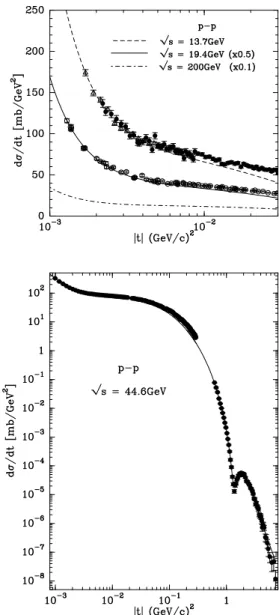
at high energy for √s = 13.7, 19.4, 200 GeV, but before turning to the calculation of this quantity, it is necessary to look at the predic-tions for the differential cross section, at the corresponding energies. They are given in the upper plot in Fig. 1 and compared with the available experimental results at √s = 13.7 and 19.4 GeV. We underestimate a bit the data for high t-values, at √s = 13.7 GeV, which might indicate the presence of a small hadronic spin-dependent amplitude. However, this is not the case at √s = 44 GeV, where the agreement is excellent, as shown in the lower plot in Fig. 1.
FIG. 1: The differential cross section versus the mo-mentum transfer t for different energies. Data from Refs. [19–24].
Note that the momentum transfer runs over four decades and the cross section over eleven orders of magnitude, which is a good illustration of the validity of the impact picture. Concerning the energy √s = 200 GeV, we cannot make a de-tailed comparison with the data. The pp2pp experiment [25] has only determined the slope of the cross section for 0.01 < |t| < 0.019 GeV2, which is b = 16.3±1.6(stat.)±0.9(syst.) GeV−2, consistent with the average value obtained in the impact picture, namely b = 16.25 GeV−2.
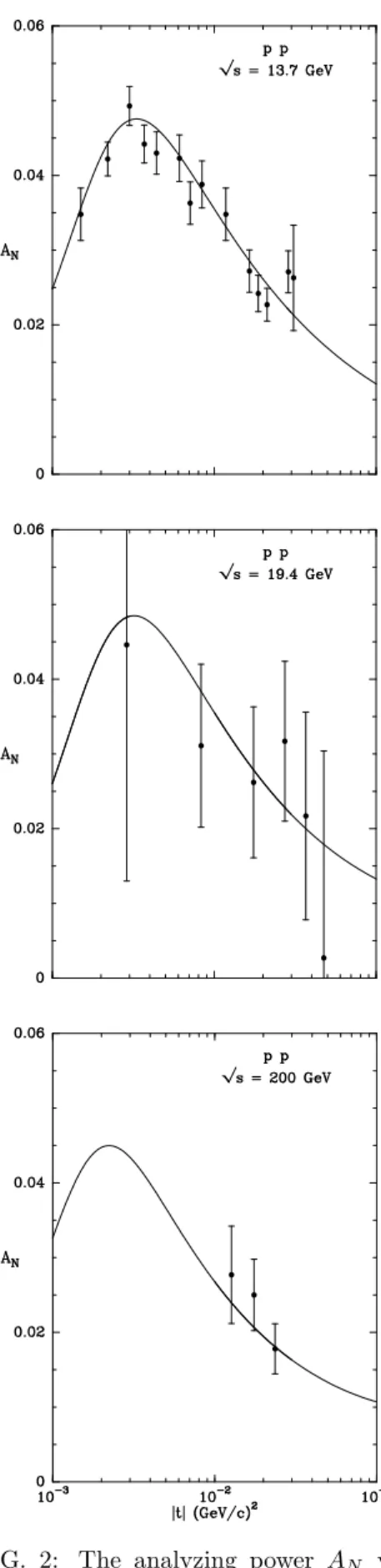
In Fig. 2, we compare the predictions with the data, for AN in the CNI region versus |t|,
4
FIG. 2: The analyzing power AN versus the
mo-mentum transfer t for different energies. Data from Refs. [26–28].
for three different energies and let us make the following remarks. First, there is almost no en-ergy dependence between √s = 13.7 and 19.4 GeV, but the curve has a slightly different shape at √s = 200 GeV. Second, although this is not obvious from the plot, AN does not vanish for
|t| > 0.1 GeV2 and we would like to stress that for pp elastic scattering at high energy, in the dip region, the hadronic and the Coulomb am-plitudes are of the same order of magnitude [29], so the behavior of spin observables is sensitive to this interference. Finally, indeed the predic-tions agree well with the present experimental data. This shows that the hadronic spin-flip am-plitude is not necessary to describe the analyz-ing power, at least when compared with the data with the present day accuracy. A similar conclu-sion was obtained in Ref. [26], which contains the best data sample so far. Note that their analy-sis, based on Ref. [6], was done using a simple model for φh
1 and they did not introduce the full
expressions for the Coulomb amplitudes φC i , as
we do here for consistency.
IV. CONCLUSION
We have shown, in the context of the impact picture, that the analyzing power AN can be
de-scribed in the CNI region by the interference be-tween the non-flip hadronic amplitude and the single-flip Coulomb amplitude. Unfortunately the data set at √s = 200 GeV is too limited to confirm the predicted trend. It should be ex-tended to make sure this method is a reliable high-energy polarimeter. The RHIC machine of-fers a unique opportunity to measure single- and double-spin observables, with both longitudinal and transverse spin directions, and we believe it worthwhile to improve such measurements, in particular in the small momentum transfer re-gion [30], as discussed in Ref. [6]. It is a trivial statement to say that at the moment we know almost nothing on the pp spin-flip amplitudes at high energy, due to the scarcity of previous experiments performed at CERN and Fermilab. They do not allow us to make a reliable am-plitude analysis, which requires these new mea-sured observables, in a significant range of
mo-mentum transfer. This will be important for our understanding of spin-dependent scattering dy-namics.
Acknowledgments
We are grateful to Margaret Owens for a care-ful reading of the manuscript. J.S. is glad to
thank G. Bunce, N. Saito and H. Okada for use-ful discussions at Brookhaven National Labora-tory. The work of one of us (T.T.W.) was sup-ported in part by the US Department of Energy under Grant DE-FG02-84ER40158; he is also grateful for hospitality at the CERN Theoreti-cal Physics Division.
[1] For a review see, C. Lechanoine-LeLuc and F. Lehar, Rev. Mod. Phys. 65, 47 (1993).
[2] For a review see, C. Bourrely, E. Leader and J. Soffer, Phys. Rep. C 59, 95 (1980) (Appendix 3).
[3] G. Bunce, N. Saito, J. Soffer and W. Vogelsang, Annu. Rev. Nucl. Part. Sci. 50, 525 (2000). [4] C. Bourrely and J. Soffer, Phys. Lett. B 442,
479 (1998).
[5] C. Bourrely and J. Soffer, 12th International Symposium on High Energy Spin Physics, Am-sterdam, September 1996. C.W. de Jager et al. (Eds) p. 825, (World Scientific 1997).
[6] N.H. Buttimore, B. Kopeliovich, E. Leader, J. Soffer and T.L. Trueman, Phys. Rev. D 59, 114010 (1999).
[7] N.H. Buttimore, E. Leader and T.L. Trueman, Phys. Rev. D 64, 094021 (2001).
[8] C. Bourrely, J. Soffer and T.T. Wu, Phys. Rev. D 19 3249 (1979).
[9] C. Bourrely, N. N. Khuri, A. Martin, J. Sof-fer and T. T. Wu, Proceedings of the XIth Int. Conf. on Elastic and Diffractive Scattering, Blois May 2005, The Gioi Publishers, Vietnam, p. 41 (2006).
[10] H. Cheng and T.T. Wu, Phys. Rev. Lett. 24, 1456 (1970).
[11] H. Cheng and T.T. Wu, “Expanding Protons: Scattering at High Energies”, M.I.T. Press, Cambridge, MA (1987).
[12] H. Cheng and T.T. Wu, Phys. Rev. D 184, 1868 (1969).
[13] C. Bourrely, J. Soffer and T.T. Wu, Nucl. Phys.
B 247, 15 (1984).
[14] C. Bourrely, J. Soffer and T.T. Wu, Eur. Phys. J. C 28, 97 (2003).
[15] C. Bourrely, H. Neal, H. Ogren, J. Soffer and T.T. Wu, Phys. Rev. D 26, 1781 (1982). [16] C. Bourrely, J. de Physique 46 , C2-221 (1985). [17] L.I. Lapidus, Nucl. and Part. Phys. 9, 84 (1978); N.H. Buttimore, E. Gostman and E. Leader, Phys. Rev. D 18, 694 (1978).
[18] G. B. West and D.R. Yennie, Phys. Rev. 172, 1413 (1968); V. Kundr´at and M. Lokaj´ı˘cek, Phys. Lett. B 611, 102 (2005).
[19] V. Bartenev et al., Phys. Rev. Lett. 29, 1755 (1972).
[20] A. Schiz et al., Phys. Rev. D 24, 26 (1981). [21] J.P. Burq et al., Nucl. Phys. B 217, 285 (1983). [22] L. A. Fajardo et al., Phys. Rev. D 24, 46 (1981); L.A. Fajardo-Paz, PhD Thesis, Yale University (1980).
[23] D. Gross et al., Phys. Rev. Lett. 41, 217 (1978). [24] U. Amaldi et al., Nuc. Phys. B 166, 301 (1979). [25] S. B¨ultmann et al., Phys. Lett. B 579, 245
(2004).
[26] H. Okada et al., Phys. Lett. B 638, 450 (2006). [27] N. Akchurin et al., Phys. Rev. D 48, 3026
(1993).
[28] S. B¨ultmann et al., Phys. Lett. B 632, 167 (2006).
[29] C. Bourrely and J. Soffer, Lettere al Nuovo Ci-mento, 19 569 (1977).