GUIDELINES
FOR THE
IMPLEMENTATION
OF THE SPECIFIC
PHYTOSANITARY
SURVEILLANCE SYSTEM
Montevideo, Uruguay 2018 Inter-American Institute for Cooperation on Agriculture (IICA), 2018 Guidelines for the implementation of the Specific Phytosanitary Surveillance System by IICA is published under license Creative Commons Attribution-ShareAlike 3.0 IGO (CC-BY-SA 3.0 IGO) (http://creativecommons.org/licenses/by-sa/3.0/igo/) Based on a work at www.iica.int IICA encourages the fair use of this document. Proper citation is requested. This publication is available in electronic (PDF) format from the Institute's Web site: http://www.iica.int Editorial coordination: Lourdes Fonalleras and Florencia Sanz Translator: Paula Fredes Layout: Victor Hugo Vidart Cover design: Victor Hugo Vidart Digital printing
Guidelines for the implementation of the Specific Phytosanitary Surveillance System / Inter-American Institute for Cooperation on Agriculture, Comité Regional de Sanidad Vegetal del Cono Sur; José Manuel Galarza. – Uruguay : IICA, 2018.
A4; 21 cm x 29,7 cm.
ISBN: 978-92-9248-790-4 Published also in Spanish
1. Pest monitoring 2. Disease surveillance 3. Pests of plants 4. Plant diseases 5. Phytosanitary measures 6. Communication 7. Risk management I. IICA II. COSAVE III. Title.
AGRIS DEWEY
Acknowledgments:
This Guide was developed as a result of the component aimed at strengthening plant pest surveillance in the framework of STDF / PG / 502 Project "COSAVE: Regional Strengthening of the Implementation of Phytosanitary Measures and Market Access". The beneficiaries are COSAVE and the NPPOs of the seven countries that make up COSAVE. The Standards and Trade Development Facility (STDF) fund it, the Inter-American Institute for Cooperation on Agriculture (IICA) is the implementing organization and the IPPC Secretariat supports the project. The editorial coordination was in charge of Maria de Lourdes Fonalleras and Florencia Sanz. Maria de Lourdes Fonalleras, Florencia Sanz y José Manuel Galarza, have defined the original structure of this Guide. The content development corresponds exclusively to José Manuel Galarza expert contracted especially for the project. The technical readers that made important contributions to the content of the Guide are the specialists of the NNPO's participating in the Project: Pablo Cortese, Ignacio García Varona, Federico Aguirre, Oscar Von Baczko, Yanina Outi from Servicio Nacional de Sanidad y Calidad Agroalimentaria – SENASA from Argentina; Luis Sánchez Shimura, Remi Castro Ávila, Gustavo López Zenteno, Edgar Delgado Vargas, Immer Adhemar Mayta Llanos, Geordana Zeballos from Servicio Nacional de Sanidad Agropecuaria e Inocuidad Alimentaria – SENASAG from Bolivia; Ricardo Kobal Raski, Dalci de Jesus Bagolin, Jesulindo de Souza Junior, Ériko Tadashi Sedoguchi from Secretaria de Defensa Agropecuaria del MAPA from Brasil; Marco Muñoz, Fernando Torres Parada, Jairo Eladio Alegría Contreras, Carolina Pizarro, Karina Reyes, Ilania Astorga from Servicio Agrícola y Ganadero – SAG from Chile; Cristian Marecos, Katya Bogado, Mariano Franco Aquino, Liz Adriana Ojeda, Rosa Liliana Encina, María Bettina Chaparro from Servicio Nacional de Calidad, Sanidad Vegetal y de Semillas – SENAVE from Paraguay;Acknowledgments:
Moisés Pacheco Enciso, Johny Naccha Oyola, Cecilia Lévano Stella, Betty Matos Nonogawa, Carmen Oré Vento, Iván Gutiérrez Martínez, Jorge Velapatiño Flores, Percy Alberto Mamani Sánchez from Servicio Nacional de Sanidad Agraria – SENASA from Perú; Elina Zefferino and Noelia Casco from Dirección General de Servicios Agrícolas – DGSA/ MGAP from Uruguay. We express special appreciation to all of them. We also thank the support received from the IPPC Secretariat for the implementation of this component of the project. Finally, we thanks Víctor Vidart by diagramming the document.The Standard and Trade Development Facility (STDF) project COSAVE: Strengthening the Implementation of Phytosanitary Measures and Market Access, in relation to phytosanitary surveillance actions, indicates the need to develop implementation guidelines, as well as case studies for the region, sharing concepts and information with a regional participatory approach based on ISPM 6 "Guidelines for surveillance" in order to train NPPOs in the design and implementation of specific phytosanitary surveillance (SPhS) systems. For the development of these Guidelines, an initial workshop was held to determine the contents. Subsequently, a draft Guidelines document was developed based on these contents. In addition, two electronic forums were set up to promote the active participation of COSAVE NPPO professionals in the analysis, review and identification of adjustments of the Guidelines. Finally, two pests were selected as case studies for the application of this document.
About these guidelines
These Guidelines are mainly intended for the staff responsible for SPhS actions in the region's NPPOs. In addition, it could also be useful to other actors of the system, according to their role regarding plant protection in each country, including institutions in academia and science, universities, researchers, extension agents, farm advisors, farmers, and any person or entity interested in learning about this area and identifying possible forms of participation.
Table of contents
Acronyms and abbreviations ... 6 Definitions ...6 Section 1.- Introduction ... 7 Section 2.- Objective of specific phytosanitary surveillance ... 8 Section 3.- Elements of specific phytosanitary surveillance ... 8 3.1. National organization... 8 3.2. Regional organization... 10 3.3. National policies and legislation... 11 3.3.1. National legislation... 11 3.3.2. Phytosanitary policy ... 12 3.4. System participants... 13 3.5. Funding... 13 3.6. Diagnostic laboratory capacity... 14 3.7. Physical resources... 14 3.8. Staff training, monitoring and frequent testing ... 15 3.9. Managing information related to the information management system... 16 3.10. Communication strategy ... 16 Section 4.- Planning, priorities and budget ... 17 4.1. Specific phytosanitary surveillance system planning... 17 4.2. Priority setting... 18 4.3. Phytosanitary intelligence... 20 4.4. Budget for specific phytosanitary surveillance ... 20 Section 5.- Implementation and methodology of specific phytosanitary surveillance ... 21 5.1. Purpose... 22 5.2. Scope ...23 5.3. Target pest and host... 23 5.3.1. Target pest... 23 5.3.2. Target host... 24 5.4. Duration and appropriate timing ... 25 5.5. Site selection... 25 5.5.1. Site selection according to the purpose of specific phytosanitary surveillance... 26 5.5.1.1 Detection survey... 26 5.5.1.2. Delimitation survey... 27 5.5.1.3 Monitoring survey ... 28Table of contents
5.6. Statistical design ... 28 5.7. Surveillance methodology ... 29 5.7.1. Prospecting ... 29 5.7.2. Trapping... 29 5.8. Collection, conditioning and submission of samples...30 5.9. Biosafety and sanitation...30 Section 6.- Information management system ... 31 6.1. Information management... 31 6.1.1. Collection, storage and traceability ...31 6.1.2. Documentation... 32 6.2. Technology tools for information analysis ... 32 6.2.1 Technology tools for specific phytosanitary surveillance... 32 Section 7.- Communication of outcomes ... 33 Section 8.- Supervision and audit ... 34 Bibliography... 35 Internet resources ... 36 International standards ... 36 Appendix: Priority-setting methodologies implemented in the region ... 37These Guidelines follow the definitions of ISPM 5 and ISPM 6, and the following: • Target host: Host to which surveillance is targeted (IPPC 5, 2016). • Target pest: Pest to which surveillance is targeted (IPPC 5, 2016). • Prospecting: An official procedure conducted over a defined period of time to determine the characteristics of a pest population or to determine which species occur in an area.
Definitions
Abbreviations
AOP: Annual operating plan COSAVE: Comité de Sanidad Vegetal del Cono Sur [Southern Cone Plant Health Committee] CPM: Commission on Phytosanitary Measures FAO: Food and Agriculture Organization of the United Nations IPPC: International Plant Protection Convention ISPM: International Standards for Phytosanitary Measures NPPO: National plant protection organization RPPO: Regional plant protection organization SPhS: Specific phytosanitary surveillance STDF: Standards and Trade Development FacilityIntroduction
Section
1
The phytosanitary surveillance system supports trade in plants and plant products, while protecting countries from the introduction of pests of major importance, by providing timely information on the phytosanitary status. This information enables the classification of a pest as a quarantine pest, as its definition includes considerations regarding its status, distribution, economic importance, and official control. This is of key importance in a world globalized by international trade, the movement of people, the production and flow of plant products and plants for planting, and the effects of climate change in recent years. Surveillance is defined as "an official process which collects and records data on pest occurrence or absence by survey, monitoring or other procedures" (ISPM 5, 2016). This implies that the NPPO is required to determine the status of a pest with appropriate procedures to enhance and develop international trade competitiveness and national production. There are two types of surveillance that complement each other and coexist permanently. They are: GENERAL SURVEILLANCE: “A process whereby information on particular pests which are of concern for an area is gathered from many sources wherever it is available and provided for use by the NPPO” (ISPM 6). SPECIFIC SURVEILLANCE: “Procedures by which NPPOs obtain information on pests of concern on specific sites in an area over a defined period of time” (ISPM 6, referred to as “Specific surveys”). The development of the SPhS system is integrated with the general surveillance system, and many characteristics are shared between the two types. In this regard, the present document references to the Guide for the Implementation of General Phytosanitary Surveillance System and complements it with the concepts, components, planning, and procedures of SPhS. Its implementation will be based on the reality of each country, the assessment of priority-setting criteria and internal policies.Objective of specific
phytosanitary surveillance
2
The purpose of the SPhS system is to collect, record, analyze, update, and communicate, in a timely manner, information on the presence, absence, distribution, characteristics of a population, or prevalence of target pests in an area during a defined period of time (ISPM 6; Acosta et al, 2011).Section
3
Elements of specific
phytosanitary surveillance
The elements of the SPhS system are: 3.1. National organization The IPPC establishes in Article IV.2.b that the NPPO of each country is responsible for "the surveillance of growing plants including both areas under cultivation (inter alia fields, plantations, nurseries, gardens, greenhouses and laboratories) and wild flora, and of plants and plant products in storage or in transportation" and for SPhS as well. The establishment of a phytosanitary surveillance system requires the identification of certain roles in its organization, regardless of the functional structure established by the NPPO. Conceptually, the system should have a national head of phytosanitary surveillance with the authority to establish targets or goals to achieve and give instructions, and with an appropriate, territorially distributed chain of command involving: supervisors or coordinators at subnational (regional, state, departmental, provincial, etc.) level, liaison personnel and field staff, with defined hierarchies, clearly specified roles, powers and responsibilities, and with an appropriate flow of information and communication across levels (Montes, G. 2017). The existence of supporting administrative support and technical units and other areas is essential. The administrative support unit should manage available resources, including human resources, purchase the inputs required for the different activities, facilitate the management of information from phytosanitary surveillance, ensure appropriate information coverage, etc. The technical support unit may be composed of specialists in different fields of plant health or other related fields (that provide technical support in establishing targets and in the development of procedures within their competence), including laboratories, experts in computer science and geomatics, etc. Moreover, the system should have support in the areas of communication, training and librarianship. It should also include the participation of production and industry sectors (packaging, cold storage, collection centers, etc.), private advisors and public and/or private institutions that provide voluntary assistance in different areas or that conduct certain activities for the NPPO or on its behalf. In some countries, it may be relevant to create one or several surveillance advisory groups, coordinated by the NPPO and involving key sectors (Montes, G. 2017).Section
Figure 1. Conceptual organization of a national phytosanitary surveillance system (Montes, G. 2017). SUPPORT UNITS • Industrial and productive sector • Private advisors • Public and/or private institutions • Others • Strategic planning • Resource management • Purchases • Information management • Quality assurance • General services • Reporting • Others • Entomologists • Phytopathologists • Malacologists • Weed scientists • Integrated pest management • Laboratories • Researchers in related areas • Computer science support • Geomatics • Communication • Bibliotecology • Others
Administrative Technical Other areas
NPPO national head of phytosanitary surveillance NPPO subnational head of phytosanitary surveillance Advisory group or committee on phytosanitary surveillance Liaison personnel Field staff This conceptual organization or functions can be adapted to the institutional structures established in each country (Montes, G. 2017). 3.2. Regional organization Regional plant protection organizations (RPPOs) are intergovernmental organizations that act as coordinating bodies for NPPOs at a regional level. Not all IPPC contracting parties are members of an RPPO, and not all RPPO members are IPPC contracting parties. Furthermore, some IPPC contracting parties are members of more than one RPPO (Montes, G. 2017). The functions performed by the RPPO are established in Article IX of the IPPC, and include (Montes, G. 2017): • coordination of and participation in activities between the NPPOs to promote and achieve the objectives of the IPPC; • cooperation between regions to promote harmonized phytosanitary measures;
3
Section
3
• compilation and dissemination of information, especially in relation to the IPPC; • cooperation with the Commission on Phytosanitary Measures (CPM) and the IPPC Secretariat in the development and implementation of ISPMs. Furthermore, RPPOs can connect with one another and establish forums to coordinate activities of common interest (Montes, G. 2017). The Comité de Sanidad Vegetal (COSAVE) [Southern Cone Plant Health Committee] is the RPPO composed of the NPPOs of the Governments of Argentina, Bolivia, Brazil, Chile, Paraguay, Peru, and Uruguay, intended to strengthen regional phytosanitary integration and to develop integrated actions to address phytosanitary issues of common interest to member countries. One of its main activities is the creation of working groups on various topics, including phytosanitary surveillance; forest health; pest-risk analysis; plant quarantine; sampling, inspection and certification; CPM matters; propagation material health; or other specific phytosanitary issues, such as Huanglongbing disease (HLB) or Lobesia botrana. These activities help the Steering Committee evaluate the progress, share criteria and approaches, identify strengths and limitations potentially constituting inputs to conduct activities related to sanitary and phytosanitary measures. 3.3. National policies and legislation 3.3.1. National legislation National legislation (including laws and regulations) in each country should provide the appropriate framework for the NPPO to fulfill its non-delegable responsibility for establishing and conducting phytosanitary surveillance, as set out in Article IV.2 (b) of the IPPC (Montes, G. 2017). To support the actions of the surveillance system, this legislation should consider: • The establishment of the NPPO as the official service with legal authority and unique responsibility to discharge the functions specified by the IPPC (IPPC 1, 2015); • The consistency with national legislation and regional and international agreements to which the contracting party is a signatory, in a global trading environment (IPPC 1, 2015); • Independence and accountability in its functions, creating predictability and certainty through good governance and respect for the rule of law (IPPC 1, 2015); • Clearly defined functions and powers, describing the roles, responsibilities and rights of stakeholders (IPPC 1, 2015), as well as the organizational structure that will support the system (Montes, G. 2017);Section
• The establishment of a clear hierarchical relationship with subnational authorities, as appropriate (IPPC 1, 2015); • The implementation of International Standards for Phytosanitary Measures (ISPMs) adopted by the CPM (IPPC 1, 2015); • Provisions made for third party institutions and personnel acting on behalf of the NPPO, for example: mechanisms of engagement (e.g. letter of agreement (LoA), memoranda of understanding (MoU), contracts), mechanisms for recognizing and dealing with conflicts of interest, level of accountability to the NPPO, redress in cases of breach of trust or contract (IPPC 6, 2015); • Confidentiality in the use of data (IPPC 6, 2015); • Identification of funding sources and provision of the resources needed for the correct performance of phytosanitary surveillance actions (Montes, G. 2017); • Access to the place of surveillance, inspection and sampling of plants, plant products or other items that may harbor pests; • Continuous training of diagnostic personnel, the construction and the maintenance of facilities to ensure the correct identification of pests; • Legal protection of NPPO officers or NPPO-authorized staff to conduct surveillance activities (IPPC 6, 2015), including insurance against accidents, charges for violation of property or physical attacks (Montes, G. 2017); • Mandatory reporting to other NPPOs, RPPOs and the IPPC, in case of incursions of absent pests or changes in phytosanitary status in an area. 3.3.2 Phytosanitary policy Horizontally related to other systems within the NPPO, the policy for the SPhS system should include: • Consistency of NPPO goals and operations with government policy and legislation (IPPC 1, 2015); • Institutional stability (this should be specifically stated and provided) (IPPC 1, 2015); • Well-defined public goals, with guidance on how to achieve them and a detailed course of action to address phytosanitary risks (IPPC 1, 2015); • Dissemination of information among stakeholders in support of transparency, and cooperation on phytosanitary measures (IPPC 1, 2015); • Technical and scientific decision-making that is free from political interference (IPPC 1, 2015); • Adequate administrative support for all NPPO programs (IPPC 1, 2015);
3
Section
3
• Ensure sustainability of their actions, including: adequate and properly trained personnel, development and retention of personnel; financing of actions, including resources to deal with emergencies and phytosanitary crises; priority setting and adequate financing; engagement with stakeholders; communication programs (IPPC 1, 2015), and internal procedures for communicating surveillance outcomes (IPPC 1, 2015; IPPC 6, 2015); • Actions to improve the infrastructure and institutional organization of the NPPO, including: management structure with appropriate lines of authority and information flow; effective cooperation and collaboration between the parties involved (private and public sector); proven inspection and verification capacity at borders or entry/exit points; suitable diagnostic equipment and laboratories; effective communication systems to address internal and external communications; and adequate documentation that includes an information retrieval system (IPPC 1, 2015); • Periodic review, incident review and auditing (internal or external) (IPPC 1, 2015); 3.4. System participants The Phytosanitary Surveillance System should include the following participants: • NPPO Staff. • Entities or authorized personnel by the NPPO. • Entities or personnel that collaborate with the NPPO. For information on these items, see the Guide for the Implementation of the General Phytosanitary Surveillance System. 3.5. Funding In order to access funding, it is necessary to have technical information that supports the budget request. For this purpose, economic impact studies of the target pest (covering direct and indirect losses, such as market closure) are developed, including the benefit of having a planned and developed SPhS, with the purpose of providing tools to NPPO authorities for the budget request and/or decision making when allocating or reallocating resources.Section
The main funding sources for the implementation of the national phytosanitary surveillance system are the following: • National and subnational government budget. • Fees or tariffs paid by users. • Private sector. • Other countries' government. • Loans or grants. • Technical assistance programs. • Contingency and other emergency funds. For information on funding sources, see the Guide for the Implementation of General Phytosanitary Surveillance System. 3.6. Diagnostic laboratory capacity Some general surveillance findings, mainly those related to the incursion or detection of pests of concern for the NPPO, require their verification through laboratory diagnosis based on official samples. Therefore, diagnosis capacity is essential to support surveillance, including different plant health areas (entomology, plant pathology, malacology, weed science, among others) (Montes, G. 2017). Diagnosis capacity covers not only the availability of the necessary facilities, equipment, and laboratory supplies but also qualified staff, consistent diagnostic procedures to ensure an accurate identification, verification and the storage of specimens, specific supplies required in each protocol, adjusted techniques, taxonomic keys, reference collection material or positive controls when appropriate. This may be difficult, given the huge range of pests to cover and the unpredictability and novelty of the general surveillance findings. In this sense, the NPPO can be supported not only by its own laboratories but also by recognized external laboratories with recognized technical competence (accredited, certified, approved, authorized, etc.), at a national level (universities, research institutes, private laboratories). Likewise, it may be helpful to determine the diagnosis capacity of laboratories in other countries (mainly in the region) that can provide assistance in specific situations (Montes, G. 2017). The NPPO, as required by ISPM 27 (Diagnostic protocols for regulated pests), is responsible for performing or otherwise authorizing plant pest identification services that support national plant pest surveillance or surveys (IPPC 4, 2016).
3
Section
3
3.7. Physical resources The NPPO requires the following physical resources for the development of an SPhS system, including: • Accredited diagnostic laboratories or laboratory networks that are part of the system; • Equipment, instruments and laboratory supplies; • Offices for staff in suitable conditions; • Infrastructure, equipment and computer systems for the recording and analysis of data; vehicles suitable for the activities • Communication material, • Supplies to take, package and deliver samples, 3.8. Staff training, monitoring and periodic review The responsibilities of the NPPO (identified in the IPPC, 1997: Article IV.2 (h)) include the “training and development of staff”. The NPPO manages a wide range of activities, and its staff should have the appropriate qualifications, skills and experience to manage the following functions of the surveillance system: • Legal and administrative systems (IPPC 2, 2015); • Administration and strategic planning (IPPC 2, 2015); • Policy and operation of regulatory requirements (IPPC 2, 2015); • Regulatory development and revision (IPPC 2, 2015); • International regulations, specifically the Agreement on Sanitary and Phytosanitary Measures and ISPMs; • Implementation of operating procedures (IPPC 2, 2015); • Pest surveillance protocols and procedures. • Pest field identification, symptomatology and suspicious signs; • Inspection and verification procedures (IPPC 2, 2015); • Sampling and testing (IPPC 2, 2015); • Audit and verification of compliance (IPPC2, 2015); • Contingency or emergency actions (IPPC 2, 2015); • Compliance with reporting obligations • Registration, training, evaluation, and audit of external personnel; • Industry, community and government liaison (IPPC 2, 2015); • International liaison (IPPC 2, 2015); • Communication (IPPC 2, 2015);Section
3
Section
However, taking into account that the education offered by universities and educational institutions rarely covers specific phytosanitary activities, the NPPO may provide a program for the staff evaluation, training and development that covers: • Resource management; • Information management and database management; • Report writing; • Negotiation; • Surveillance standards, protocols and operational procedures; • Pests (diagnosis, biology, etc.); • Epidemiology; • Access to facilities and equipment; • Specialized outsourcing; • Interpersonal relationships with other NPPOs or relevant organizations; • Surveillance methods and good practices; • Methods for collecting, preserving, transporting and recording samples; • Biostatistics; • Geomatics. 3.9. Managing information related to the information management system The national surveillance systems should be designed for the collection, collation, analysis, validation and notification of surveillance data and information, ensuring the development of computer systems for the storage and processing of information on specific phytosanitary surveillance and thus ensure their integrity from data collection to reporting. 3.10. Communication strategy The elements that make up the communication strategy are: • Communication at the national level, which may be internal or external to the NPPO; • Communication at the international level. For more information on the communication strategy, see the Guide for the Implementation of General Phytosanitary Surveillance System.4
Planning, priorities
and budget
4.1. Specific phytosanitary surveillance system planning The national phytosanitary surveillance strategy should be directly related to national priorities or strategic areas in relation to trade and the protection of plant resources and the environment and present a clear vision to achieve the support and participation needed for its proper functioning (Montes, G. 2017). The IPPC states that a strategic plan helps define the organization's roadmap for a multi-year period (for example, 5 to 10 years), including the identification of vision, mission, strategic objectives and organizational culture, as well as detailed action plans. It also indicates that the vision and mission of the NPPO should be aligned with the IPPC strategic framework (IPPC2, 2016). Each strategic objective should be supported by defined and achievable activities and results (IPPC2, 2016). In accordance with the Guide for the Implementation of General Phytosanitary Surveillance (Montes, G. 2017), the SPhS system requires careful planning, consistent with government policies, NPPO functions and the legislation in force, to predict the availability of resources throughout its implementation and to achieve an efficient development (Montes, G. 2017). The laboratory should be aware of the anticipated sample volume prior to arrival in a given period (IPPC5, 2015) in order to schedule field activities based on the technical and operational capacity of the laboratory. If the NPPO laboratory does not have the necessary technical capacity, capacity building will be required in this and other organizations. It should also be consistent with the strategic areas defined at the national and/or regional level. Planning should be reflected in a management plan document (Montes, G. 2017) The short-, medium- or long-term management plan should be accompanied by annual operating plans (AOPs) outlining, based on the priorities, the implementation of the activities, their territorial and temporal distribution and the budget (resources and supplies) required for implementation (Montes, G. 2017). It is essential to prioritize thee pests, biological control agents and agricultural and forestry crops that will be included in the AOP, to determine the allocation of resources. The design of the SPhS will depend on the objective of the activity, whether to look for a pest of unknown status in an area, to gather data about an existing pest population in an area or to determine the boundaries of an infestation or incursion.Section
Thus, an SPhS system should consider: • A set of actions with territorial coverage that are carried out at the appropriate time, frequency and duration for the collection of information; • An organizational and technical structure to consolidate surveillance at the central and subnational levels, direct coordination between these levels, resource allocation, and adequate procedures for an SPhS; • Ongoing engagement with other units within the NPPO, such as diagnostic laboratories, certification and quarantine, control or eradication programs. This requires the identification and registration of sampling sites; • Activity planning in accordance with the pests, crops and areas priorities, previously identified; • Preparation of operating procedures with the objectives, methodology, sampling, formats and collation of information; • Systematization of the collected information with digital formats and the use Internet to deliver information in real time; • Collecting records to analyze and to integrate the national information; • Verification of new occurrence records, especially when they have no precedent; • Communication of relevant information and the outcomes of the SPhS activity. 4.2. Priority setting Within the planning of SPhS, it is essential to prioritize pests or crops based on risk rating, economic and social importance, and resources involved, among others factors. A categorization methodology is therefore required. Thus, countries in the COSAVE region have developed proposals to categorize pests in order to determine the SPhS actions to be implemented. These initiatives are presented in Appendix 1.
4
Section
4
It is important to periodically establish priorities, following criteria determined by the NPPO, in alignment with national strategic pillars, including the following (Montes, G. 2017): • Compliance with international (bilateral or multilateral) agreements; • The provisions of ISPMs (pest-free areas, eradication or management programs, etc.); • The local presence of emerging pests; • The potential risk of introduction of absent quarantine pests or emerging pests at a regional or international level; • The need for information to facilitate the access and maintenance of export markets or the establishment of justified import requirements; • The requirement to detect the presence of biological control agents; • NPPO responsibility for food security and sovereignty; • The threat of pests that affect health or productions of local importance; • Economic impact assessment compared to the cost of implementing SPhS. Tools such as pest risk analysis, bioecological modeling and expert judgment may be important in the decision-making process. In addition, each country can use a rating system, based on its strategic areas, to contribute to priority setting. A failure to set priorities may result in: • Delays in new market access; • Unnecessary or unjustified import requirements; • Delays in pest detection, which may cause significant and devastating losses in agricultural and forestry crops. The parameters to be considered for NPPO implementation of SPhS actions should include: • Technical and economic feasibility to carry out the surveillance, including the pest prospecting and diagnosis method; • Pest categorization, description of the situation and characteristics; • Strategic importance of the main, secondary and wild hosts, depending on the value of production, number of producers, number of workers, production area, and value of exports; • Plant products involved in pest spread, depending on whether they are food products or propagation material;Section
4
• Historical data on pest introduction on a worldwide basis, depending on its presence in countries with more trade based on reported statistics; • Temporary feasibility to conduct SPhS. Based on the analysis carried out, the prioritization document should be prepared, indicating at least (Montes, G. 2017): • Name of the prioritized pest/crop/biological control agent; • Justification (selection criteria and other elements such as risk analysis, bioecological modeling, rating system, etc., if applicable); • Target product, environment or specific location, as appropriate; • (General and specific) surveillance actions to be developed; • Related stakeholders; • Appropriate time; • Required resources; • Implementation cost. 4.3. Phytosanitary intelligence In order to identify which pests or crops to monitor, the NPPO should follow an information analysis approach that considers multiple variables (for example, reporting of emerging pests, commercial and movement of people and products, climate change, etc.) both at national and international level, with the support of geographic information systems, databases and statistical analysis, bioecological modeling, in order to carry out "phytosanitary intelligence" as an action to strengthen the prioritization of pests and areas for monitoring, design and evaluation of surveillance systems. 4.4. Budget for specific phytosanitary surveillance In the planning, it is essential to prepare an AOP to accompany each assigned operating procedure prior to the implementation of SPhS. The AOP should reflect the corresponding requirements for operational, logistical, technological expenses and necessary inputs for the implementation of the actions planned in the SPhS protocol.Section
4
It is essential to know the required resources, their suppliers and their availability over time so that the allocation of available economic resources is made rationally for the activities required and according to the priorities identified (Montes, G. 2017). When evaluating these resources, the description of required products and inputs, units of measurement, quantity, estimated costs, and the appropriate time when it should be available. Operating expenses include the staff resources (salary, fees for third parties, national international consulting, and overtime, among others), training (workshops, internships, courses), travel allowance, transportation (vehicle, fuel, toll), SPhS supplies, investment (GPS, notebook, magnifying glass, laboratory equipment, software, etc.). Along with this budgeting, it is advisable to list the technical characteristics and terms of references of all the specific supplies as required in order to facilitate procurement and contracting processes.Section
Implementation and methodology of
specific phytosanitary surveillance
In SPhS design, it is advisable to include: 5.1. Purpose There are many purposes for SPhS, including: • Early detection of absent pests in an area; • Compliance with phytosanitary requirements/request from interested third countries to: - Generate information for the list of pests of a plant product, when the General Vigilance does not provide the required information; - Certification programs for pest-free and/or low-prevalence production areas/sites. • Determination of pest-free or low-prevalence areas; • Delimitation of pest incursions; • Continuous or semi-continuous surveillance to: - Determine the pest population characteristics in an area. - Generate information on the present pest, its distribution and/or population levels as an input for the implementation of pest management and control programs. - Verify the success of pest and eradication control campaigns. Other purposes may be found for SPhS; the objective of the system may even be a set of more than one of those listed above. Based on the purposes described, the following types of SPhS are identified: Early detection: The early detection and rapid application of phytosanitary measures against the incursion of a pest are frequently one of the keys to the success of an SPhS System. The determination of the implementation of this type of surveillance system is mainly focused on the high risk of pest entry and its potential economic impact on the crops and/or their marketing, which would be much higher than the cost of implementing the SPhS system.
5
5
Request from third countries involved: This system is developed to comply with phytosanitary requirements established by interested third countries. For the success of this type of system, the support of the stakeholders is essential, including the productive sector and the NPPOs of origin and destination of the product. External stakeholders may need on pest status information to complete a Pest Risk Analysis (PRA) for a product. Determination of pest-free or low-prevalence areas: The decision to determine a pest-free or low-prevalence area is based on phytosanitary requirements from third countries and/or on the high economic impact of a pest, leading to the protection of the producing areas where a pest has not detected or its population level is low. The delimitation of these areas should be related to the biology of the target pest. This will affect the scale at which it is feasible to define them and the types of borders by which they should be delimited. In principle, areas should be delimited based on pest presence. In practice, however, they are generally determined by easily recognizable boundaries, which consider the biological limits of a pest in an acceptable manner. These could be administrative (for example, national, provincial or community borders), geographical characteristics (rivers, seas, mountain ranges, roads), or property boundaries that are clear to all parties. Delimitation of pest incursions: The responsibility of the NPPO in the detection of an incursion not only involves pest detection, diagnosis and confirmation, but pest spread delimitation is also an important part of the work. Although not all pest incursions are formally declared as phytosanitary emergencies, they could justify their consideration in the established priority activity. For quarantine pests with a high risk of introduction and economic impact, it is important to prepare delimitation procedures in advance for a rapid response and identification of the geographical limits of the incursion. Continuous or semi-continuous monitoring: This monitoring is implemented according to the information needs of the phytosanitary management programs implemented by the NPPO. The results of the implementation of the SPhS system will be the inputs for the phytosanitary management programs in order to determine: the results of the implemented management measures; the requirement to implement control measures and their intensity; changes in the characteristics of a population that requires intervention through the application of one or more management measures.Section
5.2. Scope The scope describes the extent of the area to be covered by the surveillance, both geographically and in terms of (all or parts of) the production system (IPPC , 2016).6 In this regard, it is equally essential to consider the distribution of the host in the country at the most detailed sub-national level or at least the reasons for the area definition. In order to define the target area, prediction models for bioclimatic risk from pest occurrence can also be used. This type of modeling will allow for identification of higher to lower risk areas, delimitation of surveillance area and differentiation of intensity according to these models. 5.3. Target pest and host When defining the purpose and scope of SPhS, it is essential to simultaneously define the target pest and host. 5.3.1 Target pest The target pest is the pest is expected to be characterized by SPhS in the concerned area—its relationship with the host may or may not be considered. The target pest will be defined in the pest prioritization. The defined target pest should be described with collated information that includes the species of interest, their biological cycles, bioclimatic requirements, and identifiable characteristics. It is advisable to contact experts or organizations, review publications or pest databases, research institutions, universities, scientific societies (including amateur specialists), producers, consultants, museums, the general public and contemporary observations, international sources such as FAO or regional plant protection organizations (RPPOs), existing PRA reports, pest interception databases, among others (McMaugh, T. 2005). In addition, it is necessary to identify the list of scientific and common names of pests and their target hosts, including their synonyms, as well as, the vectors in order to consider them in the activity (McMaugh, T. 2005). It is also necessary to manage and confirm the pest diagnosis protocol, specialists and laboratories with experience and capacity to identify pests (McMaugh, T. 2005).
5
Section
5
Moreover, it is advisable to have images with pest diagnostic characteristics, communication material, a reference collection of affected hosts and pest samples, susceptible host products, associated phenological stage, description of preferred placement (e.g. fruit, bark, leaves, roots), climate conditions, preferential time of the year, and information about pest life cycle (McMaugh, T. 2005). This information should be used to develop descriptive sheets about pests summarizing diagnosis details for surveillance team field activities that are simple and easy to read, which may include common and scientific pest names, hosts, symptoms, and recognition, photographs with the typical characteristics in several hosts, preferred habitat and host weeds, as well as parts for their recognition in flowers, leaves or buds (McMaugh, T. 2005). 5.3.2. Target host In cases where the general phytosanitary surveillance does not provide the necessary information for the preparation of the list of pests that affect a host, it will be the purpose of SPhS actions. The following information should be provided: • Common and scientific host name; • Productive cycle and characteristics; • Production characteristics of the target host, including production sites, backyard gardens, public spaces, storage and distribution sites, among others. 5.4. Duration and appropriate timing The duration and the appropriate timing for the implementation of SPhS should be indicated in the surveillance program taking into account the following: • The duration will depend on the established purpose. Start and end dates should be determined. • For target pests, the choice of the appropriate timing should take into consideration its biology, especially the time in which the pest is in a most feasible state of detection and diagnosis, the presence of natural or anthropic vectors, dates of sowing, emergence, flowering, fruiting, harvesting of the host, or time of evident pest symptoms (McMaugh, T. 2005); • For target hosts, the appropriate timing should consider their full cycle.Section
5.5. Site selection The selection of the site may be determined by: reports of presence and distribution of the pest, the routes of introduction and dispersion of the pest, the biology of the pest, the favorable climatic condition for the pest, the distribution of hosts, control programs (in commercial or non-commercial sites), places to store products, geographical barriers and risk areas (IPPC , 2016).6 Regarding the approach to choose sites, there is no single method recommended for the selection of the site. It is essential to document the justification of the choices made. The following considerations can provide indications on the selection of sites for SPhS: • Dispersal pattern of the pest, assuming its presence in the target area. Pests may prefer particular aspects of an area, such as the water course or wind direction. If it is assumed that the pest is randomly dispersed, then a sampling in any part of the field should have the same chances of detecting the pest (McMaugh, T. 2005). • If the pest is present, a preliminary SPhS pilot action can be carried out, in addition to the consultations with the producers or field staff on any pattern of pest distribution (McMaugh, T. 2005). 5.5.1. Site selection according to the purpose of specific phytosanitary surveillance 5.5.1.1 Detection survey The detection surveillance is carried out to determine if pests are present. It can be done with individual or integrated actions, in: • Selected areas In the selection of areas, it is important to include: pest reports, the spread characteristics of the pest, means of transport, bioecological modeling or host distribution. SPhS is intensified in areas of higher representation or risk and then reduced with respect to distance. This selection of areas could be done in polygons representing the most detailed geopolitical level, grids or radios in which it identifies the highest risk sites. • Routes or tracks Through the location of strategic points on communication routes or tracks, backyards, urban areas, wild lands, points of consolidation, production sites, borders on which the inspections, collections or frequent trappings can be performed.
5
Section
5
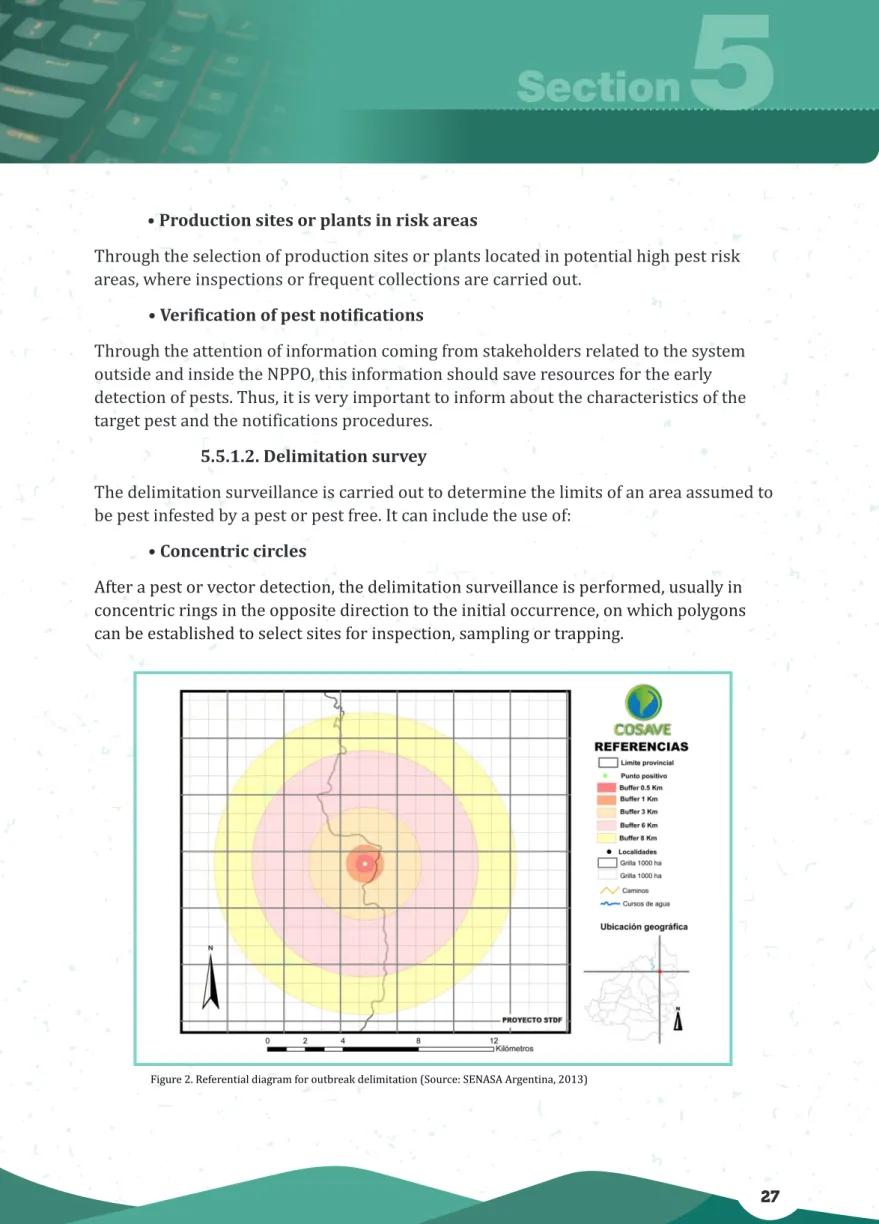
Figure 2. Referential diagram for outbreak delimitation (Source: SENASA Argentina, 2013) • Production sites or plants in risk areas Through the selection of production sites or plants located in potential high pest risk areas, where inspections or frequent collections are carried out. • Verification of pest notifications Through the attention of information coming from stakeholders related to the system outside and inside the NPPO, this information should save resources for the early detection of pests. Thus, it is very important to inform about the characteristics of the target pest and the notifications procedures. 5.5.1.2. Delimitation survey The delimitation surveillance is carried out to determine the limits of an area assumed to be pest infested by a pest or pest free. It can include the use of: • Concentric circles After a pest or vector detection, the delimitation surveillance is performed, usually in concentric rings in the opposite direction to the initial occurrence, on which polygons can be established to select sites for inspection, sampling or trapping.Section
5.5.1.3. Monitoring survey Monitoring survey is an ongoing activity to verify the characteristics of a pest population and may be implemented in the following places: In the places of production For this, it is important to take into consideration: • The selection of pest representative sites, where inspections or frequent sampling are carried out. • Host representativeness in the selected area. • Relationship of the host and its varieties and the target pest. • Sowing and harvest calendar. • Phenology of the hosts, to select the critical stages for pest detection. • Representative location and accessibility to places. • Representative technological level, selected with medium to low preference, because it is where you will find more diversity of pests. • Representative size of the place of production. In products According to ISPM 6, this activity can provide important information for the list of pests of products obtained under specific cultural practices. They can also be used to prepare lists of pest hosts where general surveillance information is needed. In addition, ISPM 6 indicates that surveillance sites may be determined by: • Geographical distribution of the production areas and their size. • Pest management programs (commercial and non-commercial sites). • Cultivars present. • Points of consolidation of the harvested commodity. It also indicates the requirement for the procedures take into consideration the phenology of the crop and the appropriate sampling technique for the product.
5
Section
5
5.6. Statistical design If the NPPO has the possibility of carrying out a statistical design, its implementation is suggested. 5.7. Surveillance methodology There are several methods available for SPhS, which should be selected according to the type of pest, effectiveness, technical availability and timeliness, which could be used independently or in an integrated fashion (IPPC 5, 2016). These methods include: 5.7.1. Prospecting It refers to the visual examination of the host, or pest, including its associated signs or symptoms. It can consider the surveillance in all the sites in an area or some of them, which can be selected in a random, stratified, systematic or selective manner. Prospecting may include sampling carried out through the collection of the host, product, pest or soil for identification and analysis. The types of sampling that can be performed are: random, stratified, systematic, and selective. • Random, in which each unit has the same chances of being selected (IPPC 5, 2016). ISPM 6 indicates that it is important to include it in order to detect unexpected events. • Stratified, which implies splitting the population into categories based on the identification of factor involved in pest distribution and conduct a random sampling on them (IPPC 5, 2016). • Systematic, which considers a certain pattern or regular interval, such as grids or transects in the form of X, W, Z, or circular. This may involve the collection of symptomatic or non-symptomatic plants (IPPC 5, 2016). • Selective, which implies choosing the sample based on experience-based differences (IPPC 5, 2016). 5.7.2. Trapping Through the use of physical or chemical traps to capture the target pest. Used when there is technical and economic availability for its use. It usually involves the selection of locations in a random, stratified, systematic, or selective way.Section
5.8. Collection, conditioning and sending of samples The protocols and training for the collection and submission of samples should be clearly provided to SPhS specialists, including the details according to the type of sample and the target pest of the surveillance. In these specifications it is important to include: • The sampling methodology with details of the material and/or pest to be collected, how to pick it and how to prepare it. • Identification of samples enabling their traceability (date of sampling, name of the collector, geo-referencing of the sampling site, name of the host, if applicable). • Sample delivery conditions (refrigeration, maximum arrival time to the laboratory, etc.). 5.9. Biosafety and sanitation When developing SPhS protocols, NPPOs should include procedures to ensure that the spread of pests during surveillance activities is not facilitated (IPPC 6, 2016). In this sense, the use of disposable material in clothing, gloves and disposable shoe covers is recommended, along with the use of soap or disinfectant gel approved for the field staff hands and disinfectants for tools. For all samples, it is necessary to take appropriate precautions to avoid the spread of pests. With some exceptions, the shipment of live insects should be avoided. Field personnel should comply with existing biosecurity procedures in the places where surveillance is carried out (IPPC 6, 2016). It is important to implement good surveillance practices that include requesting permission to enter production sites, communicating the objectives and methodology to be used, the appropriate order and operational cleanliness, as well as making the correct final disposal of activity waste (for example pheromones, flasks, traps).
5
Section
6
Information
management system
6.1. Information management Information management is essential for the SPhS system and includes: 6.1.1. Collection, storage and traceability It is important for surveillance data to be compiled in a uniform and convergent way regarding the following: • Unified catalog of pest and host species; • Unified registration of sampling sites; • Codification of differentiated phytosanitary actions. Thus, data can be used to facilitate integration with processing and data analysis IT platforms, thus contributing to support the pest status in: an area, a pest-free area or a low-prevalence area, phytosanitary certification, pest risk analysis, and decision making in the implementation of phytosanitary measures. SPhS activity records may be systematized and should include the following fields: • Identification of places of production, facilities or producers, where appropriate; • Surveillance activity; • Date of the activity; • Name of the person responsible for the activity; • Scientific name of the host, where appropriate (IPPC , 2015);6 • Detailed subnational locality and geo-referencing (IPPC , 2015);6 • Information of the prospecting site, including the characteristics and conditions of the host, area, management, etc.; • Date of collection and name of the collector, where appropriate (IPPC , 2015);6 • Details of the sample; • Scientific name of the pest when it is feasible to identify it on the field; • Survey and/or its sampling code. If samples are submitted to the diagnostic laboratory, the delivery should also include: • Type of protocol; • Delivery, reception and diagnosis dates; • Technique used; • Pest scientific name, family and taxonomy information (IPPC , 2015); name of 6 the analyst (IPPC , 2015);6Section
6
In the case of diagnosing the presence of quarantine pests, it is advisable to carry out a validation with at least two diagnostic techniques in the NPPO or in a national or international reference institution. The information generated in the different phases of SPhS should ensure traceability and be stored preferably in systematized databases that may be available as required. It should have a safe backup to avoid loss of information. 6.1.2. Documentation Appropriate documentation should ensure the uniformity, quality and availability of the procedures developed and the information collected across the national territory and over time, and its consistency with the defined surveillance strategy (Montes, G. 2017). For more information on this matter, see the Guide for the Implementation of General Phytosanitary Surveillance System. 6.2. Technology tools for information analysis It is advisable to have experts who have the capacity to perform statistical and geo-statistical analysis of the obtained data from SPhS processes, in order to generate information for the decision making and/or the support of actions. At present, there are numerous technology tools for the SPhS process that facilitate the management, processing, analysis, and interpretation of data. These tools may include geographic information systems, remote sensing, and pest modeling.Section
7
Communication
of outcomes
Surveillance staff will engage in different levels of communication in regard to the actors involved with different decision-making levels, and a strategy of results communication to the productive stakeholder should be developed.Section
Supervision or audit
8
Section
Surveillance activities developed by the NPPO or by organizations authorized by them should be monitored periodically on the basis of indicators defined in the action plans, through supervision or internal audits following the chain of command (Montes, G. 2017). On-site supervision has the advantage of assessing the quality and quantity of the actions carried out, in contrast to the analysis of remote data that assesses compliance with procedures in terms of quantity and distribution of the actions which allows the evaluation of the quality of the activity. In order to verify the degree of internalization, acceptance, positioning, and external image of the surveillance system, and to identify its activities with the collaborators and stakeholders related to the system at the national level and to identify direct possible improvements, the NPPO can promote the creation of a group for review and exchange of results, with the purpose of carrying out a participatory evaluation, in reference to NPPO functions, resources and priorities. Moreover, international commercial partners can perform external audits to verify the functioning of the system and its reliability (IPPC5 2016 & Montes, G. 2017). Interinstitutional activities can also be integrated with researchers, representatives of national or regional organizations, representatives of the private sector (commissions or ad hoc technical groups, committees, advisory groups, others), who are presented with SPhS results and actions with for monitoring and proposing improvements with an integrated vision. This information is complemented with the provisions of the Guide for the Implementation of General Phytosanitary Surveillance System.Bibliography
Acosta, H.; White, P. 2011. Atlas of Biosecurity Surveillance. 2011–May. Wellington, New Zealand, Ministry of Agriculture and Forestry. Available on January 15, 2017, at: http://www.mpi.govt.nz/mpi-surveillance-guide/atlas.pdf. Comité de Sanidad Vegetal del Cono Sur. 2010. Estándar regional en protección fitosanitaria sección I - Organización y funcionamiento 1.5 Organización y funcionamiento de los grupos técnicos y funciones de los puntos de contacto. Committee on Sanitary and Phytosanitary Measures. 2000. Technical Assistance Typology. Note by the Secretariat. G/SPS/GEN/206. IPPC 1. 2015. Establishing a National Plant Protection Organization. A guide to understand the principal requirements for establishing an organization to protect national plant resources from pests. Available on January 10, 2016, at: http://www.phytosanitary.info/ippc-technical-resources. IPPC 2. 2015. Operation of a National Plant Protection Organization - A guide to understanding the principal requirements for operating an organization to protect national plant resources from pests. Available on January 10, 2016, at: http://www.phytosanitary.info/ippc-technical-resources. IPPC 3. 2015. Managing Relationships with Stakeholders - A guide to stakeholder relations for national plant protection organizations. Available on January 10, 2016, at: http://www.phytosanitary.info/ippc-technical-resources. IPPC 4. 2016. Guide to Delivering Phytosanitary Diagnostic Services. Available on January 10, 2016. at: http://www.phytosanitary.info/ippc-technical-resources. IPPC 5. 2016. Plant pest surveillance - A guide to understand the principal requirements of surveillance programmes for national plant protection organizations. Available on January 10, 2016, at: http://www.phytosanitary.info/ippc-technical-resources. IPPC 6. 2016. Draft revision of ISPM 6 for National surveillance systems (2009-004). Current consultation for draft ISPMs. Available on January 10, 2016, at: https://www.ippc.int/en/core-activities/standards-setting/member-consultation-draft-ispms/#. McMaugh, T. 2005. Guidelines for surveillance for plant pests in Asia and the Pacific. ACIAR Monograph No. 119. Bruce, ACT. 192 pp. Available on January 10, 2016, at: https://www.aciar.gov.au/node/8941 Montes, G. 2017. Guía de Implementación del Sistema de Vigilancia Fitosanitaria General. Project STDF/PG/502. “COSAVE: Regional strengthening of the implementation of phytosanitary measures and access to markets”.Bibliography
Internet resources • IPPC: www.ippc.int • COSAVE: www.cosave.org • NPPO from Argentina: http://www.senasa.gob.ar/ • NPPO from Bolivia: http://www.senasag.gob.bo/ • NPPO from Brazil: http://www.agricultura.gov.br/ • NPPO from Chile: http://www.sag.cl/ • NPPO from Paraguay: http://www.senave.gov.py/ • NPPO from Peru: http://www.senasa.gob.pe/ • NPPO from Uruguay: http://www.mgap.gub.uy/unidad-organizativa/direccion-general-de-servicios-agricolas International standards • IPPC.- International Plant Protection Convention. • ISPM 5.- Glossary of phytosanitary terms. • ISPM 6.- Guidelines for surveillance. • ISPM 8.- Determination of the situation of a pest in an area. • ISPM 17.- Pest notification. • ISPM 27.- Diagnostic protocols for regulated pests. • ISPM 30.- Establishment of areas of low prevalence of pests for fruit flies (Tephritidae).Priority-setting methodologies
implemented in the region
Appendix
Prioritizing method implemented by the Departamento de Sanidade Vegetal (DSV) of the Ministério de Agricultura, Pecuária e Abastecimento (MAPA) of Brazil The Departamento de Sanidad Vegetal (DSV) of the Ministério de Agricultura, Pecuária e Abastecimento (MAPA) with the Federal Agricultural Research Corporation of Brazil (EMBRAPA) created a team of 20 professionals, including inspectors and researchers, in the methodology of the hierarchical analysis process (HAP), which is required in complex and important decision making process. The method is used to structure, measure and synthesize information based on the actors' experience and knowledge criteria. The HAP uses comparisons between elements, building matrices from these comparisons and thus identifying priority values. The HAP allowed the group to define and classify following a rating of importance the factors, taking into consideration the risks of entry, establishment and the level of damage caused by quarantine pests in hosts of economic importance in the Brazilian regions. As a result of the workshop, 20 priority quarantine pests were chosen, starting from 500 pests from the List of Quarantine Pests not Present in Brazil, in order to target phytosanitary surveillance and research actions. Some useful references can be reviewed in: • Moreno - Jiménez, J. 2002 l Proceso Analítico Jerárquico. Fundamentos, Metodología y Aplicaciones. In Caballero, R. and Fernández, G.M. Toma de decisiones con criterios múltiples. RECT@ Serie Monografías nº 1, 21-53. Available on July 17, 2018, at: https://app.cloudstorage.es/share.php?enlace=5uPzx8NAPaz736aRkmpg%2F F04Yo0qGDDA9R4K4guzxx5QgZzhun6fYHBrNTaGmCCjk5q2OyY%3D • Cooperative Agricultural Pest Survey (2017). Pest Assessment and Prioritization Process. EE.UU. Disponible el 17 de julio de 2018 https://caps.ceris.purdue.edu/pest-listsPrioritizing method implemented by the Servicio Agrícola Ganadero of Chile The Servicio Agrícola Ganadero of Chile implemented the “Approach for the assessment of agricultural and forest absent quarantine pests”, with the purpose of rating the priorities for the surveillance of absent quarantine or absent exotic agricultural or forest pests. This is applicable to pests not present in Chile, including absent quarantine pests; absent exotic pests; intercepted pests; incursions; emerging pests; recently detected pests in neighboring countries; quarantine or exotic pests associated with new hosts or spread tracks; quarantine or exotic pests potentially associated with the exportation. It provides definitions and guidance that facilitate the understanding and the application of the “Approach for the assessment of agricultural and forest absent quarantine pests” so that the results are consistent for the identification of priorities for the possible implementation of Phytosanitary Surveillance Programs. It includes the following assessment factors: Entry component (1) Importation: For the assessment of the characteristics of frequency and volume of imported plant products as a factor of greater risk for the entry of pests, the available statistics of the product assessed should be considered. (2) Means of transport: Any type of means of transport, cargo or passengers, air, land or sea. It does not apply to phytopathogenic agents, so the value to be assigned is "0", unless it has been intercepted as a contaminant. Establishment and spread component (3) Incursions: If there are pest incursions, that is, pest presence has been detected in the national territory but has not been established, it should include the date of the incursion(s), places, characteristics, applied phytosanitary measures, etc. (4) Climatic zones: According to the Köppen climate classification. This system created by Wladimir Köppen is based on two climatic elements, air temperature and amount of available water, in relation to the phytogeographic characteristics.
Appendix
(5) Reproduction rate: The reproduction levels of the pest should be assessed and rated against similar pests. (6) Form of reproduction: In case of parthenogenesis, the answer criteria should be yes. (7) Spread distance: It should be defined in reference to the pest, in relation to the type and its natural mobility without human action. (8) Eradication of the pest: If the pest has been eradicated from the national territory, the date of eradication, places, characteristics, applied phytosanitary measures, etc. should be indicated and described. Economic and environmental impact component (9) Area and producers: The area ranges of the host species or producers should be considered significant or high, if applicable, depending on the assessed agricultural crop or forest species and the importance assigned by the assessor based on objective information. (10) Environmental effect: pesticide use and resistance should be considered (11) General and specific surveillance: pests that require specific surveillance should be rated higher. Final result of the assessment The final result of the assessment is the rated risk level for pest entry, establishment and spread and for economic or environmental impact and damage.
Appendix
The matrix is shown below: Name of the pest: 2.1 HOST 30% 50% 1.3. ENTRY PRESSURE 40% The pest is difficult to intercept, regardless of its entry pathway. The pest has been intercepted in means of transport. (2) The pest can enter the territory on its own. The plague is a vector or can enter with a vector. RISK COMPONENT CRITERIA OF CONSIDERATION (Sub-component) Answer (Yes/No) Score Justification and observations 1. ENTRY 1.1. ENTRY PATHWAY 25% 40% Plant products capable of carrying the pest are imported frequently or in great volumes. (1) 1.2. DISTRIBUTION AND SPREAD OF THE PEST 20% The plague is present in areas with similar climatic conditions to ours. The pest is present in a country that borders Chile. The pest has spread between countries in the last five years. The pest has spread between continents in the last five years. The pest has been intercepted in products, materials or goods of plant origin that are imported or introduced into the country, in means of transports (including general cargo), passengers or their luggage. The pest or its vector has been intercepted, in a viable state, in the last five years. The pest or its vector has been intercepted, in a viable state, more than five times in the last two years. There have been pest or vector incursions in the last five years. (3) There has been more than one pest or vector incursions in a year, during the same period. (3) 2. ESTABLISHMENT AND SPREAD The pest affects more than a family of plant species. The intended use of the plant material for import is the spread. The pest may establish in more than two climatic regions, where host species are present. (4)
Appendix
3.5. IMPACT ON THE ENVIRONMENT 12.5% 3.3. IMPACT ON AGRICULTURAL AND FOREST EXPORTS 25% 2.2. PEST BIOLOGY AND LIFE CICLE 50% The pest has developed resistance that facilitates its establishment. The pest has more than an annual life cycle or has a high rate of reproduction. (5) The pest has more than one form of reproduction or infection status. (6) The pest can travel great distances on its own or naturally. (7) The pest completes its life cycle in more than a host species or group of species. 3.1. POTENTIAL PEST DAMAGE 40% 25% 3. ECONOMIC AND ENVIRONMENTAL IMPACT The pest affects or has the potential to affect strategic crops. The pest kills or seriously affects the host plant. The pest has been eradicated from Chile. (8) 3.2. IMPORTANCE OF THE HOST(S) IN THE COUNTRY 25% The host(s) cover(s) a significant area in the country, it/they has/have production potential, or there are many producers of host species. (9) It is a quarantine pest in destination countries for Chilean host exports. The pest is under official control in a destination country for Chilean exports. Destination countries require pest-specific phytosanitary measures. 3.4. IMPACT ON AGRICULTURAL AND FOREST PRODUCTION 12.5% Direct damage has been found in plant species or products, representing over 10% in other countries. It has potential negative impact on production and labor. The pest affects natural, conservation or protection environments (wooded urban, erosion control, parks, soil bioremediation, etc.). (10) 4. SURVEILLANCE 5% General surveillance systems are insufficient for early pest detection in the national territory. (11) 100% FINAL PEST RATING RISK COMPONENT CRITERIA OF CONSIDERATION (Sub-component) Answer (Yes/No) Score Justification and observations