HAL Id: tel-01338595
https://tel.archives-ouvertes.fr/tel-01338595
Submitted on 28 Jun 2016
HAL is a multi-disciplinary open access
archive for the deposit and dissemination of
sci-entific research documents, whether they are
pub-lished or not. The documents may come from
teaching and research institutions in France or
abroad, or from public or private research centers.
L’archive ouverte pluridisciplinaire HAL, est
destinée au dépôt et à la diffusion de documents
scientifiques de niveau recherche, publiés ou non,
émanant des établissements d’enseignement et de
recherche français ou étrangers, des laboratoires
publics ou privés.
Improving medium access for dynamic wireless sensor
networks
Georgios Papadopoulos
To cite this version:
Georgios Papadopoulos. Improving medium access for dynamic wireless sensor networks. Networking
and Internet Architecture [cs.NI]. Université de Strasbourg, 2015. English. �NNT : 2015STRAD034�.
�tel-01338595�
UNIVERSITÉ DE STRASBOURG
ÉCOLE DOCTORALE MATHÉMATIQUES, SCIENCES DE
L’INFORMATION ET DE L’INGÉNIEUR
Laboratoire ICube – UMR 7357
THÈSE
présentée par :
Georgios PAPADOPOULOS
soutenue le :
28 septembre 2015
pour obtenir le grade de :
Docteur de l’université de Strasbourg
Discipline/ Spécialité
: Informatique
Improving Medium Access for Dynamic
Wireless Sensor Networks
THÈSE dirigée par :
M. NOEL Thomas
Professeur, Université de Strasbourg
RAPPORTEURS :
Mme. GUÉRIN-LASSOUS Isabelle Professeur, Université Lyon I
M. DIAS DE AMORIM Marcelo
Directeur de Recherche, LIP6, Paris
AUTRES MEMBRES DU JURY :
M. GALLAIS Antoine
Maître de conférences, Université de Strasbourg
Georgios PAPADOPOULOS
Improving Medium Access for
Dynamic Wireless Sensor
Networks
Résumé
L’Internet des objets amène des contraintes uniques et une immense variété d’applications. Ceci
oblige à être capable d’établir des communications efficaces en énergie (et néanmoins à faible délai)
au sein de réseaux fortement dynamiques. Nous nous sommes concentrés sur l'amélioration du
contrôle d'accès au medium (MAC), afin d’optimiser la gestion des communications sans fils,
principale source de consommation d'énergie dans ces réseaux. Cette thèse discute de
l’auto-adaptation de solutions MAC asynchrones et montre qu’une coopération localisée entre objets
communicants permet de maintenir un partage efficace de la ressource de communication face à
une forte dynamique (trafic, mobilité, pannes). Outre une réflexion menée sur les outils de simulation
et d'expérimentation, nous avons conduit des campagnes d'évaluations complètes de nos
contributions qui traitent tant des changements de trafic que de la mobilité dans les réseaux très
denses.
Résumé en anglais
The Internet of Things brings unique constraints and a huge variety of applications. This forces to be
able to establish energy efficient communications (and nevertheless low-delay) within highly dynamic
networks. We focused on improving the medium access control (MAC) to optimize the management
of wireless communications, the main source of energy consumption in these networks. This thesis
discusses the self-adaptation of asynchronous MAC solutions and shows that a localized
cooperation between communicating objects can maintain an efficient sharing of the communication
resource in highly dynamic networks (traffic, mobility, failures). In addition to a reasoning on the tools
of simulation and experimentation, we conducted comprehensive evaluation campaigns of our
contributions that address traffic changes and mobility in dense networks.
dynamiques de capteurs sans fils
Georgios Z. Papadopoulos
Laboratoroire ICube
Universit´
e de Strasbourg, France
Introduction et Contexte
Les d´eploiements sans fil deviennent largement utilis´es et fournissent aux utilisateurs (ou aux objets) un service d’acc`es `a Internet presque partout, notamment en raison des avanc´ees technologiques qui ont amen´e non seulement smartphones et tablettes PCs, mais aussi d’autres dispositifs `a tr`es faible encombrement. Par cons´equent, au cours des derni`eres ann´ees, nous avons connu l’´emergence d’un nouveau paradigme appel´e Internet des Objets (Internet of things ou IoT) dans lequel les objets intelligents et con-nect´es construisent des r´eseaux (sans fils) coop´eratifs. Ces objets peuvent ˆetre d´eploy´es ou dissemin´es presque partout, dans les maisons, les universit´es, les villes, les champs agricoles, dans la mer, jusque dans le corps humain ou toute autre chose naturelle ou artificielle.
Depuis 2008, le nombre d’objets reli´es `a l’Internet a ainsi d´epass´e le nombre de personnes vivant sur Terre. L’Internet des objets s’organise autour de communications de machines `a machines toujours plus nombreuses. L’Internet des objets est une vision qui se construit aujourd’hui mais qui a ´emerg´e grˆace `a d’intenses activit´es de recherche et d´eveloppement autour des r´eseaux ad hoc mobiles (Mobile Ad Hoc Network, MANET) et des r´eseaux de capteurs sans fils au cours de la derni`ere d´ecennie.
Observation de l’environnement, t´el´e-m´edecine, suivi et contrˆole des proc´ed´es indus-triels, secours d’urgence, maisons et villes intelligentes sont des exemples d’applications des r´eseaux de capteurs sans fils qui n´ecessitent des ´equipements `a faible coˆut, facilement d´eploy´es et multi-fonctionnels. Cela a conduit `a une grande vari´et´e d’applications dont les nombreux d´eploiements r´eussis ont ´eclips´e les difficult´es de gestion distribu´ee de la ressource commune qu’est l’air pour les communications radio entre objets h´et´erog`enes. Ainsi, les r´eseaux de capteurs sans fils absorbent de plus en plus l’attention de la communaut´e de la recherche et de nombreuses solutions ont ´et´e propos´ees. Elles con-cernent notamment l’optimisation de la performance du r´eseau en termes de dur´ee de vie (i.e.,, les syst`emes d’´economie d’´energie), la collecte fiable de donn´ees, l’´evitement de congestion ou encore la qualit´e de service pour l’utilisateur. Cependant, certaines questions cruciales restent sans r´eponse, en raison des contraintes sp´ecifiques des nœuds capteurs et des liaisons sans fil.
Tout d’abord, les capteurs sont g´en´eralement aliment´es par batterie. Il est difficile, voire impossible de les recharger au cours d’un d´eploiement dans des zones difficiles d’acc`es ou dangereuses. Il est crucial d’´eviter le gaspillage inutile d’´energie pour chaque capteur. Cette question motive la communaut´e de recherche pour l’´etude, la conception et le d´eveloppement de protocoles de communication efficaces en ´energie.
En outre, lors d’un d´eploiement, un r´eseau de capteurs sans fils peut pr´esenter un certain nombre de d´efis inattendus tels que les pannes de noeuds, les difficiles conditions environnementales (e.g., volcan, forˆet), ou encore les topologies instables (e.g., mobilit´e, variabilit´e de la qualit´e des liens de communication).
Pour surmonter ces probl`emes, les protocoles de communication sont tenus de pr´esenter un certain niveau de robustesse et de fiabilit´e. Par exemple, des protocoles de routage multi-chemins ou opportunistes sont ´etudi´es afin de surmonter les d´efaillances de com-munication (e.g., panne de noeud, mauvaise qualit´e d’un ou plusieurs liens d’un chemin de routage). En outre, il serait id´eal pour les protocoles con¸cus de pouvoir ˆetre ´evalu´es et v´erifi´es `a la fois par simulation et au travers de campagnes d’exp´erimentation.
Un capteur effectue des op´erations telles que la d´etection ou le traitement des signaux analogiques issus de son environnement physique (e.g., lumi`ere, temp´erature, humidit´e, mouvement, son, pression, vibration). Il int`egre donc un convertisseur analogique-num´erique (charg´e de num´eriser le signal analogique continu produit par les capteurs) ainsi que d’autres composants tels qu’une m´emoire externe et une source d’alimentation. Un capteur sans fil est quant `a lui constitu´e d’un micro-contrˆoleur (e.g., pour le traitement des donn´ees et de signalisation de protocole) et d’un ´emetteur-r´ecepteur radio. Ces appareils, potentiellement ´energivores et sujets aux pannes, sont consid´er´es comme ´etant de tr`es petite taille et permettent ainsi de recueillir des donn´ees et de les transmettre `a d’autres nœuds grˆace aux communications sans fil.
Les r´
eseaux de capteurs sans fils
Les r´eseaux de capteurs sans fils sont consid´er´es comme des r´eseaux `a basse consomma-tion d’´energie et sujets aux pertes (Low-power and Lossy Networks (LLNs)) car ils sont compos´es de beaucoup de noeuds limit´es en puissance, m´emoire et ressources de traite-ment. Ainsi, ils devraient ˆetre d´eploy´es avec une forte redondance, amenant alors des probl`emes de partage de ressource (e.g., collisions, interf´erences radio). Les applications types incluent notamment :
1. la surveillance militaire : parmi les applications militaires des r´eseaux de capteurs sans fils se trouvent la d´etection d’intrusion, la localisation d’ennemis et la d´etection d’attaque biologique ou chimique.
2. l’observation de l’environnement : ces applications incluent la surveillance de la faune, de la flore et de l’activit´e sismique, l’´etude de microclimats, la d´etection des incendies de forˆet ou encore la d´etection d’inondation.
3. la surveillance de la sant´e : des r´eseaux de capteurs corporels peuvent ˆetre utilis´es pour recueillir des informations sur la sant´e du patient. Ces applications permettent par exemple d’´evaluer la position du corps et l’emplacement de la personne ou encore d’assurer le suivi clinique des patients dans les hˆopitaux et les maisons (e.g., rythme cardiaque, oxyg´enation du sang).
4. les applications urbaines et domestiques : on compte d´ej`a des d´eploiements dans plusieurs villes `a des fins de r´egulation de la circulation, de gestion du station-nement (e.g., syst`emes SmartGrains et SFpark) ou de surveillance de la pollution de l’air. Les applications domestiques incluent la d´etection d’ouverture des portes, le contrˆole des lumi`eres ou de la temp´erature.
5. la surveillance industrielle et les smart grids : un certain nombre de proc´ed´es industriels n´ecessite la surveillance des produits (e.g., d´etection d’expiration, ges-tion de la qualit´e). Le terme smart grid d´esigne des applicages-tions o`u des capteurs (e.g., compteurs intelligents), diss´emin´es dans le r´eseau de distribution ´electrique, permettent de mieux contrˆoler la production et l’acheminement d’´energie. 6. les applications agricoles : les d´eploiements de r´eseaux de capteurs sans fils
dans les exploitations agricoles permettent de surveiller l’humidit´e, la temp´erature ou le pH du m´elange eau-nutriments dans un champ de culture et ainsi assurer une maintenance plus efficace.
7. les secours d’urgence : incendies, s´eismes et autres catastrophes naturelles sont des situations dans lesquelles la recherche et le secours de victimes peuvent ˆetre am´elior´es grˆace `a la collecte d’informations en provenance directe du terrain.
L’Internet des objets a permis l’int´egration des r´eseaux de capteurs sans fils `a l’Internet, acc´el´erant ainsi grandement leur d´eploiement au service de nombreuses applications.
Communications dans les r´
eseaux de capteurs sans fils
Pour assurer les fonctions n´ecessaires aux applications pr´ec´edemment cit´ees, un grand nombre de capteurs autonomes peuvent ˆetre diss´emin´es sur une zone dont ils surveillent les conditions physiques ou environnementales. Ceci passe par la coop´eration (transmis-sion et r´eception des mesures d’un capteur mais ´egalement de celles des autres capteurs avec lesquels il peut communiquer) afin d’acheminer les donn´ees collect´ees vers une ou plusieurs stations passerelles, appel´ees puits (i.e., sinks). Un puits rassemble ainsi les donn´ees et assure la connectivit´e vers l’Internet, tout en traitant les mesures re¸cues. Celles-ci sont g´en´er´ees en fonction des exigences de l’application finale. Les d´eploiements observ´es s’appuient sur un ou plusieurs paradigmes de communications suivant que les ´emissions de donn´ees soient :
• guid´ees par le temps (time-driven), avec des paquets de donn´ees ´emis `a intervalles de temps constants;
• guid´ees par les ´ev´enements (event-driven), lorsque les transmissions se produisent uniquement en cas de d´etection d’un ´ev´enement sp´ecifique, induisant par cons´equent un trafic de donn´ees dynamique;
• guid´ees par les requˆetes (query-driven) si les ´emissions de donn´ees se font en r´eponse `a des demandes issues de l’utilisateur final.
Ces diff´erents paradigmes de communication induisent diff´erents types de trafic au sein du r´eseau (e.g., constant, sporadique, en rafale).
En outre, en raison des contraintes ´energ´etiques, les radios fonctionnent `a des puis-sances d’´emission limit´ees, imposant ainsi des rayons de communication r´eduits. Les communications multi-sauts sont alors utilis´ees pour couvrir de grandes surfaces, poten-tiellement difficiles `a atteindre et d’o`u les mesures effectu´ees par les capteurs d´eploy´es doivent ensuite atteindre l’une des stations puits. L’organisation de ces communications induit des topologies vari´ees (e.g., ad-hoc, en clusters, centralis´ees).
D`es lors, on distingue trois types de trafic :
i) multipoint-`a-point (ou convergecast) o`u plusieurs capteurs transmettent leurs donn´ees en direction des puits (sch´ema induit en time-driven et event-driven) ;
ii) point-`a-multipoint lorsque le puits envoie des requˆetes `a un ou plusieurs capteurs du r´eseau (sch´ema induit en query-driven) ;
iii) Point-`a-point lors d’une communication simple de capteur `a capteur (ou puits), par exemple, lors de la d´etection d’´ev´enements, ou pour la communication entre nœuds au sein du r´eseau (sch´ema induit en event-driven) ;.
Comme observ´e `a partir des applications actuelles de r´eseaux de capteurs sans fils, les nœuds sont souvent d´eploy´es dans des environnements difficiles `a atteindre (e.g., forˆets, montagnes, volcans) et doivent op´erer de fa¸con autonome dans des densit´es de communication ´elev´ees. Il est alors essentiel de garantir que les syst`emes seront toujours aliment´es. Par cons´equent, l’efficacit´e ´energ´etique constitue la principale pr´eoccupation dans la perspective de dur´ees de vie ´etendues pour ces r´eseaux d’observation ou de surveillance. Ceci a men´e `a la conception et au d´eveloppement de nouveaux protocoles dans toutes les couches de la pile de communication.
Dans ce contexte, la principale source de consommation d’´energie (i.e., communica-tions sans fils) est r´egie par la couche de contrˆole d’acc`es au medium (medium access control, MAC). Lors des transmissions, les sources de consommation d’´energie peuvent ˆetre class´ees comme suit :
i) des nœuds en ´ecoute passive scrutent le medium en attente de potentielles r´eceptions `
a traiter, ou encore traitent des communications ne leur ´etant pas destin´ees ; ii) deux noeuds ou plus (en cas de chevauchement des zones de communication)
ten-tent simultan´ement de transmettre un paquet, ce qui r´esulte en une collision puis en des retransmissions coˆuteuses ;
iii) enfin, selon le protocole de routage ou de contrˆole d’acc`es au medium, les nœuds doivent transmettre un paquet de contrˆole (qui g´en`ere des surcoˆuts en communi-cation) pour pallier d’´eventuels probl`emes de synchronisation.
Ces aspects rel`event de la responsabilit´e de la couche MAC, dont l’optimisation participe par cons´equent grandement `a la r´eduction de la consommation d’´energie. En effet, la couche MAC s’occupe ´egalement d’alterner la radio entre p´eriodes d’activit´e (transmission et de r´eception d’un paquet) et de passivit´e (mode veille). Deux noeuds peuvent communiquer entre eux lorsqu’ils actifs simultan´ement. Cette alternance de cycles induit un compromis fondamental entre la r´eduction de la consommation d’´energie (pour maximiser la dur´ee de vie du r´eseau) et les performances (e.g., latence, d´ebit au sien du r´eseau). Un protocole MAC annon¸cant une alternance de 1% signifie que les nœuds ne sont en mode actif que pendant 1% du temps.
Dans ce manuscrit, nous consid´erons les protocoles MAC avec contention. Dans cette famille de protocoles, les noeuds ´echantillonnent de fa¸con asynchrone le canal de communication `a intervalles r´eguliers afin de d´etecter d’´eventuels paquets entrants. Entre deux ´echantillonnages, ils passent en mode veille afin d’´economiser leur ´energie.
En outre, dans de nombreuses applications (e.g., surveillance de patients, contrˆole industriel, observation de la faune), des exigences telles que la mobilit´e des noeuds et le trafic de donn´ees en rafales sont incontournables. Par exemple, dans de telles applica-tions, les noeuds mobiles peuvent ˆetre d´econnect´es de l’infrastructure de communication pendant la majorit´e du temps, et doivent ainsi rapidement transmettre leurs mesures (i.e., trafic en rafale) lorsque des liens de communication apparaissent vers le(s) puits. Ces circonstances soudaines et non pr´edictibles de trafic en rafales provoquent certaines anomalies dans le r´eseau et justifient l’´etude de solutions appropri´ees au niveau MAC.
Dans cette th`ese, nous avons donc consid´er´e les protocoles MAC avec contention, afin de g´erer les changements de charge de trafic (e.g., d´ecisions locales) et de s’adapter face `a des topologies r´eseau dynamique (e.g., mobilit´e des capteurs). Plus pr´ecis´ement, nous ´etudions la famille de protocoles MAC asynchrones, dans lesquels les noeuds ´echantillonnent de fa¸con asynchrone le canal de communication `a intervalles r´eguliers afin de d´etecter d’´eventuels paquets entrants.
De nombreuses solutions ´economes en ´energie et auto-adaptables au trafic ont ´et´e propos´ees dans la litt´erature. Cependant, tr`es peu d’entre elles r´epondent aux besoins induits par le trafic dynamique observ´e dans des r´eseaux int´egrant des capteurs mobiles. A notre ´etat actuel de connaissance, aucun d´eploiement de r´eseaux de capteurs sans fils ne met en place une gestion de la mobilit´e et de l’auto-adaptation au trafic dynamique. En outre, compte tenu des caract´eristiques des d´eploiements r´ealis´es au cours des 10 derni`eres ann´ees, nous nous sommes concentr´es sur des r´eseaux multi-sauts, avec un trafic de donn´ees multipoint-`a-point. Enfin, dans nos proc´edures d’´evaluation de performances, nous avons consid´er´e `a la fois les communications guid´ees par le temps et par l’´ev´enement.
Contributions
Cette th`ese s’articule autour de l’optimisation des protocoles de contrˆole d’acc`es au medium pour les r´eseaux de capteurs sans fils dans des conditions de trafic et de topolo-gie dynamiques. Nous souhaitons am´eliorer la performance globale du r´eseau (i.e., d´elai, fiabilit´e) tout en r´eduisant la consommation d’´energie. Dans cette optique, nous com-men¸cons par estimer le volume de trafic entrant afin d’adapter les param`etres essentiels au niveau MAC avant de nous concentrer sur les communications issues des nœuds mo-biles. Toutes les contributions propos´ees dans cette th`ese visent `a atteindre les objectifs pr´esent´es pr´ec´edemment :
Afin de d´ebuter nos recherches, nous commen¸cons par caract´eriser
un banc d’essai pour l’Internet des objets. Nous explorons le rˆole des
bancs d’essai dans la conception et le d´eveloppement de protocoles ou applications pour l’Internet des objets en g´en´eral et les r´eseaux de capteurs en particulier. Plus pr´ecis´ement, nous montrons dans quelle mesure l’ajout d’exp´erimentations am´eliore significativement la valeur des campagnes d’´evaluation des performances. Nous discutons de la capacit´e `a produire des r´esultats scientifiques et non des preuves de concept uniquement `a partir de bancs d’essai ouverts. Dans ce but, nous analysons la reproduction des conditions de d´eploiements r´eels.
Nous pr´esentons ensuite T-AAD, un algorithme qui s’adapte
rapide-ment aux changerapide-ments de trafic. Il permet la configuration automatique et
`a la vol´ee des param`etres de la couche MAC. T-AAD est compatible avec tous les protocoles MAC dits `a ´echantillonnage de pr´eambule. Ceci permet une con-sommation d’´energie r´eduite pour le r´ecepteur et l’exp´editeur tout en r´eduisant les d´elais et temps d’occupation du canal, en comparaison aux solutions de la litt´erature. Nous effectuons une ´evaluation de performance approfondie, `a la fois par simulations et par exp´erimentations sur le banc d’essai FIT IoT-LAB.
Nous proposons ensuite M-ContikiMAC, ME-ContikiMAC et MobiX-plore, de nouveaux protocoles de niveau MAC permettant la gestion de
la mobilit´e dans les r´eseaux tr`es denses. M-ContikiMAC ´etend le protocole
ContikiMAC pour permettre la communication de nœud mobile `a statique. Il se base sur des transmissions anycast qui peuvent engendrer des anomalies r´eseau, comme des taux ´elev´es de duplication de paquets par exemple. Nous analysons et ´etudions alors comment mettre en place la co-existence et la coop´eration des nœuds mobiles avec les nœuds statiques du r´eseau, tout en mettant en ´evidence les limitations restantes de M-ContikiMAC. Nous proposons ensuite ME-ContikiMAC o`u des m´ecanismes de contrˆole des duplications et de r´eduction des d´elais sont mis en place. La r´eduction des duplications permet de limiter le d´elai `a un saut, et donc le temps d’occupation du canal et la consommation d’´energie, en comparaison avec M-ContikiMAC. Nous ´evaluons cette contribution face `a d’autres solutions
noeud en situation de mobilit´e et dont les prochains sauts de routage ne cessent de changer. Toutes les propositions mentionn´ees pr´ec´edemment sont conformes aux principes utilis´es dans les couches MAC asynchrones et peuvent donc s’adapter ais´ement aux solutions existantes voire d´ej`a d´eploy´ees.
Enfin, nous proposons un m´ecanisme auto-adaptatif qui att´enue les
du-plications de paquets lors d’utilisation de routage opportuniste. Nous
proposons un m´ecanisme qui g`ere la surdit´e dans le r´eseau par l’interm´ediaire de configurations MAC h´et´erog`enes parmi les noeuds dans le r´eseau. Nous utilisons des d´ecisions locales prises par chaque nœud de fa¸con d´ecentralis´ee.
Les nœuds adaptent alors leurs param`etres MAC de fa¸con dynamique et automa-tique afin de r´eduire le trafic inutile, l’occupation du canal de communication et la consommation d’´energie.
Conclusion
L’objectif de cette th`ese ´etait de r´epondre `a certaines questions cl´es pos´ees par les protocoles de contrˆole d’acc`es au m´edium (MAC) dans les r´eseaux de capteurs sans fils. Parmi elles, nous pouvons citer la consid´eration d’environnements contraints, des trafics et topologies dynamiques, ainsi que l’am´elioration des performances globales de r´eseaux dans lesquels des transmissions variables et en rafales se produisent.
La couche MAC devant g´erer les communications entre capteurs sans fil, elle apparaˆıt comme le premier levier pour la r´eduction d’une consommation d’´energie essentiellement induite par les op´erations de transmission, r´eception et traitement des donn´ees. Nous nous sommes par cons´equent concentr´es sur l’am´elioration de l’acc`es au medium sans fil pour permettre des communications efficaces en ´energie et `a faible d´elai.
Dans ce manuscrit, nous avons favoris´e les approches asynchrones plutˆot que des m´ethodes dites synchronis´ees, principalement en raison de l’efficacit´e et de la tol´erance des protocoles `a ´echantillonnage de pr´eambule dans des r´eseaux `a grande ´echelle et aux topologies dynamiques. Nous avons ainsi pu consid´erer des topologies r´eseaux changeantes (e.g., noeuds mobiles) et certains facteurs d’´echelle grˆace `a la coop´eration efficace et localis´ee entre capteurs. Outre une r´eflexion men´ee sur les outils de simulation et d’exp´erimentation, nous avons men´e des campagnes d’´evaluations compl`etes qui ont permis de montrer les am´eliorations apport´ees par nos contributions.
´
Ecole doctorale MSII
Improving Medium Access in Dynamic
Wireless Sensor Networks
TH`
ESE
pr´esent´ee pour l’obtention du
Doctorat de l’Universit´
e de Strasbourg
(mention informatique)
par
Georgios Z. PAPADOPOULOS
Composition du jury
Directeur de th`
ese :
Thomas NOEL, Prof., Universit´e de Strasbourg, France
Co-encadrant de th`
ese :
Antoine GALLAIS, associate Prof., Universit´e de Strasbourg, France
Rapporteurs :
Isabelle GU´
ERIN-LASSOUS, Prof., Universit´e Lyon I, France
Marcelo DIAS DE AMORIM, CNRS research director, LIP6, Paris, France
Examinateur :
Thomas WATTEYNE, research scientist, INRIA Paris-Rocquencourt, France
Laboratoire des sciences de l’ing´enieur, de l’informatique et de l’imagerie ICube — UMR 7357
i
Acknowledgments
The current thesis is the result of three intensive years of exciting work at the ICube laboratory of the University of Strasbourg in France. First and foremost, I would like to thank Dr. Antoine Gallais and Prof. Thomas Noel for believing in my potential and for giving me the necessary freedom in my research. Thomas, thank you very much for your confidence in my work and decisions. Antoine, I find myself lucky to have had you as my advisor. Thank you for your guidance, patience, constant support and, most importantly, your friendship during these years. I will always remember our long (very long) discussions at the campuses of Illkirch and Esplanade. I would also want to thank Prof. Isabelle Guérin-Lassous, Prof. Marcelo Dias de Amorim, and Dr. Thomas Watteyne for accepting to be part of my jury, for their questions, useful suggestions and constructive comments.
A big thanks to all my colleagues from the Réseaux team, Oana, Pascal, Guillaume, Fabrice, Julien B., Cosmin, Jean-Jacques, François, Thomas H., Stephan, Philippe, Keoma, Damien, Julien M., Erkan and Pierre. Thank you all for your company during these three years.
Pascal, thank you for your advices that helped me to become a better teacher and, more importantly, for your friendship. Guillaume, thank you very much for your enormous availability, constant technical support, collaboration and co-authorship. Fabrice, thank you for your precious advices, our discussions and support.
Special thanks go also to all my collaborators and co-authors (and friends) Vassilis, Periklis, Julien B., Guillaume, Kosmas and Benjamin. Thank you for your trust and collaboration.
A warm thank to Oana, Julien B. and Cosmin, for our long discussions and (most important) for your friendship.
I deeply like to thank Periklis Chatzimisios, for providing me with uncountable wise advices during the very interesting and long discussions we had, and for his collaboration in my research activity.
Jo, thank you very much for your friendship, support and for sharing with me all these great (memories) moments.
I would like to thank very much my Strasbourg’s friends, Eratoula, Asimina, Eleni C., Christos T., Eugenia and Alkis for making this period of my life an experience that I will never forget. I would also want to thank my friends, Vladimiros, Sotiris and Kosmas for being there for me when I needed them.
Eugenia, thank you for your support and for encouraging me to follow my dreams. Thank you for your advices, both personal and professional. Most of all, thank you for your love and care.
This thesis would not have been possible without the help of three persons. I thank my parents, Zourab and Larisa, and my sister, Maria, for their wholehearted support in my decisions, care, love and belief in me throughout my entire life. Thank you for pushing me to be a better person.
Last but not least, I want to thank Alex for the uncountable great evenings of nice company and music at Phonograph.
Abstract
Ad-Hoc and Wireless Sensor Networks (WSNs) have enabled a large variety of applications. Environmental and wildlife monitoring, clinical medical and home-care monitoring, monitoring and control of industrial processes including agriculture, smart houses and cities are just some of the examples of Ad-Hoc and WSN applications, where low-cost, and easily deployed multi-functional sensor nodes is the ideal solution. As a result, during the last years we experience the emergence of a new paradigm called Internet of Things (IoT) in which smart and connected objects cooperatively construct a (wireless) network of things.
However, the unique features of these technologies can pose significant challenges. In clinical medical and home-care applications, requirements such as mobility, bursty traffic and energy-efficiency are appear to be essential. In contrary to the traditional a priori known time-driven traffic patterns, event-driven, where nodes transmit their readings upon detection of a specific event determined by the application layer, networks face occasional, bursty and unanticipated multi-hop data packet transmissions. In wildlife monitoring for instance, the nodes (usually with limited-memory devices) operate under limited internet access for the majority of the time. When a network connection is detected, a surge of traffic should be handled. More specifically, the mobile wireless nodes should immediately upload their stored readings (bursts) at a more powerful device (i.e. sink) before losing again the connection. Such sudden dynamic and bursty traffic cause certain anomalies in the network and fuel the research community to find appropriate solutions.
Since, the Medium Access Control (MAC) layer is in charge for coordinating the commu-nication between wireless sensor nodes. Furthermore, among all operations of a sensor node, Transmission, Reception, Central Processing Unit and Low-power-mode, the communication is the most energy consumed. We therefore, in this dissertation, have focused on improving the access to the wireless medium for low-delay communication in energy efficient manner.
My thesis shows that these competing goals can be balanced by the use of effective algorithms and schemes that enable the protocols (and hence the network) to adapt to current application (i.e. varying traffic load) and network conditions (i.e. mobility). In support of this dissertation, we first have i ) studied the role of simulators/emulators and testbeds in the research process cy-cle, and we identified the means to strengthen their complementarity, ii ) designed, developed and evaluated an algorithm that dynamically and automatically reconfigures the MAC parameters depending on the actual and expected traffic load, iii ) proposed MAC layer protocol to coordi-nate the communication between mobile and static nodes even in very dense networks, iv ) finally, we demonstrated the advantages of employing low-power MAC protocols in a WSN in terms of latency, reliability, energy consumption and congestion in the network. With mobility-oriented preamble-sampling schemes provided by our new architecture, and the protocol adaptation pro-vided in this dissertation, one can envision new designs at all protocol levels, making wireless sensor networks truly adaptive to changes in both application requirements and network dynam-ics.
List of publications
The contributions of this thesis have been published or submitted in peer-reviewed international and national journals and conferences.
International Journals and Magazines
• "Performance Evaluation Methods in Ad-Hoc and Wireless Sensor Networks: A Literature Study",
G. Z. Papadopoulos, K. Kritsis, A. Gallais, P. Chatzimisios and T. Noël, In IEEE Communications Magazine.
• "Wireless Medium Access Control under Mobility and Bursty Traffic Assumptions in WSNs", G. Z. Papadopoulos, V. Kotsiou, A. Gallais, P. Chatzimisios and T. Noël,
In Springer Mobile Networks & Applications.
International Conferences and Workshops
• "Optimizing the Handover Delay in Mobile WSNs",
G. Z. Papadopoulos, V. Kotsiou, A. Gallais, P. Chatzimisios and T. Noël, In IEEE World Forum on Internet of Things (WF-IoT) - Milan, Italy. • "Live Adaptations of Low-power MAC Protocols",
G. Z. Papadopoulos, A. Gallais, G. Schreiner and T. Noël,
In ACM Wireless of the Students, by the Students, and for the Students Workshop (S3) -Paris, France.
• "Toward a Packet Duplication Control for Opportunistic Routing in WSNs", G. Z. Papadopoulos, J. Beaudaux, A. Gallais, P. Chatzimisios and T. Noël, In IEEE Global Communications Conference (GLOBECOM) - Austin, TX USA. • "Enhancing ContikiMAC for Bursty Traffic in Mobile Sensor Networks",
Best Student Paper Award @ Sensor Networks Track,
G. Z. Papadopoulos, A. Gallais, T. Noël, V. Kotsiou and P. Chatzimisios, In IEEE SENSORS - Valencia, Spain.
• "T-AAD: Lightweight Traffic Auto-ADaptations for Low-power MAC Protocols", Best Paper Award,
G. Z. Papadopoulos, J. Beaudaux, A. Gallais and T. Noël,
In IEEE / IFIP Annual Mediterranean Ad Hoc Networking Workshop (MedHocNet) -Piran, Slovenia.
• "Adding value to WSN simulation using the IoT-LAB experimental platform", G. Z. Papadopoulos, J. Beaudaux, A. Gallais, Thomas Noël and G. Schreiner,
In IEEE International Conference on Wireless and Mobile Computing, Networking and Communications (WiMob) - Lyon, France.
Demonstrations and Posters in International Conferences
• "Demo Abstract: Live Adaptations of Low-power MAC Protocols", G. Z. Papadopoulos, A. Gallais, G. Schreiner and T. Noël,
Demo abstract in ACM Annual International Conference on Mobile Computing and Net-working (MobiCom) - Paris, France.
National Conferences
• "Auto-configuration Proactive de la Couche MAC pour les Réseaux de Capteurs Sans Fil à Trafic Variable",
J. Beaudaux, G. Z. Papadopoulos, A. Gallais and T. Noël,
Contents
1 Introduction and Context 1
1.1 (Wireless) Sensor Node . . . 2
1.2 Wireless Sensor Networks . . . 2
1.3 Communications in WSN . . . 3
1.4 The Architecture of Wireless Sensor Networks . . . 4
1.5 Motivation and Assumptions . . . 6
1.6 Contributions . . . 7
1.7 Structure of the Thesis . . . 8
2 Current Practices and Literature Review 9 2.1 Performance Evaluation Methods for Ad-Hoc and WSNs . . . 10
2.1.1 A Thorough Literature Study . . . 11
2.1.2 Evaluation Procedures . . . 13
2.1.3 Reproducibility . . . 15
2.1.4 Scientific results or proofs of concepts ? . . . 16
2.1.5 Mobility . . . 17
2.1.6 Overview of Evaluation Methodologies . . . 18
2.2 Controlling Medium Access in WSNs . . . 18
2.2.1 Scheduled Protocols (Slotted schemes) . . . 19
2.2.2 Protocols with Common Active Periods . . . 20
2.2.3 Preamble-Sampling Protocols . . . 21
2.2.4 Hybrid Protocols . . . 21
2.2.5 Overview of MAC Protocols for WSN . . . 22
2.3 MAC under Dynamic and Traffic and Network Topology . . . 23
2.3.1 Toward runtime adaptation . . . 23
2.3.2 Overview of Adaptive MAC Protocols . . . 25
2.3.3 Mobility Oriented Protocols . . . 26
2.3.4 Overview of Mobility-Aware Protocols . . . 28
2.3.5 Context Description in Opportunistic Routing . . . 29
2.3.6 Overview of Packet Duplication Issue in Opportunistic Routing . . . 30
2.4 Conclusions . . . 31
3 Can experiments lead to scientific results?
A thorough experimental study 33
3.1 Facilities of FIT IoT-LAB Platform . . . 34 3.1.1 An IoT-LAB hardware . . . 35 3.1.2 ICube’s platform . . . 36 3.2 Thorough analysis of an IoT testbed . . . 37 3.2.1 Selecting the transmission power . . . 38 3.2.2 Assessing link stability & quality . . . 39 3.2.3 Selecting the quality radio links . . . 40 3.2.4 Evaluating the energy consumption . . . 41 3.2.5 Assigning and planning trajectories for mobile robots . . . 42 3.3 Conclusions and Perspectives . . . 43
4 Lightweight Traffic Auto-adaptations for Low-power MAC Protocols 45 4.1 Introduction . . . 46 4.2 T-AAD Design . . . 46 4.3 High Traffic Load Period Estimation . . . 48 4.4 Advantage of T-AAD over CSMA-based Solutions . . . 49 4.5 Performance Evaluation of T-AAD mechanism . . . 50 4.5.1 Simulation Evaluation . . . 50 4.5.2 Experimental Evaluation in Non Contention Environment . . . 52 4.5.3 Experimental Evaluation in Contention Environment . . . 54 4.5.4 Summary of Evaluation . . . 56 4.6 Conclusions and Perspectives . . . 56
5 Enhanced MAC under Mobility and Bursty Traffic Assumptions in WSNs 59 5.1 Mobility in WSNs . . . 60 5.2 Background & Overview . . . 60 5.2.1 ContikiMAC protocol . . . 60 5.2.2 Challenge . . . 61 5.2.3 ME-ContikiMAC in a Nutshell . . . 61 5.3 Design of M-ContikiMAC & ME-ContikiMAC . . . 62 5.3.1 M-ContikiMAC Protocol . . . 62 5.3.2 Reconnection mechanism of M-ContikiMAC . . . 63 5.3.3 Drawbacks of M-ContikiMAC . . . 64 5.3.4 Toward ME-ContikiMAC . . . 64 5.4 Performance Evaluation of ME-ContikiMAC . . . 67 5.4.1 Packet duplication . . . 69 5.4.2 Delay performance . . . 69 5.4.3 Energy consumption . . . 71
xi
5.5 MobiXplore: Handover Delay Optimizing . . . 71 5.5.1 Motivation . . . 71 5.5.2 Design of MobiXplore . . . 71 5.6 Performance Evaluation of MobiXplore . . . 72 5.6.1 Simulation Setup . . . 72 5.6.2 Simulation Results . . . 73 5.7 Conclusions . . . 74 5.8 Perspectives . . . 74
6 A Packet Duplication Control Mechanism for Opportunistic Routing 77 6.1 Context Description & Motivation . . . 78 6.1.1 Packet Duplication Issue . . . 78 6.1.2 Problem Statement: Packet Duplication . . . 78 6.2 Proposed Adaptive Scheme . . . 80 6.3 Performance Evaluation . . . 82 6.3.1 Packet Duplication . . . 83 6.3.2 Reliability . . . 83 6.3.3 Delay . . . 84 6.3.4 Energy Consumption . . . 85 6.4 Conclusions and Perspectives . . . 86
7 Conclusions and Perspectives 89
7.1 Conclusions . . . 89 7.2 Perspectives . . . 91 7.2.1 Experiments . . . 91 7.2.2 Integrating MobiXplore within Enhanced Opportunistic Routing . . . 91 7.2.3 Reliable Data Collection Schemes in Fault and Delay Tolerant Networks . 92 7.2.4 Age of Information in WSNs . . . 92
Bibliography 93
List of Figures 105
List of Tables 107
Chapter
1
Introduction and Context
Wireless deployments are becoming broadly used and provide users (or things) with internet access service almost everywhere, due to the advance of technology that now provides not only smartphones and tablet PCs, but also small and uniquely identifiable devices. Therefore, during the last years we have experienced the emergence of a new paradigm called Internet of Things (IoT) in which smart and connected objects cooperatively construct a (wireless) network of things. Those things can be deployed or embedded nearly everywhere, at homes, universities, cities, agricultural fields, in the sea, even in the human body or any other natural or man-made object.
As a result, in 2008, the number of devices (things) connected to the Internet exceeded the number of people on Earth [Cis]. The IoT revolves around increased Machine-to-Machine (M2M) communication. In fact, IoT is a vision and is being built today.
IoT has emerged thanks to numerous works and intense research and development activities that took place around Mobile Ad-Hoc Network (MANET) and Wireless Sensor Network (WSN) since the previous decade.
Environmental (e.g., in coal mines [LL07]) and wildlife monitoring [Dyo+10], clinical medical and home-care monitoring [Chi+10a], monitoring and control of industrial processes including agriculture [Iov14], military surveillance [Sim+04], emergency rescue [Sha+06], smart houses and cities are just some of the examples of WSNs applications, where low-cost, and easily deployed multi-functional sensor nodes are considered as the ideal solution [Yic+08]. This has led to a large variety of applications whose successful deployments have outshone the difficulties of sharing a common resource (air) among many heterogeneous objects, in a distributed manner.
Thus, WSNs absorb more and more attention from the research community due to their wide range of applications. Over the years, many new solutions for sensor networks have been proposed. Contributions have been mainly focused on optimizing the network performance in terms of lifetime (i.e., energy saving schemes), reliable data collection, congestion avoidance, or quality of service for the user.
However, some critical issues have remained unsolved, due to the specific constraints of the sensor nodes or the wireless links. First of all, the sensor nodes are usually battery-powered, and it is often difficult or impractical to recharge or change the batteries in case they are deployed in hard-to-reach areas [Chi+07] or in unsafe environments [RM04]. Therefore, it is crucial to avoid the unnecessary energy wastage at each sensor. This issue motivates the research community to investigate, design and develop energy-efficient schemes and protocols.
Furthermore, during the experiment, WSNs may present a number of unexpected challenges such as node crashes, heavy environmental conditions (e.g., volcano, forest), or unstable topolo-gies (e.g., mobility, unreliable communication links). To overcome these issues, WSN should be fault-tolerant to those circumstances and communication protocols are required to present a certain level of robustness and reproducibility. For example, multi-path or opportunistic routing
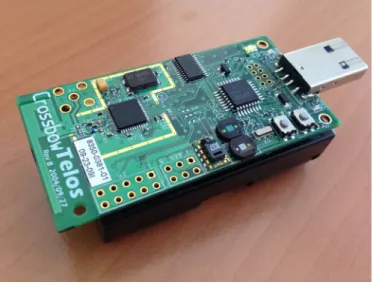
Figure 1.1: A typical sensor node:
Telos ultra-low power wireless module ("mote") with IEEE 802.15.4 wireless transceiver.
protocols are studied in order to overcome communication failures (e.g., node crashing, poor link quality in the path). Moreover, it would be ideal for the designed protocols to be evaluated and verified with both simulation and experimentation campaigns.
1.1
(Wireless) Sensor Node
A sensor device, also known as node or mote, performs operations such as sensing, detecting or responding to analogical inputs of its physical environment. These sensed inputs could be the light, the temperature, the humidity, the motion, the sound, the pressure, the vibration, or any other environmental phenomena. Such a device therefore embeds an Analog-to-Digital Converter (ADC) that digitizes the continual analog signal produced by the sensors. Other main components include an external memory and a power source, usually a battery.
A sensor node is made wireless once a micro-controller (e.g., for data processing and protocol signaling) and a wireless radio transceiver are added. As observed on Figure 1.1, such wireless devices are an extremely energy harvesting and prone to failure. They can be very small in size and thus provide a lightweight and portable detection station that can gather data and communicate with other wireless nodes, in order to transmit its readings.
1.2
Wireless Sensor Networks
Multiple wireless sensor nodes can form a network. WSNs are considered as Low-power and Lossy Networks (LLNs) since they are composed of many embedded nodes with limited power, memory, and processing resources. Thus, they are expected to be densely deployed, which leads to multi-hop interference and time-varying radio link quality. The devices in LLNs communicate by using different types of wireless links, such as the Institute of Electrical and Electronics Engineers (IEEE) 802.15.4 standards [802b].
WSNs are absorbing more and more attention from the research community due to their low cost, small in size, and availability. As a result, hundreds and thousands of such devices are interconnected, which leads to the integration of the WSNs in the emerging IoT.
1.3. Communications in WSN 3 Typical applications of WSNs include (but are not limited to) [Iov14]:
(1) Military surveillance. WSNs may support efficiently to achieve effective battlefield sit-uational awareness. Some military examples include the use of sensor nodes to detect enemy intrusion, shooters’ localization [Sim+04] or nuclear, biological, and chemical attack detection.
(2) Environmental applications: WSNs have found varied applications in the area of habi-tat and environmental monitoring. Some of the environmental applications are wildlife moni-toring [Zha+04], monimoni-toring seismic activity [WA+08], microclimate study of a tree [Tol+05], humidity and temperature monitoring [Lan+06], forest fire detection, flood detection, etc.
(3) Health monitoring: Body sensor networks can be used in mobile health monitoring to collect information about patient’s health [Jon+10]. There are many WSN-health applications such as body position measurement and location of the person, clinical monitoring of patients in hospitals and homes (e.g., heart rate and blood oxygenation) [Chi+10b].
(4) Urban and home applications: WSNs have been deployed in several cities for traffic, parking or air pollution monitoring purposes, or at home for light switching, doors detection and temperature adjustment issues.
(5) Industrial monitoring and smart grid: There are number of applications that require monitoring of products (e.g., expired detection, quality). Another example of the possible use of WSNs is to prevent repeats of the contamination of the food supply chain. Furthermore, WSNs are used in smart grid, where the sensors are called smart meters and may use Power-Line Communication for energy measurement and control (e.g., [Tri]).
(6) Terrestrial applications: These type of applications are probably the most common ones, typically deployed in the fields for agricultural purposes [Iov14]. For instance, WSNs can be used to monitor the temperature, moisture, or the PH of water-nutrient mixture in a crop field to enable more efficient maintenance.
(7) Emergency rescue. WSNs are used in emergency search and rescue cases such as fire [Sha+06] and earthquake [KL]. For instance, a sensor network (e.g., temperature or humidity measurement sensors) can be installed in a forest to detect when and where a fire has started. The early de-tection is essential for the successful reaction of the firefighters.
The Internet of Things paradigm made WSNs connected to the Internet, thus speeding up their deployments and utilization on a daily basis in urban environments, e.g., parking systems like SmartGrains [Sma] and SFpark [Sfp].
1.3
Communications in WSN
Most of the previously exposed application domains rely on WSNs that consist in a large number of spatially distributed autonomous sensor nodes. They allow to monitor physical or environmen-tal conditions and by cooperatively passing (transmit, receive and forward measurements from other nodes) their readings through the network to one or more gateways (i.e., sinks) [Aky+02a], [Ver+08]. A typical sink station gathers the data from the sensor nodes, connects the WSN to the Internet, and processes the received measurements locally. Those data are generated according to the end application requirements. In a WSN, there are three types of communication paradigm:
• Time-driven where data packets are transmitted to sink in constant time intervals; • Event-driven where data packets transmission occurs only when a detection of a specific
event takes place, in this case we may observe dynamic traffic as well;
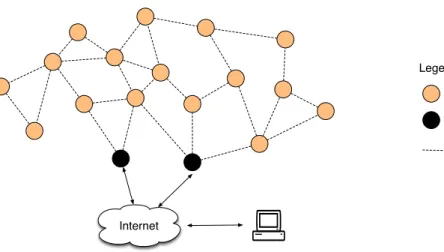
Internet
Sensor node Sink Legend:
Radio link
Figure 1.2: Overview of a Wireless Sensor Network. Data collected by sensor nodes are forwarded to a sink station in a multi-hop manner.
However, we may experience deployments with hybrid paradigm of communication [Zha+04], [Dyo+10]. These different communication paradigms can lead to different kinds of traffic in the network, such as Constant Bit Rate (CBR) or non constant (e.g., burst) ones.
Furthermore, due to energy constraints, radios operate under limited transmission powers thus imposing reduced communication ranges. Multi-hop communications are therefore required to cover large and hard-to-reach deployment areas where all measured data must be able to reach one of the sink stations (as illustrated in Figure 1.2). The sensor nodes may establish a network with various topologies, such as ad-hoc networks, clustered networks, or centralized networks.
Finally, in a WSN, we can face three types of traffic, i) multipoint-to-point (induced by time-driven and event-time-driven communication paradigms), also called convergecast: the devices sense the environment and send the information back to the sink ii) point-to-multipoint (induced by query-driven communication paradigm): used by the sink to send commands to one or more devices in the network iii) point-to-point (induced by event-driven communication paradigm): sensor-to-sink communication for instance upon event detection, or for communication between nodes inside the network, where data do not necessarily go towards the sink (e.g., in-network processing, fault-tolerance schemes).
1.4
The Architecture of Wireless Sensor Networks
In order to support such communication paradigms and induced traffic patterns and while being compliant with existing communication networks, numerous works have designed the architecture of typical interconnected sensor nodes. In [Aky+02b], Akyildiz et al. introduced one of the first protocol stacks for WSNs (see Figure 1.3b). In fact, they envisioned it based on the seven-layer architecture of Open Systems Interconnection (OSI) model (Figure 1.3a), where the session and presentation layers were not included, since they have not been identified as useful in this type of technology.
Thus, we may consider five main levels:
• Application layer that defines a standard set of services and applications;
• Transport layer which is responsible for reliable data packet delivery required by the application layer;
• Network layer which is responsible for routing the data from the transport layer and directing the process of selecting paths in the network;
1.4. The Architecture of Wireless Sensor Networks 5 Application Presentation Session Transport Network Link Physical (a) OSI Stack
Application Transport Network Link Physical (b) WSN Stack (2001) (Reproduced from [Aky+02b])
IETF RPL IPv6 IETF CoAP UDP IETF 6LoWPAN IETF 6TOP IEEE802.15.4 MAC IEEE802.15.4 PHY (c) Standardized Stack (Reproduced from [AP14])
Figure 1.3: WSN Protocol Stacks
• Data Link layer which is responsible for data frame transmission and reception, multi-plexing data streams, medium access, and error control;
• Physical layer which is responsible for signal transmission and reception over a physical communication medium, including frequency and power selection, signal modulation and data encryption.
Due to the constraints that WSNs present, cross-layer approach has been shown to be more efficient [RI04]. Since the emergence of new and heavy applications in WSNs, the proposed architecture was not well suited. Indeed, it is difficult to maintain the separation between layers during the optimization procedure at the network performance or energy saving.
The IEEE and Internet Engineering Task Force (IETF) Working Groups (WGs) have stan-dardized several protocols for the LLNs, and therefore, for WSNs. Several adaptation layers had to be established by the scientists and engineers, in order for the different standardized protocols to effectively and efficiently interact together. To this aim, by enabling IPv6 over Low power Wireless Personal Area Networks, 6LoWPAN adaptation layer had to be madden in order to provide Internet connectivity to WSN [Mon+07]. Moreover, compression schemes, such as LOWPAN_IPHC Encoding [HT11] were introduced in order to compress the IPv6 header into 2 bytes.
The IETF ROLL WG concluded that existing well-known routing protocols such as Open Shortest Path First (OSPF), Intermediate System to Intermediate System (IS-IS), Ad Hoc On Demand Vector (AODV), and Optimized Link State Routing (OLSR) do not satisfy the specific routing requirements that characterize LLNs, such as multi-hop network, complex traffic patterns, energy-efficiency. As a result, the ROLL WG developed and standardized the IPv6 Routing Protocol for Low-power and Lossy Networks (RPL) [Win+12] to manage networks constructed with up to thousands of devices.
6TOP sublayer [Wan+14], developed by the IETF 6TiSCH working group, which allows in-teractions between the link layer and the upper layers in the stack to address industrial needs (e.g., applications such as smart metering) with safe slot allocation at the Medium Access Con-trol (MAC) layer, scheduling from the end application. Furthermore, Constrained Application Protocol (CoAP) framework, an application layer protocol, emerged from the CoRE WG in order to manage the limited resources of a device.
The ieee 802.15.4 family of standards [802b] was adopted to define the Physical (PHY) and MAC layers, which were first introduced in Personal Area Networks (PANs). The first version of the standard was presented in 2003 and was followed by a revision in 2006 and 2011. The Maximum Transmission Unit (MTU) of ieee 802.15.4 standard is limited to 127 bytes, far smaller than the 1500 bytes supported by Ethernet or WiFi. Since, the single-channel of ieee802.15.4 MAC presents reliability issues, and even more, the Carrier Sense Multiple Access with Collision Avoidance (CSMA/CA) access technique causes overhearing, interference and idle-listening [Pal+13]. The IEEE802.15.4e Timeslotted Channel Hopping (TSCH) MAC amendment has been designed and developed to meet the previously pitfalls [802a].
All these efforts in standardization led to design a new protocol stack for WSNs as we can see in Figure 1.3c.
1.5
Motivation and Assumptions
As exposed throughout this introduction chapter, WSNs present a number of challenges (e.g., energy supplying, network topology), that make the research in this field demanding and exciting. As observed from current WSN applications (see Section 1.2), wireless sensor nodes are of-ten placed and deployed in a hard-to-reach environments such as forest, mountains, volcanoes, animals, and even more they operate autonomously in high volumetric densities. In those loca-tions, changing or recharging the batteries regularly can be costly, inconvenient, impractical, or even impossible. Thus, it is essential to guarantee that there will be always an adequate energy available to power the system, during the development of a WSN deployment. Hence, whatever the envisioned application, energy-efficiency is the primary concern in WSNs, since the sensor devices are battery-powered and they have to last for long duration [Dyo+10]. Thus, it is critical to investigate energy-saving techniques in order to extend the network lifetime of a WSN exper-iment. Indeed, the energy supply limitation has prompted the design and development of new protocols in all layers of the communication stack.
As already discussed in Section 1.4, the MAC layer is responsible for controlling the main source of energy consumption, i.e., medium access for wireless transmissions. Indeed, among all operations of a typical wireless sensor node, transmission, reception, Central Processing Unit (CPU) and Low-Power Mode (LPM), the communication is the most energy consumed [Aky+02b], [Eri+09]. The different energy consumption sources can be classified as follows [KM07]: i) idle listening sensor nodes unsuccessfully sample the medium for a potential packet reception, or over-hear transmissions whose destination is another node. ii) two or more nodes (with overlapping communication areas) simultaneously or almost simultaneously transmit a packet, as a result collision occurs in the medium, thus imposing costly retransmissions. iii) finally, depending the routing or MAC layers protocol, the sensor nodes must transmit a control packet (i.e., overhead) before transmitting the data packet for synchronization issue.
Therefore, tremendous gain (in reduction of energy consumption) can be achieved at the link layer where MAC manages the communications between nodes, and thus, the radio itself. Indeed, MAC is also responsible for switching the radio device ON and OF F at regular intervals. In other words, it alternates the radio between periods of activity (transmitting and receiving a packet) and passivity (sleep mode). Two nodes in a WSN may communicate with each other only when both of them are in active mode at the same time. This duty-cycling functionality results in a fundamental tradeoff between reducing the energy consumption to maximize the network lifetime and network performance (e.g., latency, throughput). MAC protocols claiming that they offer 1% of duty-cycle means that the sensor nodes are in active mode (i.e., radio turned ON) only 1% of the time. In this manuscript, we consider contention-based MAC protocols [Pap+14b]. In these family of protocols, nodes in the network asynchronously sample the wireless medium for incoming packets at regular intervals. In between, they turn OF F their radio to save energy.
1.6. Contributions 7 Furthermore, in patient or animal monitoring applications, requirements such as mobility and bursty traffic appear to be essential. In such applications, the sensor nodes operate under limited internet access for the majority of the time. Hence, once a network connection is detected, the mobile nodes should immediately upload their measurements (in burst) to the sink station [Zha+04]. These sudden circumstances of bursty traffic cause certain anomalies in the network and motivate the researchers to further investigate appropriate solutions.
To summaries, the design of MAC protocol faces a number of limitations due to the low memory and computational, and synchronization capabilities of sensor device. We therefore, in this dissertation, consider contention-based MAC protocols, mainly due to the scalability in traffic load changes (e.g., local decisions) and adaptability in dynamic nature of the network topology (e.g., mobility), as well as its energy efficiency performances. More specifically, we investigate the asynchronous-based family of MAC protocols [Can+11]. By employing these protocols, nodes in the network asynchronously sample the wireless medium for incoming packets at regular intervals. A whole range of energy-efficient and traffic auto-adaptation MAC protocols have been devised in the literature (i.e., [Bac+10]). However, very few of them address the needs implied by the presence of variable and bursty traffic in mobility-aware WSNs. As a result, to the best of our knowledge no successful WSN deployment with mobility handling and auto-adaptation to the traffic has been experienced so far.
Furthermore, considering the characteristics of the deployments in the last 10 years [Iov14], we opted to focus on the multi-hop networks, with a many-to-one data traffic. Finally, due to the nature of the WSN deployments, in our performance evaluation procedure we considered both event and time-driven applications.
1.6
Contributions
The purpose of this dissertation is to optimize the medium access schemes for WSNs within constrained conditions, such as variable traffic and dynamic network topology (due to mobility). Moreover, we aim to improve the overall network performance (i.e., delay, reliability) while reducing the energy consumption. To this aim, we first anticipate traffic load variations and dynamics in the network by adapting the MAC layer parameters according to the estimated upcoming traffic volume of the concerned nodes, and then we focus on improving the integration of mobile nodes in unattended static networks, without causing inefficiencies in the network. All proposed contributions in this manuscript, such as new MAC layer protocols and schemes to handle mobility and traffic load changes in WSNs, aimed to fulfill the previously presented goals. Hereafter, we list the contributions presented in this dissertation:
To bootstrap our investigation, we first perform an exhausted characterization of an IoT testbed. We explore the role of testbeds in the design and development of protocols or applications for WSNs and IoT. More specifically, we highlight to what extent the addition of experimentations can significantly improve the value of performance evaluation campaigns. Moreover, we show to what extent open testbeds can produce scientific results and not only proofs of concept. To this aim, we demonstrate how the conditions of real-deployments can be reproduced on it.
Secondly, we introduce T-AAD, a algorithm that quickly adapts to the traffic load. T-AAD scheme automatically configures its MAC layer parameters on-the-fly. T-AAD is compli-ant with any preamble-sampling based MAC protocol and allows for reduced energy consumption at both the receiver and sender sides, along with delay and channel occupancy reductions, when compared to the state-of-the-art solutions. We perform a thorough performance evaluation, both through simulation and experimental study over FIT IoT-LAB [Pap+13] testbed.
We then propose M-ContikiMAC, ME-ContikiMAC and MobiXplore, new MAC layer protocols to handle mobility especially in very dense networks. M-ContikiMAC extends the statically oriented ContikiMAC protocol to allow for mobile to static node communi-cation. It is based on anycast transmissions which present some anomalies in the network, such as high packet duplications. We further analyze and investigate how to allow mobile nodes to cooperate and co-exist with static nodes in the network, and we highlight the remaining limi-tations of M-ContikiMAC. We therefore propose ME-ContikiMAC by introducing a number of improvements. Thus, in the optimized version, a delay enhanced scheme and a packet dupli-cation control mechanism are presented to mitigate packet duplidupli-cations, which in turn reduces the 1-hop delay, channel occupancy, as well as energy consumption when compared to basic M-ContikiMAC as well as against other state-of-the-art solutions (such as MoX-MAC [Ba+14] and MOBINET [Rot+11]). Finally, we propose MobiXplore, a MAC layer scheme that allows a seam-less handover. Note that all previously mentioned proposals are compliant with asynchronous MAC layer protocols.
Finally, we propose an auto-adaptive scheme at the MAC layer to mitigate the packet duplications in opportunistic routing. We propose a mechanism that handles the potential deafness in the network through heterogeneous configuration among the nodes in the network. We do so through local decisions in a decentralized fashion at each node. Nodes, dynamically and automatically adapt their MAC layer parameters in order to reduce unnecessary traffic, channel occupancy and energy consumption (while increasing the reliability) due to packet duplication in opportunistic networks.
1.7
Structure of the Thesis
This manuscript is organized in seven chapters. The first Chapter presents an introduction to Wireless Sensor Networks, as well as the motivation and contributions of this manuscript. The next Chapter presents an overview of the current tendency of the validation methodology that authors follow in Ad-Hoc and WSNs. Moreover, it provides a thorough state-of-the-art on MAC layer protocols in WSNs. It also gives the reader the necessary elements for understanding the rest of this manuscript. In Chapter 3, we detail the methodology that we follow to evaluate our proposed schemes and protocols. Furthermore, we provide guidelines to translate simulation campaign to successful experimental deployments. Starting with Chapter 4, each of the chapters presents one of the contributions of this thesis. We begin with the proposal of a new MAC layer protocol, and more specifically, we present the T-AAD, a preamble-sampling based protocol that automatically adapts the MAC parameters on-the-fly. In Chapter 5 we present the M-ContikiMAC, ME-ContikiMAC and MobiXplore, mobility-aware MAC schemes that improve the integration and communication of mobile to static sensors in WSN, without causing inefficiencies in the network. In Chapter 6, we investigate to what extent the packet duplication issue (due to the nature of anycast transmission mode) depends on both the topology density and the nodes MAC configuration, and moreover, to what extent an auto-adaptive scheme can mitigate this issue in opportunistic routing. Finally, Chapter 7 concludes this manuscript by presenting concluding remarks and opening up some perspectives.
Chapter
2
Current Practices and Literature Review
Verification of theoretical analysis is an vital step to the development of an application or a protocol for wireless networks. Most of proposals are evaluated through mathematical analysis followed by either simulation or experimental validation campaigns.
In this investigation, we analyze a large set of statistics on articles published (i.e., 674 papers in total) in Ad-Hoc and WSNs related top representative conferences (i.e., ACM/IEEE IPSN, ACM MobiCom, ACM MobiHoc and ACM SenSys) during the period 2008-2013 (where 596 are related to Ad-Hoc and WSNs) in order to derive the current tendency of the validation methodology that authors follow. More specifically, we focused on exploring the role of simulators and testbeds in the development procedure of protocols or applications for Ad-Hoc, WSNs and IoT technologies. We show that there is a tendency for more and more researchers to rely on custom or open testbeds in order to evaluate the performance of their proposals.
Simulators indeed fail to reproduce actual environment conditions of the deployed systems. Experimentation with real hardware allows our research community to mind the gaps between simulation and real deployment. Still, as experimental approach through custom testbeds results in a low reproducibility level (i.e., 16.5%), we investigate to what extent such performance eval-uation methods will be able to bridge those gaps. We finally discuss experimental testbeds and their potential to replace simulators as the cornerstone of performance evaluation procedures.
Furthermore, this Chapter introduces the functionality of the MAC layer and the design characteristics when operated on top of a wireless sensor node. We then perform a thorough literature review and present a general overview of the different categories of MAC protocols for WSNs along with the major solutions that were proposed so far in the literature to leverage the previously presented issues. In this manuscript, we concentrate on contributions that target on runtime auto-adaptations on traffic load changes, mobility-aware networks, as well as energy-efficiency aspects. Furthermore, we investigate the impact of the MAC parameters to upper layers.
2.1
Performance Evaluation Methods for Ad-Hoc and WSNs
Experiences through the past real-world deployments [Lan+06], [Kro+12], [Che+11], [Bar+08b], [Tho+04] have shown that continuing directly with deployments can lead to various unexpected issues (such as node failure or network disconnection). In fact, the majority of the Ad-Hoc, WSN and IoT applications pose significant challenges due to the hardware limitations of sensor nodes (e.g., processor, memory or battery) or constrained environment in which the nodes are deployed (e.g., ocean, mountains) [Iga+15]. It is therefore essential and crucial to verify the protocols at each of design, development and implementation (either by utilizing simulators or emulators or through experimentations by employing testbeds), before being deployed in a real-world deployments.
Simulation evaluation is an essential phase during the design and development of an Ad-Hoc, WSN or IoT infrastructure. However, environments in which Ad-Hoc or sensor networks evolve are often application-specific and too complex to be reproduced precisely. Simulators allow re-searchers to provide the proof-of-concept for new solutions in a virtual environment by avoiding time-consuming, heavyweight or expensive real-world experimentation. More specifically, sim-ulators allow users to implement some basic assumptions (e.g., link quality, radio propagation, medium interferences, topologies) [Pap+13]. Although, the majority of the simulation models cannot capture real world complexity [Hir+13] [Bar+08b], they are often utilized as a first step. Our purpose is to show that this step is not sufficient to present the consistency of a solution as well as that low cost devices have steered researchers and engineers to enrich performance evaluation with testbeds.
Experimental evaluation is performed either custom or over open testbeds, and exhibits po-tential unexpected failures and problems that the proposed solutions by researchers would face during real deployments. Even though performing well over testbeds, they remain in vitro de-ployments with more or less controlled environment conditions. Such a proof of concept must then be transposed into the real world. Designing and setting up a complete Ad-Hoc or WSN sys-tem under real conditions that can support robust applications is a very complex task [Kdo+12]. Researchers and production system architects, first need an appropriate plan of deployment and later number of tools, simulators/emulators and testing facilities for real experiments, in order to initially validate their concept or model and then to develop the appropriate infrastructure.
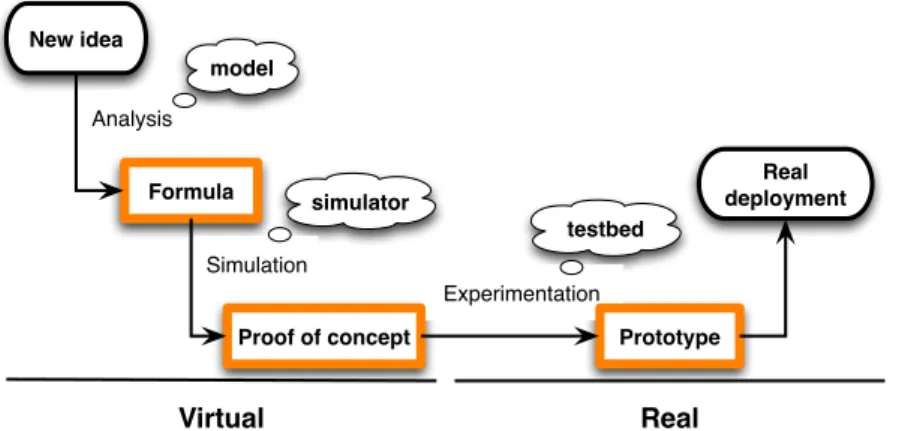
Simulators and testbeds are two important and complementary design and validation tools. In a typical research process cycle, once the modeling phase is done, network researchers and developers continue with the validation procedure in which they evaluate their concept by using either a simulator or an emulator. Later, network engineers and developers may proceed with experimentation to further cross-verify their proposal [Sto08]. Thus, once both the simulation performance and the experimental measurements are satisfactory, which actually means that the carried out mathematical analysis is validated, then real deployments can be initiated. Figure 2.1 illustrates a typical research process cycle as previously described.
In the WSN community there are number of simulators [EL+05] and open testbeds [Glu+11] available for researchers to perform simulation or experimental evaluation of their protocols or applications. However, there is always a concern about the retrieved results from such tools that they may not reflect the mathematical derivations.
Since we face complex environments that are very difficult to be theoretically analyzed and we also take into account the difficulties of setting up a real-world (e.g., large-scale) deployment, simulations are often considered as the optimal approach for studying the performance of wireless networks. Many open source and freely available simulators allow users to have a better control of the nodes by often employing a Graphical User Interface (GUI), and to retain or simplify some assumptions in order to evaluate their solutions. Simulation evaluation is a provisioning procedure during the protocol development. However, even if the simulation performance presents coherent results with mathematical analysis, past real-world deployments show that it is not recommended to proceed directly with real deployment since engineers may face unpredictable phenomena such as node crashing or network disconnection [Bar+08b], [Lan+06]. Intermediate experimentation platforms can therefore be considered to bridge the gap between simulations and real world