HAL Id: tel-00865011
https://tel.archives-ouvertes.fr/tel-00865011
Submitted on 23 Sep 2013
HAL is a multi-disciplinary open access archive for the deposit and dissemination of sci-entific research documents, whether they are pub-lished or not. The documents may come from teaching and research institutions in France or
L’archive ouverte pluridisciplinaire HAL, est destinée au dépôt et à la diffusion de documents scientifiques de niveau recherche, publiés ou non, émanant des établissements d’enseignement et de recherche français ou étrangers, des laboratoires
word recognition in L2 learners : lexical and sublexical
mechanisms
Eva Commissaire
To cite this version:
Eva Commissaire. Orthographic and phonological coding during L2 visual word recognition in L2 learners : lexical and sublexical mechanisms. Psychology. Université Charles de Gaulle - Lille III; University of Dundee - Ecosse -UK, 2012. English. �NNT : 2012LIL30007�. �tel-00865011�
Joint PhD/Doctorat degree
between
L’Université Lille Nord de France
Ecole Doctorale des Sciences de l’Homme et de la SociétéLaboratoire URECA and
The University of Dundee
School of PsychologyOrthographic and Phonological Coding
during L2 Visual Word Recognition
in L2 Learners:
Lexical and Sublexical Mechanisms
Eva Commissaire
Submitted for the degree of Doctor of Psychology Committee.
Pr. Séverine Casalis, Université Lille Nord de France Supervisor (France) Dr. Lynne G. Duncan, University of Dundee Supervisor (UK)
Pr. Yann Coello, Université Lille Nord de France Internal Examiner (France) Pr. Trevor Harley, University of Dundee Internal examiner (UK) Dr. Jonathan Grainger, Université Aix en Provence External Examiner (France) Dr. Walter Van Heuven, University of Nottingham External Examiner (UK)
I think, at a child's birth, if a mother could ask a fairy godmother to endow it with the most useful gift, that gift should be curiosity.
Quien aprende una nueva lengua adquiere una nueva alma
Juan Ramon Jimenez, Pensamientos
Table of Contents
Introduction
1Part
1.
Theoretical
Background
4
1. First section: On monolingual visual word recognition………. 7
1.1. On modelling visual word recognition in monolinguals. 7 1.2. Lexical access in monolinguals: methodology and some empirical findings 10
The lexical decision task and the masked priming paradigm 10
Identity & form priming 13
Orthographic neighbourhood using words as primes 14
Developmental perspective on visual word recognition 16
1.3. On Sublexical coding in visual word recognition 19
On letter coding 19
Another sublexical orthographic unit: graphemes 20
1.4. From orthography to phonology 23
Consistency effects 24
(Pseudo) homophone effects 25
Masked phonological priming 28
2. Second section. Lexical access in bilinguals……… 31
2.1. The debate on language-selectivity versus nonselectivity in lexical access 31 2.2. On cognates and interlingual homographs 32 2.3. On orthographic neighbourhood effects 36 2.4. On phonological interactions 39 2.5. The Bilingual Interactive Activation model 43
3. The present endeavour……….. 52
3.1 A brief review on L2 reading acquisition 53 3.2. Context of the present work 57 3.3. Main issues investigated in the present work 61
Part 2. Empirical contributions
67
Chapter 1. Lexical orthographic representations……….
68 Study 1. Within-language (L2) priming………69Method 78 Participants 78 Materials 78 Procedure 82 Results 83 Adults 83 Grade 8 children 84
Exploratory analysis of English specific words 86
Discussion 88 Study 2. On cognates……….. 94 Method 98 Participants 98 Materials 98 Procedure 101 Results 101 Discussion 104
Study 3. Cross-language Priming………..110
Part 1: L2- to- L1 priming 113
Experiment 1a 114 Method 115 Participants 115 Materials 116 Procedure 117 Results 118 Adults 118 Grade 8 children 121 Grade 6 children 123 Discussion 125
Follow-up study: Exploring the prime frequency effect 127 Experiment 1b. Instruction control 136 Method 136
Participants 136
Materials and Procedure 136
Results 137
Discussion 139
Part 2: L1- to- L2 priming 142
Experiment 2 144 Method 144 Participants 144 Materials 144 Procedure 145 Results 146 Discussion 149 Summary 150
Chapter 1. Intermediate Summary……… ..158
Chapter 2. Sublexical orthographic representations………
161 Study 4. Typicality experiment………..162Method 166
Participants 166
Materials 167
Procedure 169
Results 170
Grade 8 children and adults 170
Grade 6 children 176
Discussion 179
Study 5. Grapheme complexity……….187
Method 193 Participants 193 Materials 193 Procedure 195 Results 196 Adults 196 Grade 8 children 197 Grade 6 children 198 Discussion 199
Chapter 3. Sublexical orthography to phonology………. 207
Study 6. Pseudohomophone interference effect………...208 Experiment 1. Within-language homophony 212
Method 213 Participants 213 Materials 213 Procedure 214 Results 215 Discussion 217
Experiment 2. Cross- language homophony 217
Method 218 Participants 218 Materials 218 Procedure 220 Results 220 Discussion 222 Summary 224
Study 7. Cross-language phonological consistency. ………229
Method 235 Participants 235 Materials 236 Procedure 239 Results 239 Discussion 243
Part 3. General Discussion
2511. On lexical representations: cross- language interactions & lexical tuning 253 2. On sublexical orthographic coding 268 3. On the orthography- to phonology interface 275 4. Theoretical implications and conclusions 281
Appendices
322
Proficiency test. 323
Chapter 1.
Study 1. Within- language (L2) Priming 324 Study 2. Cognate Experiment 332 Study 3. Cross- language priming 337
Part 1. L2- to- L1 (experiments 1a and 1b) 337 Part 2. L1- to- L2 (experiment 2) 343
Chapter 2.
Study 4. Typicality Experiment 346 Study 5. Grapheme Experiment 351
Chapter 3.
Study 6. Pseudohomophone interference effect 354 Experiment 1. 354 Experiment 2. 356
Questionnaire 361
Remerciements.
Ces années de doctorat ont été riches en rencontres, collaborations et voyages. Mon sujet de thèse m’a permis d’allier mon insatiable désir d’apprendre, et de comprendre à mon penchant avéré de chanter plusieurs langues. Quelques remerciements s’imposent donc.
Je souhaite tout d’abord remercier Séverine Casalis pour m’avoir fait découvrir la recherche et permis d’étudier un sujet qui m’était cher. Merci de m’avoir soutenue dans mes choix tout en m’éclairant lorsque le doute pointait son nez...
I wish to thank you, Lynne Duncan, for your good advice and creativity which made me improve my work. Thanks for such a warm welcome in Dundee and for making me discover Dunkeld !!!.
Je remercie les directeurs de laboratoire qui m’ont accueillie, Jean- Claude Darcheville et Yann Coello, as well as all staff members of the University of Dundee who helped me integrate the school. Je tiens à saluer également les doctorants qui ont, comme moi, arpenté les couloirs de l’UFR. Merci Pauline pour avoir partagé ton expérience et tes conseils avisés, Lucie pour ta générosité et ta bonne humeur, Karinne pour nos discussions sur la recherche … et sur la vie, Mariama, Céline et tous les autres. I’d like to greet Katja, Matina, Laura, Shirley, Jens, and Carlos who I met in Dundee. We shared our scientific interests but also great coffee times and pub nights!
Un petit mot bien entendu pour les enseignants d’anglais, ou de français, ainsi que les directeurs d’établissements qui ont accepté de collaborer à ces projets. Et bien sûr, aux élèves et étudiants qui y ont participé.
Merci enfin à ma famille qui m’a encouragée à suivre la direction qui me plaisait et qui m’a soutenue dans chacun de mes déménagements ! Merci à mon compagnon, qui m’a aidé à traverser sereinement chaque étape de la thèse, et enfin à ma fille, née il y a 10 mois, qui m’a permis très vite de dormir toute la nuit !!
Abstract.
While major breakthroughs were made in the last decades on lexical access in highly proficient bilinguals, little is known about the development of lexical and sublexical orthographic representations in second language (L2) learners whose vocabulary is rudimentary. The present thesis attempted to fill this gap by examining visual word recognition mechanisms in French learners of English (Secondary Grade 6 and Grade 8 children; adults). While Chapters 1 and 2 focused on lexical and sublexical orthographic representations respectively, Chapter 3 examined the orthography to phonology interface. Masked orthographic priming techniques revealed that lexical orthographic representations were finely-tuned after only two years of acquisition and that this coding was comparable for words of varying orthographic typicality (Study 1). Evidence in favour of language non-selectivity during lexical access was uncovered: a cognate inhibition effect emerged in Grade 8 for lexical decision (Study 2). In addition, tests of cross-language orthographic neighbourhood effects using masked priming, revealed cross-language lexical competition in the highest proficiency group only (Study 3). Intriguing evidence of facilitation effects in lexical decision for L2 words whose orthography was shared across languages compared to words whose orthography was L2 specific signalled the influence of orthographic typicality during L2 visual word recognition (Study 4). Grapheme coding was also shown to be functional after only a few months of L2 learning, although differences emerged across proficiency levels in relation to the orthographic typicality of graphemes (Study 5). Finally, evidence was found for the parallel activation of print-to-sound correspondences from both languages in young L2 learners (Study 6) and for the influence of first language correspondences
on L2 visual word recognition (Study 7). While these findings have important theoretical implications for models of bilingual visual word recognition, the data also point to the need to intensify research on L2 learners for whom word recognition mechanisms may differ subtly from those of highly proficient bilinguals.
Résumé
Depuis ces dernières décennies, un nombre croissant d’études sur la reconnaissance visuelle de mots chez l’adulte bilingue a émergé dans la littérature, abordant principalement la question de la sélectivité à la langue versus non sélectivité de l’accès au lexique. Les chercheurs ont notamment rapporté la co- activation des représentations orthographiques lexicales de chaque langue dans les étapes initiales de l’accès au lexique, ainsi que l’activation parallèle et automatique des correspondances grapho- phonologiques de chacune des langues. Cependant, force est de constater que peu de données existent sur l’acquisition d’une langue seconde (L2) chez des apprenants encore peu compétents dans la L2, un cadre d’apprentissage très répandu dans les pays industriels étant l’apprentissage en contexte scolaire. Certains défis que doivent relever ces apprenants pour atteindre une reconnaissance rapide, efficace et automatique des mots en L2 représentent pourtant des questions théoriques pertinentes, qui, par la même occasion, permettent de soulever certaines faiblesses dans les modèles existants de la reconnaissance visuelle de mots chez le bilingue. Parmi ces acquisitions particulières, citons le cas des représentations orthographiques sublexicales spécifiques à la langue seconde, pour lesquelles l’apprenant doit constituer de nouvelles correspondances grapho- phonologiques (par exemple, des graphèmes spécifiques et leur(s) représentation(s) phonémique(s) correspondante(s)) ou encore celui des représentations orthographiques sublexicales partagées entre les deux langues, dont les correspondants phonologiques peuvent cependant être incompatibles. Après examen de la littérature monolingue et bilingue sur la reconnaissance visuelle de mots, le présent écrit de thèse consigne les différentes contributions empiriques de mon travail de doctorat sous forme
de trois chapitres. La population d’intérêt était constituée d’enfants et d’adultes francophone apprenant (ou ayant appris) l’anglais comme langue seconde en milieu scolaire, à raison de trois ou quatre heures hebdomadaires, sans autre exposition à cette langue (ni environnement familial bilingue, ni expérience linguistique dans le pays). Notons qu’une étude de ce travail était par ailleurs conduite chez des anglophones apprenant le français langue seconde. Tandis que les Chapitres 1 et 2 abordent des thématiques relatives aux représentations orthographiques lexicales et sublexicales respectivement, le Chapitre 3 est centré sur l’interface orthographe- phonologie.
Deux questions étaient soulevées dans le Chapitre 1. Tout d’abord, le niveau de
précision des représentations lexicales en L2 était évalué dans l’étude 1 afin de tester
l’hypothèse de « lexical tuning » développée par Anne Castles et ses collègues chez des enfants monolingues. Cette hypothèse suggère qu’au fur et à mesure de l’acquisition de vocabulaire écrit au cours de l’apprentissage de la lecture, le codage de l’identité et de la position des lettres, nécessaire à la formation de représentations orthographiques, deviendrait de plus en plus précis. Afin d’évaluer le degré de précision des représentations orthographiques en L2, une tâche de décision lexicale en anglais (L2) associée au paradigme d’amorçage masqué était proposé à des élèves francophones en classe de 4ème, après deux années d’acquisition de l’anglais, et à des étudiants en 1er cycle d’université, hors études linguistiques, ayant appris l’anglais pendant sept années lors de leur parcours scolaire. Trois conditions d’amorçage était constituées : amorçage identité (boat – BOAT), amorçage formel (doat – BOAT) et amorçage non relié (gick –
DOAT). Bien que les conditions d’amorçage identité et formel étaient supposées
condition d’amorçage non relié- l’idée sous- jacente était qu’une différence entre les conditions d’amorçage identité et formel refléterait l’existence d’un codage précis de l’identité des lettres. Afin d’évaluer l’influence de la typicalité orthographique sur le degré de précision des représentations, deux types de mots cibles étaient proposés : des cibles dites « spécifiques de l’anglais », dont l’orthographe est très typique de l’anglais du point de vue d’un francophone (par exemple, des mots tels que think), et des cibles dites « non spécifiques de l’anglais » dont la structure orthographique est au contraire légale en français (des mots tels que fire). Les résultats montrèrent un effet d’amorçage identité facilitateur, ainsi qu’une différence entre les conditions d’amorçage identité et formel, ceci de façon comparable chez les élèves de 4ème et les étudiants. Ce résultat, en faveur d’un codage précis de l’identité des lettres, était retrouvé indifféremment sur les mots cibles spécifiques et non spécifiques de l’anglais.
Les études 2 et 3 du Chapitre 1 visaient à évaluer dans quelle mesure un accès au lexique non sélectif à la langue pouvait être mis en évidence chez divers groupes d’apprenants L2, un phénomène jusqu’alors démontré chez des adultes bilingues très compétents uniquement. L’étude 2 visait plus particulièrement à examiner le traitement des mots « cognates », qui partagent la même orthographe et la même sémantique entre chaque langue (par exemple, silence), dans une tâche de décision lexicale en anglais, chez des élèves francophones en classe de 4ème. Un traitement différent des mots cognates par rapport à des mots contrôles était supposé refléter un accès non sélectif à la langue, cette différence de traitement indiquant la co- activation des deux langues lors de l’accès au lexique. Nos résultats étaient quelque peu dissonants avec la littérature puisqu’un effet inhibiteur des cognates était observé. La prise en compte de facteurs décisionnels tels que la confusion dans l’appartenance linguistique des mots cognates
était discutée dans l’interprétation de ce résultat. Un second mode d’examen de cette question de la non- sélectivité à la langue était proposé dans l’étude 3, par l’investigation de l’effet de voisinage orthographique inter- langue, associé au paradigme d’amorçage masqué. Plusieurs expériences étaient proposées, évaluant l’amorçage orthographique de la L2 vers la langue première (L1) et de la L1 vers la L2. Dans chacune des expériences, l’amorce était un mot, voisin orthographique inter- langue de la cible tel que le mot amorce français gare, voisin orthographique du mot cible anglais GAME. Cet amorçage par voisin orthographique était contrasté avec une condition d’amorçage non relié. Ces différentes expériences mettaient en évidence un effet d’amorçage d’inhibition chez les adultes, en particulier de la L2 vers la L1, reflet de la compétition lexicale inter- langue en faveur d’un accès au lexique non sélectif. Bien que cet effet n’était pas observé chez les participants enfants (élèves de 6ème et de 4ème), les résultats montraient une interaction entre la fréquence lexicale de l’amorce et l’effet d’amorçage obtenu, indiquant un certain degré de connectivité entre les deux lexiques.
Ces différentes études du chapitre 1 soulevaient ainsi des questions théoriques, déjà adressées chez l’adulte bilingue compétent, tandis que peu encore dans ce type de population. L’observation que peu de mots sont en réalité concernés par de fortes connexions inter- langues, du fait de la présence en anglais de structures orthographiques très spécifiques de cette langue, nous amena à considérer le codage des représentations orthographiques sublexicales.
Le chapitre 2 avait pour objectif de regrouper deux études ayant pour principal intérêt le codage orthographique sublexical. L’étude 5 consistait en une tâche de
décision lexicale en anglais (L2), présentée à des enfants de classe de 6ème, 4ème et à des étudiants, dans laquelle les stimuli étaient manipulés selon leur typicalité orthographique (mots spécifiques de l’anglais vs. mots non spécifiques de l’anglais). Le but était de déterminer dans quelle mesure cette variable sublexicale pouvait affecter le traitement en langue seconde. Le résultat majeur de cette étude consistait en un effet facilitateur dans les temps de réaction pour les mots anglais non spécifiques (dont l’orthographe est partagée entre les deux langues) par rapport aux mots spécifiques (dont l’orthographe est très typique de l’anglais, du point de vue francophone), ceci dès les premiers mois d’acquisition de la L2. Afin de mieux appréhender d’éventuels facteurs ayant pu influencer ce pattern, l’étude 6 était axée sur le codage du graphème en L2, une unité ortho- phonographique dont le rôle a été mis en évidence dans la reconnaissance visuelle de mots. L’objectif était de déterminer si le graphème était une unité fonctionnelle de la reconnaissance de mots en L2 d’une part, et de comparer, le cas échéant, le codage de graphèmes appartenant aux deux langues (non spécifiques tels que « ai », « ou ») de ceux spécifiques de l’anglais (tels que « ea », « oa »). Pour ce faire, trois catégories de mots étaient proposées dans une tâche de détection de lettre : ceux contenant des graphèmes simples (d’une lettre, tel que black), des graphèmes complexes non spécifiques (hair) ou spécifiques (beach). Les données obtenues indiquaient l’existence d’un codage du graphème en L2, ceci dès la classe de 6ème. Tandis que les élèves de 6ème présentaient un coût de traitement pour les graphèmes spécifiques de l’anglais par rapport aux non spécifiques, un codage comparable pour ces deux types de graphèmes complexes était cependant observé chez les étudiants, le pattern obtenu dans le groupe intermédiaire, les élèves de 4ème, étant quelque peu confus. Ainsi, ces deux études du Chapitre 2 permettaient d’explorer l’influence de facteurs sublexicaux dans la
reconnaissance visuelle de mots en L2, accentuant ainsi la particularité de la situation d’apprentissage d’une langue seconde par rapport au contexte monolingue et la nécessité d’examiner des groupes de compétences variables.
Le Chapitre 3, dont une des études composant ce chapitre était menée en Ecosse dans le cadre du Joint PhD, tentait d’intégrer à notre travail sur les représentations orthographiques une évaluation de l’interface entre orthographe et phonologie. Une particularité de l’acquisition d’une L2 dans ce cadre scolaire étant la faible exposition à la langue orale, et par conséquent, des capacités de décodage phonologique limitées, examiner l’activation phonologique en langue seconde et les interactions entre les correspondances grapho- phonologiques entre chacune des langues constituait un thème d’investigation incontournable. L’étude 6, réalisée en Ecosse, avait pour objectif de tester l’activation phonologique en français (L2) chez des élèves de 4ème/3ème anglophones, et, en particulier la co- activation des correspondances graphèmes- phonèmes de chaque langue. L’effet d’interférence par pseudohomophone était testé dans une tâche de décision lexicale en L2 : des pseudo-mots dont la phonologie correspondait à un mot réel, dit mot de base (par exemple, veet, pseudohomophone du mot français vite) étaient insérés parmi des pseudo-mots fillers, et comparés plus précisément à des pseudo-mots contrôles orthographiques (dans l’exemple précédent,
voet), partageant la même proximité orthographique avec le mot de base. Deux
expériences permettaient d’examiner l’effet de pseudohomophonie en intra- langue (en L2, en utilisant des pseudo-mots homophones grâce aux règles de correspondances françaises tel que rouje, pseudohomophone de rouge) et en inter- langue (en utilisant des pseudohomophones selon les règles de correspondances anglaises, tel que l’exemple
de veet). Dans ces deux cas, un effet d’interférence des pseudohomophones était observé, pour les erreurs en condition intra- langue (plus de fausses alarmes pour les pseudohomophones par rapport aux pseudo- mots contrôles), pour les erreurs et temps de réaction en condition inter- langue (plus de fausses alarmes ainsi qu’un temps de rejet correct plus long par rapport aux pseudo- mots contrôles). Ces résultats indiquaient une activation phonologique lors de l’accès au lexique en L2, et l’activation multiple des correspondances graphèmes- phonèmes quelle que soit leur langue d’appartenance. Enfin, la question de la (in)compatibilité inter- langue des correspondances graphèmes- phonèmes était abordée dans l’étude 7. Dans une tâche de détection de lettre en anglais (L2), deux types de mots étaient présentés: des mots compatibles dont la lettre à détecter avait un correspondant phonémique identique dans les deux langues (la lettre A dans
have se prononce /a:/ comme en français) et des mots incompatibles dont la lettre à
détecter avait un correspondant phonémique en anglais différent de celui en français (la lettre A dans take se prononce différemment de la correspondance majeure française « a » → /a:/). Les résultats indiquaient un effet de compatibilité pour tous les participants réunis, bien que peu net chez les élèves de 6ème. Détecter la présence d’une lettre était en effet plus rapide lorsque la correspondance grapho- phonologique de cette lettre était compatible avec celle du français par rapport à la condition incompatible, reflétant l’influence des associations déjà créées en L1, et ainsi la nature non sélective à la langue de l’activation phonologique en reconnaissance visuelle de mots.
Ces différentes études étaient interprétées dans le cadre théorique du « bilingual interactive activation model » de reconnaissance visuelle de mots mais des éléments explorés dans ce travail apportaient également de nouvelles pistes d’investigation chez le monolingue. Abordant diverses questions théoriques posées par l’apprentissage d’une
langue seconde, ce travail met en évidence la nécessité d’approfondir dans le futur les recherches sur les apprenants L2, pour qui les mécanismes de reconnaissance de mots pourraient se distinguer légèrement de ceux abondamment décrits chez les bilingues très compétents.
Learning a second language (L2) has become decisive for the population to adapt to the increasing globalized world. Learners of a L2 are faced with several challenges when beginning L2 acquisition. Firstly, new orthographic lexical representations must be learned and integrated to the lexicon. In adult learners, these representations may compete with first language (L1) lexical representations which are likely to be already highly specified during lexical access and efficiency therefore depends on some language control. The degree of precision of L1 lexical representations may not be as strong in child learners and the extent to which cross- language interactions may occur at the lexical level in this population could therefore be lower. Secondly, L2 learners must also build new sublexical orthographic representations such as graphemes that may be very specific to the L2 (e.g., “oa”, “ow” or “sh” for French learners of English). Even in the case of same- alphabet scripts such as French and English, the word recognition system must also compute more general orthographic sequences that may sometimes go against graphotactic rules from L1 (e.g., -ght) and the letters that compose them may be of low frequency in the L1 (e.g., w, y for French learners of English). Thirdly, these new language- specific graphemes must be connected to the corresponding phonemes. However, some difficulties may also be encountered for those graphemes that are legal in L1, given that the corresponding phonemes may be inconsistent with regard to the orthography- to- phonology correspondences from L1 (e.g., the grapheme “a” maps onto the phoneme /a/ in French but in multiple phonemic representations such as /a:/ but also /o/ or /eI/ in English). Though some of these issues such as lexical access in the bilingual lexicon or cross- language interactions of sublexical phonology have been examined in the literature on highly proficient bilinguals, there are as yet very few on- line word recognition studies
on these topics in L2 learners. The terminology may appear somewhat unclear given that L2 learners -as they will be referred to in the present work- could also be termed “bi – linguals” (i.e., as referring to individuals who speak two languages). So, the term “bilinguals” will be reserved for characterizing those individuals who have usually lived in a bilingual environment from an early age, and who have a high degree of mastery of the L2, and the term “L2 school learners” will be used to refer to the population that has learned a L2 in a standard school context, with usually little exposure to the language - limited to the school context- and rudimentary vocabulary. Given the relative paucity of research on L2 school learners’ visual word recognition, the goal was to examine several theoretical issues corresponding to the above- mentioned challenges that L2 learners must face and to provide an overview of word recognition mechanisms in L2 learners of varying proficiency. In spite of the wide theoretical background implied by the position taken in the present work, it was felt that examining several related theoretical issues that pose a challenge for L2 word recognition was the most appealing approach for this project. It is hoped that this doctoral work will enable the opening of new perspectives on L2 word recognition and that future opportunities may arise to pursue this goal further in order to expand on each of these topics.
Part 1.
The field of visual word recognition is a wide area of research, which has constantly been evolving over the last two decades. As a result of growing research using behavioural and electrophysiological data, we are progressively understanding more about how the cognitive system is able to successfully recognize thousands of words as rapidly as within a few milliseconds, by means of combinations of only a few letters (Diependaele, Ziegler & Grainger, 2010; Dufau, Grainger & Ziegler, 2012; Grainger, 2008; Grainger & Holcomb, 2009; Grainger & Jacobs, 1994, 1996; Jacobs, Rey, Ziegler & Grainger, 1998; McClelland & Rumelhart, 1981; see Dehaene, Cohen, Sigman & Vinckier, 2005 for a proposal on the neural correlates of word recognition). In the present work, we will consider visual word recognition as a hierarchical multi- stage process composed of various components, namely orthographic, phonological and semantic processes. We also focus our interest on activation-based and localist word recognition models which consider the existence of a lexicon (see Forster, Davis, Schoknecht & Carter, 1987 for an example of a search-based model of lexical access and Seidenberg & McClelland, 1989 for a parallel distributed model of word recognition). We present herein an overview of the theoretical approaches and empirical findings in monolingual and bilingual literature that are necessary to further understand the several studies that were conducted in the present work. Each of the essential theoretical elements will be further described in depth in each appropriate study introduction. This thesis examines the issue of language nonselectivity during lexical access in L2 school learners and explores the under- developed question of sublexical orthographic coding (see Figure 1 for an overview of experimental chapters). We further describe lexical access for both monolingual and bilingual individuals, that is, at the level of words themselves, and sublexical orthographic and phonological stages in the
word recognition process. The first section will expose theories and data coming from monolingual literature whereas the second section focuses on bilingual word recognition literature.
Figure 1. Presentation of the experimental chapters.
Chapter 1. Lexical representations Chapter 2. Sublexical orthographic representations Chapter 3. Sublexical orthography-to- phonology
Study 1. Within- language priming Study 2. Cognates
Study 3. Cross- language priming
Experiment 1a and 1b. L2- to- L1 priming Experiment 2. L1- to- L2 priming
Study 4. Orthographic typicality
Study 5. Grapheme processing
Study 7. Cross- language orthographic- to- phonology consistency Study 6. Pseudohomophone interference effect
Experiment 1. Within- language homophony Experiment 2. Cross- language homophony
1. First section: On monolingual visual word recognition.
We do not pretend to give an exhaustive review of monolingual visual word recognition, but to provide the theoretical tools that are needed to further comprehend the bilingual literature as well as our current work. Below is presented one major theoretical approach on visual word recognition in monolinguals followed by several main empirical findings on lexical access and sublexical orthographic and phonological coding.
1. 1. On modelling visual word recognition in monolinguals.
One of the historical and most prominent activation- based models that assume the existence of a « mental lexicon » is the Interactive Activation model (McClelland & Rumelhart, 1981). This model is qualified as such due to the activation that spreads along bidirectionnal connections between different levels. Indeed, the IA model proposes 3 levels of orthographic activation during word recognition: the feature, letter and word levels. These levels are interconnected with excitatory and/or inhibitory connections and the model postulates parallel and interactive processes. Features send activation to the corresponding letters, which in turn send activation to the corresponding words. Words in turn send activation and inhibition back to the letters. At the word level, words are connected to each other according to orthographic similarity. The links at this intra-level are inhibitory and this last concept has been referred to as lexical competition. Therefore, activation spreads along these different levels: words receive excitatory and inhibitory activations until a word candidate is selected and the
word is recognized.
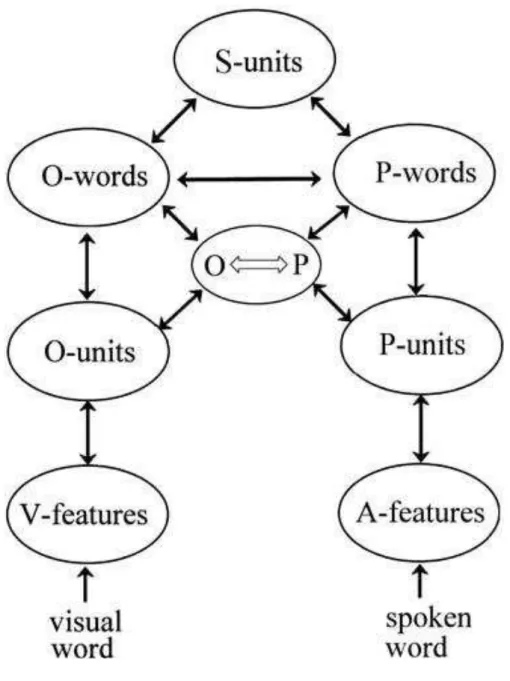
Following the principle of nested incremental modelling, many extensions of the IA model have been proposed in order to incorporate a response/decision module and task- specific mechanisms (i.e., the Multiple Read- Out Model, Grainger & Jacobs, 1994, 1996; Jacobs & Grainger, 1992 Jacobs et al., 1998, and more recently, the Leaky Competing Acumulator Model, Dufau, Ziegler & Grainger, 2012) and a phonological pathway to the lexicon (Diependaele, Ziegler & Grainger, 2010), and therefore adjust for earlier omissions from the model. The Bi-modal Interactive- Activation Model (BIAM, Grainger & Ferrand, 1994; Diependaele et al, 2010) integrates to the orthographic pathway a phonological pathway. It also includes sublexical and lexical activations in explaining word recognition, as well as an orthographic- to- phonology interface, similar to the grapheme- to- phoneme conversion from other models of reading aloud (i.e., the Dual-Route Cascaded Model by Coltheart, Rastle, Perry, Langdon & Ziegler, 2001; the Connectionist Dual Process approach to reading by Zorzi, 2010). The BIAM dual route model that distinguishes between a lexical and a nonlexical route from print to sound also provides an amodal semantic level that enables to explain the reading process in a more integrative fashion. The model is presented in Figure 2. As in the IA model, visual input activates orthographic features (V-features) that activate orthographic sublexical units (O-units, i.e., letters). These sublexical orthographic units directly connect to the orthographic lexicon (O-words) but also via the phonological pathway. These orthographic sublexical units can therefore be converted into phonological sublexical units (P-units) via a sublexical interface, which connect to the phonological lexicon (P-words). These multiple interactions inherent to the model enable to account for several empirical findings such as fast phonological
priming (see Rastle & Brysbaert, 2006 for a meta-analysis and review on fast phonological priming and Diependaele et al., 2010 for a simulation of this effect), and influences of orthography in spoken word recognition (Perre & Ziegler, 2008; Perre, Midgley & Ziegler, 2009).
Figure 2. Simplified overview of the architecture of the Bimodal Interactive Activation
Though not the focus of the present work, other theoretical endeavours have been provided to extend these models and more precisely explain sublexical orthographic processes in particular (i.e., letter identity and letter position coding), that slightly deviates from the original IA (Dandurand, Grainger, Duñabeitia & Granier, 2011; Grainger, 2008; Grainger & Jacobs, 1994; Grainger & Holcomb, 2009; Grainger & Ziegler, 2011). Again, although not debated here, note that other activation- based models that exclude the existence of a lexicon have also been proposed in word recognition literature, one of the major ones being the Parallel Distribution Processing model from Seidenberg and McClelland (1989).
1. 2. Lexical access in monolinguals: methodology and some empirical
findings
Before we turn to empirical findings that have contributed to the modelling of visual word recognition, we present some methodological aspects of our work.
The lexical decision task and the masked priming paradigm
One of the most commonly used tasks in the word recognition literature is the lexical decision task first developed by Rubenstein, Garfield, and Millikan (1970). This task implies word/nonword discrimination and is supposed to tap into lexical access process and to measure the various stages of sublexical and lexical activation. This task has been associated with the priming paradigm, which was suggested to be used with a
masked procedure by Forster and Davis (1984) in order to minimize the influence of episodic memory traces. It usually consists of presenting a prime word or nonword preceded by a forward mask (i.e., hashes for instance), and followed by a target word or nonword on which a response is generated such as a lexical decision or naming. In order to avoid any confounding perceptual variables, the prime is presented in lower-case while the target appears in upper-case. This enables the effects obtained to be more clearly interpreted as involving low-level perceptual processes as well as sublexical orthographic coding such as abstract letter identity coding. In the last decades, other procedures have been described such as the incremental priming technique which combines the classical comparison between priming conditions (i.e., related and unrelated) and reaction time progressions over time (i.e., by modulating prime duration presentation, De Moor, van der Herten & Verguts, 2007) or also the so-called “sandwich” priming (Lupker & Davis, 2009). The priming paradigm may be combined with a large range of tasks: lexical decision and naming tasks, but also semantic categorisation, cross-case same/different task to assess lower- level processes. The experimental technique has also been combined with neuroscience methodologies, such as EEG (Holcomb & Grainger, 2007) or MEG (Monahan, Fiorentino & Poeppel, 2008).
Note that some researchers consider the masked priming paradigm in terms of episodic memory accounts (Bodner & Masson, 1997, 2001; Masson & Isaak, 1999) and the lexical decision task as directly tapping into semantic processes (Plaut, 1999)1.
1
Advocates of the episodic account of masked priming effects (Bodner & Masson, 1997, 2001) suggest that visual word recognition taps into similar processes to any other memory phenomena and that episodic processes are constructed for prime words, even when masked. They found three main effects that were claimed to be incompatible with the Search model of visual word recognition (Forster and colleagues, 1987, 1991): 1) the identity priming effect for pseudoword targets, 2) the validity priming effect (i.e.,
However, the perspective taken in the present work is that the masked prime pre- activates sublexical and lexical representations of words in the lexicon (orthographic and phonological priming; but see also semantic masked priming studies, Perea & Gotor, 1997) for which its nature and time course of activation may be investigated.
The monolingual literature on visual word recognition has aimed to understand how a lexical candidate may be selected when a visual input is presented to an individual given the huge amount of words an expert reader ultimately recognizes. As a consequence of this interest, major efforts have been made to understand the nature and time course of the different activations that arise in the word recognition system. We specifically focus on orthographic and phonological activations during lexical access, and exclude here any review of morphological or semantic variables. This brief review which is necessary before we turn to bilingual recognition issues will combine empirical findings on orthographic variables that affect visual word recognition (investigated within the masked priming paradigm) as well as on phonological representations that are simultaneously activated during lexical access.
stronger identity priming effect when presenting a high proportion of identity primes as compared to when presenting a low proportion) and 3) the frequency attenuation effect (i.e., stronger identity priming effect for low frequency target words as compared to high frequency target words). In our view, these data are though likely to be interpretable within the Interactive Activation framework (McClelland & Rumelhart, 1981) and may not constitute evidence against lexical interpretations of visual word recognition. It is also felt that the finding of a “Visual Word Form Area” at the occipito- temporal junction –independent of any semantic variables- by neurophysiological research also supports lexical accounts of masked priming, rather than memory or semantic interpretations (Cohen et al., 2000; Dehaene et al., 2002).
Identity & form priming
Identity priming effects using a masked priming procedure were first
investigated by Evett & Humphreys (1981) on target detection errors, and Forster & Davis (1984, experiment 1) on target reaction times. In all cases, facilitation priming effects have been found, that is faster reaction times on the target word when preceded by an identity priming condition (e.g., the same word, boat – BOAT) as compared to an unrelated condition (e.g., dark – BOAT) or a neutral condition (e.g., xxxx – BOAT, Segui & Grainger, 1990b, experiment 2). This facilitation priming effect has been shown not to interact with target frequency (Bodner & Masson, 1997; Forster & Davis, 1984, experiments 1, 5 and 6; Segui & Grainger, 1990a experiment 4, Segui & Grainger, 1990b) but to do so with target neighbourhood size (Perea & Rosa, 2000). Identity facilitation effects have also been demonstrated in English-speaking children, as early as Primary Grade 1 (Castles, Davis & Letcher, 1999; Pratarelli, Perry & Galloway, 1994).
Form priming refers to the presentation of a target word preceded by an
orthographically similar word or pseudoword. Since lexicality of the prime has been shown to be a crucial factor in priming studies (see Mathey, 2001 for a review), only the case of pseudoword primes is considered here while the literature using words as primes is described further in the “orthographic neighbourhood using words as primes” section. Form priming effects (e.g., doat - BOAT) have commonly been shown to be facilitatory. However, several variables have been shown to affect the pattern of results, leading to either facilitatory or null effects. Effects have been shown to depend on 1) target length: facilitatory effects were reported for eight- letter words, while null effects for four- letter
words (Forster, Davis, Schoknecht & Carter, 1987), 2) target neighbourhood size: the
density constraint hypothesis suggests that facilitatory effects are expected only for
target words whose neighbourhood size is low (Forster & al, 1987; Forster & Davis, 1991; Forster & Taft, 1984; Perea & Rosa, 2000), 3) prime-target shared neighbourhood: facilitatory effects are reported only when prime and target share no common neighbour word, while null effects are observed when one such neighbour can be identified, such as the case of slort – SPORT which also activates the neighbour word short (Hinton, Liversedge & Underwoord, 1998, experiment 2 with partial ambiguous vs. unambiguous primes, van Heuven, Dijkstra, Grainger & Schriefers, 2001 with nonword primes), and 4) prime duration of presentation or SOA: form priming effects seem to disappear as early as after 60 ms SOA in French (Ferrand & Grainger, 1992, 1993, 1994).
Orthographic neighbourhood using words as primes
As compared to identity and form priming effects which have been shown to be commonly facilitatory, manipulation of orthographic neighbourhood using words as primes has tended to show inhibitory priming effects. The neighbourhood frequency
effect using a masked priming procedurewas first reported by Segui & Grainger (1990a, experiments 2 and 3) who found that low frequency target words were responded to more slowly when preceded by an orthographically related higher frequency prime word (e.g., boat – GOAT) as compared to a control condition (e.g., fire – GOAT). This effect was further confirmed by many studies (Bijeljac- Babic, Biardeau & Grainger, 1997; Davis & Lupker, 2006; De Moor & Brysbaert, 2000; De Moor, van der Herten &
Verguts, 1997; Dijkstra, Hilberink- Schulpen & van Heuven, 2010; Nakayama, Sears & Lupker, 2008) though the strength of the inhibition effect appears to vary according to several factors: 1) prime neighbourhood size: inhibition priming effects were reported to occur whatever prime frequency when primes and targets had a large neighbourhood size but only for high frequency prime condition when prime and targets had few neighbors (Nakayama et al., 2008), 2) shared prime-target neighbourhood: inhibition effects tend to be stronger for no shared neighbour priming conditions as compared to one shared neighbour conditions (Davis & Lupker, 2006, experiment 2; but see Nakayama et al., 2008 for contradictory results) and 3) neighbourhood distribution: an inhibition priming effect emerges only when in a prime/target pair, the information shared by the neighbouring word is spread over different letter positions (e.g., loge in the pair robe – LOBE, meaning respectively lodge, dress and lobe); null effects are however reported when the shared information occurs in the same letter positions (e.g.,
tard in the pair lard - FARD, meaning respetively late, bacon and blusher, Mathey,
Robert & Zagar, 2004). Recent studies from Andrews and colleagues have also revealed individual differences in that inhibition priming effects resulting from lexical competition only emerge in skilled readers (Andrews & Hersch, 2010; Andrews & Lo, 2012).
Note that neighbourhood effects have also received a large attention from studies using standard word recognition tasks, without any priming procedure (see Mathey, 2001 for a review). A facilitatory effect of neighbourhood size has been reported by Andrews (1989, 1992) in the lexical decision task. Regarding the neighbourhood frequency effect, the pattern of results seems to be dependent upon several variables, one of which is the task used. Neighbourhood frequency effects have been shown to be
either inhibitory (Davis, Perea & Acha, 2009 using deletion and addition neighbours; Grainger, 1990, Grainger & Segui, 1990, Grainger, O'Regan, Jacobs & Segui, 1989, 1992) or null (Forster & Shen, 1996) in the lexical decision task; rather inhibitory in the perceptive identification task (Carreiras, Perea & Grainger, 1997; Grainger & Segui, 1990) though depending on visibility (Sears, Lupker & Hino, 1999, experiments 1 & 2), but rather facilitatory in the naming task (Grainger, 1990; Sears, Hino & Lupker, 1995). Other variables have been shown to influence these patterns such as strategies and decision processes (such as the type of pseudowords used in the lexical decision task, Grainger & Jacobs, 1996; Mathey & Zagar, 2000 or guessing strategies in the identification task, Forster & Shen, 1996; Paap & Johansen, 1994), the language used (Andrews, 1997) and those phonological processes inherent to the task (especially regarding the different patterns between the lexical decision and the naming tasks, Andrews, 1992).
Developmental perspective on visual word recognition
The issue of the developing lexicon and of associated coding mechanisms at different ages/grade levels has recently been attracting increasing interest2. The manner in which orthographic and phonological coding take place during visual word recognition in monolingual children and how these mechanisms become fast, highly specified and automatic constitutes a large field of investigation that
2
We should note that though uncovering the on- line aspects of reading may constitute a new field in the literature, developmental theories of reading acquisition have been considerably discussed these last fifty years (see for instance proposals of Ehri, 2005 or Share, 1995). This literature will not be described in the context of this work.
ultimately will help to inform studies of L2 acquisition. Empirical findings using the masked priming paradigm such as identity and form facilitation priming effects commonly observed in monolingual adults have also been found in children (Booth, Perfetti & MacWhinney, 1999; Castles, Davis, Cavalot & Forster, 2007; Castles, Davis & Letcher, 1999; Pratarelli, Perry & Galloway, 1994; see also Janiot, 2011’s doctoral dissertation for a thorough examination of masked orthographic priming in French children attending Primary Grades 3 and 5). Further, assessment of the influence of orthographic neighbourhood at different reading levels has also enabled developmental mechanisms that lead to expert reading to be uncovered. With regard to neighbourhood size effects, Castles et al. (1999) revealed that form facilitation priming effects occurred for both large and small neighbourhood size target words in children from Grades 2, 4 and 6 while only for small neighbourhood size targets in adults. Using the standard lexical decision task, results were found to be contradictory. While Duñabeitia & Vidal- Abarca (2008) reported faster reaction times for target words that had a large neighbourhood size as compared to small one in Spanish children attending Grades 1- to- 6 (see also facilitation effects in error data reported by Laxon and colleagues, 1988, 2002, no effects were reported by Dufau and colleagues (2010) in French children from Grades 1- to- 5 (see also null effects reported by Marinus & De Jong, 2010 using the naming task in children from Grades 2 and 4). With respect to neighbour frequency effects, Marinus & De Jong (2010) found that Grade 2 children and dyslexic children of comparable reading level, but not Grade 4 children, were slower when asked to name words that had a high frequency neighbour as compared to words that did not have it. Using the masked priming paradigm, Janiot (2011)’s doctoral work revealed that the
neighbourhood frequency inhibition priming effect commonly reported in adults (Davis & Lupker, 2006; De Moor & Brysbaert, 2000; De Moor, Van der Herten & Verguts, 1997; Nakayama, Sears & Lupker, 2008; Segui & Grainger, 1990a) was observed in children in very limited circunstances. Not only were prime words more frequent than target words, but there also was a shared high frequency neighbour word between the prime and the target. Using this material, the inhibition priming effect, supposed to reflect lexical competition (McClelland & Rumelhart, 1981) was only observed in children attending Grade 5 and who had high orthographic processing skills. Null effects were reported for Grade 5 children with poor orthographic skills and all children from Grade 3, whatever their level of orthographic skill (see recent findings from Andrews and colleagues, 2010, 2012, emphasizing the influence of spelling skills in showing inhibition priming effects in adults). This experiment reveals that lexical competition is a late- developing mechanism within the word recognition system which develops after some number of years of reading exposure, and may not even emerge in all readers. This competition between orthographic lexical representations that emerges with reading acquisition could also be related to the progressive change in the tuning of these word representations, this latter phenomenon further referred to as the lexical tuning hypothesis (Castles et al., 1999, 2007) and fully described in Study 1. This hypothesis indeed postulates that orthographic representations become more and more fine- tuned as vocabulary grows (see also recent findings from Marinus & De Jong, 2010 using the naming task); this developmental mechanism could be theoretically related to the inhibitory links being formed in the lexicon (Castles et al., 2007). More recent contributions from Grainger & Ziegler (2011) on multiple routes
in learning to read are considered in experimental chapters and general discussion of the current work.
1. 3. On Sublexical coding in visual word recognition
Word recognition cannot be restricted to lexical access and its investigation should involve the different stages that contribute to the integration of various sublexical units (such as letters, graphemes or bodies) into a word representation, and access to this word representation, or lexical access (Grainger & Dijkstra, 1996; see the interactive activation model, McClelland & Rumelhart, 1981). In models of monolingual word recognition, the orthographic sublexical unit that is most represented and investigated is the letter unit. However, other sublexical orthographic units have been investigated and proved to be functional during visual word recognition.
On letter coding
In the IA model, the orthographic sublexical level is referred to as a letter level. Both letter identity and letter position must be coded in order to accurately recognize the word. In this initial model, letter strings are assumed to be processed in parallel by a set of length- dependent, position-specific letter detectors. This absolute letter position coding has however been modified over new models inspired from IA into a relative position coding mechanism. Indeed, two lines of evidences have been provided: 1) transposed- letter priming effects found with transposed word primes (e.g., trail –
pseudoword primes (e.g., cholocate – CHOCOLATE; (TL priming; Perea & Lupker, 2003, 2004; Perea & Carreiras, 2006) and 2) relative-position priming (De Moor & Brysbaert, 2000; Perressotti & Grainger, 1999) assessed by presenting a prime word that contain the target word but differs in length (e.g., spend – SEND; see Grainger, 2008 for a review on both of these effects). This relative position coding scheme is more flexible and would better support the view that other sublexical units can be used during word recognition, one of interest in the present work being graphemes. Note that very recent theoretical premises from Grainger & Ziegler (2011) suggest the existence of a dual sublexical orthographic route to reading involving both a fine- grained route (that codes the orthographic input into chunks such as graphemes and is able to then convert these into phonemes) and a coarse- grained route (that codes the input into open- bigrams).
The “typicality” of letter sequences has received little attention in monolingual visual word recognition research. Orthographic typicality has been described as “the frequency of [their] component letter pairs (bigrams) and triplets (trigrams)” (Hauk, Patterson, Woollans, Watling, Pülvermüller & Rogers, 2006, p. 818) and is therefore a sublexical orthographic metric reflecting the frequency of its orthographic components. Orthographic typicality (i.e., comparing typical vs. atypical words or pseudowords) was reported by these authors to have an effect at around 100 ms using an EEG procedure, prior to any lexical effects (i.e., difference between words and pseudowords).
Another sublexical orthographic unit: graphemes
Graphemes can be considered as the written correspondent of oral phonemes (Berndt, Reggia & Mischurg, 1987) and can therefore be considered as functional
phono- graphemic units. Graphemes can be constituted of only one letter also called “simple graphemes” such as in the case of the four graphemes M, A, S and K from the word mask, but also of two or more letters, called “complex graphemes”, such as the grapheme EA in the word meat.
Recent empirical findings using pseudoword naming (Rastle & Coltheart, 1998; Joubert & Lecours, 2000) or letter detection within words (Rey & Schiller, 2005; see also Rey, Jabobs, Schmidt- Weigand & Ziegler, 1998) have yielded evidence that graphemes have a role as perceptual units during visual word recognition. Interestingly, Rey, Ziegler & Jacobs (2000) showed in both French and English that detecting a letter embedded in a complex grapheme (e.g., detecting the letter “A” in the word beach) was slower than detecting this same letter when mapped onto a simple grapheme (e.g., such as the “A” in the word black). This grapheme complexity effect is supposed to occur because complex graphemes composed of multiple letters such as EA compete with its constituent single- letter graphemes E and A. This competition would therefore slow down word identification. Importantly, this graphemic complexity effect was reported to be independent of phonemic effects which show additive effects though (Rey et al., 2000, experiment 2; Rey & Schiller, 2005; see more explanations in Study 5).
Models such as the Interactive Activation model of visual word recognition (McClelland & Rumelhart, 1981) or the Dual- Route Cascaded model of reading aloud (Coltheart et al., 2001) give little account of graphemes as an orthographic unit per se. Only letters were considered by the IA model and this may be explained by the fact this model only took into account the orthographic route to reading. In the DRC model, the graphemic effect found in the naming task (i.e., longer latencies for words composed of complex graphemes as compared to single graphemes, length controlled, Rastle &
Coltheart, 1998) is explained as the effect of a serial letter- by- letter print- to- sound processing. For complex graphemes, the system would first convert the first letter into a phoneme. Only when the second letter of the grapheme comes into the view would the system code the entire grapheme as a phoneme3. This delay, also called the “whammy effect” (Rastle & Coltheart, 1998) is thus assumed to occur at the sublexical orthographic- to- phonological conversion level, but no orthographic graphemic level
per se – different from the letter level- is postulated. The most recent modifications
made to these two models have, however, included a stage dedicated to grapheme parsing, prior to the grapheme- to- phoneme conversion mechanism, called the two- layer associative network (TLA, Houghton & Zorzi, 2003). Indeed, the Bimodal Interactive Activation Model or BIAM presented Figure 2 (Diependaele et al., 2010; Grainger & Holcomb, 2009) now integrates local representations for graphemes and gives some account for grapheme parsing, based on the connectionist dual- route model of spelling of Houghton & Zorzi (2003). Graphemes are therefore considered within this framework as functional units relevant to the orthographic- to- phonology conversion, but also as an independent sublexical orthographic mechanism (i.e., grapheme parsing) that would operate prior to the conversion to phonological units (Joubert & Lecours, 2000; see also CDP+ model by Perry, Ziegler & Zorzi, 2007). Recent theoretical proposal from Grainger & Ziegler (2011) for a “dual- route approach to orthographic
3
Note that there are contradictory findings with regard to whether both letters of a complex grapheme are slowed down in the letter detection task (see Marinus & de Jong, 2011; Peereman, Brand & Rey, 2006) or whether only the second letter is concerned by this delay (see Brand, Giroux, Puijalon & Rey, 2007, although they use a slightly different letter detection procedure). While beyond the scope of the present work, this issue has important theoretical implications as to whether grapheme parsing and grapheme- to- phoneme conversion mechanisms may be considered as serial versus parallel processes.
processing” however seems to make a subtle difference as compared with these former models in that graphemes seem to operate at the lexical orthographic level –as well as at the sublexical orthographic- to- phonology conversion level- as an intermediate level between letters and the orthographic lexicon –along with a more coarse- grained code composed of contiguous and non-contiguous bigrams (see General Discussion for more details and Figure 6).
Note that other sublexical units have been investigated such as syllables (Ans, Carbonnel & Valdois, 1998; Carreiras & Perea, 2002) or onset- nucleus- coda units (Nuerk, Rey, Graft & Jacobs, 2000; Plaut, McClelland, Seidenberg & Patterson, 1996; see Carreiras & Grainger, 2004 for a review).
1.4 From orthography to phonology
Though word recognition could theoretically be performed directly from the visual input to the orthographic lexicon, a large consensus among modellers now supports the idea of automatic activation of phonological code during silent reading. Yet, while models such as the DRC (Coltheart et al., 2001) consider a rather slow phonological activation as compared to orthographic activation, others argue instead for a fast phonological activation (Diependaele et al., 2010; Perry, Ziegler & Zorzi, 2007). Evidence for the activation of phonological codes during visual word recognition comes from research on consistency effects, homophone and pseudohomophone effects, and phonological masked priming.
Consistency effects
Research on consistency effects have largely focused on spelling- to- sound word body consistency (e.g., “eard” in the word beard). The seminal study by Glusko (1979) showed that low frequency inconsistent words such as pint where the body “int” may be sounded out as /int/ or /aint/ were named more slowly than consistent words such as deep where “eep” is always pronounced /i:p/. This effect is seen to reflect “the parallel mapping of a single sublexical orthographic form (letter or letter cluster) onto several sublexical phonological forms (phonemes or phoneme clusters) that then compete following the principle of within-level lateral inhibition” (Grainger & Ziegler, 2008, p. 137). This effect has also been demonstrated in the lexical decision task (Gibbs & van Orden, 1998; Treiman, Mullenew, Bijeljac- Babic & Richmond- Welty, 1995) though the effect tends to be much smaller. This difficulty in observing this spelling- to- sound consistency effect in the lexical decision task was first thought to support the concept of a “delayed” phonological involvement in visual word recognition, an idea that is supported by the dual route model of word recognition and reading aloud by Coltheart et al. (2001). The underlying mechanism in this model is supposed to involve a slow nonlexical route to word recognition, also called assembled phonology, which has to compete with a faster direct lexical route, also called addressed pathway. The small or absent effect of spelling- to- sound consistency effect in the lexical decision task was therefore thought to reflect low phonological involvement in this task -note that phonology plays a much stronger role in the naming task given that phonemic buffer and articulatory processes are involved. Yet, spelling- to- sound consistency, also called feedforward consistency, is not the only consistency variable involved in word
recognition. It has also been shown that sound- to- spelling consistency, or feedback consistency, may interfere with visual word recognition. As an example, a word such as
heap contain a word body “eap” which is feedforward consistent in that it always lead
to the rime /i:p/. Yet, this rime /i:p/ may correspond to two different spellings, either “eap” as in our example or “eep” such as in the word deep. This feedback inconsistency has been shown to slow down latencies in the lexical decision task (Stone, Vanhoy & Van Orden 1997; Ziegler, Montant & Jacobs, 2007; but see Ziegler, Petrova & Ferrand, 2008 for contradictory findings), in support of a fast -and not delayed- involvement of phonology in this task. Note that though consistency effects have been largely studied at the level of the word body in the English language, cross- language comparisons have revealed that this variable may operate at different grain sizes depending on the orthographic transparency of the language (Goswami, Ziegler & Richardson, 2005). Other research has used smaller graphemic units as the index of consistency of the word -termed in this research field either regular or irregular words- and reported similar effects (Coltheart et al., 2001; Rey & Schiller, 2005; Taraban & McClelland, 1987).
(Pseudo) homophone effects
Other types of studies that have demonstrated the involvement of phonology in visual word recognition have focused on homophone (e.g., sail – SALE) or pseudohomophone (e.g., sail – SAYL) effects. Rubenstein, Lewis & Rubenstein (1971) first studied the role of phonological activation in visual word recognition by manipulating the relative frequency of the two readings of homophonic pairs of words. They observed that response latencies in a lexical decision task were longer for the less
frequent word of a homophonic pair of words (e.g., sail in the homophonic pair sail -
SALE) compared to control nonhomophonic words. They interpreted this effect as
reflecting the initial activation of the more frequent word of the homophonic pair and the confusion resulting from the presentation of the less frequent word entailed a spelling checking procedure that delayed word recognition. Using pseudohomophones in a lexical decision task, Coltheart, Davelaar, Jonasson & Besner (1977) first found that pseudohomophones took longer to be rejected than control graphemic pseudowords (see also Braun, Hutzler, Ziegler, Dambacher & Jacobs, 2009; Briesemeister, Hofmann, Tamm, Kuchinke, Braun & Jacobs, 2009 and Seidenberg, Petersen, MacDonald & Plaut, 1996 using the same task). This effect was also found in the semantic categorization task (Van Orden, 1987; Van Orden, Johnston & Hale, 1988), in the naming task (Grainger, Spinelli & Ferrand, 2003; McCann & Besner, 1987). This effect was also reproduced by recording eye movements (Inhoff & Topolski, 1994; Sparrow & Miellet, 2002), pupillary responses (Briesemeister et al., 2009) and ERPs (Braun et al., 2009; Briesemeister et al., 2009) in both isolated words and sentences. In both lexical and semantic decision tasks, pseudohomophone items were shown to slow down responses in comparison with orthographic controls (e.g., brane and prain for respectively pseudohomophone and orthographic control of the baseword brain). Note that orthographic similarity between pseudohomophones and orthographic controls has been shown to be a crucial factor to take into account when manipulating pseudohomophones: a pseudohomophone and its orthographic control should both be orthographic neighbours’ of the same baseword (Marmurek & Kwantes, 1994), or at least share the same amount of orthographic overlap with the baseword. This is important in order to interpret the pseudohomophone effect as reflecting phonological
activation. Indeed, if any difference arises between the two types of items, it should not be explained by the pseudohomophones being more “word- like” than the orthographic control. In the lexical decision task, the interference effect was interpreted as arising from a conflict between phonological and orthographic representations4. Contrary to orthographic control pseudowords (e.g., prain), pseudohomophones (e.g., brane) are able to activate lexical phonological representations (e.g., /brein/) and this activation indicates to the system the presence of words. Given that these pseudohomophones do not strongly activate lexical orthographic representations, a conflict arises which takes time to be solved. Another interpretation arising from the Multiple Readout Model of Orthographic and Phonological processes (MROM-p) of Jacobs et al. (1998) suggests that the interference effect could be explained by an increased global lexical activity in the system. While both pseudohomophones and orthographic control pseudowords activate the orthographic lexicon, pseudohomophones also activate the phonological lexicon and this top- down feedback to the orthographic lexicon increases the global lexical activity5. This enhanced global lexical activity following the presentation of a pseudohomophone leads to the readjustment of the temporal threshold that is used to respond “no” to the task: either this temporal deadline is delayed leading to longer response times for pseudohomophones as compared to orthographic controls, or the activation of the lexicon is driven above the temporal deadline and an error is therefore
4
Note that pseudohomophones were reported to be be facilitated as compared with control pseudowords in the naming task (princeps study by McCann & Besner, 1987) and this was interpreted as an advantage at the level of articulatory trajectories (Seidenberg et al., 1996 using both immediate and delayed naming tasks).
5
Similar interpretations in terms of increased global lexical activity were made by Jacobs et al. (1998) to explain neighbourhood size effects shown in pseudoword responses.