HAL Id: hal-00023400
https://hal.archives-ouvertes.fr/hal-00023400v2
Submitted on 23 May 2006HAL is a multi-disciplinary open access archive for the deposit and dissemination of sci-entific research documents, whether they are pub-lished or not. The documents may come from
L’archive ouverte pluridisciplinaire HAL, est destinée au dépôt et à la diffusion de documents scientifiques de niveau recherche, publiés ou non, émanant des établissements d’enseignement et de
First-order transitions for some generalized XY models
Aernout C D Van Enter, Silvano Romano, Valentin A Zagrebnov
To cite this version:
Aernout C D Van Enter, Silvano Romano, Valentin A Zagrebnov. First-order transitions for some gen-eralized XY models. Journal of Physics A: Mathematical and General (1975 - 2006), IOP Publishing, 2006, 39 (26), pp.439-445. �10.1088/0305-4470/39/26/L03�. �hal-00023400v2�
ccsd-00023400, version 2 - 23 May 2006
First-order transitions
for some generalized XY models
Aernout C. D. van Enter
Centre for Theoretical Physics Rijksuniversiteit Groningen Nijenborgh 4 9747 AG Groningen THE NETHERLANDS [email protected] Silvano Romano
Unit`a di Ricerca CNISM e Dipartimento di Fisica “A.Volta” Universit`a di Pavia via A. Bassi 6 I-27100, Pavia ITALY [email protected] Valentin A. Zagrebnov Universit´e de la M´editerran´ee Centre de Physique Th´eorique
Luminy - Case 907 F-13288, Marseille, Cedex 9
FRANCE
May 23, 2006
Abstract. In this note we demonstrate the occurrence of first-order transitions
point out the connection between them and annealed site-diluted (lattice-gas) continuous-spin models.
1
Introduction
In some recent papers [28, 8, 25, 24] a class of generalized XY models was intro-duced and studied. These models are ferromagnetic and, in the simplest case, restricted to a nearest-neighbour XY - type interaction. In contrast to the plane
rotator interaction, they involve 3-component spins (just as the classical
Heisen-berg model does) and they possess an O(2) symmetry with respect to the X and Y components. This part is multiplied by a product of single-site terms, depending on the third (Z) component only, which is raised to an exponent p > 0. In the following, this factor will be simply called “single-site term”.
For p = 1 one recovers the standard ferromagnetic XY model, in which the in-teraction is defined by the scalar product of the nearest neighbour spin projections on the XY - plane.
With the help of some correlation inequalities it was found [28] that in d = 2 there is a transition between a low-temperature Berezinskiˇı-Kosterlitz-Thouless (BKT) phase and a high-temperature phase, whereas, in d ≥ 3 dimensions, the existence of magnetic order at low temperatures was established.
The nature of this transition, however, was left open in these works. In d = 2 one might expect either a BKT scenario (an infinite-order transition between the BKT phase and a high-temperature phase), which was found when this exponent p is small, or a first-order one between the BKT phase and the high-temperature phase , and in d = 3 there may be an ordinary second-order transition (again found for small p), or a first-order transition. Recall that the first-order transition means coexistence of different infinite-volume Gibbs measures. Here this implies a jump in the energy density, in d ≥ 3 (but not in d = 2) accompanied by a jump in the magnetisation.
In this note we point out that, by a minor adaptation of the reflection posi-tive chessboard-estimates analysis for free-energy contours (which goes back to [9, 21] and which was recently applied to study magnetic transitions for nonlinear classical vector spin models in [12, 13, 14, 4, 22]), the occurrence of a first-order transition for sufficiently large values of the exponent p can be proven. Such a transition was already suspected to occur in d = 2, based on the numerical data of [24]. In the last part of our paper we compare this result with further numerical data.
We remark that with some small modifications our analysis covers also the case of the first-order, instead of e.g. a BKT infinite-order, transition in some
an-nealed diluted lattice-gas models (see [6], [18], Sect. 2.4, and [7]), and even in some continuum magnetic systems [19]. In this case the role of the nonlinearity is played
the particle density [19]. This becomes in particular evident, when we consider the model of [28] in the square-ditch approximation, see (2). Then the generalized XY model reduces to an annealed site-diluted plane rotator model.
With minor modifications we can also treat generalized Heisenberg interac-tions for n-vector spins with n≥ 3 or annealed dilute Heisenberg models. In that case we expect that in d = 2 there will be a transition between two phases with ex-ponentially decaying correlations, similarly to what is expected for the nonlinear models of [12, 13].
2
Model, proofs and results
For general background on the theory of Gibbs measures on lattice systems we refer to [11, 16, 17, 32, 31]. The method of reflection positivity and chessboard estimates [27] is reviewed in [30] and in the last 4 chapters of [16]. The fact that our models satisfy the property of reflection positivity follows immediately from the conditions described there.
Our systems are as follows. On each site of the lattice Zd we have a three-component unit spin, described by spherical coordinates φ and θ; our models are then described by a nearest neighbour generalized XY interaction, i.e. the plane rotator interaction in the φ-variables combined with a product of p-powers of single-site terms in the θ-variables [28]. For a finite Λ⊂ Zdthe (dimensionless) Hamiltonian reads:
HΛ(φ, θ) := − X hi,ji⊂Λ
[sin(θi) sin(θj)]pcos(φi− φj) (1)
The integer exponent p > 0 is a parameter in our model, and a large value of p means that spins can only interact noticeably when they are in a narrow ditch around the equator θ = π/2, whose width is of order O(1/√p). This narrow and deep ditch plays a similar role as the narrow-well potentials of [12, 13, 4].
We present our proof for the two-dimensional model where the ditch has a
square, instead of a polynomial, shape. Extensions to polynomial shapes then can
be done as in [12, 13, 4]. Indeed, our proof can be seen to be almost a corollary of these papers, to which we refer for further details.
So, we consider the square-ditch approximation of the generalized XY model (1) with Hamiltonians
HεΛ(φ, θ) := − X hi,ji⊂Λ
where 1ε(x) denotes, for 0 ≤ ε ≤ π/2, the characteristic function of the interval [π/2 − ε, π/2 + ε].
The square-ditch approximation (2) implies that two spins can interact only when they both are in the ditch; in other words, one can interpret (2) as the Hamil-tonian of annealed site-diluted plane rotator model with lattice-gas occupation numbers n = 0, 1, as discussed in [6, 7], and as is also suggested by the notation.
Notice that the (a priori) one-site distribution on those occupation numbers is induced by the uniform probability (Haar) measure µ0(dφ, dθ) := dφ dθ sinθ/4π on the unit sphere. Therefore, ε is related to the chemical potential ν that governs the lattice-gas overall particle density. By the standard definition of the lattice-gas chemical potential the relation becomes:
ν = β−1ln sin ε
1 − sin ε , (3)
where β−1 = Θ denotes the (dimensionless) temperature of the system. Hence at fixed temperature the chemical potential becomes negative and large in mag-nitude when ε is close to zero, which corresponds to a small lattice-gas density; whereas for ε → π/2, i.e. for ν → +∞, one obtains a non-diluted plane rotator model (2) with n(θj) = 1 for all {θj}j.
For the proof we consider in a two-dimensional lattice a square Λ, of a linear size N which is a multiple of 4, with periodic boundary conditions. Associated to Hamiltonians HΛ
ε(φ, θ) are Gibbs measures µΛ(dφ, dθ) = 1
ZΛexp[−βH Λ
ε(φ, θ)]µΛ0(dφ, dθ) , which are reflection positive (RP). Here
µΛ0(dφ, dθ) :=Y j∈Λ
µ0(dφj, dθj)
denotes the rotation-invariant product measure, and β is the dimensionless in-verse temperature.
RP is the key property for the chessboard estimates. They allow us then, follow-ing e.g. [13], to obtain contour estimates. First we can establish the estimate on the partition function
ZΛ≥ 1
and furthermore, by integrating over intervals|θ| ≤ ε and |φ| ≤ π/20, we see that also
with constants C1 and C2 = cos(π/20) (which is close to 1) which are independent of ε.
On the other hand, let us call a site ordered, if the spin on that site, as well as all its neighbours, are in the ditch, and disordered, if it is not in the ditch, and consider the same universal contour as in [30, 13], consisting of alternating diagonals at distance 2, which, in turn, consist of ordered and disordered sites (separated by sites which are neither); thus we find that the restricted partition function obtained by integrating all configurations compatible with the universal contour satisfies
Zuniv−contΛ ≤ ((2ε)3/4exp(β))|Λ|. Then, just as in the proof of Theorem 1 of [12] we obtain
ZΛ univ−cont
ZΛ ≤ ε
|Λ|/(4+C3)
with C3 some constant determined by the choice of C1 and C2.
This implies by standard arguments that, when ε is chosen small enough, con-tours separating ordered and disordered sites are suppressed, uniformly on a tem-perature Θ interval; since at low temtem-peratures most sites are ordered and at high temperatures most sites are disordered, there will be a temperature, where disor-dered and ordisor-dered phase(s) (or infinite-volume Gibbs measures) coexist.
We notice that by the Mermin-Wagner theorem [23, 10, 20, 26], in two dimen-sions all Gibbs measures are rotation-invariant, so that the spontaneous magneti-sation is necessarily zero. Since the results of [28] imply that the generalized XY models (1) at low temperatures display a BKT phase, our present statement says that for these models with high-exponent-p-potentials the transition between this phase and the high-temperature one is first-order.
In the three-dimensional version of the model (1), however, the low-temperature phase is magnetized, but again the transition in temperature to the high-temperature regime is first-order.
Notice also that in general proofs involving contour arguments do not provide very sharp estimates about the optimal parameter values for which a first-order transition appears, therefore we will not pursue this road. Below we discuss what we expect to be the situation based on numerical data, that is, which is the value of the parameter p above which one might expect the first-order transition to appear. Before ending this section, let us go back in some more detail to the lattice-gas interpretation of the square-ditch approximation (2).
The theorem just proven implies that, for d = 2, the XY lattice-gas model pos-sesses a first-order transition on a suitable curve in the (Θ, ε)-plane.
This answers an open question from [7] about the first-order phase transition in d = 2 diluted plane rotator model (2). On the whole our results complement those of [7, 19] and [28] for this model, since they concern different parts of the phase diagram in the (Θ, ν)- or in the (Θ, ε)-plane, as well as the mechanism of the phase transition.
For example, in [19] the existence of the low-temperature BKT phase in the di-luted plane rotator model is proven for a relatively large positive ν, but without any conclusion on the mechanism connecting low-temperature and high-temperature behaviour. On the other hand, the Ginibre and the Wells inequalities applied to this model (in the same way as it was done for the generalized XY model in [28]) ensure the existence of a low-temperature BKT phase for any bounded ν, but again without conclusion on the mechanism of the transition.
Moreover, the same analysis leads also to the existence of a low-temperature BKT phase for generalized XY models with annealed site-dilution, for all ν, simi-larly to what happens for the plane rotator model.
In [7] the first-order phase transition with simultaneous jumps of magnetiza-tion and particle density was established in the d > 2 diluted plane rotator model in some domain of both types of ν (positive and negative) at very low temperatures. In the present note we find (as a byproduct of our generalized-XY-model analy-sis) a first order-phase transition in the diluted plane rotator model (2) for moderate
negative ν, since we consider in (3) sufficiently small ε as well as sufficiently small
Θ. As mentioned before, this answers positively the question from [7] about the first-order phase transition in model (2), at least for those ν.
Based on [6], one knows that staggered states may be involved in the mech-anism of a first order transition at positive chemical potentials, at intermediate temperatures; this will not happen in the regime of negative chemical potentials which is covered by our results.
3
Related results and extensions
Extensions of the above theorem to other pair interaction potentials are also pos-sible.
For example, the models studied in [12, 13, 14, 4] involve n−component spins for any (n ≥ 2) and possess an O(n) symmetry. Indeed, their interactions are functions of the scalar product between the two interacting spins, having the shape of a narrow well.
The spin interaction in [18], Sect. 2.4, is of the same type and may be viewed as a diluted version of the Patrascioiu-Seiler model with a narrow-ditch interaction. For discussion of its low-temperature phase see e.g. [1].
The proof scheme indicated above works for various combinations of single-site terms and nearest neighbour interaction terms, of which at least some need to have a narrow shape. The spins can be n-component spins, and the symmetry can be either O(n) or O(2) or some symmetry in between. For example, we might have narrow-ditch site potentials (as mentioned above), or narrow-well single-site potentials as in [9], as well as well interactions ([12, 13, 14]) or narrow-ditch interactions (see [18], Sect. 2.4, and [2]). The interactions can have one well (or ditch) for ferromagnets, two (for liquid crystal models, possessing RP(n−1) symmetry), or more and could also include diagonal nearest neigbour terms (as in [22], inspired by the model of [29]). The narrowness of such terms then either creates or reinforces the first-order behaviour.
Another kind of possible extensions is related to quantum versions of our mod-els. This observation is inspired by the recent paper [2], which studies, in partic-ular, a non-linear quantum XY model. The main ingredient for their arguments is the quantum RP property, which is a quite subtle matter, but the ferromagnetic quantum XY model does verify it. Since in (2) the interaction terms are multiplied by simple single-site classical random variables (the scalar occupation numbers), the square-ditch Hamiltonian also verifies the quantum RP property. Then accord-ing to [2] we can claim the existence of the first order phase transition in this quantum model, since we proved it for the classical model (2) and we know that its quantum analogue verifies the quantum RP property.
4
Numerical estimates of transition orders and
tem-peratures
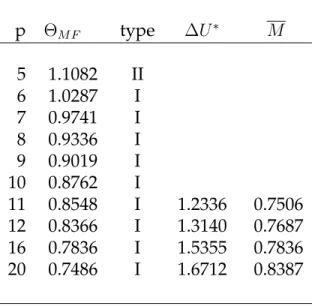
When d = 3, a Mean Field (MF) study of the ordering transition is at least qual-itatively correct, and relatively feasible in computational terms; moreover, this treatment can be refined by using various cluster-variational techniques; we used here a Two-Site Cluster (TSC) approach, and both treatments follow Ref. [28]. Cal-culations were carried out for 5≤ p ≤ 12, and then p = 16, 20.
In both cases we found that, upon increasing p, the transition changes from second to first order; the two treatments exhibited different thresholds, i.e. a threshold of p between 5 and 6 for MF, and a threshold of p between 10 and 11 for TSC; re-sults of both treatments are presented and compared in Tables (1) and (2), where first-order transitional properties, such as the energy jump, ∆U∗, and the order pa-rameter at the transition, M , are shown for p≥ 11, where both treatments predict a first-order transition.
first-order transition for any p≥ 6 in sufficiently high dimension.
On the other hand, simulation results, obtained for d = 3 and to be reported elsewhere [5], show a second-order transition for p = 8, and suggest a first-order one for p = 12, 16, 20.
Acknowledgements
A.v.E. and V.A.Z. thank Senya Shlosman for the very enjoyable earlier collabora-tions on reflection positive models, which directly led to the proof given above. We also thank Christof K ¨ulske for a helpful remark.
References
[1] M. Aizenman. On the slow decay of O(2) correlations in the absence of topological excitations: remark on the Patrascioiu-Seiler model. J.Stat.Phys., 77:351–359, 1994.
[2] M. Biskup, L. Chayes and S. Starr. Quantum spin systems at finite tempera-ture. arXiv:math-ph/0509017, to appear in Comm.Math.Phys., 2006.
[3] M. Biskup and L. Chayes. Rigorous analysis of discontinuous phase transi-tions via mean-field bounds. Commun.Math.Phys., 238:53–93, 2003.
[4] M. Biskup and R. Koteck ´y. Forbidden gap argument for phase transitions proved by means of chessboard estimates. Commun. Math. Phys., 264:631-656, 2006.
[5] H. Chamati and S. Romano. Article in preparation.
[6] L. Chayes, R. Koteck ´y and S. B. Shlosman. Staggered phases in diluted sys-tems with continuous spins. Commun.Math.Phys., 189:631–640, 1997.
[7] L. Chayes, S. B. Shlosman and V. Zagrebnov. Discontinuity of the Magneti-zation in Diluted O(n)-Models. J.Stat.Phys., 98: 537–549, 2000.
[8] H. Chamati, S. Romano, L. A. S. M ´ol and A. Pereira. Three-dimensional generalized XY models: A Monte Carlo study. Europhysics Lett., 72:62–69, 2005.
[9] R. L. Dobrushin and S. B. Shlosman. Phases corresponding to the local min-ima of the energy. Selecta Math. Soviet., 1: 317–338, 1981.
[10] R. L. Dobrushin and S. B. Shlosman. Absence of Breakdown of Con-tinuous Symmetry in 2-dimensional Models of Statistical Physics. Com-mun.Math.Phys., 42:31–40, 1975.
[11] A. C. D. van Enter, R. Fern´andez, and A. D. Sokal. Regularity properties and pathologies of position-space renormalization-group transformations: Scope and limitations of Gibbsian theory. J. Stat. Phys., 72:879–1167, 1993.
[12] A. C. D. van Enter and S. B. Shlosman. First-Order Transitions for n-Vector models in Two and More Dimensions: Rigorous Proof. Phys. Rev. Lett.,
89:285702, 2002.
[13] A. C. D. van Enter and S. B. Shlosman. Provable First-Order Transitions for Nonlinear Vector and Gauge Models with Continuous Symmetries.
Com-mun.Math.Phys., 255:21–32, 2005.
[14] A. C. D. van Enter and S. B. Shlosman. First-order transitions for very nonlin-ear sigma models. Arxiv cond-mat/0506730, Markov Proc.Rel.Fields,to appnonlin-ear, 2006.
[15] J. Fr ¨ohlich and E. H. Lieb. Phase Transitions in Anisotropic Lattice Spin Sys-tems. Commun.Math.Phys., 60:233–267, 1978.
[16] H.-O. Georgii. Gibbs Measures and Phase Transitions. Walter de Gruyter (de Gruyter Studies in Mathematics, Vol. 9), Berlin–New York, 1988.
[17] H.-O. Georgii, O. H¨aggstr ¨om and C. Maes. The random geometry of equi-librium phases. Phase transitions and critical phenomena (C. Domb and J.L. Lebowitz, Eds.), vol. 18, Academic Press, London, 2001.
[18] H.-O. Georgii and V. Zagrebnov. Entropy-Driven Phase Transitions in Multi-type Lattice Gas Models, J.Stat.Phys., 102: 35–67, 2001.
[19] C. Gruber, H. Tamura and V. Zagrebnov. Berezinskiˇı-Kosterlitz-Thouless Or-der in Two-Dimensional O(2)-Ferrofluid, J.Stat.Phys. 106: 875-893, 2002. [20] D. Ioffe, S. B. Shlosman and Y. Velenik. 2D Models of Statistical Physics with
Continuous Symmetry: The Case of Singular Interactions. Commun. Math.
[21] R. Koteck ´y and S. B. Shlosman. First-order transitions in large entropy lattice models. Commun.Math. Phys., 83:493–515, 1982.
[22] A. Messager and B. Nachtergaele. A Model with Simultaneous First and Sec-ond Order Phase Tranditions. Arxiv cSec-ond-mat/0501229, J.Stat.Phys., 122:1– 14, 2006 .
[23] N. D. Mermin and H. Wagner. Absence of Ferromagnetism or Antiferro-magnetism in One- or Two-Dimensional Heisenberg Models. Phys. Rev. Lett., 17:1133–136, 1966.
[24] L. A. S. M ´ol, A. R. Pereira, H. Chamati and S. Romano. Monte Carlo study of generalized XY models. Eur. J. Phys B, to appear, 2006.
[25] L. A. S. M ´ol, A. R. Pereira and W. A. Moura-Melo. On phase transition and vortex stability in the generalized XY models. Phys. Lett. A, 319:114–121, 2003. [26] C.-E. Pfister. On the Symmetry of the Gibbs States in Two-dimensional Lattice
Systems. Commun. Math. Phys., 79:181–188, 1981.
[27] The method of Reflection Positivity was developed by F. J. Dyson, J. Fr ¨ohlich, R. B. Israel, E. H. Lieb, B. Simon and T. S. Spencer in a series of papers. It is described in the last chapters of [16] or in [30]. The chessboard estimate method goes back to [15].
[28] S. Romano and V. Zagrebnov. On the XY model and its generalizations. Phys.
Lett. A, 301:402–407, 2002.
[29] S. B. Shlosman. Phase transitions for two-dimensional models with isotropic short-range interactions and continuous symmetries. Commun. Math.Phys., 71: 207–212, 1980.
[30] S. B. Shlosman. The method of reflection positivity in the mathematical the-ory of first-order phase transitions. Russian Mathematical Surveys, 41: 83–145, 1986.
[31] B. Simon. The Statistical Mechanics of Lattice Gases, Vol 1. Princeton Univer-sity Press, Princeton N.J., 1993.
[32] Ya. G. Sinai. Theory of Phase Transitions: Rigorous Results, Pergamon Press, Budapest, 1982.
Table 1: MF results for transitional properties of the generalized XY models in three dimensions, obtained with different values of the exponent p.
p ΘM F type ∆U∗ M 5 1.1082 II 6 1.0287 I 7 0.9741 I 8 0.9336 I 9 0.9019 I 10 0.8762 I 11 0.8548 I 1.2336 0.7506 12 0.8366 I 1.3140 0.7687 16 0.7836 I 1.5355 0.7836 20 0.7486 I 1.6712 0.8387
Table 2: TSC results for transitional properties of the generalized XY models in three dimensions, obtained with different values of the exponent p.
p ΘT SC type ∆U∗ M 5 1.1011 II 6 1.0416 II 7 0.9935 II 8 0.9537 II 9 0.9199 II 10 0.8907 II 11 0.8659 I 0.3242 0.3994 12 0.8461 I 0.5437 0.5098 16 0.7906 I 1.0097 0.6721 20 0.7549 I 1.2578 0.7374