HAL Id: tel-03231522
https://tel.archives-ouvertes.fr/tel-03231522
Submitted on 20 May 2021HAL is a multi-disciplinary open access archive for the deposit and dissemination of sci-entific research documents, whether they are pub-lished or not. The documents may come from teaching and research institutions in France or abroad, or from public or private research centers.
L’archive ouverte pluridisciplinaire HAL, est destinée au dépôt et à la diffusion de documents scientifiques de niveau recherche, publiés ou non, émanant des établissements d’enseignement et de recherche français ou étrangers, des laboratoires publics ou privés.
Investigation of the cycling mechanisms in silicon and
germanium-based Lithium-ion batteries by ex-situ and
operando X-ray scattering techniques
Diana Zapata Dominguez
To cite this version:
Diana Zapata Dominguez. Investigation of the cycling mechanisms in silicon and germanium-based Lithium-ion batteries by ex-situ and operando X-ray scattering techniques. Materials Science [cond-mat.mtrl-sci]. Université Grenoble Alpes [2020-..], 2020. English. �NNT : 2020GRALY048�. �tel-03231522�
THÈSE
Pour obtenir le grade de
DOCTEUR DE L’UNIVERSITE GRENOBLE ALPES
Spécialité : Physique de la matière condensée et durayonnement
Arrêté ministériel : 25 mai 2016
Présentée par
Diana ZAPATA DOMINGUEZ
Thèse dirigée par Sandrine LYONNARD et Codirigée par Stéphanie POUGET
préparée au sein des laboratoires Modélisation et Exploration des Matériaux (MEM) et Systèmes Moléculaires et
nanoMatériaux pour l'Énergie et la Santé (SyMMES) dans l'École Doctorale Physique de Grenoble
Etude par des techniques de diffusion des
rayons X ex-situ et operando des
mécanismes de (de)lithiation dans les
batteries Lithium-ion à base de silicium et
germanium
Investigation of the cycling mechanisms in
silicon and germanium-based Lithium-ion
batteries by ex-situ and operando X-ray
scattering techniques
Thèse soutenue publiquement le 18 décembre 2020, devant le jury composé de :
Mme. Fannie ALLOIN
Directrice de recherche, LEPMI CNRS, Présidente du jury Mme. Kristina EDSTRÖM
Professeur, Ångström Advanced Battery Centre (ÅABC), Examinatrice
Mme. Laure MONCONDUIT
Directrice de recherche, CNRS-Université de Montpellier, Rapportrice
Mme. Montserrat CASAS CABANAS
Coordinatrice scientifique, CIC energiGUNE, Rapportrice
Mme. Nathalie HERLIN-BOIME
3
Acknowledgments
I would like to acknowledge all the people without this manuscript, I would not have been possible and made my Ph.D. a successful and exceptional work. I would like to start thanking my jury committee, who carefully read and evaluated this manuscript, and I greatly acknowledge the interesting discussion we had during my thesis defense.
These three years have been formidable, and there were thanks to my supervisors, Sandrine Lyonnard and Stephanie Pouget, who welcome me for the first time at the best place to do synchrotron x-ray and neutron experiments at the same time (as Sandrine usually says): the ESRF and ILL in Grenoble. Sandrine Lyonnard and Stephanie Pouget’s unwavering enthusiasm, support, and encouragement have made it possible to finish this excellent research work and exciting experience. I sincerely thanked you to involved me in the Sintbat project, which enriches my experience with different materials and techniques.
I would not be able to produce great images of the thesis manuscript without Samuel Tardif, who introduce me to python and matplolib; neither fit all those scans obtained from the operando synchrotron measurements. To Natalie Herlin-Boime from CEA Saclay, who supplied us with the nanoparticles that make this research possible. I would like to express my deepest gratitude to our collaborators Pierre-Henri Jouneau and Praven Kumar, who made possible the complementary information obtained with the diverse microscopy techniques. To Michel Bardet and Anton Buzlukov, who measured our
4 samples using solid-state 7Li-NMR. To Cedric Haon and Willy Porcher for the
pouch cell preparation during the synchrotron experiments.
I would like to thank the beamline scientists at the BM02, ID 31, and ID20, especially Christoph Sahle and Chiara Cavallari, who introduced me to the XRS technique and helped me with the data analysis.
I would like to express my thanks to Christopher Berhaut, who was extraordinarily helpful in setting up challenging experiments at the synchrotron and whose company made easier this thesis and the different beamtime allocations at the ESRF, ILL, SOLEIL, and the FRM II. Besides, thanks for introduce me to climbing, la via ferrata, and Euromillion on Friday nights.
I want to thank my colleagues from the IRIG institute, the Ph.D. students, and post-docs who helped in this long journey every day. For instance, Jérôme Faure-Vincent, Antony Valero, Marc Dietrich, Adrien Mery, Manon Berthault, Caroline Keller, Guilhem Paradol, Nino Modesto, Sirine Layouni, Carolina Saavedra, Nicolas Martinez, and Claire Tougne, I would like to thank every coffee, meal, wine, or beer shared with you. I had a wonderful time in Grenoble, thanks to you. To Asma Medjahed, my co-bureau, I thanked you for the French grammar and speaking classes which improved my fluency, the cakes with tea every Friday (at least during the first year), the must-go places in Grenoble, and the P90X lessons. P.D. I know that you will read this one day
; it is your favorite part of the thesis.
5
Résumé de la thèse
Les batteries Li-ion sont une solution de choix pour le stockage de l’énergie. Augmenter leurs performances requiert le développement de matériaux qui peuvent insérer de plus grandes quantités d’ions lithium (batteries de haute densité d’énergie). De ce point de vue, le silicium et le germanium sont des materiaux actifs prometteurs pour les anodes, grâce à leurs capacités théoriques (1623 et 3576 mAh/g, respectivelment) plus élevées que celles de l’état de l’art, c’est-à-dire le graphite (372 mAh/g). Toutefois, les réactions d’alliages au cours de la lithiation provoquent des variations volumiques très importantes dans le Si et le Ge, ce qui induit des déformations mécaniques préjudiciables au fonctionnement à long terme des anodes. Par conséquent, étudier en détail les mécanismes de lithiation pendant le cyclage est essentiel pour comprendre et limiter les processus de dégradation.
Un certain nombre de stratégies ont été proposées pour augmenter la cyclabilité et la durabilité de ces matériaux. L’une d’entre elle repose sur l’emploi de nanostructures, qui permettent de réduire la pulvérisation et la dégradation des phases actives. Cependant, l’utilisation de nanoparticules favorise la formation d’une couche interfaciale, appelée SEI (Solid Electrolyte Interphase), qui induit une diminution de la capacité réversible et, de fait, limite la cyclabilité. Une approche alternative consiste à utiliser des matériaux composites dans lesquels le silicium est mélangé avec d’autres composantes actives ou inactives. Toutefois, la quantité de silicium incorporé (moins que 20% dans l’anode) reste faible et les capacités obtenues limitées.
6 Le germanium a été beaucoup moins étudié que le silicium. Bien que moins abondant que le silicium, il possède des propriétés très intéressantes, en plus de sa capacité théorique élevée : une meilleure conductivité électronique et une meilleure diffusivité des ions lithium que le silicium. Mélanger le Ge au Si est ainsi une possibilité prometteuse, permettant d’augmenter la capacité par rapport au graphite et de bénéficier de la grande stabilité du Ge.
Cette thèse porte sur l’étude des mécanismes de (dé)lithiation dans des anodes pour batteries lithium-ion à base de silicium et germanium. Nous avons étudié d’une part des nanoparticules de Si, Ge et d’alliages Si-Ge, et d’autre part un matériau composite commercial. Nous avons utilisé des techniques de diffusion de rayonnement operando pour caractériser les mécanismes de lithiation et la formation des phases Li15(Si100−xGex)4, obtenant des résultats
en accord avec les prédictions théoriques sur les propriétés de ces matériaux en cours de cyclage. Nous avons également exploré le potentiel de la spectroscopie Raman au synchrotron, pour étudier la composition de la couche d’interface électrode-électrolyte, permettant de quantifier sa composition en fonction de l’état de charge de l’anode.
7
Abstract
Lithium-ion batteries (LiBs) are one of the best solutions for energy storage. Increasing the performance of LiBs demands the use of materials that can host higher quantities of lithium ions (high energy density). Germanium and silicon are promising active anode materials due to their high theoretical capacities (1623 and 3576 mAh/g, respectively) compared to the commercial graphite (372 mAh/g). However, Si and Ge experience significant volume expansion upon the alloying-dealloying reactions with lithium-ions, provoking mechanical deformation. Understanding the mechanisms during cycling is essential to provide information about the degradation processes.
There are different strategies to improve the cyclability and durability of these materials. Using nanostructures is one of them, as it allows mitigating the pulverization and the active compound degradation. Nevertheless, the use of active nanoparticles favors the formation of a solid electrolyte interface layer (SEI), inducing a decrease of the reversible capacity and consequently limiting the cyclability. An alternative approach is to use composite materials in which silicon is mixed with other active or inactive components. However, to date, the silicon amount is limited (less than ~20% of the anode), decreasing the anode capacity.
Ge has received less attention than Si. Although it is less accessible than silicon, it has appealing characteristics besides its high theoretical capacity, such as better electronic conductivity and Li diffusivity than Si. Therefore,
8 mixing Ge with Si is interesting with respect to benchmark graphite to provide an increase in capacity while taking advantage of Ge stability.
This thesis aims at studying the (de)lithiation mechanisms in silicon and germanium-based negative electrodes, focusing on two types of systems: pure Ge, Si, SiGe-alloys nanoparticles, and a commercial-grade silicon-based composite. The structural evolution occurring upon (de)lithiation was probed mainly by operando X-ray scattering techniques, allowing to propose a detailed description of the lithiation mechanisms, as well as Li15(Si100−xGex)4 formation
process, which support theoretical predictions on the physical properties of these materials during cycling. Besides, we explored the potentialities of synchrotron X-ray Raman scattering to gain insight into the Solid Electrolyte Interphase (SEI) composition, providing insights into the SEI evolution and its dependence on the state of charge. Our in-depth multi-techniques characterizations bring knowledge to design better Si-based anodes for high-density long-lasting batteries.
9
Contents
Acknowledgments ... 3 Résumé de la thèse ... 5 Abstract ... 7 Introduction ... 15 Bibliography ... 19 1. Introductory concepts ... 21 1.1 Li-ion batteries ... 211.2 Operando studies in Li-ion batteries ... 24
1.3 Negative electrodes based on the first three elements of the group IV. ... 26
1.4 Lithiation mechanism in Si and Ge based electrodes ... 27
1.4.1 Silicon ... 28
1.4.2 Germanium ... 35
1.4.3 SiGe alloys ... 41
1.4.4 Composites ... 47
1.5 The solid electrolyte interphase ... 50
1.5.1 SEI model ... 51
1.5.2 The role of LiF ... 52
1.5.3 The role of the electrolyte additives ... 53
1.5.4 The role of the binder ... 53
1.5.5 Studying the SEI chemical environment ... 54
1.6 Summary and aim of the thesis ... 55
10
2. Materials and methods ... 65
2.1 Materials ... 65
2.1.1 Crystalline nanoparticles-based materials ... 65
2.1.2 Composite materials ... 67
2.2 Electrochemical characterizations... 68
2.2.1 Galvanostatic cycling with potential limitation (GCPL) ... 68
2.3 X-ray diffraction characterization... 71
2.3.1 Operando and in-situ XRD to study negative electrodes for LiB ... 75
2.3.2 Wide and small-angle X-ray scattering for LiBs (WAXS/SAXS) ... 78
2.4 X-ray Raman scattering (XRS) spectroscopy ... 81
2.5 Bibliography ... 85
3. (De)Lithiation mechanism of crystalline germanium nanoparticles ... 87
3.1 Introduction ... 87
3.2 Structural and morphological characterization of crystalline germanium nanoparticles pristine powder ... 88
3.2.1 Electrochemical characterization of c-Ge Nps ... 90
3.3 Post-mortem 7Li NMR on crystalline Ge nanoparticles ... 91
3.3.1 7Li NMR environments during lithiation ... 92
3.3.2 7Li NMR environments during delithiation ... 94
3.4 Operando XRD studies during lithiation/delithiation ... 96
3.4.1 Full lithiation: amorphization of crystalline Ge ... 97
3.4.2 Partial lithiation... 100
3.4.3 Complete lithiation: formation of highly lithiated phases ... 110
3.5 Conclusion ... 119
11
4. De(lithiation) mechanism of Si100−xGex alloys ... 125
4.1 Introduction ... 125
4.2 Characterization of Si100−xGex and Si pristine powders ... 127
4.2.1 Morphological and structural characterization ... 127
4.2.2 Electrochemical characterization of Si100−xGex alloys Nps electrodes ... 138
4.3 Operando XRD studies during lithiation of Si100−xGex alloys ... 140
4.3.1 Qualitative observations ... 142
4.3.2 Quantitative analysis of the diffraction data ... 143
4.3.3 Formation of the Li15(Si100−xGex)4 phases ... 150
4.4 Conclusion ... 158
4.5 Bibliography ... 160
5. Lithiation mechanism of a silicon-graphite industrial composite anode . 163 5.1 Introduction ... 163
5.2 Morphological and chemical composition of the composite ... 165
5.2.1 Characterization of the a-Si/c-FeSi2 alloy in powder ... 166
5.2.2 Characterization of the pristine negative electrode ... 167
5.3 Characterization of the composite anode by Operando small-angle and wide-angle X-ray scattering (SAXS and WAXS)... 169
5.3.1 Principle of the measurement ... 169
5.3.2 Cells and cycling conditions (Figure 5.3a) ... 171
5.3.3 SAXS/WAXS set-up (Figure 5.3b) ... 172
5.3.4 Experimental data (Figure 5.3 c–d) ... 172
5.4 Analysis of data: lithiation and delithiation mechanism ... 174
5.4.1 Analysis of the WAXS data ... 175
5.4.2 Analysis of SAXS data: information and evolution of silicon phase ... 178
12
5.6 Perspectives ... 189
5.7 Bibliography ... 190
6. Capabilities of X-ray Raman scattering (XRS) for investigating the chemical environment in Si-based electrodes ... 193
6.1 Introduction ... 193
6.2 Aim and approach to investigate the SEI in electrodes by XRS ... 197
6.3 XRS spectra of reference compounds ... 200
6.3.1 C K and O K edge ... 201
6.3.2 F K and Li K edge ... 203
6.3.3 Conclusions on reference spectra ... 203
6.4 c-Si Nps electrodes: observation of the SEI evolution ... 204
6.4.1 Electrochemical lithiation of c-Si Nps ... 204
6.4.2 Qualitative analysis of the XRS spectra for the c-Si Nps electrode ... 205
6.4.3 A quantitative study of the XRS spectra or the c-Si Nps electrode ... 211
6.4.4 Conclusion of the XRS analysis in c-Si Nps ... 217
6.5 a-Si/c-FeSi2/graphite composite electrodes: observation and evolution of the SEI……...219
6.5.1 Electrochemical lithiation of the a-Si/c-FeSi2/graphite electrodes ... 219
6.5.2 Morphology of the composite electrode after one cycle and effects of aging after 300 cycles………. ... 220
6.5.3 Qualitative analysis of the XRS spectra for the a-Si/c-FeSi2/graphite electrode ... 225
6.5.4 A quantitative study of the a-Si/c-FeSi2/graphite electrodes ... 228
6.5.5 Summary of the XRS analysis of composites ... 232
6.6 General conclusions on XRS ... 236
13
7. Conclusions and perspectives ... 245
Some perspectives ... 249
Crystalline silicon and graphite composite investigated by SAXS/WAXS ... 251
Crystalline germanium and graphite composite investigated by operando in-lab X-ray diffraction ... 255
8. Appendices ... 259
8.1 Chapter 3: appendix ... 259
8.1.1 Coupling of sample height and lattice parameter ... 259
8.1.2 Partial lithiation of c-Si Nps ... 260
8.1.3 Examples of the diffracted patterns and Rietveld refinement results ... 262
8.2 Chapter 4 Appendix ... 262
8.2.1 Morphological characterization of Si100−xGex alloys ... 262
15
Introduction
Fifty-one years ago, human beings finally landed on the moon. However, today we must all look after our planet. Since 1880, the average global temperature on Earth has increased by a little more than 1° Celsius. More than two-thirds of the warming has occurred since 1969, at a rate of roughly 0.15-0.20°C per decade. This climate change is mainly due to human activities that release gases such as carbon dioxide (CO2), methane (CH4), and nitrous oxide (N2O),
responsible for the well-known greenhouse effect. In Europe, the sectors of activity that are the main emitters are electricity, heat, and transportation. One way to alleviate the energy sector emissions is to use low-carbon electricity based on renewable and nuclear energy. Renewable energy output depends on natural sources such as wind and sun, which are intermittent. Their integration into energy storage devices capable of responding reliably to electricity demands whenever needed is an essential yet challenging objective. The incentive to decrease greenhouse emissions has motivated the increase in the budget for energy research. Among them, the 2019 estimated public energy research budget has increased (4%, USD 20.9 billion) in the International Energy Agency (IEA) country members, without counting the European Union funding under the Horizon 2020 program (USD 2.3 billion)1.
Besides, the European Union spent a quarter of its budget on energy storage technologies, overtaking the other IEA country partners2.
16 There are several energy storage systems available. For instance, Li-ion battery storage continues to be dominant in the market because of its high energy density (up to ~300 Wh kg-1). As there is an enormous effort to improve
the electric vehicle (EV) market batteries, this could likely boost the long-scale stationary storage for renewable energies. Nowadays, typical commercial Li-ion batteries use LiFePO4 as a positive electrode, and graphite (Gr), as a
negative electrode. However, this type of cell provides a limited energy density, an important parameter to accomplish a long driving range in EVs3. Increasing
the energy density has become a goal for the next generation of commercial batteries. There are several ways to increase the capacity, such as 1) significant potential difference between the positive and negative electrode, 2) decreasing the mass and volume of the electrodes per electron exchange, and 3) developing high-capacity electrode materials that store more Li ions per mass and volume4.
The possible candidates for achieving high specific capacity as the positive electrode are based on LiMO2, where M can be nickel, cobalt, manganese
(NMC) or Ni, Co, and Al (NCA) with capacities reaching 300 mAhg-1. Positive
electrodes are considered the bottleneck compared to the high capacities reached by the negative electrodes; however, this is generally obtained at the expense of stability, and there is still work to be done to develop stable negative electrodes5.
Alloy-type electrodes composed of elements belonging to the groups III, IV, and V, of the periodic table, such as Si, Ge, Sn, Sb, metal oxides, sulfides, or phosphides, are promising negative electrodes because of their higher Li-ion
17 host stoichiometries, that exceed at least four times the capacity of graphite. Among these, Si is one of the most studied due to its high specific capacity (3570 mAhg−1), and tentatively Ge that has a high capacity (1600 mAhg−1) and
improved transport properties, although its cost6 remains an issue, explaining
why it received less attention than Si to date.
Recently, mixing Si with Ge has shown to be a promising approach to increase the Ge capacity and improve the properties of Si as anode material. However, the negative alloy electrodes undertake high volume change upon cycling, electric connectivity loss from the current collector, and reduced cycling life. One way to improve cycling problematics in negative alloy electrodes is to use nanostructures that show better cycling life and alleviate pulverization. Another possible method is to mix the alloy material, Ge or Si, with graphite, forming composites. This method improves not only the aging behavior but also the capacity retention7. Furthermore, to mitigate lithium loss,
prelithiation can be an excellent strategy to have an additional source of lithium8. Likewise, while the negative electrodes are cycling, a solid electrolyte
interphase layer (SEI) is formed. The capacity fading and the degradation mechanism depend on the properties of the SEI since this layer inhibits the direct electrode-electrolyte contact and continues to grow upon cycling.
Operando techniques for analyzing negative electrodes have become valuable
tools to understand the cycling problematics of battery materials. X-ray and neutron-based techniques allow non-destructively probing while cycling the electrode. Nonetheless, it is essential to complement operando with in-situ and
18 the cycling mechanism. Moreover, combining these techniques with electron microscopy and spectroscopy techniques is highly relevant to understand different scales and system parameters such as morphology and chemical environment.
Within this context, my thesis research work was conducted in two laboratories: the Modeling and Exploration of Materials (MEM) and the Molecular and nanoMaterials Systems for Energy and health (SyMMES), in the IRIG fundamental research institute at CEA Grenoble. We investigated the cycling mechanisms in Ge- and Si-based negative electrodes for Li-ion batteries, more precisely Si Nps, Ge Nps, Si100−xGex alloys, and a composite
compound made of a-Si, c-FeSi2, and graphite.
In-lab and synchrotron operando and post-mortem X-ray scattering techniques
were used to follow the structural and chemical environment changes during the electrochemical cycling. Our primary focus was to understand the (de)lithiation mechanisms and provide useful information to develop advanced and stable electrodes.
This thesis is divided into six chapters.
Chapter 1 gives a brief bibliography overview of the cycling mechanisms and problematics in negative electrodes. Chapter 2 presents the different types of materials we investigated and the various characterization techniques we used, including details on sample preparation and set-ups.
Chapter 3 discusses the lithiation and delithiation mechanisms of crystalline germanium nanoparticles (c-Ge Nps). We also explore the crystalline
19 deformation while cycling using X-ray diffraction (XRD), and we complete this analysis with 7Li NMR. In Chapter 4, we study the lithiation of crystalline
silicon-germanium alloys (c-Si100−xGex) by XRD and characterize the
crystalline lithiated phases obtained.
Chapter V is devoted to the composite anode based on amorphous silicon, crystalline iron disilicide, and graphite (a-Si/c-FeSi2/Gr) material, analyzed by
operando synchrotron small and wide-angle X-ray scattering (SAXS/WAXS) in
a full-cell.
The potential of synchrotron X-ray Raman Scattering (XRS) for battery studies is presented in Chapter VI, exemplified by the investigation of the solid electrolyte interphase (SEI) chemical environment of crystalline silicon nanoparticles (c-Si Nps) and the composite a-Si/c-FeSi2/Gr.
Finally, in the last section of this manuscript, we summarize our conclusions and provide some perspectives for future studies.
Bibliography
1. IEA. Energy Technology RD&D Budgets. (2020).
2. Munuera, L. & Pavarini, C. Energy storage tracking report. (2020). Available at: https://www.iea.org/reports/energy-storage. (Accessed: 7th December 2020) 3. Duan, J. et al. Building Safe Lithium-Ion Batteries for Electric Vehicles: A
Review. Electrochem. Energy Rev. 3, 1–42 (2020).
4. Pender, J. P. et al. Electrode Degradation in Lithium-Ion Batteries. ACS Nano 14, 1243–1295 (2020).
5. Schmuch, R., Wagner, R., Hörpel, G., Placke, T. & Winter, M. Performance and Cost of Materials for Lithium-Based Rechargeable Automotive Batteries. Nat. Energy 3, 267–278 (2018).
6. Liu, X., Wu, X.-Y., Chang, B. & Wang, K.-X. Recent Progress on Germanium-Based Anodes for Lithium-Ion Batteries: Efficient Lithiation Strategies and
20
Mechanisms. Energy Storage Mater. 30, 146–169 (2020).
7. Berhaut, C. L. et al. Multiscale Multiphase Lithiation and Delithiation Mechanisms in a Composite Electrode Unraveled by Simultaneous Operando Small-Angle and Wide-Angle X-Ray Scattering. ACS Nano 13, 11538–11551 (2019).
8. Berhaut, C. L. et al. Prelithiation of silicon/graphite composite anodes: Benefits and mechanisms for long-lasting Li-Ion batteries. Energy Storage Mater. 29, 190–197 (2020).
21
Chapter 1
1.
Introductory concepts
Our main motivation is on negative electrodes for lithium-ion batteries (LiBs), principally electrodes based on the first three elements of the group IV: silicon, germanium, and composites using graphite with Si or Ge. This chapter briefly reviews the concepts needed to understand our study and present a literature review. In particular, we describe the working principle of a battery and
operando studies on ion batteries. We focus on negative electrodes for
Li-ion batteries based on Si and Ge, specifically the (de)lithiatLi-ion structural mechanism reported for silicon, germanium, SiGe alloys, and composites. Finally, we describe the solid electrolyte interphase formation, one of the main problems encountered when cycling negative electrodes.
1.1 Li-ion batteries
The components of a lithium-ion battery (LiB) consist of a positive electrode, a negative electrode, and a separator embedded with electrolyte (see Figure 1.1). While cycling a LiB, there are two processes: charging and discharging. Upon charging, the lithium-ions move from the positive electrode to the negative electrode, and external energy is chemically stored in the battery. As this process is reversible, the opposite happens during discharging, and the chemical energy stored is converted into electrical energy1. The positive
electrode is made of intercalation compounds of lithium-ion metal oxides such as lithium iron phosphate (LiFePO4, LFP with a specific capacity of 163 mAhg
-22
1), LixMO2, where M= Ni, Co, and Mn. Also, non-stoichiometric versions
contain all three metals, such as NMC positive electrodes or Al instead of Mn (NCA)2.
The negative commercial electrode is commonly graphite (with a specific capacity of 372 mAhg-1), and recently, significant efforts have been made to
exploit the potential of Silicon, which has a much higher specific capacity (3576 mAh/g).
Figure 1.1 illustration of the working principle of LiB. Adapted from [3].
The battery performance characteristics are essential to understand the cycling process and are briefly summarized in the following paragraphs4.
-Open-circuit voltage (OCV): this refers to the voltage difference between the electrodes when current is not applied to the battery. For instance, at the beginning of the cycle, the OCV of Si (vs. Li metal) is about to 2.9 V.
23 - Theoretical specific capacity: this refers to the number of electrons transferred during the lithiation process. It is usually expressed as a product of time and current, such as milliampere-hour/grams, as follows:
𝑄 = (∆𝑥 𝐹)/𝑀
Equation 1
Where M is the molecular weight of the materials, F is the Faraday's constant equal to 26801 mAh/mole. For example, as carbon in graphite stores, one Li+
for every six carbon atoms, the theoretical capacity for graphite is 372 mAhg -1. The theoretical volumetric capacity is calculated by multiplying the density
by the theoretical specific capacity; thus, the theoretical volumetric capacity for graphite is 837 mAhcm-3 (graphite density: 2.26 g cm-3).
- Energy density refers to the nominal battery energy storage per unit of volume or mass and is expressed in Wh kg-1 or Wh l-1. The energy is the
product of the discharge capacity by the voltage divided by the mass or volume of the system. Electric vehicles demand, i.e., high energy contents up to 260 Wh kg-1 or 700 Wh l-1 at the cell level, that is in the pouch, cylindrical or
prismatic cell for assembling the battery pack5.
- C-rate is a measure of the rate at which a battery is lithiated to a specific voltage. C/10 means that the lithiated current will lithiate the battery in 10 hours, and this C-rate is typically suitable for fundamental studies. However, for automotive batteries, the goal of car manufacturers is to achieve lithiation in 20 min, thus approximately 3C rate5.
24 -Coulombic efficiency: this is a ratio (expressed as a percentage) between the discharge capacity and the charge capacity. For intercalation cathode materials such as LiFePO4, the coulombic efficiencies are often high thanks to
the robustness to successive lithium intercalation and deintercalation, resulting in high reversibility (>95%), whereas, for anode materials such as Si that undertakes some aging problematics (described in section 1.3), the coulombic efficiencies are lower than 95%6.
1.2 Operando studies in Li-ion batteries
The main difference between operando and in-situ studies is that operando studies are undergone simultaneously as the battery is cycling. In contrast, in
in-situ studies, battery cycling is stopped to measure the electrode. In an ex-situ characterization (also called post-mortem), the electrochemical cell is
opened to extract and characterize the electrode. This sample preparation needs to be done using a glovebox to avoid contamination with atmospheric species. In-situ and ex-situ experiments are essential to complement operando analysis but have several disadvantages, as the electrode species can react or relax while the sample is prepared.
On the contrary, operando studies can capture the real state of the battery while cycling, avoiding sample contamination and relaxation. Several techniques have been used for studying Li-ion batteries by operando approaches such as NMR7–10, Raman spectroscopy11,12, TEM13,14, atomic force
microscopy15,16, neutron reflectometry17,18, X-ray scattering methods, which
25 multiple length scales from the macroscopic to microscopic scales and different problematics in Li-ion batteries.
Operando X-ray scattering methods are remarkable tools because of the
sensitivity to observe changes in the structure and composition of electrodes for LiBs while using synchrotron radiation to study battery cells improves time-space resolution and penetration into the matter since synchrotron sources have high power and flux. These characteristics allow the investigation of different C-rates and the aging of materials when cycling. Using lab X-rays allows the study of structural transformation at lower C-rates during lithiation/delithiation that lasts longer than 20 h, which may not be feasible in synchrotron sources due to beamtime assignments. X-ray scattering techniques such as X-ray radiography19, tomography20–22, or X-ray
diffraction23,24 have been used to perform operando studies while cycling
electrodes.
A critical issue to consider while conducting operando studies is the interaction of the X-rays with materials that are part of the battery, such as electrolyte, current collector, and a window, which might affect the data quality. Thus, specially designed cells or set-ups are crucial elements to perform operando experiments25.
26
1.3 Negative electrodes based on the first three elements of the
group IV.
The group IV elements such as carbon, silicon, germanium, and tin constitute promising materials for negative electrodes. Graphite is the most widely used negative electrode material in commercial LiBs, even though graphite capacity (372 mAhg-1) is one of the most limiting factors for commercial LiBs. Research
has been undertaken to develop other negative electrodes that have a higher capacity. Negative electrodes can be divided into intercalation, conversion, and alloy-type electrodes. Here, we discuss alloy-type electrodes focusing on lithiation and degradation mechanisms.
Alloy-type negative electrodes based on Si and Ge react with Li-ions forming intermetallic phases. They are promising as anode materials that can host a higher number of Li-ions in the structure than graphite, namely 3.75 Li-ions per atom, which produces gravimetric capacities of 3570 mAhg-1, and 1384
mAhg-1, respectively26,27.
However, alloy-type anodes, more particularly Si-based ones, have a low cycle life because while cycling, the volume of the particles changes during lithiation/delithiation, producing mechanical degradation and electrode pulverization. After many cycles, these cycling problems result in a loss of electrical contact and rapid capacity fading (see Figure 1.2, left).
Besides, the solid electrolyte interphase layer (SEI) is formed during lithiation; it can break when Si or Ge shrinks during delithiation, exposing fresh Si or Ge surface to the electrolyte. After aging, the SEI continues growing on the
27 newly exposed Si or Ge surfaces, producing a thick SEI layer. The SEI results from electrolyte decomposition and evolves while cycling, consuming Li-ions, resulting in an irreversible capacity loss (see Figure 1.2, left).
Some strategies have been used to mitigate alloy-type mechanical fractures such as 1) nanostructures of electrodes that alleviate the volume changes; thus, pulverization28, 2) mixture of the alloy-type elements with a graphite
matrix that supports the volume changes29 (see Figure 1.2, right).
Consequently, we will review the investigations that focused on the lithiation and mechanical mechanisms on these structural features of Si, Ge, and Si x-1Gex alloys that improve the cycling properties in the alloy-type negative
electrodes, producing high efficiency and long cycle life.
Figure 1.2 left: Schematic cycling problematics on alloy type anodes surfaces. Right: some of the methods used to resolve the mechanical issues encountered in the alloy-type electrodes.
1.4 Lithiation mechanism in Si and Ge based electrodes
This section reviews the fundamental studies on bulk and nano-structured Si and Ge to understand the structure, volume changes, and deformation evolution. We also outline other suggestions to overcome Si cycling problems
28 such as the preparation of solid solutions with Si and Ge and the incorporation of carbon materials in Si and Ge negative electrodes.
1.4.1 Silicon
Silicon is one of the most studied group-14 with almost 300 paper publish/year due to its low cost, natural abundance, and high capacity. Si as a material for Li batteries has been investigated for nearly three decades30,31,
although one of the major issues while cycling is the volume variations of ~300%32. Si has been synthesized as crystalline or amorphous solids in
different morphologies and sizes such as thin-films, bulk, micro-structured, and nano-structured objects like nanoparticles (Nps), nanowires (Nws), nanopillars28,33,34. The lithiation mechanism in silicon highly depends on the
atomic organization, amorphous, or crystalline. These different mechanisms will be discussed in more detail in the following sections.
1.4.1.1 The lithiation mechanism of crystalline silicon (c-Si)
Crystalline Si reacts with Li-ions by a so-called two-phase mechanism35.
During the reaction with Li+, the outer shell is transformed into amorphous
LixSi, while the c-Si core remains unlithiated (see the upper part Figure 1.3).
The diffusion of Li-ions into c-Si has been reported to depend on the crystallographic directions. SEM and TEM images on c-Si Nps showed that the lithiation is faster along the <110> direction, causing preferential volume increase in this direction14,32. This anisotropy has also been seen in c-Si
nanowires (Nws)36, and c-Si nanopillars37, which swelled preferentially on the
<110> orientation. The mechanical stability for c-Si strongly depends on the particle diameter. Liu et al. reported that the critical particle diameter was
29 ~150 nm. Above this diameter, the volume changes experienced upon lithiation/delithiation induce fractures and cracks in the c-Si particles32.
Figure 1.3 illustration of the core-shell lithiation mechanism for c-Si (upper part of the figure) and a-Si (lower part of the figure). TEM figures adapted from [13,14], respectively.
The electrochemical lithiation of c-Si at 415 ºC showed four voltage plateaus associated with intermediate phases with nominal compositions Li12Si7, Li7Si3,
Li13Si4, and Li22Si5, respectively31 (see the gray line in Figure 1.3). The
electrochemical profile of c-Si at room temperature shows a flat voltage zone at ~ 0.1 V, instead of the several plateaus formed at high temperature (see the blue line Figure 1.3).
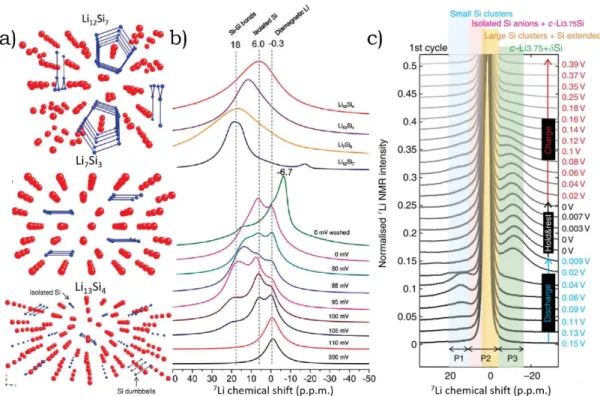
Key et al. investigated the lithiation mechanism of bulk c-Si and c-Si Nws using 7Li-NMR, which allows characterizing the different local Li environments
30 in the a-LixSi phases formed while cycling. They report that the lithiation starts
once Li-ions enter into the interstitial sites at the lithiation front. Li-ions weaken the external Si-Si network, provoking the formation of Si clusters. Then, it is easier (kinetically) to break up these clusters to form structures with isolated Si atoms rather than continue with the main Si crystalline structure7,38.
Figure 1.4 shows the 7Li-NMR chemical shift for b) bulk c-Si and c) c-Si Nws.
This figure shows 1) at lithiation cycling voltages below 100 mV, the observed resonances correspond to structures with small Si clusters, dumbbells, and isolated Si atoms (i.e., Li12Si7,Li7Si3, and Li13Si4 structures Figure 1.4a); 2) at
0 V, the obtained resonances at almost zero and negative frequencies correspond to structures with isolated atoms (i.e., Li15Si4). Nevertheless, the
kinetics and volume expansion prevent the system from reaching equilibrium and forming most of these structures as crystals38. In other words, the
31
Figure 1.4 a) crystallographic structures of Li12Si7, Li7Si3, and Li13Si4. b) ex-situ 7Li-NMR
studies on bulk c-Si during lithiation compared to references chemically synthesized. c) in-situ 7Li-NMR spectra for c-Si NWs. Adapted from [7,8].
1.4.1.2 The lithiation mechanism in amorphous Si (a-Si)
The lithiation mechanism in a-Si particles of almost 900 nm is isotropic; in other words, the structure does not fracture or swell in a preferential direction. The electrochemical cycling at room temperature for a-Si shows two slightly flat zones around ~ 230 mV and 100 mV that implies a one-phase mechanism (see light blue in Figure 1.3). On the other hand, McDowell, M. T. et al. reported using in-situ TEM that the lithiation mechanism proceeds by a two-phase mechanism13 (see TEM images highlighted in light blue, Figure 1.3).
These results imply that a-Si undertakes softer physical transformations than c-Si. Moreover, the kinetics of the reaction is different than in the crystalline case, suggesting different stress evolution.
The lithiation mechanism of a-Si is different from c-Si since Li-ions seem to penetrate the amorphous structure more easily. Using 7Li-NMR, Key et al.
32 studied the second cycle of c-Si bulk, where they assumed that the c-Si structure was totally amorphous. They suggested that in the a-Si matrix, once Li-ions enter on the whole external shell (the a-Si core remains unlithiated), the lithiation occurs step by step, forming larger Si clusters, then smaller Si clusters, and later dumbbells. Thus, the lithiation of a-Si seems to happen more sequentially and homogeneous, that is, by increasing the quantity of xLi in a-LixSi. Finally, c-Li15Si4 was obtained 8,38.
First principle calculations reported that the different deformation while cycling between amorphous and crystalline materials likely happens because of the significant activation energy to break the crystalline Si lattice39–41. Thus,
a high concentration of Li-ions in the phase boundary on the reaction front is needed to weaken Si-Si bonds in the crystalline network.
1.4.1.3 Formation of crystalline Li15Si4
The lithiation performed at high temperature reported a final plateau at ~44 mV, which is supposed to correspond to the formation of Li22Si5 with a specific
theoretical capacity of 4200 mAhg-1. At room temperature, XRD showed that
c-Li15Si4 was the only phase formed below 50 mV after the lithiation of bulk
c-Si42,43 and a-Si44. As mentioned before, since the crystalline Si structure is
difficult to break, and the lithiation happens at the reaction front, the LixSi
phases formed are amorphous and metastable.
The complete lithiation of Si should lead to crystalline Li15Si4 (c-Li15Si4).
However, this highly depends on the size and the morphology of the active material. For instance, the formation of c-Li15Si4 has been reported in
33 Si Nps below 100 nm do not form c-Li15Si4 or other crystalline LixSi phases
after full lithiation. It has been reported that Si Nps undergo parasitic reactions with the electrolyte, suppressing the crystallization of Li15Si447.
Additional studies on c-Si bulk and Nws using 7Li-NMR on bulk c-Si and c-Si
Nws showed a resonance in negative frequencies at the end of lithiation (see Figure 1.4b and c). Key et al. assigned this frequency for the first time to overlithiated Li15+δSi4, where ex-situ XRD demonstrated that the long-range
ordering is the same as c-Li15Si47,38. They suggested that probably Li15Si4 is
an electron-deficient phase such as Li15Ge4 that can accommodate excess
charge. Ogata et al. also indicated that it was easier to add Li to the c-Li15Si4
already formed than convert a-LixSi to c-Li15Si48.
In summary, crystalline Li15Si4 is formed depending on the size of the silicon
used and the organization of the atoms, favored in bulk crystalline and amorphous Si, and nanowires. c-Li15Si4 is difficult to form in nanoparticle
sizes less than 100 nm.
1.4.1.4 Mechanical properties while cycling c-Si electrodes
Li concentration gradients within c-Si cause stress while cycling. Therefore, it is essential to study the deformation during the (de) lithiation of c-Si, which is responsible for the slow down of the lithiation and produces fractures in the material, provoking continuous SEI growth, contact electrical loss, and lower energy efficiency.
The two-phase lithiation mechanism in c-Si produces a sharp reaction front. A tensile front hoop is created at the surface of the shell, while a hydrostatic
34 compression occurs on the crystalline core48,49. This hoop stress results from
the volume expansion of the a-LixSi shell and seems to be responsible for the
cracks in c-Si.
Different techniques can be used to measure mechanical deformation while the battery is cycling. For instance, McDowell et al. studied the lithiation of c-Si Nps in real-time using in-situ TEM; they found that the reaction front slowed as the crystalline core was consumed50. Furthermore, measurements
on the mechanical deformation using operando Raman spectroscopy and XRD have been done in c-Si11,12. These studies have also confirmed the two-phase
mechanism, where the crystalline core in c-Si Nps suffers compression during lithiation with stress values in the range between 0.3 GPa and 0.1 GPa11,12.
Another technique that is broadly used for measuring mechanical deformation in various electrode materials is the substrate curvature method51. This
method uses a laser beam that probes the sample, mostly films, reflected by the electrode. The changes in the position of the laser beam are used to measure the change in substrate curvature, hence the mechanical deformation in the active material. The information obtained with this technique describes the whole electrode; consequently, the strain/stress estimation is indirect, and the analysis of the results becomes tricky, especially when multiple phases are interacting at a specific state of charge in the battery. In general, the results reported by the substrate curvature method in amorphous or crystalline bulk Si films also found the two-phase mechanism during lithiation51–53.
35
1.4.2 Germanium
Germanium also has potential as a negative electrode for Li-ion batteries. Additionally to its high theoretical capacity (1384 mAhg-1), it has 400 times
higher lithium-ion diffusivity54, lower resistivity (47 cm vs. 63 600
ohm-cm for Si)55 and lower volume expansion (260% vs. 300%) than Si14.
1.4.2.1 Lithiation mechanism in c-Ge and phases formed
The discharge and charge electrochemical profiles of molten salt Ge-Li at 400 °C show five two-phase voltage zones that correspond from lower Li amount to higher Li content to LiGe, Li9Ge4, Li16Ge5, Li15Ge4, and Li22Ge556 (see Figure
1.5, gray line).
Compared to the electrochemical cycling at room temperature, the voltage vs. x in the LixGe curve presents two slightly flat zones between ~350–300 mV
and around 200 mV, indicating a one-phase process mechanism. However,
in-situ TEM has demonstrated that the lithiation process is a two-phase
mechanism in c-Ge14 as in Si, except that the reaction front between the c-Ge
36
Figure 1.5 illustration of the two-phase lithiation mechanism for c-Ge. Upper TEM images are adapted from [14]. The low part of the figure illustrates the two-phase mechanism of c-Ge
firstly proposed by [56].
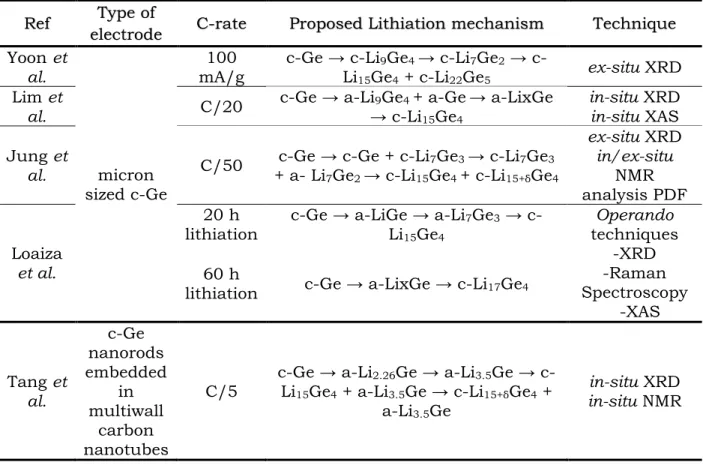
The electrochemical cycling of Ge has been investigated by in-situ and ex-situ techniques to have insights into the phase transformation, lithium diffusion, and mechanical properties. Table 1.1 summarizes the phase formation and the methods used to study the lithiation mechanism of c-Ge electrodes.
Yoon et al. reported using ex-situ XRD that a micron-sized c-Ge carbon-coated electrode during lithiation was converted to c-Li9Ge4 and c-Li7Ge2, then to
c-Li15Ge4 + Li22Ge5. During delithiation, c-Li15Ge4 and c-Li22Ge5 were converted
to c-Li7Ge2 and c-Li9Ge4 until amorphous Ge57.
Using operando XRD and X-ray absorption spectroscopy (XAS), Lim et al. proposed the lithiation mechanism for micron-sized c-Ge during lithiation at C/20, as indicated in Table 1.1. Using the structure factor to calculate the XRD diffracted intensity, Lim et al. calculated the amount of c-Li15Ge4
37 converted from c-Ge, and they found that at the end of lithiation, 56% of the c-Ge was transformed into c-Li15Ge4.
Table 1.1 State of the art of the lithiation mechanism for Ge electrodes.
Ref Type of
electrode C-rate Proposed Lithiation mechanism Technique Yoon et
al.
micron sized c-Ge
100
mA/g c-Ge → c-LiLi15Ge9Ge4 + c-Li4 → c-Li22Ge7Ge5 2 → c- ex-situ XRD
Lim et
al. C/20
c-Ge → a-Li9Ge4 + a-Ge→ a-LixGe
→ c-Li15Ge4
in-situ XRD in-situ XAS Jung et
al. C/50
c-Ge → c-Ge + c-Li7Ge3 → c-Li7Ge3
+ a- Li7Ge2 → c-Li15Ge4 + c-Li15+δGe4 ex-situ XRD in/ex-situ NMR analysis PDF Loaiza et al. 20 h lithiation
c-Ge → a-LiGe → a-Li7Ge3 →
c-Li15Ge4 Operando techniques -XRD -Raman Spectroscopy -XAS 60 h
lithiation c-Ge → a-LixGe → c-Li17Ge4
Tang et al. c-Ge nanorods embedded in multiwall carbon nanotubes C/5
c-Ge → a-Li2.26Ge → a-Li3.5Ge →
c-Li15Ge4 + a-Li3.5Ge → c-Li15+δGe4 +
a-Li3.5Ge
in-situ XRD in-situ NMR
In contrast, Jung et al.9 reported that Li9Ge4 could not be formed during
lithiation, as reported by Lim et al. using XAS. According to DFT calculations, this phase showed lower stability than Li7Ge3, which is a more stable phase58
(see Figure 1.6b). Consequently, Jung et al. reported using ex-situ 7Li-NMR
and XRD that micron-sized c-Ge at C/50 is lithiated into c-Li7Ge3. Afterward,
other stable phases with a high content of Ge-Ge dumbbells could also be formed,such as a-Li5Ge2, a-Li13Ge5, or a-Li8Ge3. Then, the breakage of Ge-Ge
bonds and Ge-Ge dumbbells continued, and the quantity of Li and Ge isolated atoms increased, forming possibly a-Li7Ge2. Later with further lithiation, the
38 c-Li15Ge4 grows. Jung et al. also reported on the overlithiated phase,
c-Li15+δGe4for which, in analogy with the Si lithiation, the subsequent lithiation
showed a different local environment at more negative frequencies in the 7
Li-NMR spectrum (see Figure 1.6a). Jung et al. supposed that like c-Li15+δSi4,
c-Li15+δGe4 has a more shielded environment because of the homogeneous
distribution of Ge and Li in the matrix.
Figure 1.6 a) ex-situ 7Li-NMR spectra of cycle Ge at different states of charge. b) Lithiation
pathway showing the possible lithiated Ge phases predicted by DFT58. Green dots correspond
to thermodynamic phases, and the red dots correspond to metastable phases. Adapted from [9].
Ex-situ XRD and pair distribution function analysis (PDF) demonstrates that
the c-Li15+δGe4 phase shows a similar long/short structure, except that the
lattice parameter increased from 10.7232(3) Å to 10.7479(2) Å. In summary, Jung et al. reported the two-phase lithiation mechanism, as shown in Table 1.19.
In a more recent study on micron-sized c-Ge, Loaiza et al. have reported that the phases formed depend on the C-rates during the cycling using operando XRD, Raman spectroscopy, and XAS59. Through 20 h of lithiation, c-Ge turned
into c-Li15Ge4. While, after 60 h of lithiation, c-Li17Ge4 was formed. The two
39 Tang et al. reported for the first time the (de) lithiation mechanism in nanostructures of c-Ge: Ge nanorods encapsulated in bamboo-type multiwall carbon nanotubes (Ge@CNT). They used ex-situ XRD and in-situ NMR to report the phase formation during the lithiation, as shown in Table 1.160.
To summarize, the nature of the phases formed during cycling depends on the type of study performed, such as ex-situ, in-situ, or operando, the lithiation rates, and the size of the particles. Overall, there is an agreement in the phase formed at the end of lithiation, c-Li15Ge4, for C-rates lower than C/50.
1.4.2.2 Mechanical properties of Ge while cycling
Since Ge has not been studied as much as Si, there is limited information on the mechanical deformation while cycling. As indicated, Ge also undergoes two-phase lithiation but with a less sharp reaction front. In-situ TEM showed that during cycling, c-Ge Nps maintained robust without cracks or fractures (see Figure 1.5), and there is no size-dependence from 100 nm to micrometers particles, in contrast with Si. It has been suggested that the resilient behavior in c-Ge comes from the weak anisotropy. In other words, Ge has nearly crystallographic orientation independence while cycling. Indeed, in-situ TEM studies on the lithiation of c-Ge Nps showed a diffused core in a lithiated shell (see Figure 1.5), which is opposed to the lithiation of c-Si Nps where the core exhibits a hexagonal shape with a sharp difference between the core-shell14.
There is only one study dedicated to following the micro-strain in micron size c-Ge cycled at C/9 using operando XRD. This study revealed the c-Ge core amorphization, while compressive stress was building up after the electrode was lithiated at 300 mV vs. Li/Li+. At 200 mV, they calculated an average of
40 0.21% compressive stress along the [111] crystallographic direction and reported that the c-Ge core experienced hydrostatic stress of 0.49 GPa61.
On the other hand, there are several strain studies on thin-film electrodes during cycling using the substrate curvature method (described in Section 1.4.1.4). Overall, they also reported compressive stress upon complete lithiation, and during delithiation, the stress turned tensile62–66.
1.4.2.3 Comparison of the lithiation mechanism between Ge and Si
Few previous works have addressed the lithiation mechanism differences in Si and Ge. Mostly, these computational studies have compared the Li-ions incorporation on Si or Ge host lattices. These calculations showed that Si is more difficult to lithiate due to its short interstitial space and harder matrix (higher bulk modulus 98.0 GPa vs. 75 GPa for Ge). As well the incorporation of Li in the host lattice has a softer effect. Essentially, the weaker ionic Li–Li, Li–Ge, or Li–Si replace the Si-Si or Ge-Ge covalent and stronger bonds67. The
bonding of Si or Ge with Li produces a more flexible lattice. Another reason for the significant difference in the lithiation mechanism between Si and Ge is that Si undergoes more complicated atomic rearrangements in Si lattices because of the suppressed Li-ions mobility (10−13 cm2 s−1 for c-Si vs. 10−11 cm2
s−1 for c-Ge). Besides, Li-ion diffusion (DLi) in Si depends on Li concentration.
For instance, DLi in a-LixSi increases with increasing x, from 10−12 cm2 s−1 for
x = 0.14 to 10−7 cm2 s−1 for x = 3.5768. On the contrary, Li-ion diffusion in Ge
is less dependent on the Li concentration, and it presents facile atomic redisposition with the same orders (10−7 cm2 s−1) of magnitude for both x =
41 Few experimental studies have compared the lithiation mechanism of crystalline Si and Ge, besides the mentioned study using in-situ TEM that showed the different core shapes upon cycling crystalline Si or Ge14. Pharr et
al. reported measurements of the curvature on Si and Ge thin-films that
highlighted the lower stress undertaken by Ge64.
To summarize, germanium undertakes less mechanical instability than Si due to its improved Li-ion transport properties, an easy atomic rearrangement, and a softer matrix (lower bulk modulus). These attractive properties reinforce the idea that germanium could be an excellent material for Li-ion batteries.
1.4.3 SiGe alloys
Since Si and Ge are miscible independently of the composition range, mixing Si with Ge has proven to be a promising approach that combines the high capacity of Si with the stability of Ge. Si100−xGex alloys have been synthesized
as amorphous and crystalline in bulk70,71, thin-films72, Nws73,74, Nps75,76. The
lithiation mechanism depending on the structure and morphologies, is challenging to differentiate since these studies and the mechanical properties of Si100−xGex alloys are scarce. This section is divided into the electrochemical
advantages of cycling performance compared to pure Si and Ge, and secondly, the lithiation mechanism and mechanical properties leading to enhanced cycling.
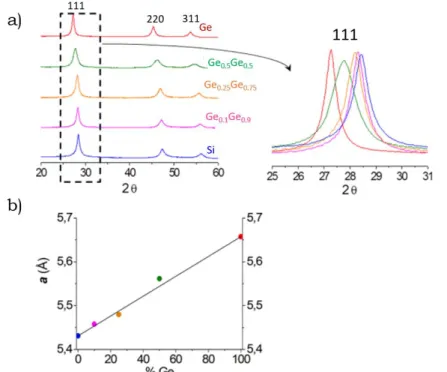
Figure 1.7a shows the X-ray pattern of bulk Si100−xGex vs. 2θ (Cu Kα)
synthesized mechanically by Duveau et al77. The image on the right is an
42 quantity. The crystalline Si100−xGex alloys follow Vegard's law, meaning that
the calculated lattice parameter (see Figure 1.7b) shows a linear increase of lattice parameters with a growing amount of Ge.
Figure 1.7 a) XRD of different Si100−xGex alloys (x=0.1,0.25,0.5) compared to Si and Ge. The
inset on the right is an enlarged view of the 111 peaks. b) lattice parameters vs. the amount of Ge77.
1.4.3.1 Electrochemical advantages of Si100−xGex alloys over Si and Ge
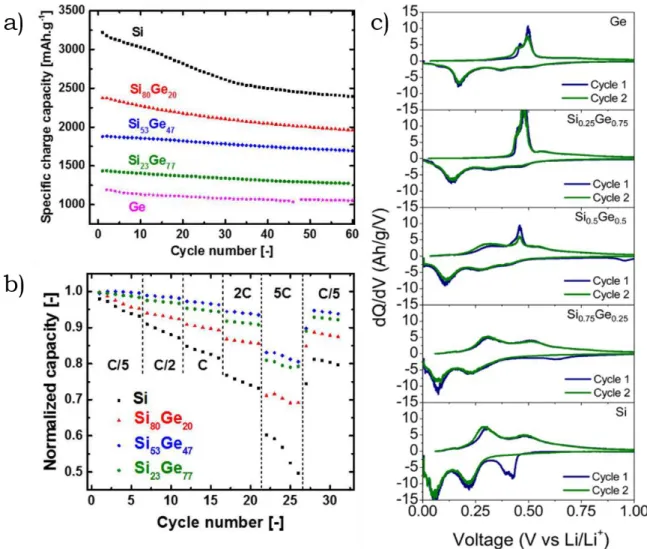
Figure 1.8a and b. present the electrochemical performances of Si100−xGex
nanoparticles. Electrochemical cycling curves show that when cycled at C/20 they have a lower initial specific capacity than Si but higher than Ge (see Figure 1.8a)76. The specific capacity value depends on the Si content Si100−xGex
alloys with more Si quantity have a higher specific capacity (see Si80Ge20,
~2500 mAhg-1). In comparison, Si100−xGex with higher Ge content shows lower
capacity, i.e., Si23Ge77 has a capacity of ~1800 mAhg-1 (see Figure 1.8a). While
Si100−xGex alloys with higher or middle Ge content may have a lower initial
43 when increasing C-rates from C/5 to 5C (see Figure 1.8b). This superior cycling performance is related to improve Li-ion diffusivity in Ge68.
The voltage vs. capacity curves give information on the different types of structural transformation in the active material. Distinguishing the voltages signatures can be more accessible using the derivative of the capacity. This analysis gives characteristic dQ/dV peaks that indicate the possible lithiation mechanism. Typical dQ/dV peaks depend on the quantity of Ge or Si. For instance, a-Si75Ge25 thin-films showed a similar electrochemical profile to the
a-Si one. The a-Si25Ge75 showed dQ/dV peaks of germanium-like materials.
In comparison, the thin-film with 50% percent of each component showed a combined voltage profile from the a-Si and Ge one72. These results indicate
that the lithiation mechanism for the Si100−xGex alloys with higher Ge content
44
Figure 1.8 a) specific charge capacity vs. cycle number of the Si100−xGex alloys Nps at C/20
compared to Si and Ge. b) normalized capacity vs. cycle number of the Si100−xGex alloys Nps
at increasing C-rates. c) Differential capacity plots for the first and second cycles of Si100−xGex
alloys thin-films at C/20. a) and b) are adapted from [76], and c) from [72].
1.4.3.2 Lithiation mechanism in Si100−xGex alloys
Traditionally, most of the studies dedicated to Si100−xGex alloys have been
devoted to describing the synthesis of the Si100−xGex alloys and the
electrochemical performance. Fundamental knowledge to understand the lithiation mechanism and mechanical properties that lead to the improved cycling performance of the Si100−xGex alloys is necessary. This section is
divided into the approach used to study Si100−xGex alloys, like computational
45 formation, and fundamental studies supporting the increased cycling performance.
- COMPUTATIONAL STUDIES ON THE MECHANICAL PROPERTIES
These fundamental investigations have shown that the host lattices are more flexible than that of Si, and they undergo a more relaxed organization, improving the Li diffusivity, the strain accommodation, and the capacity retention68. However, it is not clear if Si100−xGex alloys lithiate using the
two-phase mechanism as Si and Ge, since there are no in-situ TEM studies on Si100−xGex Nps. There are few studies on the mechanical properties of Si100−xGex
alloys while cycling. For instance, Bansal et al. used a chemo-mechanical model78 to quantify the stress evolution in Si50Ge50 nanopillars. They
compared this Si50Ge50 alloy with Si and Ge nanopillars, and they found a 17%
reduction in the maximum stress compared to Si79.
- EXPERIMENTAL STUDIES TO UNDERSTAND THE Lix(Si100−xGex)y PHASES
Loaiza et al. used XRD to study the pristine bulk Si50Ge50 alloy, and they
reported a lattice parameter value between c-Si and c-Ge (5.54 Å vs. 5.43 Å for Si, and 5.54 Å for Ge), following the Vegard's law. They also performed
operando XRD while cycling c-Si50Ge50 in 60 h, and they found that the alloy
was amorphized at ~100 mV. Below 100 mV, diffracted peaks coming from Li15(Si50Ge50)4 appeared with a calculated lattice parameter of 10.745(2) Å (see
Figure 1.9a)70. Additionally, Figure 1.9b shows the in-situ 7Li-NMR results on
c-Si50Ge50 cycled in 20 h. When the voltage reached 95 mV, a peak emerged
at negative frequencies (-17 ppm), as already observed in Si and Ge studies using 7Li-NMR. They assigned this peak to the overlithiated phase
46 Li15+δ(Si50Ge50)4 taking into account the previous 7Li-NMR studies on Si7,8,38
and Ge9,60. Upon delithiation, the Li15+δ(Si50Ge50)4 was transformed into
a-Lix(Si/Ge) intermediates, and at the end of delithiation, a-Si100−xGex was
recovered.
Figure 1.9 the electrochemical cycling of a c-Si0.5Ge0.5 self-supported film vs. Li metal by a)
Operando XRD. b) in-situ 7Li NMR. Adapted from [70].
- FUNDAMENTAL STUDIES THAT SUPPORTED THE INCREASED CYCLING PERFORMANCE
Kim et al. studied Nws of c-Si100−xGex alloys with Si-rich shell alloys and
Ge-rich core alloys annealed at 760 °C, which showed capacity retention 89% over 400 cycles. They presumed that c-Si100−xGex alloys with higher Si content were
lithiated while the inner c-Si100−xGex alloys with richer Ge content reacted
47 Zhu et al. studied different c-Si100−xGex alloys; they reported that during the
first cycle, the c-Si15Ge alloy had the highest Coulombic efficiency in
comparison with the other materials. They supported this result by using DFT calculations to look into the energy barrier of the Li diffusion path in Li-Si-Ge, Li-Ge, and Li-Si. DFT reported that the Li diffusion path in c-Si15Ge has the
lowest energy barriers since the Ge atomic ratio in the crystal lattice has a local expansion effect, reducing Li trapping. They reinforced these calculations by demonstrating that c-Si15Ge has a decreased SEI and lower lithium trapped
after the first cycle, using TEM, electrochemistry impedance spectroscopy, and atomic emission spectroscopy techniques71.
In summary, the synthesis of Si100−xGex alloys is possible in different
morphologies, and their electrochemical performance is improved compared to pure Si. Little is known on the (de)lithiation mechanism of Si100−xGex alloys
that conferred enhanced performance. Theoretical studies predict a decrease in stress when cycling, and experimental studies show that Li15(Si50Ge50)4 is
formed, indicating changes in the physical properties compared to pure Si.
1.4.4 Composites
Several solutions have been proposed to relieve the pulverization in Si and Ge. One of them is incorporating carbon materials to produce a highly conductive matrix that contains the volume expansion of Si or Ge.
The composites can be classified into several groups, such as carbon-coated materials, mixture with carbon nanostructures, and mixture with graphite. For instance, carbon-coated Si Nps improved conductivity and avoided direct
48 contact with the electrolyte80–82. Even though the carbon-coated was enough
to stand global volume expansion, it decreased by 18% of the volume expansion83. Adding carbon nanotubes or graphene can also provide electron
transport pathways and reduced the volume81,84.
Here, we are interested in the mixture of Si with graphite (Gr) and active/metal-silicide alloys.
A growing body of literature has investigated metal-silicide alloys blended in composites with Si that improve its cyclability85–89. This metal-silicide must
have good mechanical properties for stress release, high electronic conductivity, and moderate reactivity with Li+. The metal-silicides could be
useful as a buffer matrix for Si during cycling. For instance, FeSi2 seems to
fulfill previous characteristics since it has a low reversible capacity of 10 mAhg-1, lower resistivity than Si (2.6 × 101 Ω cm vs. 6.0× 10³ Ω cm), and low
breaking strength (213 ± 44 MPa)87. Besides, it is widely used in the
production of stainless steel, making it accessible. Chen et al. reported a c-FeSi2/Si@C nanocomposite with high Li storage of ~1010 mAg-1 and 94%
capacity retention after 200 cycles86.
1.4.4.1 Mechanism of cycling and aging
The mechanism of cycling and aging of composite metal-silicide alloys is not yet well understood. There are few investigations in this type of composite; Si-graphite blended composites have been mostly studied. Müller et al. studied Si-graphite nanocomposites using X-ray tomographic microscopy to study the detachment when the capacity fades after ten cycles. They reported that the capacity loss was due to loss of electrical contact between the active materials
![Figure 1.1 illustration of the working principle of LiB. Adapted from [3].](https://thumb-eu.123doks.com/thumbv2/123doknet/14628707.734368/23.893.202.700.442.775/figure-illustration-working-principle-lib-adapted.webp)

![Figure 1.5 illustration of the two-phase lithiation mechanism for c-Ge. Upper TEM images are adapted from [ 14 ]](https://thumb-eu.123doks.com/thumbv2/123doknet/14628707.734368/37.893.172.723.105.505/figure-illustration-phase-lithiation-mechanism-upper-images-adapted.webp)