HAL Id: tel-02379733
https://tel.archives-ouvertes.fr/tel-02379733
Submitted on 25 Nov 2019HAL is a multi-disciplinary open access
archive for the deposit and dissemination of sci-entific research documents, whether they are pub-lished or not. The documents may come from teaching and research institutions in France or abroad, or from public or private research centers.
L’archive ouverte pluridisciplinaire HAL, est destinée au dépôt et à la diffusion de documents scientifiques de niveau recherche, publiés ou non, émanant des établissements d’enseignement et de recherche français ou étrangers, des laboratoires publics ou privés.
krypton and xenon for the optimization of cold plasma
generators using rare gases
Cyril van de Steen
To cite this version:
Cyril van de Steen. Modeling the transport properties of molecular ions of krypton and xenon for the optimization of cold plasma generators using rare gases. Quantum Gases [cond-mat.quant-gas]. Université Paul Sabatier - Toulouse III, 2018. English. �NNT : 2018TOU30264�. �tel-02379733�
THÈSE
En vue de l’obtention du
DOCTORAT DE L’UNIVERSITÉ DE TOULOUSE
Délivré par l'Université Toulouse 3 - Paul SabatierCotutelle internationale : IT4Innovations National Supercomputing Center à la VSB – Technical University of Ostrava
Présentée et soutenue par
Cyril VAN DE STEEN
Le 11 décembre 2018Modélisation des propriétés de transport des ions
moléculaires de krypton et xénon pour l’optimisation des
générateurs de plasma froids utilisant les gaz rares
Ecole doctorale : GEET – Génie Electrique Electronique et Télécommunications :
du système au nanosystème
Spécialité : Ingénierie des Plasmas Unité de recherche :
LAPLACE - Laboratoire PLAsma et Conversion d’Energie - CNRS-UPS-INPT
Thèse dirigée par
Malika BENHENNI & René KALUS
Jury
Mme Nelly BONIFACI Chargé de recherche au CNRS – G2ELab, Grenoble Rapporteur
M. Ahmed RHALLABI, Professeur à l’Université de Nantes – IMN Rapporteur
M. Ioan SCHNEIDER Professeur à l’Université du Havre – LOMC Examinateur
M. Mohammed YOUSFI Directeur de recherche au CNRS – LAPLACE, Toulouse Président
Mme Malika BENHENNI Maître de conférences au LAPLACE, Toulouse Co-directrice de thèse
M. René KALUS Associate Professor at IT4I – VSB-TU Ostrava Co-directeur de thèse
M. Florent Xavier GADEA Directeur de recherche au CNRS – LCPQ, Toulouse Invité
xénon pour l’optimisation des générateurs de plasma froids utilisant les gaz rares.
Résumé
L’utilisation de plasmas froids à base de gaz rares (Rg) dans des applications biomédicales ainsi que dans la propulsion spatiale est en nette évolution. Pour optimiser ces réacteurs plasmas, une compréhension fine des processus ayant lieu dans ces réacteurs est nécessaire. Ce travail de thèse a pour objectif de fournir les données manquantes dans la littérature (coefficients de transport et réaction) en passant par des données mésoscopiques (sections efficaces) obtenues à partir de données microscopiques (potentiels d’interaction) pour le xénon et krypton dans leur gaz parent. Seul des plasmas froids composés d’un seul type d’atome sont considérés. Comme le krypton et le xénon sont des gaz rares, et ont donc, à l’état de neutralité peu/pas d’interaction entre eux. Par conséquent, seules les collisions ion – atome seront considérées. Du fait des faibles énergies des ions dans le plasma froid, seul les 6 premiers états excités du couple Rg2+ seront pris en compte. Ces 6 états seront classés
en deux groupes, 2P
1/2 et 2P3/2. Lors de ce travail, deux potentiels d’interaction différents disponibles
dans la littérature sont utilisés et comparés pour les systèmes collisionnels Kr+/Kr et Xe+/Xe dans le
calculdes sections efficaces. Pour les collisions impliquant des dimères ioniques (Kr2+/Kr et Xe2+/Xe),
les potentiels d’interaction sont calculés à partir du modèle DIM (Diatomics In Molecules) qui est une combinaison des potentiels atomiques d’interaction neutre – neutre et ion – neutre.
Les sections efficaces, requises pour obtenir les données mésoscopiques manquantes, sont calculées à partir de trois méthodes différentes. La première méthode est la méthode quantique qui permet, par une résolution de l’équation de Schrödinger, d’obtenir de manière exacte les sections efficaces à partir des potentiels d’interaction. Cette méthode exacte, étant grande consommatrice de temps de calcul, est utilisée en tant que référence pour valider les deux autres méthodes approchées. La seconde méthode, nommée semi-classique, est basée sur la même expression que la section efficace quantique mais utilise un déphasage approché (approximation JWKB), induit par le potentiel d’interaction, entre l’onde diffusée et l’onde incidente. Cette méthode a l’avantage d’être plus rapide que la méthode quantique tout en ayant des résultats très proches. La dernière méthode est la méthode hybride qui consiste à traiter les atomes par une méthode classique et les électrons par le formalisme quantique. Cette méthode est la seule des méthodes approchées qui permet de traiter les collisions entre dimère et atome en prenant en compte la vibration et la rotation du dimère.
Lors de collision dimère – atome, une fragmentation du dimère peut avoir lieu et donc la section efficace de dissociation du dimère, apparaissant à partir d’un seuil d’énergie, a été prise en compte dans les calculs Monte Carlo. Les coefficients de diffusion ainsi que la mobilité des ions dans leurs gaz parents sont calculés à partir des sections efficaces avec un code Monte-Carlo. Les mobilités ainsi calculées sont comparées aux mesures expérimentales disponibles dans la littérature. Dans le cas des dimère, la rotation et la vibration dans la molécule doivent être prises en compte. Tous les résultats montrés sont réalisés sur l’état fondamental du dimère.
Les mobilités ainsi calculées par les méthodes disponibles donnent des résultats proches des valeurs expérimentales, nous permettant de conforter nos autres coefficients de transport et réaction.
Mots clés
Modélisation physico-chimique, donnée de base, ion atomique (Kr+ et Xe+) et diatomique
(Kr2+ et Xe2+), interaction ion – neutre, potentiel d’interaction, section efficace de collision et
dissociation, méthode quantique, méthode semi-classique (JWKB) méthode hybride, simulation Monte Carlo, coefficients de transport, taux de réaction
Modeling the transport properties of molecular ions of krypton and xenon for the optimization of cold plasma generators using rare gases.
Abstract
The use of cold plasmas based on rare gases (Rg) in biomedical applications as well as in space propulsion is clearly evolving. To optimize these plasma reactors, a fine understanding of the processes taking place in these reactors is necessary. This thesis aims to provide the missing data in the literature (transport coefficients and reaction rates) through mesoscopic data (cross-sections) obtained from microscopic data (interaction potentials) for xenon and krypton in their parent gas. Only cold plasmas composed of a single type of atom are considered. As krypton and xenon are rare gases, and so have, in the neutral state little / no interaction between them. Therefore, only ion – atom collisions will be considered. Due to the low ion energies in the cold plasma, only the first 6 excited states of the Rg2+ pair will be taken into account. These 6 states will be classified in two groups, 2P1/2
and 2P
3/2. In this work, two different interaction potentials available in the literature are used and
compared for the Kr+/Kr and Xe+/Xe collision systems in the calculation of cross-sections. For
collisions involving ionic dimers (Kr2+/Kr and Xe2+/Xe), the interaction potentials are calculated from
the DIM model (Diatomics In Molecules) which is a combination of the atomic potentials of neutral – neutral and ionic – neutral interactions.
The cross-sections required to obtain the missing mesoscopic data are calculated from three different methods. The first method is the quantum method which allows, by a resolution of the Schrödinger equation, to obtain exactly the cross-sections from the interaction potentials. This exact method, which consumes a lot of computation time, is used as a reference to validate the two other approximate methods. The second method, called semi-classical, is based on the same expression as the quantum cross section but uses an approximate phase shift (JWKB approximation), induced by the interaction potential, between the scattered wave and the incident wave. This method has the advantage of being faster than the quantum method while having very close results. The last method is the hybrid method, consisting of treating atoms by a classical method and electrons by quantum formalism. This method is the only one of the approximate methods which makes it possible to treat the collisions between dimer and atom taking into account the vibration and the rotation of the dimer. In a dimer – atom collision, fragmentation of the dimer may occur and thus the dissociation cross-section of the dimer, appearing from an energy threshold, has been taken into account in the Monte Carlo calculations. The diffusion coefficients as well as the mobility of the ions in their parent gases are calculated from the cross-sections with a Monte Carlo code. The mobilities thus calculated are compared with the experimental measurements available in the literature. For dimer calculations, rotation and vibration in the molecule must be taken into account. All the results shown are made on the ground state of the dimer.
The mobilities thus calculated by the available methods give results close to the experimental values, allowing us to reinforce our other coefficients of transport and reaction.
Keywords
Physicochemical modeling, basic data, atomic ion (Kr+ and Xe+) and diatomic (Kr2+ and
Xe2+), ion-neutral interaction, interaction potential, collision cross section and dissociation,
quantum method, semi-classical method (JWKB), hybrid method, Monte Carlo simulation, transport coefficients, reaction rate
2017
Cyril Van de Steen, Malika Benhenni and René Kalus. Mobility of Kr
+ions in Kr
for cold plasma modelling. ICPIG XXXIII
Cyril Van de Steen, René Kalus and Malika Benhenni. Mobility of Xe
+ions in Xe
for cold plasma modelling. ISPC23
2018
Cyril Van de Steen, Malika Benhenni, René Kalus, Bruno Lepetit, Florent Xavier
Gadéa and Mohammed Yousfi. Quantum and semi-classical collision
cross-sections and transport data for a Kr
+/Kr system. Plasma Sources Science and
Technology, Volume 27, Number 6, page 065005
Cyril Van de Steen, Malika Benhenni, René Kalus, Bruno Lepetit, Florent Xavier
Gadéa and Mohammed Yousfi. Calculations with experimental validations of
cross-sections and transport coefficients of Xe
+colliding with Xe. Journal of
Physics B: Atomic, Molecular and Optical Physics, Volume 51, Number 18, page
185204
Cyril Van de Steen, Malika Benhenni, René Kalus, Rajko Ćosić, Silvie Illésová,
Florent Xavier Gadéa and Mohammed Yousfi. Cross-sections, transport
coefficients and dissociation rate constants for Kr2
+molecular ion interacting with
Kr. Plasma Sources Science and Technology,
https://doi.org/10.1088/1361-6595/aaebe0
Cyril Van de Steen, Rajko Ćosić, René Kalus, Malika Benhenni. Mobility of Xe
2+ions in Xe for cold plasma modelling. GEM XX
Cyril Van de Steen, Malika Benhenni, Rajko Ćosić, René Kalus. Mobility of Kr
2+ions in Kr for cold plasma modelling. ESCAMPIG XXIV
This work of research was done in two different laboratories, universities and countries. Since one of these laboratories is in France, I will do my thanks to related people in French in the following of this text. It will be easier for me to express my fillings in my native language and I’m sure it will be easier for them to understand it also.
Firstly I would like to thank all members of my 2 juries (French and Czech) who were not directly involved in my daily work. I’m grateful to Mrs Bonifaci, Mrs Paidarová, M. Rhallabi and M. Janecek for being the reviewers of my thesis and the time they spent reading it carefully. I would also like to thank M. Schneider, M. Kozubek, M. Lampart, M. Ciprian and M. Alexa for the time they spent for the attention they spent on my thesis and thesis defense.
Outside of the Jury members I would also like to thank all the people met in Czech Republic. I would like to give a warm thanks to Mr. René Kalus from IT4Innovations in VSB University for his help. He not only helped me with my work and provided me with advice on the work but also for common life in a foreign country. He is probably one of the best thesis directors a Ph.D. student can have. I would like also to thanks IT4Innovations and Vysoká Škola Bá ˇnská - Technická Univerzita Ostrava for the chance they give me to make PhD studies and, also, for all the translations they did in English so that I could understand. I would also like to thank the Moldyn group (René, Alex, Rajko, Stanislav, Martin and Martin) and the other PhD students of IT4I (Simona, Michal and Michal) for their help and effort to make all meeting/ discussions in English so that I could understand. In summary dekuji moc to all the people met in Czech Republic for their tolerance and acceptance of a foreign student.
Concernant la partie de la thèse réalisée en France, Je tiens à exprimer ma profonde gratitude à Madame Malika Benhenni de l’Université Paul Sabatier pour son aide, sou-tien et conseils lors de ma thèse dans le groupe P.R.H.E. (Plasma réactifs Hors-Équilibre) au sein du Laplace (Laboratoire de Plasma et Conversion d’Énergie). Un grand merci
accueil ainsi qu’au groupe P.R.H.E. en général pour leur bonne humeur ainsi que leur compréhension progressive de belgicismes.Une pensée aussi à Mofel Nerbaoui pour son courage et sa patience. Un merci à mes camarades de l’ADeL (Andréa, Simo et François) pour les moments de décompressions créés pour les Laplaciens. Un merci aussi aux Doc-toriants (Chaimae, Inthu, Nico et tous les autres) qui ont permis une mise en perspective de la thèse ainsi que des sorties des plus enrichissantes. Une pensée aussi aux petits sta-giaires qui sont devenus doctorants maintenant (Julien et Maxime) ainsi qu’aux autres doctorants Laplaciens du bâtiment d’en face (Philou et Marjorie principalement). De vifs remerciements ensuite pour deux camarades de thèse avec qui j’ai vécu des moments de pression et de détente. À savoir Farah Fawaz et Docteur Julie Chauvin. Merci à vous deux pour tous ces moments passés ensembles. Je tiens également à remercier M. Du-four qui m’a envoyé l’offre de thèse afin de me permettre de pouvoir continuer dans la recherche. Un merci aussi au secrétaire du jury de master qui, de par son discours peu encourageant sur mes capacités scientifiques lors de ma soutenance de master, m’a donné l’envie de continuer. Une pensée est bien sur dirigée à mes anciens camarades de promo au sein de mon parcours universitaires à l’ULB, les premiers noms qui me viennent en tête sont Mawie, Adrien, Jordane, Jonathan, Arnaud et pleins d’autres dont je ne pourrais écrire ici tous leurs noms. Enfin un énorme merci à ma famille sans qui je n’aurais pas pu faire cette thèse loin d’eux. Merci pour leur soutien inconditionnel durant toute la durée de ses trois ans de thèse.
kB – Boltzmann constant E – Energy T – Temperature r – Distance E – Electric field N – Gas density
E/N – Reduced electric field
K0N – Reduced mobility
eV – Electronvolt
eDT – Transverse diffusion coefficient
eDL – Longitudinal diffusion coefficient
σ(IN T ) – Integral Cross-Section (ICS)
σ(M T ) – Momentum Transfer Cross-Section (MTCS)
km – Wave vector of state m. k = µυm/̵h
µ – Reduce mass
υ – Velocity of the atom
̵
h – Reduced Planck constant (Planck constant divided by 2π) ˆ
H – Hamiltonian
l – Angular momentum number
⟨Φ∣X∣Φ⟩ – Bra-Ket notation, ∫ Φ∗XΦ XRgZ
Y – Rare-gas (krypton and xenon in this thesis) with X number
of proton + number of neutron, Z is the charge and Y is the number of atom in the molecule
Contents
1 Overview of actual context 5
1.1 General informations on plasmas . . . 5
1.1.1 Different low temperature plasma sources . . . 8
1.1.2 Dielectric Barrier Discharge (DBD) at atmospheric pressure . . . 8
1.1.3 Corona discharges . . . 9
1.1.4 Direct Current (DC) plasma . . . 10
1.1.5 Radio Frequency (RF) plasma . . . 11
1.2 Potential applications of non-thermal rare-gas plasma generators . . . 12
1.2.1 Biomedical . . . 12
1.2.2 Excilamps . . . 14
1.2.3 Plasma propulsion for Spacecraft . . . 15
1.3 Thesis objectives . . . 16
1.3.1 Plasma modeling . . . 17
2 Theory 21 2.1 Interaction potentials . . . 21
2.1.1 Ion - Atom potential . . . 21
2.1.2 Dimer - Atom potential . . . 26
2.2 Cross-section . . . 28
2.2.1 Quantum method . . . 34
2.2.2 Semi-classical method . . . 43
2.2.3 Hybrid method . . . 45
2.3 Ions transport coefficients: Monte Carlo Method . . . 55
3 Ionic Atom - Neutral Atom Collisions 61 3.1 Krypton . . . 61
3.1.1 Interaction potentials . . . 62
3.1.2 Experimental data reported in literature . . . 65
3.1.3 Cross-sections . . . 67
3.1.4 Mobility and diffusion coefficient . . . 75
3.1.5 Discussions . . . 79
3.2 Xenon . . . 84
3.2.1 Interaction potentials . . . 84
3.2.2 Experimental data reported in literature . . . 85
3.2.3 Cross-sections . . . 86
3.2.4 Mobility and diffusion coefficient . . . 92
3.3 Conclusions . . . 96
4 Ionic Dimer - Neutral Atom Collisions 99 4.1 Selection of initial conditions . . . 99
4.2 Krypton . . . 103
4.2.1 Experimental data reported in literature . . . 104
4.2.2 Neutral potentials . . . 104
4.2.3 Cross-sections . . . 106
4.2.4 Mobilities . . . 114
4.2.5 Diffusion coefficients . . . 121
4.2.6 Dissociation rate constants . . . 123
4.3 Xenon . . . 125
4.3.1 Experimental data reported in literature . . . 125
4.3.2 Neutral potentials . . . 127
4.3.3 Cross-sections . . . 128
4.3.4 Mobilities . . . 133
4.3.5 Diffusion coefficients . . . 140
4.4 Conclusions . . . 142
5 Conclusions and Perspectives 145
Appendices 149
A Tables of transport coefficients for Kr+
/Krcollisions . . . 149 B Tables of transport coefficients for Xe+
/Xecollisions . . . 155 C Tables of transport coefficients and dissociation rate constant for Kr+
2/Kr
collisions . . . 161 D Tables of transport coefficients and dissociation rate constant for Xe+
2/Xe
collisions . . . 187
This work subscribes in the continuity of research which started 7 years ago on rare-gases helium (He), argon (Ar) and neon (Ne) atomic and molecular ions in collision with their parent gases which involves 3 different laboratories (LAb-oratoire Plasma et Conversion d’Energie) LAPLACE at Toulouse, (Institut de Recherches Sur les Agrégats, Molécules et Collisions) IRSAMC at Toulouse and IT4Innovations at Ostrava. The present thesis work is performed in two different laboratories, IT4Innovations at Vysoká Škola Bá ˇnská - Technická Univerzita Os-trava (Czech Republic) under the supervision of Mr Kalus René and the LAPLACE at Université of Toulouse III (France) under the supervision of Mrs Benhenni Ma-lika in the research group PRHE (Plasmas Réactifs Hors Equilibre). In this thesis, we are focused on krypton (Kr) and xenon (Xe) rare-gases in collision with their respective parent gas at ambient temperature and atmospheric pressure.
The first chapter presents the context of this thesis, i.e. to complete the miss-ing basic data such as transport coefficients (mobility and diffusion) and constant rate of monoatomic and dimer ions of krypton (Kr+
and Kr+
2) and xenon (Xe +
and Xe+
2). These data are needed as input in chemical hydrodynamic model of
low temperature plasmas generated at atmospheric pressure used for applica-tions such as biomedical, spacecraft propulsion and dielectric barrier discharges excimer lamps. Indeed, the ion transport coefficients are rather incompletely re-ported in the literature where the only available basic data are the measured mo-bility on a limited reduced electric field range and no measurements are available both on monoatomic and dimer ions diffusion coefficient and dimer ion dissoci-ation. Moreover, ion mobility data were measured by several authors and show a clear disparity especially in the very low field range probably due to the pres-ence of impurities in their signal. Furthermore, calculations reported by Barata [1] (as reported in reference [2]) show disagreement with experimental data. This
chapter reports on the different setups of cold plasma generators found in the literature. The different potential applications of krypton and xenon cold plasma generators such as biomedical, excimer lamp or spacecraft propulsion are pre-sented in this chapter. It also describes the electro-kinetic model which allows to determine the different active species densities and the electric field needed for targeted potential applications.
The second chapter describes the ion - atom potentials used for collision cross-section calculations. Two sets of interaction potentials for ion-atom collisions (Kr+
- Kr and Xe+
- Xe) available in the literature are compared, and the methodol-ogy DIM (Diatomics In Molecule) used to generate the interaction potential for the ionic dimer - neutral atom collision (Kr+
2- Kr and Xe +
2- Xe) is described as well.
Moreover, this chapter details the basis of the three considered methods namely quantum, semi-classical, and hybrid method that uses quantum formalism for the electronic cortege while a classical treatment is applied to nuclei. The semi-classical method uses an approximate phase shift induced by the interaction po-tential between the scattered and the incident wave functions. This method has the advantage of being faster than the quantum method while providing quasi identical cross-sections. It is used in this thesis specially to verify the hypothesis of assuming in the calculations, an artificial krypton or xenon isotope with aver-age mass, instead of the real masses of the different natural isotopes in order to save computational time. The hybrid method is the only one which allows to treat the collisions between dimer ions and neutral atoms. An inverse method, based on a spherical potential with adjustable parameters, is also described in this chap-ter. This method is very useful when no interaction potential is available and, is used to extend the mobility data to electric fields where they are missing, and to provide diffusion coefficient not available in literature. Monte Carlo method which uses probabilities associated to the different calculated elastic and inelastic collision cross-sections to simulate the ion transport under the action of a uniform electric field, is also described in this chapter. This method allows to calculate, from these elastic and inelastic cross-sections, the transport coefficients (mobility
and diffusion) and constant rate over a large reduced electric field range. The third chapter is dedicated to the monoatomic (Kr+
and Xe+
) ions in colli-sion with their respective parent gases. This chapter reports the calculated mo-mentum transfer collision cross-section by using two different potentials ionic atom - neutral atom collisions available in the literature. Then, the calculated mo-bilities with Monte Carlo code from these collision cross-sections are compared to measured ion mobilities in order to select the best potential that will be used for dimer - atom collisions. Moreover, the ion transverse and longitudinal dif-fusion coefficients are also calculated and reported over a large reduced electric field range (5 Td to 3000 Td).
Chapter 4 concerns the ion basic data in the dimer ion - neutral atom colli-sions Kr+
2- Kr and Xe +
2- Xe. In this case, fragmentation of dimer ion takes place
with a characteristic threshold energy, so the dimer dissociation cross-section is also calculated and reported along with the momentum transfer collision cross-section by using hybrid method. The vibration and rotation of the dimer are also taken into account to enhance the agreement between calculated and measured dimer ion mobilities. The influence on the dimer mobility of the neutral - neutral potential in the DIM model is also discussed in this chapter.
Finally, a general conclusion summarizing the different chapter conclusions is given at the end of this thesis.
Chapter 1
Overview of actual context
1.1
General informations on plasmas
The term "plasma" was used by Irving Langmuir in 1928 to designate ionized gases [3]. Many technologies of everyday life now incorporate these plasmas, which are therefore more widely known to the general public. This is the case for example with plasma television screens, neon lamps, fluorescent tubes and one can also mention commercially available plasma balls, this showing its a democ-ratization [4]. Plasma processes have been widely used in industry for almost a century. They are present in the field of polymers (engraving, surface function-alization), microelectronics to mention a few and have more recently entered the world of biology, medicine and space propulsion.
Plasma is commonly referred to as the "fourth state of matter" after solid, liq-uid and gaseous states. Quite rare in the natural state of our planet, it represents 99% of the known universe matter, the stars, the solar wind, the ionosphere of the earth are plasma examples [4]. In the natural state, lightning and the north-ern lights (Aurora Borealis) such as shown in figure 1.1 are phenomena that are often observed.
Beyond this very global definition, a plasma is defined from the point of view of physics as a partially or totally ionized gas. An ionized gas is thus composed of electrons and ions, but also of molecules and excited atoms (that is to say in a
Figure 1.1: Aurora Borealis in Greenland [5]
higher energy level than that of the ground state). Neutral and ions often called heavy particles in the plasma, can also be excited for short time (10−6 to 10−8s)
before emitting photon during their desexcitation. This emission of photon is mostly responsible of the light emitted by a plasma and is, also, a signature of the plasma. An ionized plasma may be called plasma if, and only if, the plasma is electrically neutral, this means that the negative and positive charges inside the plasma have to counterbalance each other. This propriety is verified at distance, around an ionized particle, higher than the Debye radius. To ionize an atom or a molecule, it must be given enough energy for an electron to leave its electronic layer and becomes a free electron. This energy can be provided thermally, electri-cally, magnetielectri-cally, radiatively, chemically or mechanically. It is therefore possible to generate plasmas in the laboratory through these various sources of energy. An essential parameter for defining a plasma and for "classifying" it, is therefore its degree of ionization α, which represents the ratio of the electron density (ne) to
Figure 1.2: All possibilities of states modification
the total density of electrons and neutral species (N ): α = ne
ne+N
. (1.1)
When the degree of ionization is close to or equal to 1, the plasma is totally ionized, and it is called "hot plasma". These plasmas are said to have the thermo-dynamic equilibrium and the temperature of the charged species is of the order of one million kelvin. They are present especially in the field of nuclear fusion (tokamaks [4]) and the sun is another perfect example. Furthermore, the plasmas generated by electric arcs due to gas breakdown leads to ionization and dissoci-ation of most of the molecules species and can reach several thousands of kelvin (20000 to 30000 K). They are also considered at thermal or quasi-thermal equilib-rium. When the degree of ionization is low (between 10−4and 10−7), the plasma is
weakly ionized, and it is called "non-equilibrium or non thermal plasma" because it is out of thermodynamic and chemical equilibrium. Indeed, when an electric field is applied between two electrodes to generate a plasma, the free electrons which first receive this electrical energy via an electric force ⃗F = q ⃗Ethen, transfer only a part to the heavy particles. If time or energy is not sufficient, electrons
can-not balance their temperature with other particles, which explains the differences in temperature between electrons (Te) and other particles (ions Tiand neutral T0)
in a weakly ionized plasma. Thus, in the weakly ionized plasmas presented in this work, we have
Te>Ti>T0. (1.2)
In fact Tecan reach several eV energy in order to be able to ionize, excite and
dis-sociate the carrier gas. However, the electron density is too low to heat the weakly ionized plasma which has a mean temperature close to ambient one. This is why the low temperature or cold plasmas are used for instance in biomedical applica-tions, because of their average temperature close to the ambient temperature [3, 6].
1.1.1 Different low temperature plasma sources
There are multiple electrical discharge sources to generate low temperature plas-mas with different parameters that can be modulated, such as temperature and electron density, ions and neutrals, the density of excited atoms or molecules and the intensity of photon sources (UV). Electrical discharges producing these plas-mas can be grouped in different categories and often, different groups are associ-ated in a single setup in order to take advantage of each group specificity.
1.1.2 Dielectric Barrier Discharge (DBD) at atmospheric pressure
The use of a dielectric covering one the electrode (or both electrodes for the case of a double dielectric barrier) makes it possible to avoid the passage to the elec-tric arc which could damage the plasma generator system and the samples to be treated. But the presence of a DBD implies the formation of an electric field of direction opposite to the applied electric field, because when the positive (or neg-ative) streamer reaches the cathode (or the anode respectively), the charges are deposited on the surface of the dielectric. If this induced electric field becomes equal to the applied electric field, the plasma goes out. It is therefore preferable
Figure 1.3: Example of a DBD reactor [7]
to supply the reactor with a alternative or pulsed regime (kHz frequency) so that the electrodes can be discharged between each pulse. In addition, the short du-ration of the pulses limits the increase of the electric field [4]. The combined use of these dielectric barriers and an adequate power supply regime thus allows to generate "filaments", which will not evolve in an electric arc [8–10].
1.1.3 Corona discharges
Figure 1.4: Example of a Corona reactor [7]
The corona effect is a partial discharge without arcing the background gas enclosed between two asymmetric electrodes where a strong electric field
pre-vails. Several configurations exist such as the foreground, the wire-cylinder and the wire-plane. If the electrode having the smallest curvature radius is supplied with a DC (Direct Current) voltage positive relative to the other electrode, it is a positive corona discharge. Conversely, we speak of negative corona discharge. This distinction is important because the phenomena induced during the dis-charge will differ significantly by their nature that the amount of chemical species formed (the negative discharge produces for example much more ozone than the positive one) [6]. To be able to increase the voltage (and produce more chemical species without generating an arc and damage the electrodes), the electrodes can be powered with alternating voltage and frequency of a few kHz or using a pulse voltage generator. The pulse duration is then chosen so that the inter-electrode voltage returns to zero before the occurrence of an electric arc.
1.1.4 Direct Current (DC) plasma
Figure 1.5: Example of a DC and pulsed corona discharge in a positive point-to-plane geometry [7]
Semiconductor fabrication techniques, micro-discharge structures have been used to generate DC plasmas [11, 12]. Hollow cathode discharges with cathode dimensions less than one millimeter have also been widely used [13]. Micro-discharges generate non-thermal high-pressure plasmas having cathode dimen-sions in the micrometer range, which allows an increase in pressure while main-taining a relatively low applied voltage. DC frequencies (50/60 Hz) have also been used to produce cold plasmas. In this case, resistive barrier discharges are used where a uniformly distributed resistive film is used to cover the electrodes
[14]. Here, the discharge current is limited by the resistive layer, which acts as a ballast, and does not allow the discharge to pass to an arc.
1.1.5 Radio Frequency (RF) plasma
Figure 1.6: Example of a RF generator [15]
Radio Frequency sources have also been used to generate cold plasmas with devices similar to DBDs and with devices whose electrodes are bare metal [16]. With bare metal electrodes, the arc is a problem and both the temperature of the electrodes must be controlled (usually by water cooling) and the gas flow ad-justed to a certain level to minimize the risk of formation of the electrodes arcs. RF driven devices require impedance matching between the power source and the plasma to optimize the deposited power into the plasma and to minimize the reflected power.
1.1.5.1 Plasma jets
Non-thermal atmospheric pressure plasma jets are playing an increasingly im-portant role in various biomedical applications because of their practical ability to provide spatially unbound plasmas [18]. They are generated under a wide range of controlled frequencies and with various electrode geometries and
dif-Figure 1.7: Example of a plasma jet reactor [17]
ferent gases. The used carried gas are generally composed by rare-gases (He or Ar or Ne) mixed with other rare-gases (Kr or Xe) or molecular gases as for in-stance N2, O2 or H2O. The plasma jet is very convenient for in vivo treatment
where it can be dangerous to put living tissues inside the inter electrode due to the applied high voltage. Main configuration (as visible in figure 1.7) of plasma used in PRHE group is composed of two electrodes fixed around a quartz tube providing a DBD set up in order to avoid arc formation. In the quartz tube a flux of gas is controlled, by playing on the nature of the gas, the flow of the gas, the inter-electrode distance, the frequency of electric signal and the voltage creation of different active plasma is possible.
1.2
Potential applications of non-thermal rare-gas plasma
gen-erators
1.2.1 Biomedical
In the biomedical field, thermal discharges are used for the ablation of tissues in surgery, or for the cauterization of tissues. Non-thermal discharges are used for
instance for sterilization, decontamination or treatment of pathological tissues. The non-thermal plasmas at atmospheric pressure have shown a high potential for biomedical applications [19]. The plasma generators and studies dedicated to biomedical applications use mainly helium as carrier gas. But more recently, neon and krypton are also studied in different laboratories. Indeed, recent mea-surements reported by Li et al. [20] show that plasma jets have a very different behavior when krypton is used as carrier gas as compared to helium, argon or neon. To better understand such differences, it is necessary to better know more particularly ion transport and reaction rate in all these carrier rare-gases. The ba-sic data on He, Ne and Ar gases have already been reported in previous work [21–25].
Figure 1.8: Plasma jet propagating inside a flexible tube of about 1m length before to be launched in the ambient air. Such device can be used, for instance, for endoscopic plasma treatment : Example of direct plasma application [26]
Non-thermal plasma at atmospheric pressure using rare-gas are a promising device in plasma medicine. Several beneficial aspects of these cold plasma have been proved these last 10 years such as inactivation of bacteria or malignant cell in cancer therapy, chronic wound healing and blood coagulation. Plasma in biomedicine can be classified in two groups, direct or indirect, depending on their application. Because in cold plasma, the ions and the neutrals remain rel-atively cold, the plasma does not cause any thermal damage which allow to use these direct non-thermal plasmas for the treatment of materials that are sensitive to heat as well as cells and tissues. These cold plasmas generate many active species such as charged particles (ions and electrons), radicals, UV radiation that
can interact with the living cells, the plasma generated electric field can also par-ticipate to the bacteria inactivation. For indirect contact, active species produced by cold plasma may also interact with medium in order to be used more easily. Indeed recent research are performed on Plasma Activated Medium (PAM) to treat cancer with injection of this PAM directly in contact with cancer cells, even if this one is located inside the body [7, 27, 28]. Another example of the indirect plasma is Plasma Activated Water (PAW) which is used to improve plant growth [29]. However, the active mechanisms in such applications are not well known and deep understanding of these mechanisms is necessary in order to quantify the different active species and electric field that are involved in the observed effect of these applications.
1.2.2 Excilamps
Figure 1.9: Example of excilamps [30]
Excilamps are dielectric barrier discharge lamps using excitations of excimer which refers to the bound excited upper state of a molecule that breaks apart and a photon is emitted. Excimer lamps are almost monochromatic light sources that can operate over a wide range of wavelengths in the ultraviolet (UV) and vac-uum ultraviolet (VUV) spectral ranges. Radiation wavelength is dependent on the gas composing the lamp. For the two gases considered in this thesis
(kryp-ton and xenon), emitted wavelengths are in the UV-C region (respectively 148 [31] and 172 nm [32] for the peak maximum) with a Lorentzian photon emis-sion distribution. UV spectrum emisemis-sion is important for bio-decontamination of water or of surface [33–35]. These excilamps represent useful sources emitting narrow band UV-radiation that initiate oxidation and mineralization of organic substrates contained in water or air contaminants. Also, this kind of lamps are used in the treatment of skin diseases such as psoriasis or vitiligo with the advan-tage of treating exclusively the affected skin [36]. Krypton and xenon are usually used in mixtures, for example KrCl [37] or XeBr [38] excilamps emitting UV-C, at respectively 222 and 282 nm, wavelength being very efficient for bacteria inacti-vation in infected water [39].
1.2.3 Plasma propulsion for Spacecraft
Figure 1.10: Example of spacecraft used in NASA’s Asteroid Redirect Mission [40]
Another application of these rare-gases is spacecraft propulsion [41] in satel-lite repositioning. In fact xenon is used as the usual propellant gas due to the small value of its first ionization potential, high mass, absence of toxicity and favorable thermodynamic properties. Even if the power delivered by this kind of propulsion is low compared to chemical propulsion, its main advantage con-sists of a perfectly controlled power delivery, sun power electricity and gain of mass. Effectively, only the carrier gas is needed and replaces fuel and oxidant. Actually, the delivered power by this plasma reactor is only used in space, i.e. satellite repositioning, but it is insufficient for shuttle takeoff [42–44]. Moreover,
Propellant Mass (amu) Ei(eV) Melting/ Boiling point (K) Cost He 4.0 24.6 1 / 4 Low Ar 39.9 15.8 84 / 87 Low Kr 83.9 14.0 116 / 120 High Xe 131.3 12.1 161 / 164 Very High
Table 1.1: Partial table of reference [44] with Ei referring to the first ionization energy
krypton can be used as an alternative to xenon in spacecraft propulsion because of its lower cost than xenon. Some research have been reported by Liu et al. [45], where they concluded that an efficient use of krypton in Hall-thruster requires modifications of the currently used thruster designed for xenon.
1.3
Thesis objectives
Ion transport coefficients, reaction rate constants and cross-sections have been calculated in the past for lighter rare-gas such as helium, neon and argon [21–25] but there are not enough data for ions in krypton and xenon. So the aim of this thesis work is to complete with basic data on ionic atom - neutral atom and ionic dimer - neutral atom collisions occurring in homogeneous krypton or xenon gas. To produce accurate macro plasma modeling, lot of mesoscopic data are re-quired. Diffusion coefficient, mobility, drift velocity, dissociation constant of ions and electrons in the carrier gas are crucial. However, all this data for ions are very sparse in the literature. They mostly cover narrow range of reduced electric field. The aim of this thesis is therefore to obtain, using different interaction potentials, cross-sections that allow calculations of transport coefficients and rate constants, that will be compared to the existing experimental one, in order to complete the missing data in the literature.
Figure 1.11: Organigram of thesis domain
1.3.1 Plasma modeling
Experiments on plasma are generally expensive and complex to set up. Modeling allows to test a lot of configurations, in shorter time, without performing any experiment provided that the model and their input data are validated. Figure 1.12 displays an experimental plasma jet set up along with the ion density in this plasma jet is calculated from plasma modeling.
Figure 1.12: Example of plasma modeling of a plasma jet
• a system of equations of density conservations of charged species of the plasma,
• the drift-diffusion approximation to take into account the momentum trans-fer,
• Poisson’s equation in order to obtain the electric field of space charges,
• local field hypothesis assuming an energetic equilibrium of the species charged with the electric field.
For example, if only two species are considered (electron "e" and positive ions "p") with two main reactions (ionization "i" and recombination "r") the equations of this fluid model are written as:
∂ne
∂t + ⃗∇.nev⃗e(E/N ) = ki(E/N )N ne−kr(E/N )npne (1.3) ∂np
∂t + ⃗∇.npv⃗p(E/N ) = ki(E/N )N ne−kr(E/N )npne (1.4)
nev⃗e(E/N ) = K0,e(E/N ) ⃗E − De(E/N ) ⃗∇ne (1.5)
npv⃗p(E/N ) = K0,p(E/N ) ⃗E − Dp(E/N ) ⃗∇np (1.6)
⃗ E = − ⃗∇V (1.7) ∆V = −ρ ε0 = qene+qpnp ε0 (1.8) where n, ⃗v, K0, D and k are respectively the density, the average speed, the
re-duced mobility, the diffusion coefficient and the reaction constant (ifor ionization
andrfor recombination reactions). Equations 1.3 and 1.4 are respectively the
the drift-diffusion approximations used to obtain the transport flux of equations 1.3 and 1.4. Equations 1.7 and 1.8 allow us to calculate the value of the electric field ⃗Eand last equation depicts the electric potential (V ) depending of the space charge (ρ) and the vacuum permittivity (ε0). Approximation of equilibrium with
the field allows us to pretabulate all values (reduced mobility, diffusion coeffi-cient, and reaction rate) as function of the reduced electric field (E/N ) (N being the gas density).
All these equations can be discretized in 1, 2 and 3 dimensions and are strongly coupled. Indeed, modifying one term in any equation will lead to modifications in all the other equations. For example, a variation of ions or electron concentra-tion lead to variaconcentra-tion of potential, that will modify electric field ⃗E(trough respec-tively equations 1.7 and 1.8). This variation will be redirected towards transport equations (1.5 and 1.6) and density conservation equations (1.3 and 1.4) since transport coefficients and rate constants (K0, D, kr, ki) are strongly dependent on
Chapter 2
Theory
In this chapter we will explain all the theory needed to understand further chap-ters. First a definition of internuclear potential between two atoms will be intro-duced. An extension to three atoms using Diatomics In Molecules (DIM) method-ology will also be evoked. Then definition of cross-sections and three methods used here to obtain them will be described. Finally a Monte Carlo method used to obtained mesoscopic results, such as transport coefficients, will be explained.
2.1
Interaction potentials
2.1.1 Ion - Atom potential
Potential energy "V (r)" is a function depending on the distance (r) between two atoms or molecules. By convention, at long distance, energy between particles is set equal to 0. The potential energy is a combination of two parts, one repulsive at short distances (Vshort) and another attractive at long distances (Vlong).
Generally, long distance potential, Vlong, is composed of multiple parts.
Vlong=Vpol+Vdis+Vele, (2.1) where Vpolis a potential due to the interaction of the ionic charges with multipole
dis-persion produces mutually coupled correlated electric multipole moments. The interaction between these multipoles gives Vdis. Vele is the electrostatic potential
due to interactions between the charge of an ion and the permanent multipole moment of the neutral [46]. For rare-gas ions (Rg+
n) this last interaction is equal to
0. Effectively, no permanent moments are present for Rg atoms.
Pauli exclusion principle gives the repulsive part of the potential at short dis-tances where electronic clouds overlap between two atoms,
Vshort=Ae−ar, (2.2)
where A and a are parameters depending on the nature of the two atoms and r is the distance between the atoms. This equation depicts just one of several analytic representation of the repulsive wall (Born-Mayer), there are also others.
Figure 2.1: Schematic representation of the potential composed of short and long distance contributions.
Potential energy is the sum of this two components (V (r) = Vlong +Vshort) as visible in figure 2.1. However, in some case, Vlong is damped at short distance
using an appropriate damping function. Atomic ion - neutral atom potentials are obtained by the solution of Schrödinger equation. Thanks to Born Oppenheimer approximation, nuclear and electronic motion can be separated. Potentials are
calculated for fixed atoms and therefore nuclear Schrödinger equations can be neglected. Numerical method to resolve Schrödinger equations provide ab initio potential energy values.
For rare-gas with p orbitals fully filled as the last ones (like krypton and xenon), multiple interaction potentials can appear depending on the molecular orbitals. Molecular orbitals depend on the way atom orbitals are combined. Combination of two PZorbitals leads to a molecular orbital called σ, while PXand Pyatomic
or-bitals provide molecular oror-bitals called π. σ and π denote, namely, the projection of electrons angular momentum on the bond axis. Each of this configuration can be in a gerade or ungerade state. This terms denote the symmetry of the bond. Ef-fectively, if a rotation of the orbitals about the line joining the two nuclei followed by a rotation of the orbitals on the line perpendicular to the previous rotation leads to a remained sign of the lobes the orbital is be called gerade otherwise the orbital will be called ungerade. We have 6 different states corresponding to 4 dif-ferent energies levels (π are degenerate states) as visible in figure 2.2. This hold for spin-orbit free interaction potentials.
Figure 2.2: Molecular states for a dimer with p orbitals being the highest occupied orbitals in atoms of which the dimer is composed
This 4 different energy levels can be represented with 4 different curves de-pending on the distance as adiabatic interaction potentials (see section 3.1.1, fig-ure 3.1a for example).
By having a hole on one of this 4 energy levels, representing a missing electron for the ionic atom, the resulting energies will change. σgenergy state will become
highly repulsive curve Σ+
g, πu become repulsive curve Πu, πg become mostly
re-pulsive curve Πg and σu energy state will become mostly attractive curve Σ+u.
Example of this behavior can be seen in figure 3.1a.
Atomic ion - neutral atom potentials used in this thesis are all documented in literature. Sometimes, only ab initio values are given and sometimes there is an analytical curve describing the potential. For discrete ab initio values, a cubic spline curve was used to obtain potential values for all the distances required.
Orbital movement of electron produces intern magnetic field that can inter-act with the magnetic moment associated to the spin of the electron. This weak interaction is called Spin-Orbit Coupling (SOC). When SOC is considered, the 4 previously discussed curves are perturbed and the inclusion of the SOC pro-vides 6 different doubly degenerate energy levels. Previous same energy level are now better separated and can be observed separably. Example of such inter-action potentials with the SOC included can be seen in section 3.1.1 (figure 3.2a) or in section 3.2.1 (figure 3.15a).
To transform spin free curves to SOC curves, an already known and success-fully tested scheme is used. This scheme is known as a Cohen-Schneider scheme [47]. Using this scheme, the Ω = 1/2 potentials are obtained by diagonalizing a 2 by 2 matrix, ⎛ ⎜ ⎝ VΣ(R) −√a 2 −√a 2 VΠ(R) + a 2 ⎞ ⎟ ⎠ (2.3) either for u and g symmetry, while the Ω = 3/2 spin-orbit potentials are simply VΠ(R) − a/2, a being 2/3 of the E(2P3/2) - E(2P1/2) fine structure splitting in atomic ion.
The lowest excited state of the Kr+
ion (4s4p6) lies more than 13 eV above the
ground-state (4s24p5) [48] and a similar asymptotic separation can be expected
between the lowest Kr+
2 states (asymptotically correlating to 4s24p5) and higher
excited states. For ionized xenon, the difference between the first excited state (5s5p6) and ground-state(5s25p5) is 11 eV [48]. Separation between Xe+
2 and Xe +
2P 3/2 2P1/2 Ω = 1/2 I(1/2)u II(1/2)u I(1/2)g II(1/2)g Ω = 3/2 I(3/2)g I(3/2)u
Table 2.1: Tabulate representation of state and subspace for Rg+
2 interaction.
(see section 3.1.4), collision energies of Rg+
with the carrier gas atoms are typ-ically several electronvolts. For example, for Kr+
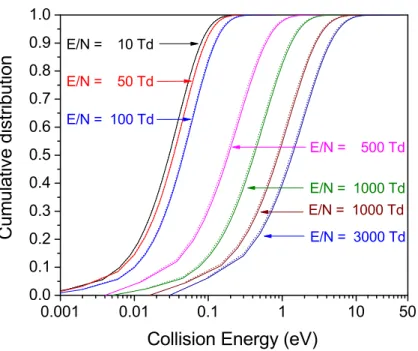
it is always below 13 eV for reduced electric field going to 2000 Td. For 3000 Td, at most 1% of collisions will appear beyond this region. For xenon even at 3000 Td (highest reduced electric field used for this thesis) none ion arrived (center-of-mass) energy above 11 eV (see section 3.2.4). As a consequence, only the six lowest electronic states of the Rg+
/Rgcollision complex (correlating respectively to 4s24p5 and 5s25p5 Kr+
and Xe+
atomic ions) [49] are effectively involved if the SOC is considered, namely, I(1/2)u,g, I(3/2)u,g, and II(1/2)u,g. Concerning ionic dimer - neutral atom
colli-sion, in this thesis, only one electronic state, I(1/2)u, will be considered for the
dimer interactions. Effectively, the difference between I(1/2)u and I(3/2)g being
approximatively 1.5 eV, only future calculations will be done in the future to pro-vide cross-section and transport coefficient for this more excited states.
With p orbitals, azimuthal number (l) is equal to 1 and s (spin number) equal to 1/2. The total orbital angular momentum (j) is delimited between ∣l − s∣ and ∣l + s∣. In the case of rare-gas atomic ions, respectively, 1/2 or 3/2. Using or-bital angular momentum, the 6 curves can be distributed in two different section
2P
3/2 for j = 3/2 containing I(1/2)u,g and I(3/2)u,g; and 2P1/2 for j = 1/2
contain-ing II(1/2)u,g. Another way to distinguished among these 6 curves is to consider
diatomic angular momentum projection subspaces (Ω), in other words the sum of the projection of total orbital momentum on the z axis and the projection of the total spin angular momentum on the z axis. I(1/2)u,gand II(1/2)u,gare
repre-sented by subspace corresponding to Ω = 1/2 and I(3/2)u,g by subspace Ω = 3/2
2.1.2 Dimer - Atom potential
When 3 atoms are involved, total interatomic potentials are calculated using Di-atomics In Molecules (DIM) methodology [50]. It consists in writing the electronic Hamiltonian as a sum of contribution of diatomic and atomic contributions:
ˆ H = n−1 ∑ a=1 n ∑ b=a+1 ˆ Hab− (n − 2) n ∑ a=1 ˆ Ha, (2.4)
where n denotes the number of atoms, and then is expanded against an appro-priately chosen basis set enabling to construct the resulting matrices exclusively from diatomic and atomic energies. These energies are obtained from indepen-dent sources (either experiments or calculations) and it is well known that if highly accurate input energies are used, the DIM approach leads, despite its ap-proximate nature, to a highly accurate estimate of the electronic Hamiltonian ma-trix.
For singly ionized complexes of rare-gases [49, 51], such basis set consists of a set of valence-bond Slater determinants representing states with the positive charge localized on a specific atom in a specific spin-orbital,
Φklsz = ∣Rg⋯Rg
+
klsz⋯Rg∣, (2.5)
where Rg denotes the electronic configuration of a ground-state rare-gas atom and Rg+
stands for the electronic configuration of kth atom, k = 1, . . . , n, from
which an electron has been removed from spin-orbital specified by angular mo-mentum l = px, py, pz, and spin projection sz = ±1/2. Note that the basis set is
approximately orthogonal and diabatic.
The Hamiltonian matrix resulting from an expansion of ˆHagainst the basis set of equation 2.80 can be built up from four lowest potential energy curves of Rg+
2,
corresponding to the electronic ground-state (2Σ+
u) and three lowest excited states
(2Π
g, 2Πu, and 2Σ+g), and the ground-state potential (1Σ+g) of the neutral dimer,
Rg2. The atomic contributions to the electronic Hamiltonian matrix can be nul-lified by identifying the zero of the total potential energy to a dissociate state
consisting of n − 1 neutral atoms and an atomic ion, all of them at infinite sepa-rations. Following our study on Kr+
/Kr collisions [52] (see also subchapter 3.1, we have used two sets of ionic diatomic potentials in the present thesis, one ob-tained from ab initio calculations [53] (hereafter denoted as "Model A") and the other based on state-of-the-art spectroscopic experiments combined with ab initio calculations [54] (Model B). If not stated otherwise, the neutral potential is taken from semiempirical modeling [55], but recent ab initio calculations [56, 57] will also be considered to analyze the effect of differences between different neutral potentials in the DIM modeling of the three-particle Kr+
2/Krcollision complex.
For heavy rare-gases, relativistic electronic effects are important. While scalar relativistic contributions are usually taken into account in ab initio calculations by using relativistic effective core potentials [58], the leading vector effect, the spin-orbit coupling, has to be included at the DIM level. An approximate method based on a semiempirical atoms-in-molecule Model [47] was proposed for the ionic complexes of rare-gases in reference [49]. Despite of the approximations em-ployed, it provides a highly accurate description of the spin-orbit coupling in ionic rare-gas complexes. For example, a thorough comparison of rovibronic spectra calculated for Kr+
2 with available experiments [53, 54] shows an
excel-lent agreement. The only external input to this method is the value of the fine-structure energy splitting between 2P
1/2 and 2P3/2 states of the atomic rare-gas
ion. In this work, an accurate experimental value, ∆ESOC=5370.1cm−1, reported for Kr+
in reference [59] has been used.
Note also that the electronic space resulting from the DIM Model used in this thesis is fully sufficient for the present calculation. As discussed in detail in the previous subsection(see also section 2 of reference [52]), going above the elec-tronic states asymptotically correlating to 4s24p5 atomic ion (i.e., above the states
considered in the present DIM model) will require excitation energies of about 13 eV and higher [48]. However, as follows from the present calculation (see sec-tion 4.2.6), even up to rather high electric fields, the mean Kr+
2/Krcollision energy
the highest electric fields considered here (E/N = 2000 Td and E/N = 3000 Td), the collision energy (¯Ecoll ≈ 10.7eV and ¯Ecoll ≈ 16.3eV, respectively) may be suf-ficiently high for the higher electronic states (asymptotically correlating to the 4s4p6 configuration of the Kr+
ion) to enter the play.
2.2
Cross-section
Figure 2.3: Particle scattering under the influence of target potential.
For illustration, let us place two particles in a plane (z, y) where one of these particles is immobile (the target) from initial position [0,0] and the other moves (the projectile) with position [z,y]. Direction of the projectile movement will be parallel to the z axis. Due to the interaction between the projectile and target, the projectile will be scattered by an angle χ, this scattering angle will depend on the impact parameter b (the initial value of projectile y coordinate) and the energy of the system. b can alternatively defined as the closest distance of projectile ap-proach to the target if there was no interaction potential between both particles. In the case of non-zero interaction between the two particles, the closest distance between them achieved during a particular collision will be different, we denote it as rcin figure 2.3.
From a classical point of view, differential cross-section (σd) can be seen as the
number of impacting particles scattered per unit of time into a solid angle (dΞ, for axially symmetric scattering dΞ = 2π sin χdχ) and divided by the flux of particles. There is more than one way for a projectile to be scattered in the solid angle dΞ.
To compare with experimental results, averaging on randomly distributed ini-tial conditions is required. By using a flux of particle (j), ∆N (χ, χ + ∆χ) being the number of projectile scattered between χ and χ + ∆χ per second,
σd(χ) =
1 j ∆χ→0lim
∆N (χ, χ + ∆χ)
2π sin χ∆χ , (2.6)
a corollary equation can be set depending on impact parameters, dσd(χ) = ∑
i
bi
sin χ(dχdb)i
. (2.7)
This equation has one important singularity. When χ goes to 0, the differential cross-section tends to infinity. Since calculations have to be done on all impact parameters which contribute to the differential cross-section into angle χ, for low scattering angle approaching zero, b diverges to infinity. Effectively, the farther is the target, the less the interaction potential has effect and the less the projectile is deflected.
Integral and momentum transfer cross-sections (respectively ICS "σ(INT)(E)"
and MTCS "σ(MT)(E)") are obtained by integration of differential cross-sections
over all scattering angles.
σ(INT)(E) =∫ π 0 σd(E, χ)2πsinχdχ, (2.8) σ(MT)(E) = ∫ π 0
(1 − cosχ)σd(E, χ)2πsinχdχ. (2.9)
MTCS is preferred to ICS, in this thesis, for multiple reasons. The principal one is that in the hybrid method, only MTCS can be calculated since ICS is in-finite due to the non-integrable singularity of σd for χ approaching zero. The
hybrid method, explained later in this chapter (see i.e. section 2.2.3), treats nuclei classically and applies a quantum formalism on electrons and allows us to obtain cross-sections for atom - atom or molecule - atom collisions. MTCS has also the advantage of decreasing the dependence on high impact parameters values for
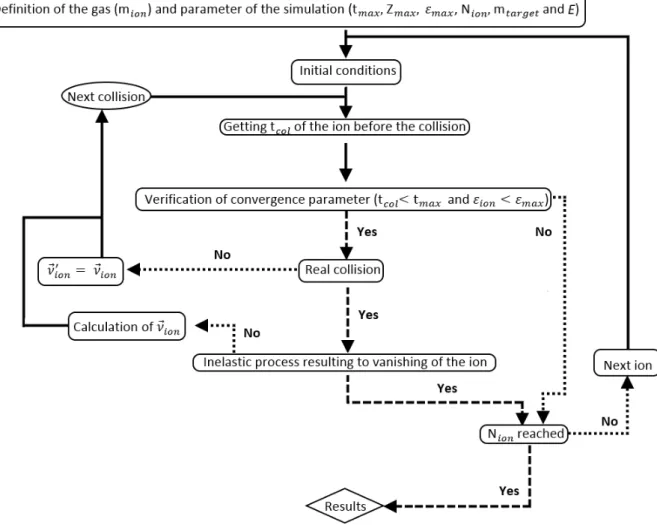
low scattering angle since the factor (1−cos χ) is close to 0 for this case. MTCSs are used in Monte Carlo code to produce accurate results if we assume an isotropic scattering for the deflection angle calculation after every calculation. Momentum transfer approximation is often used to save computational efforts and previous calculation (see reference [22]) demonstrates that it leads to acceptable accuracy calculations.
For atomic ion - neutral atom collisions considered in this thesis, multiple channels are open for the scattering of the particles (see also figure 2.4 for a graph-ical summary): Elastic, process (1) in figure 2.4,
Rg+
(2P3/2) +Rg → Rg+(2P3/2) +Rg, Rg+
(2P1/2) +Rg → Rg+(2P1/2) +Rg,
(2.10)
Elastic, charge transfer, process (2) in figure 2.4, Rg+
(2P3/2) +Rg → Rg + Rg+(2P3/2), Rg+
(2P1/2) +Rg → Rg + Rg+(2P1/2),
(2.11)
non-elastic, spin change collisions, either without the charge transfer, process (3) in figure 2.4, Rg+ (2P3/2) +Rg → Rg+(2P1/2) +Rg, Rg+ (2P1/2) +Rg → Rg+(2P3/2) +Rg, (2.12) or with the charge transfer, process (4) in figure 2.4,
Rg+
(2P3/2) +Rg → Rg + Rg+(2P1/2), Rg+
(2P1/2) +Rg → Rg + Rg+(2P3/2),
(2.13)
non elastic, angular momentum change collision, either without the charge trans-fer, process (5) in figure 2.4,
Rg+
(2P3/2, Ω = 1/2) + Rg → Rg+(2P3/2, Ω = 3/2) + Rg, Rg+
(2P3/2, Ω = 3/2) + Rg → Rg+(2P3/2, Ω = 1/2) + Rg,
or with the charge transfer, process (6) in figure 2.4, Rg+ (2P3/2, Ω = 1/2) + Rg → Rg + Rg+(2P3/2, Ω = 3/2), Rg+ (2P3/2, Ω = 3/2) + Rg → Rg + Rg+(2P3/2, Ω = 1/2). (2.15)
Figure 2.4: Schematic representation of possible transitions in a Rare-gas (Rg) ion during a collision with its neutral parent
Three different methods were used to calculate the differential cross-sections. Explanation of all methods is given in the three next sub-chapters.
Depending on the method used, some channels will not be allowed in the code. Semi-classical method allows only elastic (equation 2.10) and resonant charge transfer (equation 2.11) collisions. Quantum method will allow spin change processes (equations 2.12 and 2.13) but neglects changes in the projection of the total angular momentum along the internuclear axis (equations 2.14 and 2.15). Hybrid method will consider all the processes given in figure 2.4 including angu-lar momentum change collisions (equations 2.14 and 2.15).
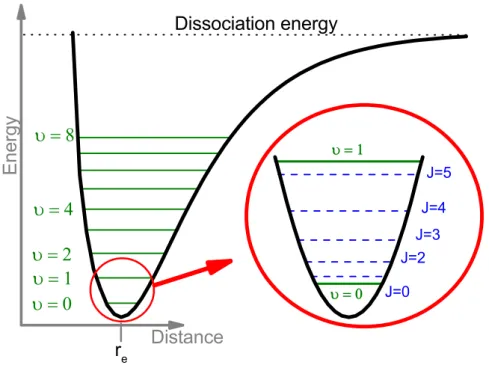
pos-sibles, for example in non reactive scattering, Rg+ 2(I(1/2)u) +Rg → Rg + 2(I(1/2)u) +Rg, Rg+ 2(I(1/2)u) +Rg → Rg + 2(I(3/2)g) +Rg, Rg+ 2(I(1/2)u) +Rg → Rg + 2(I(3/2)u) +Rg, Rg+ 2(I(1/2)u) +Rg → Rg + 2(I(1/2)g) +Rg, Rg+ 2(I(1/2)u) +Rg → Rg + 2(II(1/2)u) +Rg, Rg+ 2(I(1/2)u) +Rg → Rg + 2(II(1/2)g) +Rg, (2.16) Rg+ 2(I(3/2)g) +Rg → Rg + 2(I(1/2)u) +Rg, Rg+ 2(I(3/2)g) +Rg → Rg + 2(I(3/2)g) +Rg, Rg+ 2(I(3/2)g) +Rg → Rg + 2(I(3/2)u) +Rg, Rg+ 2(I(3/2)g) +Rg → Rg + 2(I(1/2)g) +Rg, Rg+ 2(I(3/2)g) +Rg → Rg + 2(II(1/2)u) +Rg, Rg+ 2(I(3/2)g) +Rg → Rg + 2(II(1/2)g) +Rg, (2.17) Rg+ 2(I(3/2)u) +Rg → Rg + 2(I(1/2)u) +Rg, Rg+ 2(I(3/2)u) +Rg → Rg + 2(I(3/2)g) +Rg, Rg+ 2(I(3/2)u) +Rg → Rg + 2(I(3/2)u) +Rg, Rg+ 2(I(3/2)u) +Rg → Rg + 2(I(1/2)g) +Rg, Rg+ 2(I(3/2)u) +Rg → Rg + 2(II(1/2)u) +Rg, Rg+ 2(I(3/2)u) +Rg → Rg + 2(II(1/2)g) +Rg, (2.18) Rg+ 2(I(1/2)g) +Rg → Rg + 2(I(1/2)u) +Rg, Rg+ 2(I(1/2)g) +Rg → Rg + 2(I(3/2)g) +Rg, Rg+ 2(I(1/2)g) +Rg → Rg + 2(I(3/2)u) +Rg, Rg+ 2(I(1/2)g) +Rg → Rg + 2(I(1/2)g) +Rg, Rg+ 2(I(1/2)g) +Rg → Rg + 2(II(1/2)u) +Rg, Rg+ 2(I(1/2)g) +Rg → Rg + 2(II(1/2)g) +Rg, (2.19)
Rg+ 2(II(1/2)u) +Rg → Rg + 2(I(1/2)u) +Rg, Rg+ 2(II(1/2)u) +Rg → Rg + 2(I(3/2)g) +Rg, Rg+ 2(II(1/2)u) +Rg → Rg + 2(I(3/2)u) +Rg, Rg+ 2(II(1/2)u) +Rg → Rg + 2(I(1/2)g) +Rg, Rg+ 2(II(1/2)u) +Rg → Rg + 2(II(1/2)u) +Rg, Rg+ 2(II(1/2)u) +Rg → Rg + 2(II(1/2)g) +Rg, (2.20) Rg+ 2(II(1/2)g) +Rg → Rg + 2(I(1/2)u) +Rg, Rg+ 2(II(1/2)g) +Rg → Rg + 2(I(3/2)g) +Rg, Rg+ 2(II(1/2)g) +Rg → Rg + 2(I(3/2)u) +Rg, Rg+ 2(II(1/2)g) +Rg → Rg + 2(I(1/2)g) +Rg, Rg+ 2(II(1/2)g) +Rg → Rg + 2(II(1/2)u) +Rg, Rg+ 2(II(1/2)g) +Rg → Rg + 2(II(1/2)g) +Rg. (2.21)
Or for dissociation of the ionic dimer, here only a general example is shown, different initial electronic states can be inserted,
Rg+ 2 +Rg → Rg + +Rg + Rg, Rg+ 2 +Rg → Rg + +Rg2. (2.22)
For this thesis only two different channels are considered, where the initial dimer is on the electronically ground-state I(1/2)u and final Rg+ electronic state
is2P
3/2. The first one is the Non-Reactive Scattering (NRS),
Rg+
2 +Rg → Rg +
2 +Rg, (2.23)
the second one is the Collision Induced Dissociation (CID), Rg+
2 +Rg → Rg +
+Rg + Rg. (2.24)
It is important to note that charge transfer channel in not distinguished from the non charge transfer channel in the CID process.
2.2.1 Quantum method
This is the most accurate method used in this work. This method requires also the longest calculation time. Another issue with this method is that it is easy to use for atom - atom collisions, while the computational complexity increases for dimer - atom collisions. This is why this method will only be used, as benchmark, for atom - atom collisions in this work.
If non-interacting particles are considered, their relative motion can be repre-sented with a plane wave in quantum mechanics thanks to wave-particle duality. Due to the uncertainty principle valid in quantum physics, a well defined linear momentum, like in this case, induces that the plane wave is totally delocalized in space. The wave function for such an interactionless collision (ψ0(⃗r, k)) is usually written as, ψ0(⃗r, E) = √ kµ 2πh2e ik⃗r, (2.25)
where k is the wavenumber, E is the energy of the system and µ is the reduced mass of colliding atoms.
k =µνr ̵
h , (2.26)
with νr is the velocity. The projectile will move along the z axis, considering the
target is localized in the origin [0,0]. With a spherically symmetrized interaction potential, the azimuthal angle (ϕ) will play no role during collisions. After a collision, the projectile will be scattered with a scattering amplitude (f(E, χ)). At long distances from the collision point, the wave function can be written as
ψ(⃗r, E) = √ ( kµ 2πh2) {e ikz +f(E, χ) eikr r }. (2.27)
By applying the momentum operator −i̵h ⃗∇ on the incident wave we see that it has a momentum magnitude along the z axis of k̵h and consequently the incident flux of atoms for the plane wave (eikz) is k̵h
µ ∗ ∣eikz∣2 = k̵h
µ. Flux of atoms passing
through a small area of r2 sinχdχdϕ from the scattered wave f
mn(ε, χ) eik ⃗r ⃗ r is k̵h µ ∣ fmn(E, χ) ∣2sin χdχdϕ.
Differential cross-section is defined as the flux of scattered atoms through a given solid angle (dΞ = sin χdχdϕ) divided by the incident flux. The differential cross-section can be rewritten as
σd(E, χ)dΞ = k̵h µ ∣f(E, χ) ∣2 sin χdχdϕ k̵h µ . (2.28)
After simplifications and having taken into account that the final wavenumber (kn) can be different from the initial wavenumber (km) the differential cross-section
can be transformed as,
σd(E, χ) =
kn
km
∣fmn(E, χ) ∣2. (2.29)
For simplification in the rest of the chapter k will be written in place of√knkm.
To resolve the scattering wave function we need to use the time independent Schrödinger equation. Let’s start with a general form of the Schrödinger equa-tion,
ˆ
HΨ(⃗r1, ⃗r2, ⃗r3, ..., ⃗rNe; ⃗r) = EΨ(⃗r1, ⃗r2, ⃗r3, ..., ⃗rNe; ⃗r), (2.30)
where Ψ(⃗r1, ⃗r2, ⃗r3, ..., ⃗rNe; ⃗r)is the total wave function, depending on the
elec-trons positions (⃗rx) and the nuclear position (⃗r), and E is the total energy of the
system (E = h2µ̵2k2). Hamiltonian of the system ( ˆH) consists of two parts (nuclear
and electronic),
ˆ
H = ˆTnucl+ ˆHelec. (2.31) ˆ
Tnucl is the kinetic energy related to nuclei, ˆHelec is the sum of the kinetic energy
of the electrons and the Coulomb energy of electrons and nuclei.
By expanding the total wave function of the system, (Ψ(⃗r1, ⃗r2, ⃗r3, ..., ⃗rNe; ⃗r)),
and the electronic Hamiltonian in the adiabatic wave functions basis, ˆ
![Figure 1.1: Aurora Borealis in Greenland [5]](https://thumb-eu.123doks.com/thumbv2/123doknet/14616171.733102/21.892.140.808.163.547/figure-aurora-borealis-in-greenland.webp)
![Figure 1.3: Example of a DBD reactor [7]](https://thumb-eu.123doks.com/thumbv2/123doknet/14616171.733102/24.892.243.633.165.465/figure-example-of-a-dbd-reactor.webp)
![Figure 3.18: Hypothesis verification using semi-classical method and interaction poten- poten-tials of ref [96]: JWKB approximation(a) and isotropic distribution (b)](https://thumb-eu.123doks.com/thumbv2/123doknet/14616171.733102/103.892.170.786.648.891/figure-hypothesis-verification-classical-interaction-approximation-isotropic-distribution.webp)
![Figure 4.3: Summary of experimental data on reduced Kr + 2 / Kr mobility measured at close-to-ambient temperatures and normal pressure (P = 760 Torr): ◯ Varney et al.[91]](https://thumb-eu.123doks.com/thumbv2/123doknet/14616171.733102/120.892.222.634.198.540/figure-summary-experimental-reduced-mobility-measured-temperatures-pressure.webp)