HAL Id: tel-01967611
https://tel.archives-ouvertes.fr/tel-01967611
Submitted on 1 Jan 2019HAL is a multi-disciplinary open access
archive for the deposit and dissemination of sci-entific research documents, whether they are pub-lished or not. The documents may come from teaching and research institutions in France or abroad, or from public or private research centers.
L’archive ouverte pluridisciplinaire HAL, est destinée au dépôt et à la diffusion de documents scientifiques de niveau recherche, publiés ou non, émanant des établissements d’enseignement et de recherche français ou étrangers, des laboratoires publics ou privés.
Selective Electrocatalytic reduction mediated by Sm(II) :
Application to nitroarenes, sulfoxides and phthalimides
Yu-Feng Zhang
To cite this version:
Yu-Feng Zhang. Selective Electrocatalytic reduction mediated by Sm(II) : Application to nitroarenes, sulfoxides and phthalimides. Organic chemistry. Université Paris Saclay (COmUE), 2017. English. �NNT : 2017SACLS596�. �tel-01967611�
Selective Electrocatalytic reduction
mediated by Sm(II) : Application to
nitroarenes, sulfoxides and
phthalimides
Thèse de doctorat de l'Université Paris-Saclay préparée à l’Université Paris-Sud
École doctorale n°571Sciences chimiques : molécules, matériaux, instrumentation et biosystèmes (2MIB)
Spécialité : Chimie
Thèse présentée et soutenue à Orsay, 28/11/2017, par
Yu-Feng ZHANG
Composition du Jury :
Vincent GANDON
Professeur, Université Paris-Sud (ICMMO UMR 8182) Président Éric LABBÉ
Professeur, ENS-UPMC (Électrochimie UMR 8640) Rapporteur Olivier RIANT
Professeur, Université Catholique de Louvain (IMCN-MOST) Rapporteur Delphine JOSEPH
Professeur, Université Paris-Sud (BioCIS UMR 8076) Examinatrice Sandrine PY
Chargée de Recherche CNRS, Université Grenoble 1 (SERCO UMR 5250) Examinatrice Mohamed MELLAH
Maitre de Conférences, Université Paris-Sud (ICMMO UMR 8182) Directeur de thèse
NN T: 2017S AC L S 596
Université Paris-Saclay
Espace Technologique / Immeuble Discovery
Route de l’Orme aux Merisiers RD 128 / 91190 Saint-Aubin, France
Titre : Réduction électrocatalytique sélective médiée par Sm(II): application aux nitroarènes, aux sulfoxydes et aux phtalimides
Mots clés : divalents de samarium, réduction, électrocatalyse, nitroarènes, sulfoxydes, phtalimides Résumé : Le SmI2 en tant que réactif de transfert
monoélectronique a été largement utilisé en chimie organique depuis les premiers travaux de Kagan. Cependant, la quantité stoechiométrique ou en excès de SmI2 et d'additifs toxique tels que
HMPA sont utilisés normalement pour améliorer la réactivité. de plus, du a la sensibilité à l'oxygène, le stockage de la solution de SmI2 est
difficile.
Récemment, nous avons développé une nouvelle méthode électrocatalytique basée sur la régénération électrochimique de Sm2+. Par
rapport à la réaction SmI2 classique, notre
processus s'est produit avec une quantité catalytique de Sm.
Premierement, pour la réduction de Nitroarenes, la reaction a sélectivement fourni les composés aromatiques azoïques et les anilines en fonction du solvent choisi. Notamment, c'est la première fois que la réaction Sm2+ se produit dans le
methanol dans le cas des anilines.
Deuxiement, dans le cas de la réduction des sulfoxydes par SmI2, en general, l'HMPA était
necessaire comme additif. Dans notre procédé électrocatalytique, les sulfoxydes ont été transformés en sulfures avec une chimiosélectivité élevée et des excellents rendements toujours à température ambiante sans besoin ni de HMPA ni d’atmosphère protectrice. Enfin, les dérivés d'isoindolinone sont des séries de produits importants en chimie organique, la réduction des phtalimides est l'approche la plus pratique pour les obtenir. Avec les alcools, l'alcoxylation réductrice de phtalimides a eu lieu pour la premiere fois avec le Sm2+
électrocatalytique dans nos conditions. Et si on ajoute d'autres sources de protons, ce procédé a fourni les ω-hydroxylactames et isoindolinones correspondants avec des rendements eleves.
Title : Selective Electrocatalytic reduction mediated by Sm(II) : Application to nitroarenes,
sulfoxides and phthalimides
Keywords : divalent of samarium, reduction, eletrocatalyst, nitroarenes, sulfoxides, phthalimides Abstract : The SmI2 as a single electron transfer
reagent has been widely used in organic chemistry since the pioneering works by Kagan. However, the stoichiometric or excess amount of SmI2 and harmful additives such as HMPA
are used normally to enhance the reactivity, moreover, due to the oxygen sensitive, the storage of SmI2 solution is difficult.
Recently, we have developed a new electrocatalytic method based on the electrochemical regeneration of Sm2+.
Compared to the classic SmI2 reaction, our
process occurred with a catalytic amount of Sm. In the reduction of Nitroarenes, it selectively afforded the azo aromatic compounds and anilines depending on different solvents system. Notably, it’s the first time that the Sm2+ reaction
occurred in the methanol.
Normally, the HMPA was the additive in the reduction of sulfoxides by SmI2. Under our
electrocatalytic process, the sulfoxides were converted into sulfides in high chemoselectivity and yield at room temperature without HMPA and protecting atmosphere.
The isoindolinone derivatives are series of important products in organic chemistry, the reduction of phthalimides is the most convenient approach to provide them. With alcohols, the unprecedented Sm2+ electrocatalyzed reductive
alkoxylation of phthalimides was established. Moreover, adding other proton sources, this process afforded the corresponding ω-hydroxylactams and isoindolinones.
- 1 -
Content
Résumé ……….. - 3 -
Chapter I. Introduction of SmI2 chemistry ... - 4 -
I. 1. The use of SmI2 in organic chemistry ... - 4 -
I. 2. Reduction of functional groups ... - 5 -
I. 3.SmI2 mediated Carbon-carbon bonds formation... - 8 -
I. 4. The use of SmI2 in catalytic fashion ... - 10 -
I. 5. The use of electrogenerated SmI2 ... - 13 -
I. 6. Conclusion ... - 16 -
Chapter II. The Sm electrocatalytic reductive coupling of nitrobenzenes ... - 19 -
II. 1. Introduction ... - 19 -
II. 2. 1. Catalytic synthesis of azobenzenes from anilines ... - 20 -
II. 2. 2. Catalytic synthesis of azobenzenes from nitrobenzenes ... - 21 -
II. 3. Stoichiometric synthesis of azobenzenes from nitrobenzenes using electrogenerated SmI2 ... - 23 -
II. 3. 1. Electrochemical conditions optimization ... - 24 -
II. 3. 2. Reductive synthesis of symmetrical azo compounds using stoichiometric amount of electrogenerated SmI2 ... - 25 -
II. 3. 3. The electrogenerated stoichiometric SmI2 reductive synthesis of asymmetrical azo compounds ... - 29 -
II. 4. The SmII electrocatalytic synthesis of azo compounds from nitrobenes .... - 31 -
II. 4. 1. Probe of Sm2+ electrocatalytic reductive process ... - 31 -
II. 4. 2. SmI2-electrocatalyzed reduction of nitroarenes into symmetrical azobenzenes ... - 34 -
II. 4. 3. SmI2-electrocatalyzed reduction of nitroarenes into unsymmetrical azobenzenes ... - 36 -
II. 5. Conclusion ... - 37 -
II. 6. Experiment ... - 39 -
II. 6. 1. General Information ... - 39 -
II. 6. 2. General procedure for the synthesis of symmetrical azo compounds - 39 - II. 6. 3. General procedure for the synthesis of asymmetrical azo compounds - 49 - Chapter III. The Sm2+ electrocatalytic reduction of nitroarenes into amino aromatics..- 58 -
III. 1. Introduction ... - 58 -
III. 2. 1. Catalytic reduction of nitroarenes into anilines by noble metals ... - 58 -
III. 2. 2. Catalytic reduction of nitroarenes into anilines by base metals ... - 62 -
III. 2. 3. The SmI2 reduction of nitro compounds ... - 66 -
III. 3. 1. Optimization of the reduction of nitroaroenes into anilines ... - 67 -
III. 3. 2. The efficient of current density and concentration ... - 69 -
III. 4. The scope of the reaction ... - 70 -
III. 5. Conclusion ... - 73 -
III. 6. Experiment ... - 74 -
III. 6. 1. General Information ... - 74 -
III. 6. 2. General condition for the electrocatalytic reduction of nitro aromatic compounds ... - 74 -
III. 6. 3. General condition for the electrocatalytic reduction of nitro compounds with activate hydrogens ... - 75 -
III. 6. 4. Characterization data of amino compounds ... - 75 -
- 2 -
III. 6. 6. Characterization data of alphatic amino compound... - 90 -
Chapter IV. The Sm electrocatalytic reduction of sulfoxides ... - 91 -
IV. 1. Introduction... - 91 -
IV. 2. The catalytic reduction of sulfoxides into sulfides ... - 92 -
IV. 3. Electrocatalytic reduction of sulfoxide into sulfides mediated by SmI2 ... - 96 -
IV. 3. 1. Optimization of electrochemical condition ... - 96 -
IV. 4. The scope for reduction of sulfoxide into sulfides ... - 96 -
IV. 4. 1. Using MeOH as solvent ... - 97 -
IV. 4. 2. Using THF as solvent ... - 98 -
IV. 5. Conclusion ... - 100 -
IV. 6. Experiment ... - 101 -
IV. 6. 1. General Information... - 101 -
IV. 6. 2. General condition for the electrocatalytic reduction in MeOH ... - 101 -
IV. 6. 3. General condition for the electrocatalytic reduction in THF ... - 102 -
IV. 6. 4. Characterization data of sulfides ... - 102 -
Chapter V. The chemoselective Sm electrocatalytic reduction of phthalimides .. - 109 -
V. 1. Introduction ... - 109 -
V. 2. Sm electrocatalyzed alkoxylation of phthalimides ... - 115 -
V. 2. 1. Optimization of Sm2+ reductive alkoxylation ... - 116 -
V. 2. 2. Reductive alkoxylation of N-methyl phtalimide ... - 117 -
V. 2. 3. Reductive methoxylation of N-substituted phthalimides ... - 122 -
V. 2. 4. Intramolecular reductive alkoxylation of N-substituted phtalimides- 123 - V. 2. 5. Regioselective methoxylation of unsymmetrical aryl ring-substituted phthalimides ... - 124 -
V. 2. 6. Application in the total synthesis ... - 125 -
V. 2. 7. Plausible mechanism of reduced alkoxylation ... - 126 -
V. 3. Sm electrocatalyzed reduction of phthalimides ... - 127 -
V. 3. 1. Optimization of phthalimides reduction ... - 127 -
V. 3. 2. The scope of the reduction of phthalimides into ω-hydroxylactams - 129 - V. 3. 3. Sm electrocatalyzed reduction of phthalimides into isoindolines .... - 130 -
V. 4. Conclusion ... - 131 -
General conclusion... - 132 -
V. 5. Experiment ... - 134 -
V. 5. 1. General Information ... - 134 -
V. 5. 2. Preparation of the substrates ... - 135 -
V. 5. 3. Characterization data of reductive alkoxylation of methyl phthalimide ... - 142 - V. 5. 4. Characterization data of reductive methoxylation of N-substituted phthalimides ... - 158 -
V. 5. 5. Regioselectivity of reductive methoxylation of aryl-ring-substituted N-methylphtalimides ... - 168 -
V. 5. 6. Total synthesis of 3-methoxy-2-(3-cyclopentyloxy-4-methoxyphenyl)-1-isoindolinone (25) ... - 173 -
V. 5. 7. Characterization data of ω-hydroxylactams ... - 175 -
- 3 -
Résumé
Le diiodure de samarium (SmI2), décrit pour la première fois par H. B. Kagan en 1977, est connu
comme étant un des agents réducteurs des plus utiles et des plus polyvalents en synthèse organique. Son importance et son application ont été démontrées par la publication de très nombreux articles, ce qui prouve le rôle prédominant de ce réactif en synthèse. Cependant, la majorité des réactions organiques médiées par le diiodure de samarium (SmI2) en tant que réducteur, nécessitent toujours
l’emploi d’une quantité sur-stœchiométrique de ce réactif. Cet inconvénient diminue fortement le potentiel d’applications synthétiques à plus grande échelle voir à l’échelle industrielle. Plusieurs groupes de recherche ont envisagé l’emploi de co-réducteurs pour rendre l’utilisation du SmI2
catalytiques. Cependant, bien que les co-réducteurs proposés pour des applications catalytiques représentent des progrès significatifs, leur utilisation n’en est pas moins restée que marginale, probablement en raison de l'incompatibilité entre les co-réducteurs utilisés en large excès et les substrats couramment utilisés pour les réactions induites par SmI2. Récemment, notre groupe a
rapporté une nouvelle méthode pour générer le SmI2 par dissolution électrochimique directe d'une
anode en samarium métallique. Son application s’est révélée très efficace dans des procédures électrosynthétiques et électrocatalytiques pour la formation de liaisons carbone-carbone. Dans le cadre de cette thèse, les investigations sont orientées vers la réduction catalytique de groupes fonctionnels variés. En effet, sur la base des résultats antérieurs et les conditions électrocatalytiques établies, le sujet de ma thèse portait sur le potentiel d'application de cette nouvelle procédure catalytique pour la réduction chimiosélectives de différents groupes fonctionnels en chimie organique.
Ainsi à partir des nitrobenzènes, nous avons développé une alternative facile, efficace et sûre pour la synthèse d’une grande variété de dérivés d'azobenzène symétriques et dissymétriques. L'efficacité et la grande tolérance fonctionnelle de cette procédure fournissent un nouvel outil pour accéder à des azobenzènes variés. L'utilisation de l'électrochimie pour effectuer des réactions catalytiques dans des conditions douces utilisant SmI2 comme réducteur, l'absence de métaux
précieux, de bases fortes et de substances non dangereuses font de notre protocole une excellente alternative aux méthodes décrites. Nous avons examiné de près le mécanisme réactionnel en identifiant clairement différents intermédiaires dans le processus catalytique.
La réduction électrocatalysée de nitrobenzènes fonctionnalisés en anilines correspondantes a également été réalisée en changeant simplement de solvant. Ainsi, pour la première fois la réaction de réduction par le samarium divalent est réalisée dans le méthanol pur. Cette procédure de réduction catalytique a montré une chimiosélectivité élevée, une grande tolérance fonctionnelle et toutes les anilines et aminopyridines escomptées sont obtenus avec de très bons rendements isolés. La réduction électrocatalytique des sulfoxydes a également été envisagée. Nous avons montré que la réduction dans ce cas pouvait avoir lieu soit dans le méthanol soit dans le THF. Néanmoins, le THF a été choisi pour réaliser cette transformation sur une plus large gamme de substrats. Enfin, la réduction chimiosélective électrocatalytique des phtalimides a été également testé pour la production de produits alcoxylés, de ω-Hydroxylactames et/ou d’isoindolinones. Nous avons mis en place pour la première fois une procédure de réduction électrocatalytique séléctive présentant une grande tolérance fonctionnelle et une totale chimiosélectivité. Grâce à l'électrochimie, cette approche évite avec succès les conditions usuelles de hautes températures et hautes pressions d'hydrogène. Les alcools primaires ou secondaires réagissent très efficacement avec les phtalimides, pour obtenir les isoindolinones 2-substituées correspondantes avec des rendements de bons à excellents. En outre, il n'y a aucune réduction du cycle aromatique, des liaisons insaturées, des groupements nitriles, esters, amides ou hydroxyles présentes sur la structure initialement.
- 4 -
Chapter I. Introduction of SmI
2chemistry
I. 1. The use of SmI
2in organic chemistry
SmI2 was first reported in 1906, but for a long time, it was only researched in inorganic chemistry.1 In 1977, Kagan and co-workers published the first article on preparation and application of SmI2 (Kagan’s reagent) in organic chemistry.2 This reagent can be easily prepared at room temperature by simply mixing Sm powder and 1,2-diiodoethane under inert atmosphere. This process makes possible the use of SmI2 in the laboratory. Over the years, SmI2 has become one of the most important reducing agent in organic chemistry.3 As a single electron transfer reagent, it was not only able to reduce a range of functional groups but also to perform numerous C-C bond formations (Scheme 1.1).
Scheme 1.1 The general application of SmI2 in organic chemistry
1 Matignon, C. A.; Caze, E. Ann. Chim. Phys. 1906, 8, 417-426. 2 Namy, J.-L.; Girard, P.; Kagan, H. B. Nouv. J. Chim. 1977, 1, 5-7.
3 For reviews, see: (a) Soderquist, J. A. Aldrichimica Acta, 1991, 24, 15-23. (b) Molander, G.A., Chem.
Rev. 1992, 92, 29-68. (c) Molander, G. A. Org. React. 1994, 46, 211-367. (d) Molander, G.A.; Harris, C. R. Chem. Rev. 1996, 96, 307-338. (e) Molander, G. A.; Harris, C. R. Tetrahedron 1998, 54, 3321-3354. (f) Krief, A.; Laval, A. M. Chem. Rev. 1999, 99, 745-778. (g) Kagan, H. B. Tetrahedron 2003, 59, 10351-10372. (h) Edmonds, D. J.; Johnston, D.; Procter, D. J. Chem. Rev. 2004, 104, 3371-3404. (i) Nicolaou, K. C.; Ellery, S. P.; Chen, J. S. Angew. Chem., Int. Ed. 2009, 48, 7140-7165. (j) Procter, D. J.; Flowers, R. A., II; Skrydstrup, T. Organic Synthesis Using Samarium Diiodide: A Practical Guide; RSC Publishing: Cambridge, U.K., 2010. (k) Szostak, M.; Spain, M.; Parmar, D.; Procter, D. J. Chem. Commun. 2012, 48, 330-346. (l) Szostak, M.; Spain, M.; Procter, D. J. Chem. Soc. Rev. 2013, 42, 9155-9183. (m) Szostak, M.; Fazakerley, N. J.; Parmar, D.; Procter, D. J. Chem. Rev. 2014, 114, 5959-6039.
- 5 -
I. 2. Reduction of functional groups
Functional group transformations by reductants are one of the most fundamental conversion in organic synthesis. In 1980, Kagan’s group introduced the application of SmI2 in a variety of functional group transformations such as deoxygenation of epoxides and sulfoxides, reduction of conjugated double bonds, reduction of carbonyl derivatives and dehalogenation.4 From then on, SmI
2 is widely used as a versatile reducing reagent and has captured the imagination of organic chemists and become one of the most important single electron transfer (SET) reagent for organic functional groups transformation (Table 1.1).
The dehalogenation5 and β-elimination6 by SmI2 were performed in high temperature or HMPA (Table 1.1, entry 1). Adding the alcohol or water as proton donor, the SmI2 reduction of aldehydes and ketones affords the corresponding alcohols (Table 1.1, entry 2),7 also deoxygenation of acids8 (Table 1.1, entry 3) and amides9 (Table 1.1, entry 4) produce the corresponding alcohols and amines. Interestingly, the SmI2 mediated reduction of aryl esters provided a deoxygenation protocol (Table 1.1, entry
5),10 but the lactones afforded the corresponding diols (Table 1.1, entry 6).11 As an important application, the reduction of α-heteroatom-substituted carbonyl compounds to the parent carbonyl compound is the most common chemoselective transformation mediated by SmI2 (Table 1.1, entry 7-9).12,13,14
4 Girard, P.; Namy, J.-L.; Kagan, H. B. J. Am. Chem. Soc. 1980, 102, 2693-2698.
5 (a) Inanaga, J.; Ishikawa, M.; Yamaguchi, M. Chem. Lett. 1987, 1485-1486. (b) Kagan, H. B.; Namy,
J.-L.; Girard, P. Tetrahedron, 1981, 37, 175-180. (c) Curran, D. P.; Fevig, T. L.; Jasperse, C. P.; Totleben, M. J. Synlett. 1992, 943-961. (d) Hasegawa, E.; Curran, D. P. Tetrahedron Lett. 1993, 34, 1717-1720.
6 (a) Concellón, J. M.; Rodríguez-Solla, H. Chem. Soc. Rev. 2004, 33, 599-609. (b) Concellón, J. M.;
Bernad, P. L.; Pérez-Andrés, J. A. Angew. Chem., Int. Ed. 1999, 38, 2384-2386. (c) Concellón, J. M.; Bernad, P. L.; Bardales, E. Org. Lett. 2001, 3, 937-939.
7 (a) Keck, G. E.; Wager, C. A.; Sell, T.; Wager, T. T. J. Org. Chem. 1999, 64, 2172-2173. (b) Keck, G.
E.; Wager, C. A. Org. Lett. 2000, 2, 2307-2309. (c) Chopade, P. R.; Davis, T. A.; Prasad, E.; Flowers II, R. A. Org. Lett. 2004, 6, 2685-2688. (d) Davis, T. A.; Chopade, P. R.; Hilmersson, G.; Flowers II, R. A. Org. Lett. 2005, 7, 119-122. (e) Keck, G. E.; Truong, A. P. Org. Lett. 2002, 4, 3131-3134. (f) Keck, G. E.; Giles, R. L.; Cee, V. J.; Wager, C. A.; Yu, T.; Kraft, M. B. J. Org. Chem. 2008, 73, 9675-9691. (g) Huang, L.-L.; Xu, M.-H. Lin, G.-Q. J. Am. Chem. Soc. 2006, 128, 5624-5625.
8 Kamochi, Y.; Kudo, T. Chem. Lett. 1991, 893-896. 9 Kamochi, Y.; Kudo, T. Chem. Lett. 1993, 1495-1498. 10 Lam, K.; Markó, I. E. Org. Lett. 2008, 10, 2773-2776.
11 Duffy, L. A.; Matsubara, H.; Procter, D. J. J. Am. Chem. Soc. 2008, 130, 1136-1137.
12 (a) Molander, G. A.; Hahn, G. J. Org. Chem. 1986, 51, 1135-1138. (b) Holton, R. A.; Somoza, C.; Chai,
K.-B. Tetrahedron Lett. 1994, 35, 1665-1668. (c) Molander, G. A.; Hahn, J. Org. Chem. 1986, 51, 2596-2599. (d) Molander, G. A.; Stengel, P. J. Tetrahedron 1997, 53, 8887-8912.
13 (a) Kusuda, K.; Inanaga, J.; Yamaguchi, M. Tetrahedron Lett. 1989, 30, 2945-2948. (b) Otsubo, K.;
Inanaga, J.; Yamaguchi, M. Tetrahedron Lett. 1987, 28, 4437-4440.
14 (a) Hughes, A. D.; Price, D. A.; Simpkins, N. S. J. Chem. Soc., Perkin Trans. 1999, 1295-1304. (b)
- 6 -
The reduction of nitrogen-containing compounds are very important transformation in organic chemistry. For the reduction of nitro15 and cyano16 groups, the SmI
2 presented high reactivity, furthermore, the cleavage of N-O17 and N-N18 bonds by SmI
2 have been a routine process. Moreover, the hydrogenation of electron-deficient alkenes by SmI2 was also demonstrated with high functional group tolerance.19 Kagan reported the reduction of sulfoxides and sulfones but long reaction times and an excess of SmI2 was needed.4 The addition of HMPA accelerated the reaction greatly.20 However, the carbon-sulfur bond of alkyl or alkenyl phenyl sulfones was cleaved under the SmI2 -HMPA system.21 In 2011, Procter’s group demonstrated that the use of SmI
2-Et3N-H2O system could directly reduce the acyclic esters22 and amides23 into the alcohols. The SmI2-base-ROH system has exhibited the superiority and more extensive in the future.
Table 1.1 The reduction of functional groups by SmI2.
entry SM Additive product Ref.
1
or 1. None (long time and high temp.)
2. HMPA
or
5, 6
15 (a) Souppe, J.; Danon, L.; Namy, J. L.; Kagan, H. B. J. Organomet. Chem. 1983, 250, 227-236. (b)
Kende, A. S.; Mendoza, J. S. Tetrahedron Lett. 1991, 32, 1699-1702. (c) Brady, E. D.; Clark, D. L.; Keogh, D. W.; Scott, B. L.; Watkin, J. G. J. Am. Chem. Soc. 2002, 124, 7007-7015.
16 Szostak, M.; Sautier, B.; Spain, M.; Procter, D. J. Org. Lett. 2014, 16, 1092−1095.
17 (a) Keck, G. E.; McHardy, S. F.; Wager, T. T. Tetrahedron Lett. 1995, 36, 7419-7422. (b) Zhang, Y.;
Lin, R. Synth. Commun. 1987, 17, 329-332. (c) Natale, N. R. Tetrahedron Lett. 1982, 23, 5009-5012. (d) Bode, J. W.; Carreira, E. M. Org. Lett. 2001, 3, 1587-1590. (e) Fader, L. D.; Carreira, E. M. Org. Lett. 2004, 6, 2485-2488.
18 (a) Burk, M. J.; Feaster, J. E. J. Am. Chem. Soc. 1992, 114, 6266-6267. (b) Enders, D.; Funabiki, K.
Org. Lett. 2001, 3, 1575-1577. (c) Berger, R.; Duff, K.; Leighton, J. L. J. Am. Chem. Soc. 2004, 126, 5686-5687. (d) Chowdari, N. S.; Barbas III, C. F. Org. Lett. 2005, 7, 867-870.
19 (a) Inanaga, J.; Handa, Y.; Tabuchi, T.; Otsubo, K.; Yamaguchi, M.; Hanamoto, T. Tetrahedron Lett. 1991, 32, 6557-6558. (b) Cabrera, A.; Alper, H. Tetrahedron Lett. 1992, 33, 5007-5008. (c) Fujita, Y.;
Fukuzumi, S.; Otera, J. Tetrahedron Lett. 1997, 38, 2121-2124. (d) Dahlen, A.; Hilmersson, G. Tetrahedron Lett. 2003, 44, 2661-2664. (e) Dahlen, A.; Hilmersson, G. Chem. Eur. J. 2003, 9, 1123-1128. (f) Keck, G. E.; McLaws, M. D. Tetrahedron Lett. 2005, 46, 4911-4914. (g) Davies, S. G.; Rodríguez-Solla, H.; Tamayo, J. A.; Garner, C. Smith, A. D. Chem. Commun. 2004, 2502-2503. (h) Davies, S. G.; Rodríguez-Solla, H.; Tamayo, J. A.; Cowley, A. R.; Concellón, C.; Garner, A. C.; Parkes, A. L.; Smith, A. D. Org. Biomol. Chem. 2005, 3, 1435-1447.
20 Handa, Y.; Inanaga, J.; Yamaguchi, M. J. Chem. Soc., Chem. Commun. 1989, 298-299.
21 (a) Kunzer, H.; Stahnke, M.; Sauer, G.; Wiechert, R. Tetrahedron Lett. 1991, 32, 1949-1952. (b)
Eckelbarger, J. D.; Wilmot, J. T.; Gin, D. Y. J. Am. Chem. Soc. 2006, 128, 10370-10371.
22 Szostak, M.; Spain, M.; Procter, D. J. Chem. Commun. 2011, 47, 10254-10256.
- 7 - 2 or ROH or H2O or 7 3 1. NaOH, H2O 2. H2O 8 4 H2O 9 5 HMPA 10 6 H2O 11 7 ROH 12
8 HMPA and ROH 13
9 None, HMPA or DMPU or LiCl 14
10 ROH or 15
11 None and 17
12 None, DMPU and 18
13 ROH or Hor DMA or NEt2O and HMPA
3-H2O 19
14 or HMPA or DMPU 20
15 HMPA 21
16 NEt3 and H2O 22
- 8 -
18 NEt3 and H2O 23
Although, the results illustrated that the SmI2 reagent can reduce a large range of organic functional groups, generally excess amounts of SmI2 and several additives were needed in most of the transformations.
I. 3.SmI
2mediated Carbon-carbon bonds formation
The carbon-carbon bond formation by SmI2 is another significant application in organic chemistry, one of the best known reaction is the pinacol coupling (Table 1.2, entry 1).24 In General, the coupling was carried out in high chemoselectivity. Using tetraglyme as the additive, the stereoselectivity was increased obviously.24a, b Furthermore, the pinacol cross coupling between imine derivatives and ketones mediated by SmI2 efficiently provided the vicinal amino alcohols25 or diamines26 (Table 1.2, entry 2, 3). Notably, the reductive coupling of carbonyls/imines and alkenes was also efficiency and versatility (Table 1.2, entry 4-6).27 , 28 , 29 Besides, the SmI
2 intramolecular radical cyclization can be used to construct the five member ring efficiently (Table 1.2, entry 7) without any toxic reagent (Sn reagents).30
24 (a) Namy, J.-L.; Souppe, J.; Kagan, H. B. Tetrahedron Lett. 1983, 24, 765-766. (b) Fürstner, A.; Csuk,
R.; Rohrer, C.; Weidmann, H. J. Chem. Soc., Perkin Trans. 1 1988, 1729-1734.
25 (a) Chiara, J. L.; Marco-Contelles, J.; Khiar, N.; Gallego, P.; Destabel, C.; Bemabe, M. J. Org. Chem. 1995, 60, 6010-6011. (b) Sturino, C. F.; Fallis, A. G. J. Am. Chem. Soc. 1994, 116, 7447-7448. (c)
Burchak, O. N.; Philouze, C.; Chavant, P. Y.; Py, S. Org. Lett. 2008, 10, 3021-3023.
26 (a) Enholm, E. J.; Forbes, D. C.; Holub, D. P. Synth. Commun. 1990, 20, 981-987. (b) Imamoto, T.;
Nishimura, S. Chem. Lett. 1990, 1141-1142. (c) Zhong, Y.-W.; Izumi, K.; Xu, M.-H.; Lin, G.-Q. Org. Lett. 2004, 6, 4747-4750. (d) Zhong, Y.-W.; Xu, M.-H.; Lin, G.-Q. Org. Lett. 2004, 6, 3953-3956. (e) Ebran, J.-P.; Hazell, R. G.; Skrydstrup, T. Chem. Commun. 2005, 5402-5404.
27 (a) Johnston, D. J.; Couché, E.; Edmonds, D. J.; Muir, K. W.; Procter, D. J. Org. Biomol. Chem. 2003,
1, 328-337. (b) Hutton, T. K.; Muir, K. W.; Procter, D. J. Org. Lett. 2003, 5, 4811-4814.
28 (a) Molander, G. A.; McKie, J. A. J. Org. Chem. 1995, 60, 872-882. (b) Molander, G. A.; McKie, J. A.
J. Org. Chem. 1992, 57, 3132-3139.
29 (a) Riber, D.; Skrydstrup, T. Org. Lett. 2003, 5, 229-231. (b) Peltier, H. M.; McMahon, J. P.; Patterson,
A. W.; Ellman, J. A. J. Am. Chem. Soc. 2006, 128, 16018-16019.
30 (a) Fukuzawa, S.; Tsuchimoto, T. Synlett 1993, 803-804. (b) de Pouilly, P.; Chénedé, A.; Mallet, J.-M.;
- 9 -
Table 1.2 The carbon-carbon bonds formations by SmI2
entry SM Condition product Ref.
1 None or tetraglyme
or HMPA or tBuOH 24
2 and None or tBuOH or
MeOH or HMPA 25 3 None or tBuOH or MeOH or HMPA 26 4 and ROH or HMPA 27
5 ROH or/and HMPA 28
6 and tBuOH or H2O or
LiBr 29
7 HMPA, HMPA and
ROH, NiI2 and ROH
30
Similar to the Grignard reaction, the Barbier reaction was one of the most useful transformation for carbon-carbon bonds. Both intra- and intermolecular couplings can be carried out by using SmI2 (Table 1.3, entry 1).31 Over the past 40 years, the use of Sm2+ in organic synthesis has brought the Sm3+ enolates which are important
31 (a) Krief, A.; Laval, A.-M. Chem. Rev. 1999, 99, 745-788. (b) Molander, G. A.; Machrouhi, F. J. Org.
- 10 -
intermediates in SmI2 reactions.32 The Reformatsky (Table 1.2, entry 2)33 and aldol type (Table 1.2, entry 3)34 reactions mediated by SmI
2 are representative examples.
Table 1.3 The Barbier type reactions by SmI2
entry SM Condition product Ref.
1 and None or HMPA or Fe(III) or Ni (II) 31 2 and Y= O, NR3 None or HMPA or DMPU 33
3 and None or ROH or
HMPA 34
However, a number of reports demonstrated that the SmI2 can conduct varieties of carbon-carbon bond formations, in this case, these processes still need an excess of SmI2 and harmful additives.
The significance and diverse applications of SmI2 have been highlighted, however, the majority of organic reactions mediated by samarium diiodide (SmI2) as reductive reagent require a stoichiometric or even a large excess amounts. Due to the high molecular mass of SmI2 (MW: 404 g/mol) and low concentration in THF (c= 0.1 M), a large amount of metal and solvent are required. This drawback confine the scale of the reactions and the application in industry.
I. 4. The use of SmI
2in catalytic fashion
Therefore, using a SmI2 catalyzed process is an excepted method to avoid the economic and environmental problem. In 1989, Duñach and co-workers firstly reported the samarium electrocatalyzed pinacol coupling of aldehydes and ketones with the Mg
32 Rudkin, I. M.; Miller, L. C.; Procter, D. J. Organomet. Chem. 2008, 34, 19-45.
33 (a) Utimoto, K.; Matsui, T.; Takai, T.; Matsubara, S. Chem. Lett. 1995, 24, 197-198. (b) Tabuchi, T.;
Kawamura, K.; Inanaga, J.; Yamaguchi, M. Tetrahedron Lett. 1986, 27, 3889-3890.
- 11 -
or Al as the sacrificial anode (Table 1.4, entry 1).35 Furthermore, they successfully extended this process to perform the reductive dimerization of aromatic esters into the 1,2-diketones (Table 1.4, entry 2),36 cyanomethylation of esters (Table 1.4, entry 3),37 cleavage of allyl ethers into alcohols (Table 1.4, entry 4)38 and the cross coupling between 3-chloroesters and carbonyl compounds into the butyrolactones (Table 1.4, entry 5)39. With the aid of electrochemistry, the Mg anode was oxidized to the Mg2+ while the Sm3+ was reduced to the Sm2+. This process presented the possibility to use the SmI2 in a catalytic amount.
Table 1.4SmI2 catalytic system based on Mg sacrificial anode
entry SM Condition product Ref.
1 or cat. SmCl3, Mg or Al as the sacrificial anodes 35 2 cat. SmCl3, Mg as the sacrificial anode 36
3 and cat. SmCl3, tBuOH, Mg as
the sacrificial anode 37
4 cat. SmCl3, Mg as the
sacrificial anode 38
5 and cat. SmCl3, Mg as the
sacrificial anode 39
Later on, Murakami and Ito reported a SmI2-Sm system to synthesize the alkynylsilanes (Table 1.5, entry 1).40 In this process, the Sm(0) reduced the Sm(III) into the Sm(II). Instead of metallic Sm, Endo’s group developed the SmI2 catalyzed pinacol
35 Léonard, E.; Duñach, E.; Périchon, J. J. Chem. Soc., Chem. Commun. 1989, 276-277. 36 Hébri, H.; Duñach, E.; Heintz, M.; Troupel, M.; Périchon, J. Synlett 1991, 901-902. 37 Hébri, H.; Duñach, E.; Périchon, J. Synlett 1992, 293-294.
38 Espanet, B.; Duñach, E.; Périchon, J. Tetrahedron Lett. 1992, 33, 2485-2488. 39 Hébri, H.; Duñach, E.; Périchon, J. J. Chem. Soc., Chem. Commun. 1993, 499-500. 40 Murakami, M.; Hayashi, M.; Ito, Y. Synlett 1994, 179-180.
- 12 -
coupling with Mg as the co-reductant (Table 1.5, entry 2).41 In 1997, Corey’s group reported a SmI2 catalytic intramolcular of ketones to γ-lactones with zinc amalgam (Table 1.5, entry 3).42 Two years later, Namy and co-workers introduced the SmI
2 catalytic Barbier reaction with mischmetall and summarized some other conversions by this system (Table 1.5, entry 4)43. Besides, Orsini’s group successfully accomplished the Reformatsky reaction by a SmI2 catalytic system (Table 1.5, entry 5).44 Notably, Greeves’s group developed a SmI2-Mg/tetraglyme catalyzed pinacol coupling in high diastereoselectivity (Table 1.5, entry 6).45
Table 1.5SmI2 catalytic system based on the use of co-reducing reagents
entry SM Condition product Ref.
1 and cat. SmI2, Sm 40
2
or cat. SmI2, Mg, TMSCl 41
3 and cat. SmI2, Zn•Hg, LiI,
TMSOTf 42
4
and
cat. SmI2, mischmetall 43
5
and
Y= O, NR3
cat. SmI2, Mg 44
41 Nomura, R.; Matsuno, T.; Endo, T. J. Am. Chem. Soc. 1996, 118, 11666-11667. 42 Corey, E. J.; Zheng, G. Z. Tetrahedron Lett. 1997, 38, 2045-2048.
43 (a) Hélion, F.; Namy, J.-L. J. Org. Chem. 1999, 64, 2944-2946. (b) Lannou, M.-I.; Hélion, F.; Namy,
J.-L. Tetrahedron 2003, 59, 10551-10565.
44 Orsini, F.; Lucci, E. M. Tetrahedron Lett. 2005, 46, 1909-1911. 45 Aspinall, H. C.; Greeves, N.; Valla, C. Org. Lett. 2005, 7, 1919-1922.
- 13 -
6 cat. SmI2, Me2SiCl2, Mg,
tetraglyme
up to 90% de
45
The proposed metals as co-reductants for catalytic applications represent significant advances, however, due to the incompatibility between the co-reductants and the substrates, they have not been extensively used. In addition, the presence of additional metals in the reaction medium may favor ligand redistribution, this is supported by the fact that lower chemoselectivities and stereoselectivities were generally observed in reactions involving catalytic SmI2 by comparison with the stoichiometric system.
I. 5. The use of electrogenerated SmI
2In 2012, our group developed a new method to generate SmI2 by electrochemistry. They described the first electrochemical preparation of samarium diiodide by direct oxidation of a “sacrificial” samarium anode. This alternative route for the synthesis of Sm II species is particularly efficient and can be carried out with routine methods in a galvanostatic mode. The electrogenerated SmI2 was well characterized by electrochemistry and UV/Vis analysis. The beneficial effects of this new methodology in terms of reactivity and solvent economy have been highlighted in several organic reactions induced by SmI2 as reducing reagent (pinacolization, imine homocoupling, barbier type reaction). After that, they demonstrated the potential of this method, in particularly for selective cross-coupling reactions (Scheme 1.2).46
- 14 -
Scheme 1.2 The C-C bond formations mediated by electrogenerated SmI2
This original in situ synthesis of SmI2 by electrochemistry also offered an important way to prepare various sensitive lanthanide reagents for organic applications as SmCl2, SmBr2 and Sm(OTf)2.47 This electrosynthetic procedure avoids the presence of additional metals such as Li and Mg.
Later on, they have discovered a novel and reliable SmI2 catalytic system based on the use of a samarium electrode as co-reductant. SmI2 can act as a catalyst through the use of a samarium cathode, which effectively reduces the trivalent samarium, formed during the chemical reaction, to regenerate the divalent samarium catalytic species. Various transformations mediated by this useful reagent were conducted under the established electrocatalytic conditions, and this method potentially provides an approach to catalytic Sm(II)-based reductants and reductive coupling reactions.
To establish this catalytic procedure, they have investigated the properties of several electrodes to reduce the trivalent into divalent samarium species. All attempts to reduce a suspension of SmI3 using cathodes based on platinum, carbon, nickel, lead, or stainless steel were not conclusive. Indeed, the initial SmI3 suspension remained unchanged after the electrolysis. Interestingly, they discovered that the use of a samarium metal as the cathode effectively reduces SmI3 to provide divalent samarium species (Table 1.6, entry 6).
- 15 -
Table 1.6 the Screening of Cathode Materials for Reduction of SmI3 Salts in THF/nBu4NPF6a
entry Cathode current density (mA/cm2) UV−vis (λmax, nm)
1 Pt 1.52 n. d. 2 C 2.10 n. d. 3 Pb 2.87 n. d. 4 Ni 1.80 n. d. 5 SSb 8.06 n. d. 6 Sm 1.25 612-557
aConditions: electrolyte 0.04 M nBu
4PF6 in THF, 0.1 mmol of SmI3, I = 5·10−2 A, standard vitreous
carbon anode. bSS: stainless steel contains 72% Fe, 18% Cr, and 10% Ni.
This procedure presented a novel and reliable SmI2 catalytic system based on the samarium electrode as the cathode to perform the Sm2+/Sm3+ regeneration. Thanks to the use of a samarium cathode, which effectively reduces the trivalent samarium, Sm2+ can act as a catalyst regenerated during the chemical reaction under the electrochemistry. (Figure 1.1)
Figure 1.1 the Sm2+ electrocatalytic process
In the presence of catalytic amounts of SmI2, the pinacolization provided the vicinal diols in moderate to good yields (Scheme 1.3). Diastereoselectivities are generally the same as the stoichiometric SmI2 conditions (meso/dl ratio close to 1:1). Besides, carbonyl substrates and allyl iodide afforded the corresponding homoallylic alcohols in good yields under the optimized conditions that the trimethylsilyl chloride and carbonyl compound diluted in dry THF were introduced dropwise by a syringe pump during the electrolysis.
- 16 -
Scheme 1.3 The SmI2 electrocatalyzed pinacol coupling reaction
To extend the application of this Sm electrocatalyzed system, other reactions mediated by samarium diiodide were performed (Scheme 1.4). This electrocatalytic procedure could also be applied to the reductive coupling of N-benzylideneaniline, which provided the corresponding diamine in 48% yield (Scheme 1.4). Furthermore, Reformatsky type reaction between tert-butylbromoacetate and 4-phenyl-2-butanone gave the desired cross-coupling product in 60% yield (Scheme 1.4). Finally, the crosscoupling between acetophenone and methyl acrylate leaded to the corresponding lactone in 30% isolated yield.
Scheme 1.4 other applications by SmI2 electrocatalytic system
I. 6. Conclusion
Samarium diiodide (SmI2), first described by Kagan in 1977 is recognized to be one of the most useful and versatile reducing agent in organic synthesis. Its importance and application has been highlighted by several important reports, which demonstrate the prominent role of SmI2 in synthesis. However, the majority of organic reactions
- 17 -
mediated by samarium diiodide (SmI2) as reductive reagent require a stoichiometric amount or even a large excess of SmI2.This drawback tends to decrease the synthetic potential of the reactions promoted by SmI2 in large scale. Several research groups have investigated potential solutions that would allow the use of catalytic amounts of SmI2 by employing co-reductants.
Although the proposed metals co-reductant for catalytic applications represent significant advances, they have not been extensively used, probably because of the incompatibility between the co-reductants used in large excess and the substrates commonly encountered in SmI2-induced reactions.
Recently, our group reported a new method to generate SmI2 by direct electrochemical dissolution of a samarium metal anode. Its efficient application in organic electrosynthetic and electrocatalytic procedures encouraged us to pursue the investigations toward the catalytic reduction of functional groups mediated by SmI2 with the aid of electrochemistry.
Indeed, based on the previous results mediated by the electrocatalytic condition, the subject of my PhD focused on the potential of the application on chemoselective functional group transformations.
Starting from the nitrobenzenes, the Sm electrocatalyzed system selectively afforded either the azo aromatic compounds or amino aromatics in high chemoselectivity and functional group tolerance depending on the electrochemical conditions (Chapter II, III). Moreover, without any additives as HMPA, the electrocatalytic system that we developed could reduce efficiently the sulfoxides into the corresponding sulfides (Chapter IV). Finally, we developed a new catalytic SmI2 reduction of phthalimides (Chapter V) which was never reported before. Under the electrocatalytic condition, the unprecedented reductive alkoxylation of phthalimides by Sm2+ was performed in high chemoselectivity and functional group tolerance. In the last chapter, we also developed the efficient reductive conditions of phthalimides into the corresponding aza-hemiacetals or isoindolinones, respectively. (Scheme 1.5)
Compared with the classic SmI2 reaction, the advantages such as the catalytic amount of Sm, less solvent and no protecting gas used, higher chemoselectivity and functional group tolerance illustrated the electrocatalytic process was a better choice.
- 18 -
- 19 -
Chapter II. The Sm electrocatalytic reductive coupling
of nitrobenzenes
II. 1. Introduction
Since their discovery in the early 19th century, azobenzenes are considered as one of the largest and most versatile class of organic dyes, accounting for approximatively 70% of worldwide production of industrial dyes. Azo(hetero)arenes are currently widely used in textile, food, cosmetic and pharmaceutical industries.48 The E/Z photoisomerization of the azo functionality induces a remarkable change in their physical properties (e.g. electronic, geometry and polarity),49 from whichchemists have taken advantage to develop sophisticated protein probes, 50 organic dyes, 51 chemosensors,52 smart surface materials48 and molecular machines.53
Despite the significant efforts devoted to the preparation of diverse substituted azo-photoswitches,54 accessing sterically constrained azobenzenes using common synthetic procedures still remains a challenge, not only in terms of efficiency, robustness and versatility, but also in terms of sustainability and environmental considerations. Although asymmetrical and symmetrical azobenzenes can be readily prepared through azo coupling, Mills reaction, oxidativeor reductive dimerization, these methods are often fraught with major drawbacks such as the use of an excess of reducing or oxidizing agents and/or of hazardous reactants (e.g. aromatic amines). Furthermore, their efficiency lowers with increasing steric congestion, so that their versatility is determined by the capacity of both substrates and products to endure harsh reaction conditions. In order to avoid these limitations, several catalytic strategies have been developed, relying either on a catalytic oxidation of anilines or reduction of nitroarenes.
48 Bafana, A.; Devi, S.; Chakrabarti, T. Environmental Reviews 2011, 19, 350-371. 49Merino, E.; Ribagorda, M. Beilstein Journal of Organic Chemistry 2012, 8, 1071-1090.
50For significant examples, see: (a) Lim, S.; Hong, K.; Kim, D.; Kwon, H.; Kim, H. J. Am. Chem. Soc. 2014, 136, 7018-7025. (b) Kienzler, M.; Reiner, A.; Trautman, E.; Yoo, S.; Trauner, D.; Isacoff, E. J.
Am. Chem. Soc. 2013, 135, 17683-17686.
51Isaad, J.; Perwuelz, A. Tetrahedron Lett. 2010, 51, 5810-5814.
52 Lim, H.; Han, J.; Kwak, D.; Jin, M.; Cho, K. J. Am. Chem. Soc. 2006, 128, 14458-14459.
53 Baroncini, M.; Bergamini, G. in Discovering the Future of Molecular Sciences, Pignataro, B. Ed.
(Wiley-VCH: Weinheim, 2014), pp 379-397.
54 For recent reviews, see: (a) Léonard, E.; Mangin, F.; Villette, C.; Billamboz, M.; Len, C. Catal. Sci.
Technol. 2016, 6, 379-398. (b) Merino, E. Chem. Soc. Rev. 2011, 40, 3835-3853. (c) Reuter, R.; Wegner, H. Chem. Commun. 2011, 47, 12267-12276. (d) Hamon, F.; Djedaini-Pilard, F.; Barbot, F.; Len, C. Tetrahedron 2009, 65, 10105-10123. (e) Beharry, A. A.; Woolley, G. A. Chem. Soc. Rev., 2011, 40, 4422-4437.
- 20 -
To date, only a few examples have been reported to produce efficiently various symmetrical and asymmetrical azobenzenes using catalytic aerobic oxidation of anilines.
II. 2. 1. Catalytic synthesis of azobenzenes from anilines
Initially, the catalytic oxidation of anilines was major processes to synthesize the azo aromatic compounds.
In 2008, Corma’s group reported the gold-catalyzed oxidative synthesis of azo compounds from anilines.55 The reaction presented that gold nanoparticles supported on titanium dioxide (TiO2), 1 wt % of catalyst under 5 bar of dioxygen catalyze the aerobic oxidation of aromatic anilines to symmetric and asymmetric azo compounds with yields above 99% (Scheme 2.1 (1)).
Then, it was demonstrated in literatures that copper could be a good source of catalyst for this kind of oxidation. In this context, Xi’s group developed a CuCl-catalyzed (20 mol% CuCl) oxidative coupling reaction of primary aromatic amines under atmospheric conditions to afford azo compounds (Scheme 2.1 (2)).56 This approach was easy handing and low cost. And two years later, Jiao’s group published a novel copper-catalyzed approach (10 mol% CuBr and 30 mol% pyridine) to aromatic azo compounds, which are highly valued chemicals and widely used in industry. Both symmetric and unsymmetric substituted azobenzenes can be conveniently prepared by this method in good to excellent yield (Scheme 2.1 (3)).57 Another possibility for the red copper catalyzed oxidiation was published by Gu and co-worker in 2014 (Scheme 2.1 (5)).58 They developed a red copper as the catalyst to synthesize both symmetric and asymmetric aromatic azo compounds under mild reaction conditions. Low reaction temperature and high catalytic efficiency render this system potential for industrial and synthetic applications.
Meanwhile, some other groups showed that the Mn catalyst was another choice for the synthesis of azobenzenes by oxidation of anilines. Indeed, Wang’s group reported a
55 (a) Grirrane, A.; Corma, A.; Garcia, H. Science 2008, 322, 1661-1664. (b) Grirrane, A.; Corma, A.;
Garcia, H. Nat. Protoc. 2010, 11, 429-438. (c) Corma, A.; Concepción, P.; Serna, P. Angew. Chem. Int. Ed. 2007, 46, 7266-7269. (d) Combita, D.; Concepción, P.; Corma, A. Journal of Catalysis 2014, 311, 339-349.
56 Lu, W.; Xi, C. Tetrahedron Lett. 2008, 49, 4011-4015.
57 Zhang, C.; Jiao, N. Angew. Chem. Int. Ed. 2010, 49, 6174-6177.
- 21 -
highly active, selective and recyclable manganese oxide catalyst in the oxidative coupling of anilines for the synthesis of symmetric and unsymmetric azobenzenes (Scheme 2.1 (6)).59 Notably, the asymmetric azo compounds were afforded in high efficiency. Recently, Suib’s group developed a meso-Mn2O3 catalyst for oxidative synthesizing diverse symmetrical and unsymmetrical aromatic azo compounds (Scheme 2.1 (7)).60 Air as the terminal oxidant, the absence of precious metals and additives, and the atmospheric conditions with proper reusability are the superiority.
Besides, the monodispersed Ag NPs was also reported by Li’s group to activate O2 in air at room temperature and under atmospheric pressure, to oxidate the anilines into both symmetric and asymmetric azobenzenes under mild conditions (Scheme 2.1 (4)).61
Scheme 2.1 General procedures to catalyzed synthesis of azo compounds by anilines
oxidation.
II. 2. 2. Catalytic synthesis of azobenzenes from nitrobenzenes
In contrast to the anilines, the nitrobenzenes are less noxious and more convenient to save, therefore, the reductive catalysis to synthesize the azo compounds is advantageous.
59 Wang, M.; Ma, J.; Yu, M.; Zhang, Z.; Wang, F. Catal. Sci. Technol. 2016, 6, 1940-1945.
60 Dutta, B.; Biswas, S.; Sharma, V.; Savage, N. O.; Alpay, S. P.; Suib, S. L. Angew. Chem. Int. Ed. 2016, 55, 2171-2175.
- 22 -
In 2010, Zhu’s group revealed a reduction of nitrobenzenes on supported gold nanoparticles by visible and ultraviolet light.62 Even though only 5 examples were presented, this process is greener than thermal processes, has the potential to utilize solar energy, and can be applied in temperature-sensitive synthesis. Similarly, Guo and co-workers reported a Copper-photocatalytic reduction of nitroaromatics to synthesize azo compounds in visible light.63 This study provided a green photocatalytic route for the production of azo compounds with a low-cost metal.
In 2011, Gu and co-workers developed a novel worm-like Pd nanomaterial which shows high catalytic activity toward the formation of azo compounds directly from the corresponding nitroaromatic compounds.64 Without harmful transition metals, the reaction was efficient and this preparation was much easier and more environmentally friendly. Later on, Chung’s group developed a catalytic system that can produce an azo compound, an azoxy compound, or an amine as a major product just by changing the reaction conditions.65
In the same time, Sakai’s group demonstrated that a reduction step composed of In(OTf)3 and Et3SiH with a subsequent oxidation step enabled a highly selective and a catalytic conversion of aromatic nitro compounds into both symmetrical and unsymmetrical azobenzenes.66 Moreover, they disclosed that this simple catalytic system appears to be remarkably tolerant of a variety of functional groups.
Notably, Cao’s group used the Au/Mg4Al HT catalyst to reduce directly the nitroarenes into the azo compounds without any external base or additives.67 This reaction proceeded chemoselectively in a highly efficient manner under mild reaction conditions using H2 as a clean reductant. This catalytic protocol provided a variety of symmetrical and asymmetrical aromatic azo compounds in good to excellent yields.
One year later, they developed the gold-catalyzed approach for the synthesis of aromatic azo compounds directly from reductive coupling of the corresponding nitroarenes by using CO as the sole reductant.68 The reaction is very mild, general, scalable, and tolerant of various functionalities.
62 Zhu, H.; Ke X.; Yang, X.; Sarina, S.; Liu, H. Angew. Chem. Int. Ed. 2010, 49, 9657-9661. 63 Guo, X.; Hao, C.; Jin, G.; Zhu, H.-Y.; Guo, X.-Y. Angew. Chem. Int. Ed. 2014, 53, 1973-1977. 64 Hu, L.; Cao, X.; Shi, L.; Qi, F.; Guo, Z.; Lu, J.; Gu, H. Org. Lett. 2011, 13, 5640-5643. 65 Kim, J. H.; Park, J. H.; Chung, Y. K. Adv. Synth. Catal. 2012, 354, 2412-2418. 66 Sakai, N.; Asama, S.; Anai, S.; Konakahara, T. Tetrahedron 2014, 70, 2027-2033.
67 Liu, X.; Li, H.-Q.; Ye, S.; Liu, Y.-M.; He, He.-Y.; Cao, Y. Angew. Chem. Int. Ed. 2014, 53,
7624-7628.
68 Li, H.-Q.; Liu, X.; Zhang, Q.; Li, S.-S.; Liu, Y.-M.; He, He.-Y.; Cao, Y. Chem. Commun., 2015, 51,
- 23 -
Scheme 2.2 General procedures to catalyzed synthesis of azo compounds by
nitrobenzenes reduction.
Under those catalytic conditions, various symmetrical and asymmetrical azobenzenes were generated, but the yields are moderate and the chemoselectivity is in general low. In this context, devising novel catalytic methods to achieve this type of reaction are still of great importance with the aim of being effective, selective, tolerant to manifold functional groups and easy to implement.
II. 3. Stoichiometric synthesis of azobenzenes from
nitrobenzenes using electrogenerated SmI
2In a seminal study from Kagan’s group, it was reported that SmI2 was capable of promoting the reductive coupling of nitrobenzene into the corresponding azobenzene.69 However, the reaction required the use of 8.0 equivalents of SmI2 and 2.0 equivalents of MeOH, while providing only a mixture of aniline 3 and azobenzene 2a with a low conversion (50%).
- 24 -
Scheme 2.3 The reduction of nitrobenzene by SmI2
Based on these results, we decided to explore the reduction of nitrobenzene 1 by electrogenerated SmI2 instead of Kagan’s reagent for a selective access to azobenzenes.
II. 3. 1. Electrochemical conditions optimization
Firstly, the electrochemical process was conducted using a samarium anode to generate continuously a stoichiometric amount of SmI2 (Table 2.1). To produce SmI2 from a samarium anode, 4.0 Equivalents of SmII are theoretically needed to ensure the formation of the desired azobenzene. Therefore, under imposed current intensity of 50x10-3 A, the transformation of 1 mmol of nitrobenzene would take around 5 hours of electrolysis.
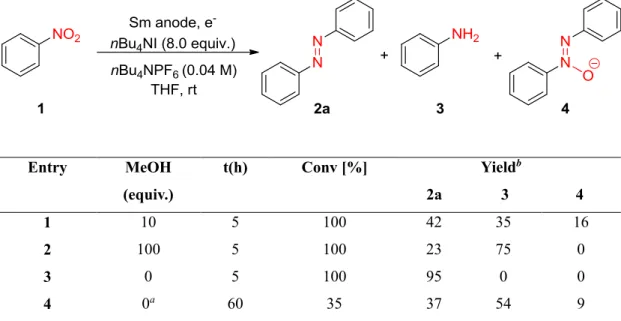
Referring to the Kagan’s report,69 we demonstrated the effect of proton donors as additives on the selectivity (Table 2.1). In the presence of 10.0 equivalents of MeOH, complete conversion was achieved within 5 hours to give the desired azobenzene 2a as a major product (49%). Aniline 3 and azoxybenzene 4 were also obtained in 35 % and 16 % yields, respectively. On the other hand, with 100.0 equivalents of MeOH, the selectivity of the reaction decreased dramatically providing azobenzene 2a in 23% yield along with aniline 3 (75%). In contrast, when the electrolysis was performed without proton donor, azobenzene 2a was obtained as the sole product in 95 % yield. The same reaction was attempted using SmI2 (8.0 equivalents) prepared according to Kagan’s method in anhydrous THF. However, only 35% conversion was observed after 60 hours with a poor selectivity towards aniline 3 (54%) (Entry 4, table 1). This result is in agreement with the results reported by Kagan et al.69 This difference of behavior, when compared to our method, can be attributed to the specific reactivity of the electrogenerated SmI2, which is freshly produced in the electrolytic medium. As noted in a previous report on the homocoupling of aliphatic ketone and the reduction of
1-- 25 1--
chlorododecane,70, 71 it proved to be also more reactive. Control experiments were then performed. First of all, the samarium anode was replaced by an inert carbon anode and electrolysis was strictly performed in the established conditions. After the electrolysis time estimated (5 h), nitrobenzene 1 was fully recovered indicating that the direct reduction at the cathode did not occur. We also checked that no chemical transformation took place without application of any current intensity. Both control experiments confirm that the coupling is mediated by electrogenerated SmI2.
Table 2.1 Optimization of the reductive coupling of nitrobenzene by electrogenerated
SmI2. Entry MeOH (equiv.) t(h) Conv [%] Yieldb 2a 3 4 1 10 5 100 42 35 16 2 100 5 100 23 75 0 3 0 5 100 95 0 0 4 0a 60 35 37 54 9
Reaction conditions: PhNO2 (1.0 mmol, 1.0 equiv.), nBu4NI (8.0 mmol, 8.0 equiv.) and nBu4NPF6
(0.04 M) in THF (50 mL) at r.t. for 5 h. a 6 eq. SmI
2 prepared by Kagan’s method. bIsolated yield.
II. 3. 2. Reductive synthesis of symmetrical azo compounds using
stoichiometric amount of electrogenerated SmI
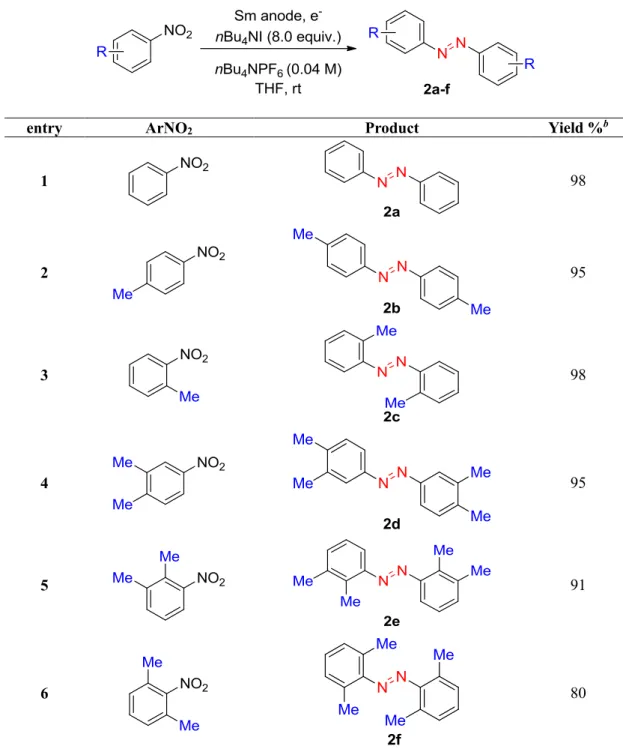
2In order to further verify the reactivity of this method, under the optimized reaction condition, the scope of different nitroarenes was investigated. The methyl aryl-substituted nitrobenzenes (Table 2.2, entry 2-6) easily reacted under the optimized
70 Sun, L.; Sahloul, K.; Mellah, M. ACS Catal. 2013, 3, 2568-2573.
71 (a) Sahloul, K.; Sun, L.; Requet, A.; Chahine, Y.; Mellah, M. Chem. Eur. J. 2012, 18, 11205-11209.
- 26 -
reaction condition to afford respective azo compound derivatives in excellent yields. Ortho and even diortho methyl substituents were no influence to this reaction.
Table 2.2 Reduction of alkyl nitroarenes into azobenzenes
entry ArNO2 Product Yield %b
1 98 2 95 3 98 4 95 5 91 6 80
Reaction conditions: R-ArNO2 (1.0 mmol, 1 equiv.), nBu4NI (8.0 mmol, 8 equiv.) and nBu4NPF6
(0.04 M) in THF (50 mL) at r.t. for 5 h. bIsolated yield.
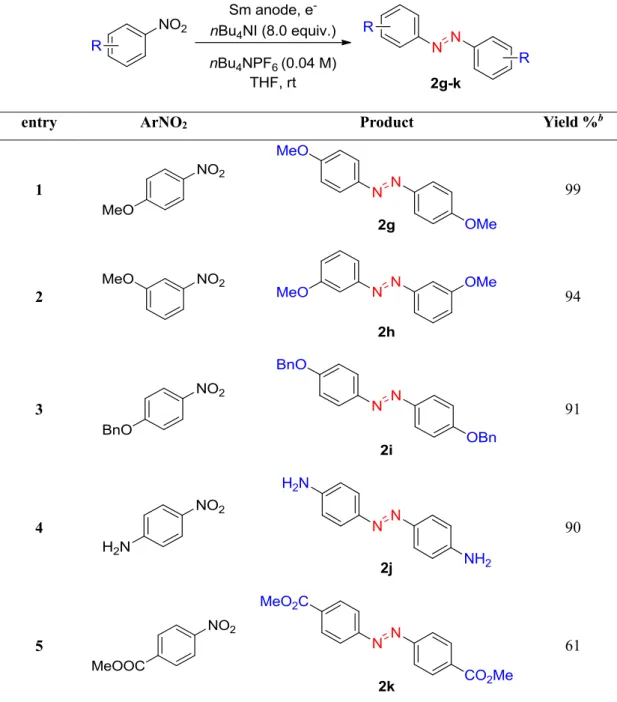
Then, we investigated the reductive coupling of various nitrobenzenes with sensitive functional groups. To our delight, all the substrates tested in this reaction gave
- 27 -
the expected azobenezenes in good isolated yields. The substrates with the electron-donating groups as methoxyl (Table 2.3, entry 1, 2), benzoxyl (Table 2.3, entry 3), amino (Table 3.2, entry 4) provided the corresponding products as well as methyl substituted. Slightly differently, methyl 4-nitrobenzoate ((Table 3.2, entry 5) with the electron withdrawing group gave a relatively low yield (61%).
Table 2.3 Reduction of nitrobenzenes with sensitive functional group into azobenzenes.
entry ArNO2 Product Yield %b
1 99
2 94
3 91
4 90
5 61
Reaction conditions: R-ArNO2 (1.0 mmol, 1 equiv.), nBu4NI (8.0 mmol, 8 equiv.) and nBu4NPF6
- 28 -
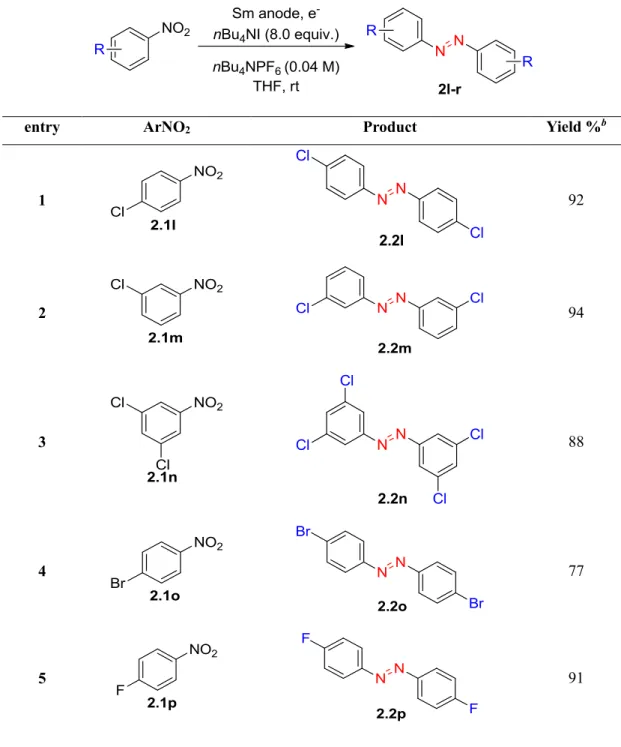
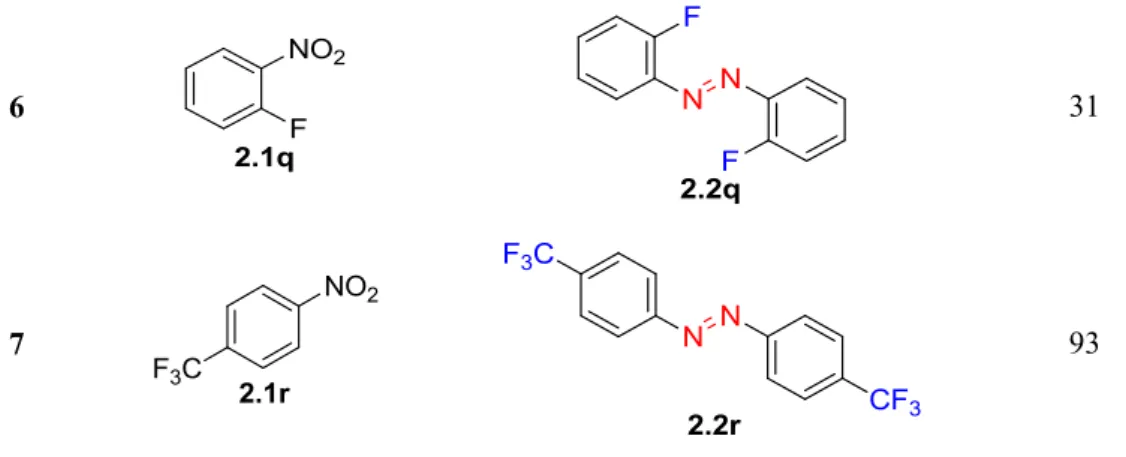
Furthermore, the halogenated compounds were induced to this electrochemical process. The chloro, bromo and fluro substrates all afforded the corresponding products without dehalogenation (Table 2.4, entry 1-6). Interestingly, the electron withdrawing trifluromethyl group gave the product in 93% yield (Table 2.4, entry 7).
Table 2.4 Reduction of halogenated nitrobenzenes into azobenzenes.
entry ArNO2 Product Yield %b
1 92
2 94
3 88
4 77
- 29 -
6 31
7 93
Reaction conditions: R-ArNO2 (1.0 mmol, 1 equiv.), nBu4NI (8.0 mmol, 8 equiv.) and nBu4NPF6
(0.04 M) in THF (50 mL) at r.t. for 5 h. bIsolated yield.
II. 3. 3. The electrogenerated stoichiometric SmI
2reductive
synthesis of asymmetrical azo compounds
The synthesis of asymmetrical azo compounds is a challenge. Following the previous reports, we chose a 1:3 ratio of two nitroarenes to synthesize the asymmetrical azo compounds. Using 1.0 equivalent p-methoxynitrobenzene and another 3.0 equivalents, the asymmetrical azo products were afforded high yields. The entries 10-13 illustrated that the 1.0 equivalent electron-rich nitrobenzene could provide a high yield.
Table 2.5 electrogenerated SmI2 reduction of nitroarenes into asym metrical azobenzenes.
entry ArNO1.0 eq. 2 Ar’NO3.0 eq. 2 product Yield %b
- 30 - 2 98 3 96 4 80 5 96 6 90 7 85 8 89 9 86 10 86
- 31 -
11 89
12 92
13 78
aReaction conditions: R-ArNO
2 (0.25 mmol, 1 equiv.), R’-ArNO2 (0.75 mmol, 3 equiv.), nBu4NI
(8.0 mmol, 8.0 equiv. of R-ArNO2 and R’-ArNO2) and nBu4NPF6 (0.04 M) in THF (50 mL) in the
presence of 10 mol% of SmI2 (determined by coulometry) at r.t. for 5 h. bYields given are isolated yields.
II. 4. The Sm
IIelectrocatalytic synthesis of azo compounds
from nitrobenzenes
II. 4. 1. Probe of Sm
2+electrocatalytic reductive process
After demonstrating that electrogenerated SmI2 can be a powerful reductant for the conversion of nitroarenes into corresponding azo compounds, we turned our attention to the development of a catalytic version.
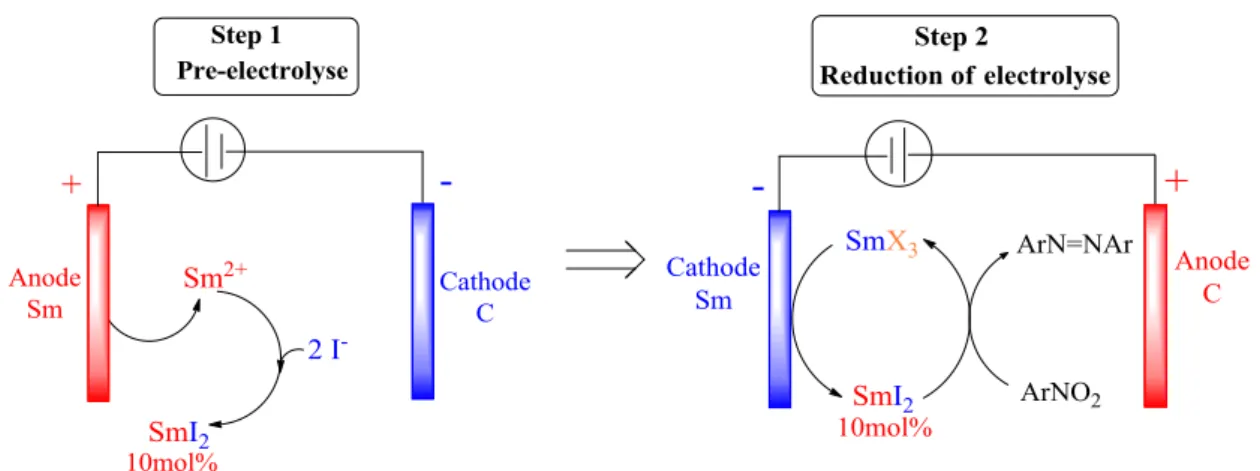
For its implementation, the catalytic procedure was accomplished in two steps as previously reported for various C-C bond forming reactions.22 The first step consists in the in situ electrogeneration of SmI2 from the samarium electrode used as an anode in the presence of nBu4NI. This pre-electrolysis was achieved in an undivided cell charged with anhydrous THF containing nBu4NPF6 under argon at a constant current intensity of 50×10−3 A, which prevents any manipulation of the sensitive catalyst out of the electrochemical cell. In order to perform the second electrolysis step, nitrobenzene 1 and 2.0 equivalents of trimethylsilyl chloride (TMSCl) were then introduced. In a precedent report, we demonstrated that TMSCl was able to promote the cleavage the SmIII-O bonds by metal exchange, providing the corresponding silyl ether and SmIIIX
3.22 A subsequent electron transfer from the samarium cathode allows ultimately the regeneration of the SmIIX
- 32 -
of the samarium electrode is then simply reversed to act as a cathode during the whole electrolysis process. Electrocatalysis is therefore carried out by applying a constant current intensity of 50 mA. Gratifyingly, nitrobenzene led selectively to the desired azobenzene 2a in 88 % yield.
Figrure 2.1 The two steps of this Sm2+ electrocatalytic process.
Figure 2.2 depicts the evolution of the various species during the course of the electrocatalytic reduction of nitrobenzene 1. Based on the retention times of pure samples, three compounds were clearly identified, namely nitrobenzene 1a, azoxybenzene 4, and azobenzene 2a. On the other hand, no other potential intermediates, such as nitrosobenzene 6 or aniline 3, were detected by this method. The concentration of nitrobenzene 1 was found to decrease continuously during the electrolysis process, while the concentration of azobenzene 2a increased over the same period, but after a delayed time of 60 minutes. Meanwhile, the formation of azoxybenzene 4 reached a threshold of 40% conversion after 140 minutes, before its concentration decreases in the second half of the electrocatalysis. The evolution of the concentration of azoxybenzene 4 suggests a reaction pathway, in which the nitroaromatic compound is initially reduced to the azoxy compound and then to the corresponding azobenzene (Figure 2.2).
- 33 -
Figure 2.2 Time-conversion plot for the catalytic reduction of nitrobenzene into
azobenzene in anhydrous THF (0.02 M) by electrogenerated SmI2 (10 mol%).
Besides, when azoxybenzene 4 or nitrosobenzene 6 were subjected independently to the same reaction conditions (Scheme 2.4, paths a and b), they both led to azobenzene
2a as a sole product within one and four hours (1 and 3 equivalents of electrons),
respectively. We observed that azoxybenzene 4 was converted into azobenzene 2a at a rate four times faster than nitrosobenzene 6, which is in agreement with their respective reactivities. These experiments confirm that nitrosobenzene 6 might be the first intermediate in the catalytic process, but would react too quickly to be detected by GC analysis. 0 10 20 30 40 50 60 70 80 90 100 0 50 100 150 200 250 300 350 nitrobenzene azobenzene azoxybenzene nitrosobenzene C onve rsion ( % ) Time (min)
- 34 -
Path a: experiment using nitrosobenzene as starting material under electrocatalytic homocoupling
conditions mediated by SmI2. Path b: experiment using azoxybenzene as starting material under
electrocatalytic homocoupling conditions mediated by SmI2.
Scheme 2.4 Probing mechanism intermediates for the catalytic reduction of
nitrobenzene.
II. 4. 2. SmI
2-electrocatalyzed reduction of nitroarenes into
symmetrical azobenzenes
We turned our attention on assessing the scope and the limitations of this catalytic procedure. Using our optimized electrolysis conditions, diverse nitrobenzene derivatives were converted into the corresponding azobenzenes in high yields (up to 95%) with an excellent selectivity (> 99%) (Table 2.6). Nitrobenzene, nitrotoluenes and dimethylnitrobenzenes were examined and gave the corresponding azobenzenes (Table 2.6, 2a-f) in excellent yields (80-94%). The reaction was compatible with both electron-rich (Table 2.6, 2g, 2h, 2i, 2j, 2t) and electron-poor (Table 2.6, 2k, 2p-s) arenes, providing the desired azobenzenes in yields ranging from 53% to 95%. Nitroaromatics bearing halogen substituents were also converted into the corresponding azobenzenes without observing any dehalogenation process (Table 2.6, 2l-q, 2u). Of note, our procedure can be performed on a large-scale without decreasing the yield. Thus, 10 mmol of p-methoxynitrobenzene gave the azo product (Table 2.6, 2g) in 85% yield (1.02 g) after 50 hours of electrolysis. The established catalytic procedure proved to be versatile and efficient for the synthesis of various functionalized symmetrical
- 35 -
azobenzenes. These results encouraged us to apply this procedure to the synthesis of unsymmerical azobenzenes, which is much more challenging. The method of choice involves usually the treatment of diazonium salts with electron-rich aromatic compounds in a stoichiometric manner.54, 72
Table 2.6 SmI2-catalyzed reduction of nitroarenes into symmetrical azobenzenes.
Reaction conditions: R-ArNO2 (1 mmol, 1 equiv.), TMSCl (2 mmol, 2 equiv.) and nBu4NPF6 0.04 M in
THF (50 mL) in the presence of 10 mol% of SmI2 (determined by coulometry) at 20 °C for 5 h. Yields
given are isolated yields.
72 Hansen, M. J.; Lerch, M. M.; Szymanski, W.; Feringa, B. L. Angew. Chem. Int. Ed, 2016, 55,