HAL Id: hal-02114685
https://hal-amu.archives-ouvertes.fr/hal-02114685
Submitted on 29 Apr 2019HAL is a multi-disciplinary open access archive for the deposit and dissemination of sci-entific research documents, whether they are pub-lished or not. The documents may come from teaching and research institutions in France or abroad, or from public or private research centers.
L’archive ouverte pluridisciplinaire HAL, est destinée au dépôt et à la diffusion de documents scientifiques de niveau recherche, publiés ou non, émanant des établissements d’enseignement et de recherche français ou étrangers, des laboratoires publics ou privés.
Dominique Morvan, Gilbert Accary, Sofiane Meradji, Nicolas Frangieh, Oleg
Bessonov
To cite this version:
Dominique Morvan, Gilbert Accary, Sofiane Meradji, Nicolas Frangieh, Oleg Bessonov. A 3D physical model to study the behavior of vegetation fires at laboratory scale. Fire Safety Journal, Elsevier, 2018, 101, pp.39-52. �10.1016/j.firesaf.2018.08.011�. �hal-02114685�
A 3D physical model to study the behavior of vegetation fires at laboratory scale Dominique Morvan, Gilbert Accary, Sofiane Meradji, Nicolas Frangieh, Oleg Bessonov
PII: S0379-7112(18)30022-5
DOI: 10.1016/j.firesaf.2018.08.011
Reference: FISJ 2739
To appear in: Fire Safety Journal
Received Date: 16 January 2018 Revised Date: 13 August 2018 Accepted Date: 16 August 2018
Please cite this article as: D. Morvan, G. Accary, S. Meradji, N. Frangieh, O. Bessonov, A 3D physical model to study the behavior of vegetation fires at laboratory scale, Fire Safety Journal (2018), doi: 10.1016/j.firesaf.2018.08.011.
This is a PDF file of an unedited manuscript that has been accepted for publication. As a service to our customers we are providing this early version of the manuscript. The manuscript will undergo copyediting, typesetting, and review of the resulting proof before it is published in its final form. Please note that during the production process errors may be discovered which could affect the content, and all legal disclaimers that apply to the journal pertain.
M
AN
US
CR
IP
T
AC
CE
PT
ED
1A 3D physical model to study the behavior of vegetation fires at
1laboratory scale
2Dominique Morvan 1*, Gilbert Accary 2, Sofiane Meradji 3, Nicolas Frangieh 1, Oleg Bessonov 4 3
4
1 Aix-Marseille University, CNRS, Centrale Marseille, M2P2, Marseille, France
5
2 Scientific Research Center in Engineering, Lebanese University, Lebanon
6
3 IMATH, EA 2134, Toulon University, France
7
4 Institute for Problems in Mechanics RAS, Russia
8 9
(*) Corresponding author: [email protected]
10 11
Abstract
12
A 3D multi-physical model referred to as “FireStar3D” has been developed in order to
13
predict the behavior of wildfires at a local scale (< 500m). In the continuity of a previous
14
work limited to 2D configurations, this model consists of solving the conservation
15
equations of the coupled system composed of the vegetation and the surrounding gaseous
16
medium. In particular, the model is able to account explicitly for all the mechanisms of
17
degradation of the vegetation (by drying, pyrolysis, and heterogeneous combustion) and
18
the various interactions between the gas mixture (ambient air + pyrolysis and combustion
19
products) and the vegetation cover such as drag force, heat transfer by convection and
20
radiation, and mass transfer. Compared to previous work, some new features were
21
introduced in the modelling of the surface combustion of charcoal, the calculation of the
22
heat transfer coefficient between the solid fuel particles and the surrounding atmosphere,
23
and many improvements were brought to the numerical method to enable affordable 3D
24
simulations. The partial validation of the model was based on some comparisons with
25
experimental data collected at small scale fires carried out in the Missoula Fire Sciences
26
Lab’s wind tunnel, through various solid-fuel layers and in well controlled conditions. A
27
relative good agreement was obtained for most of the simulations that were conducted. A
28
parametric study of the dependence of the rate of spread on the wind speed and on the
29
fuelbed characteristics is presented.
30
Keywords: Forest fuel fire, Detailed physical fire model, Fire physics
31 32
Nomenclature
33
, , ′ Reynolds average, Favre average, and fluctuation of a generic field
34
variable φ
35
CD Drag coefficient of solid particles
36
CS Heat capacity of solid particles
M
AN
US
CR
IP
T
AC
CE
PT
ED
2D Diameter of cylindrical solid particles
38
FDi Drag force in direction i resulting from solid particles
39
fv Volume fraction of soot in the gas mixture
40
gi Gravity acceleration in direction i
41
h, hα Enthalpy of the gas mixture and enthalpy of chemical species α
42
hS Heat transfer coefficient between the gas mixture and the solid
43
particles
44
∆hChar,∆hPyr,∆hVap, Charcoal combustion heat, pyrolysis heat, and water vaporization heat
45
I Radiation intensity
46
J Total irradiance
47
k Turbulent kinetic energy
48
Nu Nusselt number of solid particles
49
m Superscript referring to a vegetation family
50
M Vegetation moisture content
51
Mass rate of production of chemical species α resulting from
52
vegetation decomposition
53
P, Pα Pressure of the gas mixture and partial pressure of chemical species α
54
in the mixture
55
Pth, Phs Thermodynamic and hydrostatic pressures of the gas mixture
56
Pr, PrT Laminar and turbulent Prandtl numbers of the gas mixture
57
, , , , Rate of heat transferred to the solid particles (total, from solid-fuel
58
combustion, and by convection)
59
R0, Rα Universal ideal gas constant and specific gas constant of chemical
60
species α
61
RaD Rayleigh number of cylindrical solid particles
62
ReD Reynolds number of cylindrical solid particles
63
ReT Turbulent Reynolds number
64
ROS Rate of spread of fire
65
Sc Schmidt number of chemical species
66
t Time
67
T, TS Temperature of the gas mixture and of the solid particles
68
U Wind speed at wind tunnel entrance
69
ui Velocity vector component in direction i
70
xi Cartesian coordinate in direction i
71
Yα Mass fraction of chemical specie α in the gas mixture
72
YAsh, YChar, YDry, YH2O Mass fraction of ash, charcoal, dry material, and water in solid
73
particles
74
Greek symbol
M
AN
US
CR
IP
T
AC
CE
PT
ED
3αG, αS Volume fraction of the gaseous phase and of the solid phase
76
αSG Fraction of combustion heat absorbed by solid particles
77
δ Fuel bed depth
78
δij Kronecker coefficient
79
ε Dissipation of turbulent kinetic energy
80
ϕ Multiplying factor of S O2
ν depending on the molar ratio of CO to CO2 81
gases produced from charcoal combustion
82
λ Thermal conductivity of the gas mixture
83
µ, µT, µe Dynamic viscosity, turbulent viscosity, and effective viscosity of the
84
gas mixture
85
νChar, νSoot, νCO2, νAsh Mass fraction of charcoal, soot, CO2 gas, and ash resulting from the 86
pyrolysis of dry material
87
, , Mass stoichiometric coefficient of charcoal, CO, and soot combustion
88
, , Rate of charcoal combustion, of dry material pyrolysis, and of water
89
vaporization in solid particles
90
Rate of production of chemical species α resulting from reaction in the
91
gaseous phase
92
ρ, ρDry, ρS, ρSoot, Density of the gaseous phase, of dry material, of the solid phase, of
93
soot, and of solid-fuel elements
94
σ Stephan-Boltzmann constant
95
σS Surface area-to-volume ratio of the solid particles
96
σG Absorption coefficient of the gas/soot mixture
97
τopt Fuel-bed optical thickness
98 99
1. Introduction
100
In a near future, numerous factors such as global warming, extensive urbanization, and
101
reduction of agriculture activities could potentially contribute to increase fire hazard in
102
many regions worldwide [1]. However, in adopting the fire ecology point of view [2],
103
wildfires cannot always be considered as a natural disaster, in many cases they contribute
104
to maintain the ecological equilibrium of an ecosystem and help the renewal of forests (in
105
eliminating old trees and promoting, after the fire, the growth of new young trees). The
106
relationship between fires and ecosystems can be summarized by the fire regime, which
107
integrates various characteristics of fire and is generally summarized as the observed
108
average frequency between two fires. A modification of the fire regime, especially if it
109
appears in a short time, is an indication of a perturbation in the life of an ecosystem due to
110
human activities and an evolution of the climate. In this context, if a fire is ignited in a wild
111
ecosystem, the better response could be to do nothing, considering that the perturbation
112
induced by this fire is necessary to maintain a certain equilibrium. However, this approach
M
AN
US
CR
IP
T
AC
CE
PT
ED
4reaches its own limits if the fire affects urban structures such as housing developments in
114
what is commonly referred as the Wildland−Urban Interface (WUI) [3]. The reduction of
115
this natural hazard needs a better understanding of the physical mechanisms governing the
116
behavior of a fire during different phases (ignition, propagation, and extinction), the role
117
played by various parameters characterizing the structure and the state of the vegetation,
118
but also the effects of external conditions such as the wind, air temperature and humidity,
119
the topography, and many other factors. The development of new fire safety engineering
120
tools, based on numerical simulations will allow, in the near future, for the ability to predict
121
the trajectory of a fire front through a landscape (at large scale) or to describe in more
122
details the interaction at a smaller scale between the flames and potential targets located
123
inside the WUI ( e.g., vegetation, houses, etc.) [4,5].
124
As highlighted in the literature, most of the operational tools developed in order to predict
125
the propagation of a fire front at a landscape scale are based on statistical or
semi-126
empirical approaches [6]. Unfortunately, the use of this class of models under conditions
127
that deviate from those used to construct the database, can lead to unacceptable failures;
128
for example, in some cases, the rate of spread of the fire can exceed the wind speed (wind
129
speed measured at a sufficient height 10m open wind speed), which is totally unphysical
130
except if the wind speed tends to zero. This has motivated the development of a new class
131
of models, based on a “fully” physical approach, for which the rate of fire spread, and more
132
generally, all variables (flame geometry, fire intensity, etc.) characterizing fire behavior are
133
addressed through the resolution of balance equations governing the various interactions
134
occurring between the vegetation, the surrounding atmosphere, and the flame [5]. The
135
multiphase approach, initially introduced by A.M. Grishin in a monograph at the end of 90’s
136
[7], is based on a very detailed modeling of the physicochemical phenomena involved in a
137
fire, from the thermal degradation of the vegetation to the development of the turbulent
138
flame inside and above the vegetation layer. The model developed in this work, referred to
139
as “FireStar3D”, can be considered to belong to this multiphase class of models. Globally,
140
this approach solves two sets of problems, one for the vegetation and one for the
141
surrounding gas. These two sets of problems are coupled through additional terms in the
142
balance equations (mass, momentum, and energy) governing the physical system. No
143
modeling of the interface between the solid phase and the gaseous one was introduced in
144
the model, the geometrical complexity (fractal in nature) does not permit an easy
145
description of this interface. In an approach similar to that used to describe fluid flow in a
146
porous medium, the equations were averaged in a representative elementary volume
147
including the two phases. This preliminary operation is responsible for the introduction of
148
additional source terms in the average balance equations (gas production due to pyrolysis,
149
drag force, convection and radiation heat exchange with the solid phase). Except for some
150
particular cases clearly indicated in the text, all the constants of the different sub-models
151
have been fixed from experimental data referenced in Grishin's monograph [7]. Of course,
M
AN
US
CR
IP
T
AC
CE
PT
ED
5the value of these constants are the same for all the reported simulations. Because this kind
153
of model includes a high level of details in representing a propagating fire front and its use
154
is limited to describe the behavior of a fire at a relatively local scale (few hundred meters),
155
which is compatible with the study of the interaction between a wildfire and a house or a
156
building. A very close version of this model is already operational in a 2D approximation
157
[8–10] , in this case, the problem is solved in a vertical plane defined by the direction of
158
propagation of fire. The 3D extension of the existing model enables to render the 3D effects
159
observed in real fires [11] and to represent the real heterogeneous structure of the
160
vegetation both near the surface (for the shrubs) and the canopy (trees). The main
161
difference between 2D and 3D simulations is that in 2D the fire front is assumed to form a
162
homogeneous obstacle forcing the inlet wind flow to be deviated vertically with the
163
convective plume. In 3D, the heterogeneity of the fire front, forming a succession of peaks
164
and valleys, oscillating under the action of a thermo-convective instability, allows the inlet
165
wind flow to cross the fire front. This difference of behavior of the fire front, contributes to
166
modification of the trajectory of the flame, and also of the plume, and consequently, it
167
greatly affects the interaction between the fire front and the vegetation layer. The
168
difference in behavior between 2D and 3D simulated fires have been investigated by Linn
169
et al. [11] using the coupled atmosphere-fire model HIGRAD/FIRETEC. Even in simulating a
170
quasi-infinite fire front in 3D, using cyclic conditions in the horizontal direction
171
perpendicular to the direction of propagation, the numerical results have highlighted how
172
3D effects can affect the propagation of the fire, and particularly the relationship rate of
173
spread versus wind speed.
174
The present paper has two main objectives: (i) to present some details of the 3D model and
175
(ii) to evaluate the potential of the model in predicting the rate of fire spread in
well-176
controlled experimental conditions such as the surface fire performed in the wind-tunnel of
177
the Missoula Fire Sciences Lab [12]. One of the main interests in considering the
178
experiments carried out at Missoula Laboratory was that they had been conducted with a
179
significant number of varieties of fuel particles (pines needles, excelsior, sticks) covering a
180
large range of the solid fuel parameters, such as the surface area to volume ratio, the
181
packing ratio, and the moisture content. Before tackling the problem at large scale, for
182
example, simulating grassland fire experiments carried out in Australia or in US [13,14],
183
this paper represents a first step in evaluating the numerical results obtained with our 3D
184
model to experimental laboratory-scale data collected under well-controlled conditions.
185 186
2. Mathematical Model
187
The mathematical model of FireStar3D consists of two main parts, coupled through
188
interaction terms. The first part is devoted to the evolution of the state of the vegetation
189
subjected to the intense heat flux coming from the flaming zone. The second part is devoted
M
AN
US
CR
IP
T
AC
CE
PT
ED
6to the calculation of the turbulent-reactive gas flow resulting from the mixture of the
191
pyrolysis and combustion products with the ambient air.
192
Firestar3D includes most of the characteristics already integrated in the previous 2D
193
version, i.e. a volume decomposition model to represent the different steps of degradation
194
of the vegetation (drying, pyrolysis, char oxidation), a non-equilibrium multiphase model
195
to represent all the fine fuel elements constituting a vegetation layer (foliage, twigs of
196
various diameters), a low Mach number implicit Navier-Stokes solver including a turbulent
197
combustion model in the gaseous phase, and a multiphase model to represent the radiation
198
heat transfer coming both from the gas species (H2O, CO, CO2 …) and the soot [8–10]. 199
Particular attention was focused on the quality of the numerical convection scheme used
200
for the resolution of the transport equations in the gaseous phase, in order to avoid
201
numerical diffusion (this is capital for turbulence modeling), as well as to the
202
parallelization of the code in order to enable affordable 3D simulations. These
203
characteristics, which can contribute to the future potential of this tool, cannot all be found
204
in the other 3D wildfire models available in the community, such as FIRETEC and WFDS
205
[15–17]. Many of these well-known tools [16,17] use an explicit solver for the resolution of
206
the Navier-Stokes equations; such solvers are usually used to simulate fully compressible
207
flows, which is not the best approach for the simulation of low Mach number flows, mainly
208
because of a wide disparity between the time scales associated with convection and the
209
propagation of acoustic waves [18]. To guarantee the stability of the numerical schemes in
210
the case of fully compressible solvers, the time step and the mesh size must verify
Courant-211
Friedrich stability criterion based on the maximum value between the speed of sound and
212
the gas flow velocity. Under the low Mach number approximation, the same criterion is
213
only based on the gas flow velocity. For low Mach number flows, this constitutes a great
214
difference (if one is not interested in the propagation of acoustic waves) since the time step
215
can be easily multiplied by a factor ranged between 10 and 100 (depending the robustness
216
of the convection scheme) without any loss of accuracy in the description of the
217
phenomena of interest. In summary, choosing a fully compressible formulation and an
218
associated explicit solver, as in FIRETEC for example, constitutes a major limitation
219
especially to simulate wildfire at large scale. This is the main reason behind the mesh size
220
used in FIRETEC that can reach, for example, one meter high at ground level, exceeding
221
sometimes the height of the fuel layer, with the consequence that the pyrolysis process and
222
the heat release due to the combustion within the entire fuel layer thickness take place
223
inside one and the same computational cell. In addition, other physical aspects (turbulent
224
combustion, radiation heat transfer, soot production and transport …) are not well
225
described in WFDS and FIRETEC, especially within the fuel layer. An overview of the
226
discrepancies between these different “fully” physical fire-models can be found in reference
227
[15], summarized also in Tab. 1.
M
AN
US
CR
IP
T
AC
CE
PT
ED
7As indicated in the introduction, some new features have been added in FireStar3D, such as
229
the process of charcoal combustion and the evaluation of the heat transfer coefficient
230
between the solid phase and the gaseous one. These new features are presented in the
231 following parts. 232 233 234 235
FireStar2D FireStar3D WFDS FIRETECH FIREFOAM Solver 2D-Implicit 3D-Implicit 3D-Explicit 3D-Explicit 3D-Implicit
Low Mach model Yes Yes Yes No Yes(1)
Turbulence TRANS TRANS/LES LES LES LES
TRI model Yes No Yes(2) Yes(2) No
Combustion model Yes Yes Yes No(3) Yes
Multi-fuel model Yes Yes Yes Yes No
Small scale Yes Yes Yes No Yes
Large scale Yes(4) Yes Yes Yes Yes
236
Tab. 1. Summary of main characteristics of four fully physical fire models. (1) Work in
progress. (2) The radiation heat transfer was increased empirically. (3)
Pyrolysis and combustion take place at the same location without transport into the gaseous phase. (4) With the limitation introduced by the 2D
assumption.
237
2.1. Solid-Fuel Model
238
The heterogeneous character of the vegetation accounted for using two possible
shape-239
families of solid fuel particles: cylindrical particles (used to represent branches, twigs, and
240
needles), and disks (used to represent flat leaves). At all steps of the decomposition
241
process, each solid fuel family m is characterized using a set of physical variables: the
242
volume fraction (αS), the dry material density (ρDry), the moisture content (M),the surface
243
area-to-volume ratio (σS), the temperature (TS), and the evolution of the composition of
244
fuel particles in terms of mass fraction of char, water and dry fuel. Measurements of the fire
245
residence time measured for homogeneous solid-fuel beds in laboratory [19], have shown
246
that only small fuel particles (σS > 600 m-1 corresponding to a diameter D < 6 mm for
247
cylindrical shape particles) can contribute actively to the dynamics of a fire. This result was
248
confirmed by wildfire observations, showing that about 90% of thin fuel particles (D < 6
249
mm) were consumed in the flaming zone [20]. This threshold represents also the limit
250
separating the thermally thick and thermally thin particles, which means that the
251
temperature gradient inside each solid fuel particles can be neglected in a first
252
approximation. Thermal analysis of forest fuel samples has highlighted that this kind of
253
material were composed of a mixing of lignin, cellulose, hemicellulose, and extractives [21].
M
AN
US
CR
IP
T
AC
CE
PT
ED
8The composition between these various chemical compounds varies from one species to
255
another and between different parts of a plant (bark, branch, twigs, and foliage). At
256
relatively small heating rate (such as the conditions used in thermogravimetric analysis),
257
the chemical composition of fuel particles can affect the dynamics of thermal
258
decomposition, but at higher heating rate (such as the intense heat flux coming from the
259
flaming zone) the result are less sensitive to chemical composition [21] and seems to be
260
more affected by other parameters such as the surface area-to-volume ratio and the fuel
261
moisture content [22, 24]. For these reasons, we consider: (i) that the decomposition of
262
each vegetation family (regardless its composition) can be summarized in three main steps:
263
dehydration, pyrolysis (in only one step), and surface oxidation, (ii) that each family
264
consists locally of a mixture of water, dry material (cellulose, hemicellulose, and lignin),
265
char, and ash (mineral residue). These components are represented by their mass
266
fractions: YH2O, YDry, YChar, and YAsh respectively, resulting in a local density ρS of the
solid-267
fuel.
268
The fuel model consists of decomposing the fuelbed zone into homogeneous
solid-269
fuel element of effective density = . It is assumed that the pyrolysis process would
270
be activated only if the dehydration was entirely completed, and that surface oxidation
271
would begin only if the pyrolysis process came to an end.
272
In the dehydration phase, the evapotranspiration process is reduced to a simple
273
vaporization, during which the temperature of the solid fuel element TS is assumed to
274
remain constant at 373K. The rate of heat transfer received by that fuel element from
275
the flaming zone only serves to produce water vapor at the mass rate:
276 277
= ! = $∆ℎ (1) 278
279
where ∆hVap = 2.25×10³ kJ/kg is the heat of vaporization.
280
The decomposition of dry combustible by pyrolysis produces gaseous products (CO and
281
CO2) and charcoal. The decomposition of 1 kg of dry combustible is assumed to produce 282
νChar = 0.338 kg of carbon (0.288 kg of charcoal and 0.05 kg of soot), νCO2 = 0.2 kg of CO2 and 283
1 - νChar - νCO2 = 0.462 kg of CO. By contact with the oxygen contained in the ambient air, the
284
hot combustible pyrolysis-products (CO and soot) ignite homogeneously in the gaseous
285
phase. Taking into account these assumptions, the pyrolysis process obeys to the following
286
transformation equation written for 1kg of dry combustible:
287
(
)
Char Soot CO(
)
COcombustibe
Dry → νChar −νSoot +νSoot +νCO2 2+ 1−νChar −νCO2 (1)
The pyrolysis process is assumed to take place when the solid fuel element TS is between
288
400K and 500K [8, 19, 21] at the mass rate:
289 290
M
AN
US
CR
IP
T
AC
CE
PT
ED
9 = ∆ℎ ×500 − 400& − 400 (3) 291where ∆hPyr is the pyrolysis heat that depend on the vegetation species. We can notice that
292
this range of temperature values is slightly lower than the range 473-573 K found in [21].
293
This discrepancy can be explained by a scale effect: in the present study, the solid-fuel
294
temperature represents an average value evaluated within a 1 cm3 volume (with a 295
temperature gradient reported in [21]), whereas the temperature reported in [21] was
296
measured with a 0.5 mm thermocouple. In addition, this temperature range [400-500 K]
297
has allowed us to obtain the best results in comparison with experimental data obtained at
298
the same scale and comparable solid fuel [25] (see also Fig. 1 in reference [8]). Thus
299
according to Eq. 3, a portion of the rate of heat transfer received by the fuel element
300
contributes to the pyrolysis process, while the remaining portion of continues to
301
increase the solid fuel temperature TS. Note that TS cannot exceed 500K as long as the
302
pyrolysis process has not ended.
303
Unlike previous works [8–10] that arbitrary assumed a complete combustion of charcoal
304
(thus producing only CO2) at the solid-fuel particles, in the present work the model 305
representing the surface oxidation of charcoal has been modified to account for a possible
306
incomplete combustion, thus producing both CO and CO2. According to [23], the balance 307
equation written for 1kg of charcoal is given by:
308
(
2)
(
)
(
2)
(
)
22
2 O 2 1 CO 1 2 1 CO
C +νOS ϕ → +νOS −ϕ + +νOS ϕ − (2) where = 8/3 and ϕ is the mass stoichiometric coefficient, it depends on the molar
309
ratio of CO to CO2 gases produced from charcoal combustion and is given by: 310 2 2 2 2 2 + × + = CO CO CO CO
ϕ
(3)The molar ratio of CO to CO2 gases depends on the surface temperature TS according to the
311 following relation [23]: 312
(
TS)
exp CO CO 2 =2500 −6240 (4)At low temperatures, ϕ→ 1 and only CO2 is produced, while at high temperatures, ϕ→ 0.5 313
and only CO is practically produced.
314
The reaction rate of charcoal combustion is approximated by the following Arrhenius law:
315 316
= + , -./0−1 /34& 5 6 (7) 317
318
where PO2 is the partial pressure of O2 at the solid fuel particle surface. The frequency 319
factors kChar = 254.2 kg/(m2.s.atm) and activation energy EChar/R0 = 9000K are evaluated
320
experimentally from a thermal analysis [23].
M
AN
US
CR
IP
T
AC
CE
PT
ED
10Heat released during charcoal combustion, taking place at the surface of a solid-fuel
322
particle, is assumed to be absorbed both by the solid-fuel element and by the gaseous
323
phase. The rate of heat absorbed by the solid-fuel element is calculated as follows:
324 325
, = ∆ℎ (8)
326 327
where ∆hChar is the combustion heat given by:
328
(
2 2)
(
1)
(
1 2)
(
2 1)
CO2 S O CO S O Char h h h ν ϕ ∆ ν ϕ ∆ ∆ = + − + + − (5)with ∆hCO = 9 MJ/kg and ∆hCO2 = 30 MJ/kg are the reaction heats of incomplete and
329
complete combustion of carbon that can be obtained from Eq. (2) by setting ϕ at 0.5 and 1
330
respectively. We assume in this study that heat released during charcoal combustion is
331
equally shared by the gaseous phase and by the solid-fuel element, i.e. αSG = 0.5.
332
Taking into account all the previous equations and assumptions, time evolution of the
333
composition and the temperature of a family m of solid-fuel particles in the fuelbed are
334
controlled by the following set of six equations [8–10]:
335 336 7 78 0 9 9 :!9 5 = − (10) 337 7 78 ; 9 9 :<9 = = − (11) 338 7 78 0 9 9 :9 5 = 0 − 5 − >1 + AB C (12) 339 340 7 78 0 9 95 = − − 01 − + 5 − (13) 341 7 78 0 9 5 = − 19 (14) 342 9 9 D97&9 78 = 9 − ∆ℎ − ∆ℎ + ∆ℎ (15) 343
M
AN
US
CR
IP
T
AC
CE
PT
ED
11The heat capacity m S
C characterizing locally each solid-fuel element is obtained from a mass
344
fraction-weighted linear combination of the heat capacities of water, dry material, charcoal,
345
and ash. νAsh = 0.033 is the mass fraction of ash in the solid fuel.
346
The rate of heat transfer received by a solid-fuel element results from convection and
347
radiation heat exchanges with the hot gases and is given by [8–10]:
348 349
= ℎ 6 0& − & 5 + 6 0E − 4 6 &F5/4
(16)
350
where T is the temperature of the gas mixture at the surface of the solid fuel element, σ =
351
5.67×10⁻⁸ W/m2.K4 is the Stephan-Boltzmann constant, and J is the total irradiance (fuel 352
particles are assumed to behave as a black body). The convection heat transfer coefficient
353
hS depends on the shape of the fuel particles and their characteristic length. For example,
354
for a vegetation family with cylindrical shape particles, hS is obtained from:
355 λ D h Nu= S (6) where Nu is Nusselt number based of the diameter D of a cylindrical solid-particle, and λ is
356
the thermal conductivity of the gas mixture. Unlike previous works [8–10] that only
357
accounted for forced convection, the Nusselt number in the present study accounts for both
358
forced and natural convection and is given by:
359
(
2 2)
12 NC FC Nu Nu Nu= + (7)where NuFC and NuNC are respectively the forced convection and natural convection Nusselt
360
numbers. NuFC and NuNC are correlated to Prandtl number Pr of the gas mixture and to the
361
Reynolds number ReD and to the Rayleigh number RaD based on the diameter D of a
362
cylindrical solid-particle as follows [26]:
363
(
)
> < + = 1300 25 0 1300 5 0 43 0 38 0 6 0 38 0 5 0 D . . D D . . D FC Re if Pr Re . Re if Pr Re . . Nu (8) 27 8 16 9 6 1 2 1 559 0 1 387 0 6 0 + + = Pr . Ra . . NuNC D (9)Similar expressions are used to evaluate the convection heat transfer coefficient hS for flat
364
solid-fuel particles.
365
2.2. Gas-Phase Model
366
The evolution of the state of the gaseous phase (composition, velocity, temperature …)
367
resulting from the thermal degradation of the vegetation and the combustion reactions is
368
governed by the balance equations of mass, momentum, and energy. Since the flow regime
M
AN
US
CR
IP
T
AC
CE
PT
ED
12is unsteady and fully turbulent in various regions of the computation domain, the equations
370
are filtered using a mass-weighted average TRANS (Favre) formulation [27]. Hence, the
371
filtered variables are governed by the following set of transport equations solved in the low
372
Mach number approximation [18, 28]:
373 374 375 G ̅ G8 = I I9 9 (21) 376 377 G0 ̅JKL5 G8 = −M.M,L+ M M.NOP̅ Q MJKL M.N+ MJKN M.L − 2 3MJKM.TTULNVW − M M.N; JXYJZY= + 0 − 45[L− I \<L 9 9 (22) 378 379 G; ̅ℎ= G8 = −M,M8 +M.MNO P̅ ,]M.M&NW − M M.N; JXYℎ Y = + 01 − 5∆ℎ I 9 380 + I I 9ℎ + I , 9 + 6 ;E − 46&F= 9 9 (23) 381 382 G; ̅: = G8 =M.MN^ P̅ _`M:aM.Nb − M M.N; JXY: ′= + + I 9 9 (24) 383
In these equations, all transported variables φ (density ρ, velocity components ui, enthalpy
384
h, and mass fractions Yα of chemical species α : CO, O2, CO2, H2O, and N2) are decomposed as 385
a sum of two contributions (Reynolds average + fluctuation: = + ′). On the other
386
hand, Favre average is defined by: = / ̅. The differential operator D/Dt is defined as:
387
( )
j j x u~ t Dt D ∂ ∂ + ∂ ∂ = φ φ φ (10)The effective gas-phase density is defined as ρ = αGρG, where ρG is the density of the
gas-388
mixture and αG is the volume fraction of the gaseous given by:
389
∑
−
=
m m S Gα
α
1
(11)where 9is the volume fraction of family m of solid-fuel particles. ρ0 is the initial gas-phase
390
density that is stratified due to gravity, gi being gravity component in xi direction.
M
AN
US
CR
IP
T
AC
CE
PT
ED
13In the low Mach number approximation [18, 28], the acoustic filtering results in splitting
392
the pressure of the gas-mixture, into three contributions: the dynamic pressure P acting to
393
balance inertial and external forces, the thermodynamic pressure Pth that is spatially
394
homogeneous, and the hydrostatic pressure Phs that is time-independent and balances the
395
initial density stratification.
396
In addition to the previous equations, the gas mixture is assumed to behave like an ideal
397
gas. Hence, in low Mach number approximation, the gas-phase density is obtained from the
398
following equation of state:
399 T~ Y~ R P Pth hs = +
∑
α α α ρ (12)where Rα (J/kg.K) is the ideal gas constant of chemical species α (universal gas constant
400
divided by the molar mass).
401
The gaseous phase is assumed also to behave as a Newtonian fluid with a viscosity µ = αGµG,
402
where µG is the dynamic viscosity of the gas mixture obtained from those of the chemical
403
species (µα) using a mass fraction-weighted linear combination. The dependence of µα on
404
temperature is governed by Sutherland law:
405 + + = S T S T T T~ ref 5 . 1 ref ref α α µ µ (13)
where Tref = 273K, S = 110.4K, and P c is the dynamic viscosities of the chemical species α
406
at temperature Tref. As for dry air in standard conditions, Prandtl and Schmidt numbers are
407
both set to 0.71.
408
The term \<L9 denotes the ith component of the drag force resulting from the dynamic 409
interaction between the gas flow and the vegetation family m, it is given by:
410 L D i Di
u
~
u
~
C
a
F
=
ρ
(14)where de = 6 /2 is the leaves area density and CD is the drag coefficient obtained from
411
correlations that depend on the particles shape of the vegetation family m and on the
412
Reynolds number based on the characteristic length of solid particles [26]. For example, for
413
a vegetation family with cylindrical particles (twigs, needles), the evolution of the drag
414
coefficient with Reynolds number based on the diameter D of the particle is given by:
415 5 0 93 5 17 1 . D D Re . . C = + (15)
Similar expressions are used to evaluate the drag coefficient CD for flat solid-fuel particles
416
such as leaves.
417
The enthalpy h of the gas mixture is obtained from a mass fraction-weighted linear
418
combination of the enthalpies hα of the chemical species (CO, O2, CO2, H2O, and N2). For 419
each chemical species, the enthalpy-temperature dependence is obtained from CHEMKIN
420
thermodynamic data base [29]:
421
∑
= + = 5 1 n n n , 0 , T ~ n 1 h ~ α α α β β (16)M
AN
US
CR
IP
T
AC
CE
PT
ED
14The term 9, is the average rate of heat exchange by convection between the gas
422
mixture and the solid-fuel family m, obtained from Eq. Error! Reference source not
423
found.. σG is the radiation absorption coefficient of the gas-soot mixture (including the
424
absorption due to the presence of CO, CO2, H2O, and soot particles in the flame and the 425
plumes [30]).
426
During the thermal decomposition of each solid-fuel family m, O2 gas is consumed, CO, CO2, 427
and H2O gases, and charcoal soot particles are produced at the following mass flow rates: 428 429 = − 430 (32) 431 = 01 − − 5 + 02 + 5 01 − f5 (33) 432 = + 01 + 5 02f − 15 (34) 433 ! = (35) 434 = (36) 435
These rates contribute to the source terms of the balance equations of mass, energy and
436
chemical species. Finally, g is the rate of production or destruction of the chemical species
437
α resulting from combustion in the gaseous phase, this part is detailed in the combustion
438 modeling section. 439 440 2.3. Turbulence Modeling 441
The double correlations representing the action of the fluctuations on the average
442
transport equations are evaluated using the eddy viscosity concept [31] and generalized
443
gradient diffusion of the scalar quantities φ as follows:
444 ij l l T i j j i T j i k x u~ 3 2 x u ~ x u~ u u µ µ ρ δ ρ + ∂ ∂ − ∂ ∂ + ∂ ∂ = ′ ′ − (17) i T i x ~ Pr u ∂ ∂ = ′ ′ −ρ φ µ φ φ (18)
The turbulent viscosity µT is evaluated from the turbulent kinetic energy k and its
445
dissipation rate ε, and an adapted version of RNG-k-ε turbulence model in a high Reynolds
446
number formulation is used [32].
447 ε ρ μ μ μ 2 k C f T = (19)
where Cµ = 0.085 and fµ is a damping function given by Eq. (40) that accounts for
low-448
Reynolds-number effects and allows for a better handling of laminar flow regions.
449
( )
(
)
250
1
4
3
+
−−
=
.
Re
Tf
ln
µ (20)M
AN
US
CR
IP
T
AC
CE
PT
ED
153-h = ̅+ /Pi is the turbulent Reynolds number. In the limit of a high Reynolds number 450
(µ/µT << 1), Equations (19) and (20) result in: Ph= ̅Dj+ /i.
451
The fields of the turbulent kinetic energy k and its dissipation rate ε are calculated from the
452
two following transport equations:
453
( )
P W u~ C(
C u~ C k)
x k Pr x Dt k D w Pw m S m m S m D k k j T e j ε σ α ρ ε ρ µ ρ + + − + − ∂ ∂ ∂ ∂ =∑
2 2 1 (21)( )
(
)
− + + + + + ∂ ∂ ∂ ∂ =∑
α
σ
ε
ε
ρ
τ
ε
ρ
τ
τ
ε
µ
ε
ρ
ε ε ε ε ε w D w P m S m m S m D k k j T e j C k u ~ C C u ~ R C W C P C x Pr x Dt D 2 2 3 1 2 1 (22)The effective viscosity P = Ph+ P̅, Pk and Wk are respectively the terms contributing to the
454
production of turbulence, due to shear and buoyancy effects [31], given by:
455 j i j i k x u~ u u P ∂ ∂ ′ ′ − = ρ and j j T T k g x Pr W ∂ ∂ − = ρ ρ μ (23) The effective Prandtl number is computed by iteration using Eq. (24) derived analytically in
456
the RNG theory, where Pr0 = 1 for Pr = PrT, and Pr0 =Pr = Sc for Pr = Prφ.
457 e . . . Pr . Pr . Pr . Pr µ µ = + + − − − − − − 03679 1 0 1 6321 0 1 0 1 3929 2 3929 2 3929 1 3929 1 (24)
In Eq. (41) and (42), the terms proportional to the drag coefficient m D
C represent the
458
production and destruction of turbulence resulting from the interaction between the
459
boundary layer flow and the vegetation layer [33].
460
In the transport equation of ε, τ is the maximum between the integral turbulence time scale
461
(k/ε) and 6τη, where kl = 0P̅/ ̅i5m/ is the Kolmogorov time scale. This treatment ensures
462
that the time scale associated to the more powerful turbulent structures cannot be smaller
463
than 6 times the turbulence dissipation scales.
464
The additional source term R in the transport equation of ε results from the RNG theory
465
[32] and has extended the validity of this model to weak turbulent flow regions, i.e. near a
466
wall or in the wake region, where turbulence is far from isotropic or homogeneous.
467
(
)
( )
3 0 31
1
η
η
βη
η
μ−
+
=
C
R
(25)where η= ;,n/Dj ̅i=m/ , η0 = 4.38 and β = 0.012.
468
The following set of constants is introduced in the turbulence model [31]: C1ε = 1.42 and
469
C2ε = 1.68. On the other hand, the degree to which ε is affected by buoyancy is determined
470
by the constant C3ε calculated according to the following relation:
M
AN
US
CR
IP
T
AC
CE
PT
ED
16( )
(
2 2)
05 3 . j j j j j j g u~ g u~ u~ g u~ tanh C − = ε (26)The terms including the drag coefficient in k-ε equations represent the action of the drag
472
force resulting from the vegetation on the turbulent kinetic energy balance. The following
473
set of constants is used in these terms [33]: CPε = 0.8, Cεw = 4, CPεw = 1.5, and CPεw = 3.24.
474
2.4. Combustion Modeling
475
Near the fire front and due to the presence of hot spot (hot gases, burning particles, etc.),
476
CO gas and soot particles resulting from the decomposition of the vegetation react with the
477
ambient air to produce CO2 gas according to the following equations written for 1kg of fuel. 478
(
2)
2 2 2O 1 CO CO OG G O ν ν → + + (27)(
2)
2 2 2 O 1 CO Soot OSoot Soot O ν ν → + + (28)where = 4/7 and = 8/3 are the mass stoichiometric ratios.
479
Typical in gaseous combustion, the rate of consumption of CO gas is limited by two physical
480
processes: at a small scale, by the time necessary for the chemical reaction to occur and, at
481
a larger scale, by the time required for an effective mixing between the gaseous fuel and the
482
ambient air. The rate of reaction governed by chemical kinetics is evaluated from an
483 Arrhenius law as [34–36]: 484 485 486 A = ̅ : : o A -./;− 1A ⁄34 &= (49) 487 488
where the pre-exponential factor KAr = 7×10⁴ m3/kg.s and the ratio of the activation energy
489
with the ideal gas constant EAr/R0 = 8000K. On the other hand, the mixing between the
490
gaseous fuel (CO) and the ambient air is mainly piloted by the turbulent eddies located in
491
the flaming zone. If the conditions are fully turbulent, the reaction rate can be written as a
492
function of the local mass of reactants available for burning divided by the turbulent time
493
scale (eddy dissipation combustion concept) [34]:
494 495 q< = D A ̅ k⁄ 9Lr × st;: , : ⁄ = (50) 496
The parameter CA depends on the turbulent Reynolds number and is given by [34]:
M
AN
US
CR
IP
T
AC
CE
PT
ED
17(
−χ
χγ
)
= 1 6 23 25 0. T A Re . C (29)where γ is the volume fraction of the small-scale turbulent structures and χ is the fraction
498
occupied by the reaction zone inside these small structures, defined as follows:
499 75 0 7 9. ReT− . = γ
(
)
(
G)
O CO CO G O CO . T Y~ Y~ Y~ . Re 2 2 2 2 25 0 1 1 13 2 ν ν χ + + + = (30)The turbulent time scale τmix is the maximum between the integral turbulence time scale
500
(k/ε) and 6τη, where kl = 0P̅/ ̅i5m/ is the Kolmogorov time scale.
501
The rate of combustion of the gaseous fuel is finally obtained from:
502 503
= − st; q< , A =
(53)
504
Consequently, the rates of destruction of O2 and of formation of CO2 resulting from the 505
combustion of CO are according to Eq. (27): g = g and g = −01 + 5g .
506
Because of the lack of information on soot production in natural fire, the production rate of
507
soot is limited to that resulting from the pyrolysis process [7] given by Eq. Error!
508
Reference source not found.. Assuming that the soot particles can be assimilated as
509
carbon spheres of diameter dSoot = 1 µm and density ρSoot = 1800 kg/m3, the soot volume
510
fraction field uv is evaluated from the following transport equation [36, 37]:
511 512 G; ̅uv = G8 = −M.MN; ̅ JKN uv = − M M.N; JXYu ′= + + ̅ I w 9 − x 9 (54) 513 514
We can notice that the transport of the soot particles by convection is enhanced by the
515
temperature gradient (thermophoretic velocity JKN ) defined by:
516
( )
j th j x T~ ln 54 . 0 u~ ∂ ∂ − = ρ µ (31) The term g results from soot oxidation and is evaluated from the rate for oxidation of517
pyrolytic graphite by O2 as follows [36]: 518 519 = 12 uv 6 O1 + ++A ,g y ,g z + +{ ,g 01 − z5W |s8ℎ z = 01 + +h⁄+{ ,g 5 }m (56) 520 521
M
AN
US
CR
IP
T
AC
CE
PT
ED
18where σSoot = 6/dSoot is the surface area-to-volume ratio of soot particles, PO2 is the partial
522
pressure of oxygen, and the various reaction rates kA, kB, kT, and kz depend on temperature
523
according to Arrhenius laws [36]. The rates of destruction of O2 and of formation of CO2 524
resulting from the soot oxidation are estimated according to Eq. (28): g = − g
525
and g = 01 + 5g .
526 527
2.5. Radiation Heat Transfer
528
Radiation is one of the most important heat transfer mechanisms contributing to the
529
propagation of a fire. It usually represents about 30% of the energy received by the
530
vegetation located ahead of the fire front [20]. The total irradiance J is calculated by
531
integrating the radiation intensity I in every direction:
532
∫
= π Ω 4 0 d I J (32)Radiation mainly results from soot particles produced in the flame and from the embers
533
located behind the fire front. Accounting for these two contributions, the variation of the
534
radiative intensity I along an optical path s verifies the following radiation transfer
535
equation where σG is the absorption coefficient of the gas-soot mixture.
536
(
)
∑
( )
− + − = m m S m S m S G G G T I T I ~ ds I d π σ σ α π σ σ α α 4 4 4 (33)The absorption coefficient σG depends on the amounts of evaporation and combustion
537
products (CO2 and H2O), on the gas mixture temperature, and of the soot volume fraction 538
[39] according to the following relation:
539
(
X~ X~)
~f T~. CO H O v
G =01 2+ 2 +1862
σ (34)
where ~ and ~! are the mole fractions of CO2 and H2O respectively. A method adapted 540
to optically thick media (very sooty flames), as well as to quasi-transparent media must be
541
used to solve the radiation transfer equation (see next section).
542
3. Numerical Method
543
Describing the details of the numerical method used in FireStar3D is beyond the scope of
544
this paper; only the outlines of the method are presented in this section, as well as the
545
numerical improvements brought to the 2D version of the computational code (namely
546
FireStar2D). Two independent meshes are used to solve the mathematical model: a first
547
one for the gaseous phase and a second one for the solid phase (vegetation).
548
The transport equations in the gaseous phase Error! Reference source not found. to (11),
549
(23), (24), and Error! Reference source not found. are solved numerically in a
550
rectangular domain by a fully-implicit finite volume method using a segregated formulation
551
[38] on a structured and non-uniform staggered-mesh. To avoid fire extinction within the
M
AN
US
CR
IP
T
AC
CE
PT
ED
19solid-fuel bed for radiation-dominated fire propagation, the upper limit of the grid size (∆x,
553
∆y, ∆z) is given by [15] (both in the gas and the solid phase):
554
(
)
<∑
m m S m S z y x, , Max∆
∆
∆
4α
σ
(35)where 4/ 969 is the extinction length scale within the solid-fuel bed corresponding to
555
vegetation family m. Previous simulations performed in worst conditions of propagation
556
[41, 42], where the air flow was opposite to the direction of propagation, had shown that
557
the verification of this criterion (60) near the fire front was sufficient to ensure a correct
558
estimation of the heat transfer by radiation between the fire front and the solid fuel, and
559
consequently to obtain grid-size-independent numerical results. On the other hand, the size
560
of any cell adjacent to the wall should carefully be chosen such that its center fall within the
561
log-law region of a turbulent boundary layer [40] where the rate of turbulence production
562
equals the rate of dissipation (equilibrium turbulence). This condition is fulfilled if
563
dimensionless distance to the wall of the cell center defined by Eq. (61) satisfies the
564
constraint 11.5 < y+ < 500, and this during the entire simulation time.
565 μ ρCμ k y y 2 1 4 1 = + (36)
Wall-function formulae [40] covering both the viscous sub-layer and the log-law region
566
were then used to estimate wall shear-stresses and fluxes. An important improvement
567
brought to the 2D version is space and time discretization. The first-order fixed-time step
568
time discretization of the 2D version was replaced by a third order Euler scheme with
569
variable time steps. The time steps are obtained from an adaptive time stepping algorithm
570
based on the estimation of the truncation error [43]. The second-order space discretization
571
was replaced by the third order QUICK scheme [44] with flux limiters for convection terms,
572
while diffusion terms were approached by central difference [40]. This improvement
573
results in a higher accuracy or in larger time steps and a coarser mesh for a desired
574
accuracy (specified by a prescribed truncation error). It also allows the time step to varie
575
automatically between two prescribed limits according to the characteristic time scale of
576
the predominant physics. Since the momentum and the continuity equations are solved
577
separately, the coupling between the velocity field and the pressure field is ensured using a
578
PISO algorithm [45]. The linear systems resulting from the discretization of the transport
579
equations are solved using a bi-conjugate gradient stabilized method with Jacobi
580
preconditioner [46], while pressure equation is solved using a conjugate gradient method
581
with implicit modified ILU (MILU) preconditioner [47]. This is another important
582
improvement brought to the 2D version of the computational code, which decreases by a
583
factor 5 to 6 the CPU time required to solve the pressure equation that consumed in the
584
previous works [8-10] more than 70% of the total CPU time. In addition, the pressure
585
equation is preconditioned using the artificial compressibility method [48]. The radiative
586
transport equation (58) is solved using a Discrete Ordinate Method, consisting in the
M
AN
US
CR
IP
T
AC
CE
PT
ED
20decomposition of the radiation intensity in a finite number of directions and a
Gauss-588
Legendre quadrature [49].
589
Embedded in the fluid domain, the solid-phase domain is also subdivided into solid-fuel
590
elements using a rectangular uniform mesh. Each element could contain several vegetation
591
families, and the state of each family m is characterized by its own set of variables: 9, 9,
592
Mm, 69, composition, etc. As indicated previously, the size of the solid-phase mesh (∆
r, ∆ , 593
∆y) is also chosen according to Eq. (35), and Eqs. Error! Reference source not found. to 594
Error! Reference source not found. are solved for each vegetation family m and for each
595
solid-fuel element separately using a fourth-order Runge-Kutta method (RK4).
596
From the implementation point of view, the solver was parallelized [47] and optimized [50]
597
using the APIs OpenMP and HMPP directives (suitable for shared memory platforms). This
598
is another feature specific to FireStar3D by comparison with its 2D counterpart. FireStar3D
599
is operational on high-performance computing machines consisting of a SMP node using
600
modern processors with INTEL Xeon Phi co-processors and NVIDIA graphic cards. The
601
Navier-Stokes low-Mach-number solver of FireStar3D has been extensively validated on
602
several benchmarks of laminar and turbulent natural convection and forced convection
603
including non-Boussinesq effects [50], and the multiphase part was tested for neutrally
604
stratified atmospheric flow within and above a sparse forest canopy [51].
605 606
4. Fire Propagation in Wind Tunnel
607
After testing the hydrodynamic and the multiphase modules of FireStar3D on academic
608
configurations [50, 51], the first validation of the entire model was performed by
609
simulating some experimental fires conducted in the wind-tunnel of Missoula Fire Sciences
610
Laboratory [12]. This choice can be justified by the fact that these experiments were
611
conducted under well-controlled experimental conditions that guaranteed a good
612
reproducibility of the results [12], this concerns both the structure and the state of the
613
fuelbed (homogeneity, depth, moisture content, density, load …) and the turbulent flow in
614
the wind tunnel. As indicated by Catchpole et al. [12], the length of the test section (8 m)
615
was long enough to reach a quasi-steady state of fire propagation, and over 4.5 m of
616
propagation, the variation of the rate of spread was about 10%, which can be considered as
617
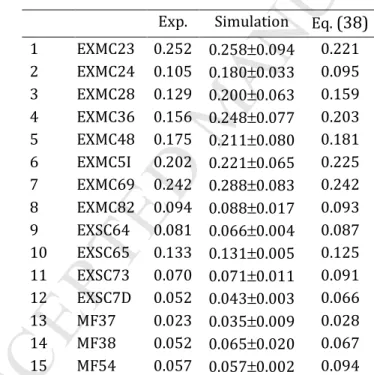
satisfactory. 15 duly chosen experiments of fuelbed fire carried out by Catchpole et al. [12]
618
were reproduced numerically. The comparison between the numerical results and the
619
experimental data was limited to the rate of spread since this was the only available output
620
from these experiments. Nevertheless, this integral variable can be considered a good
621
indicator of the overall fire behavior. Also, at low fuel moisture content (less than 20%), all
622
the solid fuel was consumed, thus the knowledge of the rate of spread allows also to
623
evaluate the fire intensity.
624
4.1. Fuelbed Configuration