HAL Id: hal-00640533
https://hal.archives-ouvertes.fr/hal-00640533
Submitted on 13 Nov 2011
HAL is a multi-disciplinary open access
archive for the deposit and dissemination of sci-entific research documents, whether they are pub-lished or not. The documents may come from teaching and research institutions in France or abroad, or from public or private research centers.
L’archive ouverte pluridisciplinaire HAL, est destinée au dépôt et à la diffusion de documents scientifiques de niveau recherche, publiés ou non, émanant des établissements d’enseignement et de recherche français ou étrangers, des laboratoires publics ou privés.
Kolmogorov cascade and equipartition of kinetic energy
in numerical simulation of Superfluid turbulence
Julien Salort, Emmanuel Lévêque, Philippe-Emmanuel Roche
To cite this version:
Julien Salort, Emmanuel Lévêque, Philippe-Emmanuel Roche. Kolmogorov cascade and equipartition of kinetic energy in numerical simulation of Superfluid turbulence. Journal of Physics: Conference Series, IOP Publishing, 2011, 318, pp.092031. �10.1088/1742-6596/318/9/092031�. �hal-00640533�
Kolmogorov cascade and equipartition of kinetic
energy in numerical simulation of Superfluid
turbulence
J Salort1, E Levˆeque2 and P-E Roche1
1 Institut N´eel, CNRS/UJF, BP 166, 38042 Grenoble cedex 9, France 2
Laboratoire de Physique de l’ ´ENS de Lyon, CNRS, Universit´e de Lyon, France
Abstract. The turbulence of a superfluid is investigated by direct numerical simulations at finite temperature and high Reynolds numbers using the continuous model. The superfluid component is described by the Euler equation while the normal fluid component is described by the Navier-Stokes equation, both being coupled by mutual friction. In the high temperature limit, the Kolmogorov cascade is recovered, as expected from previous numerical and experimental studies. As the temperature decreases, the Kolmogorov cascade remains present at large scales while, at small scales, the system evolves towards a statistical equipartition of kinetic energy among spectral modes.
1. Introduction
What is the velocity spectrum of a turbulent superfluid such as4He ?
On the one hand, one can argue that superfluids should undergo the same inertial instability as any other fluids. Therefore, a Kolmogorov k−5/3 spectrum is expected as a signature of a cascade of kinetic energy from low to large wave-numbers. Two independent experimental studies actually report such a scaling Maurer & Tabeling (1998); Salort et al. (2010).
On the other hand, one can argue that the energy distribution across spectral modes should tend towards equipartition since there is no viscous dissipation: kinetic energy piles up and spreads equally through excited modes. A k2 energy spectrum is expected. However, in real systems (at finite temperature) there is always some sort of energy dissipation, for instance due to “mutual friction” which result from interaction between vortices and the residual phonons/rotons bath in 4He. It is therefore unclear which picture is relevant to real superfluids. As we argue in a recent contribution [Salort et al. (2011)], the answer is eventually composite: a cascade operates at low wavenumbers while equipartition organizes at large wavenumbers.
2. Approach & Results
We simulated the continuous equations for superfluid at finite temperature by DNS at resolu-tion up to 5123. These equations, obtained by coarse-graining the superfluid dynamics, smooth out the atomic-core vortex singularities. Nevertheless, a numerical truncation at finite scale is introduced to account for the quantization of vortex singularities. This procedure is validated by comparisons with experimental data obtained in 4He in similar conditions. In particular, to
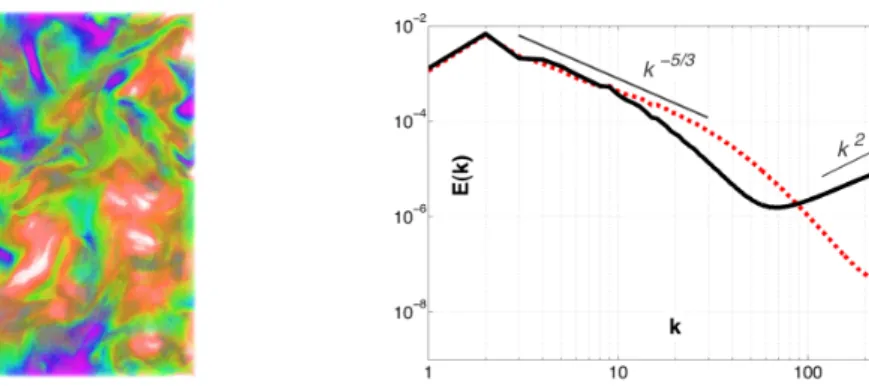
Figure 1. Left : Superfluid kinetic energy field exhibits large-scale coherency. Right : Superfluid velocity power spectrum at high temperature (dash line, T = 2.1565 K) and low temperature (solid line, T = 1.15 K) .
the best of our knowledge, our simulations are the first to account for the absolute value of the density of vortex lines at a given Reynolds number, without any adjustable parameter [Salort et al. (2011)]. Contrary to previous simulations at high Reynolds numbers [Roche et al. (2009); Tchoufag & Sagaut (2010)], no additional artificial dissipation is added to the HVBK model.
In the low temperature limit (T = 1.15 K) for which the dissipation is still possible but difficult, we found evidence that the system evolves to a stationary state that exhibits a Kolmogorov scaling k−5/3 at large scales and a nearly k2 scaling at small scales [Salort et al. (2011)]. As argued in this reference, the strong increase of the superfluid spectrum near the quantum cut-off can be seen as a response of the system to favour dissipation through mutual friction (between the superfluid and nomal components) at small scales and reach a stationary state.
Acknowledgments
We thank B. Castaing, C. Barenghi and P. Diribarne for their inputs and G. Gil for support in porting code to Jade supercomputer at CINES (Montpellier, France). This work was made possible by the ANR grant SHREK and using local computing facilities from PSMN at ENS de Lyon and HPC resources from GENCI-CINES (Grant 2010-026380 and 2011-026380).
References
Maurer, J. & Tabeling, P. 1998 Local investigation of superfluid turbulence. Europhys. Lett. 43 (1), 29–34.
Roche, P.-E., Barenghi, C. F. & L´evˆeque, E. 2009 Quantum turbulence at finite temperature: the two-fluids cascade. EPL 87, 54006.
Salort, J., Baudet, C., Castaing, B., Chabaud, B., Daviaud, F., Didelot, T., Diribarne, P., Dubrulle, B., Gagne, Y., Gauthier, F., Girard, A., H´ebral, B., Rousset, B., Thibault, P. & Roche, P.-E. 2010 Turbulent velocity spectra in superfluid flows. Phys. Fluids 22, 125102.
Salort, J., Roche, P.-E. & L´evˆeque, E. 2011 Mesoscale equipartition of kinetic energy in quantum turbulence. Europhys. Lett. 94, 24001.
Tchoufag, J. & Sagaut, P. 2010 Eddy damped quasinormal Markovian simulations of superfluid turbulence in helium II. Phys. Fluids 22, 125103.