HAL Id: tel-03141546
https://tel.archives-ouvertes.fr/tel-03141546
Submitted on 15 Feb 2021
HAL is a multi-disciplinary open access
archive for the deposit and dissemination of sci-entific research documents, whether they are pub-lished or not. The documents may come from teaching and research institutions in France or abroad, or from public or private research centers.
L’archive ouverte pluridisciplinaire HAL, est destinée au dépôt et à la diffusion de documents scientifiques de niveau recherche, publiés ou non, émanant des établissements d’enseignement et de recherche français ou étrangers, des laboratoires publics ou privés.
Surface modification of different materials for biological
and environmental applications
Flavia Fioresi
To cite this version:
Flavia Fioresi. Surface modification of different materials for biological and environmental applica-tions. Organic chemistry. Normandie Université, 2020. English. �NNT : 2020NORMR062�. �tel-03141546�
THESIS
To obtain the doctoral degree
Specialty Chemistry
Prepared at the Rouen University
SURFACE MODIFICATION OF DIFFERENT MATERIALS FOR
BIOLOGICAL AND ENVIRONMENTAL APPLICATIONS
Presented and defended by
Flávia FIORESI
Thesis directed by Pr. Franck LE DERF, COBRA laboratory
Thesis publicly defended on december 17, 2020 In front of the jury composed by
Dr Mohamed CHEHIMI Directeur de recherche, Université de Paris Est-Créteil Rapporteur Pr Steeve REISBERG Professeur des Universités, Université de Paris Rapporteur Pr Souad AMMAR-MERAH Professeur des Universités, Université de Paris Examinateur Pr Franck LE DERF Professeur des Universités, Université de Rouen Directeur de thèse Dr Julien VIEILLARD Maitre de conférences, Université de Rouen Encadrant Dr Nadine MOFADDEL Maitre de conférences, Université de Rouen Encadrant
SURFACE MODIFICATION OF DIFFERENT
MATERIALS FOR BIOLOGICAL AND
Remerciements
Je remercie tout d’abord Pr. Franck LE DERF mon directeur de thèse et aussi directeur de l’IUT et du campus d’Evreux, de l’Université de Rouen Normandie, pour m’avoir permise d’effectuer ma thèse dans son laboratoire et de m’avoir soutenue pendant toute ce période.
Je remercie tout particulièrement mon encadrant le Dr. Julien VIEILLARD, pour m’avoir accueillie dans son équipe au sein du laboratoire COBRA Evreux. Il m’a permis de découvrir puis de m’impliquer dans ce sujet pluridisciplinaire tout en me communiquant son enthousiasme. Je tiens aussi à remercier sa persévérance dans la période intermédiaire entre le démarrage de mon entreprise Fioresi Commerce, puis la naissance de mon bébé et la fin de ma thèse.
Je tiens aussi à remercier Dr. Nadine MOFADDEL ma Co-directrice de thèse et maitre de conférences, à l’Université de Rouen pour ses conseils, sa bienveillance et son encouragement.
Je remercie mon financeur, le programme EBW+ ERASMUS, qui a permis que ces travaux soient possibles.
Je tiens ensuite à remercier les membres du jury Dr. CHEHIMI, Pr. REISBERG et Pr. AMMAR-MERAH d’avoir accepté d’examiner mon travail de thèse, surtout dans ce moment compliqué à cause de l’épidémie de la COVID-19.
J’associe à ces remerciements les autres membres du groupe et collègues de travail de l’IUT d’Évreux qu’ont été très ouverts et accueillants depuis toujours pendant ces années de travail ensemble.
d’encouragement de mon mari Everton FIORESI qui a toujours été présent avec son amour.
Mes remerciements vont aussi à ma famille au Brésil et mes amis pour tout leur soutien très important pour ma motivation et encouragement, avec des places particulières réservées à ma mère, mon père et ma sœur.
Abbreviations
A
AWB Agrowastes Biomass
B
BSA Bovine Serum Albumin
C
CBD
COC
4-(Carboxymethyl) benzenediazonium Cyclic Olefin Copolymer
f
IRTF Fourier Transform Infrared Spectroscopy
FET Field-Effect Transistor
g
GC Glassy CarbonH
HBF4 Tetrafluoroboric Acid H3PO2 Hypophosphorous acidi
IM-MS Ionic Mobility and Mass Spectrometry
l
LMSM Laboratory of Microbiology - Signals and Microenvironment
n
M
M mol L-1
p
PEI Polyethylene Imine
PBS Phosphate Buffered Saline
s
SEM-EDX Scanning Electron Microscope - Energy-dispersive X-ray Spectroscopy
SPR Surface Plasmon Resonance
SAM Self-assembled monolayer
Summary
GENERAL INTRODUCTION
... 15CHAPTER I
... 191. What is surface modification and why to study it? ... 20
1.1. Surface modification applied to the development of biosensors ... 22
1.1.1. For bio detection ... 25
1.1.2. To study bio interaction ... 26
1.2. Surface modification to remove pollutant from environment ... 26
1.2.1. Liquid phase ... 27
1.2.2. Gas phase ... 28
2. The chemistries used in surface functionalization ... 30
2.1. Physical treatment ... 30 2.1.1. Heat treatment ... 30 2.1.2. Gas treatment ... 31 2.2. Chemical treatment ... 32 2.2.1. Coating ... 32 2.2.2. Covalent grafting ... 33 2.3. Thiol ... 33 2.4. Silane ... 34 2.5. Diazonium salts ... 37 2.5.1. History ... 37 2.5.2. Synthesis ... 39
2.5.3. Surface modification with diazonium salts ... 42
2.5.3.1. Spontaneous grafting ... 42
2.5.4. Chemical reduction ... 42
2.5.5. Electrochemical reduction or oxidation ... 43
CHAPTER II
... 471. Introduction ... 48
2. Presentation of the Surface Plasmon Resonance technique ... 49
2.1. Modification of the SPR surface ... 53
2.1.1. My strategy ... 54
2.2. The choice of the diazonium salt ... 54
2.3. The substrates selected to develop the SPR biochip ... 55
2.4. The optical performance requested for a SPR biochip ... 56
3. The SPR biochip developed ... 56
3.1. Surface functionalization by chemical reduction ... 57
3.2. Surface functionalization by electrografting ... 60
3.2.1. Influence of the electroreduction parameters ... 62
3.2.2. The characterization of the best candidate ... 67
3.2.2.1. Cyclic voltammetry with ferrocene ... 67
3.2.2.2. Infrared Spectroscopy (IRTF) ... 68
3.2.2.2.1. Description of the principle ... 68
3.2.2.2.2. The ATR-IRTF (Attenuated Total Reflection) spectroscopy ... 69
3.2.3. SPR Plasmon Curves ... 72
4. Application of the gold functionalized surface in SPR analysis ... 72
4.1. Antibody-antigen ... 73
4.2. The CNP-AmiC interactions ... 79
4.3. The next generation of biochip – Strip Gold Surface (SGS) ... 81
5. Conclusion ... 86
CHAPTER III
... 931. Introduction ... 95
2. SCIENTIFIC PAPER I ... 98
3. SCIENTIFIC PAPER II ... 106
4. SCIENTIFIC PAPER III ... 113
5. Conclusion ... 124
CONCLUSION AND PERSPECTIVES ... 127
GENERAL INTRODUCTION
For almost a century, the researchers have been making important efforts in order to bring new properties to materials and nowadays surface modification of materials is more than ever a very attractive research subject related to a variety of promising industrial applications. The development of simple methodology to characterize biomolecular interactions has been, over the years, an indispensable technology to support researches in the areas of biology and microbiology due its high degree of sensitivity1. Various physical and chemical techniques were
developed depending on the type and the nature of the material support. Surface modification by chemical coating is a promising solution to obtain well-defined properties such as optical reflectivity, antibacterial, self-cleaning, friction resistance, biocompatibility, anticorrosion, hydrophobicity etc… Thus, performant biosensor and membrane were developed.
That race against the time to develop that kind of device is due to the urgent necessity to expedite diagnoses, performed through support of complementary methods, to prevent the development of diseases. Specially disease resulting to the presence of opportunistic pathogens, such as bacteria2.
In development since the beginning of 19903, biosensors are devices able to provide
quantitative analytical information based on a biological recognition between two elements linked to a transduction system4. Biosensors are characterized by high selectivity and
sensitivity, fast reaction process associated to a low cost device3,5. There is a wide range of
biosensors in the research and development fields, and they can be classified in function of the transducer type4. This present study is focused on optical biosensors development due to
its applicability in Surface Plasmon Resonance (SPR)4. That is a high-quality technique used
to measure biomolecular interactions in real time in a label free environment. The ligand is covalently immobilized on the sensor surface and the analyte circulate in solution4. In few
decades, numerous studies have been developed in SPR due its possibility to carry out kinetics measurements of biomolecular interactions with a high degree of sensitivity1. The SPR analysis
are mandatory performed on a flat substrate or a microfluidic device covered with a thin layer of gold. To be robust, an SPR chip should be sensitive, resistant to oxidation and experimental conditions, compatible with biomolecules, protect from unwanted adsorption and suitable for biomolecular grafting.
Until now, the development of robust SPR chip is still under investigation and in this thesis, I proposed to modify the gold surface of the chip with organic layers in order to increase the performance of the analytical tool. This organic layer shall facilitate the attachment of selected biomolecules and limited the unwanted adsorption. Our strategy will study the feasibility of gold solid surface functionalization using a chemistry based on aryldiazonium salts. These salts could be electro- or chemically reduced to obtain a radical moiety which could then covalently grafted to gold surface. This chemistry should be more stable than thiol adsorption used in existing SPR biochip.
Since many years, industrial activities are responsible for a pollution of the atmospheric gas concentration, the water and the soil pollution, drastically increasing the demand for sustainable energy6,7. Different methods such as gas adsorption on solid surface, bio sorbents
for water heavy metal and dyes removal and different kinds of soil remediation are available to limit these pollutions. The presence some toxics gases in the atmosphere such as CO, CO2,
H2S and hydrocarbons cause damage to the environment and public health8. Although different
greenhouse gases were involved in atmospheric pollution, CO2 is still one of the most important
due its high concentrations in the atmosphere and due to its ability to induce serious health disease. The CO2 capture on solid materials has become an interesting research topic for
Several studies in the literature have demonstrated that some adsorbents such as activated carbons, basic functionalized silica sieves, zeolites, etc.8 are commercial but still sophisticated
and expensive limiting their application. However, there is still a need to capture CO2 for
activities with limited operating cost.
The objective of this study is to promote the cocoa shell, an agrowaste resource ready to use and easy to modify, as low-cost materials for CO2 adsorption, applying a chemical treatment
to modify its physic-chemical properties. Another possible application of this treatment is using the cocoa shell to remove toxins from industrial waste in solution, such as heavy metals and paint residues, which is now one of the major challenges in the textile industries.
In chapter I is presented the bibliography part. The chapter II is mainly dedicated to surface functionalization of gold for application in the Surface Plasmon Resonance (SPR) technique. In the last chapter, I investigated the functionalization of two surfaces for different applications, the first one is a polymer, i.e. cyclic olefin copolymer, and the second one is an agrowaste material, i.e. cocoa shell.
CHAPTER I
1. What is surface modification and why to study it?
Surface properties are responsible for the behavior of any material at the liquid, solid-gas or solid-solid interface. The surface modification of the materials is the strategy that consist in modifying the surface to obtain different optical, mechanical or electrical properties9, as for
example biocompatibility, adhesion, protection against corrosion,
hydrophobicity/hydrophilicity, wear resistance, etc. (Figure 1).
Figure 1: Properties obtained after surface modification.
The act of adding new characteristics to the preexisting properties of the material could help to valorize a material for any application.
Material Weldability Reactivity/ Stability Electrical/ Thermal conductivity and insulation Adhesion Optical properties Wettability Chemical and mechanical resistance Biocompatibility Antioxydation
There are many advantages of modifying a material (Figure 1) such as reduce corrosion impact through passivation step. Today, the world suffers great economic losses due to the effects caused by the corrosion of materials resulting from the pre-disposal of certain materials to the oxidation, as is the case of metals. Due to so many losses, scientists are constantly studying the development of techniques capable of reducing or avoiding corrosion, such as the use of protective paints10, the production of stainless steel10, galvanizing11, etc.
One strategy for the surface modification is to functionalize it, which means adding new chemical group suitable for different purposes. Thus, the way used for this purpose is to attach molecular species with specific functionality, in a controlled way, to the surfaces.
Surface molecular functionalization combines many challenges: from synthetize a modified material, characterize its properties, and validate its performance for the dedicated application.
The study of the surface properties of materials by organic coatings is of great interest from an industrial point of view, and a wide range of techniques have been developed over the years12.
Among requirements for organic coatings, its stability under usage conditions is one of the most important parameters. There are different organic coating available, that are usually classified according to the type of interactions created between the substrate and the organic film13. Gathered as physisorption, these techniques giving only physical interaction (such as
Van der Waals force) between the organic components and the substrate resulting in some case in limited stability12. On the contrary, chemisorption methods include grafting techniques
in which the organic layer is covalently bound to the surfaces14. In this type of interaction we
have two approaches, the “grafting to” or the “grafting from”15. The “grafting to” consist in
adsorbing a polymer layer to form a covalent bond with a surface and the “grafting from” involves a mechanism of polymerization coming from the surface16.
material occurred at interfaces. Various materials such as polymers17, gold18, bio sources19,20,
among others can be modified by chemical grafting and used as supports for different applications.
1.1. Surface modification applied to the development of biosensors
The deposit of thin layers of molecular species on surfaces allows the formation of chemically defined surfaces and the control of surface functionality14. These types of modified surfaces
are considered useful for a wide range of applications, such as biotechnology18,21, sensor
development18,22, molecular electronics18,21 corrosion inhibition23,24, among others. The use of
modified surfaces to several applications is becoming increasingly popular and indispensable.
This study focuses on:
- The functionalization of polymeric and metallic surface by diazonium salt to develop original biochip dedicated to characterization of biomolecular interaction.
- The functionalization of biomass by diazonium salt and silane to capture pollutants from the environment.
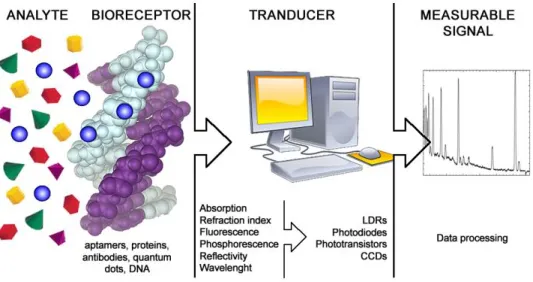
A biosensor is a device with a recognition mechanism designed to measure biological or chemical reactions3. It must be able to transform molecular recognition into a measurable
physical signal through association between a biochemical component (antibodies, DNA, protein, cell, bacteria…) and a transducer25. The intensity of the measured signal is
proportional to the concentration of the analyte8. This kind of devices are currently used in
various fields such as medical (as for example glucose biosensor for diabetes), environment (as in pollutant measurements), food (as in safety control) and also in the military field (as in detection of explosives)8.
Biosensors play important roles in our daily processes, especially in health diagnostics, biomedical engineering, pharmaceutical analysis26. In the biomedical field, bio detection is a
very important element in the fight against the COVID-19. Based on the rapid increase in the rate of human infection, the World Health Organization (WHO) has classified the COVID-19 outbreak as a pandemic27. Because no specific drugs or vaccines for COVID-19 are yet
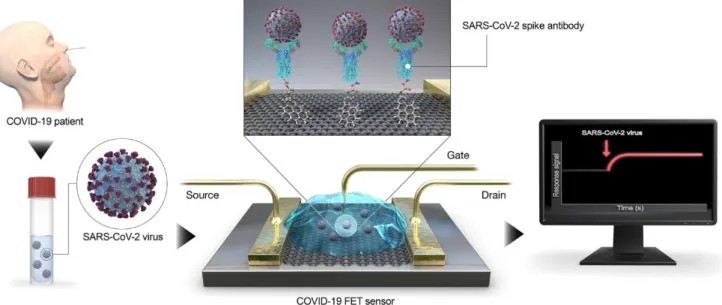
available at this date, early diagnosis and management are crucial for containing the outbreak28. Thinking about solving this problem, researchers of Korea developed a biosensor
field-effect transistor (FET)-based biosensing device for detecting SARS-CoV-2 in clinical samples28. The biosensor was produced by coating graphene sheets of the FET with a specific
antibody against SARS-CoV-2 spike protein.
The history of biosensors dates back to 1906, when M. Cremer studied the measurement of the potential difference through a glass membrane separating the unknown solution from a known reference solution, which is what we called nowadays of pH metro3.
Years later, in 1962, Leland C. Clark allowed the glucose level to be measured by oxidation using an enzyme attached to an electrode. The signal obtained was therefore a measurement of an electric current at the electrode8. However, only in 1975 the first commercial biosensor
was developed by a company called Yellow Spring Instruments (YSI)8.
This tool consists basically of three components, the output system (display), the transducer part that provide measurable information, which will be chosen for its accuracy and compatibility with the target to be detected and then the detection part of the target, a biological detection system which will be chosen for its affinity with the target to be identified or detected in the analyte8. The transduction signal must be simple, sensitive and reliable, and may be of
various nature. The selectivity and precision are two important features of a biosensor8. An
development3.
Figure 2. General Scheme of an optical biosensor 29.
In the two distinct zones of the transducer, numerous combinations are possible, which will make it possible to have biosensors that are more or less sensitive to a particular target or even sensors that allow the simultaneous detection of several biological targets. To be selective for a specific biological compound, the surface of the sensitive interface has to be modified with the bioreceptor.
As described in Table 1, the transducer part of a biosensor can measure various physicochemical parameters that can be classified by families.
Table 1. Types of transducers used for biosensor applications 29.
Types of transducers Measured property
Electrochemical Potentiometric, Amperometric, Conductometric, Nanotechnology and Bioelectronics
Electrical Surface conductivity, Electrolyte conductivity
Optical Fluorescence, Adsorption & Reflection, Surface Plasmon
resonance
Mass sensitive Resonance frequency of piezocrystals
1.1.1.
For bio detection
Biosensors are devices used for the detection and quantification of various biomolecules. Detections based on electrical transduction are generally based on conductometry and potentiometry. Conductimetric biosensors measure variation in the electrical resistance or impedance of the system due to the presence of the biomolecules, while potentiometric biosensors measure the electrical potential difference between a working and reference electrode in the presence of the analyte26.
Due the COVID-19 pandemic, the development of a highly sensitive and rapid biosensing devices has become increasingly important. Recently, a sensor was produced by coating graphene sheets of the FET with a specific antibody against SARS-CoV-2 spike protein28. The
Figure 3 below shows how the capture and the analysis are carried out through the biosensor.
Figure 3. Schematic diagram of COVID-19 FET sensor operation procedure. Graphene as a sensing material is selected, and SARS-CoV-2 spike antibody is conjugated onto the graphene sheet via
1-pyrenebutyric acid N-hydroxysuccinimide ester, which is an interfacing molecule as a probe linker.
The performance of the sensor was determined using antigen protein, cultured virus, and nasopharyngeal swab specimens from COVID-19 patients30. Moreover, this technology of bio
detection could be adapted for diagnosis of other emerging viral diseases for example.
1.1.2.
To study bio interaction
Life is based on biomolecular interaction! DNA, RNA, proteins, sugar chain… need to interact directly or indirectly to define complex answer (metabolism, immune defense…). To define medicine, we need to understand how these different species communicate together and identify if the signal is transferred through a direct interaction or mediated by another molecule. Among the biosensors, immunoassays are based on the direct interaction between antigen and antibody. These biosensors are sensitive, but both of the partners need to be known. DNA, RNA or protein chips could be also used as biosensors. They are interesting because they can be used for high-throughput screening of different targets in a complex solution (Serum, saliva, urine). Unfortunately, these techniques required a reporter strategy (fluorescent dye for instance) to see the interaction. In parallel of these biosensors, SPR biosensors are a promising alternative for quantitative analysis of molecular binding. These biosensors had the advantage of a label free technique, in real time, and ready for high-throughput screening.
1.2. Surface modification to remove pollutant from environment
In recent years, the potential of renewable sources to either produce energy or added value materials is a challenge in all fields of research. Focusing on biomass waste, its conversion into valuable products is particularly interesting, especially if the process allowing its transformation can be classified into the so-called green chemistry31.
The growth of science and technology over the world has led to the establishment of various industries which has helped the industrial, technological, and agricultural development of many nations. Environmental pollution from a variety of toxic derivatives, particularly heavy metals and minerals, aromatic molecules and dyes in wastewater posed a great danger to human,
plants, and aquatic creatures32.
A common example of a case that pollutes the environment are the organic dyes which can bring and firm color to other substances. Synthetic dyes usually have a complex aromatic molecular structure which possibly comes from coal tar-based hydrocarbons such as benzene, naphthalene, anthracene, toluene, xylene, etc. The complex aromatic molecular structures of dyes make them more stable and more difficult to biodegrade33. The conventional methods for
dye removal from wastewaters include coagulation and flocculation, oxidation or ozonation, membrane separation and adsorption. Activated carbon is popular and effective dye sorbent, but its relatively high price, high operating costs and problems with regeneration hamper its large-scale application. Therefore, there is a growing need in finding low cost, renewable, locally available materials as sorbent for the removal of dye colors33.
1.2.1.
Liquid phase
70% of the Earth’s surface is covered with water and only a small fraction (2.5%) is freshwater compatible with terrestrial life.
Sustainable water supply is an increasing demand in today’s word. In addition to water amounts needed for agriculture, water quality is fundamental for human life and the whole earth ecology.
According to the European Environmental Agency Report, only around 40% of surface waters (rivers, lakes, and transitional and coastal waters) are in good ecological status or potential, and 38% are in good chemical status.
An intensive use of chemicals in everyday activities and unrestricted access to medicines has resulted in increased waste production and an intense emission of typical as well as new organic compounds into the surrounding environment34. The impact of these chemicals on
living organisms is generally unknown but the experiments have proved their negative influence on vitality, life span, and reproductive success35.
Water treatments are most often based on biological processes which are now conveniently installed in all the developed countries. The main remaining problem concerns non-biodegradable compounds most often coming from industrial or agricultural activities. Besides very harmful dissolved heavy metal, most of these pollutants are organics, and may be very dangerous for human health.
Adsorption on activated carbon for achieving high water purification is widely used, and is often preferred as a post treatment as its cost would be excessive for concentrated pollution36,37,38,39.
The main drawback of activated carbon is its cost, its regeneration has to be improved to become sustainable.
Various methods of preparation of activated carbon based on carbonization and post activation are described in literature.
1.2.2.
Gas phase
The energy demand from our industrial way of life result in a huge increase in carbon dioxide emissions. Due to this, the capture of pollutants from the atmosphere has become an important field of research.
The pollutants are classified in two classes, the first one are called primary pollutants40 that
resulting from changes in natural emissions from the biosphere and are introduced directly into the atmosphere where many of them will react chemically, especially under the influence of solar radiation, and give rise to new constituents or secondary pollutants41, which are often
pollutants include strong acids, such as sulphuric acid and nitric acid, as well as strong oxidants such as ozone (O3). Thus, the atmosphere is the site of intense chemical activity, between
compounds that are mostly in trace amounts.
The pollutants interaction causes serious environmental problems, such as haze, photochemical smog, acid rain etc., which can cause serious risks to human health and environmental ecology42.
According to World Health Organization (WHO) economic cost of the health impact of air pollution in Europe is the first assessment of the economic burden of deaths and diseases resulting from outdoor and indoor air pollution in the 53 countries of the Region.
Currently there are many technologies for air pollution control and gaseous waste treatment such as:
- The gas washing technology2 that consists of transferring the gaseous pollution into a
washing solution, then the pollutant passes from the gas phase to liquid where it is retreated.
- The treatment by recovery of solvents43, a technology that allows the recovery of
solvents by adsorption-desorption on activated carbon, in this case the recovered solvents can thus be reused.
- The thermal/catalytic oxidation technology44 which is a treatment consisting in thermally
treating Volatile Organic Compounds (VOCs) by catalytic or regenerative route.
- The biofiltration technology45, where the gaseous compounds are degraded by bacteria
- The adsorption technology, where we have the capturing polluting gases on an adsorbent support (such as activated carbon)46.
Our study is based on this last technology, where the operating principle is based on the adsorption of the pollutant on the surface of adsorbent. Thus, the polluted gas passes through an adsorbent mass made up of activated carbon, zeolite, biomass... The pollutant developed physical and chemical interaction with the surface of the adsorbent and then the cleaned gas is rejected. When the adsorbent is saturated with pollutant, it was extracted to be unload before next processing.
2. The chemistries used in surface functionalization
There are many different ways to activate or modify material surfaces to improve their properties. To be efficient, a surface treatment has to increase the energy level of the surface to facilitate chemical or physical interaction. The type of the interactions with the environment is mainly dependent of the chemical groups available at the surface. In function of the material used, surfaces could be physically activated using temperature, plasma or ozone treatment or directly chemically modified.
2.1. Physical treatment
2.1.1.
Heat treatment
Heat treatments (annealing, quenching, precipitation hardening, laser or electron tempering) are processes where the material is alternatively heated and cooled in order to modify its microstructure and significantly change its properties. Heat treatments are mainly applied with metal and organic biomass. The most common reasons that metals undergo heat treatment are to improve their strength, hardness, toughness, ductility, and corrosion resistance. In
general, such treatments could be applied at the surface but also in the core of the material. Heat treatment could be also combined with addition of other atoms which are allowed to diffuse to the surface of the material to modify it (carbone, nitrure treatments of ferric sample for instance).
Pyrolysis and carbonization of organic materials could be also identified as a heating treatment because of the elevated temperature (600-900°C), inert atmosphere (nitrogen, argon) used and the irreversibility. Pyrolysis are used to convert carbonaceous sample (bamboo, cocoa, wood) in char residues with small pore and high surface area. In some cases, chemicals (such as salt, strong acid or base) are added before, during or after the thermal treatment to bring out new chemical group at the surface of the char. In this case, temperatures of carbonization are used in the range of 400 to 900°C47. Biochars could be also post-treated with chemicals to
obtain functionalized biochar.
2.1.2.
Gas treatment
Plasma treatment or corona discharge are used to clean and prepare surfaces prior to any coating or bonding. They are obtained when gas is exposed to a high energy source (electricity or microwave) and became a mixture of ions, electrons, radicals and other types of molecular fragments. It should be noted that in low pressure plasma treatment, just a limited elevation of temperature is required. When these molecules hit the surface material, they altered the chemical organization and composition of the surface. In corona discharge, the power and the density of the plasma is low could result in a short reactivity of the surface. Various material such as polymers, glass and ceramics could be treated by plasma treatment.
2.2. Chemical treatment
2.2.1.
Coating
During coating, the attached molecules are simply held by physical forces such as Van der Waals forces. In this case, the heat of adsorption is low, and the adsorption process is reversible. The molecular coating could be achieved by a simple immersion in the corresponding organic solution (molecule, polymer). The organic solution could be also sprayed brushed or obtained by chemical reduction of ions to the surface. The thickness of the coating could range from nm to hundreds of µm. Thus, steel alloy could be galvanized by zinc in acidic bath. For aluminum foils, samples have to be immersed in a solution of chromium to be oxidized and then protected from corrosion. In some cases, electrical potentials are applied at the surface in addition to the acidic treatment to remove inorganic pollutant and obtain a sample polishing. In this case, the contaminants are converted in ions and the surface is cleaned.
Acidic and basic solutions are often used to treat lignocellulosic material in order to improve their adsorption properties. Thus, sugarcane and agave bagasse, radish cake, eucalyptus seed, carrot waste, leaves of Melia azedarach L48 and Aleppo pine have been pretreated with
acidic solutions (tartaric, nitric, sulfuric, citric or hydrochloric acid) to remove organic moiety from the environment.
If we are looking for an enhancement of the surface roughness and exposure, it is recommended to pretreat the natural fiber with basic solution (such as sodium hydroxide for instance). To complete, this overview, it should be note that some works investigate the performance of their fiber impregnated with small molecules (such as urea, EDTA (ethylenediaminetetraacetic acid), benzene, ethanol, methanol, formaldehyde, acetone) or with polymers (Polyethylene imine (PEI), k-carrageenan, polyaniline, polysiloxane triton X-100…)49.
Glass surface could be also coated with polymers (Polyethylene oxide (PEO), polyvinyl alcohol (PVA), PEI, polyacrylamide, polyamine) to limit unwanted molecular adsorption on capillary wall or modulate its charge density50,51,52.
2.2.2.
Covalent grafting
Different methods were developed to immobilize functional groups on the surface of inorganic or organic substrates. For modification of metal, diazonium chemistry are well described53,54,55,56. For gold substrates, functional thiols could be also applied for various
applications in biodevices (surface plasmon resonance (SPR), biochip, electrochemical biosensor). For cellulosic sample and oxides (silicon, alumina, titania… oxides), the surface reactivity is based on reaction with the hydroxyl groups present at the surface. So, the main covalent strategy is the covalent grafting of silane derivates by silylation or silanization. Nevertheless, it could be note that diazonium salts have been also successfully grafted on cellulosic (cocoa shell, olive pit) and polymeric57, 58, 57, 59, 17 (Cyclic olefin copolymer, Teflon,
polyethylenterephtalate, polymethylmethacrylate) surface.
2.3. Thiol
Sulfur adsorption is suitable for modification of different noble metal such as gold, silver, palladium. Thiol deposition has been used to link organic, and biological materials to planar gold (Au) surfaces or gold nanoparticles (AuNPs). Indeed, alkanethiol are widely used on Au surfaces as a building blocks for the fabrication of different type of devices. One of the advantages of thiol adsorption is their organization at the solid-liquid or solid-gas interface. The gold-sulfur interaction is so important that thiolated molecules are organized as a Self-assembled monolayers (SAMs). In fact, SAM formation is a two- steps-process: Firstly, thiols are chemically adsorbed on gold and the molecules are lying parallel to the substrate. Then, when the surface coverage is increased, molecules stand up perpendicularly to the surface to
form dense and stable thiol lattice. In function of the nature of thiol (aromatic, number of carbon), the angle between gold substrate and molecules adsorbed could be different60. It is
generally considered that thiol sorption on gold followed a chemisorption process due to the strength of interaction which is measured at 40-50 kcal.mol-1. In 2014, Xue et al. tried to
measure the strength of the gold thiol interaction by measuring its rupture force. They found that the force was comparable to Au-Au bond at 1.4 nN (61). The suggested process of
chemisorption could be considered as an oxidative addition of the S-H bond to gold, followed by reductive elimination of the hydrogen.
But this hypothesis of chemisorption has been recently challenged by Inkpen et al. who estimate that gold-thiol is not a molecular junction but physisorption62.
In all of cases, thiol sorption is the main method used to functionalize gold surfaces for SPR applications18. Unfortunately, thiol sorption on gold is sensitive to certain physicochemical
parameters such as temperature, solvent, etc21. So, diazonium salts could be an alternative to
thiol-mediated immobilization because they are resistant to these physicochemical parameters21 and graftable the metal surfaces63,18,23.
2.4. Silane
Organosilane coupling agents were studied since few decades64,65. As they are studied since
a long time, there are many functionalized coupling agent commercially available with different functional groups (amino, alkane, thiol, methacrylic, epoxy…)66. These molecules are based
on a silicon atom which is able to create 4 linkages (general formula: R-Si-(OR’)3). To be useful
the coupling agent should have different terminal groups at these ends. In general, the coupling agent is connect through a hydrocarbon chain to a pendant terminal functional group “R”
-suitable for post-functionalization67,68.At the other ends, the coupling agent should have some
alkoxy groups or halogen group R’. In presence of water or humidity, these groups are hydrolysable to create silanol group which are crucial for chemical grafting on the material surface. In presence of others hydroxyl groups from (organic or inorganic surface), a condensation step will be developed, and a linkage O-Si-O will be created. So, silanization is a two-step process where the leaving group depends on the initial composition of the linker (Cl, CH2-CH3, CH3). The performance of the silanization depends on experimental conditions (gas
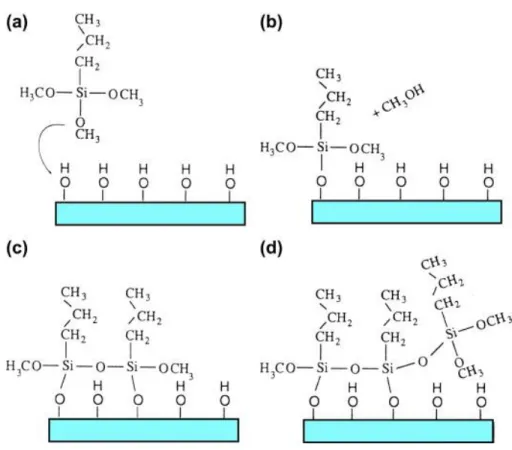
or liquid phase, concentration, pH, organic or aqueous phase, purity, temperature) and on the nature of the coupling agent (mono, di or trialkoxysilane). There is also some alkoxysilane with four alkoxylgroup but they are rarely used because not they are not suitable for orthogonal post-functionalization. (Figure 4) presents a surface silanization using a trialkoxysilane.
Figure 4: Modification of an hydroxyl surface by silanization: (a) a hydroxylated surface is immersed in a solution containing n-propyl trimethoxysilane (nPTMS); (b) one of the methoxy groups of the nPTMS couples
with a hydroxyl group releasing methanol; (c) two of the methoxy groups on another molecule of the nPTMS have reacted, one with a hydroxyl group and the other with a methoxy group from the first nPTMS molecule; (d) a third nPTMS molecule has reacted only with a methoxy group. This molecule is tied into the silane film
When the intermediate structure (Figure 4b) is fully condensate, the reaction stops. The reaction needs some pendant alkoxy or chlore group to continue and create some interaction with closed silane. In the best conditions, researchers are able to create a single silane monolayer at the surface of the material70. However, if the amount of water, the concentration
of silane, the reaction time or the solvent are not well adapted a thicker silane layer can be formed consisting of both Si–O groups bonded to the surface, and silane units participating in a “bulk” 3D polymerized network.
It is interesting to note that the reactivity of amino-terminated silane is weakly affected by the experimental conditions and fully water-miscible. In this case, the amine group induced a self-catalysis leading to a good condensation of the molecule on the substrate used71.
One of the limitations of surface modified by silanization, is its weakness against hydrolysis which could reverse the condensation and free the coupling agent. It is important for coupling silane agents which are not miscible in water.
Even if, Gandini et al. showed that silane coupling agents that include an amino group at the R group display a good affinity toward cellulosic substrate72,73, the interaction between silane
and hydroxyl group from cellulose is less evident and less described in literature than with silica. As cellulosic fibers are unreactive to many chemicals, the OH groups of the fiber have very low accessibility and weaker acidity74, the reactivity between cellulose and silane is limited
even at high temperature. In general, researchers focused their works to ascertain the impact of these modifications on the mechanical properties of the ensuing composites. The group of Herrera is one of the first research group focusing his work to study the chemical reaction between cellulose derivates and silane75.
The strategy consists in activation of the alkoxysilane by hydrolyzing the alkoxy groups of the surface to form more reactive silanol groups. Thus, the following mechanism is generally
accepted to describe the chemical reaction. Some pre-hydrolyzed silanes (from diluted solution of silane coupling agent) adsorbed on cellulose surfaces. At this stage, silane simply covered the cellulose surfaces and it is only maintained by physical interactions. Hydrogen interactions between hydroxyl groups of silanes and those of cellulose should be the main interaction. So, if a cleaning step with ethanol is applied, all the silanes are removed from the surface. If the first step is followed by heat treatment (120°C, inert atmosphere), the condensation occurred between OH group from surface and from hydrolyzed silane giving Si–O–C and Si–O–Si couplings, respectively. These reactions ensured efficient and irreversible chemical bonding of the silane onto the cellulose surface.
2.5. Diazonium salts
Although the tendency to modify surfaces using thiol compound, the low long term stability due to the easy oxidation of thiol, the small electrochemical window (range -1 V to +1 V vs SCE) in the case of electrochemical reduction, and the lower bonding energy of S-Au with respect to the C-C bond has led to the use of diazonium as an alternative for the development of a stable surface based on covalent bonding8. This system offers the advantage of facile preparation,
rapid reduction and the possibility of the introduction of different functional groups8.
In order to study all the advantages of this chemical compound, this present work is focused in the gold surface functionalization from diazonium salts.
2.5.1.
History
A diazonium salt is an aliphatic, aromatic or heterocyclic compound, in which a -N2+ group is
covalently linked to a carbon atom (R-N+≡N)76.
German industrial chemist and an early pioneer of organic chemistry called Johann Peter Griess at year of 1858 during the elaboration of a test for the detection of nitrite ions, by assaying with an amine which led to the formation of a colored compound11.
The conjugation of π electrons with the aromatic ring makes aryldiazonium ions much more stable than their aliphatic counterparts rarely used in classical organic chemistry. The diazonium group (N2+) is known as the most electron-withdrawing substitute11.
The diazonium ions are most often formed by nitrosation of primary amines in an acidic medium76, however only the aromatic diazonium salts are stable in the medium term (several
hours)76.
After its discovery the diazonium salts have been widely used for the preparation of azo dyes12,
an important commercially compound on the textile, leather and foods industry.
It was mainly due to this discovery that Griess is considered an important figure in the formation of the modern dye industry.
Figure 5: Brief history of the use of diazonium77.
Subsequently to the discovering of diazonium salts, these highly reactive chemical functions were used for the development of new synthesis of aromatic organic molecules (Figure 5)15.
The N2+ is an excellent leaving group, it could be involved during various nucleophilic
(halogenation, 1884), the Gomberg-Bachmann reaction10 (benzyl coupling, 1924), the
Schiemann reaction78 (fluoridation, 1927), the Meerwein reaction79 (arylation, 1939), among
others.
Figure 6: Scheme of the uses of aryldiazonium in organic synthesis (R = Substitute group, ● = Radical80.
2.5.2.
Synthesis
Usually, two synthetic routes are used for the synthesis of aryldiazonium. The first route uses a counter-anion which stabilize diazonium and allow its isolation as a salt; the second route consist in the synthesis and the in-situ use of the diazonium function.
1) The use of tetrafluoroboric acid in the presence of sodium nitrite allows to synthesize nitrous acid in situ and to carry out the diazotization reaction in an aqueous solution (Figure 7). This reaction is generally carried out between -5 and 0°C81,82,83,84.Then, the salts are stored at
-20°C. The HBF4- is known as a stabilizer to diazonium salts and as a catalyst for alkylations
and polymerizations.
Figure 7: Synthesis of aryldiazonium tetrafluoroborate with HBF4.
2) The second method is to use directly the nitrosonium ion, provided by NOBF4 in organic
medium to obtain the desired product (Figure 8). This reaction, making it possible to overcome the presence of reaction by-products, but it required greater precaution because it is carried out at -40°C85,86.
Figure 8: Synthesis of aryldiazonium tetrafluoroborate with NOBF4.
3) Another possible way to obtain stable salts is using the tosyl anion (p-TsO-) by using a dry mixture (p-TsOH/NaNO2 ) on aniline, mixing manually in a mortar87. According to these studies,
these diazonium salts remain stable after one month at room temperature in a desiccator.
These different synthesis routes allow to obtain the salts, which can be isolated, preserved and characterized.
But in the case where the diazonium function only serves as an intermediate for obtaining an aryl radical, it is then possible to dispense with a stabilizing counter-anion such as a chloride ion (introduced by the use of hydrochloric acid). This kind of synthesis is generally carried out in an aqueous solvent by reacting an acid (often HCl) with sodium nitrite. The presence of chloride ion, as counter-anion, is not sufficient to stabilize the diazonium cation, it will react quickly88,57. In an organic solvent, the use of tert-butyl nitrite will be preferred to sodium nitrite
for better solubility for synthesis and in-situ use at room temperature89. This route can be
considered when the aryldiazonium is poorly soluble in aqueous solvents.
The position and the nature of the functional groups on the benzene ring carrying the diazonium function influences both the synthesis of the aryldiazonium salts but also the formation of the products due to the electronic delocalization of the N2+ function. The mesomeric and inductive
effects affect the salt stability.
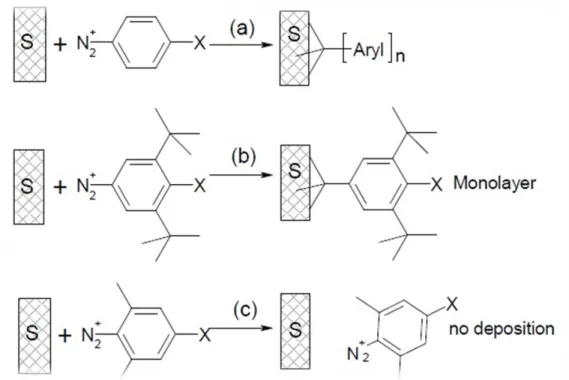
As showed in the Figure 10, the aryldiazonium salts can be also used for the grafting of aromatic layers on surfaces. Steric hindrance must therefore be taken into account when the aromatic ring is congested during a reaction between the molecule and a surface (S) that completely prevents grafting90.
Figure 10: Influence of aromatic ring substitution on organic layer grafting on a surface91.
2.5.3.
Surface modification with diazonium salts
2.5.3.1. Spontaneous grafting
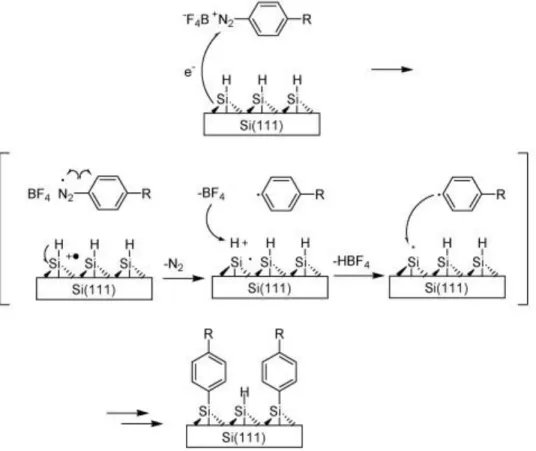
There is the possibility of working without electric current, by spontaneous electroreduction, particularly with metallic surfaces. In this case, the atoms of the metallic surface gave the electrons required for the reduction of the diazonium salts and its grafting to the surface85,92,93,94, 94,95,96,97,98.
For non-conductive materials (as will be presented in the form of a scientific article in chapter III), electrons could not come from the surface, so some chemical reducing agent have to be added in the solution.
2.5.4.
Chemical reduction
For aryldiazonium salts bearing a redox potential close to 600mV, the chemical reducers must have a lower standard potential (Figure 11)99. Among the different possible chemical reducers,
we use hypophosphorous acid (H3PO2) which has a standard potential (E°) of - 0.499 V/SHE99
providing two electrons during the reduction. It has been already described in literature to reduce aryldiazoniums100,101
Figure 11: Standard potential of the species used.
2.5.5.
Electrochemical reduction or oxidation
After a long period destined to be used almost exclusively as a dye, the electrochemistry of diazonium salts was described by Elofson, using mercury electrodes12. So, after 1992 the azo
compounds began to be used to modify surfaces 102.
The electrochemistry, by the supply of electrons in the medium, allows us to obtain radicals which are going to be formed by loss of a molecule of dinitrogen, and will thus react with the conducting surface which is used as a working electrode (Figure 12).
Figure 12: Electrodeposition of aryl nuclei on a surface.
The electrochemical reductions of aryldiazonium have been implemented with different conductive or semiconductor materials such as:
Eº (V/SHE) Standard Potential + 0,600 4-NitrobenzeneDiazonium - 0,499 H3PO2 H3PO3 Ar- Ar
.
R = Functional group Reduction -N2 Metals: Electroreduction on gold is often used103,84,86,88,57,104,105,106,107,108 but we
can also use it as a point of attachment to gold nanoparticles109. Other metals
are also used such as iron110,111,112,113,114,115, steel116,108,117,118,119,120, silver120,
palladium92, platinum121, titanium122 or copper123,124.
Carbon: We have at our disposal many forms of carbon such as vitreous carbon (GC)84,125,108,126,127,109,128,103,129, graphite130, in “printed” form131 or in highly
oriented pyrolytic form (HOPG)128. We also have in the form of nanotubes,
directly or via the use of bulky paper (a kind of thin sheet composed of an assembly of nanotubes)132 or even on microelectrodes printed in graphite133.
Silicon, widely used in electronics, requires surface preparation, allowing the transformation of the passivation layer (Si-O-Si and Si-OH bonds) present on the surface into reactive Si-H functions92,134,93,135,94,95,96,97,98,99,136, (Figure 13).
And other semiconductor materials, such as indium tin oxide (ITO)108,137,,
germanium138,139,93, titanium and its oxide (TiO2)135, or SiGe93 and GaAs92
alloys.
The electrochemical functionalization can be done by oxidation on vitreous carbon, platinum or gold140,141,142,143. However, the latter process is limited by the incompatibility of the surfaces
with electro-oxidation. It is for this reason that the electroreduction pathway is more developed with vinyl compounds143 and mainly with aryldiazonium salts144.
The main limitation of the electrochemical approach is the requirement of a conductive surface.
In this work, I will modify:
- Gold surface with diazonium salt to develop SPR biosensor (chapter 2);
- And organic surface with silane moieties and diazonium salts to develop CO2 and
CHAPTER II
FUNCTIONALIZATION OF SURFACE APPLIED TO BIOCHEMISTRY
Methodology and results
1. Introduction
The chapter II is mainly dedicated to surface functionalization of gold surface for application in the Surface Plasmon Resonance (SPR) technique. Our strategy about this chapter was to modify gold surface with diazonium salts and then use it for SPR applications.
After a short presentation of the SPR technology and the different surface modifications involved for this application, I will present the 2 strategies of modification I applied: The electroreduction and the chemical reduction of the aryldiazonium salt. I will present the influence of different parameters (number of cycles in electrochemistry, diazonium concentration…) on the plasmon sensitivity. Then, I will demonstrate the proof of concept using a well-known antibodies/antigen couple. Finally, I will validate our strategy with an original application based on CNP-AmiC interaction. To conclude, I will present an innovative approach to develop a new biosensor suitable for the next generation of SPR instrument.
2. Presentation of the Surface Plasmon Resonance technique
Surface plasmon resonance (SPR) is a well-established technique for studying affinity between biomolecules at the liquid/solid interface145. The sensitivity of this real time technique is due tothe gold sensing surface used. Thus, SPR succeeded in measuring the affinity constant between protein-DNA, protein-protein or small molecule-protein146,147.
The SPR physical process occur when a plane-polarized light hits a metal film under total internal reflection conditions4. In the process, a glass interface located between two very
different refractive index media and a gold surface is illuminate with a polarized monochromatic light. Then, these conditions make it possible to obtain a phenomenon of total internal reflection due to the illumination of the surface with an angle of incidence greater than the limit angle (from which all the light is reflected). Thus, no refraction was obtained but an evanescent wave (electromagnetic component of the light) propagates perpendicularly to the interface over a distance equal to its wavelength. The presence of a metal surface will make it possible to obtain a resonance between the plasmons of gold and the evanescent wave by loss of light energy at the level of the beam reflected at a particular angle called the resonance angle (Figure 14).
For being use on the SPR technique, the metal must have construction band electrons capable of resonating with the incoming light at a suitable wavelength4. Metals that satisfy to this
condition are silver, gold, copper, aluminum, sodium and indium. In addition, the metal on the sensor surface must be free of oxides, sulphides and not react to other molecules on exposure to the atmosphere or liquid. Of the metals, indium is too expensive, sodium too reactive, cooper and aluminum too broad in their SPR response and silver too sensitive to oxidation. This leaves the gold as the most practical metal.
This angle is sensitive to the refractive index of the medium in which the evanescent wave propagates. So, any modification on the gold surface will influence the propagation of the
evanescent wave. The use of the SPR technique for biosensor purposes has been proposed by Liedberg et al. in 19834,148. The changes in mass on the surface of the sensor which take
place during the association or dissociation of the biomolecular complex in the detection zone induce a modification of the angle of resonance of the incident light, see Figure 14.
Thus, to evaluate the interactions between two molecules, we have to immobilize a ligand into a microfluidic or planar surface and inject the analyte in a liquid phase. These systems make it possible to follow the mass changes on the gold surface, induced by the formation then the dissociation of molecular complexes, that allows to go back to the association and dissociation constant between ligand and analyte.
The SPR sensors can be coupled with image capture tools that allow observing in real time the changes induced by the differences on the surface, which we call SPRi (i for image generation)149. So, the advantages of the SPRi system is that analytical technique does not
require a labeling of the targets, it is very sensitive (detection of the interaction from approximately 1 pg of protein), and the acquisition is done in real time.
The experimental analyzes were made on a SPRi-Plex II device from the manufacturer Horiba-Genoptics. We work with a bare crystal prism on which is placed a movable planar substrate including the functionalized metallic layer (in our case, a gold layer). The contact between the prism and the gold surface is ensured by a special optical oil with a refractive index equal to that of the prism. Once the sample holder is inserted into the instrument, the system is locked by the contact of a seal holding the system at its periphery, allowing the passage of the buffer solution (containing or not the analytes studied) without any leakage. The running buffer (Phosphate buffered saline (PBS buffer), 10 mmol L-1, pH 7.4) will go through the microfluidic
circuit under a constant flow of 50 µL / min to the gold surface and then be discarded. The reflectivity measurement is carried out at a fixed angle after defining the optimal working
angle150.
Figure 14: Principle of SPR measurement151. a) with HORIBA system; b) with BIACORE system152.
A Surface Plasma Resonance system basically works as follows (Figure 14), the excitation ray passes through a high density medium (a glass prism) which will modify the speed and the vector of the incident light wave (kin) as we can see in the Equation 1.
Equation 1: Equation of the incident light wave.
λ is the wavelength of the excitation light, θ is the angle of incidence and εp is the dielectric
constant of the prism153,154. We can describe the wave vector (k
sp) of the surface plasmon
propagating at the interface metal-prism by the following equation:
a)
Equation 2: Equation of the wave vector.
In the Equation 2 we have the angular frequency of the surface plasmon (ωsp), the dielectric
constant of the metal film (εm) and the speed of light c. So, that the plasmonic wave propagates
at the metal and the insulator interface, kin must correspond to ksp. So that part of the photon
energy is transferred to the surface. When a ligand is immobilized on gold surface, the dielectric constant of the metal film is modified. So, this constant is sensitive to the thickness of the molecular deposition and consequently to the interaction between ligand and analyte. During the experiment, we recorded the reflective intensity. Thus, we are able to monitor different event such as association/dissociation of the molecular complex (Figure 15).
Figure 15: a) Kinetic of association and dissociation of the analyte/ligand complex. b) Variation of the SPR signal in function of the concentration of injected analyte152.
As SPR is a real time method, it is possible to monitor the kinetic of association and dissociation according to the modification of the dielectric constant of the surface (reflectance of the signal). Thus, the equilibrium constant K could be determined by the Equation 3. The concentration of the ligand-analyte complex (LA) is determined from the SPR signal, the concentration of the analyte (A) is defined by the user, and the concentration of total ligand grafted to the surface
(L) is obtained from the maximum SPR signal. This value is determined from Figure 15b when the curve fraction of bound receptor in function of analyte concentration reached saturation.
Equation 3: Steady state equation.
The development of nanomaterials led to the appearance of the so-called localized SPR149,155.
The plasmonic properties of nanoparticles of metals such as gold or silver make the optical signals obtained stronger and more controllable156. For example, a metallic film that comprises
nano-orifices does not require an ATR to activate the SPR, a conventional light source and a microscope are sufficient to analyze this surface157. All of the latest advances in SPR
biosensors have been reviewed recently by Singh et al158.
2.1. Modification of the SPR surface
Different strategies were investigated in the literature to immobilize biomolecules on gold surface such as physical adsorption, embedding in polymer, sol-gel entrapment, self-assembly method and layer by layer deposition159. Indeed, Biacore sell a commercial SPR biochip
modified with carboxymethylated dextran hydrogel. Physical adsorption mediated by BSA and self-assembly methods are the most used in SPR. The alkanethiol chemistry was extensively studied because the sulfur-gold bond involved in the coating process formed spontaneously a densyl self-assembled monolayer (SAM) on the gold surface160. Even if, SAM helps to limit the
non-specific adsorption of the analyte to the surface, unwanted adsorption is still a problem. To limit this interaction and enhance the S/N, the used of mixed SAM (with free and capped group), polymer coating and post-functionalization using protein or amino acid coating have been tested161.
Horiba sell some SPRi biochip pre-functionalized with SAM and dextran. Different free groups (thiol, amine, acid, alcohol) are available for covalent immobilization of the ligand. In comparison with other techniques, Thus, some carboxy-PEG based SAM were developed and present an oriented immobilization of the ligand and a limited nonspecific adsorption162.
Despite its advantage, thiolated surfaces were still sensitive to experimental conditions because the gold-sulfur interaction is labile, yielding the coating unstable under specific condition. Thus, in 2002, Raitman et al. suggested to adsorb the electrografted-polyaniline polymer on gold surface and applied it in SPR experiment163.
2.1.1.
My strategy
Commercial SPR biochips are really expensive and the chemistry available to immobilize molecule on gold surface were limited. The main objective of this work was to develop a new SPR biochip bearing a diazonium chemistry which is simple to produce and more stable than conventional commercial chip. As a proof of concept, different devices will be developed with carboxybenzene diazonium moieties in this thesis: Electrografted, chemically grafted, and strip electrografted biochip and these chips will be compared to thiolated biochip. The best device will be tested in collaboration with the Laboratory of Microbiology - Signals and Microenvironment (LMSM), EA 4312 in Evreux with a test complex Ovalbumine/anti-ovalbumine and an original complex AmiC/CNP.
2.2. The choice of the diazonium salt
On gold surface, the diazonium coating is promising as an alternative to the thiol coating because the carbon-gold interaction is more stable, and the electro-reduction is a fast process164,165,166,23. Although the diazonium salts being widely used to functionalize gold
Aryldiazonium salts (Scheme 14) could be converted in an aryl radical by sonication, photoinduction, chemical or electrochemical reduction. Then, this radical react with the narrow surface incubated in the solution. In the literature, various surfaces have been modified by aryldiazonium salts57,167.
In this work, I would like to immobilize proteins, so I decide to functionalize the surface with a diazonium salt bearing a carboxylic acid. Then, the carboxylic acid will interact with NH2 from
protein to create an amide function. The stability of the carboxybenzenediazonium salts is limited so there are not commercially available. For this reason, I choose to synthetize my own diazonium salt from the reduction of the carboxyaniline (scheme 1).
Schema 1: The 4-Carboxybenzene diazonium synthesis
I obtained the diazonium salt with a yield of 80%. It was characterized by IRTF, 1H-NMR and
then stored in the freezer until use.
2.3. The substrates selected to develop the SPR biochip
Gold is very resistant to oxidation and other atmospheric contaminants but is compatible with many chemical modification systems. The thickness of the gold should be + 50 nm. The
thickness of the metal layers is of great importance. Above an optimum, the dip in reflective light becomes shallow, bellow the optimum the dip becomes broader4.
The gold surfaces are purchased from Schott (Switzerland), Arrandee (Germany) and Horiba (France). These surfaces consist of a glass slide covered with an adhesion layer of chrome which then allows to deposit a layer of gold (Figure 16).
Figure 16: Composition of the gold support available.
2.4. The optical performance requested for a SPR biochip
Previously, we indicated that the plasmon which are confined to the plane of the gold film were parallel to the surface and sensitive to the liquid/solid interface4(Figure 17). To be efficient, an
SPR biochip should have a prism/liquid interface limited to 300 nm4 to be sensitive. So, the
surface we developed should be relatively thin (around ~ 2 nm) to measure molecular binding. The reflectivity should be as high as possible (at around 25%), the plasmon angle should be as homogenous as possible and close to the optimal value at 60°. So, the developed biochip should respect these conditions.
Figure 17: Diagram presenting the use of a surface plasmon168.
3. The SPR biochip developed
The grafting of diazonium salts on surfaces is fast and can be carried out by two techniques: chemical reduction169,19 and electrochemical reduction63. Both of them will be presented in the