HAL Id: tel-00629931
https://tel.archives-ouvertes.fr/tel-00629931v2
Submitted on 30 Mar 2012
HAL is a multi-disciplinary open access
archive for the deposit and dissemination of sci-entific research documents, whether they are pub-lished or not. The documents may come from teaching and research institutions in France or
L’archive ouverte pluridisciplinaire HAL, est destinée au dépôt et à la diffusion de documents scientifiques de niveau recherche, publiés ou non, émanant des établissements d’enseignement et de recherche français ou étrangers, des laboratoires
network security enhancement
Mohamed Abid
To cite this version:
Mohamed Abid. User identity based authentication mechanisms for network security enhancement. Other [cs.OH]. Institut National des Télécommunications, 2011. English. �NNT : 2011TELE0005�. �tel-00629931v2�
Thèse n° 2011TELE0005
Ecole Doctorale EDITE
Thèse présentée pour l’obtention du diplôme de
Docteur de Télécom & Management SudParis
Doctorat conjoint
Telecom & Management SudParis (TMSP) – Université Pierre et Marie Curie (UPMC)
Spécialité : informatique et réseaux
Par
Mohamed ABID
Des mécanismes d’authentification basés sur
l’identité de l’utilisateur pour renforcer la sécurité
des réseaux
Soutenue le 01/02/2011 devant le jury composé de :
Hatem BETTAHAR Rapporteur Université de Technologie de Compiègne
Lionel BRUNIE Rapporteur INSA Lyon
Bernadette DORIZZI Examinatrice Institut Telecom SudParis
Guy PUJOLLE Examinateur UPMC Paris 6
Hassnaa MOUSTAFA Examinatrice Telecom R&D (Orange Labs)
Patrick SENAC Examinateur ISAE Toulouse
Dijana
PETROVSKA-DELACRÉTAZ Examinatrice Institut Telecom SudParis
Thèse n° 2011TELE0005
Ecole Doctorale EDITE
Thèse présentée pour l’obtention du diplôme de
Docteur de Télécom & Management SudParis
Doctorat conjoint
Telecom & Management SudParis (TMSP) – Université Pierre et Marie Curie (UPMC)
Spécialité : informatique et réseaux
Par
Mohamed ABID
User Identity Based Authentication Mechanisms for
Network Security Enhancement
Soutenue le 01/02/2011 devant le jury composé de :
Hatem BETTAHAR Rapporteur Université de Technologie de Compiègne
Lionel BRUNIE Rapporteur INSA Lyon
Bernadette DORIZZI Examinatrice Institut Telecom SudParis
Guy PUJOLLE Examinateur UPMC Paris 6
Hassnaa MOUSTAFA Examinatrice Telecom R&D (Orange Labs)
Patrick SENAC Examinateur ISAE Toulouse
Dijana
PETROVSKA-DELACRÉTAZ Examinatrice Institut Telecom SudParis
Abstract
In this thesis, we design new authentication mechanisms based on user identity. There-fore, we bring improvements in access control for different classes of networks such as Home Network, Governmental Network and Cellular Network. The identity can be biometric public features, simple strings (email addresses, login...), etc. The goal of our work is to design innovative solutions that secure and personalize authentication mechanisms. We have three main solutions in the thesis depending on the deployed identity.
The first solution concerns the use of biometric in Home Network’ authentication mechanisms. In the Home Network (HN) case study, we aim at personalizing the access of each user in the HN and preventing illegitimate users (passing by the HG) to have any access. Our approach of personalized access also permits each user to use any device in the HN, while being able to access his/her appropriate profile. We propose a new bio-metric authentication method, while keeping in mind the constraint of the non storage of the users’ Biometric Template BT in the Home Gateway (HG). To satisfy this con-straint, we propose using the fuzzy vault method to hide a secret that should be used for authentication. The HG has the role of generating a secret for each user session, which are hidden by the BT. The user needs to recover the secret in order to be authenticated. The personalized users’ access in the proposed solution, allows controlling the access for each broadband access line depending on the user that is being connected.
The second solution proposes e-Passport authentication mechanisms. The crypto-graphic parameters are generated using the biometric templates and hence, personal-ized for the user. In travel document case study, we present our proposal which intro-duces a new e-Passport authentication mechanisms based on the Elliptic Curve Diffie-Hellman (ECDH) Key Agreement protocol. This protocol is needed to generate a session key used to authenticate the traveler and the Inspection System (IS) to exchange secure data. We designed two protocols. In the first one, the elliptic curve, used in the biomet-ric cryptosystem, are generated from the minutiae data (fingerprint) of the e-Passport holder. In the second one, we use iris code to generate the elliptic curve. We analyzed the security of our solution with respect to the goals that we defined. We found that our solution fulfills its goals and prevents the system from the attacks. The use of biometric in the cryptographic solution is a very important issue as this biometric data is stored in the e-Passport Chip without a direct link to the security. This solution is validated by using iris biometrics. We performed tests on the NIST-ICE database of iris images to compute the False Rejection Rate and the False Acceptance Rate. The results obtained (e.g., FRR
In the third solution, we worked on the Cellular Network and we used a simple string, like email addresses, as identifier to access to services. We choose the IP Multimedia Sub-system (IMS) which is an overlay architecture for the provision of multimedia services. We design a new service authentication mechanism relying on Identity Based Cryptogra-phy (IBC) for the IMS architecture. The goal was to authenticate the users using their public and private identifiers to overcome known weaknesses in the Authentication and Key Agreement (AKA) protocol. Security is assured using a symmetric protocol with a shared key (ks) between the User Equipement (UE) and the Home Subscriber Sys-tem (HSS), an asymmetric protocol for signature, and Diffie-Hellman for key agreement. We focused on the eavesdropping and impersonation attacks that can take place in clas-sical IMS scenario and we showed how our proposed solution can prevent against these attacks. We, then, proposed to add a Batch Verification on the Bootstrapping Server Function (BSF) to decrease signature verification delay and the authentication response time. To validate the performance of our proposed solution, we implemented the crypto-graphic operation in our proposed solution including the IBC procedures. We observed that the use of asymmetric cryptographic procedures leads to longer running time than symmetric procedures. However, the Batch Verification helps the BSF to verify the User Equipments (UEs) signature in a reasonable time.
Key words : Authentication, Biometrics, Identity Based Cryptography (IBC), IP Multimedia Subsystem (IMS), Home Network (HN)
Dedication
For my Father’s memory, For my Grand parents memory, For my wife Najet,
For my son Ali, For my mother,
For Prof. Hatem Bettaher memory For my sisters and brother,
For my -in laws (father, mother and brothers), For all those I appreciate...
Acknowledgements
In this thesis, I have been supported and supervised by many people to whom I would like to express my deepest gratitude:
- My supervisor, Prof. Hossam Afifi: thank you for the stupendous effort you spent to be a great colleague and friend.
- Prof. Hatem Bettaher and Prof. Lionel Brunie for accepting to review my dissertation and to be member of my Phd defense jury.
- Prof. Bernadette Dorizzi, Prof. Guy Pujolle, Dr. Hassnaa Moustafa,
Prof. Patrick Senac, Dr. Dijana Petrovska-Delacretaz to be member of my Phd defense jury.
- The staff of TMSP; particularly, I want to thank: Dr. Abdallah M’hamed,
Dr. Vincent Gauthier, . . . and especially our head of department Prof. Djamal Zeghlache for his helpful suggestions and advices. A very big thank goes to Isabelle Rebillard and Valerie Mateus for their patience and support.
- A special thank for Dr. Hassnaa Moustafa and Dr. Dijana
Petrovska-Delacretaz for their help and valuable advices.
- A special thank for Dr. Eric Renault, Shoaib Saleem and Mehdi Mani for helping me to improve the language in my report.
- This thesis reports implementation results that were conducted with the help of several colleagues. A special thank goes to Sondes Bannouri and Dingqi Yang for their contribution to the two demonstrators.
- A special thank for Dorsaf Zekri and Amira Bradai for helping me to defend my thesis.
- My family, especially my wife, my son, my mother, my systers and brother, my -in laws (father, mother and brothers) for the support, help, and encouragement.
- My friends, both from TMSP and those who go back longer, especially Boutabia, Emad, Chedhly, Aroua, Teck, Bastien, Ahmad, khaled, Ghazi, Sanjey Kanade and Songbo Song.
This thesis was supported by a research studentship from the ANR/RNRT France (Agence Nationale de la recherche/ Réseau National de Recherche en Télécommunica-tions). Project BIOTYFUL: BIOmetrics and crypTographY for Fair aUthentication Licensing [ANR-06-TCOM-018] (2006).
Contents
1 Introduction 1
1.1 Network Security . . . 1
1.1.1 Identity . . . 1
1.1.2 Authentication . . . 2
1.2 Problem Statement and Contribution . . . 2
1.3 Organization of this Thesis . . . 4
2 Cryptography 5 2.1 Introduction . . . 5
2.2 Algebraic Notations . . . 6
2.3 Symmetric Cryptography . . . 6
2.4 Asymmetric or Public-key Cryptography . . . 7
2.4.1 The Discrete Logarithm Problem (DLP) . . . 9
2.4.2 The Integer Factorization Problem (IFP) . . . 9
2.5 Digital Signature . . . 9
2.6 Elliptic Curve Cryptography (ECC) . . . 11
2.6.1 Elliptic Curve over Fp . . . 11
2.6.2 Elliptic Curve over F2m . . . 13
2.6.3 Use in Cryptography . . . 13
2.6.3.1 Elliptic Curve Diffie-Hellman ECDH Key Agreement Pro-tocol . . . 14
2.6.3.2 Menezes-Vanstone Protocol . . . 15
2.6.3.3 Elliptic Curve Digital Signature Algorithm (ECDSA) . . . 16
2.7 Identity Based Cryptography (IBC) . . . 17
2.7.1 Bilinear pairing . . . 17
2.7.3 Identity-Based Signature Scheme . . . 19
2.7.4 Certificateless Public Key Cryptography CL-PKC . . . 20
2.7.5 TIBC: Trade-off between Identity-Based and Certificateless Cryp-tography . . . 21
2.8 Conclusion . . . 22
3 State of the Art of Biometrics 23 3.1 Introduction . . . 23
3.2 Biometrics . . . 23
3.3 Multimodal Biometrics . . . 27
3.3.1 Fusion at the Data or Feature Level . . . 28
3.3.2 Fusion at the Match Score Level . . . 28
3.3.3 Fusion at the Decision Level . . . 29
3.4 Cancelable Biometrics . . . 29
3.5 Biometric Cryptosystems . . . 31
3.5.1 Locking the Key using Biometric Template . . . 32
3.5.1.1 Soutar et al.’s Solution . . . 32
3.5.1.2 Fuzzy Vault . . . 34
3.5.1.3 Linnartz and Tuyls’s Solution . . . 36
3.5.1.4 Dodis et al.’s Solution . . . 37
3.5.1.5 Sahai and Waters’s solution . . . 37
3.5.1.6 Discussion . . . 38
3.5.2 Error Correcting Codes . . . 39
3.5.2.1 Davida et al.’s Solution . . . 39
3.5.2.2 Hao et al. Solution . . . 40
3.5.2.3 Obtaining Stable Bit-String from Iris . . . 41
3.5.2.4 Discussion . . . 42
3.5.3 Using Biometric Template as part of the Key . . . 43
3.5.3.1 Monrose et al.’s Solution . . . 43
3.5.3.2 Zero Knowledge Proof (ZKP) . . . 43
3.5.3.3 Burnett et al.’s Solution . . . 45
3.5.3.4 Discussion . . . 45
3.5.4 Authentication, Authorization, Accounting (AAA) and Biometry . . 46
CONTENTS
4 Home Network (HN) Case Study 49
4.1 Introduction . . . 49
4.2 Related Works . . . 50
4.3 Our proposal: Personalized User’s Access in HNs . . . 51
4.3.1 Hypothesis . . . 52
4.3.2 Description of the Solution . . . 52
4.3.3 Required Conceptual Phases . . . 53
4.3.3.1 Configuration Phase . . . 54
4.3.3.2 Users’ Connection to the Home Gateway . . . 54
4.3.3.3 Users’ Biometric Authentication . . . 55
4.4 Solution Analysis . . . 57
4.4.1 Practical Considerations for the Solution Deployment . . . 57
4.4.2 Security Consideration . . . 57
4.4.2.1 Attacks on the Home Gateway (HG) . . . 58
4.4.2.2 Impersonating Users . . . 58
4.5 Conclusion . . . 58
5 Government Network Case Study 60 5.1 Introduction . . . 60
5.2 Technical Features of e-Passport . . . 61
5.2.1 Structure of Machine Readable Zone (MRZ) . . . 61
5.2.2 Data Structure of the e-Passport . . . 62
5.2.3 The e-Passport Public Key Infrastructure . . . 62
5.3 Security Protocol in e-Passport . . . 63
5.3.1 ICAO First Generation e-Passport Specifications . . . 64
5.3.2 Passive Authentication (PA) . . . 64
5.3.2.1 Active Authentication (AA) . . . 65
5.3.2.2 Basic Access Control (BAC) . . . 65
5.3.2.3 Weaknesses . . . 65
5.3.3 Extended Access Control (EAC) . . . 66
5.3.3.1 Chip Authentication (CA) . . . 66
5.3.3.2 Terminal Authentication (TA) . . . 67
5.3.3.3 Weaknesses . . . 67
5.3.4 OSEP Protocol . . . 68 5.3.4.1 Description of On-Line Secure e-Passport Protocol (OSEP) 69
5.3.4.2 Security Analysis of the OSEP . . . 71
5.4 Our proposed Method using fingerprint . . . 71
5.4.1 Initialization Phase . . . 72
5.4.2 Inspection System (IS) Authentication . . . 75
5.4.3 E-Passport’s Bearer Authentication . . . 75
5.5 The Proposed Iris Based Authentication Mechanism for e-Passport . . . . 75
5.5.1 Iris Based e-Passport Protocol . . . 76
5.5.1.1 Initialization Phase . . . 76
5.5.1.2 E-Passport’s Bearer Authentication . . . 79
5.6 Security Analysis of the Proposed Method . . . 80
5.7 Implementation and Performance Evaluation . . . 81
5.7.1 Implementation of the Elliptic Curve Generator . . . 81
5.7.2 Performance Evaluation . . . 81
5.8 Conclusion . . . 86
6 A new service Authentication Mechanisms for IP Multimedia Subsys-tem (IMS) 88 6.1 Introduction . . . 88
6.2 Overview on IP Multimedia Subsystem (IMS) . . . 90
6.2.1 Subscriber Identification in IMS . . . 91
6.2.2 Subscriber Authentication in IMS . . . 92
6.2.3 Service Authentication in IMS . . . 94
6.2.3.1 Network Elements . . . 95
6.2.3.1.1 User Equipment (UE) . . . 95
6.2.3.1.2 Network Application Function (NAF) . . . 95
6.2.3.1.3 Bootstrapping Server Function (BSF) . . . 96
6.2.3.1.4 Home Subscriber System (HSS) . . . 96
6.2.3.2 Reference Points . . . 96
6.2.3.2.1 Reference point Ub . . . 96
6.2.3.2.2 Reference point Ua . . . 97
6.2.3.2.3 Reference point Zh . . . 97
6.2.3.2.4 Reference point Zn . . . 97
6.2.3.3 The GBA Authentication Protocol . . . 97
6.3 IMS-IBC Service Authentication . . . 99
CONTENTS
6.3.2 Advantages of the proposed solution . . . 102
6.4 Security Analysis . . . 103
6.4.1 Preliminary Discussion . . . 103
6.4.1.1 Eavesdropping Attack . . . 103
6.4.1.2 Impersonating UE . . . 103
6.4.2 AVISPA Automatic Validation Tool . . . 104
6.4.3 Validation Results . . . 105
6.5 Performance Evaluation . . . 106
6.6 Use of Batch Verification Scheme . . . 108
6.7 Conclusion . . . 110
7 Conclusion 111 7.1 Research Summary . . . 111
7.2 Future Work . . . 112
A Acronyms i B Using Fuzzy Vault in the Extensible Authentication protocol (EAP) v C Our Proposol’s Second Phase for e-Passport Authentication Mechanism viii D AVISPA x E IMS-IBC with Batch Verification Scheme xviii E.1 Identity-based Batch Verification (IBV) . . . xviii
E.1.1 Message Signing . . . xix
E.1.2 Batch Verification . . . xx
E.2 IMS Service Authentication Based on IBC . . . xxi
E.2.1 Solution’s Steps . . . xxii
E.2.2 Batch Verification in our Modified Solution . . . xxv
F Résumé xxvii F.1 Introduction Générale . . . xxvii
F.2 Cas d’étude : La maison intelligente . . . xxviii
F.2.1 Phase de configuration . . . xxix
F.2.2 La connexion des utilisateurs à l’HG . . . xxx
F.3 Cas d’étude : Réseau Gouvernemental . . . xxxi
F.3.1 Phase d’initialisation . . . xxxii
F.3.2 Authentification du Système d’Inspection IS . . . xxxiv
F.3.3 Authentification du détenteur de l’E-Passport . . . xxxiv
F.4 Cas d’étude : Le Sous-système IP Multimédia . . . xxxvi
F.5 Conclusion . . . xxxviii
List of Figures
2.1 Symmetric System . . . 7 2.2 Asymmetric System . . . 8 2.3 Authentication . . . 8 2.4 Digital Signature . . . 10 2.5 Elliptic Curve . . . 12 2.6 IBE’s phases . . . 182.7 Identity-Based Signature Scheme . . . 19
3.1 Classical Biometrical System . . . 26
3.2 Multimodal System . . . 27
3.3 Cancelable Biometrics . . . 30
3.4 Cancelable Fingerprint . . . 31
3.5 Enrollment Phase . . . 33
3.6 Verification Phase . . . 33
3.7 Fuzzy Vault Encoding . . . 35
3.8 Fuzzy Vault Decoding . . . 35
3.9 Authentication scheme . . . 36
3.10 Fuzzy IBE . . . 38
3.11 Iris Biometric Integration into Cryptographic Applications . . . 41
3.12 Cryptographic key regeneration using iris . . . 42
3.13 Public key generation . . . 44
3.14 EAP method using Biometrical Data as Identity . . . 47
4.1 Access Personalization in Home Networks HN . . . 53
4.2 BioID Storage in the Home Network HN . . . 54
4.3 User’s Connection Procedure . . . 55
5.1 Entities Involved in the Mutual Authentication . . . 68
5.2 IS Authentication . . . 70
5.3 e-Passport Authentication . . . 71
5.4 Initialization Phase . . . 73
5.5 Elliptic Key Parameters Generation . . . 74
5.6 Elliptic Curve Generation . . . 77
5.7 Initialization Phase: Delivering an e-Passport at the Issuing Authority . . 78
5.8 Procedure of e-Passport’s Bearer Authentication at the border control using fresh iris data . . . 79
5.9 Reference and Regenerated Keys . . . 82
5.10 Generation of Elliptic Curve Parameters . . . 83
5.11 Same Elliptic Curve Regenerated . . . 83
5.12 The Output File in Genuine Verification . . . 84
5.13 Reference and Regenerated Keys for impostor case . . . 84
5.14 Different Elliptic Curve Regenerated . . . 85
5.15 The Output File in Impostor Verification . . . 85
6.1 IMS Architecture . . . 90
6.2 Relationship between IMS Identities . . . 92
6.3 Subscriber Authentication within the IMS Core Network . . . 94
6.4 Generic Bootstrapping Architecture (GBA) . . . 95
6.5 GBA Authentication for Services Access in IMS . . . 99
6.6 IMS-IBC Service Authentication . . . 100
6.7 The OFCM Output . . . 105
6.8 Testing Architecture . . . 107
B.1 EAP Request Paquet Format . . . v
C.1 IS Authentication . . . ix
E.1 IMS Service Authentication for the ith UE . . . xxv
F.1 Les entités participantes au protocole . . . xxxii
F.2 Génération des paramètres de la courbe elliptique . . . xxxiv
List of Tables
2.1 Equivalent key sizes for ECC, RSA and AES (NIST) . . . 14
3.1 Summary about Biometrical Algorithm Characteristics . . . 24
3.2 Summary of Normalization Techniques . . . 28
3.3 Summary of Fusion Techniques . . . 29
3.4 Cancelable Solutions . . . 31
3.5 Locking Key Solutions . . . 39
3.6 Results on NIST-ICE database . . . 42
3.7 Error Correcting Codes Solutions . . . 43
3.8 Biometric Template as part of the Key . . . 45
5.1 E-Passport Logical Data Structure . . . 62
5.2 Results on NIST-ICE database : subset of the database ; 175 eyes, 5 images each . . . 86
6.1 Sinature Verification Time . . . 110
E.1 System’s Parameters . . . xix
Chapter 1
Introduction
1.1
Network Security
Network security was and will stay a major catalyst for research in computer science. It begins with user authentication, commonly with a username and a password.
Security Management depends on the network classes. A small home or an agency needs only basic security, however, large businesses such as cellular operator networks require high network security management, more powerful software and hardware to avoid malicious attacks.
In this dissertation, we use different kind of identities to improve access control in such different networks, like Home Network (HN) scenario, e-Passport scenario and in final, the IP Multimedia Subsystem (IMS) scenario.
In this section, we first explore the concepts of identity, authentication, and authoriza-tion to clarify the differences between them. Then, we highlight the problem statement and our contribution. In the end, we present the organization of the thesis.
1.1.1
Identity
To access a system, users declare their identities to the system. This is the first response by the users to the system query “Who are you”. Some familiar examples of identity are user IDs, digital certificates (which contain public keys) and credit cards. An important characteristic of identity is that it is public, and it is defined by: identity is the affirmation that you are the legitimate owner of it and you defend this statement by using something accessible to everyone.
1.1.2
Authentication
This is the answer of the system’s query “Fine, but how can you prove it?”. Generally, people consider password as the only mean for authentication. Although the passwords are the most common authenticators but there are in fact other authentication mechanisms. These mechanisms rely on the verification of one or more of the following:
– Something you know : This refers to the password authentication mechanism. As password are something that we know, we can forget it as well.
– Something you have: This is the answer to the forgetting problem. Users need to have something with them like smart card, Radio Frequency Identification (RFID) card, etc... But, these cards can be stolen.
– Something you are: In this case, the mechanism is called biometric authentication scheme. This scheme uses techniques such as fingerprints, retina scans, voice print analysis, etc... In computer science, biometrics is used as a form of identity access management and access control.
In a multiuser system or network, without password, anyone could log as a legitimate user and access to his/her confidential information. A system needs to provide different mechanisms for identity and authentication. For more precisions, many solutions for identification and authentication are detailed in chapter 10 of [Menezes 97].
After a successful authentication, the system constrains user’s access only to the al-lowed resources. In general, a token or ticket is used for this purpose. Thus, the user ability to roam freely throughout the system is limited. This procedure is called autho-rization.
1.2
Problem Statement and Contribution
The identity is used in different types of networks as in Home Network, Cellular Network, etc... but this identity is used in the majority of the cases as a login to access to the system and not as a principal parameter in the cryptographic protocol i.e; the identity is not used by the system to generate the authentication keys.
The utilization of the identity depends on the type of networks, their managers and their security policies. We describe in the list below the major security risks in three different networks:
– In Home Network Scenario, the user at his/her home has to: protect the confiden-tiality of his/her files, protect the system against intruders via the Internet, prevent
1.2. PROBLEM STATEMENT AND CONTRIBUTION
hard disk failures, etc... The most important issue is the protection of user privacy. – In Cellular Operators Scenario, the subscribers needs to be authenticated and autho-rized to access to the services. The authentication of the users avoids the repudiation of involvement in a communication. For the Cellular Operator, the protection of their financial benefits and the privacy of their subscribers are the most important security goals.
– In Government Network Scenario, there are many agencies specialized in different security fields like police, army, border controls, secret services, etc... Each one of them has different security requirements in order to preserve the security of the citizens. We consider in this dissertation the border control scenario. Since many travelers enter and leave the country each day, the governments need to protect themselves from ID hackers and black listed criminals. The use of the electronic passport (e-Passport) aims to enhance the tracking of these outlaws. The major security problems related to the use of e-Passports are the protection of traveler’s privacy, identity theft and identity fraud.
In these three cases, the identity is exploited in the authentication mechanisms only to identify the users. In our contributions, we aim to enhance and personalize those mechanisms by generating cryptographic keys depending on the user identity. Hence, we consider in this work two types of identity: the biometrics and any public string as email addresses.
In the first place, we combined biometrics with cryptography since biometrics are not sufficient alone to authenticate the user. We used biometrics to personalize and enhance the authentication mechanisms in personal Home Network scenario and in e-Passport authentication protocol. In the e-passport case, we used fingerprint or iris code to authenticate the traveler. In the latter contribution, we generated the cryptosystem parameters using the biometrical data.
In the second place, we used email addresses of the subscriber in the service authenti-cation phase of the IP Multimedia Subsystem (IMS) to generate public/private key pair. This is done by choosing Identity Based Cryptography (IBC) in spite of the Authentica-tion and Key Agreement (AKA) protocol. In the end, we focused on the performance of the signature verification and how to reduce it using the Batch Verification Scheme.
1.3
Organization of this Thesis
The aim of this dissertation is not to produce finalized protocol suites but to investi-gate how authentication protocols that use different available types of identity could be designed. This dissertation is composed by seven chapters. For the sake of readability, there are a two states of the art, one about cryptography(chapter 2) and the other one about the biometrics (chapter 3). Chapter 4 describes a solution to realize personalized access in the Home Network (HN). And chapter 5 concerns the use of biometrics in the third generation e-Passport. We have designed a new version of protocol using either fingerprint or iris code. Chapter 6 contains a rapid state of the art concerning the IMS and its authentication methods. The solution presented here uses Identity Based Cryp-tography (IBC) in the service authentication in the IMS. The solution is called IMS-IBC. In the end, we conclude this dissertation and we give some perspectives of future work in chapter 7.
Chapter 2
Cryptography
2.1
Introduction
Cryptography is specified as the science of information security. Modern cryptography has the following main four objectives:
1. Confidentiality: the information is protected against unauthorized disclosure 2. Integrity: the information, that was sent, has not been changed when it was stored
or exchanged between sender and legitimate receiver
3. Non-repudiation: one of the entities involved in a communication cannot deny ha-ving participated in all or part of the communication
4. Authentication: the sender and the receiver can be convinced about each other’s identity and the origin/destination of the information
To fulfill some or all of the above criteria, we need procedures and protocols that are known as cryptosystems. Cryptosystems can refer to mathematical procedures and computer programs. But, they also involve the measures taken by the cryptographer, like:
– preferring hard-to-guess passwords
– turning off systems that are no longer used
– not talking about sensitive procedures with strangers or outsiders to the system In the following sections of this chapter, we introduce some basic concepts of security and cryptography. We choose Alice as the sender of the message and Bob as its receiver.
2.2
Algebraic Notations
A group is a set G together with an operation “*” that combines any two elements a and b to form another element of G denoted a * b. G contains an identity element e such e * a = a * e = a and for each a ∈ G, there exists an element b ∈ G such that a * b = b * a = e.
A cyclic group G is a group that can be generated by a single element a (the group generator ). Zn is a cyclic group of finite group order n and its generator a satisfies an =
e. If b is an element of Zn, then b can be written ak, ∀ 0 <= k <= n-1.
A field F is a commutative group as for two compatible operations, addition and multiplication.
A finite field has a finite number of elements. The number of these elements is called the order of the field. As an example, the finite field Z/pZ has p elements, usually labeled 0, 1, 2, ..., p-1, where operations are done modulo p.
2.3
Symmetric Cryptography
Symmetric cryptography uses the same private key to encrypt and decrypt data. Ev-eryone who has the private key, can use the cryptosystem. Generally, symmetric key ciphers are known as block ciphers.
Symmetric cryptography algorithms are fast and adequate to process large streams of data.
The disadvantage of symmetric cryptography is the assumption to have two parties which have agreed on a key and to exchange that key in a secure manner prior to com-munication. Therefore, symmetric algorithms are often mixed with public-key algorithms in order to have secure and faster cryptosystem.
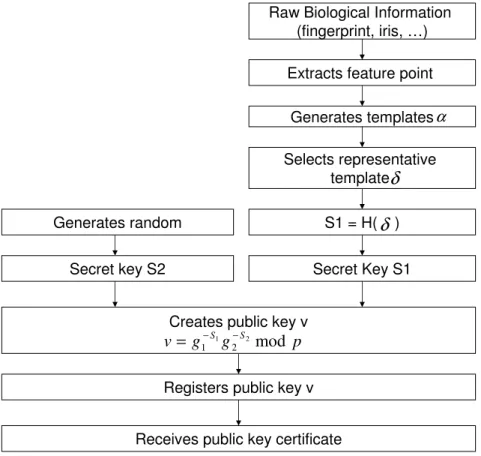
In figure 2.1, Alice and Bob must share an identical secret key for encryption and decryption. Alice encrypts a message M. The ciphertext C is sent to Bob. The latter decrypts C using the shared secret key to retrieve M. The fact to share the same key preserves the confidentiality of messages.
Some of the well known symmetric protocols are Data Encryption Standard (DES), Advanced Encryption Standard (AES) [stallings 03] to achieve confidentiality. Alice and Bob may also use a Message Authentication Code (MAC) algorithm such as Hash-based MAC (HMAC) [Bellare 96] to achieve data integrity and data origin authentication.
2.4. ASYMMETRIC OR PUBLIC-KEY CRYPTOGRAPHY
Figure 2.1: Symmetric System
2.4
Asymmetric or Public-key Cryptography
Public-key cryptography is also called asymmetric cryptography. It uses a couple of key, one private that must be hidden from unauthorized users and a public key available to anyone. The private key depends on the public key through a mathematical equation. The ciphered data using the public key can be deciphered only by the private key, and the signed data using the private key can only be checked with the public key.
The public key can be published to anyone. In a communication session, Both keys are unique.
The Public-key cryptography has two main branches:
– Public key encryption: Alice sends an encrypted message with Bob’s public key. Upon receipt, Bob decrypts it with its private key. Figure 2.2 describes a scenario of encryption.
Figure 2.2: Asymmetric System
– Authentication: Alice sends a message encrypted with her private key, Bob decrypts it with Alice’s public key. This scenario is well know as Digital signature that we detail in Section 2.5. Figure 2.3 presents a scenario of authentication.
Figure 2.3: Authentication
The Asymmetric Cryptography is used also with digital certificates which contain the public key of the certificate owner. The private key is stored in a safe place by the owner. An application of such certificates is the implementation of a Public Key Infrastructure (PKI) to manage the authentication and digital signature of the owner.
2.5. DIGITAL SIGNATURE
2.4.1
The Discrete Logarithm Problem (DLP)
The Discrete Logarithm Problem (DLP) is used in various public key infrastructure algorithms, such as Diffie-Hellman and ElGamal [stallings 03]. This problem has been studied for many years and cryptography based on it was strong against many forms of attacks.
The following applies to finite fields. We suppose that we have a prime number P (a number that is not divisible except by 1 and itself, P ). This P is a large prime number with length not less than 300 digits. We have also two other integers, a and b used to compute N as follow:
N = ab mod P, where 0 <= N <= (P - 1)
This is equation is called discrete exponentiation and it is easy to compute. However, if we are given P, a, and N to find b, then we face a very hard problem.
2.4.2
The Integer Factorization Problem (IFP)
The Integer Factorization Problem (IFP) is one of the most fundamental of all math-ematical concepts. We have two large prime numbers, P and Q. We multiply P and Q to get N. The problem is described as, being given N, how to retrieve the original P and Q ? The Rivest-Shamir-Adleman RSA [stallings 03] encryption protocol is based on this problem. In such system, the public key is N and the the private is the couple P and Q numbers. We remember at the end, that the IFP has been studied intensely for the past 20 years and no solution that can factor it in a polynomial time is found yet.
2.5
Digital Signature
Sometimes, we send a message with a signature to verify the integrity of the message. The idea is to send a message digest obtained when hashing a message using a hash function to the message (eg, Secure Hash Algorithm (SHA)). Hash algorithms are one-way mathematical algorithms that have an arbitrary length input and produce a fixed length output string. A hash value is a unique and a compressed numerical representation of a piece of data. For example, MD5 produces 128-bit hash value for instance. It is unlikely to have collusion and find two distinct inputs that have the same hash value. The process steps are shown in Figure 2.4.
Figure 2.4: Digital Signature
This digest C1 is encrypted with the Alice’s private key to create a signature S. The message M and the signature S are encrypted by Bob’s public key. Upon receipt, Bob decrypts the received message using its private key. He can extract the digest C1 after decrypting the signature S using Alice’s public key. He calculates a new digest C2 from the received message M and he compares the two digests. If they are equal, then the message M was not modified.
In 2005, a widely-used cryptography algorithm, known as SHA-1, has been broken by three researchers at Shandong University in China [Wang 05b], [Wang 05a]. The actual attack called “ collusion attack” reduced the complexity of breaking the SHA-1 standard to 269 from 280. The complexity is a measure of the number of calculations that have to
be performed to find a collision defined by two documents or files that produce the same hash. The attack is still at theoretical phase. In practice, the attack would be performed thousands of years on a most performant personal machine, and would still be slow even if we use a Grid Network.
2.6. ELLIPTIC CURVE CRYPTOGRAPHY (ECC)
2.6
Elliptic Curve Cryptography (ECC)
Cryptography mechanisms based on elliptic curves depend on arithmetic using the points of the elliptic curve. There exit two types of elliptic curves, one defined over a finite field Fp, where p is a prime number and the other type is defined of F2m which is
generated with the irreducible polynomial of degree m.
2.6.1
Elliptic Curve over F
pWe assume first that Fp has characteristic greater than 3, where p is a prime number.
An elliptic curve E over a finite field Fp, is the set of all points (x, y) ∈ Fp * Fp that verify
the equation
y2 = x3+ Ax + B, (2.1)
where A, B ∈ Fp satisfy 4A3 + 27B2 6= 0 mod p. There is another point O in this set
called the point at infinity. This curve is denoted by E(Fp) or shortly by E. A point P of
prime order in E(Fp) has the form P (xP, yP) where xP and yP in Fp [Hankerson 04].
In [Menezes 93], it is reported: “The well-known theorem of Hasse states that
card(E(Fp)) = p + 1 − t, where |t| <= 2
√ p.
If the characteristic of Fp is 2 or 3, then a curve over Fp is supersingular if and only if
it has j-invariant equal to 0.
P Q R y x R = P + Q
Figure 2.5: Elliptic Curve
The sum of two points in E(Fp) is also a point in E(Fp). Given two points P = (xP, yP)
and Q = (xQ, yQ) on the curve E:
– If P = (xP,yP) ∈ E, then -P = (xP, −yP) – If Q = -P, then P + Q = O – If xP 6= xQ, then R = P + Q = (xR, yR), where xR = s2 − xP − xQ, yR= s(xP − xR) − yP, and s =yQ−yP xQ−xP
– If P = Q and yP = yQ 6= 0, then R = P + P = 2P = (xR, yR) where
xR= s2− 2xP,
yR= s(xP − xR) − yP,
and
s =3x2P−A
2yP
Hence, the multiplication of a point P by a digit x gives a point Q = x.P belonging to E. The multiplication by x times is translated into x additions i.e; Q = P + P + .... + P
| {z }
xtimes
. To obtain x.P , the multiplier x is binary bit represented and then the techniques of double and add is used as follows: We choose as example x=(9)10=(1001)2=(b3b2b1b0)2
where b0=1, b1=0, b2=0, and b3=1
2.6. ELLIPTIC CURVE CRYPTOGRAPHY (ECC)
Thus we obtain 2 P = P + P, then we obtain 4 P = 2 P + 2 P, and finally we obtain 8 P = 4 P + 4 P. To obtain 9 P, we add P + 8 P.
2.6.2
Elliptic Curve over F
2mIn this case, the equation of the elliptic curve is defined on a binary field F2m by
y2+ xy = x3+ Ax2+ B, (2.2)
where B 6= 0. The elements of the finite field are at most m-bit integers. These numbers represent a binary polynomial of degree m − 1 since the coefficients of the binary polyno-mial can only be 0 or 1. To have a secure cryptosystem, the parameter m is chosen to have a finite large number of points on the elliptic curve. Operations on binary polynomials are modulo irreducible polynomial of degree m. The latter generates the field F2m.
2.6.3
Use in Cryptography
The elliptic curves have been well known mathematical concepts for centuries, but their application in cryptography was only from few decades. The Elliptic Curves Cryp-tography (ECC) was first suggested by V. Miller [Miller 85] and N. Koblitz [Koblitz 87]. They believed that the Discrete Logarithm Problem (DLP) was harder for elliptic curves than for finite fields. The Elliptic Curve Discrete Logarithm Problem (ECDLP) is de-scribed as follows: “P is a point on the curve, if Q = x.P , where x is a digit, try to find x ”. It is hard for an attacker to retrieve x. The last record for ECDLP was set in 2009, a 112-bit prime ECDLP was solved by the Laboratory for Cryptologic Algorithms at the Ecole Polytechnique Federale de Lausanne (EPFL) (http://lacal.epfl.ch/page81774.html). They run their experiments for almost 6 month on a cluster of more than 200 PlayStation 3 (PS3) game consoles.
ECC requires the computation of the cardinality of the curves. Schoof [Schoof 95] gave fast solutions and described several practical improvements implemented by Atkin and Elkies. The Schoof Elkies Atkin algorithm (SEA) is the algorithm used in elliptic curve over a finite field.
The Elliptic curve key length is shorter than Rivest Shamir Adleman (RSA) key length. If the key for ECC is 256-bit long, then for RSA, it is 3072-bit long. In Table 2.1 (depli-cated from [X9.62 99]), more key size values are given by the NIST guidelines. Further-more, it was proven that ECC outperforms RSA Algorithm [Gura 04], [Qingxian 05].
ECC Key size (bits) RSA Key size (bits) Key size ratio AES Key size (bits)
163 1024 1 : 6
256 3072 1 : 12 128
384 7680 1 : 20 192
512 15360 1 : 30 256
Table 2.1: Equivalent key sizes for ECC, RSA and AES (NIST)
In this thesis, we chosen elliptic curves over Fp. We describe in the following three
ECC protocols.
2.6.3.1 Elliptic Curve Diffie-Hellman ECDH Key Agreement Protocol
This protocol is a new variant of the Diffie-Hellman protocol using Elliptic Curve Cryptography ECC. It is described in the Certicom Research report [Research 00]. This is how the algorithm is performed:
– Alice and Bob select an elliptic curve E defined over Fp. The number of points in
E(Fp) should be divisible by a large prime n.
– They select a point P ∈ E(Fp) of order n.
– Alice selects a statistically unique and unpredictable integer a in the interval [1, n-1]. Bob chooses the integer b in [1, n-1].
– Alice computes point C = a.P and sends it to Bob. – Bob computes point D = b.P and sends it to Alice.
– Alice and Bob can now computes a common point K ∈ E(Fp):
K = a.D = a.(b.P ) = (a.b).P = b.(a.P ) = b.C
Durlanik et al. [Durlanik 05] made some experimental tests to compare ECDH and DH. They reported that “Besides of key sizes it can be said that ECDH is faster than DH by means of execution times and memory usage statistics according to the comparisons”. For example, the time needed to generate the Elliptic Curve Domain parameters with 256-bit prime is much lower that the one needed for DH Domain parameters with 512 bits (0.0676 seconds for ECDH-256 and 0.5783 seconds for DH-512).
There is another authenticated protocol for key agreement based on the DiffieŰHell-man scheme. It is called Elliptic Curve Menezes–Qu–Vanstone (ECMQV). More infor-mations about this protocol can be read in [Hankerson 04].
2.6. ELLIPTIC CURVE CRYPTOGRAPHY (ECC)
2.6.3.2 Menezes-Vanstone Protocol
Menezes and Vanstone [Menezes 93] designed a public key cryptosystem based on Elliptic Curves. This protocol is the version of the ElGamal encryption [ElGamal 85] using elliptic curves. It needs some initialization steps like:
– Alice and Bob choose an elliptic curve E defined over Fp where p is prime and p >
3
– Alice chooses a point P ∈ E and s a positif integer. She computes the point Q = s.P
– Alice publishes the curve E and the points P and Q as her publics parameters. The number s is her private key.
– the plaintext x = (y,z) ∈ Fp∗ Fp is a couple of integer modulo p. The plaintext x is
not necessarily a point of E. To encrypt the message x, Bob
– generates a random number k (k is fresh for each session) – computes:
u = k.P
(c,d) = k.Q (c and d are the coordinates of the points k.Q of E )
v ≡ c.y mod p
w ≡ d.z mod p
– sends the ciphertext (u, v, w) to Alice.
To decrypt the ciphertext (u, v, w), Alice computes: s.u = s.(k.P ) = k.(s.P ) = k.Q = (c, d)
c−1.v = c−1.c.y ≡ y mod p d−1.w = d−1.d.z ≡ z mod p
In [Rahouma 09], the author provides a new modified variant of Menezes and Vanstone elliptic curve cryptosystem. This new variant uses many different curves, thus, there are separate cryptosystem related to each curve.
2.6.3.3 Elliptic Curve Digital Signature Algorithm (ECDSA)
The Elliptic Curve Digital Signature Algorithm (ECDSA) was developed by the the American National Standards Institute (ANSI) by the Accredited Standards Committee on Financial Services, X9 [X9.62 99]. Moreover, the ECDSA uses the Elliptic Curve Discrete Logarithm Problem (ECDLP). The latter is analog to the Discrete Logarithm Problem described in Section 2.4. The ECDLP is described as: Given P ∈ E(Fp) and
Q = aP , find a (1<= a <= n).
An elliptic curve E defined over Fp with large group E(Fp) of order n and a point P
of larger order are chosen by Alice and made public to all users. There are three different primitives:
– ECDSA Key Generation - Alice follows these steps: 1. First, she chooses a random integer d ∈ [2; n − 2]. 2. Then , she calculates Q = d.P .
3. In the end, she publishes her public parameters (E; P; n; Q) and she keeps safe her private key d.
– ECDSA Signature Generation - Alice signs a message m following these steps: 1. She selects a random integer k ∈ [2; n − 2].
2. She calculates k.P = (x1; y1) and r = x1 mod n. If r = 0 then she return to
select a new k.
3. She computes k−1 mod n.
4. She computes s = k−1.(H(m) + d.r) mod n. H is the secure hash
algo-rithm (SHA-1). If s = 0, Alice needs to start from the begining. 5. the pair of integers (r; s) are the signature for the message m.
– ECDSA Signature Verification - Bob verifies Alice’s signature (r; s) on the message m by performing the following steps:
1. He calculates c = s−1 mod n and H(m).
2. He computes u1 = H(m).c mod n and u2 = r.c mod n.
3. he computes u1.P + u2.Q = (x0; y0) and v = x0 mod n.
4. Bob approves the signature if v = r.
Johnson et al. [Johnson 98] provide a comparison between ECDSA and DSA. They concluded that ECDSA has significant advantages over DSA like:
2.7. IDENTITY BASED CRYPTOGRAPHY (IBC)
– The ECDSA prevents the weakness found in DSA which allows the selective forgery of one message if the adversary can choose the system parameters.
– In ECDSA, it is mandatory to check, during the signature genration, if the digital signature (r,s) is non-zero. Or, in DSA, it is optional.
– It is harder to recover a private key from a public key in case of Elliptic Curve Dis-crete Logarithm Problem (ECDLP) than using DisDis-crete Logarithm Problem (DLP). As an example, for 163-bit prime number p (ECDLP), the attacker needs 9.6 * 1011
Millions Instructions Per Seconds (MIPS) years and for 512-bit key (DLP), the attacker needs 3 * 104 MIPS years.
2.7
Identity Based Cryptography (IBC)
The Identity Based cryptography (IBC) has emerged as a long-term evolution or sub-stitution to Public Key Infrastructure (PKI). It is a cryptosystem in which the public key is generated using the identity of the entity (user) and the private key is the public key multiplied by the secret key of the server. The latter is responsible of the user’s private key distribution and is called the Private Key Generator (PKG).
The IBC concept is old and was first proposed by Shamir in 1984 [Shamir 84]. Shamir’s original motivation for identity-based encryption was to simplify the certificate manage-ment in e-mail systems. Then, the first fully practical and secure identity-based public key encryption scheme was presented by D. Boneh and M. Franklin in [Boneh 01], us-ing the fundamental operations of Elliptic Curve Cryptography (ECC) and the bilinear pairing. Since then, the development of Identity based cryptosystem intensifies rapidly. As an example, D. Boneh co-founded in 2002 Voltage Security [Boneh 02]. In the next paragraphs, we present the bilinair pairing, the Identity Based Encryption and two others protocols based on IBC.
2.7.1
Bilinear pairing
Let (G1; +) and (G2; .) be two cyclic groups of prime order q. G1 is an additive group
and G2 a multiplicative group. The bilinear pairing is given as e: G1 ∗ G1 → G2, which
satisfies the following properties:
1. Bilinearity: For all P; Q; R ∈ G1;
2. Non-degeneracy: If P is a generator of G1, then, e(P, P ) is a generator of G2 (Cyclic
Group).
3. Computability: It is easy to compute e(P, Q) ∀P ; Q ∈ G1.
A bilinear map satisfying the three properties above can be considered as an admissible bilinear map [Boneh 01].
2.7.2
Identity Based Encryption (IBE)
The Identity-Based Encryption (IBE) is an important primitive of IBC. It is a kind of public-key encryption in which the public key of a user is generated using the identity of the user (e.g. a user’s email address). The following functional routines are illustrated in Figure 2.6.
IBC Key Server (PKG)
Email address: [email protected]
Master Secret
Bob sendshis Identity (authenticates
himself)
PKG sends Bob’s Private Key
Public Parameters
Alice receive PKG’s Public Parameters and encrypts
message M
1 System setup
2 Encryption
3 Key Extraction
4 Decryption
Email address: [email protected]
Bob receives PKG’s Public Parameters and his private
key
Figure 2.6: IBE’s phases
1. System Setup: IBE systems rely on the Private Key Generator (PKG) which is a trusted central authority managing the system’s parameters. The PKG generates its parameters, including a master secret S involving in user’s private keys generation. The system parameters called “params” are: the prime number p, the order q, the generator point P, PKG’s public point Ppub= S.P and the MapToPoint which is the
2.7. IDENTITY BASED CRYPTOGRAPHY (IBC)
hash function used by the PKG to convert a string into a point in the elliptic curve E ).
2. Encryption: When a user (Alice) wishes to send an encrypted message to another user (Bob), she first generates Bob’s public keyKpubBob. Then, she encrypts a
plain-text message M with KpubBob to obtain cipher message C. In the end, she sends C
to Bob.
3. Key Extraction: When Bob receives the message, he needs to decrypt it. He au-thenticates himself to the PKG in order to obtain the secret key KprivBob= S.KpubBob.
The latter is needed by Bob to decrypt the cipher message C.
4. Decryption: When Bob receives KprivBob, he decrypts the cipher message C to
obtain the plaintext message M.
2.7.3
Identity-Based Signature Scheme
The Identity-Based Signature Scheme is an another primitive of IBC. It is a signature scheme in which the private key is generated by the PKG using the user’s identity. The following functional routines are illustrated in Figure 2.7.
IBC Key Server (PKG)
Email address: [email protected]
Master Secret
Bob sendshis Identity (authenticates
himself)
PKG sends Bob’s Private Key
Public Parameters
Alice receive PKG’s Public Parameters and verifies
Bob’s signature
1 System setup
4 Verification
2 Key Extraction
3 Signature
Email address: [email protected]
Bob receives PKG’s Public Parameters and his Private
Key
Bob signs message M
M + Signature
Figure 2.7: Identity-Based Signature Scheme
2. Key Extraction: Bob authenticates himself to the PKG in order to obtain the secret key KprivBob= S.KpubBob. The latter is needed by Bob to decrypt the cipher
message C.
3. Signature: Bob signs a message M using his private key KprivBob (he hashes M
and encrypt the hash value H1 with its private key). Then, he sends the message
M and its signature Sig to Alice.
4. Verification: When Alice receives the message M and the signature Sig, she hashes the message M and gets H2. She then decrypts the signature Sig using Bob’s public
key that she computed using Bob’s Identity and the PKG’s public parameters. She gets the hash value H1. Finally, she compare the two hashes and if they rae equal,
then the signature is verified.
2.7.4
Certificateless Public Key Cryptography CL-PKC
CL-PKC was presented by Al-Riyami and Paterson in [Al-Riyami 03]. In CL-PKC cryptosystem, an entity called Key Generation Center (KGC) is responsible for generating a Partial Key to the user which has one and unique identity in the system.
The certificatless encryption runs five steps algorithm which are defined as follows: – Setup: In this step, the Key Generation Center (KGC) generates its private
master-key, the public parameters params and its public key using a security parameter k. – Partial Secret Key Extract: The KGC generates Alice’s partial secret DA ∈ G∗1
using its master-key, params and Alice’s identity IDA ∈ {1,0}∗ as inputs.
– User key generation: Alice generates first of all a secret value XA, using params
and her identity IDA. Then, she takes her partial secret DA, the params and her
secret value XA as input to generate the private key SA ∈ G∗1. In the end, she takes
the params and her secret value XA as input to generate the public key PA ∈ G∗1.
– Encrypt: Bob wants to send the message M ciphered with Alice’s public key PA.
He ciphers the plaintext M using the params, Alice’s IDA and her public key PA
into the ciphertext C or ⊥ (meaning encryption failure).
– Decrypt: After receiving the ciphertext C, Alice uses the params and her private key SA to retrieve the plaintext M or ⊥ (meaning decryption failure).
Although, CL-PKC has interesting advantages like the certificate implicitly, the Denial of Decryption (DoD) attack is still a relevant problem [Ahmad 09]. An attacker can change the legitimate user’s public key by a fake public key. Although the attacker can not decrypt the received message, he/she does not let the legitimate receiver decrypt the
2.7. IDENTITY BASED CRYPTOGRAPHY (IBC)
message.
2.7.5
TIBC: Trade-off between Identity-Based and Certificateless
Cryptography
In [Ahmad 09], the authors merged Identity Based Cryptography (IBC) and Cer-tificateless Public Key Cryptography (CL-PKC) systems to solve the problem of user impersonation by providing an implicit certificate depending on two separate processes. They called their system Trade-off between Identity-Based and Certificateless Cryptog-raphy (TIBC). Three entities are involved in TIBC: a Key Generation Center (KGC), a publisher and his/her own Public Key generator (PKG). Based on the bilinear pairing, the TIBC is performed at two levels of interaction: (1) between KGC and the publisher, and (2) between PKG and the publisher.
– Level-1: After choosing an admissible bilinear map, the KGC generates params and it fellows these steps:
1. KGC_MasterKeyGeneration: The KGC generates its private master-key and public key using the params and 1y where y ∈ N is a security parameter.
2. PartialKeyGeneration: The KGC generates Alice’s partial key P artialKeyA
using its master key and Alice’s identity IDA ∈ {1,0}∗.
3. UserKeyGeneration: Alice generates her private key SA∈ G∗1and her public
key PA ∈ G∗1 using a secret XA, params, P artialKeyA and her identity IDA.
– Level-2: In this level, Alice chooses a secret prime value n, and calculates the point F = n.SA ∈ G∗1 (hard Discrete Logarithm Problem) and sends F = (XF, YF) to her
PKG. Then, four steps are performed:
1. PKGSetUp: After receiving the point F, the PKG chooses an admissible bilinear map, a point P’ ∈ G∗1 , the abscissa XF of the point F as its master
secret key and then generates a Master Public Key Ppub00 = XF.P0.
2. ExtractUserPublicKey: the PKG computes the point QIDA = H1(IDA)
which is Alice’s final public key. H1 is a MapToPoint Function.
3. ExtractUserPrivateKey: The PKG computes Alice’s final private key UA=
XF.QIDA
4. Encryption/Decrytion: These operations are the same defined for the IBC. The most important advantages of TIBC is the “self-generated” certificate since the user’s private key depends on a secret value given by the user himself.
2.8
Conclusion
In this chapter, a comprehensive review of cryptographic protocols is presented. We remind that we need to be conform to the Cryptographic Key length Recommenda-tion [BlueKrypt 10] Since the cryptanalist are working hard to improve their capability for attacking systems. We started this state of the art by describing the symmetric and asym-metric systems. The basic cryptographic procedures are: the encryption, the decryption and the signature. The Discrete Logarithm Problem (DLP) make these systems efficient against prime factorization. Then, we introduced the Elliptic Curve Cryptography (ECC) which aims to enhance the performance of cryptographic systems and make them hardly breakable. This is due to the Elliptic Curve Discrete Logarithm Problem (ECDLP). We described only three cryptographic protocols based on ECC which are: Elliptic Curve Diffie-Hellman (ECDH) Key Agreement Protocol, Menezes-Vanstone Protocol and Ellip-tic Curve Digital Signature Algorithm (ECDSA). After that, we introduced the Identity Based Cryptography (IBC) which is a type of asymmetric cryptographic system. The IBC uses a publicly known string belonging to an individual or organization as a public key. The public string could be an email address, a domain name, or a physical IP address. We presented different variant of solution using IBC, like Identity Based Encryption (IBE), Identity-Based Signature Scheme, Certificateless Public Key Cryptography (CL-PKC) and TIBC: Trade-off between Identity-Based and Certificateless Cryptography. The IBC is primordial in our work since it is used in the proposed solutions.
Chapter 3
State of the Art of Biometrics
3.1
Introduction
The biometry or biometrics aims to improve human ability to identify a person. Dif-ferent biometrical techniques are at present under research, including fingerprints, facial, palm prints, retinal and iris scans, hand geometry, signature capture and vocal charac-teristics. However, its use raises issues that affect the people’s privacy. One innovative idea is to combine biometry with cryptography in order to generate more secure secret key dependent of the human body.
In this chapter, we present a state of the art in biometrical technologies and biometric cryptosystems.
3.2
Biometrics
Biometrics identify a person using its own identifiable and verifiable data. It answers the question: “what one is?” (fingerprints, hand, face ...). In Table 3.1(replicated from [Itakura 05], page 291), the authors present an overview of the most used biometrical technologies.
Biometrical authentication is the verification of human identity using measurement of biological characteristics. Biometrical authentication has become internationally recog-nized as a mean for people to authenticate themselves to computing systems. There are two performance thresholds of biometrical authentication mechanisms:
– False Acceptance Rate (FAR) is the percentage of false acceptances among the identification attempts.
– False Rejection Rate (FRR) is the percentage of false rejections among the identi-fication attempts.
We shall add another parameter: the Equal Error Rate (EER) which is the point where the probability of false acceptance and that of false rejection become equal. In the literature, The Genuine Acceptance Rate (GAR) is used instead of FRR. we just have to know that GAR = 1 - FRR.
Biological Fingerprint Iris Face Voice print Signature DNA
information
Identifying minutiae iris patterns facial features vocal sounds Difference in short
principle handwritten tandem repeats
letters pressure, timing
FAR 2.10−6or less 8, 3.10−7or less 10−2or less 3.10−2or less 10−2or less 10−15or less
FRR 0.05% or less 0.1% or less 1% or less 3% or less 1% or less Less than
measuring error
Sensor Image sensor Camera Camera Microphone Pressure sensor DNA analyzer
Data size of
templates 250 to 500 250 1000 1000 1000 20
in bytes
features Small size, Small Small Small High precision High precision,
economic psychological psychological psychological in dynamic uniqueness, and
and high stress and high stress stress signature high stability
precision precision with time
Problem Degradation of Change due to Voice Change Ease of Long analyzing
fingerprint – aging,camera in puberty Imitation time, high price,
due to angle, hat, or due to and privacy
dried skin or eye glass thirsty throat concerns
Risk of Fingerprint Eye captured Face captured Voice recorded handwriting stolen hair
unauthorized marked by camcorder by camcorder by microphone imitated with root
use
Table 3.1: Summary about Biometrical Algorithm Characteristics
In [Cavoukian 07], authors gave some performance values related to FAR and FRR: “For most biometric systems, FRR ranges from 0.1% to 20%, meaning that a legitimate user is rejected from one out of 1000 times to one out of five times on average. FAR ranges from one in 100 (low security applications) to one in 10,000,000 (very high security applications)”.
Research works are still underway to stabilize the biometrical data. To perform au-thentication, it is better to couple it with a smart card or a secure token (small storage element with high resistance to attacks, even physical). In the enrollment phase, the sys-tem stores the biometric sys-template in a smart or Radio Frequency Identification (RFID) card. In the verification phase, the user provides a Personal Identification Number (PIN)
3.2. BIOMETRICS
code to unlock the access to the biometric data. He/She enrolls his/her fingerprint which is compared to the one stored in the card. This system is well used in sensitive nuclear sta-tions or in airports. We describe in the next secsta-tions others methods to deploy biometric data in cryptographic system.
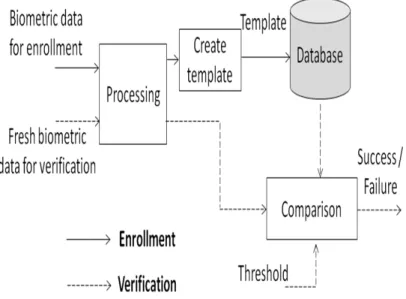
The biometrical authentication systems consist of two steps, which are the enrollment and the authentication. In the enrollment phase, the biometrical data are captured from a user, where the biometrical features are extracted and eventually stored in a database. As for the authentication phase, we need to distinguish two alternative methods:
– Verification: the user, wishing to be recognized by the system as the holder of an identifier, presents some form of identifier (like used ID, Automatic Teller Ma-chine (ATM) card) and a biometrical characteristic. The new biometrical feature is compared with the stored ones, associated with the provided identifier (1-to-1 matching);
– Identification: In the case where the user does not provide an identifier, the system needs to find the user’s identifier. The extracted biometrical feature is compared to the entire database for matches (1-to-N matching).
The difference between a password and a biometric template is relative to the replay attack, a password is supposed to be secret, while biometric templates are not. Some systems incorrectly assume that biometric measurements are secret and grant access when matching biometrical features are presented. To solve such a problem, one of the best way is to biometry with cryptography.
A classical biometric system is shown in Figure 3.1 presenting the enrollment and the verification phases. In such systems, pertinent biometrical features are extracted from the user’s biometrical data (e.g., minutia from the fingerprint, iris code, etc...). These features need to be stored in form of templates in a central database or on personal possessions (such as e-Passport) for future comparison. The user verification is carried out by comparing the stored template with the newly provided biometrical data by the user.
Figure 3.1: Classical Biometrical System
There are some problems associated with such classical biometric verification systems: – The biometrical characteristic is permanently associated with the user. Hence, it is not possible to issue different templates for different applications for the same user. The biometric data stolen from one biometric system can be used to attack another system based on the same biometrics.
– Moreover, even if the compromise is detected, that data cannot be replaced and becomes unusable by the system. This is called non-revocability of biometrics. – Another problem is that the classical biometric comparison results only in one-bit
information - success or failure. Such system can be attacked by a Trojan horse which can replace the biometric verification module and induce the desired result bit in the system.
– The storage of biometrical data in databases by non governmental authorities meets opposition from the French Data Protection Authority Commission Nationale de l’Informatique et des Libertés (CNIL) [CNIL 07] and others organizations world-wide.
In the following, we present three solutions to enhance biometrics results. The first one is the use of multimodality in biometrics, the second one is the cancelable biometric and the third one is the combination of cryptography and biometry.
3.3. MULTIMODAL BIOMETRICS
3.3
Multimodal Biometrics
Systems that use a single biometric face a variety of problems such as: fuzzy data, the intra-class variations, degrees of freedom restricted, non-universality, identity theft, and an unacceptable error rate. Some of these limitations can be avoided by choosing multimodal biometric systems. Theses latter are based on using multiple biometrics at the same time. The multimodal biometrics requires a merging mechanism between different modalities.
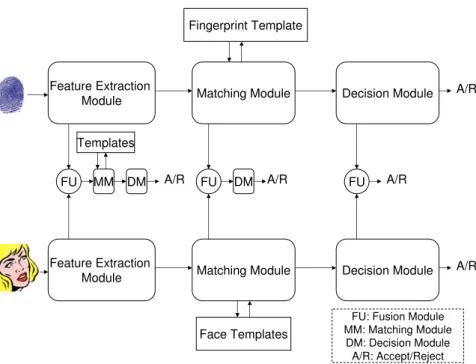
Arun Ross and Anil K. Jain [Ross 04], provided a general statement on already ex-isting multi-biometric solutions. They described the system’s deficiencies using a single modality. Then, they presented three merging levels for the multimodality presented in Figure 3.2.
Feature Extraction
Module Matching Module Decision Module
FU MM DM FU DM FU
Fingerprint Template
Face Templates Feature Extraction
Module Matching Module Decision Module
Templates
A/R A/R A/R
A/R
A/R
FU: Fusion Module MM: Matching Module
DM: Decision Module A/R: Accept/Reject
Figure 3.2: Multimodal System
There are three possible fusion levels: – Fusion at the Data or Feature Level – Fusion at the Match Score Level – Fusion at the Decision Level
3.3.1
Fusion at the Data or Feature Level
The templates are put in the same form to be merged directly after the enrollment phase. At this fusion level, there are 2 problems. The first is that all biometric sensors may not be compatible (eg facial Eigenfaces and fingerprint minutiae). The second is that most commercial biometric systems do not allow access to their used process (or raw data).
3.3.2
Fusion at the Match Score Level
At this level, each module provides a comparison score. This is provided after a normalization and fusion score phases. This method is the most used since it is easy to calculate a final score for the decision.
In [Snelick 03] and [Snelick 05], standardization and fusion methods are presented. The output of biometric sensors is S and the normalized score is N. In Table 3.2 (from [Snelick 03] page 69) , the authors present the standard normalization methods.
M in − M ax(M M ) N = (S − min)/(max − min)
Z − score(ZS) N = (S − moyenne/variance)
T anh N = 1/2[tanh(0.01(S − moyenne)/variance) + 1]
Table 3.2: Summary of Normalization Techniques
In the following, Ni are the normalized scores and P (genuine/Ni) is the
probabil-ity that score is provided by a legitimate person and not by an impostor. The fusion techniques are showed in Table 3.3 (replicated from [Snelick 03] page 70).
Afterwards, the authors compare the final scores obtained from single biometrical modal and from the association of normalization methods and different fusions. The use of the latter techniques enhances the performance significantly over the single-modal face or fingerprint minutiae. For example, with a False Acceptance Rate (FAR) fixed at 0.1%, the simple sum fusion with the min-max normalization has a Genuine Acceptance Rate (GAR) equals 94.9%, which surpasses that of face, 75.3%, and fingerprint, 83.0%.
3.4. CANCELABLE BIOMETRICS
Simple Sum PN
i=1Ni
Minimum Score M in(N 1, N 2, ...., N n)
Maximum Score M ax(N 1, N 2, ...., N n)
Sum of Probabilities PN
i=1P (genuine/Ni)
Product of Probabilities QN
i=1P (genuine/Ni)
Table 3.3: Summary of Fusion Techniques
3.3.3
Fusion at the Decision Level
At this level, there is a vote among the decisions to accept or reject the candidate. This method is difficult to realize since there are not enough data.
3.4
Cancelable Biometrics
To generate strong cryptographic keys from biometrical data, we need to find a map-ping technique. Biometrical techniques face a major problem which is their complex reinitialization. When a credit card number is stolen, the bank assigns a new credit card number to its client. When biometric features are stolen, no substitution is possible because the new enrolled features are the same as the stolen ones.
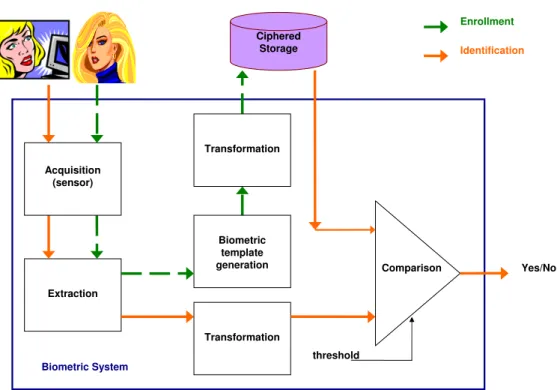
The concept of “cancelable biometrics” was suggested to avoid this problem and, by the way, offers biometric template protection. Figure 3.3 shows both the enrollment and the identification phases when cancelable biometrics are used.
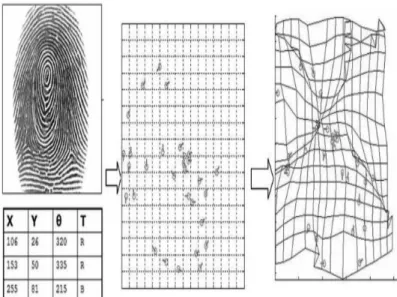
Cancelable biometrics rely on a repeatable distortion of the biometric features. This action protects the sensitive user’s biometrical data. If a cancelable feature is lost or misused by an attacker, it is easy to change the distortion characteristics. In this case, the same biometrical data are used to generate a new cancelable biometrics. In general, the transformation used for the distortion are non-invertible (i.e; if an attacker succeeds in stoling the cancelable biometrics, he/she cannot recover the real biometrical data).