
HAL Id: tel-03155660
https://tel.archives-ouvertes.fr/tel-03155660
Submitted on 2 Mar 2021HAL is a multi-disciplinary open access archive for the deposit and dissemination of sci-entific research documents, whether they are pub-lished or not. The documents may come from teaching and research institutions in France or abroad, or from public or private research centers.
L’archive ouverte pluridisciplinaire HAL, est destinée au dépôt et à la diffusion de documents scientifiques de niveau recherche, publiés ou non, émanant des établissements d’enseignement et de recherche français ou étrangers, des laboratoires publics ou privés.
Ganna Gladkykh
To cite this version:
Ganna Gladkykh. Connecting Energy System modelling with Sustainable Energy System Narratives at a Global Scale. Economics and Finance. Université Clermont Auvergne; Háskóli Islands, 2019. English. �NNT :
Ecole Doctorale des Sciences Economiques, Juridiques, Politiques et de gestion
Centre d’Etudes et de Recherche sur le Développement International (CERDI)
Université Clermont Auvergne, CNRS, IRD, CERDI, F-63000 Clermont-Ferrand, FranceFaculty of Life and Environmental Sciences University of Iceland, Reykjavik, Iceland
CONNECTING ENERGY SYSTEM MODELLING WITH
SUSTAINABLE ENERGY SYSTEM NARRATIVES
AT A GLOBAL SCALE
Thèse présentée et soutenue publiquement le 3 décembre 2019 pour
l’obtention du titre de Docteur en Sciences Economiques par
GANNA GLADKYKH
sous la direction de ARNAUD DIEMER, SONIA SCHWARTZ
et BRYNHILDUR DAVÍÐSDÓTTIR
Membres du Jury
Prof. Robert Costanza The Australian National University Président
Dr. Kirsten Jenkins University of Edinburgh Suffragant
Dr. Darren McCauley St Andrews Sustainability Institute Suffragant
Dr. Sandrine Mathy CNRS - Université Grenoble Alpes Rapporteur
Prof. Valeria Jana Schwanitz Western Norway University of Applied Sciences Rapporteur
Prof. Arnaud Diemer CERDI, UCA Directeur
Prof. Sonia Schwartz CERDI, UCA Co-directeur
L’université Clermont Auvergne n’entend donner aucune approbation ni improbation aux opinions émises dans cette thèse. Ces opinions doivent être considérées
PLEDGE
I hereby certify this document to be the original and authentic output of the author’s research work. All sources and references are duly listed, and consist mostly of published scientific articles and papers, technical books, database sets from applied research institutes and official reports from international agencies or governmental organizations.
__________________ Ganna Gladkykh Clermont-Ferrand, France December 3rd, 2019
SUPERVISORS
Prof. Doctor Arnaud DIEMER ([email protected])Université Clermont Auvergne (UCA), CERDI
Prof. Doctor Brynhildur DAVÍÐSDÓTTIR ([email protected]) University of Iceland (HI), Department of Life and Environmental Sciences
Prof. Sonia SCHWARTZ ([email protected]), Université Clermont Auvergne (UCA), CERDI
RESEARCH COMMITTEE
Dr. Sandrine MATHY ([email protected])CNRS - Université Grenoble Alpes
Ulrich GOLUKE ([email protected])
This PhD thesis was developed under the AdaptEconII project funded by the European Commission’s
Horizon 2020 Research and Innovation Programme under the Marie Skłodowska-Curie Innovative
Training Networks (ITN)research grant agreement No 675153.
AdaprEconII is a transdisciplinary program interlinking system science, ethics for an interdependent world, natural science, and observation-based political science with biophysical economics that includes expertise from academia and Civil Society Organisations.
In the AdaptEcon ITN twelve Early Stage Researchers (ESRs) are trained for a PhD at the University of Iceland (Reykjavik, Iceland), University of Clermont Auvergne (Clermont-Ferrand, France), Stockholm University (Stockholm, Sweden), Stockholm Resilience Center (Stockholm, Sweden).
The primary and the secondary universities for this PhD project are the University of Clermont Auvergne and the University of Iceland. Stockholm Environment Institute (SEI) in Sweden is a partner organization affiliated with this PhD project. In cooperation with them, a part of the research within this PhD thesis was conducted.
ABSTRACT
In my PhD thesis, I explore what can be considered a sustainable energy system on a global scale and what methods and tools can help sustainable energy policy design and assessment. Energy system modelling and sustainable energy system narratives are the two main areas of interest of this thesis. I started my PhD with exploring the current energy systems modelling practice as well as social science contribution in the sustainable energy research. I discovered several main research gaps related to the topic of this thesis: (1) Most of existing energy system models have unrealistic or oversimplified assumptions that can negatively impact the quality of the models’ outputs and consequently the quality of decision-making informed by such models; (2) There is a limited instrumental value of the available theories related to a sustainable energy system development; (3) There is a lack of global energy system narratives that would have a holistic understanding of the long-term energy system purposes (goals) and the principles of the energy system sustainable design. This thesis has become an attempt to close the identified research gaps in order to answer the main research questions. System dynamics, steady-state economy and energy justice theory are the main methodological and conceptual components of the thesis’ research design. The main results of my research are: (1) The list of questions defining the current energy paradigm which can be used as a guidance for a sustainable energy system modelling; (2) The developed steady state of energy concept implying that energy sufficiency should be a universal energy system goal in the context of a long-term energy system sustainability; (2) The list of requirements for a socially sustainable energy provision based on the energy justice principles which can be used as guidelines for a sustainable energy policy assessment and design; (3) The system dynamics model of electricity access provision in Sub-Saharan Africa which demonstrates an example of how energy system modelling can be combined with sustainable energy system narratives for addressing methodological and disciplinary gaps in the energy system research and for contributing to better sustainable energy system policy design and assessment.
Key words: Sustainable energy system, energy system modelling, energy sufficiency, energy justice, system dynamics, energy transition, energy access, energy paradigm, global north, global south
La thèse de doctorat explore ce que l'on a coutume d’appeler un système énergétique durable à l'échelle mondiale, ainsi que les méthodes et les outils qui peuvent aider à concevoir et à évaluer une politique énergétique durable. La modélisation des systèmes énergétiques et les récits (au sens de scénario narratif) de systèmes énergétiques durables sont les deux principaux domaines d'intérêt de cette thèse. Mon travail de recherche a consisté à explorer les pratiques actuelles de modélisation des systèmes énergétiques ainsi que la contribution des sciences sociales à la recherche en matière d'énergie renouvelable. Plusieurs limites ont été mis à jour : (1) La plupart des modèles de systèmes énergétiques existants reposent sur des hypothèses irréalistes ou simplifiées qui peuvent avoir une incidence négative sur la qualité des résultats des modèles et, par conséquent, sur la qualité de la prise de décision éclairée par ces modèles ; (2) les théories disponibles relatives au développement de systèmes énergétiques durables ont une valeur instrumentale limitée ; (3) il existe un manque au niveau des scénarios narratifs sur les systèmes énergétiques mondiaux, or ces derniers ont l’avantage d’offrir une compréhension globale des objectifs et des principes clés du système énergétique durable à long terme. Cette thèse se présente comme une tentative de combler ces lacunes de recherche à partir d’une réflexion méthodologique. La dynamique des systèmes, l'économie du Steady-State ou encore le champ de l’équité énergétique (Energy Justice) constituent les principales composantes méthodologiques et conceptuelles de la thèse. Les principaux résultats de mes recherches sont : (1) La liste des questions définissant le paradigme énergétique actuel qui peut servir de guide pour la modélisation d'un système énergétique durable ; (2) Le concept d'état d'équilibre énergétique développé impliquant que la suffisance énergétique (energy sufficiency) devrait être un objectif universel du système énergétique dans le contexte d'un système énergétique durable à long terme ; (3) La liste des exigences pour un approvisionnement énergétique durable sur le plan social, basé sur les principes d’équité énergétique qui peut servir de guide pour une évaluation et une conception des politiques énergétiques durables ; (4) Le modèle de dynamique des systèmes d'accès à l'électricité (energy access) en Afrique subsaharienne, qui montre comment la modélisation des systèmes énergétiques peut être combinée avec des scénarios narratifs de systèmes énergétiques durables. Mots clés: Système énergétique durable, modélisation du système énergétique, suffisance énergétique, justice énergétique, dynamique du système, transition énergétique, accès à l'énergie, paradigme énergétique, Global North, Global South
Útdráttur
Í þessari ritgerð er rýnt hvað sjálfbær orkukerfi á heimsvísu fela í sér og hvaða aðferðafræði nýtist við hönnun á orkustefnu sem styður við sjálfbæra orkuþróun og hvernig meta skuli árangur aðgerða. Lögð er áhersla á líkanagerð og söguþræði (e: narratives) sem lýsa sjálfbærum orkukerfum. Fyrst voru núverandi líkön af orkukerfum og aðferðafræði við gerð þeirra metin í samhengi við sjálfbæra orkuþróun. Auk þess var hlutverk félagsvísinda í rannsóknum á sjálfbærri orku skoðað. Rýnin leiddi í ljós eyður í rannsóknum á sjálfbærum orkukerfum sem urðu rannsóknarefni þessarar doktorsritgerðar m.a.: (1) Forsendur flestra núverandi líkana af orkukerfum eru óraunhæfar eða of einfaldar. Þetta getur rýrt gæði greininga sem koma frá slíkum líkönum, og þau þar með styðja ekki jafnvel við ákvarðanatöku; (2) Það er takmarkað hagnýtt gildi af fyrirliggjandi kenningum um sjálfbæra þróun orkukerfa; (3) Núverandi aðferðir taka ekki til þróunar orkukerfa á heimsvísu sem myndi styðja við heildstæðan skilning á tilgangi og langtímamarkmiðum sjálfbærrar orkuþróunar. Aukinn skilningur á sjálfbærum orkukerfum á heimsvísu myndi einnig styðja við hönnun á sjálfbærari orkukerfum. Í þessari ritgerð var reynt að fylla upp í þessar eyður. Kvik kerfislíkön, jafnstöðu hagkerfi (e: steady state economics) og orkuréttlæti (e: energy justice) eru helstu kenningar og aðferðafræði sem er beitt í þessari rannsókn. Framlag rannsóknarinnar er m.a. 1. Spurningalisti sem skilgreinir hugmyndafræði
sem hægt er að nýta sem leiðarvísi að líkanagerð af sjálfbærum orkukerfum; 2. Hugmyndafræðium
jafnstöðu orkukerfi sem segir að grunnþarfir fyrir orku ætti að vera almennt markmið við uppbyggingu orkukerfa í samhengi sjálfbærrar þróunar; 3. Listi af forsendum fyrir þróun sjálfbærra orkukerfa byggt á kenningum um orkuréttlæti. Listann má nota sem leiðarvísi fyrir hönnun og mat á orkustefnu sem styður við sjálfbæra orkuþróun; 4. Kvikt kerfislíkan af aðgengi að rafmagni í þeim hluta Afríku sem er sunnan Sahara eyðimerkurinnar. Þetta líkan er dæmi um hvernig líkan af orkukerfum getur: i) verið samtvinnað hugmyndum um sjálfbæra orkuþróun og fyllt í eyður í aðferðafræði og rannsóknum á orkukerfum og ii) stutt við bætta stefnumótun og greiningum er varðar sjálfbær orkukerfi.
List of Figures
Figure 1. An overview of the PhD Thesis ... 15
Figure 2. A navigation scheme for Paper I ... 17
Figure 3. A navigation scheme for Paper II ... 18
Figure 4. A navigation scheme for Paper III ... 19
Figure 5. A navigation scheme for Paper IV ... 20
Figure 6. A navigation scheme for Paper V ... 22
List of Abbreviations
SDGs IAMs CLDs SFDs
Sustainable Development Goals Integrated Assessment Models Causal Loop Diagrams
Paper I: Chapter 2
Spittler, N., Gladkykh, G., Diemer, A., & Davidsdottir, B. (2019). Understanding the Current Energy Paradigm and Energy System Models for More Sustainable Energy System Development. Energies,
12(8), 1584. https://doi.org/10.3390/en12081584
Paper II: Chapter 3
Gladkykh, G., Spittler, N., Dierickx, F. (2017). Renewable energy – characteristics and representation in macroeconomic energy-climate models. Book chapter. European Union and Sustainable development: challenges and prospects.
https://www.researchgate.net/publication/320979533_European_Union_and_sustainable_develop ment_challenges_and_prospects/link/5a05666b458515eddb857a8e/download
Paper III: Chapter 4
Diemer, A., Gladkykh, G., Spittler, N., Ndiaye, A., Collste, D., Dierickx, F. (2019). Integrated Assessment Models (IAM): How to integrate Energy, Climate and Economics? Submitted journal paper, under review.
Paper IV: Chapter 5
Gladkykh, G., Spittler, N., Davíðsdóttir, B., & Diemer, A. (2018). Steady state of energy: Feedbacks and leverages for promoting or preventing sustainable energy system development. Energy Policy,
120, 121–131. https://doi.org/10.1016/j.enpol.2018.04.070
Paper V: Chapter 6
Gladkykh, G., Diemer, A., Davíðsdóttir, B., (2020). Combining the socially sustainable energy system narrative with system dynamics modeling: A case of electricity sufficiency for Sub-Saharan Africa. Submitted paper to the Energy Research and Social Science Journal, under review.
Paper VI: Chapter 7
Gladkykh, G., Thazin Aung, M., Takama, T., Johnson, F.X., Fielding, M. (2020). Policy Dialogue on a Bioeconomy for Sustainable Development in Thailand. SEI Report. Stockholm Environment Institute: https://www.sei.org/wp-content/uploads/2020/01/200128a-mash-fielding-workshop-bioeconomy-thailand-pr-1912g.pdf
1. Introduction
A well-functioning energy system is a requirement for achieving social well-being. The way energy system is organized is interconnected with political, economic and social structures that exist in society. Today, the importance of having a sustainable energy system on a global scale is recognized internationally. One of the SDGs – SDG7 (Ensure access to affordable, reliable, sustainable and modern energy for all) – is dedicated to developing energy systems towards sustainability (United Nations, 2015). However, the question of what are the desirable and feasible ways of sustainable energy system organization globally and locally remains a challenging question at the political as well as research level.
Energy system includes all “all components related to the production, conversion, delivery, and use of energy” (Bruckner et al., 2014). Despite this straightforward definition, the boundaries of the energy system are constantly changing. With the improved understanding of how the energy system is embedded in the economic, social and environmental systems, energy system problems are no longer perceived as predominantly technological or an engineering challenge. Today, it is widely recognized that a transformative potential of the energy system is crucially dependent on the political decisions and social systems’ change, not only on the technological advancement. Energy system challenges, such as lack of energy access provision in some regions and excessive energy consumption in others, unaffordable energy for consumers, environmental pollution, economic and political inequalities and dependencies embedded in the energy system structure (IPCC, 2014; IEA, 2018), are of a very high level of complexity. Solving them is associated with a wide range of research and decision-making challenges and requires interdisciplinary approaches and multi-directional efforts (Sovacool et al., 2018; Xu et al., 2016).
Research methods and tools used in energy system research are changing along with recognizing energy system’s higher complexity. Today, two main trends in the energy literature are responding to this challenge. On the one hand, social science research in the energy field is advancing. During the last decade, in the energy literature, despite still dominated by engineering approaches, the number of studies related to the social science domain has increased significantly (Sovacool, 2014; Ramazan et al., 2017). On the other hand, the field of energy systems modelling is advancing with energy system models gaining increasing attention as the tools for informing decision-making (Hitch et al., 1977; Evans and Hausfather, 2018)
This PhD thesis explores the energy system on a global scale. By connecting energy system modelling with the advancement of social sciences in energy research, the following overarching research questions are addressed: What is the energy system on a global scale
that can be considered sustainable? and What are the conceptual and modelling tools that can help sustainable energy policy design and assessment?
1.1. Overview of the PhD thesis
Figure 1 provides an overview of the PhD thesis, which includes all the main structural components present in the six research papers comprising this thesis.
Fig. 1. An overview of the PhD Thesis
Energy system modelling and designing sustainable energy system narratives are the two main
parts of this thesis. Each of them is associated with certain methods and concepts applied at different stages of the research process.
A part of this PhD thesis is dedicated to reviewing most widely used energy system models. Energy system models have gained a reputation of the useful supporting tools for better understanding of how energy system functions and for informing energy policy. The main motivation behind this part of the research was to understand to what extent existing modelling tools correspond to the energy policy and research agenda and whether the existing models incorporate in their structures already recognized interdisciplinary complexity of the energy system.
IAMs is a category of models that aim to understand complex interconnections between
natural and socio-economic systems, play an important role in the energy and climate policy-making. In this thesis the role of IAMs is explored in the context of the current energy paradigm. Several IAMs are explored in this thesis in detail in order to better understand their underlying social dynamics structural assumptions.
System dynamics is a core methodological component of this thesis’ research design and
another building block of this thesis. System dynamics is based on systems thinking principles. It is an approach to understanding causal linkages, feedback loops, rates and levels and structural-behavioral relationships in the systems (Forrester, 1994; Sterman, 2000; Meadows and Wright, 2008). Ontologically, systems thinking is compatible with the principles of critical realism which incorporates the notion of systemic, holistic and causality a well as representation of the world based on the behavior-structure principles (Mingers, 2014). There are conceptual (CLDs) and quantitative System Dynamics modelling tools (SFDs) (Sterman, 2000). Both of these tools are used in different parts of this thesis.
Climate change targets and SDG 7 (United Nations, 2015) are presented in Figure 1 to illustrate
the main drivers setting the energy system modelling agenda.
The second thematic part of this PhD thesis (see Figure 1) is sustainable energy system narratives and focuses on exploring and developing sustainable energy system narratives. The narratives here are defined as elaborated theoretical visions of what an ideal sustainable
narratives are not necessarily based on the currently existing social system structures. Sustainable energy system narratives can be based on the structural assumptions of a societal organization that are different from existing social constructs. Energy system goals (aimed at defining what needs to be achieved) and principles of sustainable energy system design (aimed at understanding how to achieve energy system goals) are the main components explored in this thesis in the context of the sustainable energy system narratives. These two components are in turn connected to the four conceptual building blocks that contribute to the development of a sustainable energy system narrative in this thesis. Daly’s steady state
economy acts as an inspiration and starting point for developing the concept of a socially
sustainable energy system narrative. Energy justice theory (Jenkins et al., 2016; Ramazan et
al., 2017; Biros et al., 2018) and energy sufficiency act as fundamental components for
designing the goals and the principles of sustainable energy system narrative. Energy justice is as a conceptual and a policy-making framework (Jenkins et al., 2017). The principles of the established energy justice discourse are grounded on environmental justice (Schlosberg, 2007) and climate justice literature (Shue, 2014).
Bioeconomy is only indirectly related to the sustainable energy system narrative part of this
thesis. However, is represented in Figure 1 as one of the building blocks, because one of the papers in this thesis is specifically dedicated to exploring bioeconomy visions.
Overall, this thesis explores what sustainable energy system at the global scale is and how it can be achieved. On the theoretical level, this thesis, firstly, discusses sustainable energy system development by revealing dynamics and leverage points important to it. Secondly, it explores how sustainable energy system development has been addressed in energy systems models and compares the effectiveness of different modelling approaches for addressing different aspects of sustainable energy system development at different scales. Thirdly, it explores the concept of a sustainable energy system narrative and formulates a new, socially sustainable one, which includes socially sustainable goals and principles for sustainable energy system development. The results of the theoretical work are connected in this thesis to a practical modelling exercises, where it is explored how socially sustainable energy system narrative can be connected to the energy systems modelling and what are the policy implications associated with this. Finally, as a part of collaborative research, a study on exploring sustainable bioeconomy pathways is conducted which gives insights into understanding what sustainable economy narratives are and how sustainable energy narratives can fit in them.
1.2. Summary of methods and results
In this section, a summary of each paper is presented, including research questions, methods and results.
Each paper addresses some of the PhD thesis components depending on the specific research questions. The navigation scheme provided for each paper helps to understand where a paper is placed in the thesis overview picture (see Figure 1).
1.2.1. Paper I
1Fig. 2. A navigation scheme for Paper I
Spittler, N., Gladkykh, G., Diemer, A., & Davidsdottir, B. (2019). Understanding the Current Energy Paradigm and Energy System Models for More Sustainable Energy System
Development. Energies, 12(8), 1584. https://doi.org/10.3390/en12081584
© MDPI. 2019. All rights reserved. Reprinted in this thesis with permission from the publisher.
The main research questions of the paper are as follows: § How can the current energy paradigm be defined?
§ To what extent do existing modelling tools correspond to the energy policy agenda and how do they incorporate in their structures interdisciplinary complexity of the energy system?
§ What kind of energy models are needed today to help answering the most important questions related to energy system development in light of the current energy paradigm?
This paper explores how different types of energy system models correspond to the overall sustainability agenda. The study provides a list of questions through which the current energy paradigm is defined. The concept of a current energy paradigm developed in this study follows the procedure of conceptual framework analysis (Jabareen, 2009) and builds on the latest research on sustainability relevant aspects of the energy system and international documents defining the international sustainable development agenda. This paradigm covers economic, environmental and social aspects related to energy system development. The questions formulated within the current energy paradigm derive from the following principles: (i) energy is essential for continuous socio-economic development and well-being; (ii) energy system development should not threaten any generations’ quality of life and therefore it needs to stay within all environmental limits; (iii) resource limitations for fossil fuels and for renewable energies need to be accounted for.
1Paper I resulted from a collaborative research. It was written in collaboration with Nathalie Spittler – a PhD
colleague of Ganna Gladkykh. Both authors equally contributed to writing the text of the paper. The main role of Ganna Gladkykh was to define model categories based on the investigation of model reviews and carry out model analysis of top-down and other models. Nathalie Spittler was leading the part related to formulating the questions of the current energy paradigm and connecting them to the sustainable development agenda. Professors Arnaud Diemer and Brynhildur Daviðsdottir guided Ganna Gladkykh and Nathalie Spittler during the research activities and writing process.
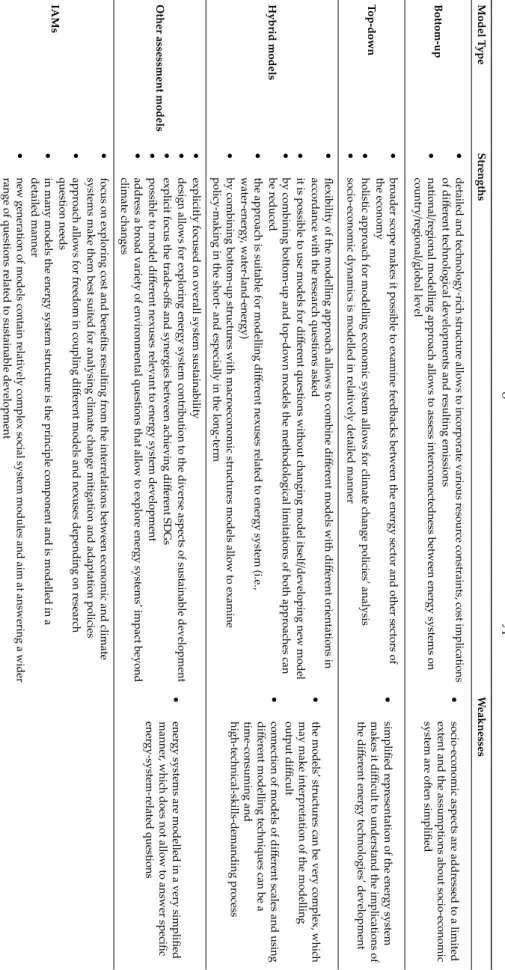
A review of recent energy reviews covering a total of 55 models was carried out to assess how the current energy paradigm is addressed by energy system models. Following this initial review, 13 models were reviewed in detail. The study concludes that some critical assumptions about biophysical and social reality are missing in the majority of energy models and emphasize the importance of developing the new modelling approaches and tools. Acknowledging that each model serves a specific purpose and is not supposed to answer all the questions, the study provides a categorization of different types of energy models’ (i.e. top-down, bottom-up and hybrid models) compatibility with each of the current energy paradigm research questions. This categorization can be used as a guidance for energy researchers and policy-makers that can help to understand a potential and the limits of different energy system modelling approaches.
1.2.2. Paper II
2Fig. 3. A navigation scheme for Paper II
Gladkykh, G., Spittler, N., Dierickx, F. (2017). Renewable energy – characteristics and representation in macroeconomic energy-climate models. Book chapter. European Union and Sustainable development: challenges and prospects.
https://www.researchgate.net/publication/320979533_European_Union_and_sustainable_ development_challenges_and_prospects/link/5a05666b458515eddb857a8e/download
© Editions Oeconomia. 2017. Reprinted in this thesis with permission from the publisher. The main research questions of the paper are as follows:
§ How are characteristics of renewable energy represented in macroeconomic energy-climate models?
§ What are the gaps in modelling renewable energy in macroeconomic energy-climate models?
This paper explores how the definitions and assumptions made for various energy sources in macroeconomic energy-climate models affect the modelling results. Departing from a 2 Paper II is a result of a collaborative research. The co-writers of Ganna Gladkykh is this paper are her PhD
colleagues Nathalie Spittler and Florian Dierickx. Ganna Gladkykh main role was conducting the comparative analysis of the energy-climate models. Nathalie Spittler was responsible for writing a theoretical part related to the limits of renewables. Florian Dierickx was responsible for describing a political context of the energy-climate models use.
definition of renewable energy, the study discusses limitations associated with different types of renewable energy technologies. Deployment of renewable-energy-based technologies is associated with certain amount of the GHG emissions and non-renewable resources required for renewable energy harvesting (e.g. WWF, 2014; JRC, 2013). In this regard our analysis was focused on understanding whether the way renewable energies are modelled today allow for the feasible projections of renewable energy development. There are four comparative criteria for assessing the limitations of different renewables defined in the paper. They are as follows: (i) availability of unlimited primary energy source; (ii) need for critical materials for technologies required for harvesting renewable energy, (iii) impacts of climate change on availability of renewable energy source, (iv) emissions occurring energy production; during the conversion of primary to secondary energy. Based on these limitations, several renewable energy technologies are compared.
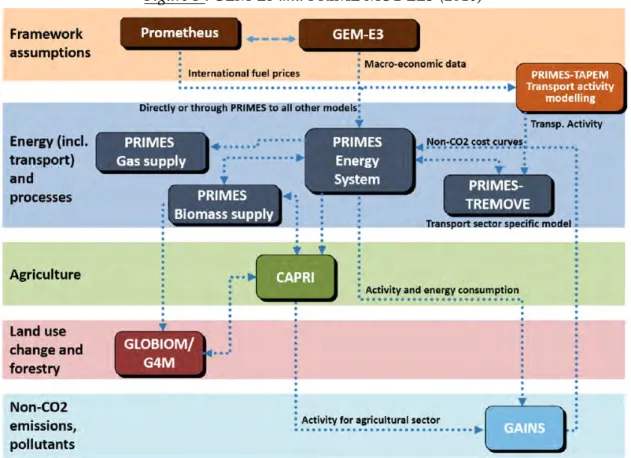
Discussion on the limitations of the renewables is followed by an overview of seven macroeconomic climate-energy models. This overview includes a description of the models’ assumptions about renewable energy technologies and the connection between renewable energy and climate change. A special focus in the models’ overview is put on the energy models used for energy scenarios and policies for the EU, focusing on PRIMES and GEM-E3. It was discovered that in most energy-climate models, there are no connections between the stocks of renewable natural resources and renewable energy production. Acknowledging this limitation in the way renewables are modelled is very important, especially when it comes to interpreting climate mitigation scenarios resulted from the models’ outputs. At the same time, better integration of the renewable energy limits in the models’ structures can provide a good tool for supporting emerging research questions related, for example, to exploring what environmental and social injustices can emerge from the further development of the renewable energy system/infrastructure.
1.2.3. Paper III
3Fig. 4. A navigation scheme for Paper III
Diemer, A., Gladkykh, G., Spittler, N., Ndiaye, A., Collste, D., Dierickx, F. (2019). Integrated Assessment Models (IAM): How to integrate Energy, Climate and Economics? Integrated Assessment Models and Other Climate Policy Tools.
3 Paper III is a result of a highly collaborative work lead by Professor Arnaud Diemer and lead-by-him project on
analyzing IAMs. Ganna Gladkykh contributed to this paper by conducting full analysis of IMAGE and REMIND-R models and but contributing to developing the comparison framework for different models.
The main research questions of the paper are as follows:
§ What are the main structural components, goals and assumptions of the IAMs policy drivers used to inform climate policy?
§ What are the main problems associated with the current generation of IAMs?
§ What are the main improvements of the IAMs that can be made to make the scenarios produced by IAMs more useful for informing climate policy-making?
Focusing on six (i.e. World3, DICE, IMAGE, MESSAGE, GEM-E3, REMIND) IAMs, this study compares the way climate-energy-economy nexus is addressed in those models. It is explored how the core modelling structures (including inter alia models’ goals, macroeconomic assumptions, key variables) across different generations of IAMs have changed historically. Special attention is drawn to the fact to what extent the structures of different IAMs makes it possible to integrate such nexuses as population, agriculture, food production, biodiversity, water which are closely connected to the energy and climate and are crucial for ensuring sustainable development of societies. The comparative analysis of IAMs’ structures is conducted with the use of CLDs. The analysis revealed that current generation of IAMs, due to advancement in research and increased capacities of the modelling tools, addresses a much higher level of climate-energy-economy complexity which allows exploring the trade-offs between environmental and economic policies in more detail. However, today’s AIMs still contain a lot of gaps related to the ways biophysical and social complexity is presented in the models’ structures. Limitations on the biophysical part mostly relate to the availability of data and the modelling effort needed. In contrast, addressing the gaps in the social system domain requires introducing new research methods and tools that can challenge established IAMs modelling practice (Gambhir et al., 2019).
1.2.4. Paper IV
4Fig. 5. A navigation scheme for Paper IV
4Paper IV was written in collaboration with Nathalie Spittler – a PhD colleague of Ganna Gladkykh, Professors
Brynhildur Daviðsdottir and Arnaud Diemer. The main role of Ganna Gladkykh was to conceptualize the leverage points. Nathalie’s Spittler role was to conceptualize sustainable energy system based on the Steady state economy theory. Both Ganna Gladkykh and Nathalie Spittler equally contributed to the writing of the text. Professors Arnaud Diemer, Brynhildur Daviðsdottir were guiding Ganna Gladkykh and Nathalie Spittler during the research activities and writing process.
Gladkykh, G., Spittler, N., Davíðsdóttir, B., & Diemer, A. (2018). Steady state of energy: Feedbacks and leverages for promoting or preventing sustainable energy system development. Energy Policy, 120, 121–131. https://doi.org/10.1016/j.enpol.2018.04.070
© Elsevier Ltd. 2018. All rights reserved. Reprinted in this thesis with permission from the publisher. The research questions of this paper are as follows:
§ To what extent can a steady state approach help conceptualize a sustainable energy
system?
§ What are the implications of using the steady state theory for a sustainable energy
system at global and national policy levels?
§ What policy leverages can be identified to achieve a sustainable energy system? § How feasible is the goal of a long-term energy system growth for achieving sustainable
energy?
In this paper, sustainable energy system narrative is explored from a biophysical perspective. Sustainable energy system is explored in a holistic manner aiming to understand underlying biophysical dynamics of the energy system development over time. In order to understand what constitutes a sustainable energy system, which stays within planetary as well as social boundaries, Daly’s steady-state economy concept (Daly, 1974) is applied. In this study, Daly’s equation of ultimate resource efficiency minimizing the service-throughput-ratio is transformed and extended into a detailed causal map of a steady-state energy system. As a result of this theoretical analysis, the Steady State of Energy concept is introduced. CLDs are used for conceptualizing and enabling a dynamic analysis of a steady-state energy system. It allows the depiction of the causal links and feedbacks among variables, from which the system’s dynamics arise. In connection with Donella Meadow’s Leverage Points (1997) approach, CLDs facilitated the identification of the implications of the steady state of energy for sustainable energy system development. Having conducted a conceptual analysis of the energy system leverage points, it was concluded that having sufficient amount of energy should be a long-term energy system goal on a global scale in order to achieve biophysically sustainable energy system. It is argued that energy sufficiency as the energy system goal is applicable in both the Global North and the Global South. The implication is that energy system expansion is needed in the regions with the lack of energy provision and, similarly, energy system contraction in required in those areas where the level of provided energy services is already beyond sufficient. In this way, energy sufficiency as the energy system goal is contrasted to the energy system growth. Defining energy sufficiency as the energy system goal within the Steady State of Energy concept resulted from the leverage point analysis. Using this framework, global energy policies are classified according to the level of their systemic impact. Transition to renewables as well as increasing energy efficiency, among other energy policies, which are on the top of the current energy policy agenda, are not ranked as high as energy sufficiency in terms of their potential policy impact. Based on the leverage points analysis, energy efficiency cannot continue increasing in the long term without depleting the stocks of natural energy resources, which is incompatible with biophysical sustainability and with the Steady State of Energy concept. The conceptual results of this paper indirectly contribute to the energy sufficiency versus energy efficiency discourse (Darby and Fawcett, 2018).
Fig. 6. A navigation scheme for Paper V
Gladkykh, G., Davíðsdóttir, B., Diemer, A., (2020). Combining the socially sustainable energy system narrative with system dynamics modeling: A case of electricity sufficiency for Sub-Saharan Africa. Submitted paper to the Energy Research and Social Science Journal, under review.
The research questions of this paper are as follows:
§ What are the principles of socially sustainable energy system design on a global scale? § What are the principles of energy access provision that can be considered socially
sustainable?
§ How can a combination of theoretical work with modelling help creating the tools for socially sustainable energy system policy assessment and design?
§ What are the systemic implications of applying socially sustainable energy system narrative to the energy system modelling and energy system planning?
In this paper, the two main research threads of this thesis – energy system modelling and sustainable energy system narratives – are bridged (Fig. 1). Particularly, socially sustainable energy system narrative is connected to system dynamics modelling. In this way, it is demonstrated how methodologically energy system modelling and sustainable energy system narratives can be combined.
This paper builds on the results of Paper IV by exploring what socially sustainable energy system narrative is, departing from the idea that in the sustainable energy narratives research the social sustainability part is the least presented. This study departs from the argument that the way energy system goals are formulated in the SDG7 provides only fragmented understanding of the targets to be met in the future and does not contain a vision of a globally sustainable energy system. Taking all this into account, it is argued that without clearly formulated and agreed upon energy system goals, there is a risk that sustainable energy policies which have been designed and implemented are not be compatible with sustainability principles. Energy sufficiency defined though both a desired minimum and a desired maximum of energy consumption per capita is identified as a universal energy system goal within a socially sustainable energy system narrative. The second component comprising socially
5 Ganna Gladkykh is the main author of the Paper V. Professors Brynhildur Daviðsdottir and Arnaud Diemer
guided her work during the research activities and writing process and provided a lot of valuable inputs into the paper’s content and form.
sustainable energy system narrative includes the principles of socially sustainable energy provision. These principles are defined based on the energy justice principles.
Energy justice (Jenkins et al., 2016; Ramazan et al., 2017; Biros et al., 2018) is applied in this study as the main conceptual framework, being in the modern energy literature the best elaborated normative theory that brings social justice principles into energy system research. For the purpose of designing the principles of a socially sustainable energy provision, the three main energy justice pillars (i.e. procedural, distributional and recognition justice) (Jenkins et al., 2016) are operationalized. There are three overarching principles of a socially sustainable energy provision formulated in the paper: (i) energy provision solutions should prioritize basic needs of individuals and households above any other types of energy use; (ii) energy provision solutions should be compatible with the idea of contributing to building low energy society rather than high energy society; (iii) energy provision solutions should prevent creating power imbalances in the energy system at all levels. The designed principles are then applied for categorizing different types of and connected them to the several different types of energy provision technologies (i.e. decentralized renewables-based, decentralized fossil-fuel-based, centralized renewables-based, centralized fossil-fuel-based) to define the most and the least socially sustainable ways of energy access provision. It is concluded that decentralized energy access provision corresponds to more socially sustainable principles when compared to centralized energy access provision.
Apart from developing socially sustainable energy system narrative which contributes to the discourse of what sustainable energy system is, this paper demonstrates an example of how to design socially sustainable energy system narrative.
In this study, qualitative system dynamics approach is applied. A modelling exercise simulates the case of providing access to a sufficient amount of electricity for rural and urban households in Sub-Saharan Africa. This case is seen as a representative example of electricity access provision in the Global South. Socially sustainable energy system narrative and the system dynamics model are combined in the three ways: (1) at the level of conceptualizing the model’s boundaries; (2) at the level of formulating the structural assumptions of the model’s structure; (2) at the level of designing assumptions for the normative (socially sustainable) simulation scenarios.
At the stage of scenarios simulation, basic model scenario is compared with the two normative scenarios. The normative scenarios are designed around the principles of the socially sustainable energy access provision. In these scenarios, those types of energy provision technologies that do not correspond to the socially sustainable energy provision principles are excluded from electricity generation mixes. A comparison between the basic model run and the two normative scenarios allows to identify controversies and trade-offs between different technological choices for energy access provision. Particularly, the analysis shows that the most cost efficient technological mixes tend to be less socially sustainable and vice versa. This study is a contribution to the interdisciplinary energy system literature. It demonstrates how conceptual sustainable energy system narratives can be connected to the energy system modelling and become more instrumental for a sustainable energy policy design and assessment.
Fig. 7. A navigation scheme for Paper VI
Gladkykh, G., Thazin Aung, M., Takama, T, Johnson, F.X., Fielding, M. (2020). Policy Dialogue on a Bioeconomy for Sustainable Development in Thailand. SEI Report. Stockholm
Environment Institute, Stockholm.
https://www.sei.org/wp- content/uploads/2020/01/200128a-mash-fielding-workshop-bioeconomy-thailand-pr-1912g.pdf
© January 2020. Stockholm Environment Institute. Reprinted in this thesis with permission from the publisher.7
The research questions of this paper are as follows:
§ How is sustainable bioeconomy envisaged in different regions in the Global North and the Global South?
§ How can stakeholder policy dialogues help to elicit sustainable bioeconomy visions and pathways in different regional contexts?
This paper resulted from Ganna Gladkykh research collaboration with Stockholm Environment Institute (SEI) within the Bioeconomy Policy Dialogues project. Bioeconomy is defined by SEI as the production, utilization and conservation of biological resources, including related knowledge, science, technology and innovation, to provide information, products, processes and services across all economic sectors aiming towards a sustainable economy. The project included developing the methodology for conducting series of stakeholder policy dialogues in different regions of the world and for analyzing their results. CLD mapping was used as a main tool for systematizing and comparing the results of the three stakeholder groups from Thailand participating in bioeconomy policy dialogues. As the result of the dialogues, three main sustainable bioeconomy pathways were discussed: agricultural pathway, biotechnological pathway, a pathways focusing on a social sustainability. The results of the dialogues analysis are compared to the three reference bioeconomy visions from the literature – a biotechnology vision, a bioresource vision, a bioecology vision (Bugge et al., 2016). The main conclusion drawn from this comparative analysis is that in the context of 6 Ganna Gladkykh is the main author of Paper VI. She designed the methodology for comparative analysis of the
dialogues and wrote the text of the paper. The rest of the authors participated in the workshops design and facilitation and assisted in data collection.
Thailand social sustainability component is very strongly present even in biotechnology vision which is typically assumed in the literature to be the least focused on social wellbeing. The conclusion drawn from these results are that in the developing country’s context social wellbeing and inclusiveness is prioritized even in the most technocratic sustainable bioeconomy visions prioritizing technological development above other societal transformations. Additionally, the results of the dialogues demonstrate a strong emphasis on the connections between the SDGs and sustainable bioeconomy.
This paper, even though it deviates from the energy systems research, provides a valuable contribution to understanding what are the existing alternative sustainable economy narratives. In this way, the study indirectly contributed to the discourse on how sustainable energy system narratives can be embedded in the sustainable economy narratives.
1.3. PhD thesis structure
The next six chapters of the PhD thesis (from chapter two to chapter seven) contain the six research papers which is then followed by a concluding discussion.
2. Paper I: Understanding the Current Energy
Paradigm and Energy System Models for
More Sustainable Energy System
energies
Review
Understanding the Current Energy Paradigm and
Energy System Models for More Sustainable
Energy System Development
Nathalie Spittler1,2,* , Ganna Gladkykh1,2, Arnaud Diemer2 and Brynhildur Davidsdottir1 1 Department of Life and Environmental Sciences, University of Iceland, Reykjavik 101, Iceland,
Sæmundargata 2, 101 Reykjavík, Iceland; [email protected] (G.G.); [email protected] (B.D.)
2 Department of Economics, University of Clermont Auvergne, 63000 Clermont Ferrand, France;
* Correspondence: [email protected]; Tel.: +43-650-790-8353
Received: 26 March 2019; Accepted: 17 April 2019; Published: 25 April 2019 !"#!$%&'(!"#$%&'!
Abstract: This study contributes to a better understanding of where to place di↵erent energy
modelling tools and support better decision-making related to the sustainable development of energy systems. It is argued that through the connection of the energy field and the field of sustainable development, the current energy paradigm—encompassing economic, environmental and social aspects—has emerged. This paper provides an analysis of di↵erent categories of existing energy system models and their ability to provide answers to questions arising from the current energy paradigm formulated within this study. The current energy paradigm and the relevant questions were defined by conducting conceptual framework analysis. The overarching question of the current paradigm asks how di↵erent energy pathways impact on the (sustainable) development of the energy system and overall (sustainable) development globally and nationally. A review of energy system models was conducted to analyse what questions of the current energy paradigm are addressed by which models. The results show that most models address aspects of the current energy paradigm but often in a simplified way. To answer some of the questions of the current energy paradigm in more depth and to get novel insights on sustainable energy system development, it might be necessary use complementary methods in addition to traditional energy modelling methodological approaches.
Keywords: energy paradigm; sustainability; energy system models
1. Introduction
Energy has been at the centre of political and scientific debate for many centuries. In line with these debates, energy models representing energy systems have been developed. The energy system directly and indirectly interacts with economic, social and environmental systems. Through these interactions the systems influence the (sustainable) development of each other [1]. Energy is a central driver for economic and social development as well as environmental and climate issues. Today, with the emergence of the sustainability debate and considering the growing importance of the energy system in reaching multiple sustainable development goals, it is necessary to explore to what extent existing energy models are in accordance with the di↵erent aspects of the current views on the role of energy systems. In this paper these views are referred to as the current energy paradigm. No recent and comprehensive definition of the current energy paradigm exists, despite some earlier studies referring to an emerging or new energy paradigm [2,3]. While many energy model reviews exist (e.g., [4–7], so far none of them has been connected to the current energy paradigm. The aim of this study is to bridge this gap.
Energy modelling has a long history and often supports decision-making in energy system planning. The first simple linear programming energy models were developed in the 1960s. Since then, many more have been developed [6]. One category of energy models is that of energy system models. An energy system can be defined as the process chain (or a subset of it) from the extraction of primary energy to the use of final energy to supply services and goods [8]. In other words, an energy system encompasses the “combined processes of acquiring and using energy in a given society or economy” [9]. Therefore, in this study all models, which focus on energy production and usage in the system, including the society or the economy, are referred to as energy system models.
In aiming to understand what kind of energy models are needed today to help answer the most important questions related to energy system development in the light of the current energy paradigm and overall sustainable development in the context of the sustainable development goals (SDGs) [10,11]. This paper aims to develop two main points:
1. The formulation of the current energy paradigm and related questions.
2. Analysis of existing energy system models used for assessing and decision making in energy system development, specifically focusing on what models are able to answer which questions. In order to help achieve sustainable development objectives energy models as supporting tools should be able to answer a variety of questions that go beyond purely technological advancement of energy systems [7]. This includes energy relevant aspects of the SDGs [12] and other biophysical and socio-economic ones (e.g., [13–17]). Hence, the practical implications of this paper are:
1. Support in choosing the most relevant model for investigating and understanding a particular issue.
2. Identifying gaps between the capabilities of existing energy models and requirements of the current energy paradigm facilitates improvement of existing energy system models.
3. Point one and two, individually or combined, can facilitate better application of models for decision-making related to the development of energy systems.
Section2describes the research method. In Section3the current energy paradigm is defined. In Section4the models are analysed. This includes a description of the model categories, examples for each of them and exploration of the question how the existing models relate to the current energy paradigm. This is followed by a discussion and critical reflection of the findings in Section5. Finally, the conclusion presents a summary of the main findings in Section6.
2. Method
To answer the question to what extent current energy system models are able to answer the questions of the current energy paradigm, a literature and model review was carried out. First, the relevant literature for defining the current energy paradigm and, second, selected models and their documentation were reviewed. The current energy paradigm is defined by following the procedure of the conceptual framework analysis presented in Reference [18]. This analysis is based on eight phases, which are carried out iteratively and among others includes mapping data sources, defining concepts and validation [18]. As suggested in Reference [18] selected data sources span a range of text types and disciplines including the following: for supporting the paradigm part, Kuhn’s [19] theory of paradigms was applied. The definition of the new view on energy systems was derived from mainly two types of literature: (i) texts international documents dealing with energy in the context of sustainable development, such as UN reports and international meeting or session reports [10,20–31] (ii) studies on sustainability and energy relevant to the broader energy system, including literature from di↵erent disciplines on the resource, environmental, economic and social aspects of the energy system [3,6,13,15–17,32–55]. The concepts identified within the literature were categorized and later integrated [18]. This resulted in a number of core concepts, constituting the current energy paradigm. In this paper, the identified and integrated concepts are represented as questions that arise from the
Energies 2019, 12, 1584 3 of 22
current energy paradigm (see Section3Theory—The current energy paradigm). This provides the basis for assessing what models are able to provide answers to which questions arising from the current energy paradigm.
To obtain information on energy (system) models, first an initial search for energy model reviews conducted within the last 15 years was carried out, which resulted in a total of thirteen energy model reviews that were explored. Following this, the model reviews were narrowed down to those that explicitly dealt with energy system models as defined in the introduction. This led to seven main reviews covering 55 models (i.e., [6,7,51,56–59]). These were used for gaining preliminary insights into the models and modelling practices of energy system modelling as defined above. Following the analysis of the reviews, a total of fourteen models were reviewed in more detail (see list below). Based on prior reviews [6,7,57,60] and the models’ manuals, it was decided to categorize the models into top-down, bottom-up and hybrid models (more details in Section4Model analysis). Each of the categories encompasses several subcategories of modelling techniques (e.g., econometric, linear optimization).
Furthermore, due to the increased importance of energy in the field of sustainable development, energy plays a substantial role in models generally concerned with the assessment of sustainable development. Hence, it is considered important to, additionally to the energy system models, also include other assessment models that contain a substantial energy module. A total of seven (LEAP (the Long range Energy Alternatives Planning system) [61]; Threshold21 [62]; IMAGE (Integrated Model to Access Global Environment) [63]; FELIX (Functional Enviro-economic Linkages Integrated neXus) [64]; C-Roads [65]; DICE (Dynamic Integrated model of Climate and the Economy) [66]; REMIND (Regional Model for Investment and Development) [67]) of those models were reviewed.
The common features of each model group and the chosen models were investigated to identify how each of them addresses the questions raised by the current energy paradigm. In order to complement the general findings about the model groups, the results regarding the chosen models of each category are described in more detail. The exemplar models chosen for each category are distinct in their modelling characteristics and being representative for the di↵erent model categories. Additional criteria were the frequency of references to the energy systems models in the studied literature reviews and the policy relevance of these models. All of the chosen models are used in a policy-making context at a national, regional or international level. The models are:
Bottom-up • MARKAL [68] • TIMES [69] • PRIMES [70] • MESSAGE [71] • WEM [72] Top-down • GEM-E3 [73] • NEMS [74,75] Hybrid • MESSAGE-MACRO [76] • MESSAGE-MAGICC [77] • MESSAGE-Access [78] • En-Roads [79,80]
• LEAP [61] • Threshold21 [62] • IMAGE [63] • REMIND [67]
3. The Current Energy Paradigm and Arising Questions
In the Oxford English dictionary a scientific paradigm is referred to as “a world view underlying the theories and methodology of a particular scientific subject.” This relates to Kuhn [19] who defines it as a set of basic concepts and experimental practices of a scientific discipline. According to Kuhn, a paradigm is not necessarily explicitly formulated and can be implicit revealing itself through the assumptions shared by a disciplinary community. A central element of Kuhn’s theory is that of a paradigm shift, which is defined as a process of changing from one set of concepts (assumptions) to another within a discipline.
There are three main questions that this section seeks to explore: (1) What is meant by energy paradigm? (2) Why has the energy paradigm changed? (3) How can the current energy paradigm be defined?
In this paper, the energy paradigm is defined as a set of explicit and implicit assumptions about the energy system. Whether or not energy studies can be related to a scientific discipline [81], Kuhn’s theory of paradigm shift is applicable, if energy is seen as a field of study associated with a set of explicit and implicit assumptions. Despite Kuhn´s discussion of the paradigm shift mainly in the context of natural sciences, his concept has been used in many other contexts since his book was published, also in the energy field [2,82]. According to Kuhn, new knowledge and crises can drive paradigm change. The current energy system faces several challenges on the social and environmental sphere, which can be understood as crises as well as technological advancements and a new political agenda have been drivers of change [12,14,49,50]. Changes in fundamental assumptions about the energy system eventually define the way it is designed in reality. An energy system paradigm shift has occurred several times. The development of the current one is explained through to the emerging role of energy in the sustainable development debate and addressed challenges within theoretical research on energy [1].
To respond to the second question, a historical overview of the events and developments leading to the change of the energy paradigm is provided in Table1. The relevant events, debates and corresponding literature for sustainable development (left column) and energy (right column) are displayed. In the middle column, the concepts derived from those two columns are presented. The concepts were obtained by conducting conceptual framework analysis (see Section2Method).
By integrating and synthesizing the concepts in Table1the answer to question number three (i.e., How can the current energy paradigm be defined?) is developed. The current energy paradigm can be described as the following: Energy is central for sustainable development and the goal of sustainable development, as defined in the Brundtland report, is central for the current energy paradigm. Three consequential aspects stem from this: (i) energy is essential for continuous socio-economic development and well-being; (ii) the facilitation of energy should not threaten any generations’ quality of life and therefore it needs to stay within all environmental limits; possible future environmental impacts on the energy system need to be considered; and (iii) resource limitations for fossil fuels and for renewable energies need to be accounted for.
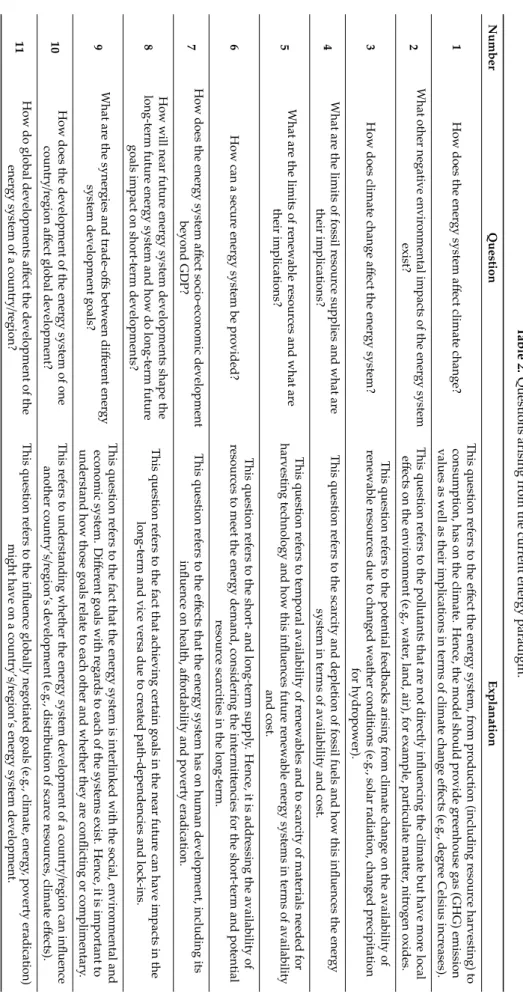
The main question arising from the current energy paradigm is “How do di↵erent energy system pathways impact (sustainable) development of the energy system and overall (sustainable) development globally and nationally?”. The concepts presented in Table1translate into questions arising from the current energy paradigm presented in Table2:
Ener gies 2019 ,12 ,1584 5 of 22 Table 1. Historical ov erview of the events and developments leading to the change of the ener gy paradigm and identified concepts (This table is based on a review of the following refer ences: [ 3 , 6 , 10 , 13 , 15 – 17 , 20 – 55 ]). Year Sustainable Development Concepts Energy 1970s Limits to Gr owth and WORLD3 model Confer ence of the Human Envir onment in Stockholm, Sweden Limits of fossils and their implications Envir onmental impact Ener gy security Oil crisis Hubbert curve Establishment of IEA Establishment of OPEC Ener gy Modelling For um establishment 1980s Br undtland report Cr eation of IPCC Sustainable development W orld Ener gy Council establishment Concept of the cost of conserved ener gy and ener gy supply curves 1990s United Nations Confer ence on Envir onment and Development in Rio, Brazil Signing of UNFCCC Agenda 21 1st IPCC report Climate change Mer ge of ener gy and climate resear ch Ener gy resear chers contribution to Special report on Emission Scenarios Global Ener gy Perspectives book 2000s MDGs 9th Session report of UN Commission of Su stainable Development W orld Summit on Sustainable Development Kyoto pr otocol Cr eation of EU ETS Ener gy is central for sustainable development Link between ener gy and socio-economic development (incl. ener gy relation to poverty , urbanization, population dynamics) Cr oss-scale ener gy systems impacts (national /regional impact on global and vice versa) IAEA, IEA, UNDESA, Eur ostat and EEA indicator set W orld Ener gy Assessment -Ener gy and the Challenge of Sustainability by UNDP 1st EU ener gy action plan (20 /20 /20 tar gets) 2010s SDGs Paris Agr eement Short-term versus long-term goals Syner gies and trade-o ↵s between di ↵er ent development goals Limits of renewables and their implications Impact of climate change on ener gy system Launch of Sustainable Ener gy for All SDG 7 Critical material resour ce debate Climate change mitigation strategies Climate change adaptation strategies Climate and ener gy justice debate Deep Decarbonization Pathways Pr oject
2019 ,12 ,1584 6 of 22 Table 2. Questions arising fr om the curr ent ener gy paradigm. Question Explanation 1 How does the ener gy system a ↵ect climate change? This question refers to the e ↵ect the ener gy syste m, fr om pr oduction (including resour ce harvesting) to consumption, has on the climate. Hence, the model should pr ovide gr eenhouse gas (GH G) emission values as well as their implications in terms of climate change e ↵ects (e.g., degr ee Celsius incr eases). 2 What other negative envir onmental impacts of the ener gy system exist? This question refers to the pollutants that ar e not dir ectly influencing the clim ate but have mor e local e ↵ects on the envir onment (e.g., water ,land, air), for example, particulate matter ,nitr og en oxides. 3 How does climate change a ↵ect the ener gy system? This question refers to the potential feedbacks arising fr om climate change on the availabi lity of renewable resour ces due to changed weather conditions (e.g., solar radiation, changed pr ecipitation for hydr opower). 4 What ar e the limits of fossil resour ce supplies and what ar e their implications? This question refers to the scar city and depletion of fossil fuels and how this influenc es the ener gy system in terms of availability and cost. 5 What ar e the limits of renewable resour ces and what ar e their implications? This question refers to temporal availability of renewables and to scar city of materials needed for harvesting technology and how this influences futur e renewable ener gy systems in terms of availability and cost. 6 How can a secur e ener gy system be pr ovided? This question refers to the short-and long-term supply .Hence, it is addr essing the availab ility of resour ces to meet the ener gy demand, considering the intermittencies for the short-term and pot ential resour ce scar cities in the long-term. 7 How does the ener gy system a ↵ect socio-economic development beyond GDP? This question refers to the e ↵ects that the ener gy system has on human development, including its influence on health, a ↵or dability and poverty eradication. 8 How will near futur e ener gy system developments shape the long-term futur e ener gy system and how do long-term futur e goals impact on short-term developments? This question refers to the fact that achieving certain goals in the near futur e can have imp acts in the long-term and vice versa due to cr eated path-dependencies and lock-ins. 9 What ar e the syner gies and trade-o ↵s between di ↵er ent ener gy system development goals? This question refers to the fact that the ener gy system is interlinked with the social, envir onmental and economic system. Di ↵er ent goals with regar ds to each of the systems exist. Hence, it is important to understand how those goals relate to each other and whether they ar e conflicting or complimentary . 10 How does the development of the ener gy system of one country /region a ↵ect global development? This refers to understanding whether the ener gy system development of a country /region can infl uence another country’s /region’s development (e.g., distribution of scar ce resour ces, climate e ↵ects). 11 How do global developments a ↵ect the development of the ener gy system of a country /region? This question refers to the influence globally negotiated goals (e.g., climate, ener gy ,poverty eradication) might have on a country’s /region’s ener gy system development.

![Table 1. Historical ov erview of the events and developments leading to the change of the ener gy paradigm and identified concepts (This table is based on a review ofthefollowingreferences:[3,6,10,13,15–17,20–55]).YearSustainableDevelopmentConceptsEnergy](https://thumb-eu.123doks.com/thumbv2/123doknet/14534651.723934/32.892.236.756.134.1129/historical-developments-leading-paradigm-identified-concepts-ofthefollowingreferences-yearsustainabledevelopmentconceptsenergy.webp)


![[PDF] Les cours gratuits d'informatique pour les debutant | Cours informatique](data:image/gif;base64,R0lGODlhAQABAIAAAP///wAAACH5BAEAAAAALAAAAAABAAEAAAICRAEAOw==)