RESEARCH OUTPUTS / RÉSULTATS DE RECHERCHE
Author(s) - Auteur(s) :
Publication date - Date de publication :
Permanent link - Permalien :
Rights / License - Licence de droit d’auteur :
Bibliothèque Universitaire Moretus Plantin
Institutional Repository - Research Portal
Dépôt Institutionnel - Portail de la Recherche
researchportal.unamur.be
University of Namur
Delay induced Turing-like waves for one species reaction–diffusion model on a
network
Petit, Julien; Carletti, Timoteo; Asllani, Malbor; Fanelli, Duccio
Publication date:
2015
Document Version
Early version, also known as pre-print
Link to publication
Citation for pulished version (HARVARD):
Petit, J, Carletti, T, Asllani, M & Fanelli, D 2015, Delay induced Turing-like waves for one species
reaction–diffusion model on a network. naXys Technical Report Series, no. 15, vol. 7, vol. 7, 15 edn, Namur
center for complex systems.
General rights
Copyright and moral rights for the publications made accessible in the public portal are retained by the authors and/or other copyright owners and it is a condition of accessing publications that users recognise and abide by the legal requirements associated with these rights. • Users may download and print one copy of any publication from the public portal for the purpose of private study or research. • You may not further distribute the material or use it for any profit-making activity or commercial gain
• You may freely distribute the URL identifying the publication in the public portal ?
Take down policy
If you believe that this document breaches copyright please contact us providing details, and we will remove access to the work immediately and investigate your claim.
Namur Center for Complex Systems
University of Namur
8, rempart de la vierge, B5000 Namur (Belgium)
http://www.naxys.be
DELAY INDUCED TURING-LIKE WAVES FOR ONE SPECIES
REACTION-DIFFUSION MODEL ON A NETWORK
By J. Petit, T. Carletti, M. Asllani & D. Fanelli
Report naXys-07-2015 6 july 2015
-4-3.5-3 -3 -2.5 -2.5 -2.5 -2 -2 -2 -2 -1.5 -1.5 -1.5 -1.5 -1 -1 -1 -1 -0.5 -0.5 -0.5 -0.5 -0.5 0 0 0 0 0 0 0 0 0 τ 0.2 0.4 0.6 0.8 1 1.2 1.4 1.6 1.8 a 0 0.2 0.4 0.6 0.8 1 1.2 1.4 1.6 1.8 2 -4 -3.5 -3 -2.5 -2 -1.5 -1 -0.5 0 aτ =π 2 time 0 50 100 150 200 250 nodes 1 20 40 60 80 100 0.4 0.5 0.6 0.7 0.8 0.9 1 1.1 1.2 1.3
Delay induced Turing-like waves for one species reaction–diffusion model on a network
Julien Petit1, Timoteo Carletti1, Mabor Asslani1, Duccio Fanelli21. naXys, Namur Center for Complex Systems, University of Namur, rempart de la Vierge 8, B 5000 Namur, Belgium
2. Dipartimento di Fisica e Astronomia, University of Florence, INFN and CSDC, Via Sansone 1, 50019 Sesto Fiorentino, Florence, Italy
A one species time–delay reaction-diffusion system defined on a complex networks is studied. Travelling waves are predicted to occur as follows a symmetry breaking instability of an homoge-nous stationary stable solution, subject to an external non homogehomoge-nous perturbation. These are generalized Turing-like waves that materialize in a single species populations dynamics model, as the unexpected byproduct of the imposed delay in the diffusion part. Sufficient conditions for the onset of the instability are mathematically provided by performing a linear stability analysis adapted to time delayed differential equation. The method here developed exploits the properties of the Lam-bert W-function. The prediction of the theory are confirmed by direct numerical simulation carried out for a modified version of the classical Fisher model, defined on a Watts-Strogatz networks and with the inclusion of the delay.
Keywords: Nonlinear dynamics, Spatio-temporal patterns, complex networks, delay differential equations, Turing waves
Collective dynamics spontaneously emerge in a vast plethora of physical systems and often play a role of paramount importance for the efficient implementation of dedicated functions. Travelling waves are among the most studied phenomena for their ubiquitous and cross-disciplinary interest. Periodic traveling waves are for example encountered when describing self-oscillatory and excitable systems in different realms, from chemistry to biology, passing through physics. The Fisher [1, 2] equation, introduced to characterize the spatial spread of an advantageous allele, defines the paradigmatic arena for addressing the peculiarities of travelling wave solutions in a reaction diffusion system in a spatial continuous domain. This is a one species population dynamic model, which assumes a logistic rule of replication and growth. The microscopic entities belonging to the scrutinized population can also delocalized in space, as follows a standard diffusion mechanism. The interplay between the aforementioned processes yields stable travelling wave solutions, which are selectively generated starting from a special class of initial conditions [3]. More generally, it is however interesting to speculate on the possibility for a system to yield self-organized collective patterns of the travelling wave type, as follows a symmetry breaking instability, seeded by diffusion. Starting from a homogeneous solution subject to a tiny, non homogeneous, initial perturbation, a reaction diffusion system can destabilize via a dynamical instability, identified by Alan Turing in a seminal work [4]. The Turing instability, as the process is nowadays called, can drive the emergence of non linear stationary stable patterns, if at least two species, the activator and inhibitors, are diffusiong and mutually interacting in the embedding environment. Alternatively, the Turing mechanims can instigate travelling wave solutions, provided at least three species, one of which mobile, are assumed to interact via apt non linear couplings. For a reaction diffusion system hosted on a discrete heterogeneous spatial support, namely a network, the instability can eventually set in for a two species model, if just the inhibitor is allowed to crawl from one node to its adjacent neighbors [5]. Also in this case, three coupled species are the minimal request for a travelling wave to rise from a stochastic perturbation of an initial homogeneous stationary stable state.
Starting from these premises, the aim of this Letter is to tackle the above problem under a radically different angle and thus introduce the simplest mathematical setting for which travelling wave solutions are generated, on a network, as a symmetry breaking instability of the Turing type. To anticipate our finding, we will prove that a one species model endowed with a delay in the diffusion can produce the sought instability. The analysis holds in general, but to demonstrate our conclusion we shall refer to a Fisher equation defined on a complex networks and modified with the inclusion of the delay term.
The usage of time–delay differential equations (DDEs) defined on complex networks [6–8] is nowadays very popular, from pure to applied sciences [9, 10]. Delays are for instance introduced to model finite communication or displace-ment time of quantities across network links. The imposed time-delay can non trivially interfere with the reactive dynamics, taking place on each node of the graph, thus resulting in unexpected emergent properties. For example, the classical paper [11] deals with time-delayed system made of two coupled phase oscillators and demonstrates the existence of multistability of synchronized solutions: an invariant manifold exists which attracts all the solutions of the system, yielding global oscillatory phenomena. Since this pioneering contribution, the subject has gained lot of attention and several contribution have been reported, assuming linear systems [12], coupled oscillators [13–15], oscillations death [16–18] and oscillations control [19]. Theory has been fruitfully applied to tackle real problems, see
2 for instance [20–26].
The work of this Letter moves from this reference context to build an ideal bridge with the Turing-like theory of pattern formation on complex networks. The discrete Laplacian operator, that encodes for the diffusion of the mobile population, incorporates a delay term. Our analysis of the DDEs exploits the properties of the Lambert W-function [27, 28] thus the solution of the linearised equation can be given in closed analytical form. Furthermore, we have full access to the associated eigenvalues and their dependence on the involved parameters is made explicit. This allows us to go beyond the technique based on the computation of the Hopf bifurcation, namely to determine the parameters for which the eigenvalue with the largest real part passes through a pure imaginary value.
We consider an undirected connected network composed by n nodes and assume one species to diffuse, from node to node, via the available links. Reactions also take place on each node, as dictated by a specific non-linear function
f of the local species concentration. Let us denote by xi(t) the species concentration on node i, at time t. Then its
time evolution is governed by
˙xi(t) = f (xi(t − τr)) + D
!
j
Lijxj(t − τd) , (1)
where D stands for the diffusion coefficient, Lij = Gij− kiδij is the Laplacian matrix of the network whose adjacency
matrix is given by G and ki="jGij identifies the degree of the i-th node. τr is the delay involved in the reaction
occurring at each node, while τd is the delay due to the displacement across nodes. For the sake of simplicity we
hereby assume the delay to be independent from the link indexes [31]. As mentioned earlier, it is well known that the
above one species reaction-diffusion system cannot exhibit Turing-like instability, in the limiting case for τr= τd= 0.
As we shall argue, the introduction of a finite delay τr= τd = τ > 0, will significantly alter this conclusion.
To proceed in the analysis we assume a stable homogeneous equilibrium, xi(t) = ˆx for all i = 1, . . . , n and t ≥ 0
and look for sufficient conditions to destabilize such equilibrium, as follows the introduction of a non homogeneous perturbation, which in turn activates the diffusion part. To determine the preliminary conditions that have to be
met for the homogeneous equilibrium to be stable, we linearize system (1) with D = 0, around ˆx, and recall that
τr= τ > 0. Let A = f′(ˆx), then the characteristic equation reads λ = Ae−λτ whose solutions are:
λk =
1
τWk(τ A), k ∈ Z , (2)
Wk being the k–th branch of the Lambert W–function [27]. To guarantee the needed stability of the homogeneous
equilibrium ˆx, one has to require that (A, τ ) and an integer k exist for which ℜλk(A, τ ) < 0.
The Lambert W–function is the complex multivalued function of the complex variable z ∈ C defined to be solution
of the equation z = W (z)eW(z). It has infinitely many branches [27] denoted by W
k(z), for k ∈ Z; among them W0(x)
- the principal branch - is obtained by restricting z to lie on the real axis, more precisely on ℜz ∈ (−e−1, +∞), and
with the constraint W0(z) ≥ −1. Hence the branch cut of W0is defined by {z : −∞ < ℜz ≤ −e−1, ℑz = 0}. Let us
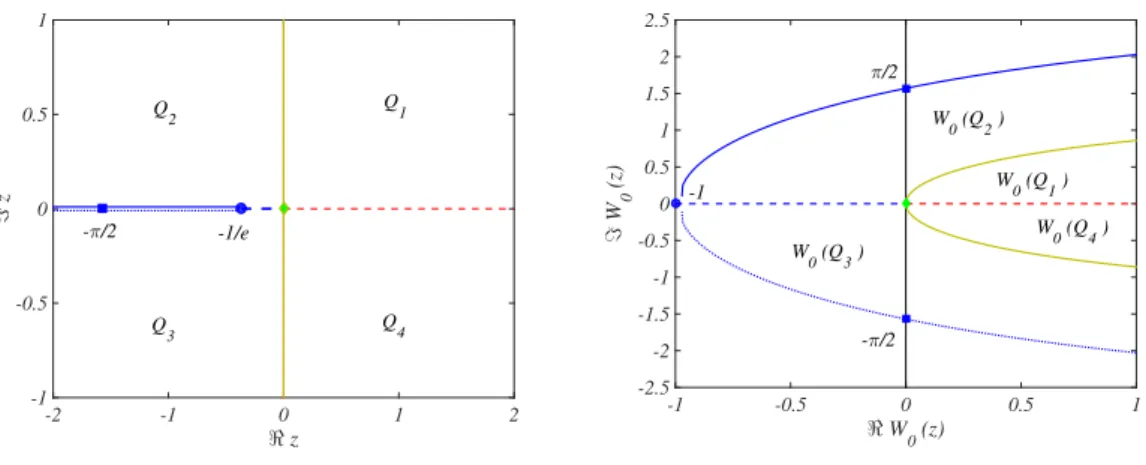
observe that k = 0 and k = −1 are the only branches for which the Lambert W–function can assume real values. For all remaining k, ℑWk(z) ̸= 0 for all z (see Fig. 1).
Roughly speaking, W0bends the z plane (cut along ℜz < −e−1) into a parabolic like domain in the w plane, whose
boundary curves ℑw )→ ℜw = −ℑw cotan ℑw (blue solid and dotted curves in Fig. 1) are bounded by π and −π.
Moreover W0satisfies the following relevant condition (Lemma 3 of [29])
∀z ∈ C : max
k∈ZℜWk(z) = ℜW0(z) . (3)
The previous Eq. (3) allows to restate the stability condition of the homogeneous equilibrium as follows:
∃(A, τ ) such that ℜW0(τ A) < 0 . (4)
Hence, from the properties of the Lambert W–function represented in Fig. 1, this amounts to require
−π
2 < τ A < 0 . (5)
We now turn to considering the effect of a non homogeneous perturbation, superposed to the postulated homogenous equilibrium. This implies studying the full system (1), with τr= τd= τ > 0 and D > 0. Linearising as before, we get
˙
δxi(t) = Aδxi(t − τ ) + D
!
j
3 ℜ z -2 -1 0 1 2 ℑ z -1 -0.5 0 0.5 1 -π/2 -1/e Q2 Q 3 Q4 Q 1 ℜ W 0 (z) -1 -0.5 0 0.5 1 ℑ W 0 (z) -2.5 -2 -1.5 -1 -0.5 0 0.5 1 1.5 2 2.5 -π/2 π/2 -1 W0 (Q2 ) W 0 (Q3 ) W0 (Q1 ) W 0 (Q4 )
FIG. 1: The Lambert W function: principal branch W0(z). Left panel: in the complex plane z ∈ C, we represent the
upper part of the branch cut {z : −∞ < ℜz ≤ −e−1, ℑz = 0+} by a solid line and the lower part of the branch cut
{z : −∞ < ℜz ≤ −e−1, ℑz = 0−} by a dashed line; the circle denotes the point (−1/e, 0) while the square refers to (−π/2, 0).
Right panel: the complex plane w ∈ C, where w = W0(z). The solid blue line is the image of the upper part of the branch
cut ℑw '→ ℜw = −ℑw cotan ℑw for 0 < ℑw < π, while the dashed blue line is the image of the lower branch cut via W0,
ℑw '→ ℜw = −ℑw cotan ℑw for −π < ℑw < 0. The circle at coordinates (−1, 0) is the image of the point (−1/e, 0) and
the squares positioned at (0, π/2), respectively at (0, −π/2), are the image of the point of coordinates (−π/2, 0+
), respectively
(−π/2, 0−). The red dashed line is the image of the positive real axis while the green curved line is the image of the imaginary
axis ℜz = 0. Observe that if ℑz = 0 and −π/2 < ℜz < −1/e, then −1 ≤ ℜW0(z) < 0, |ℑW0(z)| < π/2 and ℑW0(z) ̸= 0
(blue solid and dotted lines), if ℑz = 0 and −1/e ≤ ℜz ≤ 0, then −1 ≤ ℜW0(z) ≤ 0 and ℑW0(z) = 0 (blue dashed line), if
ℑz = 0 and ℜz < −π/2, then ℜW0(z) > 0 and |ℑW0(z)| > π/2 (blue solid and dotted lines) and if ℑz = 0 and ℜz > 0, then
ℜW0(z) > 0 and ℑW0(z) = 0 (red dashed line).
The Laplacian matrix has a complete set of orthonormal eigenvectors φα, associated to the topological eigenvalues
0 = Λ1 > Λ2≥ . . . ≥ Λn, "
jLijφαj = Λαφαi, for α = 1, . . . , n. Using this basis to decompose δxi(t) and employing
once again the ansatz of exponential growth δxi(t) =
!
α
cαeλαtφαi, for all i = 1, . . . , n , (7)
we eventually get from (6) the characteristic equation
λα− (A + DΛα)e−λατ = 0 . (8)
That is τ λαeτ λα= τ (A + DΛα), whose solutions are:
λα,k=
1
τWk(τ (A + DΛ
α)) , k ∈ Z and α = 1, . . . , n. (9)
Symmetry breaking instabilities seeded by diffusion can set in if at least a pair k and α exists such that ℜλα,k> 0,
provided −π2 < τ A < 0 (the homogeneous equilibrium must be stable as a prerequisite of the analysis) [32]. When
a bounded family of k exist for which ℜλα,k > 0, the one with the largest real part dominates the instability and
shapes the emerging pattern. Recalling again Eq. (3), we finally get the following sufficient condition for the onset of Turing-like instability in a one species DDE of the general type (1):
∃α ∈ [2, . . . , n] such that 1
τℜW0(τ (A + DΛ
α)) > 0 . (10)
Exploiting the properties of the Lambert W–function represented in Fig. 1, Eq. (10) is satisfied whenever [33] there exists ¯α > 1 such that
τ DΛα¯ < −π
2 − τ A . (11)
Observe also that for such ¯α, ℑλ0, ¯α ̸= 0. Hence, the instability materialize in the appearance of travelling waves.
4 Laplacian eigenvalues being ordered for decreasing real parts. Hence, the Turing-like instabilities cannot develop if τ DΛn > −π
2−τ A. Summing up, travelling waves are expected to develop, for a fixed network topology, and sufficently
large values of τ and D. Conversely, for a fixed choice of the parameters (τ , D and A), one should make the network
big and so force Λn to be large enough, in absolute value.
As our goal is to determine the minimal model for which the aforementioned instability sets in, we now consider
the reduced case for τr= 0 and τd= τ > 0, that is the delay is only associated to the diffusion part. For D = 0 the
homogeneous equilibrium ˆx, is stable if and only if A < 0. By repeating the procedure highlithed above we end up
with the following characteristic equation:
λα− A − DΛαe−λατ = 0 , (12)
whose solution reads
λα,k=
1
τWk(τ DΛ
αe−τ A) + A, k ∈ Z . (13)
The equilibrium ˆx is hence destabilised by diffusion if there exist α > 1 for which
ℜW0(τ DΛαe−τ A) > −Aτ . (14)
Let us observe that −Aτ is positive and τ DΛαe−τ A is negative. Moreover, we already remarked that ℜW
0(x) is
positive and increasing for decreasing negative x. Hence, a critical xc< 0 exists [34] for which ℜW0(xc) = −Aτ and
Eq. (14) is satisfied for all τ DΛαe−τ A< x
c. Travelling waves are hence predicted to manifest, for sufficiently large
Λα¯, in absolute value. We again stress that ℑλ 0, ¯α̸= 0.
To complete the general discussion we consider the dual problem, where τr = τ > 0 and τd = 0. As already
observed, the homogenous equilibrium ˆx is stable if −π/2 < τ A < 0. The characteristic equation associated to this
problem can be cast in the form:
λα− Ae−λατ− DΛα= 0 , (15) whose solution is λα,k= DΛα+ 1 τWk(τ Ae −τ DΛα ), k ∈ Z . (16)
One can prove [35] that DΛα+1
τW0(τ Ae
−τ DΛα
) < 0 for all Λα, α > 1. We are consequently led to conclude that the
stable homogeneous equilibrium cannot undergo a diffusion driven Turing-like instability, if the delay term is solely confined in the reaction part.
As an application of the previous theory, we take f in Eq. (1) to be logistic function f (x) = ax(1 − x), as in the spirit of the Fisher model. At variance with the Fisher equation [1, 2], we now imagine the species to be hosted on a discrete support, rather than a continuum segment. In the original Fisher scheme the emerging wave relates to the heteroclinic orbit of the system and requires a specific, step-like, initial profile. In our case the travelling wave will originate as follows a symmetry breaking instability of an initial randomic perturbation. To carry out the
analysis, we select the homogeneous equilibrium solution ˆx = 1 and look after to its associated stability properties,
as a function of a, τ , D and the network topology. Silencing the diffusion, D = 0, the stability condition Eq. (5) rewrites 0 < aτ < π
2. In demonstrating our findings, we consider a Watts-Strogatz network [30] made of 100 nodes,
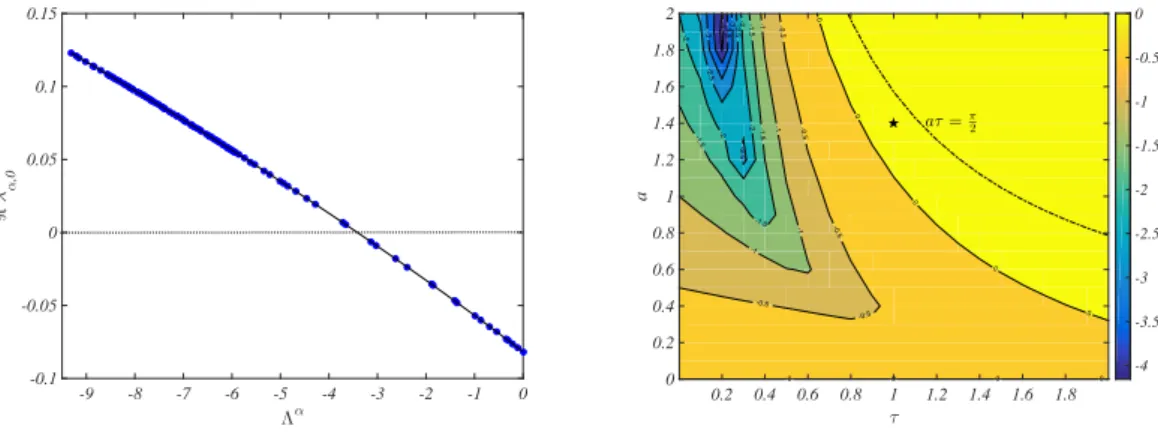
with average degree ⟨k⟩ = 6 and probability to rewire a link p = 0.03. Other network topologies can be in principle assumed, returning similar qualitative conclusions. The chosen network is large enough so to have one eigenvalue for which the dispersion relation has positive real part (see left panel of Fig. 3): thus Turing-like waves do exist. In Fig. 2 we report the result of a numerical solution of the system under scrutiny obtained with a RK4 method adapted to deal with delay differential equation. The parameters are set to the values a = 1.4, D = 0.05 and τ = 1. The DDE should be complemented with the value of the function on the delay interval [−τ, 0). In the spirit of a perturbation
of the stable equilibrium, we decided to set xi(t) = 1 + δi for all t ∈ [−τ, 0) where δi are random Gaussian numbers
drawn from N (0, 0.01). Observe that aτ = 1.4 < π/2 and thus the equilibrium ˆx = 1 is stable in absence of diffusion.
On the other hand, one can clearly appreciate that after a transient period, patterns do manifest as stable oscillations around the solution ˆx = 1.
In Fig. 3 the dispersion relation are displayed. In the left panel the quantity max
k ℜλα,k= ℜλα,0=
1
τℜW0(−τ a + τ DΛ
α) ,
is plotted as a function of Λα, for fixed a, D and τ (as specified in Fig. 2), and for the same Watts-Strogatz network.
5 time 0 50 100 150 200 250 nodes 1 20 40 60 80 100 0.4 0.5 0.6 0.7 0.8 0.9 1 1.1 1.2 1.3
FIG. 2: Numerical solution of the system under scrutiny with parameters a = 1.4, D = 0.05 and τ = 1. Initial conditions are
set equal to xi(t) = 1 + δi for all t ∈ [−τ, 0) where δi are random gaussian numbers drawn from N (0, 0.01). The underlying
network is a Watts-Strogatz network [30] made of 100 nodes, with average degree ⟨k⟩ = 6 and probability to rewire a link p = 0.03.
dispersion relation as a function of the eigenvalues, i.e. maxαℜλα,k, versus (a, τ ) for fixed D = 0.05 and for the
same Wattz-Strogatz network. The stability domain of the equilibrium without diffusion is bounded by a > 0 (τ > 0, for physical reasons) and aτ < π/2 (dash-dotted black curve). The Turing-like waves can emerge for all pairs (a, τ ), inside such limited domain, for which maxαℜλα,0> 0.
Λα -9 -8 -7 -6 -5 -4 -3 -2 -1 0 ℜ λα ,0 -0.1 -0.05 0 0.05 0.1 0.15 -4 -3.5 -3 -3 -2.5 -2.5 -2.5 -2 -2 -2 -2 -1.5 -1.5 -1.5 -1.5 -1 -1 -1 -1 -0.5 -0.5 -0.5 -0.5 -0.5 0 0 0 0 0 0 0 0 0 τ 0.2 0.4 0.6 0.8 1 1.2 1.4 1.6 1.8 a 0 0.2 0.4 0.6 0.8 1 1.2 1.4 1.6 1.8 2 -4 -3.5 -3 -2.5 -2 -1.5 -1 -0.5 0 aτ =π 2
FIG. 3: Dispersion relation. Left panel ℜλα,0 as a function of Λα, for fixed a, D and τ , as specified in Fig. 2 and for the
same Wattz-Strogatz network. Blue dots represent the values of λα,0computed for a given Λα, while the solid black line is the
continuous approximation. The horizontal dotted black line stands for the 0–th level. Right panel: maxαℜλα,0, as a function
of (a, τ ), for fixed D = 0.05 using the same Wattz-Strogatz network as employed in Fig. 2. The dash dotted curve aτ = π/2
delineates the boundary (together with a > 0 and τ > 0) of the stability region of the homogenous solution ˆx = 1. Hence, all
pairs (a, τ ) for which 0 < aτ < π/2 correspond to stable solution of the homogeneous equilibrium. Turing-like instabilities are
thus allowed to develop for all pairs (a, τ ) inside such domain, for which maxαℜλα,0> 0. The star refers to the setting of the
simulation reported in Fig. 2.
In conclusion, we have here shown that a one species time–delay reaction-diffusion system defined on a complex networks can exhibit travelling waves, as follows a symmetry breaking instability of an homogenous stationary stable solution, subject to an external non homogenous perturbation. These are Turing-like waves which emerge in a minimal model of single species population dynamics, as the unintuitive byproduct of the imposed delay. Based on a linear stability analysis adapted to time delayed differential equation, we provided sufficient conditions for the onset of the instability, as a function key quantities, as the reaction parameters, the delay, the diffusion coefficient and the network topology. The wave possesses multiple fronts and persists in time, without fading away as it happens for the customary Fisher equation. The observation that Turing–like instability can originate for a one species model evolving on a heterogeneous graph, provided a delay is included in the transport term, enables us to significantly
6 relax the classical constraints for the patterns to emerge and opens up the perspective for intriguing developments in a direction so far unexplored.
The work of J.P, T.C. and M.A. presents research results of the Belgian Network DYSCO (Dynamical Systems, Control, and Optimization), funded by the Interuniversity Attraction Poles Programme, initiated by the Belgian State, Science Policy Office.
APPENDIX A: TURING-LIKE INSTABILITY WHEN THE DELAY IS CONFINED IN THE DIFFUSION TERM.
Let us consider the case where the delay is present only in the diffusion part (τd = τ > 0 and τr= 0)
˙xi(t) = f (xi(t)) + D
!
j
Lijxj(t − τ ) . (A1)
To study the stability of the equilibrium ˆx in this case we have to look for α > 1 for which
ℜW0(τ DΛαe−τ A) > −Aτ . (A2)
Let z = x + iy and w = ξ + iη, then the following relation is recovered once we impose z = wew, namely w = W
0(z):
#
x = eξ(ξ cos η − η sin η)
y = eξ(η cos η + ξ sin η) . (A3)
Let us introduce xc = τ DΛα¯ and ξc= −τ A, values for which the equality holds in (A2). Observe that xc < 0 and
ξc > 0. Rewriting Eq. (A3) for zc= xc (namely yc= 0) and wc= ξc+ iηc we get:
#
xc= eξc(ξ
ccos ηc− ηcsin ηc)
0 = eξc
(ηccos ηc+ ξcsin ηc) .
From the second equation one can obtain (implicitly) ηc as a function of ξc:
ηc= −ξctan ηc.
Because ξc< 0 one can find a unique solution ηc(ξc) ∈ (π/2, π) (and the opposite one). Inserting this result into the
first equation we get
xc(ξc) = −e−ηc(ξc)cotan ηc(ξc) ηc(ξc)
sin ηc(ξc)
.
So in conclusion given −τ A one can obtain the critical xc(−τ A) for which we have equality in Eq. (A2), and thus
conclude, by invoking the scaling properties of W0, that for all Λα< xc(−τ A)/(τ D) the strict inequality sign holds
in Eq. (A2).
APPENDIX B: TURING-LIKE INSTABILITY ARE IMPEDED WHEN THE DELAY ONLY APPEARS IN THE REACTION TERM.
Let us consider system
˙xi(t) = f (xi(t − τ )) + D
!
j
Lijxj(t) , (B1)
once the delay dependence is given only through the reaction term, τr = τ > 0 and τd = 0. The condition for the
stability of the homogeneous equilibrium without diffusion is given by −π
2 < τ A < 0. Following the same procedure
outlined in the main body of the paper – linearising, then expanding the perturbation in the basis of the eigenvectors of the Laplacian – one obtains the following characteristic equation:
7 that can be solved using the W–Lambert function to give
λα,k= DΛα+
1
τWk(τ Ae
−τ DΛα
), k ∈ Z . (B3)
Turing-like instability can emerge if the homogeneous equilibrium becomes unstable in presence of the diffusion.
We then look for α and k such that ℜλα,k> 0. Using Lemma 3 of [29] this is equivalent to
ℜW0(τ Ae−τ DΛ α
) > −τ DΛα,
Let us observe that −τ DΛα≥ 0. Because τ A < 0, one cannot solve the previous equation with ℑW
0(τ Ae−τ DΛ α
) = 0
(in this case one should have the argument of W0 to be positive). Hence we look for τ Ae−τ DΛ
α
< −π/2.
Let us introduce s = −DΛα> 0, u = τ A ∈ (−π/2, 0) and the function
g(s) = −s + ℜW0(ues) , (B4)
our goal is to prove that g(s) < 0 for all s > 0 which is in turn equivalent to stating that Turing-like instability cannot develop.
Let us rewrite Eq. (A3) for x = uesand y = 0:
#
ues= eξ(ξ cos η − η sin η)
0 = eξ(η cos η + ξ sin η) .
Isolating ξ in the second equation and inserting it in the first one, we get:
es= − η
u sin ηe
ξ.
One can thus rewrite g(s) as follows:
g(s) = −s + ℜW0(ues) = −s + ξ = −ξ − log $ − η u sin η % + ξ = − log $ − η u sin η % .
Because u > −π/2 and π/2 < η < π we obtain −η/(u sin η) > 1 and thus log&−usin ηη '> 0.
[1] Fisher R.A., The genetical theory of natural selection Oxford University Press, USA (1930) [2] Fisher R.A., The Wave of Advance of Advantageous Genes Annals of Eugenics, 7, pp.355, (1937).
[3] Kolmogorov, A., Petrovskii, I. and Piscounov, N. A study of the diffusion equation with increase in the amount of substance, and its application to a biological problem. In V. M. Tikhomirov, editor, Selected Works of A. N. Kolmogorov I, pages 248270. Kluwer 1991. Translated by V. M. Volosov from Bull. Moscow Univ., Math. Mech. 1, 125, 1937.
[4] A. M. Turing, The Chemical Basis of Morphogenesis Phils Trans R Soc London Ser B, 237, 37 (1952)
[5] Cantini L., Cianci C., Fanelli D., Massi E., Barletti L., Asllani M, Stochastic amplification of spacial modes in a system
with one diffusing species J. Math. Biol, DOI 10.1007/s00285-013-0743-x (2013)
[6] Atay F.M. , Jost J., Delays, Connection Topology, and Synchronization of Coupled Chaotic Maps PRL, 92 (4), pp. 144101-1–144101-4, (2004).
[7] Ponce M.C., Masoller C., Mart´ı A.C. Synchronizability of chaotic logistic maps in delayed complex networks EPJB, 67, pp. 83–93, (2009).
[8] H¨ofener J.M., Sethia G.C., Gross T., Stability of networks of delay–coupled delay oscillators EPL, 95, pp.
40002-p1–40002-p6, (2011).
[9] Niculescu, S. I., Delay Effects on Stability: a Robust Control Approach Springer, New York, (2001).
[10] Richard J. P. Time-delay systems: an overview of some recent advances and open problems Automatica, 39 (10), pp.16671694, (2003)
[11] H. G. Schuster and P. Wagner Prog. Theor. Phys. 81, 939, (1989).
[12] Jirsa V. K. and Ding M. Will a Large Complex System with Time Delays Be Stable? Phys. Rev. Lett., 93, pp. 070602, (2004).
8
[14] Yeung M. K. S. and Strogatz S. H., Time Delay in the Kuramoto Model of Coupled Oscillators Phys. Rev. Lett., 82, pp. 648, (1999)
[15] Earl M. G. and Strogatz S. H., Synchronization in oscillator networks with delayed coupling: A stability criterion Phys. Rev. E, 67, pp. 036204, (2003)
[16] Reddy D.V. R. et al. Time Delay Induced Death in Coupled Limit Cycle Oscillators Phys. Rev. Lett., 80, pp. 5109, (1998) [17] Atay F.M., Total and partial amplitude death in networks of diffusively coupled oscillators Physica D, 183, pp. 1, (2003) [18] Dodla R. et al., Phase-locked patterns and amplitude death in a ring of delay-coupled limit cycle oscillators Phys. Rev. E,
69, pp. 056217, (2004)
[19] Rosenblum M. and Pikovsky A., Controlling Synchronization in an Ensemble of Globally Coupled Oscillators Phys. Rev. Lett., 92, pp. 114102, (2004)
[20] Herrero R. et al., Experimental Observation of the Amplitude Death Effect in Two Coupled Nonlinear Oscillators Phys. Rev. Lett., 84, pp. 5312, (2000)
[21] Kozyreff G. et al., Global Coupling with Time Delay in an Array of Semiconductor Lasers Phys. Rev. Lett., 85, pp. 3809, (2000)
[22] Reddy D.V. R. et al. Experimental Evidence of Time-Delay-Induced Death in Coupled Limit-Cycle Oscillators Phys. Rev. Lett., 85, pp. 3381, (2000)
[23] Takamatsu A. et al., Time Delay Effect in a Living Coupled Oscillator System with the Plasmodium of Physarum
poly-cephalum Phys. Rev. Lett., 85, pp. 2026, (2000)
[24] Vladimirov, A. G., Kozyreff, G. and Mandel, P. , Synchronization of weakly stable oscillators and semiconductor laser
arrays Europhys. Lett., 61, pp. 613, (2003)
[25] Takamatsu A. et al., Hidden Symmetry in Chains of Biological Coupled Oscillators Phys. Rev. Lett., 92, pp. 228102, (2004)
[26] Rosenblum M. and Pikovsky A., Delayed feedback control of collective synchrony: An approach to suppression of pathological
brain rhythms Phys. Rev. E, 70, pp. 041904, (2004)
[27] Corless, R. M. et al., On the Lambert W function Advances in Computational Mathematics, 5, (4), pp. 329–359, (1996). [28] Asl F. M., Ulsoy A. G., Analysis of a system of linear delay differential equations Journal of Dynamic Systems, Measurement
and Control, 125 (2), 215-223, (2003)
[29] Shinozaki H. and Mori T., Robust stability analysis of linear time-delay systems by Lambert W function: Some extreme
points results Automatica, 42, pp. 1791–1799, (2006).
[30] Watts D.J., Strogatz S.H., Collective dynamics of small-world networks Nature, 939, 440 (1998)
[31] A more general description can be provided by taking into account the possibility that each link introduces a different delay [7]
[32] Remark that α > 2: in fact, for α = 1 we have Λ1= 0 and thus, by assumption, ℜλ
1,k= ℜWk(τ A) < 0.
[33] It is worth emphasizing that, in principle, one could also satisfy Eq. (10) with τ (A + DΛα) > 0. This alternative condition
is however not compatible with the stability request (5) and the negativeness of Λα for all α.
[34] See section A of the Appendix the explicit computation of xc.