1
Comparative study of several dispatching rules used with the selection
rule of alternative routing in real time DMM
A. Hassam
N. Keddari
F. Ain sebaa
Z. Sari
Manufacturing
Engineering Laboratory
of Tlemcen, University
of Aboubekr Belkaïd,
PoBox 230, Tlemcen
13000, Algeria
[email protected]
Manufacturing
Engineering Laboratory
of Tlemcen, University
of Aboubekr Belkaïd,
PoBox 230, Tlemcen
13000, Algeria
[email protected]
Manufacturing
Engineering Laboratory
of Tlemcen, University
of Aboubekr Belkaïd,
PoBox 230, Tlemcen
13000, Algeria
[email protected]
Manufacturing
Engineering Laboratory
of Tlemcen, University
of Aboubekr Belkaïd,
PoBox 230, Tlemcen
13000, Algeria
[email protected]
Abstract--The management of the queues by rules of
priorities constitutes one of the simplest approaches and most used to dynamically schedule the tasks in a job shop. Unfortunately, one of the most important problems concerning the use of the rules of priority is the fact that no rule seems overall better than the others. To regulate these problems, we will combine rules of priorities and scheduling with selection of alternative routings in real time rule DMM. This combination will be realized according to the operating conditions, of the production targets and the state of the jobshop. Since the state of the workshop changes during time, we propose to analyse the state of the system each time a decision of scheduling must be taken, in order to take into account the real state of the jobshop. This approach will be implemented on a model of jobshop and will simulate by the simulation software ARENA.
Index Terms--Job-shop, Real time, Dispatching rules,
Selection of routings, Simulation.
1.INTRODUCTION
For more than twenty years, scheduling in real-time of the job-shop has caused many research tasks in order to fully draw part of the flexibility offered by the flexible manufacturing systems. In such systems; scheduling must be taken in real-time and in a dynamic way, according to the state of the workshop, the characteristics of the plan, the production targets, the routings of the parts, the breakdowns in system…
The scheduling workshops problems constitute one of the most important difficulties for the companies in their management systems and piloting. Indeed, it is on this level that must be taken into account the multiple real and complexes criteria of the workshops. Among the most difficult and studied scheduling problems types, we have the problem of Job Shop scheduling. This problem corresponds, really, with the modeling of a jobshop. The objective consists in programming the realization of the products so as to optimize the production, by respecting a number of constraints on the machines used. The
resolution of this problem in an optimal way is impossible in the majority of cases because of its strongly
combinative character. The exact methods require a calculation time which increase exponentially with the size of the problem. Then, approximate methods were
proposed to solve this problem in reasonable time.
Among the methods of scheduling in real-time we can quote the DMM method (Dissimilarity Maximization Method), who is a method of selection of alternative routing in real-time of an FMS. The priority rules select, among several parts in a queue, the next part to be treated on the machine according to local or total criteria of the system. The DMM uses the FIFO rule as priority rule, for the management of the queues, in this work we will use other dispatching rules, SPT, LPT and LIFO in order to see whether these rules give better results than FIFO-DMM. For that, we will simulate the system with these various rules by using the simulation software ARENA. 2.LITERATURE REVIEW
In general, scheduling involves decisions of allocating resources to tasks over time, and optimizing one or more objectives. Scheduling models can be either deterministic or stochastic. Deterministic models assume that all job data are known exactly in advance. In stochastic models, not all job data but their distributions are known. Static scheduling problems assume that a list of n jobs are available at the beginning of the scheduling period, while the dynamic scheduling problems deal with an ongoing situation, in which new jobs are continuously added to the system. The general scheduling problem is a NP-hard type of problem [1].
One of the earliest studies on the FMS scheduling problem in the work of Nof et al. [2] who demonstrated the importance of scheduling decisions for system performance. From a traditional viewpoint, scheduling almost immediately subject to inevitable changes. Therefore the traditional off-line scheduling approaches cause increased waiting times, increased work-in-process, low equipment utilization, and eventually degrade the system performance. [3], [4].Several researchers propose various methods to accommodate flexibility into off-line
2
scheduling in order to increase the system performance [5], [6]. However, real time scheduling has always remained e desirable but elusive goal [7], [8]. real time scheduling and control FMS have been popular research areas since the beginning of the 1980s when flexible manufacturing systems started gaining acceptance by the industrialized countries [9]. Owing to the lack of successful analytical methods, simulation has been used for real-time scheduling of FMS by several researchers. The framework of simulation based real-time FMS scheduling includes a simulation model linked to a physical system. Many studies in real-time FMS
scheduling and control area do not consider the influence of routing flexibility [10].
Most of the studies that consider routing flexibility in FMS focus on the problem of routing selection prior to production [11]. This approach is not applicable to random type FMS. The control system of a random type FMS is required to have the capability to adapt to the randomness in arrivals and other unexpected events in the system by effectively using operation and routing flexibility in time[13], [14], [15]. The lack of real-time FMS scheduling methods that effectively use operation and routing flexibility is the driving force behind this paper. The objective of this study is to test the effectiveness of DMM method with SPT, LPT and LIFO dispatching rules and compare this method with the DMM method and FIFO dispatching rule.
3.JOB SHOP MODEL
The hypothetical FMS is assumed to be composed of : 1. Two vertical milling machines (VMC).
2. Two horizontal milling machines (HMC). 3. Two vertical turning centres (VTC). 4. One shaper (SHP).
5. One loading station (L). 6. One unloading station (UL).
This FMS configuration is shown in Figure 1[12]. Each machine in the system has an input and output buffer and there are six part types.
The alternative routes and processing times of each part type and the production ratio of the part types that are randomly arriving at the loading station.
The operation of the FMS model used in this study is based on the following assumptions:
1. The flexible process plan (i.e. alternative routings) of each part type is known prior to production.
2. Processing times are known deterministically and they include tool change, set-up, and machining times.
3. The processing time of an operation is the same on the alternative machines identified for that operation.
4. Each machine can process only one part at a time.
4.PRESENTATION OF DMM RULE
DMM [12] is developed with the goal of reducing the congestion in the system, The DMM concept is based on the objective of maximising the dissimilarities among the alternative routings. DMM uses a dissimilarity
coefficient, wich is based on the types of machines in routings. It selects a routing for each part so that the cumulative dissimilarity, in terms of machine tool requirements, is maximised. Dissimilarity between routings I and j is defined as follows:
The following flow chart (see figure 2 ) explains the algorithm of the DMM method.
3
5.SIMULATION RESULTS
In order to show the improvements made by DMM method with SPT,LPT and LIFO dispatching rules, we made several studies in simulation with variations on the criteria of the studied system. The following results are obtained after the simulation of the Job shop model by ARENA software.
A. Cycle Time
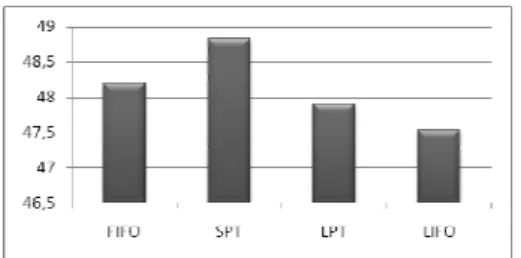
In this section we can see that the results given by DMM/SPT is the best in all cases if the system is saturated. In figure 2 when the system is extremely saturated the difference between SPT and other dispatching rules is very considerable. The SPT gives the best result because the parts having short processing time are the priority in the queue of machines.
Fig. 2. Cycle Time (min) for queue size=2 and creation of the parts (1/5) min.
Fig. 3. Cycle Time (min) for queue size=2 and creation of the parts (1/10) min.
Fig. 4. Cycle Time (min) for queue size=4 and creation of the parts (1/5) min.
Fig. 5. Cycle Time (min) for queue size=4 and creation of the parts (1/10) min.
B. Work in process
In this case (work in process) we can not say that a rule is better than the others since the difference between the results is not significant and the results are almost identical.
Fig. 6. Work in process for queue size=2 and creation of the parts (1/5) min.
Fig. 7. Work in process for queue size=2 and creation of the parts (1/10) min.
Fig. 8. Work in process for queue size=4 and creation of the parts (1/5) min.
Fig. 9. Work in process for queue size=4 and creation of the parts (1/10) min.
C. Production rate
In this paragraph we present the results of the production rate. These results are the average of ten replications, obtained after the simulation of DMM method with four dispatching roules (FIFO, SPT, LPT and LIFO). Rate of part leaving the system is calculated by dividing the number of parts left the system on the number of parts created, in order to make standardization. We can see that
4
the SPT rule give the better results whatever the system state because the priority in the queues of machines is given to the parts having the shortest processing time.
Fig. 10. Rate in (%) of parts leaving the system for queue size=2 and creation of the parts (1/5) min.
Fig. 11. Rate in (%) of parts leaving the system for queue size=2 and creation of the parts (1/10) min.
Fig. 12. Rate in (%) of parts leaving the system for queue size=4 and creation of the parts (1/5) min.
Fig. 13. Rate in (%) of parts leaving the system for queue size=4 and creation of the parts (1/10) min.
5.CONCLUSION
The results show that for the system studied in case of saturation, method DMM / FIFO does not give the best results and the methods DMM/SPT and DMM/LPT exceed it in the case of cycle time and the production rate, for the work in process method DMM / FIFO is not far from the other methods but those who still gives the lowest results. Now we must explore and study other systems and other criteria.
REFERENCES
[1] J. Liu and B. L. MacCarthy, “A goal MILP model for FMS scheduling”, European journal of operational research, 100, 441-453, 1997.
[2] S. Nof, M. Barash, and J. Solberg, “Operational control of item flow in versatile manufacturing system”, International journal of production research, 17, 479-489, 1979.
[3] S. Y. D. Wu and R. A. Wysk, “An application of discrete event simulation to on-line control and scheduling in flexible manufacturing”, International journal of Production Research, 27, 1603-1623, 1989.
[4] N. Ishii and M. Muraki, “A process-variability-based on-line scheduling system in multi product batch process”, Computing in Chemical Engineering, 20, 217-234, 1996.
[5] C. Saygin and S.E. Kilic, ”Integrating flexible manufacturing systems with scheduling in flexible manufacturing system”, International journal of advanced Manufacturing Technology, 15(4),268-280, 1999.
[6] C. Saygin and S. E. Kilick, “Effect of flexible process plans on performance of flexible manufacturing systems”, proceedings of 7th International DAAM symposium, Vienna, Austria, 393-394, 1996.
[7] C. Basnet and J. H. Mize, ”Scheduling and control of flexible manufacturing systems: a critical review ”, International journal of Computer Integrated Manufacturing, 7(6), 340-355, 1994. [8] C. S. Shukla and F. F. Chen, “The state of the art in intelligent
real-time FMS control: a comprehensive survey”, Journal of intelligent Manufacturing, 7, 441-455, 1996.
[9] C. Peng and F.F. Chen, "Real-time control and scheduling of flexible manufacturing systems : a simulation based ordinal optimization approach", International Journal of Advenced Manufacturing Technology, 14 (10), 775-786, 1998.
[10] A. Kazerooni, F. T. S. Chan, and K. Abhary, "A fuzzy integrated decision-making support system for scheduling of FMS using simulation", Computer Integrated Manufacturing Systems, 10 (1), 27-34, 1997.
[11] H. Cho and R. A. Wysk, "Intelligent workstation controller for computer-integrated manufacturing : problems and models", Journal of Manufcturing Systems, 14(4), 252-263, 1995. [12] C. Saygin, F.F. Chen, and J. Singh, “Real-Time Manipulation of
alternative Routings in Flexible Manufacturing Systems: A simulation Study”, International journal of advanced Manufacturing Technology, 18, 755-763, 2001.
[13] A. Hassam, " Manipulation des routages alternatifs en temps réel dans les systèmes flexibles de production ", Magister, Abou Bekr Belkaid University, Tlemcen, 2006.
[14] L. Ghomri, Influence des contraintes et des perturbations sur les performances des règles de routages dans un FMS, la conférence internationale Conception et Production Intégrées, CPI’07, 2007. [15] M. Souier, A.Hassam, and Z. Sari, "Metaheuristics for real time
routing selection in FMS", Book chapter in: Lyes Benyoucef and Bernard Grabot (ED.), Artifical intelligence techniques for networked manufacturing enterprises management, Springer-Verlag, ch. Pp.221-247.ISNB 978-1-84996-118-9, 2010
![Fig. 1. Flow chart of DMM rule [12].](https://thumb-eu.123doks.com/thumbv2/123doknet/14461300.712751/2.892.476.805.396.958/fig-flow-chart-dmm-rule.webp)