HAL Id: hal-01570711
https://hal.laas.fr/hal-01570711
Submitted on 31 Jul 2017HAL is a multi-disciplinary open access archive for the deposit and dissemination of sci-entific research documents, whether they are pub-lished or not. The documents may come from teaching and research institutions in France or abroad, or from public or private research centers.
L’archive ouverte pluridisciplinaire HAL, est destinée au dépôt et à la diffusion de documents scientifiques de niveau recherche, publiés ou non, émanant des établissements d’enseignement et de recherche français ou étrangers, des laboratoires publics ou privés.
Hermetic cavities using gold wafer level
thermocompression bonding
Samuel Charlot, Patrick Pons, Monique Dilhan, Isabelle Vallet, Sebastiano
Brida
To cite this version:
Samuel Charlot, Patrick Pons, Monique Dilhan, Isabelle Vallet, Sebastiano Brida. Hermetic cavities using gold wafer level thermocompression bonding. Eurosensors, Sep 2017, Paris, France. 2p. �hal-01570711�
Hermetic cavities using gold wafer level thermocompression bonding
Charlot Samuel1, Pons Patrick1, Dilhan Monique1, Vallet Isabelle2, Brida Sebastiano21.LAAS-CNRS, Université de Toulouse, CNRS, Toulouse, France 2. Company Esterline, Bourges, France
Summary
This paper presents the study of gold/gold thermocompression bonding at silicon wafer level. The first samples contains sealing rings and electrical pads and are characterized on pull and shear test showing bond strength similar to silicon/glass anodic bonding (10MPa-80MPa). A sealed cavity and a piezoresistor on a 30µm-thick silicon membrane are added in the second samples. Helium test, membrane deflection and piezoresistor signal monitoring after aging 14 days at 250°C confirm the vacuum stability inside the cavity after bonding.
Motivation and results
Several bonding techniques [1-5] exist to ensure hermeticity and protection of sensor inside micro-cavities. The analysis of gold thermo-compression bonding performed here contains both sealing ring and electrical contacts. To qualify our process, two different structures are realized to test bond strength (Figure 1) and hermeticity (Figure 2). For both structures, two 4 inches 500µm-thick, double-sided polished silicon wafers with 200nm-thick thermal SiO2 are used. On each wafer, a diffusion barrier followed by 50nm/500 nm Ti/Au evaporated seed layer is deposited. Then a 3µm-thick electroplating gold is deposited inside a patterned resin mold in order to define sealing rings and electrical pads. For the second structure, a square membrane (30µm-thick and 2000µm-side) and piezoresistors are added. For both structures, we used a SUSS-SB6 bonder to perform the thermocompression bonding (420°C, 5,7MPa, 50 minutes). We include spacers between the wafers during alignment to obtain vacuum inside the cavity (5.10-3mbar). After bonding and dicing, some dies are polished to observe the gold structure at
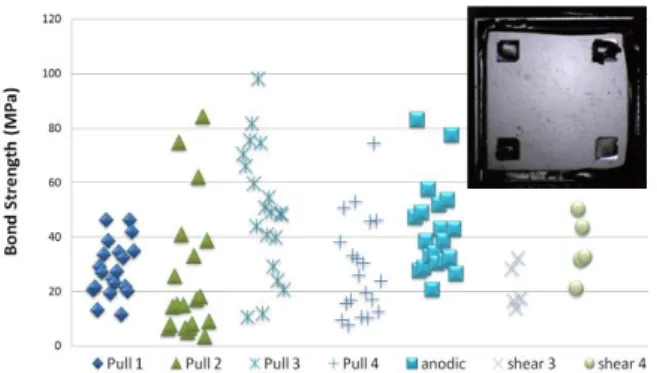
the interface (Figure 3). No delamination is observed between the different materials showing a complete atomic diffusion at the gold interface bonding. Batches of 20 dies are then selected from different wafer areas for pull and shear tests. Most of the dies exhibit cohesive fracture in silicon with tensile strength comparable or superior to silicon/glass anodic bonding (figure 4). Even if pull tests are often used for the qualification of bond strength, this technique don’t give reproducible results compared to shear test. High rate leakage through bonding interface has been evaluated with structure 2 by monitoring the membrane deflection several hours after bonding with a mechanical profiler. Measurements show deflection between 4µm and 5µm for 75% of the cells, which is consistent with simulation and technological process variations. In order to check more precisely the leakage, the dies (after breaking the thin silicon membrane) are glued on a special tool where one side of the die is exposed to He and the other side is connected to vacuum (1.10-9 mbar) detector equipment (Figure 5). The mean leak measured by He
detector was 10-8 mbar.l/s for the best dies structure bonded which correspond to an excellent hermeticity.
The hermeticity reliability has been characterized by following the response of a piezoresistor placed on the membrane after aging at 250°C during 14 days for 6 cells (Figure 6). The piezoreristance shift is lower than 250 ppm for the best cell which correspond to a 75mbar variation inside the cavity.
Word count: 486
References
[1] N. Malik & al., “Environmental Stress Testing of Wafer-Level Au-Au Thermocompression Bonds Realized at Low Temperature,” ECS Journal of Solid State Science and Technology, 4 (7) P236-P241 (2015)
[2] C. S. Tan & al., J. Micromech. Microeng, 21, 075006 (2011). [3] C. H. Tsau & al;, J. Microelectromech. Syst., 13, 6 (2004). [4]. M. V. Taklo & al;, J. Micromech. Microeng, 14, 884 (2004).
[5] Hiroyuki Ishida, “Low temperature hermetic seal bonding for wafer level MEMS packaging using submicron gold particles with stencil printing patterning”, SUSS report 2015..
Corresponding author
Figure 1: Test structure 1. Cross section & top view
Figure 2: Test structure 2. Cross section & top view
Figure 3: Gold optical and SEM cross section after dicing and polishing
Figure 4: Cohesive fracture on silicon die and bond strength obtained with pull and shear tests
Figure 5: He hermiticity setup
Cell
Number 1 2 3 4 5 6
R / R
(ppm) 248 568 333 3770 2370 1070
Figure 6: Piezoresistor shift after aging 14 days at 250°C for 6 different cells