Dynamic Optimization of Interpreters using
DynamoRIO
by
Iris Baron
Submitted to the Department of Electrical Engineering and Computer
Science
in partial fulfillment of the requirements for the degree of
Master of Science
at the
MASSACHUSETTS INSTITUTE OF TECHNOLOGY
September 2003
©
Massachusetts Institute of Technology 2003. All rights reserved.
A uth or ...
Department of Electrical Engineering and &omputer Science
June 27, 2003
11C ertified by ...
Saman Amarasinghe
Associate Professor
Thesis Supervisor
Accepted by ...
...
Arthur C. Smith
Chairman, Department Committee on Graduate Students
MASSACHUSETTS INSTITUTE OF TECHNOLOGY
Dynamic Optimization of Interpreters using DynamoRIO
by
Iris Baron
Submitted to the Department of Electrical Engineering and Computer Science
on June 27, 2003, in partial fulfillment of the
requirements for the degree of
Master of Science
Abstract
Interpreters are widely used in domain-specific, dynamic, and scripting languages. While
their implementation is relatively simple, their performance is poor. In this thesis we
im-prove the performance of interpreters using dynamic optimization techniques. This task is
challenging because the information regarding the interpreted program is not known
un-til the interpreter is run. Efficient implementations of interpreters (such as Just-in-Time
compilers) require a runtime system that performs optimization dynamically, using program
specialization. Such solutions incur high engineering cost. Furthermore, they are usually
language-specific and hardware-dependent, and thus are not portable or reusable.
We create a single software dynamic optimizer that can be applied to different
inter-preters. Our system, DynamoRIO-with-LogPC is based on DynamoRIO's infrastructure,
which is a dynamic optimization tool. While DynamoRIO is very efficient in a broad range
of applications, typical interpreters' implementation foils DynamoRIO's strategy of trace
collection. In addition, DynamoRIO's low-level optimization is unable to extract sufficient
high-level semantics of the interpreted program to perform many of the necessary
optimiza-tions.
We provide simple annotations to the interpreters and modify the trace creation
method-ology of DynamoRIO such that its traces correspond to frequent sequences of code in the
high-level program (the interpreted program), rather than in the interpreter. Then, we use
standard optimization techniques such as constant propagation, dead code elimination, and
partial evaluation to further improve the traces created. We also present two techniques to
avoid unrolling native loops. Such loops might create too long traces that harm performance.
Our experimental results on Kaffe and TinyVM interpreters show that
DynamoRIO-with-LogPC outperforms DynamoRIO and is faster than the native program by 50-90%. While
these results are not comparable with those of a hand-crafted native compiler, we believe
that it provides an appealing point on the language implementation spectrum.
Thesis Supervisor: Saman Amarasinghe
Title: Associate Professor
Acknowledgments
First, I thank my advisor, professor Saman Amarasinghe for giving me the opportunity to work in the exciting area of dynamic optimization. I am grateful for his support during my studies. He always knew how to encourage me on both the professional and personal levels.
A special thank is also due to Gregory Sullivan from the AI Lab for his time and invaluable
comments. Our meetings were always fruitful and it was a pleasure working with him. In addition I want to thank him for providing the TinyVM interpreter that we used. I want to thank the DynamoRIO group members for their help: Derek Bruening, for guiding me in the maze of the DynamoRIO's code, Timothy Garnett for providing the basic optimizations techniques, and Vladimir Kiriansky for handing help when needed. I also want to thank Gleb Chuvpilo, Michael Karczmarek, and David Maze for their friendship.
I would like to thank my parents, Ella and Bruno for teaching me the value of hard work.
Their continues support and understanding helped me to overcome the unavoidable obstacles of life. I thank my brother, Lior for the beautiful memories we share. Traveling together filled me with energy that carried me throughout these years. To my grandmothers, Omi and Buna, I thank for the motivation and encouragement they provided abundantly. To my parents in law - Bracha and Itzik, and Zvika and Hana, and to Meyrav and Mordechai I thank for their open ears, wise advices, and love. To my family, although you are far away, my heart and mind are always with you.
A very special thank is to my son Ethan and to my loving husband Opher. I thank
Ethan, for the joy he brings into our life with each and every smile and cry. And most of all I thank Opher for sharing this exciting path in life with me through bad times and good times.
"Two roads diverged in a wood, and I
-I took the one less traveled by,
And that has made all the difference." Robert Frost
Contents
1 Introduction 11 1.1 Research Objectives . . . . 11 1.2 Thesis Overview . . . . 13 1.3 Interpreters . . . . 14 1.3.1 TinyVM Interpreter . . . . 17 1.3.2 K affe V M . . . . 17 2 Optimizing Interpreters 20 2.1 Ad-hoc Bytecode Interpreter Optimization . . . . 202.2 Program Specialization . . . . 22
2.2.1 Compiling Interpreters . . . . 24
2.2.2 Generating Compilers and Compiler-Generators . . . . 30
2.3 Dynamic Translation and JITs . . . . 31
2.4 Dynamic Optimization . . . . 33
3 Dynamic Optimization and DynamoRIO 35 3.1 D ynam oR IO . . . . 36
3.2 DynamoRIO and Interpreters . . . . 37
4 DynamoRIO-with-LogPC 39 4.1 A nnotations . . . . 40
4.2 Abstract PC and Logical CTI . . . . 40
4.2.2 Instrumenting Kaffe . . . . 44
4.3 Collecting Logical Traces . . . . 46
4.4 L inking . . . . 48
4.5 Discussion . . . . 49
5 Trace Optimization 51 5.1 Immutable Regions and Trace-head Constants . . . . 52
5.1.1 Immutable Addresses . . . . 52
5.1.2 Trace-Head Constant Addresses . . . . 54
5.2 Constant Propagation . . . . 56
5.3 Dead Code Elimination . . . . 58
5.4 Call-Return Matching . . . . 60
5.5 Avoiding Too Long Traces . . . . 60
5.6 Functional Memorization . . . . 61
5.7 Discussion . . . . 63
6 Experimental Results 66 6.1 Performance Summary . . . . 68
6.2 Comparison between DynamoRIO-with-LogPC and DynamoRIO . . . . 71
6.2.1 Trace Utilization . . . . 71
6.2.2 Trace Length . . . . 72
6.2.3 Discussion . . . . 72
6.3 DynamoRIO-with-LogPC and Optimizations . . . . 73
6.3.1 Traditional Optimization Techniques . . . . 73
6.3.2 Avoiding too Long Traces . . . . 75
6.3.3 Functional Memorization . . . . 79
6.4 D iscussion . . . . 79
7 Summary 82 7.1 Thesis Overview . . . . 82
7.2.1 Additional Optimization Techniques . . . . 84
7.2.2 Core Improvements . . . . 87
7.2.3 Simplifying the Instrumentations . . . . 87
7.3 R esults . . . . 88
A List of Instrumentation API 90
List of Figures
1-1 Schematic description of a compiler (a), an interpreter (b) and a virtual-machine (c). 16
1-2 TinyVM 's dispatch loop. . . . . 18
1-3 Kaffe's dispatch loop, and the IADD bytecode implementation. . . . . 19
2-1 Pure bytecode interpreter. . . . . 21
2-2 Direct threaded code. . . . . 22
2-3 Dynamic translation of bytecodes into threaded code. . . . . 23
2-4 Schematic partial evaluator. . . . . 23
2-5 A schematic description of a dynamic compilation system . . . . . 29
3-1 Flow chart of the DynamoRIO system. Dark shading indicates application code. . 37 4-1 Translation of set logical-pc(logical-pc) and logical-direct jump() at instruction
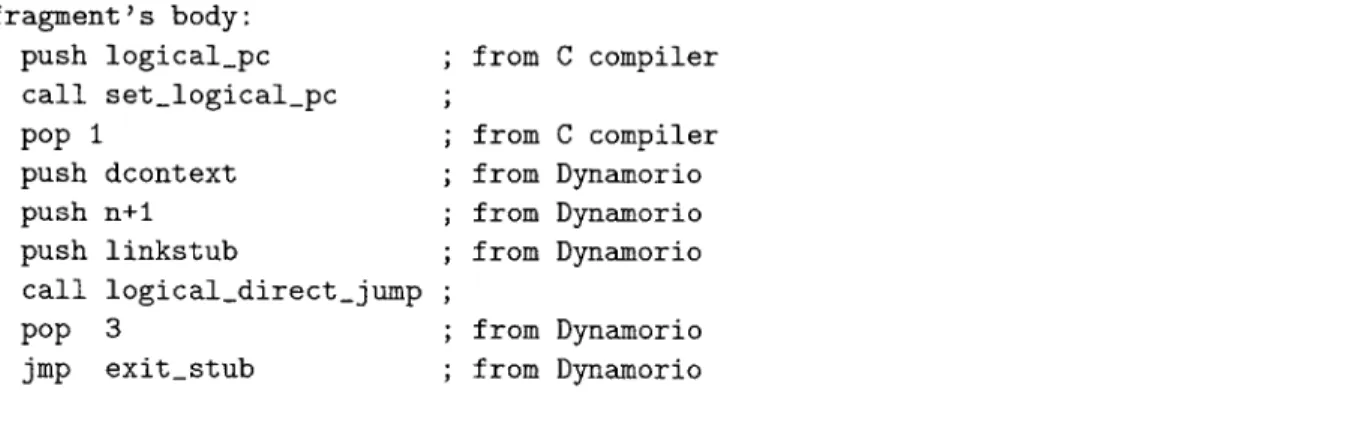
n.
. . . . 424-2 Instrumenting InvokeStatic bytecode in Kaffe. . . . . 46
4-3 Linking functionality in the Logical CTI function. . . . . 48
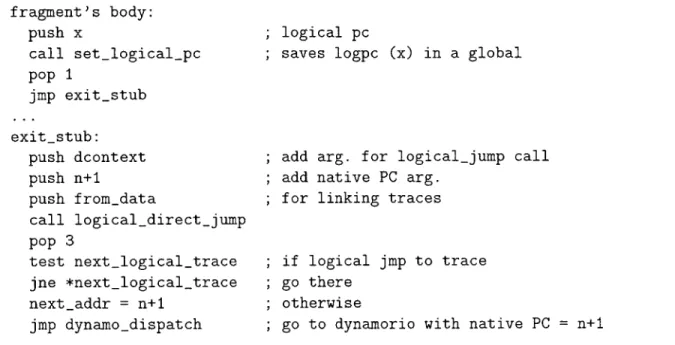
4-4 Translation of logical-direct-jump(x) at instruction n. . . . . 49
5-1 Example to instrumenting Kaffe VM for immutable data. . . . . 53
5-2 Example to instrumenting TinyVM for trace-head constant addresses. . . . . 55
5-3 Example to instrumenting Kaffe for trace-head constant addresses. . . . . 56
5-4 The left table contains constant propagating data. The right table is dead code elim ination data. . . . .
59
5-5 The sequence of instructions, including the functional memorization instrumenta-tion, before and after functional memorization. . . . . 64
6-1 Performance in three configurations, normalized against native execution, for TinyVM benchmarks. The configurations are: DynamoRIO with optimization (DynOpt), DynamoRIO-with-LogPC (DynLog), and DynamoRIO-with-LogPC and optimiza-tions (DynLogOpt). . . . . 68 6-2 Running times in three configurations, normalized against native execution, for
Kaffe. The configurations are: DynamoRIO (Dyn), DynamoRIO-with-LogPC (Dyn-Log), and DynamoRIO-with-LogPC and optimizations (DynLogOpt). . . . . 69 6-3 Running times in two configurations, normalized against native execution, for Ocaml.
The configurations are:DynamoRIO-with-LogPC without optimization (DynLog), and DynamoRIO-with-LogPC and optimizations (DynLogOpt). . . . . 70
6-4 Contributions of separate optimizations, normalized against native execution. The configurations for DynamoRIO-with-LogPC are with: no optimizations (no opt), constant-propagation (const-prop), dead-code-elimination (dead-code), call-return-matching (call-ret), constant-propagation and dead-code-elimination (const-dead), and finally all of these optimizations together (all). . . . . 74
6-5 Total trace sizes of DynamoRIO-with-LogPC for the TinyVM benchmarks. We compare four different configurations of DynamoRIO-with-LogPC: with traditional optimizations and trace reduction (DynLogRed), only with traditional optimiza-tions (DynLogOpt), only with trace reduction (DynLogRed), and without any op-timizations (DynLog). Note that the y axis is with a logarithmic scale. . . . . 76 6-6 Running Times of DynamoRIO-with-LogPC and traditional optimizations, with
and without not-inline optimization, and with part-eval optimization, normalized against native Execution . . . . . 80 7-1 Performance comparison between DynamoRIO-with-LogPC and optimizations on
Kaffe's interpreter and Kaffe's JIT, normalized to the native execution time of K affe's interpreter. . . . . 85
List of Tables
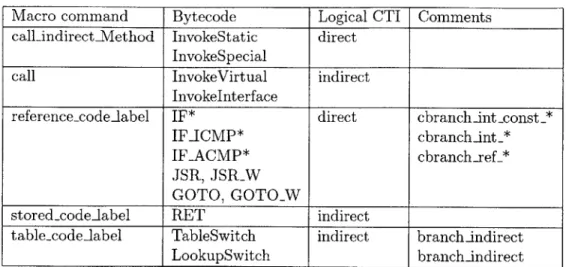
4.1 Bytecodes in Java and their Logical CTI. . . . . 44
6.1 Hottest traces' exit statistics and sizes, for Sieve2 benchmark on TinyVM using DynamoRIO and DynamoRIO-with-LogPC. . . . . 71 6.2 Trace characteristics for DynamoRIO vs. DynamoRIO-with-LogPC (no
optimiza-tions) on TinyVM's benchmarks. The first column gives the number of traces; columns 2,3,4 show the mean, max and min length of traces, respectively (in bytes); last column gives the total memory space for all traces (in bytes). . . . . 72 6.3 Trace characteristics for DynamoRIO-with-LogPC with traditional optimizations
only, on TinyVM benchmarks. The first column is the benchmark's name; second column is the number of traces; columns 3,4,5 are the mean, max and min of the traces, respectively; column 6 is the total memory space for all traces; columns 7 and
8 are the improvements in the total memory space required and in the performance
achieved, respectively. These improvements are one minus the division of the results from DynamoRIO-with-LogPC with traditional optimizations by those from the DynamoRIO-with-LogPC with no optimizations case. . . . . 75
6.4 DynamoRIO-with-LogPC and traditional optimizations, sieve-loop, avoiding too long traces. Traces' length, execution time and cache misses for different configu-ration s. . . . . 77
6.5 Trace characteristics for DynamoRIO-with-LogPC with traditional optimizations and "not-inline" the pop function, on TinyVM benchmarks. The first column is the benchmark name; second column is the number of traces; columns 3,4,5 are the mean, max and min of the traces, respectively; column 6 is the total memory space for all traces; columns 7 and 8 are the improvements in the total memory space required and in the performance achieved, respectively. These improvements are one minus the division of the results from DynamoRIO-with-LogPC with traditional optimizations and "not-inline" the pop function by those from the DynamoRIO-with-LogPC with no optimizations case. . . . . 78 6.6 Total memory space required for traces, for DynamoRIO-with-LogPC and
tra-ditional optimizations, with and without not-inline optimization. The last two columns present the total memory space and performance from without 'not-inline' to with 'not-inline' (in %), respectively. These improvments are one minus the division of the with 'not-inline' results by the ones from the wihtou 'not-inline'. . . 79 A. 1 Instrumentation API divided to categories of use. . . . . 90
Chapter 1
Introduction
1.1
Research Objectives
Interpreters are widely used in domain-specific, dynamic, and scripting languages. Domain-specific languages, for example, are a very powerful problem solving mechanism. They simplify programming by providing a level of abstraction. This allows programmers to focus on the specific class of problem they are facing. Moreover, their high-level notion allows for semantic analysis and good debugger tools.
Building an effective compiler for these languages requires a huge effort; thus, we only see one or two new languages per decade with good compiler support. For this reason, domain specific languages are typically implemented using interpreters. Furthermore, many domain-specific languages include dynamic features such as dynamically dispatch calls, polymor-phism and user-defined control structures that make it difficult or impossible for a compiler to perform static optimizations.
While interpreters' implementation is relatively simple, their performance is several orders of magnitude worse than a low-level compiled language like C. Thus, despite the domain-specific languages' appealing properties, they are far less common than we expect.
Efficient implementations of interpreters (such as Just-in-Time compilers) require a run-time system that performs optimization dynamically, using program specialization. These so-lutions incur high engineering cost. Furthermore, such implementations are usually
language-specific and hardware-dependent, and thus not portable or reusable.
Thus, the motivation for this research is the need to optimize interpreters and VMs, without incurring the costs of developing an expensive custom implementation.
Our main objective is to create a single software dynamic optimizer that can be applied to different interpreters. Our system, DynamoRIO-with-LogPC is based on DynamoRIO's infrastructure with the appropriate changes to fit interpreters. DynamoRIO is a dynamic optimization tool, jointly developed at HP Labs and MIT. While it is very efficient in a broad range of applications, typical interpreter implementations foil DynamoRIO's strategy of trace collection. In addition, DynamoRIO's low-level optimization is unable to extract sufficient high-level semantics of the interpreted program to perform many of the important optimizations.
The design and development of DynamoRIO-with-LogPC includes three phases. In the first one, we modify DynamoRIO such that it will target the interpreted program rather than the interpreter for trace creation. In the second phase, we provide an interface for communicating high-level application information from the interpreter to DynamoRIO-with-LogPC. In the third phase, we implement additional optimization techniques to be performed on the generated traces in the new system.
We demonstrate the use of DynamoRIO-with-LogPC by improving the execution times of benchmarks on two very different interpreters: Kaffe and TinyVM. We consider improving the performances of these two VMs as the practical objective of this thesis. This will serve as a proof-of-concept for applying dynamic optimization in software to interpreters.
Our experimental results are encouraging. They suggest that DynamoRIO-with-LogPC has a high potential for improving performance of interpreters in general. Using simple instrumentation that required only a little familiarity with the interpreter and by chang-ing/adding small percentage of the code (e.g., in Kaffe VM we changed 70 lines of code out of the 25,000 of line codes that deal with the interpreter), we improved native execution times of interpreters by 50-90%. While these results are not comparable with the ones of a hand-crafted native compiler, we believe that this system provides an appealing point on the language implementation spectrum.
1.2
Thesis Overview
In this chapter we introduce the notions of compilers and interpreters and explain why interpreters are typically slower than compiled programs. We also present two, essentially different, examples for VMs: the TinyVM, which is a simple bytecode interpreter written in
C (by Dr. Greg Sullivan of AI Lab at MIT), and Kaffe, which is an open-source VM for Java.
In chapter 2 we survey different approaches to improve interpreters' performance. We explain each technique and point to relevant literature in that field. Among the techniques discussed in that chapter are: run-time code generation, dynamic compilation, and JITs. Chapter 3 discusses the dynamic optimization technique, and gives an overview of DynamoRIO, the dynamic optimizer infrastructure that we use. DynamoRIO identifies and collects traces, which are native sequences of frequently executed code, during runtime. Then it optimizes these traces, and emits them to the cache. This process improves the performance of many applications; however, it is not effective for interpreters and VMs, because it generates traces for the interpreter rather than for the interpreted program. These traces are typically short and not well utilized.
In chapter 4, we explain how we modified DynamoRIO to support optimization of preters and VMs. We designed DynamoRIO-with-LogPC so that it would target the inter-preted application instead of the interpreter. The use of DynamoRIO-with-LogPC requires simple annotations to the interpreters. These annotations provide DynamoRIO-with-LogPC with the information regarding the high-level (interpreted) program's representation. Using theses annotations DynamoRIO-with-LogPC creates traces that correspond to frequently used code sequences in the application. These traces are longer and better utilized than the ones generated by DynamoRIO.
In chapter 5, we extend the optimization capability of DynamoRIO-with-LogPC. We use three classes of optimizations: "traditional" (used by DynamoRIO), avoiding too long traces, and functional memorization. Some of these optimizations may benefit from adding optional annotations to the interpreters. The first class is enhancing the traditional optimization tech-niques: constant-propagation, dead-code-elimination, and call-return-matching. To improve the efficiency of constant-propagation and dead-code-elimination, we use immutable regions
and introduce trace-head constants (for both global and stack-allocated addresses). For the second class we first explain the need to avoid too long traces. Then, we propose two tech-niques to shorten traces: The first one is to constrain the number of basic-blocks in a trace to be smaller than a given maximum; The second technique is not to inline functions that contain loops. The third class of optimizations, partial-evaluation, uses a more aggressive optimization: for specific type of functions, it completely eliminates the function call and replaces it with the function's returned value.
Chapter 6 presents extensive experimental results from Kaffe and TinyVM interpreters, for both execution time and memory usage (trace length). We chose these VMs as they are very different in their characteristics. TinyVM is a simple stack VM, and Kaffe has a more complex internal representation. We compared the results of DynamoRIO, and DynamoRIO-with-LogPC with and without optimizations, to the native run time. For both
VMs, DynamoRIO-with-LogPC and optimizations is by 30 -- 80% faster than the native run
time.
These results show that performance improvement can be obtained with DynamoRIO-with-LogPC for small programs such as the TinyVM benchmarks, where native execution times are less than a minute, as well as for large programs such as the SpecJVM98 bench-marks, where native execution times are tens of minutes.
Finally, chapter 7 outlines possible directions for future research and summarizes this thesis.
In the next section we provide a basic background on interpreters and VMs.
1.3
Interpreters
Computers are programmed in multiple levels of abstraction. Low-level languages, such as assembly, are closer to the architecture and directly map to the instruction set of the host CPU. In contrast, high-level languages, such as C and Matlab, are closer to human languages. In high-level languages, each instruction represents one or more machine language instructions.
com-bination of both. A compiler translates the high level code (source code) into a machine code (target code) that can be run later on. Running the program after changing the source code requires an additional compilation. Interpreters execute the high level program during runtime without creating a target code. This is known as a "one-level of interpretive indirec-tion." Because of this interpretive indirection, interpreters are, typically, slower than target codes. Therefore, in this thesis we look for techniques to improve interpreters' performance. The advantages of interpreters are threefold. First, they are easy to write and understand, because they follow the logic of the high level language, and they do not require the generation of a corresponding low level program. Thus, they are simple and easily portable. Second, because of their nature (executing the source program directly) interpreters, usually, have good error messages and include a good source-level debugger. Both help in the programming process. The third advantage is the dynamic flexibility of interpreters. Some languages, as Lisp, Prolog and Scheme, can add code to themselves or change the behavior of part of their code during runtime. The dynamic nature of such languages requires an interpreted implementation.
There are implementations that combine compilers and interpreters. First, a compiler translates the high-level code into an intermediate representation of the code's (bytecodes). Then, a virtual-machine (VM) executes this intermediate code, as an interpreter does. This allows the code to be written and compiled to an intermediate code by the programmer, and then to be executed using an appropriate VM on all the machines running the user's application. A concrete example of a language that is implemented in this form is Java. However, VMs, similarly to interpreters, suffer from an interpretive overhead.
Figure 1-1 (from [45]) shows the relations between a compiler, an interpreter, and a VM. When running a program under an interpreter or a VM, one pays extra time for executing the interpreter-related logic, in addition to the "real work" of the application. This overhead is known as "interpretive overhead," and it is the main reason that interpreters are slower than target codes. In addition, compilers can afford to spend more time on optimizations, because the compilation is done only once and is not a part of the program's run time. As a result, compilers generate efficient target code.
(a)
High-level (Source) Program
Compiler
- Target ProgramInput --. Target Program -. Output
(b)
High-level (Source) Program Interpreter Output
Input
Inepetr
- Otu(C)
High-level (Source) Program Translator Intermediate Program
Intermediate Program Virtual-Machine - Output
Input L
Figure 1-1: Schematic description of a compiler (a), an interpreter (b) and a virtual-machine (c).
early-binding decisions, and use them to generate efficient code. In contrast, interpreters use late-binding technique and analyze the declaration of variables each time the program runs. Moreover, interpreters analyze the declaration of local variables within subroutines every time the subroutine is called.
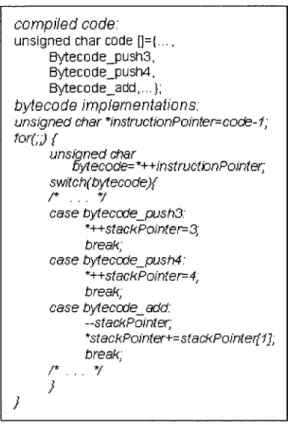
A "Pure Bytecode Interpreter" consists of a loop that increments the instruction pointer,
fetches the next bytecode from memory, dispatches to the routine that implement that bytecode (involves some conditional control flow such as a switch statement), jumps to bytecode-specific instructions, and loops (increments the instruction point and jumps to the head of the loop).
Another typical form of interpreter implementation is the "read-eval-print" loop. It is used in many scripting languages and debuggers. The interpreter displays a prompt and is waiting for input. Upon receiving the required input, it reads an expression, evaluates it, prints the result and displays another prompt.
All these implementations suffer from the interpretive overhead. They can be improved
using different optimization techniques. An overview of these techniques is given in the next chapter.
In the rest of this thesis, we use both interpreters to demonstrate and examine the concepts
we develop. Both interpreters are implemented using switch-based technique, derives from the pure bytecode interpreter.
1.3.1
TinyVM Interpreter
TinyVM is a simple VM written in C. Its main dispatch loop deconstructs the element of the bytecode vector instrs, using pc as an index into the array of bytecodes; then it finds the matching case in a switch statement, executes the relevant code, and jumps back to the head of the loop. Figure 1-2 illustrates the implementation of the interpreter's dispatch loop
in TinyVM.
1.3.2
Kaffe VM
Kaffe is an open source Java VM written in C. Similar to TinyVM, the interpreter's imple-mentation is a switch-based. Kaffe uses recursive tree-walking impleimple-mentation for its Java method invocation. Each method invocation, which is not a native method is loaded by the VirtualMachine function and then executed by the run VirtualMachine. The interpreter dispatch loop is an infinite loop which executes the bytecode sequentially, until reaches one of the return-from-method bytecodes. The cases are structured in the kaffe.def. They use macros of the instruction definition, which are defined in icode.h file. Figure 1-3 illustrates the implementation of the Kaffe interpreter's dispatch loop for the IFEQ bytecode.
loop:
op = instrs[pc] .op;
arg = instrs[pc].arg; switch (op) {
case CALLOP:
... setup new call frame ...
pc = arg; /* go to start of function body */ goto loop;
case RETOP:
... clean up stack ...
pc = pop-rawo; /* pop the return PC */
*(++sp) = val; /* put return value back on stack */
goto loop; case BEQOP: n = pop-into; if (n) { pc++; } else { pc = arg; } goto loop; /* /*
top must be an int */ not equal 0 */
just continue */ equal 0 */ do the branch */
Figure 1-2: TinyVM's dispatch loop.
in machine.c:
void runVirtualMachine(methods *meth, slots *lcl, slots *sp, uintp npc,
slots *retval, volatile vmException *mjbuf, Hjava-langThread *tid) {
bytecode *code = (bytecode*)meth->c.bcode.code;
for (;;) { register uintp pc = npc; assert(npc < meth->c.bcode.codelen); mjbuf->pc = pc; npc = pc + insnLen[code[pc]]; switch (code[pc]) { default:
dprintf ("Unknown bytecode %d\n", code[pc]); throwException(NEWLANGEXCEPTION(VerifyError)); break;
#include "kaffe .def" } } end: return; } in kaffe.def: define-insn(IFEQ) {
idx = (int16)((getpc(O) << 8) 1 getpc(1)); begin-synco; cbranchint_consteq(rstack(O), 0, referencecodelabel(pc+idx)); pop(l); endsynco; } in icode.h: (macros)
#define cbranchint_const-eq(sl, s2, w) if ((sl)[OI.v.tint == (s2)) { w; }
#define referencecode§label(l) npc = (1)
Chapter 2
Optimizing Interpreters
In this chapter we present different approaches for improving interpreters' performance. Section 2.1 describes ad-hoc optimization for more efficient implementation of interpreters. Another type of optimization is program specialization, as described in section 2.2. This area includes many techniques; we present a few of them, such as run-time code generation and dynamic compilation. Dynamic translators and Just-In-Time compilers can also be consid-ered program specializers. Due to their popularity, we dedicate section 2.3 to them. Finally, in section 2.4 we mention the dynamic optimization technique that is further described in the next chapter.
2.1
Ad-hoc Bytecode Interpreter Optimization
An interpreter's performance is directly correlated to its implementation. The pure bytecode interpreter described in section 1.3, suffers from large overhead: each bytecode implementa-tion involves at least two memory references and two jumps, aside from the dispatch lookup (the switch). This overhead is more substantial when executing simple bytecodes. An ex-ample of such an interpreter is seen in Figure 2-1 (copied from [41]).
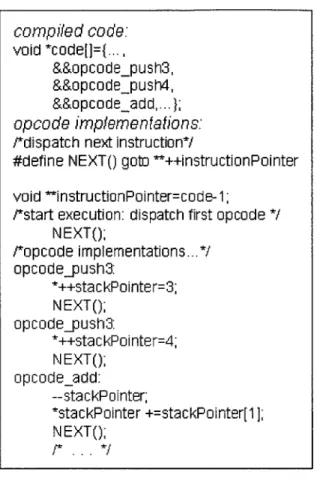
To overcome these problems, threaded code was first used as part of the Forth program-ming language, described by Moore and Leach [39], and then used as direct threading in [19]. The direct threaded code technique improves performance by removing the dispatch lookup
Figure 2-1: Pure bytecode interpreter.
and eliminating the centralized dispatch. In direct threading, each bytecode represents the implementation address. Thus, the dispatch involves fetching the bytecode and jumping directly to its implementation address; Furthermore, each direct threaded bytecode imple-mentation ends with code that dispatches to the next bytecode. This procedure eliminates the need for a centralized dispatch. Figure 2-2 (copied from [41]) displays a direct threaded code for the bytecode interpreter from Figure 2-1.
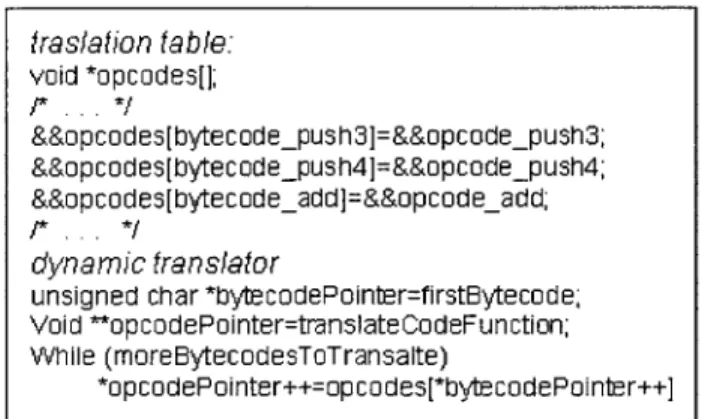
To obtain direct threaded code, we can dynamically translate bytecodes into their direct threaded representation, before executing the code. The translation process involves a loop that reads the bytecode, looks up its implementation address, and creates the direct threaded code. An example for this is given in Figure 2-3 (copied from [41]).
Dynamic translation to threaded code allows additional bytecodes to exist. Moreover, by specifying different implementations for the same bytecode ("overloaded" bytecodes) during translation time, it also allows the creation of a "macro"bytecode from a common sequence of bytecodes (during execution time). In addition, this technique removes the dispatch
compiled code:
unsigned char code []={...
Bytecodepush3,
Bytecodepush4,
Bytecodeadd,... };
bytecode implementations:
unsigned char instructionPointer-code-1;
tor(;;) f
unsigned char
Dytecode=*++fnstructbonPointer* switch(bytecode){
/* . .. */
case bytecode push3: *++stackPointer=3; break; case bytecodepush4: *++stackPonter=4; break; case byecodeadd: --stackPointer *stackPointer+=stackPointer1]; break; /* . */ } }
Figure 2-2: Direct threaded code.
overhead, improves code locality, and permits inter-bytecode optimization by the compiler. Dynamic translation to threaded code was used in Squeak, a portable "pure bytecode"
implementation [23], in BrouHaHa, a portable Smalltalk VM [37], [7], and in Objective Caml [34].
An extension to this approach is to dynamically find the best choice of common sequences of bytecodes to translate. It is done by selective inlining during the translation of bytecode to threaded-code or as a separate pass over the threaded code. This technique was introduced
by Piumarta and Riccardi [41] and results in very good performances for any application.
2.2
Program Specialization
Program specialization is a program optimization technique that is also known as "partial evaluation". We first explain the meaning of it in the general context, and then demonstrate
compiled code:
void *code[]={..., &&opcode_push3, &&opcode_push4, &&opcode_add,... };opcode implementations:
/*dispatch next instruction*/
#define NEXT() goto **++instructionPointer
void **instructionPointer=code-1;
/*start execution: dispatch first opcode */
NEXTO; /*opcode implementations...*/ opcode_push3: *++stackPointer=3; NEXTO opcode_push3: *++stackPointer=4; NEXT(, opcodeadd: --stackPointer *stackPointer +=stackPointer[ 1]; NEXTO; /* ... */
Figure 2-3: Dynamic translation of bytecodes into threaded code.
its use in optimizing interpreters. Standard references to the subject of partial evaluation
are [25] and [24].
Partial evaluation's basic definition is as a source-to-source transformation, i.e. program P and part of its input data, inl, are transformed into a new specialized program, Pini, using a partial evaluator (PE), mix. Running Pini on the rest of the input data should yield the same results that P yields when running on all of the input data.
[[P]][inl, in2] = [[ [[mix]][P, inl] ]] in2 = [[Pin1]] in2
In other words, all calculations that involve only inl are pre-computed in P; however, new code is generated for calculations that depend on other input data. P is said to be specialized with respect to inl. Figure 2-4 presents a schematic partial evaluator.
Static input, inl Evaluato , Specialized program, Pinl
General Program P Partial E r, "mix"
Dynamic input, in2 ' Specialized program, Pi . Output
Figure 2-4: Schematic partial evaluator. Programs that might benefit from partial evaluation are:
1. Highly parameterized programs: In such programs a long time is spent inspecting
parameters which are often the same.
2. Similar subcomputations: Programs that can benefit from computing a common part only once and use it again when needed.
traslaton table: void *opcodes[]; /* ... */ &&opcodes[bytecodepush3]=&&opcodepush3, &&opcodes[bytecodepush4]=&&opcodepush4, &&opcodes[bytecodeadd]=&&opcode add; /* ... */ dynamic translator
unsigned char *byte codePointer=firstByteco de; Void **opcodePointer=translateCodeFunction;
While (moreBytecodesToTransalte)
3. Highly interpretive programs (such as interpreters and simulators): By specializing
the interpreter with respect to the program being run, the interpretive overhead can be removed. In simulators, specializing with respect to the object being simulated eliminates the object's scanning time.
4. Database query search algorithms: We can specialize the program with respect to often used queries.
The rationale behind such specializations is that a more efficient code can be generated, as the level of available information increases. Conceptually, partial evaluation is simple, and therefore it was implemented in many areas, such as computer graphics, Fast Fourier Transformations (FFT), circuit simulation, compiler and compiler generator, pattern match-ing, and more. Partial evaluators in practice started in the mid-70s with partial evaluators for Lisp [26] and Prolog [31]. Today they are used for many different languages, such as
Scheme (Similix [6] and Schism [12]) and C (C-mix [2] and Tempo [13]).
The notion of partial evaluation can be used with interpreters to specialize them with respect to a specific program. This technique is called "compiling interpreters". Many of the practical solutions, such as dynamic code generation and dynamic compilation, rely on this technique. Another use of partial evaluation in the context of interpreters is "generating compilers and compiler-generators" from the interpreter. In the next subsections we briefly review these techniques.
2.2.1
Compiling Interpreters
Assuming there is an interpreter, int, and a source program, P. The result of running partial evaluator, mix, on these two is a target code:
target = [[mix]][int, P].
The mix function takes a source program and an input and produces a specialized version of the source program (in our case, the interpreter). The target program is a specialized interpreter, in the language that the interpreter is written in.
We expect a specialized interpreter to be faster than the original one when running on
overhead). Yet, we do not expect the specialization to reach the performance of a well-designed compiler, because it cannot perform optimizations based on the semantics of the interpreted code (the input, P).
There are two types of partial evaluators that can be invoked at compile-time; online and offline. The online partial evaluator takes as input the program and the subset of input data that is static; then, by doing "symbolic computation" of the available data, it obtains a specialized program. The offline partial evaluator, has two steps. In the first one, it performs binding-time analysis in order to determine which part of the input is static (known) and which part is dynamic (unknown). In the second step, the offline partial evaluator uses the real specialization values to generate the specialized program. The result is source code for the specialized program, which may be compiled to obtain an executable program.
In dynamic languages the specialization values are not known at compilation time (this is also the reason that it is difficult for a compiler to perform optimizations statically). This constrains the effectiveness of offline partial evaluators, and motivates the use of run-time specialization. Run-run-time specializers do not perform source-to-source transformation, rather they produce executable code from the specializations. They are based on offline specialization, but the real values are filled in at runtime. Run-time specializers are widely used in run-time code generation, dynamic compilation and automatic specialization. Next, we describe the use of these techniques and explain how they can be used in relation with interpreters.
Run-Time Code Generation
Run-time code generation (also called "Dynamic code generation") is a process in which new code is added to the instruction stream of an executed program. It usually uses run-time information for generating specialized code. This type of information is not available statically; thus, it cannot be used during the compilation process. Keppel et al. [30] gives an example for the potential of run-time code generation. They considered an interactive program, in which the user enters an expression that is to be evaluated once for each item in a data set (such as matching regular expression with lines in a file). Using dynamic code
generation, we can dynamically compile the expression into a special-case function and then use this function for each input data in the datum.
Dynamic code generation has been used to improve performance in many areas: operat-ing systems, dynamically typed languages, simulators, matrix manipulation and compiloperat-ing interpreters. Here are additional examples for its use:
1. Hardwiring infrequently changing runtime values into the executable program: this
allows for constant-propagation, constant-folding, removing branches that depend on these values, and removing unnecessary load time. Of course, it should be regenerated each time that these values change [22, 43].
2. Matrix manipulation: programs can be specialized with respect to the matrix's char-acteristics, e.g. in multiplication of sparse matrices
[20].
3. Compilation of small languages (such as query languages): we can benefit from
dy-namically compiled queries, in which the program is specialized with respect to some fields, values, and boolean operators. This improves performance, especially in large databases [9].
4. Frequently interpreted parts of the program: these parts can be compiled and directly executed. Interpreters are a perfect application for dynamic compilation in which the interpreted program is a runtime constant [15],[35].
In [15], a run-time code generation implementation for smalltalk-80 bytecode VM was described. This implementation dynamically collects a sequence of VM instructions, compiles them to native code while performing simple optimizations, and caches them. This technique showed better performance than the ad-hoc optimizations described in section 2.1. Another application that uses run-time code generation with interpreters is SELF, presented in [10]. Some dynamic code generators have a specific language that is used to write programs that generate dynamic code at runtime. Such languages provide high-level notations that allow users to write programs that manipulate code.
DCG [18] provides an interface for the programmers to manually construct routines. It
These routines are compiled by DCG and result in an executable code, which can be invoked
by an indirect call. Then, at runtime, the compiled code is executed, and a fast code
generator is invoked to compile the new code. In order to save time, the dynamic code generator used in DCG, is very simple; it provided no instruction scheduling or elaborated register allocation.
'C (Tick C), developed by Engler et al. [17], originally used DCG as its dynamic code
generator. It provides an extension of the C language (extending the ANSI C library), to support dynamic code generation. The programmer uses the extended library to write programs that explicitly manipulate, compose, and compile program-fragments at runtime. These programs look like fragments of C code, which eases the programming burden. In addition, 'C provides an opportunity to perform static analysis, in order to reduce the overhead of generating code at runtime. After the introduction of VCODE [16], which is (more than an order of magnitude) faster than DCG, 'C was re-implemented using VCODE as its dynamic code generator [42]. VCODE is a template-based system for dynamic code generation that provides a similar interface to the one of an idealized RISC architecture.
VCODE also generates code in-place, without representing the code in data structures. Thus,
the resulting dynamic compiler made 'C a very fast and efficient dynamic code generator. In addition, the target code it produces is highly efficient.
The run-time code generation implementations described above allow programmers to manually program the dynamic code generation. This is known as an imperative/operational approach. On the one hand, it is controllable and flexible. On the other hand, it increases the programming effort. It also requires the programmer to well understand the code generation process and therefore it is error-prone.
Dynamic Compilation
Another approach to run-time specialization is the declarative approach, in which users declare (by annotation) guidelines for the dynamic code generator. The term "dynamic compilation" specifies the part of the compilation done during the execution of the program. Similar to run-time code generation, dynamic compilation systems also perform run-time
specialization, in order to take advantage of information available at runtime. But unlike run-time code generation, which is written manually, these systems create templates that are automatically filled at runtime, using only hints from the programmer.
Dynamic compilation simplifies the programmers' part and puts the complexity at the dynamic compiler's end. Thus, the main focus of dynamic compilation systems is on re-ducing time spent in the dynamic compiler. This is done by performing extensive offline pre-computations, and, similarly to run-time code generation systems, by restricting the optimization performed by the dynamic compiler.
This technique is sometimes called "deferred compilation". Leone and Lee [33] describe a "lightweight" approach for dynamic code generation, where compilation of some parts of the program is postponed until runtime, to better optimize programs.
An annotation-based dynamic compilation system for C, was presented by Auslander et
al [4]. This system defines annotations that indicate parts of the program that should be
compiled dynamically (dynamic regions) and source variables that remain constant during the execution of the dynamic regions. This system is sometimes referred to as "selective dynamic compilation" since it performs run-time specialization only on a portion of the code. Its goal is to move much of the burden of dynamic compilation to the static compi-lation phase. This system is a template-based system that contains a static compiler and a dynamic one. During static compilation the dynamic regions are analyzed based on the programmer's annotations. This analysis determines which variables and data structures would be invariable (constants) at runtime. The static compiler generates set-up code that calculates values of the derived runtime constants. It also creates pre-compiled machine-code templates, whose instructions contain holes that would be filled with runtime constant values. Then, the static compiler generates directives. These directives instruct the dynamic compiler how to produce executable code from templates and computed constants of the set-up code's (e.g., to copy blocks and update offsets of branches). The static compiler also performs optimizations on the templates it created.
The dynamic compiler needs only to follow the directives to instantiate the machine-code templates. It runs the set-up code once to get the values of the constants, fills in the holes based on labels, and executes all of the directives. Figure 2-5, taken from [41 describes this
schematic system.
Static code
annotated
Static
Executable
source
Compiler
dynamic
Programs
code
j
templates
Dynamic
set-up code
.
Compiler
run-time values
(Stitcher)
directive
Static Compile Time..
...Dynamic Compile Time.
.
Figure 2-5: A schematic description of a dynamic compilation system.
During execution the specialized code can be reused if the runtime values match those that were used to specialize it. If a dynamic region is invoked with different runtime values, multiple versions of the specialized code can be stored and maintained. Each time the execution enters a dynamic region, a dispatcher selects the appropriate specialized version, based on the runtime values, or invokes the dynamic compiler to produce a new specialized version.
The declarative approach leads to a shorter dynamic compilation time in comparison to imperative/operational approach. However, since the correctness of the specialization de-pends on the annotations, it is still error-prone. Moreover, it is less flexible and controllable. An improved system, based on the system described above, is DyC presented by Grant et al. [21]. In this system, the annotations are more expressive, flexible, and controllable, while the core system is similar to its predecessor [4].
Automatic Specialization
It is hard to predict the performance gain from a run-time specializer. Therefore, using manual annotations requires programmers to perform a trial-and-error loop in order to tune the choices of dynamic regions and runtime variables. Automatic specialization replaces the manual annotation presented earlier with automatic system that infers annotation based only on a description of the known inputs. This technique is more reliable, because it requires little or no modification of the interpreter.
Calpa [38] is an automatic generator annotation for DyC that combines program anal-ysis and profile information. It first creates an instrumented version of the program that generates and summarizes value and frequent data. Then, Calpa runs this version on some representative inputs, yielding an execution profile for that program. An annotation selection tool analyzes all opportunities for run-time specialization in terms of cost versus benefit and chooses the optimal ones. Then, Calpa runs DyC, which was mentioned before. Other au-tomatic program specialization are C-Mix, developed at DIKU [2], and TEMPO, developed
at IRISA [13].
2.2.2
Generating Compilers and Compiler-Generators
Program specialization can be further extended to generate a compiler from an interpreter [27] and [28]. It involves a self-application that uses mix to specialize itself. In the context of interpreters, this creates a compiler, which is a specialized version of the interpreter:
compiler= [[mix]] [mix, int].
Now, the compiler is applied to the source program P, and generates the target: target = [[mix]] [int, P] = [[ [[mix]][mix, int] ]] P = [[compiler]] P
Using the same concept we can define a compiler generator. This would be a program that transforms interpreters into compilers:
target = [[P]][inl, in2] =
[[
[[mix]][P, inl] ]]in2
=[[
[[
[[mix]][mix,P] ]] in1 ]] in2
=[[
[[[[[[mix]] [mix,mix] ]] P ]] inl ]] in2
== [[[[[[compiler - gen]] P ]] inl ]] in2
2.3
Dynamic Translation and JITs
The basic idea of the dynamic translation field is to translate frequently executed code into native code during runtime; and then cache this native code. As a result, further references to this code can be executed directly from the cache. This technique was pioneered by the commercial smalltalk implementation (in 1980), currently known as VisualWorks. Its main use was in non-native system emulations. This type of use is called "binary translation." Today, this technique is named Just-In-Time (JIT) compilation and it is widely used in implementations of the Java Virtual Machine (JVM). In this section we present the evolution of JITs. We focus on JIT implementations for Java, since Java is the most popular object-oriented programming language, and it is, typically, implemented by a VM (JVM).
The first generation of JVMs, included simple interpreters that executed bytecodes se-quentially. Their performance was very poor, because of the interpretive overhead. The calls for virtual and interface methods are time consuming, because they require a method lookup. Moreover, in object-oriented programs, there are, usually, many small methods, and frequent calls to static methods (which do not require method lookup). This prevents intra-procedural optimization by a compiler. Another source of overhead is safety checks and exception checks for accesses to arrays and instance variables.
To overcome the JVMs' poor performances two compiler solutions were suggested. The first one is to compile statically all bytecodes into native code. While this solution allows additional static optimization (at static compilation time), it does not support dynamic class loading. Thus, it cannot be implemented for the Java language. The second solution is the introduction of a JIT compiler/translator. This JIT compiler translates bytecodes into native code when a new method is invoked at runtime. This solution is so popular that it is considered to be the second generation of Java. Java JITs have evolved over time and have
become very complex, performing most of the traditional optimization techniques used in static compilers. In addition, they involve many optimizations that are tailored for the Java language. The following is a non-exhaustive list of optimization techniques that are used in JITs' implementation:
1. Method call optimization: This technique uses inlining of method calls. The inlining
removes the overhead of the method invocation and further increases opportunities for additional optimizations (by creating large inlined blocks of code). While this is easy to implement for static method calls, it is very difficult for dynamic ones. The reason for this difficulty is that in dynamic object-oriented languages (as Java) there may be a number of implementations for a single method. The naive solution of inlining all implementations of the method that may be called at runtime is not practical; because such a solution will result in an exploding code size. A more practical solution is to perform resolution of the dynamic method calls; this is usually done by profiling. HotSpot [36], for example, gathers information about the program's behavior, including the method implementations that were called. Thus, it can inline only those that are used. Inlining dynamic method calls saves a lot of time in Java, since Java has frequent dynamic method invocations.
2. Exception check elimination: This technique reduces the overhead of exception checks. One way of doing this is by removing the array bounds check, required by the Java language specification. In cases when the JIT can prove that the index to the array is always within the correct bounds or that an earlier check would throw an exception.
3. Type inclusion test: This technique simplifies the type inclusion test needed in Java
to support down-casts. One approach is to encode the class hierarchy in a small table. This approach requires both space and time (re-computation is required when classes are loaded and unloaded dynamically). Another approach is to inline code to test the most-frequently occurring cases, such as NULL objects, cases where the class of the referenced object is identical to the required class, etc.
JIT. It allocates local variables to physical registers, for both temporary variables of the JIT's computation and local variables within a single method. While this technique is well known in static compilers, it is hard to implement when there is time constraint, as in JITs.
5. Common subexpression elimination: This technique reduces redundancies by looking
for identical subexpressions that compute the same value.
Despite improved JITs, there is a room for additional improvement to JITs' performance. The basic idea is that only a small fraction of the code (10-20%) consumes most of the execution time (80-90%). Thus, running the traditional JIT does not yield the optimal performances, because part of the time is spent in an unnecessary dynamic compilation of code. The third generation of Java solves this problem, by performing compilation only on the most frequently executed code. HotSpot, that was mentioned above, was the first one to implement this idea by detecting "hot spots" in the code and performing dynamic compilation to these hot spots. This selective compiling is known as "adaptive optimization". It is also used in JITs for other object-oriented programming languages, such as SELF [10]. The Jalapeno JVM [3] uses an advance form of adaptive optimization. It utilizes idle processors in a Symmetric Multi-Processing (SMP) system to optimize code at runtime. Jalapeno initially performs a low-level optimization of all the code; then, it embeds profiling information and uses it to trigger re-optimization of frequently executed code at higher
levels [32].
The main disadvantage of JITs is the enormous engineering effort they require. Addi-tional disadvantages are that JITs are very specific to the VM and that they are hardware-dependent (as a traditional compiler). Thus, they are not easily portable to multiple archi-tectures.
2.4
Dynamic Optimization
Unlike dynamic compilation or dynamic translation, dynamic optimization is not concerned with translating code or compiling it. It takes as input a compiled code (executable code) and
optimizes it during runtime. Currently there are hardware and software dynamic optimizers. Their success in improving performance depends directly on the behavior of the program to be optimized.
We identified the potential of running programs using dynamic optimizers, and explored running interpreters and VMs on DynamoRIO, which is a software dynamic optimizer. In the next chapter, we introduce DynamoRIO and further discuss the dynamic optimization technique.
Chapter 3
Dynamic Optimization and
DynamoRIO
Dynamic optimization has many applications, but is especially worthwhile for applications with a high degree of dynamism. Today, dynamic language features, such as reflection and dynamic class loading are beginning to appear in mainstream programming languages, such as Java. These dynamic features make static optimization substantially more challenging, or even impossible. We believe that dynamic optimization will facilitate and promote the use of high-level, domain-specific, dynamic languages, by improving their performance.
Other optimization techniques, which were described in chapter 2, require a massive effort in research and development of program analysis and optimization. Such an effort is unattainable for most domain-specific languages. We propose the use of a common dynamic optimization framework to improve performance of interpreters and VMs. We investigate this idea by using DynamoRIO as the dynamic optimizer.
Dynamic optimization is a technique in which optimization is done on the native code during execution time, without any intervention from users.
Hardware dynamic optimization of an instruction stream is performed in superscalar processors. The Trace Cache [44] allows such optimizations to be performed off of the critical path.
employs program counter sampling to form traces that are specialized for a particular Alpha machine; Mojo [11], which targets Windows NT running on IA-32, but has no available information beyond the basic infrastructure of the system; Dynamo [5] for PA-RISC, and DynamoRIO which targets X86 architecture.
This chapter's outline is as follows: section 3.1 presents the DynamoRIO dynamic op-timizer and explains the dynamic optimization technique; section 3.2 explains the main problems in using DynamoRIO with interpreters, and the approach we take in order to solve them.
3.1
DynamoRIO
Our optimization infrastructure is built on a dynamic optimizer called DynamoRIO. Dy-namoRIO is based on the IA-32 version [8] of Dynamo [5]. It is implemented for both IA-32 Windows and Linux; and it is capable of running large desktop applications.
DynamoRIO was design to observe and potentially manipulate every single application instruction prior to its execution. The simplest way to do this is with an interpretation engine. However, interpretation via emulation is slow, especially on an architecture like
IA-32 with a complex instruction set. Thus, DynamoRIO uses a typical trick to avoid emulation
overhead; it caches translations of frequently executed code, so they can be directly executed in the future.
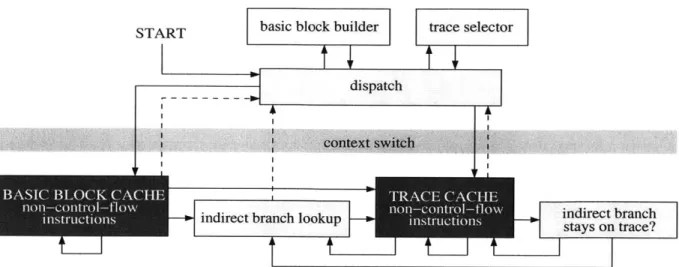
DynamoRIO copies basic blocks (sequences of instructions ending with a single control transfer instruction) into a code cache and executes them natively. At the end of each block, the application's machine-state must be saved and control must be returned to DynamoRIO (a context switch) to copy the next basic block. If a target basic block is already present in the code cache, and it is targeted via a direct branch, DynamoRIO links the two blocks together with a direct jump. This avoids the cost of a subsequent context switch.
Indirect branches cannot be linked in the same way because their targets may vary. To maintain transparency, original program addresses must be used wherever the application stores indirect branch targets (for example, return addresses for function calls). These ad-dresses must be translated into their corresponding code cache adad-dresses in order for the
START basic block builder trace selector
dispatch 4txs tA
cotx switc
11ItRCOISindirect branch lookup stay otrc.
Figure 3-1: Flow chart of the DynamoRIO system. Dark shading indicates application code. code to continue at the right location. This translation is performed as a fast hashtable lookup.
To improve the efficiency of indirect branches and to achieve better code layout, basic blocks that are frequently executed in a sequence are stitched together into a unit called a
trace. When an indirect branch occurs within a trace, a check is inserted to ensure that the
actual target of the branch will keep its execution in the trace. This check is much faster than the hashtable lookup, but if the check fails the full lookup must be performed. The superior code layout of traces goes a long way toward amortizing the overhead of creating them and often speeds up the program [5, 44].
A flow chart showing the operation of DynamoRIO is presented in Figure 3-1. The figure
focuses on the flow of control in and out of the code cache, which is shown at the bottom portion of the figure. The copied application code looks just like the original code with the exception of its control transfer instructions, which are shown with arrows in the figure.
3.2
DynamoRIO and Interpreters
An important heuristic, upon which DynamoRIO's trace identification and collection strat-egy is based, is that popular targets of jumps are good candidates for trace heads. Further-more, it is assumed that most of the time execution will proceed most or all of the way