HAL Id: hal-02426744
https://hal.archives-ouvertes.fr/hal-02426744
Submitted on 9 Jan 2020
HAL is a multi-disciplinary open access
archive for the deposit and dissemination of
sci-entific research documents, whether they are
pub-lished or not. The documents may come from
teaching and research institutions in France or
abroad, or from public or private research centers.
L’archive ouverte pluridisciplinaire HAL, est
destinée au dépôt et à la diffusion de documents
scientifiques de niveau recherche, publiés ou non,
émanant des établissements d’enseignement et de
recherche français ou étrangers, des laboratoires
publics ou privés.
Gravity darkening in late-type stars
Raphaël Raynaud, Michel Rieutord, Ludovic Petitdemange, T. Gastine,
Bertrand Putigny
To cite this version:
Raphaël Raynaud, Michel Rieutord, Ludovic Petitdemange, T. Gastine, Bertrand Putigny. Gravity
darkening in late-type stars. Journées de la SF2A, Jul 2018, Bordeaux, France. 2018. �hal-02426744�
GRAVITY DARKENING IN LATE-TYPE STARS
R. Raynaud
1, M. Rieutord
2, L. Petitdemange
3, T. Gastine
4and B. Putigny
2Abstract. Recent interferometric data have been able to constrain the brightness distribution at the
surface of nearby stars, in particular the gravity darkening that makes fast rotating stars brighter at their poles than at their equator. However, good models of gravity darkening are missing when the stars own a convective envelope. In order to better understand how rotation affects the heat transfer in stellar convective envelopes, we studied the heat flux distribution in latitude at the outer surface of numerical models of anelastic convection in rotating sphericall shells. We found that the variations of the surface brightness are mainly controlled by the surface value of the local Rossby number: when the Coriolis force dominates the dynamics, the heat flux is weakened in the equatorial region by the zonal wind and enhanced at the poles by convective motions inside the tangent cylinder. However, in presence of a strong background density stratification, as expected in real stars, the increase of the local Rossby number in the outer layers leads to the uniformisation of the surface heat flux distribution.
Keywords: convection, hydrodynamics, methods: numerical, stars: interiors
1 Introduction
Gravity darkening is one of the phenomena that can modify the surface brightness of a star and thus be important in the interpretation of stellar light curves. This phenomenon is usually associated with fast rotating early-type stars. We recall that for such stars, endowed with a radiative envelope, the flux varies with latitude basically because their centrifugal flattening makes the equatorial radius larger than the polar one. The temperature drop between the center and the pole or the equator of the star being roughly the same, the temperature gradient is slightly weaker in the equatorial plane. Hence, the local surface flux is slightly less at the equator than at the poles: the equator appears darker (e.g. Monnier et al. 2007). During many decades this phenomenon was approximated by von Zeipel (1924) law that says that Teff ∝ g
1/4
eff . Sometimes, fitting data requires a more
general relation and von Zeipel’s law was changed into Teff ∝ g β
eff, and β adjusted.
Observational works that have given constraints on the gravity darkening exponent β come essentially from the photometry of eclipsing binaries (Djuraˇsevi´c et al. 2006) and interferometric observations of fast rotating stars (e.g. Domiciano de Souza et al. 2014). On the theoretical side, much progress has been made recently with the construction of the first self-consistent (dynamically) 2D-models of fast rotating stars (e.g. Espinosa Lara & Rieutord 2007; Espinosa Lara & Rieutord 2013; Rieutord et al. 2016). With these models it has been possible to make more precise predictions on the gravity darkening effect, in particular for rapidly rotating early-type stars (Espinosa Lara & Rieutord 2011; Rieutord 2016). Actually, interferometric data and the most recent ESTER models agree very well on the gravity darkening exponents (Domiciano de Souza et al. 2014). But this is valid only for early-type stars.
For late-type stars, the situation is less clear. Lucy (1967) was the first to propose a theoretical estimate of gravity darkening for stars with convective envelopes. He suggested that β ∼ 0.08 for main sequence stars of mass around the solar mass. However, as shown in Espinosa Lara & Rieutord (2012), Lucy’s approach leads
1 AIM, CEA, CNRS, Universit´e Paris-Saclay, Universit´e Paris Diderot, Sorbonne Paris Cit´e, F-91191 Gif-sur-Yvette, France 2 Universit´e de Toulouse, UPS-OMP, CNRS, IRAP, 14 av. ´Edouard Belin, 31400 Toulouse, France
3LERMA, Observatoire de Paris, PSL Research University, CNRS, Sorbonne Universit´es, UPMC Univ. Paris 06, ´Ecole normale
sup´erieure, 75005 Paris, France
4Institut de Physique du Globe de Paris, Sorbonne Paris Cit´e, Universit´e Paris-Diderot, UMR 7154 CNRS, 1 rue Jussieu, 75005
Paris, France
c
92 SF2A 2018
to a gravity darkening exponent that is essentially controlled by the opacity law in the surface layers and does not reflect the effects of the expected anisotropies of the underlying rotating convection. Interferometric data from the star β Cas, which is beyond the main sequence and most likely owns a convective envelope, point to β ∼ 0.14 (Che et al. 2011), thus also requiring a new modelling.
However, modelling the latitude dependence of the heat flux in a fast rotating late-type star is a thorny problem. Basically, three effects combine and potentially modulate the heat flux (Rieutord 2016). The first, which is expected to be the most important one, is the effect of the Coriolis acceleration. It tends to make the flows in a columnar shape, with columns parallel to the rotation axis, inhibiting convection near the pole and favouring it near the equator, thus pointing to a negative gravity darkening exponent. The second effect is the centrifugal effect that diminishes the buoyancy in the equatorial regions and thus contributes to a positive gravity darkening exponent. Finally, fluid flows generate magnetic fields that can also inhibit heat transfer, both in the bulk or at the surface via spots.
As a first numerical approach toward modelling the gravity darkening in late-type stars with convective envelopes, we carried out in Raynaud et al. (2017) a systematic parameter study to investigate the heat flux distribution at the surface of a rotating spherical shell.
2 Model
The set-up we used corresponds to the anelastic dynamo benchmark (Jones et al. 2011) that considers a spher-ical shell in rotation at angular velocity Ω ~ez, bounded by two concentric spheres of radius ri and ro, and filled
with a perfect gas with kinematic viscosity ν, turbulent entropy diffusivity κ and specific heat cp. The
con-vective flow is modelled by the sound-proof LBR anelastic equations (Braginsky & Roberts 1995; Lantz & Fan 1999). Neglecting the centrifugal acceleration results in a radial gravity profile ~g =−GM~er/r2, where G is the
gravitational constant and M the central mass.
Convection is driven by an entropy difference ∆S between the inner and outer boundaries, while we impose impenetrable and stress-free boundary conditions for the velocity field. The system control parameters are then the Rayleigh number Ra = (GM d∆S)/(νκcp), the Ekman number E = ν/(Ωd2), the Prandtl number P r = ν/κ,
the number of density scale heights N%= ln %(ri)/%(ro), together with the shell aspect ratio χ = ri/roand the
polytropic index n.
Numerical simulations have been performed with two benchmarked pseudo-spectral codes, Parody (Dormy et al. 1998; Schrinner et al. 2014) and Magic∗ (Gastine & Wicht 2012; Schaeffer 2013). In the following, the
heat transfer efficiency is given in terms of the Nusselt number N u, defined as the output luminosity normalised by the conductive state luminosity.
3 Results
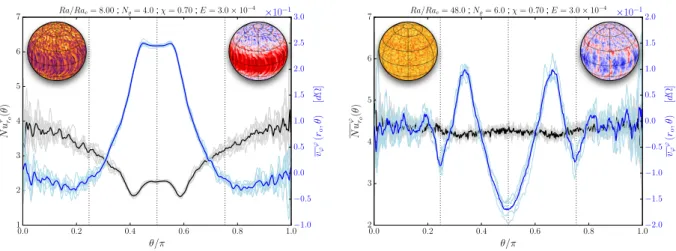
For low to moderate stratifications, our results are consistent with the tendencies that have been reported in Boussinesq simulations: at the onset of convection, the equator is usually brighter, but it becomes darker than the polar regions when the ratio Ra/Rac increases and convective motions fill the tangent cylinder. Favoured
by our choice of stress-free boundary conditions, the equatorial zonal flow is then efficient at impeding the radial heat transfer at low latitudes (Goluskin et al. 2014) – see Fig. 1(left).
Besides, thanks to the use of the anelastic approximation, we found that the background density stratification has a strong impact on the Nusselt number profile. Indeed, as the stratification increases, the Nusselt number tends to fluctuate around a constant value in latitude, as one can see in Figs. 1(right) and 2(left). Moreover, Fig. 2(right) shows that this uniformisation of the heat flux distribution is primarily controlled by the surface value of the local Rossby number Ro`(ro), which indicates that it becomes effective in the outer fluid layers
where the Coriolis force is no longer dominating the dynamics. In our numerical models, the background density drop and the shape of the conductive entropy profile Sc at high N% strongly favour the sharp increase of the
local Rossby number close to the outer boundary. This is the reason why we found uniform profiles only in highly stratified simulations (N% ≥ 6). In this regime, the anti-correlation between zonal flows and heat flux
which usually characterises the strongest pole/equator luminosity contrasts vanishes (compare the two panels of Fig. 1)
∗
Magic is available online at https://magic-sph.github.io. It uses the SHTns library available at https://bitbucket.org/ nschaeff/shtns.
0.0 0.2 0.4 0.6 0.8 1.0 ✓/⇡ 1 2 3 4 5 6 7 Nu ' (✓ro ) 1.0 0.5 0.0 0.5 1.0 1.5 2.0 2.5 3.0 v' '(r o ,✓ ) [d ⌦ ] ⇥101 Ra/Rac= 8.00; N%= 4.0; = 0.70 ; E = 3.0 ⇥ 104 0.0 0.2 0.4 0.6 0.8 1.0 ✓/⇡ 2 3 4 5 6 7 Nu ' (✓ro ) Ra/Rac= 48.0; N%= 6.0; = 0.70 ; E = 3.0 ⇥ 104 2.0 1.5 1.0 0.5 0.0 0.5 1.0 1.5 2.0 v' '(r o ,✓ ) [d ⌦ ] ⇥101
Fig. 1.Nusselt (black) and zonal velocity (blue) profiles as a function of colatitude for different thin shell models. The
color insets represent snapshots of S(r = 0.98ro) and vϕ(r = ro). The positions of the equator and the tangent cylinder
are indicated by vertical dotted lines.
0.0 0.2 0.4 0.6 0.8 1.0 ✓/⇡ 0.0 0.2 0.4 0.6 0.8 1.0 1.2 Nu ' (✓ro )/N u ' (0)ro Ra/Rac= 16.0; = 0.35 ; E = 3.0 ⇥ 104 N%= 8 N%= 6 N%= 4 N%= 2 N%= 1 (a) 10−3 10−2 10−1 100 101 Ro`(ro) −150 −100 −50 0 50 100 150 (N u poles − N u eq)/ N u [%] N%= 0.5 N%= 1.0 N%= 2.0 N%= 4.0 N%= 6.0 N%= 8.0 5 10 15 20 25 30 35 40 45 Ra/Rac
Fig. 2. Left: Normalised time averaged Nusselt profiles for a subset of thick shell models with decreasing density
stratification. Right: Relative pole/equator contrast as a function of Ro`(ro) for our sample of models. Solid (dashed)
lines indicate E = 3× 10⁻⁴ (E = 10−4) models. Empty/full symbols are used for thin/thick shell models.
4 Conclusion
The study we carried out in Raynaud et al. (2017) mainly shows that, despite its strength, the Coriolis force does not seem to be able to break the spherical symmetry of the exiting heat flux in a rotating star if the local Rossby number exceeds unity in the surface layers. The short time scale, associated with a short length scale of surface convection, seems to be able to screen the anisotropy of the deep motions of rotating convection.
With regards to the Sun, we recall that the observation of a uniform energy flux density coexisting with the non-uniform rotation of the solar surface was the heart of the so-called “heat flux problem” in theories aimed at explaining the Sun’s differential rotation (R¨udiger 1982). Rast et al. (2008) indeed report a weak ∼0.1% enhancement of the solar intensity at polar latitudes. The absence of stronger latitudinal variations of the mean solar photospheric intensity could then be explained by the fact that convective flows are probably not rotationally-constrained anymore in the near-surface shear layer that spans the outermost 35 Mm of the Sun (Greer et al. 2016a,b). Greer et al. (2016a) suggest weak rotational constraint in the outer layers above r∼ 0.96ro, while we find for the thin shell model displayed in Fig. 2(right) that the transition Ro`= 1 occurs
at r ∼ 0.9ro– a value which is slightly lower than the one predicted from observations, but we may have deeper
94 SF2A 2018
we stress that for this numerical model the radial profile of the local Rossby number is in very good agreement with the profile we expect according to the mixing length theory.
This study was granted access to the HPC resources of MesoPSL financed by the R´egion ˆIle-de-France and the project Equip@Meso (reference ANR-10-EQPX-29-01) of the programme Investissements d’Avenir supervised by the Agence Nationale pour la Recherche. Numerical simulations were also carried out at the TGCC Curie and CINES Occigen computing centers (GENCI project A001046698) as well as at CALMIP – computing center of Toulouse University (Grant 2016-P1518).
References
Braginsky, S. I. & Roberts, P. H. 1995, GAFD, 79, 1 Che, X., Monnier, J. D., Zhao, M., et al. 2011, ApJ, 732, 68
Djuraˇsevi´c, G., Rovithis-Livaniou, H., Rovithis, P., et al. 2006, A&A, 445, 291 Domiciano de Souza, A., Kervella, P., Moser Faes, D., et al. 2014, A&A, 569, A10 Dormy, E., Cardin, P., & Jault, D. 1998, Earth Planet. Sci. Lett., 160, 15 Espinosa Lara, F. & Rieutord, M. 2007, A&A, 470, 1013
Espinosa Lara, F. & Rieutord, M. 2011, A&A, 533, A43 Espinosa Lara, F. & Rieutord, M. 2012, A&A, 547, A32 Espinosa Lara, F. & Rieutord, M. 2013, A&A, 552, A35 Gastine, T. & Wicht, J. 2012, Icarus, 219, 428
Goluskin, D., Johnston, H., Flierl, G. R., & Spiegel, E. A. 2014, JFM, 759, 360 Greer, B. J., Hindman, B. W., & Toomre, J. 2016a, ApJ, 824, 128
Greer, B. J., Hindman, B. W., & Toomre, J. 2016b, ApJ, 824, 4 Jones, C. A., Boronski, P., Brun, A. S., et al. 2011, Icarus, 216, 120 Lantz, S. R. & Fan, Y. 1999, ApJS, 121, 247
Lucy, L. B. 1967, Zeit. f¨ur Astrophys., 65, 89
Monnier, J. D., Zhao, M., Pedretti, E., et al. 2007, Science, 317, 342 Rast, M. P., Ortiz, A., & Meisner, R. W. 2008, ApJ, 673, 1209
Raynaud, R., Rieutord, M., Petitdemange, L., Gastine, T., & Putigny, B. 2017, A&A, 609, A124
Rieutord, M. 2016, in Lecture Notes in Physics, Berlin Springer Verlag, Vol. 914, Cartography of the Sun and the Stars, ed. J.-P. Rozelot & C. Neiner, 101
Rieutord, M., Espinosa Lara, F., & Putigny, B. 2016, J. Comp. Phys., 318, 277
R¨udiger, G. 1982, Astron. Nachr., 303, 293
Schaeffer, N. 2013, Geochemistry, Geophysics, Geosystems, 14, 751
Schrinner, M., Petitdemange, L., Raynaud, R., & Dormy, E. 2014, A&A, 564, A78 von Zeipel, H. 1924, MNRAS, 84, 665