HAL Id: hal-00799185
https://hal.archives-ouvertes.fr/hal-00799185
Submitted on 11 Mar 2013
HAL is a multi-disciplinary open access
archive for the deposit and dissemination of sci-entific research documents, whether they are pub-lished or not. The documents may come from teaching and research institutions in France or abroad, or from public or private research centers.
L’archive ouverte pluridisciplinaire HAL, est destinée au dépôt et à la diffusion de documents scientifiques de niveau recherche, publiés ou non, émanant des établissements d’enseignement et de recherche français ou étrangers, des laboratoires publics ou privés.
Inquiry-based physics education in French middle school.
Jean-Marie Boilevin, Ludovic Morge, Alice Delserieys
To cite this version:
Jean-Marie Boilevin, Ludovic Morge, Alice Delserieys. Inquiry-based physics education in French middle school.. Inquiry-based physics education in French middle school., 2010, Reims, France. pp.23-24. �hal-00799185�
1
Inquiry-based physics education in French middle school
Jean-Marie Boilevin IUFM Aix-Marseille, Université de Provence – UMR ADEF, France
Ludovic Morge Clermont Université, Université Blaise Pascal, IUFM Auvergne –
PAEDI, France
Alice Delserieys IUFM Aix-Marseille, Université de Provence – UMR ADEF, France
1. Responses to the students' loss of interest in science and / or science studies
Developed countries are facing a long-standing phenomenon of students deserting science studies. In response, many international reports have been published to improve science education in compulsory schooling (High Level Group, 2007). They often encourage important evolutions regarding the final objectives for science education (Osborne & Dillon, 2008). Thus an understanding of the nature of science and its practices in classrooms holds a significant position, as does the learning of scientific knowledge. These changes have shaped the role of laboratory activities, leading to science teaching through scientific inquiry in the 60s in the United States (Schwab, 1962). They led to the development of new curricula in the United States from the early 90s (Science for All Americans (AAAS, 1989) ; National Science Education Standards (NRC, 1996)), and more recently in Europe (Eurydice, 2006). These curricula aim at emphasizing a scientific literacy for all, giving a broader image of scientific methods. They promote teaching methods with activities of higher cognitive level where students are given more autonomy by using more open tasks. Hands on activities or scientific inquiry are often used in order to increase students' motivation and interest in science. They use (not always explicitly) specific teaching models such as socio-constructivism, calling upon real-life contexts. This implies a change from activities focused on conceptual or manipulative learning often involving stereotyped methods, to open activities based on methods of inquiry with questions to be addressed, hypotheses, etc.
In France, inquiry-based science education (IBSE) was introduced with “La main à la pâte”, a program launched by the French Academy of sciences in 1996. Tasks relating to scientific inquiry are encouraged, aiming to develop a scientific literacy for all and raise students' interest in science. In 2000 a large national renovation plan in science education aimed to generalize IBSE in primary school. As for secondary education, several French reports (Bach, 2004 ; Académie des sciences, 2004 ; Rolland, 2006) highlight the need to change the way experimental science is taught. Considering the current students in middle school and high school, these reports advise teaching methods that are less frontal and allow students to be more active (intellectually and manually). In this context, French curricula first evolved in 2005 for middle school to encourage inquiry-based approaches in natural sciences, technology and mathematics. In order to give coherence to the curricula and the different disciplines, IBSE is presented as the method of teaching to prioritize so that “pupils construct their own knowledge” (open translation, B.O., p. 4).
Recent research studies analyze these new directions. Some are more concerned with the explicit meaning of IBSE in curricula. Others intend to evaluate the effect of such teaching procedures on pupils' learning and teaching practices. The benefit of IBSE on pupils was shown, both in terms of scientific knowledge acquisition (Hofstein & al., 2005 ; Wu & Hsieh, 2006) and regarding their attitude towards science (Gibson & Chase, 2002). However, other studies show that students need time to adapt to the new type of situation introduced with IBSE (Holbrook & Kolodner, 2000). Windschilt (2003) offers an interesting perspective on
2
this matter. He defends a progressive development of scientific competence for inquiry over several years by introducing open tasks progressively.
As part of their studies, researchers in science education in France are led to design teaching units. Some of them can be considered as inquiry based teaching units and put into practice in classes. In this paper, we present and analyze several examples of these teaching units to highlight the diversity of IBSE. The analysis allowed us to bring out a structure shared by all of these teaching units. The model we define also allows one to define criteria to identify IBSE approaches from within the wide range of teaching strategies.
2. Modelling inquiry-based learning sequences resulting from research in teaching of physical sciences
Modelling using a 'series of inter-related tasks'
In this research, we gathered together fifteen Inquiry-Based Teaching Units (IBTU) resulting from research in physical sciences teaching. Several types of teaching units were analyzed : problem solving, open problem solving, PACS (Prevision Argumentation Confrontation Syntheses), games or other out-of-school contexts ('adidactic'), modeling etc.(Morge & Boilevin, 2007).
These all differ from one another, both in terms of their nature and the order of the tasks given to students. They also privilege an epistemological aspect (modelling, PACS) or dimensions that are related to the method of teaching physics (problem solving, games or other out-of-school contexts). On the other hand, they all aim at giving value to the construction of knowledge by the pupil. They also share a common structure that we have called a structure of a 'series of inter-related tasks'. Indeed, these teaching units present the common characteristic of setting pupils a succession of tasks. Here, the word 'task' has been chosen in relation to work psychology where there is a traditional distinction between what has to be done (the task) and what is actually done (effective task or action) (Leplat & Hoc 1983). The nature and order of the tasks are justified because they strive to achieve the goal of the inquiry. We choose to talk about 'series of inter-related tasks' because in all of the sequences analyzed, the areas of knowledge produced during a task T are then used in task T+1, which in turn are used in task T+2 etc. For example, these tasks may consist of : Designing an experimental protocol ; Predicting the result of an experiment ; Recollecting experimental results ; Building a model of a phenomenon ; Building a model of an everyday life situation ; Observing a phenomenon ; Establishing connections between model and phenomenon ; Explaining a phenomenon ; Explaining a discrepancy between a predicted result and an observed one...
Our analysis of the fifteen IBTU led us to propose a model for any IBTU. This model must be used for what it is, a tool to analyze, compare, choose, design and conduct inquiry based teaching units. It does not constitute a step by step procedure that has to be strictly followed. It is essentially a tool that allows one to be explicit about choices made during preparation and application of IBTU. Thus, it can be regarded as a tool to question one's teaching habits.
The way that an IBTU takes place can be represented through a number of actions (fig. 1) indicated by letters (A, B, C, D, etc.). When events happen simultaneously, they have the
3
same letter, with a different number (D1, D2, D3). This model (Morge, 2008) compliments a previous one (Morge 2007, p. 40) with two new courses of action (D3 and E).
Inquiry goal and task construction
In order to illustrate different ways of building inquiry tasks, we will concentrate on the two primary actions of an IBTU and the link between them (fig. 1). The first one is the definition of the goal of the inquiry (action A). In the second one, students can be guided to specify the succession of tasks (action B).
For each inquiry scenario, the goal to be attained gives meaning to all of the tasks. It is the motor and organizer of the inquiry. The order and nature of these tasks are justified by the goal that is to be attained. The goal can be determined by the teacher. This is the case in example 1, where the aim is to explain why Julien's walkman does not work. The succession of tasks is to be define by the pupils.
Identification of battery terminals 1st part
In your opinion, what is the reason why Julien's walkman is not working?...
Ex. 1 : Part of an inquiry-based teaching unit, grade 7, http://spcfa.ac-creteil.fr/spip.php?article55
But the teacher may involve the students in determining the goal. To do this, he may use a situation that will instigate pupils activity. Such a situation need to lead pupils to raise their own questions. It may hinge on the analysis of an image, for example (Courtillot, 2006) or on an intriguing observation (Larcher & Peterfalvi, 2006). Amongst all of the subsequent questions, the teacher and the pupils define the question or questions they are going to tackle, and obtaining answers to the questions becomes the goal (A fig. 1). In other cases (eg. Larcher et al., 1990) the teacher may act alone in determining the goal to be attained and the tasks that allow this to happen leading to guided IBTU.
At school, you catch a conversation between Fred and Julien : Fred, I have a problem. My walkman is no
longer working. Could you tell me the reason why?
I have no idea. I will think about it. Unless someone can help us!
4 C. The teacher presents the
task T (Ex : Design an experimental protocol ; Predict the result of an experiment, Create a
hypothesis, Build a model of a phenomenon…). G2 Addition to the area of knowledge available to students.
D1. Students, using their previous knowledge, produce a piece of work (written or aral) and justify it.
F. Students and teacher publicly test* the validity of the work selected (coherence and relevance criteria, law of non-contradiction)
G1.The teacher formalizes knowledge of general scope (structure 1)
* Potentially problematic action. A task can be considered a problem when a contradiction cannot be raised without challenging the student's previous knowledge. In other words, a problem-based situation occurs when students encounter a contradiction that challenges their preconceptions. ** A task is fully completed when going through the loop from action C to H.
D3. The teacher tests whether each proposition works correctly.cheks whether the pupil’s
d ti
D2. Students, using their previous knowledge, produce a piece of work (written or oral) and justify it.
Or G’1. The teacher and / or the students summarize the knowledge temporarily retained or of reduced scope (structure 2)
B. The teacher and/or the students define a succession of tasks that students will have to perform to reach the goal.
H. Following task (T+1)**
and operation.
Fig. 1 : Model of actions achieved during an inquiry-based teaching unit
A. The teacher defines implicitly or explicitly the goal to be reached. The goal is the leading and structuring element of the inquiry.
E. The teacher (and sometimes the students) select a range of productions.
5
3. Criteria suggestions to identify an Inquiry-based teaching unit
The model of 'series of inter-related tasks' detailed above provides unity in the description of a wide variety of IBTU. Certain characteristics of these units apply to all of them. These common characteristics can serve as a basis for providing criteria to allow one to identify an IBTU amongst several different teaching units.
From our previous model, a list of three minimal criteria can be proposed. We believe that a teaching unit is inquiry-based if :
1) the pupil learns one piece of scientific knowledge or more during the unit… 2) …by accomplishing tasks that are not only experimental …
3) … and by participating in finding out whether other pupils' work is valid; in other words, by participating in making the choice from several methods, hypotheses, experimental protocol, explanations, models with relevant arguments.
These criteria can be seen as a first level of reflection to distinguish an inquiry scenario from another teaching scenario. If the three criteria are met, a teaching unit can be considered as an inquiry-based teaching unit. We are not claiming to present the one and only definition of an IBTU, but a definition using a range of criteria useful to analyze IBTU. This definition incorporates a wide range of IBTU (pre-defined task inquiry, pre-defined goal inquiry, previously undefined aim inquiry, open-ended problem-solving inquiry, PACS situation, modelling activity...).
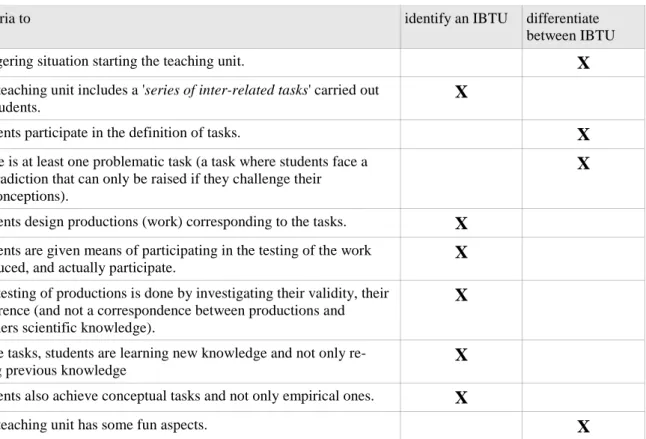
From the three initial criteria, and the model presented in figure 1, we have derived more detailed criteria summaries in table 1. The detailed version is also available (Morge & Boilevin, 2007).
Table 1 : Summary of criteria to characterize Inquiry-based Teaching Units (IBTU).
Criteria to identify an IBTU differentiate between IBTU Triggering situation starting the teaching unit. X The teaching unit includes a 'series of inter-related tasks' carried out
by students.
X
Students participate in the definition of tasks. X There is at least one problematic task (a task where students face a
contradiction that can only be raised if they challenge their preconceptions).
X
Students design productions (work) corresponding to the tasks. X Students are given means of participating in the testing of the work
produced, and actually participate. X The testing of productions is done by investigating their validity, their
coherence (and not a correspondence between productions and teachers scientific knowledge).
X
In the tasks, students are learning new knowledge and not only
re-using previous knowledge X
Students also achieve conceptual tasks and not only empirical ones. X
6
4. Application of the 'series of inter-related tasks' model to an ''adidactic'' Inquiry-based teaching unit : The resistors game example
This is a unit for middle school or high school. It was designed by Robardet (1997). The aim is '' to make pupils understand that an electrical circuit functions as a complex system in
which all the components interact and that most importantly, the intensity of the current in the generator loop depends not only upon its own characteristics, but also upon those of the receivers and the way that they are set up within the circuit. '' (Ibid, p 59, open translation).
The following equipment is used : a generator, a push button, an ammeter and a lamp are connected in series ; the pupils have five identical ohmic conductors that they can connect to the circuit. To make building and dismantling easier, a perforated board may be used to position the resistors.
The following description uses our successive tasks model.
Aim of the game : To score points by changing the number and/or position of the resistors on the board in order to raise the value shown on the ammeter screen.
Task 1 : First, students play on their own, with another person watching to make sure that they play by the rules. This phase of the game can be considered a task because it leads the student to produce something (a series of circuits) which will be examined by the teacher and/or the students (here, the teacher's role in the test is indirect, since the teacher watches from a distance and only intervenes by setting the rules he gives to the students).
Task 2 : The class is divided into teams of four to six students who play against each other. On a large piece of paper, each team writes down the strategy that they think will win the game, in the form of a succession of diagrams detailing how the resistors are to be set up. These successive diagrams constitute the production that the students have to do for this task. To test the productions, the students and the teacher check that each circuit allows one to obtain a lower resistance than the previous one. In the event of a disagreement, an experimental check is carried out. A point is scored for every successful attempt.
Task 3 : In groups of 4 to 6, the students come up with empirical rules to allow the variations in intensity within the generator loop to be accounted for, as a result of changes made to the resistor setup. These rules constitute the students' productions, which will then be tested by the class. Once again, the test criterion is the law of non-contradiction, since the rules stated by the students must not contradict the strategies that were accepted during the previous task.
1. Conclusion
The 'series of inter-related task' model presented here constitutes a tool for analysis, comparison, choosing, designing and managing inquiry in physics classes.
Our ''definition'' of criteria for inquiry-based teaching units seems expansive enough to incorporate a wide range of different teaching units. It should allow teachers to diversify their teaching practices by using inquiry in class, acknowledging the many important aspects of science teaching. At the same time, this ''definition'' of investigation shows a major heterogeneity of teaching units with regard to the students' position in the building of knowledge, the importance given to reasoning and scientific debate in learning, the importance and nature of the teacher's role in managing these teaching units.
7
Bibliography
American Association for the Advancement of Science. (1989). Science for All Americans. Project 2061. New York : Oxford University Press.
Avis de l’Académie des Sciences sur l’enseignement scientifique et technique dans la scolarité obligatoire, 2004.
Bach, J-F. (2004). Groupe de relecture des programmes du collège. Pôle des sciences. Ministère de la Jeunesse, de l’Education Nationale et de la Recherche.
B.O. Hors Série n°6 du 28 août 2008, p 4.
Courtillot, D. (2006). Utiliser des images pour déclencher un questionnement en sciences physiques, Bulletin de l’Union des Physiciens, 886, 887-894.
EURYDICE. (2006). Science teaching in schools in Europe. Policies and research. Derectorate general for education and culture. European Commission.
Gibson, H.L. & Chase, C. (2002). Longitudinal impact of an inquiry-based science program on middle school students’ attitudes toward science. Science Education, 86(5), 693-705.
High Level Group on Science Education. (2007). Science Education now: a renewed
pedagogy for the future of Europe. Commission Européenne. Direction de la Recherche.
Hofstein, A. Navon, O., Kipnis, M. & Mamlok-Naaman, R. (2005). Developing students’ ability to ask more and better questions resulting from inquiry-type chemistry laboratories.
Journal of research in science teaching, 42(7), 791-806.
Holbrook, J. & Kolodner, J.L. (2000). Scaffolding the development of an inquiry-based (science) classroom. In B. Fishman & S. O’Connor-Divelbiss (Eds.), Fourth International
Conference of the Learning Sciences (pp. 221-227). Mawah, NJ : Erlbaum.
Larcher, C. & Peterfalvi, B. (2006). Diversification des démarches pédagogiques en classe de sciences, Bulletin de l’Union des Physiciens, 886, 825-834.
Larcher, C., Chomat, A., & Méheut, M. (1990). Á la recherche d'une stratégie pédagogique pour modéliser la matière dans ses différents états. Revue Française de Pédagogie, 93, 51-62. Leplat, J., & Hoc, J-M.(1983). Tâche et activité dans l’analyse psychologique des situations, Cahiers de Psychologie Cognitive, L’analyse du travail en psychologie ergonomique (pp. 49-64), Toulouse : Octares.
Morge L. (2008). De la modélisation didactique à la simulation assistée par ordinateur des
interactions langagières en classe. Habilitation à Diriger des Recherches, Université Blaise
Pascal.
Morge L. (2007). Modélisation des séquences d’apprentissage par investigation issues de la recherche en didactique des sciences physiques et chimiques. In Morge et Boilevin (dir.)
Séquences d’investigation en physique – chimie... recueil et analyse de séquences issues de la recherche en didactique des sciences. Clermont-Ferrand : scérén, Collection : repères pour
agir, CRDP d'Auvergne.
Morge L. & Boilevin J.-M. (Dir.) (2007). Séquences d’investigation en physique – chimie...
recueil et analyse de séquences issues de la recherche en didactique des sciences.
Clermont-Ferrand : scérén, Collection : repères pour agir, CRDP d'Auvergne.
National Research Council. (1996). National Science Education Standards. Washington, DC: The National Academies Press.
8
Osborne J. et Dillon J. (2008). Science Education in Europe: Critical Reflections. A report to the Nuffield Foundation.
Robardet, G. (1997). Le jeu des résistors : une situation visant à ébranler des obstacles épistémologiques en électrocinétique. ASTER, 24, 59-79.
Rolland, J.-M. (2006). L’enseignement des disciplines scientifiques dans le primaire et le
secondaire. Commission des affaires culturelles, familiales et sociales. Assemblée Nationale.
Schwab, J. (1962). The teaching of science as enquiry. In The teaching of science (pp. 1-103). Cambridge, MA: Harvard University Press.
Windschitl, M. (2003). Inquiry projects in science teacher education : what can investigative experiences reveal about teacher thinking and eventual classroom practice ? Science
Education, 87(1), 112-143.
Wu, H.K. & Hsieh, C.E. (2006). Developing sixth graders’ inquiry skills to construct explanations in inquiry-based learning environments. International Journal of Science