A Biologically Inspired System for Action
Recognition
by
Hueihan Jhuang
Submitted to the Department of Electrical Engineering and Computer
Science
in partial fulfillment of the requirements for the degree of
Master of Science
at the
MASSACHUSETTS INSTITUTE OF TECHNOLOGY
September 2007
©
Massachusetts Institute of Technology 2007. All rights reserved.
A uthor ...
I
. ...
Department of Electrical Engineering and Computer Science
September 1, 2007
Certified by...
Tomaso Poggio
Professor
Accepted by
.
MASSACHUSETTS INSTITUTE, OF TECHNOLOGYOCT 12
2007
Artnur U. :mrunA Biologically Inspired System for Action Recognition
by
Hueihan Jhuang
Submitted to the Department of Electrical Engineering and Computer Science on September 1, 2007, in partial fulfillment of the
requirements for the degree of Master of Science
Abstract
We present a biologically-motivated system for the recognition of actions from video sequences. The approach builds on recent work on object recognition based on hi-erarchical feedforward architectures and extends a neurobiological model of motion processing in the visual cortex. The system consists of a hierarchy of spatio-temporal feature detectors of increasing complexity: an input sequence is first analyzed by an array of motion-direction sensitive units which, through a hierarchy of processing stages, lead to position-invariant spatio-temporal feature detectors. We experiment with different types of motion-direction sensitive units as well as different system ar-chitectures. Besides, we find that sparse features in intermediate stages outperform dense ones and that using a simple feature selection approach leads to an efficient system that performs better with far fewer features. We test the approach on different publicly available action datasets, in all cases achieving the best results reported to date.
Thesis Supervisor: Tomaso Poggio Title: Professor
Contents
1 Introduction 11
1.1 The Action Recognition Problem . . . . 11
1.2 M otivation . . . . 12
1.3 The Visual Processing System . . . . 12
1.4 Previous W ork . . . . 13
2 Background 15 2.1 Function of the Motion Pathway. . . . . 15
2.1.1 Primary Visual Cortex (VI) . . . . 15
2.1.2 Middle Temporal Area (MT) . . . . 16
2.1.3 Medial Superior Temporal Area (MST) . . . . 17
2.1.4 Superior Temporal Sulcus (STS) . . . . 17
2.1.5 Sum m ary . . . . 18
2.2 Previous Models of Specific Motion Cortical Areas . . . . 18
2.2.1 V 1-M T . . . . 18
2.2.2 V1-MT-MST . . . . 19
2.2.3 MT Speed Tuning Cells . . . . 20
2.3 Related Feedforward Hierarchical Models . . . . 20
2.3.1 Object Recognition with Cortex-like Mechanisms . . . . 21
2.3.2 Neural Mechanisms for Biological Motion Recognition . . . . . 21
3 The System 25 3.1 System Overview . . . . 25
3.2 Representation . . . . 3.3 Feature Selection . . . . 3.4 Classification . . . . 4 Experiments 4.1 M ethods . . . . 4.1.1 Datasets . . . . 4.1.2 Methodology . . . . . 4.1.3 Benchmark Algorithm 4.2 Results.. . . . . 5 Conclusion 5.1 M ain Contributions . . . .
5.2 Role of the System in the Motion Pathway and Action Recognition
5.3 Future w ork . . . .
5.4 Sum m ary . . . .
A Detailed Implementation and Parameters
26 31 31 33 33 33 34 35 36 41 41 42 43 44 45 . . . . . . . . . . . . . . . . . . . .
List of Figures
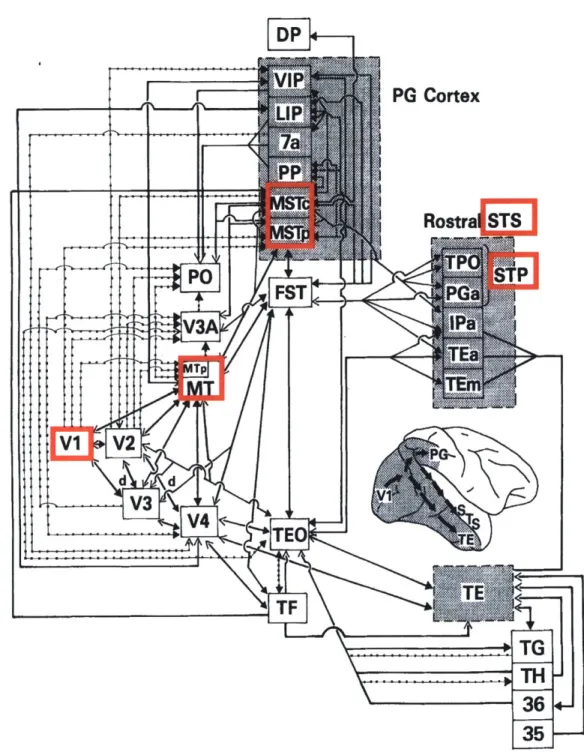
2-1 Summary diagram of the visual cortical hierarchy. Red boxes indicate the cortical areas we model along the dorsal stream. Reproduced with perm ission from [12]. . . . . 23
3-1 Sketch of the system (see text for details). . . . . 26
3-2 (a) The extraction of a S2 motion prototype. (b) The extraction of a
S3 temporal prototype (see Appendix for the notations.) . . . . 30
3-3 The upper part (blue) shows the building of C2 vectors through
re-peated matching/pooling mechanisms in the
S1-C
2 stages, and the lower part (green) shows that, stacked C2 vectors go through an-other matching/pooling mechanism to generate C3 vectors. The upper dashed box is modified by adding feature selection, as shown in the lower left dashed box. We randomly extract 500 frames for each action category to generate C2 vectors, and select prototypes by applyingfeature selection on the C2 vectors. The remaining frames are then matched to the selected prototypes. . . . . 32
4-1 Sample videos from the mice dataset (1 out 10 frames displayed with a frame rate of 15 Hz) to illustrate the fact that the mice behavior is m inu te. . . . . 34
4-2 (a) KTH Human. First row: outdoor condition. Second row: out-door with scale variance. Third row: outout-door with different clothes. Fourth row: indoor with lighting variation. Six actions from left to right: walking, running, jogging, boxing, handwaving, and handclap-ping. (b) Weiz. Human. Actions in the first row from left to right: bending, jumping-jack, jumping forward on two legs, jumping in place on two legs, running, galloping-sideways, walking, waving one hand, and waving two hands. (c) UCSD Mice. Five actions from left to right: drink, eat, explore, groom and sleep. . . . . 40
List of Tables
4.1 Selecting features: System performance for different numbers of se-lected C2 features at rounds 1, 5, 10, 15 and 20 (see text for details). 37
4.2 Comparison between three types of C2 features (gradient based GrC2,
optical flow based Of C2 and space-time oriented StC2). In each col-umn, the number on the left vs. right corresponds to the performance of dense vs. sparse C2 features (see text for details). s1,. . .s4 corre-spond to different conditions of the KTH database (see Section 4.1.1) and Avg to the mean performance across the 4 sets. Below the per-formance on each dataset, we indicate the standard error of the mean (s.e .m .). . . . . 3 7 4.3 Comparison between three types of C3 units (gradient based GrC3,
op-tical flow based Of C3 and space-time oriented StC3). In each column,
the number to the left vs. the right corresponds to the performance of
C3 features computed from dense [62] vs. sparse [44] C2 features. The results are based on the performance of the model on a single split of th e d ata . . . . 38
Chapter 1
Introduction
1.1
The Action Recognition Problem
The problem we deal with is the recognition of actions from video sequences. We are given training data, i.e. video sequences of several actions, then classify a test video into one of the pre-defined actions. The applications include surveillance, video retrieval and human-computer interaction.
Humans can robustly recognize actions under various conditions like moving back-ground, clutter, co-occurrence of multiple actions, and variations of viewing angle, position, appearance and scale. Humans can also recognize a wide range of action types including human body, head, hand, and general animal actions. The existing work on action recognition solves one or more of the challenges above, depending on their applications, and is mostly restricted to the domain of human actions. In this work, we focus on video sequences with slight background variations and differ-ent foreground variations and with a single subject performing an action throughout the video sequence. The action types are general, including both human and animal actions.
1.2
Motivation
Understanding the perception of actions in both humans and animals is an important area of research crossing the boundaries between several scientific disciplines from computer science to brain science and psychology. In this work we are interested in addressing the action recognition problem by building a model that simulates some well-known human visual capacities.
1.3
The Visual Processing System
The visual cortex appears to be organized into two functionally specialized pathways: a ventral stream that is crucial for the processing of shape information and object vi-sion, and a dorsal stream that is crucual for the processing of the spatial relationships among objects, as well as for the analysis of motion information [72, 40]. Interest-ingly, the organization of these two pathways is very similar. Their organization is hierarchical; aiming, in a series of processing stages, to gradually increase both the selectivity of neurons and their invariance to spatial transformations [21]. As one proceeds from one area to the next, both neuronal response latencies and average sie of the receptive field, i. e. the part of the visual field that if properly stimulated may elicit a response from the neuron, increase along the hierarchy, and neuronal response properties become increasingly complex.
These two pathways originate in the primary visual cortex (VI) where one can find at least two populations of cells: cells which are tuned to spatial orientations
(e.g. a static vertical bar) and project to areas V2 and V4 of the ventral stream, and
cells which are sensitive to direction of motions (i.e. a bar at a specific orientation moving in a direction perpendicular to its orientation) and project to area MT and MST in the dorsal stream. The neurons in MT and MST are tuned to speed and direction of motion [37, 2, 31]. The neurons in MST have also been found to have substantial position and scale invariance and [22, 20], and respond to large flow field stimuli.
In this work, we speculate that neurons in intermediate visual areas of the dorsal stream such as MT, MST and higher superior temporal polysensory areas are tuned to spatio-temporal features of intermediate complexity, which pool over afferent input units along space and time. This includes, but is not limited to, the optical flow neurons described above. We assume that such spatio-temporal seneitivity neurons might be found at different locations in the visual cortex such as STS, temporal cortex and prefrontal cortex [24, 69, 47]. Finally, in higher polysensory areas (STSa), one can find neurons that are responsive to the observation of biological motions [55].
Motivated by the recent success of biologically inspired approaches for the recog-nition of objects in real-world applications [62, 44, 53], we extend a neurobiological model of recognition of biological movements [21, 65]. The model has only been applied so far to simple artificial stimuli.
Our work, based on the similar organization of the ventral and dorsal streams in the visual cortex, applies computational mechanisms that have been proven to be useful for the recognition of objects to the recognition of actions. The idea of extending representations of object to that of actions has been successfully used in a recent non-biologically motivated system [13].
1.4
Previous Work
Typically, computer vision systems for the recognition of actions have fallen into two categories. One class of approaches relies on the tracking of object parts [75, 52,
5]. While these approaches have been successful for the recognition of actions from
articulated objects such as humans (see [19] for a review), they are not expected to be useful in the case of less articulated objects such as rodents. The other common class of approaches is based on the processing of spatio-temporal features, either global as in the case of low-resolution videos [76, 14, 4] or local for higher resolution images
[59, 13, 16, 46].
Our approach falls in the second class of approaches to action recognition. It extends an earlier neurobiological model of motion processing in the ventral/dorsal
stream of the visual cortex by Giese and Poggio [21]. While their model has been successful in explaining a host of physiological and psychophysical data, it has only been tested on simple artificial stimuli such as point-light motion stimuli [27]. In particular, it is too simple to deal with real videos due to the use of a limited dictionary of features in intermediate stages.
Chapter 2
Background
2.1
Function of the Motion Pathway
Researchers have largely explored the properties of different cortical areas and con-nections among them [72, 401. It is believed that there exists at least two functionally specialized processing pathways, ventral stream and dorsal stream, each having the primary visual cortex as the source of initial inputs. Dorsal stream, or motion path-way, is dedicated to the transmission of motion information, i.e. visual signals our eyes received during relative motion to the world. The motion pathway starts with retina and LGN, reaching the primary visual cortex (VI), and goes through middle temporal cortex (MT, V5) to medial superior temporal cortex (MST). (See Fig. 2-1). It subsequently projects to higher cortical areas like STD, LIP, VIP, STS, where sig-nals from different pathways are integrated and, due to their complexity, the neural properties are less known.
2.1.1
Primary Visual Cortex (VI)
Starting from the retina, where large ganglion cells called magnocellular, or M cells, are triggered when moving objects sweeps across their receptive fields. The M cells' impulses travel along the optic nerve to a relay station in the thalamus, near the middle of the brain, called the lateral geniculate nucleus (LGN). Then they go to the
_1_
middle layer of neurons in the primary visual cortex. There, by pooling together the inputs from many M cells, neurons become sensitive to the spatial orientation and direction of motion. In the primate, most VI cells have small receptive fields, about 1 x 10. Such direction-sensitive cells were first discovered in the mammalian visual cortex by Hubel and Wiesel, who projected moving bars of light across the receptive fields of cells in the primary visual cortex of anesthetized cats and monkeys [26].
Most V1 cells respond to oriented moving bars or edges, and they are classified into two types according to the receptive field structure. Simple cells respond linearly due to the fixed excitatory and inhibitory subregions comprising their receptive fields. Complex cells' responses are independent of the spatial position of the stimulus within the receptive field. It is widely accepted that complex cells combine multiple simple cells to gain position invariance and thus non-linearity [26]. Both simple and complex cells are sensitive to direction of motion and spatial frequency [9, 39]. In addition, complex cells were recently found to be sensitive to the speed of the moving stimulus
[51].
2.1.2
Middle Temporal Area (MT)
Area MT lies along the posterior bank of the superior temporal sulcus [18]. The cells in this area inherit the direction and speed tuning properties from their direct afferent inputs, VI complex cells [42, 3, 37, 39]. Inside the large receptive field, about
100 x 10 , of MT cells, integration of local sensed motion into the perception of a whole
moving object starts occurring, as supported by the finding of pattern-sensitive neu-rons by Movshon et al., who presented a plaid containing two gratings with different orientations and moving independently along the direction perpendicular to their ori-entations [41, 36]. The direction of the plaid is thus the vector sum of the direction of the two gratings. Relative to component-sensitive cells which respond when one of the grating moves along the cells' preferred direction, pattern-sensitive cells respond when the direction of the plaid matches the cells' preferred direction. Using more complex moving patterns, pattern-sensitive cells are shown to be insensitive to the exact shape of the moving stimulus [50].
2.1.3
Medial Superior Temporal Area (MST)
Area MST receives its input from the MT area [71, 67]. This area contains at least two major subdivisions: a ventral-lateral one (MSTl), and a dorsal one (MSTd). The cells in MSTl have been shown to have relatively small receptive fields, similar in size to those found in area MT at the same eccentricity and also similar in terms of the di-rectional selectivity and their preference for moving bars. The MSTd cells have larger receptive fields and respond to flow-field stimuli. Most of the MSTd neurons respond to radial (expansion/contraction), rotation (clockwise/counterclockwise), translation, and spiral motions (the combination of radial and rotation, see Fig. 7A in [22]), pre-sumably from the particular combination of multiple MT afferent cells [58, 23]. Since these motions are associated with the flow-field patterns projected onto the retina during observer locomotion, it has been suggested by several groups that the area
MSTd has a role in processing optical flow information used in the analysis of self
motion and visual guidance of movements in space. It has also been suggested that MST may be important in analyzing the complex motions of objects. Similarly to MT pattern cells, MST cells respond to the moving stimulus regardless of the form [20], but opposed to the MT cells that respond to the position of moving stimulus, MST cells are position invariant [30, 22]. This prominent position and form invariance, as well as the large receptive field size, about one fourth the visual field, establishes the role of MST area as further integrating of motion information from MT area.
2.1.4
Superior Temporal Sulcus (STS)
Several electrophysiological or fMRI studies have shown that there exist neurons in
STS that respond selectively to biological motions [24, 11, 47, 55]. Neurons in the
temporal cortex can learn to associate pairs of arbitrary geometrical stimuli [69]. This is a key capacity to recognize different views of an action. In addition, the integration of form (ventral) and motion (dorsal) pathways has been found in superior temporal polysensory area (STPa) in macaque, and temporal coherence between form and motion signals have been proven to subserve the recognition of biological movements
[48].
2.1.5
Summary
Along the motion pathway, the average receptive field size and the complexity of their optimal stimuli increase steadily, suggesting that the cells receive convergent input from multiple cells in the lower cortical area. In addition, much of the neural mechanism reviewed above can be viewed as a 'bottom-up' process subserved by feed-forward projections between successive pairs of areas within the motion pathway. The motion pathway can therefore be modeled as a feedforward hierarchical architecture [17, 33, 54, 21, 61].
The increasing selectivity (from moving edges to complex flow-field patterns) and invariance (position invariance of Vi complex cells, form invariance of MT cells, and from/position invariance of MST cells) observed in the dorsal stream have also been observed in the ventral stream [21, 61], indicating similar organizations of the two streams, and thus supporting the extension from model of object recognition to action recognition.
2.2
Previous Models of Specific Motion Cortical
Areas
Several researchers have proposed computational models of individual or multiple motion cortical areas based on different aspects of neuronal properties. In this section we review this work.
2.2.1
V1-MT
Simoncelli and Heeger proposed a two stage model corresponding to neurons in cor-tical area VI and MT [66]. Each stage computes a weighted linear sum of inputs, followed by rectification and divisive normalization. The orientation and spatial fre-quency selectivity of VI simple cells are modeled by a set of three-dimensional filters
which are oriented in the space-time domain. Following the previous finding that some aspects of complex cells' responses can be obtained by combining subunits distributed over a localized spatial region [15], they computed the responses of VI complex cells as a weighted sum of simple cells with the same space-time orientation over a local spatial region. In the second stage, MT pattern and component cells are modeled as a weighted sum of VI complex cells. The speed and direction selectivity of MT pattern cells are constructed via an implicit implementation of IOC (intersection-of-constraints) by summing a set of VI complex cells over a local spatial region and over orientation and spatial frequency. MT component cells sum VI complex cells with the same space-time orientation over spatial position and spatial frequency. The rectification is imposed to simulate the positive-only responses of neurons, and the normalization accounts for nonlinear response, saturation and lateral inhibition.
2.2.2
V1-MT-MST
Grossberg et al. proposed a V1-MT-MST neural model to explain the flow-field pat-tern sensitivity of MST cells by combining well-known neural mechanisms: log po-lar cortical magnification, Gaussian motion-sensitive receptive fields, spatial pooling of motion-sensitive signals and subtractive extraretinal eye movement signals
[23].
The mapping of visual information from retina to VI obeys a cortical magnification, meaning the cortical resolution gradually increases from periphery to fovea [8]. The property can be modeled by transforming the visual information in a cartesian coordi-nate in the retina into a log-polar coordicoordi-nate in VI [60]. The mapping was calculated within a 45' x 450 visual field, the receptive field size of MST cells. MT cells are com-puted as a summation of VI cells with the same preferred direction within a Gaussian receptive field. MST cells are computed as a summation of MT cells with the same preferred direction. (see the Fig 3. in [23]) This formulation transforms the spiral motion in a cartesian coordinate into a oblique linear motion in a log-polar coordinate in the cortex, therefore MST cells' flow-field selectivity simply results from local spa-tial summation of MT cells with the same directional preferences, rather than from complex and specialized interactions as the template model in [58].- - _
2.2.3
MT Speed Tuning Cells
Perrone proposed a mechanism to explain the speed tuning of MT cells by investi-gating their properties in the frequency domain [49]. Considering one-dimensional motion, an object moving in a constant speed has a spectrum that lies on a line in the spatio-temporal frequency domain [73]. By measuring the neuronal responses to moving sine-wave gratings of different combinations of spatial and temporal frequen-cies, the spectral receptive field (SRF) can be mapped out. The SRF of speed-tuned MT cells is typically oriented relative to the spatial and temporal frequency axes, similar to that of a moving edge with a fixed speed. Conversely, the typical SRF of a VI cell is parallel to the spatial and temporal frequency axes. Therefore, the speed tuning of MT cells can be constructed by combining the non-oriented SRF of VI cells into the oriented SRF of MT cells (a formulation is derived in Eq 1. in [49]).
2.3
Related Feedforward Hierarchical Models
Our system consists of a feedforward hierarchical architecture which has been de-veloped by several researchers. The main connection between hierarchical stages is each unit in a stage receives inputs from multiple units in the previous stage. This idea was inspired by Hubel and Wiesel [26] and subsequently the architecture was constructed by Fukushima and applied on handwritten-digits recognition [17]. Le-Cun et al. developed the convolutional network [33], also a feedforward hierarchical architecture. With no attempt to model biology, Riesenhuber and Poggio developed the HMAX model for the ventral stream [54]. Giese and Poggio extended it to in-clude dorsal stream and applied it to the recognition of biological motion [21]. More recently HMAX model was refined by Serre et al. and successfully applied to the multiple object recognition tasks in real world scenario [62, 61]. In this section, we briefly review recent work that are mostly related to our system.
2.3.1
Object Recognition with Cortex-like Mechanisms
Serre et al. built a computational model accounting for several well-known facts: (a) visual processing is hierarchical with increasing position and scale tolerance at each stage. (b) along the hierarchy, the receptive fields of neurons and the complexity of their preferred stimulus increase. (c)The first 100-200 ms visual information process-ing is feedforward (d) plasticity and learnprocess-ing probably occur at all stages [62, 61].
The model is hierarchical with alternating simple S units and complex C units. The S units combine their inputs with Gaussian-like tuning to increase selectivity, and the C units pool their inputs through a maximum operation to increase invariance to
2D transformations. In the first stage, Si units model the spatial-orientation-selective
VI simple cells by Gabor filters with a range of orientations and spatial scales. In the next complex stage, C1 units mimic the scale and position tolerant VI complex cells by pooling Si units with the same orientation over a local spatial region and over
adjacent scales. In the next simple stage, S2 units are modeled as Gaussian functions that are tuned to prototypes extracted from training examples. The S2 units are similar to the view-tuned neurons in inferotemporal cortex (IT) , which are selective to complex shapes. The input of each S2 unit is an image patch from the previous
C
1 stage with all the orientations and at a particular scale. Therefore, S2 maps arecomputed at all positions and all scales. In the next complex stage, C2 units pool a global maximum from S2 maps over all scales and all positions. This results in a vector representation of an input image, with each element corresponding to the best match between the image and a prototype. A support vector machine (SVM) is then trained to classify images based on these vector representations.
2.3.2
Neural Mechanisms for Biological Motion Recognition
Giese and Poggio built a model based on several experimental results relating to the recognition of biological movements [21]. The model is divided into two parallel processing streams, modeling the ventral and dorsal pathways. The model of ventral pathway is a simpler version of the HMAX model [54] (also see Sec. 2.3.1).
The model of dorsal pathway considers the tuning properties of VI, MT, and MST cells by a four-stage model. The first stage consists of motion detectors corresponding to Vi direction-selective cells and MT component cells. The second stage models cells that are sensitive to local flow-field structure. Two types of cells are considered: MT translation-flow-sensitive cells and motion-edge-sensitive (or opponent-motion sensitive) cells in MT and MST. Positional and scale invariance of MST neurons are modeled in this stage by pooling from position-specific motion-edge detectors through a maximum operation. The third stage uses Gaussian functions to model the flow-field-pattern-sensitive neurons found in STS and MST. The Gaussian functions center at flow-field patterns extracted from training sequences. The last stage achieves temporal order selectivity by adding the lateral connections between the flow-field-pattern-sensitive neurons.
DP
IP
PG Cortex
LIP
PP.--
Rostra STS
P
PO
..
P
FST
PG
V3A
TE
V1 V2; d dV3
...
TEO
ETF
\
>TG
36
+.j35
-Figure 2-1: Summary diagram of the visual cortical hierarchy. Red boxes indicate the cortical areas we model along the dorsal stream. Reproduced with permission from [12].
Chapter 3
The System
3.1
System Overview
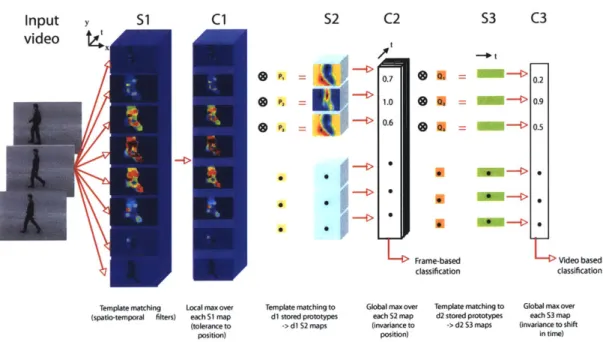
Our approach builds on recent work on object recognition [62, 61] based on hier-archical feedforward architectures and extends a neurobiological model of motion processing in the visual cortex [21]. The system has a hierarchical structure and uses as an input a gray value video and outputs a vector-form representation. In the first stage, motion features are detected by motion-sensitive units which bear functional similarity to VI simple cells and MT cells, and in the next stage, tolerance to spatial translation is built by a maximum-pooling mechanism which simulates VI complex cells. In the higher stages of the hierarchy, we predict the existence of neurons that re-spond to spatio-temporal features and that may be similar to motion-pattern-sensitive MST neurons and temporal-order-sensitive STP neurons. Such predicted neurons are modeled by a template matching operation. By alternating the template matching (simple) and maximum-pooling (complex) operations, the extracted features grad-ually gain their complexity and invariance. In the last stage, features are selective to complex motion patterns and temporal orders of sequences and tolerant of local deformations in space and shifts in time. The system is illustrated in Fig. 3-1 (also see Appendix for the detailed implementation).
Input y S1 C1 S2 C2 S3 C3 video %X t 0.7 . S1.0 0.9 -10.6
*
0 0. 0. ->.eFrame-based Video based classification classification
Template matching Local max over Template matching to Global max over Template matching to Global max over (spatio-temporal filters) each S1 map dI stored prototypes each 52 map d2 stored prototypes each 53 map
(tolerance to ->d I 2 maps (invariance to -)d2 S3 maps (invariance to shift
position) position) in time)
Figure 3-1: Sketch of the system (see text for details).
3.2
Representation
S1 units The first stage of the system contains a set of motion-sensitive Si units
which are similar to the V1 simple cells and MT cells in the motion pathway. Each Si unit extracts one attribute of motion from the input video, a 2-8 second image sequence with frame rate 25 (fps). The output of this stage is a video sequence with several layers of frames (S1 frames). Each layer is the output of one S1 unit. We will describe three kinds of S1 units and briefly review the related work that motivate our choices.
Space-time-gradient-based Si units: The space-time gradients are three-dimensional vectors containing gradients at each pixel along two spatial dimensions and one temporal dimension. Several studies have shown that the space-time gra-dients contain useful motion information. A statistical distance measurement based on normalized space-time gradients is applied to event recognition [76]. The similar-ity measurement between two space-time patches can be built through the statistics of space-time gradients [63]. Several optical flow algorithms based on the
constant-brightness assumption accumulate local motion information by computing space-time gradients. In this work, we use two types of S1 units, each computing the ratio of
the temporal gradient to a spatial gradient. We compute the ratios, instead of using the three gradients directly, to keep features in the same scale so as to avoid any bias of the template matching in the higher stages. Also, to make features invariant to contrast reversal between foreground and background, their absolute values are taken.
Optical-flow-based S units: The Si units model the direction-sensitive VI
neurons and the speed-sensitive MT neurons, as motivated by the work in [21]. The directional tuning curve of VI neurons is modeled as a circular-Gaussian-like function
[6, 21, 57]. The sensitive MT neurons can be classified as low-pass,
speed-tuned or broad-band, based on the characteristics of responses [31]. Low-pass cells are characterized by large responses to slow speeds and a small upper cutoff speed. Broad-band cells are characterized by large responses to slow speeds and a large upper cutoff speed. Speed-tuned cells have a salient peak in the response curve, indicating the cells' preferred direction. As opposed to previous work in which broad-band cells are modeled by a band-pass function [6], we model the speed-tuned cells by an exponential function. We use eight VI and MT neurons with preferred directions and speeds chosen to be in the range of our motion sequences. We use eight Si units, each combining the response of one VI and one MT neuron in a multiplicative way.
Space-time-oriented Si units: Most studies focus on the spatial structure
of receptive fields: VI simple cells' receptive field profiles were modeled by two-dimensional Gabors or Gaussian-derivative functions in [28, 29]. However, the organi-zation of the receptive field is not static: Mclean et al. analyzed the three-dimensional first-order properties of simple cells in cat and found two classes of cells [38]. For one class, the receptive field profiles are space-time separable, meaning the spatial and temporal profiles can be disassociated. Receptive field profiles in the other class are inseparable, meaning that the excitatory and inhibitory subregions comprising the
receptive field are tilted in space-time domain (the two classes were also reported in [10]). They found most of the simple cells with separable receptive fields are not direction-selective, and for those with inseparable receptive fields, the preferred di-rection can always be predicted by the oblique didi-rection of the subregions, and the preferred speed can be derived from the slope of the tilted subregions. Motivated
by their idea that the space-time tilted subregions of receptive fields underly
veloc-ity selectivveloc-ity of VI simple cells, we model S1 units as a set of space-time-oriented three-dimensional filters.
Several studies have used three-dimensional linear filters as motion detectors. The energy model was built from two space-time separable filters whose spatial responses are 2D Gabor functions and temporal responses are based on psychophysical experi-mental results [1, 56]. A set of three dimensional Gabor filters were used to extract image flow [25]. MT neurons were modeled by three-dimensional Gaussian derivative filters in [66]. In this work, we use the directional (3 rd) derivatives of three-dimensional
Gaussians as Si units, following the work in [66]. The size of the filters is chosen to match that of the receptive field of a typical VI simple cell [62, 56]. The orientations of the filers in space-time depend on the preferred directions and speeds of the Si units.
C1 units Tolerance to local spatial translation is achieved in this stage by pooling a maximum response from S1 frames over local spatial positions. The pooling mech-anism has been widely used to model VI complex cells: some work computed the V1 complex cells as a linear summation of VI simple cells [43, 66, 15], and others computed the VI complex cells as a local maximum of VI simple cells [21, 62]. Com-paring the two operations, maximum-pooling assures that the pooled features do not lose their selectivity built by previous stages. In addition, maximum-pooling provides robustness to the background clutter.
The pooling is performed for each layer of S, frame, meaning the invariance is built upon each motion attribute. The resulting C1 frames are smaller than S1 frames
same. Note that the maximum-pooling operation is separately applied to each frame without temporal pooling.
S2 units This stage consists of motion-prototype-sensitive S2 units: their existence
is a prediction of the model. S2 units are similar to MST neurons in that they both respond to complex motion patterns. The difference is that S2 units respond to class-dependent prototypes extracted from the training data, while MST neurons respond to patterns with general structures such as circular, radial, spiral or translational mo-tion [23, 22]. The role of S2 units in the hierarchy is to increase the feature complexity
and selectivity by a template matching operation between the input features and the stored motion prototypes.
The motion prototypes are extracted at a random spatial position and across all the layers of a random training C1 frame. See Fig. 3-2 (a) for an illustration. Taking the input as a C1 frame with all the layers, each S2 unit convolves the stored prototype with the input frame. This results in a S2 map where each pixel represents a similarity measurement between a patch of the input C1 frame and the stored prototype.
We consider two metrics of similarity measurements: the dense Euclidean distance as used in [62] and the sparse normalized dot-product as used in [44]. The two distance measurements differ in the amount of computation. Given a prototype with size n(pixels) xn(pixels) x l(layers), and a patch of the same size, in the dense case, all the In2
values are taken. In the sparse case, based on the fact that weak features are noisy and have only minute effects on the responses, at each pixel location, only the strongest value among the I layers is taken, resulting in the size n(pixels) x n(pixels) and thus only n2
values are considered. Another difference is in terms of the form of operation. Using the Euclidean distance, the response is simply the Euclidean distance between the prototype and the input patch. Using the normalized dot-product, the patch is firstly sparsified similarly to the prototype, meaning that at each pixel location, the value of the patch is chosen from the layer used in the prototype's corresponding pixel location. The response is the dot product of the n x n prototype and the patch normalized by their norms.
nn
S
nt
(a)
(b)
Figure 3-2: (a) The extraction of a S
2motion prototype. (b) The extraction of a
S3temporal prototype (see Appendix for the notations.)
C2
units Similar to the role of the C1 unit, the
C
2unit adds position invariance by
a maximum-pooling operation. The C2 unit pools the global maximum across all the
pixel locations of an input S
2map, resulting in a scalar representing the best match
between the C frame and the motion prototype. By stacking all the
C2responses of
a frame, we get a vector representation (C2 vector).
S3
units Sequence selectivity is one of the neural mechanisms involving in action
recognition, meaning that neurons are tuned to a temporal order, and randomization
of the temporal order of the frames doesn't trigger neurons. It was previously modeled
as from asymmetric lateral connections of neurons [21]. In this work, to be consistent
with the use of motion-prototype-sensitive S
2units, we model the sequence-selective
neurons by temporal-prototype-sensitive S3
units. We firstly align the
C2vectors of
a video into columns, resulting in a C2 matrix. Each temporal prototype is then
extracted at a random column and across all rows of a random training C2 matrix.
See Fig. 3-2 (b) for an illustration.
Taking as an input a
C2matrix, each S3
unit convolves the stored temporal
prototype with the input C2 matrix. This results in a S
3map where each pixel
represents a similarity measurement between a patch of the input C2 matrix and the
stored temporal prototype.
C3 units Similar to the role of the
C
and C2 units, the C3 unit adds invariance to shifts in time by a maximum-pooling operation. The C3 unit pools the global maximum across all the pixel positions of an input S3 map, resulting in a scalar representing the best match between the C2 matrix and the temporal prototype. By stacking all the C3 responses of a video, we get a vector representation (C3 vector).3.3
Feature Selection
The S2 stage is the most time-consuming part of the system because it performs template matching between each C1 frame and each motion prototype. We perform feature selection on the C2 features [74]. Firstly, we compute the C2 vectors of a small subset of the training frames by matching them to all the motion prototypes. Then we apply feature selection on these C2 vectors to identify relevant features, which come from the matching to class-dependent prototypes, and select these motion prototypes. The S2 maps of the remaining training and test frames are then computed by matching to the selected motion prototypes. See Fig. 3-3 for an illustration.
3.4
Classification
The classification stage uses a support vector machine (SVM). Frame-based and video-based classification are both used to evaluate our system. In the frame-video-based case, the C2 vectors are used to train and test an SVM. In the training phase, each frame is assigned the label of the video it belongs to. In the test phase, we obtain a predicted label for each frame of a video, and combine these predictions to get a label for the video by a majority voting scheme. In the video-based case, the C3 vectors are used to train and test an SVM, and a single label is obtained for each test video. See Fig.
Training vid S1 frames F ---C1-frames-Motio C frame tope S2maps C2 vectors st ck SVM C2 maL- -- --S3 maps C3 vectors SVM C1 frames prMotion
prootpe
500 cl frames from each categoryI
S2 mapsC2vectors- Feature Selected selection prototypes Testing vide S1 frames C1 frames S2maps C2 ectors C2 matrice S3 maps C3 vectors template matching pooling maximum random extraction training/testing
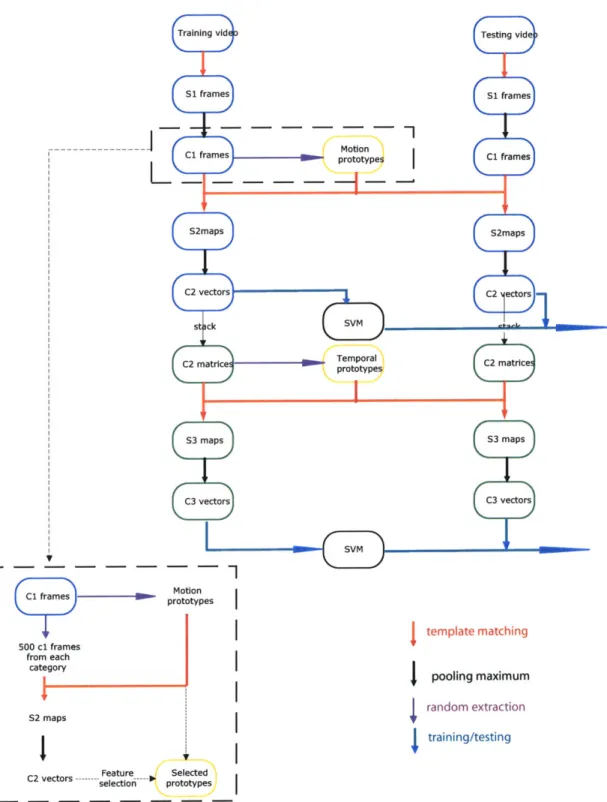
Figure 3-3: The upper part (blue) shows the building of C2 vectors through repeated
matching/pooling mechanisms in the
SI-C
2stages, and the lower part (green) shows
that, stacked C2 vectors go through another matching/pooling mechanism to generate
C3 vectors. The upper dashed box is modified by adding feature selection, as shown in
the lower left dashed box. We randomly extract 500 frames for each action category
to generate C2 vectors, and select prototypes by applying feature selection on the
C2vectors. The remaining frames are then matched to the selected prototypes.
F
r
Chapter 4
Experiments
We have conducted an extensive set of experiments to evaluate the performance of the proposed action recognition system on three publicly available datasets: two human action datasets (KTH and Weizmann) and one mice action dataset (UCSD).
4.1
Methods
4.1.1
Datasets
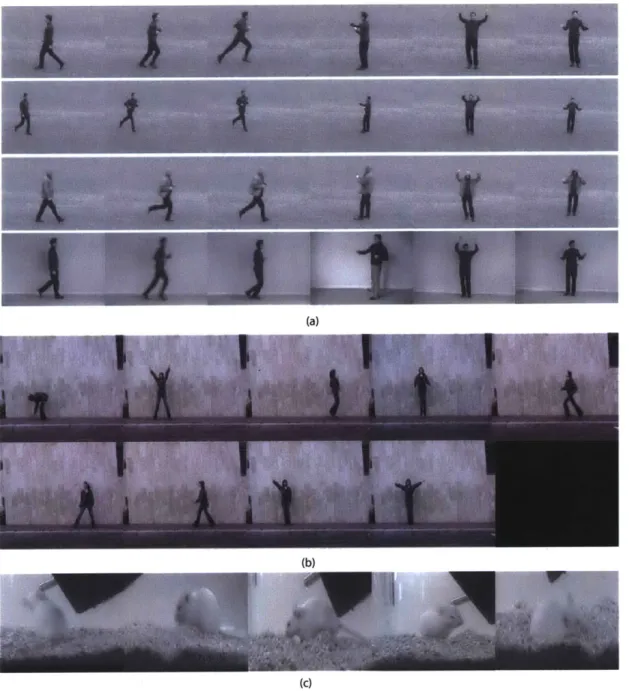
KTH Human The KTH human action dataset [59] contains six types of human
actions: walking, jogging, running, boxing, hand waving and hand clapping. These actions are performed several times by twenty-five subjects in four different conditions: outdoors (si), outdoors with scale variation (s2), outdoors with different clothes (s3)
and indoors with lighting variation (s4). The sequences are about 4 seconds in length. The sequences were down-sampled to a spatial resolution of 160 x 120 pixels. The dataset is shown in the Fig. 4-2.
Weizmann Human The Weizmann human action dataset
[4]
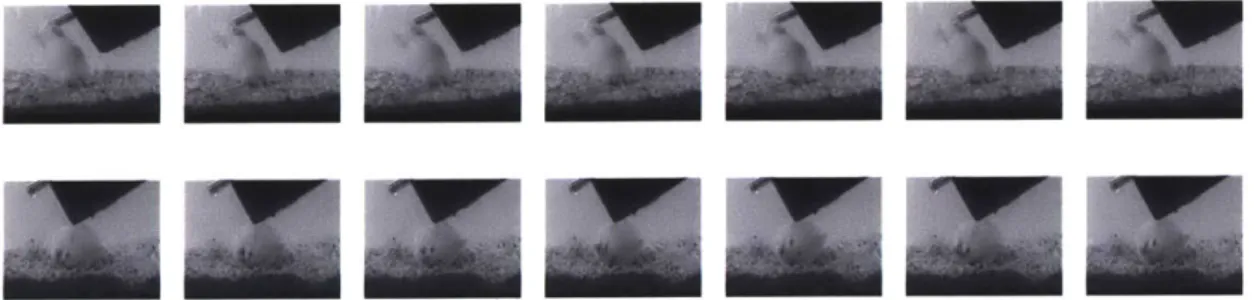
contains eighty-one low resolution (180 x 144 pixels) video sequences with nine subjects performing nine actions: running, walking, jumping-jack, jumping forward on two legs, jumping in place on two legs, galloping-sideways, waving two hands, waving one hand, andbend-Figure 4-1: Sample videos from the mice dataset (1 out 10 frames displayed with a
frame rate of 15 Hz) to illustrate the fact that the mice behavior is minute.
ing. The size of the subject in this dataset is about half the size of the subject in the
KTH human action dataset. However, we run experiments on the two sets using the
same parameters.
UCSD Mice The UCSD mice behavior dataset [13] contains seven subsets, each
being recorded at different points in a day such that multiple occurrences of actions
within each subset vary substantially. There are five actions in total: drinking, eating,
exploring, grooming and sleeping. The sequences have a resolution of 240 x 180
pixels and a duration of about 10 seconds. This dataset presents a double challenge.
First the actions of the mice are minute (see Fig. 4-1 for examples) and second the
background of the video is typically noisy (due to the litter in the cage).
4.1.2
Methodology
Splits We divide each dataset into groups: each condition of KTH Human is divided
into 25 groups, one per subject; Weizmann Human is divided into 9 groups, one per
subject; UCSD Mice is kept 7 groups as the original setting. We report the recognition
rate of our system as the average of 5 rounds. Each round, we train on randomly
drawn 9 groups and test on the rest groups. The detail is as follows: each condition
of KTH Human contains 16 training groups and 9 test groups; Weizmann Human
contains 6 training groups and 3 test groups; UCSD Mice contains 4 training groups
and 3 test groups.
Preprocessing We preprocessed the datasets to speed up our experiments: for
the KTH human and UCSD mice datasets we used the openCV GMM background subtraction technique based on [68]. In short, a mixture of Gaussians model was used to identify the foreground pixels of each frame. From the foreground mask, we extracted a bounding box (full height, half the width of the frame and centering at the mass center of the foreground pixels) for each frame. For the Weizmann Human dataset, the bounding boxes were extracted directly from the foreground masks provided with the dataset.
Performance Measurement Having represented each video as a vector, we are
going to deal with a multi-class classification problem. The most common perfor-mance measure is the confusion matrix. Let the number of action categories be n. The confusion matrix is a n x n matrix, where each row represents a true label, each column represents a predicted label, and element (i,
j)
is the percent of label-i exam-ples which are classified as labelj.
The value of the element (i,j)
directly reflects the confusion between the two classes, i andj.
We compute the overall recognition rateby averaging over the diagonal terms (i, i), i = 1, .. , n.
4.1.3
Benchmark Algorithm
For benchmark we use the algorithm by Dollar et al [13] which has been compared favorably to several other approaches [76, 14] on the KTH human and UCSD mice dataset described earlier. Based on the assumption that a behavior(or action) can be fully described in terms of the types and locations of interest points, a space-time separable filter is applied to detect interest points:
R= (I*g* he,) 2 + (I*g* hod) 2 (4.1)
where g is a 2D spatial Gaussian function, and he, and hod are quadrature temporal Gabor functions. The local behavior is characterized by a cuboid, i.e., a spatio-temporal window of pixel values around each point detected. A dictionary of cuboid
prototypes is built by clustering cuboids extracted from all the training sequences using K-means algorithm. In the training stage, each cuboid is assigned a type by matching it to the cuboid prototypes, and a vector representation of a sequence is obtained by computing the histogram of its cuboid-types. Each element of the vector denoted the frequency of the occurrences of each cuboid prototype. In the classification stage, a linear SVM classifier is used. The code was graciously provided
by Piotr Dollar.
4.2
Results
We have studied several aspects and design alternatives for the system. First we showed that zero-norm feature selection can be applied to the C2 units and that the number of features can be reduced from 12, 000 down to ~ 500 without sacrificing accuracy. We then proceeded to apply feature selection for all the remaining exper-iments and compared different types of motion-direction sensitive input units. We also compared the performance of sparse vs. dense C2 features and present initial preliminary results with the addition of a high-level C3 stage.
Selecting C2 features with the zero-norm SVM
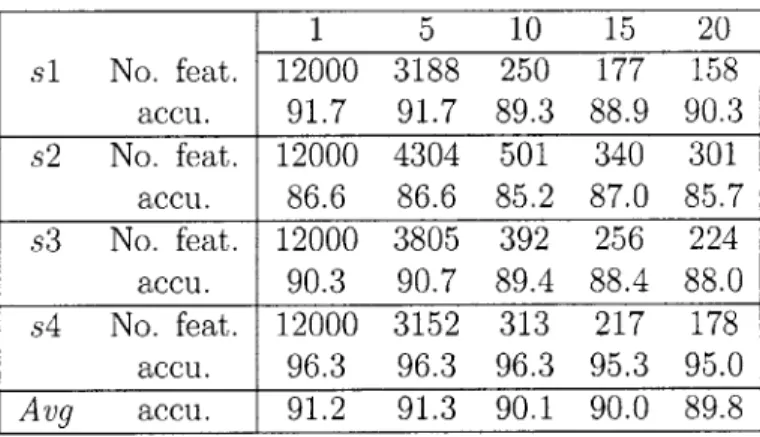
The following experiment looks at feature selection and in particular how the perfor-mance of the system depends on the number of selected features. For this experiment, we used space-time oriented Si units and sparse C2 features. Performance is evalu-ated on the four conditions of the KTH dataset.1 In the first iteration, all the 12, 000 prototypes extracted from the C1 frames of the training set were used to compute the C2 features. In each of the following iteration, only features with a weight IwI > 10-3 were selected.
Table 4.1 compares the performance of each round. In agreement with previous results on object recognition [44], we found that it is possible to reduce the number of C2 features quiet dramatically (from ~ 104 down to ~ 102) with minimal loss in
1 5 10 15 20 si No. feat. 12000 3188 250 177 158 accu. 91.7 91.7 89.3 88.9 90.3 s2 No. feat. 12000 4304 501 340 301 accu. 86.6 86.6 85.2 87.0 85.7 s3 No. feat. 12000 3805 392 256 224 accu. 90.3 90.7 89.4 88.4 88.0 s4 No. feat. 12000 3152 313 217 178 accu. 96.3 96.3 96.3 95.3 95.0 Avg accu. 91.2 91.3 90.1 90.0 89.8
Table 4.1: Selecting features: System performance for different numbers of selected C2 features at rounds 1, 5, 10, 15 and 20 (see text for details).
[13] GrC2 Of C2 StC2 KTH si 88.2 94.3 / 92.7 92.8
/
93.3 89.8/
96.0 sem. s1 ±1.9 ±1.7 / ±3.2 ±2.8 / +2.9 ±3.1 / ±2.1 KTH s2 68.3 86.0/
86.8 80.7 / 83.1 81.3/
86.1 s.e.m. s2 ±2.1 ±3.9 / ±3.9 ±4.0 / ±3.9 ±4.2 / ±4.6 KTH s3 78.5 85.8/
87.5 89.1/
90.0 85.0 / 88.7 s.e.m. s4 ±2.9 ±2.7 / ±3.3 ±3.8 / ±3.5 ±5.3 / ±3.2 KTH s4 90.2 91.0 / 93.2 92.9/
93.5 93.2/
95.7 se.m. s4 ±1.8 ±2.0 / ±1.9 ±2.2 / ±2.3 ±1.9 / ±2.1 Avg 81.3 89.3 / 90.0 88.9/
90.0 87.3 /91.6 s.e.m. Avg ±2.2 ±2.6 / ±3.1 ±3.2 / ±3.1 ±3.6 / ±3.0 UCSD 75.6 78.9 / 81.8 68.0 / 61.8 76.2 / 79.0 s.e.m. ±4.4 ±4.3 / ±3.5 ±7.0 / ±6.9 ±4.2 / ±4.1 Weiz. 86.7 91.1 / 97.0 86.4/
86.4 87.8 / 96.3 s.m. ±7.7 ±5.9 / ±3.0 ±9.9 / ±7.9 ±9.2 / ±2.5Table 4.2: Comparison between three types of C2 features (gradient based GrC2,
optical flow based Of C2 and space-time oriented StC2). In each column, the number
on the left vs. right corresponds to the performance of dense vs. sparse C2 features (see text for details). 1,. .84 correspond to different conditions of the KTH database
(see Section 4.1.1) and Avg to the mean performance across the 4 sets. Below the performance on each dataset, we indicate the standard error of the mean (s.e.m.).
accuracy. This is likely due to the fact that during learning, the S2 prototypes were extracted at random locations from random frames. It is thus expected that most of the prototypes should belong to the background and should not carry much informa-tion about each specific acinforma-tion. In the following, feature selecinforma-tion was performed on the C2 features for all the results reported.
GrC
3Of 3
StC
3 KTH s1 92.1 / 91.3 84.8/
92.3 89.8/
96.0 KTH s2 81.0 / 87.2 80.1/
82.9 81.0/
86.1 KTH s3 89.8 / 90.3 84.4 / 91.7 80.6/
89.8 KTH s4 86.5 / 93.2 84.0/
92.0 89.7 / 94.8 Avg 87.3/
90.5 83.3/
89.7 85.3/
91.7 UCSD 73.0/
75.0 62.0/
57.8 71.2/
74.0 Weiz. 70.4 / 98.8 79.2/
90.6 83.7/
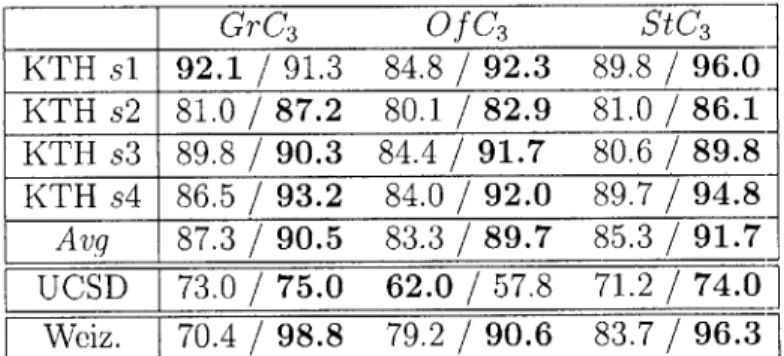
96.3Table 4.3: Comparison between three types of C3 units (gradient based GrC3, optical
flow based Of C3 and space-time oriented StC3). In each column, the number to the
left vs. the right corresponds to the performance of C3 features computed from dense
[62] vs. sparse [441 C2 features. The results are based on the performance of the model on a single split of the data.
Comparing different C2 feature-types
Table 4.2 gives a comparison between all three types of C2 features: gradient based
GrC2, optical flow based Of C2 and space-time oriented StC2 features. In each
col-umn, the number on the left vs. the right corresponds to the performance of dense
[62] vs. sparse [44] C2 features (see Section 3.1 for details). s1,. . .84 corresponds to
the different conditions of the KTH database (see Section 4.1.1).
Overall the sparse space-time oriented and the gradient-based C2 features (GrC2
and StC2) perform about the same. The poor performance of the Of C2 features on
the UCSD mice dataset is likely due to the presence of the litter in the cage which introduces high-frequency noise. The superiority of sparse C2 features over dense C2 features is in line with the results of [44] for object recognition.
Comparing different C3 feature-types
We have started to experiment with high-level C3 features. Table 4.3 shows some initial results with three different types of motion-direction sensitive input units (see caption). Overall the results show a small improvement using the C3 features vs. C2
features on two of the datasets (KTH and Weiz) and a decrease in performance on the third dataset (UCSD).
Running time of the system
A typical run of the system takes a little over 2 minutes per video sequence (KTH
human database, 50 frames, Xeon 3Ghz machine), most of the run-time being taken up by the S2 + C2 computations (only about 10 seconds for the S1 + C1 or the S3 + C3 computations). We have also experimented with a standard background
subtraction technique [68]. This allows us to discard about 50% of each frame thus cutting down processing time by a factor of 2 while maintaining a similar level of accuracy. Finally, our system runs in Matlab but could be easily implemented using multi-threads or parallel programming as well as General Purpose GPU for which we expect a significant gain in speed.
(a)
(b)
(c)
Figure 4-2: (a) KTH Human. First row: outdoor condition. Second row: outdoor
with scale variance. Third row: outdoor with different clothes. Fourth row: indoor
with lighting variation. Six actions from left to right: walking, running, jogging,
boxing, handwaving, and handclapping. (b) Weiz. Human. Actions in the first row
from left to right: bending, jumping-jack, jumping forward on two legs, jumping in
place on two legs, running, galloping-sideways, walking, waving one hand, and waving
two hands. (c) UCSD Mice. Five actions from left to right: drink, eat, explore, groom
and sleep.
Chapter 5
Conclusion
5.1
Main Contributions
Our approach is closely related to the feedforward hierarchical architectures with alternating template matching and maximum-pooling, used for the recognition of objects in still images [61]. We list the main extensions as follows:
Using motion-direction sensitive S1 units In the work [61], a still gray-value
input image is first analyzed by an array of Gabor filters (Si units) at multiple orien-tations for all positions and scales. To extend from the system of object recognition to action recognition, we empirically searched for a suitable representation for the Si units. We compared three types of motion-sensitive Si units: a) Space-time-gradient-based units; b) Optical-flow-Space-time-gradient-based units; c) Space-time-oriented units, which have been shown to be good models of motion-sensitive simple cells in the primary visual cortex [66]. Interestingly, we found that the optical flow features previously used in [21, 6, 65] lead to worse performance than the gradient-based and the space-time-oriented features.
Learning sparse spatio-temporal motion S2 features In the work [61], a
Gaussian-like function is used to compute the responses of dense S2 features. A
can be sparsified leading to a significant gain in performance on standard object recognition databases [44]. In this work, instead of using a Gaussian-like function, we directly use the Euclidean-distance as a similarity measurement, and we compare the performance of both dense and sparse S2 features.
Introducing feature selection to the S2 stage As opposed to video-based
pro-cessing [59, 13], our system, inherited from object recognition model. is a frame-based processing, in particular, from S1 to C2 stage. Using a frame-based processing sys-tem, action recognition is time consuming in that each data point is a video sequence containing up to 100 frames. Introducing feature selection can lead to an efficient system with better performance but with less features, as shown in [44]. Motivated
by these findings, we experiment with the AROM feature selection technique [74] in
the S2 stage to select relevant motion prototypes, and thus facilitating the template matching. We find that a more compact S2 feature representation can lead to signifi-cant decrease in the computation time taken by the overall system without sacrificing accuracy.
Adding new S3 and C3 stages Finally we experiment with an extension of the
hierarchy which is specific to motion processing, i.e. to include time invariant S3 and C3 units. Preliminary experiments suggest that these units sometimes improve
performance, but not significantly.
5.2
Role of the System in the Motion Pathway and
Action Recognition
Rather than sorting out a "biologically realistic" model from the wealth of anatom-ical, physiological and biophysical evidence to provide a functional explanation and quantitative simulations of experimental data concerning cells in the dorsal stream, we built a "biologically inspired" system based on two ideas. (1) Simple features processed in low-level cortical areas are transformed into complex features in