BET bromodomain proteins regulate
enhancer function during adipogenesis
The MIT Faculty has made this article openly available.
Please share
how this access benefits you. Your story matters.
Citation
Brown, Jonathan D. et al. “BET Bromodomain Proteins Regulate
Enhancer Function During Adipogenesis.” Proceedings of the
National Academy of Sciences 115, 9 (February 2018): 2144–2149 ©
2018 National Academy of Sciences
As Published
http://dx.doi.org/10.1073/PNAS.1711155115
Publisher
National Academy of Sciences (U.S.)
Version
Final published version
Citable link
http://hdl.handle.net/1721.1/118467
Terms of Use
Article is made available in accordance with the publisher's
policy and may be subject to US copyright law. Please refer to the
publisher's site for terms of use.
BET bromodomain proteins regulate enhancer function
during adipogenesis
Jonathan D. Browna,1, Zachary B. Feldmana, Sean P. Dohertya, Jaime M. Reyesb, Peter B. Rahlc, Charles Y. Linb,
Quanhu Shengd,e, Qiong Duanf, Alexander J. Federationg, Andrew L. Kungh, Saptarsi M. Haldari, Richard A. Youngc,j,
Jorge Plutzkyk,1,2, and James E. Bradnerg,1,2,3
aDivision of Cardiovascular Medicine, Vanderbilt University Medical Center, Nashville, TN 37232;bDepartment of Molecular and Human Genetics, Baylor
College of Medicine, Houston, TX 77030;cWhitehead Institute for Biomedical Research, Cambridge, MA 02142;dCenter for Quantitative Sciences, Vanderbilt
University School of Medicine, Nashville, TN 37232;eDepartment of Bioinformatics, Vanderbilt University School of Medicine, Nashville, TN 37232;
fCardiovascular Division, Xiangya Hospital, Central South University, 410078 Changsha, Hunan, PR China;gDepartment of Medical Oncology, Dana–Farber
Cancer Institute, Harvard Medical School, Boston, MA 02115;hDepartment of Pediatrics, Columbia University Medical Center, New York, NY 10032;
iGladstone Institute of Cardiovascular Disease and Department of Medicine, University of California, San Francisco, CA 94158;jDepartment of Biology,
Massachusetts Institute of Technology, Cambridge, MA 02139; andkCardiovascular Division, Brigham and Women’s Hospital, Harvard Medical School, Boston, MA 02115
Edited by Robert G. Roeder, The Rockefeller University, New York, NY, and approved January 12, 2018 (received for review June 21, 2017)
Developmental transitions are guided by master regulatory tran-scription factors. During adipogenesis, a trantran-scriptional cascade culminates in the expression of PPARγ and C/EBPα, which orches-trate activation of the adipocyte gene expression program. How-ever, the coactivators controlling PPARγ and C/EBPα expression are less well characterized. Here, we show the bromodomain-containing protein, BRD4, regulates transcription of PPARγ and C/EBPα. Analysis of BRD4 chromatin occupancy reveals that induc-tion of adipogenesis in 3T3L1 fibroblasts provokes dynamic redis-tribution of BRD4 to de novo super-enhancers proximal to genes controlling adipocyte differentiation. Inhibition of the bromodomain and extraterminal domain (BET) family of bromodomain-containing proteins impedes BRD4 occupancy at these de novo enhancers and disrupts transcription of Pparg and Cebpa, thereby blocking adipo-genesis. Furthermore, silencing of these BRD4-occupied distal regula-tory elements at the Pparg locus by CRISPRi demonstrates a critical role for these enhancers in the control of Pparg gene expression and adipogenesis in 3T3L1s. Together, these data establish BET bromodo-main proteins as time- and context-dependent coactivators of the adipocyte cell state transition.
chromatin
|
coactivator|
BET bromodomain|
adipogenesis|
transcriptionT
ranscription factors (TFs) guide cell state transitions duringdevelopment (1). Adipocyte differentiation is controlled by the action of peroxisome proliferator-activated receptor gamma (PPARγ) and CCAAT/enhancer binding protein alpha (C/EBPα), master TFs that control the gene expression program of the developing adipocyte (2). In model systems, proadipogenic stimuli induce PPARγ and C/EBPα expression by activating an upstream TF cascade comprised of C/EBPβ, C/EBPδ, and the glucocorticoid receptor (GR) (3). Disruption of this TF network impairs adipocyte differentiation and adipose tissue formation (4). These master TF networks signal via chromatin to execute the gene expression programs that drive adipogenesis. Comparative analysis of chromatin states in preadipocytes versus adipocytes has demonstrated massive enhancer reorganization during adi-pogenesis, as marked by genome-wide changes in the acetylation of histone 3 lysine 27 (H3K27ac) or lysine 9 (H3K9ac) (5, 6). Super-enhancers—cis-regulatory domains comprised of dense clusters of DNA-bound TFs and exceptionally high enrichment of chromatin-associated coactivators [e.g., BRD4, Mediator subunit-1 (MED1)]—have recently been identified in models of adipogenesis (7). Super-enhancers, akin to stretch enhancers or locus control regions, contain a disproportionately large amount of coactivator molecules for any given cell state (8, 9) and drive transcription of genes essential for cell identity (10, 11). During adipogenesis, super-enhancers have been identified near genes important for adipocyte differentiation including Pparg (7). How-ever, the specific mechanisms by which dynamically remodeled
enhancers signal to RNA polymerase and regulate adipogenesis are not as well characterized.
The bromodomain and extraterminal domain (BET) family of bromodomain-containing coactivator proteins—BRD2, BRD3, BRD4—associate with chromatin (12–14). BETs coactivate tran-scription by forming scaffolds with other coregulatory proteins, including Mediator subunits and the positive transcription elon-gation factor-b (PTEF-b) complex at enhancers. These multi-protein complexes activate RNA polymerase II (RNA Pol II) via long-range chromatin interactions (15). Prior studies establish BRD4 as a dynamic constituent of super-enhancers (10, 16, 17).
Significance
Adipocyte differentiation is necessary for metabolic homeo-stasis. Transcription factors control adipocyte differentiation by regulating expression of genes required for adipocyte function. Here we show that the bromodomain and extra-terminal domain (BET) family of bromodomain-containing pro-teins are important coregulators of adipogenesis. BRD4 binds to enhancers that drive expression of PPARγ, a master transcription factor required for normal adipocyte differentiation. Disrupting BRD4 at these enhancers blocks PPARγ expression and impairs differentiation. Understanding the molecular determinants of PPARγ expression and adipocyte differentiation may provide in-sights into the pathogenesis of metabolic diseases related to adipose tissue dysfunction and obesity. Furthermore, these data implicate metabolic pathways and their transcriptional regulators as potential targets of BET bromodomain inhibitors, as currently under investigation in human clinical trials of cancer therapy.
Author contributions: J.D.B., J.P., and J.E.B. designed research; J.D.B., Z.B.F., S.P.D., P.B.R., Q.D., A.J.F., A.L.K., and J.E.B. performed research; J.D.B. and Z.B.F. contributed new re-agents/analytic tools; J.D.B., J.M.R., P.B.R., C.Y.L., Q.S., A.J.F., S.M.H., R.A.Y., and J.P. an-alyzed data; and J.D.B., S.M.H., J.P., and J.E.B. wrote the paper.
Conflict of interest statement: J.D.B., J.P., and J.E.B. have a patent filed on Compositions and Methods for Modulating Metabolism (application no. PCT/US2011/036647) in which BET bromodomain inhibition is used to modulate metabolic diseases including obesity and fatty liver. J.E.B. is now an executive and shareholder of Novartis AG.
This article is a PNAS Direct Submission.
This open access article is distributed underCreative Commons Attribution-NonCommercial-NoDerivatives License 4.0 (CC BY-NC-ND).
Data deposition: ChIP-Seq data reported in this paper have been deposited in the Gene Expression Omnibus (GEO) database,https://www.ncbi.nlm.nih.gov/geo(accession no.
GSE109940).
1To whom correspondence may be addressed. Email: [email protected],
[email protected], or [email protected].
2J.P. and J.E.B contributed equally to this work.
3Present address: Novartis Institutes of Biomedical Research, Cambridge, MA 02139.
This article contains supporting information online atwww.pnas.org/lookup/suppl/doi:10. 1073/pnas.1711155115/-/DCSupplemental.
Recently, a distinct role for BETs has been described in tran-scription control of dynamic, stimulus-coupled cell state transi-tions in heart failure and inflammation (18, 19). Overall, these data reveal that BETs can transduce dynamic, genome-wide changes in enhancer activity to regulate cell identity.
We hypothesized that BETs are essential coregulators of adipogenesis. Here, we show that BRD4 is a critical enhancer factor that potently coactivates stage-specific expression of PPARγ and C/EBPα during adipogenesis. Induction of adipo-genesis in 3T3L1 preadipocytes provokes dynamic redistribution of BRD4 to de novo super-enhancer regions including the cis-regulatory elements controlling transcription of PPARγ and C/EBPα, thereby promoting differentiation. Displacement of BRD4 from enhancer chromatin with a BET bromodomain inhibitor blocks transcription of Pparg resulting in failure of differentiation. These data establish BET bromodomain proteins as essential transcriptional coactivators of the adipocyte cell state transition and implicate BET proteins in the regulation of sys-temic metabolic processes.
Results
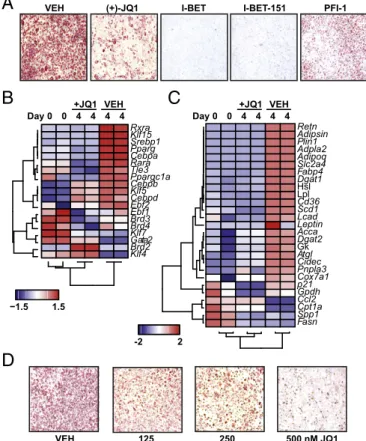
BET Bromodomain Proteins Control Adipocyte Differentiation.We first tested the effect of BET bromodomain inhibition on adipo-cyte differentiation using the 3T3L1 murine fibroblast model system (“L1”). Induction of differentiation using dexamethasone, isobutylmethylxanthine (IBMX), and insulin (DMI) resulted in adipocyte differentiation on day 8, as reflected by uniform lipid accumulation measured by oil red O staining (Fig. 1A). Cotreat-ment of preadipocytes with a panel of structurally dissimilar BET bromodomain inhibitors blocked differentiation (Fig. 1A) (20–24).
Effects on adipogenesis correlated with their relative IC50against
BRD4 (25). PFl-1 demonstrated a more modest block in adipo-genesis, while RVX-208 demonstrated no difference at the
con-centration tested (1μM) (Fig. 1A and Fig. S1A). Inhibition of
L1 differentiation by JQ1 was concentration-dependent, occurred without significant cytotoxicity, and resulted in only a modest
slowing of cell cycle (Fig. S1 B and C).
Given these potent effects of BET bromodomain inhibition on adipogenesis, we next considered the role of BETs in gene reg-ulation during differentiation. To address this issue, we designed a gene expression probe set (58 probes) for digital mRNA analysis (Nanostring). This curated gene set, containing probes for measuring expression of proadipogenic TFs, key transcrip-tional coregulators, and mature adipocyte markers, represents a molecular signature that encompasses critical stages of the dif-ferentiation process. At day 4 of L1 difdif-ferentiation, we observed expected induction of master regulatory TFs including Cebpa, Pparg, members of the Klf family, and retinoid-x receptor family (Rxr) as well as downstream target genes involved in adipocyte function including lipid uptake (Cd36; fatty acid binding protein: Fabp4), lipid synthesis (monoacylglyerol lipase: Magl; diac-ylglycerol O-actyltransferase1: Dgat1), and systemic metabolism (Adipsin; Adipoq) (Fig. 1 B and C). Cotreatment of L1s with JQ1 abrogated induction of the adipocyte gene set (Fig. 1 B and C), and unsupervised hierarchical clustering grouped JQ1-treated L1s more closely with preadipocytes. Both Pparg and Cebpa mRNA levels were quantitatively similar to preadipocytes (Fig. S1 D and E). BET inhibition also suppressed induction of
Adipoq and Fabp4, two genes directly regulated by PPARγ (Fig.
S1 F and G). Complementary studies using siRNA-mediated knockdown of Brd4 supported a role for this BET family
mem-ber in L1 differentiation (Fig. S1 H and I). To explore the
rel-evance of these findings in primary cells, we next performed adipocyte differentiation assays using the stromal vascular frac-tion (SVF) isolated from murine subcutaneous (s.c.) adipose depots. Cells from SVF differentiated into mature adipocytes over 10 d in the presence of a defined hormonal mixture. Concomitant BET bromodomain inhibition resulted in a concentration-dependent block in differentiation (Fig. 1D). In rodents, a short period of visceral adipose tissue expansion oc-curs in the first weeks of postnatal life, which may, in part, be
regulated by adipogenesis (26). To test the role of BET bro-modomain proteins in adipose tissue, we treated 2-wk-old pups with JQ1 for 12 d and detected a significant reduction in
epi-didymal white adipose tissue (EWAT) mass (Fig. S1J). In
EWAT, Pparg2 mRNA levels were also lower in JQ1-treated animals. Taken together, these data establish a role for BET bromodomain proteins in adipocyte differentiation in both the L1 model system and primary mouse adipogenic precursors.
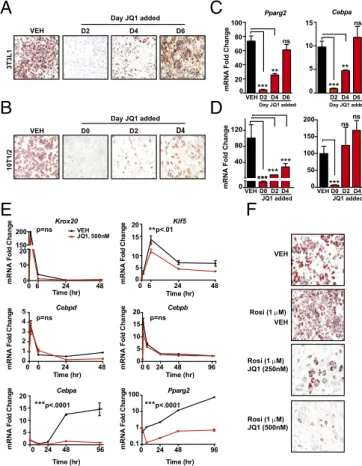
BETs Control Expression of the Master TFs Pparg and Cebpa.A pre-cise, temporally regulated cascade of TF activity drives adipo-genesis. Consistent with this wave of TF function, we observed a time-dependent effect of BET bromodomain inhibition on L1 differentiation. JQ1 cotreatment on day 2 or day 4 after in-duction of differentiation resulted in significant rein-ductions in lipid accumulation and Pparγ, Cebpα and Adipoq gene expres-sion, with these inhibitory effects diminishing when JQ1 was administered at later time points in the differentiation process
(Fig. 2 A and C andFig. S2A). JQ1 treatment of fully
differen-tiated adipocytes (day 6) had no effect on Pparg and Cebpa gene expression or the mature adipocyte phenotype measured on day 8. We next tested whether JQ1 effects were reversible during this first 96-h window by performing JQ1 washout experiments. As before, JQ1 treatment throughout the 8 d completely blocked
L1 differentiation (Fig. S2B). JQ1 exposure during day 0 through
day 2 also suppressed differentiation and Pparg expression, but partial recovery of expression did occur. This recovery was more
A
B
C
(+)-JQ1
VEH I-BET I-BET-151 PFI-1
125 250 500 nM JQ1 VEH
D
2 -2 Fasn Spp1 Cpt1a Ccl2 Gpdh p21 Cox7a1 Pnpla3 Cidec Atgl Gk Dgat2 Acca Leptin Lcad Scd1 Cd36 Lpl Hsl Dgat1 Fabp4 Slc2a4 Adipoq Adpla2 Plin1 Adipsin Retn Day 0 0 4 4 4 4+JQ1 VEH −1.5 Klf4 Brd2 Gata2 Klf7 Brd4 Brd3 Ebf1 Ebf2 Cebpd Klf5 Cebpb Ppargc1a Tle3 Rara Cebpa Pparg Srebp1 Klf15 Rxra 1.5 Day 0 0 4 4 4 4+JQ1 VEHFig. 1. BET bromodomain proteins control adipocyte differentiation. (A)
Pho-tomicrographs of oil red O stained L1 adipocytes after induction of
differenti-ation by DMI (day 8)± structurally distinct BET bromodomain inhibitors (JQ1 at
500 nM; I-BET, I-BET-151, and PFI-1 at 1μM). (B and C) Heatmaps of expression
of proadipogenic, master regulators (B), and mature adipocyte genes (C) at
D0 and D4 of differentiation± JQ1 (500 nM). (D) Photomicrographs of oil red
O staining after differentiation of cells isolated from the stromal vascular
fraction of mouse s.c. adipose tissue± JQ1. Data represent mean ± SEM. The
statistical significance of the difference in expression between vehicle (VEH)
and JQ1 was determined using a two-tailed t test. (Magnification: 4×.)
Brown et al. PNAS | February 27, 2018 | vol. 115 | no. 9 | 2145
CELL
BIO
evident in cells exposed to BET inhibition for only 24 h between
D1 and D2 (Fig. S2 B and C).
Adipogenesis proceeds in two phases: (i) early fate specification, involving commitment of stem cells to the adipocyte lineage, and (ii) terminal differentiation, in which committed cells progressively acquire features of mature adipocyte phenotype (3). As L1 cells are already committed to the adipocyte lineage (3), we asked whether BETs also played a role in the earlier events of lineage specifica-tion. Therefore, we performed an additional series of differentia-tion experiments with C3H10T1/2 cells (10T1/2), a cell line derived from the C3H mouse embryo that possesses mesenchymal stem cell-like properties and can be induced to differentiate into adi-pocytes using a hormonal mixture (27). In the 10T1/2 model, ma-ture adipocytes are evident by day 4. Similar to our L1 experiments, BET inhibition blocked differentiation in 10T1/2 cells in a
time-dependent manner (Fig. 2 B and D andFig. S2D). Reductions in
Pparg expression persisted in the presence of BET inhibition whether initiated on day 0 or day 2 of differentiation, while Cebpa mRNA levels were similar to vehicle in day 2-treated cells (Fig. 2D). In contrast to BRD4 loss-of-function experiments, enforced
expression of BRD4 in NIH3T3s—a nonadipogenic cell line—did
not induce differentiation (Fig. S2E), consistent with a role for
BRD4 as a coactivaor that transduces signals from enhancer-bound TFs to the transcriptional machinery. Collectively, these data es-tablish that BETs are stage-specific regulators of adipocyte differ-entiation and Pparg expression in committed preadipocytes (L1) and mesenchymal stem cells (10T1/2), but BRD4 is not sufficient to drive differentiation in cells lacking intrinsic adipogenic potential.
L1 differentiation proceeds by the coordinated action of a TF cascade that converges on Pparg and Cebpa expression. We next tested whether BET bromodomain proteins regulate the first wave of master TF expression during adipogenesis. In time-course experiments, expression of Krox20, Klf5, Cebpb, and Cebpd increased 1 h after starting L1 differentiation, peaked by 6 h, and returned to baseline by 24–48 h (Fig. 2E). Cotreatment of L1 cells with JQ1 had no effect on the magnitude or kinetics of Krox20, Cebpb, or Cepbd regulation, with a modest effect on Klf5 mRNA levels. Despite no significant effects on the expres-sion of these early TFs, BET inhibition completely abolished induction of both Cebpa and Pparg. In addition, treatment of L1 cells with a high-affinity, synthetic PPARγ ligand
(rosiglita-zone, 1μM) that further drives adipogenesis also failed to rescue
the block in differentiation by BET bromodomain inhibition
(Fig. 2F andFig. S2F). Overall, these data support a model in
which BET bromodomain proteins promote adipocyte differen-tiation by coactivating expression of Pparg and Cebpa in a cell type-specific manner.
BRD4 Is Dynamically Redistributed to Proadipogenic Super Enhancers.
To determine the role of BETs in adipocyte enhancer function, we first investigated genome-wide BRD4 binding to chromatin in
L1 preadipocytes (day 0, “D0”) and differentiating adipocytes
(day 2, “D2”) using chromatin immunoprecipitation coupled
with high-throughput deep sequencing (ChIP-seq). Experimental data obtained for BRD4 were integrated with publicly available datasets that provide high-resolution epigenomic maps of eu-chromatin during adipocyte differentiation (5). First, we identi-fied BRD4 to be enriched at preadipocyte and adipocyte promoters (13% and 4%, respectively, and as follows) and intergenic (39% and
38%) and intragenic (47% and 57%) regulatory sequences (Fig.
S3A). Alignment of BRD4 ChIP-seq data with published chromatin
state maps of enhancers (H3K27ac) and promoters (H3K4me3) in L1 cells demonstrated a strong correlation between H3K27ac and
BRD4 at both D0 and D2 (Fig. S3B). Global alignment revealed
BRD4 localized to chromatin at promoters and enhancers in both
preadipocytes and adipocytes (Fig. S3C).
We next ranked BRD4 enhancers by increasing ChIP-seq signal and identified 212 and 411 super-enhancers in pre-adipocytes and pre-adipocytes, respectively (Fig. 3 A and B). Dif-ferences in super-enhancer regions between preadipocytes and adipocytes (Fig. 3 A and B) prompted a systematic evaluation of the dynamic changes in super-enhancer organization. We ob-served significant redistribution of BRD4 to new enhancers in the D2-differentiating adipocytes. Differential enhancer analysis reclassified a significant subset of enhancers as transitioning from typical to super-enhancer (“adipocyte-gained,” n = 365) and from super to typical enhancer (“preadipocyte-lost,” n = 54) (Fig. 3C). Genes associated with adipocyte-gained super-enhancers were enriched for TFs that positively regulate adipo-cyte differentiation, including Pparg, Cebpa, and Cebpb (Fig. 3C). In contrast, other genes associated with preadipocyte-lost super-enhancers, such as Klf3 and Pleotrophin (Ptn), are known to interfere with differentiation and are down-regulated during adipogenesis; furthermore, prior work has revealed that enforced expression of these factors suppresses differentiation (28, 29). Super-enhancers feature high levels of coactivator protein en-richment and are also densely occupied by master regulatory TFs (8). Motif analysis revealed the GR (NR3C1) and C/EBP motifs were found at much higher density at adipocyte-gained enhancer regions compared with preadipocyte-lost super-enhancer regions (Fig. 3 D and E). Comparison of binding
A
10T1/2 3T3L1 D2 D4 D6 D0 D2 D4 5 0 Day JQ1 added D2 D4 D6 D2 D4 D6 * ** 0 0 50 100 150 200 D0 D2 D4 mRNA Fold Change VEH VEHC
B
D
E
F
Krox20 mRNA F o ld Ch a nge Klf5 0 6 24 48 0 5 10 15 20 Time (hr) mRNA F o ld Ch an g e Cebpb 0 5 10 15 20 0 6 24 48 96 Time (hr) mRNA Fo ld C h a nge Cebpd 0 6 24 48 0 1 2 3 4 5 Time (hr) mRNA Fol d Ch a nge 0 10 20 150 200 0 6 24 48 Time (hr) VEH JQ1, 500nM Pparg2 mRNA Fol d C ha nge Cebpa 0 24 48 96 Time (hr) mRNA Fold C ha nge 0 24 48 96 0.1 1 10 100 Time (hr) Pparg2 Cebpa 0 5 10 15 20 VEH VEH 0 40 80 120 D0 D2 D4 mRNA Fold Change VEH 100 80 60 20 40 15 10 VEH Rosi (1 M) Day JQ1 added JQ1 added JQ1 added VEH Day JQ1 added Day JQ1 added ** * ** * ** ns ns * ** * * * ** * ** * ** * **p<.0001 * **p<.0001 **p<.01 p=ns p=ns p=ns nsns Rosi (1 M) JQ1 (250nM) Rosi (1 M) JQ1 (500nM)Fig. 2. BETs control expression of the master TFs Pparg and Cebpa. (A and B)
Photomicrographs oil red O stained L1s (A) or C3H10T1/2 mesenchymal stem
cells (B) after induction of differentiation± JQ1 (500 nM). JQ1 was added to
differentiation medium on indicated days. Staining was on D6 for L1 and
D4 for 10T1/2. (Magnification: 4×.) (C and D) Bar plots of fold change in Pparg
and Cebpa mRNA levels in 3T3L1 cells and 10T1/2 cells from A and B. ns, not significant. (E) Line plots of fold change in mRNA of early response TFs in-volved in adipogenesis measured at 1, 6, 24, 48, and 96 h following induction
of differentiation± JQ1 (500 nM). (F) Oil red O staining of L1 adipocytes 8 d
after induction of differentiation in the presence or absence of rosiglitazone
(1μM) ± JQ1 (500 nM). (Magnification: 10×.) Data represent mean ± SEM. The
statistical significance of the difference in expression between vehicle (VEH) and JQ1 at each time point in C and D was determined using one-way ANOVA
with post hoc (Dunnett’s) multiple comparison tests of the means. **P < 0.01,
***P< 0.001. For E, two-way ANOVA was performed with ***P < 0.001 for
enrichment between BRD4 and previously generated datasets for C/EBPβ, CEBPδ, GR, and PPARγ ChIP-seq also demonstrated strong statistical correlation at D2 of L1 differentiation between
each of these TFs and BRD4 (R2 = 0.58, 0.62, 0.43, 0.57,
re-spectively) (Fig. 3 F and G andFig. S3D), suggesting genomic
colocalization of these factors. In addition, coimmunoprecipita-tion experiments revealed a modest interaccoimmunoprecipita-tion between CEBPβ
and BRD4 during differentiation (Fig. S3E), as previously
iden-tified in other cell types (13, 14). At the Pparg locus, pre-adipocytes feature minimal BRD4 or H3K27ac enrichment (Fig. 3H). Following induction of differentiation, L1 cells on D2 acquired
massive increases in both BRD4 and H3K27ac levels at a 5′ distal regulatory element and the promoter region of Pparg, consistent with formation of super-enhancers (Fig. 3H). By contrast, the Ptn locus contained high levels of BRD4 and H3K27ac at the 5′ en-hancer region in preadipocytes, which were lost on D2 of differen-tiation (Fig. 3I). To test the signals that control recruitment of BRD4 to chromatin, we omitted individual components of the ad-ipocyte differentiation mixture. The absence of insulin in this mix-ture resulted in a reduction of BRD4 recruitment to the Pparg locus
after 24 h of differentiation (Fig. 4 andFig. S3F). Overall, these
results establish that BRD4 dynamically redistributes away from preadipocyte genes to new super-enhancers associated with stage-specific expression of master regulatory factors including proadi-pogenic TFs such as Pparg.
BRD4 Super-Enhancer Binding Sites Regulate Pparg Gene Expression and Adipogenesis. Recruitment of BRD4 to super-enhancers at the Pparg locus suggests that these cis-regulatory elements may directly control Pparg gene expression. To test this hypothesis, we employed clustered, regularly interspaced, palindromic repeats interference (CRISPRi) to silence individual cis-regulatory ele-ments occupied by BRD4 (30). L1 cells were selected for stable expression of dCas9-KRAB along with individual guide RNAs (gRNAs) complementary to DNA at BRD4-enriched loci within the Pparg super-enhancers (Figs. 3H and 4). Targeting these sites by multiple, individual gRNAs repressed Pparg gene induction on D4 of L1 differentiation, compared with cells expressing dCas9-KRAB with no gRNA (Fig. 4). Notably, silencing of the distal 5′ site (E1) and intragenic sites (E4, E5) resulted in the most sig-nificant reduction in gene expression, with more modest effects at the other regions tested. CRISPRi of these Pparg enhancers also attenuated adipogenesis, as measured by oil red O staining (Fig. 4B). These data establish an important functional role for these de novo formed, BRD4-enriched cis-regulatory elements in adipo-genesis in the endogenous chromatin context of the cell.
Transcription of Pparg and Cebpa Is BET Bromodomain-Dependent.
The dynamic redistribution of BRD4 to de novo super-enhancers predicts that depletion of BRD4 from chromatin would reduce transcription at super enhancer-associated genes. To analyze the transcriptional consequences of disruption of BET super-enhancers, we performed ChIP-seq analysis of RNA Pol II oc-cupancy in L1 preadipocytes (D0) as well as differentiating L1s (D2) in the presence or absence of the selective BET bro-modomain inhibitor (JQ1, 500 nM). Comparison of RNA Pol II signal from actively transcribed genes in vehicle versus JQ1-treated L1s revealed overall statistical correlation between these two groups (Fig. 5A). However, at a subset of genes, RNA Pol II signal in JQ1-treated cells was lower than vehicle (Fig. 5A). Within this cluster, reductions in RNA Pol II signal at the Pparg gene locus were noted in JQ1-treated L1 cells. A comparison of RNA Pol II signal at the Pparg and Cebpa loci on D0 versus D2 revealed a robust increase during differentiation, coincident with acquisition of BRD4 at super-enhancers (Figs. 3H and 5B andFig. S4A). BET bromodomain inhibition with JQ1 depleted BRD4 from chromatin, and this resulted in reduced transcrip-tion of Pparg and Cebpa. This effect on Pparg and Cebpa ex-pression also blocked transcription of known downstream target
genes such as Fabp4 (Fig. S4B). Finally, we considered the
possibility that TF genes induced at earlier time points during L1 adipogenesis (Fig. 2E) are less sensitive to BET inhibition because they are not controlled by super-enhancers. Analysis of a previously published dataset of genome-wide binding of MED1—a constituent of super-enhancers (8)—at 4 h after the start of L1 differentiation revealed no super-enhancers assigned to Krox20,
Cebpd, and Cebpb genes (Fig. S4C) (7). Collectively, these data
reveal that BET inhibition blocks transcription of super enhancer-associated genes including Pparg and Cebpa.
A
B
BRD4 signal 212 Super-enhancers 100k 75k 50k 25k 0 5,000 1,000 0 3,000 Preadipocyte (D0) Super enhancers Ptn PpargE
PPAR ChIP-Seq D2 chr6:115,171,075 chr6:115,464,727 4.0 chr6:36870788 chr6:36654949 4.0 PtnC
D
F
G
PPAR ChIP-Seq D2 r = 0.58 BRD4 signal 41 1 Super-enhancers 200k 150k 100k 50k 0 15,000 5,000 0 10,000 Adipocyte (D2) Super enhancers Pparg Ptn Enhancers ranked by increasing BRD4 signal Enhancers ranked by increasing BRD4 signal C/EBP ChIP-Seq D2 C/EBP ChIP-Seq D2 H3K27ac ChIP-Seq D0 12 3.0 3.0 SEs gained 14 BRD4 ChIP-Seq D0 50kb D2 14 15BRD4 ChIP-Seq SE lost 50kb D0 D2 15 15H3K27ac ChIP-Seq D0 D2 15 D2 12 NR3C1 C/EBP C/EBP NR3C1 Higher in D2 gained SEs Higher in D2 lost SEsTranscription factor motif density enrichment
−1 −0.5 0 0.5 1.0 1.5 2.0 Log2 enrichment of transcription factor binding motifs in D2 gained vs. lost SEs
−15 −10 −5 0 5 10 15 la n gi s 4 D R B ni e g na hc y b de k na r se ty c o pi da ni s n oi ge r r ec na h ne re p u S E S de ni a g 2 D n= 365 E S t s ol 2 D PpargRxra Cebpa Cebpb Ptn n= 54 0 100 200 300 400 500 Change in BRD4 Log2 D2 vs. D0
H
1 3 5 7 9 12 15 18Position 0 0.5 1 1.5 2 1 2 3 4 5 6 7 8 9 0 0.5 1 1.52 Inf or mation content 3.0 C/EBP ChIP-Seq D0 C/EBP ChIP-Seq D0 3.0 BRD4 Signal CEBP β Signal .01 .02 0.2 2.0 0.01 0.02 0.2 2.0 Fert2 Klf3 r = 0.62 .01 .02 0.2 2.0 0.01 0.02 0.2 2.0 CEBP δ Signal BRD4 SignalI
Syn2 Pparg rpm/bp rpm/bpFig. 3. Brd4 is dynamically redistributed to proadipogenic enhancers. (A and
B) Plots of enhancers in preadipocytes (D0; A) and adipocytes (D2; B) ranked by increasing BRD4 signal in units of reads per million (rpm). Enhancers are de-fined as regions of BRD4 ChIP-Seq binding not contained in promoters. The cutoff discriminating typical enhancers from super-enhancers is shown as a dashed line. (C) Horizontal bar plot of all genomic regions containing a SE
in preadipocytes (D0) or differentiating adipocytes (D2) ranked by log2change
in BRD4 signal. The x axis shows the log2fold change in BRD4 signal. Change in
BRD4 levels at SEs are colored by intensity of change (green to red). (D) Hor-izontal bar plot showing the ratio of TF motif density between gained (D2) and lost (D0) super-enhancers. Twenty-one TFs are displayed whose motifs occur more frequently than expected based on dinucleotide background
model. The motifs are ranked by log2 fold change in density between
D2 gained and D0 lost super-enhancers. (E) Consensus sequences of C/EBPβ
(Top) and NR3C1 (Bottom) DNA binding motifs. (F and G) Scatter plot of C/EBPβ
versus BRD4 binding signals (F) or C/EBPδ versus BRD4 signals (G) in L1 cells on
D2 of differentiation. (H and I) Gene tracks of ChIP-Seq signal (rpm/bp) for BRD4,
H3K27ac, C/EBPβ, and PPARγ at the Pparg locus (H) or Ptn (I) locus in 3T3L1 cells
on D0 (Upper) or D2 (Lower) of differentiation.
Brown et al. PNAS | February 27, 2018 | vol. 115 | no. 9 | 2147
CELL
BIO
Discussion
Adipocyte differentiation requires the coordinated activity of the master TFs, C/EBPα, and PPARγ. Disruption of their expression or function in humans profoundly alters metabolism, in part, through effects on adipocyte differentiation (31). In this study, we explored the role of chromatin-dependent signal transduction in this process. We demonstrate that the BET bromodomain-con-taining protein, BRD4, transduces the adipogenic program through formation of de novo super-enhancers that drive transcription of Pparg and Cebpa and promote adipocyte differentiation.
Super or stretch enhancers are clusters of enhancers where TFs and coactivator proteins are concentrated and drive tran-scription of genes controlling cell state (8, 9). In this study, we identified that BRD4 redistributes to de novo super-enhancers in proximity to genes encoding TFs, including Cebpa and Pparg, in response to adipocyte differentiation cues. These data build on prior reports demonstrating that TF hotspots colocalize with super-enhancers containing MED1 in differentiating L1 cells (7). Functional interactions between Mediator and BRD4 may par-tially explain how BRD4 redistributes to these regions (32). In addition, the colocalization of BRD4 with multiple TF-binding motifs, as observed in our study, suggests that site-specific BRD4 redistribution may occur via interactions between BRD4 and specific DNA-binding TFs. In the context of in-flammation, biochemical studies have demonstrated that BRD4 can bind acetylated p65-RelA, implicating this in-teraction as a possible mechanism for genome-wide redistri-bution of BRD4 to inflammatory super-enhancers during innate immune activation (19, 33). Furthermore, a functional relation-ship between C/EBPβ and BRD4 has been described in NIH
3T3 fibroblasts (14). Overall, these data are consistent with a model in which lineage-specific TFs activated during adipo-genesis direct state-specific flux of BRD4 and other coregulators to de novo super-enhancers that control cell state.
We find that selective depletion of BRD4 from chromatin impairs adipocyte differentiation. These results occurred in three models of adipogenesis (3T3L1, 10T1/2, and SVF) in response to a panel of structurally dissimilar BET bromodomain inhibitors or siRNA-mediated knockdown of Brd4. Notably, two independent studies have recently emerged that used BET bromodomain in-hibition or conditional Brd4 deletion to demonstrate a role for BETs in adipogenesis (34, 35). The results presented here align with these reports while also providing additional significant insights, including the use of CRISPR interference to demon-strate directly that silencing of individual, BRD4-enriched en-dogenous enhancer elements at the Pparg locus resulted in disrupted Pparg expression and adipogenesis. Whether BRD4 enrichment at specific cis-regulatory elements is sufficient to drive adipogenesis and which elements are required for this will be of interest to investigate in future studies. Overall, when considered collectively, these data demonstrate a requirement for BETs and BRD4 in adipogenesis through collaboration with lineage determining TFs and may in part explain why systemic Brd4 haploinsufficient mice have reduced adipose tissue forma-tion (36). The effects of BET bromodomain inhibiforma-tion diminished
E1 E1 E2 14 0 50 100 150 E3 E4 E5 E6
sgRNA for Individual Enhancer Loci
G1 G2 G3
E2
G1 G2 G3
E3
G1 G2 G3
Relative mRNA Fold Change
E4 G1 G2 G3 E5 G1 G2 E6 G1 G2 G3 G1 G2 G3 G1 G2 dCas/ KRAB G1 G2 G3 G1 G2 G3 G1 G2 G1 G2 G3 G3
A
B
rpm/bpPparg Super Enhancers
chr6:115,173,856 chr6:115,415,698 dCas-KRAB 25kb *** *** *** *** * *** *** *** ****** *** * * * * *** ***
Fig. 4. BRD4 binding sites regulate Pparg expression and adipogenesis. (A)
Gene track of ChIP-Seq signal of BRD4 on D2 of L1 differentiation at the upstream and intragenic Pparg super-enhancer regions (Upper) and bar plot of Pparg mRNA expression (D4 of L1 differentiation) in cells stably expressing dCas9-KRAB alone or with gRNAs targeting individual enhancer constituent
sites (E1–E6). (Lower) Three unique gRNAs per enhancer site were used in
separate cell lines. (B) Oil red O staining of cells (D7) treated as in A. The statistical significance of the difference in expression between individual gRNA and dCas9-KRAB was determined using two-tailed t test.
(Magnifica-tion: 4×.) *P < 0.05; ***P < 0.001. chr6:115,171,075 chr6:115,464,727 Syn2 Pparg 50kb 2.0
A
D2 Gained SEsB
2.0 2.0 D2 + JQ1RNA Pol II ChIP-Seq D0 D2 D2 + JQ1 14 14 BRD4 ChIP-Seq D2
RNA Pol II Signal D2
RNA Pol II signal D2+JQ1
1 1-4 1 r=0.86 1-2 1-4 1-2 Pparg rpm/bp
Fig. 5. Transcription of adipogenic master regulatory factors is BET
bromo-domain-dependent. (A) Scatter plot of RNA Pol II ChIP-Seq signal at gene bodies
of all actively transcribed genes in L1 cells on D2 of differentiation versus D2+
JQ1 (500 nM). (B) Gene tracks of ChIP-Seq signal (rpm/bp) for BRD4 (D2 versus
D2+ JQ1 of differentiation) and RNA Pol II on D0 (Top), D2 (Middle), and D2 +
over time, revealing the presence of precise temporal windows during which enhancer activity is required to regulate distinct stages of adipocyte differentiation. The muted effect of BET bromodomain inhibition at later time points may reflect com-pensation by other coactivators such as MED1 at established su-per-enhancers, functional cooperativity between multiple TFs bound at these regions or bromodomain-independent re-cruitment of BETs to these enhancers (13, 37). Our findings in adipogenesis extend prior work describing the role of BRD4-enriched super-enhancers in cell state. In embryonic stem cells (ESCs) and in certain cancers, super-enhancers regulate expres-sion of pluripotency factors (8, 17) or oncogenes, respectively (16, 22). In these contexts, BET bromodomain inhibition triggers dif-ferentiation, growth arrest, and/or cell death (22). The differen-tiation block by JQ1 in L1 and 10T1/2 cells stands in sharp contrast to the prodifferentiation effects of BET inhibition in ESCs and NUT midline carcinoma (17, 22). These differences highlight how BETs transduce signals controlling the establishment of specific, TF-driven cell states by coactivating context-specific enhancer activity to RNA polymerase II.
BET bromodomain inhibitors are a new class of drugs in cancer therapy now under investigation in human clinical trials. The data presented herein have implications for this therapeutic approach. Disruption of BET-occupied enhancers may have adverse conse-quences in noncancer cellular compartments including adipocytes, where stimulus-coupled transcription is an essential mechanism controlling metabolic homeostasis. Furthermore, analysis of BET-dependent super-enhancer wiring may provide insight into potential
on-target toxicities of pharmacologic BET bromodomain inhibitors that target cell-state defining genes. Considered more broadly, understanding the precise mechanisms underlying context-specific, BET bromodomain-dependent coactivation may deepen our un-derstanding of the gene regulatory circuits governing tissue-specific responses in development and diseases outside of cancer. Experimental Procedures
Animal experiments were approved by Institutional Animal Care and Use Committee (IACUC) at Harvard Medical School. Adipocyte differentiation was performed in media supplemented with fetal bovine serum (10%), in-sulin, dexamethasone, and IBMX. For 10T1/2 cells, 1 nM T3 and 0.125 mM
indomethacin was also included. Summary data are presented as mean± SEM,
and Student’s t test was used to compare groups. For kinetic gene expression,
ANOVA was conducted. Methods for ChIP-Seq, coimmunoprecipitation,
CRISPRi, RNA preparation, and cell staining are provided inSI Experimental
Procedures.
ACKNOWLEDGMENTS. We thank the Gersbach and Boehm/Hahn/Root labo-ratories for Addgene plasmids and M. Steinhauser and Y. Zhang in the Division of Genetics, Brigham and Women’s Hospital, for comments during manuscript preparation. Research was supported by Grant NIH-K08 HL105678 (to J.D.B.); the US Department of Defense (C.Y.L.); National Heart, Lung, and Blood In-stitute (NHLBI) Grant P01 HL048743 (to J.P.); NIH/NHLBI Grants R56-HL125894 and R01-HL133665 (to J.P.); NIH/National Institute of Diabetes and Digestive and Kidney Diseases Grant R01-DK107239 (to J.P.); the Burroughs-Wellcome Fund (J.E.B.); the Damon-Runyon Cancer Research Foundation (J.E.B.); and the Next Generation Award (to J.E.B.).
1. Long HK, Prescott SL, Wysocka J (2016) Ever-changing landscapes: Transcriptional enhancers in development and evolution. Cell 167:1170–1187.
2. Sarjeant K, Stephens JM (2012) Adipogenesis. Cold Spring Harb Perspect Biol 4: a008417.
3. Rosen ED, MacDougald OA (2006) Adipocyte differentiation from the inside out. Nat Rev Mol Cell Biol 7:885–896.
4. Lefterova MI, Haakonsson AK, Lazar MA, Mandrup S (2014) PPARγ and the global map of adipogenesis and beyond. Trends Endocrinol Metab 25:293–302. 5. Mikkelsen TS, et al. (2010) Comparative epigenomic analysis of murine and human
adipogenesis. Cell 143:156–169.
6. Siersbæk R, et al. (2011) Extensive chromatin remodelling and establishment of transcription factor‘hotspots’ during early adipogenesis. EMBO J 30:1459–1472. 7. Siersbæk R, et al. (2014) Transcription factor cooperativity in early adipogenic
hot-spots and super-enhancers. Cell Rep 7:1443–1455.
8. Whyte WA, et al. (2013) Master transcription factors and mediator establish super-enhancers at key cell identity genes. Cell 153:307–319.
9. Parker SC, et al.; NISC Comparative Sequencing Program; National Institutes of Health Intramural Sequencing Center Comparative Sequencing Program Authors; NISC Comparative Sequencing Program Authors (2013) Chromatin stretch enhancer states drive cell-specific gene regulation and harbor human disease risk variants. Proc Natl Acad Sci USA 110:17921–17926.
10. Lovén J, et al. (2013) Selective inhibition of tumor oncogenes by disruption of super-enhancers. Cell 153:320–334.
11. Saint-André V, et al. (2016) Models of human core transcriptional regulatory circuit-ries. Genome Res 26:385–396.
12. LeRoy G, Rickards B, Flint SJ (2008) The double bromodomain proteins Brd2 and Brd3 couple histone acetylation to transcription. Mol Cell 30:51–60.
13. Wu SY, Lee AY, Lai HT, Zhang H, Chiang CM (2013) Phospho switch triggers Brd4 chromatin binding and activator recruitment for gene-specific targeting. Mol Cell 49:843–857.
14. Roe JS, Mercan F, Rivera K, Pappin DJ, Vakoc CR (2015) BET bromodomain inhibition suppresses the function of hematopoietic transcription factors in acute myeloid leu-kemia. Mol Cell 58:1028–1039.
15. Yang Z, et al. (2005) Recruitment of P-TEFb for stimulation of transcriptional elon-gation by the bromodomain protein Brd4. Mol Cell 19:535–545.
16. Chapuy B, et al. (2013) Discovery and characterization of super-enhancer-associated dependencies in diffuse large B cell lymphoma. Cancer Cell 24:777–790.
17. Di Micco R, et al. (2014) Control of embryonic stem cell identity by BRD4-dependent transcriptional elongation of super-enhancer-associated pluripotency genes. Cell Rep 9:234–247.
18. Anand P, et al. (2013) BET bromodomains mediate transcriptional pause release in heart failure. Cell 154:569–582.
19. Brown JD, et al. (2014) NF-κB directs dynamic super enhancer formation in in-flammation and atherogenesis. Mol Cell 56:219–231.
20. Picaud S, et al. (2013) PFI-1, a highly selective protein interaction inhibitor, targeting BET bromodomains. Cancer Res 73:3336–3346.
21. Picaud S, et al. (2013) RVX-208, an inhibitor of BET transcriptional regulators with selectivity for the second bromodomain. Proc Natl Acad Sci USA 110:19754–19759. 22. Filippakopoulos P, et al. (2010) Selective inhibition of BET bromodomains. Nature 468:
1067–1073.
23. Mirguet O, et al. (2012) From ApoA1 upregulation to BET family bromodomain in-hibition: Discovery of I-BET151. Bioorg Med Chem Lett 22:2963–2967.
24. Nicodeme E, et al. (2010) Suppression of inflammation by a synthetic histone mimic. Nature 468:1119–1123.
25. Filippakopoulos P, Knapp S (2014) Targeting bromodomains: Epigenetic readers of lysine acetylation. Nat Rev Drug Discov 13:337–356.
26. Kim SM, et al. (2014) Loss of white adipose hyperplastic potential is associated with enhanced susceptibility to insulin resistance. Cell Metab 20:1049–1058.
27. Reznikoff CA, Brankow DW, Heidelberger C (1973) Establishment and characteriza-tion of a cloned line of C3H mouse embryo cells sensitive to postconfluence inhibicharacteriza-tion of division. Cancer Res 33:3231–3238.
28. Gu D, et al. (2007) The effect of pleiotrophin signaling on adipogenesis. FEBS Lett 581: 382–388.
29. Sue N, et al. (2008) Targeted disruption of the basic Krüppel-like factor gene (Klf3) reveals a role in adipogenesis. Mol Cell Biol 28:3967–3978.
30. Thakore PI, et al. (2015) Highly specific epigenome editing by CRISPR-Cas9 repressors for silencing of distal regulatory elements. Nat Methods 12:1143–1149.
31. Hegele RA, Cao H, Frankowski C, Mathews ST, Leff T (2002) PPARG F388L, a trans-activation-deficient mutant, in familial partial lipodystrophy. Diabetes 51:3586–3590. 32. Wu SY, Chiang CM (2007) The double bromodomain-containing chromatin adaptor
Brd4 and transcriptional regulation. J Biol Chem 282:13141–13145.
33. Huang B, Yang XD, Zhou MM, Ozato K, Chen LF (2009) Brd4 coactivates transcrip-tional activation of NF-kappaB via specific binding to acetylated RelA. Mol Cell Biol 29:1375–1387.
34. Lee JE, et al. (2017) Brd4 binds to active enhancers to control cell identity gene in-duction in adipogenesis and myogenesis. Nat Commun 8:2217.
35. Goupille O, et al. (2016) Inhibition of the acetyl lysine-binding pocket of bromodo-main and extraterminal dobromodo-main proteins interferes with adipogenesis. Biochem Biophys Res Commun 472:624–630.
36. Houzelstein D, et al. (2002) Growth and early postimplantation defects in mice de-ficient for the bromodomain-containing protein Brd4. Mol Cell Biol 22:3794–3802. 37. Shu S, et al. (2016) Response and resistance to BET bromodomain inhibitors in
triple-negative breast cancer. Nature 529:413–417.
Brown et al. PNAS | February 27, 2018 | vol. 115 | no. 9 | 2149
CELL
BIO