it/kerwan%Musdum
PUBLISHED BY THE AMERICAN MUSEUM OF NATURAL HISTORY CENTRAL PARK WEST AT 79TH STREET, NEW YORK 24, N.Y.
NUMBER
2076
FEBRUARY 28, I962The
Weights of Dinosaurs
BY EDWIN H.
COLBERT
INTRODUCTIONOneof the attributesofthe dinosaurs that makes these fossils so inter-estingto scientist andlaymen alike is their size. Of course not all dino-saurs are giants, indeed some of them are very small; yet by and large the two reptilian orders Saurischia and Ornithischia, which together are termed "dinosaurs," are typified by the large and even gigantic proportions ofa majority of their constituent genera. Some of the dino-saurswerethe largest animals ever to live on the land, and a very large proportion of them were greater and more massive than most of the
land-livinganimals of the present day. It isa very human response to beinterested in the extremes of sizethat occurin the world around us, either the very large orthe very small, and consequently the dinosaurs because of their size arebound to beofmore general interest than are mostfossils.
It must not be thought, however, that interest in the dinosaurs as gigantic animals is a matterof idle curiosity. The general trend towards giantism, so characteristic of the dinosaurs of Jurassic and Cretaceous
times, carries with it various evolutionary implicationsthat have been vigorously studied in the past and offer the opportunity for much fur-ther investigation in the future. Such problems as the evolutionary growthrates in the dinosaurs, the structural limitations of size in land-living vertebrates, the relation of size totemperatures and other factors of thephysical environment, giantism and competition, and many ad-ditional topics present challengingsubjects for research by the
scien-tific disciplines who are concerned with the earth and its past life. We know how bigthe various dinosaurs werefrom the evidence of their fossil bones, but how much did they weigh? Very little work has been done in answer to this question, and in truth most of the state-ments about the probable weights of the dinosaurs are educated guesses. There is a reason for thissituation, namely, it is not easy to try to calculate the weights of animals long extinct, especially those of which no close relatives are living today. The determination of the weights of extinct animals such as dinosaurs must be carried out by methods that may be somewhat roundabout; nevertheless it can be donewith afair degree of accuracy.
One method is to find the volume of a good model of the animal in
question and then to calculate the volume of theextinct form, the scale of the model used being known. With the volume of the extinct animal so determined, it is possible to calculate the weight by multiplying this volume by theassumed specific gravity of the extinct animal. It is apparent from this description that, given an accurate restoration of the extinct form (and a restoration usually can be made which ap-proaches very near to the probable external form of the animal), a reasonably accurate calculation of its volume is possible. The only as-sumption of consequence thatenters into this method is of the specific
gravity of the extinct animal. Here a comparison with living related animals is ofhelp.
A half century ago, William King Gregory calculated the weight of the giant sauropod dinosaur Brontosaurus, or more properly Apatosaurus, using essentially the method outlined above. His results, published in Science in 1905, are referred to below.
The present paper is anelaboration of Gregory's study, using models representative of the six suborders of dinosaurs. It was initiated as a project limited to the brontosaurs, a resultof correspondence between the author and acolleague, Dr. Theodore White, Naturalist at Dino-saur National Monument, concerning the probable weight ofsome of the largesauropod dinosaurs. As workprogressed, theproject expanded,
finally including dinosaurs belonging toall thesuborders, as mentioned above. Themethod and the results aredescribed on thefollowing pages. I wish to acknowledge the help of Mr. Gilbert Stucker, Specialist in the Laboratory of Vertebrate Paleontology at the American Museum of Natural History, who rendered invaluable assistance in determining
the volumeof the various models of dinosaurs. Also I wish to
acknowl-edgethe kindness ofMr. Charles M. Bogert, Chairman of the
Depart-mentofHerpetologyatthe AmericanMuseum,forpermissiontoobtain theweight and the volume ofa live alligator and a live Gila monster
and for his assistance in the securing of these data. Help in these deter-minations was also given by Mr. George Foley of the Department of Herpetology.
DIRECT EVIDENCE AS TO THE WEIGHTS OF DINOSAURS Ofcourse some rather general ideas as to weights in dinosaurs can beobtained from the fossils themselves. For instance,one can lookat a skeleton and make a rough estimate as to the probable weight of the animal inlife on the basis offamiliarity with livinganimals. Thus if adinosaur skeleton appearsto be about the same sizeas the skeletonof
amodern elephant, one may assume that the dinosaur in life may have been comparable to an elephantin weight. Similar comparisons may be applied between various smaller dinosaurs and modern reptiles or mammals that are more orless equal to them in size. But many of the dinosaurs were considerably larger than the largest elephants (which are the greatest of modern land-living animals), so this method of vis-ual comparison soon breaks down. We can only say that these dino-saurswere generally larger in life than elephants but generally smaller than the largest modern whales, which leaves muchroom for specula-tion.
Another clue as to the weights of dinosaurs is in their footprints. In Texas,for example, are found trackways made by a large sauropod of
early Cretaceous age, each individual print being several inches in
depth. Evidently the prints musthave been made by very heavy ani-mals, even if one assumes that the mud at the time was quite soft.
But these indications of the weight of certain dinosaurs are at best of a very general nature, and no exact information is to be had from them. Consequently it is necessary to turn to anindirect yet none the less valid method of getting to the heart of thisproblem, the method that involves theuse of models.
THE METHOD
Some passages from Gregory's paper of1905, in which the method used by him to determine the probable weight of Brontosaurus is de-scribed, are quoted here:
"From the model [made by Charles R. Knight], a number of plaster casts were made, and one of these was usedin thefollowing determin-ation. The model was constructed as nearly as possible to the exact scale of one sixteenth natural size, hence the cubic contents of the modelmultiplied by the cube of16(4096) should indicate the probable
volumeof water which would be displaced by the animal in the flesh. One of thecasts was cut into sixpieces of convenient size,which were
then made water-tight by a double coating of shellac....
"The weightof the cast in air minus its weight in water would equal the weight ofan equal volume ofwater. This differential weight was determined in grams. Asa gram is the weight of acubic centimeter of watertheweight of the waterdisplaced gavedirectly the cubic contents of themodel" (Gregory, 1905, p. 572).
The advantage of the method described above is in the accuracy with which the weights of the model in the air and in water can be determined. Its disadvantage is the necessity of treating the model to make it impervious to water. Therefore it was decided in the present work to make adirect measurement of the volume of each model used and touse somedry material for this purpose. Sand was employed, be-causeit is fine and can be packed around all the complex shapes of a model.
Some slight inaccuracies may have been introduced into the meas-urementsbythe use ofsand. The volume of each model was determined at leasttwice, and anaverage was taken. Many of the models were at-tached to bases. With the use of sand, separate determinations of the volumes of the bases could be made, which would have been difficult if water had been used. Consequently the volumes of a valuable series of scaled models were obtained without any destruction or injurytothe models. This is an item ofimportance, because of the cost of casting such models.
The method was simple. Three boxes were constructed, one for large
models, one for those of medium size, and one for small models. In each instance the model was placed in its box and completely covered with sand, the box being tapped during the process sothat the sand would settle in place and fill all the spaces. The box was filled with sand to its top, and the sand was leveled off. Then the model was
care-fully removed, without any of the sand being spilled. The box was again filled with sand, the amountof sand used being carefully meas-ured. Thus the sand that went into the box the second time, after the removal of the model, indicated the volume of the model.
In the case ofthose models on bases, either of two methodswas used. Onewas toplace the modelupside down in thebox, with the base com-pletelyoutof the box.When this methodwasnotfeasible, the volume of themodelandthatofthe baseweredeterminedseparately. Inthis latter method, the model was placed in a shallow tray, whichwas filled with sand, all around, to the uppersurface of the base. The modelwas then removed, measured sandwasagain added, and the volume ofthebase wasthereby obtained.
When the volume of the model had been obtained in cubic centi-meters, it was multiplied by the cube of the linear scale to which the model had been made, which gave the volume of the dinosaur when alive. The metric volume of the dinosaur could then be converted directly into metric weight, based on an assumption of the specific grav-ityof the living animal.
Gregory wrote in his 1905 paper, "But as the animal was probably slightly heavier than the water displaced, in order to enable it to walk on the bottom along the shore of lakes and rivers, we may add about ten percent . . ." (Gregory, 1905, p. 572).
Probably Gregory erred in making such an assumption. Careful study of the Texas brontosaur tracks by R. T. Bird has shown that, where the water was deep, these animals did not walk along the bottom but ratherfloated, barely touching the bottom with one foot or another to propel themselves along (Bird, 1944, p. 66). That this is indeed the case among modern tetrapods has clearly been shown by under-water moving pictures of hippopotamuses made in recent years. Theselarge mammals hadlong enjoyed the reputation of being able to walk on the bottoms of rivers and lakes. The pictures show that they do not walk in the true sense of the word; rather, they float at such a depth that they are able to push themselves along in greatunder-water "bounds."
Consequentlythe hippopotamuses, so massive and clumsy on the shore, are transformed under waterinto beasts of true grace and agility, ex-ecutingtheir aquatic leaps with the aplomb ofa ballet dancer. Perhaps the samewas more orless true for the large dinosaurs.
Certainlythere is good reason to think that these ancient reptileshad a specific gravity of less than one, as is the case amongmodern land-living animals.
During the course of the work it was decided to check thespecific
gravity of some modern reptiles. A young alligator (Alligator) and a Gila monster (Heloderma)wereeach weighed in air. Eachwasimmersed in water, and the volumeof water displaced was measured, thereby
giv-ing the volume of the animal. It was found that these reptiles had spe-cific gravities considerably less than one, that of the alligator being
about 0.9, that of the Gila monster about 0.8.
The low figure for the Gila monster is probably due tothe fact that this lizard has a great deal of fat in thetail and in other parts of the body. The figure for thealligator is verylikely closer towhatwas
typi-cal of mostdinosaurs, this assumption beingbased in parton the close taxonomic relationships of crocodiliansto the two dinosaurian orders. One might ask, of course, whetherthe figure of 0.9, which is the
spe-cific gravity of a very young alligator, can be taken as an index of specific gravity in the dinosaurs. What might be the specific gravity of a fully adult alligator, in which the ratio of heavy bone and muscle to total body weight is conceivably greater than in the young animal? For the moment this question will remain unresolved; the present author has no desire tostruggle with a 10-foot crocodilian for the sake of a few percentage points of specific gravity. Certainly the figure of 0.9 should
FIG. 1.Dinosaur models, scaled at one-tenth to one-twelfth natural size. Left to right: Protoceratops, Allosaurus, Anotosaurus, Stegosaurus. Figure not to scale.
notbefar from the truth ifapplied in the calculations of theweightsof dinosaurs.
Something should be said here about the models used and the determination of the scales of these models. As for the models them-selves, it is highly important in a study such as this to have accurate restorations, made by competent artists under thesupervision of expe-rienced paleontologists, and executed with meticulous detail. Slight
inaccuracies in small models will loomlarge when the volumes of such models are expanded to natural size. A list of the modelsfollows, with the names of the artists and their supervisors, and remarks, where pertinent.
Allosaurus, orAntrodemus
Modeled by Charles R. Knight,under thesupervisionofHenryFairfield Os-bornandWilliam Diller Matthew.
Averylife-likemodel,except that thethoracicregionisprobablytoothin.
Con-sequentlytheweightofAllosaurus, asdetermined from volumetricmeasurements ofthis model,isslightlyless than it should be.
Tyrannosaurus
Modeled by Vincent Fusco, under thesupervision of BarnumBrown.
Agood model,butabit heavy in the thoracic region. The weight of
Tyranno-saurus, as determined by use of this model, may therefore be somewhat on
the heavy side. Brachiosaurus
ModeledbyVincent Fusco, underthesupervision of Barnum Brown.
There is littletocriticize in this model,exceptthatagain the thoracicregionis
FIG. 2. Dinosaur models, scaled at one-twenty-fourth to one-twenty-seventh
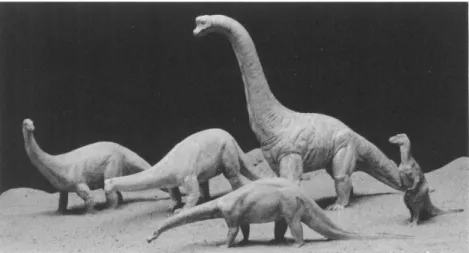
naturalsize. Infront, Diplodocus. Backrow,left to right: Brontosaurus (Allen), Bronto-saurus(Knight), Brachiosaurus,Iguanodon. Figure not to scale.
wellrounded-asindeedmayhavebeenthecase.
Brontosaurus, orApatosaurus
Modeled by Charles R. Knight, underthedirection ofHenry Fairfield Osborn andWilliam Diller Matthew.
An excellentmodel by Knight. It canbe criticizedashaving the base of the tail somewhat toothin. Therewas heavy musculaturebehind thepelvis inthe
greatsauropods.
Brontosaurus,orApatosaurus
ModeledbyJ. E. Allen, under the supervision of Barnum Brown.
This model issuperiortotheKnight modelinthat the tail is restoredinwhat
seems tobeitsmore correct proportions, whichaccounts for the difference in the
calculatedweight ofBrontosaurus asderivedfromthe two models. Diplodocus
Modeled byJosephPullenberg.
Agood model,needingnocomments.
Camptosaurus
Agoodmodel.No comments necessary.
Iguanodon
Modeled byJoseph Pullenberg. Agood model, needing no comments.
Corythosaurus
Modeled by Vincent Fusco, under the supervision of Barnum Brown. A good model. No comments necessary.
Anatosaurus
Modeled by Charles R. Knight, under the supervision of Henry Fairfield
Os-bornandWilliam Diller Matthew.
Amodelwith thedisplay ofthe usual Knight skill. No comments necessary.
_!_~~~~~~~~~~~~~~~~~~~~~~4
FIG.3.Dinosaur models,scaledatone-fifteenthto about one-sixteenthnatural size. Front row, lefttoright: Camptosaurus, Styracosaurus,Palaeoscincus. Backrow,left
toright: Triceratops, Tyrannosaurus, Corythosaurus. Figure not toscale. Stegosaurus
Modeledby J. E.Allen, underthesupervisionof Barnum Brown.
Agoodmodel. No comments necessary.
Palaeoscincus
Modeled byVincent Fusco, under the supervision ofBarnumBrown. Agood model. No comments necessary.
Protoceratops
Modeled by Vincent Fusco, under the supervision of Barnum Brown.
Thesmallest of the models inthe series. Good, but because of its sizethe
de-tails are somewhat generalized.
Styracosaurus
ModeledbyVincentFusco,under thesupervisionofBarnum Brown. Ingeneral, agoodmodel, butthe baseofthetail is thinner than it should be.
Triceratops
Modeled by Vincent Fusco,under the direction of Barnum Brown. Agood model. No comments necessary.
The determination of the scales of the models used is particularly important and should be done very carefully. Wherever possible the measurements were made on the original skeleton, and the same meas-urements were made on the model, even though most of the models had the scale indicated onthem. As will be seen in table 1, a few of the models came out at rather odd scales, in relation to the skeletons meas-ured. Nevertheless, this procedure gave a feeling of assurance concern-ing the results. The one large question as to the weight of a dinosaur in this series concerns Brachiosaurus, as is discussed below, and in the case ofthis reptile the scale had to be determined from published plates.
Those dinosaurs of which the scale of the model was checked against a mounted skeleton are Allosaurus, Tyrannosaurus, Brontosaurus,
Corytho-saurus, Anatosaurus, Stegosaurus, Palaeoscincus, Protoceratops, Styracosaurus,
and Triceratops.
Those dinosaurs of which the scale of the model was checked against published figures and plates are Brachiosaurus, Camptosaurus, Diplodocus, and Iguanodon.
THE SPECIFIC GRAVITY OF TWO RECENT REPTILES On page 5 there is a brief discussion of the specific gravity of two modern reptiles, namely, a young alligator and a Gila monster, partic-ularly as these specific gravities bear on the problem of the estimating of the weight of dinosaurs. The complete measurements are:
Alligator (Alligator mississipiensis)
Weightinair 280.1 grams
Volume 315 cubiccentimeters Specific gravity 0.89
Gilamonster(Heloderma horridum)
Weight in air 864 grams
Volume 1055cubic centimeters Specific gravity 0.81
CALCULATION OF THE PROBABLE WEIGHTS OF CERTAIN DINOSAURS
Table 1 presents the data obtained by the method described above. As can beseen, each model and each skeleton were measured inthe pelvic region-from the crest of the ilium or the tips of the sacral spines to the base, except in the case ofBrachiosaurus, of which a shoul-der measurement was made. In some genera additional measurements were obtained, in order to check on the accuracy ofthe scales estab-lished by pelvic or shoulder heights. Such wasthe case particularlyfor Brachiosaurus,
Cogythosaurus,
Palaeoscincus, andStyracosaurus. The skeletons(spunocj
oo Coone e0oe s N weemJo) suoi,Ss fltn t. - - o
'.Jnesoin(I jo IqBi!AA Nr>o^-ci"t o:n"tM nM + ¢
(StuflSO
olyQ
ONMN tN010 1o LI-C - CO 4VoOCOm COinCO Ln r- '
J0)SUOI3TJ1aj Ul . . . CO
'in-esoui(I JO
IOPBlNA
N0COon
C - O ooStuvIBJOp U l(A4! N- 0%Cs00NO CM'10 N- N --OCOX
s \ 'IOP°p0aunlooov-04 r-°° r- ° ° r->
-AUeJOJ
UgpodS)
6'0 ow01 0i coN NrNN oN000
OP-|s N0 cu500iIen
X 'lppojNjoouTnoA o N en e O
sO-jjui UpgqnD0- 'I °0 ° Nin 00 NtO0
'lapoyV
NNJo aumloAX %o1enlO ¢ >T- GsGOClora irur en SO NC) r-Cso -40 C1't C. 00 +880
QnI'I;P°Z fiO aumloA N > ¢>C%O" 0 inq cn n 1*C,
X
lopopiA
jou.inloA
cOCen.400
.30
U 2'T 0%1.O MO0 -4L0COi '.0n N'c'-X)o)U!~DUJ~AV
S~~~
"-o'o+ C-, 00%t 't 'U! K G8e0%ON Nm t 0
jo ouno
'lPPon JO~TMA CN N00CO4 1-CO0%C 0%0% 1-O
Zloo3q o uan en0% 0000~000nCsMCc 'C00O '
OA
ale?4o -144 % q 000
0 00C cooo310N14 0 0
aIllopopi jo ouinj A NN CaW "MU\>c~O C sct2o>m
tuyV~~~~~~~C1 1 ulq 'SIO dg m 8°e8 °q
O C0ONN0N0sN 0 ON N0NON
poqno alTDSjuoH- o O 0%0 000 0.O in 0 0 NOCO
3Cg O%C Co '.3 -o o N o -n
00
010'd C Ln %'0N 0o' 0 N'.OU)L
o U14.JUT'SIA 0%0~~L,. LnLnONOc m,ocO'.co V-0 CONc
eq 0~~0'--OI 0 "I-,~~~~~~I 000 -- 000 0- 0>00-0-%)~~~~~~~~4 bO~~~C' 10~~~~~~~~~~~~~0
of Corythosaurus and Styracosaurus at the American Museum of Natural History are set up as plaque mounts, notfree mounts, and thus the pel-vic heights had to be obtained by our measuring the various elements involved (ilium, leg bones, and foot bones) and working out the heights from these measurements with the bones posed in their correct posi-tions. Itis felt that the margin of errorwas small-certainly no more than would be involvedinvarying poses of free mounted skeletons. The
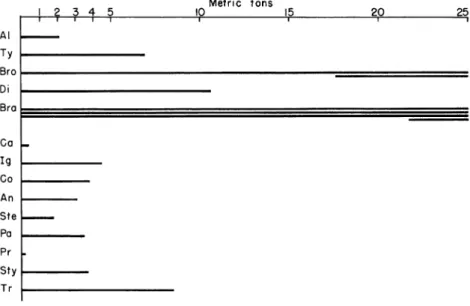
Metric tons 2 3 4 5 10 15 20 25 Al Ty Bro Di Bra Ca Ig Co An Ste Pa Pr Sty Tr
FIG. 4. Weights of saurischians (top five) and ornithischians (bottom nine).
Abbreviations: Al,Allosaurus;An, Anatosaurus; Bra,Brachiosaurus; Bro, Brontosaurus;
Ca, Camptosaurus;Co, Corythosaurus; Di, Diplodocus; Ig, Iguanodon; Pa, Palaeoscincus; Pr, Protoceratops; Ste, Stegosaurus; Sty,Styracosaurus;Tr, Triceratops;Ty, Tyrannosaurus.
pelvic heightof Palaeoscincus hadto beestimated, partly from the known elements of this genus and partly from closecomparisons with
Ankylo-saurus.
Most of the measurements of volumes ransurprisingly close, which indicates that the method of making these measurements was a good one. The greatest difference was inthe measurements of Anatosaurus-13.6 per cent of the mean; the next greatest was inthose ofStegosaurus -7.1 per cent of the mean. All theother measurements varied byonly
a few percentage pointsor by fractions ofa per cent,the greatestof the remainder beingin those ofthe Allen modelofBrontosaurus (3.3% of the
mean)and theleast beingthe volumetric measurements ofCamptosaurus,
Protoceratops, and Styracosaurus, in which there were no differences in the two determinations. In five models (the Knight Brontosaurus, Diplo-docus, Brachiosaurus, Iguanodon, and Palaeoscincus) there were differences of less than 1 per cent. In the remaining models (Allosaurus, Tyranno-saurus, Cotythosaurus and Triceratops) the variation was between 1 per cent and 3 per cent.
DISCUSSION
Perhaps the chief value of this paper is its attempt to give some sub-stance to a problem that has been largely in the field of speculation. Table 1 maynot be completely accurate, but it is believed that the
figures probably approach the truth with a reasonable degree of valid-ity, particularly when one considers the range of individual variation amongadult reptiles.
Certain elements in table 1 are rather unexpected, at least to the author. For example, the living Allosaurus andStegosaurus werelighter than I wouldhaveexpected them to be. Conversely, Brachiosauruswas seemingly much heavier than was expected.
The calculated weightofBrachiosaurusis the one worrisome figure in the table. It has been generally supposed that 40 to 50avoirdupois tons constitute about the upper limit for the weight ofa land-living verte-brate, the assumption being that greater weights would exceed the
limitations ofthe supporting strength of bone, ligament, and muscle. Yet here is a dinosaur that, on the basis of the calculations, weighed as much as alarge whale. Extra volumetric measurements of the model were made, and linear measurements of the model and of Janensch's
figures of Brachiosaurus were checked several times. Afterall possible
checks of method and measurements had been made, the figure still held. Therefore, unless one is prepared to reject the Fusco model of Brachiosaurus as being completely inaccurate, a proposition that I for one cannot accept, it appears that Brachiosaurus was indeed a gigantic
sauropod, inweight almost two anda half times the size of Brontosaurus. When a visual comparison is made of the models ofBrachiosaurusand Brontosaurus (using the Knight interpretation of the latter, which is to thesame scaleas the FuscoBrachiosaurus), this differential is easyto be-lieve. Brachiosaurus was indeed giganticin comparison with other sauro-pods. Much of its great size can be attributed to the tremendous developmentofthe shoulders and forelimbs, themassive neck, and the huge body. Certainly noother land-living vertebrate ever approached
All in all this study points up the well-known fact that giantism was advantageous to the dinosaurs of middle and late Mesozoic times, in spite of the many inherent disadvantages that accompany giantism. The Jurassic and Cretaceous periods were times of world-wide tropical conditions, when temperatures were at an optimum for the great growth ofreptiles, plantlife was luxuriant, and food was plentiful. It wasthe age when there were giants on the earth.
These giants came in assorted sizes, and, while it is evident that the big sauropods weregiants in every sense of the word, many of the other dinosaurs were giants of moderate dimensions, which poses problems concerning giantism among the dinosaurs and their life habits, specifi-cally the problem of first- and second-class food consumers and preda-tor-preyrelationships.
An overwhelming majority of the dinosaurs were first-class con-sumers,living on the abundant vegetation of middle and lateMesozoic times. It was obviously a good living, for the herbivorous dinosaurs, especially the ornithischians, developed in great variety along numer-ous lines of adaptive radiation. As can be seen from figure 4, the ornithischians that roamed Mesozoic landscapes varied from very small
dinosaurs toponderousanimals weighing as much as 8 or 9 metric tons. Thecarnivorous theropodsof the Cretaceous period, the time when the ornithischians were at the climax of their evolutionary radiation, were likewise large, the greatest of them, Tyrannosaurus, being some 7 metric tons in weight. Evidently this giant predator made his way in life by
feeding upon avariety of dinosaurs that were considerably smaller than himself; thus Tyrannosaurus, in attacking one of the hadrosaurs or per-haps one of the ankylosaurs, would have had a great advantage because of his gigantic size. Even when he attacked Triceratops, a dino-saur larger than himself, his chances were good, because the size
differential between them wasnotvery great. The same considerations obtained for the earlier dinosaurs of the upperCretaceous-Gorgosaurus and itscontemporaries. Only thelingering sauropodswere appreciably
larger than these Cretaceous predators.
When we look at the late Jurassic scene a different situation is ap-parent. In the Morrison fauna of North America, for example, orin theroughly correlative Kimmeridge fauna of Europe ortheTendaguru
fauna ofAfrica, there were no great hosts ofornithischians, these dino-saursbeing limited to afewearly types. Thus a less varied foodsupply
was available to thecarnosaurs ofthat age, such asAllosaurus(or Antro-demus). It has been very generally supposed, therefore, that the
sauro-pods, apparently the most abundant of the herbivores. How valid is such an assumption?
Aglance at figure 4 will show that Diplodocus, one of the lightest of thegiant sauropods, was about five times heavier than Allosaurus, while Brontosaurus exceeded the carnosaur by as much as 13 times. The differ-ential between Brachiosaurus and the largest of lateJurassic carnosaurs must have been exceedingly great. Would one expect these predators to have attacked intended victims that outweighed them by such great margins?
Perhaps they did. The series of dinosaur trackways mentioned above, discovered at Glen Rose, Texas, in sediments of lower Cretaceous age, give clear evidence that a large sauropod comparable to Brontosaurus in size was followedor trailed by a carnosaur ofAllosaur-like proportions. Here is what seems to be the evidence of an ancient hunt.
But when we turn to a consideration of modern animals, we find that generally there arenoextreme differences between the weights of the predator and those of its prey. Among the mammals, for example, a North American mountain lion, commonly weighing about 150 pounds (about 70 kilograms), preys extensively upon the muledeer, an animal the average bucks of which are of about thesame weight. The mountain lion may attack the American stag or wapiti, which may be three or four times its weight, but the lion isnot likely tomake such an attack if the smaller deer areavailable. An African lion,weighing about 300 pounds (about 135 kilograms) habituallypreys upon zebras, which exceed it in weight by about two to three times. It seldom attacks larger herbivores and very commonly kills smaller ones. In short, these more orlesssolitaryhunters prey uponanimals thattheycan"handle,"
by virtue of theirspeed and strength.
It is difficult to visualize an allosaur "handling" a sauropod many times larger than itself.
To extend thecomparison, it should be remarked that the alligators
andcrocodiles, the arch predatorsamong modernreptiles, attimes kill animals that are considerably largerthan themselves. The success ofa large crocodile in killing alarge mammal, however, usuallyrestsupon its ability to drag the victim under water and drown it. Certainlyno such behavior pattern wouldhave been involved in the caseofan allo-saur, athoroughgoing terrestrial animal and a brontosaur, an aquatic
type.
There is a possibility that the carnosaurs huntedingroupsor"packs,"
like wolves, but of course on a much lower level of organization. A pack ofwolves, theindividual members ofwhich might
weigh
about75 pounds (27 kilograms), will attack a caribou (300 pounds, 135 kilo-grams) or even a moose (1000 pounds, 450 kilograms). Yet even these highly intelligent and intrepid carnivores would, in the old days of the great bison herds, shy at attacking a full-grown bison. The disparity in weight and strength was too much, evenfor the combined efforts of the pack.
Fromthese comparisons it is reasonable to think, therefore, that the giant carnosaursof the Mesozoic preyed largely on dinosaurs that were not overwhelmingly larger than themselves, were of the same size as or weresmaller than the hunters. Perhaps theirconsumption ofgiant sauropods was largely in the roleof scavengers or carrion eaters.
Various other aspects of the problems of giantism in the dinosaurs might bediscussed at this place. It is, however, a large subject, and can best be considered elsewhere. The foregoing remarks may indicate the manner in which so simple an exercise as an attempt to calculate the weights ofliving dinosaurs, rather than to resort tospeculation, can throw light on various aspectsof the lives of these long-extinct reptiles.
REFERENCES
BENEDICT, FRANCIS G.
1936. The physiology oftheelephant. Publ. Carnegie Inst. Washington, no.
474,vii+302 pp.
BIRD, ROLANDT.
1944. Did Brontosauruseverwalk onland? Natural History, vol.53, no. 2, pp.
60-67.
BROWN, BARNUM
1908. TheAnkylosauridae, a newfamily of armored dinosaursfrom theupper Cretaceous. Bull. Amer. Mus. Nat. Hist., vol. 24, art. 12,pp. 187-202.
BROWN,BARNUM,ANDERICH M. SCHLAIKJER
1940. Thestructure andrelationships ofProtoceratops. Ann. New YorkAcad. Sci., vol. 40, art. 3, pp. 133-266.
DOLLO,M. L.
1882. Premiere note sur les dinosauriens deBernissart. Bull. Mus. Roy.d'Hist.
Nat. Belgique,vol. 1, pp. 1-18, pl.9. GILMORE, CHARLES W.
1909. Osteology of the Jurassic reptile Camptosaurus, with a revision ofthe
species ofthe genus, and descriptions oftwo newspecies. Proc. U. S.
Natl. Mus., vol. 36, pp. 197-332, pls. 6-20.
1914. Osteology ofthe armored Dinosauria in the United States National
Museum, with special reference to the genus Stegosaurus. Bull. U. S. Natl. Mus., vol. 89, pp. 1-143, pls. 1-37.
1920. Osteologyof the carnivorous Dinosauria in the United States National Museum, with special reference to the genera Antrodemus (Allosaurus)
and Ceratosaurus. Ibid., vol. 110,pp. 1-154,pls. 1-36.
Carnegie Museum. Mem. Carnegie Mus., vol. 11,no.4,pp.175-300, pls. 21-35.
GREGORY,WILLIAM KING
1905. The weight of the Brontosaurus. Science, new ser., vol. 22, no. 566, p.572.
HATCHER,J.B.
1905. Diplodocus Marsh, its osteology,taxonomy,andprobable habits, witha
restoration of the skeleton.Mem.CarnegieMus., vol. 1, no. 1,pp. 1-63, pls. 1-13.
HUENE, FRIEDRICHVON
1932. Die fossile Reptil-Ordnung Saurischia, ihre Entwicklung und Geschichte. Leipzig,Gebruder Borntraeger,vi + 361pp., 56pls.
JANENSCH. W.
1950. Die Skelettrekonstruktion vonBrachiosaurus brancai.Palaeontographica, suppl.7,1Reihe, Teil 3,Leiferung 2,pp.97-103, pls.6-8.
LULL, RICHARD SWANN
1933. Arevision oftheCeratopsiaorhorneddinosaurs. Mem.PeabodyMus.
Nat.Hist., vol. 3,pt.3,pp. 1-175, pls. 1-17.
LULL, RICHARD S.,ANDNELDA E.WRIGHT
1942. Hadrosaurian dinosaurs of North America. Special Papers Geol. Soc.
Amer., no. 40, pp. 1-242,pls. 1-3 1. OSBORN, HENRY FAIRFIELD
1917. Skeletal adaptations of Ornitholestes, Struthiomimus, Tyrannosaurus. Bull. Amer.Mus. Nat. Hist., vol. 35,art.43,pp.733-771,pls.24-27.