HAL Id: hal-01236161
https://hal.univ-reunion.fr/hal-01236161
Submitted on 1 Dec 2015
HAL is a multi-disciplinary open access
archive for the deposit and dissemination of
sci-entific research documents, whether they are
pub-lished or not. The documents may come from
teaching and research institutions in France or
abroad, or from public or private research centers.
L’archive ouverte pluridisciplinaire HAL, est
destinée au dépôt et à la diffusion de documents
scientifiques de niveau recherche, publiés ou non,
émanant des établissements d’enseignement et de
recherche français ou étrangers, des laboratoires
publics ou privés.
American–Pacific plate boundary in California from
SKS splitting
Mickael Bonnin, Guilhem Barruol, Götz H.R. Bokelmann
To cite this version:
Mickael Bonnin, Guilhem Barruol, Götz H.R. Bokelmann. Upper mantle deformation beneath the
North American–Pacific plate boundary in California from SKS splitting. Journal of Geophysical
Research, American Geophysical Union, 2010, �10.1029/2009JB006438�. �hal-01236161�
Click Here
for
Full Article
Upper mantle deformation beneath the North American
–Pacific
plate boundary in California from
SKS splitting
Mickael Bonnin,
1Guilhem Barruol,
1and Götz H. R. Bokelmann
1Received 6 March 2009; revised 27 August 2009; accepted 13 November 2009; published 8 April 2010.
[1]
In order to constrain the vertical and lateral extent of deformation and the interactions
between lithosphere and asthenosphere in a context of a transpressional plate boundary, we
performed teleseismic shear wave splitting measurements for 65 permanent and temporary
broadband stations in central California. We present evidence for the presence of two
anisotropic domains: (1) one with clear E
–W trending fast directions and delay times in the
range 1.5 to 2.0 s and (2) the other closely associated with the San Andreas Fault system
with large azimuthal variations of the splitting parameters that can be modeled by two
anisotropic layers. The upper of the two layers provides fast directions close to the strike of
the main Californian faults and averaged delay times of 0.7 s; the lower layers show E
–W
directions and delay times in the range 1.5 to 2.5 s and thus can be compared to what
is observed in stations that require a single layer. We propose the E
–W trending
anisotropic layer to be a 150 to 200 km thick asthenospheric layer explained by the
shearing associated with the absolute plate motion of the North American lithosphere. The
shallower anisotropic layer ought to be related to the dynamics of the San Andreas
Fault system and thus characterized by a vertical foliation with lineation parallel to the
strike of the faults localized in the lithosphere. We also propose that the anisotropic layer
associated with each fault of the San Andreas Fault system is about 40 km wide at the base
of the lithosphere.
Citation: Bonnin, M., G. Barruol, and G. H. R. Bokelmann (2010), Upper mantle deformation beneath the North American– Pacific plate boundary in California from SKS splitting, J. Geophys. Res., 115, B04306, doi:10.1029/2009JB006438.
1.
Introduction
[2] In the last decades, seismic anisotropy has become a
powerful tool for mapping upper mantle deformation and for studying the dynamics of the lithosphere‐asthenosphere system. Anisotropy, i.e., the physical property of a medium that induces variations in seismic wave velocities with the direction of propagation, is mostly related to rock micro-fracturing in the upper crust [e.g., Crampin, 1984] or to single‐crystal intrinsic elastic properties associated with crystal‐preferred orientation at greater depth such as in the lower crust [e.g., Barruol and Mainprice, 1993a] or in the upper mantle [e.g., Mainprice and Silver, 1993]. At upper mantle depths, seismic anisotropy results primarily from elastic anisotropy of rock‐forming minerals, particularly olivine, which develop preferred orientations in response to tectonic stress and flow [e.g., Nicolas and Christensen, 1987; Mainprice et al., 2000].
[3] Shear wave splitting is a direct effect of birefringence
of the medium and therefore of seismic anisotropy: a shear wave crossing an anisotropic medium splits into two
per-pendicularly polarized shear waves that propagate at different velocities. From three‐component seismic records, two parameters can be measured to quantify anisotropy: (1) the delay (dt) between the two split waves that depends on the thickness and on the intrinsic anisotropy of the medium and (2) the azimuth of the fast split wave polarization ( ), which is related to the orientation of the pervasive fabric in the anisotropic structure (foliation and lineation) or to fluid‐ filled microcracks at upper crustal levels.
[4] The San Andreas Fault (SAF) system is a
transpres-sional, dextral strike‐slip plate boundary that separates the Pacific plate from the North American plate [e.g., Wallace, 1990; Bokelmann and Kovach, 2000]. As it separates litho-spheres with different nature and ages, it represents an area of major interest for studying the coupling between the Earth’s envelopes, i.e., between the crust and the underlying litho-spheric mantle and between the lithosphere and the under-lying asthenosphere. The relatively simple and linear geometry of the SAF system and the dense seismological instrumentation of the area allow mapping of the deformation and its lateral and vertical variations beneath a major strike‐ slip plate boundary using shear wave splitting.
[5] In the last 2 decades, several studies have already
focused on SKS splitting in California [Ozalaybey and Savage, 1994; Silver and Savage, 1994; Ozalaybey and Savage, 1995; Hartog and Schwartz, 2000, 2001; Polet and Kanamori, 2002]. These works evidenced regional variations in the
1Géosciences Montpellier, Université Montpellier II, CNRS, Montpellier, France.
Copyright 2010 by the American Geophysical Union. 0148‐0227/10/2009JB006438
JOURNAL OF GEOPHYSICAL RESEARCH, VOL. 115, B04306, doi:10.1029/2009JB006438, 2010
seismic parameters, particularly between stations close to the fault and those farther east, near the Sierras. In eastern
California, directions of were described as trending
mostly E–W, whereas near the SAF, fast split shear waves are trending NW–SE and are characterized by larger variations of with the wave back azimuths. Silver and Savage [1994] were the first to model these azimuthal variations in terms of two anisotropic layers for a set of stations close to the SAF: they found that an upper layer with a fast split direction close to the fault strike ( 1= 50°W), overlying a lower layer with E–W direction ( 2= 90°E), could explain the observed back
azimuthal variations in and dt. Ozalaybey and Savage
[1994] proposed a similar model for station BKS and other stations close to the SAF with 1= 45 ± 22°W and 2= 90 ± 27°E [Ozalaybey and Savage, 1995], with a close correlation between the fast azimuth and the strike of the faults. Polet and Kanamori [2002] explained the observed variations of the anisotropic parameters in terms of heterogeneity beneath the faults instead of models of two anisotropic layers. In all the papers dealing with models of two anisotropic layers, the different authors agree on the fact that the upper layer is closely related to the fault dynamics and with the associated shear. The origin of the deeper anisotropic layer is more debated, but it is generally associated with a regional asthenospheric flow. Hartog and Schwartz [2001] proposed the regional anisotropic layer to be related with absolute motion of the Sierra Nevada–Great Valley block, whereas Ozalaybey and Savage [1995] and Polet and Kanamori [2002] prefer to explain the regional fast axis directions pattern by postsubduction processes.
[6] The present paper takes advantage of the dense seismic
coverage that has recently become available, and especially the recently acquired data from USArray, to better constrain the deformation associated with the plate boundary, as well as that induced by the relative motion between the plate and the convective mantle. The aim of this work is therefore to tackle the lateral and vertical extent of the deformation beneath the SAF system to elucidate the relations between the litho-sphere and the underlying upper mantle for the various strike‐slip faults accommodating the large‐scale relative motion. The USArray experiment provides us an updated map of mantle deformation, even though these temporary deployments provided not more than 2 years of data each, while the regional broadband networks (e.g., Berkeley Digital Seismic Network (Berkeley network), California Integrated Seismic Network (Caltech)) now have stations with much more than 10 years of data. Permanent networks provide enough data to improve the back azimuthal coverage and to go further in the characterization of the complexity of the anisotropic structure.
[7] We focus our investigation on the area extending from
the Pacific coast in the west to the Nevada border in the east and from N35° in the south to the Mendocino Triple Junc-tion in the north. This is motivated by the fact that the SAF system is characterized by a relatively linear structure in this zone and that such a relatively simple geometry should permit discriminating between deformation related to the fault itself and deeper deformation. After a brief description of the data and method used in this work, we describe the individual and average results from the scale of the station to the regional scale. Section 4 discusses the various possible
origins of the upper mantle anisotropies and their vertical and lateral locations.
2.
Data and Methods
[8] In order to update the anisotropy map of the
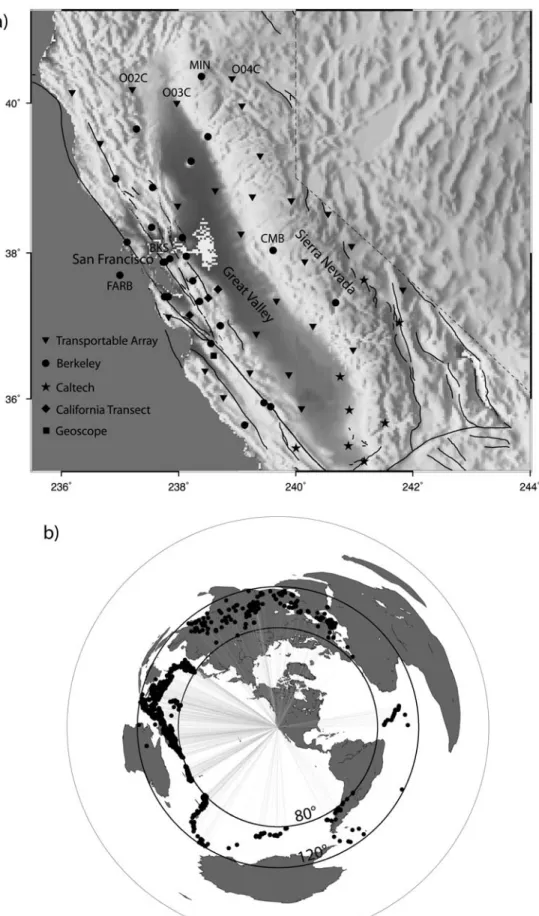
Cali-fornian upper mantle, we analyzed the complete data set provided by 65 broadband stations. These comprise 25 permanent stations of the Berkeley network in the northern part of the study area, 8 from Caltech in the southern part and 1 from the Geoscope network; we also used data from 28 temporary stations from the Transportable Array of the USArray experiment that provide a dense network with a station spacing of about 50 km, increasing considerably the spatial resolution. Finally, we used three stations from the California Transect experiment. Station locations are shown in Figure 1a and are also listed in Table 1.
[9] We analyzed SKS waveforms and performed shear
wave splitting measurements at these 65 stations. In order to observe distinct, high signal‐to‐noise ratio SKS and SKKS phases, we systematically selected events with magnitudes (Mw) larger than 6.0 occurring at epicentral distances in the range of 85° to 120°. We obtained between 100 and 1000 events fitting our criteria at each station. Event origin times and locations were taken from the National Earthquake In-formation Center preliminary determination of epicenters catalog (U.S. Geological Survey). The phase arrivals were computed using the IASP91 Earth reference model [Kennett and Engdahl, 1991]. As an example, the events selected at station BKS (Figure 1b) show the rather good back azi-muthal coverage that can be obtained in this area from permanent seismological stations.
[10] For each selected event, we measured the two
split-ting parameters, i.e., the azimuth of the fast axis and the delay timedt between the fast and slow components of the two split shear waves by using the SplitLab software [Wüstefeld et al., 2008]. This software developed under the Matlab environment is freely available at http://www.gm. univ‐montp2.fr/splitting/ and is particularly well suited to processing large amounts of data while preserving an event‐ by‐event approach and helping the user in the fastidious tasks of data preprocessing and in the results analysis and diagnostic. It simultaneously utilizes three different techni-ques: (1) the rotation‐correlation method [Bowman and Ando, 1987] to maximize the cross correlation between the radial and transverse component of the SKS phase, (2) the minimum energy method [Silver and Chan, 1991] to mini-mize the energy on the transverse component, and (3) the minimum eigenvalue method [Silver and Chan, 1991].
[11] We performed 1832 individual splitting
measure-ments of which 1393 were nonnull measuremeasure-ments. The splitting parameters ( , dt) are reported in Data Set S1 of the auxiliary material, together with the phase used, the back azimuth and angle of incidence of the selected events, and the error bars determined from the 95% confidence interval in the ( , dt) domain.1
We ascribe a quality factor for each measurement (good, fair, or poor) depending on the signal‐ to‐noise ratio of the initial waveform, the correlation between the fast and slow shear waves, the linearization of the
polar-1
Auxiliary materials are available at ftp://ftp.agu.org/apend/jb/ 2009jb006438.
Figure 1. (a) Location of the broadband seismic stations used in this study. BKS, CMB, FARB, MIN, O02C, and O04C are stations cited in this study. Black lines show major faults of the San Andreas Fault (SAF) system. (b) Locations of the events selected at BKS station (magnitude greater than 6.0, occurring between 80° and 120° of epicentral distance); the projection preserves the back azimuthal coverage in the California region.
BONNIN ET AL.: SEISMIC ANISOTROPY BENEATH CALIFORNIA B04306 B04306
ization on the transverse component, the linear pattern of the particle motion in the horizontal plane after correction, and the size of the 95% confidence region. As SplitLab provides measurements performed with both the rotation‐correlation (RC) method [Bowman and Ando, 1987] and the minimum energy method [Silver and Chan, 1991], the final quality also depends on the similarity between the two methods. Good measurements, such as the one shown in Figure 2 (event 1993.219.00 recorded at station CMB), satisfy the following conditions: (1) high initial wave signal‐to‐noise ratio, (2) good correlation between fast and slow shear waves, (3) good linearization of the polarization of the transverse component, (4) small confidence region, and (5) good correlation between the RC and minimum energy methods. This example clearly shows strong energy on the transverse component (T) of the initial seismogram, and the elliptical particle motion in the T‐Q plane normal to the ray is well linearized after anisotropy correction [see Wüstefeld et al., 2008]. Fair measurements fit at least four of these conditions; the other ones are poor measurements. This qualitative approach is very useful for analyzing and sorting the final results. Filtering was manually applied depending on characteristics of each seismogram in order to keep the largest amount of signal as possible. When necessary, i.e., when long‐period and/or high‐frequency noise level was present, they were band‐pass filtered using various combi-nations of corner frequencies (typically between 0.01 and 0.2 Hz, as shown in Data Set S1 of the auxiliary material). [12] In addition to the nonnull measurements, we observed
439“nulls,” i.e., event‐station pairs devoid of energy on the transverse component of the seismogram suggesting that the SKS wave had not been split. This may happen in three kinds of situations: either (1) when the medium is isotropic; (2) when the incoming SKS wave is polarized parallel to the slow or the fast direction in the anisotropic medium; or (3) finally, in cases of two anisotropic layers with orthog-onal symmetry axes beneath the station and with similar delay times in each layer, when the upper layer“removes” the delay acquired in the lower layer. We reported null measurements in Data Set S2 of the auxiliary material. We also ascribe quality to these measurements mostly depending on the presence of energy on the transverse component but also on the signal‐to‐noise ratio (SNR), on the linearity of the particle motion, and on the valley shape of the confi-dent area. Good nulls are characterized by high SNR on the radial component and no energy on the transverse component; fair are measurements where there is some energy on the transverse component but not enough to mea-sure splitting.
3.
Results: Seismic Anisotropy Beneath Central
California
3.1. Individual Splitting Measurements
[13] Figure 3a presents the whole set of individual
split-ting measurements that we performed in central California, plotted at each respective station. Figure 3b plots the back azimuth of the events that produced null splitting measure-ments. At large scale, fast axis directions show a regional clockwise rotation between values approximately NE–SW to E–W in the Sierra Nevada and values more NW–SE close to the Pacific coast. In the northern part of the map in
Table 1. Station Locations Together With the Number of Measurements Performed for Each Stationa
Station Latitude (deg) Longitude (deg) Number of Measurements Total Good Fair Poor Nulls
ARV 35.127 −118.830 6 1 4 1 2 BAK 35.344 −119.104 15 4 4 2 5 BDM 37.954 −121.866 53 15 15 3 20 BKS 37.876 −122.236 68 22 23 16 7 BNLO 37.131 −122.173 17 3 9 2 3 BRIB 37.919 −122.152 24 8 13 1 2 BRK 37.874 −122.261 39 21 14 1 3 CMB 38.035 −120.387 164 48 50 25 41 CVS 38.345 −122.458 50 12 22 11 5 FARB 37.698 −123.001 28 17 3 1 7 FERN 37.153 −121.812 17 6 4 5 2 GASB 39.655 −122.716 10 2 2 1 5 HAST 36.389 −121.551 13 2 7 2 2 HELL 36.895 −120.674 24 6 9 2 7 HOPS 38.993 −123.072 72 17 27 20 8 ICAN 37.505 −121.328 15 5 5 3 2 ISA 35.663 −118.474 20 5 6 2 7 JRSC 37.404 −122.239 55 12 15 11 17 KCC 37.324 −119.319 100 35 37 15 13 LAVA 38.755 −120.740 26 7 7 2 10 MCCM 38.145 −122.880 10 4 2 1 3 MHC 37.342 −121.643 75 14 31 18 12 MIN 40.346 −121.607 20 2 5 1 12 MLAC 37.630 −118.836 16 6 9 0 1 MNRC 38.879 −122.443 19 1 9 2 7 O01C 40.140 −123.820 1 0 0 0 1 O02C 40.177 −122.788 7 3 2 1 1 O03C 39.997 −122.032 7 0 1 1 5 O04C 40.320 −121.086 14 7 4 1 2 O05C 39.962 −120.918 13 3 5 0 5 ORV 39.555 −121.500 114 24 26 8 56 P01C 39.469 −123.336 7 2 4 0 1 P05C 39.303 −120.608 14 4 3 1 6 PACP 37.008 −121.287 38 19 7 4 8 PKD 35.945 −120.542 41 12 20 3 6 PKD1 35.889 −120.426 14 5 4 0 5 POTR 38.203 −121.935 25 4 8 5 8 Q03C 38.633 −122.015 9 4 3 1 1 Q04C 38.834 −117.182 18 2 7 1 8 R04C 38.257 −120.936 32 12 11 1 8 R05C 38.703 −120.076 17 11 3 0 3 R06C 38.523 −119.451 14 10 4 0 0 R07C 38.089 −119.047 12 6 4 1 1 RAMR 35.636 −120.870 27 2 14 3 8 RCT 36.305 −119.244 5 2 0 0 3 S04C 37.505 −121.328 13 8 3 1 1 S05C 37.346 −120.330 24 10 8 2 4 S06C 37.882 −119.849 16 3 7 1 5 S08C 37.499 −118.171 17 12 4 0 1 SAO 36.764 −121.447 99 22 26 32 19 SAVY 37.389 −121.496 10 2 6 2 0 SCZ 36.598 −121.403 73 16 19 20 18 SMM 35.314 −119.996 28 6 3 9 10 STAN 37.404 −122.175 9 3 4 0 2 SUTB 39.229 −121.786 10 1 2 0 7 T05C 38.896 −120.674 6 1 3 1 1 T06C 37.007 −119.709 23 9 11 0 3 TIN 37.054 −118.230 27 7 17 1 2 U04C 36.363 −120.783 17 2 9 1 5 U05C 36.336 −120.121 8 1 6 0 1 V03C 36.021 −121.236 14 3 7 0 4 V04C 35.636 −120.870 15 1 7 0 7 V05C 35.867 −119.903 8 1 4 2 1 VES 35.841 −119.085 6 1 2 2 1 WENL 37.622 −121.757 22 8 11 0 3 a
Good, fair, and poor are quality indicators assigned to measurements, where splitting is observed; whereas nulls are measurements where no splitting is apparent.
Figure 3a, three stations (O02C, MIN, and O04C (see Figure 1a for locations)) show a different trend with fast polarization directions going approximately E–W in the Sierra to clear NE–SW in the west. Null back azimuths are consistent with those observations: most nulls are observed along azimuths subparallel or perpendicular to the fast polarizations (see Figure 3). The splitting directions for the south of the studied area show strong variations of anisotropic parameters with a few measurements that can be partly explained by a lower signal‐to‐noise ratio at those stations.
[14] The general pattern is consistent with that of Polet
and Kanamori [2002], who also observed an apparent clockwise rotation between eastern and western California. The present study, however, presents many more splitting measurements and fills several gaps of splitting observations that existed in central California, especially in the Great Valley area. A difference, with respect to Polet and Kanamori [2002], is that we observe strong variations for
both and dt values at stations close to the SAF. This
difference may be due to the fact that we processed more data than in their study. The directions of fast polarization obtained for the northern stations seem to be less N–S than in our study, doubtless caused by a smaller number of measurements.
3.2. Spatial Variations of Anisotropic Measurements
[15] As in previous studies, our observations indicate that
central California seems to be characterized by two different regions regarding the degree of scatter of the anisotropic parameters. Stations in the vicinity of the SAF system are characterized by strong scatter in both the fast polarization directions and delay times, whereas stations located in the eastern and northern areas are characterized by much more homogeneous splitting directions, with values ranging be-tween NE–SW and E–W. In order to illustrate this different anisotropic behavior, we present the individual anisotropic parameters in Figure 4 as a function of event back azimuth at station CMB in the Sierra Nevada and at station BKS on the SAF (see Figure 1 for locations).
[16] Our observations at CMB do not show strong and
consistent variations in the splitting parameters with back azimuth. Even though back azimuthal coverage is not complete, we observe a rather good coherence of the fast
polarization directions (Figure 4a) and delay times
(Figure 4b) over the different azimuths. The absence of back azimuthal variation of the anisotropic parameters suggests a rather simple single‐layer anisotropic structure beneath this
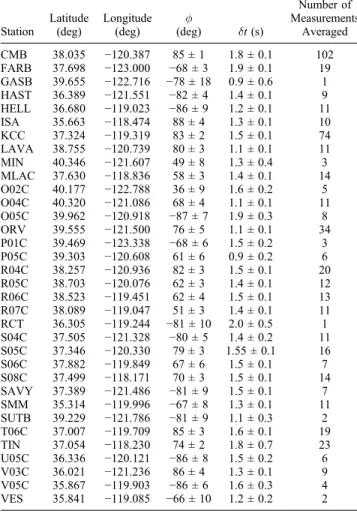
station and allows us to determine the average as dt
values for station CMB. These are well defined and N084°E Figure 2. Example of a good splitting measurement (event 1993.219.00) at station CMB. (a) Initial
seis-mogram before analysis (dashed line, radial component; solid line, transverse component; gray zone, cal-culation window). (b) Seismogram rotated in fast and slow orientations (dashed line, fast component; solid line, shifted slow component). (c) Anisotropy‐corrected components (dashed line, radial component; solid line, transverse component). (d) Particle motion before (dashed line) and after (solid line) correction. (e) Splitting measurement result with 95% confidence region (gray zone); lines give values of splitting delay and fast direction. This example is characterized by an E–W trending fast anisotropic direction (N087°E) and by a 2.0 s delay time.
BONNIN ET AL.: SEISMIC ANISOTROPY BENEATH CALIFORNIA B04306 B04306
and 1.77 s, respectively. Such an averaging has been per-formed at every station where no coherent back azimuthal
variation of and dt was observed; these values are
reported in Table 2. Interestingly, all the stations charac-terized by a weak scatter in the splitting parameters give fast polarization directions ranging from N060°E to E–W and delay times in the range 1.0 to 2.0 s, with an average close to 1.5 s. All these stations are within and to the east of the Great Valley, and they define a zone in the Sierra where splitting parameters values seem homogeneous.
[17] Station BKS is close to the SAF and is representative
of the western stations. Figures 4c and 4d present the clear
and strong back azimuthal variations of in the range
−60°E to −10°E and of dt in the range 0.8 to 3.2 s. These back azimuthal variations are clearly not random but well organized. Because of the large number of data, we obtain well‐constrained back azimuthal variations of the anisotropic
parameters that evidence ap/2 periodicity for both and dt, although the sparse azimuthal window results from the fact that most measurements have been performed from events coming from the west. Interestingly, 15 other stations located along the SAF system in central California present very similar patterns of variation in their anisotropic parameters.
3.3. Modeling of Two Anisotropic Layers
[18] Following Silver and Savage [1994], Ozalaybey and
Savage [1994, 1995], Barruol and Hoffmann [1999], or Hartog and Schwartz [2001], we suggest that such back azimuthal variation could result from the presence of two anisotropic layers beneath these stations. This is motivated by the well‐developed p/2 periodicity of the anisotropic parameter variations in our data, which is well explained by the presence of two anisotropic layers beneath a seismic station. We propose below a modeling approach to constrain the possible geometries of these anisotropic layers that may explain our observations.
[19] A shear wave propagating successively through two
anisotropic layers is split twice and should generate four quasi‐shear waves that should be observed at the receiver. Because the signal period typically ranges from 8 to 30 s and the amplitude of the delay times is around 1 s, the split waves are not individualized but overlapping each other; therefore, only apparent splitting parameters can be deduced from the waveform analysis. As described by Silver and Savage [1994], one can, however, calculate the theoretical apparent and dt variations as a function of the event back azimuth by direct modeling, keeping in mind that it is the-oretically not possible to determine a unique model from observations of apparent splitting parameters without inde-pendent constraints [e.g., Hartog and Schwartz, 2001].
[20] Thanks to the large number of high‐quality
mea-surements and the clear back azimuthal variations of and dt, we decided to search for the four best model parameters ( lower layer, dt lower layer, upper layer, and dt upper layer) using the approach described by Fontaine et al. [2007]. Following the scheme described by Silver and Savage [1994] and for a dominant signal frequency of 0.1 Hz, we computed the apparent splitting back azimuthal variations for each two‐layer model by varying in each layer the fast directions in steps of 2° (from 0°E to 180°E) and the delay time by steps of 0.2 s (from 0 to 2.6 s), providing a total of 1,353,690 models to test at each station. The fit between the observations and the theoretical apparent var-iations of the anisotropic parameters allows one to sort the models and to find the best fitting solutions characterized by the largest fitting parameter Radj2 (adjusted standard misfit reduction) [Walker et al., 2005; Fontaine et al., 2007].
[21] Figures 4c and 4d present the observed splitting
parameters together with the best two‐layer model com-puted for station BKS. This best fitting model is
character-ized by an upper layer 1= −30°E and dt1= 0.6 s and a
lower layer 2 = −78°E and dt2 = 1.6 s. This particular
model slightly differs from the one proposed by Ozalaybey and Savage [1994] but falls within its uncertainties. It should be better constrained by the almost 15 years of supplementary recordings. The two‐layer models were cal-culated for each station where consistent azimuthal varia-tions where detected. In order to ensure that this methodology is not too influenced by the quality of the Figure 3. (a) Individual splitting measurements plotted at
each station; the azimuth of each segment represents the direction of the fast split shear wave and the length of the seg-ment the delay time. Black dot represents station which yielded no splitting measurement. (b) Null measurements observed at each station; directions of each segment represent the back azimuth of the events that produced nulls. Black dots are stations where no nulls were observed.
splitting measurements, we systematically search for the best fitting two‐layer model by using (1) all the splitting data, (2) only the good and fair splitting measurements, and (3) only good splitting measurements. Such an approach allows us to only keep models that have Radj2 > 0.5, which indicates that at least 50% of the anisotropic signal can be explained by two layers of anisotropy.
[22] Figure 5 presents the results determined in this study
at the stations where two‐layer models provide a better so-lution than a single layer (see Table 3). These two maps clearly show that the stations requiring two anisotropic layers to explain the back azimuthal variations of the anisotropic parameters are clearly located close to the SAF system, as observed by Ozalaybey and Savage [1995] and Hartog and Schwartz [2001]. Our direct modeling concludes that the polarization directions within the upper layers (Figure 5a) show a good correlation with the strike of the main faults, whereas the orientation of the fast azimuths within the lower layers (Figure 5b) are more or less E–W, i.e., similar to the trend of the fast directions observed farther east.
3.4. Synthesis
[23] Figure 6 presents the final map of anisotropic
para-meters for central California. It includes all the (weighted)
average splitting parameters for the stations with no back azimuthal variations, i.e., those underlain by a single anisotropic layer and the best two‐layer models found at the other stations. The black dots represent stations without enough available data and where no reasonable average or double‐layer model could be performed without including strong bias. These are mostly USArray stations that provided only 2 years of data and often produced a limited number of well‐constrained splitting measurements.
[24] The map in Figure 6 shows a clear homogeneity of
the fast polarization directions and delay times for most of the stations at which we did not find evidence of two anisotropic layers. We observe average values in the range N060°E to 90° and average dt close to 1.5 s. Interestingly, the E–W trending anisotropic directions are also detected on the western side of California beneath the SAF system for the deeper anisotropic layer, suggesting that such an anisotropic pattern could result from a single anisotropic structure and process, extending from the Pacific coast in the west to the Sierras in the east. These observations are indeed consistent with those of Ozalaybey and Savage [1995], Hartog and Schwartz [2000, 2001], and Polet and Kanamori [2002], which evidenced the existence of a regional layer beneath California, but also with large‐scale Figure 4. Individual splitting parameter values ( , dt) with respect to event back azimuths. (a) Fast
direc-tions (in degrees) and (b) delay times dt (in seconds) obtained at station CMB (see location in Figure 1). (c) Fast directions and (d) delay times obtained at station BKS. The curves correspond to the best two‐ layer model: 1= −30°E, dt1= 0.6 s; 2=−78°E, dt2= 1.6 s. Errors bars correspond to the 95% con-fidence region.
BONNIN ET AL.: SEISMIC ANISOTROPY BENEATH CALIFORNIA B04306 B04306
observations of upper mantle azimuthal anisotropy from surface wave tomography [e.g., Debayle et al., 2005]. On the other hand, our findings show that the double‐layer extent is geographically limited to the neighborhood of the SAF system, particularly in the south where results obtained at stations located at approximately 50 km from the fault do not show evidence of back azimuthal varia-tions of the splitting parameters and therefore do not re-quire two layers of anisotropy. Interestingly, close to the San Francisco Bay, the double anisotropic layer models seem to extend to a wider zone (about 100 km from the SAF in a strict sense), corresponding more or less to the extent of active faulting at the surface.
4.
Discussion
4.1. Lateral Extent of the Anisotropy
[25] In section 3, we show that stations located on or close
to the plate boundary are characterized by the presence of two anisotropic layers and that the upper anisotropic layer is likely related to plate boundary deformation (see Figure 6). By using individual splitting measurements instead of mean splitting values, we try in this section to provide more accu-rate evidence for the lateral extent of the plate boundary deformation. In order to approach the question of the location of the deformation at depth, and considering that the litho-sphere thickness beneath western California is close to 70 km [e.g., Melbourne and Helmberger, 2001; Li, 2007], we project the splitting parameters along the seismic ray down to the 70 km depth piercing point (as schematically presented in Figure 7). Such an approach allows us to determine the dis-tance d between the piercing point of the SKS ray at that depth and the surface trace of the fault and to study the relation between the anisotropy measurements and the surface trace of the faults. As shown in Figure 7 and assuming a vertical extent of the SAF throughout the lithosphere, a station installed
Table 2. Averaged Splitting Parameters Values for Stations Where No Back Azimuthal Variation Is Observed
Station Latitude (deg) Longitude (deg) (deg) dt (s) Number of Measurements Averaged CMB 38.035 −120.387 85 ± 1 1.8 ± 0.1 102 FARB 37.698 −123.000 −68 ± 3 1.9 ± 0.1 19 GASB 39.655 −122.716 −78 ± 18 0.9 ± 0.6 1 HAST 36.389 −121.551 −82 ± 4 1.4 ± 0.1 9 HELL 36.680 −119.023 −86 ± 9 1.2 ± 0.1 11 ISA 35.663 −118.474 88 ± 4 1.3 ± 0.1 10 KCC 37.324 −119.319 83 ± 2 1.5 ± 0.1 74 LAVA 38.755 −120.739 80 ± 3 1.1 ± 0.1 11 MIN 40.346 −121.607 49 ± 8 1.3 ± 0.4 3 MLAC 37.630 −118.836 58 ± 3 1.4 ± 0.1 14 O02C 40.177 −122.788 36 ± 9 1.6 ± 0.2 5 O04C 40.320 −121.086 68 ± 4 1.1 ± 0.1 11 O05C 39.962 −120.918 −87 ± 7 1.9 ± 0.3 8 ORV 39.555 −121.500 76 ± 5 1.1 ± 0.1 34 P01C 39.469 −123.338 −68 ± 6 1.5 ± 0.2 3 P05C 39.303 −120.608 61 ± 6 0.9 ± 0.2 6 R04C 38.257 −120.936 82 ± 3 1.5 ± 0.1 20 R05C 38.703 −120.076 62 ± 3 1.4 ± 0.1 12 R06C 38.523 −119.451 62 ± 4 1.5 ± 0.1 13 R07C 38.089 −119.047 51 ± 3 1.4 ± 0.1 11 RCT 36.305 −119.244 −81 ± 10 2.0 ± 0.5 1 S04C 37.505 −121.328 −80 ± 5 1.4 ± 0.2 11 S05C 37.346 −120.330 79 ± 3 1.55 ± 0.1 16 S06C 37.882 −119.849 67 ± 6 1.5 ± 0.1 7 S08C 37.499 −118.171 70 ± 3 1.5 ± 0.1 14 SAVY 37.389 −121.486 −81 ± 9 1.5 ± 0.1 7 SMM 35.314 −119.996 −67 ± 8 1.3 ± 0.1 11 SUTB 39.229 −121.786 −81 ± 9 1.1 ± 0.3 2 T06C 37.007 −119.709 85 ± 3 1.6 ± 0.1 19 TIN 37.054 −118.230 74 ± 2 1.8 ± 0.7 23 U05C 36.336 −120.121 −86 ± 8 1.5 ± 0.2 6 V03C 36.021 −121.236 86 ± 4 1.3 ± 0.1 9 V05C 35.867 −119.903 −86 ± 6 1.6 ± 0.3 4 VES 35.841 −119.085 −66 ± 10 1.2 ± 0.2 2
Figure 5. Anisotropic parameters of the best two‐layer models obtained at stations where two layers are required to explain the SKS splitting: (a) upper layers and (b) lower layers.
close to the fault itself may record SKS phases crossing an unperturbed mantle if the ray arrives from the east (SKS wave 1), and alternatively, a station installed east of the SAF may record seismic rays crossing the deep structure of the fault itself if the event arrives from the west (SKS wave 2). The width of the Fresnel zone obviously imposes a limit of resolution for that comparison. To go below that limit, one would need to apply finite‐frequency techniques [e.g., Favier and Chevrot, 2003].
[26] Figure 8 presents the variations of splitting
para-meters and dt measured from individual events as a
function of distance from the SAF in a strict sense (Figures 8a and 8b) or to the closest fault within the SAF system (Figure 8c). This allows us to estimate the lateral extent of the anisotropy at depth related to this fault, i.e., to locate the boundary between the region characterized by two aniso-tropic layers and the region characterized by a single anisotropic layer. The black curve corresponds to the varia-tions of the mean splitting parameter for a 20 km wide moving window.
[27] In Figure 8a, average values of dt are globally
con-stant and close to 1.5 s. A distance dependence is not apparent because of uncertainties of this parameter. The behavior of fast directions presented in Figure 8b appears to be rather different though: at large distance to the SAF fault (>100 km), the black curve is in the range 80° to 90° (consistent with the E–W Sierras directions), whereas close to the fault, the average is close to N120°E, illustrated by the large scatter observed in this region and explained by the strong back azimuthal variations related to the presence of two anisotropic layers. Figure 8b suggests that this two‐ layered domain extends relatively widely, between at least −50 (west) and 80 km (east) from the surface trace of the SAF. There is perhaps an asymmetry, which may possibly be due to the relative position of the San Andreas Fault within the plate boundary system, but it may also be due to the thinner lithosphere to the east the SAF [Melbourne and Helmberger, 2001]. The lithosphere might thus be more deformable there than on the western side, leading to strain and formation of anisotropy preferentially in the eastern part. [28] In order to take into account not only the deformation
induced by the SAF itself but also the other faults that may together accommodate the strike‐slip deformation at depth
(Calaveras, Hayward, Greenville faults, etc.), Figure 8c shows the variations of with respect to the distance to the closest fault (and not specifically the SAF in a strict sense). The pattern is different in the sense that the scattered values are now grouped more closely to 0 km. The average curve decays more quickly with distance, suggesting not only that the San Andreas Fault is a source of anisotropy at depth but that the other strike‐slip faults of the system also produce back azimuthal variations of the anisotropic para-meters and hence two anisotropic layers. This implies that those other faults are likely lithospheric faults and not restricted to the crust. This analysis provides a simple (but certainly oversimplified) view of the plate boundary that consists of a set of faults, each extending throughout the entire lithosphere and that each of these faults is about 40 km wide in the lithospheric mantle. At this level of
Table 3. Splitting Parameter Values of the Best Two‐Layer Modelsa
Station Latitude (deg) Longitude (deg) up(deg) dtup(s) low(deg) dtlow(s) Radj2
BDM 37.954 −121.866 −28 1.2 84 2.4 0.93 BKS 37.876 −122.236 −30 0.6 −78 1.6 0.73 BNLO 37.131 −122.172 −54 1.0 80 1.8 0.75 BRIB 37.919 −122.152 −58 1.4 70 1.2 0.84 BRK 37.874 −122.261 −54 0.8 −80 1.0 0.75 CVS 38.345 −122.458 −30 0.8 −78 1.6 0.5 FERN 37.153 −121.812 −58 1.0 76 0.8 0.81 HOPS 38.994 −123.072 −8 0.4 −66 1.4 0.54 JRSC 37.404 −122.239 −30 1.0 88 1.8 0.79 MHC 37.342 −121.643 −18 1.0 −84 2.0 0.8 PACP 37.008 −121.287 −34 0.8 82 1.4 0.73 PKD 35.945 −120.542 −30 0.6 −84 1.4 0.72 POTR 38.203 −121.935 −48 1.4 72 1.4 0.67 SAO 36.764 −121.447 −34 0.6 86 1.4 0.68 SCZ 36.598 −121.403 −30 0.8 80 1.4 0.88 U04C 36.363 −120.782 −60 0.8 80 1.6 0.63 a
Radj2 indicates the values of the correlation coefficient obtained between the models and the observations.
Figure 6. Anisotropy map of central California presenting the averaged splitting measurements together with the best two‐layer models. Red bars are upper layers of the two‐layer models. Black dots indicate stations where neither averaging nor two‐layer modeling could be performed.
BONNIN ET AL.: SEISMIC ANISOTROPY BENEATH CALIFORNIA B04306 B04306
inference, the deformation appears to be more or less symmetric across the faults, and the entire SAF system appears to be about 130 km wide (Figure 8c). One has, however, to notice that these observations do not take into account the width of the Fresnel zone of the SKS waves at 70 km depth (close to 100 km). The proposed width of the deformation zone associated with strike‐slip faults in Cali-fornia is therefore a minimum value.
4.2. Vertical Location and Extent of the Anisotropy
[29] The major limitation in interpreting SKS splitting is
that there is no direct constraint on the vertical location of the anisotropy. Theoretically, because SKS waves are gen-erated at the core‐mantle boundary, the splitting could be acquired everywhere along its 2900 km long path to the Earth’s surface. There is, however, a large consensus concerning the overall isotropy of the lower mantle [e.g., Meade et al., 1995] although seismic anisotropy has been described in its lowermost part in the D″ region for hori-zontally propagating S waves [e.g., Kendall and Silver, 1998] and although anisotropy may be also locally present beneath the transition zone in some subduction environ-ments [e.g., Wookey et al., 2002]. Petrophysical investiga-tion of the transiinvestiga-tion zone suggests that it may be weakly anisotropic due to the small intrinsic anisotropies of the constituting mineral phases [e.g., Mainprice et al., 2000; Mainprice et al., 2008]. The analysis of olivine slip systems at upper mantle depths finally suggests that most preferred orientations are likely concentrated in the uppermost 300 km of the Earth [Mainprice et al., 2005], which is confirmed by the systematic presence of olivine lattice‐preferred
orienta-tion in natural peridotites, like basalt xenoliths [e.g., Pera et al., 2003], kimberlite nodules [e.g., Ben Ismail et al., 2001], orogenic peridotite bodies [e.g., Peselnick et al., 1974], or ophiolite massifs [e.g., Jousselin and Mainprice, 1998]. From a seismological point of view, analyses of the sensi-tivity kernels suggest that the SKS waves are primarily sensitive to anisotropy in the uppermost 300 to 400 km of the Earth [Sieminski et al., 2007], i.e., in the uppermost lithospheric and asthenospheric mantle. This is consistent with the large‐scale global correlation between the anisot-ropy patterns derived from surface waves [e.g., Debayle et al., 2005] and SKS splitting observations [Wüstefeld et al., 2009].
[30] In this section we discuss the vertical location of the
deformation by taking into account the observed delay times, the possible thicknesses of the various anisotropic layers, and the possible intrinsic magnitude of anisotropy that could be constrained independently through petrophy-sical analyses of mantle rocks. Such discussion has to take into account the geological settings (lithosphere thickness, locations, and orientations of the geologic structures).
4.2.1. Regional,“E–W” Anisotropy
[31] This work presents evidence for a regional
aniso-tropic layer beneath the entire study area that is character-ized by a N060°E to E–W fast directions and by high and constant delay times around 1.5 s (see Figure 6). Consid-ering that the lithosphere beneath central California is only 70 km thick [e.g., Melbourne and Helmberger, 2001; Li, 2007], including a crustal thickness of 25 km close to the SAF and 50 km beneath the Sierras [e.g., Mooney and Weaver, 1989], one has to admit that the anisotropic sig-nal is likely acquired in the sublithospheric mantle, i.e., within the asthenosphere.
[32] In the Sierras, where the crust is relatively thick, the
only 20 km thick mantle lid of the lithosphere is likely not thick enough to explain the 1.5 s observed delay times in terms of lithospheric deformation alone. Petrophysical data indeed suggest that the crust is able to produce maximum delay times in the range of 0.1 to 0.2 s per 10 km of path, depending on the overall mineralogy, fabric strengths, and orientations [Barruol and Mainprice, 1993b]. One could therefore expect a maximum of 0.5 s of crustal delay time, still requiring at least 1.0 s supplementary splitting to be explained within the upper mantle. The presence of such large amounts of anisotropic signal in the crust is, however, unlikely since seismological measurements of the whole crustal shear wave splitting, using Moho Ps converted phases in the neighboring Basin and Range [McNamara and Owens, 1993], have shown a total crustal delay time around 0.2 s, implying an upper mantle delay time of about 1.3 s that would require very high intrinsic anisotropy to be located in the 20 to 45 km thick lithospheric mantle lid.
[33] Typical values of anisotropy magnitudes of upper
mantle rocks are in the range of 4% to 5% for shear waves propagating parallel to the Y structural direction, i.e., normal to the lineation within the foliation, and in the range of 2% to 3% for waves propagating along the Z structural direc-tion, i.e., normal to the foliation [Mainprice and Silver, 1993; Ben Ismail and Mainprice, 1998; Mainprice, 2000]. Taking into account that the foliation within the astheno-sphere deformed by the overlying plate drag is expected to be horizontal and that the SKS waves propagate along the Figure 7. Cartoon explaining the way the individual
split-ting measurements are projected in Figure 8 in order to evaluate the actual distance between the fault and the 70 km (i.e., the assumed bottom of the lithosphere) depth piercing point. Horizontal distance between the 70 km piercing point of the SKS wave to the surface trace of the fault(s) is re-presented by d. Note that for a station close to the fault, SKS waves may sample the upper mantle from each side of the fault depending on the wave back azimuth. The shaded area illustrates the width of the Fresnel zone for each SKS wave, calculated for a dominant period of 10 s.
vertical direction, i.e., normal to the foliation, we deduce from the relation L = (dtVs)/A, linking delay timedt, velocity of the shear wave considered (here SKS) Vs, anisotropy magnitude A, and length of the anisotropic path L (Figure 9), that the thickness of the regional anisotropic layer may ex-plain that the observed regional delay times must be in the range 150 to 250 km.
[34] Obviously, the absence of stronger constraints on the
anisotropy magnitude allows envisaging various alter-natives. Anisotropy magnitudes smaller than 4% (A < 0.04) will require a longer anisotropic path to explain the 1.5 s of delay time (for instance, about 300 km for 2% anisotropy), but alternatively, stronger anisotropy should result in a thinner anisotropic layer. For instance, Ozalaybey and Savage [1995] proposed stronger values of S wave anisot-ropy (8%) in order to explain all the splitting by lithospheric anisotropy. However, studies of xenoliths of lithospheric origin sampled close to the SAF [Titus et al., 2007] or in the
Mojave Desert in southern California [Soedjatmiko and Christensen, 2000] indicate 4% to 5% of maximum anisotropy for shear waves and therefore do not favor such a hypothesis. All the arguments above converge to the con-clusion that the lithosphere in the eastern part of California can hardly explain the whole anisotropic signal. This is also confirmed by other geophysical observables, such as global surface wave tomographic models [e.g., Debayle et al., 2005] that show clear E–W trending fast direction beneath the western United States at a depth between 150 (if 5% anisotropy magnitude) and 250 km (if 3% anisotropy magnitude), favoring an asthenospheric location for the E–W trending anisotropic layer.
4.2.2. San Andreas Fault System
[35] In the SAF area, we have shown that anisotropy is
characterized by a two‐layer structure. The deeper layer clearly has the same characteristics as the regional anisot-ropy discussed in section 4.2.1 and is probably located in the asthenosphere as a 150 to 250 km thick deformed layer. This section will thus focus on the upper layer that we relate to the deformation of the plate boundary, partly because of the parallelism of with the trend of the faults.
[36] This upper layer is characterized by delay times
generally smaller than 1.0 s, with an average around 0.7 s. Such delay times may result from a relatively thin aniso-tropic layer in the range 50 to 100 km thick (Figure 9), which is consistent with the lithospheric thickness in this area (<70 km thick), especially to the east of the SAF [e.g., Melbourne and Helmberger, 2001; Li, 2007], including a 25 km thick crust [e.g., Mooney and Weaver, 1989]. Con-trary to the Sierras, this region is crosscut by numerous vertical strike‐slip faults that may have produced pervasive vertical foliations and horizontal lineations in the middle and the lower crust, which is the most efficient orientation of the pervasive structures relative to the vertically
propa-gating SKS waves to generate high dt. In such geometry,
delay times of 0.1 to 0.2 s per tens of kilometers of strained crust could be therefore produced [Barruol and Mainprice, 1993b] and may reasonably explain 0.2 to 0.4 s. Aligned microcracks in the uppermost crust can also potentially produce anisotropy and therefore shear wave splitting. However, studies at San Andreas Fault Observatory at Depth (SAFOD) site, near Parkfield, showed from local seismicity that crack‐induced delays are smaller than 0.1 s for 15 km long raypaths [e.g., Liu et al., 1997; Liu et al., 2008] and that crack‐induced fast polarization directions in the vicinity of the fault are trending N010°E, i.e., parallel to the maximum horizontal stress in California and thus at a large angle to the fault. Although their signature is likely, upper and lower crustal anisotropies are therefore too low to explain the entire observed delay times close to the SAF but can possibly produce 0.2 to 0.4 s of splitting delay, i.e., approximately 50% of the observed upper layer anisotropic signal. This is of interest in light of the debate over the last years as to whether the faults are merely crustal features [e.g., Brocher et al., 1994; Parsons and Hart, 1999].
[37] The upper mantle anisotropy beneath the SAF can be
locally constrained by direct peridotite sampling brought up at the Earth’s surface by recent volcanism. Titus et al. [2007] showed, by studying xenoliths sampled near the SAF between Parkfield and San Francisco, that a rather strong fabric (inducing 5% of S wave anisotropy) is present Figure 8. Diagram of the splitting parameter values with
respect to distance d to the faults (as defined in Figure 7). (a) Delay times and (b) fast directions, with distance from the San Andreas Fault in a strict sense. (c) Fast directions as a function of distance from the closest fault within the SAF system.
BONNIN ET AL.: SEISMIC ANISOTROPY BENEATH CALIFORNIA B04306 B04306
at lithospheric mantle depth beneath the SAF. Such anisot-ropy magnitude suggests that the missing 0.5 s of delay time can be easily acquired in a 50 km thick lithospheric mantle (Figure 9). The lithosphere beneath the SAF system is therefore sufficient to explain the entire delay time corresponding to the upper layer at the various two‐layer stations. Interestingly, in the case of a strike‐slip fault, both the crustal and upper mantle layer will add their effect to-gether and will be seen as a single anisotropic layer. In the crust, foliations are expected to be steeply dipping and parallel to the fault, and the lineations are expected to be horizontal, providing fast split shear waves parallel to the fault, whereas in the mantle, such a system should align the olivine a axes horizontal and parallel to the fault [e.g., Tommasi et al., 1999], also producing fast split shear waves parallel to the fault. Seismic waves crossing this area along a vertical path should therefore see the lithospheric mantle and the overlying crust as a single anisotropic layer.
[38] Interestingly, independent seismological observations
in the western United States provide similar conclusions on the fault‐related lithospheric anisotropy. Azimuthal velocity variations of Pn waves that propagate horizontally beneath the Moho show a NW–SE fast trend beneath central western California, compatible with the strike of the main Cali-fornian faults [Hearn, 1996]. This study indicates (1) that there is no E–W trending anisotropic layer that affects the upper part of the lithosphere and (2) that the SAF‐related anisotropy is likely concentrated in the vicinity of the fault, as we show from the SKS splitting. Azimuthal anisotropy deduced from regional surface waves tomography from ambient noise correlation [Lin et al., 2009] also clearly in-dicates fast polarization directions correlated with the faults strike at periods of 24 s and also at periods of 12 s, indi-cating a possible coherence of anisotropy between the crust
and the uppermost lithospheric mantle. Lin et al. [2009] also constrain the lateral extent of this fault‐parallel fast direction from the Pacific coast to the western border of the Great
Valley, compatible with the deformation broadness
evidenced by our SKS measurements.
4.3. Geodynamic Interpretation
4.3.1. SAF System Anisotropic Layer
[39] As mentioned in section 4.2.2, in the case of large‐
scale strike‐slip faults, the associated strain likely extends from the ductile crust down to the lithospheric mantle. The accommodation of the deformation may develop pervasive structures such as vertical foliation and horizontal lineation parallel to the fault strike. The modest scatter of the fast directions in the upper layer, and the good fit with the faults orientations, agree with such structures. Such a strike‐slip tectonic regime is ideal to produce strong SKS splitting response [Tommasi et al., 1999] and agrees with the fact that a thin lithosphere, even with little mantle lithosphere (as observed here), can be sufficient to explain our observa-tions, i.e., 0.5 to 1.0 s of splitting delays (see Figure 9). Those observations favor a deep extent of the SAF system, i.e., across the whole lithosphere, and thus bring important information in the debate on the possible mantle extension of the San Andreas Fault [Brocher et al., 1994; Teyssier and Tikoff, 1998; Parsons and Hart, 1999]. The poor vertical resolution of the SKS waves does not allow constraining the existence of a decoupling zone at the base of the upper crust [Bokelmann and Beroza, 2000]. Another interesting obser-vation is the northward decay of the splitting delay toward the Mendocino Triple Junction, which is coherent with the plate boundary related deformation, since the strain is expected to go to zero at the triple junction; the relation Figure 9. Thickness (L) of the anisotropic layer crossed by SKS waves with respect to anisotropy
mag-nitude (A) for various delay time (dt). L = (dtVs)/A. On the horizontal axis,“Anisotropy” corresponds to A × 100.
between latitude and delay time, however, is not clear for the southern and central stations.
4.3.2. Absolute Plate Motion Versus Seismic Fast
Orientations
[40] We have evidenced an E–W to NW–SE rotation of
fast direction from the east to the west of what we interpret as asthenospheric deformation (Figure 6). A possible explanation may lie in the absolute plate motion (APM) of the North American and Pacific plates, e.g., in the differential movements between the lithosphere and the underlying mantle that may produce large strain [Silver, 1996; Savage, 1999]. Hartog and Schwartz [2001] already noticed the good correlation between APM directions and anisotropic fast polarizations but only for North American parameters, as they did not process measurements on the Pacific plate.
[41] Figure 10a presents the splitting related to the lower
layer, as well as that of the single‐layer stations, and com-pares them with the APM vectors calculated in the HS3‐
NUVEL‐1A reference frame [Gripp and Gordon, 2002] for
the Pacific and North American plates (Figure 10b). Inter-estingly, the APM directions correlate well with the overall observed fast split directions far from the SAF for both the eastern domains, where trends close to E–W (close to the North American APM), and to the west of the SAF with a NW–SE trending (close to the Pacific APM), mainly documented by station FARB (see Figure 1a for location). This agreement across the plate boundary at large scale may therefore confirm the notion of plate motion related an-isotropy in the asthenospheric layer. We note, however, that the transition between the two regions is much smoother in the splitting observations than in the APM vectors.
[42] In an APM‐related anisotropy model, the North
American plate that goes westward should progressively move over an asthenospheric mantle that was previously beneath the Pacific plate (Figure 11). The normal compo-nent of North America according to the plate boundary is about 1 cm/yr and similar in amplitude to the normal component of the Pacific motion (Figures 11a and 11b). The American plate thus covers old Pacific mantle at the rate of
10 km/Myr. The type of deformation remains nearly simple shear, but the direction of strain changes with time and lo-cation. We may thus expect that Pacific fast directions (NW–SE) are gradually replaced by E–W fast directions thus forming a smooth transition area (Figures 11c and 11d). The plate boundary represents the western limit of the region where the transition takes place. Although the number of measurements on the Pacific plate itself is small, this mechanism may thus explain the observed asymmetry rather
naturally. This model also implies that “North American”
E–W fast directions can never be observed to the west of the western limit of the plate boundary (the San Gregorio Fault, etc.).
[43] We have observed in Figure 8 that the rotation appears
to be complete about 140 km to the east of the San Andreas Fault, i.e., 14 Myr after the San Andreas Fault has passed over the deeper mantle in that region. Interestingly, that distance roughly corresponds to the vertical thickness of the zone over which the deformation probably occurs within the asthenosphere.
[44] An alternative way to explain a rotation of deep
anisotropy across California is to invoke an eastward oriented mantle flow [Silver and Holt, 2002]. Such a view is coherent with large‐scale mantle dynamics under the North American plate [e.g., Bokelmann, 2002], and explains the anistropy observations in central California. However, the observations are more easily explained by the motion of the plate boundary itself.
4.3.3. Other Geodynamic Models
[45] Besides the simple mantle replacement model that we
presented in section 4.3.2, there are further geodynamic elements in California that may be addressed using seismic anisotropy. In our region of interest, the Farallon plate and its remnants have been subducting nearly E–W beneath North America [Severinghaus and Atwater, 1990] and thus possibly produced an E–W trending flow within the North American mantle that would be in agreement with the fast observed directions. Subduction of the East Pacific Rise at 29 Ma [Atwater, 1970] provoked the detachment of the flat Figure 10. (a) Splitting measurements for single‐layer stations, as well as the lower layer from two‐layer
stations. (b) Absolute plate motion (APM) in HS3_NUVEL‐1A reference frame [Gripp and Gordon, 2002] of the Pacific and North American plates.
BONNIN ET AL.: SEISMIC ANISOTROPY BENEATH CALIFORNIA B04306 B04306
Farallon slab [Coney and Reynolds, 1977; Humphreys, 2008], opening a slab‐free window beneath western North America [Dickinson and Snyder, 1979]. The asthenospheric flow that filled the gap left by the slab has indeed been evoked previously to explain the E–W anisotropic trend [Ozalaybey and Savage, 1995; Hartog and Schwartz, 2001] but does not explain the smooth rotation of the fast direc-tions observed in central California. On the other hand, the three northernmost stations of our study (O02C, O04C, and MIN) located, as shown by seismic tomography [Van der Lee and Nolet, 1997; Burdick et al., 2008], above the Juan de Fuca slab that is a remnant of the Farallon plate, show fast directions in the range N35°E to N50°E that is close to the N15°E to N25°E trend of the Juan de Fuca APM [Gripp and Gordon, 2002]. As previously suggested by Bostock and Cassidy [1995] for the station close to Van-couver, fast directions from SKS splitting probably indicate that anisotropy in this area is related to the corner flow above the slab.
4.3.4. Synthesis
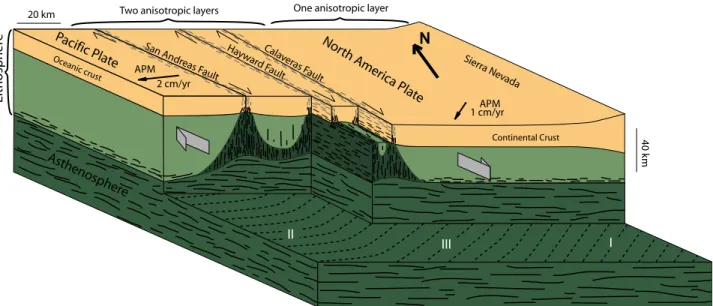
[46] Figure 12 is a cartoon that summarizes our
observa-tions pertaining to the Californian plate boundary, including the different anisotropic layers and their vertical extent, the possible orientation of the pervasive structure (foliation and lineation), and some other tectonic features, such as the lithosphere thicknesses. Our observations allow us to pro-pose that the anisotropic layer associated with the SAF system is a 50 to 80 km thick deformed structure localized
within the lithosphere and characterized by a vertical folia-tion with a fault‐strike parallel lineafolia-tion. At lower litho-spheric depths, this zone does not extend laterally more than 100 to 150 km from the surface strike of the SAF (in a strict sense) in zones where deformation is distributed. This fault‐ related anisotropy is overlying and decoupled from a regional (asthenospheric) layer that is likely 150 to 250 km thick, probably with a horizontal foliation and, as explained in Figure 11, with lineation parallel to the North American APM directions beneath the Sierra Nevada (area I) to Pacific APM directions west from the Californian coast (area II), with a smooth transition beneath the plate boundary where inter-mediate directions are observed (area III). However, even if this model is attractive for explaining our observations, the other tectonic processes, such as the Farallon subduction and the propagation of the slab‐free window, may also generate lineations in the upper mantle close to E–W strikes and therefore may superimpose their own signatures with the APM‐induced deformation.
5.
Conclusion
[47] The analysis of shear wave splitting performed at 65
broadband stations in central California allowed us to in-vestigate upper mantle deformation beneath California and especially across the strike‐slip plate boundary between the North American and the Pacific plates. The large number of permanent and temporary seismic stations permits us to Figure 11. Cartoons illustrating the Pacific and North American plate motions. The plate boundary is
shown (a) at time t1and (c) at time t2. (b and d) Cross sections which show how the plate boundary
(and part of the North American plate) is moving over mantle that was previously beneath the Pacific plate. In Figure 11d, areas I, lineation parallel to the APM of the North American plate; II, lineation par-allel to the APM of the Pacific plate at asthenospheric depth; and III, intermediate directions of lineation.
discuss the horizontal and vertical extent of the upper mantle deformation from the Sierra Nevada to the Californian coasts.
[48] Our analysis reveals two different anisotropic
domains: (1) a zone extending from the Sierra Nevada to the Great Valley where splitting measurements require a single, E–W trending anisotropic layer and (2) the SAF system region where two anisotropic layers are required, an upper layer trending parallel to the fault overlying an E–W trending lower layer. The E–W regional fast directions likely corre-spond to a 150 to 250 km thick asthenospheric layer deformed by the relative motion between the North American plate and the underlying mantle. In the plate boundary region, the upper of the two layers is clearly associated with the dynamics of the SAF system (fast anisotropic directions close to the faults’ strikes) and suggests that the whole lith-osphere (i.e., the crust and the lithospheric mantle) deforms coherently and is thus decoupled from sublithospheric flow. Thanks to the good seismic coverage and the large amount of data, we estimated the lateral extent of the deformation zone associated with the SAF system. We propose that around each single strike‐slip fault, the lithospheric mantle deformation is concentrated in a 40 km broad strip, providing a total broadness of deformed San Andreas Fault zone to be around 130 km at lower lithospheric levels. The good fit between APM of the North American plate and the fast anisotropic directions leads us to suggest that shear produced by the relative motion of the lithosphere overlying the astheno-sphere is a good candidate for the origin of this layer. The motion of the plate boundary and the North American lith-osphere over an old Pacific mantle with NW–SE fast directions can also be invoked to explain the smooth tran-sition of the fast directions from the east to the west. The lower layer could be thus characterized by a horizontal foliation with lineation parallel to the absolute plate motion of the North American plate in the east and with lineation parallel to the Pacific APM in westernmost California. The
relatively large thickness of this asthenospheric layer (150 to 250 km) is also coherent with the presence of a slab‐free window beneath the western United States that entrained hot and therefore softened material close to the lithosphere‐ asthenosphere boundary that could be more easily deformed. In a different way, the fast directions observed for the northernmost stations, localized north of the Mendocino Triple Junction, are close to the APM direction of the Juan de Fuca plate and thus can be interpreted as the signal of the Juan de Fuca slab subducting beneath North America.
[49] Acknowledgments. The facilities of the IRIS Data Management System and, specifically, the IRIS Data Management Center, were used for access to waveform and metadata required in this study. The IRIS DMS is funded through the National Science Foundation and, specifically, the GEO Directorate through the Instrumentation and Facilities Program of the National Science Foundation under Cooperative Agreement EAR‐ 0004370. Thanks to Geoscope, to Berkeley, and to the Southern California Seismic Network, operated by Caltech and USGS, for the availability and the high quality of the data. Data from the Transportable Array (TA) network were made freely available as part of the EarthScope USArray facility sup-ported by the National Science Foundation, Major Research Facility program under Cooperative Agreement EAR‐0350030. We thank the two anonymous reviewers for the constructive comments that improved the manuscript. SplitLab software and the SKS splitting database are available at http:// www.gm.univ‐montp2.fr/splitting/.
References
Atwater, T. (1970), Implications of plate tectonics for the Cenozoic tectonic evolution of the western North America, Geol. Soc. Am. Bull., 81, 3513–3536, doi:10.1130/0016-7606(1970)81[3513:IOPTFT]2.0.CO;2. Barruol, G., and R. Hoffmann (1999), Seismic anisotropy beneath the
Geo-scope stations from SKS splitting, J. Geophys. Res., 104, 10,757–10,774, doi:10.1029/1999JB900033.
Barruol, G., and D. Mainprice (1993a), 3D seismic velocities calculated from LPOs and reflectivity of a lower crustal section: Example of the Val Sesia (Ivrea Zone, northern Italy), Geophys. J. Int., 115, 1169– 1188, doi:10.1111/j.1365-246X.1993.tb01519.x.
Barruol, G., and D. Mainprice (1993b), A quantitative evaluation of the contribution of crustal rocks to the shear wave splitting of teleseismic SKS waves, Phys. Earth Planet. Inter., 78, 281–300, doi:10.1016/ 0031-9201(93)90161-2.
Figure 12. Block diagram summarizing the lithospheric and asthenospheric structures beneath northern California. Areas I, lineation parallel to the APM of the North American plate within the deforming asthenosphere; II, lineation parallel to the APM of the Pacific plate; and III, intermediate directions of lineation corresponding to the reorientation zone.
BONNIN ET AL.: SEISMIC ANISOTROPY BENEATH CALIFORNIA B04306 B04306