HAL Id: hal-00110574
https://hal.archives-ouvertes.fr/hal-00110574
Submitted on 20 Nov 2018
HAL is a multi-disciplinary open access
archive for the deposit and dissemination of
sci-entific research documents, whether they are
pub-lished or not. The documents may come from
teaching and research institutions in France or
abroad, or from public or private research centers.
L’archive ouverte pluridisciplinaire HAL, est
destinée au dépôt et à la diffusion de documents
scientifiques de niveau recherche, publiés ou non,
émanant des établissements d’enseignement et de
recherche français ou étrangers, des laboratoires
publics ou privés.
phenomenon: III. Analysis of the localization transition
Renaud Toussaint, Steven R Pride
To cite this version:
Renaud Toussaint, Steven R Pride. Fracture of disordered solids in compression as a critical
phe-nomenon: III. Analysis of the localization transition. Physical Review E : Statistical, Nonlinear,
and Soft Matter Physics, American Physical Society, 2002, 66 (3), pp.036137.
�10.1103/phys-reve.66.036137�. �hal-00110574�
Fracture of disordered solids in compression as a critical phenomenon.
III. Analysis of the localization transition
Renaud Toussaint*and Steven R. Pride†
Ge´osciences Rennes, Universite´ de Rennes 1, 35042 Rennes Cedex, France
共Received 14 November 2001; revised manuscript received 13 June 2002; published 27 September 2002兲 The properties of the Hamiltonian developed in Paper II are studied showing that at a particular strain level a ‘‘localization’’ phase transition occurs characterized by the emergence of conjugate bands of coherently oriented cracks. The functional integration that yields the partition function is then performed analytically using an approximation that employs only a subset of states in the functional neighborhood surrounding the most probable states. Such integration establishes the free energy of the system, and upon taking the deriva-tives of the free energy, the localization transition is shown to be continuous and to be distinct from peak stress. When the bulk modulus of the grain material is large, localization always occurs in the softening regime following peak stress, while for sufficiently small bulk moduli and at sufficiently low confining pressure, the localization occurs in the hardening regime prior to peak stress. In the approach to localization, the stress-strain relation for the whole rock remains analytic, as is observed both in experimental data and in simpler models. The correlation function of the crack fields is also obtained. It has a correlation length characterizing the aspect ratio of the crack clusters that diverges as⬃(c⫺)⫺2 at localization.
DOI: 10.1103/PhysRevE.66.036137 PACS number共s兲: 62.20.Mk, 46.50.⫹a, 46.65.⫹g, 64.60.Fr
I. INTRODUCTION
In Paper II of this series, we obtained the Hamiltonian Ej(,m) of a population of interacting cracks which is the
energy necessary to lead a mesovolume of a disordered-solid system from uncracked and unstrained initial conditions, to a final crack state j at a maximum imposed strain m that is
possibly different than the actual strain if the system has been subsequently unloaded. Using this Hamiltonian, we prove here that at a well-defined strainc, the system
under-goes a phase transition to bands of coherently oriented cracks.
To study the nature of this localization transition, we must evaluate the partition function Z from which all physical properties depending on the crack distribution are obtained through differentiation. In Paper I, it was established that Z takes a standard form
Z共,m,T兲⫽
兺
j
e⫺Ej(,m)/T, 共1兲
despite the fact that it derives from the initial quenched dis-order in the grain-contact strengths and has nothing to do with fluctuations through time. The possible crack states j for a mesovolume are defined by a local order parameter (x) distributed at each cell x of a regular square network of iden-tical cells. The amplitude of(x) corresponds to the length of a local crack 共always less than cell dimensions兲, and its sign indicates its orientation (⫾45° relative to the principal-stress axis兲.
Our approach for performing the sum over states begins by determining which fields maximize the Hamiltonian. Because the temperature in strain-controlled experiments is negative, such maximizing states are the dominant terms in Eq. 共1兲. Any change in the nature of the maximizing crack fields or in the nature of the Hamiltonian in their neighbor-hood共e.g., the vanishing of a second derivative兲 corresponds to a phase transition.
In Sec. II, the localization transition is identified and the geometrical nature of the crack fields in the ‘‘functional neighborhood’’ surrounding the maximizing states defined. In Sec. III, we sum only over this subset of all states to obtain an analytical approximation of Z. In Sec. IV, the free energy F⫽⫺T ln Z is differentiated with respect to and T to determine both the sustained stress , the energy U, and the entropy S. In the approach to localization, no singularities are present in either F or any of its derivatives with respect to strain or temperature which demonstrates, among other things, that the stress/strain relation is analytic up to 共and including兲 localization. In Sec. V, an external field J is intro-duced that couples to permitting an autocorrelation func-tion to be obtained. All singularities at localizafunc-tion are in the second 共and higher兲 derivatives of F with respect to J with the consequence that the correlation length diverges as
⬃(c⫺)⫺2.
II. PRINCIPLE OF THE TRANSITION A. Extrema of the Hamiltonian
We now determine the most probable states by maximiz-ing the Hamiltonian Ej(,m) along the load path ⫽m.
From the summary of Paper II, we have Ej⫽E0共
m兲⫹共1⫺q兲兵Eav共m兲关兴⫹Eint共m兲关兴其,
where E0 is the energy of the intact material, Eav is the energy due to the crack field when crack interactions are *Present address: Department of Physics, University of Oslo, P.O.
Box 1048 Blindern, 0316 Oslo 3, Norway. Email address: [email protected]
†Email address: [email protected]
neglected, and Eint is the energy due to crack interactions. The parameter q derives from the quenched-disorder distri-bution and is bounded as 1/2⭐q⬍1.
That the Hamiltonian must be maximized and not mini-mized comes from the temperature parameter being negative as was quantitatively established in Sec. IV of Paper I. Be-cause we assume the system is intact before strain is applied, it is a fact of our model that the intact state is always the most probable. For this to hold true, the temperature must be negative in strain-controlled experiments because the arrival of cracks at constant strain always reduces the energy in a mesovolume.
1. Mean-field terms
A mean-field simplification of the model built in Paper II would reduce the Hamiltonian to the sole term
E0⫹共1⫺q兲Eav⫽1 2关␣⌬
2⫹共1⫺␣兲␥2兴
⫺共1⫺q兲⑀¯关2⌬2⫹ 3␥2兴,
where⌬ is the strain dilatation,␥ the shear strain, and␣and i are combinations of the elastic moduli all as defined in
Paper II. The second term is strictly negative and represents the weakening of the rock due to the crack porosity which is proportional to ¯ , the volume average of the positive field ⫽兩兩. Therefore, this mean-field Hamiltonian is maximum
when ¯⫽0, which uniquely corresponds to the uniform in-tact state⫽⫽0.
2. Interaction term
The interesting term is the interaction energy Eint. As de-fined in the summary of Paper II 共the reader should consult this summary for the definitions of all the terms in what follows兲, Eint is a sum over wave numbers k of orthogonal quadratic forms involving Rkand Ik, which are vectors con-taining the k-space Fourier modes of the order-parameter fields and. The sign of these forms is determined by the sign of the two eigenvalues of the symmetric matrices Pk. For any k, at least one of the eigenvalues is positive, since
关1,0兴•Pk•关1,0兴T⫽Lk⫽⌬21 2
(1⫺␣uk
2
)⬎0, where 1/2⬍␣
⬍1 and ukis a cosine. To determine the sign of the second eigenvalue, it is sufficient to take the determinant of Pk. Using uk2⫹vk2⫽1, it is straightforward to show that
det兩Pk兩⫽⌬41
4共1⫺␣兲关cv
k⫹兴2. 共2兲 This is strictly positive for every k, except when
vk⫽sin共2k兲⫽⫺/c, 共3兲 in which case the determinant and second eigenvalue are zero. The vanishing of the determinant is thus independent of the norm of k, and takes place at either of two conjugate angles k⫹⫽arcsin(⫺/c)/2 or k⫺⫽/2⫺arcsin(⫺/c)/2, where k represents the angle between k and the crack-orientation vector eˆ1. The directions in k space at which the
determinant vanishes will be denoted by the unit vectors kˆ⫾. Thus, the matrices Pk are positive definite; i.e., they have two strictly positive eigenvalues, except for those particular wave vectors lying along one of the two directions for which they become positive degenerate. The eigenvector of Pk as-sociated with the zero eigenvalues is easily computed to be
关1,⫺Mk/Lk兴T.
The positive-definite quadratic forms of Eint are multi-plied by a negative constant which implies that the maximum of Eintoccurs when˜k⫽˜k⫽0 for every nonzero k with the exception of those k satisfying Eq.共3兲. At these degenerate angles, the Fourier modes of and are related as
˜k⫽⫺ Lk
Mk˜k. 共4兲 Now, the definition of the auxiliary fieldx⫽兩x兩 imposes a
series of constraints between ˜k and ˜k. The simplest is obtained by noting that the space integrals of2and2must
be the same which is equivalent to
兺
k 共˜
k˜⫺k⫺˜k˜⫺k兲⫽0. 共5兲 For a crack-state maximizing Eint, this condition further re-quires that 共˜ 0 2⫺˜ 0 2兲⫹
兺
k⫽kkˆ⫾ k⫽0冉
1⫺Mk 2 Lk2冊
˜ k˜⫺k⫽0. 共6兲 It will be seen momentarily that along the directions kˆ⫾, the factors 1⫺Mkkˆ2 ⫾/Lkkˆ2⫾ are equal, and that this quantity is an increasing function of the shear-strain parameter ⫽(3␥)/(⌬1), starting at a strictly negative value when
⫽0 共no shear deformation yet applied兲, and reaching 0 at a
particular valuec. For every wave vector,˜k˜⫺k⫽储˜k储2is trivially positive, and the definition of also requires that
˜
0 2⫺˜
0
2⭐0 for any crack state. From Eq. 共6兲, we can
con-clude that for⬍c, the only crack-states maximizing the
interaction term Eintmust satisfy both˜02⫽˜02and, for every nonzero k, ˜k⫽˜k⫽0. Such a maximum thus corresponds to a spatially uniform crack field.
At the degenerate point ⫽c, the set of maximizing
crack states goes through a drastic change. Any nonzero Fou-rier mode of and along the directions kˆ⫾ no longer modifies Eint so long as ˜02⫽˜02; i.e., so long as the crack field has the same sign over the entire mesovolume. This degeneracy of Eintat⫽c is at the origin of the
localiza-tion phase transilocaliza-tion.
The critical value c, and the corresponding wave
vec-tors k for which nonzero Fourier modes of and do not contribute to Eint, are determined from the two conditions
det共Pk兲⫽0, 共7兲
Using the solution of Eq. 共7兲 given by Eq. 共3兲 in the defini-tions of Lkand Mkgiven in the summary of Paper II, Eq.共8兲 then becomes an equation for c,
关c 2 ⫺共c2⫺1兲兴
冋
c 2⫹共1⫺␣兲 ␣ c2册
⫽0. 共9兲 From the definitions of Paper II, we have c⬎1 while 1/2⬍␣⬍1. Thus, Eqs. 共7兲–共8兲 can only be satisfied by
⫽c⫾⫽⫾
冑
c2⫺1, 共10兲
sin共2k兲⫽⫺共
冑
c2⫺1兲/c. 共11兲 With a radial confining pressure maintained constant, and a positive shear stress axial⬎radial, the strain components ofthe rock satisfy axial⬍radial and axial⬍0 so that
⫽(3/1)(axial⫺radial)/(axial⫹radial) is a positive and
monotonically increasing function of the axial stress, until the rock possibly exhibits some positive volumetric strain
共we will later show that this does not occur prior to
localiza-tion兲, where this quantity diverges to ⫹⬁ and increases fur-ther starting from ⫺⬁. All of this establishes that Eqs. 共7兲 and 共8兲 have no solution until the first solution ⫽c⫹ is
reached. At this particular strain value, nonzero Fourier modes of and having any wave vector lying in one of the two directions defined by Eq. 共11兲 can be added to a mesovolume with no change in the interaction energy.
For quartz as the rock mineral, 1
3c
⫹⫽
冉
axial⫺radialaxial⫹radial
冊
c⯝12,so that we find (axial/radial)c⯝⫺1.2 at the transition. Our
model thus predicts the localization transition to occur after a sign reversal of radialbut prior to the point where ⌬⫽axial
⫹radialchanges sign. These results are consistent with what
is observed in usual triaxial mechanical experiments 共e.g.,
关1–3兴兲.
It can now be algebraically verified using the definitions of Lkand Mkgiven in Paper II, that 1⫺Mkkˆ⫾
2
/Lkkˆ2 ⫾ does not depend on the norm k nor on which of the two directions kˆ⫾ is selected. Further, it increases monotonically from a nega-tive value to reach zero when⫽c⫹ 共facts used in obtain-ing the above results兲.
B. Structure at the localization transition
The goal here is to define the geometric nature of the states maximizing Eintat the strain pointc. Necessary
con-ditions on the structure of the degenerate states were just given and these are easily made into sufficient conditions. First, the degenerate states must correspond to crack fields of constant sign. They thus satisfy everywhere ⫽ or ⫽
⫺ or, equivalently,˜k⫽˜kor˜k⫽⫺˜k. Considering this together with the necessary conditions of Eqs. 共4兲 and 共7兲, requires that the degenerate states be one of two types: 共1兲 ⬎0 everywhere and the only possible nonzero Fourier
modes of have wave vector directions that satisfy Nk/ Mk
⫽Mk/Lk⫽⫺1; or 共2兲⬍0 everywhere and the wave vec-tor directions satisfy Nk/ Mk⫽Mk/Lk⫽⫹1. Using again the definitions of Lk, Mk,Nkgiven in the summary of Paper II, the first type of degenerate mode corresponds to wave vec-tors satisfying sin(2k)⫽⫺
冑
c2⫺1/c and cos(2k)⫽⫺1/c, while the second type of mode has the same sine require-ment, but an opposite value for the cosine. Using kˆ⫹to rep-resent the wave vector direction corresponding to the first condition, and kˆ⫺ the wave vector direction for the second condition, we conclude that the emergent degenerate crack states consist either of right-inclined cracks with spatial fluc-tuations forming bands perpendicular to kˆ⫹, or of left-inclined cracks forming bands perpendicular to kˆ⫺. Such ge-ometry is sketched in Fig. 1.These two sets of crack modes are conjugate to each other; i.e., symmetric to each other under inversion of the radial axis. Since they become statistically important as
→c, whereas the intact state or uniform states are the
im-portant states prior to c, the system spontaneously breaks
its symmetry at the transition, which is characteristic of a continuous phase transition.
Further, the angle formed by these bands is at 45°
⫺兩kˆ⫺兩 from the axial direction. Using Eq.共11兲 and the defi-nitions of1 and2 in terms of the Lame´ parameters, it is
found that this angle is typically between 15° and 35° de-pending on the rock mineral关4兴 considered which is consis-tent with laboratory experiments.
Finally, we note that these special crack bands that leave Eintunchanged, make a negative contribution to the Hamil-tonian through the mean-field energy Eavthat is proportional to ¯ . Due to the r⫺D range of elastic interactions, Eint is independent of the norm of k 共it depends only on its orien-tation兲. Thus, the spatial variation of the bands perpendicular to their lateral extent has no influence on Eint; it only affects Eavthrough the number of cracks present. For large systems and a narrow band of only a few cell widths, ¯⫽⌳ᐉ/ᐉ2
FIG. 1. A part of the conjugate bands emerging at the critical strain. The bands perpendicular to kˆ⫹are exclusively composed of right-inclined cracks, while those perpendicular to kˆ⫺contain only left-inclined cracks.
⫽⌳/ᐉ, where ⌳ and ᐉ are the linear size of a cell 共grain兲 and
of a mesovolume. Thus, such a thin band makes a negligible contribution to ¯ for large systems, and is energetically equivalent to the intact state. However, states with numerous and/or wide bands can make a non-negligible contribution to
¯ and are, therefore, less probable. So this transition indeed corresponds to ‘‘localized’’ structures. Only those states with a small number of small width bands along the special direc-tions are the statistically emergent ones as is observed in actual experiments on rocks.
III. OBTAINING THE PARTITION FUNCTION The sum over crack states in Eq. 共1兲 is equivalent to the functional integration
Z⫽
冕
冉
兿
x苸⍀
dx
冊
e⫺E[,,m]/T. 共12兲 Since our Hamiltonian is expressed in terms of the Fourier modes ˜k, it is shown in standard textbooks 关5,6兴 that Z further transforms to Z⫽冕
d˜0兿
k苸⌼ 共d ˜ k R d˜kI兲e⫺E[˜k,,m]/T, 共13兲 where˜k R and˜k Iare the real and imaginary part of˜k, and
⌼ is a half space of the set of the wave vectors
correspond-ing to the nonzero modes; i.e., correspondcorrespond-ing in two dimen-sions to the discrete set (k1,k2)⫽(2ᐉ/n1,2ᐉ/n2) with
(n1,n2)苸Z2. There is a small-wavelength cutoff given by
max(兩n1兩;兩n2兩)⬍ᐉ/⌳ that ensures that does not vary on
scales smaller than that of a cell, and there is the arbitrary criterion k1⬎0 made to divide this space into two
symmetri-cal parts. Equation共13兲 is valid up to a multiplicative con-stant that has no physical importance since the properties of a system correspond to the derivatives of the free energy F
⫽⫺T ln Z.
An analytic approximation for Z is obtained by perform-ing the functional integration over a properly chosen subset of all the possible crack states. The definition of this subset is based on what was learned in the preceeding section; namely, that among the states having a given nonzero crack occupa-tion ¯ , the most probable are the uniform states, and pre-cisely at the phase transition, certain banded states may ar-rive at almost no energy cost, and these emergent states also have the same sign over space. Thus, the geometrical char-acteristic of all such states in the ‘‘functional neighborhood’’ of the minimizing state is that in each one, all cracks are oriented in the same direction共either left or right兲. This prop-erty justifies making a so-called ‘‘constant-sign’’共or ‘‘mean-phase’’兲 approximation for the partition function in which only those states in which the sign does not change in space will be considered. This still includes a huge range of states in which spatially varies. The excluded states in this ap-proximation are guaranteed to have lower probabilities than the included ones and, as such, should have a negligible influence on the physical properties of the system. In this
aproximation, the Fourier modes of the auxiliary field are trivially related to those of as either˜k⫽˜k for the posi-tive states, or˜k⫽⫺˜kfor the negative states.
We now rescale the temperature as T⫽⌳DT
⬘
/ᐉD. From the definition T⫽U/S and the fact that U is an energy density independent of ᐉ while S is extensive and thus in-creases as ᐉD, we have that T scales asᐉ⫺D. In taking the thermodynamic limit in what follows, it is convenient to work with the purely intensive parameter T⬘
共that is indepen-dent of ᐉ). Our partition function within the constant-sign approximation then takes the formZ⯝
冕
⫹Dexp再
⫺ᐉD ⌳DT⬘
冋
d⫹e冉
˜0 ᐉD冊
⫹k兺
苸⌼ w ⫹共k兲冏
˜k ᐉD冏
2册冎
⫹冕
⫺Dexp再
⫺ᐉD ⌳DT⬘
冋
d⫹e冉
˜0 ᐉD冊
⫹兺
k苸⌼ w⫺共k兲冏
˜k ᐉD冏
2册冎
, 共14兲whereD is a compact notation for the functional measure d˜0兿k苸⌼(d˜k
R
d˜kI), and where 兰⫹ and兰⫺ represent inte-gration over the subsets of fields that are everywhere either positive or negative. The quantities d,e, and w⫾are defined in the summary of Paper II as
d⫽1 2关␣⌬ 2⫹共1⫺␣兲␥2兴, 共15兲 e⫽⫺⑀ 2关2共⌬ 2⫺q⌬ m 2兲⫹ 3共␥ 2⫺q␥ m 2兲兴, 共16兲 w⫾共k兲⫽⫺ ⑀ 2 共1⫺␣兲 关共Lk⫾2Mk⫹Nk兲共兲 ⫺q共Lk⫾2Mk⫹Nk兲共m兲兴. 共17兲
Recall that the values of the actual strainintervening in the probability distribution and in the partition function are those along the load curve for which⫽m. Their formal
distinc-tion only plays a role when partial derivatives of the free energy are taken to define stress. We note then that the value of w⫾ at ⫽m is w⫾⫽⫺(1⫺q)⑀2关1,⫾1兴•P(k)•关1,
⫾1兴T/(1⫺␣) and since we have shown that P is a
positive-definite matrix, and that the temperature T
⬘
is negative, we have that w⫾/T⬘
in Eq.共14兲 is strictly positive.The symmetry of the problem under the parity transfor-mation 共inversion of the radial axis兲 guarantees that both integrals in Eq. 共14兲 are equal. Accordingly, only the first integral over positive crack states will be treated. This inte-gral separates into products of Gaussian inteinte-grals with the only remaining coupling between the Fourier modes coming from the complicated constraints on the integration domain boundaries that are what guarantee to have the same sign everywhere in real space, and to lie within关0,1兴. But in order to study any singular behavior of the free energy F in
the vicinity of localization, Z is determined in the thermody-namic limit in which both the system size and mesovolume size ᐉ are taken to be infinite. In this limit, the complicated integration bounds in k-space are not relevant. The integra-tion can be carried out entirely onR⫹for˜0/ᐉD, andR for
each of the variables ˜kR/ᐉD, ˜kI/ᐉD without changing the result because the contribution to these integrals in the ther-modynamic limit comes from the immediate neighborhood of ˜0/ᐉD⫽0 and˜k/ᐉD⫽0.
A technical proof of this can be obtained as follows: using
R⫹ and R as the integration domains produces an upper bound for Z since this includes every positive crack field. A lower bound can be obtained by reducing the integration domain to a subset of the set of all positive crack fields in which 0⬍˜0⬍ᐉD and 兺k苸⌼(兩˜k R兩⫹兩 ˜ k I 兩)⭐min关˜ 0/
冑
2,(ᐉD⫺˜0)/
冑
2兴. Integrating mode by mode over this polyhedra, the result can be shown to be asymptotically equivalent to the result of the upper bound in the limit whereᐉDbecomes infinite. This exercise is left to the attention of the reader.Thus, no coupling between the k modes exists in the ther-modynamic limit, and our approximation of the partition function takes the convenient form
Z⯝2z0z1
兿
k苸⌼ 关z共k兲 2兴, 共18兲 where z0⫽e⫺ᐉ Dd/⌳DT⬘ and z1⫽冕
x苸R⫹ dxe⫺ᐉDex/⌳DT⬘, 共19兲 z共k兲⫽冕
x苸R dx e⫺ᐉDw⫹(k)x2/⌳DT⬘. 共20兲 In the limitᐉ→⫹⬁, these two integrals becomez1⬃⌳DT
⬘
/共ᐉDe兲, 共21兲 z共k兲⬃冑
⌳DT⬘
/关ᐉDw⫹共k兲兴. 共22兲 Using Eq. 共18兲, one then obtains the free-energy density in the thermodynamic limitF⫽⫺T
⬘
共ln Z兲⌳D/ᐉD⬃d⫹⌳ DT⬘
ᐉD k兺
苸⌼ ln冉
ᐉDw⫹共k兲 ⌳DT⬘
冊
. 共23兲The contribution z1 has vanished in this limit due to the fact
that x ln x→0 as x→0. This is a technical consequence of the fact that for states composed of a few single bands,¯ van-ishes in the thermodynamic limit, as commented upon in the previous section.
IV. SYSTEM PROPERTIES AT LOCALIZATION The remaining task is to link this free energy to the ob-servables of the system by taking the partial derivatives of F in the limit as localization is approached.
The two partial derivatives of primary interest are those that give the dimensionless entropy density s⫽⌳DS/ᐉDand the stress. From Paper I, we have
⫺s⫽ F T
⬘
冏
, m and ⫽F 冏
T⬘, m .The free energy of Eq.共23兲 is rewritten by replacing the sum over the wave vectors 兺k苸⌼ with a continuous integral
ᐉD/(2)D兰
0 2/⌳
k dk兰0d. After performing the trivial inte-gration over dk we have
F⫽d⫹T
⬘
2
冋
I⫺ln冉
⫺⌳DT
⬘
ᐉD
冊
册
, 共24兲where I is the integral
I⫽
冕
⫺/2/2
ln共⫺w⫹兲d. 共25兲 The integrand w⫹ is a temperature-independent strain func-tion so that⫺F/T
⬘
givess⫽⫺I 2⫹ 2
冋
1⫹ln冉
⫺ ⌳DT⬘
ᐉD冊
册
, 共26兲while from F⫽U⫺T
⬘
sU⫽d⫹
2T
⬘
. 共27兲Since d represents the linear elastic response of an intact rock, and T
⬘
decreases from zero to negative values as dam-age accumulates, this expression shows that the averdam-age en-ergy decreases due to the presence of cracks and is thus consistent with the negative curvature of the strain/stress load curve observed experimentally.Before addressing how s and F 共and their derivatives兲 behave at localization, we first establish the stress and tem-perature behavior at localization.
A. Mechanical behavior at localization
Consider the stress components ⫽⫺2F/␥ and p⫽
⫺2F/⌬, where 共shear stress兲 and p 共pressure兲 are both positive and related to the axial and radial stress components as
⫺⫽a⫺r, and ⫺p⫽a⫹r. 共28兲
In standard laboratory experiments, the axial stressa varies
while the radial stress r⫽⫺pr is kept constant. The strain
components ␥ 共shear strain兲 and ⌬ 共dilatation兲 are similarly related to the axial and radial strain as
␥⫽a⫺r, and ⌬⫽a⫹r. 共29兲
Using the definition of w⫹ 关Eq. 共17兲兴 along with the defini-tions of Lk, Mk, and Nkgiven in the summary of Paper II,
we differentiate the integral I with respect to the actual strain variables, evaluate along the load path (⌬m⫽⌬ and ␥m
⫽␥), use the definition⫽3␥/⌬ with the new constant
3⫽3/1 and make the change of integration variables z
⫽tan⫺1 to obtain exactly
␥I⫽共1⫺q兲⌬3 I, 共30兲
⌬I⫽ 1
共1⫺q兲⌬ 共2⫺I兲, 共31兲
where q⫽1⫺1/(k⫹2) is the constant associated with the exponent k⭓0 of the quenched disorder distribution, and the integralI is defined I⫽
冕
⫺⬁ ⫹⬁ g g dz 1⫹z2, 共32兲 with g(,z) given by g共,z兲⫽关1⫺␣⫺2共1⫺␣兲c⫹共1⫺␣兲c2⫹2兴z4 ⫹关4␣⫹4共1⫺␣兲c兴z3⫹关2⫹2␣⫹2共1⫺␣兲c2 ⫺2共2␣⫺1兲2兴z2⫹关⫺4␣⫹4共1⫺␣兲c兴z⫹1 ⫺␣⫹2共1⫺␣兲c⫹共1⫺␣兲c2⫹2. 共33兲Thus, the shear stress and pressure can be written as
⫽⫺2共1⫺␣兲␥⫺T⌬
⬘
共1⫺q兲3 I共兲, 共34兲⫺p⫽2␣⌬⫹ T
⬘
共1⫺q兲⌬ 关2⫺I共兲兴. 共35兲
The integralI is solved using the residue theorem once the roots z of the quartic g(,z) have been found.
This quartic decomposes into the exact form
g共,z兲⫽关z⫺共兲兴关z⫺*共兲兴u共,z兲, 共36兲 u共,z兲⫽共兲关z⫺共兲兴关z⫺*共兲兴, 共37兲 where the star indicates taking the complex conjugate. The roots () and *() both merge to the real axis in the approach to localization →c, while the other two roots
() and*() remain complex at localization.
There are thus three simple poles(), (), and i con-tributing toI if the loop is closed in the upper-half z plane so that the residue theorem yields
I ⫽ g共兲 Im兵其u共兲关1⫹2兴⫹ g共兲 Im兵其关⫺兴关⫺*兴关1⫹2兴 ⫹ g共i兲
关i⫺兴关i⫺*兴u共i兲, 共38兲
where Im designates taking the imaginary part. We are inter-ested in evaluating this integral 共and therefore, the roots and and the function) only in the approach to localiza-tion; i.e., when␦⫽⫺ccan be considered small. In this
limit, the second and third terms of Eq. 共38兲 共the residues from and i) have numerators and denominators that are both order 0 in ␦ so that it suffices to know the behavior
共兲⫽0⫹1␦, 共39兲
共兲⫽0⫹1␦. 共40兲
However, the residue related to is proportional to ␦ in both the numerator and the denominator which requires knowledge of this root to second order
共兲⫽0⫹1␦⫹2␦2. 共41兲
The various strain-independent constants i, i, andi are
all known groupings of the elastic constants derived from Eqs.共33兲, 共36兲, and 共37兲. The final result for the integral after an enormous algebraic reduction is
I⫽Ic⫹I1␦, 共42兲
where the constants Ic and I1 are exactly
Ic⫽2
冑
c2⫺1c2 and I1⫽2 2⫺c2
c4 . 共43兲
1. Stress and strain at localization
The shear stress and pressure may be written as ⫽0⫹int and p⫽p0⫹pint,
where0⫽⫺2(1⫺␣)␥ and p0⫽⫺2␣⌬ are the trivial
lin-ear variations of the uncracked material. We have just shown that at localization (␦⫽0), the nontrivial shear stress due to cracks and crack interaction is
c
int⫽⫺ 23Tc
⬘
共1⫺q兲⌬c
冑
c2⫺1c2 ⬍0, 共44兲
while the nontrivial pressure is
pcint⫽⫺ 2Tc
⬘
共1⫺q兲⌬cc2
⬍0. 共45兲
That these critical values are both negative follows because Tc
⬘
共scaled temperature at localization兲 is negative and ⌬c共total dilatation at localization兲 will soon be shown to be
negative. Equations 共44兲 and 共45兲 say that the presence of cracks has lowered both shear stress and pressure relative to an intact material at the same strain. This is indeed what is observed in experiments.
To quantify the nature of ⌬c, we use that the confining
pressure pr is a known positive constant in standard
pr⫽⫺␣⌬c⫹共1⫺␣兲␥c⫺
Tc
⬘
关2⫺共c⫹3兲Ic兴2共1⫺q兲⌬c
. 共46兲
Together withc⫽3␥c/⌬c, this represents an equation for
⌬c,
冋
␣⫺共1⫺␣兲c 3册
⌬c 2⫹p r⌬c⫹ Tc⬘
关2⫺共c⫹3兲Ic兴 共1⫺q兲 ⫽0. 共47兲Because T
⬘
varies with strain, we have that Tc⬘
is also a function of ⌬c so that Eq. 共47兲 is more than a simplequa-dratic in ⌬c. To obtain an order-of-magnitude estimate of
Tc
⬘
, we use the approximate temperature expression based on noninteracting cracks, 1 Tc⬘
⫽⫺ 2⌳2 dm2共1⫺q兲关2⫹3共c/3兲2兴⌬c 2 ⫻ln再冋
2⌫ 共⫹2兲dm⌬c 2关 2⫹3共c/3兲2兴册
q/(1⫺q) ⫺1冎
. 共48兲After putting Eq.共48兲 into Eq. 共47兲, ⌬cis numerically
deter-mined using Newton’s method. The predicted⌬cis negative
for the range of confining pressure prof interest and remains
negative for all ranges of elastic moduli found in rocks. The signs of the various terms in Eq.共47兲 imply that the transi-tion happens when the temperature has sufficiently departed from zero, but is still negative. Typical results from the
nu-merical evaluation are Tc
⬘
⬃⫺10⫺2(⫹2), which confirms the rough estimate given in Sec. V of Paper II. The typical value for ⌬c is a few percent; i.e., the order of magnitudeexperimentally observed at peak stress 关7兴.
The conclusion is that at localization, both dilatation ⌬c
and shear strain ␥c⫽c⌬c/3 are negative while 兩␥c兩
Ⰷ兩⌬c兩. This demonstrates that the radial strainr⫽⌬c⫺␥c
is positive at localization, which is also consistent with ex-perimental observations.
2. Stress, strain, and temperature derivatives at localization
We now address how the stress and strain components, as well as the temperature are changing with the negative of axial strain ⫽⫺a⫽⫺(⌬⫹␥)/2 at localization.
In the approach to localization we write ⌬⫽⌬c⫹␦⌬, ␥
⫽␥c⫹␦␥, and T
⬘
⫽Tc⬘
⫹␦T⬘
using the exact differentialequation for temperature to define␦T
⬘
in what follows共not the approximation兲. The condition that pris constant requiresthat ␦⌬
再
⫺␣⫹Tc⬘
关2⫺共2c⫹3兲Ic⫺共c⫹3兲cI1兴 2共1⫺q兲⌬c2冎
⫹␦␥再
1⫺␣⫹Tc⬘
3关Ic⫹共c⫹3兲I1兴 2共1⫺q兲⌬c2冎
⫺2共1⫺q兲⌬␦T⬘
c兵 2⫺共c⫹3兲Ic其⫽0,which along with ⫺2␦⫽␦⌬⫹␦␥ gives
1 2
d⌬ d ⫽
2共1⫺q兲共1⫺␣兲⌬c2/Tc
⬘
⫹3关Ic⫹共c⫹3兲I1兴⫹⌬c/共2Tc⬘
兲关2⫺共c⫹3兲Ic兴dT⬘
/d⫺2共1⫺q兲⌬c 2 /Tc
⬘
⫹2⫺2共c⫹3兲Ic⫺共c⫹3兲2I1 , 共49兲 1 2 d␥ d ⫽ 2共1⫺q兲␣⌬c2/Tc⬘
⫺2⫹共2c⫹3兲Ic⫹共c⫹3兲cI1⫺⌬c/共2Tc⬘
兲关2⫺共c⫹3兲Ic兴dT⬘
/d ⫺2共1⫺q兲⌬c 2 /Tc⬘
⫹2⫺2共c⫹3兲Ic⫺共c⫹3兲2I1 . 共50兲To obtain an exact expression for dT
⬘
/d 共within the context of having employed the mean-phase approximation兲, we use the formalism of Sec. IV A of Paper I to write冋
T⬘U⫹冉
⌬U⫹⌬mU⫹ p 2冊
T⬘⌬⫹冉
␥U⫹␥mU⫹ 2冊
T⬘␥册
dT⬘
d ⫹冉
⌬U⫹⌬mU⫹ p 2冊
⌬⫹冉
␥U⫹␥mU⫹ 2冊
␥⫽0. 共51兲Using Eq.共27兲 for U, we haveT⬘U⫽/2, ⌬U⫽␣⌬⫽⫺p0/2, ␥U⫽(1⫺␣)␥⫽⫺0/2, ⌬mU⫽0, and␥mU⫽0 so that the
temperature derivative at localization is given by
1 2 dT
⬘
d ⫽ 关共2⫺cIc兲共1⫺␣兲⫹3Ic␣兴2共1⫺q兲⌬c⫹3共c⫹3兲共2I1⫹3Ic 2兲T c⬘
/⌬c ⫺关2⫺共c⫹3兲Ic兴2⫹共1⫺q兲关⫺2共1⫺q兲⌬c 2/T c⬘
⫹2⫺2共c⫹3兲Ic⫺共c⫹3兲2I1兴 . 共52兲This derivative is numerically calculated to be finite and negative for the ranges of elastic moduli and radial confining pressures of interest, thus indicating that the localization transition always preceeds the phase transition where the temperature diverges to ⫺⬁. Since rocks fail immediately after localization, the temperature-divergence transition is not observed in rock experiments.
Last, we determine the variation of the stress components with axial strain at localization. Since pr is constant, we
have that d p/d⫽d/d⫽⫺da/d. These derivatives
de-fine the so-called ‘‘tangent modulus’’ given by
1 2 d d ⫽⫺ 3 2共1⫺q兲 Ic ⌬c dT
⬘
d ⫹ Tc⬘
3共Ic⫹cI1兲 2共1⫺q兲⌬c2 d⌬ d ⫺冋
共1⫺␣兲⫹ Tc⬘
2共1⫺q兲⌬c23 2I 1册
d␥ d, 共53兲where the derivatives d⌬/d, d␥/d, and dT
⬘
/d have been given above.In Fig. 2, we plot how d/d varies with radial confining pressure for various values of the elastic constants. The plot shows that for a sufficiently large ratio of bulk to shear modulus, the axial pressure is always decreasing at localiza-tion, which means that it has already passed through the stress maximum. However, for sufficiently small bulk moduli and at low confining pressures, localization can also occur prior to peak stress. Thus, peak stress and localization are distinct in our theory. Localization can occur in either the hardening or softening regime depending on the bulk modu-lus and confining pressure. When localization occurs in the softening regime共large bulk modulus兲, the strain/stress curve around peak stress is necessarily an analytic共quadratic兲 func-tion, whereas when it occurs in the hardening regime共small bulk modulus with small confining pressure兲, the peak stress presumably corresponds to a sharper variation as
micro-cracks start to coalesce along a weakened band and unstable failure sets in. These predictions are consistent with the ex-perimental observations.
B. Entropy and its derivatives at localization
The exact result I⫽Ic⫹I1␦ with Ic and I1 as given
by Eq.共43兲 means that the integral I of Eq. 共25兲 is itself both finite and continuous in the limit as␦→0. Because it has further been shown that T
⬘
remains finite and continuous at localization, Eqs.共24兲 and 共26兲 then show that both the free energy and the entropy共and all of their derivatives with re-spect to strain兲 remain finite and continuous as␦→0. This demonstrates exactly that the localization transition is a con-tinuous phase transition and allows us to classify it as a criti-cal point.V. CORRELATION FUNCTION A. Derivation of a diverging correlation length The qualitative study of Sec. II B leads to the conclusion that the localization transition is associated with the creation of conjugate bands of coherently oriented cracks. In this final section, the statistical correlation between cracks will be quantitatively addressed.
The autocorrelation function is defined as
G共x,y兲⫽
具
共x兲共y兲典
⫺具
共x兲典具
共y兲典
共54兲 and will be determined using a standard method of statistical mechanics 关5,6,8兴. First, the Hamiltonian E关兴 is general-ized to include an additional coupling of the local field(x) with an aribitrary field J(x) coming from some external sourceE
⬘
关,J兴⫽E关兴⫺冕
x苸⍀dDxJ共x兲共x兲. 共55兲
The partition function becomes then a functional of the ex-ternal field
Z关J兴⫽
冕
兿
x苸⍀共dx兲e
⫺E⬘[,J]/T 共56兲
and the averages involved in Eq.共54兲 are obtained by taking functional derivatives of Z关J兴 with respect to J and then letting the external field go to zero; i.e.,
具
共x兲典
⫽ lim J→0 T Z ␦Z ␦J共x兲, 共57兲具
共x兲共y兲典
⫽ lim J→0 T2 Z ␦2Z ␦J共x兲␦J共y兲. 共58兲 Since the original Hamiltonian is most easily handled in Fou-rier form, the external coupling will be expressed asFIG. 2. The localization value of the axial tangent modulus
d/d as a function of the radial confining pressure pr. The three
curves represent different assumed bulk moduli for the mineral. The other rock properties are ⌫⫽10 J/m2, dm⫽10m, ⫽15 GPa,
⫺
冕
x苸⍀ dDx J共x兲共x兲 ⫽⫺ 1 ᐉD冉
˜J0˜0⫹2k兺
苸⌼˜Jk R˜ k R⫹2兺
k苸⌼ J ˜ k I˜ k I冊
, 共59兲where the superscripts R and I refer once again to the real and imaginary parts of a complex quantity. The functional derivatives relative to J(x) must then be expressed by their counterparts in Fourier space,
␦ ␦J共x兲⫽k苸⌼艛
兺
兵0其冉
␦˜JkR ␦J共x兲 ˜JkR⫹ ␦˜JkI ␦J共x兲 ˜JkI冊
⫽兺
k苸⌼艛兵0}冉
cos共k•x兲 ˜JkR⫺sin共k•x兲 ˜JkI冊
. 共60兲 The modified partition function will again be determined us-ing the constant-sign approximation, but now the presence of the external field breaks the symmetry between the sum over positive and negative crack fields, so that both terms need to be kept in the generalization of Eq. 共14兲. This leads to a slightly more complicated version of Eq.共18兲 for the expres-sion of Z in the thermodynamic limitZ⯝z0
再
z1⫹兿
k苸⌼ 关zR ⫹共k兲z I ⫹共k兲兴⫹z 1 ⫺兿
k苸⌼ 关zR ⫺共k兲z I ⫺共k兲兴冎
, 共61兲where z0 is again the trivial intact term, and where
z1⫾⫽
冕
x苸R⫹ dx e⫺(eᐉD⫾J˜0)x]/⌳DT⬘, 共62兲 zR⫾共k兲⫽冕
x苸R dx e⫺[⫺2J˜k Rx⫹ᐉDw⫾(k)x2]/⌳DT⬘, 共63兲with zI⫾(k) having the same form as zR⫾(k) after replacing J˜kR with J˜kI. In the following, the forms implying derivatives with respect to J˜kI are to be implicitly understood as having the same forms as their counterparts with respect to J˜kR共these imaginary components will not be explicitly written out兲.
The integrals are easily performed giving
z1⫾⫽⌳DT
⬘
/关eᐉD⫾J˜0兴, 共64兲 zR⫾共k兲⫽exp冋
共J˜k R兲2 ⌳DᐉDw⫾共k兲T⬘
册
冑
⌳DT⬘
ᐉDw⫾共k兲. 共65兲The first derivatives of Z with respect to the external field are then Z ˜J0 ⫽z0
再
⫺ ⌳DT⬘
共eᐉD⫹J˜ 0兲2 z1⫹兿
k苸⌼ 关zR ⫹共k兲z I ⫹共k兲兴 ⫹ ⌳ DT⬘
共eᐉD⫺J˜ 0兲2 z1⫺兿
k苸⌼ 关zR ⫺共k兲z I ⫺共k兲兴冎
, 共66兲 Z ˜JkR⫽z0再
z1 ⫹兿
k苸⌼ 2J˜k R ⌳DᐉDw⫹共k兲T⬘
关zR ⫹共k兲z I ⫹共k兲兴 ⫹z1⫹兿
k苸⌼ 2J˜kR ⌳DᐉDw⫺共k兲T⬘
关zR ⫺共k兲z I ⫺共k兲兴冎
. 共67兲 Letting the external field go to zero, both of these terms disappear, so that using the chain rule of Eq.共60兲, the aver-age of the crack variableat any point x in a mesovolume is given by Eq.共57兲 to be具
共x兲典
⫽0.As expected, there is no spontaneous symmetry breaking prior to the transition.
Consequently, the autocorrelation function reduces to only the second derivatives of Z in Eq. 共58兲. Differentiating Eqs.
共66兲–共67兲 with respect to J˜0, J˜k⬘
R
and J˜kI⬘, and taking the limit where J goes uniformly to zero leads to
2Z ˜JkR˜Jk ⬘ R ⫽ 2Z ˜JkI˜Jk ⬘ I ⫽
冋
1 w⫹共k兲⫹ 1 w⫺共k兲册
2Z0␦kk⬘ ⌳DᐉDT⬘
, 2Z ˜J02⫽ 2⌳DT⬘
ᐉ3De3 Z0,where Z0⫽Z关0兴 is the original partition function without external source. All the remaining cross derivatives go to zero, 2Z ˜JkR˜Jk ⬘ I ⫽ 2Z ˜JkR˜J0 ⫽ 2Z ˜JkI˜J0 ⫽0.
Through the chain rules of Eq. 共60兲, these equalities show that the autocorrelation function has the form G(x;y)⫽G(x
⫺y) due to the symmetry of the problem under translation
for an infinite system. The Fourier transform G(x;y)
⫽兺kG˜ke
ik•(x⫺y)/ᐉDis thus given by
G
˜k⫽2⌳DT
⬘
冋
1w⫹共k兲⫹ 1
w⫺共k兲
册
共68兲 when k⫽0. The special value G˜0⫽2⌳3DT⬘
3/e3ᐉ3Ddoes notplay any role in the thermodynamic limit.
In real space, the autocorrelation function is obtained by an inverse Fourier transform:
G共x兲⫽ 1 42
冕
0 2/⌳ kdk冕
0 2 dG˜共k兲eik•x. 共69兲Using G˜ (⫺k)⫽G˜ (k) which is a consequence of w⫾ being -periodic functions, and working in polar coordinates x
⫽(x,x) and k⫽(k,), the angular integral is divided into
two symmetric domains which gives
G共x,x兲⫽
冕
0 2/⌳kdk 22冕
x x⫹ dG˜共k,兲cos关kx cos共⫺x兲兴.Since w⫾and therefore G˜ only depend on the angular part of
k, the integral over k⫽兩k兩 yields
G共x,x兲⫽
冕
⫽x x⫹ dG ˜共兲 22 ⫻再
⌳x cos共2⫺ x兲 sin冉
2x cos共⫺x兲 ⌳冊
⫹ 1 x2cos2共⫺x兲冋
cos冉
2x cos共⫺x兲 ⌳冊
⫺1册
冎
.For xⰇ⌳, this integral is dominated by a neighborhood of ⫽x⫹/2, of angular size c1⌳/x with c1 a constant of
order unity. The function G˜ () is almost constant over this small neighborhood, and this integral can be well approxi-mated as G共x,x兲⫽G ˜共x⫹/2兲 ⌳2 IG
冉
x ⌳冊
,with the dimensionless integral IGdefined as
IG共u兲⫽22
冕
⫽0 d再
2sin关2u cos共兲兴 u cos共兲 ⫹兵cos关2u cos共兲兴⫺1其 u2cos2共兲冎
.An asymptotic study of this oscillating integral for uⰇ1 shows that IG(u)⬃c2/u, with c2, a positive constant of
or-der unity. Reformulating Eq. 共68兲 with
h共兲⫽2c2T
⬘
冋
1 w⫹共⫹/2兲⫹1
w⫺共⫹/2兲
册
共70兲 gives the real space autocorrelation function in the formG共x,x兲⬃h共x兲
⌳
x. 共71兲
This establishes that along any direction, the autocorrelations decay as⌳/x 共for two points separated by a significant num-ber of grains, xⰇ⌳).
Concerning the angular dependence of G, the symmetry of the system under parity leads to w⫺()⫽w⫹(/2⫺)
关which can also be verified directly from the definitions of
w⫾and the dependencies of Lk, Mk,Nkon uk⫽cos(2) and
vk⫽sin(2) given in paper II, together with the fact that the parity symmetry keepsv constant but changes the sign of u].
This, along with the periodicity of w⫾, shows that G is symmetric under parity; i.e., G(x,/2⫺x)⫽G(x,x).
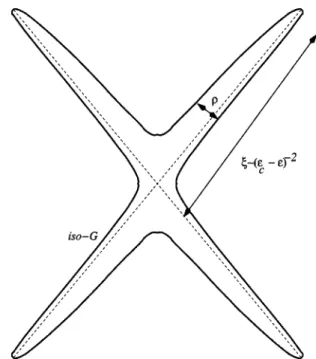
The angular dependence is best shown by considering curves of isocorrelations G(x,x)⫽c3, where c3 is constant
along a curve. Such curves obey x⫽⌳h(x)/c3. The direct
study of the function w⫹ shows that it admits quadratic maxima along the directions ⫹关兴, scaling as max(w⫹)
⫽w⫹(⫹关兴)⫽⫺a(␦)2 when the transition is approached,
where a is a positive constant. This comes from the fact that Eint is degenerate exclusively for the critical angles ⫾, at reduced strainc. Outside a small neighborhood of⫹关兴,
w⫹ remains bounded. The definition of h and the exchange under parity of w⫾ shows then that such an isocorrelation curve has four branches 共spikes兲 along the directions ⫾⫹
⫾/2, whose extent diverge to ⫹⬁ as ⬃2⌳共⫺T
⬘
兲acc23共
c⫺兲⫺2⬃c4⌳共c⫺兲⫺2. 共72兲
The fact that w⫹remains bounded outside any small neigh-borhood of ⫹关兴 also means that the width of the branches remains finite; i.e., that the aspect ratio of the branches / also diverges as (c⫺)⫺2. This is qualita-tively illustrated in Fig. 3. This prediction can be interpreted as corresponding to the formation of clusters of microcracks having aspect ratios / that diverge as the cracks organize into long thin structures along which the sample will ulti-mately fail to form the experimentally observed shear bands.
B. Experimental measurement of
It would certainly be desirable to have direct experimental verification of whether the crack bands have aspect ratio that diverge as 1/(c⫺)2. Unfortunately, there are many
practi-cal problems that have prevented the direct measurement of the autocorrelation function of cracks in materials like rocks. We comment here on three types of measurements that either have or could be used to quantify the autocorrelation.
FIG. 3. Form of an isoautocorrelation curve in the approach to the localization transition.
First, following ideas used by Davy and Bonnet 关9兴 in interpreting their sandbox shear experiments, one can mea-sure the local deformation of a large sample by covering the surface with pixels and monitoring the shear strain of each pixel. The total shear strain of the system is then approxi-mated by taking the average over the surface pixels. If the system deformation is plotted as a function of the pixel size, it is expected that when the pixels are smaller than the emer-gent band structures, the system deformation will decrease as a power law of increasing pixel size as was observed by Bonnet and Davy. However, at a particular pixel size there is a crossover to a constant system deformation as pixel size increases. The pixel size at the crossover point is at least an indirect measurement of the correlation length above which a volume-averaged description of the system holds with properties independent of the pixel size.
Second, a direct measurement of the autocorrelation be-tween cracks can in principle be obtained via acoustic-emissions monitoring 关10兴. However, the present resolution of this method 共millimeters in centimeter-scale specimens兲 and the difficulty in determing the mode of the individual crack events prevents having a satisfactory sampling for sta-tistical analysis. It seems that improvements on these present limitations are possible.
Last, by analogy with the probing of spin populations by electromagnetic waves to study the ferro/paramagnetic tran-sitions, it should be possible to send plane sound waves through a system and measure the scattering cross section as the waves scatter from the structure of the evolving micro-crack population. We have not yet obtained the rigorous con-nection between such a measured cross section and the Fou-rier transform of our autocorrelation function; however, such a relation almost certainly exists. No experimental attempts to measure the correlation function of cracking systems in this manner has been attempted to our knowledge.
VI. CONCLUSION
We now summarize the principal results that have emerged in our study. First, we have demonstrated that at a well-defined strain point ⫽c, thin bands of coherently
oriented cracks can be added to the system at no energetic cost. Such localized structures break the symmetry that held when ⬍c and correspond to a phase transition that we
named the ‘‘localization transition.’’ It was demonstrated that
the free energy F and entropy of the system remain continu-ous and finite at the localization transition which justifies calling it a critical-point phenomena. Such continuity also demonstrates that the stress/strain behavior of the rock is entirely analytic up to and including localization. The only divergence at localization is in the second derivatives of F with respect to the external field J. The consequence is that the correlation length 共aspect ratio兲 of the emergent-crack clusters diverges as (c⫺)⫺2. Presumably, if the
‘‘mean-phase’’ approximation had not been invoked and if order-parameter contributions proportional to 3 and higher had
been retained in the Hamiltonian through a renormalization scheme, then a nontrivial exponent on this scaling law might emerge.
The mechanical behavior of the system at localization ex-hibits many qualities observed in actual experiments on rocks. First, the stress components at localization are reduced relative to their values if the rock had remained intact. The total dilatation ⌬c remains negative at localization, even though the radial strain is positive. With radial confining stress kept constant, the tangent moduli d/d are, most normally, negative at localization indicating that the load curve has already gone through a smooth quadratic peak stress prior to localization. Nonetheless, for rocks with a suf-ficiently low bulk modulus and at sufsuf-ficiently low confining pressures, the localization can occur in the hardening regime, presumably followed by a sharp peak stress corresponding to the unstable coalescence of cracks as the sample fails along a shear band. These results are consistent with what experi-mentalists observe.
Using the exact differential equation that controls the perature in the theory, it has been demonstrated that the tem-perature is becoming even more negative at localization that means that the temperature is always finite at localization. Unfortunately, the exact value Tcof the temperature at local-ization is difficult to obtain because it is a result of integrat-ing the differential equation from the initial conditions. Al-though this could be done numerically, we have instead used an approximate value of Tcbased on a noninteracting crack model.
By far the most important signature of the localization transition is the divergence of the aspect ratio of the crack clusters. As reported, no definitive experimental work has yet been performed to test this prediction and we hope that ex-perimentalists take this as a challenge.
关1兴 W.F. Brace, B.W. Paulding, Jr., and C. Scholz, J. Geophys. Res. 71, 3939共1966兲.
关2兴 R.N. Schock, H.C. Heard, and D.R. Stephens, J. Geophys. Res.
78, 5922共1973兲.
关3兴 C.H. Scholz, J. Geophys. Res. 73, 1417 共1968兲.
关4兴 J. Bass, in Mineral Physics and Crystallography. A Handbook
of Physical Constants, edited by T. J. Ahrens共American
Geo-physical Union, Washington, DC, 1995兲.
关5兴 M. Le Bellac, in Des Phe´nome`nes Critiques aux Champs de
Jauge, 2nd ed.共CNRS, Paris, 1990兲.
关6兴 N. Goldenfeld, Lectures on Phase Transitions and the
Renor-malization Group, Frontiers in Physics 共Addison-Wesley
Reading, MA, 1992兲.
关7兴 M.S. Paterson, Experimental Rock Deformation—the Brittle
Field共Springer-Verlag, Berlin, 1978兲.
关8兴 J.J. Binney, N. Dowrick, A. Fisher, and M. Newman, The
Theory of Critical Phenomena 共Clarendon Press, Oxford,
1992兲.
关9兴 P. Davy and E. Bonnet, J. Geophys. Res. 共to be published兲. 关10兴 D. Lockner, in Rock Physics and Phase Relations. A Handbook
of Physical Constants, edited by T.J. Ahrens共American