DEMOCRATIC AND POPULAR REPUBLIC OF ALGERIA MINISTRY OF HIGHER EDUCATION AND SCIENTIFIC RESEARCH
UNIVERSITY OF ABDLHAMID IBN BADIS MOSTAGANEM FACULTY OF FOREIGN LANGUAGES
DEPARTMENT OF ENGLISH LANGUAGE
MASTER
Didactics and Applied Linguistics
Presented by: MziYamina
Board of Examiners
Chair: Miss Adnani University of Mostaganem
Supervisor: BellalHanane University of Mostaganem Examiner: MissDerrazAmel University of Mostaganem
Academic Year: 2016-2017
Teaching Research Methodology in EFL Classrooms:
Bridging the Gap between Design and Delivery
The Case Study: of Master (2) English Students at
Abdelhamid Ibn Badis University of Mostaganem
Table of Contents
Abstract……… …I Dedication……….………. …II Acknowledgments………...………. III List of Abbreviation/Acronyms………IV List of Tables……….………V List of Graphs……….……. VI List of Figures………...……….VII Table of Contents……….……… VIII General Introduction………. …..011 Chapter One: Issues in the Design and Delivery of Research
Methodology Course
1.1 Introduction………. 04
1.2 What is
Research……….04
1.2.1 Research Method Verse Research
Methodology………..…………05 1.2.1.1 Research
1.2.1.2 Research
Methodology………...…….……….06 1.2.2 The Importance of Research Method and Research
Methodology……….………….06
1.3 Research Methodology as a
Course……….………...07
1.4 The Design of Research Methodology
Course…………...……….08 1.4.1 Course
Description………...……….08 1.4.2 The Importance of Teaching Research
Skills………...……….09
1.4.3 Challenges of Teaching and Learning Research Methods………10
1.5 The Delivery of Research Methodology
Course……….…11
1.5.1 The Pedagogy of Teaching Research Methodology Course…….………11
1.5.2 Teaching
Approach………...………...12
1.5.2.1 The Teacher Centered Approach/ The Traditional Approach ………...13
1.5.2.2 The Student-Centered
1.5.2.2.1 Problem-Based
Learning………...…...……16
1.5.2.2.2 Project-Based Learning: hands on teaching ………...16 1.6 Classroom Assessment………17 1.6.1 Why Classroom Assessment……….18 1.6.2 Course Based Assessment………...……….….19
1.6.3 The Role of Assessment in Teaching Research Methods /Methodology…….……….19
1.7 Conclusion………..………20
2 Chapter Two: Data Collection and Analysis
2.1 Introduction……….……… 21 2.2 Research Setting………..……...……….21 2.3 Description of the Study………...………...22 2.4 Research Question………...………22 2.5 Population………...……….23 2.6 Sample (Participants)………...………23
2.7 Data Collection Instruments……… 2.7.1 The Teachers’ Interview: The Teachers’ Methodology Course through of
Perspective of Teacher
………...24
2.7.1.1 The Description of the Teachers’
Interview……….24
2.7.1.2 The Teachers’ Interview
Protocol……….24
2.7.1.3 The Data Analysis of the Teachers’ Interview………..25
2.7.2 The Students’ Questionnaire: Students’ Opinion Regarding the Pedagogy Used in
Teaching Research
Methodology.……….………..…….29
2.7.2.1 Description of the Students’
Questionnaires……….………29
2.7.2.2 The Data Collection
Procedures………...……….31
2.7.2.3 The Data Analysis of the
Questionnaires………..………31
2.7.2.3.1 Section (01): Students’ Characteristics ….……….31 2.7.2.3.2 Section (02): Students’ Perception of Research Methodology
Course…...…….34
2.7.2.3.4 Section (04): Overall Learning
Experience…………..………43 2.7.2.3.5 Section (05): The Learning
Outcomes………....……….………45 2.7.2.3.6 Section (06): Students’ General Impression of the
Course………..……48
2.8 Conclusion………...50
3 Chapter Three: The Findings and Discussion
3.1 Introduction………...…..51 3.2 Summary of the Findings………..………...…52 3.3 Discussion of the Findings……….………..……54 3.4 Limitation of the Study………..………....57
3.5 Recommendations for Future Implication ……….………..…57 3.6 Conclusion……….….58 General Conclusion………..…….…60 Appendices………62 Appendix 1: Teachers’ Interview………...………..62
Appendix 2: Students’
Questionnaire……….………..64
References……….68
Abstract
Conceptual and empirical knowledge are a two sides coin of research methodology course. Previous research has revealed that most of times this course is taught through traditional teacher-centered approach which made students perceive it as boring and lacking context this is because that they were just exposed to the theoretical knowledge, and did not have the chance to communicate the empirical side of the research process. This study was conducted in order to collect information regarding the issue of teaching research methodology course with the context of EFL classrooms. The main purpose of this study is to capture the way research methods teachers’ and M2 undergraduate students
atAbdelhamidIbnBadis University of Mostaganemperceive the teaching-learning process of this course. In other words, this dissertation is intended to evaluate the effectiveness of this course through the perspectives of instructors and students.In doing so, and to achieve the already mentioned aims of the study two main tools were used. On one hand, and as part of the study a semi-structured format of interview was conducted with (03) instructors having a research methodology course teaching experience regarding the issues associated with the design and delivery of the course; the teaching product and the teaching approaches implemented. On the other hand, a self-reported questionnaire consisted of (19) items in (06) sections was administrated among (70) of M2 undergraduate students belonging to (08) different specialties. The results of the present study indicated that the research methodology course partially served for its purpose because students expressed a more negative attitude towers the teaching approach implemented by teachers at the mentioned university who are still adhering to the traditional approach of teaching.
Key words: Course Design, Course Delivery, Research Methodology Course
Dedication
I wish to give a heartfelt thanks to my parents who offered their endless support and constant prayers. This academic journey would not have been possible without their love,
patience, and sacrifices along the way.
I would never forget to thank my sister Nour El Houda my brothers Mehdi and Farouk, who have been a great source of motivation and inspiration and who have encouraged me
with their constant support and companionship when I felt so desperate. To all the members of my short family.
I want to take the opportunity to thank Messoussa Fatima, my best friend. To all my friends; Sadika, Khadija, Fairouze…. I cannot list all the names, but you are
always on my mind.
Acknowledgements
I thank Almighty God for giving me the courage and the determination, as well as guidance in conducting this research study, despite all the difficulties.
I would like to express my deepest gratitude to my supervisor Miss Bellel who made this study possible.
I feel grateful to all the teachers at Mostagnem University, for the permission I was given to carry out my study.
My sincere and special thanks go to my colleagues at Mostaganem University, who participated in the study and spent their valuable time delivering and collecting the questionnaires. I cannot forget to mention you Sadika.
List of Abbreviations:
EFL: English as a Foreign Language
ICT: Information and Communications Technology
M2: Master 2
List of Tables
Table 1:Distribution of Students by
Gender………...32
Table 2: Distribution of Students by
age………..32
Table 3: Distribution of Students by
Table 4:Student’s Course
Attendance……….35
Table 05:Students' Feelings towards Research Methodology Course………36
Table 06: Course
Aspect………..36
Table 07:Students Opinion about the Research Methodology Course Content………..38
Table 08: Students’ Opinion of Method of Teaching Research Methodology Course………36
Table 09: Classroom
Assessment……….…37
Table 10: Instructor’s
Engagement………..38
Table 11:Teacher’s Evaluation
Method………..39
Table 12: Students versus Research Methodology Course Context………40
Table 13: Overall Learning
Table 14: Outcome Abilities………...45
Table15: The Outcome Research
skills………46
Table 16: Writing Dissertation
Difficulties………..47
Table 17:Students’ Satisfaction with the
Course………...….48
Table 18: Students’ General
Impression………..49
List of Graphs:
Graph 01:Distribution of Students by
Gender………32
Graph 02: Distribution of Students by
age………..…33
Graph 03: Distribution of Students by
Specialty……….…34
Graph 04:Students’ Attendance in Research Methodology
Course………...…35
Graph 05:Students' Feelings towards Research Methodology Course………...…36
Graph 06: Course
Aspect………...37
Graph07:Students’ Opinion about the Content of Research Methodology
Course………...38
Graph08:Students’ Opinion of Method of Teaching Research Methodology
Course….…..38
Graph09: Classroom
Assessment………..…..40
Graph10:Students’ Instructional
Engagement………....41
Graph11:Teacher’s Evaluation
Method……….42
Graph12: Students versus Research Methodology Course Context………43
Graph13: Overall Learning
Experience………...44
Graph14: Outcome
Abilities………46
Graph15: The Outcome Research
Graph16:Writing Dissertation
Difficulties……….………48
Graph 17:Students’ Satisfaction with the Course………...………....49
Graph18:Students’ General Impression……….50
List of Figures
Figure 01: Research Skills………...………11Figure 02: Teacher-Centered Approach versus Student-Centered Approach……….14
Chapter One: Issues in the Design and Delivery of Research Methodology Course 1.1 Introduction: ... 17
1.2 What is Research: ... 18
1.2.1 Research Methods vs Research Methodology: ... 19
1.2.1.1 Research Methods: ... 19
1.2.1.2 Research Methodology: ... 19
1.2.2 The Importance of Research Methods and Research Methodology: ... 20
1.4 The Design of Research Methodology Course: ... 22
1.4.1 Course Description: ... 22
1.4.2 The Importance of Teaching Research Skills: ... 23
1.4.3 The Challenge of Teaching and Learning Research Methodology: ... 24
1.5 The Delivery of Research Methodology Course: ... 25
1.5.1 The Pedagogy of Teaching Research Methodology: ... 25
1.5.2 Teaching Approaches: ... 26
1.5.2.1 Teacher-Centered Approach (The Traditional Approach):... 27
1.5.2.2 Student-Centered Approach: ... 29
1.5.2.2.1 Problem-Based Learning: ... 30
1.5.2.2.2 Project-Based Learning: Hands on Teaching ... 31
1.6 Classroom Assessment: ... 32
1.6.1 Why Classroom Assessment? ... 32
1.6.2 What is Course Assessment? ... 33
1.6.3 The Role of Assessment in Teaching Research Methods /Methodology: ... 33
3.7 Introduction:
The focus of this chapter is on the teaching of research methodology_ methods_ course rather than its learning, as an attempt to answer three important questions; what should be taught? how it should be taught? and in what context?
Beginning first by presenting a background information of research and providing terminologies of research, research methods and research methodology, and the interdisciplinary importance which gains at universities and higher education institutions. Then moving to the design of research methodology as a course, this includes a general description of what content and skills should be taught, and the challenges facing the teaching of this subject matter. Following this by an outline of the major approaches methods teachers adopted to deliver this course;by offering a comparison between recent
and traditional approaches. And finally following a brief insight of classroom assessment, the meaning of course-based assessment, the role it plays in the teaching of research methodology.
3.8 What is Research:
The word research is consisted of two syllabuses, ‘re’ and ‘search’. “Re” is a prefix – meaning again, anew or over again. “Search” is a verb – meaning to examine closely and carefully, to test and try, or to probe. Thus, research is simply the repetition of search; it is to track down information and gain knowledge about a specific topic. Plutchick.R also defines the verb ‘research’ as “to go around and to explore” something that you did not know beforehand, research then for him is a fact-finding journey. (cited in Khan,2008, p.22).And this corresponds tothe definition posited by (Macnaughtonet al.,2006, p.3); which states that “Research is about discovery. Research creates knowledge”.
The Oxford Dictionary of English defines the noun ‘research’ as the systematic investigation into existing or new knowledge and the study of materials and sources in order to establish facts and reach new conclusions, while Merriam-Webster Dictionary provides an expanded definition to the noun ‘research’ ; a studious inquiry or examination; especially: investigation or experimentation aimed at the discovery and interpretation of facts, revision of accepted theories or laws in the light of new or revised theories or laws. Therefore, research is a purposive attempt to answer unanswered questions, finding solutions to unsolved problems and creating new knowledge; through verifying, explaining and analysing the information at hand.
“Research is a scientific activity undertaken to establish something, a fact, a theory, a principal or an application” (Kumar,2008, p.1).
3.8.1 Research Methods vs Research Methodology:
Conducting a research require from the researcher to adopt research methodology along with research methods in order to thoroughly understand the research problem.Though those two terms are considered to be distinct from each other, people are often used synonymously. Thus, make a distinction become a necessity, in this sense (Deborah, 2011) says;” understanding the difference between method and methodology is of a paramount importance”.
Hence, it seems apt to define the two terms.
3.8.1.1 Research Methods:
Research methods are “…all those methods and techniques which are used by the researcher during the course of studying his research problem” (Kumar,2008, p.4). “It is all the behaviours and instruments, used at various levels of the research activity” (Suribhi,2016). Thus, research methods are simply the methods used in collecting data and of approaching in research; it comprises the tools, techniques and processes that the researcher use in conducting a research. Research methods aim at finding a solution to a research problem, and these might be surveys, questionnaires, interviews or participants’ observation, etc.
3.8.1.2 Research Methodology:
(McGregor and Murname, 2010, p.2) wrote;
the word methodology comprises two nouns: method and ology, which means a branch of knowledge; hence, methodology is a branch of knowledge that deals with general principles or axioms of the generation of new knowledge. It refers to the rationaleand the philosophical assumptions that underline any natural, social or
human science study, whether articulated or not. Simply put, methodology refers to how each of logic, reality, values and what counts as knowledge inform research.(as cited by Cram, 2013, para.4).
It is the manner to scientifically finding out about a solution to the research problem.It is the science which guides the researcher and paves the way for him to complete his study, it is often recognised as how the research is to be done and how knowledge to be gained (Kumar,2008, p.5).
3.8.2 The Importance of Research Methods and Research Methodology:
Kothari claimed that;
The study of research methodology gives the student the necessary training in gathering material and arranging or card-indexing them, participation in the field work when required, and also training intechniques for the collection of data appropriate to particular problems, in the use of statistics, questionnaires and controlled experimentation and in recording evidence, sorting it out and interpreting it. (2004, p.10).
Thus, the sole intention of teaching research methodology is to provide students with an overall context for each step of executing research by providing the students with the knowledge of how to perform research so as to generate knowledge, and then this helps them contextualize the use of research methods. In other words; research methodology provides students with a practical guidance.
(Rajasekar, Philominathan, &Chinnathambi,2006, p.6) indicated that the importance of research methodology is concerned with the explanation of the following:
(1) Why is a particular research study undertaken? (2) How has one formulate a research problem?
(3) What types of data are collected? (4) What particular method has been used?
(5) Why was a particular technique of analysis of data used?
3.9 Research Methodology as a Course:
Since ever universities played a pivotal role in providing education and preparing students for their contribution to society. Regardless, universities have another key function; which is the production and distribution of new knowledge. These institutions work on producing a knowledge generators; through turning toddy’s students into future researchers by undertaking the activity of research. Hence, in this regard (Elen and Verburgh 2008) say that “Research and teaching are two of the main tasks of universities. A close link between them is often considered to be at the heart of the institution” (as cited in Visser-Wijnveen, van der Rijst, & van Driel 2015, p.474). Tofulfil this aim, universities all over the world offer courses in research methods and methodology.
Khan said that “After 19th century, courses in social research have come to occupy an increasingly important role in social sciences and at present every major university offers courses of research methods” (2008, p.21). It is inevitable today that any educational curriculum does not involve a research methodology course.
(Crooks, Castleden& Van Meerveld, 2010) “Research methods courses are becoming increasingly popular in degree requirements” (as cited in Braguglia&Jackson,2012, p.348).Thus,most of the students are taking the course as a requirement for graduation.
(Harris, 2010, para.1) indicated that“knowledge and use of research methods is widely shared across a range of social science disciplines». Moreover, (Kilburn, Nind and
Wiles,2014, p. 191) say that“Social research methods are taught at all levels of higher education and across a wide range of disciplinary, institutional and national contexts”. Thus, research methods course is a common part in all curriculum and disciplines.
3.10 The Design of Research Methodology Course:
In higher education, the term of course design is broadly used; “Course design is generally considered to refer to the structure of the course (i.e., what content is covered, what activities are included, what assessments are used) in order to achieve a set of learning outcomes (Brinthaupt, Clayton, Draude, &Calahan,2014, p. 327).
3.10.1 Course Description:
After accessing a number of universities web sites which offer courses in research methodology, it has been deduced that the nature, objectives and content of this course is unified and typically the same though the divergence of discipline humanities, social sciences, business management, natural and physical sciences.
Dr. NeerpalRathi described research methodology course as:
a hands‐on course designed to impart education in the foundationalmethods and techniques of academic research in social sciences and business management context. Research scholars would examine and be practically exposed to the main components of a research framework i.e., problem definition, research design, data collection, ethical issues in research, report writing, and presentation. Once equipped with this knowledge, participants would be well‐placed to conduct disciplined research under supervision in an area of their choosing. (2013, p.1) This course aims to provide students with basic knowledge and skills in research methods and critical thinking.
3.10.2 The Importance of Teaching Research Skills:
(Hewitt, 2001, p.371) said that “While there are some carpenters who do excellent work without ever touching a hammer, most carpenters need adequate hammering skills in order to complete their work.”(as cited inAdriaensen, Kerremans, &Slootmaeckers,2015, p. 1); they claimed that “In conventional curricula” most of courses focus merely on knowledge transfer and it is considered to be the teachers’ first priority,while learners are in need to be acquainted with the necessarily skills “to correctly apply research methods”; and this is what actually differentiateresearch methods course from other courses “it revolves around the acquisition of a skill rather than knowledge”, in this sense (Kilburna et al.,2014) argue that research requires “a combination of theoreticalunderstanding, procedural knowledge and mastery of a range of practicalskills". Thought theoretical knowledge is essential for students, they also need to be equipped with practical skills to navigate a research and meet its challenges.
Amongst these skills: critical thinking skill, problem solving skill, analysis, planning, and dissemination.
Figure 01:Research skills
Retrieved from http:// science.uniserve.edu/projects/skills/jantrial/reaserch.htm.
3.10.3 The Challenge of Teaching and Learning Research Methodology:
There are many challenges that encounter the process of teaching and learning of research methodology course. Scholars linked these challenges firstly to the learners; the way they see and perceive this studied material. (Gel et al.,1997) said that “ for many students the study of research methodology and statistics is anxiety provoking” (as cited inRock, Coventry, Morgan,&Loi, 2016, para. 1), (Burgess, 1981; Edwards & Thatcher, 2004;Schutt,Blalock, &Wagenaar, 1984)agreedon this statement and said that “Many students, graduate and undergraduate alike, enroll in research methods courses with trepidation” (as cited in Ekmekci, Hancock, A., & Swayze, 2012, p.272).(Kilburn et al.,2014) re-mention this challenge and contend “students often define the methods course as dreaded requirement” (p. 294).
(Ball &Pelco, 2006) declared“An unfortunate hallmark of research methods courses is low student interest and engagement” (as cited in Ekmekci et al.,2012, p.272). (Kilburn et al.,2014) explain the students’ attitudes towards studying this course; as they may have difficulties to comprehend its major concept, or “tomeaningfully connect what they learn in these classesto whatthey learn in the rest of their plan of study”(Ekmekci et al.,2012,p .272); the difficulty to link between research in theory and research in practice lead students to be frustrated and hence to be dissatisfied with the course.
MacInnes (2012) argued that “undergraduates may lack the level of ‘literacy’ required to understand the results of commonly used techniques for analyzing data”(as cited in Kilburn et al.,2014, p .193).
In page (194) this later pointed out that the challenges do not concern only the learner but it goes beyond that; to the subject matter in itself and quoted what Hammersley argued:
The task of teaching research methods […] is not the transmission of a body ofknowledge, or the drilling of students in the use of techniques, but rather a matter of helping them to build up relevant knowledge and capabilities, and to develop thenecessary intellectual virtues. (2012, p. 2)
3.11 The Delivery of Research Methodology Course:
(Brinthaupt.et al.,2014) concluded that the“Course delivery refers to decisions about how to present the content, activities, and assessments that are designed into the course”.
(Benson & Blackman, 2003) indicated that “The conventional model of delivering research methods classes has been the lecture model—grounded in theory, rather than practice—that usually falls short of providing an engaging learning experience for students” (As cited in Ekmekci et al., 2012)
3.11.1 The Pedagogy of Teaching Research Methodology:
“There are many research methods books available (Breakwell et al, 2012; Coolican, 2009; Flanagan, 2012; Miles and Banyard, 2007) that can provide a practitioner with the knowledge to teach research methods, however this knowledge does not automatically translate into the capacity to teach it well (Garner, 2012). Even ‘the best curriculum is worthless without proper pedagogy’ (Coombs and Rybacki, 1999, p56).” (As cited in Harris,2010).
“While there is extensive literature regarding what should be taught in a research methods course (Birbili 2002), Deem and Lucas (2006) note that there is less emphasis on doing research than on learning about how to do research” (as cited in Tonia A. Dousay, Diane Igoche and Robert Maribe Branch, 2010, p. 3)
(Wagner et al., 2011) share the same idea; even with the large number of courses teaching research methods, there is limited published research into research methods pedagogy and assessment (as cited in Hosein,& Rao, 2015)
3.11.2 Teaching Approaches:
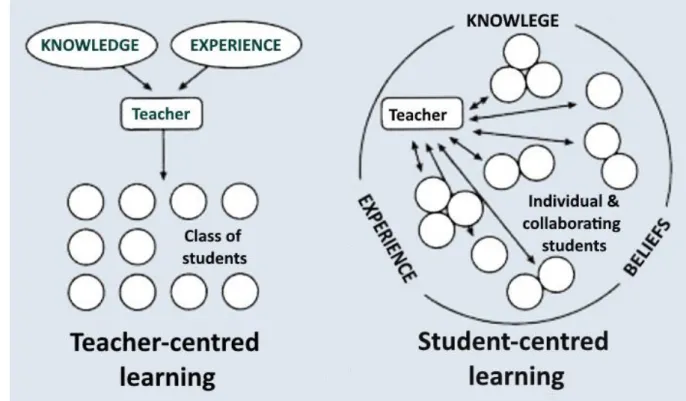
Today there are two overlapping terminologies of teaching approaches; teacher-centered and student-teacher-centered, which are representing answers of questions about the teaching learning process, the roles played by both the teacher and the learner, and what methods should be followed instead of the previous debated philosophies of education. In this sense (de la Sablonnière, Taylor, &Sadykova)“The articulation of the most desirable philosophy of educationremains a hotly debated issue often expressed in the form of aconflict between two prevailing teaching orientations: the teacher/expert approach versus the student-centered approach”(2009, p.1)
Figure 02:Teacher-Centered versus Student-Cantered Approach
Retrieved from http://lo.unisa.edu.au/mod/book/viewphp?!=id610988&chapterid=102030
(Chet etal.,1993) said that “In the student-centered approach teachers are removed from their role of standing at the front of a classroom and presenting thematerial, and theyare converted in to coaches and helpers in the process, Whilethe students are placed in to the position of teaching themselves” (as cited in Bekele,2016, p.789)
3.11.2.1
Teacher-Centered Approach/The Traditional Approach:
IGI Global Disseminator of knowledge dictionary definesthe teacher centered approach (TCA) as a teaching method where the teacher is involved in teaching while the learners are in passive, receptive mode of listening as the teacher teaches.
(King, 1993, p.30) attempt toprovide a fair and an accurate description of how the teaching learning process might be like when applying this approach of teaching:
The traditional approach rests on a heavy instructor-dependent relationship. Students are conditioned to rely on the daily injection of course material dispensed from the lectern in doses carefully calibrated to fill each scheduled class period. Throughout, they race to copy notes, PowerPoint presentations, and whiteboard scribblings spoon-fed to themby the "Sage on the Stage".(as cited in Conner, n.d., Student-Centered Instruction: A Brief Description, para. 2)
(Sablonnièreet al., 2009.p 2)had expanded further on the definition of this approach, where they stated that according to this approach “Knowledge is defined as an entity that can be givenor transmitted and absorbed by students", and “the professor is the essential figure”, and “the main source of knowledge, while the learner is expected to follow the instruction, and the information provided by the teacher in order to learn the material” (Sablonnièreet al., 2009.p 1), thereby the learner is regarded as “an empty vessel to be filled with knowledge” (Moor, 1997, p .124); whose primary concern is “to absorb the teacher imparted-information”,
(Wright, 2011) pointed out that “teacher-student relationships primarily are defined by intellectual explorations chosen by the teacher, in which the teacher is an arbiter and distributor of knowledge and students are receivers of knowledge” (as cited inRandall M. Moate, Jane A. Cox, 2015, p.379).Therefore, this “information transfer model” (Moor, 1997, p .124)of teaching-learning process “assume that the student’s brain is like an empty container into which the professor pours knowledge” (king, 1993, p.30)
(Sablonnièreet al., 2009.p 2) added that “The teacher/expert approach is characterized by the predominantuse of traditional methods of teaching such as formal lectures,seminars and examinations”.
The teacher-centered approach is considered to be as one of the “traditional boundaries governing the manner in which students have—by and large—been conditioned and expected to learn for centuries”but it has diminished by a new teaching strategy; Student-Centered Approach (Connor, n.d., Student-Centered Instruction: A Brief Description, para. 1).
3.11.2.2
Student-Centered Approach:
(Slunt&Giancario, 2004) stated that:
Learner-centered methods of content deliveryallow students the opportunity to control their learningsince they require students to take responsibility fortheir learning by being actively involved in the learningprocess rather than simply passively receivinginformation from a lecture. (as cited in Wright, 2011, p.94) (Sablonnièreet al., 2009.p 3) pointed out that according to this approach “The learner is not a passive receiver of knowledge but, rather, an active participant. The learner has the responsibility to accommodate the learning process to his/ her own unique learning style in order to structure his/her own learning”.(Randall M. Moate, Jane A. Cox, 2015, p. 283) says that “such an approach diminishes the instructor’s role as “expert” in the classroom”; whereas the teacher had abandonedhis role of being the only distributer of knowledge, andoccupied another role which is a “facilitator of the learning process”; “a guide who assists the learner in the difficult process of constructing his/her individual system of knowledge”(Sablonnièreet al., 2009.p 1-3),“Instructors are still relied on, of course, but more as coaches working the sidelines”(Conner, n.d., Student-Centered Instruction: A Brief Description, para.3), this latter also pointed out that students would gain maximum benefit from their classes if this approach of teaching had adopted by their instructor since it“calls for student engagement, immersion and personal responsibility”.
Furthermore, (Felder & Brent) added that “when properly used, this approach enhance motivation to learn, retention of knowledge, depth of understanding, and appreciation of the subject being taught”(1996, p.43),and they provide some useful ways that may help teachers to put their centeredness into reverse. Among them; “assigning open-ended problems and those requiring critical and creative thinking, reflective writing exercises, and involving students in stimulation and role play”.
(Sablonnièreet al., 2009; Froyd&Simpson,2008)indicated that there is a broad spectrum of named approaches have developed under the umbrella of student-centered approach; these include cooperative learning, student-centered instruction, collaborative learning, hands-on learning, inquiry-based learning, and problem-based learning.
3.11.2.2.1 Problem-Based Learning:
(Duch, Groh, & Allen) defined the problem-based learning (PBL) as “a powerful classroom process, which uses real world problems to motivate students to identify and apply research concepts and information, work collaboratively and communicate effectively .it is a strategy that promote life-long habits of learning”(2001.conclusion section), whileSavery defined (PBL)as “an instructional (and curricular) learner-centered approach that empowers learners toconduct research, integrate theory and practice, and apply knowledge and skills to develop a viable solution to a defined problem” (2006, p.12).
(Ball&Pelco) said that the goals teachers have for teaching research methods to undergraduate studentshave much in common with goals of PBL, which are; “to encourage self-directed learning in the students that leads to higher motivation, better retention of material, and the development of important reasoning and problem-solving skills” (2006, p.148), and (Marek et al., 2004) indicated that “the PBL approach—especially one where
the students are asked to developtheir own personal research project—has beensuggested to be the most
effective way to buildlearning into research methods courses” (as cited in Ekmekci et al.,2012)
3.11.2.2.2 Project-Based Learning: Hands on Teaching:
(Savery, 2006, p. 16-17) noted that “projects are excellent learner-centered instructional strategies”, and that the project-based learning is a valid educational techniquethat “promote active learning and engage the learners in higher-order thinking such as analysis and synthesis”.Where the classroom activities are “organized around achieving a shared goal (project)”. The following is adescriptionof the project group method of teaching provided by Ransford:
Students, working in small projectgroups, become actively involved in researching a topic of theirinterest. They plan an original study, develop an instrument, andgather data to test the hypotheses of their study. Lectures andreadings continue to comprise an important part of the course,but at least 50% of class time (and 50% of the student's grade) isdevoted to research projects. (1982, p.292)
This latter pointed out that the use of this teaching technique wouldmaximize the students’ comprehension, increasetheir motivation, andinvolvement in the research process. Teachers are more likely to be instructors andcoaches (rather than tutors) who provide expert guidance, feedback and suggestions for“better” ways to achieve the final product”(Savery, 2006, p. 16). Furthermore, Ransford claimed that “no lectures or laboratory assignments, no matter how well organizedor skillfully presented, can give students these kinds ofpractical field work learning” experiences”.
3.12 Classroom Assessment:
Within higher education context the term “assessment” has placed several meanings.(Angelo& Cross) consideredclassroom assessment as“an approach designed to help teachers find out what students are learning in the classroom and how well they are learning it”(1993, Classroom assessment technique, para.3). While (Stassen et al.,2005,p. 5) indicated that “the term can refer to the process faculty use to grade student course assignments…,or to any activity designed to collect information on the success of a program, course, or University curriculum”. And they defined assessment as “the systematic collection and analysis of informationto improve the student learning”.
3.12.1 Why Classroom Assessment:
Classroom assessment is also considered by (Linking Classroom Assessment with Student Learning,2003, p.1) as “among an instructor’s most essential educationaltools”, that an effective instructor cannot overlook the importance of its usage in the teaching-learning process.
An effective instructor should befully aware of the fact that “Learning occurs when there is an interplay between the teaching process and the outcome”,and might not expect that students will directly apprehend the course material once introduced to them. (Stassen etal.,2005, p. 6), but rather he should measure the students “educational attainment” relying on their performances whether using the ongoing informal or formal classroom assessment, in this sense (Linking Classroom Assessment with Student Learning,2003, p. 1) asserted that both are“the bond that holds teaching and learning together”,and added that classroom assessment is beneficial for both; the instructor and the student “to improve their own performances” since it provides them with an overall feedback on their teaching and learning effectiveness.
Classroom assessment can aid educators “Identify students’ strengths and weaknesses, allows him to monitor teaching effectiveness and student learning, and gauge student mastery of required skills”.To sum up, it can “motivate and shape learning and instruction”.(Stassen et al.,2005, p. 6) express this idea in a different way, say that it “helps instructors become better teachers by offering specific feedback on what is working or not working in their classrooms; and provides systematic feedback to students about their own progress”. In other words, classroom assessment helps both reconsider the shortcomings of their teaching and learning strategies.
3.12.2 What is Course Assessment?
“Course-based Assessment refers to methods of assessing student learning within the classroom environment, using course goals, objectives and content to gauge the extent of the learning that is taking place"(Stassen et al.,2005, p. 6)
3.12.3 The Role of Assessment in Teaching Research Methodology
Course:
3.13 Conclusion:
In the light of the literature review, it is found that research methodologyis of great importance in higher education. Furthermore, the task of teaching this course is not as easy as some believed;just transferring knowledge to students about how research would be like through traditional approaches.The teaching of this course is no longer dependent on the teacher-centered approach, but rather there are new approaches that have been emerged to improve the delivery of the content of this course to consolidate the most important research skills in the learner’s mind e.g. the student-centered approach which brought about several approaches; problem-based learning and project-based learning.
One of the purposes of the next chapter is to identify whether teachers of research methodology at Mostganemuniversity are keeping up with the new approaches of teaching or they are still adhering to the traditional one.
Chapter Two:Data Collection and Analysis
2.1 Introduction: 36
2.2 Research Setting: ... 37 2.3 Description of the Study: ... 37 2.4 The Research Question: ... 37 2.6 The Sample (Participants): ... 38
2.7.1 The Teachers’ Interview: Research Methodology Course through the
Perspective of Teacher ... 38 2.7.1.1 The Description of the Teachers’ Interview: ... 39 2.7.1.2 The Teachers’ Interview Protocol: ... 40 2.7.1.3 The Data Analysis of the Teachers’ Interview: ... 40 2.7.2 The Students’ Questionnaire: Students’ Opinion regarding the Pedagogy used in Teaching Research Methodology ... 44
2.7.2.1 Description of the Students’ Questionnaires: ... 45 2.7.2.2 Data Collection Procedure: ... 46 2.7.2.3 The Data Analysis of the Questionnaire: ... 47 2.7.2.3.1 Section (01) : Students’Characteristics ... 47 2.7.2.3.2 Section (02): Students’ Perception of Research Methodology Course ... 49 2.7.2.3.3 Section (03): Delivery of Research Methodology Course ... 53 2.7.2.3.4 Section (04): The Overall Learning Experience ... 58 2.7.2.3.5 Section (05): The Learning Outcomes ... 60 2.7.2.3.6 Section (06): Students’ General Impression of the Course ... 64 2.8 Conclusion: ... 66
2.1
Introduction:
This chapter displays an overview description of the study,and provides details
ofhow data aregathered, who the participantsare.It also presents data collection
instruments, data collection procedures and data analysis, the research setting where the study is conducted plus a description.
2.2
Research Setting:
The present study is conducted at Abdelhamid Ibn Badis University; which is located in the city of Mostaganem, Algeria. This institution was established in 1978 and it comprises of (08) faculties amongst the faculty of Letters and Languages; and the attention isdrawn towards the English department
2.3
Description of the Study:
The purpose of this study is to detect the opinion of the teachers and students about the method of teaching a “research methodology” course.
In this study, both qualitative and quantitative data are collected. For
quantitativedata, a self-reported questionnaire consisting of (18) items in five sections is used to collect data from the students. And as for Qualitative data, theyare gathered through interviews with the instructors working at Abdelhamid ibn Badis University_ Mostaganem_.
2.4
The Research Question:
This study is guided by a particular research question and linked to sub-question; which are cited underneath:
Are the lessons of Research Methodology course well organized to help undergraduate students execute a research and write their dissertation?
How can the teacher’s formative assessment in Research Methodology course help EFL students overcome difficulties when conducting a research and writing their dissertation?
This target population that the researcher aimed to gather data to accomplish the present study iscomprised of teachers having a research methodology course teaching experience, and Master 2 (M2) students of English studying at the English Language teaching department of Abdelhamid Ibn Badis University_Mostaganem.
2.6
The Sample (Participants):
For the questionnaire, (70) students out of (323) took part in this study; which represents 20% of the total number. The sample is composed of students belonging to (08) different specialties, and these participants whoare randomly selected; (50) girls and (20) boys constituted the sample of this study.
For the interview, out of (32) instructors, (03) instructors participated in the study. Theinstructors were visited in their classrooms. They were interviewed to understand more about how they are teaching research methodology course, and to detect their opinions with regard to the teaching approachesimplemented.
2.7
Data Collection Instruments:
In the present study, a semi structured interview and questionnaires are used as the main instruments to collect data.
2.7.1 The Teachers’ Interview: Research Methodology Course through
the Perspective of Teacher
As a part of the study, an interview was conducted with teachers regarding issues associated with the design and implementation of the research methodology course; theteaching product andthe teaching approaches implemented.
This instrument is used in order to gain an extrainformation that would not be available or missed from the use of the questionnaires, and also to address the researcher to
dig deeply into the research project and thus to provide her with ageneral insight into studiedcase.
2.7.1.1 The Description of the Teachers’ Interview:
This interview sought to analyze the research methodology course teaching from the perspective of teachers, this instrument is selected because it always has been considered as the best mean to collect information about peoples’ opinions and experiences.
A semi structured format of interview took place in this study. The participant teachers are interviewed personally. Therefore, it is a face to face interview. It consists of (10) questions divided into (04) sections:
Section 01 (Teaching Product):through this part the participants were asked about the content / product they attempt to provide their students with. In other words, what knowledge and skills they plan to teach. It consisted of 03 questions.
Section 02(Teaching Approach):participants were asked to discuss their way of teaching this subject, give their opinion of the other applied teaching approaches. In other words, how they plan to deliver it to their students. this part consisted of 03 questions.
Section 03(Assessment):Teachers were asked; whether they assess their students or not, to list some activities, and also about the role of assessment (formative) in enhancing the students learning.
Section 04 (Teaching Materials): this section consisted of an only one question, in which teachers were asked about the material they may use to teach this subject.
2.7.1.2 The Teachers’ Interview Protocol:
The interview ‘s questions were previously developed and written by the researcher herself, and then it was previewed by the supervisor’s thesis. In order to check its validity. The Interviewwas conducted with (03) instructors during the period of April 10th and 12th, 2017; In which they were interviewed in “3” sessions lasting around 20minutes,andthis has been after arranging an appointment.
An initial contact was made with intervieweesbefore; to ask for their permission to participate in the study, toensure their availability, andto schedule the interview.
Concerning the process of recording the interview’s data, the researcher requested the teachers’ permission to store their answers, hence they were informed that the
interview would be recorded.
The audio-recorderphone application -voice memo- was used as the principal instrument to capture information from each interviewee. The use of such un instrument is very useful in the sense that information can be easily uploaded and played back.
Theinformation gathered from the interview are transcribed to be summarized and analyzed later by the researcher.
2.7.1.3 The Data Analysis of the Teachers’ Interview:
Question 01:What types of knowledge and skills you attempt to provide your students with through research methodology course?
The three teachers have different answers on thisquestion:
Instructor (A): when it comes to research methodology course I attempt to provide my students with both the practical and the theoretical side, but I mainly focus on the “what
is”; itmeans conceptual knowledge e.g. notions and scientific concepts, and then on “how to”, because I cannot provide them with the practical side directly without introducing to them the theoretical one.
Instructor (B):my first purpose is to make my students know “what research methodology
is”, because sometimes they do not have the ability of understanding what it is about and what differentiates it from a research in its own.
instructor (C):I believe that vocabulary, writing, thinking and even speaking are
implicitly and explicitly taught through research methodology course. For me, I attempt to teach thinking and to raise critical thinking in my students’minds. And I do notfocus or give any importance to definitionsbecause I think it is personal and not general.
Question 02:Do you believe that what you are providing your students with is sufficient for them when they are tackling a research and writing their dissertation?
Instructor (A):no, it is not enough due to the short amount of time.
Instructor (B):yes, it is sufficientbecausethis course is not about only one year, but rather there were some kinds of gradation during the schooling process in which students were following a whole program.
instructor (C):refused to answer this question because she thinks that it would be better to ask students this kind of question.
Question 03: Do you agree that almost if not all teachers focus more on conceptual knowledge and ignore to teach students how to implement it?
Instructor (A): yes, of course and this is intended because the pedagogical setting at the universityis not well equipped for workshops that is why we focus on giving them just the theoretical part.
Instructor (B):no, I do not think so.
instructor (C): yes, I do agree unfortunately. And she added, when we teach students grammar or writing, we never tell them that grammar for instance is useful when writing a dissertation.
Question 04: What methods of teaching do you follow when teaching the research methodology module?
Instructor (A):it depends on my students, most of times giving lectures.
Instructor (B): sometimes, I try to be very classicale.g. giving lectures, and in other times I try to focus on the students; obtain feedback because they might be lost in lectures.
instructor (C): I try to give my students the opportunity to express themselves, interfere, react, say yes or no. In other words, it is to have a discussion and a debate.
Question 05: Do notyou agree that almost if not all teachers are following the content-based approach?
Instructor (A):yes, of course. And he added: “sometimes, the problem is not in the method itself but is in the competencies of the teacher”.
Instructor (B):/ refuse to answer.
instructor (C):/refuse to answer.
Instructor (A):yes, this approach is a good way to sustain what students have seen in the class, but I think it is not yet effectivesimply because of plagiarism; students may access the net, take a sample and bring it.
Instructor (B):yes, perfectly.
instructor (C):yes, I encourage that because several skills could be developed e.g. critical and communication skills.
Question 07: Do you assign tasks /activities to your students after each session?
Instructor (A): sometimes.
Instructor (B):not always, when I feel like they need some activities.
instructor (C):no, I do notbelieve in assessment. I do not like assessing students, correcting their papers which are most of time plagiarized, but rather I focus more on classwork; debates, interaction, etc.
Question 08: If yes, what kind of activities you ask students to do?
Instructor (A):maybe I ask them to summarize a chapter, write a small abstract or a literature review in which I am not concerned with the content but the form; to see whether they have understood, respect implement those methods in writing.
Instructor (B):maybe I give them a short passage and ask them to work on it, and may be to turn it to a piece of research.
instructor (C):/refused to answer
Question 09: Do you use material? If yes, what are the materialsemployed when the teaching research methodology module?
Instructor (A):I sustain my lectures with videos, e-books, and sometimes I provide my students with web sites in which they may visit.
Instructor (B):sometimes,I use powerpointpresentation because I think it is the best way to teach and explain important points.
instructor (C):I merely use the overhead projector.
Question 10:Students are learning more through doing, and there is no formative assessment in a research methodology in our EFL classrooms. To what extent do you aboutthis statement?
Instructor (A): I partially agree. And he added: “the credibility of assessment or
evaluation has gone the same as the credibility between the teacher and the learner who has lost faith in each other”.
Instructor (B):it is not only about assessment. Doing things and assess them sometimes it is better to leave them do things alone without assessment. It is about giving them a chance to assess and evaluate themselves because self-assessment is going to help them better.
instructor (C):yes, I totally agree.
2.7.2 The Students’Questionnaire: Students’ Opinion regarding the
Pedagogy used in Teaching Research Methodology
The use of questionnaires became an indispensable part of any research. (Menter, Elliot, Hulme, Lewin, & Lowden, 2011, p.105) considered that the
questionnairesareaneffective and a valuable instrument that can be used to collecta wide range ofinformation fromrespondents, andto study their attitude, values,beliefs, and past
behaviors. Thus, it is preferable to use such a means to collect information from the chosen respondents in the selected department.
The questionnaires used in this study are developed by the researcher herself, and then it is reviewed by the thesis’s supervisor in terms of scaling, ordering, and
appropriateness, in other words; validity and reliability.
2.7.2.1
Description of the Students’ Questionnaires:
It consisted of a list of (19) items which belonged to (06) different sections, and each one served for a specific objective; which sought to answer the research question.
Section01 (Students’ Characteristics):The purpose of this part of the questionnaire, is to
extract the respondents’ demographic profile. It consisted of threeitems and the participants are required to provide the researcher with their demographic information;age, gender and the studied specialty.
Section 02 (Students’ Perception of the Research Methodology Course):The purpose of
this part is to assimilate the students’ perception of the course. The researcher aims to set forth the students attitude in some details;this section is focused towards quantifying the students’ attendance, feelings, and perception on the content.
Section 03(Delivery of Research Methodology Course):Students’ perception of the
delivery of research methodology course is elicited through this part of questionnaire. Respondents are asked to show their agreement or disagreement on (05) items; Teaching Approach adopted, Assessment, Engagement, Evaluation, and the last item concerned with the course context as a whole, by providing (02) alternative responses; Agree and
Section 04 (Overall Learning Experience): Through this part of the questionnaire, the researcher aimes to investigate the research learning experience the students had acquire after almost 05 years of studying the research methodology subject within the classroom. Section (04) composed of (03) items with (03) alternative responses; not at all, once and a few times.
Section 05 (Learning Outcome):The purpose behind the design of this part of the
questionnaire is to find out whether the outcome abilities and skills are being exhibit or not by respondents. In other words; to investigate whether the expected research knowledge and competencies are acquired. Along with this tow items, this part served for the purpose to find out to what extent students are satisfied with that learning outcome.
Section 06 (Students’ General Impression of the Course):This section of the
questionnaire is designed to extract information from respondents regardingthe studied course_research methodology. Respondentsare encouraged to freely express their views and to provide a written feedback. Section (06) composed of (02) items; an open-ended question with (05) alternative responses: Poor, Adequate, Good, Excellent, Need Improvements. And an open question which permitted therespondents to unleash their thoughts. Thus, this section offered the researcher with the opportunity to dig deeper in the students mind and collect information that might be missed from the questionnaire.
2.7.2.2
Data Collection Procedure:
To administrate the questionnaires, a personal on-sit survey approach is followed by the researcher; whereby the questionnaires were handed out to respondents in the college setting.
2.7.2.3
The Data Analysis of the Questionnaire:
2.7.2.3.1 Section(01) :Students’Characteristics
Item (1):Distribution of Students by Gender
Through the questionnaire,(70) students participated in the study; 50 (71%) are girls and 20 (29%) are boys. The frequencies and percentage of the students that took part of the study are illustrated in the table (1).
Table 1: Distribution of Students by Gender
Gender Students’ Number %
Female 50 71%
Male 20 29%
Total 70 100%
Item (2): Distribution of Students by Age
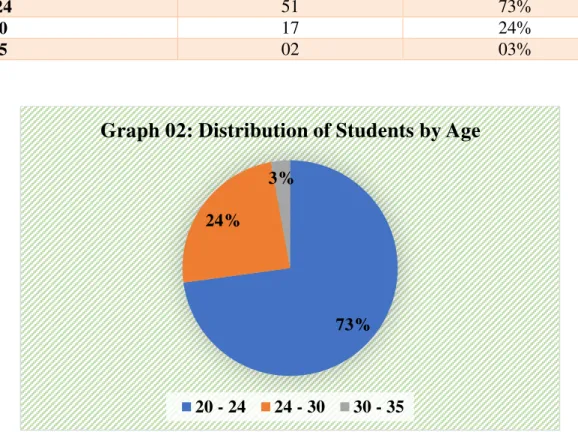
It is clear from the table below that the majority of the M2 undergraduate students who participated in the study (73%) belonged to age group of (20-24), whilealmost a quarter of students (24%) their age ranged from (24 to 30) and (3%) students are above 30 years of age.
29%
71%
Graph 01: Distribution of Students by Gender
Male Female
Table 2: Distribution of Students by Age
Age (years) Students’ Number %
20 - 24 51 73%
24 -30 17 24%
30 -35 02 03%
Item (3):Distribution of Students by Specialty
Throughout this item, the participants were asked to provide information about theirspecialties. Students form different specialties/ branches participate in the study, the percentages seemed very likely to be equal, and the participation rates gives a close approximation. Table (3) reports the number and percentage of students in terms of theirspecialized field.
(16) undergraduate students from Didactics and Applied Linguistics specialty took the big part in the study by (23%), and (10)students from Applied Linguistics come after by (14%). While for the remainingspecialties, the students’ contributions are the same by (10%).
Table 3: Distribution of Students by Specialty 73%
24%
3%
Graph 02: Distribution of Students by Age
Specialty Students’ Number %
Didactics and Applied Linguistics 16 23 %
Applied Linguistics 10 14 %
English Language and Linguistics (ELL) 09 13 %
Psycholinguistics 07 10 %
British Civilization 07 10 %
Sociolinguistics and Gender Studies 07 10 %
British Literature 07 10 %
Linguistics 07 10%
2.7.2.3.2 Section (02): Students’ Perception of Research Methodology
Course
Item (01):Students’Course Attendance
Q4:I attend Research Methodology sessions:
a. Always b. Sometimes c. Rarely d. Never
Through / Via this item the researcher aims to track down information about the students’ research methodology course attendance.
23% 14% 13% 10% 10% 10% 10% 10%
Graph 03:Distribution of Students by Specialty
Didactics and Applied Linguistics Applied Linguistics English Language and Linguistics (ELL) Psycholinguistics
British Civilization Sociolinguistics and Gender Studies British Literature Linguistics
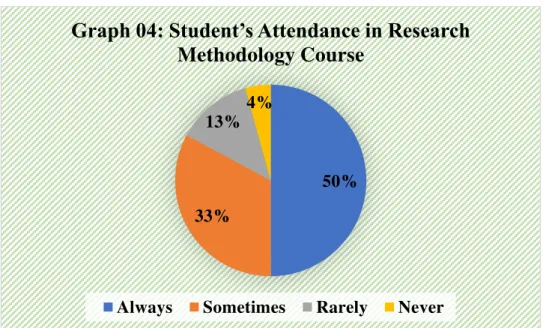
About the half of the surveyed students indicated that they are always attending the research methodology lectures, while (03) students indicated that they skipped the classes and never attended with (04%).
Table 4: Student’s Course Attendance
The answer Student’s Number %
Always 35 50%
Sometimes 23 33%
Rarely 09 13%
Never 03 04%
Item (02): Students' Feelingstowards Research Methodology Course
Q5:Research Methodology course is boring:
a. Yes b. No
Table 05: Students' Feelingstowards Research Methodology Course 50%
33% 13%
4%
Graph 04: Student’s Attendance in Research
Methodology Course
The Answer Student’s Number % of students
Yes, it is boring 45 64%
No, it is not boring 25 36%
From the table (05) above that represent the students feeling towards the research methodology, it is noticed that more than (60%) of students felt that the subject matter was not interesting and bored while attending the session. As for the remaining number of students (25), say the opposite with 36%.
Item (03):Course Aspect
Q6:Research Methodology course is absolutely theoretical:
a. Agree b. Agree
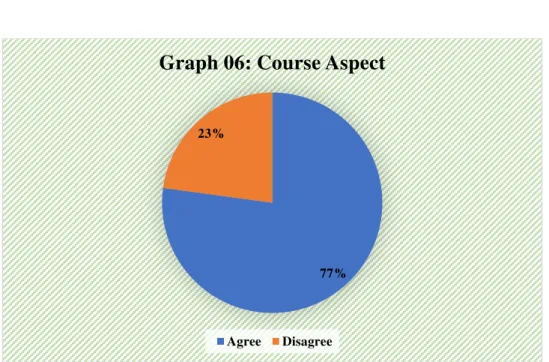
Table (06) shows that (77%) of undergraduate students agree with the statementthat the research methodology course is absolutely theoretical, while (23%) disagree with it.
Table 06: Course Aspect
Answer Students Number % of Students
64% 36%
Graph 05: Students' Fellings towards the
Research Methodology Course
Agree that research methodology course is absolutely theoretical
54 77%
Disagree that research methodology course is absolutely theoretical
16 23%
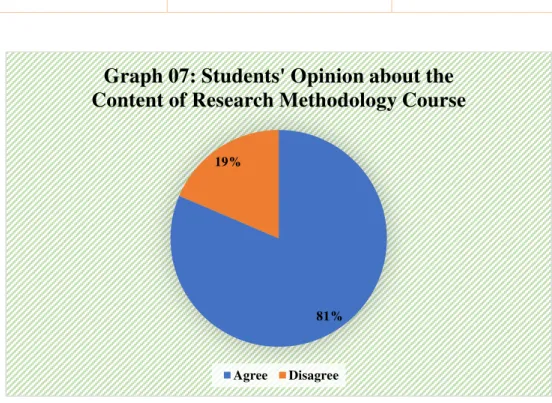
Item (04):Students’ Opinion About the Content of Research Methodology Course Q7:The content of Research Methodology course is non-renewable and non-sequenced since it is repeated all years
a. Agree b. Disagree
The obtained results from students about their opinion of research methodology course content indicated that about (80%) of students agree that the course contentis neither renewable nor sequenced.
Table 07: Students Opinion about the Research Methodology Course Content
Non-Renewable andNon-Sequenced Since
Students number % of Students
Agree 57 81%
77% 23%
Graph 06: Course Aspect
Disagree 13 19%
2.7.2.3.3 Section (03): Delivery of Research Methodology Course
Item (01):Students’ Opinion about Research Methodology Teaching Method
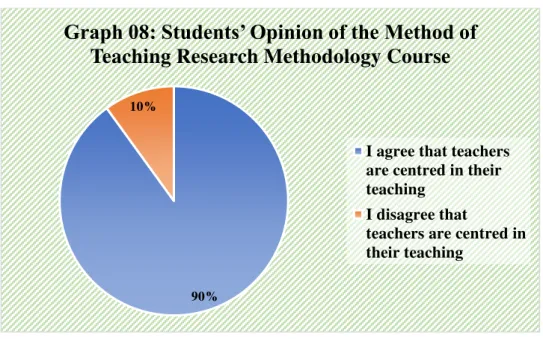
It can be seen from the table (09) that (90%) ofstudents agree with the statementthat “Most of methods teachers are (teacher-centered) and delivering/ teaching research
methodology course using the traditional approach e.g. lecture-based format”.
Table 08: Students’ Opinion of Method of Teaching Research Methodology Course
The answer Students’ Number % of Students
I agree that teachers are centred in their teaching
63 90%
I disagree that teachers are centred in their teaching
07 10%
81% 19%
Graph 07: Students' Opinion about the
Content of Research Methodology Course
Item (02):Classroom Assessment
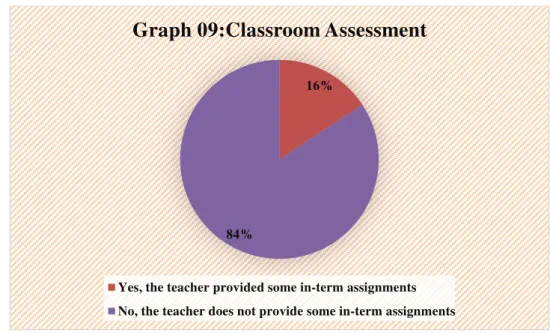
Q9:The teacher provided assignments that helped me understand the course content
a. Yes b. No
Table (09) shows that (84%) of respondents reported that there is not any assessment by research methodology teachers.
Table 09: ClassroomAssessment
The answer Students Number % of Students Yes, the teacher provided
some in-term assignments
11 16%
No, the teacher does not provide some in-term assignments
59 84%
90% 10%
Graph 08: Students’ Opinion of the Method of
Teaching Research Methodology Course
I agree that teachers are centred in their teaching
I disagree that
teachers are centred in their teaching
Item (03): Students Engagement in the Course
Q10:There is a little engagement by teachers of Research Methodology:
a. Agree b. Disagree
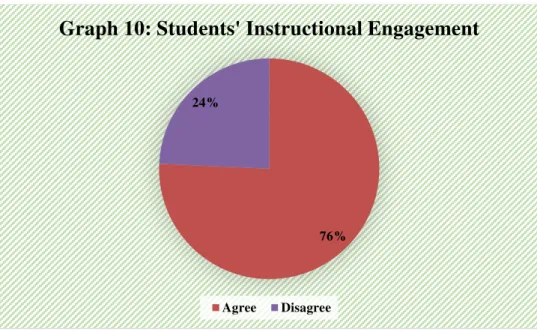
As shown in the table (11) below, three quarter of the sample agree that there is a little engagement by teachers in research methodology course.
Table 10: Instructor’s Engagement
The answer Students‘Number % of Students
Agree 53 76%
Disagree 17 24%
16%
84%
Graph 09:Classroom Assessment
Yes, the teacher provided some in-term assignments No, the teacher does not provide some in-term assignments
Item (04):Students opinion about their Research Methodology Examinations
Q11:In exams, the methods teachers evaluate students according to their memorization skills
a. Agree b. Disagree
Table (11) reports the frequencies and percentages of the respondents in terms of evaluation. (79%) of respondents thought/ believedthat most of teachers evaluate them according to their memorization skills, while (21) is the percent of respondents who disagree with this belief.
Table 11: Teacher’s Evaluation Method
The evaluation method isaccording tomemorization skills Students’ Number % Agree 55 79% Disagree 15 21% 76% 24%
Graph 10: Students' Instructional Engagement
Item (05):Students’ Opinion About the Learning Environment Q12:Research Methodology course is lacking context:
a. Agree b. Disagree
The table above shows the students versus research methodology course context, (71%) agree that the course lacking context despite (29%) disagreed.
Table 12: Students versus Research Methodology Course Context
Research Methodology is Lacking Context
Student’s Number % of Students
Agree 50 71%
Disagree 20 29%
79% 21%