HAL Id: cea-02384424
https://hal-cea.archives-ouvertes.fr/cea-02384424
Submitted on 28 Nov 2019
HAL is a multi-disciplinary open access
archive for the deposit and dissemination of
sci-entific research documents, whether they are
pub-lished or not. The documents may come from
teaching and research institutions in France or
abroad, or from public or private research centers.
L’archive ouverte pluridisciplinaire HAL, est
destinée au dépôt et à la diffusion de documents
scientifiques de niveau recherche, publiés ou non,
émanant des établissements d’enseignement et de
recherche français ou étrangers, des laboratoires
publics ou privés.
Are analytical standards and reagents really reliable ?
Céline Gautier, Perrine Wund, Elodie Laporte, Jérôme Vial, Didier Thiebaut,
Cédric Rivier, Marielle Crozet, Florence Goutelard
To cite this version:
Céline Gautier, Perrine Wund, Elodie Laporte, Jérôme Vial, Didier Thiebaut, et al.. Are analytical
standards and reagents really reliable ?. Accreditation and Quality Assurance, Springer Verlag, 2016,
21 (1), pp.41-46. �10.1007/s00769-015-1178-4�. �cea-02384424�
0 5 10 15 20 3H reco ve ry y ie ld ( % ) Tritiated-labelled dodecane Tritiated-labelled impurities
Are analytical standards and reagents really reliable?
Céline Gautier*
a, Perrine Wund
b, Elodie Laporte
a, Jérôme Vial
c, Didier Thiébaut
c, Cédric Rivier
d,
Ma-rielle Crozet
e,
Florence Goutelard
faCEA/DEN/DANS/DPC/SEARS/LASE, Atomic Energy Commission, CEA Saclay, PC 171, 91191 Gif-sur-Yvette, France b
IFP Energies Nouvelles, Physics and Analysis Division, 1&4 avenue de Bois-Préau, 92852 Rueil-Malmaison Cedex, France cAnalytical and Bioanalytical Sciences and Miniaturization Laboratory, UMR CNRS CBI 8231, ESPCI ParisTech, PSL Research University, 75005 Paris, France
d
CEA/DEN/MAR/DRCP/SERA/LAMM, Atomic Energy Commission, CEA Marcoule, Building 166, BP 17171, 30207 Bagnols-sur-Ceze, France
e
CEA/DEN/MAR/DRCP/CETAMA, Atomic Energy Commission, CEA Marcoule, Building 400, BP 17171, 30207 Bagnols-sur-Ceze, France
f
CEA/DEN/MAR/DEIM/Nuclab, Atomic Energy Commission, CEA Marcoule, Building 109, BP 17171, 30207 Bagnols-sur-Ceze, France
ABSTRACT: Quality assurance is one of the major challenges in analytical chemistry whatever the scope of application. The quality of analytical standards is never questioned, however sometimes odd results are obtained and all the other potential sources of discrepancies are eliminated. So, we investigated the quality of three analytical standards and reagents implemented for radiological and chemical characterizations of nuclear waste. In particular, this work examined the purity of a source of tritiated-labelled dodecane, the trueness and the purity of a DTPA reagent and the trueness of a multi-anions standard used for an intercomparison exercise. It was shown that the source of tritiated-labelled dodecane contains 60 % of tritiated-labelled impurities. The trueness of the DTPA concentration was ques-tioned due to the presence of impurities in the solution. It was proven that the long-term stability of the multi-anions standard was not guaranteed for nitrite. The results clearly demonstrated that, although in opposition to intuition, cautiousness has to be taken towards the quality of the analytical standards.
The issue of quality assurance (QA) in the analytical chem-istry laboratory has become of great importance for many years.1-4 Quality control (QC) and QA are particularly essential for pharmaceutical sciences5, environmental monitoring6 but also for nuclear industry7. Radioactive waste management is a challenging task faced by nuclear power countries and is a prime concern for the public and therefore for analytical la-boratories. In France, the National Radioactive Waste Man-agement Agency (ANDRA) is in charge of the manMan-agement of radioactive waste. It requests radiological and chemical char-acterizations of nuclear waste and specifies acceptance criteria for packages that have to be respected.8
Consequently, analytical laboratories devoted to nuclear waste characterizations must implement validated methods and provide accurate and reliable measurements.7 All the
radiological and chemical analyses require the implementation of different laboratory instruments, such as liquid chromatog-raphy systems (High-Performance Liquid Chromatogchromatog-raphy coupled to Mass Spectrometry HPLC-MS, Ion Chromatog-raphy IC) or Liquid Scintillation Counters (LSC). Those in-struments must be calibrated with reference materials and standards of known compositions. Calibration standards and reagents must be reliable in terms of accuracy, purity and long-term stability.1-4,9
Among the list of nuclear waste characterizations to be in-vestigated, many radionuclides such as tritium have to be quantified.8 As a pure beta-emitter with a low energy (Emax = 18.6 keV), tritium is favorably measured by LSC.10 The liquid scintillation analyser is generally calibrated using tritiated water standards. For nuclear waste and effluent samples,
triti-2
um is usually extracted from the matrices and isolated fromthe potential interfering radionuclides using a combus-tion/pyrolysis step prior to LSC.10,11 The optimization and the validation of the combustion conditions also require the use of tritiated water standards.11 For the analysis of radioactive materials such as organic solvents and oils, it is necessary to implement tritiated-labelled organic compounds as reference molecules.11 In the nuclear fuel reprocessing cycle, liquid-liquid extraction processes generally involve dodecane as solvent. Consequently, for tritium determination in radioactive waste after a combustion step, it is crucial to have access to a reliable and pure source of tritiated-labelled dodecane.
Moreover, in the framework of nuclear waste management, waste producers are requested to quantify organic ligands like EDTA (ethylenediaminetetraacetic acid) and DTPA (diethylenetriaminepentaacetic acid). Actually, polycarboxylate molecules have been widely used in the nu-clear industry for decontamination purposes. Hence, they may be present in effluents and waste samples.12 They may form complexes with radionuclides, which can facilitate their mo-bility and as a consequence their potential leaching in the environment. They can be analyzed by high performance liquid or ion chromatography13 coupled with conductimetric14 or mass spectrometry15-17 detection. Our group previously reported the quantification of EDTA17 in radioactive effluents by applying a HPLC-MS method. For all chromatographic separations13-17, it is necessary to establish calibration curves based on standards to quantify the analytes of interest.
The chemical composition in terms of inorganic anions has also to be characterized in the radioactive effluents.8 Among the inorganic anions to be analyzed, chloride, fluoride, sulfate, nitrate and nitrite must be quantified because of their complexing and corrosive properties.8 Common inorganic anions are widely determined by IC coupled with conductimetric detection.18-20 Actually, this technique has become a reference method for the measurement of inorganic ions in water and wastewater20, including radioactive efflu-ents21. The anions quantification relies on calibration curves obtained from the analyses of IC standards.
Recently, Wahl et al.22 investigated solvent purity using comprehensive 2D gas chromatography. They highlighted the presence of impurities in common organic solvents such as commercial acetone brands. This work pointed out that cau-tiousness must be taken towards the purity of solvents used for trace analysis.
In the present study, we investigated the reliability of three standards and reagents implemented for radiological and chemical characterizations of nuclear waste. In particular, this work examined the purity of a source of tritiated-labelled dodecane, the trueness and the purity of a DTPA reagent and the trueness of a multi-anions standard used for an intercomparison exercise.
MATERIALS AND METHODS
All reagents (nitric acid) and solvents (hexane, ethyl acetate, ethanol) used were of analytical grade.
For the radiological analysis of tritium, a source of tritiated-labelled dodecane was purchased from a US provider. Accord-ing to the technical data sheet, its specific activity was speci-fied at 40 kBq/g (no uncertainty was given) whereas the radio-chemical and radio-chemical purity was specified at 99% from Thin-Layer Chromatography (TLC). The recommended storage temperature was 0-5°C. It was noted that no expiration date
was indicated. The chromatographic separations were carried out on pre-packed FinisterreTM Si SPE cartridges (Teknok-roma, Spain) containing 1 g of silica with average particle size of 50 µm. The dead volume of the cartridge was around 1.2 mL. The Si SPE cartridges were conditioned with 12 mL hexane. All fractions obtained after separation were collected to quantify tritium. All tritium measurements were performed with a Tri-Carb liquid scintillation counter (Perkin-Elmer, France). The instrument was calibrated for tritium analysis using a certified tritiated water standard (CERCA LEA, France). The accuracy of the tritium analyses was checked annually with proficiency tests organized by the LNHB labor-atory (Laboratoire National Henri Becquerel, France). All organic samples were diluted in 5 mL ethanol and then mixed with 10 mL Ultima GoldTM LLT scintillation cocktail in 20 mL polyethylene vials. It was checked that the organic mole-cules of the samples did not induce any quenching effects.
The DTPA solution was purchased as a General Purpose Reagent (GPR) from an international supplier. This chemical product was a DTPA pentasodium solution in water which should have a purity grade higher than 95.0 %. According to the certificate of analysis, the pH of the solution was certified at 11.7 and the concentration was certified at 1.02 M (for a GPR, no uncertainty is given). The experimental pH was measured with a SevenMulti™ pH-meter (Metrohm, Villebon sur Yvette) which was calibrated with certified pH buffers.
For IC experiments, single- and multi-anions standards were purchased as IC Certified Reference Material (CRM) from a US accredited supplier. The interlaboratory exercise called “EQRAIN Ions 2014” was performed using a CRM solution. The nitrite concentration was certified at 0.330 (+/- 0.016) mg/L for six months. All IC standards except the interlabora-tory CRM solution were diluted prior to injection in ultra-pure water (resistivity 18.2 M cm) obtained from a Milli-Q puri-fication system (Millipore, France). The IC separations were conducted using an ICS-4000 capillary-scale instrument (Thermo Scientific, USA). The capillary-scale system con-sisted of an AS-AP autosampler, a capillary single pump, an EG online eluent generator module, a conductivity detector (which was thermally controlled at 15°C) and an IC Cube. The latter integrated a capillary-scale in-line eluent degasser, a separately controlled capillary column oven (which tempera-ture was fixed at 30°C), a capillary 4-port injection valve fitted with a 0.4 µL internal loop and an anion capillary eluent sup-pressor (ACES). The ICS-4000 system was equipped with capillary AG15/AS15 columns (Thermo Scientific, USA) working at 0.012 mL/min with 38 mM KOH eluent.
RESULTS AND DISCUSSION
Source of tritiated-labelled dodecane. For the determina-tion of tritium in nuclear waste, it is requested to perform a pyrolysis/combustion prior to LSC.10,11 To calibrate our meth-od, a commercialized source of tritiated-labelled dodecane was chosen as an organic reference molecule of nuclear pro-cesses. Before using it as a quality control standard, its purity was examined. For that purpose, liquid chromatography with gravitational elution was implemented. Due to the non-polar property of dodecane, normal-phase chromatography based on silica as stationary phase was selected.23 In those chromato-graphic conditions, dodecane must be quantitatively eluted with a non-polar solvent (such as hexane), whereas polar compounds must be eluted with a polar solvent (such as acetyl acetate).23 After the loadings of the titriated source, the Si SPE
3
cartridge was successively flushed with hexane and acetylacetate. Figure 1 shows the elution diagram of tritium con-tained in the tritiated-labelled dodecane source. Two elution peaks were respectively detected in hexane and acetyl acetate fractions, which was not consistent with the presence of a single molecule in the source. The first peak should corre-spond to the elution of tritiated-labelled dodecane. The second peak may be related to more polar tritiated-labelled impurities contained in the source whereas the source purity was speci-fied as 99 %. Besides, both elution peaks corresponded to 40 % of tritium activity: the total loss of tritium activity was thus quantified at 20 %. To assess the presence of impurities, the fractions corresponding to the first elution peak were gath-ered and a second chromatographic separation was carried out with this purified tritiated-labelled dodecane solution. The corresponding elution diagram is depicted in Figure 2. Only one elution peak was observed and tritium activity was quanti-tatively recovered in hexane fractions. As a consequence, the commercialized source of tritiated-labelled dodecane contains 60 % of tritiated-labelled impurities. The TLC procedure applied by the supplier should not be sufficiently selective to purify the synthesized product, or the long-term stability of the tritiated molecule is not enough reliable.
Figure 1. Elution diagram of the non-purified tritiated dodecane source (each A corresponds to the flushing of 1 mL non-purified tritiated dodecane source, each B corresponds to the flushing of 2 mL hexane and each C corresponds to the flushing of 2 mL ethyl acetate).
Figure 2. Elution diagram of the purified tritiated-labelled dodecane source (each A* corresponds to the flushing of 1 mL purified tritiated dodecane source, each B corresponds to the flushing of 2 mL hexane and each C corresponds to the flushing of 2 mL ethyl acetate).
General Purpose Reagent (GPR) of DTPA. We previous-ly developed a method to quantify EDTA in radioactive efflu-ents by HPLC-MS.17 It was recently proven that the same procedure can be implemented for the analysis of DTPA.24 It can be noted that no commercialized CRM or analytical stan-dard is available for DTPA. As for EDTA, a calibration curve was established for DTPA using a commercialized salt dis-solved in diluted ammonia. A GPR of DTPA was purchased to be used as a quality control solution. It was decided to control its certified pH and concentration. DTPA (denoted here as H5DTP) has five acidic functions: the corresponding pKa values are: pKa1 = 2, pKa2 = 2.6, pKa3 = 4.3, pKa4 = 8.6 and pKa5=10.5.25 Prior to the experiments, the theoretical specia-tion of DTPA in water was modelled using JChess software (Ecole des Mines ParisTech, France). For that purpose, the database of the software (chess.tdb) was enriched with specific stability constants for DTPA obtained from Smith and Mar-tell.25 Figure 3 shows the theoretical titration curve of the DTPA solution by 5M HNO3 (triangles). The initial pH of the solution should be 11.7, as specified in the supplier certificate. Due to the closeness of the 5 pKas, only one equivalence point should be expected during the titration, which corresponds to the conversion of DTP5- into H2DTP
3-. To determine the DTPA concentration, 50 mL of the solution was experimen-tally titrated using 5M HNO3. The result of this experimental titration is presented in Figure 3 (squares). The initial experi-mental pH of the solution was found to be higher than 14. Furthermore, the titration curve exhibited two equivalence points. Those experimental results were not in agreement with the theoretical simulations. To explain those differences, the presence of impurities can be assumed, such as NaOH impuri-ties originating from DTPA synthesis. Based on this hypothe-sis, the first equivalence point was associated to the reaction of OH- with H+ and the second one to the conversion of DTP 5-into H2DTP
3-, which led to respective concentrations of 0.28 M for NaOH and 0.93 M for DTPA. The theoretical titration curve corresponding to this composition was modelled with JChess software (diamonds in Figure 3). The theoretical titra-tion curve with NaOH impurities fits perfectly the experi-mental curve. Consequently, the DTPA solution contains impurities which induces a bias of 9 % for DTPA concentra-tion.
Figure 3. Experimental and theoretical titrations of the DTPA solution.
Multi-anions standard with NO2
-. Our group recently test-ed the new technology of capillary-scale IC systems for the measurements of common inorganic anions in radioactive effluents.26 To evaluate the analytical performance of this
0 2 4 6 8 10 12 14 16 18 20 A A A A A A B B B B C C C C 3H rec ov er y yie ld ( %) 0 2 4 6 8 10 12 14 16 18 20 A* A* A* A* A* A* B B B B C C C C 3H rec ov er y yie ld ( %) 0 2 4 6 8 10 12 14 16 0 5 10 15 20 25 30 pH
Volume of added 5M HNO3(mL)
Experimental titration
Theoretical titration without impurities Theoretical titration with impurities
4
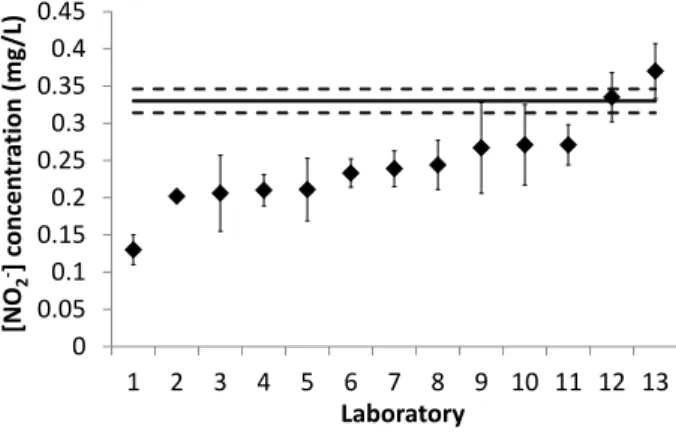
novel instrument, our group participated to an intercomparisonexercise called “EQRAIN Ions” organized in 2014 by the CETAMA committee27. To quantify the different anions, calibration curves were established from a multi-anions CRM standard containing F-, Cl-, NO3 -, SO4 2-, PO4 and mono- NO2
-and Br- CRM standards. For all the anions analyzed in the “EQRAIN Ions” solution, the absolute values of z-scores and zeta-scores were lower than 2: the laboratory performance was considered as satisfactory, except for NO2
-. Figure 4 was elab-orated for NO2
from the results of the interlaboratory compar-ison exercise. It can be highlighted that the robust mean value of the intercomparison exercise ((0.243 +/- 0.038) mg/L) differs significantly from the assigned value ((0.330 +/- 0.016) mg/L) for NO2
-. Thedifference of 26 % between the robust value and the assigned value can be attributed to the instability of NO2
-
due to its conversion to NO3 -
atlong term. Actually, NO2
is known to be quite unstable, even in reagent-grade water, especially at low concentrations.28,29 The results of the supplier against analysis show also an abnormal drift of the NO2
-concentration in the solution. Therefore, the hypothesis of an erroneous reference value was confirmed. There is no guar-antee that this drift is the same in each of the bottles sent to laboratories. The supplier recognizes that the long-term preservation of 6 months was unsuitable for NO2
in this con-centration range. So, cautiousness should be taken towards to the long-term stability of the analytical standards, otherwise the end results can be biased. For future EQRAIN ions com-parisons, NO2
should be separated from the other anions to ensure its stability at low concentrations.
Figure 4. Graph derived from the results of the interlaboratory exercise “EQRAIN Ions 2014” obtained for NO2
concentration (assigned concentration in bold line, limits of the uncertainties associated to the assigned concentration in dotted lines, black diamonds correspond to the results of the 13 laboratories partici-pating to the interlaboratory exercise).
CONCLUSION
The reliability of the analytical standards and reagents is of prime importance. Their purity and trueness are a key deter-minant for the validity of the calibration procedures, and therefore for the quality of the end results. In this work, the reliability of three standards and chemical products was clear-ly questioned in terms of purity and trueness. This study obvi-ously demonstrated that cautiousness has to be taken towards the quality of analytical standards. Unlike what is commonly admitted, analytical standards can also be affected by errors. AUTHOR INFORMATION
Corresponding Author *E-mail: [email protected] Author Contributions
The manuscript was written through contributions of all authors. All authors have given approval to the final version of the manu-script.
REFERENCES
(1) Taylor, J. K. Anal. Chem. 1981, 53, 1588A-1596A. (2) Nadkarni, R. A. Anal. Chem. 1993, 65, 387A-395A.
(3) Wenclawiak, B. W.; Koch, M.; Hadjicostas, E. In Quality
Assur-ance in Analytical Chemistry, Springer, 2010.
(4) CITAC / EURACHEM In Guide to Quality in Analytical
Chemis-try. An Aid to Accreditation, 2002.
(5) Knaack, J. Pharmaceut. Anal. Acta 2012, 3, 1-2.
(6) Kayasth, S.; Swain, K. J. Radioanal. Nucl. Chem. 2004, 262, 35-42.
(7) Parry, S. J. Radiochim. Acta 2012, 100, 495-501.
(8) ANDRA, National Radioactive Waste Management Agency, In
ACO.SP.ASRE.99.001D and ACO.SP.ASRE.99.0002D ANDRA specifications, 2014.
(9) Kupiec, K.; Konieczka, P.; Namieśnik, J. Crit. Rev. Anal. Chem.
2009, 39, 311-322.
(10) Hou, X.; Roos, P. Anal. Chim. Acta 2008, 608, 105-139. (11) Warwick, P. E.; Kim, D.; Croudace, I. W.; Oh, J. Anal. Chim.
Acta 2010, 676, 93-102.
(12) Keith-Roach, M. J. Sci. Total Environ. 2008, 396, 1-11. (13) Sillanpaa, M.; Sihvonen, M. L. Talanta 1997, 44, 1487-1497. (14) Patzay, G.; Ramadan, Y.; Tonko, C. J. Radioanal. Nucl. Chem.
2014, 302, 161-168.
(15) Keith-Roach, M. J. Anal. Chim. Acta 2010, 678, 140-148. (16) Dodi, A.; Monnier, A. J. Chromatogr. A 2004, 1032, 87-92. (17) De Maquillé, L.; Renaudin, L.; Goutelard, F.; Vial, J.; Jardy, A.; Thiébaut, D. J. Chromatogr. A 2013, 1276, 20-25.
(18) Fritz, J. S.; Gjerde, D. T. In Ion Chromatography, Wiley-VCH,
2009.
(19) Haddad, P. R.; Nesterenko, P. N.; Buchberger, W. J.
Chromatogr. A 2008, 1184, 456-473.
(20) Michalski, R. Crit. Rev. Anal. Chem. 2006, 36, 107-127. (21) Hodge, E. M. J. Chromatogr. Sci., 2000, 38, 353-356. (22) Wahl, K. L.; Wahl, J. H.; Bolz, C. D. LCGC Europe 2010, 23, 188-189. (22) Wahl, K. L.; Wahl, J. H.; Bolz, C. D. LCGC Europe 2010, 23, 188-189.
(23) Meyer, V. R. In Practical High-Performance Liquid
Chromatog-raphy, J. Wiley, 2010.
(24) Wund, P.; Gautier, C.; Vial, J.; Thiebaut, D.; Goutelard, F., presented at SEP 2015 conference, Paris, France, March 31-April 2,
2015.
(25) Smith, R. M.; Martell, A. E. In Critical Stability Constants, Plenum Press, 1973.
(26) Gautier, C.; Rey, C.; Roussignol, D.; Machon, E.; Randon, J.; Crozet, M.; Rivier, C., in preparation.
(27) Analysis method establishment Committee, In
http://fr.amiando.com/eventResources/O/H/QqXVzYtB2ddd0c/Present ation_CETAMA_2015.pdf, Assessed 20 March 2015.
(28) Wolff, J. C.; Ornemark, U.; Taylor, P. D. P.; De Bievre, P.
Talanta 1998, 46, 1031-1040.
(29) Roman, M.; Dovi, R.; Yoder, R.; Dias, F.; Warden, B. J.
Chromatogr., 1991, 546, 341-346. 0 0.05 0.1 0.15 0.2 0.25 0.3 0.35 0.4 0.45 1 2 3 4 5 6 7 8 9 10 11 12 13 [NO 2 -] c oncen tr ation ( mg /L) Laboratory