HAL Id: hal-00769728
https://hal.archives-ouvertes.fr/hal-00769728
Submitted on 3 Jan 2013
HAL is a multi-disciplinary open access
archive for the deposit and dissemination of
sci-entific research documents, whether they are
pub-lished or not. The documents may come from
teaching and research institutions in France or
L’archive ouverte pluridisciplinaire HAL, est
destinée au dépôt et à la diffusion de documents
scientifiques de niveau recherche, publiés ou non,
émanant des établissements d’enseignement et de
recherche français ou étrangers, des laboratoires
A cold-atom random laser
Quentin Baudouin, Nicolas Mercadier, Vera Guarrera, William Guerin, Robin
Kaiser
To cite this version:
Quentin Baudouin, Nicolas Mercadier, Vera Guarrera, William Guerin, Robin Kaiser. A cold-atom
random laser. Nature Physics, Nature Publishing Group, 2013, 9, pp.357. �hal-00769728�
A cold-atom random laser
Q. Baudouin, N. Mercadier
†, V. Guarrera
‡, W. Guerin and R. Kaiser*
Institut Non Linéaire de Nice, CNRS, Université de Nice Sophia-Antipolis, 1361 route des Lucioles, 06560 Valbonne, France
†Present address: Saint-Gobain Recherche, 39 quai Lucien Lefranc, 93303 Aubervilliers, France
‡Present address: Research Center OPTIMAS, Technische Universität Kaiserslautern, 67663 Kaiserslautern,
Germany
*e-mail: [email protected]
Conventional lasers make use of optical cavities to provide feedback to gain media.
Conversely, mirrorless lasers can be built by using disordered structures to induce multiple
scattering, which increases the effective path length in the gain medium and thus provides
the necessary feedback
1. These so-called random lasers
2-7potentially offer a new and simple
mean to address applications
6such as lighting
8. To date, they are all based on
condensed-matter media. Interestingly, light or microwave amplification by stimulated emission occurs
also naturally in stellar gases
9-11and planetary atmospheres
12,13. The possibility of
additional scattering-induced feedback (that is, random lasing) has been discussed
11,14and
could explain unusual properties of some space masers
15. Here, we report the experimental
observation of random lasing in a controlled, cold atomic vapour, taking advantage of
Raman gain. By tuning the gain frequency in the vicinity of a scattering resonance, we
observe an enhancement of the light emission of the cloud due to random lasing. The unique
possibility to both control the experimental parameters and to model the microscopic
response of our system provides an ideal test bench for better understanding natural lasing
sources, in particular the role of resonant scattering feedback in astrophysical lasers.
A cloud of cold atoms constitutes a new medium to study random lasing, allowing a detailed
microscopic understanding of gain and scattering. Multiple scattering of light in cold atoms has
been extensively studied in the past
16,17. Also, quasi-continuous lasing with cold atoms as gain
medium, either placed inside optical cavities
18-21or based on distributed feedback
22, has recently
been demonstrated, illustrating the potential for a variety of gain mechanisms in a regime where
optical coherence is limited by purely radiative decay channels. This is significantly different
with respect to most random lasing devices, based on pulsed excitation of condensed matter
systems, where the relaxation rates of the optical coherence are several orders of magnitude faster
than the decay of the excited state population. Long phase coherence times however allow for
efficient feedback by resonant scattering, as expected in astrophysical lasers
11.
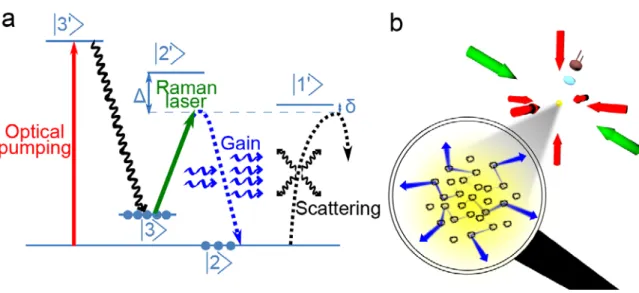
To combine sufficient gain and scattering while using only one atomic species, we take advantage
of the multilevel structure of rubidium atoms, shown in Fig. 1a (D
2line of
85Rb, wavelength
λ = 780 nm). Two-photon Raman gain is obtained by a population inversion between the two
hyperfine ground states |2> and |3> sustained by optical pumping. A Raman laser drives the
|3> Æ |2’> transition with a large detuning
Δ, so that atoms can be transferred into the |2> state
by stimulated emission. Scattering required for random lasing is provided by the |2> Æ |1’> line,
which is a closed transition efficient for multiple scattering. Both Raman gain and scattering can
occur at the same frequency (that is, for the same photons) by an appropriate choice of the Raman
detuning
Δ = −4.8 Γ, determined by the hyperfine splitting between the |1’> and |2’> states
(Γ/2π = 6 MHz is the linewidth of the transition). We thus tune the Raman laser to the vicinity of
this condition and define the detuning δ = Δ + 4.8 Γ as the relevant parameter (Fig. 1a). This
scheme takes advantage of the selection rules, which forbid electric dipole transitions between
the states |3> and |1’>, so that the |1’> level does not affect the Raman gain.
For a given amount of gain and scattering, the threshold of random lasing is determined by a
critical minimum size of the sample
1. In our case, gain and scattering are provided by the same
atoms and depend on the atomic density n. We have shown
23-25that the critical parameter
defining the random-laser threshold is the on-resonance optical thickness b
0, defined for a
homogeneous cloud of radius R as b
0= 2nσ
34’R, with
σ
34’the on-resonance scattering
cross-section for the |3> Æ |4’> transition (used to measure b
0, see Methods). Moreover, its critical
value can be computed from the atomic polarizability only (see Supplementary Information).
Our sample consists of a cloud of cold
85Rb atoms collected in a magneto-optical trap. A
controlled compression period provides a variable optical thickness b
0with a constant number of
trapped atoms (see Methods). We then switch off all lasers and magnetic field gradients during
1 ms before applying strong counterpropagating Raman beams (intensity I
Ra= 4.25 mW/cm
2per
beam with crossed linear polarizations) tuned around δ ~ 0. In addition, we use an
optical-pumping laser tuned slightly below the |2> Æ |3’> transition to sustain a steady-state population
inversion between the two hyperfine levels involved in our scheme. The relative intensity
between the two external lasers allows us to adjust the relative populations, and thus to tune
continuously from a sample with large gain and no scattering (with all atoms in the |3> state) to a
situation without gain and with large scattering on the |2> Æ |1’> line (with all atoms in the |2>
state). The data presented here have been obtained with an optical-pumping intensity
I
OP= 2.9 mW/cm
2, corresponding, at δ = 0, to 71% of atoms in the |3> state (evaluated for a
single atom).
The signature of random lasing is obtained in our system by the detection of the total emitted
light from the sample, which we collect with a solid angle of 10
-2sr at an angle of 40° with
respect to the Raman beam axes (Fig. 1b). Indeed, in contrast to other random-lasing devices,
where the scattered pump light is orders of magnitude stronger than the random-laser emission
itself, the random-laser line in our system has a strength comparable to the one of the other
involved transitions. In addition, the external lasers are not scattered by the |2> Æ |1’> transition.
Figure 2 shows the measured fluorescence as the Raman laser frequency is swept through the
region of interest, for different values of the optical thickness b
0of the atomic cloud (see
Methods). We stress that for these measurements we vary b
0while keeping the atom number
constant. Variations in the fluorescence can thus only be related to collective features.
The first signature of such a collective behaviour can be seen in a regime of negligible scattering,
far from the |2> Æ |1’> transition (regions 1 of Fig. 2): amplified spontaneous emission (ASE)
induces an overall increase of the fluorescence as a function of b
0. Photons from the Raman beam
can indeed undergo a spontaneous Raman transition. The subsequent scattered light is then
amplified by Raman gain produced by the surrounding atoms while leaving the sample with a
ballistic path. The efficiency of this process is directly related to the optical thickness (see
Supplementary Information). The ASE signal decreases as the Raman laser is detuned further
away from the |3> Æ |2’> transition (located at δ = +4.8 Γ) since both the spontaneous (source
contribution) and stimulated (gain contribution) Raman scattering rates decrease for larger
detuning. Note that when tuning the Raman laser very close to the |3> Æ |2’> line, single-photon
scattering dominates. As detailed in ref. 26, population redistribution is then responsible for the
increase of fluorescence. This effect is negligible for the detunings considered here, and only gain
can explain the observed features.
When the Raman laser is tuned close to δ = 0 (region 2 of Fig. 2), the combination of gain and
scattering gives rise to a random laser. It appears as an enhanced fluorescence bump that emerges
as the optical thickness b
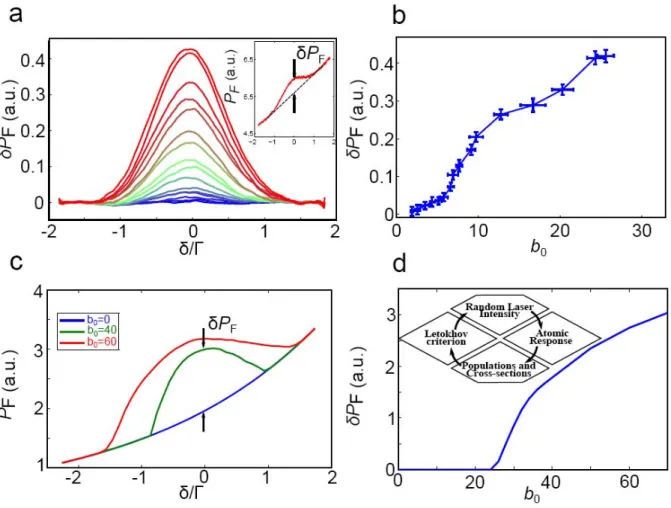
0is increased. To better extract this signal, we fit the wings of the curves
(regions 1) by adjustable slope and curvature and remove this ASE background. The remaining
random-laser signal is a Gaussian peak, well-centred at δ = 0 (Fig. 3a), which thus comes from
the scattering due to the |2> Æ |1’> transition. Therefore, the observed peak is due to the
combination of gain and scattering. Moreover, the peak amplitude shows a threshold behaviour,
with a change of slope at b
0= 6±1 (Fig. 3b). This threshold is the signature of the occurrence of
random lasing in our sample when the Raman beams are tuned around δ ~ 0 and when b
0> 6. We
stress that varying the optical thickness acts simultaneously on the amount of gain and feedback
provided by the medium. This is unusual in laser physics, where the threshold is most-commonly
defined as a critical pump power. In our case, increasing the optical-pumping intensity increases
indeed the population inversion that provides gain, but simultaneously decreases the feedback, so
that random lasing needs a fine tuning of the laser parameters.
Finally, we have exploited the possibility to perform ab initio theory by developing two simple
models, one for ASE and the other for random lasing. Both are detailed in the Supplementary
Information. Here, we describe briefly the random-lasing model. It consists in self-consistently
coupling the atomic response, based on optical Bloch equations (OBE) with additional scattering
on the |2> Æ |1’> line, to a diffusion equation for the light scattered on the |2> Æ |1’> resonance.
The OBE allows us to compute the atomic polarizability and, including the additional scattering
on the |2> Æ |1’> line, the mean-free path ℓ
scand the gain length ℓ
g, including saturation effects
due to the random laser intensity I
RLinside the sample. Like in conventional laser theory, we look
for a steady-state solution where gain exactly compensates losses. In the diffusive regime and
taking into account only the diffuse mode with the longest lifetime, this condition is equivalent to
Letokhov’s result on the random-lasing threshold
1,23,
,
(1)
where R
cris the critical sample size. As a consequence, for a given b
0, we find the value of I
RLsuch that Eq. (1) is fulfilled. Considering the simplicity of our model and the absence of
adjustable parameter, the qualitative agreement between the experimental data and the computed
values for the additional fluorescence is very satisfactory (Fig. 3b,c). The quantitative
discrepancies suggest the need for more involved models. Many ingredients have indeed been
neglected, like interference effects on light transport, light polarization, the Zeeman degeneracy
of the involved atomic levels, the finite temperature, the inhomogeneous atomic density
distribution, and cooperative effects
21,27. The comparison between the experiment and new
models including some of these effects will allow one to identify the most relevant ones and thus
to better understand random-laser physics.
In summary, we have presented an experimental evidence of combined gain and scattering of
light in a cloud of cold atoms, demonstrating random lasing in a dilute vapour. This type of
experiments, based on well-controlled atomic systems, with the possibility of ab initio
calculations, will allow the comparison to different models of random lasing
23,27-29and help
understanding complex situations encountered in astrophysical systems. Testing light propagation
models with realistic atomic structures and designing novel detection schemes, based for instance
on high-order photon correlations
30, are promising examples of such an approach.
Methods
Sample preparation. In our experiment6 counter-propagating trapping beams with a waist of 3.4 cm (1/e2 radius of
the intensity distribution) are used to load 85Rb atoms from a background atomic vapour into a magneto-optical trap
(MOT). Thetrapping beams are detuned by −3Γ from the |3> Æ |4’> hyperfine transition. To maintain the atomic populations in |3>, we add 6 repumper beams tuned slightly below the |2> Æ |3’> transition. We can loadbetween 108 and 1011 atomsby changing the background vapour pressure and the duration of the trap loading (from 10 to 500
ms).Once the atoms are trapped in the MOT, we perform a temporal dark-MOT stage by increasing the detuning of the trapping beams to -6 Γ and by reducing the intensity of the repumper beams to few percents of their initial value. This leadsto an increase of the spatial density and thus of the optical thickness b0 of the cloud, without loss of atoms.
By changing the duration of this compression stage, we are able to tune b0 from 1.9 to 27, while keeping almost
constant the total number of atoms, which, for the measurements presented here, is set to 7×10⁸ ± 12%. The
temperature is T ~ 50 µK. The optical thickness b0 is measured by a transmission spectrum with a small and weak
probe beam on the |3> Æ |4’> transition24. The shot-to-shot fluctuations of b
0 (horizontal error bars in Fig. 3b) are
evaluated by repeating the measurement five times.
Data acquisition. After the sample preparation, we switch off magnetic field gradients and trapping lasers and we
expose the sample to two counterpropagating Raman beams with waists of 2.4 cm and intensities of 4.25 mW/cm2
each and 6 optical pumping beams with waists of 3.4 cm and intensities of 0.48 mW/cm2 each at a detuning of -2Γ
from the |2> Æ |3’> transition. Note that the diameters of these lasers are large enough to insure that their effective intensities on the atom cloud are independent from the chosen optical thickness. The Raman laser is obtained from a distributed-Bragg-reflector laser diode and is frequency-tuned by a double-pass acousto-optic modulator before it is amplified by two stages of saturated slave lasers. This system allows us to scan the frequency in a range up to 16Γ with intensity variations of only 0.1%.
The measuring procedure consists in scanning in 2 ms the Raman beam detuning δ from -3,2Γ to 4,8Γ while a high gain photodiode gathers the fluorescent emission of the cloud in a solid angle of ~ 10-2 sr. We checked that the
direction of the sweep does not change the detected fluorescence, and that the duration of the sweep is short enough to avoid significant variations of b0 during the measurements (< 5%) and long enough to probe a quasi-steady state
(the sweep rate is 4Γ/ms). We averaged over 4000 subsequent measurements in order to increase the signal-to-noise ratio, thus performing also an averaging over the disorder configurations.
Received 14 December 2012
References
1. Letokhov, V. S. Light generation by a scattering medium with a negative resonant absorption. Sov. Phys. JETP
16, 835-840 (1968).
2. Markushev, V. M., Zolin, V. F. & Briskina, C. M. Luminescence and stimulated emission of neodymium in sodium lanthanum molybdate powders. Sov. J. Quantum Electron. 16, 281-282 (1986).
3. Lawandy, N. M., Balachandran, R. M., Gomes, A. S. L. & Sauvain. E. Laser action in strongly scattering media.
Nature 368, 436-438 (1994).
4. Cao, H. et al. Random Laser Action in Semiconductor Powder. Phys. Rev. Lett. 82, 2278-2281 (1999). 5. Wiersma, D. S. & Cavalieri, S. A temperature-tunable random laser. Nature 414, 708-709 (2001). 6. Wiersma, D. S. The physics and applications of random lasers. Nature Phys. 4, 359-367 (2008). 7. Special issue on Nano and Random Laser. J. Opt. 12, 020201–024014 (2010).
Photon. 6, 355-359 (2012).
9. Weaver, H., Williams, D. R. W., Dieter, N. H. & Lum, W. T. Observations of a strong unidentified microwave line and of emission from the OH molecule. Nature 208, 29-31 (1965).
10. Letokhov, V. S. Laser action in stellar atmospheres. IEEE J. Quantum Electron. 8, 615 (1972). 11. Letokhov, V. S. & Johansson S. Astrophysical Lasers (Oxford University Press, 2009).
12. Johnson, M. A., Betz, M. A., McLaren, R. A., Sutton, E. C. & Townes, C. H. Nonthermal 10 micron CO2
emission lines in the atmospheres of Mars and Venus. ApJ. 208, L145-L148 (1976).
13. Mumma, M. J. et al. Discovery of natural gain amplification in the 10-micrometer carbon dioxide laser bands on Mars: a natural laser. Science 212, 45-49 (1981).
14. Lavrinovich, N. N. & Letokhov, V. S. The possibility of the laser effect in stellar atmospheres. Sov. Phys. JETP
40, 800-805 (1975).
15. Truitt, P. & Strelnitski, V. Transition to oscillation regime in flaring water vapour masers. Bull. Am. Astron. Soc.
32, 1484 (2000).
16. Labeyrie, G. et al. Slow Diffusion of Light in a Cold Atomic Cloud. Phys. Rev. Lett. 91, 223904 (2003). 17. Labeyrie, G., Delande, D., Müller, C. A., Miniature, C. & Kaiser, R. Multiple scattering of light in a resonant
medium. Opt. Commun. 243, 157-164 (2004).
18. McKeever, J., Boca, A., Boozer, A. D., Buck, J. R. & Kimble, H. J. Experimental realization of a one-atom laser in the regime of strong coupling. Nature 425, 268-271 (2003).
19. Guerin, W., Michaud, F. & Kaiser, R. Mechanisms for Lasing with Cold Atoms as the Gain Medium. Phys. Rev.
Lett. 101, 093002 (2008).
20. Vrijsen, G., Hosten, O. Lee, J., Bernon, S. & Kasevich, M. A. Raman Lasing with a Cold Atom Gain Medium in a High-Finesse Optical Cavity. Phys. Rev. Lett. 107, 063904 (2011).
21. Bohnet, J. et al., A steady-state superradiant laser with less than one intracavity photon. Nature 484, 78-81 (2012).
22. Schilke, A., Zimmermann, C., Courteille, Ph. W. & Guerin, W. Optical parametric oscillation with distributed feedback in cold atoms. Nature Photon. 6, 101-104 (2011).
23. Froufe-Perez, L. S., Guerin, W., Carminati, R. & Kaiser, R. Threshold of a Random Laser with Cold Atoms.
Phys. Rev. Lett. 102, 173903 (2009).
24. Guerin, W., Mercadier, N., Brivio, D. & Kaiser, R. Threshold of a random laser based on Raman gain in cold atoms. Opt. Express 17, 11236-11245 (2009).
25. Guerin, W. et al. Towards a random laser with cold atoms. J. Opt. 12, 024002 (2010).
26. Baudouin, Q., Mercadier, N. & Kaiser R. Steady-state signatures of radiation trapping by cold multilevel atoms. Preprint at http://arxiv.org/abs/1208.1884 (2012).
27. Goetschy, A. & Skipetrov, S. E. Euclidean matrix theory of random lasing in a cloud of cold atoms. Europhys.
Lett. 96, 34005 (2011).
28. Türeci, H. E., Ge, L., Rotter, S. & Stone, A. D. Strong interactions in multimode random lasers, Science 320, 643-646 (2008).
29. Conti, C. & Fratalocchi, A. Dynamic light diffusion, three-dimensional Anderson localization and lasing in inverted opals, Nature Phys. 4, 794-798 (2008).
30. Dravins D. Photonic Astronomy and Quantum Optics, in High Time Resolution Astrophysics, Astrophysics and Space Science Library, Vol. 351. Phelan, D., Ryan, O. & Shearer, A., Eds. (Springer, Berlin, 2008).
Acknowledgments
We acknowledge financial support from ANR (project ANR-06-BLAN-0096), CG06, PACA, DGA and the Research Executive Agency (program COSCALI, No. PIRSES-GA-2010-268717). We thank R. Carminati and S. Skipetrov for fruitful discussions, and A. Aspect and S. Tanzilli for useful comments on the manuscript.
Author contributions
Q.B., N.M. and V.G. made the experiment and analysed the data; Q.B., N.M. and R.K. developed the theory; Q.B., W.G. and R.K. wrote the paper; R.K. supervised the project. Q.B. and N.M. contributed equally to the study. All authors discussed the results and commented on the manuscript.
Figure 1 | Working principle of the random laser.
a, Atomic transitions of the D2 line of 85Rb used to create random lasing in cold atoms. The two hyperfine ground
states are |2> = |F=2> and |3’> = |F’=3>. Similarly, the involved hyperfine excited states are the states |F’=1,2,3> denoted |1’>, |2’>, and |3’>. Optical pumping creates a population inversion between |2> and |3>. This allows us to create Raman gain by applying a laser with a detuning Δ from the |3> Æ |2’> transition. The gain frequency has a detuning δ from the closed |2> Æ |1’> transition. Around δ ~ 0, this transition provides efficient scattering. Random lasing can thus occur around this frequency.
b, Schematic representation of the experiment. The magneto-optical trap (yellow sphere) is exposed to two
Raman-laser beams (green) and six optical-pumping beams (red). Its fluorescence is collected by a lens and detected by a photodiode. Zoom-in: light (in blue) is scattered by atoms in the |2> state (black) and amplified by atoms in the |3> state (yellow background).
Figure 2 | Fluorescence measurement.
Total fluorescence PF as a function of the Raman laser detuning δ (in units of the linewidth Γ of the optical
transition) recorded for optical thickness varying from b0 = 1.9 to b0 = 26. The number of atoms is kept constant at
N = 7×10⁸ ± 12 %. Two collective features are visible. In the wings (regions 1), the overall increase of the
fluorescence with b0 is due to amplified stimulated emission. Around δ ~ 0 (region 2), an additional peak appears for
large optical thickness. This enhanced light emission is due to the combination of Raman gain and multiple scattering provided by the |2> Æ |1’> transition and is thus a signature of random lasing.
Figure 3 | Random laser emission around δ = 0.
a, Supplementary fluorescence δPF due to random lasing as a function of the Raman laser detuning δ, measured for
optical thickness varying from b0 = 1.9 to b0 = 26. The source data are the same as in Fig. 2, but the wings (regions 1
in Fig. 2) have been subtracted. The inset illustrates the fitting procedure. For clarity we also smoothed the data, corresponding to a detuning resolution of 0.3 Γ.
b, Amplitude of the additional peak due to random lasing. A threshold optical thickness is clearly visible at b0~6.
Vertical error bars correspond to the rms noise on the data of Fig. 2 and horizontal error bars to shot-to-shot fluctuations of b0.
c, Computed fluorescence PF as a function of the detuning δ with three different optical thicknesses (b0 = 0
corresponds to the single-atom limit), using our self-consistent model for random lasing. It shows that an increase of the total fluorescence is expected around δ = 0 when random lasing occurs.
d, Solution at δ = 0 of the self-consistent model for random lasing. Only the supplementary fluorescence δPF is
plotted, to allow for a comparison with the experimental data (panel b). Inset: principle of the model. The atomic response allows the computation of the threshold optical thickness following Letokhov’s criterion1,23. Due to
saturation effects, this threshold depends on the random-laser intensity. Therefore, for each b0, we find the
random-laser intensity such that the computed threshold equals b0, corresponding to a steady state (see Supplementary