Publisher’s version / Version de l'éditeur:
Vous avez des questions? Nous pouvons vous aider. Pour communiquer directement avec un auteur, consultez la première page de la revue dans laquelle son article a été publié afin de trouver ses coordonnées. Si vous n’arrivez pas à les repérer, communiquez avec nous à [email protected].
Questions? Contact the NRC Publications Archive team at
[email protected]. If you wish to email the authors directly, please see the first page of the publication for their contact information.
https://publications-cnrc.canada.ca/fra/droits
L’accès à ce site Web et l’utilisation de son contenu sont assujettis aux conditions présentées dans le site
LISEZ CES CONDITIONS ATTENTIVEMENT AVANT D’UTILISER CE SITE WEB.
Internal Report (National Research Council of Canada. Division of Building Research), 1961-09-01
READ THESE TERMS AND CONDITIONS CAREFULLY BEFORE USING THIS WEBSITE.
https://nrc-publications.canada.ca/eng/copyright
NRC Publications Archive Record / Notice des Archives des publications du CNRC :
https://nrc-publications.canada.ca/eng/view/object/?id=1bf63e6f-9ca5-4d01-b934-517858bca927 https://publications-cnrc.canada.ca/fra/voir/objet/?id=1bf63e6f-9ca5-4d01-b934-517858bca927
NRC Publications Archive
Archives des publications du CNRC
For the publisher’s version, please access the DOI link below./ Pour consulter la version de l’éditeur, utilisez le lien DOI ci-dessous.
https://doi.org/10.4224/20338160
Access and use of this website and the material on it are subject to the Terms and Conditions set forth at
Small-scale fire extinguishment test on mechanical foam. Part II
NATIONAL RESEARCH COUNCIL CANADA
D I V I S I O N O F B U I L D I N G RESEARCH
SMALL-SCALE
FIRE
M T I N G U I SHMENT T E S T ON MECHANICAL FOAM PAm I1 by K. S u m i I n t e r n a l R e p o r t No. 230 of t h e D i v i s i o n of B u i l d i n g R e s e a r c h rnTAWA S e p t e m b e r 1961PREFACE
The c o n s i d e r a t i o n s l e a d i n g t o t h e s e a r c h f o r a small-scale f i r e extinguishment t e s t f o r mechanical foam, t o g e t h e r with t h e r e s u l t s of preliminary i n v e s t i g a t i o n s made with one foam l i q u i d and a 2- by 2 - f t t a n k have a l r e a d y been presented i n DBR Report 224 covering P a r t I of t h i s study. An extension of t h i s work t o include s i x foam l i q u i d s and t h e use of 3 - f t and 1 0 - f t t a n k s i n a d d i t i o n t o t h e 2 - f t t a n k a r e now presented. The r e s u l t s obtained a r e considered t o be s u f f i c i e n t j u s t i f i c a t i o n f o r s e r i o u s c o n s i d e r a t i o n of t h e
2 - f t t a n k t e s t f o r foam e v a l u a t i o n , when c a r r i e d out i n accordance w i t h t h e procedure proposed i n t h e r e p o r t .
!he a u t h o r , a chemical engineer and a. r e s e a r c h o f f i c e r i n t h e F i r e Research Section of t h e Division, i s engaged i n s t u d i e s of v a r i o u s a s p e c t s of f i r e extinguishment.
Ottawa
SMALL-SCALE FIRE EXTINGUISHI'AENT TEST ON
MECHANICAL
FOAMPART II
by
K.
SumiAn i n v e s t i g a t i o n d i r e c t e d toward t h e development of a small-scale f i r e extinguishment t e s t t o a s s e s s t h e performance p o t e n t i a l of mechanical foam over a wide range of c h a r a c t e r i s t i c s was described i n a previous r e p o r t (1).
The purpose of t h e p r e s e n t s t u d y was t o i n v e s t i g a t e f u r t h e r t h e p o t e n t i a l i t i e s of t h e new f i r e t e s t .
PRESENT INVESTIGATION
I t was decided t o e s t a b l i s h a procedure f o r t h e small-scale f i r e extinguishment t e s t t o f i n d o u t i f t h e technique being i n v e s t i g a t e d would provide a s u i t a b l e means t o examine r e l a t i v e degrees of e f f e c t i v e n e s s of d i f f e r e n t brands of foam l i q u i d .
The r e s u l t s obtained i n t h e e a r l i e r i n v e s t i g a t i o n (1) were used a s t h e b a s i s f o r t h e procedure.
The e a r l i e r work i n d i c a t e d t h a t t h e f o l l o w i n g
experimental c o n d i t i o n s appeared optimum f o r t h e suppression of a 2- by 2 - f t flammable l i q u i d f i r e by foam:
( a ) S o l u t i o n r a t e of a p p l i c a t i o n =
0.06 gal/min/sq f t of f u e l s u r f a c e .
( b ) !Twenty-five p e r c e n t drainage time of foam = 2 t o 4 min.
( c ) Expansion r a t i o of foam = 1 2 .
The 25 p e r c e n t drainage time i s t h e time a t which 25 p e r c e n t of foam s o l u t i o n i s drained from a sample of foam i n a standard foam c o n t a i n e r ( 3 , 5 ) and i s a n index of t h e degree of s t a b i l i t y and of f l u i d i t y of t h e foam. Ekpansion r a t i o i s t h e r a t i o of t h e f i n a l foam volume t o t h e o r i g i n a l foam s o l u t i o n volume.
The optimum v a l u e s given above were based on t h e measurement of "control" time which was defined a s t h e time a f t e r foam a p p l i c a t i o n a t which t h e r a d i a t i o n i n t e n s i t y from
t h e f i r e i s decreased t o 10 p e r c e n t of t h e maximum v a l u e reached d u r i n g t h e pre-burn period. The optimum v a l u e s obtained f o r s o l u t i o n r a t e o f a p p l i c a t i o n and 25 p e r c e n t drainage time were i n good agreement w i t h t h o s e determined by previous i n v e s t i g a t o r s and appear s u i t a b l e f o r a d o p t i o n
i n t h e t e s t procedure. The v a l u e determined f o r t h e
expansion r a t i o was h i g h e r t h a n expected and t h e r e was some q u e s t i o n a s t o whether expansion r a t i o of 12 i s t h e most l o g i c a l f o r use i n t h e new procedure, p a r t i c u l a r l y i n view of t h e f a c t t h a t c o n t r o l time was used a s t h e end-point t o o b t a i n t h e optimum v a l u e s and extinguishment time was ignored.
Consideration was a l s o given t o t h e s e l e c t i o n of t h e most s u i t a b l e s i z e of t a n k f o r conducting t h e f i r e t e s t s , I n t h e e a r l i e r i n v e s t i g a t i o n t h e 2- by 2 - f t t a n k was a r b i t r a r i l y selecT3d f o r t h e i n d o o r f i r e t e s t s . There was some doubt a s
t o whether t h i s was t h e most s u i t a b l e s i z e a s t o convenience f o r conducting t h e f i r e t e s t s and t o r e l i a b i l i t y o f r e s u l t s . It w a s decided, t h e r e f o r e , t o c a r r y o u t a s e r i e s
o f
r e p l i c a t e t e s t s u s i n g t h e 2- by 2 - f t t a n k , a 3- by 3 - f t t a n k and a 10- by 10-ft t a n k , and t o determine both c o n t r o l time and complete extinguishment time.A f t e r t h e . t e s t procedure was e s t a b l i s h e d , it was
decided t o c a r r y o u t a s e r i e s of r e p l i c a t e t e s t s u s i n g d i f f e r e n t brands of commercially a v a i l a b l e " 6 p e r c e n t
Regular" mechanical foam l i q u i d . This type of foam l i q u i d , which i s g e n e r a l l y recommended f o r use a t normal temperatures i n p r o p o r t i o n s of 6 p a r t s of foam l i q u i d t o 94 p a r t s of w a t e r , i s covered i n J F M C S p e c i f i c a t i o n No. 260.00. ( 2 )
A. FURTHER DEVELOPMENT OF TEST PROCEDURE EXPERIMENTAL DETAILS
The purpose of t h e p r e s e n t s e r i e s of experiments was t o e s t a b l i s h a t e s t procedure f o r use a s a means t o a s s e s s t h e q u a l i t y of foam l i q u i d . The s e l e c t i o n of a s u i t a b l e s i z e sf t a n k f o r conducting t h e f i r e t e s t s and of t h e expansion r a t i o of foam f o r t h e procedure were examined u s i n g t h e new f i r e t e s t .
1. Procedure
F i r e t e s t s were c a r r i e d o u t u s i n g a 6 p e r c e n t
Regular mechanical foam l i q u i d which had met t h e requirements of JFMC S p e c i f i c a t i o n No. 260.00.
( a ) 2- by 2 - f t f i r e t e s t
Ten r e p l i c a t e t e s t s were c a r r i e d out a t each of t h e expansion r a t i o s 8, 1 0 and 1 2 , a t s o l u t i o n r a t e of a p p l i c a t i o n of 0.060 gal/min/sq f t of f u e l s u r f a c e and
25
p e r c e n td r a i n a g e time of about 3 minutes.
The procedure was a s f o l l o w s : A 2-in. l a y e r of heptane was f l o a t e d on 2 i n . of w a t e r i n a f i r e t a n k 2 by
2 by 1 f t deep. A f t e r a pre-burn p e r i o d of 60 seconds, foam produced by a v a r i a b l e foam g e n e r a t a r was d i s c h a r g e d from a p o s i t i o n d i r e c t l y above t h e mid-point of one w a l l of t h e tank. !The foam stream was d i r e c t e d a c r o s s
tibe
f i r e t o s t r i k e t h e o p p o s i t e s i d e of t h e t a n k , which was w e d a s t h e backboard, about 4 i n . above t h e f u e l s u r f a c e .C o n t r o l time was determined By t h e use of a gold- d i s c r a d i o m e t e r ( 4 ) connected t o a m i l l i v o l t r e c o r d e r . The r a d i o m e t e r was p o s i t i o n e d 6 f t from one
of
t h e s i d e s of t h et a n k p a r a l l e l t o t h e d i r e c t i o n of t h e foam stream a t a n e l e v a t i o n of 2 f t above t h e to^ of t h e tank. C o m ~ l e t e extinguishment time which i s d e f i n e d a s t h e time a f t e r foam a p p l i c a t i o n a t which t h e l a s t f l i c k e r of flame i s e l i m i n a t e d w a s a l s o determined.
( b ) 3- by 3 - f t f i r e t e s t
Ten r e p l i c a t e t e s t s were a l s o c a r r i e d o u t w i t h t h e
3-
by 3 - f t tank. Experimental c o n d i t i o n s f o r expansion r a t i o , s o l u t i o n r a t e of a p p l i c a t i o n and 25 p e r c e n t d r a i n a g e time were t h e same a s f o r t h e 2- by 2 - f t t e s t .Experimental d e t a i l s were s i m i l a r t o t h o s e of t h e 2- by 2 - f t t e s t b u t w i t h t h e f o l l o w i n g m o d i f i c a t i o n s . !The s i z e of t h e f i r e t a n k was
3
by3
by 1 f t deep. The backboard was i n c r e a s e d t o a h e i g h t of 16 i n . The foam stream wasd i r e c t e d t o s t r i l c e t h e backboard a b o u t 6 in, above t h e f u e l s u r f a c e . The radiometer was l o c a t e d i n approximately t h e same geometric p o s i t i o n w i t h r e s p e c t t o t h e t a n k and t h e n o z z l e a s w i t h t h e 2 - by 2 - f t t e s t . The r a d i o m e t e r was
p o s i t i o n e d 6 f t from t h e n e a r e s t s i d e of t h e t a n k and 4 f t above t h e t o p of t h e tank.
( c ) 10- by 1 0 - f t f i r e t e s t
Ten r e p l i c a t e t e s t s were c a r r i e d o u t i n accordance w i t h t h e procedure f o r f i r e t e s t d e s c r i b e d i n JFMC S p e c i f i c a t i o n No. 260.00. Fewer t e s t s were c a r r i e d o u t w i t h t h i s t a n k because t h e c h a r a c t e r i s t i c s of foam cannot be v a r i e d i n t h i s t e s t .
T h i s t e s t procedure i s a s follows: A minimum of 150 g a l l o n s of g a s o l i n e i s f l o a t e d on 200 g a l l o n s of w a t e r i n a f i r e t a n k 1 0 by 1 0 by 3 f t deep. A f t e r a pre-burn p e r i o d
.of 60 seconds foam i s discharged through a standard 5-gpm n o z z l e , supplied w i t h water a t a pressure o f 100 p s i . The foam stream i s d i r e c t e d from a p o s i t i o n j u s t above t h e s i d e of t h e t a n k a c r o s s t h e f i r e t o s t r i k e t h e approximate c e n t r e of t h e opposite t a n k w a l l a t r i g h t a n g l e s . The foam i s a p p l i e d f o r
5
minutes. Visual observations a r e recorded during t h e t e s t .One important modification i n t h e p r e s e n t s t u d y was t h e use of radiometers t o determine c o n t r o l time. Two r a d i o - meters were used t o provide two s e t s of r e s u l t s . One r a d i o - meter ( R - 1 ) was l o c a t e d i n approximately t h e same geometric p o s i t i o n w i t h r e s p e c t t o t h e t a n k and t h e nozzle a s i n t h e s m a l l e r t e s t s . T h i s radiometer was p o s i t i o n e d 25 f t from t h e n e a r e s t s i d e of t h e t a n k a t an e l e v a t i o n of 1 2 f t above t h e t o p of t h e tank. The second radiometer
( R - 2 )
was posi-Zoned d i r e c t l y behind t h e nozzle 20 f t from t h e n e a r e s t s i d e of t h e t a n k and 12 f t above t h e t o p of t h e tank.2. R e s u l t s
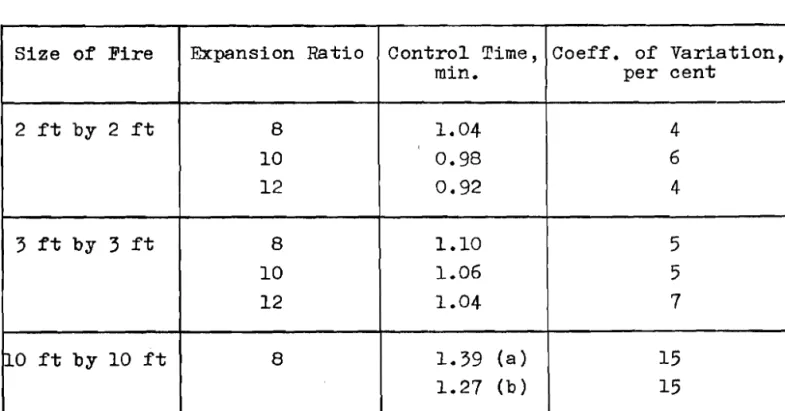
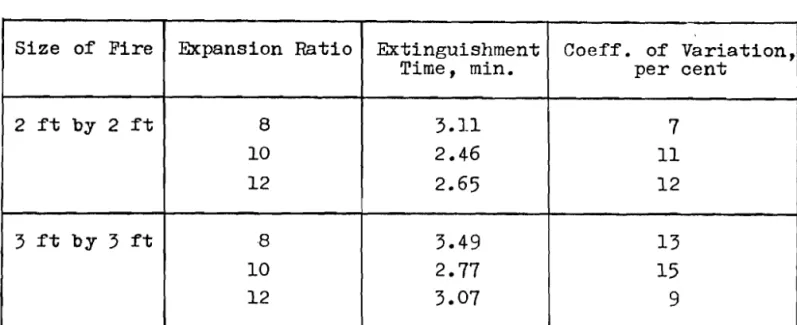
The r e s u l t s of t h i s s e r i e s of experiments a r e
presented i n Tables .I and 11. The 25 p e r c e n t drainage time of foam was about 3 minutes f o r a l l t h e experiments.
TABLE
I
CONTROL TIME ( a ) Radiometer R - 1 ( b ) Radiometer R-2 Coeff. of V a r i a t i o n , p e r c e n t 4 6 4 55
7 15 15 Control Time, min. 1.04 0.98 0.92 1.
10 1.06 1.04 1.39 ( a > 1.27 ( b ) Size of F i r e 2 f t by 2 f t3
f t by3
f t 1 0 f t by 1 0 f t Ekpansion Ratio 8 1 0 1 2 8 1 0 12 8TABLE I1 EXTINGUISrnXENT TIME 3. Discussion Size of P i r e 2 f t by 2 f t 3 f t b y 3 f t
The most e f f e c t i v e expansion r a t i o of foam based on c o n t r o l time i n t h e s e experiments was 1 2 , followed by 10 and t h e n 8. T h i s r e s u l t a g r e e s w i t h t h e e a r l i e r work (1). llhe most e f f e c t i v e expansion r a t i o based on extinguishment time was, however, 1 0 , followed by 1 2 and t h e n 8. These r e s u l t s were i n agreement f o r t h e 2- by 2 - f t t e s t and t h e 3- by 3 - f t t e s t .
Control time appeared t o i n c r e a s e s l i g h t l y a s t h e s i z e of t h e t e s t was increased. The i n c r e a s e i n t h e c o n t r o l time between t h e r e s u l t s of t h e 2- by 2 - f t t e s t and those of t h e
3-
by 3 - f t t e s t was 6 t o 11 p e r c e n t ; t h e i n c r e a s e between t h e r e s u l t s of t h e 3- by 3 - f t t e s t and those of t h e 10- by 1 0 - f t t e s t was 22 t o 34 p e r c e n t . These percentage i n c r e a s e s a r e very small compared t o t h e i n c r e a s e i n t h e s i z e of t h e f i r e . Ekpansion Ratio 8 10 1 2 8 10 1 2Extinguishment time increased s l i g h t l y a s t h e s i z e of t h e t e s t was increased from 2 by 2 f t t o 3 by 3 f t . This percentage i n c r e a s e (12 t o 16 p e r c e n t ) i s very small compared t o t h e i n c r e a s e i n t h e s i z e of t h e f i r e . Thus extinguishment time can be considered t o be very n e a r l y t h e same f o r t h e 2- by 2 - f t t e s t and t h e 3- by 3 - f t t e s t . I n g e n e r a l , complete extinguishment was n o t obtained i n
5
minutes f o r t h e 10- by 1 0 - f t t e s t .The r e p r o d u c i b i l i t y of r e s u l t s f o r a
2-
b y 2 - f t t e s t appears t o be very s l i g h t l y b e t t e r than f o r a 3- by 3 - f tExtinguishment Time, min. 3.1-1 2.46 2.65 3.49 2.77 3.07 Coeff. of V a r i a t i o n , p e r c e n t 7 11 1 2 1 3 15 9
t e s t . Both s m a l l e r t e s t s gave b e t t e r r e p l i c a t i o n t h a n t h e 10- by 1 0 - f t t e s t . The c h i e f reason f o r t h i s d i f f e r e n c e i s probably due t o t h e f a c t t h a t t h e 10- by 1 0 - f t t e s t s were conducted outdoors, whereas t h e s m a l l e r t e s t s were conducted indoors.
The two radiometers used f o r t h e 10- by 1 0 - f t t e s t s produced c o n t r o l times t h a t agreed w e l l w i t h each o t h e r . The c o e f f i c i e n t s of v a r i a t i o n determined from t h e s e r e s u l t s a l s o agreed w e l l .
The q u e s t i o n t h a t a r r i s e s i s whether t h e 2- by 2 - f t t a n k i s a s r e l i a b l e a s a 10- by 1 0 - f t t a n k which i s now used f o r a s s e s s i n g t h e q u a l i t y of foam l i q u i d .
A c o n s i d e r a t i o n of dimensions involved indicu-tLes
t h a t t h e s i z e of t h e t a n k can be considered i n f i n i t e l y l a r g e i n uomparison t o t h e s i z e of t h e bubbles. This o b s e r v a t i o n i s v a l i d r e g a r d l e s s of whether a 2- by 2 - f t t a n k o r a 10- by 1 0 - f t t a n k were considered. A f u r t h e r examination of r a t i o of dimensions i n d i c a t e s t h a t t h e foam must be t r a n s - ported a l o n g d i s t a n c e over t h e f u e l s u r f a c e w i t h r e s p e c t t o i t s t h i c k n e s s . The t h i c k n e s s of foam b l a n k e t f o r t h e 2- by 2 - f t t e s t s was about
3
inches when t h e f i r e was completely extinguished. This value i n f l u e n c e s t h e p r o c e s s of movement of foam over t h e f u e l s u r f a c e . The r a t i o of maximum d i s t a n c e t h a t t h e foam h a s t o t r a v e l t o t h e thiclrness of foam b l a n k e t i s about 8. Thus t h e d i s t a n c e t h a t t h e foam i s t r a n s p o r t e d i n a 2- by 2 - f t t a n k may be d e s c r i b e d a s l a r g e . A s m a l l e r t a n k , however, seems u n d e s i r a b l e .E m i s s i v i t i e s of flames of t h e n a t u r e t h a t a r e b e i n g considered tend t o u n i t y when dimensions of t h e o r d e r of 4 f t a r e involved. Flame h e i g h t s f o r a 2- by 2 - f t
t e s t were a t l e a s t 6 f t when t h e foam was f i r s t a p p l i e d . Thus, t h e r e a r e no obvious r e a s o n s why t h e r e s u l t s obtained u s i n g a 2- by 2 - f t t a n k should n o t be a t l e a s t a s adequate
a
t e s t of foam q u a l i t y a s t h o s e obtained u s i n g a 10- by 1 0 - f t tank.4.
Conclusions, S e c t i o n AThe experimental r e s u l t s and d i s c u s s i o n l e a d t o t h e conclusion t h a t t h e 2- by 2 - f t t e s t should be a t l e a s t a s adequate a s t h e 10- by 1 0 - f t t e s t a s a means t o a s s e s s t h e q u a l i t y of foam l i q u i d .
Thus, t h e procedure e s t a b l i s h e d w i l l be based on t h e use of a 2- by 2 - f t tank. The expansion r a t i o of 10 was s e l e c t e d f o r i n c l u s i o n i n t h e t e s t procedure. This expansion r a t i o of foam y i e l d e d t h e lowest extinguishment time and i s more l i k e l y t o be met i n p r a c t i c e t h a n a n expansion r a t i o of 12 which yielded t h e lowest c o n t r o l time.
B. EXAMINATION OF D I F l ? E W T BFANDS
-
OF-
FOAM LIQUIDThe procedure f o r a s m a l l - s c a l e f i r e extinguishment t e s t t o a s s e s s t h e q u a l i t y of mechanical foam l i q u i d , a s
e s t a b l i s h e d i n S e c t i o n A of t h i s r e p o r t , i s d e s c r i b e d i n d e t a i l i n Appendix A i n t h e form of a t e s t method. S e v e r a l d i f f e r e n t brands of foam l i q u i d were examined i n t h e f o l l o w i n g s e r i e s of experiments u s i n g t h e method developed.
EXPERIMENTAL DETAILS 1. Procedure
I n o r d e r t o examine t h e s u i t a b i l i t y of t h e new f i r e t e s t f o r use i n a s s e s s i n g t h e q u a l i t y of foam l i q u i d on t h e b a s i s of c o n t r o l time and extinguishment time t e n r e p l i -
c a t e t e s t s were conducted w i t h each of s i x d i f f e r e n t commercially a v a i l a b l e brands o f 6 p e r c e n t Regular mechanical foam l i q u i d . The t e s t s were conducted u s i n g t h e 2- by 2 - f t t a n k a s d e s c r i b e d
i n S e c t i o n A. The main p o i n t s i n t h e t e s t procedure were: ( a ) S o l u t i o n r a t e of a p p l i c a t i o n =
0.06 gal/min/sq f t of f u e l s u r f a c e . ( b ) 25 p e r c e n t drainage time = 3 min.
( c ) Expansion r a t i o = 10.
2. R e s u l t s
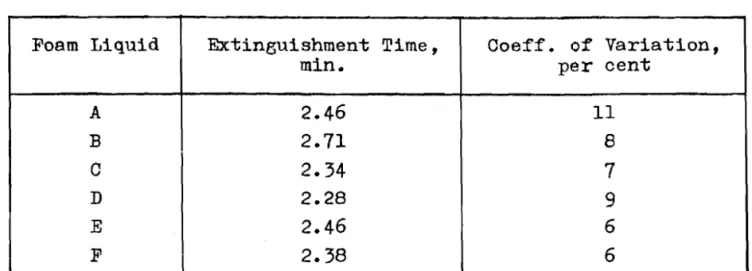
The r e s u l t s of t h i s s e r i e s of experiments a r e presented i n Tables 111 and I V .
TABLE 111 CONTROL TIME Coeff. of V a r i a t i o n , p e r c e n t 6 8 5 6 6 8 Foam Liquid A B C D E
F
Control Time, min.
0.98 1.20 1.09 0.92 1.08 1 . 1 2TABLE I V MTINGTJISllWIENT
TIME
3.
Discussion Foam Liquid A B C D EF
The mean c o n t r o l t i m e s f o r t h e s i x brands of
6
p e r c e n t Regular mechanical foam l i q u i d examined were i n t h e range 0.92 min. t o 1.20 rnin, and t h e mean extinguishment times were i n t h e range 2.28 rnin. t o 2.71 min.The p o t e n t i a l use of t h e new f i r e t e s t t o a s c e r t a i n t h e q u a l i t y of foam l i q u i d was considered. It i s b e l i e v e d t h a t it would be reasonable t o c a r r y o u t t h r e e r e p l i c a t e t e s t s t o determine i f a foam l i q u i d would meet t h e r e q u i r e - ments of t h i s f i r e t e s t . The r e l i a b i l i t y of t h e t e s t would be i n c r e a s e d by making it mandatory t h a t a l l t h r e e r e p l i c a t e t e s t s s a t i s f y t h e acceptance l e v e l s f o r b o t h c o n t r o l time and extinguishment time. Ektinguishment Time, min
.
2.46 2.71 2. 34 2.28 2.46 2.38 C a l c u l a t i o n s were made t o c o n s i d e r e s t a b l i s h i n g t h e acceptance l e v e l s f o r both c o n t r o l time and extinguishment time. Suppose t h r e e r e p l i c a t e t e s t s a r e t o be conducted and t h e c o n t r o l time f o r each t e s t i s t o be l e s s t h a n 1.25 min. Using t h e t a b l e s of t h e a r e a of t h e normal curve it can be shown t h a t t h r e e r e p l i c a t e t e s t s c a r r i e d out u s i n g each of t h e s i x brands of mechanical foam l i q u i d w i l l provide t h e r e s u l t s g i v e n s i n Table V which i n d i c a t e t h e p r o b a b i l i t y t h a t a l l t h r e e r e p l i c a t e t e s t s w i l l meet t h e acceptance l e v e l . One of t h e brands t h a t y i e l d e d t h e p o o r e s t r e s u l t s h a s a chance of 1 i n 3 of meeting t h e acceptance l e v e l .Coeff, o f V a r i a t i o n , p e r c e n t 11 8
7
9 6 6 The c a l c u l a t i o n s a l s o i n d i c a t e t h a t a l l t h e o t h e r brands examined w i l l meet t h e requirements f o r c o n t r o l time i n a m a j o r i t y of cases. Suppose t h i s requirement i s eased and t h e acceptance l e v e l f o r t h e c o n t r o l time i s r a i s e d t o1.5
min. Then a l l s i x brands w i l l have a chance g r e a t e r t h a n 99 i n 100 of meeting t h i s acceptance l e v e l . Since noneof t h e brands appeared u n u s u a l l y l e s s e f f e c t i v e t h a n t h e o t h e r s , a requirement of 1 . 5 min. appears r e a s o n a b l e f o r t h e acceptance l e v e l f o r t h e c o n t r o l time.
S i m i l a r c a l c u l a t i o ~ i s on t h e extinguishment time provided r e s u l t s shown i n Table V I .
The a u t h o r i s of t h e opinion t h a t t h e c o n t r o l time i s more important t h a n t h e extinguishment t i m e i n a s s e s s i n g t h e q u a l i t y of foam l i q u i d . The a b i l i t y of foam t o e x t i n g u i s h f l i c k e r s of flames a t c o m e r s of a square t a n k i s considered t o be of secondary importance. I n p r a c t i c e , s i n c e t h e n o z z l e s a r e movable, t h e d u r a t i o n of time between t h e c o n t r o l time and t h e extinguishment time is g e n e r a l l y n o t g r e a t . On t h e o t h e r hand, i n t h e experiments i n which a f i x e d nozzle was used,
t h e d u r a t i o n of t i m e between t h e c o n t r o l time and t h e e x t i n g u i s h - ment was g r e a t e r t h a n t h e time r e q u i r e d t o c o n t r o l t h e f i r e .
Thus, a l i m i t of 4.0 min. a p p e a r s r e a s o n a b l e f o r t h e acceptance l e v e l f o r t h e extinguishment time.
The degree of c o r r e l a t i o n between c o n t r o l time and complete extinguishment time f o r t h e r e s u l t s of experiments i n v o l v i n g s i x d i f f e r e n t brands of foam l i q u i d was examined. The c o r r e l a t i o n c o e f f i c i e n t was found t o be 0.7, i n d i c a t i n g a f a i r degree of c o r r e l a t i o n between t h e two t e s t c r i t e r i a . Although t h e a u t h o r h a s suggested acceptance l e v e l s f o r b o t h c o n t r o l time and complete extinguishment time i n t h e p r e s e n t r e p o r t , accumulated d a t a from a c t u a l t e s t s might l e a d t o t h e conclusion t h a t complete extinguishment time could be e l i m i n a t e d from t h e t e s t method.
TABLE V
PROBABILITY OF THREE FlEPLICATE TESTS MEETING SELECTED ACCEPTANCE LEVELS FOR CONTROL TIME
Foam Liquid A B C D E F Acceptance Level f o r Control Time 1.25 min. 7 0 . 9 9 0.33 7 0 . 9 9 20.99 0.99 0.77 1.5 min. pO.99 7 0 . 9 9 7 0 . 9 9 7 0 . 9 9 7 0 . 9 9 7 0 . 9 9
TABLE V I
PROBABILITY OF THREE REPLICATE TESTS MEETING
SELECTED ACCER?ANCE LEVELS FOR EXTINGUISHMENT TIME
4. Conclusions, S e c t i o n B Foam Liquid A B C D E
F
R e p l i c a t e f i r e t e s t s u s i n g s i x d i f f e r e n t brands of 6 p e r c e n t Regular mechanical foam l i q u i d i n d i c a t e t h a tr e a s o n a b l e acceptance l e v e l s a r e :
( a ) The c o n t r o l time f o r each o f t h r e e r e p l i c a t e t e s t s s h a l l be l e s s t h a n
1 . 5
min.Acceptance Level f o r Extinguishment Time
( b ) The extinguishment time f o r each of t h r e e r e p l i c a t e t e s t s s h a l l be l e s s t h a n
4
min. 3.0 min. 0.93 0.75 ' >0.99 7 0 . 9 9 70.99 2 0 . 9 9 CONCLUSIONS3.5
min.7
0.99 >0.99 7 0.99 >0.99 >0.99 >0.991. A new f i r e t e s t , u s i n g a t a n k 2 by 2 by 1 f t deep has
been developed f o r c o n s i d e r a t i o n a s replacement f o r t h e 10- by 1 0 - f t t e s t d e s c r i b e d i n JFMC S p e c i f i c a t i o n No. 260.00.
D e t a i l s of t h e new t e s t a r e given i n t h e Appendix t o t h i s r e p o r t .
2. The new t e s t h a s a number of advantages over t h e p r e s e n t
10- by 10-ft t e s t :
( a ) Because t h e f i r e t a n k i s s m a l l , t h e t e s t can be conducted i n d o o r s , i n a n atmosphere a b s e n t from t h e i n f l u e n c e o f weather.
(b) The r e d u c t i o n i n expense f o r conducting t h e
( c ) The c o n t r o l time appears t o be of t h e same o r d e r of magnitude f o r t h e 2- by 2 - f t t e s t a s f o r t h e 10- by 1 0 - f t t e s t .
( d ) The r e p r o d u c i b i l i t y of r e s u l t s a r e b e t t e r f o r t h e new t e s t t h a n f o r t h e 10- by 1 0 - f t t e s t . ( e ) The use of a radiometer f o r c o n t r o l time
reduces t h e r e l i a n c e on v i s u a l observation and t h e r e s p o n s i b i l i t y placed on t h e
observer.
3. The new t e s t procedure was developed f o r 6 p e r c e n t Regular mechanical foam l i q u i d . This t e s t i s a l s o
s u i t a b l e , however, f o r examining o t h e r t y p e s of mechanical foam l i q u i d , e. g., 3 p e r c e n t Regular mechanical foam
l i q u i d .
The a u t h o r wishes t o thank Messrs.
E.
L. Mulligan, A. L. Opseth, E. W. Oracheski and C. Wolfgram f o r conducting t h e f i r e t e s t s .The 10- by 1 0 - f t t e s t s were c a r r i e d out a t I n s p e c t i o n S e r v i c e s Proof Establishment of t h e Department of National
Defence i n N i c o l e t , Quebec, with t h e co-operation of t h e Superintendent and members of h i s s t a f f .
(1) Sumi, K. Small-scale f i r e extinguishment t e s t on
mechanical foam, P a r t I. National Research Council, Division of Building Research, I n t e r n a l Report No. 224, Ottawa, June 1961.
( 2 ) J o i n t F i r e Marshals Committee S p e c i f i c a t i o n No. 260.00 F i r e Extinguishing Agent
-
Foam Liquid (Mechanical Airfoam) February 12, 1958, 1 2 p.( 3 ) National F i r e P r o t e c t i o n Association Standard No. 11
-
1960, Foam Extinguishing Systems.( 4 ) McGuire, J. H. and H. Wraight. Radiometer f o r f i e l d use. Journal of S c i e n t i f i c Instruments, Vol. 37, A p r i l 1960, p. 128-130.
( 5 )
Tuve, R. L. and He B. Peterson. A study o f somemechanical foams and t h e i r use f o r e x t i n g u i s h i n g t a n k f i r e s . Naval Research Laboratory Report 3725, Washington, D O C u , 'August 23, 1950,
8 9
p.THE Nl3Y FIFU3 TRST
The t a n k used f o r t h e f i r e t e s t s h a l l be of s t e e l o o n s t r u o t i o n measuring 2 f t square by 1 f t deep. Four g a l l o n s of heptane, t h e volume e q u i v a l e n t of a 2-in. l a y e r i n t h i s t a n k , s h a l l be f l o a t e d on 2 i n . of water.
A $-in. nozzle s h a l l be p o s i t i o n e d d i r e c t l y above t h e mid-point of one of t h e s i d e s of t h e t a n k and about
4
i r ~ above t h e s i d e . A gold-disc radiometer connected t o am i l l i v o l t r e c o r d e r s h a l l be used t o determine t h e c o n t r o l time. Control time i s defined a s t h e time a f t e r foam a p p l i - c a t i o n a t which t h e r a d i a t i o n i n t e n s i t y from t h e f i r e i s decreased t o 10 p e r c e n t of t h e maximum value reaohed d u r i n g t h e preburn period. The radiometer s h a l l be positioned 6 f t from one of t h e s i d e s o f t h e t a n k p a r a l l e l t o t h e d i r e c t i o n of t h e foam stream a t a n e l e v a t i o n of 2 f t above t h e t o p of t h e tank.
The foam i s produced by a v a r i a b l e foam g e n e r a t o r a t a s o l u t i o n r a t e of 0.24 g a l l o n s p e r minute. The foam l i q u i d c o n c e n t r a t i o n s h a l l be 6 per cent. The expansion r a t i o of foam s h a l l .be 10 and t h e 25 p e r c e n t drainage time s h a l l be about
3
min.The f i r e s h a l l be permitted t o burn f r e e l y f o r 60 seconds before foam a p p l i c a t i o n . The foam stream s h a l l be d i r e c t e d a c r o s s t h e f i r e t o s t r i k e t h e approximate c e n t r e of t h e t a n k w a l l a t r i g h t a n g l e s . The foam stream s h a l l be
a p p l i e d u n t i l t h e f i r e i s completely extinguished o r f o r 4 min.,
whichever i s l e s s . Control ti-me and complete extinguishment time s h a l l be recorded.
Three r e p l i c a t e t e s t s s h a l l be conducted. Requirements of F i r e Test
The c o n t r o l time s h a l l be l e s s t h a n 1.5 rnin. f o r each t e s t . The complete extinguishment time s h a l l be l e s s t h a n 4.0 rnin. f o r each t e s t .