maize and its wild ancestor, teosinte
PhD thesis presented by
Elvira S. de Lange
University of Neuchâtel, Switzerland
September 13
th2013
Thesis director
Prof. Ted C.J. Turlings
Tritrophic interactions on cultivated
maize and its wild ancestor, teosinte
Dissertation submitted to the University of Neuchâtel for the Degree of Doctor in Natural Sciences byElvira S. de Lange
Faculty of Science, Institute of Biology Laboratory of Fundamental and Applied Research in Chemical Ecology University of Neuchâtel Accepted by recommendation of the thesis committee: Prof. Ted C.J. Turlings, University of Neuchâtel, Switzerland (thesis director) Dr. Christophe J. Praz, University of Neuchâtel, Switzerland Prof. Florian P. Schiestl, University of Zürich, Switzerland Dr. Alisa Huffaker, USDA‐ARS, United States of America Defended on September 13th, 2013 University of Neuchâtel 2014Rue Emile-Argand 11 2000 Neuchâtel - Suisse Tél: + 41 (0)32 718 2100 E-mail: [email protected]
IMPRIMATUR POUR THESE DE DOCTORAT
La Faculté des sciences de l'Université de Neuchâtel
autorise l'impression de la présente thèse soutenue par
Madame Elvira DE LANGE
Titre:
Tritrophic interactions on cultivated maize and
its wild ancestor « teosinte »
sur le rapport des membres du jury composé comme suit:
• Prof. Ted Turlings, Université de Neuchâtel, directeur de thèse • Dr Christophe Praz, Université de Neuchâtel
• Prof. Florian Schiestl, Université de Zürich
• Dr Alisa Huffaker, USDA-ARS, Center for medical, Agricultural and veterinary Entomology, Gainesville, FL, USA
Neuchâtel, le 13 janvier 2014 Le Doyen, Prof. P. Kropf
Key words
Campoletis sonorensis, Chemical ecology, Cotesia marginiventris, Corn, Domestication,
Fall armyworm, Green leaf volatiles, Herbivore‐induced plant volatiles, Host plant, Insect herbivore, Maize pest, Mexico, Natural enemy, Parasitoid wasp, Plant defense,
Spodoptera frugiperda, Teosinte, Tritrophic interactions, Volatile organic compounds, Zea mays
Mots clés
Campoletis sonorensis, Écologie Chimique, Cotesia marginiventris, Maïs, Domestication,
Légionnaire d'automne, Green leaf volatiles, Odeurs induites, Plante hôte, Insecte herbivore, Ravageur du maïs, Mexique, Ennemi naturel, Guêpe parasitoïde, Défense des plantes,
Spodoptera frugiperda, Téosinte, Interactions tritrophiques, Composés organiques volatils, Zea mays
5
Contents
Abstract ... 7 Résumé ... 9 Resumen ... 13 Zusammenfassung ... 15 Samenvatting ... 19 General introduction ... 23 Chapter 1 Insect and pathogen resistance in cultivated maize and its wild ancestor, teosinte ... 39 Chapter 2 Natural presence of insect pests on teosinte, the ancestor of maize, in Mexico ... 59 Chapter 3 Has maize lost some of its ability to attract parasitoids during domestication? ... 75 Chapter 4 Behavior and performance of fall armyworm and its parasitoids on cultivated maize and its wild ancestor, teosinte ... 93 Chapter 5 Parasitic wasps can reduce mortality among caterpillar‐infested teosinte plants ... 115 Chapter 6 Are green leaf volatiles important for parasitoid wasp attraction in the field? ... 137 General discussion... 157 References ... 163 Acknowledgements ... 183 Annex 1 ... I Annex 2 ... V Curriculum vitae ... XIXFront cover pictures: A female parasitoid wasp, Campoletis sonorensis, localizes and parasitizes her lepidopteran host, Spodoptera frugiperda, while the latter is feeding on a maize plant. Pictures: Matthias Held
7
Abstract
Modern maize plants (Zea mays ssp. mays, Poaceae) are characterized by large cobs that contain juicy grains, although they have not always had these characteristics. Approximately 9000 years ago, maize was domesticated from teosinte (Z. mays ssp. parviglumis), its wild ancestor, which produces much less and much smaller seeds. Teosinte still grows in the wild in southern Mexico, while cultivated maize is produced all over the world. Continuous selection for improved yield and quality has had a cost for the plant in terms of the loss or alteration of other potentially useful traits, such as resistance to pathogens and herbivorous insects (reviewed in Chapter 1). This thesis focuses on the resistance of maize and teosinte against insect pests, in particular with respect to the emission of herbivore‐induced volatiles. This feature is considered an indirect defense trait, as the volatiles can betray the presence of prey or hosts to predators and parasitoids, natural enemies of herbivorous insects. Among these natural enemies are parasitoid wasps, of which females have an ovipositor with which they can lay single or multiple eggs in individual hosts. When the wasp larvae develop inside the host they will eventually kill it, potentially benefitting the plant.
At first, we assessed in nature which insect pests occur on teosinte (Chapter 2). Fall armyworm, Spodoptera frugiperda (Lepidoptera: Noctuidae), is reported as one of the main maize pests in the Americas, and is frequently attacked by many species of parasitoids. However, little is known about the presence of this herbivore and its associated parasitoids on teosinte.
In a laboratory setting, we then assessed whether maize and teosinte emit a similar blend of volatiles when induced by lepidopteran herbivores. We also evaluated the attractiveness of the odor blends to females of two species of solitary koinobiont
endoparasitoid wasps, Campoletis sonorensis (Hymenoptera: Ichneumonidae) and
Cotesia marginiventris (Hymenoptera: Braconidae). Although the odor blends appeared
similar upon gas chromatography analysis, the foraging parasitoids responded differentially to them. C. sonorensis did not distinguish between the odors, whereas C. marginiventris showed a preference for the odors of teosinte over those of maize (Chapters 3, 4). We obtained similar results when testing real plants and extracts of collected odors (Chapter 3) indicating that these extracts can be used to identify the key compounds that are responsible for parasitoid wasp attraction.
Interestingly, we observed that the host plant, i.e. cultivated maize or wild teosinte, can
have an effect on the development of parasitoid larvae within their host. While
C. marginiventris developed equally well when their host, S. frugiperda, had been feeding on
maize or teosinte, C. sonorensis cocoons were larger when their host had fed on maize plants. Since C. marginiventris wasps preferred the odors of teosinte, and C. sonorensis wasps did not display a preference for the odors of teosinte or maize, these results indicate that the parasitoids were not necessarily attracted to the plants that were best suited for the development of their offspring (Chapter 4).
8
There is surprisingly little field evidence for fitness benefits for plants due to the action of natural enemies. This is still an important point in the discussion on the possible indirect defense role of inducible plant volatiles, especially in the case of parasitoid wasps that, unlike predators, do not directly kill their hosts. Therefore, we evaluated how parasitoid wasps can affect plant performance in a semi‐natural setting in Morelia, Mexico. Our tritrophic system comprised teosinte, devoid of the pleiotropic effects of artificial selection, the herbivore S. frugiperda and the wasp C. sonorensis, all organisms that co‐occur in nature. Teosinte was planted in large screen tents, which allowed us to assess how the herbivore, in the absence or in the presence of parasitoid wasps, affected plant growth and survival. Also, we collected volatiles and confirmed that teosinte plants emit odors in response to herbivore attack under semi‐field conditions. The presence of parasitoid wasps in the tents significantly reduced herbivore damage, which, for the smallest plants, resulted in a reduction in plant mortality. These findings support the notion that plants may benefit from the presence of parasitoids and may help to resolve the current debate on the defensive function of herbivore‐induced volatiles (Chapter 5).
To further explore the importance of volatiles for the attraction of parasitoids under field conditions, we studied maize lox10 mutants, impaired in the biosynthesis of green leaf volatiles (GLVs). These volatiles, responsible for the smell of cut grass, are commonly emitted by plants when wounded or attacked by herbivores. Previously, laboratory studies have shown that GLVs can be used as foraging cues by predators and parasitoids. We planted maize lox10 mutants alongside wildtype plants that do emit GLVs in an experimental field in Texas, USA. The plants were artificially infested with S. frugiperda larvae and were harvested after a week. The collected larvae were monitored until the emergence of an
adult moth or, in the case of parasitism, a parasitoid wasp. C. marginiventris and
Chelonus spp. (Hymenoptera: Braconidae), an egg parasitoid, were identified as the major
parasitoids. Overall, parasitism levels were low but, contrary to expectations, tended to be highest on non‐GLV‐emitting lox10 plants. This result implies that GLVs are not of key importance for parasitoid attraction in the field (Chapter 6).
Collectively, these studies provide novel insights into the importance of herbivore‐ induced volatiles for the attraction of parasitoid wasps, and their indirect importance for plant growth and survival. We identified differences between modern, cultivated maize and its wild ancestor, teosinte, with respect to the attraction of parasitoid wasps that could possibly be exploited for ecologically sound methods to better protect cultivated maize against insect pests.
9
Résumé
Le maïs moderne (Zea mays ssp. mays, Poaceae) est caractérisé par des larges épis renfermant des graines juteuses. Pourtant, ces plantes n’ont pas toujours présenté ces
caractéristiques. Il y a environ 9000 ans, le maïs a été domestiqué à partir de la téosinte (Z. mays ssp. parviglumis), une espèce sauvage ancestrale qui produite de faibles quantités
de graines de petite taille. Alors que la téosinte ne pousse qu’au sud du Mexique, le maïs cultivé est répandu à travers le monde entier. Une sélection continue pour améliorer le rendement et la qualité des graines a influencé d’autres traits, comme la résistance contre les pathogènes et les insectes herbivores (discuté dans le chapitre 1). Cette thèse s’intéresse à la résistance du maïs et de la téosinte face aux insectes ravageurs et plus particulièrement aux composés organiques volatiles émis en réponse à leurs attaques. Ces odeurs, considérées comme des défenses indirectes, peuvent être utilisées par les ennemis naturels des ravageurs, des prédateurs et des parasitoïdes, comme signaux pour trouver leurs proies et leurs hôtes. Les guêpes parasitoïdes sont un exemple d’ennemi naturel. Les femelles peuvent pondre un ou plusieurs œufs à l’intérieur de leur hôte à l’aide de leur ovipositeur. Au cours de son développement, la larve du parasitoïde se nourrira de son hôte et finira par le tuer, pouvant ainsi avantager la plante. D’abord nous avons étudié quels insectes ravageurs sont associés avec la téosinte dans la nature (Chapitre 2). La chenille Spodoptera frugiperda (Lepidoptera: Noctuidae) est un des plus importants ravageurs du maïs sur le continent américain et est associée avec plusieurs espèces de guêpes parasitoïdes. Cependant, il n’y a pas beaucoup d’informations concernant la présence de cet herbivore et de ses parasitoïdes associés sur la téosinte.
En conditions de laboratoire, nous avons comparé les odeurs émises par le maïs et la téosinte lorsqu’ils sont attaqués par des chenilles. Nous avons ensuite évalué l’attractivité de
ces odeurs pour deux espèces de guêpes parasitoïdes solitaires, à savoir
Cotesia marginiventris (Hymenoptera: Braconidae) et Campoletis sonorensis (Hymenoptera:
Ichneumonidae). Bien que les analyses par chromatographie gazeuse révèlent une similarité dans les mélanges odorants émis, les guêpes parasitoïdes les perçoivent différemment. Alors que C. sonorensis ne semble pas faire de distinction entre les odeurs émises par le maïs et celles émises par la téosinte, C. marginiventris semble quant à elle préférer les odeurs émises par la téosinte (Chapitres 3, 4). Nous avons obtenu des résultats similaires en testant de vraies plantes ainsi que des extraits d’odeurs, ce qui indique que ces extraits pourraient permettre l’identification des composés clés responsables de l’attraction des guêpes parasitoïdes (Chapitre 3).
De façon intéressante, nous avons observé que la plante hôte, c’est à dire le maïs cultivé ou la téosinte sauvage, peut influencer le développement des larves de parasitoïdes dans leurs hôtes. Tandis que C. marginiventris se développait de façon similaire, que son hôte se soit nourri sur du maïs ou sur de la téosinte, les cocons de C. sonorensis étaient plus gros lorsque l’hôte s’est nourri de maïs. Ces résultats montrent que les guêpes parasitoïdes ne
10
sont pas nécessairement attirées par les meilleures plantes pour le développement de leur progéniture (Chapitre 4).
Il y a étonnement peu de preuves sur le terrain indiquant que les ennemis naturels confèrent un avantage aux plantes en termes de fitness. Cet aspect reste un élément important au cœur de la discussion du rôle des composés volatiles dans le cadre des défenses indirectes, et plus particulièrement en ce qui concerne les parasitoïdes qui, à la différence des prédateurs, ne tuent pas directement leurs hôtes. Pour éclaircir ce point, nous avons évalué l’impact des guêpes parasitoïdes sur la performance des plantes dans un environnement semi‐naturel à Morelia, au Mexique. Notre système tritrophique comprenait
la téosinte, dénuée d’effets pléiotropiques liés à la sélection artificielle, l’insecte ravageur
S. frugiperda et la guêpe parasitoïde C. sonorensis, un des principaux ennemis naturels de S. frugiperda avec lequel il partage une longue association évolutive. La téosinte a été
plantée dans de vastes tentes grâce auxquelles nous avons pu évaluer l’influence de l’herbivore sur la croissance et la survie des plantes et ce, en présence ou en absence de guêpes parasitoïdes. Parallèlement, des collectes d’odeurs nous ont permis de confirmer que la téosinte émet des substances volatiles en réponse à l’attaque d’insectes herbivores dans la nature. La présence des guêpes parasitoïdes dans les tentes a réduit les dégâts causés par les herbivores sur les jeunes plantes, réduisant ainsi la mortalité de la téosinte. Ces résultats étayent l’hypothèse selon laquelle les plantes bénéficient de la présence de guêpes parasitoïdes et peuvent de ce fait aider à résoudre le débat actuel sur le rôle défensif des volatils induits par les herbivores (Chapitre 5).
Pour explorer en plus amples détails l’importance des substances volatiles pour l’attraction des parasitoïdes sur le terrain, nous avons étudié des mutants de maïs lox10, produisant peu ou pas de « green leaf volatiles » (GLVs). Ces composés volatiles, à l’origine de l’odeur d’herbe coupée, sont généralement émis par des plantes blessées ou attaquées par des herbivores. Des études en laboratoires ont montré que ces GLVs peuvent être utilisés par les prédateurs et parasitoïdes pour localiser leurs proies et leurs hôtes. Nous avons planté des mutants de maïs lox10 ainsi que du maïs dépourvu de cette mutation, pouvant donc produire des GLVs, dans un champ experimental au Texas, aux Etats Unis. Les plantes ont été artificiellement infestées avec des larves de S. frugiperda et ont été récoltées après une semaine. Les larves collectées ont été observées jusqu’à l’émergence d’un papillon ou, en cas de parasitisme, d’une guêpe parasitoïde. C. marginiventris et Chelonus spp. (Hymenoptera: Braconidae), un parasitoïde oophage, ont été identifiés comme les principaux parasitoïdes. Globalement, les taux de parasitisme étaient faibles, mais, contrairement à nos attentes, ils tendaient à être plus élevés sur les plantes mutantes lox10. Ces résultats impliquent que les GLVs ne sont pas d’une importance capitale pour l’attraction des guêpes parasitoïdes sur le terrain (Chapitre 6).
Dans l’ensemble, ces études ouvrent de nouvelles perspectives au sujet de l’importance des odeurs des plantes pour l’attraction des guêpes parasitoïdes et leur importance indirecte pour la croissance des plantes et leur survie. Nous avons mis en évidence l’existence de différences entre le mais cultivé et son ancêtre sauvage, la téosinte, concernant l’attraction
11 de guêpes parasitoïdes. Ces nouvelles connaissances peuvent être utilisées dans le cadre du développement de nouvelles méthodes écologiques visant à mieux protéger les cultures de maïs contre les insectes ravageurs.
13
Resumen
El maíz moderno (Zea mays ssp. mays, Poaceae) se caracteriza por grandes mazorcas con granos jugosos de alto contenido nutricional comparado con los presentes en la especie de maíz nativo, el teosinte. Estos caracteres, han ido modificándose desde hace aproximadamente 9000 años por medio de la domesticación hecha por el hombre. Cabe mencionar, que en la actualidad, aunque el maíz está distribuido por casi todo el mundo, podemos encontrar algunas poblaciones de teosinte en el sur de México. La selección artificial impuesta por los humanos en esta especie ha llevado un costo para las plantas, debido a que se han alterado caracteres tales como la resistencia en contra de patógenos y a insectos herbívoros (revisión capítulo 1). En esta tesis, se evaluó la resistencia del maíz y del teosinte contra sus plagas (artrópodos), enfocándose en la emisión de volátiles inducidos después de la herbivoría. Este carácter es considerado como una defensa indirecta, porque los enemigos naturales, como depredadores y parasitoides, de los herbívoros pueden utilizar estas señales para buscar sus presas y hospederos. Un ejemplo son las avispas parasitoides que ponen huevos en su hospedero (herbívoro) y cuando están es la última etapa de desarrollo matan al hospedero beneficiando a la planta.
En primer lugar se evaluó en la naturaleza cuyos insectos plagas ocurren en teosinte (Capítulo 2). El gusano cogollero, Spodoptera frugiperda (Lepidoptera: Noctuidae), es una plaga importante del maíz en las Americas. Es frecuentemente atacado por varias especies de avispas. Pero no hay mucha información de la presencia de este herbívoro y sus avispas asociadas sobre teosinte.
Con experimentos de laboratorio se evaluó si las plantas de maíz y de teosinte emiten olores similares después de haber sido dañadas por larvas de lepidópteros. Después, se evaluó la acción de estos olores sobre la atracción de dos avispas parasitoides solitarias
Cotesia marginiventris (Hymenoptera: Braconidae) y Campoletis sonorensis (Hymenoptera:
Ichneumonidae). Aunque los resultados de estos análisis de olores entre plantas no muestran diferencias significativas; cuando fueron analizados bajo cromatografía de gases, las especies de parasitoides respondieron de forma diferente. La especie C. sonorensis no distinguió entre olores, mientras que C. marginiventris mostró preferencias en los olores emitidos por las plantas de teosinte comparado con las plantas de maíz (capítulo 3, 4). Resultados similares fueron obtenidos cuando se probaron con plantas versus los extractos colectados en el campo (capítulo 3), lo cual sugiere que estos extractos podrían ser usados para identificar algunos compuestos implicados en la atracción de los parasitoides.
También, se encontró que existe un efecto de la planta sobre el desarrollo de las larvas del parasitoide dentro de su hospedero. Mientras que en C. marginiventris no se encontraron diferencias entre el desarrollo de los parasitoides provenientes de herbívoros que se alimentaron de teosinte y de maíz, la especie C. sonorensis mostró diferencias significativas en el tamaño de los capullos, los cuales fueron más grandes cuando los herbívoros se alimentaron de plantas de maíz. Estos resultados indican que los parasitoides
14
no fueron necesariamente atraídos a las plantas que representan un recurso de mejor calidad para el desarrollo de su progenie (capítulo 4).
Existe escasa evidencia en la literatura sobre los beneficios en términos de adecuación para las plantas por la acción de los enemigos naturales de los herbívoros. Aunque el rol de la posible defensa indirecta mediada por los volátiles que son inducidos por la planta después del daño esta aun en discusión, y aún más particularmente en el caso particular de los parasitoides que durante su ciclo de vida no matan directamente a los herbívoros. Se evaluó el cómo los parasitoides pueden afectar el rendimiento de las plantas en condiciones seminaturales en Morelia, México. Nuestro sistema tritrofico incluyó el teosinte, el gusano cogollero S. frugiperda y la avispa parasitoide C. sonorensis, las cuales en su conjunto comparten una historia evolutiva definida. El diseño consistió en plantas de teosinte acomodadas en tiendas las cuales permitieron evaluar como la presencia del herbívoro con o si parasitoidismo afecta el crecimiento y la supervivencia de las plantas. También se colectaron volátiles y se confirmó que las plantas de teosinte emiten olores en respuesta al ataque de los herbívoros bajos condiciones de campo. La presencia de las avispas parasitoides en las tiendas redujo significativamente el daño por herbívoros, lo cual para plantas muy pequeñas resultó en una reducción de la mortalidad de las plantas. Estos resultados sugieren que la presencia de los parasitoides podría ayudar a resolver el debate sobre el rol defensivo de los volátiles inducidos por los herbívoros (capítulo 5).
Para explorar con más detalles la importancia de olores para atraer las avispas bajo condiciones de campo, se estudiaron plantas del maíz mutantes lox10, que no pueden sintetizar “volátiles verdes de las hojas” (GLVs). Estos volátiles, responsables por el olor de hierba cortada, son rápidamente emitidos por las plantas cuando ellas son dañadas o atacadas por insectos herbívoros. Estudios en el laboratorio han mostrado que los depredadores y los parasitoides pueden utilizar GLVs para localizar sus presas u hospederos. Para este experimento se plantó maíz lox10 mutantes al lado de plantas variedad “silvestre” que pueden emitir GLVs en un campo experimental en Texas, EEUU. Infestamos las plantas con S. frugiperda y se colectaron una semana después, las larvas colectadas fueron almacenadas y puestas bajo condiciones controladas hasta la emergencia de herbívoro o depredador. Los niveles de infestación por parasitoides fueron muy bajos pero a diferencia de nuestra hipótesis, se encontraron más parasitoides en las plantas mutantes lox10. Estos resultados sugieren que los GLVs no son compuestos cruciales en la atracción de avispas parasitoides en el campo (capítulo 6).
En resumen, estos estudios en su conjunto proveen evidencia de la importancia de los volátiles inducidos por herbivoría para la atracción de parasitoides, y el rol que ejercen en la defensa indirecta de las plantas. Las diferencias encontradas entre la variedad silvestre del maíz (teosinte) y el maíz actual con respecto a la atracción de parasitoides que podría ser explotado en un futuro para crear estrategias de protección de cultivos de maíz en contra de sus insectos herbívoros.
15
Zusammenfassung
Moderne Maispflanzen (Zea mays ssp. mays, Poaceae) zeichnen sich durch grosse Maiskolben mit saftigen Körnern aus, obwohl sie diese Eigenschaften nicht immer hatten. Vor etwa 9000 Jahren wurde Mais von Teosinte (Z. mays ssp. parviglumis), dem wilden Vorfahren, domestiziert, welche viel weniger und viel kleinere Samen produziert. Teosinte wächst noch immer wild im Süden Mexikos, während kultivierter Mais auf der ganzen Welt angebaut wird. Kontinuierliche Selektion für erhöhten Ertrag und bessere Qualität war mit Kosten für die Pflanze verbunden, bezüglich dem Verlust oder der Modifikation anderer potentiell nützlicher Eigenschaften, wie beispielsweise der Resistenz gegenüber Pathogenen und pflanzenfressenden Insekten (Überblick im Kapitel 1). Diese Dissertation bezieht sich auf die Resistenz von Mais und Teosinte gegen Pflanzenschädlinge, insbesondere bezüglich der Emission von durch Herbivoren induzierten Duftstoffen. Diese Eigenschaft ist als indirekter Verteidigungsmechanismus angesehen, da die Duftstoffe den Prädatoren und Parasitoiden, welche die natürlichen Feinde der pflanzenfressenden Insekten sind, die Anwesenheit von Beute‐ oder Wirtstieren signalisieren. Parasitische Wespen gehören zu den natürlichen Feinden. Die Weibchen legen mit ihrem Legebohrer einzelne oder mehrere Eier in einzelne Wirtstiere. Wenn die Wespenlarven sich im Wirt entwickeln, werden sie ihn letztendlich töten, was von Vorteil für die Pflanze sein kann.
Zuerst haben wir im Freiland ermittelt, welche Pflanzenschädlinge auf Teosinte vorkommen (Kapitel 2). Der Eulenfalter Spodoptera frugiperda (Lepidoptera: Noctuidae) ist eine der schwerwiegendsten Maisplagen in Amerika, und er wird regelmässig von vielen Schlupf‐ und Brackwespenarten parasitiert. Allerdings ist wenig bekannt bezüglich der Präsenz dieses Pflanzenfressers und seiner Parasitoide auf Teosinte.
Im Labor haben wir daraufhin untersucht, ob Mais und Teosinte ähnliche Mischungen von Duftstoffen ausstossen, wenn sie von Pflanzenfressern (Lepidoptera) induziert werden. Wir haben zusätzlich die Attraktivität des Duftgemisches gegenüber Weibchen zweier Arten von solitär lebenden endoparasitischen Wespen, Campoletis sonorensis (Hymenoptera: Ichneumonidae) und Cotesia marginiventris (Hymenoptera: Braconidae), untersucht. Obwohl die Duftgemische in der Gaschromatographie ähnlich erschienen, reagierten die Parasitoide unterschiedlich auf sie. C. sonorensis konnte nicht zwischen den Düften unterschieden, während C. marginiventris den Duft von Teosinte über den der Maispflanzen bevorzugte (Kapitel 3, 4). Wir erhielten ähnliche Erbebnisse in einem Test mit lebenden Pflanzen und Extrakten des gesammelten Duftes (Kapitel 3), was darauf deuten lässt, dass diese Extrakte zur Identifizierung der Schlüsselkomponenten, welche für die Anziehung der parasitischen Wespen wichtig sind, genutzt werden können.
Interessanterweise haben wir beobachtet, dass die Wirtspflanze, also kultivierter Mais oder wilde Teosinte, eine Auswirkung auf die Entwicklung der Parasitoidlarven in ihrem Wirt
haben kann. Während C. marginiventris sich gleich gut entwickelt, wenn ihr Wirt,
16
grösser, wenn ihr Wirt an Mais gefressen hat. Da C. marginiventris Wespen den Duft der Teosinte bevorzugt haben, und C. sonorensis Wespen keine Präferenz für Teosinte‐ oder Mais‐Düfte gezeigt haben, deuten diese Ergebnisse darauf hin, dass Parasitoide nicht unbedingt von den Pflanzen angezogen waren, die am besten für die Entwicklung ihres Nachwuchses geeignet waren (Kapitel 4).
Es existieren überraschend wenige Nachweise von Fitnessvorteilen für Pflanzen durch die Aktivität natürlicher Feinde im Freiland. Dies ist noch immer ein wichtiges Argument in der Diskussion um die mögliche Rolle von induzierbaren pflanzlichen Duftstoffen in indirekter Verteidigung, insbesondere im Fall parasitischer Wespen, die, im Gegensatz zu Prädatoren, ihren Wirt nicht direkt töten. Deshalb haben wir evaluiert, wie parasitische Wespen die Leistung der Pflanzen in einer halbnatürlichen Umgebung in Morelia, Mexiko, beeinflussen. Unser tritrophes System umfasste Teosinte, frei von pleiotropen Effekten von künstlicher Selektion, den Herbivoren S. frugiperda und die Wespe C. sonorensis; jeweils Organismen, die in der Natur zusammen vorkommen. Teosinte wurde in grossen Fliegengitterzelten gepflanzt, was uns ermöglichte zu untersuchen, wie der Pflanzenfresser, in Abwesenheit oder Anwesenheit parasitischer Wespen, das Wachstum und Überleben der Pflanzen beeinflusst. Zusätzlich haben wir Duftstoffe gesammelt und bestätigt, dass Teosintepflanzen unter halbnatürlichen Konditionen Düfte als Reaktion auf den Angriff von Pflanzenfressern abgeben. Die Anwesenheit parasitischer Wespen in den Zelten reduzierte den Schaden durch die Pflanzenfresser, welches für die kleinsten Pflanzen eine Reduktion der Mortalitätsrate bedeutete. Diese Ergebnisse unterstützen die Ansicht, dass Pflanzen von der Gegenwart der Parasitoide profitieren können, und sie könnten helfen, die jetzige Debatte um die Verteidigungsfunktion von durch Herbivoren induzierte Duftstoffe beizulegen (Kapitel 5).
Zur weiteren Erforschung der Bedeutung von flüchtigen Stoffen für die Anziehung von Parasitoiden im Feld, haben wir Mais lox10 Mutanten untersucht, welche in der Biosynthese von Blattduftstoffen (‚green leaf volatiles‘, GLVs) beeinträchtigt sind. Diese Duftstoffe, verantwortlich für den charakteristischen Duft von geschnittenem Gras, werden häufig von Pflanzen abgegegeben, die verletzt oder von Schädlingen befallen wurden. Es wurde zuvor gezeigt, dass GLVs von Prädatoren und Parasitoiden als Hinweise während der Nahrungssuche genutzt werden. In einem Freilandversuch in Texas (USA) wurden Mais lox10 Mutanten neben Wildtyppflanzen, welche GLVs ausstossen, ausgebracht. Die Pflanzen wurden künstlich mit S. frugiperda Larven infiziert und nach einer Woche geerntet. Die eingesammelten Larven wurden beobachtet bis zum Schlüpfen der adulten Motten oder, im Fall von Parasitismus, der parasitischen Wespen. C. marginiventris und Chelonus spp. (Hymenoptera: Braconidae), ein Eiparasitoid, wurden als hauptsächlicheParasitoiden identifiziert. Insgesamt waren die Parasitismusraten niedrig, aber, im Gegensatz zu unserer Erwartung, tendierten sie dazu, am höchsten in nicht‐GLV‐emittierenden lox10 Pflanzen zu sein. Dieses Ergebnis lässt darauf schliessen, dass GLVs nicht die Haupt‐Ursache für die Anziehung von Parasitoiden im Feld sind (Kapitel 6).
17 Gemeinsam bringen diese Studien neue Einsicht in die Bedeutung von durch Schädlinge induzierten Duftstoffen für die Anziehung von parasitischen Wespen, und ihre indirekte Bedeutung für das Wachstum und Überleben der Pflanzen. Wir identifizierten Unterschiede zwischen modernem, kultiviertem Mais und seinem wilden Vorfahren, Teosinte, bezüglich der Anziehung parasitischer Wespen, welche möglicherweise für ökologische Methoden genutzt werden können, um kultivierten Mais besser gegen Pflanzenschädlinge zu schützen.
19
Samenvatting
Moderne, gecultiveerde maisplanten (Zea mays ssp. mays, Poaceae) hebben grote kolven met vele sappige maiskorrels. Deze planten hebben er echter niet altijd zo uitgezien.
Ongeveer 9000 jaar geleden is mais gedomesticeerd vanuit zijn wilde voorouder, teosinte (Z. mays ssp. parviglumis). Teosinte produceert veel minder en veel kleinere zaden dan mais.
Terwijl mais overal ter wereld gecultiveerd wordt, groeit teosinte in het zuiden van Mexico nog steeds in het wild. Voortdurende kunstmatige selectie heeft geleid tot een betere gewasopbrengst en een hogere kwaliteit van de maiskorrels. Deze vooruitgang is echter onbedoeld ten koste gegaan van nuttige natuurlijke eigenschappen, zoals resistentie tegen pathogenen en plantenetende insecten (samengevat in hoofdstuk 1). Dit proefschrift gaat over de resistentie van gecultiveerde mais en wilde teosinte tegen plaaginsecten, voornamelijk met betrekking tot de uitstoot van geurstoffen in reactie op een aanval van deze insecten. Deze eigenschap wordt over het algemeen geïnterpreteerd als een mechanisme van indirecte afweer. Geurstoffen kunnen de aanwezigheid van een prooi of gastheer verraden aan hun natuurlijke vijanden, predatoren en parasitoiden. Een sluipwesp is een voorbeeld van een parasitoïde die zich in of op een gastheer ontwikkelt. Vrouwtjes hebben een legboor waarmee ze één of meerdere eitjes kunnen leggen per gastheer en de ontwikkeling van de wespen, die zich voeden met de gastheer, leidt uiteindelijk tot zijn dood.
Eerst hebben we onderzocht welke herbivore insecten voorkomen op teosinte in de natuur (Hoofdstuk 2). De larven van de nachtvlinder Spodoptera frugiperda (Lepidoptera: Noctuidae), zijn verantwoordelijk voor één van de belangrijkste plagen van mais op het Amerikaanse continent. Vele verschillende soorten parasitoide wespen zijn geassocieerd met deze rups. Er is echter nog weinig bekend over het voorkomen van de rups en zijn parasitoiden op teosinte.
Daarna hebben we in het laboratorium gekeken of mais en teosinte vergelijkbare geurstoffen uitstoten in reactie op rupsenvraat. We hebben ook de aantrekkelijkheid van deze geurstoffen geëvalueerd voor vrouwtjes van twee soorten solitaire sluipwespen,
Cotesia marginiventris (Hymenoptera: Braconidae) en Campoletis sonorensis (Hymenoptera:
Ichneumonidae). Hoewel het er na analyse met behulp van gaschromatografie op leek dat mais en teosinte een vergelijkbaar geurprofiel produceren in reactie op insectenvraat, reageerden de sluipwespen verschillend op deze geuren. C. sonorensis had geen voorkeur voor een bepaalde plantengeur, maar C. marginiventris verkoos de geur van teosinte boven die van mais (Hoofdstuk 3, 4). We verkregen vergelijkbare resultaten wanneer we het experiment uitvoerden met echte planten en met geurextracten van door herbivoren aangevreten mais en teosinte (Hoofdstuk 3). Dit geeft aan dat geurextracten mogelijk gebruikt kunnen worden voor het identificeren van de sleutelcomponenten die verantwoordelijk zijn voor het aantrekken van de sluipwespen.
20
Interessant genoeg hebben we geobserveerd dat de waardplant waarop de gastheer zich bevindt, dat wil zeggen mais of teosinte, een effect kan hebben op de ontwikkeling van sluipwespen. Terwijl C. marginiventris zich vergelijkbaar ontwikkelde in rupsen die zich voedden met mais of teosinte, waren de poppen van C. sonorensis groter wanneer hun gastheer mais te eten kreeg. Deze resultaten geven aan dat de sluipwespen niet noodzakelijkerwijs aangetrokken werden tot de waardplanten die het beste zijn voor de ontwikkeling van hun nageslacht (Hoofdstuk 4).
Er is verrassend weinig bewijs gebaseerd op veldexperimenten voor de bewering dat het aantrekken van natuurlijke vijanden een positieve invloed heeft op de fitness van planten. Wetenschappers bediscussiëren volop of induceerbare plantengeuren wel of niet beschouwd moeten worden als een indirect afweermechanisme, voornamelijk omdat de aantrekking van sluipwespen, in tegenstelling tot predatoren, niet direct leidt tot het doden van herbivoren. Daarom hebben we in een semi‐natuurlijke omgeving in Morelia, Mexico, bestudeerd hoe sluipwespen de ontwikkeling van planten beïnvloeden. Ons tritrofe systeem bestond uit teosinte, een plant die niet is beïnvloed door veredeling, de rups S. frugiperda en de sluipwesp C. sonorensis, een belangrijke natuurlijke vijand van S. frugiperda in de regio. Door teosinte te planten in grote tenten werd het mogelijk om te bestuderen hoe de herbivoren in de aan‐ of afwezigheid van sluipwespen de groei en overleving van de planten beïnvloedden. Ook verzamelden we geurstoffen, wat bevestigde dat teosinte in het veld geurstoffen uitstoot in reactie op rupsenvraat. Wanneer er sluipwespen in de tenten aanwezig waren, veroorzaakten de rupsen minder schade aan de planten, wat voor de kleinste planten resulteerde in een grotere overlevingskans. Deze resultaten bewijzen dat planten baat hebben bij het aantrekken van sluipwespen en kunnen daarom een bijdrage leveren aan het voortdurende debat over de mogelijke functie van plantengeuren, geïnduceerd door herbivoren, als indirect afweermechanisme (Hoofdstuk 5).
Om het belang van specifieke plantengeuren voor het aantrekken van sluipwespen te bestuderen onder natuurlijke omstandigheden gebruikten we mais lox10 mutanten, planten die niet langer in staat zijn om „green leaf volatiles“ (GLVs) te produceren. Deze componenten zijn verantwoordelijk voor de geur van versgemaaid gras en worden razendsnel uitgestoten door planten in reactie op verwonding en insectenvraat. Studies in laboratoria hebben aangetoond dat sluipwespen en predatoren GLVs kunnen gebruiken als signaalstoffen voor het vinden van gastheren en prooien. In een experimenteel veld in Texas, Verenigde Staten van Amerika, hebben we mais lox10 mutanten geplant naast wildtype maisplanten die wel GLVs produceren. Deze planten werden geïnfesteerd met S. frugiperda rupsen en werden na een week geoogst. Van de verzamelde rupsen werd genoteerd of ze zich ontwikkelden tot een mot of dat er, in het geval van parasitisme, een sluipwesplarve
tevoorschijn kwam. De meest voorkomende parasitoiden werden geïdentificeerd als
C. marginiventris en Chelonus spp. (Hymenoptera: Braconidae), een parasitoïde van eieren.
Het aantal geparasiteerde rupsen was laag, maar neigde, in tegenstelling tot onze verwachtingen, het hoogst te zijn op mutante lox10 planten. Dit resultaat impliceert dat
21 GLVs niet de belangrijkste signaalstoffen zijn voor het aantrekken van sluipwespen in het veld (Hoofdstuk 6).
Gezamelijk geven deze studies nieuwe inzichten in het belang van door rupsen geïnduceerde plantengeuren voor de aantrekking van sluipwespen en hun indirecte belang voor de groei en overleving van planten. We hebben verschillen ontdekt tussen moderne, gecultiveerde mais en zijn wilde voorouder, teosinte, met betrekking tot het aantrekken van natuurlijke vijanden van herbivore insecten. Deze kennis kan mogelijk gebruikt worden voor het ontwikkelen van nieuwe, duurzame methodes om gecultiveerde mais beter te beschermen tegen insectenplagen.
23
General introduction
Despite the large variety of crop protection methods available, insects still account for at least 15% of the world’s crop losses (Oerke, 2006). This is an alarming fact in the view of a human population that is projected to rise from today’s 7.1 billion to 8.9 billion by 2050 (United Nations, 2004) and will therefore require an equally dramatic increase in the amount of food that is produced. Current pest control measures rely mostly on chemicals and although they are quite effective, they may have severe non‐target effects. One of the first of such effects was shown for dichlorodiphenyltrichloroethane (DDT), which even adversely effects humans after exposure and was found to display enormous bioaccumulation and persistence in the ecosystem (Carson, 1962). Its use has therefore been severely restricted (United Nations, 2001). Most recently, it has been suggested that neonicotinoids may have adverse effects on bees, killing pests and beneficial insects alike (Gill et al., 2012; Henry et al., 2012; Whitehorn et al., 2012), reasons to temporarily ban general use in the European Union (European Union, 2013). Furthermore, pests are increasingly developing resistance to insecticides (Denholm et al., 2002; Whalon et al., 2008). It is generally recognized that novel methods are needed for more sustainable ways to handle pests. Recent focus has been on strengthening the strategies that plants themselves use to combat their enemies (e.g. Turlings and Ton, 2006; Bruce, 2010; Gurr et al., 2012).
Plants are far from helpless when it comes to defending themselves against their herbivorous enemies. They have access to a broad spectrum of defense mechanisms to fend off their attackers, which can be constitutively present or specifically induced in response to herbivore attack. Plant defenses can be physical in nature, such as thorns and trichomes, but also chemical, like toxic compounds and proteinase inhibitors, which are molecules that inhibit the digestion of proteins in the insect gut. Because the presence of these defenses has a direct negative impact on the herbivore, they are termed direct defenses (Schoonhoven et al., 2005)
Plants also show traits that have been interpreted as indirect defenses, because they act through the recruitment of natural enemies of herbivores. For instance, Acacia (Fabaceae) and Cecropia (Urticaceae) trees have hollow thorns that can house ants, and they may produce extrafloral nectar and food bodies to provide food for the ants, who in turn protect the trees against herbivory (Heil and McKey, 2003; Bronstein et al., 2006). Another well‐ studied possible indirect defense trait is the emission of volatile organic compounds (VOCs) in response to herbivory, which can be exploited by predators and parasitoids in their search for prey or hosts (Turlings et al., 1990; Turlings and Wäckers, 2004). This thesis will focus on the importance of these herbivore‐induced VOCs in cultivated maize (Zea mays L. ssp. mays, Poaceae) and its wild ancestor, teosinte (Z. mays ssp. parviglumis Iltis & Doebley).
24
Differences and similarities in cultivated maize and wild teosinte
Maize is the most abundantly grown cereal, with an annual production of about 880 million tonnes, above wheat and rice (Fig. 1; FAO, 2013). It is the most important staple food in Mexico and Central America and is also an important food source in other countries worldwide. Furthermore, it is used as feed for livestock and as raw material for industry (FAO, 1992). Despite this importance, its wild ancestor has only recently been revealed. There is no plant with a fruiting structure that looks similar to a maize cob, so the origin of maize has been the topic of considerable controversy (Mangelsdorf and Reeves, 1939; Bennetzen et al., 2001; Doebley, 2001). An extensive genetic study based on microsatellite
genotyping eventually put an end to the controversy, as Balsas teosinte (Z. mays ssp. parviglumis) was confirmed to be the wild ancestor of cultivated maize
(Matsuoka et al., 2002; Doebley, 2004). This plant is still growing nowadays in the area where maize was thought to be domesticated some 9000 years ago, in southern Mexico (Sánchez González and Ruiz Corral, 1995; Matsuoka et al., 2002). Fig. 1 Worldwide production of maize, rice and wheat, the world’s most important cereals, in 2011. Adapted from FAO (2013)
All taxa in the genus Zea, besides cultivated maize, are collectively referred to as teosintes. Occasionally, teosinte is still referred to as Euchlaena, the genus in which it was placed initially. The genus Zea contains a total of eight taxa classified into two sections and five species (Table 1), although new classifications are continuously being proposed (Fukunaga et al., 2005; Sánchez G. et al., 2011). The section Zea contains four subspecies of
Z. mays and in Z. mays ssp. mexicana (Schrader) Iltis, different races are distinguished based
on ethnobotanical information, geography, and morphology. The section Luxuriantes contains four more distantly related species.
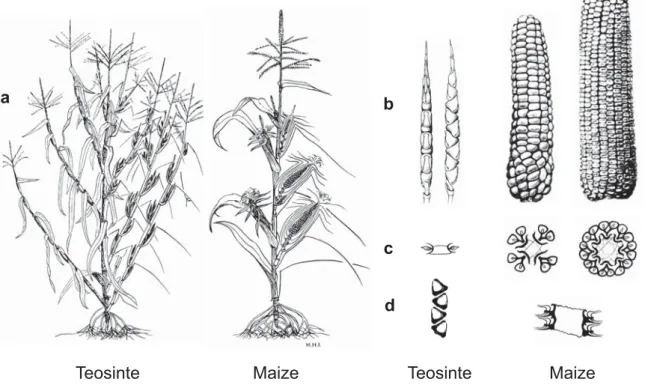
Maize and teosinte are monocots with C4 carbon fixation. They are monoecious, that is, they contain separate male and female flowers on the same plant. Maize, as well as most teosintes, is diploid (2n=20), with the exception of Z. perennis (Hitchc.) Reeves & Mangelsdorf, which is tetraploid (2n=40). All maizes and teosintes are annual with the exception of two perennial species, Z. diploperennis Iltis, Doebley & Guzmán and Z. perennis. Maize and teosinte differ greatly, both morphologically and genetically, although they frequently hybridize (Wilkes, 1977; Fig. 2,3). During domestication, the process of genetic
25 modification of a wild species to create a new form of a plant suited to human needs (Doebley et al., 2006), maize stopped producing as many branches as teosinte. Instead, maize developed a large cob with more individual kernels. Those are, contrary to teosinte, firmly attached to the cob so that they do not disperse, facilitating harvest by humans (Fig. 2,3). A common set of traits, including but not limited to apical dominance, seed dispersal, and a decrease in bitter substances in edible structures, distinguishes most seed and fruit crops from their wild ancestors and is known as the “domestication syndrome” (Doebley et al., 2006). Although defining this “domestication syndrome” tends to be biased towards cereals, when comparing a great number of different crops, changes in secondary metabolites affecting flavor, pigments and toxicity appear to be the most common traits associated with breeding and cultivation (Meyer et al., 2012). Charles Darwin already addressed domestication as an adaptation (Darwin, 1859, 1868). After initial domestication, there has been a large improvement of maize. Traditional landraces, locally adapted varieties managed by local farmers, used to be major sources of crop variability. However, nowadays, a small number of hybrids and other high‐yielding varieties are mostly planted. These varieties were mainly developed during the “Green Revolution” in the sixties, and in combination with improved cultivation practices, such as applying nitrogen fertilizers and enhanced methods of irrigation, worldwide crop yield increased tremendously (Khush, 2001). Table 1 The taxonomy of Zea Section Luxuriantes Doebley & Iltis Zea diploperennis Iltis, Doebley & Guzmán Zea perennis (Hitchc.) Reeves & Mangelsdorf Zea luxurians (Durieu & Ascherson) Bird Zea nicaraguensis Iltis & Benz Section Zea Zea mays L. ssp. mexicana (Schrader) Iltis Race Chalco Race Central Plateau Race Durango Race Nobogame ssp. parviglumis Iltis & Doebley ssp. huehuetenangensis (Iltis & Doebley) Doebley ssp. mays After Iltis and Doebley (1980), Doebley (1990), Iltis (2000) and Iltis and Benz (2000)
While maize is grown all over the world nowadays, teosinte occurs only in the tropical and subtropical areas of Mexico, Guatemala, Honduras and Nicaragua (Fig. 4). Teosinte populations are not uniformly distributed, but populations are isolated and rather vary in size. Teosintes commonly grow at roadsides, in abandoned fields and next to maize fields, but the plants can also invade maize fields and in some areas are notorious as weeds (Vibrans and Estrada Flores, 1998; Mondragón‐Pichardo and Vibrans, 2005). Overall, similar
26
insects and pathogens occur on maize and teosinte in the area of distribution of teosinte, altough there is ample local variability (Sánchez González and Ruiz Corral, 1995).
Fig. 2 Morphological differences between wild teosinte and cultivated maize. While teosinte plants have long lateral branches, each terminated by a tassel, and multiple ears growing from secondary branches in the nodes of the leaves on these lateral branches, maize plants have a single stalk bearing one or two short lateral branches tipped by an ear (a). While teosinte ears contain 5‐12 kernels, one on top of the other, maize ears can bear 500 or more kernels arranged in 4‐20 ranks. The teosinte ear contains abscission layers that allow the ear to shatter when mature, while maize kernels are firmly attached to the central axis of the ear and do not disperse (b). While teosinte bears one kernel on each rank or cupule (kernel‐bearing structure), maize has two kernels on each rank (c). Teosinte kernels contain a protective casing, the cupulate fruitcase, while maize kernels are naked on the ear (d). Adapted from several sources (Iltis, 1983; Doebley et al., 1990; Doebley, 1992; Doebley et al., 1995) by Thomas Degen Fig. 3 Morphological differences between maize (left) and teosinte (right) seeds. Picture: Matthias Held
Teosinte Maize Teosinte Maize
a b
c d
27 Fig. 4 Teosinte distribution in Mexico. Adapted from Sánchez González and Ruiz Corral (1995)
Herbivore and pathogen resistance in maize and other plants
Maize plants contain a variety of constitutive and induced defenses against microbes and herbivores. It is known that the plant hormones jasmonic acid (JA), salicylic acid (SA) and ethylene (ET) play an important role in the regulation of these defenses (Balmer et al., 2013b; Lyons et al., 2013). The best‐investigated classes of direct defense compounds in maize are benzoxazinoids (Macias et al., 2009; Niemeyer, 2009). Benzoxazinoid‐glucosides, weakly active compounds, are stored in the vacuole, and only upon contact with the enzyme β‐glucosidase, which is located in the plastid, more toxic aglucons are produced. The compound and the enzyme come in contact when a pathogen or pest attacks the plant (Frey et al., 2009). Benzoxazinoids are also known to be present in teosinte (Shahid and Esen, 1998).
When it comes to VOC‐mediated attraction of parasitoids, maize is one of the best studied plants. Non‐attacked maize plants hardly emit any odors, but caterpillars feeding on maize plants induce the emission of copious amounts of VOCs that attract various species of parasitoid wasps (Turlings et al., 1990, 1995; Turlings and Fritzsche, 1999; Tamò et al., 2006a). Lima bean (Phaseolus lunatus L., Fabaceae) and tobacco (Nicotiana attenuata Torr. Ex Wats, Solanaceae) serve as model systems to study the attractiveness of herbivore‐ induced VOCs to predators. Spider mites feeding on lima bean induce the emission of VOCs
28
that are attractive to predatory mites (Dicke and Sabelis, 1988) and caterpillars feeding on tobacco induce the emission of VOCs that are attractive to predatory bugs (Kessler and Baldwin, 2001).But the capacity to emit VOCs and to attract natural enemies is not limited to these plant species; the trait appears to be rather common and has been demonstrated in at least 49 plant species in 25 families (Mumm and Dicke, 2010). For instance, caterpillar‐ induced VOCs of cabbage (Brassica oleracea L., Brassicaceae) attract parasitoid wasps (Geervliet et al., 1996), as well as VOCs emitted by the model plant Arabidopsis thaliana (L.) Heynh. (Brassicaceae) (Van Poecke et al., 2001). Interestingly, maize roots also emit odors upon herbivory by root‐feeding herbivores. When larvae of the beetle Diabrotica virgifera
virgifera LeConte (Coleoptera: Chrysomelidae) attack the roots, those emit an odor that
attracts insect‐killing nematodes (Rasmann et al., 2005). Similarly, roots of Thuja occidentalis L. (Pinales) emit odors attractive to parasitic nematodes in response to root feeding by weevil larvae (Van Tol et al., 2001), as do roots of citrus plants (Ali et al., 2010).
Odor emission by maize leaves in response to herbivory has been studied for various species of folivorous caterpillars, like beet armyworm Spodoptera exigua Hübner (Lepidoptera: Noctuidae) (Turlings et al., 1990), Egyptian cotton leafworm S. littoralis Boisduval (Turlings et al., 1998a; Degen et al., 2004), fall armyworm S. frugiperda Smith (Carroll et al., 2006), and corn earworm Heliothis armigera Hübner (Lepidoptera: Noctuidae) (de Lange, 2008). Two stemborers, the European corn borer Ostrinia nubilalis Hübner (Lepidoptera: Crambidae) (Turlings et al., 1998a) and the Asian corn borer O. furnacalis Guenée (Huang et al., 2009) also induce odor emission, as does an attack of piercing‐sucking insects, such as the corn leaf aphid Rhopalosiphum maidis Fitch (Hemiptera: Aphididae) (Turlings et al., 1998a) and the leafhopper Euscelidius variegatus Kirschbaum (Hemiptera: Cicadellidae) (Erb et al., 2010). However, maize does not tend to emit odors in response to
attack of a pathogen, such as Setosphaeria turcica (Rostás et al., 2006) or
Colletotrichum graminicola (Gregory Röder, Elvira S. de Lange, Dirk Balmer and Ted C.J.
Turlings, unpublished data).
The interactions between plants, herbivores and natural enemies are generally termed tritrophic interactions, as they take place at three levels of the food chain (Price et al., 1980). Although herbivore‐induced VOCs are extensively studied, for many study systems it remains unclear which of the compounds in the blend are of key importance for parasitoid and predator attraction (D'Alessandro and Turlings, 2006).
Herbivore‐induced VOCs and their biosynthesis
Various plant organs emit odors, but these odors may have different functions: while floral volatiles serve, among others, to attract pollinators, volatiles emitted from vegetative parts, both from shoots and from roots, tend to play a role in protection against herbivory (Pichersky and Gershenzon, 2002). The blends emitted from floral and vegetative parts are distinct, although they can have several compounds in common (Lucas‐Barbosa et al., 2011; Tholl et al., 2011). Maize plants are wind pollinated and these types of flowers tend to emit
29 less odors than insect‐pollinated flowers (Faegri and Van der Pijl, 1979). But, as stated above, maize vegetative parts emit copious amounts of odors in response to herbivory.
There are four major VOC biosynthetic pathways (Maffei, 2010; Dudareva et al., 2013). The first, the lipoxygenase (LOX) pathway, leads to the emission of green leaf volatiles (GLVs; Paré and Tumlinson, 1997; Turlings et al., 1998b), six‐carbon aldehydes, alcohols and their acetates, which are named after their distinctive “green” scent, like the smell of cut grass (Hatanaka, 1993; Matsui, 2006). This pathway also leads to the biosynthesis of the plant hormone JA, which plays an important role in the regulation of defenses against herbivory. GLVs, such as (Z)‐3‐hexenal, (E)‐2‐hexenal, (Z)‐3‐hexen‐1‐ol and (Z)‐3‐hexenyl acetate, are rapidly formed after leaves are damaged, whether that is by insects or mechanically, for instance by wind or a lawnmower. Within half an hour after wounding, GLVs are released from the ruptured plant cells (Loughrin et al., 1994; Turlings et al., 1995; Turlings et al., 1998b) while de novo production of other compounds might take at least 4‐5 hours (Turlings et al., 1998b). GLVs are formed from linolenic and linoleic fatty acids and the first step of their synthesis is catalyzed by the enzyme lipoxygenase (LOX). Tissue disruption is suggested to trigger the provision of free fatty acids for the formation of GLVs, but the details of this process have yet to be revealed (Matsui, 2006). Plants impaired in producing GLVs in response to wounding, such as the recently characterized maize lox10 mutant (Christensen et al., 2013) and the A. thaliana mutant all84 (Shiojiri et al., 2006b), attracted fewer wasps of some species in a laboratory setting, indicating that GLVs are important cues for parasitoid wasps in their search for hosts.
The second VOC biosynthetic pathway is the shikimate/phenylalanine pathway, which results in the emission of aromatic compounds like indole and methyl anthranilate, the emission of benzenoids such as methyl salicylate, and phenylpropanoids. The mevalonic acid pathway, the third VOC biosynthetic pathway, produces 15‐carbon sesquiterpenes, the most abundant compounds that are emitted by herbivore‐induced maize plants (D'Alessandro and Turlings, 2005). Examples of sesquiterpenes are (E)‐β‐caryophyllene, (E)‐α‐bergamotene, (E)‐β‐farnesene, β‐sesquiphellandrene and (E)‐nerolidol. The fourth pathway, the methylerythrol phosphate pathway, produces 10‐carbon monoterpenes such as linalool and (Z)‐β‐ocimene, as well as 20‐carbon diterpenes. Then, there are also terpenoids with irregular acyclic C16 and C11 carbon skeletons, so called homoterpenes: 4,8‐dimethyl‐1,3(E),7‐
nonatriene and 4,8,12‐trimethyl‐1,3(E),7(E),11‐tridecatetraene. They are believed to be derived from geranyl‐linalool and (E)‐nerolidol, respectively (Maffei, 2010; Dudareva et al., 2013). The relevance of VOC emission in an ecological context Emitting floral scent is important for attracting pollinators and thereby ensuring fertilization. Therefore, floral scent is evidently important for plant fitness (Kessler et al., 2008; Majetic et al., 2009). Despite general agreement that VOCs emitted by plants in response to herbivory are used by natural enemies to locate herbivorous insects, it remains to be demonstrated that recruitment of predators and parasitoids indeed confers adaptive advantages to the
30 plants (Allison and Hare, 2009; Agrawal, 2011; Hare, 2011; Kessler and Heil, 2011). VOCs are also emitted in response to mechanical damage and might therefore not be all that reliable, although there are distinct differences compared to herbivore‐induced VOCs (Turlings et al., 1990). This might be due to the presence of elicitors in the oral secretions of insects, as has been detected in caterpillars and grasshoppers, which trigger the emission of specific VOCs (Alborn et al., 1997, 2007; Schmelz et al., 2006). However, the saliva could also contain repressors that can manipulate the emission of VOCs (Musser et al., 2002).
Most studies on tritrophic interactions have been performed in the laboratory (Reviewed by Hunter (2002)). Only few studies have shown that herbivore‐induced VOCs act to increase parasitism and predation of herbivores in the field. In Africa, intercropping of cereal crops with odor‐emitting, native molasses grass significantly decreased crop infestation by
stemborers and increased larval parasitism (Khan et al., 1997a). In the USA,
Cardiochiles nigriceps Viereck (Hymenoptera: Braconidae) wasps were preferentially
attracted to tobacco plants infested by their hosts over plants infested by non‐host lepidopteran larvae (De Moraes et al., 1998). Inducing odor emission in tomato plants with JA increased parasitism of caterpillar pests in an agricultural field (Thaler, 1999). And application of ecologically relevant concentrations of synthetic VOCs to plants, resulting in the augmented emission of these compounds, increased predation of lepidopteran eggs on wild tobacco (Kessler and Baldwin, 2001).
Even fewer studies provide evidence that parasitoids help to increase plant fitness in terms of seed production. A parasitoid exclusion experiment with seed‐weevils showed that the presence of parasitoids benefits the plant Hormathophylla spinosa (L.) Küpfer (Brassicaceae) in terms of seed dispersal, but the relevance of volatiles in attracting the parasitoids, chalcid wasps, is unknown (Gomez and Zamora, 1994). Other studies, where it was shown that A. thaliana (Van Loon et al., 2000), Brassica nigra L. (Brassicaceae) (Smallegange et al., 2008) and maize plants (Fritzsche Hoballah and Turlings, 2001) under attack by parasitized caterpillars produced more seeds than plants attacked by healthy larvae, included plants and insects that do not co‐occur together or were conducted under relatively artificial conditions.
A recent study with transformed tobacco plants has convincingly shown that plants produce fewer flowers when they are unable to recruit predatory bugs, which probably affects seed production (Schuman et al., 2012). However, parasitoid wasps do not immediately kill their hosts, rendering the proposed defense function of herbivore‐induced VOCs quite controversial. Therefore, whether plants benefit from the emission of VOCs and the attraction of parasitoid wasps remains the topic of heavy debate (Allison and Hare, 2009; Agrawal, 2011; Hare, 2011; Kessler and Heil, 2011). The influence of domestication on plant‐insect interactions
Obviously, the emergence of agriculture and the planting of monocultures have shaped insect communities. At the individual plant level, there are indications that artificial selection of crop plants for increased yield and quality also influenced resistance to insects and