HAL Id: hal-01936210
https://hal.archives-ouvertes.fr/hal-01936210
Submitted on 27 Nov 2018
HAL is a multi-disciplinary open access
archive for the deposit and dissemination of
sci-entific research documents, whether they are
pub-lished or not. The documents may come from
teaching and research institutions in France or
abroad, or from public or private research centers.
L’archive ouverte pluridisciplinaire HAL, est
destinée au dépôt et à la diffusion de documents
scientifiques de niveau recherche, publiés ou non,
émanant des établissements d’enseignement et de
recherche français ou étrangers, des laboratoires
publics ou privés.
SPEN: A Solver for Separation Logic
Constantin Enea, Ondřej Lengál, Mihaela Sighireanu, Tomáš Vojnar
To cite this version:
Constantin Enea, Ondřej Lengál, Mihaela Sighireanu, Tomáš Vojnar. SPEN: A Solver for Separation
Logic. 9th NASA Formal Methods Symposium (NFM 2017), May 2017, Moffett Field, United States.
�hal-01936210�
Constantin Enea1, Ondˇrej Leng´al2, Mihaela Sighireanu1, and Tom´aˇs Vojnar2
1
Univ. Paris Diderot, IRIF CNRS UMR 7089, France 2
FIT, Brno University of Technology, IT4Innovations Centre of Excellence, Czech Republic Abstract. SPEN is a solver for a fragment of separation logic (SL) with inductively-defined predicates covering both (nested) list structures as well as various kinds of trees, possibly extended with data. The main functionalities of SPENare deciding the satisfiability of a formula and the validity of an entailment between two formulas, which are essential for verification of heap manipulating programs. The solver also provides models for satisfiable formulas and diagno-sis for invalid entailments. SPENcombines several concepts in a modular way, such as boolean abstractions of SL formulas, SAT and SMT solving, and tree au-tomata membership testing. The solver has been successfully applied to a rather large benchmark of various problems issued from program verification tools.
1
Introduction
For analyzing programs with dynamic memory, separation logic (SL) is an established and fairly popular logic introduced by Reynolds [11]. The high expressivity of SL, its ability to generate compact proofs, and its support for local reasoning motivated devel-opment of many tools for automatic reasoning about programs with complex dynamic linked data structures. These tools aim at establishing memory safety properties and/or inferring shape properties of the heap. The tools often build on (semi-)decision proce-dures for checking satisfiability and entailment problems in SL.
Our tool SPEN3provides (semi-)decision procedures for the most commonly con-sidered symbolic heaps fragment of SL, extended with user-defined inductive predicates to specify data structures of an unbounded size. Because unrestricted definitions of in-ductive predicates make the entailment problem for the fragment undecidable [3], only semi-decision procedures have been proposed, e.g., in [2,4]. Iosif et al. [10] identified a rather large class of inductive definitions for which the entailment problem is decidable, although with a high complexity. SPENfocuses on a smaller class of inductive defini-tions that is, however, expressive enough to specify complex dynamic data structures, such as skip lists, lists of circular lists, AVL trees, or binary search trees.
The chosen class of inductive definitions enables the design of efficient (semi-)decision procedures for satisfiability and entailment [6,8]. The key idea used for satisfiability checking in SPENis to exploit the semantics of restricted inductive definitions and of separating conjunction to build an equisatisfiable boolean abstraction of the formula. For entailment checking, the idea is to reduce the problem of checking ϕ ⇒ ψ to the problem of checking a set of simple entailments where the right-hand side is an inductive predicate atom. The compositionality of this reduction leads to high efficiency (the simple entailments can be checked independently) and to a capability to provide fine diagnosis for invalid entailments.
2
The current version of SPENimproves on the ones reported in [6,8] in several direc-tions. First, we introduced caching of constructions and results obtained from checking simple entailments in order to increase its efficiency. Second, the wrappers calling the SAT and SMT solvers have been refined to generate smaller formulas and to exploit the incrementality feature of underlying solvers. Third, we improved the diagnosis pro-duced by SPEN. For satisfiability checking, SPEN now provides either a model of a satisfiable formula or an unsatisfiable core; for entailment checking, SPEN provides a proof witness for valid entailments and a diagnostic information otherwise.
SPENhas been successfully tested on a quite large benchmark. The first version of SPENparticipated in the SL-COMP’14 contest [15] where it won one of its divisions and was second in another one. The later extensions now allow SPENto handle a richer fragment than those considered in the competition. Moreover, the improvements above lead to better execution times (e.g., by 10 % within the SL-COMP’14 division won by the first version of SPENand by 30 % on the division where SPENwas the second).
SPEN is not the only solver for SL. The existing solvers differ in the fragment considered (CYCLIST [2], SLIDE [9]) and/or the techniques used (ASTERIX [12], DRYAD [14], GRASSHOPPER [13], SLEEK [4]). A detailed comparison with these
solvers is beyond the scope of this paper—we refer the reader to the survey in [6,8,15].
2
Logic Fragment
SPENdeals with decision problems in a fragment of SL, denoted as SLID, that combines
the symbolic heaps fragment of SL [1] with user-defined inductive predicates describing various kinds of lists (possibly nested, cyclic, or equipped with skip links) or trees, possibly extended with data constraints.
Syntax:We write X, Y, Z to denote location variables, d to denote data variables, and x, y, z for both kinds of variables. We use the vector notation ~x to abbreviate tuples. We denote by ρ the tuples built from pairs of field labels and variables that specify structured values. We assume a finite setP = {P1, . . . , Pn} of predicate symbols, each
with an associated arity, and a special location variable nil. A symbolic heap formula ψ is a formula of the form∃~x · Π ∧ Σ where Π is a pure formula and Σ is a spatial formulawith the following syntax:
Π ::= X = Y | X 6= Y | ∆ | Π∧ Π Σ ::= emp| X 7→ ρ | P (X, ~x) | Σ∗Σ Here, ∆ is a constraint over data variables. We let it unspecified, though SPENpresently supports the first-order theory over multisets of integers with integer linear constraints. The spatial atoms (i.e., the empty heap, the heap cell allocated at X, resp. the heap region shaped by some predicate P ∈ P) are composed by the separating conjunction “∗”. An SLIDformula ϕ is a set of symbolic heaps interpreted as a disjunction ∨iψi.
Predicates P ∈ P are defined by a set of inductive rules of the form ψ ⇒ P (X, ~x) where (X, ~x) is a tuple of distinct variables including all free variables in the symbolic heap ψ (the rule body). X is called the root node of the heap segment defined by P . A rule is called a base rule if its spatial part is emp, i.e., an empty heap; otherwise, it is an inductive rule.
Fragments:SPEN considers a restricted class of inductive rules such that the defined predicates specify (possibly empty) heap segments connecting (by location fields) the
root location X with all locations in the heap or nil. The restrictions have been defined formally in [6,8]. They mainly require, for each inductive predicate P , the presence of a unique base rule and inductive rules where the root X points to a memory cell that contains at least one field from which another heap specified by P starts. The fragment defined in [6], called SLID
L , can describe various kinds of lists that can be
singly- or doubly-linked, cyclic, nested, and can have skip links. It does not permit data constraints and inductive tree structures. On the other hand, the fragment SLID
D defined
in [8] permits data constraints and can describe tree structures of bounded width, such as sorted list segments, AVL trees, binary search trees, but not nested cyclic lists. Decision problems:For both fragments above, SPENconsiders the problems of check-ing satisfiability of a formula, i.e., checkcheck-ing whether|= ϕ holds, and the validity of an entailment ϕ ⇒ ϕ0 where the symbolic heaps of ϕ0 can be quantified only over data variables. A simple example of an entailment problem in SLIDL considered by SPENis: ∃Y, W. X 6= Z ∧ X 7→ {(next, Y )}∗sll(Y, W )∗W 7→ {(next, Z)} ⇒? sll(X, Z), which, intuitively, checks whether a composition of two memory cells specified by the points-to atoms X 7→ {(next, Y )} and W 7→ {(next, Z)} and the predicate atom sll(Y, W ) describes a set of heaps that are all also models of the predicate sll(X, Z) defining an acyclic singly-linked list segment between X and Z.
3
Satisfiability Checking
Spen {P1, . . . , Pn}, ψ
Parsing and typing
Pi Pi ψ Boolean abstraction B[ψ] Normalization sat ψ0 Build shape + data model Build unsat core unsat SAT solver unsat core of B[ψ] SMT solver unsat core of ψ model of ψ
Fig. 1: SPENworkflow for satisfiability checking Given a set of inductive definitions
P and a symbolic heap ψ, the pro-cedures for checking satisfiability in SPENfollow the workflow given in Fig. 1. The satisfiability check-ing of an SLID formula ϕ makes
a classic use of this basic proce-dure. The crux of the procedures for both fragments is the definition of a boolean formula B[ψ], called boolean abstraction, such that the data-free part of ψ is satisfiable iff B[ψ] is satisfiable [6,7].
Once the boolean abstraction B[ψ] is computed, SPENqueries a SAT solver (currently, MINISAT4) for the satisfiability of B[ψ]. If B[ψ] is unsatisfiable, SPENcan
re-turn an unsatisfiable core of ψ, deduced from an unsatisfiable core of B[ψ]. If B[ψ] is satisfiable and ψ∈ SLIDL , SPENhas the option of returning a model of ψ obtained from a model of B[ψ] by unfolding predicate atoms corresponding to non-empty heap seg-ments. The unfolding of predicate atoms is done twice to emphasize the non-emptiness
4
of the segment. For ψ∈ SLIDD, the satisfiability checking continues by constructing a for-mula ∆ψthat conjuncts the data part of ψ with the data parts obtained by unfolding the
non-empty heap segments given by the model of B[ψ]. To check the satisfiability of ∆ψ, SPEN queries an SMT solver for the theory of multisets with integer data
(cur-rently, SPENimplements a wrapper for the UFLIA theory ofZ3 [5]).
If the boolean abstraction B[ψ] is satisfiable, it is then used to normalize the spatial part of ψ, which is a step used by entailment checking too. This process saturates the pure part of ψ with (dis-)equalities between locations variables and removes predicate atoms that correspond to empty heap segments, producing a normalized formula ψ0.
4
Entailment Checking
Spen {P1, . . . , Pn}, ψ1⇒ ψ2
Parsing and typing
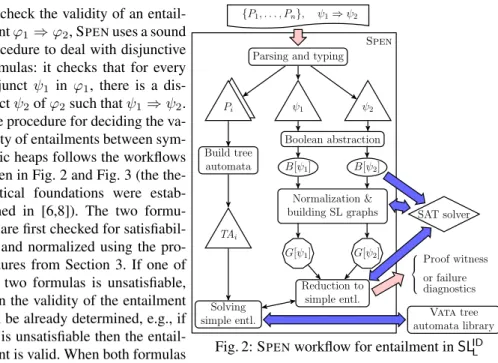
ψ1 Pi Pi Build tree automata ψ2 Boolean abstraction B[ψ1] B[ψ2] Normalization & building SL graphs G[ψ1] G[ψ2] TAi Solving simple entl. Reduction to simple entl. SAT solver Proof witness or failure diagnostics Vata tree automata library
Fig. 2: SPENworkflow for entailment in SLIDL To check the validity of an
entail-ment ϕ1⇒ ϕ2, SPENuses a sound
procedure to deal with disjunctive formulas: it checks that for every disjunct ψ1 in ϕ1, there is a
dis-junct ψ2of ϕ2such that ψ1⇒ ψ2.
The procedure for deciding the va-lidity of entailments between sym-bolic heaps follows the workflows given in Fig. 2 and Fig. 3 (the the-oretical foundations were estab-lished in [6,8]). The two formu-las are first checked for satisfiabil-ity and normalized using the pro-cedures from Section 3. If one of the two formulas is unsatisfiable, then the validity of the entailment can be already determined, e.g., if ψ1is unsatisfiable then the
entail-ment is valid. When both formulas
are satisfiable, SPENoffers two different procedures tuned for each fragment of SLID.
For the fragment SLIDL , SPENreduces the entailment problem ψ1 ⇒ ψ2to a set of
entailment queries of the form ψ1[a] ⇒ a, called simple entailments, where ψ1[a] is
a sub-formula of ψ1and a is a (points-to or inductive) spatial atom of ψ2(there will be
one such entailment for each spatial atom a in ψ2). Intuitively, the sub-formula ψ1[a]
describes the region of a heap modelled by ψ1 that should satisfy a. The procedures
for computing ψ1[a] and testing simple entailments use an intermediary graph
repre-sentation of symbolic heap formulas, called an SL-graph and denoted G[ψ]. Basically, nodes of G[ψ] represent sets of aliased variables according to the pure part of ψ, and edges represent dis-equalities and spatial atoms of ψ, e.g., a spatial atom P (X, Y, ~x) is represented by a directed edge from X to Y labeled by P (~x). Thus, when a is a predi-cate atom P (X, Y, ~x), ψ1[a] is obtained from the SL-graph of ψ1by selecting the edges
Table 1: Experimental results on an Intel(R) Core(TM) i7-2600 CPU at 1.60GHz
Fragments Time [s] SL-COMP’14 results SLID
L SLIDD Benchmark SizeSPENLSPEND Time [s] StarExec/solver X X sll0 sat 110 11.20 11.28 (I) 1.06 / Asterix, (II) 3.27 / SPEN
X X sll0 entl 292 34.45 34.94 (I) 2.98 / Asterix, (II) 7.58 / SPEN
X X FDB entl 43 1.08 1.00 (I) 0.61 / SPEN, (II) 43.65 / SLEEK
X FDB entl+ 55 0.65 — —
into a tree t1, which is tested for membership in the language of a tree automaton built
from the rules defining P for the atom a = P (X, Y, ~x).
Spen {P1, . . . , Pn}, ψ1⇒ ψ2
Parsing and typing
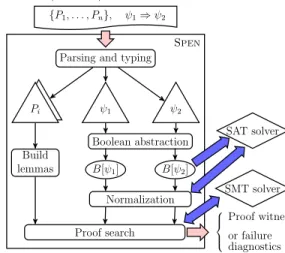
ψ1 Pi Pi Build lemmas ψ2 Boolean abstraction B[ψ1] B[ψ2] Normalization Proof search SAT solver SMT solver Proof witness or failure diagnostics
Fig. 3: SPENworkflow for entailment in SLIDD For the fragment SLID
D, SPEN
implements a proof search strat-egy for the entailment problem ψ1 ⇒ ∃~d. ψ2. The strategy
computes a sequence of formulas ∃~d1. ψ11, . . . ,∃~dn. ψn1 such that (1) ∃~di. ψi 1 ⇒ ∃~di+1. ψ i+1 1 and (2) ∃~dn. ψn 1 is syntactically
equiv-alent to ∃~d. ψ2. The entailments
in point (1) are obtained by ap-plying the inductive rules and lem-mas obtained automatically thanks to restriction required on inductive definitions. The procedure requires to check entailments between data
constraints, which is done using the previously mentioned wrapper to the SMT solver. For both procedures, when the input entailment ψ1 ⇒ ∃~d. ψ2holds, SPENhas the
option of providing a proof witness that either indicates the fact that ψ1is unsatisfiable
or it consists of the normalized forms of ψ1and ψ2and the mapping of sub-fomulas in
ψ1to atoms of ψ2. When the input entailment is not valid and the procedure terminates,
SPENprovides a diagnosis that explains why the entailment fails.
5
Experimental Results
SPENhas been applied to a benchmark of 578 problems (available in the repository), 90 % obtained from verification conditions of iterative programs on complex dynamic data structures. The remaining problems are crafted to test the capabilities of the solver. Tables 1 and 2 provide an overview of results obtained by SPENon this benchmark.
The benchmark of SLID
L problems includes three divisions of SL-COMP’14:
sat-isfiability and entailment problems for acyclic singly linked lists (sll0 sat resp. sll0 entl), and entailment checking for formulas describing more complicated types of linked lists, e.g., doubly-linked lists, skip lists, and nested lists (FDB entl). SPEN
spends less than 0.05 s on 90 % of the problems with the maximum time of 0.5 s; these times include calls to a SAT solver. The benchmark FDB entl+includes the problems not in the SL-COMP’14 benchmark (e.g., formulas describing lists of cyclic lists). The reported times in the last column have been obtained in 2014 on the StarExec5platform.
6
Table 2: Results for SLIDD
Benchmark Size Time [s] sll0 sorted 16 0.45 BST 45 1.67 AVL 22 1.21 RBT 21 3.61
The benchmark of SLIDD problems (see Table 2) in-cludes verification conditions for proving the correct-ness of iterative procedures (delete, insert, search) over recursive data structures storing integer data: sorted lists, binary search trees, AVL trees, and red-black trees. SPEN spends less than 0.4 s on each problem, includ-ing calls to SAT and SMT solvers. The first three lines
of Table 1 demonstrate that the two approaches implemented in SPEN(based on tree automata—column “SPENL”—and on proof search—column “SPEND”) are not only
complementary but also comparable on the common fragment. The improvements dis-cussed in this paper reduce the execution times by 10 % within the division sll0 entl and by 30 % within FDB entl w.r.t. the old version [6].
Acknowledgement.This work was supported by the French ANR project Vecolib, the Czech Science Foundation (project 17-12465S), the BUT FIT project FIT-S-17-4014, the IT4IXS: IT4Innovations Excellence in Science project (LQ1602), and by the Euro-pean Research Council (ERC) under the EuroEuro-pean Union’s Horizon 2020 research and innovation programme (grant agreement No 678177).
References
1. J. Berdine, C. Calcagno, and P. O’Hearn. A decidable fragment of separation logic. In Proc. FSTTCS’04, LNCS 3328, Springer, 2004.
2. J. Brotherston, N. Gorogiannis, and R. L. Petersen. A Generic Cyclic Theorem Prover. In Proc. of APLAS’12, LNCS 7705, Springer, 2012.
3. C. Calcagno, H. Yang, P. O’Hearn. Computability and Complexity Results for a Spatial As-sertion Language for Data Structures. In Proc. of FSTTCS’01, LNCS 2245, Springer, 2001. 4. W.-N. Chin, C. David, H. H. Nguyen, and S. Qin. Automated Verification of Shape, Size
and Bag Properties via User-defined Predicates in Separation Logic. Science of Computer Programming, 77(9):1006–1036, Elsevier, 2012.
5. L. De Moura and N. Bjørner. Z3: An Efficient SMT Solver. In Proc. of TACAS’08, LNCS 4963, Springer, 2008.
6. C. Enea, O. Leng´al, M. Sighireanu, and T. Vojnar. Compositional Entailment Checking for a Fragment of Separation Logic. In Proc. of APLAS’14, LNCS 8858, Springer, 2014. 7. C. Enea, V. Saveluc, and M. Sighireanu. Compositional Invariant Checking for Overlaid and
Nested Linked Lists. In Proc. of ESOP’13, LNCS 7792, Springer, 2013.
8. C. Enea, M. Sighireanu, and Z. Wu. On Automated Lemma Generation for Separation Logic with Inductive Definitions. In Proc. of ATVA’15, LNCS 9364, Springer, 2015.
9. R. Iosif, A. Rogalewicz, and T. Vojnar. Deciding Entailments in Inductive Separation Logic with Tree Automata. In Proc. of ATVA’14, LNCS 8837, Springer, 2014.
10. R. Iosif, A. Rogalewicz, and J. ˇSim´aˇcek. The Tree Width of Separation Logic with Recursive Definitions. In Proc. of CADE-24, LNCS 7898, Springer, 2013.
11. P. W. O’Hearn, J. C. Reynolds, and H. Yang. Local Reasoning about Programs that Alter Data Structures. In Proc. of CSL’01, LNCS 2142, Springer, 2001.
12. J. A. N. P´erez and A. Rybalchenko. Separation Logic Modulo Theories. In Proc. of APLAS’13, LNCS 8301, Springer, 2013.
13. R. Piskac, T. Wies, and D. Zufferey. Automating Separation Logic Using SMT. In Proc. of CAV’13, LNCS 8044, Springer, 2013.
14. X. Qiu, P. Garg, A. Stefanescu, and P. Madhusudan. Natural Proofs for Structure, Data, and Separation. In Proc. of PLDI’13, ACM Press, 2013.