Improvement of antibiotic prescription in outpatient care: a
cluster-randomized intervention study using a sentinel
surveillance network of physicians
David Hu¨rlimann
1, Andreas Limacher
2, Maria Schabel
3, Giorgio Zanetti
4, Christoph Berger
5,
Kathrin Mu¨hlemann
1,6† and Andreas Kronenberg
1,6* on behalf of the Swiss Sentinel Working Group‡
1
Institute for Infectious Diseases, University of Bern, Bern, Switzerland;
2Department of Clinical Research, and Institute of Social and
Preventive Medicine (ISPM), University of Bern, Bern, Switzerland;
3Swiss Federal Office of Public Health, Bern, Switzerland;
4Hospital Preventive Medicine Service, Centre Hospitalier Universitaire Vaudois, Lausanne, Switzerland;
5Division of Infectious Diseases,
University Children’s Hospital of Zurich, Zurich, Switzerland;
6Department of Infectious Diseases, Bern University Hospital and
University of Bern, Bern, Switzerland
*Corresponding author. Institute for Infectious Diseases, University of Bern, Friedbu¨hlstrasse 51, 3010 Bern, Switzerland. Tel:+41-(0)31-632-32-65; Fax: +41-(0)31-632-49-66; E-mail: [email protected]
†Deceased.
‡Members are listed in the Acknowledgements section.
Received 12 June 2014; returned 12 July 2014; revised 3 September 2014; accepted 7 September 2014
Objectives: To assess the effectiveness of implementing guidelines, coupled with individual feedback, on
antibiotic prescribing behaviour of primary care physicians in Switzerland.
Methods: One hundred and forty general practices from a representative Swiss sentinel network of primary care
physicians participated in this cluster-randomized prospective intervention study. The intervention consisted of
providing guidelines on treatment of respiratory tract infections (RTIs) and uncomplicated lower urinary tract
infections (UTIs), coupled with sustained, regular feedback on individual antibiotic prescription behaviour during
2 years. The main aims were: (i) to increase the percentage of prescriptions of penicillins for all RTIs treated with
antibiotics; (ii) to increase the percentage of trimethoprim/sulfamethoxazole prescriptions for all uncomplicated
lower UTIs treated with antibiotics; (iii) to decrease the percentage of quinolone prescriptions for all cases of
exa-cerbated COPD (eCOPD) treated with antibiotics; and (iv) to decrease the proportion of sinusitis and other upper
RTIs treated with antibiotics. The study was registered at ClinicalTrials.gov (NCT01358916).
Results: While the percentage of antibiotics prescribed for sinusitis or other upper RTIs and the percentage of
quinolones prescribed for eCOPD did not differ between the intervention group and the control group, there
was a significant increase in the percentage of prescriptions of penicillins for all RTIs treated with antibiotics
[57% versus 49%, OR ¼ 1.42 (95% CI 1.08–1.89), P ¼ 0.01] and in the percentage of
trimethoprim/sulfamethoxa-zole prescriptions for all uncomplicated lower UTIs treated with antibiotics [35% versus 19%, OR ¼ 2.16 (95%
CI 1.19– 3.91), P ¼ 0.01] in the intervention group.
Conclusions: In our setting, implementing guidelines, coupled with sustained individual feedback, was not able
to reduce the proportion of sinusitis and other upper RTIs treated with antibiotics, but increased the use of
recom-mended antibiotics for RTIs and UTIs, as defined by the guidelines.
Keywords: ambulatory, guidelines, antibiotic prescribing
Introduction
Antibiotic resistance is increasing rapidly worldwide. While
increasing resistance rates were initially mainly described in the
hospital setting, resistant microorganisms such as
penicillin-resistant Streptococcus pneumoniae, community-acquired MRSA
and Escherichia coli or Klebsiella spp. producing ESBLs are
increas-ingly observed in the ambulatory setting. It has been shown
pre-viously at the population level that the volume of outpatient
antibiotic use in a given area is significantly associated with
resist-ance rates in that area,
1and even that community antibiotic use
may influence resistance rates in the hospital.
2In addition,
#The Author 2014. Published by Oxford University Press on behalf of the British Society for Antimicrobial Chemotherapy. All rights reserved. For Permissions, please e-mail: [email protected]J Antimicrob Chemother 2015; 70: 602 – 608
several reports described the association between antibiotic use
in primary care and the development of resistance in individual
patients.
3,4In ambulatory medicine, antibiotics are most
com-monly prescribed for respiratory tract infections (RTIs).
1,5Broad-spectrum agents are more likely to be prescribed for this
indication than narrow-spectrum agents.
5This is especially
men-acing as, besides the volume of antibiotics prescribed, the
spec-trum of antibiotics may also have an impact on the
development of resistance, with broad-spectrum antibiotics
exerting a higher ecological pressure.
6Whether a reduction in antibiotic consumption leads to a
reduction in resistance rates is still a matter of debate and
seems to depend on the microorganisms and antibiotics tested.
While most studies were performed in the hospital setting,
where infection control measures could have influenced the
results, some studies demonstrated the reversibility of resistance
development following reduction in antibiotic consumption in the
ambulatory setting.
7–11As antibiotic prescriptions in ambulatory
care exceed antibiotic use in hospitals,
1improving antibiotic
pre-scription in the ambulatory setting might be even more important
in stopping or reversing the increasing antibiotic resistance rates in
the ambulatory setting, and indirectly in the hospital setting.
Using the Swiss Sentinel Surveillance Network of physicians,
12we performed a cluster-randomized intervention study to analyse
the influence of detailed antibiotic prescription guidelines on
pre-scription behaviour. The intervention aimed to simultaneously
reduce antibiotic prescription rates and modify the antibiotics
used in the two most important infections [upper RTIs and
uncomplicated lower urinary tract infections (UTIs)]. To improve
and sustain the impact of the intervention, guidelines were
com-bined with iterative regular feedback on individual prescription
behaviour over 2 years.
Methods
Study design and data collection
This open, prospective, cluster-randomized intervention study was per-formed within the framework of the Swiss Sentinel Surveillance Network (https://www.sentinella.ch), covering 3.1% of all Swiss practitioners in pri-mary care.12
Antibiotic prescription data were collected on a weekly basis by the Swiss Federal Office of Public Health (SFOH) from 1 January 2011 to 31 December 2012. Antibiotic prescriptions were categorized into penicillins (including combinations with penicillinase inhibitors), cephalosporins, macrolides, trimethoprim/sulfamethoxazole, quinolones, tetracyclines, glycopeptides, oxazolidinones and other. Diseases were categorized into upper RTIs (including streptococcal angina, otitis media, sinusitis, acute bronchitis, other upper RTIs), lower RTIs [including exacerbated COPD (eCOPD) and pneumonia] and lower uncomplicated UTIs. For each anti-biotic prescription, we collected the following dataset: patient age, gender, previous antibiotic therapy since November of the preceding year, perceived patient’s attitude to antibiotic prescription (‘insistent’, ‘not insistent’), disease category and the antibiotic group prescribed. In the case of multiple prescriptions only the first prescription per patient and year was analysed. Incomplete datasets were queried continuously by the SFOH, were therefore rare and were removed from the dataset (in total four were missing for ‘indication’ and five were missing for ‘antibiotic class’).
Baseline characteristics of each practice were obtained by a separate questionnaire before the start of the study. In an additional survey in the same practices during 4 weeks in spring and 4 weeks in autumn
each year, we collected data on the total number of cases with sinusitis or other upper RTIs.
At the end of the study all data were delivered by the SFOH to the Clinical Trials Unit Bern, University of Bern, in Excel format. The study was registered at ClinicalTrials.gov (NCT01358916) and was exempted by the ethics committee from the need to obtain patients’ informed con-sent because treatment followed current guidelines.
Participants
All registered sentinel members as of May 2010 were evaluated for partici-pation in this study. We excluded (i) members of the programme commit-tee and (ii) non-regularly reporting members, defined as members not reporting at least one physician – patient contact in at least 75% of the weeks from August 2009 to July 2010. Finally, 140 members were included and randomly allocated to either the control or the intervention group in a 1: 1 ratio.
Intervention
The intervention consisted of two activities: guidelines for antibiotic pre-scription in RTIs and UTIs, which were developed by the Pediatric Infectious Disease Group of Switzerland and—for adult patients—by an ad hoc committee of adult infectious disease specialists. Guidelines included indications for antibiotic use as well as information on the pre-ferred antibiotic regimen (see Supplementary data, available at JAC Online). The main focus of the guidelines was to restrict prescriptions to bacterial infections and to preferentially prescribe narrow-spectrum anti-biotics, namely penicillins for RTIs and trimethoprim/sulfamethoxazole for uncomplicated lower UTIs. Physicians allocated to the intervention group received these guidelines in November 2010 and again in April 2012. In addition they were provided twice yearly with a reminder, including indi-vidual feedback on their antibiotic prescription pattern for all four primary and secondary endpoints, compared with the aggregated data of the other members of the intervention group.
Aim of the study and outcome measures
With this study we aimed to analyse whether an intervention at physician level would be able to influence the prescription pattern of the individual physicians. The primary objectives were: (i) to increase the percentage of prescriptions of penicillins for upper and lower RTIs over all upper and lower RTIs treated with antibiotics; and (ii) to increase the percentage of tri-methoprim/sulfamethoxazole prescriptions for uncomplicated lower UTIs over all uncomplicated lower UTIs in adults (≥17 years) treated with antibiotics. The secondary objectives were: (i) to decrease the per-centage of quinolone prescriptions for eCOPD over all eCOPD in adults (≥17 years) treated with antibiotics; and (ii) to decrease the percentage of antibiotic prescriptions for sinusitis and other upper RTIs over all diag-nosed sinusitis and other upper RTIs.
In addition, we evaluated the primary and secondary objectives at practice level and studied the influence of patient factors (age, gender, attitude to antibiotic prescription) and practice level factors [practice type (one versus more than one physician), practice specialization and language region (French/Italian- versus German-speaking part of Switzerland)] on the effect of the intervention concerning the primary and secondary outcomes. Additional pre-specified objectives were defined and are summarized in the Supplementary data.
Randomization and blinding
Stratified randomization was performed to randomly allocate the prac-tices to the intervention or control arm in a 1: 1 ratio. Variables used for stratification were practice specialization (paediatric versus internal or
general), size of cluster (≤100 versus .100 prescriptions per year) and baseline performance of prescription of penicillins for RTIs (≤50% versus .50%) based on data collected between August 2009 and July 2010. Practices were not blinded to allocation.
Statistical analysis
We performed an initial power analysis based on data collected for 1 year before study start, which was updated 9 months after study start. Based on 16863 cases with RTIs and 4245 cases with lower UTIs per year, base-line proportions of 46.6% and 18.9% and intra-class correlations of 0.28 and 0.37, we calculated a power of 0.99 and 0.92 to detect an increase in the proportion of penicillin prescriptions to 60% and an increase in the proportion of trimethoprim/sulfamethoxazole prescriptions to 30%, respectively, with a two-sided type I error of 0.05. Exact details of the power calculation are given in the Supplementary data.
Outcomes at patient level were analysed using mixed-effects logistic models that take into account the correlation of data within practices. Adjustment was done for all stratification factors used in the randomization procedure. The influence of other co-factors on the intervention effect was studied by stratified analyses incorporating an interaction term between the co-factor and the intervention into the mixed-effects logistic model.
To compare prescription rates averaged at practice level, we excluded practices with fewer than five cases in total. Absolute differences concern-ing the proportions of the prescriptions for the study drug between the two groups were derived from linear regression models, adjusting for all strati-fication factors used in the randomization. We assessed the goodness of fit of linear regression models by R2. Goodness of fit of mixed-effects
logis-tics models was investigated by plotting deviance residuals against pre-dicted values. The resulting graphs revealed no extreme observations. A more detailed description of the regression analyses is provided in the Supplementary data. In the primary analysis, we used the full analysis set, including all practices as randomized (ITT principle). In sensitivity ana-lyses, we used different adjustment schemes as well as a PP analysis set, where data from practices joining the programme committee of the study during the study, leaving the Sentinel network within 12 months from the start of data collection or notifying ,20 prescriptions in total were excluded.
All endpoint definitions and statistical methods were pre-defined in a statistical analysis plan before evaluation of the data and strictly followed during analysis. For the analysis of the primary and secondary endpoints, the data analyst was blinded to the intervention assignment. Once the pri-mary and secondary endpoints were analysed, the data analyst was unblinded. All analyses were done using Stata 12 (Stata Corporation, College Station, TX, USA).
Results
Practice and patient flow
Between randomization and the start of data collection, three
practices from the control group (4.3%) and one practice from
the intervention group (1.4%) left the sentinel network.
Therefore, 67 practices were finally analysed in the control
group and 69 in the intervention group.
During the study period, a total of 34 682 antibiotic
prescrip-tions were collected. Two thousand seven hundred and
twenty-six (17%) out of 16 053 prescriptions in the control group and
3004 (16%) out of 18 629 prescriptions in the intervention group
were excluded from analysis because antibiotics had been
pre-scribed previously, leaving 13 327 and 15 625 prescriptions for
analysis in the control and intervention groups, respectively. The
average number (SD) of prescriptions per practice was 199 (156)
and 226 (201) in the control and intervention groups, respectively.
Baseline characteristics
Baseline characteristics of included practices and patients are
shown in Table
1
.
There were only minor differences between the control and the
intervention groups.
Primary objectives
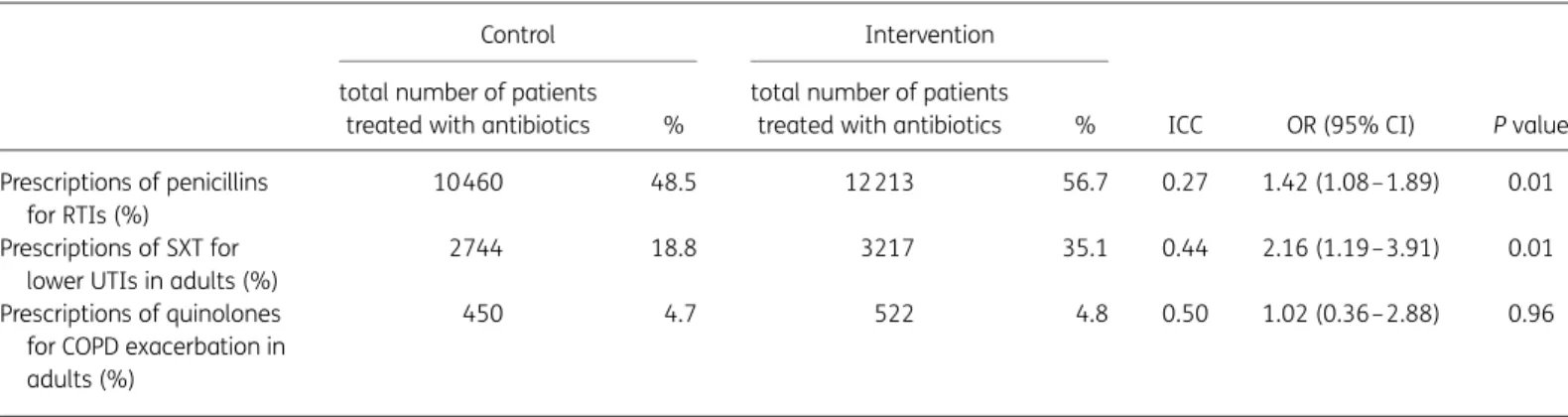
The percentage of prescriptions of penicillins for all treated RTIs
was significantly higher in the intervention group [OR 1.42 (95%
CI 1.08 – 1.89); Table
2
]. This difference was mainly driven by a
high increase in the French/Italian-speaking part of Switzerland
[from 35% to 63%, OR 2.81 (95% CI 1.78 – 4.45)], whereas
prescription rates did not differ between groups in the
Table 1. Baseline characteristics
Control Intervention Practice characteristics
total, n 67 69
practice specialization
(paediatric versus internal or general), n (%)
8 (11.9) 9 (13.0)
practice size (.100 prescriptions per year at baseline), n (%)
41 (61.2) 40 (58.0)
high rate of prescription of penicillins at baseline (.50% for RTIs), n (%)
32 (47.8) 31 (44.9)
group practice (.1 physician per practice), n (%) 28 (41.8) 26 (37.7) French/Italian-speaking south-western part of Switzerland (versus German-speaking north-eastern part), n (%) 24 (35.8) 22 (31.9) Patient characteristics total, n 13327 15625 age, years, median (IQR) 38 (12– 61) 33 (10–58) age category, years, n (%)
0 –5 2041 (15.3) 2486 (15.9) 6 –16 1709 (12.8) 2665 (17.1) 17– 64 6690 (50.2) 7483 (47.9) ≥65 2887 (21.7) 2991 (19.1) female, n (%) 8024 (60.2) 9273 (59.3) insisting on antibiotics, n (%) 1790 (13.4) 1847 (11.8) indication, n (%) angina 1976 (14.8) 2736 (17.5) otitis media 1920 (14.4) 1817 (11.6) sinusitis 1572 (11.8) 1637 (10.5) other upper RTIs 1874 (14.1) 2397 (15.3) acute bronchitis 1868 (14.0) 2211 (14.2) COPD exacerbation 451 (3.4) 524 (3.4) pneumonia 799 (6.0) 891 (5.7) lower UTIs 2867 (21.5) 3412 (21.8)
German-speaking part of Switzerland (Table
3
). The effect of the
intervention tended to be smaller in paediatric than in general/
internal practices. Interestingly, the effect of intervention was
sig-nificantly larger in children than in adults. This also held true
when looking separately at general and internal practices
(P value for interaction ¼ 0.002) or paediatric practices (P value
for interaction ¼ 0.05).
The percentage of trimethoprim/sulfamethoxazole
prescrip-tions for all treated uncomplicated lower UTIs in adults was also
significantly higher in the intervention group [OR 2.16 (95%
CI 1.19– 3.91); Table
2
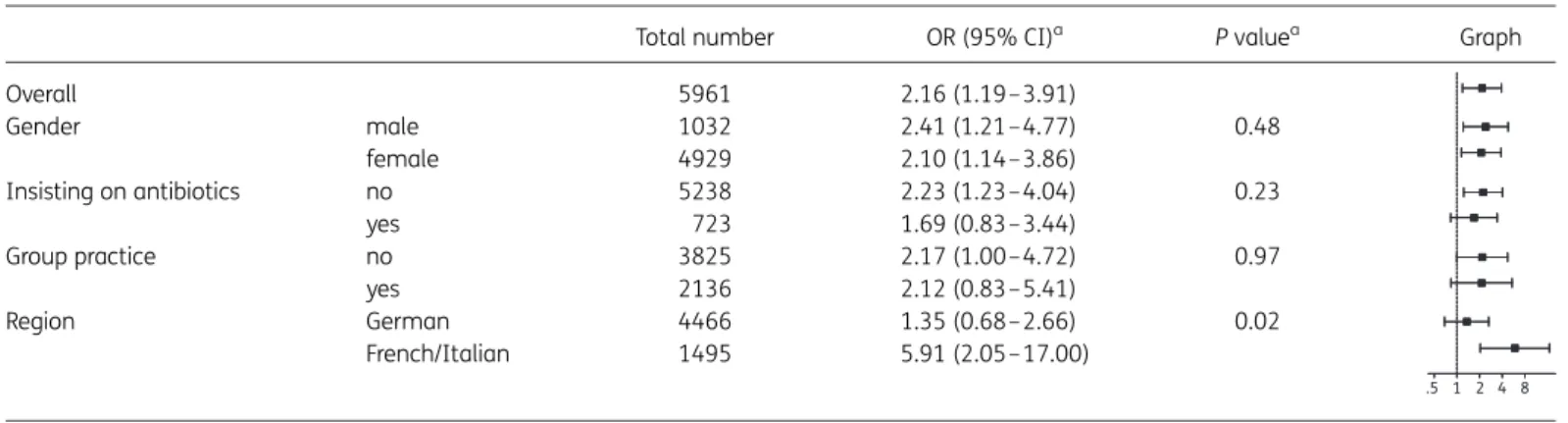
]. Again the difference was much higher in
the French/Italian-speaking part of Switzerland [6.8% versus 35%,
OR 5.91 (95% CI 2.05– 17.00)] than in the German-speaking part
of Switzerland [28% versus 36%, OR 1.35 (95% CI 0.68 – 2.66);
Table
4
].
Secondary objectives
The percentage of quinolone prescriptions for eCOPD in adults did
not differ between groups (Table
2
). There were no differences
between different subgroups of region, gender, practice type or
attitude (data not shown). Analysis of averaged proportions at
practice level revealed congruent results (Table
5
and Figure
1
).
Antibiotics were prescribed in about one-third of all patients
with sinusitis or other upper RTIs, irrespective of the group
(Table
5
).
Sensitivity analysis
We repeated the main analysis (i) without any adjustment, (ii)
adjusting additionally for age and gender and (iii) using the PP
analysis set. All of these additional analyses led to results very
similar to those of the main analysis (data not shown).
Discussion
In this cluster-randomized trial, antibiotic prescription guidelines
and regular feedback on individual prescription behaviour resulted
in an increase in the use of penicillins for upper RTIs and
Table 3. Comparison of penicillin prescription rate for RTIs among subgroups
Total number OR (95% CI)a P valuea Graph
Overall 22 673 1.42 (1.08–1.89) .5 1 2 4 8 Age 0 – 16 years 8583 1.88 (1.35–2.62) 0.001 ≥17 years 14 090 1.32 (0.99–1.76) Gender male 10 573 1.35 (1.01–1.80) 0.13 female 12 100 1.48 (1.11–1.97) Insisting on antibiotics no 19 773 1.41 (1.06–1.88) 0.44 yes 2900 1.53 (1.10–2.13) Paediatric practice no 15 821 1.55 (1.15–2.09) 0.12 yes 6852 0.81 (0.38–1.74) Group practice no 15 046 1.37 (0.96–1.97) 0.75 yes 7627 1.51 (0.96–2.36) Region German 14 213 0.99 (0.71–1.37) ,0.001 French/Italian 8460 2.81 (1.78–4.45)
aCalculated from a mixed-effects logistic model with a P value for interaction.
Table 2. Comparison of antibiotic prescription rates between the intervention group and the control group Control Intervention
ICC OR (95% CI) P value total number of patients
treated with antibiotics %
total number of patients treated with antibiotics % Prescriptions of penicillins
for RTIs (%)
10460 48.5 12213 56.7 0.27 1.42 (1.08–1.89) 0.01 Prescriptions of SXT for
lower UTIs in adults (%)
2744 18.8 3217 35.1 0.44 2.16 (1.19–3.91) 0.01 Prescriptions of quinolones
for COPD exacerbation in adults (%)
450 4.7 522 4.8 0.50 1.02 (0.36–2.88) 0.96
ICC, intra-class correlation; SXT, trimethoprim/sulfamethoxazole.
Proportions, ICCs, ORs and P values were derived from a mixed-effects logistic model.
trimethoprim/sulfamethoxazole for uncomplicated lower UTIs,
but did not affect the total amount of antibiotics prescribed for
sinusitis or other upper RTIs. This is in agreement with other
stud-ies, demonstrating that using printed material and feedback for
physician education was not able to improve their prescribing or
only improved it by a small amount, whereas patient-based
inter-ventions or even more multifaceted interinter-ventions could reduce
antibiotic prescribing.
13–15In general, active clinical education
strategies seem to be more efficient than passive strategies,
13,16and training in enhanced communication skills could be one
important element of these strategies.
17,18In addition, the effect
of even complex intervention programmes may depend on the
infections studied.
19Our intervention was successful in (i) increasing the percentage
of prescriptions of penicillins for all RTIs treated with antibiotics,
paralleled by a decrease in cephalosporin use, while macrolide
consumption was stable, and (ii) increasing the percentage of
tri-methoprim/sulfamethoxazole prescriptions for all uncomplicated
lower UTIs treated with antibiotics, paralleled by a decrease in the
quinolone prescription rate. For both indications, the increase was
significantly more pronounced in the French/Italian-speaking
region of Switzerland, which is known to have higher outpatient
antibiotic prescription rates than the German-speaking part of
Switzerland.
20,21In RTIs, the intervention was more effective in children. There is
some indication that the intervention was less effective in
paedi-atric practices than in general or internal practices; however, the
difference was non-significant (P value for interaction¼ 0.12). Two
hypotheses may explain this difference. First, as amoxicillin syrup
is widely used in all paediatric practices for RTIs, as reflected by an
amoxicillin prescription rate for RTIs of 82.1% in the control group,
improvement in this subgroup is hardly possible, also taking into
account the contraindications, namely allergic reactions. Second,
the paediatric guidelines existed before this study began. They
were not advertised in the control group, but nevertheless were
available on the internet, which might have further reduced the
effect of the intervention.
Prescription of quinolones for lower RTIs in adults should only
be considered when there are clinically relevant bacterial
resist-ance rates against all first-choice agents.
11Nevertheless, we
were not able to reduce quinolone use in COPD exacerbations.
We suppose that this is due to the already very low quinolone
pre-scription rate and the relative low number of patients in this group.
So far, antibiotic stewardship programmes have mainly been
recommended for hospitals. For outpatient care only a few
re-commendations are offered, largely because of the paucity of
data regarding effective interventions.
22There are few studies
describing the effect of an outpatient antimicrobial stewardship
Table 4. Comparison of trimethoprim/sulfamethoxazole prescription rate for uncomplicated lower UTIs in adults among subgroups
Total number OR (95% CI)a P valuea Graph
Overall 5961 2.16 (1.19–3.91) .5 1 2 4 8 Gender male 1032 2.41 (1.21–4.77) 0.48 female 4929 2.10 (1.14–3.86) Insisting on antibiotics no 5238 2.23 (1.23–4.04) 0.23 yes 723 1.69 (0.83–3.44) Group practice no 3825 2.17 (1.00–4.72) 0.97 yes 2136 2.12 (0.83–5.41) Region German 4466 1.35 (0.68–2.66) 0.02 French/Italian 1495 5.91 (2.05–17.00)
aCalculated from a mixed-effects logistic model with a P value for interaction.
Table 5. Comparison of antibiotic prescription rates at practice level
Control Intervention
Difference in proportion
(95% CI)a P valuea
total (n) % total (n) %
Prescribing rate of penicillins for RTIs treated with antibiotics 67 48.7 68 55.8 8.0 (2.3 –13.6) 0.006 Prescribing rate of SXT for lower UTIs in adults treated with
antibiotics (internal/general practices only)
57 26.4 55 39.0 12.4 (3.3 –21.6) 0.009 Quinolone prescribing rate for COPD exacerbation in adults treated with
antibiotics (internal/general practices only)
28 10.5 33 13.3 2.2 (27.6–12.1) 0.66 Prescription rate for all diagnosed sinusitis and other upper RTIs 66 34.4 67 32.5 21.2 (210.5–8.2) 0.80
SXT, trimethoprim/sulfamethoxazole.
aAbsolute differences between groups and corresponding CI and P values were derived from a linear regression model adjusting for all stratification
factors used in the randomization. The goodness of fit of the models, expressed as R2, was 0.48, 0.05, 0.05 and 0.02 from top to bottom.
intervention on the selection of the preferred antibiotic. In a
cross-sectional study Bhattacharyya et al.
14observed an increase in the
proportion of patients treated with amoxicillin as the agent of
choice from 8.1% to 29.4% after publication of treatment
guide-lines for sinusitis in adults. In another study
22—using a 1 h
educa-tion session, quarterly audits and regular feedback as interveneduca-tion
tools—broad-spectrum prescriptions for RTIs in a paediatric
popu-lation were reduced from 26.8% to 14.3%, which compares well
with the absolute increase in prescription of penicillins of 13.4% in
patients below age 17 in our study.
Our study has several strengths. Randomization was done by
practice and there were no significant differences between the
groups. Data analysis proved to be very stable, as ITT analysis,
PP analysis and analysis at practice and patient levels all led to
congruent results.
There were some limitations in our study. First, practices were
not blinded to allocation and practices participating in the sentinel
network are probably not representative of all Swiss physicians.
However, we believe that the high interest of study physicians in
infectious diseases and knowledge of the study design probably
led to better results in the control group, which would rather
underestimate the effect of our study. Second, the
cluster-randomized design did not allow prescription patterns to be
stud-ied within individual practices. Third, we do not have any data on
the duration of therapy or the DDDs used. Fourth, we were not able
to identify which part of the intervention was most effective. Fifth,
we did not analyse whether outcomes were different between
groups, although there are some data in the literature showing
that outcomes and satisfaction of patients are not influenced
by the prescription pattern.
16,18Sixth, we did not measure the
sus-tainability of the effect, but there is some evidence that effects
may be sustained for years.
17Seventh, as participants did not
cover a complete geographical region, we were not able to
study the effect of this intervention on resistance prevalence.
We conclude that publication of guidelines and individual
feed-back to prescribers may influence prescription behaviour. It may
be easier to modify the preferred antibiotic than the total
anti-biotic prescription rate. Knowledge of the size of the effect in
indi-vidual subgroups is important for better targeting of further
interventions.
Acknowledgements
We thank the members of the reporting Sentinella physicians for their meticulous data collection and the Notification Systems Section of the SFOH for providing the infrastructure and the database. We thank the Pediatric Infectious Disease Group of Switzerland for their support in developing the treatment guidelines.
Members of the Swiss Sentinel Working Group
Andreoli Piero, Lugano; Banderet Hans-Ruedi, Basel; Be´guin Pierre, Biel; Birrer Andreas, Bern; Dvorak Charles, Vallorbe; Frey Peter, Bern; Gallacchi Martine, Breno; Haller-Hester Dagmar, Meyrin; Herzig Lilli, Lausanne; Lehmann Thomas, Orselina; Merlo Christoph Marco, Luzern; Peytremann Bridevaux, Lausanne; Rohrer Jo¨rg, Liebefeld; Ru¨etschi Bernhard, Reinach;
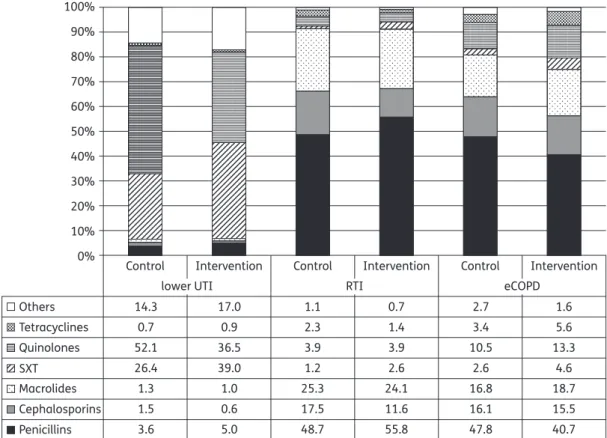
Others Control Intervention 14.3 0% 10% 20% 30% 40% 50% 60% 70% 80% 90% 100% 0.7 52.1 26.4 1.3 1.5 3.6 17.0 0.9 36.5 39.0 1.0 0.6 5.0 1.1 2.3 3.9 1.2 25.3 17.5 48.7 0.7 1.4 3.9 2.6 24.1 11.6 55.8 2.7 3.4 10.5 2.6 16.8 16.1 47.8 1.6 5.6 13.3 4.6 18.7 15.5 40.7 Tetracyclines Quinolones SXT Macrolides Cephalosporins Penicillins
Control Intervention Control Intervention
RTI eCOPD
lower UTI
Figure 1. Antibiotic prescription rates averaged at practice level for treated RTIs, lower UTIs in adults (internal/general practices only) and eCOPD in adults (internal/general practices only) in the control and intervention groups. SXT, trimethoprim/sulfamethoxazole.
Schnoz Markus, Schwyz; Senn Nicolas, Lausanne; Staehelin Alfred, Winterthur; Stark Benedikt, Aesch; Suter Herbert, Lyss; Zeller Andreas, Basel.
Funding
This study was supported financially by the Swiss Centre for Antibiotic Resistance (www.anresis.ch).
Transparency declarations
We affirm that the manuscript is an honest, accurate and transparent account of the study being reported, that no important aspects of the study have been omitted and that any discrepancies from the study as planned (and, if relevant, registered) have been explained.
We declare: no support from any organization for the submitted work besides the acknowledged financial support from anresis.ch; no financial relationships with any organizations that might have an interest in the submitted work in the previous 3 years; and no other relationships or activ-ities that could appear to have influenced the submitted work. A. K. reports grants from ESCMID and personal fees from ArjoHuntleigh for an inde-pendent lecture outside the submitted work.
Supplementary data
Supplementary data are available at JAC Online (http://jac.oxfordjournals. org/).
References
1 Goossens H, Ferech M, Vander Stichele R et al. Outpatient antibiotic use in Europe and association with resistance: a cross-national database study. Lancet 2005; 365: 579–87.
2 Sun L, Klein EY, Laxminarayan R. Seasonality and temporal correlation between community antibiotic use and resistance in the United States. Clin Infect Dis 2012; 55: 687– 94.
3 Malhotra-Kumar S, Lammens C, Coenen S et al. Effect of azithromycin and clarithromycin therapy on pharyngeal carriage of macrolide-resistant streptococci in healthy volunteers: a randomised, double-blind, placebo-controlled study. Lancet 2007; 369: 482–90.
4 Costelloe C, Metcalfe C, Lovering A et al. Effect of antibiotic prescribing in primary care on antimicrobial resistance in individual patients: systematic review and meta-analysis. BMJ 2010; 340: c2096.
5 Shapiro DJ, Hicks LA, Pavia AT et al. Antibiotic prescribing for adults in ambulatory care in the USA, 2007 – 09. J Antimicrob Chemother 2014; 69: 234–40.
6 Blommaert A, Coenen S, Gielen B et al. Patient and prescriber determi-nants for the choice between amoxicillin and broader-spectrum antibio-tics: a nationwide prescription-level analysis. J Antimicrob Chemother 2013; 68: 2383– 92.
7 Seppala H, Nissinen A, Jarvinen H et al. Resistance to erythromycin in group A streptococci. N Engl J Med 1992; 326: 292–7.
8 Aldeyab MA, Harbarth S, Vernaz N et al. The impact of antibiotic use on the incidence and resistance pattern of extended-spectrum b-lactamase-producing bacteria in primary and secondary healthcare set-tings. Br J Clin Pharmacol 2012; 74: 171–9.
9 Bergman M, Huikko S, Huovinen P et al. Macrolide and azithromycin use are linked to increased macrolide resistance in Streptococcus pneumoniae. Antimicrob Agents Chemother 2006; 50: 3646– 50.
10 Guillemot D, Varon E, Bernede C et al. Reduction of antibiotic use in the community reduces the rate of colonization with penicillin G-nonsusceptible Streptococcus pneumoniae. Clin Infect Dis 2005; 41: 930–8.
11 Woodhead M, Blasi F, Ewig S et al. Guidelines for the management of adult lower respiratory tract infections-full version. Clin Microbiol Infect 2011; 17 Suppl 6: E1– 59.
12 Stuck AK, Tauber MG, Schabel M et al. Determinants of quinolone ver-sus trimethoprim-sulfamethoxazole use for outpatient urinary tract infec-tion. Antimicrob Agents Chemother 2012; 56: 1359– 63.
13 Arnold SR, Straus SE. Interventions to improve antibiotic prescribing practices in ambulatory care. Cochrane Database Syst Rev 2005; issue 4: CD003539.
14 Bhattacharyya N, Kepnes LJ. Patterns of care before and after the adult sinusitis clinical practice guideline. Laryngoscope 2013; 123: 1588– 91.
15 Gonzales R, Steiner JF, Lum A et al. Decreasing antibiotic use in ambu-latory practice: impact of a multidimensional intervention on the treat-ment of uncomplicated acute bronchitis in adults. JAMA 1999; 281: 1512– 9.
16 Ranji SR, Steinman MA, Shojania KG et al. Interventions to reduce unnecessary antibiotic prescribing: a systematic review and quantitative analysis. Med Care 2008; 46: 847–62.
17 Cals JW, de Bock L, Beckers PJ et al. Enhanced communication skills and C-reactive protein point-of-care testing for respiratory tract infection: 3.5-year follow-up of a cluster randomized trial. Ann Fam Med 2013; 11: 157–64.
18 Cals JW, Butler CC, Hopstaken RM et al. Effect of point of care testing for C reactive protein and training in communication skills on antibiotic use in lower respiratory tract infections: cluster randomised trial. BMJ 2009; 338: b1374.
19 Chahwakilian P, Huttner B, Schlemmer B et al. Impact of the French campaign to reduce inappropriate ambulatory antibiotic use on the prescription and consultation rates for respiratory tract infections. J Antimicrob Chemother 2011; 66: 2872–9.
20 Achermann R, Suter K, Kronenberg A et al. Antibiotic use in adult out-patients in Switzerland in relation to regions, seasonality and point of care tests. Clin Microbiol Infect 2011; 17: 855–61.
21 Filippini M, Masiero G, Moschetti K. Socioeconomic determinants of regional differences in outpatient antibiotic consumption: evidence from Switzerland. Health Policy 2006; 78: 77– 92.
22 Gerber JS, Prasad PA, Fiks AG et al. Effect of an outpatient antimicro-bial stewardship intervention on broad-spectrum antibiotic prescribing by primary care pediatricians: a randomized trial. JAMA 2013; 309: 2345 – 52.