1996 Oxford University Press Nucleic Acids Research, 1996, Vol. 24, No. 6 1171–1172
Alpha complementation of LacZ in mammalian cells
Peter Moosmann and Sandro Rusconi
1,*
Institut für Molekularbiologie II, Winterthurerstrasse 190, CH-8057 Zürich, Switzerland and 1Institut de Biochimie, Université Fribourg, Pérolles, CH-1700 Fribourg, Switzerland
Received January 9, 1996; Accepted February 7, 1996
The bacterial lactose converting enzyme beta-galactosidase (β-gal) and its gene (LacZ) have been studied for many years (1
and references therein) and are among the most utilized tools in molecular biology. The LacZ product, a polypeptide of 1029 amino acids, gives rise to the functional enzyme after tetrameriz-ation (2 and references therein) and is easily detected by chromogenic substrates either in cell lysates or directly on fixed cells in situ (3 and references therein). The tetramerization is dependent on the presence of the N-terminal region spanning the first 50 residues (2 and references therein). Deletions in the N-terminal sequence generate a so-called omega peptide that is unable to tetramerize and does not display enzymatic activity. The activity of the omega peptide can be fully restored either in bacteria or in vitro (4) if a small fragment (called alpha peptide) corresponding to the intact N-terminal portion of the β-gal is added in trans. The phenomenon is called alpha complementation and the small N-terminal peptide is called alpha peptide. This effect has been widely exploited for studies in procaryotes, where special strains that constitutively express omega peptide exist and allow the detection of expression of the small alpha peptide.
Aiming to study the stability of microsatellites in ageing eucaryotic cells, we have engineered (CA)n repeats at the
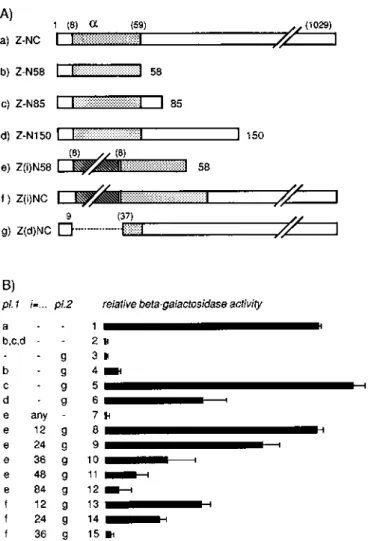
N-terminal position of LacZ (Fig. 1A). However, we were disappointed by the rapid loss of activity caused by prolonged repeats (see below). We reasoned that, analogously to procaryotic systems, the alpha peptide might be more stable towards such insertions. Surprisingly we could not find any report describing alpha complementation of LacZ in mammalian cells. Therefore, we constructed eucaryotic expression vectors that should produce either a lacZ omega peptide [Fig. 1A, construct g, called Z(d)NC] or different alpha peptides (constructs b–d, called Z-N58, Z-N85 and Z-N150, respectively). We have also compared the tolerance towards N-terminal inserts for the whole enzyme [construct f, Z(1)NC] or for an alpha peptide [construct e, Z(i)N58]. Transfec-tion of these constructs in various combinaTransfec-tions has produced the results shown in Figure 1B, where the length of the bars represents the relative enzymatic activity obtained from extracts of transiently expressing HeLa cells. The data clearly show that co-expression of alpha and omega peptides (lines 4–6 and 8–12) resuscitates enzymatic activity that is absent in the single components (see control lines 2 and 3). We find that the optimum length of the alpha complementing peptide is ∼85 amino acids
(line 5), while a shorter peptide (truncated at position 58) that is otherwise active in most prokaryotic systems (see Fig. 1 legend) demonstrates only a very weak alpha complementing activity (line 4). We could also demonstrate that alpha peptides are more tolerant towards insertions of foreign sequences (compare lines 8–12 with lines 13–15). The tolerance was tested with the relatively weak N58 alpha complementing peptide and we expect the N85 construct to be even more tolerant. We are looking forward to using similar peptides to monitor stability of dinucleotide repeats in mammalian cells. Recently we learned that expression of Z-N85 and Z(d)NC in yeast cells does also result in efficient trans complementation (D. Picard, personal communication). We observed the same complementation behaviour in other human cell lines (S. B. Verca, unpublished). Therefore, we are confident that these constructs can be used in a variety of eucaryotic cells.
The availability of this approach opens new perspectives in gene expression studies in cell cultures and animals, such as (i) easy monitoring of various fusion proteins in eucaryotic systems; (ii) facilitated packaging of small reporter peptides in size-constrained viral vectors; (iii) establishment of dual expression monitoring systems in which omega and alpha peptides are brought under distinct genetic control; (iv) study of protein trafficking, where only co-compartmentalization shall produce significant complementa-tion. Thus, we believe that this system will become the basis of many experiments and applications in eucaryotic systems.
ACKNOWLEDGEMENTS
We thank D. Picard for communication of unpublished results obtained with the LacZ elements described above. This work has been supported by the Schweizerischer Nationalfonds, the Kanton Zürich and the Kanton Fribourg.
REFERENCES
1 Ullmann, A., Jacob, F. and Monod, J. (1967) J. Mol. Biol., 24, 339–343. 2 Jacobson, R. H., Zhang, X.-J., DuBose, R. F. and Matthews, B. W. (1994)
Nature, 369, 761–766.
3 Ko, M. S., Nakauchi, H. and Takahashi, N. (1990) EMBO J., 9, 2835–2842.
4 Gallagher, C. N., Roth, N. J. and Huber, R. E. (1994) Prep. Biochem., 24, 297–304.
5 Rusconi, S., Severne, Y., Georgiev, O., Galli, I. and Wieland, S. (1990) Gene, 89, 211–221.
Nucleic Acids Research, 1996, Vol. 24, No. 6
1172
Figure 1. LacZ constructs and effects of their transient transfection in HeLa cells. (A) Constructs. The constructs were inserted in the expression vector pSCT (5) and only the part corresponding to the LacZ is shown. Open bars and shaded area, native LacZ sequences; numbers in parenthesis, position along genuine lacZ ORF; filled box, foreign amino acids; shaded area, region that is mostly used for alpha complementation in procaryotes (aa 8–58, found in most procaryotic alpha complementing peptides, our unpublished observations); hatched area, region in which CA repeat has been inserted in-frame (encoding a Thr–His repeat, the number (i) refers to the number of CA repeats, 12, 24, 36, 48 or 84); dotted line, deleted region in our omega peptide expression vector. Exact protein sequences: Escherichia coli LacZ: MTMITDSlavvlqrrdwenpgvtqlnrlaahp-pfaswrnseeartdrpsqqlrslngew...; pSCT Z-NC: MASWGSIPGNSlavvlqrrdwenpg-vtqlnrlaahppfaswrnseeartdrpsqqlrslngew...; pSCT Z(d)NC: MASWGSIPGwrn-seeartdrpsqqlrslngew.... (one-letter code: italics, non-LacZ sequences; lower case, residues necessary for alpha complementation; underlined, tryptophan position 37 which defines the amino border of our omega peptide construct). (B) Results of transfection. HeLa cells were transfected by CaPO4 co-precipitation in which equimolar amounts of alpha and omega peptide expression vectors or mock vectors were co-transfected. β-Galactosidase was measured in a colorimetric assay with ONPG as substrate. The three columns at left indicate the composition of transfection cocktail. pl.1, first component of the cocktail (plasmid 1); i=..., number of CA repeats in the construct; pl. 2, second component of the cocktail; numbers at left of bars serve for line identification; filled bars; relative enzymatic activity. Line 1 defines 100% with Z-NC construct, the percentage is calculated from several experiments in which different amounts of expression vectors were used. The T-bar represents the standard deviation from at least three experiments.