HAL Id: hal-02197259
https://hal.archives-ouvertes.fr/hal-02197259
Submitted on 30 Jul 2019HAL is a multi-disciplinary open access archive for the deposit and dissemination of sci-entific research documents, whether they are pub-lished or not. The documents may come from teaching and research institutions in France or abroad, or from public or private research centers.
L’archive ouverte pluridisciplinaire HAL, est destinée au dépôt et à la diffusion de documents scientifiques de niveau recherche, publiés ou non, émanant des établissements d’enseignement et de recherche français ou étrangers, des laboratoires publics ou privés.
Sterility, fecundity: what about the men?
Elise de la Rochebrochard
To cite this version:
Elise de la Rochebrochard. Sterility, fecundity: what about the men?. Population et sociétés, INED, 2001. �hal-02197259�
BULLETIN MENSUEL D’INFORMA
TION DE L
’INSTITUT NA
TIONAL D’ÉTUDES DÉMOGRAPHIQUES
H
uman reproduction is based on the sexual union of a man and a woman. Nonetheless, scientific re-search on fertility (births), fecundity (the ability to give birth) or contraception (birth control) is mainly devoted to women and practically ignores men. Some studies on male fecundity have been carried out, however. These focus on the role of men in three aspects of hu-man fecundity: couple infertility, the question of a pos-sible male fecundity decrease with age and the hypothesis that the fecundity of younger male genera-tions may be diminishing.The role of men in couple infertility
Thanks to effective contraception methods and abor-tion, couples can choose to have children when they “feel ready for it”. However, once this decision has been taken, they cease to be in control of the situation: some may conceive right away, others may take longer, and some never succeed; in addition, though most pre-gnancies lead to the birth of the child, others can be prematurely terminated due to miscarriage. Succeeding in having a child is a lottery; there is no way of predicting a priori which couples will have pro-blems and which will not. No biological indicator can determine whether a couple is more or less likely to succeed. To measure fecundity, one calculates aposte-riori the proportion of successful couples among all
those that are trying to conceive (probability of suc-cess). At the age of 25, the probability of success is, on average, of 25% per cycle (the time required for conception ranges from 3 to 6 months). If pregnancy has not occurred after a year, the couple is considered to be having trouble conceiving. In this case, the term
Sterility, fecundity: what about the men?
Élise de la Rochebrochard *
* INSERM (French National Institute of Health and Medical Research).
used is infertility: the couple probably has a low fe-cundity, whereas real cases of sterility — couples who have no chance of conceiving at all — are rare. To give the reader an idea of the extent of this problem, 13 to 14% of French couples have seen a physician once in their lives for infertility problems, but only 3% to 5% are diagnosed as being actually sterile [1].
For a long time, the causes of infertility were auto-matically attributed to the woman, men being a priori considered fecund (unless they were impotent). However, research findings of the last 30 years yield a very different picture: the origins of infertility seem to be more equally shared by men and women. Thus, in a survey conducted among infertile couples in three re-gions of France at the end of the 1980s [1], a male fe-cundity disorder was diagnosed in 6 out of 10 couples, and a female fecundity disorder in over 7 out of 10 couples (see table 1). These studies show that infertili-ty, to a large extent, is also a male problem.
In fact, instead of considering infertility as having a male or female source, these studies show it to be a problem pertaining to the couple. Indeed, in 4 out of 10 cases of infertility (see table 1), the problem was dia-gnosed as being related to both the man and the wo-man. The difficulty experienced by most of these couples in conceiving was not so much due to him or her as to their specific combination: indeed, if either partner had been instead with a very fecund person, a “compensation” phenomenon might have made it possible for the couple to have a child.
The question of age for men
The tendency to postpone childbirth observed in deve-loped countries raises the issue of the impact of age on fecundity: until what age is it possible to delay
child-Editorial – Sterility, fecundity: what about the men?
• The role of men in couple infertility - p. 1 • The question of age for men - p. 2 • Has male fecundity declined among the younger generations? - p. 3
What’s New – The 2000 Chinese population census - p. 4
CONTENTS
2
INED
Sterility, fecundity: what about the men?
Population et Sociétés, 371, September 2001
Women Men 15-19 20-24 25-29 30-34 35-39 40-44 45-49 50-54 55-59 100 90 80 70 60 50 40 30 20 10 0 100 94 80 79 71 47 97 95 87
Fecundity level in relationship to the maximum level (in %)
Age (in years) INED 18601 93 100 14 60 87 9 6 97
Figure 1 – Variations in fecundity according to the age of the man and the age of the woman
birth? What are the risks involved for those who choose to have children later in life?
Much research has been devoted to the impact of the woman’s age on childbirth. Thus, it has been shown that fecundity decreases as the age of the wo-man increases. Menopause (which occurs around the age of 50, on average) marks the end of a woman’s childbearing period. However, signs of decreasing fe-male fecundity begin to appear well before meno-pause (figure 1): chances of conceiving decrease, while the proportion of miscarriages, ectopic pregnancies and stillborn children increases, as well as the risk of having a child with birth defects, in particular Down’s syndrome.
As concerns the impact of the man’s age, we know next to nothing. The press has reported famous cases of late fatherhood: Yasser Arafat became a father at 66, Charlie Chaplin at 73, etc. An American scientific jour-nal has even reported the “authenticated” case of a man who fathered a child at the age of 94. These cases may give us the impression that the age of the father has a negligible impact on human fecundity. In reality, there are considerable variations in this respect, and the fact that some men are able to conceive at 66, 73 or even 94 does not mean that all men are able to do so. The impact of paternal age has been determined in a specific area, that of genetic diseases [2]. As the age of the man at the time of conception increases, so does the risk for the child to develop a genetic disease, in parti-cular those linked to a dominant autosomal muta-tion (1). Thus, cases of children with achondroplasia, Apert’s disease or Fibrodysplasia ossificans progressiva occur more frequently as the father grows older. To provide a scale of reference, among 1,000 children born of fathers over 40 at the time of conception, 3 to 5 are born with a dominant autosomal mutation [2]. This risk is as high as that of Down’s syndrome observed among children born to mothers aged 35 to 39 at the time of conception.
In addition, the impact of the age of the man on the
(1) A dominant autosomal mutation is a mutation affecting one of the 22 pairs of autosomal chromosomes (all the chromosomes except for the sexual chromosomes), and which asserts itself in the heterozygotic state.
(2) These studies are based on: the 1911 Irish census [3], genealogies collected by the Utah Genealogical Society among the Mormon population (women born between 1840 and 1879) [4], fertility sur-veys conducted at the end of the 1970s with nationally representati-ve samples of women aged 15 to 49 in firepresentati-ve derepresentati-veloping countries (Côte d'Ivoire, Ghana, Kenya, Sudan, Syria) [5].
probability of giving birth to a live baby was assessed in three studies conducted among couples who did not use birth control methods (2). The fecundity of these couples can be measured by studying births (in parti-cular the birth rate).
Figure 1 shows the impact of the age of the man and that of the woman, as assessed in one of these stu-dies [4]. These curves do not measure the level of fe-cundity but only the impact of age on fefe-cundity. For men, fecundity is at its highest between 30 and 34 (ra-ted 100), after which it slowly decreases. By the age of 55-59, male fecundity is twice as low (rated 47) as that observed at the age of 30-34. The couple’s fecundity thus decreases as the man’s age increases, even though this decrease is slower and occurs later than that linked to the age of the woman. Of course, these are initial findings and further research on this question remains necessary.
Source [4] – Estimations based on a regression carried out with 5,959 biographies of Mormon women born between 1840 and 1859.
Origin of infertility For 100 couples
Combined (male and female) 38
Only female 34
Only male 20
Origin unknown 8
Source [1] Survey among 1,686 couples having consulted a gynaecologist or an obstetrician (either independent or working in a hospital) between July 1988 and June 1989 in three French departments (Indre-et-Loire, Loire-Atlantique, Haute-Vienne) for an infertility problem (defined as a period of at least 12 months during which conception was hoped for but did not happen). The origins of infertility were evaluated on the basis of the 1,318 couples of which both partners were examined by a physician.
(3) Cryptorchidism – A congenital anomaly whereby one or both testicles fails to descend normally. This defect must be diagnosed as early as possible and corrected either with drugs or through surge-ry, in order to avoid permanent sterility and an increased risk of tes-ticular cancer. Another name for cryptorchidism is ectopic testis. (4) Hypospadias is a birth defect where the urethral opening is mis-located on the underside of the the penis shaft rather than at the tip. (5) Endocrine disrupters or modifiers are defined as exogenous agents that alter the production, storage, transport, metabolism, binding, action and breakdown of natural hormones.
Has male fecundity declined among the
younger generations?
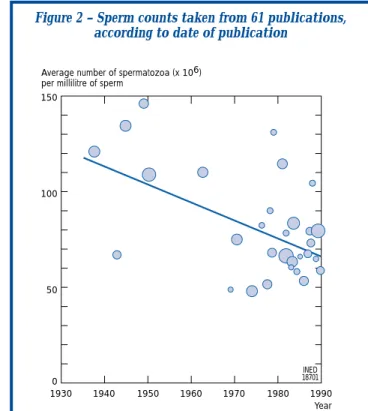
In 1992, a Danish team suggested the hypothesis of a de-crease in sperm count over the past 50 years [6] (see figu-re 2). Since then, many new studies have been devoted to the subject; the hypothesis of a reduction of male fecundi-ty has become more explicit and scientists now speak of a decline in both quantity (sperm count) and quality (moti-lity and morphology) of human semen, and of an increa-se in the incidence of congenital anomalies at birth, such as cryptorchidism (3) and hypospadias (4), as well as in the incidence of testicular cancer.
What are the reasons for this decline? The genetic hypothesis seems unlikely: this phenomenon is occur-ring at a rapid pace and has been observed in different geographic areas. Studies have focused on possible lifestyle and environmental changes. Among environ-mental factors, researchers are investigating the possible effect of toxic chemicals, in particular hormo-ne modifiers having an oestrogenic effect (5). Since the 1950s, the use of such chemicals has dramatically in-creased; they are used in many products such as pesti-cides, detergents, cosmetics and some prescription drugs. Thus, it seems that a number of chemicals used in agriculture, industry and in everyday life are hor-mone disrupters which are liable to contaminate the food chain, water and air. These toxic substances could have an impact on the male reproductive system not only at the adult stage but even during foetal develop-ment. Thus, the younger generations of boys, who might have been exposed during their mother’s pre-gnancy, could be more strongly affected. As concerns lifestyle factors, stress, alcohol and tobacco have been put forward as possible causes. The hypothesis of an increase in the temperature of testicles is more specifi-cally under investigation. Indeed, for a testicle to func-tion normally, its temperature must be 2 to 4 C° lower than normal body temperature. A slight rise in this temperature (around 2°C) can alter proper testicular functioning. Different behavioural factors linked to modern lifestyles could lead to this rise in temperature: people tend to remain sitting for long periods of time, wear tighter clothes (especially underclothes), or are professionally exposed to heat (welders, ceramists, steel workers, cooks).
These studies thus raise the issue of a possible de-cline of male fecundity among younger generations.
As we have seen, the issue of male fecundity pre-sently raises more questions than it yields answers.
INED Population et Sociétés, 371, September 2001
0 50 100 150 INED 18701 Average number of spermatozoa (x 106)
per millilitre of sperm
1930 1940 1950 1960 1970 1980 1990 Year
Figure 2 – Sperm counts taken from 61 publications, according to date of publication
Interpretation: each circle represents one study (the area of the circle is proportional to the logarithm of the number of subjects observed in the study). The blue line is the linear regression line (estimated by weighting each study per number of subjects observed).
Source [6] – Data resulting from the observation of 14,947 men in 61 articles published between 1938 and 1991.
REFERENCES
[1] P. THONNEAU, S. MARCHAND, A. TALLEC, M. L. FERIAL, B. DUCOT, J. LANSAC, P. LOPES, J. M. TABASTEand A. SPIRA
-“Incidence and main causes of infertility in a resident popu-lation (1,850,000) of three French regions (1988-1989)”, Human Reproduction, 1991, vol. 6, n° 6, p. 811-816.
[2] J.M. FRIEDMAN - “Genetic disease in the offspring of
older fathers”, Obstetrics and Gynecology, 1981, vol. 57, n° 6, p. 745-749.
[3] B.A. ANDERSON- “Male age and infertility. Results from Ireland prior to 1911”, Population Index, 1975, vol. 41, n° 4, p. 561-567.
[4] G.P. MINEAUand J. TRUSSELL- “A specification of marital
fertility by parents’ age, age at marriage and marital dura-tion”, Demography, 1982, vol. 19, n° 3, p. 335-350.
[5] N. GOLDMANand M. MONTGOMERY- “Fecundability and husband’s age”, Social Biology, 1989, vol. 36, n° 3-4, p. 146-166.
[6] E . CA R L S E N, A . GI W E R C M A N, N . KE I D I N G a n d
N.E. SKAKKEBAEK- “Evidence for decreasing quality of se-men during the past 50 years ”, British Medical Journal, 1992, vol. 305, n° 6 854, p. 609-613.
4 Sterility, fecundity: what about the men?
POPULATION ET SOCIÉTÉS. The monthly newsletter of the Institut national d’études démographiques ISSN 0184 77 83
Director of Publications: François Héran – Editor-in-chief: Gilles Pison – Assistant Editor: Catherine Guével – Translations Coordinator: Linda Sergent – Design and layout: Isabelle Brianchon – D.L. 3e term. 2001 – Ined: 133. boulevard Davout - 75980 Paris. Cedex 20. France – Telephone: (33) (0)1 56 06 20 00 – Fax: (33) (0)1 56 06 21 99 –
http://www.ined.fr – e.mail : [email protected]
The 2000 Chinese
population census
According to the November 2000 cen-sus, China has a population of 1.265 billion — 1.295 billion including Taiwan (22.3 million), Hong Kong (6.8 million) and Macao (0.44 million). National minorities have exceeded the symbolic threshold of 100 million (106.4) and represent 8% of the total figure. These results were more or less expected, given the trends shown in the annual surveys carried out throughout the 1990s with 1‰ popu-lation samples. The annual growth rate has now fallen below 1% and the fertility rate below the generation replacement level. In addition, theresults of the census correspond to those of the annual survey in three respects. First, the Chinese population is ageing: 23% of the population are under 15 and 7% are 65 or more, compared to 28% and 6% respectively in the last 1990 census.
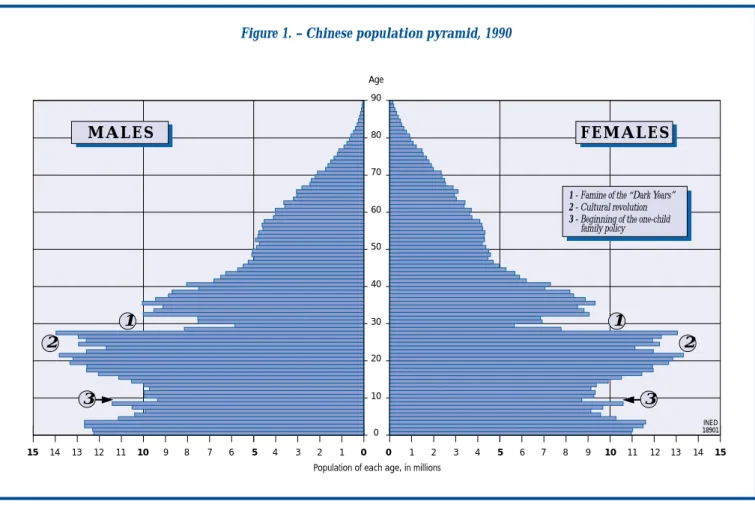
The base of the population pyramid is growing narrower; this trend, already observed in 1990 (see figure 1), is now accelerating. Second, China is an increasingly urban country: in 2000, 36% of the population lived in urban areas, 10 times more than in 1990; for the first time, the rural population has decreased in absolute terms: 807 mil-lion in 2000, against 841 milmil-lion in 1990. Last, the proportion of men is on the increase: the global sex ratio (the
number of males per 100 females) was 106.7 in 2000, up from 106.0 in 1990, whereas the sex ratio at birth reached 117, up from 111 ten years earlier. Data remains too scarce for us to be able to reconstruct reality and judge the qua-lity of the census data. However, para-doxically, due to its close similarity with the data of the annual surveys, the reliability of these figures is ques-tionable: in the 1980s, the annual sur-veys underestimated births by 5 to 20%, depending on the years; why should those of the 1990s be any more reliable? As soon as detailed data becomes available, we shall be in a position to answer these questions.
Isabelle Attané (INED)
0 1 2 3 4 5 6 7 8 9 10 11 12 13 14 15 0 1 2 3 4 5 6 7 8 9 10 11 12 13 14 15 0 10 20 30 40 50 60 70 80 90 Age
Population of each age, in millions
INED 18901
1 - Famine of the “Dark Years”
2 - Cultural revolution
3 - Beginning of the one-child
family policy 2 2 1 1 3 3 M A L E S F E M A L E S
Figure 1. – Chinese population pyramid, 1990