HAL Id: hal-01943949
https://hal.archives-ouvertes.fr/hal-01943949
Submitted on 4 Dec 2018
HAL is a multi-disciplinary open access
archive for the deposit and dissemination of
sci-entific research documents, whether they are
pub-lished or not. The documents may come from
teaching and research institutions in France or
abroad, or from public or private research centers.
L’archive ouverte pluridisciplinaire HAL, est
destinée au dépôt et à la diffusion de documents
scientifiques de niveau recherche, publiés ou non,
émanant des établissements d’enseignement et de
recherche français ou étrangers, des laboratoires
publics ou privés.
Verifying Robustness of Event-Driven Asynchronous
Programs Against Concurrency
Ahmed Bouajjani, Michael Emmi, Constantin Enea, Burcu Kulahcioglu
Ozkan, Serdar Tasiran
To cite this version:
Ahmed Bouajjani, Michael Emmi, Constantin Enea, Burcu Kulahcioglu Ozkan, Serdar Tasiran.
Veri-fying Robustness of Event-Driven Asynchronous Programs Against Concurrency. Programming
Lan-guages and Systems 26th European Symposium on Programming, ESOP 2017, Held as Part of the
European Joint Conferences on Theory and Practice of Software, ETAPS 2017, Uppsala, Sweden,
April 22–29, 2017, Proceedings, pp.170-200, 2017. �hal-01943949�
Verifying Robustness of Event-Driven
Asynchronous Programs against Concurrency
Ahmed Bouajjani1, Michael Emmi2, Constantin Enea1, Burcu Kulahcioglu
Ozkan3, and Serdar Tasiran3 1
Universit´e Paris Diderot, France
2
Bell Labs, Nokia, USA
3 Ko¸c University, Turkey
Abstract. We define a correctness criterion, called called robustness against concurrency, for a class of event-driven asynchronous programs that are at the basis of modern UI frameworks in Android, iOS, and Javascript. A program is robust when all possible behaviors admitted by the program under arbitrary procedure and event interleavings are admitted even if asynchronous procedures (respectively, events) are as-sumed to execute serially, one after the other, accessing shared memory in isolation. We characterize robustness as a conjunction of two correct-ness criteria: event-serializability (i.e., events can be seen as atomic) and event-determinism (executions within each event are insensitive to the in-terleavings between concurrent tasks dynamically spawned by the event). Then, we provide efficient algorithms for checking these two criteria based on polynomial reductions to reachability problems in sequential programs. This result is surprising because it allows to avoid explicit handling of all concurrent executions in the analysis, which leads to an important gain in complexity. We demonstrate via case studies on Android apps that the typical mistakes programmers make are captured as robustness violations, and that violations can be detected efficiently using our approach.
1
Introduction
Asynchronous event-driven programming is a widely adopted style for building responsive and efficient software. This style allows programmers to use asyn-chronous procedure calls that are stored for later executions, in contrast with synchronous procedure calls that must be executed immediately. Asynchronous calls are essential for event-driven programming where they correspond to call-backs handling the occurrences of external events. In particular, modern user interface (UI) frameworks in Android, iOS, and Javascript, are instances of asynchronous event-driven programming. These frameworks dedicate a distin-guished main thread, called UI thread, to handling user interface events. Since responsiveness to user events is a key concern, common practice is to let the UI thread perform only short-running work in response to each event, delegating to asynchronous tasks the more computationally demanding part of the work. These asynchronous tasks are in general executed in parallel on different background threads, depending on the computational ressources offered by the execution plat-form. The apparent simplicity of UI programming models is somewhat deceptive.
The difficulty of writing safe programs given the concurrency of the underlying execution platform is still all there.
A formal programming abstraction that is simple, yet exposes both the potential benefits and the dangers of the UI frameworks would go a long way in simplifying the job of the programmer. Programs written against this abstraction would then be insensitive to implementation and platform changes (e.g., automatic load balancing). Indeed, the choice of parameters such as the number of possible threads running in parallel, the dispatching policy of pending tasks over these threads, the scheduling policy for executing shared-memory concurrent tasks, etc., should be transparent to the programmer, and the semantics of a program should be independent from this choice. Therefore the conformance to this abstraction (in the sense that a program can be soundly abstracted according it) would be a
highly desirable correctness criterion.
The objectives of our work are (1) to provide such a programming abstraction that leads to a suitable correctness criterion for event-driven shared memory asynchronous programs, and (2) to provide efficient algorithms for verifying that a program is correct w.r.t. this criterion.
The programming abstraction we consider compares two semantics, the multi-thread and the single-multi-thread semantics.
– The multi-thread semantics reflects the concurrency of the actual program: The main (UI) thread and asynchronous tasks posted to background threads interact over the shared memory in a concurrent way. No limit on the number of tasks, no limit on the number of threads, and no restriction on the dispatching and scheduling policies are assumed.
– The single-thread semantics is a reference model where a program is supposed to run on a single thread handling user events in a serial manner, one after the other. Each event is handled by executing its corresponding code including the created asynchronous tasks until completion. The asynchronous tasks created by an event handler (and recursively, by its callee) are executed asynchronously (once the execution of the creator finishes) serially and in the order of their invocation.
While the multi-thread semantics provides greater performance and respon-siveness, the single-thread semantics is simpler to apprehend. The inherent non-determinism due to concurrency and asynchronous task dispatching from the multi-thread semantics is not present in the context of the single-thread one.
We consider that a desirable property of a program is that its multi-thread semantics is a refinement of its single-thread semantics in the sense that the sets of observable reachable states of the program w.r.t. both semantics are exactly the same. A program that satisfies this refinement condition is said to be robust against concurrency(or simply robust). In fact, robustness violations correspond to “concurrency bugs”, i.e., violations that are due to parallelization of tasks, and that do not show up when tasks are executed in a serial manner.
Then, let us consider the issue of verifying that a program is robust. We show that, surprisingly, for the class of UI event-driven asynchronous programs, it is possible to reduce in linear time the robustness verification problem to the state
reachability problem in sequential programs. Robustness can be checked on an (instrumented) sequential version of the program, without exploring explicitly all its concurrent executions, which allows to avoid state explosion and leads to a polynomial complexity. Let us consider in more details the way we achieve that.
First, we show that robustness against concurrency can be characterized as the conjunction of event-serializability and event determinism, which are variants of the classical notions of serializability and determinism, adapted to our context. Intuitively, since the single-thread semantics imposes a unique execution, given a set of external events (partially ordered w.r.t. some causality relation imposed by the environment), then (1) the executions of the event handlers must be serializable (to an order compatible with their causality relation), i.e., the execution of each event handler and its subtasks can be seen as an atomic transaction, and (2) the execution of each event handler is deterministic, i.e., it always leads to the same state, for any possible scheduling of its parallel subtasks.
To search efficiently for event-serializability and event-determinism violations, we make use of based approximations in the style of [27], called conflict-serializability and conflict-determinism, respectively. Indeed, these conflict-based criteria do not take into account actual data values, but rather syntactical dependencies between operations, e.g., writing to the same variable, which makes them stronger, but also “easier” to check, while still accurate enough for catching real bugs, introducing rarely false positives, as our experiments show. We reduce verifying conflict event-serializability and conflict event-determinism to detecting cycles in appropriately defined dependency (or happen-before) relations between concurrent events and asynchronous procedure invocations, respectively. Our key contribution is that these cycle detections can be done by reasoning about the computations of sequential programs instead of concurrent programs, avoiding explicit encodings of (potentially unbounded) sets of pending tasks and exploring all their possible interleavings. Let us explain this in more details.
An event handler is deterministic when all its executions have conflict-preserving permutations where tasks are executed serially in the same order as in the single-thread semantics. Scheduling tasks in this order corresponds to the DFS (Depth First Search) traversal of the call-tree of tasks (representing the relation caller-callee). We show that detecting a conflict-determinism violation, i.e., an asynchronous execution with no serial DFS counterpart, can be done by reasoning about an instrumented version of the procedural program obtained from the code of the event handler by roughly, turning asynchronous calls to synchronous ones. This instrumented program simulates borderline violations, if any, i.e., violations where removing the last action leads to a correct execution. We show that the amount of auxiliary memory needed to witness such violations is finite (and small). Moreover, such violations are “almost” asynchronous executions where tasks are scheduled serially according to the DFS traversal of the call-tree. Such executions can be simulated using synchronous procedure calls because roughly, the latter are also initiated according to the DFS traversal of the call-tree. However, they are interleaved in a different way compared to the asynchronous calls and the event handler must undergo a syntactic transformation described in Section 6.3.
A first issue in checking conflict-serializability is that the event handlers may consist of different concurrently-executing tasks. This issue is solved by assuming that the conflict-determinism check is done a-priori. If this check fails then the program is not robust and otherwise, checking conflict-serializability can assume sequential event handlers which are in fact the instrumented procedural programs used in the conflict-determinism check.
Even assuming sequential event handlers, general results about conflict-serializability state that this problem is PSPACE-complete for a fixed number of threads [6, 15], and EXPSPACE-complete for an unbounded number of threads [10] (assuming a fixed data domain and absence of recursive procedure calls). However, we prove that, in the programming model we consider in this paper, the problem of checking conflict-serializability is polynomial! This result relies on two facts: (1) there is only one distinguished thread, the UI thread, for which the order in which procedure invocations are executed is relevant, and (2) we assume that each asynchronous task executed in the background (not on the UI thread) is running on a fresh thread. This assumption is valid since background threads are not manipulated explicitly by the programmer but by the runtime, and therefore, we need to consider the situation where concurrency is maximal. In fact, we show that when events are conflict-deterministic, the problem of checking conflict-serializability can be reduced to a reachability problem in a sequential program. Again, we prove that it is sufficient to focus on a particular class of (borderline) violations of conflict-serializability. Then, we show that detecting these violations can be done by reasoning about the executions of a program where events are executed in a sequential manner, in any order (chosen nondeterministically), and where the tasks generated by each event are executed as in the single-thread semantics. For that, we define an instrumentation of that program that consists in simulating the delaying effects of the multi-thread semantics, guessing the actions involved in the violation and tracking the dependencies between them in order to check the correctness of the guess (that they indeed form a cycle). The cycle detection in the case of conflict-serializability is technically more complex than in the case of conflict-determinism. But still, a crucial point in the reduction is that we do not need to store the whole cycle during the search, but it is enough to maintain a fixed number of variables to traverse the elements of this cycle. This leads to a polynomial reduction of the conflict-robustness problem to a reachability problem in a sequential program.
Our reductions hold regardless of the used data domain, for programs with recursive procedure calls, and unbounded numbers of events and tasks. These reductions allow to leverage existing analysis tools for sequential programs to check conflict-robustness. When the data domain is bounded, we obtain a polynomial-time algorithm for checking conflict-robustness for UI event-driven asynchronous programs (with recursive procedure calls, and unboundedly many events and tasks).
We validate our approach on a set of real-life applications, showing that with few exceptions all detected robustness violations are undesirable behaviours. Interestingly, the use of conflict versions of the correctness criteria characterizing
robustness is efficient and quite accurate, producing only few false positives (that can be eliminated easily).
Finally, let us mention that our work leads in particular to an efficient approach for the verification of functional correctness of UI event-driven asynchronous programs that consists in reducing this problem to two separate problems: (1) showing that the program is functionally correct w.r.t the single-thread semantics, and (2) showing that the program is robust against concurrency. Both of these problems can indeed be solved efficiently by considering only particular types of computations that are captured by sequential programs.
To summarize, our contributions are:
– Introduction of the notion of robustness against concurrency that provides a programming abstraction for event-driven asynchronous programs, and its characterization as the conjunction of serializability and event-determinism.
– Efficient algorithms for checking robustness based on reductions from conflict event-serializability and conflict event-determinism to state reachability prob-lems in sequential programs. Decidability and complexity results for verifying robustness in the case of finite data domains.
– Experimentations showing the relevance of our correctness criteria and the efficiency of our approach.
2
Motivating Examples
We demonstrate the relevance of robustness using several excerpts from Android applications. To argue that robustness is not too strong as a requirement, we discuss two concurrency bugs reported in open-source repositories that are also robustness violations, more precisely, event-serializability and event-determinism violations. We also provide a typical example of a robust program.
2.1 A Violation to Event Serializability
A c t i o n E d i t T e x t m s g T x t ; b o o l e a n o n K e y ( . . . ) { // a c t i o n s on UI t h r e a d new S e n d T a s k (). e x e c u t e (); } v o i d o n D o u b l e C l i c k e d ( S t r i n g n a m e ){ t e x t += " " + n a m e ; m s g T x t . s e t T e x t ( t e x t ); } c l a s s S e n d T a s k e x t e n d s A s y n c T a s k { v o i d o n P r e E x e c u t e (){ e . c o m m a n d = m s g T x t . g e t T e x t (); } v o i d d o I n B a c k g r o u n d ( . . ) { w r i t e m s g T x t . g e t T e x t () i n t o J S O N obj /* c o r r e c t e d v e r s i o n : w r i t e e . c o m m a n d i n t o J S O N o b j */ } }
Fig. 1: A program with an event-serializability violation.
Figure 1 lists a a real code excerpt from the Android IrcCloud app [2] for chatting on the IRC. Under the con-crete multi-thread semantics, the user event of pressing the “send” key is handled by the procedure onKey. Ac-tions associated with this event han-dler include actions performed byonKey on the main (UI) thread, actions per-formed by SendTask.onPreExecute() on the UI thread before the actions per-formed asynchronously on a background thread by SendTasks’s doInBackground procedure. Another event handler in this example is onDoubleClicked, which ap-pends to the message text the namename of the user whose name is clicked on. The
multi-thread semantics allows interference between the two event handlers, onDoubleClicked can interleave with doInBackground. In contrast, the single-thread semantics allows no such interference. The event handlers and the asyn-chronous tasks they create are executed entirely on the UI thread, and all the tasks created byonKeyare executed before any other event handler invocation.
This program is not robust and a violation can be generated under the following scenario. Suppose that the user types “Hello”, presses “send”, and then double-clicks on another IRC user’s name. Under the multi-thread semantics, onDoubleClickedmay start running on the UI thread whileSendTask.doInBackground is in progress. These two procedures’ accesses can interfere with each other. In particular, the ordering ofmsgTxt.getText() with respect to the appending of nameto msgTxtdetermines whether “Hello” or “Hello foo” gets sent on the net-work. Moreover, sinceonKey first recordsmsg.getText()to a fielde.command, an execution of these two events can end in a program state in which e.command contains “Hello” whilemsgTxtcontains “Hello foo”. This end state is not possible with any execution of these two event handlers under the single-thread semantics, where the event handlers are executed serially one after the other. This is a violation to event serializability. Actually, this behavior was reported as a bug, and the code was updated [1] so thate.command(instead ofmsgTxt, which may have changed) is written into a JSON object and sent on the network. It was the designers’ intent for the entire event handling code for the “send” key to appear atomic. With this modification the program becomes robust.
2.2 A Violation to Event Determinism
v o i d i c o n P a c k U p d a t e d (){ new T h r e a d ( new R u n n a b l e (){ v o i d run () { .. m A d a p t e r = new A p p R o w A d a p t e r ( . . ) ; } } ). s t a r t (); new H a n d l e r (). p o s t D e l a y e d ( new R u n n a b l e () { v o i d run () { .. if ( s e t A d a p t e r ) l i s t V i e w . s e t A d a p t e r ( m A d a p t e r ); .. m A d a p t e r . n o t i f y D a t a S e t C h a n g e d (); } } , 1 0 0 0 ) ; }
Fig. 2: A program with an event-determinism violation.
Figure 2 lists an event handler called iconPackUpdated which creates an asyn-chronous task (the first runnable to be ex-ecuted by the created thread) to initialize the mAdapter object. Then it creates an-other task, to be run by the UI thread, that usesmAdapterto update the list view of displayed icons. In an effort to ensure that the second task runs after the first task completes, the programmer posts the second task after a second’s delay.
Under the concrete multi-thread seman-tics, it is possible for the first task not to complete even after a second. In this case, the second runnable code will produce a null pointer exception, while in other schedules, the code works as intended. Although the programmer had intended a deterministic outcome there are executions with different outcomes, including errors. Therefore, this event handler is not event-deterministic, and not robust. 2.3 A Robust Program
The program in Figure 3 has two event handlerssearchForNewsandshowDetail which can be invoked by the user to search for news containing a keyword and to display the details of a selected news respectively.
// E v e n t 1 v o i d s e a r c h F o r N e w s ( S t r i n g key ) { new S e a r c h T a s k . e x e c u t e ( key ); new S a v e T a s k . e x e c u t e ( key ); } // E v e n t 2 v o i d s h o w D e t a i l ( int id ) { // s h o w d e t a i l of t h e i d t h n e w s new D o w n l o a d T a s k . e x e c u t e ( id ); } c l a s s S a v e T a s k e x t e n d s A s y n c T a s k { v o i d d o I n B a c k g r o u n d ( S t r i n g key ) { // w r i t e k e y to t h e d a t a b a s e } } c l a s s S e a r c h T a s k e x t e n d s A s y n c T a s k { L i s t r e s u l t = n u l l ; v o i d d o I n B a c k g r o u n d ( S t r i n g key ) { r e s u l t = ... // g e t f r o m t h e n e t w o r k } v o i d o n P o s t E x e c u t e () { l i s t = r e s u l t ; // d i s p l a y t h e l i s t of t i t l e s } } c l a s s D o w n l o a d T a s k e x t e n d s A s y n c T a s k { S t r i n g c o n t e n t = n u l l ; v o i d d o I n B a c k g r o u n d ( int id ) { c o n t e n t = ... // g e t f r o m t h e n e t w o r k } v o i d o n P o s t E x e c u t e () { // d i s p l a y t h e c o n t e n t } }
Fig. 3: A robust program.
The proceduresearchForNewscreates twoAsyncTaskobjectsSearchTaskand SaveTask whoseexecute method will invoke asynchronouslydoInBackground fol-lowed by onPostExecute, in the case of the former. Under the multi-thread semantics, doInBackgroundis invoked on a new thread andonPostExecuteis in-voked on the main thread. When the user input to search for news is triggered, the invocationdoInBackgroundofsearchTaskconnects to the network, searches for the keyword and fetches the list of resulting news titles. Then, the invocation onPostExecutedisplays the list of titles to the user.SaveTask saves the keyword to a database representing the search history in the background. The background tasksSearchTask.doInBackgroundand SaveTask.doInBackground might interfere but any interleaving produces the same result, i.e.,searchForNewsis deterministic.
The second event, to show the details of a title, can be triggered once the list of titles are displayed on the screen. It invokes an asynchronous task to download the contents of the news in the background and then displays it. In this case, the tasks are executed in a fixed order and the event is trivially deterministic.
Concerning serializability, the invocation ofSaveTaskin the first event and the second event might interleave (under the concrete semantics). However, assuming that the second event is triggered once the results are displayed, any such interleaving results in the same state as a serial execution of these events.
3
Programs
In order to give a generic definition of robustness, which doesn’t depend on any particular asynchronous-programming platform or syntax, we frame our discussion around the abstract notion of programs defined in § 3.1. Two alternative multi-thread and single-multi-thread semantics to programs are given in § 3.2 and § 3.3. We consider programs that are data-deterministic, in the sense that the evaluation of every (boolean) expression is uniquely determined by the variable valuation. 3.1 Asynchronous Event-Driven Programs
We define an event handler as a procedure which is invoked in response to a user or a system input. For simplicity, we assume that inputs can arrive in any order. Event handlers may have some asynchronous invocations of other procedures, to be executed later on the same thread or on a background thread.
x := y y := x assume y call p(y) async[w] p(y) return
Fig. 4: A canonical program syntax. The metavariables x and y range over global and local variable names, respectively, p ranges over procedure names, and w over the symbols “main” and “any.”
We fix sets G and L of global and local program states. Local states ` ∈ L represent the code and data of an asynchronous procedure or event-handler invocation, including the code and data of all nested synchronous procedure calls. A program is defined as a mapping between pairs of global and local states which gives the semantics of each statement in the code of a procedure (the association between threads, local states, and procedure invocations is defined in § 3.2 and § 3.3). To formalize the conflict-based approximation of robustness, this mapping associates with each statement a label called program action that records the set of variables read or written and the asynchronous invocations in that statement. An event set E ⊂ L is a set of local states; each e ∈ E represents the code and data for a single event handler invocation (called event for short).
Formally, let X = {rd(x), wr(x) : x ∈ . . .} be the set of memory accesses, W = {main, any} the set of invocation places, and B = {invoke(`, w) : ` ∈ L, w ∈ W }∪ {return} ∪ X ∪ {ε} the set of program actions, where ε represents irrelevant program actions. The rd(x) and wr(x) represent read and write accesses to variable x; invoke(`, w) represents an asynchronous invocation whose initial local state is `; the invocation is to be run on a distinguished main thread when w = main, and on an arbitrary thread when w = any. Finally, the return program action represents the return from an asynchronous procedure invocation.
A program P : G × L → G × L × B maps global states g ∈ G and local states ` ∈ L to new states and program actions; each P (g, `) represents a single program transition. We assume that when b is an asynchronous invocation or return program action and P (g, `) = hg0, , bi then g = g0.
Canonical Program Syntax. Supposing that the global states g ∈ G are maps from program variables x to values g(x), and that local states ` ∈ L map program variables y to values `(y) and a program counter variable pc to program statements `(pc), we give an interpretation to the canonical program syntax listed in Figure 4. For simplicity, we omit the interpretation of synchronous procedure calls call p(y) which is defined as usual. For instance, writing `+ to denote
`[pc 7→ `(pc)+1], then P (g, `) is
– hg[x7→`(y)], `+, wr(x)i when `(pc) is a global-variable write x := y,
– hg, `+[y7→g(x)], rd(x)i when `(pc) is a global-variable read y := x,
– hg, `+, rd(y)i when `(pc) is assume(y) and `(y) 6= 0,
– hg, `, εi when `(pc) is assume(y) and `(y) = 0,
– hg, `+, invoke(`0, w)i when `(pc) is an asynchronous invocation async[w]
p(y), where `0 maps the parameters of procedure p to the invocation
argu-ments y and pc to the initial statement of p, and – hg, `, returni when `(pc) is the return statement.
The semantics of other statements, including if-then-else conditionals, while loops, or goto statements, etc., is standard, and yield the empty program action ε.
An event is called sequential when its code doesn’t contain asynchronous invo-cations async[w] p(y). Also, a program P with event set E is called sequential when every event e ∈ E is sequential. Otherwise, P is called concurrent. 3.2 Multi-thread Asynchronous Semantics
Our multi-thread semantics maximizes the set of possible program behaviors by allowing events to interleave and interfere with each other. It dispatches the event handlers serially on the main thread but allows the asynchronous procedure invocations to execute on separate threads, and not necessarily in invocation order. Configurations of the multi-thread semantics thus maintain sets of running procedure invocations as well as an unordered queue of pending invocations, and invocations are associated with events and threads.
To characterize executions by the event-serializability and event-determinism criteria, we expose the following set A of actions in execution traces:
A ={start(j), end(j) : j ∈ N} ∪ X ∪ {invoke(i), begin(i), return(i) : i ∈ N} By convention, we denote asynchronous procedure invocation, event, and thread identifiers, respectively, with the symbols i, j, k. The start(j) and end(j) actions represent the start and end of event j; the invoke(i), begin(i), and return(i) actions represent an asynchronous procedure invocation (when it is added to the queue of pending invocations), the start of i’s execution (when it is removed from the queue), and return of i, respectively. The set X of memory accesses is defined as in the program actions of Section 3.1.
A task u = h`, i, j, ki is a local state ` ∈ L along with invocation, event and thread identifiers i, j, k ∈ N, and U denotes the set of tasks. We write invoc(u), event(u), and thread(u) to refer to i, j, and k, respectively. A configuration c = hg, t, qi is a global state g ∈ G along with sets t, q ⊆ U of running and waiting tasks such that: (1) invocation identifiers are unique, i.e., invoc(u1) 6= invoc(u2)
for all u16= u2∈ t ∪ q, and (2) threads run one task at a time, i.e., thread(u1) 6=
thread(u2) for all u16= u2∈ t. The set of configurations is denoted by Cm. We say
that a thread k is idle in c when k 6∈ {thread(u) : u ∈ t}, and that an identifier i, j, k is fresh when i, j, k 6∈ {α(u) : u ∈ (t ∪ q)} for α ∈ {invoc, event, thread}, respectively. A configuration is idle when all threads are idle.
The transition function → in Figure 5 is determined by a program P and event set E, and maps a configuration c1∈ Cm and thread identifier k ∈ N to
another configuration c2∈ Cmand label λ = hi, j, ai where i and j are invocation
and event identifiers, and a ∈ A is an action — we write invoc(λ), event(λ), and act(λ) to refer to i, j, and a, respectively. event transitions mark the beginnings of events. We assume that all events are initiated on thread 0, which is also referred to as the main thread. Also, for simplicity, we assume that events can be initiated arbitrarily at any time. Adding causality constraints between events, e.g., one event can be initiated only when a certain action has been executed, is possible but tedious. async transitions create pending asynchronous invocations, dispatch transitions begin the execution of pending invocations, and return transitions signal their end (the condition in the right ensures that this is not a return from an event). end event transitions mark the end of an event and by
event
e ∈ E i, j are fresh
g, t, q−−−−−−−−−−−→ g, t, q ∪ {he, i, j, 0i}0,h ,j,start(j)i
async
P (g, `1) = h , `01, invoke(`2, w)i u2= h`2, i2, j, k2i
i2is fresh k2is 0 if w = main or fresh otherwise
g, t ∪ {h`1, i, j, ki}, q−−−−−−−−−−−−−→ g, t ∪ {h`k,hi,j,invoke(i2)i 01, i, j, ki}
dispatch
u = h`, i, j, ki k is idle
g, t, q ∪ {u}−k,hi,j,begin(i)i−−−−−−−−−−−→ g, t ∪ {u}, q
return
P (g, `) = h , , returni j ∈ {event(u) : u ∈ t ∪ q}
g, t ∪ {h`, i, j, ki}, q−−−−−−−−−−−−→ g, t, qk,hi,j,return(i)i
end event
P (g, `) = h , , returni j 6∈ {event(u) : u ∈ t ∪ q}
g, t ∪ {h`, i, j, ki}, q−−−−−−−−−−−−−−−−−−−−−−−−→ g, t, qk,hi,j,return(i)i k,hi,j,end(j)i
local
P (g, `) = hg0, `0, ai a ∈ {ε, rd(x), wr(x)}
g, t ∪ {h`, i, j, ki}, q−k,hi,j,ai−−−−−−→ g0, t ∪ {h`0, i, j, ki}, q
Fig. 5: The multi-thread transition function → for a program P with event set E. an abuse of notation, they map c1 and k to a configuration c2 and two labels,
return(i) denoting the end of the asynchronous invocation and end(j) denoting the end of the event. All other transitions are local.
An execution of a program P under the multi-thread semantics with event set E to configuration cnis a configuration sequence c0c1. . . cnsuch that cm
km,λm+1
−−−−−−→ cm+1 for 0 ≤ m < n. We say that cn is reachable in P with E under the
multi-thread semantics, and we call the sequence λ1. . . λn the trace of c0c1. . . cn. The
reachable states of P with E, denoted Rm(P, E), is the set of global states in
reachable idle configurations. The set of traces of P with E under the multi-thread semantics is denoted byJP, E Km. We may omit P when it is understood from the context, and writeJE Km instead ofJP, E Km.
The call tree of a trace τ is a ranked tree CallTreeτ = hV, E, Oi where V are
the invocation identifiers in τ , and the set of edges E contains an edge from i1
to i2whenever i2 is invoked by i1, i.e., τ contains a label hi1, , invoke(i2)i. The
function O : E → N labels each edge (i1, i2) with an integer n whenever i2 is
the nth invocation made by i1, i.e., hi1, , invoke(i2)i is the nth label of the form
hi1, , invoke( )i occurring in τ (reading τ from left to right).
3.3 Single-thread Asynchronous Semantics
Conversely to the multi-thread semantics of Section 3.2, our single-thread se-mantics minimizes the set of possible program behaviors by executing all events and asynchronous invocations on the main thread, the asynchronous procedure invocations being executed in a fixed order.
We explain the order in which asynchronous invocations are executed using the event handler searchForNews in Figure 3. This event handler is supposed to add the keyword to the search history only after the fetching of the news containing that keyword succeeds. This expectation corresponds to executing the asynchronous procedures according to the DFS traversal of the call tree. In general, this traversal is relevant because it preserves causality constraints which are imprinted in the structure of the code, like in the case of standard synchronous procedure calls. Note however that this semantics is not equivalent to interpreting asynchronous invocations as synchronous, since the caller finishes before the callee starts. In the formalization of this semantics, the DFS traversal is modeled using a stack of FIFO queues for storing the pending invocations.
event
e ∈ E i, j are fresh
g, ⊥, ε============0,h ,j,start(j)i⇒ g, ⊥, he, i, j, 0i
end event
P (g, `) = h , , returni
g, h`, i, j, ki, ε=========================⇒ g, ⊥, εk,hi,j,return(i)i k,hi,j,end(j)i
async
P (g, `1) = h , `01, invoke(`2, w)i u2= h`2, i2, j, 0i i2is fresh
g, h`1, i, j, ki, q · f=0,hi,j,invoke(i2)i=============⇒ g, h`01, i, j, ki, q · (f ◦ i2)
dispatch u = h`, i, j, ki f = u ◦ f0 q0is hi if f0= hi or f0· hi, otherwise g, ⊥, q · f =0,hi,j,begin(i)i===========⇒ g, u, q · q0 return P (g, `) = h , , returni j ∈ {event(u) : u ∈ q} g, h`, i, j, ki, q=k,hi,j,return(i)i============⇒ g, ⊥, q local P (g, `) = hg0, `0, ai a ∈ {ε, rd(x), wr(x)}
g, h`, i, j, ki, q=k,hi,j,ai======⇒ g0, h`0, i, j, ki, q
Fig. 6: The single-thread transition function ⇒ for a program P with events E (ε and hi are the empty sequence and tuple, resp.,). Also, f and f0 are tuples, and q
is obtained by popping a queue from q if this queue is empty, or q = q, otherwise. The formalization of the single-thread semantics reuses the notions of task and label in §3.2. Let U0 be the set of tasks u = h`, i, j, 0i executing on thread 0.
We overload the term configuration which in this context is a tuple c = hg, u, qi where g ∈ G, u ∈ (U0∪ {⊥}) is a possibly-empty task placeholder (at most one
task is running at any moment), and q ∈ (Tuples(U0))∗ is a sequence of tuples of
tasks (a tuple, resp., a sequence, denotes a FIFO queue, resp., a stack). Csis the
set of configurations of the single-thread semantics. We call c ∈ Cs idle if u = ⊥.
The transition function ⇒ in Fig. 6 is essentially a restriction of → where all the procedures run on the main thread, an event begins when there are no pending invocations, and the rules async and dispatch use a stack of FIFO queues for storing pending invocations. The effect of pushing/popping a queue to the stack or enqueuing/dequeueing a task to a queue is represented using the concatenation operation ·, resp.,◦, for sequences, resp., tuples. Every task created by async is posted to the main thread and it is enqueued in the queue on the top of the stack q. dispatch dequeues a pending task from the queue f on the top of q, and pushes a new empty queue to q (for storing the tasks created during the newly started invocation) if f doesn’t become empty. Moreover, the rules return and end event pop the queue on the top of q if it is empty.
An execution of a program P under the single-thread semantics with event set E to configuration cnis a sequence c0c1. . . cn s.t. cm
0,λm+1
−−−−−→ cm+1for 0 ≤ m < n.
We say that cnis reachable in P with E under the single-thread semantics, and we
call the sequence λ1. . . λn the trace of c0c1. . . cn. The reachable states of P with
E, denoted Rs(P, E), is the set of global states reachable in idle configurations.
The set of traces of P with E under the single-thread semantics is denoted byJP, E Ks (P may be omitted when it is understood from the context).
4
Robustness of Asynchronous Programs
Our robustness criterion is defined as the equality of the single-thread and multi-thread semantics of a program, and decomposed into two independently-checkable criteria, event serializability and event determinism.
Given a program P with event set E, each execution under the single-thread semantics can be simulated by an execution under the multi-thread semantics: the latter corresponds to a special scheduling policy that consists in executing all tasks created by an event before starting executing tasks corresponding to another event, and moreover, tasks are executed atomically, in the order given by the DFS traversal of the call tree. This implies that the multi-thread semantics is a relaxation of the single-thread semantics, and therefore, Rs(P, E) ⊆ Rm(P, E).
The reverse direction is the most interesting one:
Definition 1 (Robustness). A program P with events E is robust against concurrency (or simply robust) when all reachable states in the multi-thread semantics are also reachable in the single-thread semantics:Rm(P, E) ⊆ Rs(P, E).
Robustness means that for the considered program, the concurrency intro-duced by the multi-thread semantics does not modify the set of observable states, i.e., Rm(P, E) = Rs(P, E). We introduce in the following two correctness criteria
that capture precisely the notion of robustness.
We say an execution with trace λ1· · · λn is event-serial when for all n1< n3,
if act(λn1) = start(j) and act(λn3) = start(j
0), then there is n
2 such that
n1< n2< n3 and act(λn2) = end(j).
Definition 2 (Event-serializability). A program P with events E is event-serializable if every global state in Rm(P, E) can be reached by an event-serial
execution 4.
Given an event e, an e-execution starting from global state g0is a g0-initialized
execution (according to the multi-thread semantics) with trace λ1· · · λnsuch that
(1) act(λ1) = start(j), (2) act(λn) = end(j), for some j, and (3) for every m ∈ N
such that 1 < m < n, act(λm) is neither a start nor an end action. Intuitively,
we consider executions of individual events, from their starting point until the completion of all the tasks they have created. Then, let Rm(P, g0, e) be the set
of global states in final configurations of e-executions starting from g0. Notice
that e-executions from g0differ by the scheduling order of the tasks created by e
that are running in parallel on different threads.
Definition 3 (Event-determinism). An evente of a program P is determin-istic if for every global state g0, the setRm(P, g0, e) is a singleton or empty. A
program P with events E is event-deterministic, if every e ∈ E is deterministic. Notice that our notion of determinism is defined for events that are running alone, without interference of other events.
Theorem 1. A program is robust against asynchrony if and only if it is event-serializable and event-deterministic.
5
Conflict robustness
Following an idea introduced in the context of database transactions [27], we define a syntactic, conservative notion of conflict robustness that is the conjunction of two properties: conflict-event serializability and conflict-event determinism.
4 For simplicity, we have ignored the set of events which are executed when comparing
global state reached by aribitrary and event-serial executions, resp. Reaching a global state using the same set of events is easy to formalize but tedious.
5.1 Conflict-Event Serializability.
Let ≺⊆ A × A be a conflict relation that relates any two actions a, a0 accessing
the same variable, i.e., a, a0 ∈ {rd(x), wr(x)} for some x, one of them being a
write. A trace is conflict-event serializable iff the “conflict-event graph” which tracks the conflict relation between concurrent events is acyclic.
Formally, the conflict-event graph of a trace τ is the directed graph EvGτ=
hV, Ei whose nodes V are the event identifiers of τ , and which contains an edge from j1 to j2 when τ contains a pair of labels λ1 and λ2 such that λ1 occurs
before λ2, act(λ1) ≺ act(λ2), event(λ1) = j1, and event(λ2) = j2.
Definition 4. A traceτ is called conflict-event serializable when EvGτ is acyclic.
A program P with event set E is conflict-event serializable iff every trace in JP, E Kmis conflict serializable.
A permutation τ0 of a trace τ is conflict-preserving when every pair λ 1, λ2of
labels in τ appear in the same order in τ0 whenever act(λ
1) ≺ act(λ2). Note that
a conflict-preserving permutation τ0 leads to the same global state as the original
trace τ . From now on, whenever we use permutation we mean conflict-preserving permutation.A trace τ is conflict-event serializable iff it is a conflict-preserving permutation of an event-serial trace.
Theorem 2. A program P with event set E is event-serializable when it is conflict-event serializable.
5.2 Conflict Determinism.
We define conflict determinism, which is also based on the acyclicity of a certain class of “conflict graphs”, called conflict-invocation graphs. These graphs represent the conflicts between the asynchronous invocations, but also the order in which these invocations would be executed under the single-thread semantics, i.e., the DFS traversal of the call tree. If the conflict-invocation graph of every trace τ of an event e is acyclic, then e is deterministic because every trace τ is a conflict-preserving permutation of the trace t0corresponding to the single-thread
semantics, and thus leads to the same global state as t0.
Given a trace τ , let <dfs be the total order between the invocation identifiers
in τ defined by the DFS traversal of CallTreeτ. The conflict-invocation graph
of a trace τ is the directed graph InvG(τ ) = hV, Ei whose nodes V are the asynchronous invocation identifiers in τ , and which contains an edge from i1 to
i2 when i1<dfs i2, or τ contains a pair of labels λ1 and λ2 of i1 and i2, resp.,
such that act(λ1) ≺ act(λ2) and λ1occurs before λ2.
Definition 5. A trace τ is DFS-serial iff InvG(τ ) is acyclic. An event e is conflict-deterministic iff every trace inJeKm is DFS-serial.
A trace τ is called invocation-serial iff for every three labels λ1, λ2, λ3occurring
in τ in this order, if invoc(λ1) = invoc(λ3), then invoc(λ1) = invoc(λ2). For an
event e, a DFS-serial trace τ in JeKm is a permutation of an invocation-serial trace τ0∈JeKm where invoc(λ1) <dfs invoc(λ2) for every two labels λ1 and λ2 occurring in this order in τ0.
6
Checking Conflict Determinism
We reduce the problem of checking conflict determinism of an event to a reachabil-ity problem in a sequential program. We present the reduction in two steps. First, conflict determinism of an event interpreted under the multi-thread semantics, whose asynchronous invocations run concurrently, is reduced to a reachability problem in a program running on the single-thread semantics, where asynchronous invocations are executed serially (Section 6.1 and 6.2). The latter is then reduced to a reachability problem in a sequential program (Section 6.3).
This reduction uses the fact that a certain class of conflict determinism violations can be simulated by a sequential program up to conflict-preserving permutations of actions (note that any conflict-preserving permutation of a violation is also a violation). This class of violations called borderline violations are minimal in the sense that removing the last action leads to a correct trace. Besides the simulation, we show that fixed-size additional memory is required to witness the conflicts inducing a cycle in the conflict invocation graph.
Definition 6 (Borderline Conflict Determinism Violation). A trace τ is a borderline violation to conflict determinism if it is not DFS-serial but every strict prefix of τ is DFS-serial.
For instance, the trace τ1 given in Figure 7(a) contains a borderline violation.
This trace is generated by an event e that invokes two procedures p and q in this order, each procedure on a different thread. The only conflict between memory accesses is that between the wr(x) actions in q and resp., p. The conflict-invocation graph of τ1 contains a cycle between the invocations of p and q: the edge from
the invocation of p to that of q is implied by the fact that p is invoked before q within the same procedure (we have “p <dfs q”), and the edge in the other
direction exists because q writes to the variable x before p does. The trace τ1until
after the second wr(x) is a borderline violation since its maximal strict prefix (without the second wr(x)) is DFS-serial. The last label of a borderline violation τ , in this example wr(x), is called the pivot of τ . The label of τ which precedes and conflicts with its pivot and which induces the cycle in its conflict-invocation graph is called the root of τ . Formally, if i1 is the invocation containing the pivot
of τ , the root of τ is an action conflicting with the pivot and which is included in an invocation i2 such that i1<dfs i2. For the trace in Figure 7(a), the root is
the action wr(x) in the invocation of q. 6.1 Simulating Borderline Violations
We define a code-to-code translation from an event e to an event detStr−(e) which simulates5permutations of every DFS-serial or borderline violation trace in
JeKm. The event detStr−(e) uses additional non-deterministically enabled statements to simulate the particular interleavings present in those traces. The instrumentation required to witness violations is introduced in Section 6.2.
Overview We give an informal description of the translation using as examples the traces pictured in Figure 7.
5
We refer to the standard notion of (stuttering) simulation where (sequences of) transitions in detStr−(e) are mapped to transitions of e.
p e q wr(x) DFS-serial borderline violation wr(x) ` : p e q wr(x) DFS-serial borderline violation wr(x) ` : p e q wr(x) DFS-serial borderline violation wr(x) ` : p e q wr(x) DFS-serial borderline violation wr(x) ` : e q wr(x) DFS-serial borderline violation wr(x) ` : p delay ` : pivotLabel:= ` goto pivotLabel (a) (b) (c) e q wr(x) q wr(x) skip skip goto pivotLabel e p delay ` : pivotLabel:= ` p wr(x) DFS-serial borderline violation ` : wr(x) ` : DFS-serial borderline violation e q wr(x) q wr(x) skip skip goto pivotLabel e p delay ` : pivotLabel:= ` p wr(x) DFS-serial borderline violation ` : wr(x) ` : DFS-serial borderline violation q e p1 p3 No memory conflicts e p1 q p2 p3
[main] [any] [main] [main] q e p1 p3 No memory conflicts q e p3 No memory conflicts p1 skip p2 skip skip (d) (e) (f) (g)
Fig. 7: Simulating borderline conflict determinism violations on the single-thread semantics. The event e makes two fresh thread asynchronous invocations to p and q in this order. Boxes represent sequences of trace labels ordered from top to bottom. Actions of the same thread are aligned vertically. The arrows represents transition label conflicts. For readability, we omit the event and task identifiers in the trace labels and keep only the memory accesses. The grey blocks labeled by delay, resp., skip, denote sequences of actions that are delayed, resp., skipped. Delaying the pivot We first explain the simulation of the invocation that contains the pivot, which may interfere with invocations that are supposed to be executed later under the single-thread semantics. For the borderline violation in Figure 7(a), the invocation of p that contains the pivot wr(x) destroys the value written to x by q, an invocation which is executed after p under the single-thread semantics.
The maximal strict prefix (ending before the second wr(x)) is DFS-serial and can be reordered to a trace where the order between transition labels is consistent with the invocation order (i.e., e before p and before q). Figure 7(b) pictures such a reordering, denoted by τ0
1. Our goal is to show that the trace τ10
can be simulated by an execution under the single-thread semantics of a slightly modified version of e. First note that τ0
1 is not admitted by the single-thread
semantics of e because the invocation of p is only partially included in this prefix. And the single-thread semantics executes every task until completion. However, it is possible to “delay” the execution of the pivot wr(x) in p until q finishes, even under the single-thread semantics, by adding a suitable set of auxiliary
variables to e. This mechanism is pictured in Figure 7(c). Every statement in the procedure p is guarded by (the negation of) an auxiliary boolean flag skip which can be non-deterministically flipped to true in order to skip over statements. Moreover, an auxiliary global variable pivotLabel will record the next control flow label ` when this flag is set to true. Then, extending the invocation of q with goto pivotLabelallows to resume the invocation of p and execute the pivot. To simulate every borderline violation, the goto statement is non-deterministically enabled in every invocation.
Incomplete invocations While the violation in Figure 7(a) includes only one incomplete invocation (the one containing the pivot) this is not always the case. A borderline violation may contain unboundedly-many other incomplete invocations. For instance, the violation in Figure 7(d) includes incomplete invocations of e and q (they finish after the pivot). Should the simulation of this borderline violation execute e and q entirely, the pivot may never be enabled. The correct simulation, pictured in Figure 7(e), will make use of the same mechanism based on the boolean flag skip in order to skip over statements in e and q. In general, an invocation can be skipped in its entirety. This simulation also shows that the goto statement can be executed after an incomplete invocation.
Main thread invocations The last issue concerns the main thread which has the particularity of being able to execute more than one invocation (all the other threads execute a single invocation). It executes invocations serially and only the last one may be incomplete. For instance, consider the DFS-serial trace τ3
pictured in Figure 7(f). This is the trace of an event e that invokes p1, q, p2,
and p3, in this order, and except q all the tasks are assigned to the main thread.
Since p1 is invoked before p3, a DFS-serial permutation τ30 of τ3 contains the
incomplete invocation of p1 before the complete invocation of p3, as shown in
Figure 7(g). None of the semantics we defined allows such traces. The problem is that both invocations are executed by the main thread which has to complete a task before executing another one. Our simulation will however admit such traces but it will verify that they are conflict-preserving permutations of valid traces. This verification procedure (included in the definition of detStr−(e)) checks that the conflict invocation graph doesn’t contain a path of memory conflicts, i.e., conflicts induced by read and write accesses, from the incomplete invocation on the main thread to any future complete invocation on the same thread. Let us consider again the trace τ3 in Figure 7(f). Since τ3 is DFS-serial, its conflict
invocation graph doesn’t contain paths of memory conflicts from p3 to any other
invocation ordered before p3 in the DFS traversal of the call tree. This includes
the incomplete invocation p1 and q. For the permutation τ30, this implies that its
conflict invocation graph contains no paths of memory conflicts from p1 to p3.
When a trace satisfies this condition, i.e., an incomplete invocation on the main thread doesn’t conflict with a future complete invocation on the same thread, all the complete invocations on the main thread can be reordered before the incomplete one (preserving the order between conflicting trace labels) and this results in a valid trace (under the multi-thread semantics). The simulation of τ0 3
on the single-thread semantics, pictured in Figure 7(g), enables this verification procedure during the invocation of p1 because it is executed on the main thread
and it skips over statements. It is also possible that other invocations on the main thread, e.g., p2, are skipped entirely.
Notations We introduce several notations used in the definition of detStr−(e). This event is obtained by rewriting every statement s of a procedure transitively invoked by e to a code fragment s1; if(c) then s; s2where s1and s2are statements
and c is a boolean expression. We use before(s), guard(s), and after(s) to refer to s1, c, and s2, respectively. For every statement s, `(s) denotes the control
flow label of s, that can be used for instance in goto statements. Also, rdSet(s), resp., wrSet(s), is the set of global variables read, resp., written, by s. We have wrSet(s) = {x} and rdSet(s) = ∅ when s is x := y, and wrSet(s) = ∅ and rdSet(s) = {x} when s is y := x. Otherwise, rdSet(s) = wrSet(s) = ∅.
We assume that every procedure p is augmented with two local variables rdSetProc and wrSetProc tracking the global variables read and written by p, respectively (rdSet(s) and wrSet(s) are added to rdSetProc and wrSetProc, respectively, after every statement s that gets executed).
The instrumentation uses the non-deterministic choice denoted by ∗ (for-mally, ∗ is a distinguished boolean variable that evaluates non-deterministically to true or false). To refer to the different non-deterministic choices in the instrumentation, we may index them with natural numbers.
To reduce clutter in the instrumentation, we use [ s ]ev(b) to denote a statement s that is executed at most once during the execution of the event and the boolean variable b is set to true when s gets executed.
For an event e, let P(e) be the set of the procedures possibly invoked by e, which is defined inductively by: (1) e ∈ P(e) and (2) for every p ∈ P(e), if async[w] q(y) occurs syntactically in the code of e, then q ∈ P(e). Also, let P0(e) be the subset of P(e) consisting of procedures posted to the main thread,
i.e., in the previous inductive definition, we take w = main. W.l.o.g. we assume that the procedures in P0(e) are distinct from the procedures q contained in
asynchronous invocations “async[any] q(. . .)” executed on other threads. All the boolean variables added by the instrumentation are initially false. Defining the instrumentation
Dealing with fresh thread invocations To simulate incomplete invocations executed by threads other than the main thread, every procedure in P(e) \ P0(e) is
augmented with a boolean flag skip that is non-deterministically set to true. Once skip is set to true, the rest of statements are skipped and the first skipped statement may be chosen as the pivot and its label stored in pivotLabel. The pivot may get executed non-deterministically at a later time.
The program instrumentation to simulate borderline violations is given in Figure 8a. For every statement s of procedure p ∈ P(e) \ P0(e), guard(s) and
before(s) are defined respectively at lines 1 and 4 where skip is a local variable and pivotLabel is a global variable.
Dealing with main thread invocations For procedures in P0(e), the instrumentation
ensures that at most one invocation of such a procedure is incomplete, and also, that the invocation graph contains no path of memory conflicts from such an incomplete invocation to any future complete invocation of a procedure in P0(e).
1 //guard(s) for p ∈ P(e) \ P0(e):
2 !skip
3
4 //before(s) for p ∈ P(e) \ P0(e):
5 if( !skip & ∗1) then
6 skip:= true
7 if ( ∗2) then
8 [ pivotLabel := `(s) ]ev(pivotSet)
9 if( skip & pivotSet & ∗3) then
10 [ goto pivotLabel ]ev(gotoDone)
11
12 //guard(s) for p ∈ P0(e):
13 ! skipProc & ! skip
14
15 //before(s) for p ∈ P(e):
16 if( ∗4) then
17 [ skip := true ]ev(skipMainSet)
18 rdSetGlobal:= rdSetProc
19 wrSetGlobal:= wrSetProc
20 if( ∗5) then
21 [ pivotLabel := `(s) ]ev(pivotSet)
22 // at the beginning of each p ∈ P(e):
23 if( ∗6) then skipProc := true
24 validMain:= false
25
26 //after(s) for p ∈ P(e), after(s):
27 if( skipMainSet & ( rdSetGlobal ∩ wrSetProc 6= ∅
28 | wrSetGlobal ∩ rdSetProc 6= ∅
29 | wrSetGlobal ∩ wrSetProc 6= ∅
30 | conflictDetected) ) then
31 rdSetGlobal:= rdSetGlobal ∪ rdSetProc
32 wrSetGlobal:= wrSetGlobal ∪ wrSetProc
33 conflictDetected:= true
34
35 // at the end of each p ∈ P(e):
36 if( skipMainSet & ! skipProc & ! skip ) then
37 assume! conflictDetected
38 validMain:= true
39 if( pivotSet & ∗7) then
40 [ goto pivotLabel ]ev(gotoDone)
(a) Simulating Borderline Violations
41 // added tobefore(s):
42 if(! skip & pivotSet & ∗ ) then
43 [ rootLabel := `(s) ]ev(rootSet)
44 // added toafter(s):
45 if(conflict(pivotLabel, rootLabel) & pivotLabel == `(s)
46 & gotoDone & rootSet ) then error := true;
(b) Witnessing Borderline Violations
Fig. 8: Instrumentation for Checking Conflict-Determinism.
Such paths of memory conflicts may cross invocations of procedures which are not in P0(e), therefore the instrumentation of the latter must also be modified.
To simulate an incomplete invocation on the main thread, for every statement s of a procedure p ∈ P0(e), before(s) is defined as in line 15 in Figure 8a where
skip is a boolean local variable. As for invocations executed on other threads, the first skipped statement may be chosen as the pivot. To be able to track paths of memory conflicts, the variables read and written during the incomplete invocation are stored in the global variables rdSetGlobal and wrSetGlobal, respectively. For invocations of procedures p ∈ P0(e), skip can be set to true at
most once during the execution of the event.
Other tasks posted to the main thread can be skipped entirely or executed completely, by setting a local flag skipProc. When they are executed completely, a global boolean flag validMain is used to witness that they are not the destination of a path of memory conflicts as explained above. At the beginning of each procedure, validMain is reset to false as shown at line 22. Then, guard(s) of every statement s of a procedure p ∈ P0(e) checks for skipProc as in line 13.
Once an incomplete invocation on the main thread is present, i.e., skipMainSet is true, the procedure for checking the absence of paths of memory conflicts is enabled. For every statement s of every procedure p ∈ P(e), after(s) is set as in line 26 where conflictDetected is a boolean local variable. This conditional checks whether the current procedure conflicts with the incomplete invocation or transitively, with all the other invocations that conflict with the latter. If this is the case, then its set of memory accesses is continuously added to the global sets rdSetGlobaland wrSetGlobal of memory accesses.
When a main thread invocation finishes, if it has been executed completely and if it follows an incomplete main thread invocation, the instrumentation checks for absence of paths of memory conflicts and may non-deterministically execute the pivot. The code at line 35 is added at the end of every p ∈ P0(e).
Relationship betweene and detStr−(e) The following result expresses the relation-ship between the original event e and detStr−(e). It shows that the single-thread semantics of detStr−(e) simulates permutations of all the DFS-serial traces and borderline violations of e under the multi-thread semantics (modulo a thread id renaming). Moreover, every trace of detStr−(e) under the single-thread semantics where the last value of validMain is true, this set of traces being denoted by JdetStr
−(e)
K
validMain
s , corresponds to a trace of e under the multi-thread semantics
(modulo the instrumentation added in detStr−(e) and a thread id renaming). For a trace τ of detStr−(e), τ is the trace obtained from τ by erasing all transition labels corresponding to statements added by the instrumentation. For readability, we ignore the issue of renaming thread ids.
Theorem 4. For every trace τ1 in JeKm, if τ1 is DFS-serial or a borderline conflict determinism violation, then there exists a traceτ2 inJdetStr
−(e)
Kssuch thatτ0
1= τ2 is a conflict-preserving permutation of τ1. Moreover, for every trace
τ1 inJdetStr
−(e)
K
validMain
s there exists a traceτ2 inJeKm such thatτ2= τ1. 6.2 Witnessing Borderline Violations
The instrumentation used to verify that a trace is indeed a borderline violation consists in guessing a candidate for the root and then, when the pivot gets executed, checking whether it conflicts with the chosen candidate. For instance, if we consider the single-thread semantics simulation in Figure 7(c), the action wr(x) in q is guessed as the root and its label is stored in an auxiliary variable rootLabel. This label is used to check that the root candidate conflicts with the pivot when the latter is executed. The root must be chosen after the pivot in order to guarantee that this leads to a cycle in the conflict invocation graph (i.e., the DFS traversal of the call tree orders the invocation containing the pivot
before the one containing the root).
We define a new event detStr(e) that sets an error flag to true whenever the current trace is not DFS serial and the root and pivot candidates are valid. This event is obtained from detStr−(e) by adding two global variables error and rootLabel, and:
– Concatenating the code at line 41 in Figure 8b to before(s). This allows to non-deterministically choose s to be the root of the violation. In order to avoid choosing the pivot after the root, we must also replace ∗2 and ∗5 in
detStr−(e) with ! rootSet & ∗2and ! rootSet & ∗5, respectively.
– Concatenating the code at line 44 in Figure 8b to after(s) where
conflict(pivotLabel, rootLabel) ::= rdSet(`−1(pivotLabel)) ∩ wrSet(`−1(rootLabel)) 6= ∅
| rdSet(`−1(rootLabel)) ∩ wrSet(`−1(pivotLabel)) 6= ∅
| wrSet(`−1(rootLabel)) ∩ wrSet(`−1(pivotLabel)) 6= ∅
This allows to validate that the root does indeed conflict with the pivot, once the latter gets executed. If the conflict is validated, then error is set to true.
Since the added instrumentation only reads variables of detStr−(e), the new event detStr(e) still satisfies the claim in Theorem 4.
Theorem 5. An event e (under the multi-thread semantics) satisfies conflict determinism iff the program detStr(e) under the single-thread semantics does not reach a state where error= true.
For complexity, detStr(e) can be constructed in linear time and its number of variables increases linearly in the number of variables and procedures of e. 6.3 Reduction to the procedural semantics
As a continuation to Theorem 5, we define a code-to-code translation from an event e to a sequential event seq(e) such that seq(e) admits exactly the set of traces of e under the single-thread semantics6.
Single-thread semantics vs procedural semantics Essentially, seq(e) is obtained from e by rewriting asynchronous procedure invocations to regular procedure calls. However, this rewriting can’t be applied directly because of the following issue. Consider a procedure p invoking another procedure q. If the invocation of q is asynchronous, the single-thread semantics executes p completely before starting q. Under the procedural semantics, when q is invoked using a regular procedure call, the execution of p is blocked when q is invoked and resumed when q is completed. For instance, consider the event:
p r o c e d u r e e1(){ y : = 1 ; a s y n c [ m a i n ] p(); y : = 2 ; } p r o c e d u r e p(){ y : = 3 ; }
Executing e1 on the single-thread semantics, we get the sequence of assignments
y := 1, y := 2, y := 3. Rewriting async[main] p() to a regular procedure call call p(), we get an event that executes y := 1, y := 3, y := 2 in this order.
This issue doesn’t exist if all the asynchronous invocations occur at the end of the procedures. For instance consider the following event e2:
p r o c e d u r e e2(){ x : = 1 ; a s y n c [ m a i n ] p ( ) ; } p r o c e d u r e q () { x : = 3 ; }
p r o c e d u r e p(){ x : = 2 ; a s y n c [ m a i n ] q ( ) ; }
Rewriting every async[main] to a procedure call call , we get an event that executes the assignments on x in exactly the same order as e2 under the
single-thread semantics. This holds because the single-thread semantics executes the asynchronous invocations according to the DFS traversal of the call tree, which corresponds to the “stack” semantics of procedure calls.
Therefore, the event seq(e) is obtained in two steps. A first translation is used to move all asynchronous invocations at the end of the procedures. This results in an event having exactly the same single-thread semantics as the original one. Then, we replace every asynchronous invocation with a procedure call.
Defining seq(e) The event e is extended with auxiliary data structures that store the names and the inputs of the asynchronous invocations. Using these data structures, all the invocations are delayed till the end of the encompassing procedure. Thus,
6
Modulo the omission of the labels invoke(i), begin(i), return(i) related to asyn-chronous invocations.
– each procedure p is extended with an auxiliary local variable invocList which stores a list of procedure names and inputs,
– when an asynchronous procedure q is invoked in p with inputs y, the procedure name q together with its parameters y is appended to the local variable invocListof p without invoking q,
– before returning from a procedure p, all the procedures stored in invocList are invoked in the order they are recorded.
For the event e1, this boils down to simply moving the invocation in e1at the
end (i.e., after y := 1). It is easy to see that the obtained event has the same single-thread semantics as the original event.
Let seq(e) be the event obtained from e by applying the transformation above and then, replacing every asynchronous invocation async[w] p(y) with call p(y).
For an event e, we overload the equality relation between traces τ1 ∈ JeKs and τ2∈Jseq(e)Ksas follows: τ1= τ2iff removing the labels invoke(i), begin(i), return(i) with i ∈ N from τ1, and the transition labels corresponding to statements
added by the instrumentation from τ2, we get the same trace.
A sequential program Seq has the same set of traces under the multi-thread and the single-thread semantics, so its set of traces is denotedJSeqK.
Theorem 6. For any event e,JeKs=Jseq(e)K.
For an event e, let detSeq(e) = seq(detStr(e)). By Theorem 6, detSeq(e) still satisfies the claim in Theorem 4. The following is a direct consequence of Theorem 5 and 6.
Corollary 1. An event e (under the multi-thread semantics) satisfies conflict determinism iff the sequential event detSeq(e) does not reach a state where error= true.
Concerning complexity, let e be an event where each procedure invokes at most k other procedures, for some fixed k. Then, the time complexity of constructing detSeq(e) and its number of variables are quadratic in the number of variables and procedures of e and k.
7
Checking Conflict Robustness
Building on the reduction of conflict determinism to reachability in sequential programs, we show that a similar reduction can be obtained for conflict robustness. This reduction is based on two facts: (1) incomplete executions of conflict-deterministic events can be simulated by a sequential program, which has been proved in Section 6, and (2) conflict serializability for a set of conflict deterministic events can be again reduced to reachability in sequential programs. To prove the latter we use the concept of borderline violation, this time for conflict serializability. We show that interleavings corresponding to such violations can be simulated by a sequential program. This program behaves like a “most-general client” of the event-based program in the sense that it executes an arbitrary set of events, in an arbitrary order, but serially without interference from others. We show that the memory required to track the conflicts which induce a cycle in the conflict graph is of bounded size, although the conflict graph cycles are of unbounded size in general.
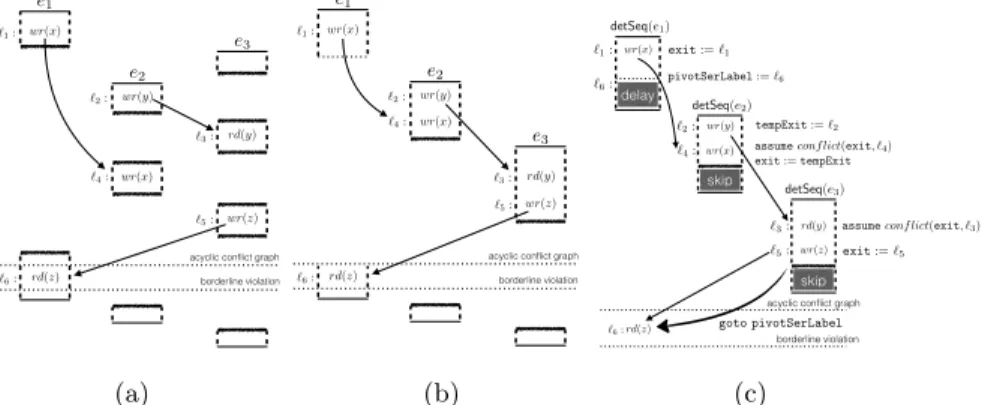
e1 wr(x) `1: e2 wr(y) `2: e3 rd(y) `3: `4: wr(x) wr(z) `5: rd(z) `6:
acyclic conflict graph borderline violation e1 wr(x) `1: e2 wr(y) `2: e3 rd(y) `3: `4: wr(x) wr(z) `5: rd(z) `6:
acyclic conflict graph borderline violation e1 wr(x) `1: e2 wr(y) `2: e3 rd(y) `3: `4: wr(x) wr(z) `5: rd(z) `6:
acyclic conflict graph borderline violation e1 wr(x) `1: e2 wr(y) `2: e3 rd(y) `3: `4: wr(x) wr(z) `5: rd(z) `6:
acyclic conflict graph borderline violation wr(x) `1: wr(y) `2: rd(y) `3: `4:wr(x) wr(z) `5: rd(z) `6:
acyclic conflict graph
borderline violation delay skip skip goto pivotSerLabel exit:= `1 pivotSerLabel:= `6 tempExit:= `2
assumeconf lict(exit, `4) exit:= tempExit
assumeconf lict(exit, `3) exit:= `5 detSeq(e1) detSeq(e2) detSeq(e3) `6: (a) (b) (c)
Fig. 9: Simulating borderline conflict serializability violations with a sequential program. Boxes represent sequences of trace labels ordered from top to bottom. Actions of the same event are aligned vertically. The arrows represent all the conflicts in the trace. The grey blocks labeled by delay, resp., skip, denote sequences of actions that are delayed, resp., skipped.
Definition 7 (Borderline Conflict Serializability Violation). A tracet is a borderline violation to conflict serializability if it is not conflict serializable but every strict prefix ofτ is conflict serializable.
The trace τ1 in Figure 9(a) contains a borderline violation. Its conflict-event
graph contains a cycle between the three events e1, e2, and e3. The prefix of
τ1 ending just before rd(z) satisfies conflict serializability. The last label of a
borderline violation τ is called the pivot of τ (in this example rd(z)) and the event that contains the pivot is called the delayed event of τ (in this example e1).
Simulating Borderline ViolationsFor a set of conflict-deterministic events E, we define a code-to-code translation to a set of sequential events that simulates every conflict-serializable trace and every borderline serializability violation of E under the multi-thread semantics.
As for conflict determinism, the maximal strict prefix of a borderline violation can be reordered to a trace where events are executed serially, but possibly not until completion (because it satisfies conflict serializability). Such a reordering for the trace τ1is given in Fig. 9(b). This reordering can be simulated by a sequential
program that executes the conflict determinism instrumentations detSeq(ei) with
i ∈ [1, 3] instead of the original events, as shown in Fig. 9(c). The sequential program chooses non-deterministically the delayed event, in this case e1, and
the pivot, and stores the latter in an auxiliary variable pivotSerLabel when leaving the delayed event. While executing other possibly incomplete events using the skipping mechanism introduced for conflict determinism, it may non-deterministically choose to execute goto pivotSerLabel, in this case after e3.
Witnessing Borderline Violations To establish that a trace is indeed a borderline violation, the instrumentation guesses for each event a statement called exit point which conflicts with an action of a future event and a statement called entry point which conflicts with the currently recorded exit point of a previous event. The conflict is validated each time an entry point is chosen. This