HAL Id: tel-01784336
https://tel.archives-ouvertes.fr/tel-01784336
Submitted on 3 May 2018HAL is a multi-disciplinary open access
archive for the deposit and dissemination of sci-entific research documents, whether they are pub-lished or not. The documents may come from teaching and research institutions in France or abroad, or from public or private research centers.
L’archive ouverte pluridisciplinaire HAL, est destinée au dépôt et à la diffusion de documents scientifiques de niveau recherche, publiés ou non, émanant des établissements d’enseignement et de recherche français ou étrangers, des laboratoires publics ou privés.
Collective dynamics of weakly coupled nonlinear
periodic structures
Diala Bitar
To cite this version:
Diala Bitar. Collective dynamics of weakly coupled nonlinear periodic structures. Mechani-cal engineering [physics.class-ph]. Université Bourgogne Franche-Comté, 2017. English. �NNT : 2017UBFCD002�. �tel-01784336�
Thèse de Doctorat
é c o l e d o c t o r a l e s c i e n c e s p o u r l ’ i n g é n i e u r e t m i c r o t e c h n i q u e s
U N I V E R S I T É D E F R A N C H E - C O M T É
Thesis Presented by Diala BITAR
Thesis submitted for the degree of Doctor
of the University of Bourgogne Franche-Comté (UBFC) Specialty: Engineering Sciences
Collective dynamics of weakly coupled
nonlinear periodic structures
Thesis defended on 21 February 2017 in front of the jury composed of
Reporters Claude-Henri LAMARQUE Prof., ENTPE/LGCB/LTDS Lyon, France
Stefano LENCI Prof., UNIVPM, Ancona, Italy
Jury President Cyril TOUZÉ Prof., ENSTA, Paris, France
Examiner Manuel COLLET CNRS Research Director, LTDS, Lyon, France
Supervisor Noureddine BOUHADDI Prof., UBFC, Besançon, France
Acknowledgement
Making the commitment to undertake this PhD as a career decision has been a life-changing and challenging experience that would not have the possibility to end up with a success without the guidance and support that I received from many people. I believe in William Raduchel quote that says: Don’t pick a job. Pick a Boss. Your first boss is the biggest factor in your career success. A boss who doesn’t trust you won’t give you opportunities to grow. I couldn’t have chosen more wisely, they inspired me at several scientific levels and ignited in me the love for research and curiosity for further investigations.For this reason, I would like to express my sincere appreciation to my director, Prof. Noureddine Bouhaddi for his immeasurable support, motivation during hard times and invaluable guidance and instructions. I am grateful for the opportunities he gave me to present and participate to several international conferences, where I gained a large scientific exposure and knowledge. In addition, I will never forget and deeply appreciate his carefulness and patience.
I am also exceedingly grateful to Dr. Najib Kacem for guiding, supporting and encouraging me throughout the doctoral study. I would like to thank him for his un-conditional availability, the time and patience for various technical discussions which led to realize major milestones in my research.
My warmest thanks go to the jury members, including the reporters Prof. Claude-Henri Lamarque and Prof. Stefano Lenci who have accepted to judge and evaluate my work and the examiners Dr. Cyril Touzé and Dr. Manuel Collet for their partici-pation to the jury. Moreover, I really appreciate the technical support I received from the permanent members of the Laboratory Scott Cogan, Vincent Walter, Emmanuel Ramasso, Emmanuel Foltete and Joseph Lardies.
I’m very appreciative of all the support I have received from Prof. Lamine Boubakkar beside his help on various occasions. I greatly acknowledge the funding received towards my PhD from the cooperation with the Labex ACTION program (contract ANR-11-LABX-01-01). Many thanks for the coordinator’s assistants of the Labex ACTION Sandrine Chatrenet and Claudia Laou-huen, the SPIM Doctoral School secretariat Alexandrine Vieillard and the Applied Mechanics Department
sec-I am thankful for the friendships sec-I developed while at the applied mechanics de-partment with my labmates. Special thanks to my best friend Khaoula Chikhaoui for the difficult and wonderful moments we shared together during our thesis pe-riod. Many thanks for my office colleagues for the unforgettable moments we shared: Edouard for his kindness, Mohamed with whom I never agree however he is always there to help when someone needs, Ahmed, Fatah who started deep discussions from his first day, Franck “ Telecom ” who joined the gang, Abou bakri “ Bonchour Apou avec p comme Bernard! C’est quoi ces horaires! ” and Camille.
I would also like to acknowledge the current and former colleagues for the good moments we spent together inside and outside the lab specially: My favorite Lebanese friend Ali, Olivier, Paul L., Paul T., Fabien, Hamza, Saber, Pauline, Kévin J., Ro-main, Justine, Alessandra, Alexandre, Gaêl M., Gaêl C., Emeline, Paul V., Rémi, Issam, Sifeng, Julien, Abd El Hamid, Abir, Vahan, Gang, Belgasem, Ding, Ramzi, Drezet, Bérenger, Youssef, Ludovic, Gemala, Flaviano, Kévin B., Titouan, Emile, Romeo, Leandro, Aymen, Mohamed, Damien, Karim, Dimitri, Vincent P., Vincent T., Clément, Jean Louis, Xavier, Saoussan.
On a personal level, I would like to acknowledge the unwavering support, love, patience and encouragement I received from my family through the tough times. A very special thanks to my dad Fawaz, mother Norma, brother Youssef and sisters Abir and Aline. Many thanks to my Lebanese friends Elie, Anna Maria, Jinane, Micheline, Mostafa, Ibrahim, Adham, Mohamad H.
Contents
Abstract 11
Résumé 13
Frequently used Abbreviations 15
Introduction 17
1 Dynamics of periodic structures 21
1.1 Overview . . . 21
1.2 Periodic structures . . . 23
1.3 Linear systems . . . 24
1.3.1 Methods for dealing with linear periodic systems . . . 24
1.3.2 Multidimensional linear periodic systems . . . 25
1.4 Nonlinearity in periodic systems . . . 27
1.4.1 Pendulums arrays . . . 28
1.4.2 MEMS/NEMS arrays . . . 29
1.4.3 Granular crystal lattices . . . 31
1.5 Localization phenomena . . . 33
1.5.1 History of localization studies . . . 33
1.5.2 Localization in linear quasi-periodic structures . . . 35
1.5.3 Nonlinear localization . . . 37
1.6 Conclusion . . . 39
2 Methods for solving nonlinear problems 41 2.1 Introduction . . . 42
2.2 Literature review on methods in periodic nonlinear systems . . . 42
2.3 Direct time integration method . . . 44
2.4 Shooting method . . . 45
2.5 Asymptotic Numerical Method (ANM) . . . 46
2.5.1 Basic concepts of correction-prediction methods . . . 46
2.5.2 Concepts of the ANM . . . 49
2.6 ANM with Harmonic Balance Method (HBM) . . . 53
2.6.1 Principle of the harmonic balance method . . . 53
2.6.3 HBM applied to the quadratic system . . . 54
2.6.4 The continuation procedure . . . 54
2.6.5 Implementation in MANLAB . . . 55
2.7 Multiple scales perturbation method . . . 56
2.7.1 Introduction to perturbation techniques . . . 56
2.7.2 The method of multiple scales . . . 56
2.8 Applications . . . 57
2.8.1 Time integration . . . 58
2.8.2 ANM with HBM . . . 58
2.8.3 Multiple scales method . . . 61
2.8.4 Multiple scale method coupled with standing waves . . . 64
2.8.5 Basins of attraction . . . 69
2.9 Conclusion . . . 71
3 Collective dynamics of weakly coupled nonlinear oscillators array 73 3.1 Introduction . . . 73
3.2 Motivations . . . 74
3.3 One-dimensional array of coupled nonlinear oscillators . . . 74
3.3.1 Equations of motion . . . 75
3.3.2 Normalization . . . 76
3.3.3 Linear study . . . 76
3.3.4 Derivation of the amplitude equation . . . 77
3.3.5 Numerical solutions . . . 80
3.4 Examples and discussions . . . 85
3.4.1 Two coupled nonlinear resonators . . . 85
3.4.2 Three coupled nonlinear resonators . . . 94
3.5 Summary . . . 97
4 Nonlinear oscillators arrays with weakly linear coupling 99 4.1 Introduction . . . 99
4.2 1D array of coupled pendulums . . . 100
4.2.1 Introduction . . . 100
4.2.2 Equation of motion of nth pendulum . . . 101
4.2.3 Normalized equations . . . 103
4.2.4 Solving procedure . . . 103
4.2.5 Numerical and analytical studies . . . 104
4.3 2D pendulums array . . . 115 4.3.1 Introduction . . . 115 4.3.2 Problem Formulation . . . 115 4.3.3 Dimensionless equations . . . 117 4.3.4 Linear study . . . 118 4.3.5 Semi-analytical approach . . . 120 4.3.6 Numerical simulations . . . 121 4.4 Summary . . . 124
CONTENTS
5 Nonlinear oscillators arrays with weakly nonlinear coupling 127
5.1 Introduction . . . 127
5.2 NEMS array . . . 128
5.2.1 Introduction . . . 128
5.2.2 Equations of motion . . . 129
5.2.3 Complex amplitude equations . . . 130
5.2.4 Nonlinear responses to parametric excitation . . . 131
5.3 2D granular particles lattice . . . 139
5.3.1 Introduction . . . 139
5.3.2 Contact of spheres . . . 139
5.3.3 1D periodic array of granular particles . . . 140
5.3.4 2D periodic structure . . . 141
5.3.5 Weakly nonlinear regime . . . 143
5.3.6 Normalized equations . . . 144
5.3.7 Analytical-numerical approach . . . 145
5.3.8 Results and discussions . . . 146
5.4 Summary . . . 150
6 Intrinsic localized modes 153 6.1 Introduction . . . 153
6.2 Derivation of the amplitude equation . . . 155
6.3 Soliton solutions . . . 157
6.3.1 Exact analytical soliton solutions of the PDNLS equation . . . 157
6.3.2 Approximate analytical soliton solutions for η > 0 . . . 158
6.3.3 Exact analytical solitary solutions of the CSDNLS equation . 160 6.3.4 Numerical solutions of the DSDNLS equation . . . 162
6.4 Numerical simulations and interpretations . . . 164
6.5 Conclusion . . . 170
Conclusions 173 A Appendices 177 A.1 The ANM Functions in ManLab . . . 177
A.2 Explicit equations of the solution expansion into the EoM . . . 179
A.3 ∆ Kronecker functions . . . 182
A.4 Nonlinear cubic and quintic stiffnesses terms into quadratic . . . 183
Scientific production 187
Abstract
Localization phenomenon has attracted significant interest recently due to its impor-tant role in the qualification as well as quantification of periodic systems dynamics. The localization can be generated either by the disorder (imperfection) in a lattice or by the interaction between nonlinearities in a discrete system. One of the most frequent localization phenomena is the nonlinear energy localization, called intrinsic localized modes or solitons.Although the dynamics of periodic nonlinear lattices was thoroughly investigated in the frequency and time-space domains, there is a real need to perform profound analysis of the collective dynamics of such systems in order to identify practical relations with the nonlinear energy localization phenomenon in terms of modal in-teractions and bifurcation topologies. The principal goal of this thesis consists in exploring the localization phenomenon for modeling the collective dynamics of peri-odic arrays of weakly coupled nonlinear resonators.
An analytico-numerical model has been developed in order to study the collective dynamics of a periodic coupled Duffing-Van Der Pol oscillators array under simul-taneous primary and parametric excitations, where the bifurcation topologies, the modal interactions and the basins of attraction have been analyzed. Two applica-tions were considered: (i) an array of coupled pendulums under harmonic external excitation, where it has been shown that by increasing the number of coupled pen-dulums, the number of multi-modal solutions increases and the distribution of the basins of attraction of the resonant solution branches becomes larger, (ii) an array of electrostatically coupled nanobeams under parametric excitation, while including the main sources of nonlinearities up to the fifth-order. The model was extended to investigate the collective dynamics of periodic nonlinear two-dimensional arrays, and two applications have been considered: (i) a 2D array of coupled pendulums under harmonic base excitation, where it has been shown that considering a high ratio between the coupling parameters in the two directions leads to additional features distinct from those obtained in 1D arrays, mainly a larger bandwidth and important vibrational amplitudes, (ii) a 2D periodic granular crystals array subjected to com-pressive loadings and a harmonic horizontal base excitation, where each particle is coupled with fixed-fixed uniform beam while the nonlinear dynamics is governed by the Hertzian contact. A second investigation of this thesis consist in transforming the developed discrete model into a continuous one, where the dynamics is generated
by the Schrödinger equation. This model allows the identification of the solitons associated to the collective nonlinear dynamics of the considered arrays of periodic structures and the study of their stability.
Keywords: Periodic lattices, nonlinear oscillators, collective dynamics, weak
Résumé
La localisation joue un rôle important pour de nombreuses applications en physique car elle permet de quantifier et de qualifier la dynamique d’un système périodique. Elle peut être générée, soit par le désordre (imperfections) dans un réseau ou par l’interaction entre les non-linéarités dans un système discret. L’un des phénomènes de localisation le plus courant est celui de la localisation non-linéaire de l’énergie, connu sous le nom de modes intrinsèques localisés (ILMs) ou Solitons.Bien que la dynamique des réseaux périodiques non-linéaires ait été investiguée dans les domaines temporel et fréquentiel, il existe un réel besoin d’identifier des rela-tions pratiques avec le phénomène de la localisation d’énergie en termes d’interacrela-tions modales et topologies de bifurcation. L’objectif principal de cette thèse consiste à exploiter le phénomène de la localisation pour modéliser la dynamique collective d’un réseau périodique de résonateurs non-linéaires faiblement couplés.
Un modèle analytico-numérique a été développé pour étudier la dynamique col-lective d’un réseau périodique d’oscillateurs couplés de type Duffing-Van Der Pol sous excitations simultanées primaire et paramétrique, oú les interactions modales, les topologies de bifurcations et les bassins d’attraction ont été analysés. Deux ap-plications ont été investiguées: (i) un réseau de pendules couplés sous excitation extérieure harmonique, oú il a été démontré qu’en augmentant le nombre de pend-ules, le nombre de solutions multimodales et la distribution des bassins d’attraction des branches résonantes augmentent, (ii) un réseau de nano-poutres couplées élec-trostatiquement sous excitation paramétrique en incluant les principales sources de non-linéarité jusqu’à l’ordre cinq. Ce modèle a été étendu pour investiguer la dy-namique collective d’un réseau périodique non-linéaire bidimensionnel, oú deux ap-plications ont été étudiées: (i) un réseau 2D de pendules couplés sous excitation extérieure harmonique, oú il a été démontré que le choix de différents paramètres de couplage dans les deux directions, enrichit la dynamique collective comparée à celle obtenue dans les réseaux 1D, et conduit principalement à des amplitudes de vibra-tion plus importantes et des bandes passantes plus larges, (ii) un réseau 2D de billes métalliques en compression, guidées élastiquement par des poutres et sous excitation à la base, où la non-linéarité est gouvernée par le contact de Hertz. Une deuxième investigation de cette thèse consiste à transformer le modèle discret développé en modèle continu dont la dynamique est régie par l’équation de Schrödinger. Ce mod-èle permet d’identifier les solitons associés à la dynamique collective du réseau de
structures périodiques et d’étudier leurs stabilités.
Mots clés: réseaux périodiques, oscillateurs non-linéaires, dynamique collective, couplage faible, interactions modales, bassins d’attraction, localisation d’énergie, soli-tons.
Frequently used Abbreviations
1D One-Dimensional
2D Two-Dimensional
dof degree-of-freedom
Mdofs Multi-degrees-of-freedom
ANM Asymptotic Numerical Method
ILMs Intrinsic Localized Modes
MEMS Microelectromechanical systems
NEMS Nanoelectromechanical systems
DBs Discrete Breathers
HBM Harmonic Balance Method
D-VDP Duffing-Van Der Pol
EoM Equations of Motion
SM Single Mode
DM Double Mode
TM Triple Mode
ROM Reduced Order Model
R Resonant
NR Non-Resonant
NLS Nonlinear Schrödinger
PDNLS Parametrically Driven Damped Nonlinear Schrödinger
PDE Partial Differential Equation
CSDNLS Conservative Simultaneously Driven NonLinear Schrödinger
Introduction
Motivations
Arrangements of periodically repeated united cells, known as periodic structures are ubiquitous. They exist naturally as can be man-made over a large range of length scales, with a wide range of engineering applications, including photonic crys-tals, elastic plates and shells, honeycombs, civil constructions, antennas, mechanical constructions, MEMS/NEMS and so on. The motivations behind studying similar structures, lie in their ability to exploit periodicity in order to attenuate, isolate or localize vibrations. Their simple fabrication was the main advantage, which moti-vated researchers in several domains to emerge innovative applications and develop new devices, to explore in deep wave propagation in periodic structures.
In fact, periodic arrangement properties present a particular capacity to attenu-ate the propagation of elastic waves [Romeo 03], reduce the transmitted vibrations and noise [Li 17] or filter them [Barbarosie 04] as the dichroic filters which is real-ized on the concept of photonic crystals [Winnewisser 98]. In addition, interesting electromagnetic properties arise from periodic structures as when white light passes through a diffraction grating (optical component with a periodic structure) or pho-tonic crystal fibers and integrated optical devices based on phopho-tonic crystals and periodic arrays of holes [Broeng 99] and frequency-selective surfaces which are peri-odic surfaces that can be found on a plane, designed to reflect, transmit or absorb electromagnetic fields based on frequency [Mittra 88]. Moreover, it has been shown that mode localization can occur in weakly coupled quasi-periodic linear systems [Hodges 82], resulting to the Anderson localization [Anderson 58].
Despite the interesting wave properties encountered in periodic linear system as filtering, bandgaps, propagation and attenuation zones, isolate or localize vibrations, periodic nonlinear structures may exhibit variety of rich dynamics properties. For instance, bifurcations, solitary waves and solitons [Cuevas 09], energy dependent nonlinear propagation/attenuation zones [Romeo 06], nonlinear modes localization [Vakakis 97], multitude of nonlinear resonances [Nayfeh 08], wave interaction, spatial and temporal chaos [Waller 84] and energy transfer/harvesting/trapping [Lydon 15]. In fact, space localization represents an interesting phenomenon in engineering science, which attracted significant interest recently due to its important role in the qualification as well as quantification of periodic systems dynamics. It is based on the fact that the energy does not propagate arbitrary and it is localized in space, while
the wave-function amplitude of the oscillating modal shape decays exponentially in space. This phenomenon has inspired innovative studies in physics and motivated researchers over many years to explore in depth its effects and consequences. The localization can be generated either by the disorder (imperfection) in a lattice or by the interaction between nonlinearities in a discrete system. One of the most frequent localization phenomena is the nonlinear energy localization, called intrinsic localized modes or solitons.
Although the dynamics of periodic nonlinear lattices was thoroughly investigated in the frequency and time-space domains, there is a real need to perform profound analysis of the collective dynamics of such systems in order to identify practical rela-tions with the nonlinear energy localization phenomenon in terms of modal interac-tions and bifurcation topologies. The principal goal of this thesis consist in exploring the localization phenomenon for modeling the collective dynamics of periodic arrays of weakly coupled nonlinear resonators.
Overview
Chapter 1 presents a state of art of the dynamics of periodic structures, their
ex-istence and the characteristics of their assemblies. Then, methods for dealing with wave propagation in multidimensional periodic linear systems are presented, with the highlight of the interesting wave properties that can produce. Variety of rich dy-namical nonlinear phenomena motivated the study of wave propagation in periodic nonlinear lattices. In particular, the review of several physical applications that can be modeled as periodic nonlinear lattices is given; in particular, pendulums arrays, MEMS/NEMS arrays and granular crystal lattices. The history of localization phe-nomenon, the presentation of the techniques employed to investigate localization in discrete and continuous quasi-periodic structure and spatial localization in weakly coupled perfectly periodic and quasi-periodic structures are emphasized.
Chapter 2is devoted to covering most of the numerical, analytical or
combina-tion of both methods employed to study periodic nonlinear lattices. The direct time integration, the asymptotic numerical method (ANM), ANM with the harmonic bal-anced method (HBM), the multiple scales method with and without standing waves decomposition are presented. An application consisting of periodic two weakly cou-pled mass-spring system is considered and a comparison between the different used methods is presented. The goal is to validate the capability of the multiple scales method coupled with standing wave decomposition to handle weakly coupled non-linear periodic oscillators.
In Chapter 3, we consider the general case of an array of weakly coupled Duffing-Van Der Pol oscillators with fifth order nonlinearity under simultaneous primary and external excitations. An important choice of weakly linear coupling parameter be-tween substructures is made enabling the creation of linear closed modes. The cou-pled nonlinear differential system is solved using an analytico-computational model,
based on the method of multiple scales coupled with standing wave modal decompo-sition, transforming the nonlinear differential system into a set of coupled complex algebraic equations which are numerically solved using the ANM enabling the con-struction of resonance curves for a large number of dofs. The complexity and the multivaludness of the responses are illustrated by a detailed study of its basins of at-traction. The ability of the combination of both primary and parametric excitations to adjust the stability of the system is shown.
Chapter 4is dedicated to the study of with the collective dynamics of a periodic array of linearly coupled pendulums under primary resonance. A model reduction method is proposed to calculate the dominant dynamics without significant loss of accuracy compared to the full model. The modal interactions and their effects on the nonlinear dynamics and their bifurcation topology are studied. The model is extended to investigate the collective dynamics of 2D coupled pendulums arrays, under harmonic base excitation, where additional feature not obtained in the 1D array are achieved.
Chapter 5 studies the collective dynamics of nonlinear oscillator’s arrays with
weakly nonlinear coupling, for two different physical applications. An electrostati-cally coupled nanobeams array under parametric excitation is modeled and investi-gated, while including the main sources of nonlinearities up to the fifth order. The influence of the fifth order nonlinearity on the complexity of the frequency responses is highlighted. In addition, we investigated, the collective dynamics of a 2D periodic lattice of granular particles coupled with identical beams and subjected to a pre-compression loads where the nonlinearity is governed by the Hertzian contact law, under horizontal base excitation.
Chapter 6 deals with a different type of behavior in nonlinear periodic arrays,
called the intrinsic localized modes or solitons. The multiple scales method is used to transform the differential nonlinear system into an amplitude equation in the form of a Nonlinear Schrödinger (NLS) equation. Exact analytical solitary solutions of the conservative NLS equation are derived, while the dissipative system is solved numerically using the analog Newton’s method. Several numerical simulations are performed demonstrating that the stability of localized solutions can benefit from the combination of both parametric and external excitations.
1
Dynamics of periodic structures
Contents
1.1 Overview . . . 21
1.2 Periodic structures . . . 23
1.3 Linear systems . . . 24
1.3.1 Methods for dealing with linear periodic systems . . . 24
1.3.2 Multidimensional linear periodic systems . . . 25
1.4 Nonlinearity in periodic systems . . . 27
1.4.1 Pendulums arrays . . . 28
1.4.2 MEMS/NEMS arrays . . . 29
1.4.3 Granular crystal lattices . . . 31
1.5 Localization phenomena . . . 33
1.5.1 History of localization studies . . . 33
1.5.2 Localization in linear quasi-periodic structures . . . 35
1.5.3 Nonlinear localization . . . 37
1.6 Conclusion . . . 39
1.1
Overview
The current research interests focus on the collective dynamics to explore the lo-calization phenomena in periodic nonlinear lattices. The upcoming section starts introducing periodic systems along with some definitions and examples on both nat-urally existing and man-made periodic structures. Next, a literature review on the dynamics of multidimensional linear periodic structures is introduced along with the methods devoted to study wave propagation in periodic media such as Floquet, Block, and finite element method and so on. Although linear periodic structures exhibit a
number of interesting wave phenomena as bandgaps, propagation and attenuation zones, vibration isolation and localization, variety of rich dynamic properties such as wave localization, solitary waves, energy transfer and frequency-conversion emerged the trend to study the wave propagation in nonlinear periodic systems. Then, a review on the state of art of the different complex dynamical phenomena encoun-tered in periodic nonlinear structures is reported. Three famous physical examples: pendulums, MEMS/NEMS and granular crystals that can be modeled as periodic nonlinear lattices are presented, along with a brief literature review, background study and properties. A historical background, highlighting the existing of the local-ization phenomena is presented followed by a detailed study on the space locallocal-ization and its properties in periodic linear and nonlinear arrays. The research motivations, the objectives and the challenges of studying the collective dynamics of periodic non-linear lattices are addressed and the methodology employed to achieve the present goal is announced.
(a) (b) (c)
(d)
Figure 1.1: (a) Crystal lattice of diamond or silicon( Image credit: Dr. Willem Tjerkstra, et al., MESA+ Institute for Nanotechnology, University of Twente). (b) a- Photograph of the Weevil Lamprocyphus Augustus b- Optical micrograph of individual scales attached to the exoskeleton under white-light illumination c- Cross-sectional SEM image of a single scale d- Detailed cross-sectional SEM image of a region of a scale (Reproduced from Phys Rev E 2008;77:050904). (c) Honeycomb. (d) Morpho rhetenor nanostructures (Reproduced from www.asknature.org/media/image/28125#)
1.2 Periodic structures
1.2
Periodic structures
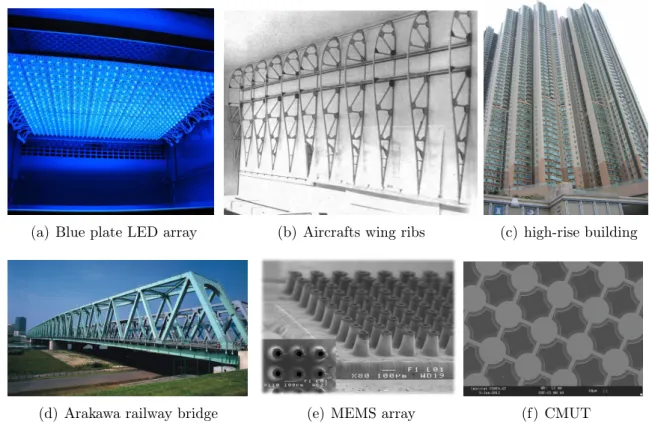
Periodic structures consist of an arrangement of coupled identical substructures, geometrically repeated and defined by a unit cell at periodic intervals. They can exist naturally (figure 1.1) as they can be man-made (figure 1.2) over a wide range of length scales. For instance, crystal lattices are three-dimensional arrangement of unit cells, made of atoms, ions and molecules. Interactions between these last are characterized by potential energy that result in a series of vibrational waves propagations (Phonons). On the other hand, the origin of the shinning colors of some insects lies in a distinct nanostructure built into their biopolymeric wing scales and exoskeletons which have a high degree of periodicity. Particularly, the propagation of light through the polymeric structures (diffraction and specular reflection) those with nanostructures periodicity produce angle-dependent iridescent colors. Furthermore, honeycombs consist of hexagonal cells built by bees, where their periodicity influence the way waves propagate.
In regards to man-made periodic structures, we can mention many architectural designs as long span bridges and high-rise buildings, aircrafts wing ribs in aerospace, micro- and nano-electromechanical systems, LED arrays in electronics and so on. In addition, they can support many applications as photonic crystals cavities and bandgaps, electromagnetic/optics devices, frequency selective surface or metamate-rials.
(a) Blue plate LED array (b) Aircrafts wing ribs (c) high-rise building
(d) Arakawa railway bridge (e) MEMS array (f) CMUT
From an engineering viewpoint, the principal advantage of such structures is due to the simplicity of their geometry and manufacturing, the significant impact and high temperature tolerance and their high strength-to-weight ratios. In addition, periodic structures provides interesting wave propagation properties as mechanical filters or waveguides. Moreover, the motivations behind studying similar structures, lie in their ability to exploit periodicity in order to attenuate, isolate or localize vibrations. Therefore, the comprehension of the dynamics of periodic structures is necessary for analyzing and synthetizing the role of periodicity in generating local-ization phenomena.
1.3
Linear systems
Several researches on the dynamics of one-dimensional periodic structures were based on linear model structure. Under the hypothesis of linearity, analytical and numerical methods have been developed in order to analyze their dynamics, where the study of wave propagation in these structures was thoroughly addressed in the literature.
1.3.1 Methods for dealing with linear periodic systems
Brillouin [Brillouin 53] traces a detailed historical background and motivation be-hind treating wave propagation in the field of solid-state physics, by considering a classical mass-spring system. Mead and his research group [Mead 73, Mead 96] de-veloped methods and techniques based on wave modes to analyze and predict free vibration propagation and forced vibration induced by stationary harmonic loads in continuous periodic engineering structures. In the field of structural mechanics, Lan-gley [LanLan-gley 96] studied the response of a two-dimensional linear periodic structure subject to point harmonic forcing using a spring mass model, showing that the loca-tion and the extension of the stop bands depend on the considered direcloca-tion of wave propagation on the structure plane. Later, Langley et al. [Langley 97] presented theoretical and experimental studies to the response of a beam grillage constructed from strips of aluminum with bolted joints (figure 1.3 (a)), using the finite element analysis.
About 50 years ago, the dynamics of wave propagation in periodic linear systems has been investigated by means of transfer matrix method. This method allow re-ducing computational effort and time of the considered problem to the number of degrees of freedom coupling basic periodic element. Lin et al. [Lin 69] developed an analytical technique applying a transfer matrix for the determination of the frequency response of stiffened plate vibration. A review on the theory of wave propagation in a survey physical applications of one-dimensional locally periodic media using the transfer matrix approach has been reported by Griffiths [Griffiths 01]; proving that as the number of coupled resonators increases, the band structure characteris-tic of waves in infinite periodic media emerges. Vibrational responses of 1D filter and 2D wave guide modeled as mass-spring structures subjected to periodic loading
1.3 Linear systems has been analyzed, while studying the effects of boundaries, viscous damping and imperfections [Jensen 03]. The well know formulation of Floquet [Floquet 83] is a methodology to solve differential equations with periodic coefficients, assuming that any solution of the system can be expressed as a linear combination of functions.
Although Bloch theorem [Bloch 29] was firstly introduced to represent the model of homogenous states of Schrödinger equation with periodic potential, it can be con-sidered as a multidimensional application of the Floquet theorem. The Floquet-Bloch theorem is extensively used for calculating the dispersion properties, wave modes and group velocities of periodic structures. Collet et al. [Collet 09, Collet 11] developed new multifunctional structures integrating electro-mechanical systems in order to optimize their vibro-acoustic behavior over a large frequency band and introduced a Floquet-Bloch decomposition for the computation of dispersion of two-dimensional periodic (figure 1.3 (b)), damped mechanical systems. Recently, an efficient method originally proposed by Zhou et al. [Zhou 15a, Zhou 15b] was illustrated by one and two-dimensional periodic structures; this method is based on a Component Mode Synthesis (CMS) approach to analyze the local behavior of the unit cell using a re-duced modal basis in addition to a Wave Finite Element Method (WFEM) that fully exploit the periodic propriety of the structure and extracts directly the propagation parameters.
(a) (b)
Figure 1.3: (a) A schematic of a periodic beam grillage system with a single period high-lighted The point A represents the reference node [Langley 97]. (b) Generic 3D periodic cells [Collet 11]
1.3.2 Multidimensional linear periodic systems
A large number of physical systems in different scientific areas can be modeled as two-dimensional linear periodic lattices. For instance, in the field of acoustics, Vasseur et al. [Vasseur 98] validated theoretically and experimentally the existence of large band gaps at low frequencies in 2D periodic binary solid/solid composite media. The dynamic behavior of 2D cellular structures with the focus on the effect of the
dynamics of the propagation of elastic waves within the structure has been evalu-ated [Ruzzene 03]. In addition, Zou et al. [Zou 08] presented a detailed calculations of the dispersion relations of bulk waves propagating in two-dimensional piezoelec-tric composite structures and showed that the first bandgaps could be controlled according to need. A new continualization procedure that refers to the non-local interaction between variables of a 2D discrete media (figure 1.4 (a)) was proposed [Andrianov 08]. Moreover, the effect of micro-structural properties on the wave dis-persion in linear elastic membrane, using a periodic 2D-mass spring lattice under transverse vibrations has been studied [Lombardo 10]. A finite element formula-tion of the wave propagaformula-tion problem and a discussion of the dispersion relaformula-tion for classical honeycomb geometries (figure 1.4 (b)) were given, where the standard terminology used in honeycomb mechanics was also recalled [Gonella 08]. Further-more, Leamy [Leamy 12] detailed an exact wave-based approach for characterizing wave propagation in two-dimensional periodic lattices. In phononics, Zhang et al. [Zhang 12] investigated numerically Lamb wave propagation in a homogenous plate with periodic tapered surface, showing that the BGs could be effectively shifted by changing the geometrical parameters, including the ratio of lower base width to upper base width.
(a) (b)
Figure 1.4: (a) A 2D lattice in the (x,y) plane. The lattice is assumed to vibrate in direction perpendicular to its planar position [Rosenau 87, Andrianov 08]. (b) Schematic of generic lattice and unit cell with considered reference frames [Gonella 08]
A high number of researches on wave propagation in periodic structures is based on studying linear structural designs. Although these latter produce interesting wave properties as filtering the propagation of waves, bandgaps, propagation and attenuation zones and isolate or localize vibrations, complex dynamical phenomena may be detected in nonlinear periodic structures, which can be exploited to design periodic structure-based smart systems with high performance. In addition, and since most of the structures are nonlinear due to their nature, the interactions with their neighbors, the restoring forces and so on, it’s essential to analyze wave propagation in periodically nonlinear systems.
1.4 Nonlinearity in periodic systems
1.4
Nonlinearity in periodic systems
Variety of rich dynamic properties such as multi-stability, bifurcations, existence of highly stable localized solutions, solitary waves and solitons, energy transfer, frequency-conversion and variation in wave speeds and propagation direction related to wave amplitude and nonlinearity etc. emerged the trend to devote significant stud-ies to explore these complex phenomena for wave propagation in nonlinear periodic media.
(a) (b) (c)
Figure 1.5: (a) Bifurcation diagram for the logistic map Jordan Pierce. (b) Spatiotemporal chaos http://www.physics.uci.edu/ dennin/pictures.html. (c) 3D view of the spatio-temporal evolution of a Peregrine soliton Christophe Finot
For instance, the existence of waves and amplitude dependent frequencies bound-ing nonlinear propagation and attenuation zones (PZs and AZs) has been found by studying an infinite chain of mono-coupled oscillators with geometric nonlinearities [King 95]. The existence of solitary wave propagation in strongly nonlinear periodic structures such as uncompressed granular media was first revealed by Nesterenko [Nesterenko 83]. Soliton-defect interactions using simple two-mode models charac-terized by a mobile soliton and a localized (trapped) mode were first suggested by Goodman et al. [Goodman 04]. Localization and solitary wave phenomenon were ob-served in a perfectly cyclic, weakly nonlinear periodic system [Vakakis 93]. Nayfeh et al. [Nayfeh 08] explored the multitudes of nonlinear resonances such as subharmonic, superharmonic and combination resonances by applying several perturbation tech-niques for predicting wave propagation in weakly nonlinear continuous systems. In addition, the synchronization of chaotic circuits has been studied in random network such as secure communication [Zhou 05]. Moreover, it was found that the presence of defects and interfaces in granular media is interesting to control stress propagation and produces energy trapping [Daraio 06].
Chapter 1 is dedicated to the theoretical framework of methods for solving pe-riodic nonlinear problems, with a short literature review on the methods employed to solve similar systems. In addition, many physical systems in several scientific do-mains such as materials, acoustics, optics, mechanics, MEMS/NEMS and vibrations can be modeled as periodic nonlinear chains. In the following section, we will be
interested in three principal physical application that can be modeled as arrays of coupled nonlinear oscillators.
1.4.1 Pendulums arrays
(a) (b) (c)
Figure 1.6: (a) Pictures of three stationary states of the pendula chain obtained for one single given driving amplitude and frequency [Khomeriki 08]. (b)-(c) Experimental setup and schematic diagram of a pendulum array and its frame sits on a platform that can freely move horizontally [Cuevas-Maraver 14]
In mechanics, the array of coupled pendulums (figure 1.6 (b), (c)) represents a famous example of periodic nonlinear structures which can be described by the Sine-Gordon model [Cuevas-Maraver 14]. The latter is suitable for a large variety of physical systems, which explains the vast research area developed around this field. Several theorems on the existence of oscillatory, rotary, and mixed periodic motions of cou-pled pendulums were proved [Marlin 68]. In addition, Cai et al. [Cai 93] identified two distinct regimes for a damped Sine-Gordon chain driven by the spatio-temporal periodic potential. The nonlinear dynamics and chaos in a simple pendulum array have been reported experimentally, reproducing the fact that if there was no disorder a state of fully developed spatiotemporal chaos appears, while an optimal amount of disorder returns the dynamics regular [Shew 99]. In addition, the synchronization of parametrically excited coupled chaotic pendulums has been experimentally observed [Zhang 01]. Vyas et al. [Vyas 01] showed that the bandwidth of absorber effectiveness can be increased substantially by using an array of pendulums with slightly different natural frequencies. For a chain of coupled pendula driven periodically at one end (figure 1.6 (b)), Khomeriki et al. [Khomeriki 08] demonstrated experimentally the existence of a novel regime which produces an output frequency at an odd fraction of the driving frequency. Chen et al. [Chen 07] showed using the Floquet theory that the instability onset in a pendulum array always responds to the forcing frequency subharmonically. Recently, Liang et al. [Liang 15] reported an experiment using a coupled-pendulums chain to demonstrate various aspects of wave motion.
Further-1.4 Nonlinearity in periodic systems more, Jallouli et al. [Jallouli 15] investigated the nonlinear dynamics of a 2D array of coupled pendulums under parametric excitation.
(a) (b)
Figure 1.7: (a) Observation of an inter-site breather [Cuevas 09]. (b) Soliton visualized along a pendulum. Image: pe.soliton.free.fr/.
In other studies, Intrinsic Localized Modes (ILMs), existing as exact solutions in nonlinear lattices have been widely studied. Particularly, for an array of coupled pendulums [Ikeda 15] which is an ideal playground for showcasing many interesting features of discrete breathers (figure 1.7 (a)), [Cuevas 09] which can be stabilized in the presence of driving and damping [English 14] or propagate energy in a forbidden band gap [Geniet 02]. The nonlinear coupling and decoupling between ILM and third allowed plane-wave mode, as well as both modes interaction with the driver, give rise to pulsating breather instability [Thakur 08]. In addition, it was shown that the mass impurity in a parametrically driven, damped nonlinear coupled pendula has striking influence on the high-frequency modes [Hai-Qing 06]. Recently, the influence of adding external harmonic excitation on the intrinsic localized modes of coupled pendulums chains parametrically excited has been investigated [Jallouli 17].
1.4.2 MEMS/NEMS arrays
Over the last decade, there has been an increasing attention in the field of MEMS & NEMS dynamics as an important process technology, induced by a set of functional needs which have the potential to affect our lives as well as fundamental questions [Bao 96]. These small integrated devices are used to create tiny systems that com-bine electrical and mechanical components, having high frequencies contrary to their microscales. There are plenty of new challenges in this area of researches that results from the request to manufacture new MEMS devises that improve the reliability and performances of the existing ones.
In parallel, there was the effort of miniaturization for designing Nanoelectrome-chanical systems (NEMS), with a reduced size that is less than one micrometer. This down scaling from MEMS to NEMS has permitted the fabrication of very small devices having faster speed, higher complexity, lower power and cost in the domain beyond electronics, that allow for better performing sensors. While operating at res-onance, NEMS display high fundamental frequencies, small masses, tolerable linear
stiffness and they are subject to very low damping. These characteristics enable NEMS to be a perfect candidate for several applications like inertial sensors, gas sensing, filters and switches [Craighead 00, Ekinci 05].
(a) (b)
Figure 1.8: (a) A series of silicon nanowires from [Carr 99]. (b) A scanning electron mi-crograph showing a fluidics structure fabricated with the sacrificial layer removal technique [Craighead 00]
The capability to produce arrays of high number of coupled beams in very large scale integration fashion opens new possibilities to study the nonlinear dynamics of coupled MEMS and NEMS. These devices are compatible and co-integrable with standard silicon electronics processes and one can take advantage of their result-ing collective dynamics to enhance the performances of MEMS/NEMS sensors and actuators. The collective responses of coupled arrays could be beneficial for signal improvement and noise decrease , as well as sophisticated mechanical signal pro-cessing applications. To possess rich dynamic behavior unreachable with uncoupled MEMS resonators, Buks and Roukes [Buks 02] studied the mechanical character-istics of an array of parametrically excited micromechanical doubly clamped gold beams (figure 1.9 (a)). Qualitative comparison with the experiment of Buks and Roukes was done by Lifshitz and Cross [Lifshitz 03], by modeling a parametrically excited MEMS array using a set of coupled discrete nonlinear equations of motion. They used the secular perturbation theory and standing waves decomposition to transform the coupled differential equations of motion into a set of coupled nonlin-ear complex algebraic equations for the normal modes amplitudes. Although, this procedure helped them to obtain exact solutions for few coupled oscillators, they gave a qualitative understanding of the dynamics of large arrays. Later, Bromberg, Cross and Lifshitz [Bromberg 06] studied the same equations of motion to obtain an-alytical results for large arrays by approaching the system from the continuous limit of infinitely large degrees of freedom, and obtaining a description of the slow spa-tiotemporal dynamics of the array of oscillators in terms of an amplitude equation. Moreover, Kenig, Lifshitz and Cross [Kenig 09a] extended the investigations of the amplitude equation to study the problem of pattern selection with the application to
1.4 Nonlinearity in periodic systems MEMS/NEMS systems. They described the transitions between standing-wave pat-terns of different wave numbers as the drive amplitude is varied either quasistatically, abruptly, or as a linear ramp in time. A review of the nonlinear dynamics and com-plexity of such nanomechanical and micromechanical resonators was conducted by Lifshitz and Cross [Lifshitz 10]. The nonlinear dynamics of electrostatically coupled microresonators (figure 1.9 (b)) in several frequency regions have been performed by Gutschmidt et al. [Gutschmidt 12] using a continuum model. We should note that, such arrays may exhibit interesting dynamical phenomena such as the intrinsic localized modes [Sato 03c, Sato 03a], which make them adequate for analyzing the dynamics of large degrees of freedom systems.
(a) (b)
Figure 1.9: (a) Array of doubly clamped beams forming a diffraction grating [Buks 02]. (b) Micro-electromechanical array; actuation and dissipative forces applied at mid-span of each beam [Gutschmidt 12]
1.4.3 Granular crystal lattices
Hertzian chains of spherical particles represent a famous example of nonlinear dis-crete structures, where the nonlinearity emerges from two characteristics; the first one is the geometry between particles is such that the transmission between two particles in contact is nonlinear and the second one from the applied compressive load. The dynamic behavior of one-dimensional chain of granular crystals emerged by Nesterenko [Nesterenko 83] showing analytical and numerical studies. Later, the concept of “sonic vacuum” and the formation and propagation of highly non-linear solitary waves in similar arrays was experimentally shown by Lazaridi et al. [Lazaridi 85]. The motivation behind studying granular crystals lies from their abil-ity to control the nonlinearabil-ity and tune their dynamic responses from linear to weakly and strongly nonlinear by changing the amount of the static precompression loads [Nesterenko 01]. In addition, they have a great controllability of the assembly as well as the simplicity of their construction and their applicability to engineering devices [Boechler 11, Spadoni 10].
Figure 1.10: One-dimensional chain of particles compressed by a large static force F0
[Nesterenko 01], causing initial displacement δ0 between neighboring centers.
Granular crystals showed the ability to support tunable acoustic band gaps in their linear and weakly nonlinear regime, where a novel perturbation analysis verified by numerical simulations was applied to derive amplitude dependent dispersion rela-tions [Boechler 10a]. In addition, it was observed that the wave speed changes with increase in amplitude at certain frequency leading to small changes in the band edges [Boechler 10b]. Several studies have reported, both experimentally and numerically, energy localization phenomena in Hertzian chains with mass defects considering a one-dimensional diatomic granular crystals [Boechler 10c]. Experimental observation of the modulation instability and discrete breathers in the weakly nonlinear dynam-ical regime in such arrays was reported [Theocharis 10]. Heterogeneous, 1D strongly compressed spheres chain has been used to generate solitary waves [Yang 11]. In the strongly nonlinear regime it has been demonstrated that a sequence of pulses is induced at the interface of two sonic vacua by the deceleration of interfacial particles [Nesterenko 05]. In addition, Daraio et al. [Daraio 06] demonstrated experimentally and numerically the efficiency of soliton-like and shock-like pulse trapping and dis-integration in a composite granular protector and proved that its efficiency depends on the particle’s arrangements. Moreover, Job et al. [Job 07] described through experimental, numerical and theoretical studies the formation of solitary wave train by large striker on an alignment of spheres. On the other hand, Theocharis et al. [Theocharis 13] reported the dynamic behavior of nonlinear periodic phononic struc-tures, along with how such structures can be utilized to affect the propagation of mechanical waves.
Several studies were devoted to investigate the dynamics of two-dimensional gran-ular lattices, motivated by the richness of the complex dynamical nonlinear phenom-ena found in one-dimensional ones. Recently, Leonard et al. [Leonard 13] studied the stress wave properties in a basic 2D granular crystals. Coste et al. [Coste 08] inves-tigated the effects of varying the isotropic static compression in linear and nonlinear regimes for 2D granular lattice (figure 1.11 (a)). Experimental and numerical studies have been performed in order to show the impact of the type of excitation imparted on a centered square of highly nonlinear granular system [Leonard 12] (figure 1.11
1.5 Localization phenomena (b)).
(a) (b)
Figure 1.11: (a) 2D triangular lattice of beads [Coste 08]. (b) Uncompressed 20 by 20 square array of spherical particles square array of cylindrical particles (intruders) in the interstitial spacings [Leonard 12]
1.5
Localization phenomena
Space localization represents an interesting phenomenon in engineering science, which can occur in periodic structures when the wave-function amplitude of the oscillating modal shape decays exponentially in space. It is based on the fact that the energy does not propagate and it is localized in space. Consequently, researchers were moti-vated to explore more deeply the effects and consequences of the localization, where they demonstrated analytically and numerically that for linear periodic systems mode localization exists when: (1) the coupling between substructures is weak enough and (2) the periodicity in the structure is perturbed by structural mistuning. However, for perfectly periodic nonlinear systems, strongly localized nonlinear normal modes may occur for sufficiently weak substructures coupling.
1.5.1 History of localization studies
In the previous sections, the dynamics of perfectly periodic structures encountered in many field of engineering and physics have been examined. Manufacturing and assembly defects may produce disorder that can occur in material properties of the system. Spatial localization of normal modes and attenuation of waves in all fre-quency bands could be the consequence of a disorder in periodic structures, in which energy is confined to the region near disorder where the dynamics behavior of the structure changes.
Starting from the fifties, two notable papers the first one by Dyson [Dyson 53] explored the effect of disorder of a one-dimensional oscillators, coupled by harmonic forces where the inertia of each oscillator and the strength of each coupling were con-sidered as random variables. A vibrating mass-spring system has been concon-sidered
where a method for calculating the distribution-function of the frequencies of nor-mal modes has been presented. In addition to the frequency spectra, was calculated analytically when the considered distribution law of the oscillator parameter takes an exponential form. The second paper, Schmidt [Schmidt 57] developed a math-ematical method which gives fairly generally the density of eigenstates for linear disordered chain system. Although, their results helped explaining in a mathemat-ical way the wave transmission in a disordered periodic systems, they ignored the effect of disorder on the eigenvectors and wave propagation.
(1) (2)
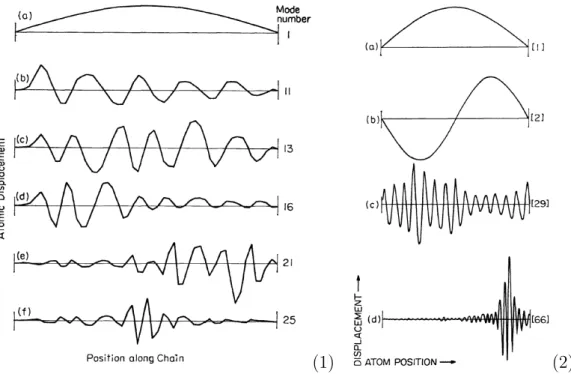
Figure 1.12: Normal modes of an isotopically disordered harmonic chain, half-heavy atoms and half·light with a mass ratio of three. The mode numbering is from the lowest to the highest frequency. (1) N=50, (2) N=200 [Matsuda 70]
In quantum mechanics, the first scientist to describe eigenstate localization by the absence of diffusion of waves in a disordered potential is the American physicist Philip Warren Anderson [Anderson 58]. He showed that an electron in a semiconduc-tor has the possibility of not being transported, provided that the number of disorder is sufficiently large in a lattice. This phenomenon is named Anderson
localiza-tion in some cases token of appreciation for his original contribution. Anderson
suggestions motivated researchers over many years to well understand localization. This phenomenon has been thoroughly investigated in mistuned periodic structures, inspiring innovative studies in physics. Early studies treated disordered chains of atoms, it has been proved that any infinite disordered chain can be made to have an exponentially localized solution (figure 1.12) for any frequency by modifying the mass of one atom to a suitable real value as a function of frequency [Matsuda 70].
1.5 Localization phenomena In addition, a general proof for the exponential growth of the particular solutions of the stationary equation of motion in the system was given later by Ishii [Ishii 73].
1.5.2 Localization in linear quasi-periodic structures
In the field of structural dynamics and vibrations, Hodges [Hodges 82] was the first to study localization phenomena in disordered periodic structures. He used simple examples such as coupled pendula (figure 1.13) and strings chains to prove that disorder in periodicity could have amazing impact on the structural dynamics and waves attenuation in all frequency bands independently of any dissipation in the system. Later, Hodges et al. [Hodges 83] measured the transmission of energy and the mode shapes in a mass-spring system after moving the masses in a controlled way to provide small degree of irregularities. They satisfied the theoretical predictions by proving that the individual modes making up each passband are localized in specific areas of the disordered structure.
1.5.2.1 Techniques to investigate mode localization in discrete
sys-tems
The possibility of localization in large space structures including the effect of struc-tural imperfection and disorder was investigated theoretically and numerically, prov-ing that mode localization is most likely to occur in structures consistprov-ing of a large number of weakly coupled substructures [Bendiksen 87]. Pierre et al. [Pierre 87b] considered a multispan beams on irregularly spaced supports to study localization using a perturbation technique. In a disordered system consisting of identical nearly coupled component systems, strongly localized modes of vibration may occur if the coupling between the substructures is of the order of or smaller than the spread in natural frequencies of the component system [Pierre 87a, Pierre 88]. Later, Li et al. [Li 92] gave a brief review underlying the effects of near-periodicity on both linear waves and dynamic behavior in the interest of engineering structures. For one-dimensional chain of coupled disordered, Ottarasson et al. [Óttarsson 96] stud-ied mode localization in mistuned bladed disk using random transfer matrices where they used a perturbation technique to obtain an approximation of the localization factor and the spatially averaged rate of exponential attenuation.
1.5.2.2 Techniques to investigate mode localization in continuous systems
Several researchers thoroughly analyzed the dynamics of continuous disordered sys-tems such as chains of beams, panels, blades, patches or strings using different tech-niques. Bendiksen et al [Bendiksen 89] investigated mode localization phenomenon in a generic class of large space reflectors, using a Rayleigh-Ritz formulation for few cantilevered beam bending modes and a finite-element formulation using Bernoulli-Euler beam elements. A new perturbation scheme for damped disordered periodic structures, which permits to calculate the localization factor which means the av-erage exponential decay rate of wave transmission with respect to the distance of transmission has been developed [Cai 91]. In disordered cyclic structures, a local-ization length scale is proposed as a measure of the spatial extent of a mode using numerical experiments indicating that the particular set of random disorder can have a significant effect on the degree of localization [Cornwell 92]. Axially vibrat-ing beam continuously restrained by imperfect elastic sprvibrat-ings have been analyzed by [Luongo 92] using a deterministic approach. Pierre et al. [Pierre 89] developed a perturbation method which was applied for mistuned assemblies of coupled Mdof component systems, showing that higher modes are more susceptible to localization, which is unavoidable if the mode number is large enough.
More recently, Localization phenomena in one-dimensional imperfect continu-ous structures have been analyzed in both dynamics and buckling, where Luongo developed a general perturbation method which generalizes the classical WKB ap-proximation (in Honor of Léon Brillouin, Hendrik Anthony Kramers and Gregor Wentzel) which consists in finding approximate solutions to linear differential equa-tions with spatial varying coefficients [Luongo 01]. Disorder in periodically shunted piezoelectric patches extends the stop bands into two adjacent propagation zones and produces the localization of the vibration energy near the excitation zone [Thorp 01]. The wave localization in disordered periodic 2-2 piezoelectric composite structures is strengthened due to the piezoelectricity, where a slight disorder can lead to promi-nent localization phenomenon [Li 05]. Huang [Huang 06] Used the Galerkin method to discretize the localization equation of a continuous system constituting a number of several mistuned blades, revealing that the number of grouped blades and the distribution of multi-disorder in a rotating blade system my markedly affect the lo-calization phenomenon. A review on the literature of mistuned blade disks vibration has been given by Castanier et al. [Castanier 06] enabling better understanding of their forced responses and highlighting important developments and emerging di-rections in this research area. The Lyapunov exponent has been used in order to calculate the localization factors in a disordered periodically stiffened double-leaf panels, where the numerical results show the significant effect on the pass bands and the localization factor [Yu 10] and the localization characterizing the average expo-nential rate of decay of the wave amplitude in a disordered piezoelectric axial-bending coupled beams [Zhu 13].
1.5 Localization phenomena split and localization in disordered rotationally periodic structure [Bisegna 11]. The frequencies of the wave localization in periodic composite materials with local de-fects have been analyzed based on the transfer-matrix and the plane-wave expansion methods [Andrianov 14]. Ding et al. [Ding 16] modeled a disordered tunnel with a pipe-beam with periodic joints on elastic foundation, localization factors were cal-culated showing that the flexural wave is always localized near the moving load when the velocity is less than some critical velocity of a uniform tunnel on elastic foundations. In addition, a numerical approach using the modal data has been sug-gested in order to quantify vibration mode localization in complex systems using the modal criterion across all the modes sue to changes in some systems parameters [Chandrashaker 16].
1.5.3 Nonlinear localization
Although, mode localization in linear periodic structures exists only when the cou-pling is sufficiently weak and the structure is perturbed by small mistuning, It has been shown that for sufficiently weak substructure coupling in perfectly nonlinear periodic structure, strongly localized Nonlinear Normal Modes (NNMs) may occur.
1.5.3.1 Mode localization in perfectly periodic structures
In the theory of nonlinear waves, spatial nonlinear localization is one of the most important properties encountered in NNMs, where it provides a link between these modes and solitary solutions (solitary waves and solitons). This link was demon-strated by Scott et al. [Scott 85] where they considered a general system of arbitrary large or infinite degrees of freedom. Their analysis showed that in the limit of weak nonlinearity and when the coupling parameters are at the same order, the system possesses 3n−1
2 NNMs where the majority are spatially localized.
Voluminous studies on mode localization in discrete and continuous periodic non-linear systems exist in the physics of engineering using appropriate analytical and numerical techniques. In 1955, Fermi, Pasta, Ulam (FPU) and Tsingou [Fermi 55] studied numerically the lack of equipartition of energy in one dimensional anhar-monic nonlinear lattice of 64 particles (equation (1.1)), where they found that the solution almost recurred and the energy is localized in the lower modes.
M ¨ui = k2(ui−1− 2ui+ ui+1) + k3[(ui+1− ui)2+ (ui− ui−1)2] (1.1)
After 10 years, Zabusky et al. [Zabusky 65] studied the continuum limit of the corresponding FPU lattice by expressing the displacement as a continuous functions of position and time and expanding the continuous limit of u±1 into a Taylor series
up to the fourth order to obtain the famous integrable partial differential nonlinear Diederik Korteweg and Gustav de Vries (KDV) equation of the form:
with ∂xand ∂tdenoting partial derivatives with respect to the space x and time t,
and δ a small parameter. They observed a noticeable property of solitary wave pulse named Soliton that they interact elastically with each other and reappear virtually unaffected in size or shape: "interacting localized pulses do not scatter irreversibly". Researchers paid particular attention to study nonlinear localization in discrete systems. For one dimensional periodic array of nonlinear oscillators, it was nu-merically discovered that such system undergo time-periodic and spatially localized solutions (Discrete Breathers DBs or Intrinsic Localized Modes ILMs), whose ampli-tude decays exponentially in space [Takeno 88]. The existence of such strong, stable large amplitude breathers in a discrete Klein-Gordon model [Kragh 84] has been dis-covered and calculated numerically [Dauxois 92] and a qualitative explanation about their importance was given by [Dauxois 93]. The existence of such spatially localized solutions was rigorously proved for a broad range of weakly coupled oscillators arrays regardless of the lattice dimension [MacKay 94].
1.5.3.2 Localization in weakly coupled disordered nonlinear
sys-tems
Kuske et al. [Kuske 93] developed a quasi-degenerate perturbation theory to compute the localization length of the localized wave function while considering the stationary Schrödinger equation in one-dimensional chain of particles with random potentials. Thermal conductivity in one- and two-dimensional randomly disordered nonlinear lattices has been studied when performing numerical simulations of energy transport in these systems [Payton 68]. Toda [Toda 89] verified by numerical experiments that introducing a nonlinearity of interaction in periodic lattices, only a little energy partition occurred and the state of the systems return periodically to the initial state. In addition, he proved via numerical experiments that the strength of the energy flow in many cases, larger than that in the linear lattice with same impurity concentration and nonlinearity enhance the energy transmission. Nonlinear mode localization in certain classes of discrete periodic oscillators was discussed by Vakakis et al. [Vakakis 96]. In addition, they confirmed for the first time experimentally the existence of mode localization phenomena in a practical flexible structure of coupled beams with actively induced stiffness nonlinearities. Moreover, they presented an analytical methodology to study standing solitary waves of noncyclic continuous oscillators governed by nonlinear partial differential equations. Nonlinear vibrational localization was firstly reported by Brown [Brown 93] confirming experimentally their presence in a rotating turbine-bladed disk assemblies. The main conclusion of these works is that unlike the linear mode localization, nonlinear mode localization may occur in perfectly symmetric periodic nonlinear lattices, where the only constraint is the presence of weak coupling between oscillators.
1.5.3.3 Nonlinear spatial localization in optics and photonics
The concept of DBs or ILMs and Discrete Solitons (DS) has been the subject of theo-retical, numerical and experimental researchers which attracted increasing attention
1.6 Conclusion over the last years. The discovery of such modes and their important role played by nonlinear spatial localization motivated researchers in several domains toward a better understanding of their role. For instance, DBs and ILMs attracted consid-erable attention in optics due to their novel physics and light-routing applications [Christodoulides 03, Campbell 04]. For a comprehensive review of the theoretical and experimental developments in the area of discrete optical systems which provides new possibilities for optical solitons see [Lederer 08]. In addition, the first experimental observation of a 2D discrete solitons in a biased photorefractive crystals was made by Fleischer et al. [Fleischer 03]. In photonics, Martin et al. [Martin 04] observed 2D discrete solitons in optically induced partially coherent photonic lattices along with a host of new phenomena arising from soliton-lattice interaction (see figure 1.14). Experiments were performed in spatially random nonlinear optical media expanding light propagation, demonstrating that weak interaction tend to restore the coherence in Anderson insulators [Lahini 08]. Maldovan et al. [Maldovan 06] demonstrated the-oretically the simultaneous localization of photons and phonons in the same spatial region by introducing lattice defects in a periodic array of dielectric/elastic mate-rial that exhibits gaps for both electromagnetic and elastic waves. Schwartz et al. [Schwartz 07] reported experimentally the first observation of Anderson localization of expanding waves packets in spatially random nonlinear 2D optical media. An im-pressive number of various experiments during the last years observed the existence of ILMs in driven arrays of micromechanical arrays [Sato 06, Kenig 09b].
(a)
Figure 1.14: A two-dimensional intrinsic localized mode forms in a photonic lattice [Martin 04].
1.6
Conclusion
Variety of rich dynamical phenomena such as propagation and attenuation zones, localization, solitary waves, energy transfer and frequency-conversion emerged the trend to study wave propagation in periodic nonlinear systems. Pendulums, MEMS, NEMS and granular crystal arrays represent famous examples of periodic nonlinear lattices. It has been shown that spatial localization may occur in linear periodic systems when the coupling between substructures is sufficiently weak and the pe-riodicity is perturbed by small structural mistuning. However, perfectly periodic
nonlinear structures may exhibit strongly localized nonlinear normal modes for suf-ficiently weak substructure coupling.
The principal goal of this thesis consists in exploring the localization phenomena by modeling the collective dynamics of periodic arrays of weakly coupled nonlinear resonators. To do so, we propose the study of the collective dynamics of a periodic array of weakly coupled Duffing-Van Der Pol oscillators under simultaneous primary and external excitations. A convenient choice of physical parameters enabling the creation of linear closed modes has to be considered. In addition, one must combine appropriate quasi-analytical and numerical solving techniques to enable the study of the modal interactions and bifurcation topologies. Therefore, the following chapter presents a review of the analytical and numerical methods which are able to calculate periodic responses of weakly coupled nonlinear systems.
2
Methods for solving nonlinear
problems
Contents
2.1 Introduction . . . 42 2.2 Literature review on methods in periodic nonlinear
sys-tems . . . 42 2.3 Direct time integration method . . . 44 2.4 Shooting method . . . 45 2.5 Asymptotic Numerical Method (ANM) . . . 46 2.5.1 Basic concepts of correction-prediction methods . . . 46 2.5.2 Concepts of the ANM . . . 49 2.6 ANM with Harmonic Balance Method (HBM) . . . 53 2.6.1 Principle of the harmonic balance method . . . 53 2.6.2 The quadratic recast . . . 53 2.6.3 HBM applied to the quadratic system . . . 54 2.6.4 The continuation procedure . . . 54 2.6.5 Implementation in MANLAB . . . 55 2.7 Multiple scales perturbation method . . . 56 2.7.1 Introduction to perturbation techniques . . . 56 2.7.2 The method of multiple scales . . . 56 2.8 Applications . . . 57 2.8.1 Time integration . . . 58 2.8.2 ANM with HBM . . . 58 2.8.3 Multiple scales method . . . 61 2.8.4 Multiple scale method coupled with standing waves . . . . 64

![Figure 1.7: (a) Observation of an inter-site breather [Cuevas 09]. (b) Soliton visualized along a pendulum](https://thumb-eu.123doks.com/thumbv2/123doknet/14690427.745246/29.892.109.756.229.403/figure-observation-inter-breather-cuevas-soliton-visualized-pendulum.webp)
![Figure 1.10: One-dimensional chain of particles compressed by a large static force F 0 [Nesterenko 01], causing initial displacement δ 0 between neighboring centers.](https://thumb-eu.123doks.com/thumbv2/123doknet/14690427.745246/32.892.212.728.160.380/figure-dimensional-particles-compressed-nesterenko-causing-displacement-neighboring.webp)
![Figure 1.14: A two-dimensional intrinsic localized mode forms in a photonic lattice [Martin 04].](https://thumb-eu.123doks.com/thumbv2/123doknet/14690427.745246/39.892.117.740.640.801/figure-dimensional-intrinsic-localized-forms-photonic-lattice-martin.webp)