Eur Arch Otorhinolaryngol (2007) 264:1239–1241 DOI 10.1007/s00405-007-0337-6
123
M I S C E L L A N E O U SE
Ycacy of the barbecue manoeuvre in benign paroxysmal
vertigo of the horizontal canal
Anette Escher · Christiane RuYeux · Raphaël Maire
Received: 19 January 2007 / Accepted: 1 May 2007 / Published online: 23 May 2007 © Springer-Verlag 2007
Abstract Five to ten percent of benign paroxysmal posi-tional vertigo are caused by the horizontal semi-circular variant (h-BPPV). In this study, we reviewed the eYcacy of the Barbecue repositioning manoeuvre in h-BPPV, and we assessed the possible eVect of diVerent factors on the out-come. Barbecue manoeuvre consists in turning the supine patient around his longitudinal axis toward the unaVected side until 360° are accomplished. After every 90° step the patient is maintained in the new position for 30 s. We reviewed 46 patients with h-BPPV, treated by barbecue rotation from 2003 to 2005. After the Wrst Barbecue manoeuvre, the patients were followed-up at intervals of approximately 1 week and the rotation was repeated if h-BPPV persisted (up to three rotations). Factors assessed were age, gender, duration of symptoms before treatment and type of h-BPPV (canalolithiasis vs. cupulolithiasis). Fisher’s exact test was used for the analysis. Results: 85% of patients (39/46) were cured after a maximum of 3 rota-tions. 74% (34/46) were cured after the Wrst manoeuvre and 80% (37/46) after the second one. None of the evaluated factors did signiWcantly aVect the eYcacy (P > 0.05). The Barbecue manoeuvre is an eYcient treatment of h-BPPV demonstrating 85% cure rate after a maximum of three ses-sions. 74% of the patients are healed after one manoeuvre. The eYcacy is not aVected by the evaluated factors.
Keywords Benign paroxysmal positional vertigo · Horizontal canal · Treatment · Barbecue manoeuvre
Introduction
Benign paroxysmal positional vertigo (BPPV) is a common cause of recurrent vertigo. The most common kind of BPPV is caused by involvement of the posterior semi-cir-cular canal (p-BPPV). In 5–10% of the cases BPPV involves the horizontal semi-circular canal (h-BPPV) [8,
10].
The majority of h-BPPV are idiopathic, fewer cases are post-traumatic or preceded by positioning manoeuvres to treat p-BPPV [1]. According to the presumed pathophysio-logic mechanism, h-BPPV is caused by fragments of degenerating otoconia that move freely in the horizontal semi-circular canal (Canalolithiasis) or are attached to the cupula (Cupulolithiasis) and thereby displace the cupula producing asymmertic vestibular stimulation that leads to vertigo and horizontal nystagmus [5, 9]. h-BPPV provokes paroxysmal vertigo that occurrs when changing position, typically when turning the head while lying in supine posi-tion. Clinically, bidirectional horizontal nystagmus is trig-gered as the head of the supine patient is turned fom side to side. In case of canalolithiasis, nystagmus is geotropic and more intense after rotation of the head toward the aVected side. Ageotropic nystagmus corresponds to cupulolithiasis and is more intense after rotation of the head toward the unaVected ear [5, 9, 11].
DiVerent kinds of treatment for h-BPPV are proposed: therapeutic head-shaking [9, 13]; 270° rotation, performed in three 90° steps toward the unaVected ear [7], modiWed by
Baloh [2] into the Barbecue rotation of 360° assuming that a wider rotation might displace the debris more eVectively; A. Escher (&) · R. Maire
Department of Otolaryngology and Head and Neck Surgery, University Hospital CHUV, Rue du Bugnon 46,
1011 Lausanne, Switzerland e-mail: [email protected] C. RuYeux
University Institute of Social and Preventive Medicine, 1011 Lausanne, Switzerland
1240 Eur Arch Otorhinolaryngol (2007) 264:1239–1241
123
the forced prolonged position described by Vannucchi et al. [10, 12, 14] consisting in maintaining a lateral supine posi-tion with the aVected ear uppermost for 12 h. Few studies have evaluated and compared the diVerent treatments. The aim of this study was to assess the eYcacy of the Barbecue manoeuvre and the possible eVect of various factors on the result of this manoeuvre.
Methods
This retrospective study includes 46 patients, examined between January 2003 and December 2005, who presented symptomatic, unilateral h-BPPV and were exclusively treated with the Barbecue manoeuvre. This represents 6.5% of all patients presenting with BPPV in this period of time. There were 27 females, 19 males, median age 58.9 years (range 16–90 years). 40 patients presented primary h-BPPV, in 6 patients h-BPPV was secondary, either after positioning manoeuvres to treat p-BPPV (5 patients) or post-traumatic (1 patient). None of them showed bilateral involvement. The diagnosis of h-BPPV was made by using a triggering manoeuvre which consists of quickly turning the head 90° toward one side with the patient supine and, then rapidly turning the head to the other side. In case of h-BPPV, this causes a horizontal geotropic (in case of canalo-lithiasis) or ageotropic nystagmus (in case of cupulolithia-sis) to appear. In most cases, the positional nystagmus was clearly greater after rotation of the head toward one side and allowed determination of the side of the lesion (aVected ear for canalolithiasis, unaVected ear for cupulolithiasis). In some patients, however, this localisation was uncertain. The Barbecue manoeuvre was performed after the trigger-ing manoeuvre; the supine patient is turned 360° around his longitudinal axis towards the unaVected side. After every
90° step the patient remains in the intermediate position for about 30 s. Only one manoeuvre was performed per session. The patient was then followed-up at 1-week inter-vals. If no more nystagmus could be triggered, the patient was considered as cured, while in case of persistent, nystagmus the rotation was repeated weekly up to three times.
The following factors of inXuence were studied: age (<55 vs. ¸55 years), gender, duration of symptoms before treatment (·1 vs. > 1 week) and type of lithiasis (canalo-lithiasis vs. cupulo(canalo-lithiasis).
The Fisher’s exact test was used for statistical analysis. P values <0.05 were considered to indicate statistical sig-niWcance.
Results
A 34 of 46 patients (74%) were cured after the Wrst manoeuvre. Within the patients with persisting h-BPPV, three were healed by a second manoeuvre, thus 37 of 46 patients (80%) were healed after less than three manoeu-vres. Two additional patients were healed by a third one, so 39 of 46 patients (85%) were healed after maximum three manoeuvres.
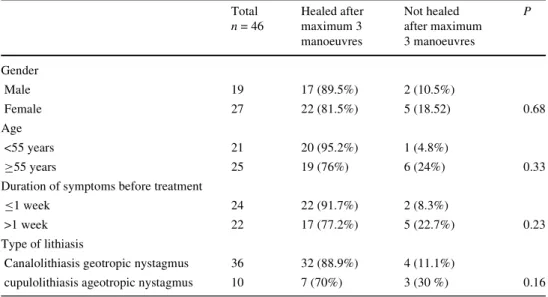
Distribution of patients and results of treatment by barbecue manoeuvre in relation to the evaluated factors are shown in Table1. None of the evaluated factors did signi W-cantly aVect the eYcacy of the treatment (P > 0.05). There was no diVerence in eYcacy of the manoeuvre whether h-BPPV was primary or secondary.
Five patients consulted for recurrence occurring 9–30 months after Barbecue manoeuvre. Three of them presented h-BPPV, and in two cases the posterior semi-circular was aVected.
Table 1 Distribution of pa-tients and results of Barbecue manoeuvre according to diVer-ent factors of interest
Total n = 46 Healed after maximum 3 manoeuvres Not healed after maximum 3 manoeuvres P Gender Male 19 17 (89.5%) 2 (10.5%) Female 27 22 (81.5%) 5 (18.52) 0.68 Age <55 years 21 20 (95.2%) 1 (4.8%) ¸55 years 25 19 (76%) 6 (24%) 0.33
Duration of symptoms before treatment
·1 week 24 22 (91.7%) 2 (8.3%)
>1 week 22 17 (77.2%) 5 (22.7%) 0.23
Type of lithiasis
Canalolithiasis geotropic nystagmus 36 32 (88.9%) 4 (11.1%)
Eur Arch Otorhinolaryngol (2007) 264:1239–1241 1241
123
DiscussionBarbecue manoeuvre is an eYcient treatment of h-BPPV demonstrating 85% cure rate after a maximum of three rotations. 74% of the patients were cured after the Wrst manoeuvre.
Other authors found similar results concerning the eYcacy of Barbecue manoeuvre combined with other treat-ments [5] or variants of Barbecue manoeuvre [6, 11].
The evaluated factors did not signiWcantly aVect the eYcacy of the treatment, but the small number of patients per group has to be considered. However, some trends are emerged: elderly are more prone to persistent h-BPPV despite treatment, duration of symptoms before treatment seems to be inversely proportional to the eYcacy of the manoeuvre and cupulolithiasis appears to be more resistant to treatment than canalolithiasis.
Natural history of h-BPPV is usually benign [10], with 70–80% of cases that resolve spontaneously within several days to months [3]. Casani et al. [4] evaluated 18 subjects with h-BPPV, in whom no therapeutic manoeuvre had been performed. After 1 week, 17% of the cases were healed, but 28% continued to present symptoms for several months. Our results demonstrate that Barbecue manoeuvre facili-tates quicker resolution.
Barbecue rotation is not known to have any adverse eVects, except vertigo and rarely neuro-vegetative symp-toms. The main disadvantage of this kind of treatment is the diYculty to determine the aVected side and thereby the direction in which the manoeuvre has to be performed. On the other hand, the execution of Barbecue manoeuvre can be incorrect or even impossible due to other diseases (e.g. muscular stiVness, overweight, traumatic injuries) or old age.
Conclusion
Barbecue manoeuvre is an eVective treatment for h-BPPV, demonstrating 85% cure rate after a maximum of three
rotations; 74% of the patients are healed after one manoeu-vre. In our series, the eYcacy of the treatment is not inXu-enced by the diVerent factors assessed. In the majority of cases Barbecue manoeuvre accelerates resolution without notable side-eVects.
References
1. Baloh RW, Jacobson K, Honrubia V (1993) Horizontal semicircu-lar canal variant of benign positional nystagmus? Neurology 43:2542–2549
2. Baloh RW (1994) Horizontal benign poistional vertigo. Neurology 44:2214
3. Brandt Th (1999) Benign paroxysmal positionong vertigo. In: Ver-tigo its multisensory syndromes, 2nd edn. Springer, Heidelberg, pp 269–279
4. Casani A, Vannucci G, Fattori B, Berrettini S. (2002) The treat-ment of horizontal canal positional vertigo: our experience in 66 cases. Laryngoscope 112:172–178
5. Fife TD (1998) Recognition and management of horizontal canal benign positional vertigo. Am J Otol 19:345–351
6. Hornibrook J (2004) Horizontal canal benign positional vertigo. Ann Otol Rhinol Laryngol 113:721–725
7. Lempert T (1994) Horizontal benign positional vertigo. Neurology 44:2213–2214
8. McClure JA (1985) Horizontal canal BPV. J Otolaryngol 14:30– 35
9. Nuti D, Vannucchi P, Pagnini P (1996) Benign paroxysmal posi-tional vertigo of the horizontal canal: a form of canalolithiasis with variable clinical features. J Vestib Res 6:173–184
10. Pagnini P, Nuti D, Vannucchi P (1989) Benign paroxysmal vertigo of the horizontal canal. ORL J Otorhinolaryngol Relat spec 51:161–170
11. Tirelli G, Russolo M (2004) 360-Degree canalith repositioning procedure for the horizontal canal. Otolaryngol Head Neck Surg 131:740–746
12. Vannucchi P, Giannoni B, GiuVreda P, Paradiso P, Pagnini P (1994) The therapy of benign paroxysmal positional vertigo of the horizontal semi-circular canal. In: Versino M, Zambarbieri D (eds) International workshop on eye movements. Fondazione IRCCS, Pavia, pp 321–324
13. Vannucchi P, Giannoni B, Nuti D (1992) La cupololitiasi del ca-nale semicircolare orizzontale: aspetti clinici. In: Pagnini P (ed) La cupololitiasi. Formenti-Puropharma, Milano, pp 81–91
14. Vannucchi P, Giannoni B, Pagnini P (1997) Treatment of horizon-tal semicircular canal benign paroxysmal positional vertigo. J Vestib Res 7:1–6