People’s Democratic Republic of Algeria Minister of Higher Education and Scientific Research
UNIVERSITY OF 8 MAY 1945 /GUELMA FACULTY OF LETTERS AND LANGUAGE
DEPARTMENT OF LETTERS AND ENGLISH LANGUAGE
Fostering EFL Learners’ Communicative Competence Through the Use of Information and Communication Technology.
Case Study: Master Two Students at the Department of English, 8 Mai 1945 University, Guelma.
A Dissertation Submitted to the Department of Letters and English Language in Partial Fulfillment of the Requirements for Master’s Degree in Language and Culture. Submitted by: Supervised by:
Ms. DIAB Moufida Ms. EL AGGOUNE Amina Board of Examiners:
Chairwoman: Mrs. TABOUCHE Imen (M.A.A) 8 Mai 1945 University -Guelma Supervisor: Ms. EL AGGOUNE Amina (M.A.B) 8 Mai 1945 University -Guelma Examiner: Mrs. HIMOURA Kawther (M.A.B) 8 Mai 1945 University-Guelma
I
Dedication
In the Name of Allah, the Most Merciful, the Most Compassionate
First of all, I want to offer my greatest thanks to Allah who supply me with enthusiasm, power and never-ending help to reach such moment in my life.
I dedicate this modest work
To my respectful supervisor Ms. EL AGGOUNE Amina, my special thanks to her. To my beloved parents for their endless love, patience, support, and encouragement.
To my old brother Mohamed.
To all my sisters who always support me especially my cherished young sister Rima and my model teacher Feirouz.
II
Acknowledgement
I would like to express my greatest thanks
To my supervisor Ms. EL AGGOUNE Amina for her guidance, comments, instructions and advice.
To the jury members Mrs. TABOUCHE Imen and Mrs. HIMOURA Kawther for their acceptance to read and evaluate this work.
I would like also to express my gratitude to all my teachers at 08 Mai 1945-University of Guelma.
To Master two students for their collaboration with me. To my model teacher Feirouz who was with me side-by-side.
III ABSTRACT
The ultimate goal of this research is to investigate students’ attitudes concerning whether information and communication technology can foster the learner’s communicative competence. Therefore, it attempts to gather various the various perceptions and views of students regarding the tackled topic. Towards this point, the study follows the descriptive method through the use of the questionnaire to obtain a quantitative data. The sample of the current study includes forty master two students chosen randomly at the department of English 8 Mai 1945 University, Guelma. The obtained results confirm the hypothesis which suggests that learners would perceive positive attitudes towards the use of ICT to develop their communicative skills and capacities. Finally, it really asserts for the implication of ICT remains as being a cornerstone for the progression of EFL teaching and learning.
Keywords: Communicative Competence, Information and Communication Technology, EFL Learners.
IV
List of Acronyms and Abbreviations CBA: Competency-based Approach
CBLT: Competency-Based Language Teaching CC: Communicative Competence
CL: Collaborative Learning
CLA: Communicative Language Ability CLT: Communicative Language Teaching CP: Communicative Performance
EFL: English as a Foreign Language FL: Foreign Language
FLL: Foreign Language Learning
ICT: Information and Communication Technology IT: Information Technology
LMD: License Master Doctorat LMD: License Master Doctorate LT: Language Teaching
US: United States
V List of Tables Table 3. 1. Participants’ Gender
48 Table 3. 2. Students’ Period of English Instruction
48 Table 3.3. Daily Use of English
49 Table 3.4. Frequency of Using English
49 Table 3.5. Appreciation of English Proficiency
50 Table 3.6. Interacting with Native Speaker
51 Table 3.7. Types of Interaction
52 Table 3.8. Appreciation of Communicative Competence
53 Table 3.9. The Role of Grammar in the Communicative Competence
53 Table 3.10. Communicative Competence and its’ Components
54 Table 3. 11. Appreciation of the Speakers’ Communicative Competence
55 Table 3. 12. Frequency of Using ICT
56 Table 3. 13. Useful Tools for Developing the Communicative Competence
57 Table 3.14. ICT Users that EFL Students Contact
58 Table 3.15. ICT and CC Relationship
59 Table 3.16. The Incorporation of ICT in Language Learning
60 Table 3.17. Types of Lesson’s
61 Table 3.18. Changes Brought by ICT in EFL Classroom
62 Table 3.19. Lack of ICT in Shaping Learners’ CC communicative competence
VI List of Figures
Figure 1. 1. Jakcobson’s outline of the process of Communication 8
Figure 1. 2. Hymes Model of CC 13
Figure 1. 3. Canale and Swain’s Model of CC 14
Figure 1. 4. Bachman Model of CC 16
VII Contents Dedication
Acknowledgments Abstract
List of Acronyms and Abbreviations List of Tables
List of Figures Contents
GENERAL INTRODUCTION 1
1. Statement of the Problem 2
2. Aims of the Study and Research Questions 2
3. Research Hypotheses 2
4. Research Methodology and Design 3
a. Research Method 3
b. Population of The Study 3
c. Data Gathering Tools . 4
5. Structure of the dissertation 4
CHAPTER ONE: Communicative Competence (CC) Introduction 5
1.1. Origin of CC 6
1. 1.1. Definition of Communication 6
1.1.1.1 Jackobson’s Model of Communication 6
1.1.2. Definition of Competence 8
1.1.2.1. Chomsky’ s Competence Vs De Saussure’s Langue 8
1.2. Defining the Concept of CC 9
1. 3. Models of CC 10
1. 3.1. Dell Hymes Model of The CC 12
1. 3.1.1. Dell Hymes’ Parameters of CC 12
1.3.2. Canale and Swain Framework of CC 13
1. 3.3. Bachman’ Framework of C 15
1.3.4. Celce-Murcia Model of C 17
1.4. Approach’s to CC 19
1.4.1. Communicative Language Teaching Approach (CLT) 19
1.4.1.1. History of (CLT) 19
1.4.1.2. Definition of (CLT) 20
1.4.1.3. Principles of (CLT) 21
1.4.2. Competency-Based Approach (CBA) 23
1.4.2.1. History of (CBA) 23
1.4.2.2. Definition of (CBA) 23
VIII
1.4.2.3. Features of (CBA) 25
Conclusion 28
CHAPTER TWO: Information and Communication Technology Introduction 29
2.1. Definition of ICT 30
2.2. ICT Integration in Education 31
2.2.1. ICT Enhancing Foreign Language Learning 33
2.2.1.1. The Role of ICT in developing Learners’ CC 35
2.2.1.2. Technological Tools Needed in EFL Classroom 36
2.2.1.3. Teacher and Learner Roles in Technology-Enhanced EFL Classroom 39
2.3. The Merits of ICT 40
2.4. The Demerits of ICT 42
2.5. The Importance of ICT in Fostering EFL Learners’ Communicative Competence 44
Conclusion 46
CHAPTER THREE: Field Investigation Introduction 47
3.1. Students’ Questionnaire 47
3.1. Research methodology and Design 47
3.1.1. Sample 47
3.1.2. Description of Students’ Questionnaire 47
3.1.3. Administration of Students’ Questionnaire 48
3.1.4. Data Analysis and Interpretation 49
3.1.4.1. Analysis of Results and Findings from Students’ Questionnaire 49
3.1.4.2. Summary of Results and Findings from Students’ Questionnaire 66
Conclusion 68
Pedagogical Implications 69
Limitations of the Study 71
Suggestions for Future Research 72
GENERAL CONCLUSION 73 References
Appendix A صخلم
1
GENERAL INTRODUCTION
Nowadays with the development of technology and the wide spread of digital devices communication becomes easier and faster. The way and the degree to which people use technology to communicate differs from one person to another and from one society to another. This is due to their cultural, educational, and environmental background that reflect their necessity to the use of technology. To highlight this fact, communicating through technology depends on how much it is needed due to itsadvantages. Because it is very beneficial especially when it is integrated in the domain of education. Learners benefit certainly and easily, theycan carry their techno-devices along with them at any time and in any place. Hence, they will use them to speak, read, listen, and/or share their ideas, thoughts, pictures, and talents as well.
1. Statement of the Problem
Nowadays, technology invades every corner of the society. It proved to be efficiently used to a great extent in saving time, distance, money, and efforts wherever field it is used. However, the main problem that arises is that it does not enjoy a condensed use in the academic surround. In this regard, many students can tend to use digital devices for so often but it turns to limited extent when it comes to their academic achievement in general and to foster their communicative skills in particular. Therefore, what matters most is what can be elaborated from the following question:
What are ELF students’ views towards the effect of ICT’s in fostering learners’ communicative competence?
2
2
. Aims of the StudyThe main aim of the current research is to examine the importance and effectiveness of ICTs usage in fostering EFL learners’ communicative competence. Besides to tackling learners’ adaptation and their familiarization with ICT tools in their studies. Also, it aims to explore learners’ views, perception, and attitudes towards ICT integration in their language learning.
3
. Research HypothesisUsing ICT as a tool in language teaching and learning is one of the last appeals that educationists and linguists call for. Moreover, EFL learners usually prefer to incorporate various ICT tools in their studies aiming to facilitate their language learning. Therefore, creating a strong relation between both CC and ICT stimulated us to hypothesis that:
EFL students would perceive positive attitudes towards ICT and its impact on CC.
4
. Research Methodology and Design4
.1. Research MethodThe current study follows the Quantitative method in order to investigate the role of information and communication technology in developing EFL learners’ communicative competence. Thus, the questionnaire and the interview are picked to collect the needed information. However, the situation of Covide 19 limits the researcher to only one research method which is the quantitative and thus one research tool which is the questionnaire. By the end of the research the obtained results will show whether the research objectives are reached or not and whether the assumed hypothesis is to be rejected or confirmed.
3 4.2. Population of the Study
The population of the current research includes Master two LMD students at the department of English, 8Mai 1945, University-Guelma. The sample consists of forty Master two students who are selected randomly to answer the questionnaire. The reason behind selecting such a sample is that; Master two students mastery of language and their linguistic competence seem to be more developed than other levels. As well as since students are preparing for their dissertations, of course they would rely on various ICT tools and applications to make their research.
4.3. Data Gathering Tools
Depending on the chosen method and the selected sample, the current study is conducted through the use of the questionnaire as a research tool. The main aim of the questionnaire is to investigate students’ views towards the role of ICT in fostering learners’ CC. Therefore, the questionnaire is selected based on the reason that it is quick, easy and convenient to the researched topic.
5.
Structure of the DissertationThe general framework of the dissertation is composed of two main sections, the first section contains two chapters and the second section contains one chapter. To explain more, the first part is a theoretical background of the study, it is a total of two chapters. The first chapter focuses on defining the term communicative competence (CC), and introduces its origin, various models, and approaches, besides to the conclusion. Moving to the second chapter which is devoted to information and communication technologies (ICT). Similarly, it centers on its various definitions, and its role in education, in foreign language learning, and in communicative competence. In addition to the teachers and learners’ roles and the various
4
technological tools used in EFL classrooms. Nevertheless, its advantages that should be tackled and stated hand in hand with its disadvantages.
Likewise, the second part of the dissertation includes only one chapter which is the field work of the current study that is mainly concerned with the description of the questionnaire, its interpretation and analysis, as well as the summary of the obtained results. Finally, in a general conclusion a set of pedagogical implications, besides to the study barriers, in addition to further suggestions for future research, are also tackled in this part.
CHAPTER ONE
Communicative Competence (CC)
Introduction 5
1.1. Origin of CC 6
1. 1.1. Definition of Communication 6
1.1.1.1 Jackobson’s Model of Communication 6
1.1.2. Definition of Competence 8
1.1.2.1. Chomsky’ s Competence Vs De Saussure’s Langue 8
1.2. Defining the Concept of CC 9
1. 3. Models of CC 10
1. 3.1. Dell Hymes Model of The CC 12
1. 3.1.1. Dell Hymes’ Parameters of CC 12
1.3.2. Canale and Swain Framework of CC 13
1. 3.3. Bachman’ Framework of C 15
1.3.4. Celce-Murcia Model of C 17
1.4. Approach’s to CC 19
1.4.1. Communicative Language Teaching Approach (CLT) 19
1.4.1.1. History of (CLT) 19
1.4.1.2. Definition of (CLT) 20
1.4.1.3. Principles of (CLT) 21
1.4.2. Competency-Based Approach (CBA) 23
1.4.2.1. History of (CBA) 23
1.4.2.2. Definition of (CBA) 23
1.4.2.2.1. Competency-Based Language Teaching (CBLT) 24
1.4.2.3. Features of (CBA) 25
5 Introduction
In the past, the mastery of the linguistic system is the main goal of the classical language teaching theories. Linguists argue that learning a language means learning its grammar i.e. a competent speaker is a perfect language user. However, suddenly new studies appear to contradict such paradigm considering language as a means of communication. Linguists emphasize that learning grammar is not sufficient for speakers to be competent language users. However, they must be able to use the language linguistically correct and contextually appropriate in different communicative contexts. This is what is mainly termed by language pioneers as the communicative competence which recently becomes as the main goal of foreign language learners.
Therefore, the first part of the current inquiry deals with the first variable which is CC. It starts with a brief overview of the term tackling communication as a central concept then moving to the definition of the term competence and how it is originated in Chomsky’s work and later reconceived by Hymes. The coming titles summarize the main models of Communicative Competence which are elaborated by a variety of linguists. Shifting to two principle teaching methods the first is CLT Approach and the second is Competency-based Approach. They are considered as crucial since the former is concerned with communication and the latter with competence. Before concluding, a link between the two variables CC and ICT is also talked to see to what extent they are related to each other. In addition, to a conclusion that recapitulates all what has been tackled in this chapter.
6 1.1.Origin of Communicative Competence (CC)
The term of CC is a combination of two important concepts which are communication and competence. These two concepts are considered as the basis of language learning since the main aim of language learners is to develop their competences to be effective communicators.
1.1.1. Definition of Communication
Communication is one of many terms that are defined variously among linguists because it is considered as a dynamic process for which there is no fixed definition. However, most of researchers agreed on the idea that communication is transferring and sharing. According to Patridge (2006) communication is derived from the Latin word “Communicare” which means to share, or to make common” (p. 576).
Coates (2009) provides approximately three similar and brief definitions for communication. The first one is “communication is the sharing of information”; the second one states that “communication is the giving and receiving of information”; in his third definition communication is viewed as “the transfer of information from one or more people to one or more other people” (p. 13). Briefly speaking, communication is to exchange knowledge by sending and/or getting it between communicators.
1.1.1.1.Jackobson’s Model of Communication (1960):
Jackobson’s (1960) outlines the process of communication in a well framed scheme. He explains that communication involves six elements. It requires a sender and a receiver which Jackobson refers to as addresser and addressee respectively. When the former sends a message to the latter a context is needed for appropriate function of the message. All this cannot be realized unless a code is used i.e. a language shared by both as he maintains
7
“the encoder and decoder of the message” (p. 3). Eventually, a contact which is “a physical channel and psychological connection between the addresser and the addressee” would be achieved (p. 3). Continuing further explanation, he claims that the aforementioned elements define six distinguishable functions of the language. These functions are referential, poetic, emotive, conative, phatic, and metalingual. They are concisely elucidated as following:
The referential function: is concerned with the context. It targets the facts that all people over the world agreed upon.
The emotive function: is concerned with the addresser. It is about the speaker’s emotional side as far as the message is concerned. Expressive features play an important role in conveying a clear and an understandable message.
The poetic function: is concerned with the message. It targets the artistic and aesthetic side of the language. It goes beyond poetry, and it requires both mastery of the target language and large lexical background.
The conative function: is concerned with the addressee. It targets the grammatical side of the language. Here the language aims to order and to give recommendations which can be manipulated via imperative sentences which are transformable and unchangeable. The phatic function: is concerned with the message. The language seeks to create, enlengthen, or interrupt communication. It aims to monitor to what extent the language users are engaged in the communication.
The metalingual function: is concerned with both the addresser and the addressee. When both the addresser and the addressee use the language to ask about the language “code” is used itself e.g. what do you mean?
8
It targets the lexical side of the language since both language users seek to well understand the lexis used ( Jakobson, 1960, pp.1-27).
Figure 01: Jackobson’s Model of Communication (1960) CONTEXT (Referential) MESSAGE (Poetic) ADDRESSER………ADDRESSEE (Emotive) (Conative) CONTACT (Phatic) CODE (Metalingual)
Retrieved from Tribus (2017) as cited in Jakobson (1960) 1.1.2. Definition of Competence
The term Competence is originated in Chomsky’s work “Aspects of the Theory of Syntax”. He is considered as the first linguist to coin the term when he has tried to differentiate between the two notions of “competence” and “performance” (Tarvin, 2013, p.5). For Chomsky (1965), competence simply means “the speaker-hearer’s knowledge of language” (p.4). In other words, competence refers to the implicit knowledge of the grammatical rules in the speaker’s mind and their ability to apply these rules. Chomsky’s introduction and perception of these two key notions has revolutionized the modern teaching and learning terrain.
9
Chomsky’s competence Vs performance has been greatly influenced by De Saussure’s dichotomy langue and parole as Czechowska (2002) highlights “it is usually associated with Noem Chomsky (….) who had departed from De Saussure’ s distinction into Langue and Parole” (p. 8). They are quite similar but different in the sense that, while Chomsky considers competence as an internal system of the language that is innate in the human mind i.e. it is a mental phenomenon which is unique and proper to each individual, De Saussure (1959) emphasizes that “Langue” is the abstract system that is internalized in the human mind and at the same time shared by members of the community i.e. Langue is considered as a social phenomenon.
1.2.Defining the Concept of Communicative Competence:
The term CC is first coined by the American linguist Hymes as both a reaction and an enhancement to Chomsky’s notion of Competence. It is composed of two words “the Competence to communicate” (Bagarie, 2007, pp. 94-95). In opposition to Chomsky’s definition, Hymes claims that; CC refers not only to one’s implied grammatical knowledge but also to their capability to apply that knowledge in different speech and social situations. Thus, enhancing Chomsky’s term of Competence with a “sociolinguistic perception” (Hymes, as cited in Bagarie, 2000, pp. 94-95).
Throughout history many other pioneers in the field continue to provide various definitions according to their own perspectives including Savignon (1971) who uses the notion CC to describe learners’ ability “to interact with other speakers, to make meaning, as distinct from their ability to recite dialogues or perform on discrete-point tests of grammatical knowledge” (as cited in Savignon, 2015, p. 3). In other words, CC is used to describe FL learner’s mastery of the language to communicate meaningfully in different
10
speech situations outside the classroom rather than learning grammar just for the sake of not failing a classroom language test.
The linguists Canale and Swain (1980) are considered to be as the most influential names who embrace the notion of CC very earlier and upon which they develop their theory. Basing their ideas on the previous studies on CC, they point out that:
We have so far adopted the term ‘communicative competence’ to refer to the relationship and interaction between grammatical competence, or knowledge of the rules of grammar, and sociolinguistic competence, or knowledge of the rules of language use (p. 6).
According to them, CC can only be achieved when grammatical competence accompanied with sociolinguistic competence. To explain more, when one knows what is syntax and when to use those syntactical forms into concrete communicative situations this indicates that they are communicatively competent. In addition to that, they differentiate CC from “Communicative Performance” (CP) arguing that “it is the realization of these competences in their interaction in the actual production and comprehension utterances” (Canale and Swain, 1985, p. 6).Simply, CP means putting out those competences into real communication to make sentences and to understand various meanings “under general psychological constraints that are unique to performance” as both of them argue.
1.3. Models of Communicative Competence
There are three major theoretical and conceptual frameworks of the term CC: 1.3.1. Hymes (1972) Model of CC:
Although Chomsky’s work creates a revolution in the field of language learning, it is subjected to many critiques. This leads to the rejection of his wok by other linguists like
11
Hymes who is one of the prominent critics to Chomsky’s work. Therefore, Hymes depends on some basis to develop his theory of CC. He tackles Chomsky’s limited perspective towards the linguistic theory, which mainly focuses on a perfect communicator or language user who masters the grammatical knowledge of language shared in his community and puts it into practice successfully without submitting to any other obstacle like “memory limitation” which may hinder the communication.
From Hymes perspective this theory is not correct as far as children are concerned, since they are not perfect language users. In other words, they still learn/ acquire the language of their community, and here language problems and obstacles are impossibly elevated. The idea that must be considered when reproaching the linguistic theory pays attention to the social and cultural factors, which have an influential role in determining communication. Chomsky excludes “the social side of the language” considering it as a purely grammatical system. Hymes gives too much importance to CC considering language like a coin with two faces social and linguistic one.
According to him the study of Ethnography “symbolic forms” is a rigid basis for the CC which highlights the fact that language cannot be dealt with in isolation. He further claims that “language and society” is a dichotomy in CC which compromises both linguistic and nonlinguistic elements (motivation, cognition, emotion, etc.). That’s why Hymes clarifies that CC is to be developed to serve the educational objectives opposing to Chomsky who tends to focus only on the language system study. CC is not restricted only to grammatical knowledge of the language “the linguistic mastery”, but rather it goes beyond the linguistic factors to embrace other social and nonlinguistic factors because language is a social phenomenon. A communicatively competent language user is the one who is able to
12
mobilize his/her grammatical knowledge whatever and however it is. Additionally, without forgetting the paralinguistic features to convey his/her message competently and efficiently regardless to obstacles. (Acare, 2005, pp. 2-4).
1.3.1.1.Dell Hymes’ Parameters of CC
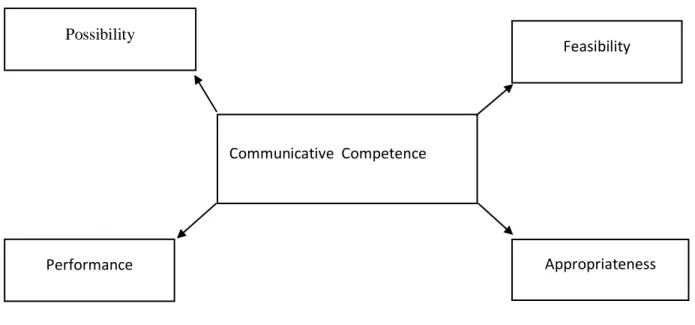
According to Hymes (1972) it is of high importance for the speaker-hearer to know that “something is formally possible, feasible, appropriate, and performed” (pp. 285--286). in order to achieve effective communication. Furthermore, the idea behind the aforementioned parameters is to clarify that if a speaker is linguistically competent i.e. He is able to produce correct grammatical sentences but at the same time ignores the knowledge of use; of course s/he cannot function or communicate appropriately. Hymes formulates these criteria in the form of four questions that are explained as follows:
whether and to what degree something is formally possible
Possibility, refers to the speaker‘s knowledge of producing linguistically correct and culturally appropriate grammatical forms and communicative actions, as well as reasoning wrong forms and actions.
whether and to what degree something is feasible in virtue of the means of implementation available
Feasibility, in other words, it refers to what is not only correct grammatically but also to what is suitable for the memory to be processed.
whether and to what degree something is appropriate (adequate, happy, successful) in relation to a context in which it is used and evaluated
13
Appropriateness, logically speaking, the speaker must adhere to the context in which s/he is speaking to be relevant to the listener, taking into consideration; when, where, and whom he is addressing.
Whether and to what degree something is in fact done” actually performed, and what its doing entails.
Performance, refers to one’s ability to match words together that cannot naturally work together. Those words could be grammatically correct, appropriate, feasible, but not in their actual occurrence. (Hymes, 1972, pp. 285--286). Therefore, Hymes parameters are outlined in the following scheme:
Fig 02: Hymes’ Parameters of CC (1972)
(Retrieved From Hymes, 1972, pp. 285-286) 1.3.2. Canale and Swain (1980) Model of the CC
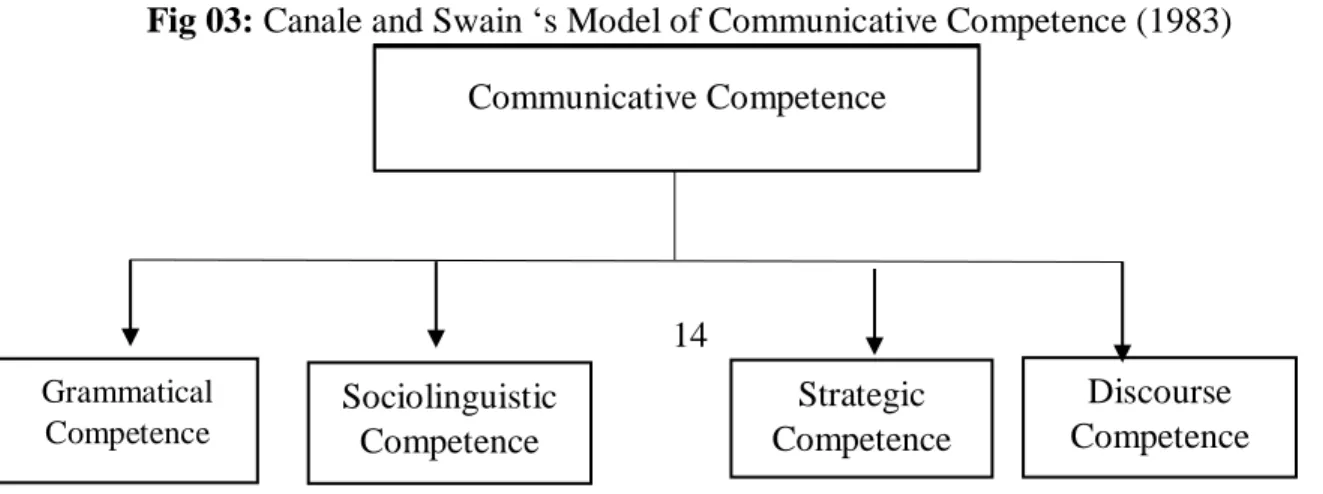
One of the models designed to reconceive the constituents of CC is that of Canal and Swain (1980). In their work which is published in (1980, 1981), they introduce a framework for CC which at the beginning contained only three components. Later on, Canale (1982, 1983) republishes another work in which he adds another component which is
Communicative Competence Possibility
Feasibility
14
“Discourse Competence” (Bagarie, 2007, p. 97). Thus, CC is composed of four areas, each of which is briefly explained as follows:
2.1. Grammatical Competence
It refers to the mastering of all linguistic systems from phonology and morphology to syntax and semantics.
2.2. Sociolinguistic Competence
As its name suggests, it is further subdivided into two other competencies; socio-cultural and discourse competence which both can enable the speaker to grammatically and contextually sound correct and appropriate.
2.3. Strategic Competence (communication strategies)
During communication the speakers enhance their speech with verbal and non-verbal communication strategies. The aim of this latter is to recompense or to solve linguistic or socio-linguistic interruptions related to performance that hinders the reception of the message. (Canale and Swain, 1980, pp. 28-31)
2.4. Discourse Competence
This competence can be achieved through the speaker’s ability to create messages where meanings and forms are in a complete harmony. This harmony is enhanced “by cohesion in form and coherence in meaning” (Bagarie, 2007, p. 97).
The following scheme outlines the components of CC according to Canale and Swain (1980) and Canale (1983):
Fig 03: Canale and Swain ‘s Model of Communicative Competence (1983)
Grammatical Competence Communicative Competence Sociolinguistic Competence Strategic Competence Discourse Competence Communicative Competence
15
(Retrieved from Ed. Richards and Schmidt, 1983, p. 6) 1.3.3. Bachman’s Model of CC (1990)
The professor of Applied Linguistics Bachman (1990) develops another model of CC which he basically calls Communicative Language Ability (CLA) and considers as “consisting of both knowledge, or competence and the capacity for implementing, or executing that competence in appropriate, contextualized communicative language use” (p. 84). In other words, Bachman (1990) views that CLA refers to ones ’aptitude to know how to invest their knowledge in order to apply it fittingly and relevantly to the situation needed.
Bachman’s model is basically composed of three constituents; language competence, strategic competence, and psycho-physiological mechanisms. Starting with Language Competence, he perceives it as “a set of specific knowledge components that are utilized in communication via language”. It is composed of organizational competence and pragmatic competence. The former refers to one’s power to manipulate the linguistic system to create accurate syntactical forms and understanding their implicit or explicit meaning. This constituent is further subdivided into two kinds: the grammatical and textual competencies.
The other component of Language Competence is pragmatic Competence which is regarded by Bachman as the speakers’ knowledge of how to combine the linguistic symbols forming logical connections between them to sound contextually relevant. It is divided into two types; illocutionary and sociolinguistic competence. The former as Bachman explains “is used both in expressing language to be taken with certain illocutionary force and in interpreting the illocutionary force of language” (p. 92). That is to say, this competence can be shown when the speaker uses a certain piece of language to convey meaning that is not explicitly stated i.e. implied in words but convenient to the context. Whereas, the
16
sociolinguistic competence simply refers to the appropriate use of the linguistic system according to the social context.
Moving to the strategic competence which refers to how much the human mind is able to employ the components of language competence appropriately. Distinctively, what characterizes Bachman’s framework is the integration of neurology (Saleh, 2013, p. 4). Besides to psycho-physiological mechanisms which refer to the fact that language production is influenced by the speaker’s psychology and neurology (Bachman, 1990, p. 84).
Fig03: Bachman’s model of communicative competence
(Retrieved from Bachman, 1990, p. 87) Communicative Competence Strategic competence Psychophysiology mechanisms Language Competence
Organizational competence Pragmatic competence
Textual competence Grammatical competence Illocutionary competence Sociolinguistic competence
17 1.3.4. Celce-Murcia, M. Model of CC (2007)
In 1995, Celce-Murcia, Dornyei, and Turrell, propose a model of CC which is composed of five competences (a)socio-cultural competence, (b)discourse competence, (c)linguistic competence, (d)actional competence, (e)strategic competence. In her reviewed model, Murcia (2007) makes some modifications to the previous model and introduces a new one as it is explained:
4.1. The Sociocultural Competence
As Murcia clarifies this competence refers to “how to express messages appropriately within the overall social and cultural context of communication” (p. 76). In other words, it refers to the speaker’s ability to use the language fittingly to express his/her message regarding to the social and cultural factors within the society.
4.2. Discourse Competence
It refers “to the selection, sequencing, and arrangement of words, structures, and utterances to achieve a unified spoken message” (p. 77). To say it in another way, there should be an elaboration of a coherent and cohesive message taking into consideration lexical and grammatical norms. Also, the choice, relevance, and organization of the linguistic pieces is so crucial for well-comprehensive speech.
4.3. Linguistic competence
As Murcia mentions, this latter refers to the knowledge of using the language correctly in terms of pronunciation, morphology, syntax, and lexis (p. 77).
4.4. Formulaic Competence
It is much more restricted in the meaning in comparison to the linguistic competence since it refers only to the use of already-made language chunks without any reflection. In
18
other words, the everyday frequently used items by the society forced the speaker to use them unconsciously (p. 77).
4.5. Interactional Competence
It refers to the ability of setting up conversations with interlocutors effectively through using different techniques like; speech initiation, turn taking, speech closing, interruption, using paralinguistic features, and understanding how to use language functions like: apologizing, blaming, regretting, and complaining. (Murcia et al., 1995, as cited in Murcia, 2007, p. 48).
4.6. Strategic Competence
It involves different learning strategies that are used by the learner to foster and facilitate the process of language learning and make it more effective, and real. Murcia mentions three types of learning strategies including; “Cognitive Strategies”; “Meta- cognitive Strategies”, and “Memory-related Strategies” (p.78). Therefore, Murcia’s model is outlined as follows:
19
(Retrieved from Celce Murcia, 2007, p. 45) 1.4. Approaches of CC
There are two main approaches of CC
1.4.1. Communicative language Teaching Approach (CLT) 1.4.1. 1. The History of (CLT)
The appearance of CLT “can be traced back to concurrent developments in Europe and North America” (Savignon, 2015, p.1) Communication which is neglected in first language studies starts to gain importance “toward the end of the twentieth century” when “great attention was given to the Communicative Approach” (Davies and Elder, 2004, p. 608). Consequently, the emergence of CLT is not sudden but it gradually grows through mainly three stages along with the development of language learning theories “up to the late 1960’s till the present time” (Richard, 2006, p. 6)
Discourse Competence Socio-cultural Competence CCompetence CCCCompetenc e C C Competence Interactional Competence CCompetence CCCCompetenc e C C Competence Lingustic Compete nce C C Compete nce Formilaic Compete nce
20
Traditionally, the methods that are adopted in language classrooms are described by Swan (1985) as “old language courses taught forms, but did not teach what the forms meant or how to use them” (p. 77). According to Richard (2006) “in the 1970’s a reaction to traditional language teaching approaches began and soon spread around the world” (p. 6). the fact that makes classical methods that focus more on grammar are put aside namely; Audio-Lingual, Suggestopedia, and Grammar Translation Method
At the late of 1990’s till the modern times a variety of new approaches mainly CLT that considers CC as its focal point starts to gain much attention and emphasis. Considerably, CLT is a dynamic and flexible approach that refers to various principles that are applied along with the necessities and needs of the language learners. “Communicative Language Teaching marks the beginning of a major paradigm shift within language teaching in the twentieth century” (Richards and Rodgers (2001), p. 151)
1.4.1.2. Definition of (CLT)
According to Richard (2006) CLT can be defined as an approach to language teaching that includes a set of principles that are mainly concerned with the aim behind teaching and learning a FL /SL. It sheds light on the language tasks that simplify learners’ way of learning, in addition to the teacher, and the learner’s responsibilities inside the classroom. Richards’ definition denotes that the tutor, learner and even tasks play a crucial role in the process of learning new language. (p. 2)
Savignon (2015) also argue that “CLT refers to both processes and goals in classroom learning” (p. 1). In other words, CLT simply refers to the methods and ways of teaching the language inside the classroom, and the aims to which the followed method is intended to achieve.
21
She further clarifies that “the essence of CLT is the engagement of learners in communication in order to allow them to develop their communicative competence” (Savignon, 2006, p. 209). In other words, the corner stone of CLT as a language teaching approach resides in developing learners’ communicative skills. Such skills would be developed inside the classroom through learners ‘interaction with each other and the teacher. Widdowson’s concept of CLT is clearly expressed in this quote that says “when we acquire a language we do not only learn how to compose and comprehend correct sentences as isolated linguistic units of random occurrence” i.e. grammar out of its context is not enough but what is more crucial and needed also to know is “how to use sentences appropriately to achieve a communicative purpose” (Widdowson, 1978, p. 2).
1.4.1.3. Principles of (CLT)
According to Bern there are eight principles of CLT:
1. It considers language as a phenomenon that is rooted in society where people use it for interacting with each other clearly and verbally.
2. Divergence is highly appreciated and regarded as an enhancement for the language to progress in an environment where it is used as a second language as it is progressed among its natives.
3. The learning ability of learners is always viewed as changeable and needs growing up. 4. Language varieties are useful examples for teachers to follow in second language teaching 5. Culture is viewed as a key factor in elaborating learners ‘Communicative Competence whether in their Mother Tongue or in other learned and/or acquired languages.
6. CLT is not a mono-method approach; rather it is based on multiplicity and flexibility in presenting the language material.
22
7. Practicing language is purposeful and very beneficial for boosting learners’ communicative skills
8. More importantly, learners require to participate in various activities in the classroom and to be an effective factor in all steps of the learning process. (Bern as cited in, Savignon, 2002, p. 6)
According to Richard (2003) (CLT) is one of the approaches that are widely preferred in language teaching classrooms. The attention gained by this approach is due to the flexibility of its principles that function fittingly in whatever language situation they are applied. Richard introduces six other principles upon which the CLT approach is based: 1. The primary focus of CLT is to shed light on developing FL learners ’CC.
2. The best way for learners to develop their language performance is to interact with the language.
3. Creating real settings inside the classroom as an essential feature to language tasks.
4. Clear articulation and correct pronunciation should be stressed as being the essence of the interaction.
5. Both the receptive skills and the productive ones should take the lion’s share in the teaching and learning process.
6. Mistakes are not considered as barriers for learners in CLT but rather a basic step for learning (p. 5).
1.4.2. Competency-Based Approach (CBA)
Since its emergence CBA passes with different stages and events that form its historical period.
23
According to Richard and Rodgers (2006) (CBA) is first appeared in the United States in the second half of 1960. Its origin dates back to previous studies and events that lead to its emergence. It is argued that CBA is rooted in the behaviorist theories appeared in 1950’s, whereas others relate it to USA military which gets inspired by Frederick Taylor (1947) and initiates the CBA. According to Norland and Pruett-Said (2006) “since the 1970’s, this approach has been expanded on and has come to play a central role in most contemporary language teaching situations.” (p. 18)
According to Butova (2015), the development of the CBA grows gradually following three main phases starting from 1960 to 1970 as its first step. During this stage, important terms linked to the field started to appear like “competence, competency, professionalism, etc.” it is a theoretical period. From 1970 to 1990, psychology as an independent field takes part in CBA and becomes a key aspect within it. Thus, integrating psychology to CBA leads to Competency-Based Education (CBE) where the focus was on FL learning due to the linguistic origin of the approach. At this stage, competence was decided to be the main aim of learning. Nowadays competency emphasizes the consequences of learning and learners’ needs. (pp. 252-254)
1.4.2.2. Definition of CBA
(CBA) is introduced as an approach in the domain of education as Richard and Rodgers (2001) put it, CBA“ is an educational movement that focuses on the outcomes or outputs of learning in the development of language programs” (p.141).This quote highlights that the main emphasis of CBA is the fruits and the consequences that one comes up with after a process of learning .Similarly, Butova (2015) shares the same view with them claiming that “CBE is currently focused on learning outcomes”(p. 254). In the same vein
24
Schaffer and Van Duzer (1984) define it widely so as to refer to “a performance-based process leading to demonstrated mastery of basic and life skills” which in turn serves to help “the individual to function proficiently in society” (p. 37). Likewise, they further postulate that CBA is in a complete harmony with the modern “Linguistic Theory” that concentrates on the “Communicative Approach” (p. 5).
Another way of defining CBA is to put the accent on its focal points. To that end, Norland and Pruett-Said (2006), argue that “CBA includes an assessment of learners ‘needs, selection of competencies based on those needs, instruction targeted on meeting those needs and evaluation of learners’ performance in meeting the competencies” (p. 57). To put it another way, CBA measures the requirements of learners that guide the teacher to decide about the competences to be fixed. The teacher’s decision is made after scrutinizing learners’ abilities to see whether the intended competence is well learned.
1.4.2.2.1. Competency-Based Language Teaching (CBLT)
(CBLT) is developed in relation to CC and aims to promote learners’ interactive skills as well as it works in harmony with CLT as Richards and Rodgers (2001) argue that “CBLT thus shares some features with Communicative Language Teaching” (p. 143). Furthermore, they add that
CBLT is an application of the principles of Competency-Based Education to language teaching. Such an approach had been widely adopted by the end of the 1970’s, particularly as the basis for the design of work -related and survival-oriented language teaching programs for adults (p. 141).
Griffith and Lim cited Docking who claims that CBLT “is designed not around the notion of subject knowledge but around the notion of competency. The focus moves from
25
what students know about language to what they can do with it. The focus on competencies or learning outcomes underpins the curriculum framework and syllabus specification, teaching strategies, assessment and reporting” (2014, p. 2). Furthermore, according to Richard and Rodgers (2014), CBLT
is based on a theory of learning that sees skills as integrated sets of behaviors that are learned through practice and that are made up of individual components that may be learned separately and that come together as a whole to constitute skilled performance (, p. 169).
To sum up, CBLT is an approach to language teaching that follows the CBA principles. It does not focus on the learners’ knowledge of the language but on their abilities to invest that knowledge in various communicative situations to achieve their goals. When teachers investigate learners’ competences, it will be easier for them to know what skills learners are developed and what they still lack. Gaps in learners’ outcomes are a starting point for educators and teachers to depart from and to design an effective curriculums, syllabuses, and lessons besides to making evaluations and assessments as well as enhancing their teaching strategies.
1.4.2.3. Features of CBA
Auerbach (1986) elaborates eight pivotal characteristics of Competency-Based Approach (CBA) which shows that Language is learned for the sake of:
1. CBA comes to cope with the different world challenges so it’s’ aim is to prepare learners to be independent, responsible, and self-relying citizens to respond to the different current defies.
26
2. CBA seeks to prepare the learners to be effective communicators in their societies and to deal with different social unexpected situations efficiently through its emphasis on different language functions, skills, and real tasks.
3. CBA emphasizes on the learner’s output, their reaction, and response to the prompt which must be real and measured. Priority is given to performance over knowledge to be assessed 4. The teacher must break down his broader objectives into sub objectives and focuses on one language difficulty each time to reach his objectives efficiently and easily to ensure the learners total mastery of the presented linguistic input.
5. The output should be unified and common to both the teacher and learners. A clear real prompt makes the learners end up with the same response.
6. The assessment goes hand in hand with the teaching learning process. Firstly, it takes place at the beginning of the learning process to identify the learners’ strengths and weaknesses in order to tailor made the linguistic content. Then, it takes place after the learning process in order to identify what has been totally mastered and what has been partially acquired to be reinforced and consolidated once again.
7. Classical tools of student’s assessment are no longer relying on but rather the focus is on the degree to which learners are able to demonstrate and implement the acquired knowledge. 8. Individual differences are taken into consideration when setting instructions which are not time bound because the teacher is supposed to follow the learner’s rhythm and pace. Pre-required knowledge must be taken into consideration before designing a real practical curriculum because it serves as a starting point for the new presented knowledge (pp. 414-415).
27 Conclusion
To conclude, CC is a very crucial skill in language teaching and learning. That is why it has been the discussion of many linguists and language practitioners throughout the history of FLL. They introduce a set of theories and methods which emphasize on dealing with the language as a tool for communication and not only as a linguistic system. In other words, learners should be taught how to use the language appropriately in different speech and communicative situations. Therefore, developing a strong CC becomes nowadays a must for foreign language learners due to the wide spread of technology, globalization, etc. Finally, Communicative Competence is highly significant for language learners because knowing language is created for no aim but communication.
CHAPTER TWO
Information and Communication Technology
Introduction 29 2.1. Definition of ICT 30 2.2. ICT Integration in Education 31 2.2.1. ICT Enhancing Foreign Language Learning 33 2.2.1.1. The Role of ICT in developing Learners’ CC 35 2.2.1.2. Technological Tools Needed in EFL Classroom 36 2.2.1.3. Teacher and Learner Roles in Technology-Enhanced EFL Classroom 39 2.3. The Merits of ICT 40 2.4. The Demerits of ICT 42 2.5. The Importance of ICT in Fostering EFL Learners’ Communicative Competence 44 Conclusion 46
28 Introduction
Developing the process of FLL and making it much more effective has been the interest and the main goal of many linguists throughout the time. That is why they display too many efforts to revolutionize the foreign language learning field with a wide diversity of teaching methods and techniques. However, the use of materials was still limited until technology was born to fulfill this gap and to support both teachers and learners in foreign language teaching and learning.
Therefore, the second part of this study deals with the second variable which is Information and Communications Technology (ICT). It starts with a definition of the acronym supported with various scholars and linguists’ views concerning the term. Moving directly to ICT integration in education and providing a general overview to explore how ICT gained attention and asserts itself since its emergence. Moreover, arriving to the role of ICT in Education, in FLL and more precise in developing learners’ communicative competence. Then jumping to the various technological tools used in FLL classrooms. Besides the teacher and learner roles that are altered with the incorporation of technology. Finally, concluding with the merits that ICT can offer to FL learners without forgetting its demerits as well.
29
2.1. Definition of Information and Communication Technology (ICT)
(ICT) is an acronym that stands for Information and Communication Technology. It is used interchangeably with Information Technology (IT). Margaret (2005) clarifies the difference between ICT and ICT in the sense that; the singular form of communication refers to the process of communication and human interaction itself however its plural form refers to all broadcasting systems, networks, tools , devices, equipment as well as processes….etc., used for the sake of communicating and transferring information and facilitating human services in any life sector, which Margaret refers to it as “the whole field of data communications infrastructure” (p. 3). Moreover, researchers in the field define ICT differently; narrowly, and globally, each one according to his/her own perspective.
Hennessy et al. (2010) argue that “ICT is used as an umbrella term that includes any communication device or application” (p. 6). In other words, ICT in the broad sense is seen as any electronic apparatus or program “encompassing: radio, television, cellular phones, computer and network hardware and software, satellite systems, as well as the various services and applications associated with them, such as videoconferencing and distance learning” (p. 6).
According to Mikre (2011) ICT “refers to the computer and internet connections used to handle and communicate information for learning purposes” (p. 2) To put differently, it refers to the computer networks that are used in the education field by learners to satisfy their needs and purposes such as searching and exchanging information.
Harrison (2000) defines clearly technology and information as following “technology is referred to the use of more advanced and developed equipment designed particularly for humans to realize their necessities. While information is all what is produced to be
30
transferred and shared between humans for easy access and comprehension (as cited in, Tamils Elvan, et al.). Therefore, the basic definitions of these two terms (Technology and information) constitute what is referred to as Information Technology (IT) which is conceived by Celebic and Rendulic (2011) as it “encompasses all of the technology that we use to collect, process, protect, and store information. It refers to hardware, software (computer programs), and computer networks” (p. 2).
Understanding ICT and mastering the basic skills and concepts of ICT as part of the core of education makes educationists view it from two sides as Moursund (2005) “ICT is a significant aid to both students and teachers, and it is significant challenge to both students and teachers” (p. 107). In other words, ICT needs to be learnt about first before using it to learn with i.e. it starts as a target and then becomes a means. The power of ICT in facilitating the teaching and learning process resides in its proper and reasonable use unless both teachers and learners can fail if they do not dominate it of course they will be dominated by.
All in all, ICT refers to the various technological tools with its advanced applications, systems devices, and products that is used to provide easy access to all forms of information every when and everywhere. It abbreviates time and distance to facilitate the communication of information between people all over the world. Information Technology (IT) is not the same as Information and Communication Technology ICT since the former is concerned more with the hardware and software of the computer systems used for gathering, processing and saving information while the latter is distinctively concerned with the process of communicating, transferring, and broadcasting information whatever the distance is. 2.2. ICT integration in Education
31
The appearance of Globalization is a turning point in the history of humanity due to the profound changes it brings and the revolutions it creates in whatever domain of life. Such shifts assert their position by what is referred to as the “internet network” which the ultimate aim behind its creation is to revolutionize education which in turn serves and contributes to the development of other sensitive fields like economy and military and so on and so forth. This means that ICT is created for powering and driving the education wheel in a new road for a deep and long-life reform to develop learners and students’ skills in their specialties.
The 1990s was the decade of computer communications and information access , particularly with the popularity and accessibility of internet based services such as electronic mail and the world wide web ( WWW).At the same time the CD-ROM became the standard for distributing packaged software( replacing the floppy disk).As a result , educators became more focused on the use of the technology to improve student learning as a rational for investment (Noor-UI-Amin, 2012, p. 2). The emergence of ICT in education is also led by the shifting paradigm in the teaching and learning process where too much emphasis is put on the learner to support self-learning as, Lowther et al. (2008) state that “there are three important characteristics are needed to develop good quality teaching and learning with ICT: autonomy, capability, and creativity” (as cited in Fu, 2013). These three principles are started to appear when autonomy born with the coming of ICT into classroom.
Therefore, the implementation of ICT into education leads to the appearance of what is referred to as “Educational Technology”. It is defined by Ghavifekr and Rosdy (2015) as “technology–based teaching and learning that closely relates to the utilization of learning technologies in schools” (p. 175). Bearing in mind that the integration of this latter
32
into the school pedagogy gains high significance and becomes one of the learning basics which the learner seeks to learn about before learning with alongside other types of skills and specialties as Stanley (2013) clarifies that with “the incorporation of technology into school -wide teaching pedagogy …Students will also develop digital literacy skills at the same time as acquiring a second language” (p. 58). Sharing the same view, Meenakshi (2013) also argue that “Information and communication technology (ICT) has become, within a very short time, one of the basic building blocks of modern society” (p. 4).
Moreover, the coming of ICT to the educative context is categorized into two sections because most of people confused ICT for education with ICT in education but Noor-Ul-Amin (2012) highlights the difference between the two arguing that ICT for Education means developing ICT tools particularly for the sake of improving this field and facilitating the teaching learning process whereas ICT in Education concerns the implementation of the various technological tools in the process of teaching and learning (p. 2).
2.2.1. ICT Enhancing Foreign Language Learning
ICT is considered as one of the greatest achievements that scientists ever reached and despite this it continuous to grow and develop rapidly and wonderfully. In education and more narrowly in foreign language learning it plays an important role in creating a scholastic and enjoyable learning environment which serves to engage the learner effectively in the learning process and makes it easier. Besides to that, it becomes a criterion for the success of foreign language learning and teaching that is why countries all over the world compete to incorporate it to make learners overcome all the challenges and problems that hinder their learning. Moreover, the benefits that EFL learners are enjoyed are due to the availability of ICT that no one can ignore. Ghasemi and Hashemi (2011) argue that:
33
ICT can be used to integrate speaking, listening, reading and writing. It enhances interactive teaching and learning styles. It also extends pupil’s ability to exercise choice, work independently and make connections between their work in English and in other subjects (p. 3100).
These two researchers intend to demonstrate that the integration of ICT within foreign language learning serves many tasks chiefly the focus on the language skills and their combination to each other. In the sense that, each skill serves, builds and supports the other i.e. when students listen and read can speak and write. Furthermore, it suits all teaching and learning styles whether they are auditory, visual, or kinesthetic style. It also gives learners more chance to work independently, collaboratively and autonomously creating a strong relation between English and other subject matter knowledge which they learnt. Azmi (2017) further maintains that:
By increasing the amount of authentic material in the classroom (blogs, podcasts and digital videos) and providing students with appropriate skills to approach authentic material, teachers promote meaningful interaction, raise students ’interest and motivation; and ensure more participation and engagement in the classroom (pp.112-113).
Believing in the effectiveness of the integration of the ICT within the language learning, this quote highlights the idea of authenticity when dealing with the choice of the pedagogical materials since it proves to be the motor towards motivation, interaction, and high engagement which eventually guarantee success among learners and have positive attitudes towards the language and the integration of ICT.
34
Unlike traditional learners who used to travel and spend a long period of time in foreign countries to learn a certain language and develop their communicative skills. Nowadays, the digital generation’s learners are lucked since ICT paved the way for them to realize what was like a dream in the past. For example, “the internet can be a rich source of authentic oral models via recorded songs, talking electronic books, podcasts and video clips that help learners with pronunciation as well as the acquisition and reinforcement of new vocabulary” (Pim, 2013, p. 22). To put it differently, it provides them with all what is oral produced in different forms supported with visualities and sounds in order to enrich the learners’ vocabulary background and improves their speaking skill especially pronunciation. Therefore, exposing learners to the way a native speaker utter and pronounce words teaches them how to phonetically pronounce the language successfully and thus becoming effective communicators.
Moreover, the availability of ICT tools permits learners not only to listen, read, and, write the language but also to discover its culture since the former and the latter are closely related to each other i.e. words and expressions which are derived from culture needs to be produced in their appropriate situations in order for the learner to appear more relevant as Ghasemi and Hashemi (2011) maintain that “using ICT gives the learners real –life contact with , and exposure to , the cultures of the people and countries where the new language is spoken and enables children to access and research information worldwide ”(p. 3099).
In addition to that when learners are exposed to videos, audios, electronic books, and talking dictionaries will certainly develop a high listening skill which is one of the basics of learning a foreign language and developing a successful communicative competence. Such tools increase the student’s motivation and increased their desire to learn and discover more
35
about the language. It also encourages them to produce similar audios and videos with the language and thus putting their linguistic knowledge into practice so that their interactional abilities get more improved. As Park, and Son (2009) argue “such experiences can help language learners develop their communicative competence through interaction with the other people, practice the language beyond the classroom and understand cultural diversities” (p. 19)
All in all, ICT plays a pivotal role in developing learners’ communicative skills due to its availability and flexibility which makes it well-esteemed not only by foreign language learners but also by linguists, psychologists, and educationists as well.
2.2.1.2. Technological Tools Needed in EFL Classrooms
Like any other field of study FELT welcomes the coming of ICT to the classroom and starts to adopt it in a way or in another to help teachers to be effective and learners to be creative. According to UNESCO Work Education Report (WER) (1998) “ICTs provide an array of powerful tools that may help in transforming the present isolated , teacher-centered and text-bound classrooms into rich , student-focused, interactive knowledge environments (p. 16, as cited in UNESCO, 2002).In other words, ICT with its developed tools and advanced applications altered the domination of the teacher with the creativity and richness of students and transformed the school materials-limited lesson to a large source of diversity that motivate learners and attract their attention. Ivy (2011), provides a set of technological options that teachers may use them:
36
Is the largest source of information in all over the world which includes an infinite number of sources visited by each and every researcher “teachers should be equipped with the necessary skills to track and sort out these resources” (Ivy, 2011, p. 207).
2.2. Multimedia Sources
According to Andersen and Brink (2013) “multimedia contains texts, graphics, animations, video and sound in an integrated way and the content can be structured and presented differently” (p. 21). In other words, it refers to the multimedia products like when a teacher integrates sounds, images, and animations creating enjoyable and a motivating material to attract learners’ attention. Taking as an example, the power point presentations “it can be used by teachers to present organized lectures, aid ‘visual’ and inattentive learners and prepare students for their professional life” (Ivy, 2011, p. 208).
2.3. Office Applications
It offers an endless number of applications for the user to facilitate his/her work like opening a word page in which one can write a letter, draw a picture or produce anything they need. In addition to that the Microsoft office can help in correcting grammar and spelling mistakes and other usages like “concordancing, collaborative writing, referencing, presenting research data etc.” (Ivy, 2011, p. 208)
2.4. Audiovisual Equipment
Recently the majority of classes rely on computers and some of its physical components so teachers should master how systems basically function so that when a machine is troubled a teacher can easily find the solution without disturbing the students’ concentration (Ivy, 2011. p, 208).