BIOINFORMATICS
APPLICATIONS NOTE
Vol. 21 no. 16 2005, pages 3435–3438doi:10.1093/bioinformatics/bti537Structural bioinformatics
FoldIndex
©: a simple tool to predict whether a given protein
sequence is intrinsically unfolded
Jaime Prilusky
1,†, Clifford E. Felder
2,†, Tzviya Zeev-Ben-Mordehai
2,3,
Edwin H. Rydberg
2,3,5, Orna Man
2,4, Jacques S. Beckmann
4,6,
Israel Silman
3and Joel L. Sussman
2,∗1Biological Services and2Department of Structural Biology,3Department of Neurobiology and4Department of
Molecular Genetics, Weizmann Institute of Science, Rehovot 76100, Israel,5Department of Biochemistry,
Instituto di Ricerche di Biologia Molecolare ‘P. Angeletti’ S.p.A. I-00040 Pomezia (Rome), Italy and6Service of
Medical Genetics, Centre Hospitalier Universitaire Vaudois, CH-1011 Lausanne, Switzerland
Received on August 27, 2004; revised on May 10, 2005; accepted on June 8, 2005 Advance Access publication June 14, 2005
ABSTRACT
Summary: An easy-to-use, versatile and freely available graphic web
server, FoldIndex©is described: it predicts if a given protein sequence
is intrinsically unfolded implementing the algorithm of Uversky and co-workers, which is based on the average residue hydrophobi-city and net charge of the sequence. FoldIndex© has an error rate
comparable to that of more sophisticated fold prediction methods. Sliding windows permit identification of large regions within a protein that possess folding propensities different from those of the whole protein.
Availability: FoldIndex© can be accessed at http://bioportal.
weizmann.ac.il/fldbin/findex
Contact: [email protected]
Supplementary information: http://www.weizmann.ac.il/sb/faculty_
pages/Sussman/papers/suppl/Prilusky_2005
A growing number of proteins have been found to be natively unfol-ded under physiological conditions (Dunker et al., 2000; Wright and Dyson, 1999; Zhang and Forman-Kay, 1997; Uversky et al., 2000; Bell et al., 2002; Schweers et al., 1994; Zeev-Ben-Mordehai et al., 2003; Vucetic et al., 2004). Uversky et al. (2000) described a simple method to predict whether a given protein assumes a defined fold or is intrinsically unfolded. It is based solely on the average hydrophobi-city of its amino acids and on the absolute value of its net charge. Using as axes these two parameters, proteins determined experiment-ally to be folded and intrinsicexperiment-ally unfolded ones are separated by a straight line described by a simple equation. This simple procedure allows rapid prediction of whether a given sequence is disordered or not.
Several other methods are available for predicting whether or not protein sequences are intrinsically unfolded. They include: PONDR (Romero et al., 1997; Dunker et al., 2002, http://www.disprot. org), NORSP (Liu and Rost, 2003, http://cubic.bioc.columbia.edu/ services/NORSp), DisEMBL™(Linding et al., 2003a, http://dis. ∗To whom correspondence should be addressed.
†The authors wish it to be known that, in their opinion, the first two authors
should be regarded as joint First Authors.
embl.de), DISOPRED (Ward et al., 2004, http://bioinf.cs.ucl.ac.uk/ disopred/) and GlobPlot (Linding et al., 2003b, http://globplot. embl.de).
We have implemented the algorithm of Uversky et al. (2000) by transforming the equation of the boundary line separating ‘folded’ from ‘disordered’ proteins into a simple index, FoldIndex©, that discriminates between folded and intrinsically unfolded proteins. Uversky et al. (2000) defined the mean net charge, |<R>|, as the absolute value of the difference between the numbers of pos-itively and negatively charged residues at pH 7.0, divided by the total residue number, and the mean hydrophobicity, <H >, as the sum of all residue hydrophobicities, divided by the total number of residues, using the Kyte/Doolittle scale (Kyte and Doolittle, 1982), rescaled to a range of 0–1. We rearranged their fold boundary equa-tion|<R>| = 2.785<H> − 1.151 (Uversky et al., 2000) to yield the Fold Index©as:
IFKD= 2.785<H> − |<R>| − 1.151.
All positive values thus represent proteins (or domains) likely to be folded, and negative values represent those likely to be intrinsically unfolded.
To independently evaluate FoldIndex© and compare it to three
other tools, we compiled our own sets of folded and unfolded pro-teins. The unfolded set consisted of 39 proteins (or domains) reported in the literature to be intrinsically unfolded: experimental data sug-gested that all are fully unfolded throughout their entire lengths. The 151 folded proteins were obtained from the OCA Protein Data Bank (PDB) browser at http://bioportal.weizmann.ac.il/oca, specify-ing only X-ray structures consistspecify-ing of a sspecify-ingle polypeptide chain, 50–200 residues long, with neither disulfide linkages nor non-protein elements, such as nucleic acids, heterogen groups or metal ions, to eliminate any possible external template that might help the poly-peptide fold. Folded proteins with sequences missing >5%, or 10 residues, in the ATOM records relative to the SEQRES sequence, or those seen to be homologous duplicates at the 90% level by the nrdb90 tool (Holm and Sander, 1998), were excluded from the list of folded proteins.
J.Prilusky et al.
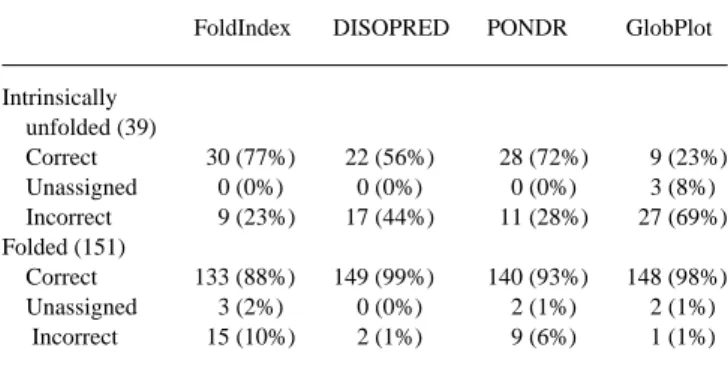
Table 1. Comparison of the efficacy of four algorithms in prediction
of the folding status of sets of folded and intrinsically unfolded test proteins
FoldIndex DISOPRED PONDR GlobPlot
Intrinsically unfolded (39) Correct 30 (77%) 22 (56%) 28 (72%) 9 (23%) Unassigned 0 (0%) 0 (0%) 0 (0%) 3 (8%) Incorrect 9 (23%) 17 (44%) 11 (28%) 27 (69%) Folded (151) Correct 133 (88%) 149 (99%) 140 (93%) 148 (98%) Unassigned 3 (2%) 0 (0%) 2 (1%) 2 (1%) Incorrect 15 (10%) 2 (1%) 9 (6%) 1 (1%)
The web tool FoldIndex©, implementing the original Uversky algorithm, provides a single score for the entire sequence, predicting whether it is folded or not. The other methods calculate a separ-ate fold score for each individual residue. In order to compare the various methods we obtained a fold score for the entire sequence from the scores of the individual residues by calculating the arith-metic mean for PONDR and GlobPlot, and the geometric mean for DISOPRED. The use of the geometric mean for the DISOPRED score was deemed necessary because of the model on which this algorithm is based. It results in a highly skewed distribution with the range of scores for ordered residues being very narrow, rel-ative to the range for disordered residues. We thus assumed that the DISOPRED scores for the residues of its training set, which contains mainly ordered residues, follow a log–normal distribution, making the geometric mean a more appropriate measure of whole sequence disorder rather than the arithmetic mean. Unless other-wise noted, the default settings were used with each method. For PONDR, the VL-XT method was used. It should be noted that for PONDR, DISOPRED and GlobPlot, scores above 0.5, 0.05 and 0, respectively, indicate a disordered protein. Scores very close to the boundary line, within±0.005 for FoldIndex©, DISOPRED and
GlobPlot, and within±0.05 for PONDR VL-XT, were scored as unassigned, equivalent to no prediction. Table 1 summarizes the results obtained using the four procedures. Supplementary Mater-ial containing the lists of 39 intrinsically unfolded proteins and 151 folded proteins utilized in this comparison, as well as all individual scores, is available at http://www.weizmann.ac.il/sb/faculty_pages/ Sussman/papers/suppl/Prilusky_2005
Inspection of these results shows that FoldIndex© performs slightly better than PONDR, and substantially better than DISO-PRED and GlobPlot in correctly predicting the unfolded status of proteins shown experimentally to be intrinsically unfolded. In con-trast, DISOPRED and GlobPlot perform best in predicting the folded status of proteins indeed known to be folded, with PONDR and FoldIndex© both being somewhat less successful. What might be
the reason for these opposite trends? With respect to the intrinsic-ally unfolded proteins, the FoldIndex© algorithm relies directly on
data relating to charge and hydrophobicity, and PONDR makes sub-stantial use of similar information relating to order-promoting and order-breaking amino acids. In contrast, DISOPRED and GlobPlot employ training sets that utilize disordered sequences in the PDB
structures. It should be noted that the GlobPlot method is the most similar to that of FoldIndex©, inasmuch as it based on a simple
‘dis-order scale’, namely the Russell/Linding Scale, which thus does not suffer from the possibility of ‘over training’ (Linding et al., 2003b).
The single global value for an entire sequence utilized by FoldIndex©and PONDR militates against successful prediction in
a small number of cases for folded proteins, because fine structural matching may overcome the global physical chemical properties for borderline cases.
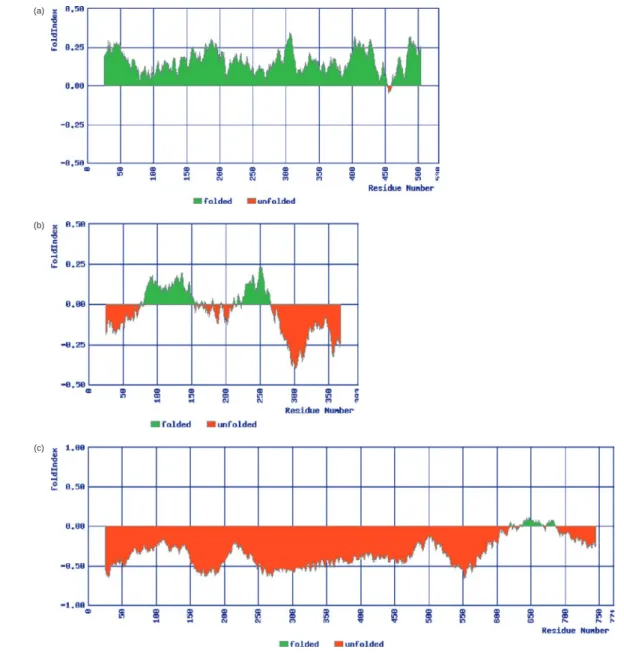
The Drosophila adhesion molecule, gliotactin, contains an extra-cellular domain with sequence homology to acetylcholinesterase, a transmembrane sequence and an intracellular sequence devoid of homology to any known protein sequence (Auld and Gilbert, 2005). FoldIndex© predicts that the first two segments, as expec-ted, are folded, while the intracellular segment is predicted to be almost completely unfolded. This prediction for the latter segment was confirmed by physicochemical characterization (Zeev-Ben-Mordehai et al., 2003). Thus, FoldIndex© permits examination of the fold properties of overlapping segments, or sliding win-dows, within a sequence, to identify contiguously large regions with different fold properties than the protein as a whole. Figure 1 displays snapshots of the server outputs for three proteins shown experimentally to be folded, partially folded and intrinsically unfolded.
FoldIndex© can be used both as an interactive web tool and as an automated web service. The GUI (http://bioportal.weizmann. ac.il/fldbin/findex) generates a graph describing IKD
F for a
submit-ted sequence. It can superimpose a graph of the running averages of hydrophobic amino acids and charged amino acids, and gen-erate a detailed report of values for each stage of the sliding window during the analysis. A file containing multiple sequences in ‘fasta’ format can also be uploaded, yielding a detailed report of the IKD
F values for each sequence. The user can select the
size of the sliding window or protein fragment size, step size to the next window, and specify the output format, as plain text, XML format (DTD, sample XML) or eFamily compat-ible format (http://www.sanger.ac.uk/xml/efamily/documentation/ eFamily.html). These latter formats are particularly useful if a program or script is required to parse the results automatically. The output for this option is either displayed in the browser or e-mailed, depending on output size. The simplicity of the method permits rapid prediction of foldability for a large num-ber of sequences. FoldIndex© is freely available for
unlim-ited use by all classes of users, and returns the results right inside the web page within seconds. FoldIndex© should serve
as a valuable tool for protein crystallographers, especially in the area of structural genomics/proteomics, by directing them to proteins or subsegments that are more likely to crystallize (Jaakola et al., 2005) and see, e.g. http://www.weizmann.ac.il/ISPC/ biotools.html
FoldIndex© can be used as a web service for remote
and automatic data processing by accessing http://bioportal. weizmann.ac.il/fldbin/findex?m=xml&sq=SEQUENCE where ‘m’ is either ‘xml’ (for XML output format) or ‘efam’ (for eFamily compatible format), and ‘sq’ is the one character code protein sequence, no spaces. A simple working perl script using this technique is available from http://bioportal.weizmann.ac.il/flddoc/ example1.txt
FoldIndex©predicts if a protein is disordered
(a)
(b)
(c)
Fig. 1. FoldIndex plotted with window size 51, for three protein sequences. (a) Cat-Muscle (M1) Pyruvate Kinase is a well-folded three-domain structure
(PDB-ID 1PKM; Swiss-Prot: P11979) (Allen and Muirhead, 1996). (b) The human p53 tumor suppressor protein contains large unstructured regions in its native state (PDB-ID 1TSR; Swiss-Prot: P04637) (Bell et al., 2002). (c) Chicken gizzard caldesmon is natively unfolded (Swiss-Prot: P12957) (Permyakov et al., 2003).
ACKNOWLEDGEMENTS
We thank both referees for their constructive suggestions. Support was by the EC Vth Framework ‘SPINE’ Project QLG2-CT-2002-00988, by an Israel Ministry of Science and Technology grant to the Israel Structural Proteomics Center, by the Divadol Foundation and the Minerva Foundation. J.L.S. is Morton and Gladys Pickman Professor of Structural Biology.
Conflict of Interest: none declared. REFERENCES
Allen,S.C. and Muirhead,H. (1996) Refined three-dimensional structure of Cat-Muscle (M1) Pyruvate Kinase at a resolution of 2.6 Å. Acta Crystallogr. D Biol. Crystallogr.,
52, 499–504.
Auld,V.J. and Gilbert,M.M. (2005) Evolution of CLAMs (Cholinesterase-Like Adhe-sion Molecules): structure and function during development. Front. Biosci., 10, 2177–2192.
Bell,S. et al. (2002) p53 contains large unstructured regions in its native state. J. Mol.
Biol., 322, 917–927.
Dunker,A.K. et al. (2000) Intrinsic protein disorder in complete genomes. Genome
Informatics, 11, 161–171.
Dunker,A.K. et al. (2002) Intrinsic disorder and protein function. Biochemistry, 41, 6573–6582.
Holm,L. and Sander,C. (1998) Removing near-neighbour redundancy from large protein sequence collections. Bioinformatics, 14, 423–429.
Jaakola,V.-P. et al. (2005) G protein-coupled receptors show unusual patterns of intrinsic unfolding. PEDS, 18, 103–110.
Kyte,J. and Doolittle,R.F. (1982) A simple method for displaying the hydropathic character of a protein. J. Mol. Biol., 157, 105–132.
Linding,R. et al. (2003a) Protein disorder prediction: implications for structural proteomics. Structure, 11, 1453–1459.
J.Prilusky et al.
Linding,R. et al. (2003b) GlobPlot: exploring protein sequences for globularity and disorder. Nucleic Acids Res., 31, 3701–3708.
Liu,J. and Rost,B. (2003) NORSp: predictions of long regions without regular secondary structure. Nucleic Acids Res., 31, 3833–3835.
Permyakov,S.E. et al. (2003) Natively unfolded C-terminal domain of caldesmon remains substantially unstructured after the effective binding to calmodulin. Proteins,
53, 855–862.
Romero,P. et al. (1997) Sequence data analysis for long disordered regions prediction in the calcineurin family. Genome Informatics, 8, 110–124.
Schweers,O. et al. (1994) Structural studies of tau protein and Alzheimer paired helical filaments show no evidence for beta-structure. J. Biol. Chem., 269, 24290–24297. Uversky,V.N. et al. (2000) Why are ‘natively unfolded’ proteins unstructured under
physiologic conditions? Proteins, 41, 415–427.
Vucetic,S. et al. (2004) DisProt: a database of protein disorder. Bioinformatics, 21, 137–140.
Ward,J.J. et al. (2004) The DISOPRED server for the prediction of protein disorder.
Bioinformatics, 20, 2138–2139.
Wright,P.E. and Dyson,H.J. (1999) Intrinsically unstructured proteins: re-assessing the protein structure–function paradigm. J. Mol. Biol., 293,
321–331.
Zeev-Ben-Mordehai,T. et al. (2003) The intracellular domain of the Drosophila cholinesterase-like neural adhesion protein, gliotactin, is natively unfolded. Proteins,
53, 758–767.
Zhang,O. and Forman-Kay,J.D. (1997) NMR studies of unfolded states of an SH3 domain in aqueous solution and denaturing conditions. Biochemistry, 36, 3959–3970.