Nephrol Dial Transplant (1995) 10 [Suppl 8]: 14-16
Nephrology
Dialysis
Transplantation
Efficacy of oral citrate administration in primary hyperoxaluria
E. Leumann, B. Hoppe, T. Neuhaus and N. Blau
University Children's Hospital, Zurich, Switzerland
Abstract. Urinary citrate is a potent inhibitor of
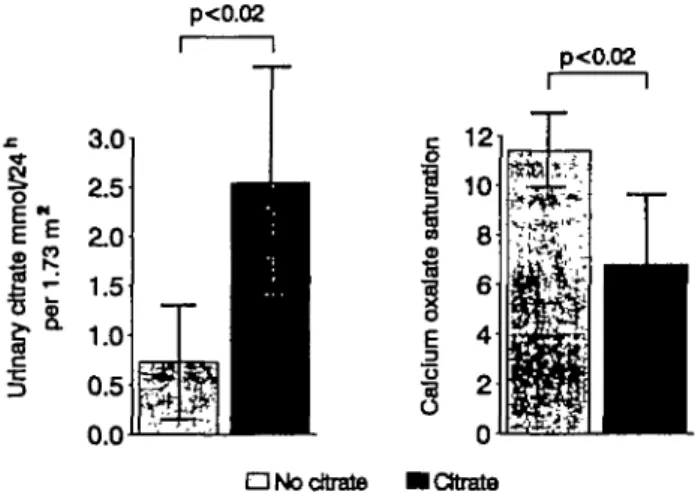
cal-cium oxalate (CaOx) crystallization, but oral citrate has rarely been used in patients with primary hyperox-aluria (PH). We studied the effect of sodium citrate administration (0.1-0.15 g/kg/day) on urinary citrate excretion and CaOx saturation in seven paediatric patients and the clinical response to long-term treat-ment (average 4 years) in five patients. Urinary citrate increased from 0.73 to 2.54 mmol/24h/l .73 m2 and urinary saturation for CaOx (calculated by equil 2) decreased from 11.41 to 6.79 (for both, p<0.02). Long-term administration of alkali citrate [0.15 g (0.5mmol)/kg/day] resulted in stable or improved renal function in three and slow deterioration in two partially non-compliant patients. Alkali citrate is effective in patients with PH.
Key words: calcium oxalate; citrate; nephrocalcinosis;
oxalosis; hyperoxaluria; urolithiasis
Introduction
The goal of treating patients with primary hyperoxalu-ria (PH) is to inhibit deposition of calcium oxalate (CaOx) in the renal interstitium and to prevent renal stone formation. Several drugs (e.g. magnesium, phos-phate, methylene blue, thiazides) have been advocated for this purpose, but little evidence of the efficacy has been provided—with the exception of pyridoxine, to which a minority of patients with PH type 1 is respons-ive [1]. Oral citrate administration has only occasion-ally been used in PH despite its known action as an important inhibitor of CaOx crystallization [2,3]. In view of the apparent positive clinical experience with potassium citrate administration in adult patients with idiopathic CaOx nephrolithiasis [4], we studied the effect of alkali citrate in paediatric patients with PH type 1 (PHI) [5]. This report extends our previous findings and includes a larger number of urine examinations.
Methods
The effect of sodium citrate administration (0.1-0.15 g/kg body weight/day) was assessed in seven children with PHI after they had been on or off this treatment for at least 14 days. The clinical response to long-term administration of alkali citrate [sodium citrate or sodium potassium citrate (Uralyt-U, Madaus) 0.15 g/kg body weight; phosphate cit-rate 0.1 g/kg (Phosphate Sandoz) in patient 3] was assessed in five of them. Urine collections (24 h) and chemical analysis of urine were done as described previously [5] except that citrate was measured by ion chromatography. The mean citrate excretion and CaOx saturation (calculated by equil 2 [6]) were determined in each patient without oral citrate and during citrate administration (in total, 17 and 51 urine samples, respectively). The mean value for the whole group was calculated from the means of the individual patients.
Results
Citrate excretion in the urine (Table 1) was in the normal range in two and very low in five patients before citrate administration and increased in all seven to values in the normal range [7,8]. The urinary CaOx saturation before oral citrate administration was uni-formly elevated above the normal range for age and gender [8] and decreased in each instance, although not reaching the normal range in four patients (Table 1). Both the increase of the mean citrate
Table 1. Effect of sodium citrate administration in seven patients with PHI Patient i 2 3 4 5 6 7 Gender m f m f m f m Age (yean) 15 8 10 10 2 12 15 Urinary citrate1 No oral citrate 0.12 0.68 1.61 0.69 0.47 0.38 1.19 1 Oral citrate 1.63 1.65 4.33 2.17 2.17 4.01 1.82 CaOx saturation No oral citrate 11.67 10.51 11.48 15.03 9.97 10.57 10.63 Oral citrate 9.06 7.84 5.34 9.31 4.37 2.72 8.87 Normal2 <6.0 <62 <7.7 <6.2 <8.0 <62 <6.0
Correspondence and offprint requests to: Prof. E. Leumann, University ' m m o l ^ h/1.73 m3.
Children's Hospital, Steinwiesstr. 75, CH 8032 Zurich, Switzerland. f o r m a l (X+SEM) for gender and age [8].
Oral citrate in primary hyperoxaluria
excretion from 0.73 to 2.54 mmol/day/1.73 m2 and the decrease of the mean saturation from 11.41 to 6.79 were statistically significant (P<0.02; one-sample Wilcoxon test) (Fig. 1).
During oral citrate administration for 24-68 (aver-age 47) months, renal function, as estimated from serum creatinine, remained stable or improved in three patients, and slowly deteriorated in two (Fig. 2). These two male teenagers were intermittently non-compliant, as demonstrated by the strong variations of the urinary pH and the urinary citrate excretion. Clinically, all four patients with repeated attacks of colicky pain before citrate administration had fewer episodes of passage of renal stones (Patient 1 from 2.8 to 0.6 per month). Patient 2 was anorectic when citrate was temporarily discontinued.
There were no apparent adverse effects of citrate administration; plasma bicarbonate was in the normal range or slightly elevated (24-28 mmol/1).
15
p<0.02
p<0,02
d No citrate
Fig. 1. Effect of citrate administration on citrate excretion and CaOx saturation. 300 creatinine (/imol/I) 2 5 0 -2 0 0 : 1 5 0 : 1 0 0 : 5 0: * poor compliance
— upper limit of normal (boys)
10 age (years)
15 20
Discussion
Fig. 2. Serum creatinine during citrate administration. Patients are identified by numbers.
Urinary citrate is a potent inhibitor of CaOx crystal-lization by complexing with calcium and thus lowering the ionic calcium concentration [2,3]. This effect is more pronounced at a higher pH G>7) where citrate is predominantly trivalent, in contrast to pH 5 (only one negative charge). In order to have the maximum effect it is therefore necessary to increase both the urinary pH and the urinary citrate excretion. Most of the administered citrate is metabolized to bicarbonate, but a fraction of the absorbed citrate may escape metabolic degradation and appear directly in the urine [3,9]. More citrate is excreted during metabolic alkal-osis as a result of lower tubular reabsorption of filtered citrate (normal plasma concentration 0.1 mmol/1) [3,9]. Sodium chloride loading depresses urinary citrate excretion [10], whereas a large vegetable fibre intake and high urine volume have the opposite effect in adult calcium stone formers with hypocitraturia [11].
Potential disadvantages of prescribing sodium citrate are the added osmotic load and, possibly, an increased intestinal absorption of oxalate, since sodium oxalate is more soluble than calcium oxalate. Therefore, it might be preferable to use sodium potassium citrate as long as there is no severe renal insufficiency. Dietary sodium intake should be restricted. Thiazides—occa-sionally prescribed in PH because of their hypocalciuric effect—depress urinary citrate excretion by inducing hypokalaemia with intracellular acidosis [3]. Poor compliance was a critical issue in our adolescent patients. Sodium or sodium potassium citrate (in powder form or tablets) is not particularly attractive; sodium potassium citrate, now available as effervescent tablets (Madaus), is not accepted by all paediatric patients. Therefore, a close follow-up with regular monitoring of the urinary pH, volume and citrate excretion is necessary.
Administration of alkali citrate will not fully prevent deposition of CaOx in the kidney, although the demon-strated lowering of the CaOx saturation appears straightforward. Indeed, saturation was not normalized in all patients. Additional measures, notably a large fluid intake and early diagnosis, are crucial to prevent renal insufficiency which also depresses urinary citrate excretion [7,12]. Further experience in more patients is certainly needed in PHI, a disease carrying a pro-gnosis that is difficult to predict. PHI has great geno-typic, enzymatic and clinical heterogeneity. Enzymatic activity correlates poorly with clinical manifestation [1]. Therefore, the importance of other factors, includ-ing environmental ones, must not be underscored.
Acknowledgements. We thank Ana Matasovic for her skillful work
and Prof. A. Hesse, Bonn, for allowing us to include one of his patients in the study.
References
1. Danpure CJ, Jennings PR, Fryer P, Purdue PE, Allsop J. Primary hyperoxaluria type 1: genotypic and phenotypic heterogeneity.
16
2. Sutor DJ, Pereival JU, Dooncen S. Urinary inhibitors of the formation of calcium oxalate. Br J Urol 1979; 52: 253-255 3. Hamm LL. Renal handling of citrate. Kidney Inl 1990; 38:
728-735
4. Pale CYC, Fuller C, Sakhaee K, Preminger GM, Britton F. Long-term treatment of calcium nephrolithiasis with potassium citrate. / Urol 1985; 134: 11-19
5. Leumann E, Hoppe B, Neuhaus T. Management of primary hyperoxaluria: efficacy of oral citrate administration. Pediatr
Nephrol 1993; 7: 207-211
6. Werness PG, Brown CM, Smith LH, Finlayson B. Equil 2, a basic computer program for the calculation of urinary satura-tion. J Urol 1985; 134: 1242-1244
7. Scharer K, Manz F. Renal handling of citrate in children with various kidney disorders. Int J Pediatr Nephrol 1985; 6: 79-88 8. Bach D, Hesse A, Bernal-Sprekelsen MS, Nemath S. Normal
values of lithogenic and inhibitory substances in the urine of healthy children. In: Walker V, Sutton R, Cameron E, Pak C, Robertson W, eds. Urolithiasis. Plenum Press, New York, 1989: 775-776
9. Sakhaee K, Alpem R, Jakobson HR, Pak CYC. Contrasting effects of various potassium salts on renal citrate excretion.
J Clin Endotrinol Me tab 1991; 72: 396-400
E. Leumann etaL 10. Pak CYC. Citrate and renal calculi: new insights and future
directions. Am J Kidney Dis 1991; 17: 420-425
11. Hess B, Michel R, Takkinen R, Ackennann D, Jaeger P. Risk factors for low urinary citrate in calcium nephrolithiasis: low vegetable fibre intake and low urine volume to be added to the list Nephrol Dial Transplant 1994; 9: 642-649
12. Marangella M, Vitale C, Manganaro M, Cosseddu D, Martini C, Petrarulo M, Linari F. Renal handling of citrate in chronic renal insufficiency. Nephron 1991; 57: 439-443
13. Milliner DS, Eickhott JT, Bergstrath EJ, Wilson DM, Smith LH. Results of long-term treatment with orthophosphate and pyridoxine in patients with primary hvperoxaluria. N Engl J Med 1994; 331: 1553-1558
Note added in proof
Milliner etal. [13] report long-term results with orthophosph-ate and pyridoxine in PH. Three of their nine patients with PHI were pyridoxine-sensitive. Effervescent phosphate tab-lets also contain citrate [5].