Ministry of Higher Education and Scientific Research
University of 8 May 1945/ Guelma ةملاق -1945 يام8 ةعماج
Faculty of Letters and Languages تاغللاو بادلاا ةيلك
Department of Letters and English Language ةيزيلجنلاا ةغللاوبادلاامسق
The Impact of Televised Presidential
Debates on Voters
’ Decision; a
Comparative Study of the 1960 and the
2016 Debates
A Dissertation Submitted to the Department of English in Partial Fulfillment of the Requirements for the Master Degree in Civilization
Board of Examiners
Chairman: Prof. Abdelhak ELAGGOUNE (Professor) University of 8 May1945/Guelma Supervisor: Mr. Mourad ATY (MA/A) University of 8 May 1945/Guelma
Examiner: Mrs. Adila CHELGHOUM (MA/B) University of 8 May 1945/Guelma
Submitted by Supervised by Nour elhouda KRINAH Mr. Mourad ATY
I would like first to express my gratefulness to Allah;
I would like also to thank my supervisor Mr. Mourad ATY. I really appreciate his support and patience. He guided and steered me in the right direction whenever I needed.
I would like also to thank all my teachers who devoted time and efforts to help me to be at this level of studies.
Sincere thanks goes to my family, friends and colleagues for their patience, help and especially the support at every moment I needed to be encouraged to successfully finish this work.
father for their continuous support and patience in addition to their endless love. Also, I dedicate this work to my only sister Wided; who believed in me and encouraged me more than anyone did, and my bothers.
I also dedicate this work for all my friends and colleagues; especially, Sara, Sabah and Karima who pushed me to work hard for this achievement.
States. The research’s objective was to investigate the impact of the debates on the voters. It highlighted the historical background and the development of these televised debates. The research focused on two case studies; the presidential elections of 1960 and those of 2016, that witnessed very dramatic and exciting debates between very powerful and important candidates. Moreover, it made an examination of their performances and speeches during the debates. The data analysis targeted all the recorded results and statistics to check the extent to which these televised debates had influenced voters’ decision in the Election Day.
تاشقانملا ىلع نيبخانلا . و دق طلس ت ءوضلا ىلع ةيفلخلا ةيخيراتلا روطتو هذه تاشقانملا لا ينويزفلت ة ربع نمزلا . زكرو ثحبلا ىلع ةسارد لك نم تاباختنلاا ةيسائرلا يف يماع 1960 و 2016 ، تدهش يتلا و تاشقانم ةريثم نيب م ر نيحش ءايوقأ نيمهمو . ةولاع ىلع ،كلذ رجأ ثحبلا ى ةسارد ئادلأ مه مهبطخو ءانثأ شقانملا تا . و دق فدهتسا ليلحت لا تانايب لك جئاتنلا تاءاصحلإاو ةلجسملا ققحتلل نم ىدم ريثأت هذه لا ةشقانم ىلع ةينويزفلتلا رارق نيبخانلا يف موي تاباختنلاا .
CNN Cable News Network
CPD Commission on Presidential Debates
FCC Federal Communications Commission
FEC Federal Election Commission
GOP Grand Old Party
JFK John Fitzgerald Kennedy
MSNBC Microsoft National Broadcasting Company
NBC National Broadcasting Company
US United States
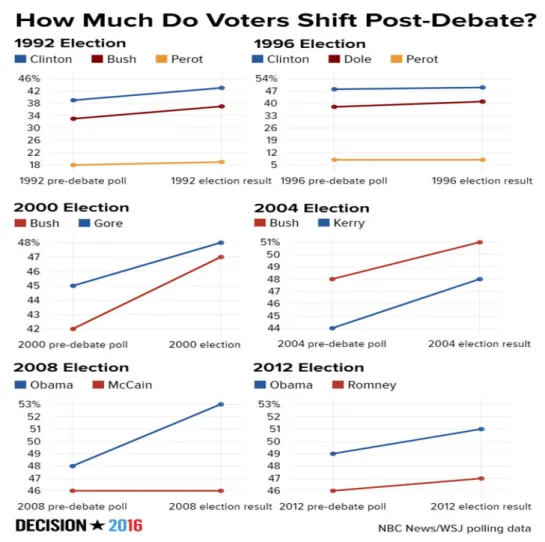
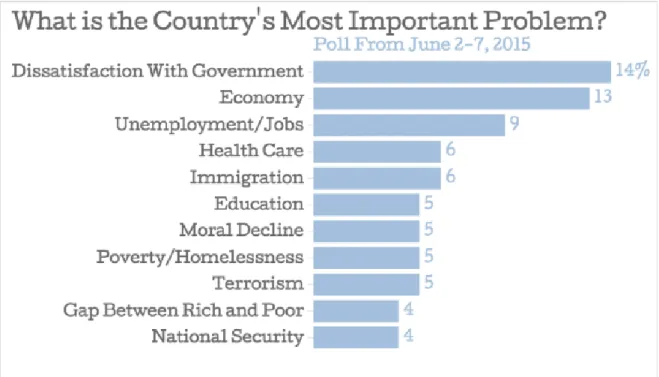
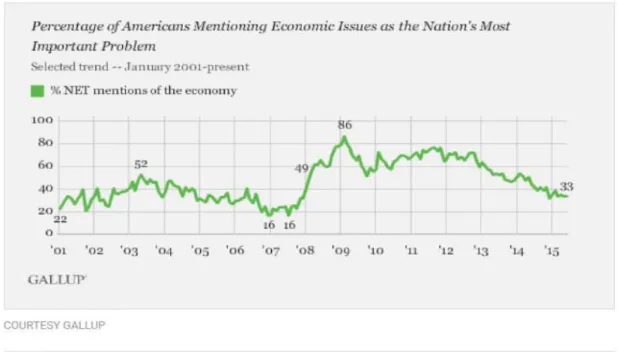
Figure 1: How Much Do Voters Shift Post- Debate? ……….42 Figure 2: What Is the Country’s Most Important Problem? ...46 Figure 3: Percentage of Americans Mentioning Economic Issues as the Nation’s Most
Important Problem………..47
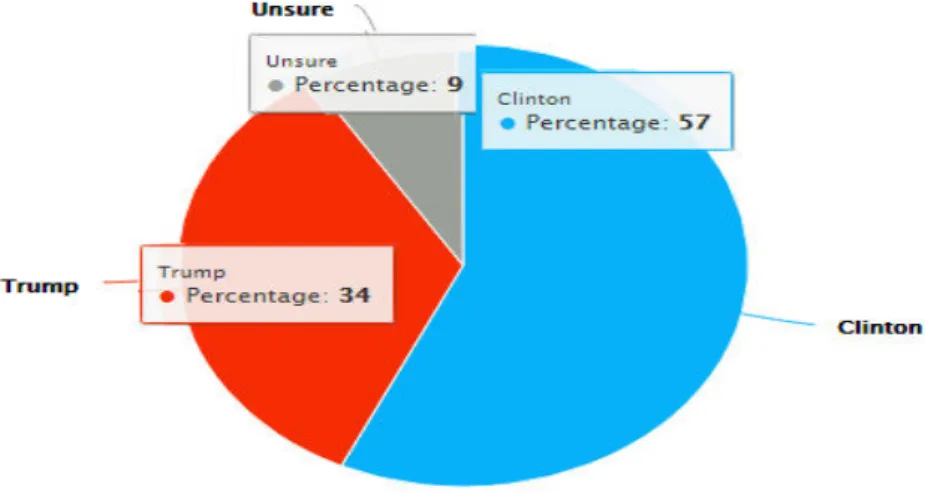
Figure 4: Who Won the Debate? ...50
Introduction ……….…..……...1
Chapter One: A Historical Overview of the American Presidential Elections...7
1. American Presidential Elections………...7
1.1. Origins, Names, and Symbols of the Political Parties………...8
1.2. Evolution of Political Parties and the Two-Party System in USA…...11
1.3. Constitutional Laws and Processes of Presidential Elections………...12
1.4. Electoral Campaigns………...15
1.5. The Electoral College………...17
2. The Concept of Political Communication………...19
2.1. Presidential Debates………...………….20
2.2. The Commission on Presidential Debates (CPD)………...20
2.3. Broadcasting Electoral Debates and Media Coverage………...22
2.4. The Introduction of Televised Presidential Debates………...23
Chapter Two: Presidential Debate of 1960, the First Modern Campaign…...26
1. American Politics and Television Broadcasting………...27
2. The Great Debate……….………...29
2.1. Televised Debates Tipping the Scales of the Results…….…………...29
4. Presidential Debates Following the 1960 Debate………...35
Chapter Three: Presidential Debate of 2016………...44
1. Overview of the 2016 Presidential Elections………...45
2. Donald Trump Vs Hilary Clinton………...48
2.1. First Debate………...48
2.2. Second Debate………...50
2.3. Third Debate………...51
3. How Did Donald Trump Win the Elections? ...52
3.1. The Impact of the Debates on Voters………...54
3.2. The Role of Media………...55
4. Why Did Hillary Clinton Lose the Elections? ...56
5. Outcome of the Presidential Elections: Fears and Protests………...58
Conclusion………...61
Bibliography………...65
Introduction
Citizens of the United States are granted a combination of rights and duties which are stated in the Constitution. One of the major rights which the government protects is the right to vote, sovereignty and the freedom of expression. Citizens from all parts of the country are granted the right to vote in the matters of national interests. Presidential elections were made every four years to include the fifty states and the districts of the country. Before the Elections Day, party members and candidates go through a series of preparations and campaigns to increase votes and support. Becoming a president of the world’s most powerful country could never be easy; yet, it is not impossible!
Televised presidential debates are one of the major events in the elections. They are defined as the formal discussions held late in the electoral circle organized and sponsored by the Commission on Presidential Debates (CPD), which was established in 1987 and had run every presidential debate held since 1988. The main focus of these debates is the candidate’s performance, personality and the political agenda of his political party. Candidates should provide arguments for their ideologies in the most controversial issues in the country, and which attract the public attention and center of interest. Besides, these debates are believed to be an attempt to get the public support and to benefit the most of them. It is also important to mention that the target audience of these debates was the ambivalent voters who had not decided yet on which candidate to vote.
In the US, these debates were the most dramatic part in the elections’ process; thus, they attract huge numbers of watchers. According to the statistics made by the Commission on Presidential Debates, the number of people watching these debates since 1960 to 2016 was varying between 37.5 and 84 million people. These numbers emphasized the significance of debates for citizens to better recognize the candidates and make the appropriate. So, it is very
important to question if these debates can impact the voter’s decision and the extent to which they matter.
The selection of a president is based on many criteria side-by-side with internal and external factors around the voter. Presidential debates were the most worthy mentioned external factors ever since they became part of the elections. This study is designed to shed light on the role of the public opinion in making national decisions and the roles of the
televised presidential debates on them. Besides, it is constructed based on a comparative study between the electoral debates of 1960 and 2016 to be able to reach the desired purpose.
Although, there were other ways to recognize a political candidate and his agenda, televised presidential debates became a best tool for such aim. They became a medium through which candidates could express their ideologies and beliefs in an environment that provided a natural and fair atmosphere to face each other while being watched and judged by a huge number of audiences. Nevertheless, the nature of these debates as live programs might put the candidates under a big stress and pressure while debating in front of camera. As a result, they had to make sure to be well prepared long time before the debate’s day.
The first major objective of the present dissertation was to shed light on the importance of the candidates’ performance during a televised debate. Because of the difficulties they face, candidates must make lots of efforts to express their political agenda in a convenient way. The watchers used to depend on the every action made by the candidate on TV to understand his personality and to get a clearer image of his character. They look for some sort of
characteristics which are usually required to be in the candidate who is willing to be next president of the country. Their appearance, language and charisma will make great difference in terms of performance. So, candidates were the central focus of all the televised presidential debates.
The second objective of this study was to show the significance of the presidential debates as the bridge that connected both candidates and the citizens. On one hand, a candidate was given the chance to convince as much as possible of citizens to vote for them. In that, debates were the best means for a candidate to show himself as fit for the office among others. The camera is used to communicate the target audience. They were asked to take advantage of every moment against each other avoiding any kind of errors and mistakes that might cause them to lose the race.
The research addresses very important questions related to the televised debates. Not only citizens who should know everything related to these debates, candidates also should be well informed about them to able to benefit most of them. Questions like: “what is the real purpose behind the establishment of these debates? In what ways they can influence the audience? Do presidential debates provide beneficial opportunities for both; the candidates and the voters? Do electoral debates manifest the real intents of the candidates? Do negative evaluations of one candidate affect positively the other opponent?” should be well answered and well understood by both sides; thus, this study is about to clarify them well.
The research is divided into three interrelated chapters, each one of them was related to following chapters. The first chapter deals with an overview of the historical background of the United States’ presidential elections, the political parties and how and when did the televised presidential debates came into function as essential part in politics. The second chapter is centered on the case study of the presidential debates of Kennedy Vs Nixon. This chapter talks about the role of the great debate in the results of the 1960 elections.
Additionally, I tried to conclude how it impacted the presidential elections in the following years. The third chapter was about the second case study of Clinton Vs Trump in 2016; it includes the analysis of the televised debates between both candidates.
The theme of the present research had been widely discussed through different periods of time and by many scholars. So, it makes use of Noam Chomsky’s book entitled Language
and Politics in which he defined the term debate in relation to electoral campaigns. Chomsky is a very famous and important figure in all the fields especially politics and linguistics. He also gave his point of view about the American party system in one of his conferences; which was watched to add reliability and credibility to this study. In addition, it is based on the works of many other important researchers who studied the televised debates of both case studies. Gary Donaldson wrote his book The First Modern Campaign: Kennedy, Nixon, and
the Election of 1960; in which he gave important points and analysis to the elections of that year in which the Americans were introduced to the first televised presidential bebate in the history of the US politics.
Campaigns in the United States had noticed a great change as Kreimendahl stated. She believed that one of the basic elements of this change is the development of media. It became the basic element and the political engine. Party members and candidate’s assistants make a special effort to gain the support of powerful media sectors. Mainly, this was due to the due to the fact that media became the bridge between the voters and the political party involved in a political race. Kreimendahl believed that the media extension is the main reason for the
decrease of the party affiliation’s significance; however, it strengthened the power of the party organization.
Though it had been sixty years since the Great Debate, debates were an inseparable part of the presidential elections’ process. They had been held in every election since 1976. Media had widely contributed in raising the significance of such debates. It gave it a special attention during the presidential campaign. Thus, people and voters had become paying more attention too. Yet, debates have the ability and power to change the voters’ sensation to the candidates but it rarely changed their opinions. However, the undecided voters will depend on the
opportunity provided by the debates by giving them the chance to evaluate the debaters from the direct show of the debate on television.
This research had carried out a historical, descriptive method in the first chapter. In addition, it made use of the comparative and analytic approaches in the second and the third chapters. The study was based on different data collection tools including some statistics and graphs to provide the needed evidence for the objectives of the research. They provided many reliable criteria that added credibility to the research. The primary sources were a collection of videos, and scholary journals and the secondary sources included books, articles of news websites and academic journals. Both sources were used to develop the understanding of the problem and provide support in reaching the desired goals of the study.
In every democracy, citizens are supposed to make decisions in relation to their daily life and well being. A citizen had never been living in isolation from others and his actions should be made on this basis. Most importantly, they should make their voices heard not only for their benefit but also for the benefit of the others. Nowadays, it has become much easier for voters to know and search about everything they want to understand in relations to making a political decision. Televised presidential debates are one of those means by which voters formulate an idea about the candidates and their ideologies. Consequently, this study reveals the role of these debates on the voters’ decision and if it impacts the outcomes of elections. Candidates for the presidential elections represent a certain political party to which they belong. In early times, the first writers of the American constitution did not take into consideration the political parties, because there were no parties during that period of time. However; after the development of voting rights in addition to the influence of the western countries on the new world, the political parties emerged during the 18th and 19th centuries. As
a consequence, many constitutional regulations and laws were added to the Constitution after long discussions and debates.
Chapter One
A Historical overview of American Presidential Elections
Throughout history, the presidential elections were the most important and attractive events in American politics. Since the end of the cold war, the United States became the only central power of the world. As a result, not only American citizens were concerned with the elections; actually, the whole world became concerned too. In fact, American presidential elections would always result a president to the United States and a leader to the rest of the world. He would occupy the highest office in the most powerful country in the world.
Presidential elections are those formal processes by which citizens participate in selecting a candidate to be their president. Also, they were defined as the means or act of electing a candidate to become the president and hold the head office in the White House and serve for the benefit of both; the citizen as an individual and for the benefit of the nation as a whole unity of individuals. The president had been granted a combination of powers that would allow him to participate in the decision making in public affairs. Citizens were and will be considered as an essential part in the elections’ process. They vote on the candidate who they believe to be the most adequate to become the president of their country. Thus, it was up to the candidates, the campaign, and the party’s members and assistants to do their best to gain public support.
1. American Presidential Elections
At the indirect elections, citizens in the fifty states of America and the District of Columbia cast their votes for the members of the Electoral College. The first American presidential elections were held on February 4th, 1789. George Washington won the race and had become the first president in the United States. Among the 13 colonies; New York, North
Carolina and Rhode Island were not part of these elections because they did not finish by the dead line. (Deskins, Walton and Puckett 10) At that time, elections’ process was not as complex as it is nowadays. Its process got through many modifications and changes through history because of many events and circumstances.
At the time of the first presidential elections in the US, only few people in the 13 colonies had the right to vote due to the restriction imposed on citizens by the government preventing large numbers of people from voting. According to the Share America website, only 6 percent of the citizens had the right to vote. Only the landowners, white men over the age of 21 who lived in the new world at that time had the right to vote. However, this percentage had a highly noticeable improvement due to many events and changes throughout the history of the country. Nowadays, more citizens gained their right to vote and the legal age to vote became 18 years.
1.1. Origins, Names, and Symbols of the Political Parties
Political parties were one of important characteristics of the western democratic systems. For a long time, these parties shaped a bridge between the government and its citizens.
Political parties in the United States were opposed by the founding Fathers. They were viewed as weak factions that would seek to use the powers, which the government would grant for them, and authority to fulfill their personal needs on the coast of citizens’ rights and benefits. Besides, if a party had a large public support, it might turn against the government. Thus, political parties were considered as a threat to the country when unity was needed most (Hoadley 9).
It was important to mention that in the 18th and the 19th centuries the Whigs and the Democrats parties were the first established major parties in the United States. The idea of establishing a political party was hard to be accepted at that time because it was revolutionary
at the domain of politics and full of doubts. The political parties were faced by many
oppositions and obstacles due to many reasons (Epstein 6) as mentioned above. However, this fact did not stop the ambitions and desires of politicians to gain more powers and influence through them. Thus, the very first parties took long in the history to become the way they are organized nowadays.
The Whigs party was one of the two active parties during 1834-1854. The party was lead by its major advocate Henry Clay (Gold 39). It was brought to existence during the time of Henry Clay and American System of the National Republicans’ platform in 1832. The name ‘Whigs’ was taken from the British Anti-monarchist party. The Whigs were a party interested in aristocracy, wealth and economics mainly. However, this did not decide its affiliations and principles. The majority of its members were qualified and business men; so, they had good financial resources. The party had a great influence with high status though it did not last for long period of time (Gold 63).
Moving to the Democratic-Republican Party, it was the other major old and modern-day political party in the United States. It had roots back to 1792, and it was founded by Thomas Jackson and James Madison as an opposition to the Federalist Party. Together with other members, they brought the first Antifederalists and the moderate federalists (Cornelison and Yanak 134). Gold stated that the majority of its members were farmers and artisans. Unlike the Whigs who were charged for their economic interests, the Democrats were social conservatives and classical liberalists. Though it included many wealthy members also, the Whigs were financially better than the Democrats at that time. Besides, the Democrats had less number of high status members but it had many qualifications that helped keeping the party to last until today (63).
In contemporary world politics, the major parties became the Democrats and Republicans. They were descendents of the previously mentioned party, the Democratic-Republican Party. As it was mentioned in (Nelson 778), the political parties’ evolution had been confusing concerning the names of the American parties. Complexity about these parties was not limited with their names; actually, the whole party system in the United States is complicated and hard to be comprehended for many people. However, it was believed that this intricacy had many advantages especially if one thought of the unity of the country.
The origins of the names of the two parties were different. First, The Democratic Party was traced to the age of Thomas Jefferson. This party had two names “Republican or the
Democratic-Republican. However, in 1830, President Andrew Jackson abandoned the ‘Republican’ portion of the name. Thus, the party’s name had become the Democratic Party. Second, the Republican Party was founded in 1854 by an antislavery group of people. They established the party and named themselves the Republicans. It was the original party from which nowadays Republicans came (Nelson 778).
Both parties had some shared aspects and distinct ones; however, differences seemed to be more than similarities. Symbols were one of the important and remarkable signs of distinction between both. The Republicans had the Elephant and the Democrats Had the Donkey. The Republican Elephant, as (Nelson 778) pointed, was used at the beginning to refer to the silliness of the Republican vote. But later, Thomas Nast and others used the characteristics of the elephant as being strong and huge in size to refer to the political control of the GOP after the Civil War. Moving to the Democratic donkey, the symbol was used during the 1830s. Andrew Jackson was referred to as “jackass” by his adversaries. Unexpectedly, Jackson was proud of that nickname since donkeys are tough, courageous, and clever. The symbol was revived during the 1870s in Harper’s Weekly magazine. Actually, many recent historians linked the symbol also to the survival of the party all this time.
1.2. Evolution of Political Parties and the Two-Party System in USA
The main false impression about American politics is that the two-party system had been there from the beginning. In fact, this thought is totally wrong. In 1789, the United States did not have a two-party system. The country had the first president George Washington, who had no political party. Later, during his terms, Thomas Jefferson founded the first real political party. He named it the Democratic-Republican Party, with which he challenged John Adams. After that in 1828, the war-hero Andrew Jackson became the first president of the Democratic Party which was new at those times (Epstein 6).
In America, it had never been strange to describe this party system as central point of an “American civil religion”. The two-party system in the United States became a basic notion that goes hand in hand with American political system. The major two parties of that system were the Democratic and the republican parties. They have what was called “Duopoly”, meaning that they had domination over the American politics and shared it between them. Elections were and still standing for these two parties through marginalizing any other third party, because they might form a threat to both; the Republicans nor to the Democrats (Disch 4).
According to (Schmidt, et al 303), the main reason for the two-party system endured had to do with: “(1) the historical foundation of the system, (2) political socialization and practical considerations, (3) the winner-take-it-all electoral system, and(4) state and federal laws favoring the two-party system.” This system; however, did not last with no contestants. American third Parties had been there repeatedly. Each of those minor parties emerged as a reaction to a specific event in the American history. They all had an impact either in the economy or the society of the United States.
It was strongly believed by Noam Chomsky that the United States did not have a two-party system. He stated; in one of his recorded press conferences, that: “Democrats and republicans aren’t a category-the Republicans and Democrats differ… they are two factions of the same party.” From this saying, he emphasized that the two dominant political parties in America were groups belonging to the same party, having the same principles and goals. He added by saying: “We have a one-party state with two somewhat different factions with a lot of
overlap.” Additionally; when he was interviewed by Adam Jones, he said on the same matter that: “In the United States, the political system is a very marginal affair. There are two parties, so-called, but they’re really factions of the same party, the Business Party. Both represent some range of business interests.” His beliefs obviously came from a long studies and interpretations of the history and origins of the dominant political parties.
1.3. Constitutional Laws and Processes of Presidential Elections
The American Constitution consisted of all most every detail related to elections, precisely the presidential ones. It discussed the citizens’ right to vote and the requirements that would grant their ability to participate in the public affairs’ decisions. The act of voting became a right and duty for all citizens in any democracy. Moreover, the Constitution stated the process of the elections, their period, the duration of the term for presidency, the qualifications and characteristics required for anyone who would like to be nominated for the presidency, and all the other details related to the presidential elections a year before their start to the day of the announcement of the results. The constitution provided all regulations and law to ensure the clear and fair demonstration of all presidential elections.
According to the US Constitution; the Fifteenth, the Twenty-Fourth, and the Twenty-Sixth Amendments discussed the characteristics of citizens who are granted the right to vote in elections. First, the right to vote can never be denied or taken because of the race, color, or
previous condition of servitude of the citizen; that is for being a slave previously. Second, the right to vote could never be denied because of the sex or gender of the citizen. Third, citizens must be of eighteen years or older. Finally, their right would not be taken for failure to pay poll tax or any other type of taxes.
Article II section one of the Constitution determined the term of the presidency for the President with the Vice-President. The term was set to be four years for both from the day they were appointed. Besides, the Article stated that each state will appoint Electors who were equal in the number with the whole number of the Congress members. According to this Article, no member of the Congress, either being a Senator, a representative or an officer of trust or profit to the United States can be an elector at the same time. The congress was granted the power of determining the time of choosing electors and the day in which they shall cast their votes; thus, all the electors throughout the states will vote at the same day.
The twelfth Amendment stated that the electors shall meet in the states to which they belong and vote by ballot. Here the electors should vote for a president who was not an inhabitant of their respective state. Additionally, The Electoral College was required to make separate lists for the candidates of the presidency and distinct lists of those to be voted for as Vice-Presidents and each of the lists mentioned above should be signed and certified. So, the ballots for the president were distinct from those for the Vice president. Next, the president of the Senate should open the certificates and the votes with the presence of the Senates and the representatives and then the votes shall be counted.
This Amendment proclaimed that, the candidate for presidency with the highest number of votes, or majority of the whole number of the Electors will be appointed as the president. If he did not get the majority, then the House of Representatives should vote by ballot on one of the two who have the highest number of votes. The votes in this exception shall be counted as one
state representation equals one vote, and the candidate should have two-thirds of the states’ votes at least to win, the majority of the states in this case is necessary.
Moreover, the Twelfth Amendment stated that the Vice-President also needed to win the majority of votes of the whole Electors. If he did not win the majority, the Senators should choose one of the two with highest numbers of votes in the list of candidates. The candidates for Vice-President should get at least two-thirds of the whole number of Senators. The
majority of the Senators’ votes was necessary too. The final regulation related to the elections in this Amendment was that a person who was constitutionally not qualified to be a president may not be eligible to become a Vice-President.
In the twentieth Amendment, the 1st section determines the time and date of the end of the terms for both the President and the Vice-President. The 3rd section states the cases and conditions under which the Vice-President replaces the President in addition to the condition in which the Congress by law appoints a qualified person to act as president. Also the twenty-second Amendment determines the limitation of terms for the President and the limitation of the period during which a person replaces President. However, the law in this Article is not applicable until the Article becomes operative.
Many Amendments and Articles included and discussed many other details, cases and laws related to the President, Vice-President and the Congress members’ roles in the elections and the restrictions imposed on each. The Constitution writers and established those laws only to ensure the Rule of law above all and to provide equality and unity among all citizens and the subjects of the country. The process in which American presidential elections were designed could be described in many ways, but it could never be referred to as an easy process. Complexity is one of the main characteristics of their presidential elections.
1.4. Electoral Campaigns
Primaries and caucuses are considered to be a major step during the elections’ process. Gore provided the definition and the distinction between a caucus and a primary. On the one hand, caucuses were one of the most used ways of presidential nominees’ selection. However, nowadays only ten states still use this process. They could be organized either by the state or by the political party and citizens could support candidates openly, and the result of the caucus is used to decide the nominees for state and national conventions of all political parties. The caucus includes only citizens who are registered voters and each voter participates at the caucus of the political party to which he belongs.
Unlike primaries, caucuses have a very complicated process. Each state had its own different system of caucuses. It involved meetings that were programmed over long period of time; sometimes weeks or even months. In small states, the delegates were passed directly to the state convention be nominated in the national convention. However, in the large states, there should be at least an additional step before going to a national convention. Usually, the number of participators in the caucuses was noticed to be lower than in the primaries (Nelson 204).
On the other hand, a primary was defined as a state level process of delegates’ selection. First, citizens are to cast secret ballots to deliver their votes. Next, the results shall be used to decide the nominees for the national convention of all parties. A primary may have two forms; it could be an open process as well as it could be a closed one. Unlike the closed primary, an open primary is designed for all registered voters without taking into
consideration their political affiliation; they can vote to any candidate they want even if he was from a different party to which they belong. Nevertheless; in a closed primary, citizens could vote only to a candidate of the same political party to which they belong. Yet, the
common thing between both processes is that all political parties hold the primaries and caucuses on the same day (unless indicated).
In 1971, The Federal Election Campaign Act was introduced in the Senate on May 6, 1971, and the Act was approved by the majority of the Senate vote on August 5, 1971. It came to function in 1972 to replace all the previous laws. Actually, the Act did not put restrictions on the entire spending of a party campaign; it rather restricted their spending on all the types of media advertising. It imposed limitation on how much money a candidate is allowed to use in his electoral campaign. Nevertheless, the Act was reformed in 1974. It founded the Federal Election Commission, limited presidential campaign spending and many other limitations and financial restrictions were imposed under the 1974 amendments (Schmidt, et al 356).
According to the official website of the Commission; in 1975, the Federal Election Commission was created by Congress to manage and implement the Federal Election Campaign Act. The FEC is responsible to reveal all information related to the campaign finance, to impose the limitations and prohibitions on donations, and to supervise the public financial support of Presidential elections.
The Commission included six members chosen by the President and confirmed by the Senate and called Commissioners. Each member of the Commission was allowed a six-year term. Every two years, two members shall to be replaced by other members; that is every two years two members are subjected to be changed. According to the law, no more than three commissioners may represent the same political party. In addition, a minimum of four votes was required for any official Commission action to take place. The six members should work full time, and they meet in two ways. The first way was the closed sessions; in which they talk about some issues that must remain confidential. The second way was that they meet in public to make policy and vote on key legal and administrative decisions and issues (Ballotpedia).
1.5. The Electoral College
Researchers provided almost the same definition to the Electoral College. The definition of the term Electoral College given by Shea was a good and relevant. He said: “The term
“electoral college” was not used in the Constitution, shown here, but it was a term used for the electoral process today. “College” was taken from the Latin word collegiums, which meant a group in which each member had equal power and authority.” The term did not exist literally in the constitution; however, it came to be used to refer to the electoral process nowadays (10).
In May 1787, there was a Constitutional Convention in Philadelphia that had approved the elections of the president by what had become known as the Electoral College (Schulman 118). It became one of the major elements constructing the electoral system in the United States. It was never a place, but rather a process and a system which was established by the founding fathers as a compromise between electing the President in addition to the Vice President by a vote in Congress or by qualified citizens’ votes. Its role was stated in the constitution. The Electoral College consisted of 538 electors, and the majority of 270 electoral votes was required for a candidate to win, as stated in the Constitution.
The Electors’ selection was a two-part process. The first was when the political parties in each state made a list of possible Electors; sometime, this procedure takes place before the general elections. The second step was on the Election Day. The voters in each state were asked to select their state's Electors by casting their ballots for President. The Process of this Electoral College includes citizens of the fifty states of America and the District of Columbia voting for the President and his Vice. Citizens are actually voting for the representatives from the political party of the candidates. Those representatives are called electors. Next the
electors will elect the President and the Vice President who are normally from the same political party to which they belong (Shea 4).
The number of Electoral votes in each state was mentioned in the Constitution to maintain the balance among all states. Burgan said: “The process for choosing the president is outlined in Article II, Section 1 of the Constitution. Each state’s number of electors is based on the number of people it sends to Congress. Since each state has two senators and at least one House representative, each state has at least three electoral votes. No Congress or other government official can serve as an elector” (18-19).
The most remarkable thing about the Electoral College was that it had a very complex body of processes. This intricacy was a result of many factors to strengthen it. Bennett believed that this complexity actually was working for its own benefit to make compromises between the federal and the state powers. He provided four main elements which were considered as sources of the complexity in the Electoral College. The first factor was the compromises about dividing the powers between the federal government and fifty one states including the District of Columbia. The second factor was the fact that the Electoral College was a group of separate self-governing bodies became another source of complexity. These bodies’ formats were chosen according to each state’s decision. The third factor was the continuous doubt about many elements of the Electoral College elements. All humans, by nature, were believed to reject anything just because of one element they did not like about it, despite the many good qualities it had. Thus, many elements and qualities about the Electoral College were not investigated or fully understood (Bennett 180).
2. The Concept of Political Communication
The concept of political communication was defined in many ways. McNair referred to it as: “a visual mean of signification, such as dress, make-up, hairstyle and logo design, i.e. all those elements of communication which might be said to constitute a political ‘image’ or identity” and not only the written or the spoken statement. Thus, Political communication did not depend only on what was said or stated to the audience and the voters but also it contained what they observed and visualized. It referred to the combination of aspect which constructs the political ‘image’ (4).
Hence, it could be said that the political communication was a well planned step. The politician or the candidate should make deliberate preparations to make a successful political communication, and to accomplish certain objectives. McNair stressed that political
communication consists of “communication undertaken by politicians and other political actors for the purpose of achieving specific objectives”; “communication addressed to these actors by non-politicians such as voters and newspaper columnists”; “communication about these actors and their activities, as contained in news reports, editorials, and other forms of media discussion of politics” (4).
For Tuman; in his book Political Communication in American Campaigns, he limited the term political communication as being the process of discussion through which political information was distributed. He saw it as being related to “elections and the most rhetorical artifacts of elections in modern age.” It emphasized the use of political speeches, the role of political debates and the participation of all forms of mass media. The political
communication was directed to focus on the less interested people in politics, whose number was diminishing gradually (Tuman 8).
2.1. Presidential Debates
The candidates of the Democratic and Republican parties ware used to be invited to perform in the formal discussions which were called presidential debates. Chomsky called them “performances” (443). Those debates became of a central attention by citizens and voters from the all parts of the United States. Schantz stated that:” the central events of contemporary presidential campaigns are the presidential and vice presidential debates.” He added that:” These debates have consistently attracted huge television audiences over 60 million people.” (28) His view was confirmed by the statistics made by the Commission on Presidential Debates on the number of people watching these debates. In 1960, the number was 37.5 million; however, in 2016 the number became over 84 million people.
Undoubtedly, presidential debates became of significance mainly because the two major parties had decided to make use of them. At the early beginning, candidates had always been hesitant about either to perform a debate or not; the majority had escaped such clashes, including President FDR during 1940s and President Dwight Eisenhower in 1950s. Both of them refused the invitations to debate because they feared to slip or make mistakes that might cost them to lose (The State of the Presidential …). In 1960, most of the American houses had TV and both candidates were very excited to take the chance of debating. Usually, debates were prepared in a specific format that may decide the number of debates to be held every time a general election was held. In addition, it may decide the date, time, and place for every debate.
2.2. The Commission on Presidential Debates (CPD)
The Commission on Presidential Debates was a private, neutral, nonprofit organization, and tax-exempt which was founded in response to the lack or poor quality of presidential debates. The organization was qualified and used under federal law to sponsor presidential
and vice-presidential debates. According to the official website page of the Commission, the CPD was an independent organization, it was not controlled by any political party or outside organization and it did not endorse, support or oppose political candidates or parties.
Moreover, it did not receive financial funding from the government or any political party. The CPD had sponsored every debate in every presidential election since 1988.
In addition to its efforts to ensure that debates provided the best feasible information to citizens, the CPD's primary goal was to ensure that general elections debates were run fairly between and among the leading candidates in the United States. The Communications Act of 1934 section 315 imposed the equal opportunity for candidates for the same office to have equal time. Nonetheless, the debates of 1960 between JF Kennedy and Nixon had broken the Act. According to this Act, all the other candidates should have the same opportunity with Nixon and Kennedy. The congress reacted by provisionally hang the 315 section (Farah 5).
Following the year 1960, debates went through many regulations; the major one was that of 1975. The decision was called the Aspen Institute and it was made by the FCC, in which the Federal Communications Commission decided that televised debates would be free from the equal-time obligation as long as they were not sponsored by any broadcaster. This decision cleared the stage for the debates of 1976 to take place after 16 years of halt. The debates of that year as well as the debates of 1980 and 1984 were sponsored by the League of Women Voters. The League made some changes in the rules of debating; it did not allow front-runners of the major parties to evade from debating. Thus, presidential debates did not go through the halt in the following years (6).
Later in 1985, under the demand of the bipartisan National Commission on Elections, the sponsorship of Presidential debates was given to the two major parties. The CPD was
of the Presidential debates. Farah added that the Commission “proudly” claimed that it is free from any political control; however, it was not “honorable” as it argued to be. He believed that: “The CPD is a corporate-funded, bipartisan cartel that secretly awards control of the presidential debates to the Republican and Democratic candidates, perpetuating domination of a two-party system and restricting subject matters of political discourse.” Under the
sponsorship of this commission the minor parties candidates were and still excluded from the debates to get rid of any additional competition (6).
The impact of this Commission was remarkable in organizing the presidential debates at all levels. It made sure that the competition was fair and candidates were treated equally. Its main role was to serve and work for the advantage of the Republican and the Democratic Parties. The CPD was not that ideal organization, it had always been under the control and management of members from the two major parties in the United States.
2.3. Broadcasting Electoral Debates, Media Coverage
Television was the major medium for American politics. McKeenver and Davies, stated that: “American politics without television is unthinkable.” The role which media played in any country’s politics was never denied but rather it was a vital one. In fact, voters were always updated with political news from all the different types of media. In addition, policy makers considered media as crucial part in the “art of political persuasion” (137).
As it was argued by Jamieson and Birdsell debates with opponents was seen inappropriate in early 20th century. This type of clash was beyond belief to candidates especially those who were not ready yet to carry their case openly with voters (84). Candidates had never viewed positive outcomes from these debates, all they saw was “minuses”. Nevertheless, they had advantages for both the voters and the candidates. Starting with the voters’ benefits, debates exposed the personalities, preferences, and priorities of the candidates through their verbal
and non-verbal performance. In addition, people who watched them showed better knowledge about candidates, ideologies and beliefs than those who did not watch them. Moving to the candidates’ benefits, debates provided a free opportunity for them to further explain and justify their political orientations and goal to gain more support (161).
Broadcasting debates and the political campaign in general was and will always be there. It provided both, citizens and candidates with the opportunity to have a direct relation.
Candidates made use of it to influence the public while citizens made use of it to get everything they need to know in relation to president selection. Thus, broadcasting debates had a great significance in connecting both sides in the electoral process.
2.4. The Introduction of Televised presidential Debates
The development of the public television broadcasts in the United States was not fast as it was in the European countries especially in Britain. In the UK, the television broadcasting started in 1936; however, in the US it appeared in 1939 and was stopped for some time because of the war to begin again in 1946. Like the radio stations, television stations were aiming at making financial profits through advertising. As the television and other
broadcasting technologies got developed through time, it gave the presidential elections; precisely campaigns, a higher dimension. The federal law of “equal opportunity” for
politicians to advertise their ideologies and campaigns was imposed to all television stations; however, those candidates are asked to pay for every moment they appear on TV (Vile 43). In the 18th c political elections, debates were not significant as they are nowadays because radio and television did not exist at that time. All news and information related to political events, elections, or parties were held by newspapers or spread in occasional public meetings. Newspapers; then, were partisan and run by one of the political parties; thus their reports were
subjective to support their own political party. Generally speaking, debates existed that time but they were limited to the Congress where they discuss the key issues of that time.
Before the year 1960 there was little attention given to presidential debates. However, the growth and development of the radio in the early 1900s brought about a remarkable growth of interest in the political debates (Trent, et al 261). In 1952, the first nationally televised debate was made between the representatives of the Republican and Democratic parties. They answered two questions for each of them at the League of Women Voters’ yearly conference. Two months after this debate, Senator Blair Moody requested the presidential candidates of both parties to perform a debate. Although NBC and CBS agreed to offer free time for the debate, both candidates refused to debate (Presidential Debates …).
The year 1960 was a turning point in the course of American history. Actually, this was the year of the first televised presidential debate in the United States. It was performed by the Republican Vice President Richard Nixon and Democratic Senator John Kennedy. It was the most interesting event that characterized the 1960 campaign. Donaldson believed that the elections of the year had a different path; however, the debates caused a very surprising result. They were broadcasted in both, TV and radio, and it attracted attention and gave presidential elections a new path (125).
However, in the following years from 1960 until 1976, debates went through a gap of continuity. The interruption was caused by some reasons. On the one hand, the front-runners refused to face their opponent on the same stage. Politicians did not want to share the
attention floor which television provided for them. In addition, they feared the dynamic nature of such debates that their chances to win could be minimized due to any failure in
performance or answers. Richard Nixon was among those who rejected the debates. The debates got a widespread support of the public; they asked for them in the 1964, 1968 and in the 1972 elections. Yet, those who supported Nixon in the Congress figured a well prepared
plan to help him skip them. They passed some federal communications laws; among which the Communications Act of 1934, which required equal time opportunity for all candidates, even for minor parties’ candidates(Freeley and Steinberg 367).
After the 1960, Americans started to view the benefits which resulted from these debates. Thus, televised debates were back again to the floor of interest of the public opinion and political racers for presidency. Since 1976, every presidential election campaign included a series of televised presidential debates which had its distinctive dramatic events.
Chapter Two
Presidential Debate of 1960, the First Modern Campaign
The United States presidential elections of 1960 marked the end of Dwight D.
Eisenhower's two terms as President. And Eisenhower's Vice President was Richard Nixon. The latter was the Republican candidate of the 1960 elections who faced the Democrats’ John F. Kennedy, who was Senator of Massachusetts. These were the first presidential elections in which Alaska and Hawaii participated, having been granted statehood, respectively, on January 3rd and August 21st of the previous year. It was also the first elections in which both candidates for president were born in the 20th century. Many in the Nixon camp, including President Eisenhower, urged the vice president to reject the debate proposal and deny
Kennedy invaluable national exposure. But Nixon confidently agreed to share a platform with his rival on nationwide television (1960 Presidential Election).
During a televised debate, the candidates usually tended to keep it as a discussion built up between two sides competing about might provide made the most convincing arguments. However, the real goal of each candidate was to address the voters or the citizens who were watching them on TV. Thus, this way of debates offered competitors benefits to attract as many as possible numbers of supporters. Additionally, the television station played a good role in this kind of debates since it provided the significant information needed by the audience without making them notice that they are a part in the “trialogic communication process” as “secondary participant” (The Kennedy Nixon Debate … 4).
According to Wihbey and Ordway in the Journalist’s Source Organization’s website article, another important fact about the debates that should be known is the purpose of watching them. They argued that the purpose of watching televised debates was different in two ways. First, reporters often intended to find out the winner and the loser at the end of the
debate. They would analyze if the candidate looked “big enough” to become the next president or not. Second, viewers attempted to extract two opinions; if one of them was a better choice compared to his opponent or not. This distinction showed to some extent that there was a strong direct connection between the televised debates and the voters’ decision. 1. American Politics and Television Broadcasting
Researchers were arguing about whether the there was a concrete proof that the media had an impact on the majority of the voters’ decision or not. Biagi, on the one hand, believed that there was no concrete evidence. However, in the Kennedy vs. Nixon televised debates people strongly believed that media, especially TV, had changed the results of the elections. The political debates held in 1960 were the first in the history of American politics. Thus, people were influenced with the innovations brought with that event in concerning the relationship between politics and media. Yet, Biagi admitted that the performance of Kennedy one of the major causes for his “narrow victory” in the race (263).
Actually, the televised debate of 1960 had shown a great power of media and television in influencing the voters and the voting behavior. On the other hand; the Time magazine website published that without the first televised debate, Kennedy would never win the race against the handsome Irish-American Vice President Richard Nixon. He was not well known at the time, whereas Nixon was better known especially that he had more connections with the media during the campaign of former president Eisenhower. The victory of Kennedy had impacted political campaigns, media and the political history and gave it other dimensions. It was considered at this point in the timeline of the American politics’ history as “the
In his book, Swint explained that the 1960 debates are historically important for many reasons. It is the incident when media and TV started becoming the manager for political campaigns. Only after this era when people confidentially could say that television had a fundamental impact on the results of the presidential elections. Before 1960, not all
Americans had television in their houses; thus, most citizens were collecting the information about politics, elections, and candidates from newspapers, pamphlets and radio channels. One could never deny the fact that the Eisenhower’s campaign was innovatory when the political parties used TV advertisements to “sell their candidates.” Following the 1956 elections, 87 percent of the Americans had television in their houses. The debates of 1960 and the intensive media coverage on them were the main reasons for the increase of the number of the politics’ followers on television to rise. As a result, most Americans became addicted to getting the political information from television rather than from radio and newspapers (8).
The presidential debates of 1960 had a deep influence in the history of the United States’ politics. The “expectations game” was the main reason for the deep impact made. In fact, Nixon was much known and famous than young newly introduced Kennedy. Nixon was known as the strong and tough vice president of Eisenhower. He was famous for the “kitchen debate” which was of great influence at large scales. In addition, the most ironic fact about him was that he played a major role at increasing the power of television in politics especially at the 1956 President Eisenhower campaign. Thus, expectations were drown on the victory of Richard Nixon; however, it was Kennedy who won at the end of the race for presidency (Swint 8).
2. The Great Debate
Mathews; in the MSNBC website, added that whenever Americans thought of John F. Kennedy and Richard Nixon, they brought to mind the Great debate held between both, which marked the changing point in the history of American politics. After World War II, two young war heroes were back to their mother country. One of them was Democrat young man from an aristocratic family in Boston, who was a real war hero. The other one was an ordinary young man that earned a grocery store in Southern California. Many historians and writers pointed that both candidates had a special relationship before, during and after the elections of the 1960.
Mathews in his article referred to the story which draws both candidates together as “pretty fabulous”. At the day of their first debate, they were both on the midnight train back to
Washington. They stopped at a local diner and had hamburgers. People were astonished on the way both acted and looked like. Actually, they were acting like very normal people in a way that one could never distinguish the rich young man from the other one. They were friends for long years before and after they faced each other. Proudly, they proved that political rivals could “get along together” and earn respect for the each other.
2.1. Televised Debates Tipping the Scales of the Results
As cited in the History News website, the debates of the 1960 elections; precisely the Great Debate, did not only impact the history of the United States, they also had a great influence on the outcomes of the elections. Actually, the results were very surprising to many people; since the expectations were drown on the fact Nixon is the next president of the United States. Those debates were seen also as a sign for a big change that was about to happen in politics, history, media and television powers.
Webley had posted the opinion of President Kennedy on the role of media in his campaign including television. The President after four days of showing the results and Kennedy won, he admitted the significance of the media and television that had contributed in his victory by a “narrow margin”. He stated that: "It was the TV more than anything else that turned the tide." Thus, debates had become the most interesting events and attractive shows in the United States. Not only because they have such a good influence on the voters’ decision, but also because they provide a dramatic race floor for the candidates and followers.
The Great Debates of Kennedy vs. Nixon had a remarkable impact on the audience’s decision while voting. Political researchers had agreed that the first debate fastened the support for President JF Kennedy. Newcomb stated that: “voters in 1960 did vote with the Great Debates in mind. During the elections, over half of all voters reported that the Great debates had influenced their opinion: 6 percent reported that their vote was the result of the debates alone. Thus, regardless of whether the debates changed the elections result, voters pointed to the debates as significant reason for electing Kennedy” (1258). Undeniably, a 6% is seen as a small percentage, but still it is a proof that there was an impact on voters in a way or another.
Molly Crab added the reasons why President Kennedy won the elections were strongly related to the mass media efforts and the televised debates which he had with Nixon. She first stated that most Americans had TV sets in their houses and the fact that citizens were excited about the first debates to be shown on television, in fact this first debate left a great impact on them. Moreover, she believed that the way in which JF Kennedy used the language was “charming, entertaining, relatable, and used casual language”; and this was believed to be attracting to voters. However, Nixon’s language in the first debate was “straight forward, stronger vocabulary, and attacked Kennedy”; and this did not help very much.
Actually, debates were seen important in terms of persuasion. To some extent, they were effective for the challenger, especially if he was less known for the public. The best example for this idea was that of John F. Kennedy. The other possible area for debates’ impact was the agenda setting. Debates could limit national issues for the citizens to help them decide. Usually, this may work for the benefit of the party and its candidate; by providing better arguments on the issues of national interest to convince voters with their ideologies.
2.2. Great Lesson from a Great Debate
After the first televised presidential debate between JF Kennedy and Richard Nixon, both parties depended on polls to learn about the impact of these debates on voters’ position before and after the debate took place. There was a slit difference but many people agreed on their significance. So, Nixon and his party worked hard for the next debate to win more voters and change the impression that he left due to his performance. The Republican candidate
freshened up his appearance for the next debates; even during the following years, he remembered the lesson very well. When he received the invitation for the next presidential debate in 1968, he declared himself “tanned, rested, and ready” (Gidlow).
Sides in Washington Monthly Magazine added that nearly all the political critics viewed the televised debates are “game changers”. It was a common notion about the presidential debates. A candidate may ensure victory if he and his party made a well-prepared answer given at the right time, as well as, they may lose if they made a slip at any important moment. Actually, every in every political debate we find that precise moment or moments. He
believed that the special moments in the first 1960 debate are: when Gerald Ford said that “there is no Soviet domination of eastern Europe”, when Michael Dukakis answered the question about if he would support the capital punishment if his wife was murdered, when George H. W. Bush was looking at his watch, and when Al Gore groaning.
Nixon learned from the mistakes he made in Chicago and tried to show a better image to the audience through wearing dark suit and using make-up. Nixon also took a much more aggressive standpoint in the remaining debates, abandoning the genteel style he tried in the first debate. His experience with the first debate and the following debates was a significant lesson; not only for him but also for the other candidates in the following years. They became more careful towards them, by devoting more time and efforts preparing for these discussions.
Finally, it can be said that the impact of the televised debates, the debates of 1960 had, without doubt, contributed at Kennedy’s victory. They are considered as the key element for his victory. However, recent studies do not agree with such result. He won with very close percentage to that of Richard Nixon. Against such a powerful and famous candidate like Nixon, Kenney had really benefited from the debates well.
3. Effectiveness of Candidate’s Nonverbal Communication
In the series of the debates of Kennedy vs. Nixon, it was known that they were the first to be recorded and presented to the audience via both radio and television. Voters were split into two groups. Based on what was widely spread and interpreted by researchers, people; who followed the debates through radio, were convinced that it was Nixon who would win the elections. Mainly, that was because his speech was so close to what may people wanted. Nevertheless, people who watched TV saw that young Kennedy was the one to be the next president of the United States. Basically, this was because his performance and appearance were of great impact rather than what was said by both competitors.
The body language and appearance were the other factors that were not less important than any other factor that may have an impact on the voters and the outcomes of election. Crabb described the body language and appearance of Kennedy as attractive, warm appearance, confident, well dressed man who used makeup. He showed up a friendly but very strong
personality by looking directly into camera. Nevertheless, she described Richard Nixon as sweaty, pale, nervous, suit blended in, older in age compared to Kennedy. He refused to wear makeup, and was extremely unused to television. Truly, both candidates were far different from each other, they way acted in front of the camera and the kind of impression they left in the minds of the audience.
As stated by Gidlow, the debates in 1960 gave Kennedy the look of a winner. Instead of looking in the eye of the journalist who was asking him the questions, he practiced the art of looking directly into the camera while talking as if he was addressing the audience in a very confident way, providing them with “straight answers. President Kennedy’s performance to some extent gave the audience a powerful impression that he was the one to be trusted for the office and that he was the best choice compared to his competitor. The most repeated and truthful story about the debates of 1960 was that after the first debate most people who listened to it on radio were pretty sure that it was Nixon who will be the next US president, while most people who watched it on TV believed that Kennedy is going to be the next
winner of the office. In fact, Kennedy was a perfect TV speaker who appeared young, healthy, handsome, and balanced. However, Nixon wore a gray suit and looked unhealthy and skinny because he was recovering from the flu and had lost weight, and suffered from a knee injury. So, candidates are always committed to show up on TV in their best look they in order to persuade as many voters to choose them as possible!
According to Higdon, after the first televised debates researchers started working on the influential factors of the debates, especially the power of the body language of the candidates on the viewers. So, the reasons of the failure of Nixon in the first debate started to reveal. That event served as a good example of how body language could make or break a candidate. As the interest in this study continued, citizens, politicians and critics became more aware of those nonverbal behaviors and to what purpose they were precisely used. As a result, the
audience will get more information about the candidates, especially to grasp all things beyond what was spoken in the debate (Higdon 2-3).
During the following debates Nixon performed better and showed up healthier thanks to what Webley called the "milkshake diet" that helped to make him look fatter than before. However, it was strongly believed that he could not delete the picture he had inserted in brains of the audience at the first debate. Webley agreed that after the first debate of 1960 candidates could no longer risk to discount the powerful ability of television at the campaign. Seemd like it was not only Nixon who learned the lesson, but rather all the candidates in the following years’ debates did.
Ted Sorenson in Campaigns and Elections weekly newsletter gave about thirteen lessons from the 1960 presidential elections. The best and most needed ones for this research were the three following advices or lessons. First, the best thing to be made before a debate was to have “good rest, good health, and good review of the substance and data on major issues”. So, the candidate should make a strong unbreakable positions and responds. Second, a candidate should always accept and welcome all invitations to debate his opponent, especially if his opponent is better known, even if he was experienced with such televised debates. Third, a candidate should never waste time or worry about ridiculous attacks from minor sources, because usually their only aim is to shake his image.
Beyond what the debate meant for the political parties or critics, both candidates were aware of the importance of what they were about to perform. Both candidates were certain that there was something to be gained behind debating. However, it was up to them to do what they could to win the advantage of debating and avoid losing votes. Thus, they became
required to take care of their body language and appearance as much as they do with their spoken one. Both debaters worked hard and prepared as much as possible to provide the best