Calibration of a Microvision System for MEMS Device
Characterization
by
Jaydeep Porter Bardhan
Submitted to the Department of Electrical Engineering and Computer Science
in partial fulfillment of the requirements for the degree of
Master of Engineering in Computer Science and Engineering
at the
MASSACHUSETTS INSTITUTE OF TECHNOLOGY
May 2001
@ Jaydeep Porter Bardhan, MMI. All rights reserved.
The author hereby grants to MIT permission to reproduce and distribute publicly
paper and electronic copies of this thesis document in whole or in part.
Author... .... ...
Department of El (tri
En neering and Computer Science
May 11, 2001
C ertified by ...
.. ...
...
..
... ...
Stephen D. Senturia
Barton L. Weller Professor of Electrical Engineering
Thesis Supervisor
A ccepted by ...
...
..
Arthur C. Smith
Chairman, Department Committee on Gi A'
I-OF TECHNOLOGY
JUL 1 1 2001
Calibration of a Microvision System for MEMS Device Characterization
byJaydeep Porter Bardhan
Submitted to the Department of Electrical Engineering and Computer Science on May 11, 2001, in partial fulfillment of the
requirements for the degree of
Master of Engineering in Computer Science and Engineering
Abstract
With the growing use of microelectromechanical systems (MEMS), it becomes increasingly important that reliable, accurate methods for characterizing and calibrating MEMS be developed. One microsystem in need of specific characterization measurements is the poly-chromator, an electrically programmable, surface micromachined diffraction grating. A microvision system has been developed to measure the electromechanical behavior of the polysilicon beams that comprise this device. Proper rigor demands that the system for making characterizations should itself be characterized; its accuracy and precision should be determined, so that users may understand the possible error margins of its measurements. This thesis describes HUMS (Heavily Upsampling Microvision System), the software appli-cation developed to automate the characterization of the polychromator, and the method developed to quantify the accuracy of the HUMS application.
Thesis Supervisor: Stephen D. Senturia
Acknowledgments
I would like to offer the most profound thanks to my advisor, Professor Stephen D. Senturia, for his support. Without his guidance, patience, and financial assistance, I could not have pursued this work.
My officemates Erik R. Deutsch and Rajendra K. Sood deserve kudos for their help and
their friendship. Working with them has been highly instructive in its own right, and a lot of fun.
I am very grateful to Steven Yang, who offered his own valuable time to help review
my software code, and who taught a seminar on good software design rules. Microsoft, for their software, gets no thanks at all.
My close friends and associates, including Sarah Wu, Kenneth Conley, Eric Cohen,
Andrew Hogue, and Andrew Martinez listened to my progress and to my problems, and never failed to offer words of encouragement in return.
Finally, my family has tirelessly supported my interests my entire life, and it is to them that I credit everything. Thank you mom, dad, and Neil.
Contents
1 Introduction 1.1 Forew ord . . . . 1.2 Polychromator Background . . . . 1.3 Motivation . . . . 1.4 Prior Work . . . . 1.5 Thesis Outline . . . . 2 Experimental Setup2.1 Laboratory Equipment Setup . . . . 2.2 Displacement Measurement . . . .
2.3 Application Development Environment . . . .
3 Algorithms
3.1 Phase Integrator . . . .
3.1.1 Correlation Functions . . . .
3.1.2 Correlation Function Weaknesses
3.1.3 Phase Integrator Solution . . . .
3.1.4 U se . . . .
3.2 Automation Techniques . . . .
3.2.1 Stage Alignment and Movement
3.2.2 Fringe Centering . . . . 4 Application Description
4.1 User Interface . . . . 4.2 Class Hierarchy and Object Design . . .
10 10 11 12 14 14 15 15 15 17 18 . . . . 18 . . . . 18 . . . . 19 . . . . 21 . . . . 24 . . . . 25 . . . . 25 . . . . 26 29 29 29
4.2.1 Signal class . . . .
4.2.2 FringeSignal class . . . . .
4.2.3 DisplacementCurve class . 4.3 Testing Beams . . . .
4.3.1 Voltage Ranges Used . . . 4.3.2 Test Beam Algorithm . . 4.4 Test Automation . . . . 4.4.1 Stage Control . . . . 4.4.2 Fringe Alignment . . . . . 4.4.3 Pull-In Detection . . . . . 4.4.4 Tied Beam Detection . . 5 Calibration of the Measurement
5.1 Calibration Standards Used . . 5.2 5.3 5.4 5.5 5.6 Procedure Testing Procedure . . Bias Results . . . . Repeatability Results. Accuracy Results . . . Analysis . . . . 6 Results 6.1 Analysis Of Data . . . . 6.2 Performance . . . . 6.2.1 Automation . . . . 6.2.2 Resolution. . . . .
6.3 Entire Device Test . . . . 6.4 Device Behaviors . . . .
6.4.1 Charging Effects in Old Devices
6.4.2 Linear Response Characteristics
6.5 Weaknesses . . . . 6.5.1
6.5.2
Acceptable Zeroing of Displacement Weak Fringes . . . . . . . . 29 . . . . 31 . . . . 32 . . . . 32 . . . . 32 . . . . 33 . . . . 34 . . . . 34 . . . . 34 . . . . 35 . . . . 36 37 37 37 39 40 41 42 44 44 45 45 46 47 50 50 51 52 52 53
List of Figures
1-1 Cross section of an actuated polychromator beam . . . . 1-2 Schematic diagram of polychromator functionality . . . .
1-3 Absorption spectrum example from fixed grating . . . .
2-1 Test Equipment Setup . . . .
3-1 Correlation between signals a and b . . . .
3-2 Video frame from interference microscope showing phase shift on central 3-3 3-4 3-5 3-6 3-7 3-8 3-9 3-10 3-11
beam, relative to the other beams . . . . Intensity signal along a beam . . . . Glitch in delay calculation . . . . Comparison of reference and test signals at 26 V . . Correlation of beam fringe patterns at 26 V . . . . . Limiting the search space of the correlation function Displacement curves . . . . Periodic signal across multiple beams . . . . Calculating the peak of the fringe pattern . . . . Calculating the linear trend in envelope peaks . . . .
11 12 13 16 19 . . . . 20 . . . . 20 . . . . 21 . . . . 22 . . . . 23 . . . . 23 . . . . 24 . . . . 26 . . . . 27 . . . . 28 . . . 30
4-1 Screenshot of the HUMS application . . . . 5-1 Calibration of .151 micron step height . . . . 5-2 Residual Error Of Measurements . . . . 5-3 Measurements Compared to Calibration . . . . 6-1 Experimental data and calculated best-fit curve for one beam . . 6-2 Residual errors between observed data and best-fit curves . . . . . . . . 38
. . . . 40
. . . . 41
45 46
6-3 Interference fringes of first tested device, showing defects . . . . 48
6-4 Variance of the voltage/displacement transfer characteristic across a device 48 6-5 Beam displacements across the device for several voltages . . . . 49
6-6 Beam displacements across the device at 80 V and best fit curve . . . . 50
6-7 Drift in displacement characteristic for repeated testing of a beam . . . . . 51
List of Tables
5.1 Calibrated heights . . . . 39
5.2 Mean block measurements . . . . 39 5.3 Table of standard deviation of measurements . . . . 41
Chapter 1
Introduction
1.1
Foreword
The design, fabrication, and use of microelectromechanical systems, also known as MEMS or microsystems, is a young and rapidly growing field. Using standard IC microfabrication techniques in conjunction with newer, MEMS-specific, methods, a wide range of devices, from simple "gear trains" [1] to multi-wafer rotors [2] have successfully been designed, built, and tested. Large, complex devices can now be realized in MEMS, but one of the looming barriers to widespread acceptance is the challenge of manufacturing devices that perform consistently [3].
In a microfabrication process, the materials deposited or grown on a substrate almost always have residual stresses [4]. Microelectronics designers may, to first order, ignore these stresses; the electrical properties of the materials and the electrical properties alone affect device behavior. MEMS designers, however, may not ignore these stresses. The mechanical behavior of a micromechanical structure is often crucially dependent on the residual stresses of the structure's component material layers. Senturia [4] notes failures of
"otherwise brilliant designs" due to poor stress control.
Even if a device does not fail due to undesired stresses, behavior may still change very significantly. Since devices fabricated with varying stress may have wide variances in performance, it is necessary to design the devices around this uncertainty, and offer "calibration and trim" controls [4] to provide a "black box" abstraction of the device, which can offer consistent performance to a higher level system. This thesis examines calibration procedures and their analysis for a specific MEMS device, the polychromator.
Mirror beam Bending beam
Figure 1-1: Cross section of an actuated polychromator beam
1.2
Polychromator Background
The polychromator project is a joint effort between Honeywell Technology Center, Sandia National Laboratory, and MIT. The project members at MIT are responsible for electrome-chanical design and characterization; the members at Honeywell perform the majority of the fabrication steps and the electronic packaging for the device; those at Sandia are developing optical applications and the optical package for the final system deliverable.
The device is an electrically programmable micromachined diffraction grating [5]. The fundamental device structure is an array of tiled, doubly-supported beams with electrodes underneath. When voltage is applied to an electrode, the beam above it bends towards the electrode, in reaction to the electrostatic attraction between the electrode and the beam. As illustrated in Figure 1-1 (courtesy of Erik Deutsch), laying another tiled beam on top of this electrostatically actuated beam creates a structure in which the top beam travels vertically without bending, up to a point called the pull-in instability. When a beam "pulls in," the lower polysilicon beam is suddenly pulled down to the grounded electrode lying on the substrate, and the upper beam moves along with it. Pull-in arises from the disappearance of a stable equilibrium point between two forces acting on the beam. One force, pulling it down, is the electrostatic attraction between the polysilicon beam and the electrodes. The other force pulls the beam back to its original shape, and arises from the increase in elastic stored energy as the beam displaces towards the electrodes. As the beam displacement increases, the electrostatic attraction increases faster than the restoring force, and at a critical displacement (from the system standpoint, at a critical applied voltage) the attractive force exceeds the restoring force, and so the beam accelerates downward until it hits the grounded electrode.
11L ~U- ~U ____________ - -. -Broadband Light In Deflectable Micromirror Grating Elements \-Individually Addressable
Array of Driver Electrodes
Figure 1-2: Schematic diagram of polychromator functionality
designs, 1024 beams are controlled as 8 blocks of 128 beams, and each block is actuated as a unit. In later designs, each of the beams is controlled independently. To ease the strain on packaging, and limit the device size for designs with wider beams, the latest series of
devices has 512 beams, each of which is independently controlled.
The beams are actuated to different heights, creating a profile (as shown in Figure 1-2) that diffracts the light incident on the device (image courtesy of Honeywell).
The polychromator's diffractive capabilities find use in spectroscopic applications. But-ler and Sinclair [6] [7] have developed an algorithm that can calculate a profile of steps of varying heights such that broadband light incident on this profile will be diffracted in such a manner as to produce a spectrum very similar to a desired spectrum passed as an input parameter to the algorithm. Figure 1-3 (courtesy of Sandia National Labs) shows one example of a synthetic spectrum produced by a fixed grating. The granularity of the resolvable features on a spectrum is called the grating's spectral resolution; this resolution
improves with the range of actuation that the polychromator can achieve, as well as with the accuracy with which elements on the grating can be positioned.
1.3
Motivation
The motivation for this thesis is the need to accurately produce desired spectra from the polychromator grating. Once a profile (for a given spectrum) has been calculated, the
Cl)
ci
H
Syntheti:
Spectru
I
Wavenumbers
Figure 1-3: Absorption spectrum example from fixed grating
device itself must be programmed to produce the calculated profile. To do this, however, each beam must be actuated to the calculated position; this requires precise and accurate knowledge of how much voltage must be applied to displace each beam by any desired amount.
The development of an automated software tool to characterize the displacements of these beams under applied voltage is the goal of this thesis. Ideally, measuring one such voltage - displacement transfer characteristic on one beam would suffice to characterize an entire grating. However, these ideal conditions assume that residual stresses and beam geometries are equal across the entire array, and this is not what is observed. Transfer characteristics vary substantially, and it is important to measure each beam individually to improve spectroscopic resolution.
Complicating the task of characterization further are device failures that must not be mistaken for simple variance in transfer characteristics. The electrodes underlying the beams are sometimes improperly fabricated. Some of these fabrication mistakes result in inactive electrodes-the beams overlaying these electrodes cannot be actuated at all; other failures result in electrically shorted electrodes, and the movement of these beams are then tied together also: actuating one beam results in actuation of multiple adjacent beams. A high-quality characterization system must provide the capacity to correctly identify these failure modes when they occur.
1.4
Prior Work
There is a great deal of literature on interferometric analysis already, and this thesis does not claim an advancement in that area. This use of interferometry for the characterization of the polychromator is quite specific-the structures under analysis are known very well, and so general methods of interferogram analysis [8] [9] are eschewed in favor of device-specific analytical methods as discussed in Chapter 3. This allows a number of significant optimizations, several of which are developed in this thesis.
Volpicelli [13] developed interferogram analysis techniques for a related MEMS struc-ture, the M-Test [15] device, which is used to measure material properties. The M-Test structures have doubly-supported polysilicon beams as found on the lower beam of the polychromator, and the analysis techniques were used to detect the pull-in event. Volpicelli
et al. [14] also established an application framework from which the current polychromator
characterization application was derived.
1.5
Thesis Outline
This thesis will first describe the general method of measuring the displacement charac-teristics of beams on the polychromator devices, and the experimental setup used in the laboratory.
The application developed in the course of this thesis is called HUMS, for "Heavily Upsampling Microvision System." The key algorithms used in the HUMS software will be discussed in Section 3, and a description of the application itself and its structure will be presented in Section 4.
Sections 5 and 6 examine the results from the use of HUMS, and detail the error analysis which allows quantitative understanding of the precision and accuracy of the application. Finally, Section 7 is a summary of the results of this thesis.
Chapter 2
Experimental Setup
2.1
Laboratory Equipment Setup
The laboratory setup for testing the polychromator is shown in Figure 2-1. It was developed by Volpicelli [13], Sood, and Deutsch.
The polychromator device is mounted on an electrically actuated stage, and it is elec-trically controlled via a ZIF socket, or a specially designed circuit board. The PC commu-nicates with a custom-designed programmable voltage source (called the HVADI), whose outputs connect to the polychromator package (either ZIF or circuit board). An accurate measurement of the applied voltage comes from an external multimeter (not shown in the diagram) that monitors the HVADI output.
A CCD camera captures the image under a Michelson interferometer, and sends data
back to the PC via a Matrox Meteor II video capture card. If the device is not positioned satisfactorily in the image, the application has controls to actuate the stage motors, which can move the area of interest on the device into the field of view.
2.2
Displacement Measurement
Vertical displacement of beams of the polychromator device is measured with the aid of interference microscopy. Because the beams are movable, a physical probe (like those used in surface profilometry) will move the beam and disrupt the measurement. However, by taking light from a narrow-band source, with a known center wavelength, and reflecting it off of the polychromator beams, and also reflecting light from the same source off of a
CCD Camera Michelson Interferometer X0 Light Source Voltage Source Polychromator + 7Package 6 DOF Stage Workstation
Figure 2-1: Test Equipment Setup
flat reference sample, the two reflected beams can be combined to produce an interference pattern which reveals the height of the test sample at a particular point on the device. The interference pattern results from the difference in path lengths between the light reflecting from the reference and the light reflecting from the test sample. A path length difference is directly proportional (by the wavelength of the light, which is known) to the phase difference between the wave fronts. If the two beams of light are ir radians out of phase, the combined beam has zero amplitude, because the two reflected beams destructively interfere. If the two reflected beams are in phase, however, constructive interference occurs, and the combined light is twice as intense.
Hecht [10] discusses this method of observation, known as interference microscopy, in more depth than may be covered here, but the general concept is to use these interference patterns to measure the path length difference between a point on a flat surface (the refer-ence sample) and a sample underneath the microscope. The path length differrefer-ence is twice the vertical height difference between the reference and the experimental sample, because the light follows an incident path and then a reflected path to reach the objective lens of the microscope. Thus, between two adjacent points of constructive interference (with no points of constructive interference between them) the height of the experimental sample changes by one half of one wavelength; this results in the 2 * 7r phase shift required for
con-structive interference. Interference "fringes" or "fringe patterns" result from the changing path length differences on the device, and from these fringe patterns the profile of the entire device may be calculated.
It is worth noting that, as shown in Figure 2-1, the experimental sample (the poly-chromator) is actually tilted slightly underneath the microscope. This creates a set of interference fringes even on a flat surface; if the polychromator were flat underneath the microscope and parallel to the reference sample, no fringes would exist because the height differences between each point on the device and the corresponding point on the reference sample would all be equal.
Therefore, unactuated beams as well as actuated beams have fringe patterns on them. As an actuated beams displaces, the path length difference between the beam and the flat reference sample changes. This results in a fringe pattern shift on the actuated beam; the fringe pattern on an unactuated beam, however, remains unchanged. Sampling the fringe pattern of an unactuated beam gives a "reference signal" which can then be compared to the fringe pattern on an actuated beam (or "test signal") to determine the relative displacement between the two beams.
2.3
Application Development Environment
HUMS application components were developed in three stages, progressing from rapid
pro-totyping, to formal representation, and then to integration with the final application en-vironment. Numerical techniques were first programmed in Matlab, for easy development, debugging, and refinement of algorithms. The techniques were then ported to C++ under Linux, so that the output of the code could easily be verified against the output from Mat-lab. After verification, the classes were then imported to the lab workstation for compilation under Windows95.
A number of external libraries were also linked in to build HUMS. Most notably, the
FFTW library[11] was used to provide frequency domain capabilities to the application. Davies' [12] newmat09 library was applied to curve fitting problems. For device drivers, the Matrox Imaging Library and the General Purpose Instrumentation Board (GPIB) Library were both used.
Chapter 3
Algorithms
The algorithms developed for HUMS reflect the two-fold nature of the application: first, a method was developed to test individual beam displacement characteristics, and second, a framework of methods was built to automate the testing of entire polychromator devices. These two groups of techniques are discussed separately.
3.1
Phase Integrator
The most important technique used in the HUMS application is a method for phase integra-tion. The phase integration algorithm calculates the phase difference between two periodic signals. It is the fundamental method for calculating the varying vertical displacement of a beam under varying applied voltage, as well as for tracking the beams while moving the device under the microscope.
3.1.1 Correlation Functions
A correlation function is a signal processing tool used to measure how closely two signals
match for any shift (spatial or temporal, depending on the nature of the signals) between them. Mathematically, the correlation function c between two discrete signals a and b is represented as:
00
Ck =
an
* bn-k (3.1) i=-00Graphically, this can be seen in Figure 3-1. As the shift between the argument signals a and b increases, the signals match increasingly closely, until they are lined up perfectly: at
4 C,,
-
Signal a
o
1
2
3
4
r
4 C,, c2--E Signal b 00 12
3
4
c 20
0 0 Correlation(a,,b)o
1
2
3
4
Delay
Figure 3-1: Correlation between signals a and b
this point the correlation function reaches a maximum. For further increases in the shift, the correlation function decreases. The two signals are similar in shape but not identical; signal a has its peak value at 1, and b has its peak at 3.
The point at which the maximum correlation is calculated is then determined to be the shift between the two argument signals. Here, the delay between a and b is correctly calculated to be 2. At this delay, the signals line up perfectly; signal a, delayed by 2, has its peak at 3, just like signal b. This delay maximizes the similarity between the signals, and thus is the point at which the correlation function reaches its maximum.
3.1.2 Correlation Function Weaknesses
The correlation function, used strictly mathematically, has two significant drawbacks: per-formance and noise sensitivity.
First, as shown in equation 3.1, a large number of multiplications and adds need to be performed to calculate a whole correlation function. The HUMS application, for instance, needs to calculate the correlation function between two signals with lengths of approximately
10,000 elements each. Calculation of the correlation function, therefore, requires on the
Figure 3-2: Video frame from interference microscope showing phase shift on central beam, relative to the other beams.
0 50 100 150 200 250 Pixels
300 350 400 450
Figure 3-3: Intensity signal along a beam
every beam. This quickly becomes a serious bottleneck for fast characterization of many beams.
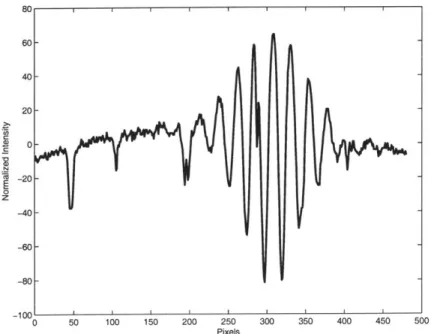
The second problem with correlation functions is more serious: the correlation function itself is sensitive to noise in the argument signals. Figure 3-2 shows a set of fringes for 7 horizontally oriented beams, each with a fringe pattern on it; the center beam has been displaced, resulting in the shifted fringe pattern on the beam. The noise can be seen by examining a horizontal slice of a fringe pattern, as shown in Figure 3-3. This slice is a plot of intensity (brightness) along the image; fringe patterns are seen to follow the form of Gaussian envelopes modulated by sinusoids, with some amount of additive noise.
This noise can cause the correlation function to "glitch" and return an incorrect delay
60 40 20 0 -20 -40 2:-Z S cc E 0 Z
60
-Sol -10C 500 anO .I1
-U 0.950.9-
0.85--- 24V0.8
---
26V-II a e 5 10 15 20 25
Pixel Delay
Figure 3-4: Glitch in delay calculation
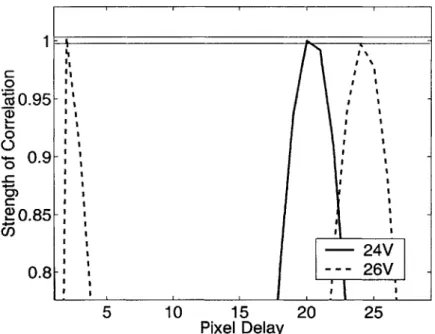
between the two signals. In Figure 3-4 this is shown between applied voltages of 24 V and
26 V. When 24 Volts are applied, the delay is calculated to be 20 pixels. When 26 Volts
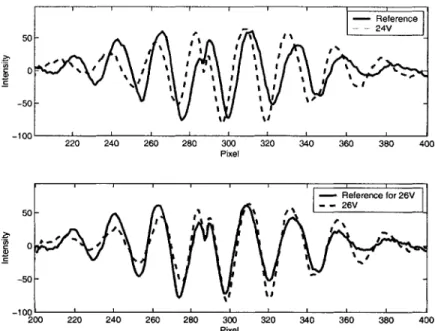
are applied, however, the noise in the intensity signal results in a maximum value of the correlation function at a delay of I pixel. Correlating the test signal (the fringe intensity pattern on the actuated beam) and the reference signal (the fringe pattern on an unactuated beam), as shown in Figure 3-5, by eye shows that this is not the correct delay-the signal has been shifted to the right of the reference signal by approximately one complete cycle of the sinusoid.
Due to the noise in the measurements, the value of the correlation function at the
miscalculated delay value is very slightly greater than the correlation calculated at the actual (known) shift.
3.1.3 Phase Integrator Solution
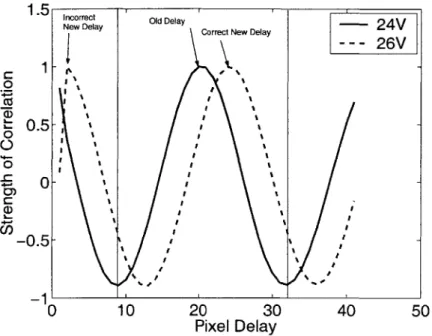
To solve the problem of noise sensitivity, it should be noted that because both of the argument signals are periodic with a period P, the correlation function is periodic with the same period, as shown in Figure 3-6, and thus the miscalculation of the shift is off by a
-- Referenc 50 -- 24V C 0 -50--220 240 260 280 300 320 340 360 380 400 Pixel - Reference for 26V 50- - 26V O% 5 0 -50- --100 i 200 220 240 260 280 300 320 340 360 380 400 Pixel
Figure 3-5: Comparison of reference and test signals at 26 V
to avoid miscalculated correlation delays.
The solution to miscalculated delays can be summarized as "take small steps." In the characterization of the polychromator, calculating displacements is not an isolated activity, done once for an arbitrary displacement. Instead, the displacement is the variable of interest,
to be tracked over many samples. Recall that each 'sample' of the displacement is actually determined by correlating a pair of fringe patterns, one on an unactuated reference beam and one on the actuated beam of interest, to find the phase shift between them. This phase shift is then a direct measurement of the displacement of the actuated beam, relative to the reference beam.
Thus, if the measurement process can be designed so that each change in total shift is always quite small (much less than the fringe period), the "glitches" where the correlation function incorrectly identifies the shift can be automatically rejected. The a priori knowl-edge that the change in phase difference between samples will be less than one wavelength effectively limits the search space of the correlation function to a small region centered around the delay that was calculated at the previous sample.
Figure 3-7 illustrates the limited search space technique; the correlation delay calculated with the new method, 23 pixels, is the correct delay.
20 40 60
Pixel Delay
80
100
Figure 3-6: Correlation of beam fringe patterns at 26 VOld Delay
Correct New Delay
9. 1 9. I 9. I 9. I 9. I 9. I 9. I 9. 1 9. I 9. 1 9. I 9. I 9. I 9. 9. 1 9. 1 I 9. 10 20
Pixel
-224V - - - 26V % I-30 40 50 DelayFigure 3-7: Limiting the search space of the correlation function 1 C o 0.5 a) 0
0
0U)
-0.5
1'
0
1.5
Incorrect New Delayi1F
0.5F 0: 00
0 -C a) 0 -0.5 1 00 6.2832 radians = 2 pi C'-5
-C -1O - -0 )
-15
E
a) 0-20-CzS-25-
6.2832 radians = 2 pi-30-
...
Phase
Integrator
- Naive Correlation0
10
20
30
40
50
60
Voltage Applied (V)
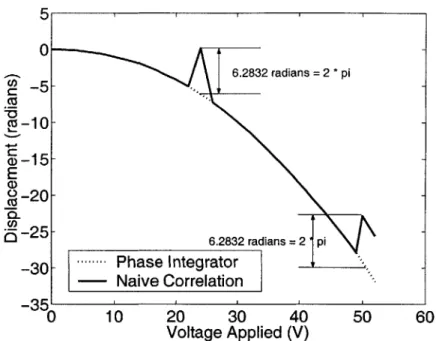
Figure 3-8: Displacement curvesThis technique nicely addresses both of the significant weaknesses of the correlation function technique. First, the computation time is reduced to a tiny fraction of the whole calculation, assuming that the wavelength of the sinusoidal envelope is much less than the length of the signal. This savings arises because the correlation function must only be calculated over a small portion of its length, as opposed to its entirety. Secondly, the noise sensitivity is substantially improved-abrupt jumps in the displacement curve do not occur using this "limited-search correlation function" method.
Figure 3-8 illustrates two displacement characteristics; one uses the new phase integra-tion approach and the other does not. As discussed, glitches are always a multiple of 7r radians.
3.1.4
Use
This method, as originally designed, was developed to calculate the displacement of a beam as the applied voltage increased over a specified range. As described in Section 3.2.1, however, it also finds application in the procedure to align the device under the microscope.
3.2
Automation Techniques
The following algorithms were developed to allow automated testing of polychromator de-vices; the are designed so that a user could plug in a device for testing, start the HUMS application, and walk away, only to return when the characterization process had finished for the whole device.
3.2.1 Stage Alignment and Movement
Since a beam must obviously be visible in the CCD field of view in order to be characterized
by the application, and only about 100 beams fit into the field of view, a well-controlled
mechanism is needed to move the device underneath the objective, in order to test each of the several hundred beams per polychromator. However, moving the device requires that the application recognize beams and be able to track their movement within the image; after the device has moved under the microscope, the application must still recognize where each beam appears, so it can identify the correct region to analyze for fringe patterns.
As this task became more clearly defined, it was observed that the highly regular nature of the beam array could be exploited. Between each pair of beams is a gap, and the surface of the device is a few microns below the layer of the top beams. This gap therefore appears as a dark line separating the two adjacent beams. Since a dark line similarly exists between every two adjacent beams, a periodic signal is found by taking a vertical slice of the image (see Figure 3-2). Instead of taking a horizontal slice along the length of a beam, as was used to calculate displacement, a slice across the widths of several beams is taken; the periodic signal then resembles the one shown in Figure 3-9.
By using another "take small steps" approach, this time in an orthogonal manner,
the application can maintain its knowledge of beam positions on the image. If the beam positions are known at the beginning of the movement procedure, the application must actuate the stage such that the movement across beams is less than half the length from the center of one beam to the center of the next (in other words, one half of the "across beam period"). The application can then always correctly calculate the new positions of the beams (using the phase integrator from Section 3.1.3, the shift between the signals is correctly calculated, and thus each new position is simply the sum of the old position and the calculated shift).
10 5 0 z -10 -15 -20 190 200 210 220 230 240 250 260 270 Pixels
Figure 3-9: Periodic signal across multiple beams
Thus, the regular, symmetric properties of the polychromator device helped reduce a difficult problem of image recognition and tracking to a previously solved problem, one of phase difference calculation.
3.2.2 Fringe Centering
Another important element of the procedure to set up polychromator devices for testing is the centering of the fringe patterns, which have a peak intensity and fall off with a Gaussian envelope. The fringe patterns on each beam in the field of view should all be centered on the same vertical position, because this maximizes the allowable displacement calculation between any two beams.
To center the fringe patterns, the application must first have a method to find the location of the peak of a given fringe pattern. It therefore applies an averaging filter to the fringe pattern intensity signal. Choosing the maximum value of the averaged signal gives an approximate location for the peak of the fringe envelope. This method is illustrated in
Figure 3-10.
By calculating the envelope peak across a number of beams in the field of view, a linear
least squares fit can be used to find the how far the envelope peak shifts, looking from beam I Z
Repeatability Tests: 128 tests of 1 beam 1 0.8-0.6 E 0.4 0.2 200 250 300 350 400 Applied Voltage (V)
Figure 3-10: Calculating the peak of the fringe pattern
to beam. Figure 3-11 illustrates this envelope-peak curve with a dashed line. The slope and "offset" of this best fit line can then be passed as input to any routine that needs to level out, or equalize, relative beam positions, across the field of view.
Chapter 4
Application Description
Here, the user interface will be presented, and the software design will be discussed briefly, to explain design decisions and a few optimizations. The application behavior itself will be described as well. The core function of HUMS is the beam testing procedure, and the secondary functionality around this core procedure exists to allow test automation; the application behavior will be presented in a similarly segmented manner.
4.1
User Interface
The user interface to the HUMS application is an expanded model of work done by Volpicelli[13].
A screenshot of the application in use is shown in Figure 4-1.
The notable controls are for stage movement and the voltage to apply to the selected beam. Other controls include a selection box, which is used to determine which 128 beam block is connected to the HVADI voltage source, and the button that runs an automated test procedure.
4.2
Class Hierarchy and Object Design
4.2.1 Signal class
The Signal class is of fundamental importance to the HUMS application. It encapsulates the concept of a generic signal, either in time or in space (both of which will be referred to as time-domain), which may be real-valued or complex.
Figure 4-1: Screenshot of the HUMS application
both be described as subclasses of a common base Signal class, since both representations would have numerous common functions (a getLength() procedure, for instance), but a number of different functions specific to each (a time-domain signal has no need for a inverseFFT() function, for instance). However, the decision was made that in the HUMS application, the two representations would be member variables of a single Signal class. This is an optimization to improve the speed of the application, in the relatively common occurrence that a time-domain signal is cascaded through a series of frequency-domain represented filters.
If a time-domain representation alone is encapsulated in a class, then applying a filter (in the frequency domain) requires two Fourier transforms: one forward to allow a frequency-domain filtering, and one reverse, to return the filtered signal to the original object. To apply another filter then requires another two Fourier transforms. Thus, assuming n*log(n) complexity for the transform (the FFTW library [11] actually performs the computation with less cost, but the point for this discussion is the same), the computational cost for b transforms is b * n * log(n), which grows linearly with the number of filters applied.
If, instead, the time-domain and frequency-domain representations are commonly
ac-cessible to a filtering function (for instance, if they are members of a single object), then a forward or backward Fourier transform must be computed only when the particular resentation needed for a specific use is "invalidated" in the sense that the alternate rep-resentation has been modified more recently. For a series of frequency-domain filters, the transform cost is reduced to 2 * n * log(n), which is constant with the number of filters
applied.
Thus, combining both representations as common data members in a single class effec-tively allows "lazy" FFT or IFFT evaluation. The Signal class also offers the capability to find peak values, to filter out or to boost carrier signals, and to correlate itself with other Signal objects.
4.2.2 FringeSignal class
To extend the concept of a Signal appropriately for a fringe pattern, it was subclassed to create the FringeSignal class. A FringeSignal represents a fringe pattern in some form, and therefore its member functions should be functions that are relevant to fringe patterns but not to Signal objects in general. As illustrated in Figure 3-10, fringe patterns follow
a Gaussian envelope. As described in Section 3.2.2, calculating the approximate peak of this envelope for every beam visible under the microscope is helpful in aligning the fringes. The FringeSignal class therefore offers this capacity in an isolated fashion-that is, the procedure for calculating this envelope peak has been changed and redesigned transparently to the rest of the application.
The fringe pattern signals are upsampled by a factor of 24 to improve the resolution of the calculated phase difference between them; the extremely high factor for upsampling gives rise to the application name, "Heavily Upsampling Microvision System."
4.2.3 DisplacementCurve class
The final goal of the testing procedure is the creation of a voltage to displacement transfer function. This is essentially an array of size (2, N), holding a list of (voltage, displacement) pairs, where N is the number of voltages used in testing the beam. The functions that should be associated with this array, to complete the design of the DisplacementCurve class, should encompass the following capabilities: initializing the curve, adding points to the curve, and checking for errors.
DisplacementCurve objects contain finite-state machines whose state changes with each test. Entrance into some states (for instance, error states) prohibits further use of the object until it has been reset (and the error, therefore, acknowledged). Entrance into other states (for instance, "dangerous" states in which the next transition may be an error state) sends warning messages to the rest of the application so that the undesirable error states may be avoided.
4.3
Testing Beams
4.3.1 Voltage Ranges Used
The voltage range used to test a device varies; some devices, from older fabrication runs, can only safely be tested to 60 or 70 Volts. Because the testing software should not pull-in beams (and thereby risk damaging the beams), this range is specified when the program is run. Newer devices can be tested up to about 80 Volts.
To minimize the time required to test a beam, the initial voltage steps are quite large: because the displacement changes very little with voltage at first, the steps can be large
without much risk that the "small step" rule for the phase integrator will be broken. At larger voltages, care must be taken to avoid this rule, and the process is described below.
4.3.2 Test Beam Algorithm
When a beam begins the testing process, it is first moved into the field of view if it is not already present. The fringes are then centered on the image, using the technique from Section 3.2.2 to calculate the general trend in fringe envelope peak location across the field of view. A proportional feedback loop is used to equalize all the peak locations.
Once the fringes are acceptably centered, the application initializes a new Displace-mentCurve for the beam, and prepares to check for tied beams, as in Section 4.4.4 when the first video capture (normally at 0 Volts applied to the test beam) is taken. In taking a video capture, the image from the CCD camera is saved to memory and used repeat-edly, and discarded at the end of the capture process: because motion jitter is a significant
problem, data cannot be taken directly from the CCD camera whenever it is needed. For each voltage along the range specified at run-time, a video capture is taken; the two beam images are saved into FringeSignal objects, and then passed to the Displace-mentCurve for the active test. The DisplaceDisplace-mentCurve: : addPoint function uses the prior state (previous calculated displacement) to calculate the new displacement, according to the limited-search correlation technique from Section 3.1. If the new displacement seems to indicate some kind of problem, for instance a pulled-in beam, the main testing loop is notified, and the test is aborted.
When the displacement reaches half a fringe of displacement, the application checks for tied beams (Section 4.4.4). If the change in displacement is growing large, such that the next change in displacement may violate the "small step" rule for the limited-search correlation technique, the voltage range is adjusted so that the steps are smaller. The following tests will then have smaller changes in displacement, to allow testing to continue without glitches. After completing the range of voltages to be tested, the whole DisplacementCurve is saved to disk for later use.
4.4
Test Automation
Four tasks dominate the effort required to automate the beam testing procedure to allow an entire device to be characterized with no user interaction (beyond execution of the ap-plication and the initial set up). One task is controlling the stage, so the entire device may be scanned; another is fringe alignment, which keeps the fringe pattern on each beam on-screen so that it may be used for calculating correlation functions. The third and fourth tasks involve error handling, not of the software but of the Polychromator devices them-selves. Device error modes must be detected by the testing software so the user knows the full set of capabilities and specific problems for each tested device.
4.4.1 Stage Control
Underneath the microscope, supporting the Polychromator package, is a stage which has a full six degrees of freedom, controlled by a set of picomotors. As described in Section 2.2, the stage must be tilted along the long axis of the beams in order to see any fringes at all in the microscope.
However, as discussed in Section 3.2.2, the fringe pattern on each beam in the field of view should have the peak of its intensity envelope in the same position along the image. To achieve this, another axis of rotation is actuated in a feedback loop to bring the trend in the envelope peak to the desired flat line, or zero slope on the best fit line.
4.4.2 Fringe Alignment
Fringe alignment is the portion of the application that actually implements the feedback loop described in Section 4.4.1 and utilizes the envelope peak calculation and best-fit line from Section 3.2.2.
When the application calls for an alignment of the fringe patterns across the beams in the field of view, the best-fit line is first calculated. If the slope is within an acceptable tolerance, corresponding to a 64 pixel change in peak location across the field of view, no stage rotation is done; otherwise, the program rotates the stage by some starting amount. The fit line is calculated again, and the process repeats. If the slope of the best-fit line changes, the ideal slope (0) has been crossed, so the rotation should proceed in the opposite direction. To avoid an infinite loop, the application reduces the amount of rotation
to oppose the previous. Otherwise, the application could oscillate between detecting the same positive and negative slopes, both of which might exceed the threshold slope, and the routine would never exit. This forced reduction in rotation amount forces a convergence
to some slope; if a minimum threshold of rotation is reached, but an acceptable slope not found, an error is signaled.
If an acceptable slope is reached, however, the program then translates the stage
(with-out rotation) to place the fringe offset (conceptualizing the best-fit line as y = mx + b) at
a desired location on the screen. This loop follows a similar "forced convergence" pattern as the slope minimizing loop, and similarly signals an error if the desired offset cannot be reached within a threshold distance.
4.4.3 Pull-In Detection
It is important that pulled in beams be identified as soon as the pull-in event occurs, so that the voltage applied to the electrodes is not increased further (doing so might damage the beam). The event can be detected in three ways.
First, a large displacement, or a phase shift which must be "corrected" to fall into the limited search range, which is followed on the next voltage sample by a very small displacement, is termed a pull-in event. Physically, this corresponds to the beam "snapping down" to the substrate on one voltage sample, resulting in the large displacement. On the next sample, a very small, or negligible displacement, is then calculated: the beam cannot be displaced any further because it is already resting at the minimum displacement, contacting the substrate.
The second method of pull-in detection relates to the first: two very small calculated displacement changes in a row is called a pull-in event, and this results from an errant calcu-lation on the first. If the correcalcu-lation mistakenly calculates the large change in displacement, and calculates the phase change at the pull-in voltage to be within the limited search range, the first method will fail to detect the event. However, the next two voltage samples will have very small displacement changes, and the application tags this behavior as pull-in.
The final method differs from the other two, and depends on the electrical nature of the device at pull-in. It is important that the polysilicon beams are conductive: if the lower beam touches down and contacts a voltage-driven electrode, a voltage divider appears in the electrical circuit, and the voltage measured by the HVADI suddenly drops. This voltage
drop only occurs at pull-in, and so if it is observed at any time while the applied voltage is being increased, a pull-in event is signaled.
4.4.4 Tied Beam Detection
One failure mode of the electronic fabrication is that two adjacent beams, or two beams with one beam between them, may move together when either beam is actuated by itself. This can result from a number of causes. An incomplete etch of the electrode layer beneath the beams can cause the charging of one electrode to also charge another, and an incomplete etch of the interconnect layer can result in similar shorting problems. An incomplete etch of either of the beam layers will result in the beams being physically tied together.
The HUMS application has been designed to address and identify these behaviors if they arise. When a beam first enters the testing process, the application saves an image of the relative positions of the fringe patterns on the 4 closest beams. When the fringe pattern on the tested beam reaches half a fringe (Alight/2) of displacement, the relative positions of
the adjacent beams are checked again, and compared to their original relative positions. If the calculated displacement on any of the adjacent beams exceeds a threshold dis-placement compared to that of the tested beam, an error is signaled and logged. This threshold has been set at 0.1 times the displacement of the tested beam. When the tested beam reaches half a fringe of displacement, the value of the threshold displacement is ap-proximately 13 nm.
Chapter 5
Calibration of the Measurement
Procedure
Once the HUMS application was acceptably debugged of actual software errors, the dis-placement measurement was calibrated to provide quantitative data about the measurement procedure's accuracy and repeatability (precision).
5.1
Calibration Standards Used
To calibrate the HUMS measurement procedure, it was used to measure step heights which have been measured with known accuracy. Deutsch [18] has fabricated blocks of various heights for just such a purpose. The heights of the blocks have been measured to within
0.7% accuracy using an ellipsometer that had been previously calibrated.
5.2
Testing Procedure
The calibration standards were first measured using an ellipsometer. Blocks with four different heights were used for these measurements; the wafers had a very thin layer of gold deposited on them, so that they could be used in the interferometry setup for HUMS.
Once the calibration standard blocks were prepared for testing, the application was modified slightly to take repeated, static measurements of fixed blocks. An interference picture of one block undergoing testing is shown in Figure 5-1. A height measurement is taken by taking two fringe patterns at different x positions in the image, at the reference
Figure 5-1: Calibration of .151 micron step height
height, and one fringe pattern is taken at an x position where the height is to be calculated. The two fringe patterns allow the calculation of a line through their envelope peaks. This allows the device to be leveled with processing rather than with stage control: the resultant line may then be "subtracted off" from any other fringe pattern, to reveal the fringe pattern's fundamental phase shift from the (now-leveled) fringe pattern at the reference height.
The left two lines with arrows are over the block, and thus 0.151 microns above the substrate, which is sampled at the two lines on the right. The two lines on the left are used to level the fringe patterns at the block height, and then used as a reference signal for the third line (at the substrate height); a similar process holds for measuring in the reverse direction, from the substrate to the block.
Four samples are taken so that a bias can be calculated between measuring positive height differences and measuring negative height differences. Absent a bias between positive and negative height measurements, the two calculated heights should be equal in magnitude and opposite in sign. Each of these tests was run 32 times, on each of the four measured
Block number
[
Mean height (from ellipsometer)1 1435.6 A
2 4964.7 A
3 10457 A
4 18445
A
Table 5.1: Calibrated heights
Block number Step Height (block to substrate) Step Height (substrate to block)
1 1578A 1565A
2 5010A 4995A
3 10620A 10611A
4 18423A 18405A
Table 5.2: Mean block measurements
calibration blocks.
The calibrated block heights are shown in Table 5.1. The confidence of the measurement of the smallest block height is low, however: Deutsch reported that while measuring this block height in the ellipsometer, repeated attempts were necessary to succesfully test the displacement. The ellipsometer is designed to test the thickness of films on a substrate, but the thinnest film (the smallest height step) has a thickness which is out of the ellipsometer's usual measurement range. Although it can measure thicknesses as small as the roughly
0.15 pm, its accuracy may suffer.
5.3
Bias Results
The two types of measurements, from substrate to block and from block to substrate, revealed an underlying bias in the measurement procedure. Although the measurements were, as expected, opposite in sign, the magnitude of the height difference when measured using the block as the reference height was consistently above the height difference measured in the reverse manner. Figure 5-2 illustrates this. The mean difference between heights was 13.472
A;
the full list of differences between the measurement means is in Table 5.2.proce-
0.015-D 0.01-0.005-
0--0.005 --0.01 0 0.5 1 1.5 2Calibrated Height (microns) Figure 5-2: Residual Error Of Measurements
dure:
1 fringe 1 pixel 2625 Angstroms Ansgtroms
* * ~10.9
~ 10 pixels 24 upsampled pixels 1 fringe upsampled pixel
Thus, the system has a very small, but positive bias, towards measuring the height negatively (using the block as the reference height).
5.4
Repeatability Results
The standard deviation of the measurements was very small; the error bars on Figure 5-2 span a two standard deviation range (centered on the mean) of the measurement, for both types of measurement (block to reference and reference to block). The mean standard deviation is 3.96 Angstroms; this is much less than the minimum resolvable displacement of approximately 10.9 Angstroms.
Block number [[Block to Substrate Substrate to Block
1
4.54A
1.72A2 9.68A
4.57A
3 2.55A 4.o1A
4
2.30A
2.30A
Table 5.3: Table of standard deviation of measurements
2-C 21.5-0
E
@, 1 Slope: 0.9928 -30.5
-0 0.5 1 1.5 2Calibrated Height (microns)
Figure 5-3: Measurements Compared to Calibration
5.5
Accuracy Results
Figure 5-2 plots the residual error as a function of the calibrated height, and Figure 5-3 plots the actual measured heights against the calibrated height. The mean absolute error in the measurements is 61.9
A;
if the low-confidence first measurement is discarded, the meanabsolute error is 41.5
A.
The probable error p is an error defined such that the probability that any error is p or less away from the mean is 0.5 [19]. For the HUMS measurement process, the probable error is 0.674 * c-, where a is the standard deviation of a measurement. If the low-confidence measurement is included in this calculation, the probable error is 40.9
A;
if the measurement is neglected, the probable error is 28.8A.
Even allowing for some error in the measurement procedure, a best-fit line calculated between the calibrated height and the measured height should have a slope of 1: for every increase in the calibrated height, an increase of exactly the same amount should be calcu-lated in the measured height. Because the measured height, plotted against the calibrated height, is a linear function of the wavelength used to extract the height difference from the phase, the expectation is that a unity slope will result from perfect knowledge of the wavelength.
If the wavelength of the actual light used is different from the wavelength used to calculate the height difference, the slope of the line will deviate from 1. Let the real wavelength of the light source be AO, and the wavelength used to calculate the height difference from the phase be Awrong. A 2 * 7r phase shift between two interference fringes corresponds to a Ao/2 difference in height, regardless of Awrong. However, the calculated difference in height will be Awrong/2, and the error will be (Ao - Awrong)/ 2; this error is directly proportional to the phase shift, and thus to the displacement. If the exact
AO is used, there will be no error, and so the calculated displacement will change in 1-1
correspondence with the calibrated displacement. If any Awrong is used, there will be a linear error residual proportional to the displacement and Ao - Awrong, and thus a deviation from this 1-1 correspondence between the calibrated height, and the calculated height.
A best-fit line drawn through the calculated measured heights has a slope of 0.9928,
which says that the wavelength of the light is within 1% of the peak wavelength specification on the LED used (525 nm). By removing the low-confidence first calibration measurement, the slope increases to 0.9944.
Because this error term is small (less than 1%), the measurements are not adjusted, but left as they are taken. For all measurement ranges of interest (from 0 to 3 pm) the error will be small enough to be neglected.
5.6
Analysis
The results of the calibration data are very encouraging. They suggest that the HUMS measurement procedures are both accurate and precise, to well within the design specifica-tions for actuating the device to within 100 nm. Future calibration work will require that thorough perturbation analysis be done on the polychromator devices themselves; also, the
"beam problem" detection portions of the application should be tested to find false-positive and false-negative rates.
Chapter 6
Results
This section discusses the observations made from the use of HUMS in its full automated mode. First, the methods used to analyze the observed data are discussed, and the no-table weakness of these methods is raised. Secondly, the performance of the application is described, showing the advantages of this method of characterization over the previous method. Data from the use of HUMS are discussed in the following section, and the in-teresting results are highlighted. Finally, the sensitivity of the measurement application to disturbances is described in terms of experimental observations, and the weaknesses of the application are mentioned.
6.1
Analysis Of Data
To analyze the voltage/displacement data sets that were taken using HUMS, linear least squares fits were taken for each test of each beam. The fits are 6th order polynomials of the form
d = a3v6 + a2v4 + a1v2
+
aoOne beam's observed transfer curve, and its associated best fit line, are shown in Fig-ure 6.1.
The odd power terms of the polynomial are discarded because the physical operation of the device should have no dependence on them; any calculated dependence is an artifact of the fitting procedure rather than an indication of an actual dependence.