Publisher’s version / Version de l'éditeur:
Vous avez des questions? Nous pouvons vous aider. Pour communiquer directement avec un auteur, consultez la première page de la revue dans laquelle son article a été publié afin de trouver ses coordonnées. Si vous n’arrivez pas à les repérer, communiquez avec nous à [email protected].
Questions? Contact the NRC Publications Archive team at
[email protected]. If you wish to email the authors directly, please see the first page of the publication for their contact information.
https://publications-cnrc.canada.ca/fra/droits
L’accès à ce site Web et l’utilisation de son contenu sont assujettis aux conditions présentées dans le site LISEZ CES CONDITIONS ATTENTIVEMENT AVANT D’UTILISER CE SITE WEB.
Physical Review. B, Condensed Matter and Materials Physics, 68, 15, p. 155305,
2003
READ THESE TERMS AND CONDITIONS CAREFULLY BEFORE USING THIS WEBSITE.
https://nrc-publications.canada.ca/eng/copyright
NRC Publications Archive Record / Notice des Archives des publications du CNRC :
https://nrc-publications.canada.ca/eng/view/object/?id=e5020c8a-6881-457d-a425-f182a69b10d1
https://publications-cnrc.canada.ca/fra/voir/objet/?id=e5020c8a-6881-457d-a425-f182a69b10d1
NRC Publications Archive
Archives des publications du CNRC
This publication could be one of several versions: author’s original, accepted manuscript or the publisher’s version. / La version de cette publication peut être l’une des suivantes : la version prépublication de l’auteur, la version acceptée du manuscrit ou la version de l’éditeur.
For the publisher’s version, please access the DOI link below./ Pour consulter la version de l’éditeur, utilisez le lien DOI ci-dessous.
https://doi.org/10.1103/PhysRevB.68.155305
Access and use of this website and the material on it are subject to the Terms and Conditions set forth at
Effective Bloch equations for strongly driven modulation doped
quantum wells
Effective Bloch equations for strongly driven modulation-doped quantum wells
Alexandra Olaya-Castro,1Marek Korkusinski,1 Pawel Hawrylak,1and Misha Yu. Ivanov2
1Institute for Microstructural Sciences, National Research Council of Canada, Ottawa, Canada K1A 0R6 2
Steacie Institute for Molecular Sciences, National Research Council of Canada, Ottawa, Canada K1A 0R6
~Received 2 May 2003; published 13 October 2003!
We study the effects of macroscopic carrier density on intersubband transitions in a modulation-doped quantum well with two electronic subbands coupled by an intense ac electric field.We propose an ansatz wave function consistent with the Hartree-Fock approximation, and we use it to derive and analyze the effective nonlinear Bloch equations.
DOI: 10.1103/PhysRevB.68.155305 PACS number~s!: 78.67.De, 42.65.Sf
I. INTRODUCTION
There is currently an interest in exploiting intersubband transitions in semiconductor quantum wells for detectors, emitters, quantum cascade lasers, and lasers without inver-sion in the far-infrared and terahertz region.1 Many of the physical concepts considered in this context originate from atomic physics, where one manipulates well-defined quan-tum levels.2In quantum wells, however, a macroscopic num-ber of carriers participates in intersubband transitions3 and analogies with atomic physics are not obvious. We are par-ticularly motivated by recent experiments on quantum foun-tain laser in coupled quantum wells by Liu et al.4 In these experiments, two subbands of a modulation-doped quantum well are optically driven by a CO2 laser. In related experi-ments, intersubband transitions in intense laser fields have been studied experimentally5– 8and theoretically.9–14In the-oretical works, the effects of electron-electron interactions have been included mainly in the Hartree approximation by, e.g., Zaluzny10and Birnir and Galdrikian.13The effect of the exchange and correlations were studied using semiconductor Bloch equations ~SBE’s! ~exchange only!11,12,14,15 and the time-dependent density functional approach.16The effects of electron-electron correlations in quantum dots in intense la-ser field have also been studied using exact diagonalization techniques.17,18 The SBE approach typically relies on the equation of motion approach which is not transparent to ex-perimentalists, as it resorts early on to numerical analysis, and often neglects exchange and correlations.
In this work we formulate the analogy of intersubband transitions in intense laser fields with two-level atoms start-ing from the ansatz many-body wave function. We postulate a correlated wave function, show how to reduce it to a Hartree-Fock ~HF! approach, derive SBE directly from the HF wave function, and reduce SBE to an effective Bloch equation for a two-level system familiar from the atomic physics.19 The effect of a macroscopic number of carriers translates into a nonlinear Bloch equation. The nonlinearity is carefully traced to depolarization effects, i.e., screening of the applied electric field, and to self-energy and vertex cor-rections. The self-energy and vertex corrections are natural and compensating components of any response from the Hartree-Fock ground state. Here we clarify how they contrib-ute to the response to intense ac fields.
II. THE MODEL
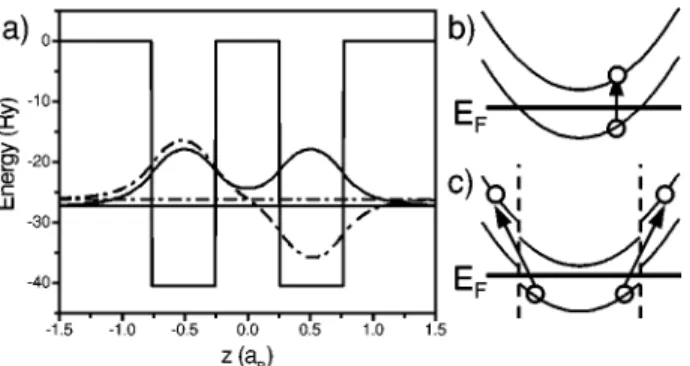
In order to make a clear analogy with two-level systems we focus on a symmetric double quantum well ~DQW! for which only two subbands are relevant, as illustrated in Fig. 1~a!. The single-particle states of the DQW are ukWns
&
with energies given bye(kns)5En1k2/2m*. Here n50,1 is thesubband index, En is the quantized subband energy, kW is the
wave vector parallel to the plane,s is the zth component of the spin, and m*is the electronic effective mass. The lowest subband n50 has even parity, and the first excited subband
n51 has odd parity. The two lowest levels are well
sepa-rated from other subbands, with spacing tunable by the bar-rier width and height. The lowest level is filled with elec-trons, with Fermi energy less than the energy of the n51 subband. The two levels n50 and n51 are coupled through a time-dependent field E(t) applied along the growth direc-tion (z axis!. We assume the radiadirec-tion field to induce wave vector and spin-conserving transitions between states with different parity, as illustrated in Fig. 1~b!.
The Hamiltonian for the system of electrons in a double quantum well has the form
FIG. 1. ~a! Potential profile, energy levels, and wave functions of the lowest ~solid line! and first excited ~dotted line! subbands in a double symmetric quantum well. ~b! Schematic energy dispersion
E(k) for the first two subbands. In the lowest order, the electric field induces spin and wave vector-conserving transitions and each pair of occupied kW levels forms a driven two-level system. ~c! Pair excitations with net wave vector kW50 from the ‘‘light dressed’’ occupied levels to bare undressed unoccupied levels.
2H5
(
n(
kWs e~ kns!ckWn1sckWns 1(
nn8 kWkW(
8s^
kWnuezE~t!ukW8
n8&
ckWn1sckW8n8s 11 2 n1n(
2n3n4 kW(
1kW2kW3kW4ss8^
kW1n1,kW2n2uVukW3n3,kW4n4&
3ckW1n1s 1 ckW 2n2s8 1 ckW3n3s8ckW4n4s. ~1! The operator ckWn1s (ckWns) creates ~annihilates! a particle in astate ukWns
&
. We can introduce two new creation operators identified with the two subbands: for n50, ckWns1 5akW1s, and for n51, ckWns 1 5bkWs 1
. The matrix elements between different states coupled by the ac electric field are defined as
^
s8
n8
kW8
uezE(t)ukWns&
5dkW,kW8ds,s8dn8,n61mE(t), and the Coulomb matrix elements are written as^
kW1n1,kW2n2uVukW3n3,kW4n4&
5v(q)Fn1,n2,n3,n4(q), with kW15kW2qW, kW25kW
8
1qW, kW35kW8
, and kW45kW. The form factorFn1n2n3n4(q)5**dzdz
8
jn1(z)jn2(z8
)e2quz2z8ujn3(z8
)jn4(z)and v(q)52pe2/e0q, wheree0is the dielectric constant and
eis the electronic charge. The form factor is nonzero for the combination of indices conserving parity in scattering:
F0000, F10015F0110, F01015F1010, F11005F0011, F1111.
III. THE WAVE FUNCTION AND BLOCH EQUATIONS
We now proceed to an investigation of the time depen-dence of the system. Before the external field is turned on the ground state of the system has a definite parity, i.e., all elec-trons are in the n50 subband, filling a Fermi disk kW<kWF.
This state isu0
&
5)kW<kWF,sakWs 1uv
&
, whereuv&
is the vacuum. Since the radiation induces wave vector and spin-conserving intersubband transitions between different parity states, we are only interested in states with zero total wave vector but undetermined parity. The simplest ansatz for the Hartree-Fock wave function which satisfies these requirements can be written asuC~t!
&
HF5)
kW,kWF,s
@akWs~ t !akW1s1bkWs~ t !bkW1s#uv
&
. ~2!This ansatz is a HF combination of two-level states without definite parity but preserving the Fermi disk, with states oc-cupied with probability 1 up to k5kF and 0 outside. Only
occupied states are dressed by the light and renormalized. Electronic correlations change this sharp distinction between the occupied and empty states by smearing the occupation probability due to the admixture of multipair excitations. We can include these correlations by expanding the wave func-tion in multiples of pair excitafunc-tions chosen to preserve the total wave vector. This procedure is schematically illustrated in Fig. 1~c!. Note that the light-dressed states are occupied states which are renormalized differently from the unoccu-pied undressed states, which is illustrated in Fig. 1~c! as a discontinuity of the quasiparticle dispersion at the Fermi level. If we extend the definition of HF operators into the
entire lowest ‘‘light-dressed band’’ as AkW1s5akWs(t)akWs 1 1bkWs(t)bkW1s corresponding to each state kW at a given time, the HF wave function can now be written as uC(t)
&
HF 5)kW,kWF,s@AkWs1#uv
&
. In a similar way we can define opera-tors B1 of the second light-dressed band. To account for correlations, the wave function may be expanded in pair ex-citations from the light-dressed Fermi disk with no net wave vectoruC~t!
&
5uC~ t !&
HF1(
qWkWkW8ss8
B~ kW,kW
8
,qW,t !A(kW1qW)s13A(kW182qW)s8AkW8s8AkWs]uC~t!
&
HF1•••. ~3!The interband excitations can be added in a similar way. It is clear that one way to include pair excitations to all orders but without higher order correlations is to sum up the pair exci-tations in a way analogous to the linked cluster expansion uC~t!
&
5expF
(
qWkWkW8ss8 B~ kW,kW8
,qW,t !A(kW1qW)s1 A(kW 82qW)s8 1 AkW8s8AkWsG
3uC~ t !&
HF. ~4!The time evolution of this wave function is described by the time evolution of each two level system given by the time dependence of HF coefficientsakWs(t), bkWs(t) and by corre-lations among excitations expressed by the coefficient
B(kW,kW
8
,qW,t). Even though this is an approximate ansatz, the determination of all the coefficients is still a very compli-cated problem which will be tackled elsewhere. Our goal in this work is the opposite, i.e., to provide the simplest pos-sible description of the problem with full understanding of the limitations of such a description. The first step in this direction is the reduction of the problem to as few parameters as possible, bringing out the analogy with atomic two-level systems. Hence, we neglect correlations given by coefficientsB(kW,kW
8
,qW,t) and consider only parameters of each two-level system ~the HF approximation!. These parameters are related to the expectation values of both particle number operators^
C(t)uakW1sakWsuC(t)
&
, and the off-diagonal matrix elements, e.g.,^
C(t)ubkW1sakWsuC(t)
&
. To see that the off-diagonal ma-trix elements of this form survive, let us evaluate^
C(t)ub1lW alWuC(t)&
:^
C~t !ub1lW alWuC~t!&
5
)
kW,kW8^
vu~a kW8 *akW81bkW*8bkW8!blW 1 alW~akWakW 1 1bkWbkW 1 !uv&
5)
kW,kW8 @akW 8 * akW^
vuakW 8blW 1 alWakW1uv&
1akW* b8 kW^
vuakW 8blW 1 alWbkW 1 uv&
1bkW* a8 kW^
vubkW 8blW 1 alWakW 1 uv&
1bkW* b8 kW^
vubkW 8bkW 1!uv&
] 5b*alW lW^
vublWb lW 1 alWalW1uv&
5blW*alW. ~5!OLAYA-CASTRO, KORKUSINSKI, HAWRYLAK, AND IVANOV PHYSICAL REVIEW B 68, 155305 ~2003!
The expectation values of operators n0(k)5
^
akW1,sakW,s&
, n1(k)5^
bkW1,sbkW,s&
, p(k)5^
bkW,s 1 akW,s&
, p1(k)5^
akW,s 1 bkW,s&
are simply products of corresponding coefficients a andb. Their physical meaning is related to the number of par-ticles, e.g., in the second subband N1(t)5(kW,s
^
bkW,s1
bkW,s
&
, and to the complex intersubband polarization P(t) 5 (kW,s^
bkW,s1
akW,s
&
5 (kW,sbkW* a,s kW,s. Their time evolution is de-rived from the equations of motioni]
]t
^
C~t !ubkWs 1akWsuC~t!
&
5^
C~t !u@bkWs 1akWs,H#C~ t !
&
. ~6! Through direct evaluation of the commutators and expecta-tion values the evoluexpecta-tion of the density matrix is found to be given by i p1~ kWs! 52V10~ kWs!p1~ kWs!1D 10~ kWs!@n1~ kW,s!2n0~ kW,s!#, i p~ kWs!5V10~ kWs!p~ kWs!2D01~ kWs!@n1~ kW,s!2n0~ kW,s!#, in0~ kW,s!52p1~ kW,s!D01~ kWs!1p~kW,s!D10~ kWs!, in1~ kW,s!51p1~ kW,s!D01~ kWs!2p~kW,s!D10~ kWs!. ~7! Here the effective energies and effective dipole moments are given by V10(kWs)5E1(kWs)1S11(kWs)2E0(kWs) 2S00(kWs), D01(kWs)5mE1V01(kWs), and D10(kWs)5mE(t) 1V10(kWs). The self-energies of the two levels are defined asS00~ ks!5
(
k8s8 ~^
k0,k8
0uVuk8
0,k0&
2^
k8
0,k0uVuk8
0,k0&
dss8!n0~ k8
s8
! 1~^
k8
1,k0uVuk0,k8
1&
2^
k8
1,k0uVuk8
1,k0&
dss8!n1~ k8
s8
!, S11~ ks!5(
k8s8 ~^
k1,k8
1uVuk8
1,k1&
2^
k8
1,k1uVuk8
1,k1&
dss8!n1~ k8
s8
! 1~^
k8
0,k1uVuk1,k8
0&
2^
k8
0,k1uVuk8
0,k1&
dss8!n0~ k8
s8
!. ~8! The off-diagonal elements of the Coulomb interaction renor-malizing the applied field are defined asV01~ ks!5
(
k8s8 ~^
k1,k8
0uVuk8
1,k0&
2^
k1,k8
0uVuk0,k8
1&
dss8!p~ k8
s8
! 1~^
k1,k8
1uVuk8
0,k0&
2^
k8
1,k1uVuk8
0,k0&
dss8!p1~ k8
s8
!, V10~ ks!5(
k8s8 ~^
k8
1,k0uVuk1,k8
0&
2^
k8
1,k0uVuk8
0,k1&
dss8!p1~ k8
s8
! 1~^
k0,k8
0uVuk8
1,k1&
2^
k8
0,k0uVuk8
1,k1&
dss8!p~ k8
s8
!. ~9! These Bloch equations are a direct consequence of the form of the HF wave function. They were derived by a different method in Ref. 11. These equations carry the information about time evolution of each occupied kW state while neglect-ing correlations among them. This detailed microscopic in-formation is often not needed; rather inin-formation about the macroscopic quantities such as the population inversion and the polarization of the system is important. We therefore pro-ceed to reducing the SBE equations to a comprehensive form of effective two-level Bloch equations for total population inversion and total polarization of the two subbands.IV. EFFECTIVE NONLINEAR BLOCH EQUATIONS
We define the three-component Bloch vector S(t) in terms of mean real and imaginary parts of polarization and mean population inversion per electron as
S15@ (kW,sp1~ kWs!1p~kWs!#/ (kW,sn~ kW,s!,
S25 (kW,si@ p1~ kWs!2p~kWs!#/ (kW,sn~ kW,s!, and
S3~ k !5@ (kW,sn1~ kWs!2n0~ kWs!#/ (kW,sn~ kW,s!. Due to the conservation of the number of particles the Bloch vector satisfies S121S221S3251. To obtain equations for S(t) we replace the local behavior in Eq. ~7! by corresponding mean field values and close equations. For example, when we evaluate (kV10(k) pkwe use the mean value theorem to
write (kV10(k) pk5
^
V&
(kWpkW, and replace the unknownvalue of
^
V&
with the average transition energy^
V&
' (kWV10(k)n(k)/ (kWn(k). The resulting equations lead to
ef-fective nonlinear Bloch equations for the driven double quantum well system
S˙15~v102gS3!S2,
S˙252~v102gS3!S11@2mE~ t !22bS1#S3,
S˙352@2mE~ t !22bS1#S2. ~10! Herev10is the renormalized but time-independent transition energy, b is the coefficient of the nonlinear term that renor-malizes the applied field due to induced polarization, andg
is a result of the interplay between vertex and self-energy corrections to the transition energy. The nonlinear coeffi-cients can be evaluated as a function of the total number of electrons and parameters of a double quantum well. We find it sufficient to expand the form factors F(q) to the lowest
order in q and define the relevant length elements Ln1n2n3n4 5**dzdz
8
jn1(z)jn2(z8
)uz2z8
ujn3(z8
)jn4(z) to obtain v105~ E12E0!11 2 2pe2 e0 NS
L11112L0000 2D
, g512 2pe 2 e0 NS
L10012 L11111L0000 2D
, b51 2 2pe2 e0 NL1100. ~11! We see that the population inversion S3 renormalizes the transition energy v10 and that the induced polarization S1 screens the applied electric field. The renormalization of the transition energy ~coefficient g) consists of two compensat-ing terms: the self-energy and the vertex correction. A similar compensating process takes place in the screening of applied field. The parameterb, accounting for screening, turns out to be exactly half the Hartree contribution (2pe2/e0)NL1100, where N is the electron density. The reduction in the screen-ing is due to the exchange correction. The exchange correc-tions appear as terms linear in the number of electrons N. This is rather surprising as the exchange self-energy depends on N as N1/2. All exchange terms nonlinear in N cancelled out exactly due to the interplay of self-energy and vertex corrections. We are left only with linear terms which are the same order as Hartree contribution.The structure of the set of equations ~10! is S˙W5VW(SW) 3SW, i.e., these are truly nonlinear Bloch equations.15 The driving field has the form VW(SW)52(2mE(t)22b)xˆ 2v10(S3)zˆ, where v10(S3)5v102gS3 is the renormalized and time-dependent transition energy. We emphasize that this renormalization is different from just a difference in self-energies and includes vertex corrections.
Finally, we model the relaxation phenomena in terms of dephasing (T2) and population decay (T1) times, which leads to a set of effective Bloch equations
S˙15v10~ S3!S22 S1 T2 , S˙252v10~ S3!S11@2mE~ t !22bS1#S32 S2 T2 , S˙352@2mE~ t !22bS1#S22S311 T1 . ~12!
This treatment of relaxation draws on analogies to two-level systems but the issue of relaxation is a difficult one and is closely related to the extension of the proposed wave func-tion to include correlafunc-tions and the interacfunc-tion with phonons.
V. ROTATING WAVE APPROXIMATION
The Bloch equations can be analyzed in the rotating frame of the driving field, which has been assumed to be E(t) 5E0sin(vt). The Bloch vector can be rewritten in terms of
in-phase and out of phase components with the driving field, in the following way:
S15U sin~vt!2V cos~vt!,
S25V sin~vt!1U cos~vt!,
S35Z. ~13!
In this rotating frame, the Bloch equations for U, V, and Z can be written as a combination of slowly and fast oscillating terms: U˙ 5D˜v10~ Z !V2U T22@ mE02bU#Z cos~ 2vt! 1bZVsin~ 2vt!, V˙ 52D˜v10~ Z !U1mE0Z2 V T21@ mE02bU#Z sin~ 2vt! 1bZVcos~ 2vt!, Z˙52Z11 T1 2 mE0V1@mE02bU#V cos~ 2vt! 2@mE0U2b~ U22V2!#sin~ 2vt!, ~14! where D˜v10(Z)5v102v2gZ1bZ is the renormalized
transition energy. This frequency shift accounts for screening as well as vertex and self-energy effects. Neglecting fast os-cillating terms in Eq. ~14! leads to the rotating wave approxi-mation ~RWA!. The RWA set of equations has the form R˙W 5V(RWW)3RW, with V(RW)52mE0xˆ2Dv˜10(Z)zˆ.
VI. PUMP AND PROBE ANALYSIS
In this section we explore the response of the driven DQW system to a weak probe field dSW. In the presence of the probe field the total Bloch vector satisfies SWtotal5SWpump 1dSW. Neglecting second order terms, the time evolution of the probe field is
dSW
˙5VW~ SWpump!3dSW1dVW~ SW!3SW
pump, ~15!
where dVW(SW)5dVW01dMWp(SW), with dVW0522mEprobe(t)xˆ anddMWp(S)52bdS1xˆ1gdS3zˆ. Therefore the equations for the perturbation become
dS˙15~v102gS3p!dS22gS2pdS3, dS˙252@~v102gS3 p !12bS3 p #dS1 1@~ 2mE~ t !22bS 1 p !1gS1 p #dS312mS3 pE probe~ t !, dS˙352$@2mE~ t !22bS1p#%dS212bS2pdS122mS2pEprobe~ t !. ~16! We see that the test field does not just probe the renormal-ized frequency (v102gS3
p
), nor the renormalized field
OLAYA-CASTRO, KORKUSINSKI, HAWRYLAK, AND IVANOV PHYSICAL REVIEW B 68, 155305 ~2003!
@2mE(t)22bS1p# of the electronic system. It probes the combined electronic and pump photon system which leads to cancellation effects in frequency @(v102gS3
p
)12bS3
p
# due to the screening of applied field ~parameter b), and in ap-plied field$@2mE(t)22bS
1
p
#1gS1p% due to the renormaliza-tion of electronic transirenormaliza-tion energy ~parameterg).
VII. DISCUSSION OF RESULTS
We now turn to the numerical analysis of our nonlinear Bloch equations. We rescale the time in terms of the bare transition energy, i.e., t1051/E10 (\51), measure energies in units of the effective Rydberg R5m*e4/2e02\2, and lengths in units of the effective Bohr radius aB
5e0\2/m*e2. In these units explicit expressions for coeffi-cients are
v10~ S3!511~EF/E10!~ L10012L0000!2~EF/E10!@L1001 2~ L11111L0000!/2#~ 11S3!,
b5~ EF/E10!L1100,
here EF is the Fermi energy, and mE(t)
5(z10/E10)E0sin(vt)5mE0sin(vt). As an example we com-pute these coefficients for a double quantum well shown in Fig. 1. We find z10520.51aB, E1051.12R, b
520.41(EF/E10), v10(S3)5120.0124(EF/E10)S3 ~since
L1111.L0000). For a density of '1.231011cm22, i.e.,
EF/E1050.5, the nonlinear coefficient b520.2 andv10(t
50)51.0124. It is clear that for a symmetric double quan-tum well with these parameters the energy renormalization is very small. However, if the barrier separating the two wells is removed, we find b520.15(EF/E10) and v10(S3)51 20.11(EF/E10)S3, i.e., the nonlinearity in screening of the field is reduced, while the energy renormalization is increased.
In Fig. 2 we show the dipole moment z10 and the param-eter L1100 as a function of the barrier width relative to the well width, for a double symmetric quantum well. As can be seen, the screening of the applied field, b5(EF/E10)L1100, varies linearly with the barrier width @see Fig. 2~a!#, as does the dipole moment z10 @see Fig. 2~b!#.
We now turn to explore the coherent long-time behavior of the system. In the RWA the S˙W50 and the adiabatic con-dition V50 gives the remaining U and Z components of the Bloch vector. Since U21Z251, we can write U5sin(u),
Z5cos(u), whereuis the Euler angle. This reduces the Bloch equations to one transcendental equation
tan~u!5 m
E02bsin~u!
Dv102gcos~u!. ~17! Its solutions, if they exist, give the stationary state of the system. Without nonlinearity the solution takes the form tan(u)5mE0/Dv10, i.e.,u50, p, or Z561 in the absence of the external field. The system is thus either in its ground state (Z521) or is inverted (Z511). When the external FIG. 2. Length element L1100~a! and dipole moment z10~b! as a
function of the barrier width relative to the well width for a sym-metric DQW.
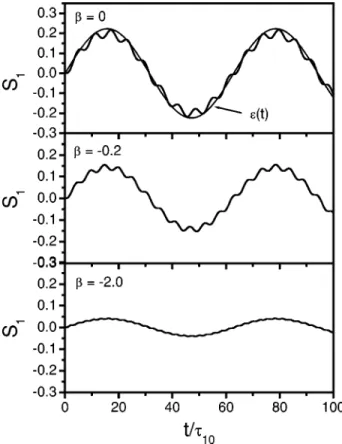
FIG. 3. Real part of mean polarization S1as a function of time
for different values of parameter b. In this calculation v/v10
field is very small but bÞ0, two new solutions appear: Z 52E10/b, U56
A
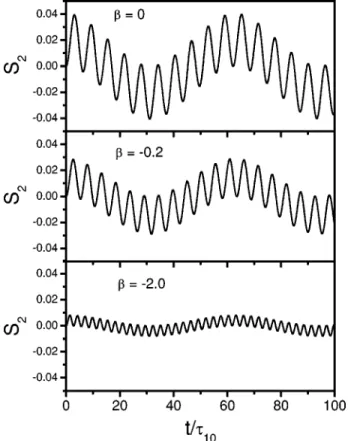
12(E10/b)2. These solutions are char-acterized by opposite sign of polarization. They exist only when uE10u/ubu,1.In Figs. 3, 4, and 5 we show the coherent time evolution of the Bloch vector components S1, S2, and S3, respectively, for slow (v/v1050.1) and weak (mE050.1) driving field, and for different values ofb50, 20.2, 22.0. Figure 4 in-dicates that the absorption of the radiation is very small, as is expected for this frequency. Figure 3 shows that the induced polarization follows and reduces the applied field. Such be-havior is superimposed with rapid oscillations, whose fre-quency increases with increasing nonlinearity. These rapid oscillations can be better understood in the RWA. Since the frequency and strength of the field are small, the population inversion remains almost constant ~see Fig. 5! and the renor-malized transition energy becomes D˜v10.v102v1g2b. Therefore, the RWA equations become linear and their solutions are of the form V5exp(ivefft), with veff 5
A
(mE0)21D˜v10 2
. This is illustrated in Fig. 6 which shows
U and V as a function of time for different values of the parametersb andg.
We now turn to the analysis of the long-time behavior of induced polarization S1 as a function of the strength of the applied field. In Fig. 7 we show the time evolution of S1for different field strengths obtained by integrating the Bloch equations without RWA. The long-time behavior of S1 is FIG. 4. Imaginary part of mean polarization S2as a function of
time, for different values of parameter b. In this calculation v/v1050.1 and mE050.1.
FIG. 5. Population inversion S3as a function of time, for
dif-ferent values of parameter b. In this calculation v/v1050.1 and
mE050.1.
FIG. 6. In-phase ~a! and out of phase ~b! components of the Bloch vector as a function of time, for different values of param-eters b, in the RWA. Time is measured in units of the effective frequency veff. In this calculation v/v1050.1 and mE050.1.
OLAYA-CASTRO, KORKUSINSKI, HAWRYLAK, AND IVANOV PHYSICAL REVIEW B 68, 155305 ~2003!
extracted for times much longer than the relaxation times: first, the system is allowed to evolve 200 cycles, and then the values of S1 are stored at fixed times equal to half a cycle of the driving field, i.e., at times when the driving field attains its maximal value and is directed either parallel or antiparal-lel to the z axis. The polarization as a function of field strength is shown in Fig. 8. As can be seen, if the field strength exceeds a critical value, S1 oscillates between two opposite values, corresponding to the same population inver-sion. Such critical behavior depends on the value of the non-linearity b as a function of the applied field. The values of the steady-state solution can be obtained by solving the equa-tion T21SW5VW(SW)3SW with constant driving field. The results shown here agree qualitatively with those of Ref. 13, ob-tained in Hartree approximation and for finite temperatures. The main difference is the lack of chaotic behavior observed in Ref. 13.
VIII. CONCLUSIONS
In conclusion, we derived effective nonlinear Bloch equa-tions describing the effect of macroscopic carrier density on intersubband transitions in modulation doped quantum well
with two electronic subbands coupled by an intense ac elec-tric field. We proposed the correlated wave function and sys-tematically reduced it to an effective two-level nonlinear Bloch equation. Further, we analyzed the properties of this equation and calculated the response of the system to the test field. Our future work will focus on the effect of correlations and coupling to optical and acoustical phonons.
ACKNOWLEDGMENTS
We acknowledge useful discussions with H.C. Liu and L. Quiroga. One of us ~A.O-C.! thanks the Institute for Micro-structural Sciences for hospitality and financial support dur-ing the course of this work and COLCIENCIAS ~Colombia! for partial financial support.
1For review and references see Intersubband Transitions in Quan-tum Wells: Physics and Device Applications, Vol. 62 of
Semicon-ductors and Semimetals, edited by H.C. Liu and F. Capasso. 2M. Gavrila and J.Z. Kaminski, Phys. Rev. Lett. 52, 613 ~1984!;
M. Pont, N.R. Walet, M. Gavrila, and C.W. McCurdy, ibid. 61, 939 ~1988!; J. Purvis, M. Do¨rr, M. Terao-Dunseath, C.J. Joachain, P.G. Burke, and C.J. Noble, ibid. 71, 3943 ~1993!; P.B. Corkum, ibid. 71, 1994 ~1993!.
3For a review of excitations in quantum wells see, e.g., J.J. Quinn, G. Eliasson, and P. Hawrylak, in Electromagnetic Waves: Recent
Developments in Research, edited by P. Halevi ~North Holland,
Amsterdam, 1992!, Vol. 1.
4H.C. Liu, I.V. Cheung, A.J. SpringThorpe, C. Dharma-wardana, Z.R. Wasilewski, D.J. Lockwood, and G.C. Aers, Appl. Phys. Lett. 78, 3580 ~2001!.
5D. Fro¨hlich, R. Wille, W. Schlapp, and G. Weimann, Phys. Rev. Lett. 59, 1748 ~1987!.
6K. Unterrainer, B.J. Keay, M.C. Wanke, S.J. Allen, D. Leonard, G. Medeiros-Ribeiro, U. Bhattacharya, and M.J.W. Rodwell, Phys. Rev. Lett. 76, 2973 ~1996!.
7E. Dupont, P.B. Corkum, H.C. Liu, M. Buchanan, and Z.R. Wasilewski, Phys. Rev. Lett. 74, 3596 ~1995!.
FIG. 7. Real part of mean polarization S1as a function of time
for b520.2 and relaxation times T15T2530t10, and different
strengths of the applied field.
FIG. 8. Real part of mean polarization S1 as a function of the
strength of the applied field for b520.2 ~a! and b522.0 ~b!. In this calculation the relaxation times T15T2510t10 and v/v10
8J.N. Heyman, K. Craig, B. Galdrikian, M.S. Sherwin, K. Camp-man, P.F. Hopkins, S. Fafard, and A.C. Gossard, Phys. Rev. Lett. 72, 2183 ~1994!; K. Craig, B. Galdrikian, J.N. Heyman, A.G. Markelz, J.B. Williams, M.S. Sherwin, K. Campman, P.F. Hop-kins, and A.C. Gossard, ibid. 76, 2382 ~1996!.
9M. Holthaus and D. Hone, Phys. Rev. B 47, 6499 ~1993!; R. Bavli and H. Metiu, Phys. Rev. Lett. 69, 1986 ~1992!; D.D. Coon and H.C. Liu, J. Appl. Phys. 58, 2230 ~1985!.
10M. Zaluzny, Phys. Rev. B 47, 3995 ~1993!.
11S.L. Chuang, M.S.C. Luo, S. Schmitt-Rink, and A. Pinczuk, Phys. Rev. B 46, 1897 ~1992!.
12D.E. Nikonov, A. Imamoglu, L.V. Butov, and H. Schmidt, Phys. Rev. Lett. 79, 4633 ~1997!.
13B. Galdrikian and B. Birnir, Phys. Rev. Lett. 76, 3308 ~1996!.
14A. Batista, B. Birnir, and P. Tamborenea, cond-mat/0102263 ~un-published!.
15P. Hawrylak, in Light Scattering in Semiconductor Structures and Superlattices, edited by D.J. Lockwood and J.F. Young ~Plenum, New York, 1991!, p. 479.
16G. Vignale and W. Kohn, Phys. Rev. Lett. 77, 2037 ~1996!; G. Vignale, C.A. Ullrich, and S. Conti, ibid. 79, 4878 ~1997!; C.A. Ullrich and G. Vignale ibid. 87, 037402 ~2001!.
17P.I. Tamborenea and H. Metiu, Phys. Rev. Lett. 83, 3912 ~1999!. 18P. Hawrylak, P.A. Schultz, and J.J. Palacios, Solid State Commun. 93, 909 ~1995!; P. Hawrylak and L. Rego, Physica E ~Amster-dam! 3, 198 ~1998!.
19L. Allen and J.H. Eberly, Optical Resonance and Two-level Atoms ~Dover, New York, 1987!.
OLAYA-CASTRO, KORKUSINSKI, HAWRYLAK, AND IVANOV PHYSICAL REVIEW B 68, 155305 ~2003!