Democratic and Popular Republic of Algeria
Ministry of Higher Education
University of Oran
Faculty of Letters Languages and Arts
Department of Anglo-Saxon Languages
English Section
Attitudes towards Languages among
Secondary School and University Learners
in Sidi Bel-Abbes
Thesis Submitted to the Department of English in fulfillment of the
requirements for the degree of Magister in Sociolinguistics
By: KHATIR Naima
Board of Examiners:
President: D
rBAHOUS Abbes Professor University of Mostaganem
Supervisor: D
rDENDANE Zoubir MC University of Tlemcen
Examiners: D
rBENALI Mohamed Rachid MC University of Oran
D
rMOSTEFA SBA Zoulikha MC University of Oran
Attitudes towards Languages among
Secondary School and University
i
Table of Contents page
Dedication ...v
Acknowledgements ...vi
Abstract ...vii
List of tables and figures...viii
General Introduction...1
CHAPTER ONE: 1 Preliminaries to Language Attitudes and Language Selection Study:...6
Theoretical Considerations Introduction 1.1 Language Attitudes...6
1.1.1 The Notion of Attitude...6
1.1.2 The Evaluation of Language and Speakers...7
1.1.3 Language Attitude Theories...8
1.1.3.1 The Mentalist Theory...9
1.1.3.2 The Behaviourist Theory...9
1.1.3.3 Lambert's Position...10
1.2 The Scope of the Investigation...11
Introduction 1.1.4 Language Proficiency for Educational Purposes...12
1.1.5 Secondary School Pupils...13
1.1.6 University Students...14
1.1.7 Language Selection...14
1.1.7.1 Speech Repertoire...15
ii
1.1.7.3 Setting...16
1.1.8 Gender...17
1.2 The Importance of Standardization...18
1.2.1 Non-Standard Varieties...18
1.2.2 Standard Varieties...19
1.2.3 Attitudes and Language Selection in the Speech Community....22
1.3 Conclusion...23
CHAPTER TWO: The Language Situation in Algeria...25
2.1 The Language Situation from 1830 to 1962 in Algeria...25
Introduction 2.1.1 Bilingualism and Multilingualism...26
2.1.1.1 Diglossia………27
2.1.1.2 Code Switching...29
2.1.2 The Colonial Period (1830 to 1962)...30
2.1.2.1 Algerian Arabic...31 2.1.2.1.2 Borrowing...33 2.1.2.2 Berber...35 2.1.2.3 Standard Arabic...36 2.1.2.4 French...37 2.1.2.5 Spanish...38 2.1.2.6 English...38
2.2 The Language Situation after 1962...38
Introduction 2.2.1 Berber...38
2.2.2 Algerian Arabic...40
2.2.3 Standard Arabic...40
2.2.4 The Language Organisation in Education...43 Introduction
iii
2.1.4.1 Standard Arabic in Education...44
2.2.4.1.1 Primary School...43
2.2.4.1.2 Middle School...44
2.2.4.1.3 Secondary School...44
2.2.4.1.4 Higher Education...45
2.2.4.2 Standard French in Education...45
2.1.4.2 .1 Primary School...46
2.2.4.2.2 Middle School...47
2.2.4.2.3 Secondary School...47
2.2.4.2.4 Higher Education...47
2.2.4.3 Standard English in Education...48
2.2.4.3.1 Primary School...48
2.2.4.3.2 Middle School...48
2.2.4.3.3 Secondary School...48
2.2.4.3.4 Higher Education...49
2.2.4.4 Other Foreign Languages...49
2.2.5 The Language Situation in the Mass Media...49
2.2.5.1 Cinema...49
2.2.5.2 Theatre...50
2.2.5.3 Radio and Television...50
2.2.5.4 Newspapers and Magazines...51
2.3 Conclusion...51
CHAPTER THREE: 3 Language Attitudes and Language Selection: An Investigation 3.1 Language Attitudes: Analysis and Discussion of the Results...53
Introduction 3.1.1 Use of Questionnaires...53
3.2 .2 Algerian Arabic...61
iv
3.2.4 Berber...71
3.1.4 French...73
3.1.5 English...76
3.1.6 Conclusion...81
3.2 Language Selection: Analysis and Discussion of the Results...79
Introduction 3.2.1 Language Use with Parents...82
3.2.2 Language Selection in TV Watching...83
3.2.3 Language Selection in Radio Listening...83
3.2.4 Language Selection in Reading...84
3.2.5 Language Selection in Writing...85
3.2.6 Language Selection in Speech Situation...85
3.2.6.1 Secondary School Pupils...85
3.2.6.2 Students of Standard Arabic...87
3.2.6.3 Students of French...90 3.2.6.4 English Students...92 3.3 Conclusion...94 Final Conclusion...95 Questionnaires...98 Bibliography...111
v
Dedication
vi
Acknowledgements
I am particularly grateful to Dr Dendane who provided me with so much clear-sighted help. I am also deeply indebted to Mrs. Sebbane Zoubida, whose detailed comments and creative guidance helped me during the writing of this dissertation. I would like to thank my parents who first encouraged my interest in this work. My most grateful thank is also for my friend Zehhaf Asma for her support. It is with pleasure that I express my affectionate gratitude to the secondary school pupils and university students who were kind enough to collaborate with me.
vii
Abstract
Language attitudes have been considered in sociolinguistics as an important factor revealing people’s reactions towards existing varieties in a given linguistic community. Language attitudes constitute a long-term phenomenon that tends to become more specific over generations. Language learning and language planning appear to have left their mark on the learners` attitudes. This study examines the learners` language attitudes through survey data. An ambivalence of judgments was confirmed as the mother tongue was stigmatized. Yet, the regional identity and loyalty were asserted by all informants. An important issue about prestige came about when it was related to school instruction. Language learning has proved to be influential. Thus, Standard Arabic as well as the foreign languages are judged favourably. The process of language standardization and language planning seem to have influenced the aspects that the informants would like to promote.
In an effort to uncover male female parameters, it was admitted that the differences were not noticeable. The influence of the university language learning was indeed noticed as it was found out that there were differences between groups. It was found out that the prominence of a foreign language can have a positive impact as French speakers were considered favourably. However, external forces such as political conflicts can create negative stereotypes for another language as it was the case with English speakers, who are also associated with positive criteria.
The case of Berber that was recognized by the government as a national language was examined. The external level, that is, the political doctrine did not influence the attitudes of Sidi Bel Abbes learners. It was found out that negative criteria were selected. The results revealed that informants select unfavourable opinions for a variety that they neither speak nor learn. The data suggested that the status of Berber speakers is reduced.
Language learning fostered positive opinions as the target language was selected in various activities. Thus, the differences between groups were remarkable. As far as language selection in speech situation was concerned, language shift in accordance with language learning increasingly affected the informants` competence. So Algerian Arabic and Standard Arabic were used by secondary school pupils and university students of Standard Arabic. It was pointed out that the learning of French had its impact on foreign language learners in different activities.
viii
Lists of Figures and Tables: page
Figures
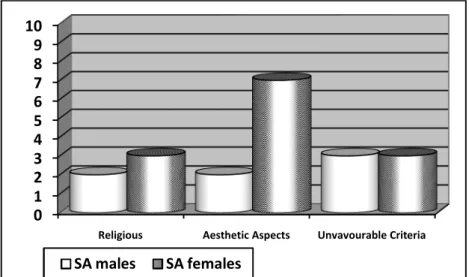
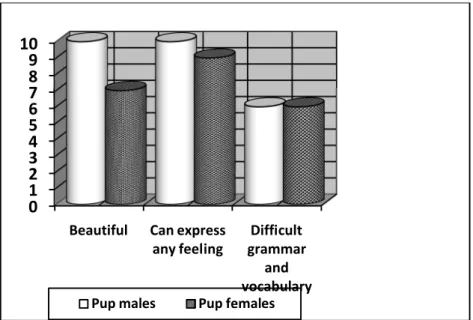
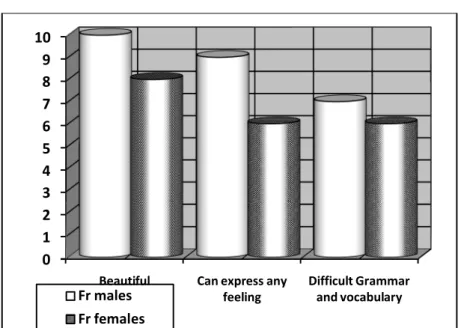
1.figure 3.1: Secondary School Pupils’ Attitudes towards Algerian Arabic by Gender……....62 2.Figure 3.2: University Arabic Students’ Attitudes towards AA by Gender………...62 3.Figure 3.3: Foreign Language Students’ Attitudes towards AA………62 4.Figure 3.4: Secondary School Pupils and Students’ Attitudes towards Speakers of AA……63 5.Figure 3.5: Foreign Language Students’ Attitudes towards Speakers of AA……….64 6.Figure 3.6: Secondary School Pupils’ Attitudes towards Linguistic Features of SA……...65 7.Figure 3.7: University Arabic Students’ Attitudes towards Linguistic Features of SA……...66 8.Figure 3.8:University Students of French Attitudes towards Linguistic Features of SA……66 9.Figure 3.9:University Students of English Attitudes towards Linguistic Features of SA……67 1. Figure 3.10: Secondary School Pupils’ Feelings about
SA………..68 2. Figure 3.11: SA Students’ Feelings about SA………..68 3. Figure 3.12: Foreign Language Students’ Feelings about
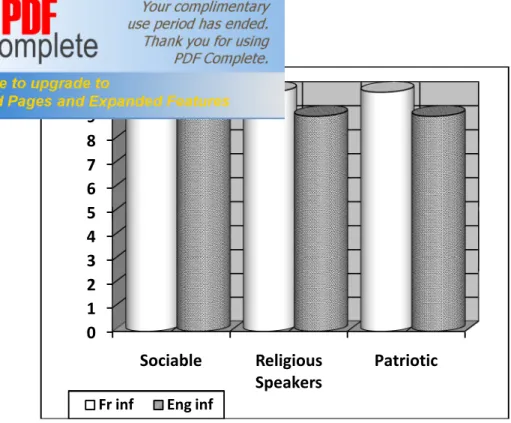
SA………..69 4. Figure 3.13: Secondary School Pupils’ Attitudes towards Functional Features of SA………70 5. Figure 3.14: SA students’ Attitudes towards Functional Features of SA……….70 6. Figure 3.15: Foreign Language Students’ Attitudes towards Functional Features of SA…….71 7. Figure 3.16 and Figure 3.17: Informants’ Attitudes towards Berber Speakers……….72 8. Figure 3.18 and figure 3.19: Informants’ Attitudes towards Linguistic Criteria of French...73-74 9. Figure 3.20: Informants’ Feelings towards French………75 10. Figure 3.21: Informants’ Attitudes towards Speakers of French………..76
ix
11. Figure 3.22 and Figure 3.23:Informants’ Attitudes towards Linguistic features of English….77 12. Figure 3.24:Informants’ Feelings towards English………78 13. Figure 3.25:Informants’ Feelings towards the Learning of English………..79 14. Figure 3.26 and Figure 3.27:Informants’ Attitudes towards English Speakers……….80 15. Figure 3.28.a: Use of AA in Situations by Gender………86 16. Figure 3.28.b: Use of SA/ AA in Situations by Gender……….86 17. Figure 3.29.a: Use of AA among students of Arabic by Gender………...88 18. Figure 3.29.b: Use of SA/ AA among Students of Arabic by Gender………...88 19. Figure 3.29.c: Use of SA among Students of Arabic by Gender………...89 20. Figure 3.30.a: Use of AA/Fr among Students of French by Gender ……….91 21. Figure 3.30.b: Use of AA among Students of French by Gender ……….91 22. Figure 3.31.a:Use of AA among Students of English by Gender………...93 23. Figure 3.31.b: Use of AA/Fr among Students of English by Gender
………93
Tables
24. Table 3.1: Informants’ Attitudes towards AA………...61 25. Table 3.2: Informants’ Attitudes towards Speakers of Algerian Arabic………...63
x
26. Table 3.3: Informants’ Attitudes towards Linguistic Features of SA………...65 27. Table 3.4: Informants’ Attitudes towards the use of SA………..67 28. Table 3.5: Informants’ Attitudes towards Functional Features of SA………..69 29. Table 3.6: Informants’ Attitudes towards Berber Speakers………..72 30. Table 3.7: Informants’ Attitudes towards Linguistic Criteria of French………..73 31. Table 3.8: Informants’ Feelings towards French………..75 32. Table 3.9: Informants’ Attitudes towards Speakers of French………...75 33. Table 3.10: Informants’ Attitudes towards Linguistic Features of English………...76 34. Table 3.11: Informants’ Feeling towards English………...78 35. Table 3.12: Informants’ Feeling towards the learning of
English………...79 36. Table 3.13 and 3.14: Informants’ Attitudes towards English Speakers………..79-80 37. Table 3.15: The Language Selection of Pupils………..85 38. Table 3.16: The Language Selection of Students of SA………..87 39. Table 3.17: The Language Selection of Students of French………...90 40. Table 3.18: The Language Selection of Students of English………...92
viii
Lists of Figures and Tables: page
Figures
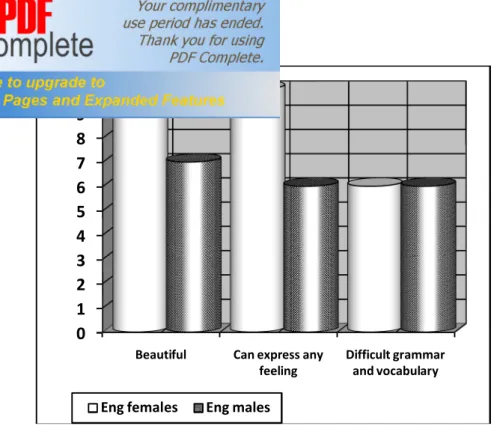
1. Figure 3.1: Secondary School Pupils’ Attitudes towards Algerian Arabic by Gender……....62
2. Figure 3.2: University Arabic Students’ Attitudes towards AA by Gender………...62
3. Figure 3.3: Foreign Language Students’ Attitudes towards AA………62
4. Figure 3.4: Secondary School Pupils and Students’ Attitudes towards Speakers of AA……63
5. Figure 3.5: Foreign Language Students’ Attitudes towards Speakers of AA……….64
6. Figure 3.6: Secondary School Pupils’ Attitudes towards Linguistic Features of SA……...65
7. Figure 3.7: University Arabic Students’ Attitudes towards Linguistic Features of SA……...66
8. Figure 3.8:University Students of French Attitudes towards Linguistic Features of SA……66
9. Figure 3.9:University Students of English Attitudes towards Linguistic Features of SA……67
10. Figure 3.10: Secondary School Pupils’ Feelings about SA………..68
11. Figure 3.11: SA Students’ Feelings about SA………..68
12. Figure 3.12: Foreign Language Students’ Feelings about SA………..69
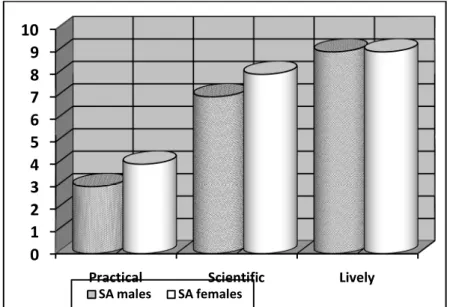
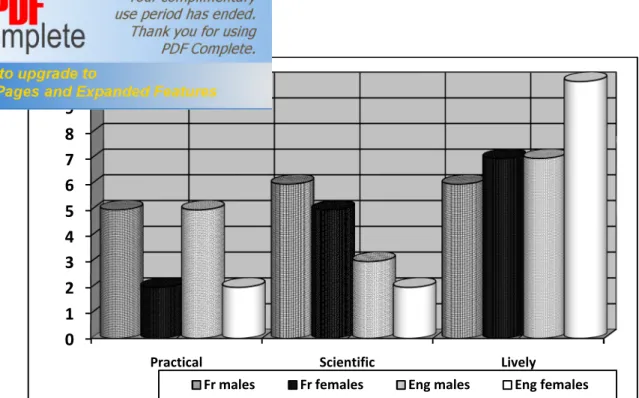
13. Figure 3.13: Secondary School Pupils’ Attitudes towards Functional Features of SA………70
14. Figure 3.14: SA students’ Attitudes towards Functional Features of SA……….70
15. Figure 3.15: Foreign Language Students’ Attitudes towards Functional Features of SA…….71
16. Figure 3.16 and Figure 3.17: Informants’ Attitudes towards Berber Speakers……….72
17. Figure 3.18 and figure 3.19: Informants’ Attitudes towards Linguistic Criteria of French...73-74 18. Figure 3.20: Informants’ Feelings towards French………75
19. Figure 3.21: Informants’ Attitudes towards Speakers of French………..76
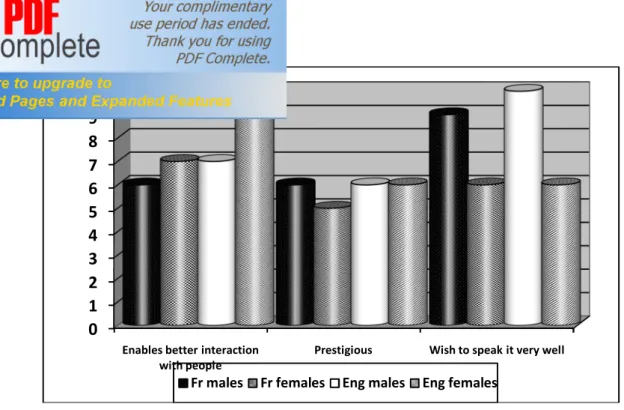
20. Figure 3.22 and Figure 3.23:Informants’ Attitudes towards Linguistic features of English….77 21. Figure 3.24:Informants’ Feelings towards English………78
22. Figure 3.25:Informants’ Feelings towards the Learning of English………..79
23. Figure 3.26 and Figure 3.27:Informants’ Attitudes towards English Speakers……….80
24. Figure 3.28.a: Use of AA in Situations by Gender………86
25. Figure 3.28.b: Use of SA/ AA in Situations by Gender……….86
26. Figure 3.29.a: Use of AA among students of Arabic by Gender………...88
27. Figure 3.29.b: Use of SA/ AA among Students of Arabic by Gender………...88
28. Figure 3.29.c: Use of SA among Students of Arabic by Gender………...89
29. Figure 3.30.a: Use of AA/Fr among Students of French by Gender ……….91
ix
31. Figure 3.31.a:Use of AA among Students of English by Gender………...93
32. Figure 3.31.b: Use of AA/Fr among Students of English by Gender ………93
Tables
33. Table 3.1: Informants’ Attitudes towards AA………...6134. Table 3.2: Informants’ Attitudes towards Speakers of Algerian Arabic………...63
35. Table 3.3: Informants’ Attitudes towards Linguistic Features of SA………...65
36. Table 3.4: Informants’ Attitudes towards the use of SA………..67
37. Table 3.5: Informants’ Attitudes towards Functional Features of SA………..69
38. Table 3.6: Informants’ Attitudes towards Berber Speakers………..72
39. Table 3.7: Informants’ Attitudes towards Linguistic Criteria of French………..73
40. Table 3.8: Informants’ Feelings towards French………..75
41. Table 3.9: Informants’ Attitudes towards Speakers of French………...75
42. Table 3.10: Informants’ Attitudes towards Linguistic Features of English………...76
43. Table 3.11: Informants’ Feeling towards English………...78
44. Table 3.12: Informants’ Feeling towards the learning of English………...79
45. Table 3.13 and 3.14: Informants’ Attitudes towards English Speakers………..79-80 46. Table 3.15: The Language Selection of Pupils………..85
47. Table 3.16: The Language Selection of Students of SA………..87
48. Table 3.17: The Language Selection of Students of French………...90
1 General Introduction
Some of the main points of interest of social psychology of language consist of investigating what people believe about the distribution of language varieties in their own speech community, what attitudes they have towards these varieties and how they have arrived at and implement those beliefs. The present dissertation is an analysis which investigates the different attitudes held towards languages by secondary school pupils and university students of French, English and Arabic in Sidi Bel-Abbes. Language planning in education as well as government decisions concerning languages are said to influence language attitudes. Language varieties are classified according to underlying cultural, educational and political bases. The successful spread of a given language at the official level or its use at the unofficial one are factors very much dependent on the positions that these varieties hold in a society. In fact, these positions are traced by a linguistic policy dictated, primarily, by political objectives. By the early 1980s, arabisation began to produce some measurable results. In the primary school, instruction is in standard Arabic while French is taught as a subject and arabisation has proceeded on grade by grade basis. Despite the demands of the Algerian government to arabise the educational system, French remains the main language of instruction for the scientific branches at the universities.
Specific features of the learner`s native language and the language being learned can have an effect. A level of proficiency is a realistic goal that can lead to the fact that language exposition can orient the informants `subjective judgements. Hence, the relation between language learning –either a school subject or a university speciality- and language attitudes can be questionable. It is a well-known fact that education, which is an important factor in influencing language attitudes, is related to school and university that are considered to be institutions for attaining knowledge. The assumption that can be formulated here is that there are significant attitudinal differences between learners from various
2
grade levels. Secondary school pupils and university students of different languages are not exposed to the same language skills. The time spent on learning may have an impact on learners' value judgements or viewpoints.
Language assessments have, possibly, a role in determining the learners' choice of a language, known as code-switching, in a speech situation. Bilinguals, who can speak at least two languages, have the ability to use elements of both languages when conversing with another bilingual. Code-switching is the syntactically and phonologically appropriate use of multiple varieties. A major approach in sociolinguistics focuses on the social motivations for switching, a line of inquiry concentrating both on immediate discourse factors such as lexical need and the topic and setting of the discussion, and on more distant factors such as speaker or group identity, and relationship-building associated with solidarity. Code-switching may also be reflective of the frequency with which an individual uses particular expressions from one or the other language in his/her daily communications. Language selection can also be related to and indicative of group membership in particular types of bilingual speech communities. Thus, the regularities of the alternating use of two or more languages within one conversation may vary to a considerable degree between groups.
One can assume that language learning as well as attitudes are related to socially based language selection. An individual is confronted to a source of interest, and then involved at the socio-cognitive parameter. Thus, the speaker starts manifesting a behaviour that is closely related to the linguistic attitudinal evaluation. This characterises the preference or rejection of a given linguistic variety in a given speech situation and given activities, such as TV watching, radio listening and newspaper reading. The use of a desired variety among members of the same group of learners participates in the reinforcement of the relationship. This research asks questions about the degree of attitudinal aspects in relation to language selection that speakers of the same group share. Any factor may account for choosing one language over another, but the combination of several factors such as language proficiency, setting and language attitudes can explain language choice.
3
This work includes three chapters. The first chapter covers a number of issues. The first deals specifically with the definition and the different theories of language attitudes. The second one includes the scope of the investigation, whereby the rationale and the suggested hypotheses as well as research questions are stated. This part examines oriented ideological dimensions which are in accordance with language attitudes that are considered to be true by the respondents. It also presents the informants' criteria. One questionable fact here is the relation that exists between these criteria and the informants’ value judgements that are manifested implicitly or explicitly revealing views and postures. The next part sheds light on the importance of shared opinions within members of the same speech group. It is alleged that the usage of given varieties throughout the educational career like subjects learned in Arabic, French or English can have an impact on the speakers’ assessments. Here the main point is to make reference to the contribution of standard and non-standard status of languages to the influence of learners' attitudes.
Furthermore, the case of Berber is taken into account. Berber Social movements emerged and political parties were created to represent and defend the Kabyle demands. The Berber variety, that has always been the mother tongue of an ethnic minority, was recognised as a national language in 2002. Yet, there are five distinct Berber varieties. The assumption that can be expressed here is that, informants can show rejection of a variety with which they are not acquainted.
More questions can be asked about the effects that assessments can have on judgements of speakers` honesty, likeability or unlikeability and other characteristics which are found in the questionnaires. For instance, one can ask questions as to what adjectives are related to the speakers of an unknown language.
There is another aspect of social stratification of attitudes related to male and female indices. It can be assumed that patterns of sex differentiating can be manifested and girls may be more sensitive to language attitudes than boys. The questionnaire aims are explained and exemplified, too. Questionnaires can be
4
considered as an effective means to elucidate data. Various questions urge informants to express an acceptance or a rejection more practically. This means provides statistical information that can be related to an applied side.
In the second chapter, a brief report is presented about the language situation of Berber, Algerian Arabic, Standard Arabic, French, English and other foreign languages in Algeria. The Algerian society is pluralist in its regions and its languages. The people of this country speak their various mother tongues, either Arabic or Berber. Before independence French was the only official language. In post-colonial period Arabisation strategy sought to restore the national dignity. The history of functioning linguistic media within a community provide clues which allow the comprehension of both the individual and the group`s assessments. This raises more questions about the impact of the nature of various language usages at the social, the educational and the academic levels. The language situation is largely the outcome of socio-economic development policies such as language planning in education and government decisions. This part gives an overall examination as to what type of participation bilingualism, arabisation and multilingualism situations have in the establishment of subjective evaluations.
The third chapter includes an analysis of language attitudes of a number of informants. It discusses the influence that a speaker's proficiency has on his/her language attitudes. This part explores more deeply the respondents’ personal interpretation of their language attitudes. The key insight is to search underlying beliefs, such as nationalism or high vs. low statuses. Gender indices are taken into account, whereby an analysis is presented about the factual bases that are behind male/female indices.
This part also provides an analysis of field work data about the informants' language selection in writing, reading, radio and TV. It is discussed that performing different activities and subjective reactions are closely related. Sociolinguistic criteria can also determine the choice of a particular variety in speech situations. For instance, situational factors such as topic setting and participants in relation to language attitudes are examined. Fieldwork data are
5
explored and provide information about the emergence of language use in a given set of speech situations. It is argued that language proficiency as well as attitudinal aspects can affect language selection. Hence, differences and similarities between the questioned groups are stated.
6
CHAPTER ONE:
1. Preliminaries to Language Attitudes and Language Selection Study: Theoretical Considerations
Introduction
The present research is carried out in Sidi Bel-Abbes, where the author is a native speaker. This work includes a number of issues. The main one deals with a comparative study of attitudes towards: Berber, Algerian Arabic, Standard Arabic, French and English. Spanish is not included in this survey as it is neither a spoken language in the Algerian society nor a learned subject in schools by all informants. The next important issue deals with the linguistic variety that an informant chooses in different situations such as TV watching, radio listening, reading, writing and given speech situations.
1.1 Language Attitudes
Language attitude analysis is dealt with in terms of value judgements or people's reactions towards mother tongues and educational media taught in institutions (schools and university). In order words, favourable and/or unfavourable opinions on languages are analysed.
1.1.1 The Notion of Attitude
According to Oxford English dictionary, attitude is defined as a “way of thinking or behaving” (1993:65).
The word attitude derives from the Latin root ‘aptus’, meaning suited or fit. As far as the sociolinguistic sphere is concerned, N. Dittmar (1976:181) defines language attitudes as follows: ‘’ Language attitudes ask questions on the assessment and evaluation of speakers of linguistic varieties. ‘’
7
Language attitudes can be considered as long term phenomena that pertain to social psychology. This raises an issue of how linguistic varieties are evaluated. Fasold (1984:158) explains the evaluation of a language variety as follows:
The evaluation of a variety is the fruit of experiences, products of a whole series of historical, social, economic, political and cultural implications that continuously interact with one another, turning the objective into subjective.
Social psychologists are interested in observing language study, not only as objective socially neutral instruments for conveying meaning, but as varieties linked up with the identities of social or ethnic groups that have consequences for the social evaluation of, and the attitudes towards languages.
1.1.2 The Evaluation of Language and Speakers
The way a person speaks is very much a clue to social information, and is in itself neutral, neither good nor bad. Language itself can be evaluated and associated with ‘toughness’ or ‘likeability’. For instance, Hudson (1998:209) argues that ``if A is some characteristic of speech and B is some characteristic of personality such as education, speech will be used as a clue to personality’’. Language attitudes can be related to issues such as prestige, power or stigmatisation. They are studied in various ways from different points of view by disciplines such as sociology, psychology and linguistics. Studies on language attitudes are inherently related to group identity.
Trudgill (1995:91) argues that “positive attitudes are related to prestige varieties” because speakers generally prefer such linguistic media even though they may not use them. Speakers of prestige varieties are usually considered more ‘educated’ than speakers of non-standard varieties. Non-prestigious speech, on the contrary, may be related to other human qualities, such as sympathy and
8
affection. Some studies (cited by Giles and Coupland 1991) reveal that people manifest their preference of the prestige varieties in order to increase their likeability. Fasold (1984:148) suggests that ``attitudes toward a language are often the reflection of attitudes towards members of various ethnic groups’’.
People’s reactions to language varieties reveal clues about the perception of the speakers of these varieties.
The stigmatisation of a variety shows how negative images are assigned to it. For instance, members of a speech community can create negative stereotypes of another language to reduce the status of its speakers in society (Labov, 1972:133). So one can suggest the following statement:
- The same attitudes are related to a given language and to its speakers.
1.1.3 Language Attitude Theories
Social psychology of language has shown criteria involved in the speakers' judgements of languages. As pointed out in Fishman and Agheyisi (1976:81-82)1, “Validation of attitude study is problematic because of the very nature of attitudes as properties of the psychological or mental process.”In fact, one problem in evaluating the role of language attitudes is the difficulty in measuring the attitudes themselves. In other words, to what extent does the scale of evaluation reveal useful information for the investigation? The development of a questionnaire on attitudes is not a simple task. Thus, the following question can be asked: Do informants express their honest feelings/opinions or simple attitudes they think are more acceptable when they are asked direct questions in interviews? Labov (1966) discovered that people do not necessarily speak the way they say they do. Hence, one can consider that the study of language attitudes remains probabilistic. Most people are not consciously aware of the combination between linguistic criteria and judgements, so it is preferable to elicit people's responses indirectly. This is why different techniques are used as explained in section 3.1.
1 In Dittmar (1976).
9
Language attitudes studies are based on both mentalist and behaviourist theories. This raises more issues of how to understand the relation of attitudes with language learning. So it is necessary to examine the views of social-psychologists and see how their approaches tackle characteristics of attitudes pertaining to social phenomena.
1.1.3.1 The Mentalist Theory (Allport, 1954)
For holders of such a view, attitudes are as Allport2 (1954:45) describes them “a mental neural state of readiness organised through experience exerting a directive or dynamic influence upon the individual response to all objects and situations with which it is related”. Attitudes cannot be observed directly, but must be inferred from the subject's introspection. This viewpoint includes the questions that attitudes can be derived from given data that are quantifiable in a given way. For instance, many studies have demonstrated that the quality and prestige of language varieties depend on the knowledge of the social connotations which they process. That is, “the use of dialects would be expressions of social preference, which reflects an awareness of the status ingrained in the speakers' minds.” (Fasold, 1984).
1.1.3.2 The Behaviourist Theory (Bain, 1928)
According to the behaviourist theory, attitudes are determined by observing actual behaviour in social situations. For instance, Bain2 (1928) asserts that “attitudes are regarded as a hypothetical construct that can be revealed by verbal responses to a given set of stimuli”. Attitudes, then, can be held to indicate other forms of behaviour that have a relation with preferences of a given language in everyday activities. For instance, an individual's favourable attitudes can be reflected in some activities or behaviour, such as a selected language in TV watching and radio listening as well as a selected variety in a given speech
2 In Dittmar, (1976).
10
situation. Similarly, Edwards (1982:191) suggests that attitudes towards a language are often the reflection of attitudes towards members of various ethnic groups. He claims that “people's reactions to language varieties reveal much of their perception of the speakers of these varieties”.
Le Page and Tabouret-Keller (1985) stress the importance of the nature of intergroup relations in the discussion of language attitudes and uses. For instance, language attitudes vary as the nature of intergroup relations changes. When relations change, status relationships and therefore perceptions, attitudes and uses, change too. It is hypothesized that a person who identifies himself with the mother tongue and the group that speaks it would hold favourable attitudes to this language and to the group.
1.1.3.3 Lambert's Position
A pioneer in the exploration of learner attitudes in relation to language learning, the Canadian psychologist Wallace Lambert (1964:181) identified two types of orientation: integrative and instrumental.
An instrumental orientation to learning stresses the utilitarian value of L2 proficiency, of which getting a pay raise or a better job or a good grade in school are examples. In contrast, an orientation is said to be integrative if it reflects an openness toward another culture group, an openness that may include a desire to be accepted as a member of that group.
The point is that the purpose for which a given language is learned can have an impact on the learner's judgements about languages. Hence, the present research aims at discovering language learning –instrumental orientation- influence on learners' language attitudes whereby the individual's opinions are taken into account. Besides, another issue can seek not only what people think about languages but what they do as well. This can be sought in activities people
11
perform such as the newspapers they read, the TV programmes they watch as well as the variety they use in speech situations for given topics.
According to Lambert (1964), attitudes have been considered in terms of the following components:
1- The cognitive component refers to one's beliefs about objects and situations.
2- The affective component refers to the amount of positive or negative feeling one has towards such a situation.
3- The conative component refers to one's behavioural intentions, or to one's actual behaviour towards the object.
The above criteria are concerned with the individual's behaviour, feeling, thought and manner of acting. A person classifies a language on the basis of these criteria which can be considered as an “evaluative scale”. The evaluation of languages lies in the conscience of individuals, forming part of their cognitive world; they are made up of a series of opinions shared by a social group. Thus, they are specific structured series of beliefs that are shared socially.
1.2 The Scope of the Investigation Introduction
This work focuses on speakers’ language judgement in connection with education, as it is probably one of the main vehicles by which learners' evaluations are spread in society. Schools can be considered to transmit and cultural values about language and might be more inclined than the general population to report attitudes. This study also investigates the correlation between linguistic proficiency and favourable or unfavourable attitudes towards given languages. On the one hand, we aim at discovering judgements of non-standard varieties known as dialects; on the other hand, we consider the level and purpose of the influence of language usage on language attitudes. Language usage is dealt with in terms of language learning. It is explained as follows:
12
a- School subject, e.g.: French and English in secondary schooling. b- Language learning in university, e.g.: the French language.
In any of these broad areas more information about the informants' language usage will be given subsequently.
Eighty informants are questioned; the Secondary school pupils are aged between seventeen and nineteen, and the students are aged between twenty two and twenty five. The respondents are split in groups and the group comprises ten informants. The informants' criteria dealt with are presented in the following sub-sections:
1.2.1 Language Proficiency for Educational Purposes
Learning a language is gaining knowledge in an institutionalised environment such as school or university. A learner attains more linguistic competence of a given language. One can suggest that the time spent on learning can influence learners' attitudes. When exposed to a given linguistic medium (either the medium of instruction or a subject, or language learning at the university), the individual is supposed to develop various skills like reading, writing, speaking and listening. This language proficiency can be accompanied by feelings and opinions. The following groups are selected:
a- Secondary school pupils: Third year pupils are selected because they are supposed to have attained more linguistic knowledge in Arabic, French and English than pupils in lower forms.
b- University students: Those informants study a language as a subject matter at the university. Four year students are selected because they are supposed to have attained a given mastery of the learned language, and are considered to be psychologically involved in this task. The following groups are chosen:
- Students of Arabic and its literature. - Students of French.
13
1.2.2 Secondary School Pupils
Standard Arabic is the medium of formal institution. Standard French is taught as a subject and a first foreign language. English is commonly taught as a second foreign language and a subject too3. One can state a set of differences when comparing the English syllabus with the French one:
The French input is more detailed than the English one. In other words, activities related to lexis, morphology, syntax such as parts of speech, affixation and tenses, as well as discourse are presented in French. Moreover, pupils in the second and third year are required to present “exposés” written in French. An English syllabus, however, is meant to put less emphasis on detailed activities related to morphology, syntax and discourse. This is a situation where the two foreign languages are taught for particular pedagogical purposes, whereas, the medium of education which is Arabic is commonly used in schools, on the Algerian TV channel and in administration of schools. In this way, one can hypothesize that this very situation can influence the pupils' attitudes; that is to say, the study of these languages would give us some indication of the extent to which these linguistic situations –that is the learning of French, English and Arabic- is sensitive to or affects the same group. Therefore, it is hypothesized that, there is a relationship between the level of language proficiency and language attitudes. For instance, the fact that secondary school pupils learn English and French as subjects and have Arabic as the medium of instruction may reveal differences of language attitudes in comparison with university students. Hence, the following questions can be asked:
Does a pupil learning a language as a subject share the same attitudes towards languages with a university student? If not, to what degree are they different?
3 More information about secondary school subjects is given in section 2.2.4
14
1.2.3 University Students
This group of informants is composed of university students registered for the ‘licence’ degree (equivalent of BA) in the chosen language.
In this type of studies, more time is spent in learning different modules in the same language: written and oral expression, linguistics, phonetics, literature and civilization. Theoretically, at this level, the learner of a given language is exposed to a larger range of lexical items and grammatical structures, as well as to a more complex phonological system. As a result, he gradually gets more and more familiar with the target language.
In view of what has just been mentioned, one can suggest that when a certain amount of linguistic data is transmitted and developed in the students' mind, his/her language attitudes can be influenced to a certain extent. Members of the same group can share these attitudes. This work investigates whether there is an influence of university language learning on students' language opinions. One can assume the following hypotheses:
- Learners become more sensitive to aesthetic aspects of a language when exposed to its poetry and literature.
- Attaining more proficiency in a given language means associating easiness with this linguistic tool.
1.2.4 Language Selection
This work also investigates language selection known as code switching among every group included in this research. This field deals with the choice of a particular linguistic variety according to situational factors. When speaking, the informants use “X” or “Y” variety according to the situations they find themselves in and the people they talk to. Fishman (1972) views language choice in terms of a well-known question “who speaks what language to whom and when?” Hymes (1971:91) sees “language use as the speaker's ability to choose
15
the appropriate variety for any particular purpose as part of his communicative competence”.
1.2.4.1 Speech Repertoire
An individual is likely to have communicative competence in more than one speech variety. Speech varieties do not refer to standard linguistic forms only, but they also mean dialects. A speech variety can be an official language or a regional dialect. The neutral term speech variety is a useful one in sociolinguistic studies because it does not have ‘connotations’ that are associated with political or social classifications. The term ‘repertoire’ is considered in relation to the speech community in question (Fishman, 1972). A speech repertoire has been defined by Platt (1975:35) as follows:
A speech repertoire is the range of linguistic varieties which the speaker has at his disposal and which he may appropriately use as a member of his speech community.
Members of a community have access to a more or less consistent speech repertoire and the use of each linguistic variety is linked to social roles such as the ‘elite’ or ‘friendship’. A speaker whose speech varieties are A, B or C will attempt to keep them separate in every way, in order to compartmentalize his role, e.g.: a friend, a learner and the head of the family.
1.2.4.2 Participants
In some speech events, roles are fixed by the social status that the participants hold in society. Various researchers (Gal, 1979) found out that language choice can be determined by different characteristics. For instance, participants are seen to be an essential element in a speech situation. A given linguistic variety is used as long as the hearer or addressee can understand it.
16
Formality and informality also play a role in determining the choice of a language (Weinreich, 1953). In other words, formality is referred to as the style used when talking carefully on some occasions. Informality is described in terms of the style used in ordinary conversations characterized by spontaneity and casualness. The topic is an important clue in language choice in a bilingual community. Besides, a speaker's proficiency in a given linguistic variety enables him to use it in a situation where the common rule is to use this particular variety and not another.
1.2.4.3 Setting
When tackling the concept of speech variety, the term setting is important as it signifies the class of situations within which a given speech variety is used. The environment or setting which is the place where speech takes place, such as the street or the house, is important (Gumperz, 1966). In fact, some settings can be referred to in terms of formality and informality. For instance, a classroom is a setting where a formal discussion can take place, though this can allow exceptions, such as speech events that cannot be predictable. That is to say a non-standard variety can be used in a formal setting. The speaker may or may not take into consideration the formality of the setting (Weinreich, 1953). Often the speaker's selection of a variety in a speech situation is of great importance.
This selection is based partially on the speaker's belief or attitudes, and the evaluations of his/her own role in society as well as the role of his/her addressee. Therefore, the present work aims at discovering the influence of the informants' language attitudes, as well as language proficiency on the preference of such or such language variety in a particular situation. For instance, one may ask this question: Do students of English use English when speaking with an English teacher outside the classroom circle? It is suggested that the more a person is proficient in a given anguage, the more words of this language are used in speech events or situations.
17
In addition, language attitudes can influence a speaker's activities. In other words, one can ask this question:
- Do language attitudes influence a speaker's language selection in watching TV programmes, reading magazines and newspapers and to the listening radio?
1.2.5 Gender
Male and female indices are included in most sociolinguistic studies since the sex variable is an important social attribute in social interaction. This may be due to the fact that men and women are biologically different and are therefore attributed different social roles. Hence, one can suggest that sex roles affect speakers' attitudes towards languages. For instance, a remarkable pattern has emerged in languages that have a distinction between non-standard and standard forms (Labov, 1966). In fact, females use high prestige standard forms more often than males do. Thus, ‘the sex prestige pattern’ has been found in many studies such as that of Labov (1990) which discusses examples from English, Canadian, French, Spanish and other studies. This pattern is explained by Hudson (1998:193) as follows:
The sex prestige pattern: In any society where males and females have equal access to the standard forms, females use standard variants of any stable variable which is socially stratified for both sexes more often than males do.
Females are attracted by ‘sophisticated’ speech. Generally speaking, sociological studies have demonstrated that women are more status-conscious than men. For this reason, they are, presumably, more sensitive to the social significance of linguistic media (Trudgill, 1974). Gender and prestige can be related in studies of the speech patterns. In British English Peter Trudgill observed that more working class women adopted the standard dialect than men. Other areas in which this has been observed include New Zealand and Guangdong in China. Trudgill suggests
18
that for men, there is covert prestige associated with speaking the working class dialect. In fact, he observed that men speak a `less’ prestigious dialect than that which they actually spoke. According to this interpretation then, Trudgill (1978:122) noticed that "women's use of prestige features simply conforms to the ordinary sociolinguistic order, while men deviate from what is expected." Whatever the cause, women across cultures seem more likely than men to modify their speech towards the prestige dialect. Though women use prestige dialects more frequently than do men, the same gender preference for prestige languages does not seem to exist. The present work asks the question as to whether the sex parameter indicates differences in language attitudes and language selection.
1.3 The Importance of Standardization
Historical and national factors play an important part in the attitudes held by members of a society with regard to different language varieties. The decisions of a government concerning languages can be described as instances of language planning. For instance a language might be is recognized by a government as an official language constitutionally, whereby language attitudes can be influenced. Linguistically speaking, both standard and non-standard languages are comprehensible, rule-governed and used according to social rules. In this context, Trudgill (1995:129) writes:
People have attitudes towards languages: In fact these attitudes are held on many bases: cultural, social, political, regional, racial and so on. We all have attitudes towards X or Y language. To criticize the structure “I seen” and “I done it” as poor structure has no linguistic foundation.
Individuals set up a dichotomy between linguistic media on the basis of written or spoken standard status and non-standard spoken one. That is, language status either standard or non-standard can influence people's attitudes.
19
1.3.1 Non-Standard Varieties
In the Arabic-speaking countries the mother tongue is considered to be a non standard variety. In other words, it is acquired in a non-official environment. A child acquires his mother tongue as well as its social structure, which will become the sub-stratum of his innermost experience. A mother tongue is not only a mechanical task but also learned responses which become co-ordinated by social rules. Thus, speech is viewed as the major means through which the social structure is part of individual experience. This linguistic medium is known as a dialect, too. ``The speakers' rating of their mother tongues depends upon sociocultural and political factors’’ (Weinreich, 1953:104). For instance, dialects are used for conversing with friends or colleagues and at home.
Ferguson (1959) discusses the situation where two varieties of the same language function in a speech community. This situation is known as diglossia. That is, a situation where a non-standard spoken variety known as dialect , considered to be ‘low’ and a standard one regarded as 'high' are used. Ferguson argues that the ‘low variety’ has fewer grammatical, morphological categories and a reduced system of inflection4. Stewarts (1968) sees that dialects are vital, that is used in wider communication which means that their speakers master them, and they are not considered as autonomous5 as well as educational.
1.3.2 Standard Varieties
Standard languages are the kind of varieties considered to be ‘proper’ languages or ‘prestigious’, official and correct. A dialect that is considered as a non-standard medium can gain a standard status thanks to a political decision. For instance, Berber6 in Algeria used to be regarded as a dialect and non-standard
4 This is the case with Arab dialects as opposite to Standard Arabic.
5 This idea is concerned with dependence related to borrowing that can be considered as value-judgments
that people associate with linguistic varieties.
20
variety, since 2001 it has been adopted as a national language; that is a variety of a political, social and cultural entity. Yet, Berber has no standard form.
Standard languages pass through the following processes (Haugen 1966, Garvin 1959).
(1) Selection: The standard variety is selected as one to be used in political and/or educational fields. The choice is of great social and political importance. So the people who speak it share the prestige. However, this standard variety is in some cases the native language of no-one, a good example is that of Standard Arabic in the Arab states.
(2) Codification: Written dictionaries and grammar books are edited “to fix” the variety, so that everyone agrees on what is correct. Codification is established in order to enable learners to attain correct forms.
(3) Elaboration of function: The selected variety is used in all functions associated with government and writing, like parliament, law courts, bureaucratic, educational and scientific documents. This may require the addition of new linguistic items such as technical words in order to serve different domains like medicine, chemistry, etc.
(4) Acceptance: The selected variety is supposed to be accepted by the relevant population as the variety of the community. In fact, it is often regarded as the national language. The standard language is considered to serve as a strong unifying force for the state. It is also a symbol of its independence from other states and a marker of its difference from others. For instance, Algeria and all other Arab states recognize Standard Arabic as a national language shared with all other Arab states. In some cases, this variety is the mother tongue of no one. In fact, one language is used at home and another is used when presenting official speech or religious sermon. For instance, this is the case with Arab dialects as opposite to standard Arabic. Stewart (1968) considers standard languages as autonomous but artificial at the level of everyday use. The proposal of the criteria stated above concerned with standardization has been quite widely accepted by sociolinguists (Fasold 1984, Milroy 1985, Haugen 1994).
21
Ferguson considers that standard languages are high varieties and have a greater grammatical and morphological complexity. For instance, these varieties are used for writing formal speech or as a medium of instruction. A national language is considered to be a symbol of language loyalty. It is regulated and given a socio-political, national and official value. Edwards (1982:201) states that ‘’the use of a standard language would be expression of social preference,
which reflect an awareness of the status and prestige”.
The political dominance can determine the favourability of a variety functioning in a speech community. This fact can open the way for a classification of attitudes towards the national language as well as foreign languages. Indeed, it is proposed that learners prefer attaining a foreign language in relation with the Algerian environment; since it is assumed that the linguistic criterion is not sufficient to enable a learner to be a member of the community in question. A learner wishes to learn a foreign language and the culture of its speaker, but does not necessarily identify himself/herself with the target community. For instance, an Algerian citizen who masters the French language is not necessarily considered as a member of the French community.
Learned foreign languages are varieties recognised as standard. The knowledge of foreign languages opens up a set of experiences that cannot be attained otherwise. A learner who gains knowledge during four years of university studies in English has a better chance of understanding an English newspaper or some criteria of the English culture such as traditions. A learner feels the need to develop a foreign language; his opinions on the target language can be influenced as well. One of the most comprehensive reviews of the relationship between language learning and attitude change is that in Morgan (1993). She argues:
Attitude change does not operate in isolation. In order for change to take place some basic re-structuring on a cognitive level with probable shifts in affectivity must occur.
22
That is, foreign language learning in university alone does not seem to affect attitudes. Others factors, such as the positions that a given foreign language has in the world, can play an important role in the influence of language judgements. English, for instance, which is a world language, that is a medium used over wide commercial and technological areas in the world, is not necessarily judged in the same way as French, which is not an international language but is used in everyday speech in Algeria.
1.3.3 Attitudes and Language Selection in the Speech Community
Each speech community has its own sociolinguistic values related to opinions or attitudes that its members have on the existing language varieties. These opinions are related to a set of “markers” or “indices” that can inform the observer about the historical background of a country, sex, group membership as well as the linguistic proficiency. Labov (1972:120-1) emphasizes on shared attitudes and knowledge in a speech community:
The speech community is not defined by any marked agreement in the use of language elements so much as by participation in a set of shared norms; these norms may be observed in overt types of evaluative behaviour, and by the uniformity of abstract patterns of variation, which are invariant in respect to particular levels of usage.
Members of a given group known as a community have something in common. They share the use of a language or a dialect and interact by means of speech, a given set of rules for using them as well as a range of attitudes towards the varieties. It is suggested that there are similarities between informants which may be referred to as ‘conformity’. Hudson (1998:12) states that “the amount of conformity can be predominating in some communities”. Furthermore, Le page and Tabouret Keller (1985:175) discuss “the notion ‘focussing’ which is found where there is a high degree of contact among speakers and agreement on
23
linguistic norms”. This can be a typical situation where there are highly standardized written languages such as English or French in the Algerian society. For instance, the shift towards French can be indeed confirmed, even though differences exist among speakers as no two speakers have the same language experience. Individuals draw a more or less unconscious mental map of the community in which they live. In fact, the map covers linguistic codes related to viewpoints. The task of the sociolinguist is to discover how given linguistic criteria of a language relate with social meaning.
1.4 Conclusion
The study of language attitudes in relation to language learning, as a subject, a medium of instruction or a university subject matter, gives some indication of the extent to which linguistic situations are sensitive to or affect opinions of members within the same group. It is also important to explore the impact that language attitudes have on language selection in different domains such as writing, reading and TV watching. Some languages are seen as practical, others as scientific but related to a colonial background. Language policy in education can be effective in fostering favourable attitudes towards languages. Thus, it is a matter of the historian to discover how different varieties have functioned through history in a community in order to understand people's attitudes. The next chapter provides more information about language functions in Algeria. The actual process of language attitudes is an issue we have still to learn much about.
The next chapter tackles different issues like the Arab conquest and independence from France. Various movements appeared to have left their mark on language policy that gained social prominence and acceptance through time. The historically oriented interpretation may be an effective way to explain social activity where the loss of attitudinal criteria is inevitable.
24
CHAPTER TWO: The Language Situation in Algeria
2.1 The Language Situation from 1830 to 1962 in Algeria Introduction
It is a well-known fact that, starting from the seventh century, the Arabs invaded Algeria; consequently, Islam and Arabic culture as well as language were introduced. The introduction of Islam and Arabic had a profound impact on North Africa as the new religion and language affected social and economic relations as well as political discourse and organizations. Kings tried to create a national or at least a provincial patriotism but they failed, as a result, Algeria was isolated and torn by the French raids in 1830.
From 1830 to 1962, Algeria came to be considered as a province rather than a colony by the French settlers who imposed their language in every sphere in Algeria. The French controlled education, government, business, and most intellectual life. They were in firm possession of the territory7 by the year 1870 (Encyclopédie Géographique, 1993). As a result, the effects of this policy are still found at the social level today. To use some French expressions in everyday speech events is socially accepted.
A large number of Algerians have acquired Algerian Arabic as a mother tongue. Other ethnic minorities have had distinguishable forms of Berber as a mother tongue (Galand, 1979). After independence, the Algerian government chose Standard Arabic as an official and national language (journal official, 1963). In other words, a language used in legislative, executive and judicial domains all over the nation.
A great number of Algerians can be considered as bilinguals, though to various extent as to the use of French and standard Arabic. Many Berbers are trilingual, yet some of them speak only their mother tongue.
7 French colonists did not settle in some areas in the desert, because of the hot weather and the non-fertile
sandy lands. They did not also inhabit some mountainous areas such as Djurdjura mountain chain. (M. L. Ouel Khelifa, 1991)
25
2.1.1 Bilingualism and Multilingualism
A great number of people are multilingual or bilingual and use two languages or more in their everyday life. The languages they use have different statuses as majority/minority varieties both in their community and internationally and some of the languages are used primarily in the private domain while others are used in public domains, such as work or school. The use of minority languages and interest in their maintenance and revival is also creating situations in which more than two languages co-exist and are necessary in everyday communication, the languages of the community and a language of wider communication (Edwards, 1994). Group bi/multilingualism is also promoted by multilingual education. Learning second and additional languages in school has traditionally been associated with the social elite and the hallmark of a well-educated person’s background, the increasing recognition and use of world languages as well as minority languages is making bi/multilingualism a preferred educational aim for many individuals in many communities around the world. Community multilingualism can be the result of historical, political or economic movements such as colonialism or immigration. There can be a growing need for group multilingualism as a result of increasing communications among different parts of the world and the need to be competent in languages of wider communication.
At independence in 1962 many Algerian people were extensively French-speaking and French-educated. Today it is commonplace to say that the use of French is regularly confirmed in the Algerian society. Moreover, a great number of Algerians have relatives (7 million)8 in France as a result of increasing flows of emigrants; mainly during the 60s and 70s.
Now, Algeria is developing a language considered to be a symbol of its independence. Standard Arabic was adopted as the national and official language, that is, a medium functioning as a legally appropriate language for all
8 This was declared by Djamel Oueld Abbes, the minister of national solidarity, family and the Algerian
26
politically and culturally representative purposes on a nationwide basis. The recognition of Arabic was a natural choice to mark the break with France and forge an identity suited to the country's status as an Arab state. Since the declaration of independence, more and more decisions have been taken to arabise many spheres in Algeria. Education, for example, is now totally arabised except for some scientific and technical branches in higher education. Legislation enforcing Arabic has been an ongoing process throughout Algeria's post-independence history. It is estimated that about thirty arabisation laws, decrees and injunctions have been passed since independence in July 1962. During the 1990s two laws were passed: no.91-05, on 27 December 1990, which advocated the arabisation of all administrative offices and schools by July 1992, and higher education establishments by 5 July 2000, and another voted on 17 December 1996 by the CNT (Conseil National de Transition), that called for a nationwide arabisation to take effect from 5 July 1998. (Journal officiel, 2001).
Obviously, one can hypothesize that Standard Arabic, as the official language in addition to the prestige it gets from its status as the language of the Koran, is gaining more favour among learners. However, Standard Arabic alone does not allow the country to function as a modern nation in the fields of science and technology. This is so, not because this language is not an adequate medium in those fields, as this is not acceptable scientifically. It is the case because a large number of educated Algerians who were educated in French have not reached a position of perfect mastery of Standard Arabic. In addition, most of the printed materials like books, especially in scientific fields e.g.: medicine and engineering are either in English or French. As a result, nowadays, despite the programmes to arabise school, French continues to be the dominant language in business e.g.: banks and some professional circles like the university. Our students and pupils learn the foreign languages in which most of the world's knowledge is available. For instance, a language that can give access to science and knowledge is, presumably, considered prestigious.
27
Berber people consider that they have nothing in common with Arabic dialects. Large sections of this population whose identities are partly assigned to local Berber varieties feel excluded from the new project of nation-building. The Kabyle cultural movement was more than a reaction against arabisation. Essentially, it challenged the language policy that the national government pursued since1962. It sought a wider scope for the development of the Berber variety free of bureaucratic controls (Galand, 1979). In 2002, Berber was recognized as a national language. This variety is taught in schools in Kabylia, this can have an effect on recognizing the Berbers' social and cultural identity. One can ask the following question: Does the recognition of Berber as a national language enhance non-Berber speakers to consider this variety favourably? In other words, do informants wish to associate Berber with 'high' status now?
2.1.1.1 Diglossia
The various codes in a multilingual speech community usually fulfil complementary functions. They are used differentially according to the interlocutor, domain, topic, role and the choice of one rather than the other. Diglossia is at hand if different varieties or languages co-occur throughout a speech community, each with a distinct range of social functions as it is the case with Spoken Arabic and Standard Arabic in the Arabic-speaking countries. Ferguson first introduced the term diglossia in sociolinguistics in 1959 to refer to a relationship between varieties of the same language. One variant is reserved for informal uses within a speech community; the low variety is associated with less social prestige. It is the language of informal interactions such as family life. Gumpers (1971:74) defines the two varieties as follows:
The low variety is typically acquired at home as a mother tongue, the high variety, on the other hand, is learned later, normally at school, never at home. It is a language of institutions outside the home.