HAL Id: hal-00302892
https://hal.archives-ouvertes.fr/hal-00302892
Submitted on 22 Jun 2007HAL is a multi-disciplinary open access
archive for the deposit and dissemination of sci-entific research documents, whether they are pub-lished or not. The documents may come from teaching and research institutions in France or abroad, or from public or private research centers.
L’archive ouverte pluridisciplinaire HAL, est destinée au dépôt et à la diffusion de documents scientifiques de niveau recherche, publiés ou non, émanant des établissements d’enseignement et de recherche français ou étrangers, des laboratoires publics ou privés.
A new atmospheric aerosol phase equilibrium model
(UHAERO): organic systems
N. R. Amundson, A. Caboussat, J. W. He, A. V. Martynenko, C. Landry, C.
Tong, J. H. Seinfeld
To cite this version:
N. R. Amundson, A. Caboussat, J. W. He, A. V. Martynenko, C. Landry, et al.. A new atmospheric aerosol phase equilibrium model (UHAERO): organic systems. Atmospheric Chemistry and Physics Discussions, European Geosciences Union, 2007, 7 (3), pp.8709-8754. �hal-00302892�
ACPD
7, 8709–8754, 2007 UHAERO: organic systems N. R. Amundson et al. Title Page Abstract Introduction Conclusions References Tables Figures ◭ ◮ ◭ ◮ Back CloseFull Screen / Esc
Printer-friendly Version Interactive Discussion
EGU
Atmos. Chem. Phys. Discuss., 7, 8709–8754, 2007 www.atmos-chem-phys-discuss.net/7/8709/2007/ © Author(s) 2007. This work is licensed
under a Creative Commons License.
Atmospheric Chemistry and Physics Discussions
A new atmospheric aerosol phase
equilibrium model (UHAERO): organic
systems
N. R. Amundson1, A. Caboussat1, J. W. He1, A. V. Martynenko1, C. Landry2, C. Tong3, and J. H. Seinfeld3
1
Department of Mathematics, University of Houston, Houston, USA 2
Chaire d’Analyse et Simulation Num ´eriques, Ecole Polytechnique F ´ed ´erale de Lausanne, Lausanne, Switzerland
3
Departments of Chemical Engineering and Environmental Science and Engineering, California Institute of Technology, Pasadena, USA
Received: 23 May 2007 – Accepted: 11 June 2007 – Published: 22 June 2007 Correspondence to: J. H. Seinfeld ([email protected])
ACPD
7, 8709–8754, 2007 UHAERO: organic systems N. R. Amundson et al. Title Page Abstract Introduction Conclusions References Tables Figures ◭ ◮ ◭ ◮ Back CloseFull Screen / Esc
Printer-friendly Version Interactive Discussion
EGU Abstract
In atmospheric aerosols, water and volatile inorganic and organic species are dis-tributed between the gas and aerosol phases in accordance with thermodynamic equi-librium. Within an atmospheric particle, liquid and solid phases can exist at equiequi-librium. Models exist for computation of phase equilibria for inorganic/water mixtures typical of
5
atmospheric aerosols; when organic species are present, the phase equilibrium prob-lem is complicated by organic/water interactions as well as the potentially large number of organic species. We present here an extension of the UHAERO inorganic thermo-dynamic model (Amundson et al., 2006c) to organic/water systems. Phase diagrams for a number of model organic/water systems characteristic of both primary and
sec-10
ondary organic aerosols are computed. Also calculated are inorganic/organic/water phase diagrams that show the effect of organics on inorganic deliquescence behav-ior. The effect of the choice of activity coefficient model for organics on the computed phase equilibria is explored.
1 Introduction 15
Atmospheric particles are generally a mixture of inorganic and organic components and water. Water and other volatile species are distributed between the gas and aerosol phases in accordance with thermodynamic equilibrium, and the quantities of these species in the aerosol phase at given conditions of temperature and relative humidity are determined by the conditions of that equilibrium. A great deal of work
20
has been carried out on the development of thermodynamic models of atmospheric aerosols, as such models are an essential component of more comprehensive atmo-spheric chemical transport models that treat aerosols. A recent summary of a num-ber of existing thermodynamic models for inorganic aerosols is given by Amundson et al. (2006c). Thermodynamic models of aerosols containing organic material have
25
Pan-ACPD
7, 8709–8754, 2007 UHAERO: organic systems N. R. Amundson et al. Title Page Abstract Introduction Conclusions References Tables Figures ◭ ◮ ◭ ◮ Back CloseFull Screen / Esc
Printer-friendly Version Interactive Discussion
EGU
dis, 2000, Clegg et al., 2001, 2003; Pankow et al., 2001; Seinfeld et al., 2001; Ming and Russell, 2002; Topping et al., 2005; Clegg and Seinfeld, 2006a, b; Metzger et al., 2006; Amundson et al., 2007). Aerosol thermodynamic models that are imbedded within atmospheric chemical transport models predict, at any time, the gas-particle distribution of volatile species. In the case of inorganic particles, the equilibrium
calcu-5
lation determines whether the aerosol phase is liquid, solid, or a mixture of solid and aqueous phases. When organics are present as well, current models that include both inorganics and organics assume a priori either that particles consist of a single-phase inorganic-organic-water mixture or that each particle consists of an aqueous phase that contains largely inorganics and water and an organic phase (e.g. Griffin et al., 2002,
10
2003, 2005). Whereas predicting the phase state of the mixture is a cornerstone of in-organic aerosol models, in-organic aerosol models do not yet generally have this capabil-ity. Predicting the phase state of atmospheric organic-containing particles is important for a variety of reasons. For example, the presence of organic species in solution may substantially influence the phase transitions that occur when salts deliquesce and
ef-15
floresce; likewise, dissolved electrolytes can have appreciable effects on the solubility of organic components in solution. A new inorganic atmospheric aerosol phase equi-librium model, termed UHAERO, was introduced by Amundson et al. (2006c). In the present work UHAERO is extended for determining the phase equilibrium of organic-water systems. The next section is devoted to a brief summary of the mathematical
20
approach to solving the equilibrium problem, the details of which are given elsewhere (Amundson et al., 2005b, 2006b). Section 3 discusses general characteristics of or-ganic phase equilibria, and presents a number of examples of oror-ganic phase equilibria calculated with the model. In Sect. 4 we calculate the effect of organic phase equilib-ria on inorganic deliquescence behavior. Finally, in Sect. 5 we evaluate the sensitivity
25
of the predicted phase diagram in one system (1-hexacosanol/pinic acid/water) to the activity coefficient model used.
ACPD
7, 8709–8754, 2007 UHAERO: organic systems N. R. Amundson et al. Title Page Abstract Introduction Conclusions References Tables Figures ◭ ◮ ◭ ◮ Back CloseFull Screen / Esc
Printer-friendly Version Interactive Discussion
EGU
2 Modeling approach
The liquid phase equilibrium problem (PEP) for a system ofnssubstances inπ phases at a specified temperatureT and pressure P and for a given total substance abundance in units of moles is the solution of the constrained minimization problem:
minG(y1, . . . , yπ; x1, . . . , xπ)= π X α=1 yαg(xα) (1) 5 subject to xα>0, yα≥ 0, α=1, 2, . . . , π, π X α=1 yαxα=b, (2)
whereyα is the total number of moles in phase α, xα is the mole fraction vector (of dimensionns) for phaseα, g(xα) is the molar Gibbs free energy for phaseα, and b is
10
thens-dimensional vector of the total substance abundances. Condition (2) expresses the fact that in calculating the partition of speciesj , for j =1, . . . , ns, amongπ phases, the total quantity of speciesj is conserved and equals the feed bj. Relation (1) char-acterizes the phase equilibrium as the global minimum of the total Gibbs free energy, G, of the system.
15
The molar Gibbs free energy (GFE)g is the relevant thermodynamic function for the PEP, and is usually defined for the mole fraction vector x byg(x)=xTµ(x), with xTµ(x) denoting the scalar product of the two vectors x and µ(x). The chemical potential vector µ(x) is given by
µ(x)=µ0+RT ln a(x),
20
whereR is the universal gas constant, µ0is the standard chemical potential vector of liquid species, and a(x) is the activity vector at the mole fraction vector x. On a mole
ACPD
7, 8709–8754, 2007 UHAERO: organic systems N. R. Amundson et al. Title Page Abstract Introduction Conclusions References Tables Figures ◭ ◮ ◭ ◮ Back CloseFull Screen / Esc
Printer-friendly Version Interactive Discussion
EGU
fraction scale, the activity of component j, for j=1, . . . , ns, is expressed as aj=fjxj, wherefj is the mole fraction-based activity coefficient, and xj is the mole fraction of speciesj . The PEP as stated in (1) can be reformulated in a normalized form:
minGn(y1, . . . , yπ; x1, . . . , xπ)=
π X α=1
yαgn(xα) (3)
subject to condition (2). In (3), the normalized molar GFE gn is defined for the
5
mole fraction vector x by gn(x)=xTln a(x) and is related to the molar GFE g by gn(x)=(g(x)−xTµ0)/RT . We also have the relation Gn=(G−bTµ0)/RT for the nor-malized total GFE of the system. The fact that the normalization relatesG to Gn, via first a shift by the constant bTµ0then a scaling by the constantRT , implies that the two formulations (1) and (3) of the PEP are equivalent; that is, if{yα, xα}α=1,πis the solution
10
of (1) for the feed vector b, it is also the solution of (3) for the same feed vector b, and the converse is also true. In the formulation of the PEP, we assume that all the phases in the system belong to the same phase class so that the molar GFE,g or gn, is the same for all phases; we assume also that all substances can partition into all phases and that no reactions occur between the different substances. We are interested in
15
determining the state of the system at the thermodynamic equilibrium, i.e. the number of phasesπ and their compositions {yα, xα}α=1,π.
The detailed description of the numerical solution of the PEP by a primal-dual interior-point algorithm is given by Amundson et al. (2005b, 2006b). Essentially, the numerical minimization technique relies on a geometrical concept of phase simplex
20
of the convex hull of the normalized GFE gn to characterize an equilibrium solution that corresponds to a global minimum of the total GFEGn. The algorithm is started from an initial solution involving all possible phases in the system, and applies, at each iteration step, a Newton method to the Karush-Kuhn-Tucker optimality system of (3), perturbed by a log-barrier penalty term, to find the next primal-dual approximation of
25
the solution of (3). A second-order phase stability criterion is incorporated to ensure that the algorithm converges (quadratically) to a stable equilibrium rather than to any
ACPD
7, 8709–8754, 2007 UHAERO: organic systems N. R. Amundson et al. Title Page Abstract Introduction Conclusions References Tables Figures ◭ ◮ ◭ ◮ Back CloseFull Screen / Esc
Printer-friendly Version Interactive Discussion
EGU
other first-order optimality point such as a maximum, a saddle point, or an unstable local minimum.
The key parameters in the phase equilibrium calculation are the mole fraction-based activity coefficients fj, j =1, . . . , ns, as functions of the mole fraction vector x. Atmo-spheric aerosols comprise a wide range of organic species of diverse chemical
struc-5
tures. The approach that has generally been adopted in thermodynamic modeling of organic aerosol mixtures is to represent the mixture in terms of the organic functional groups present. UNIFAC (UNIQUAC Functional Group Activity Coefficients), a semi-empirical thermodynamic model applying the group contribution concept in which the mixture consists not of molecules but of functional groups, is a well-established method
10
for estimating activity coefficients fj of organic mixtures (Fredenslund et al., 1977; San-dler, 1999). The availability of an extensive set of UNIFAC group-interaction parameters permits the characterization of complex mixtures of virtually all organic compounds of atmospheric interest (Gmehling, 1999; Wittig et al., 2003).
What is ultimately needed in a 3-D atmospheric model is a thermodynamic model
15
that computes both the gas-aerosol partitioning and the aerosol phase equilibrium, whose mathematical formulation is given as
min G(nl, ng, ns;y1, . . . , yπ; x1, . . . , xπ) =nTgµg+nTsµs+ π X α=1 yαg(xα), (4) subject to 20 ng>0, nl>0, ns≥0 , xα>0, yα≥ 0, α=1, 2, . . . , π , Agng+Alnl+Asns=b , (5) π X α=1 yαxα=nl, (6)
ACPD
7, 8709–8754, 2007 UHAERO: organic systems N. R. Amundson et al. Title Page Abstract Introduction Conclusions References Tables Figures ◭ ◮ ◭ ◮ Back CloseFull Screen / Esc
Printer-friendly Version Interactive Discussion
EGU
where ng, nl, ns are the concentration vectors in gas, liquid, and solid phases, re-spectively, µg and µs are the corresponding chemical potential vectors for gas and solid species, Ag, Al, As are the component-based formula matrices, and b is the component-based feed vector. Condition (5) expresses the fact, for example, that in calculating the partition of any chemical component (electrolytes and/or organic
5
species) among gas, liquid and solid phases the total concentration is conserved, while maintaining a charge balance in solution. Condition (6) is similar to condition (2) stat-ing that in calculatstat-ing the partition of liquid speciesj , for j =1, . . . , ns, amongπ phases, the total quantity of speciesj is conserved and equals the total abundance nl ,j of liquid speciesj . The chemical potential vectors for gas and solid species are given by
10
µg=µ0g+RT ln ag,
µs=µ0s,
where µ0g and µ0s are the standard chemical potentials of gas and solid species, re-spectively, and ag is the activity vector of the gas species.
Again, the key issue in the phase and chemical equilibrium calculation of (4) is the
15
estimation of the activity coefficients fi as a function of the mole fraction vector x for a liquid phase. If both electrolytes and organic species are present, the general thermo-dynamic model used in the present application is based on a hybrid approach, namely, the so-called CSB model (Clegg et al., 2001; Clegg and Seinfeld, 2006a,b), where the activity coefficients for the electrolytes and the non-electrolyte organics are computed
20
independently, with the Pitzer, Simonson, Clegg (PSC) mole fraction-based model (Clegg and Pitzer, 1992; Clegg et al., 1992) for water/electrolytes mixtures and UNI-FAC models for water/non-electrolyte organic mixtures, respectively. The CSB model is necessarily based upon the assumption of a single solvent (water) in which ions and organic molecules are dissolved. Additional terms for electrolyte/non-electrolyte
25
organic contributions to the activity coefficients are consequently expressed on a mo-lality basis from the model of Pitzer. The CSB modeling approach is not intended to be applied to mixed solvent systems containing both electrolytes and organic species
ACPD
7, 8709–8754, 2007 UHAERO: organic systems N. R. Amundson et al. Title Page Abstract Introduction Conclusions References Tables Figures ◭ ◮ ◭ ◮ Back CloseFull Screen / Esc
Printer-friendly Version Interactive Discussion
EGU
such as those considered in Sect. 4. Such liquids may have an organic phase present at equilibrium that contains very little water, and the Pitzer model for electrolyte/non-electrolyte organic contributions to the activity coefficients would be unlikely to be ac-curate over the full range of compositions and concentrations. There are many other uncertainties affecting the interactions between electrolytes and non-electrolyte
organ-5
ics, largely caused by a lack of data, which affect both liquid/liquid and liquid/solid equi-librium (Clegg et al., 2001). Consequently the terms in the Pitzer model for interactions between electrolytes and non-electrolyte organics are not included in the thermody-namic equilibrium calculations presented in this paper. Raatikainen and Laaksonen (2005) reviewed a number of other water/organic/electrolyte activity coefficient models
10
and identified a lack of experimental thermodynamic data as a major constraint to the development of accurate models. The effect of interactions between electrolytes and non-electrolyte organics on the liquid phase equilibria and on the inorganic deliques-cence properties of inorganic/organic/water mixtures will be a subject of future studies. In Amundson et al. (2006c), a new inorganic atmospheric aerosol phase equilibrium
15
model, termed UHAERO, was introduced that is based on a computationally efficient minimization of the GFE,G, defined as in (4), but for pure inorganic gas-aerosol equi-librium, which is a computationally simpler problem where the number of liquid phases is limited to one, i.e.π=1, and the activity coefficients of aqueous inorganic electrolyte solutions are predicted by the PSC model. The special algebraic structure of the pure
20
inorganic gas-aerosol equilibrium problem was taken advantage of in the numerical minimization technique of UHAERO that is based on a primal-dual active-set algorithm Amundson et al. (2005a, 2006a). In Amundson et al. (2007), UHAERO is extended to include water-soluble organic compounds to account for the influence of organic solutes in electrolyte mixtures, with application to dicarboxylic acids: oxalic, malonic,
25
succinic, glutaric, maleic, malic, and methyl succinic acids. Activity coefficients in in-organic/organic/water mixtures are predicted via the hybrid CSB model that combines the PSC model for inorganic multicomponent solutions and the UNIFAC model for wa-ter/organic mixtures. We note that, compared to pure inorganic gas-aerosol
equilib-ACPD
7, 8709–8754, 2007 UHAERO: organic systems N. R. Amundson et al. Title Page Abstract Introduction Conclusions References Tables Figures ◭ ◮ ◭ ◮ Back CloseFull Screen / Esc
Printer-friendly Version Interactive Discussion
EGU
rium, the addition of water soluble organic compounds neither changes the number of liquid phases in equilibrium, i.e. π remains as 1 and the aqueous phase is the only liquid phase at equilibrium, nor alters the special algebraic structure characterizing the underlying phase equilibrium. Therefore, the same numerical minimization technique of UHAERO, namely, the primal-dual active-set algorithm as presented in Amundson
5
et al. (2005a, 2006a), is employed again in Amundson et al. (2007) for mixed inor-ganic/(water soluble) organic gas-aerosol equilibrium calculations. As an example, with the inclusion of one dicarboxylic acid, denoted by H2R, to the sulfate/ammonium/water system, the additional organic species, namely, H2R (gas), H2R (aqueous), HR+
(aque-ous), R2+ (aqueous), H2R (solid), (NH4)2R (solid), are treated computationally in the
10
same way as inorganic species.
In the present work, UHAERO is further extended to include organic compounds that may not be water soluble. Therefore, in equilibrium, multiple liquid phases are allowed to form, i.e. π>1, and their equilibrium compositions {yα, xα}α=1,π are to be determined. Again, the CSB hybrid approach is employed for the activity coefficient
15
calculation of inorganic/organic/water mixtures. In addition, the underlying numerical minimization technique of UHAERO in the present work is a hybrid one that combines the primal-dual active-set algorithm for the gas-aerosol (i.e. electrolyte solution and solids) equilibrium with the primal-dual interior-point algorithm for the liquid phase equi-librium. Therefore, the overall computational efficiency of the hybrid solution method is
20
dictated by the efficiency of two underlying numerical minimization techniques.
3 Characteristics of organic phase equilibria
The method for determining organic/water phase equilibria developed here treats, in general, any number of organic compounds. The organic fraction of atmospheric aerosols comprises a complex mixture of compounds from direct emissions and
at-25
mospheric gas-to-particle conversion. Even if all compounds were known, inclusion of all in an atmospheric model is infeasible. Consequently, one approach is to represent
ACPD
7, 8709–8754, 2007 UHAERO: organic systems N. R. Amundson et al. Title Page Abstract Introduction Conclusions References Tables Figures ◭ ◮ ◭ ◮ Back CloseFull Screen / Esc
Printer-friendly Version Interactive Discussion
EGU
the complex mixture by a set of model compounds that span the range of proper-ties characteristic of the actual ambient mixture (see, for example, Pun et al., 2002). The set of surrogate compounds should include ones that display characteristics of primary and secondary organics. Primary organics tend to be longer chain aliphatic (and aromatic) species, whereas oxidized secondary species are characterized by the
5
presence of –OH, –COOH, and –CHO groups. Those chosen for detailed study here are given in Table 1. Palmitic acid (X4), 1-hexacosonol (X5), and nonacosane (X6) are characteristic of primary organic aerosol material, whereas 2-hydroxy-glutaric acid (X1), adipic acid (X2), glutaraldehyde (X3), pinic acid (X7), and pinonic acid (X8) rep-resent secondary species. Adipic acid and pinic acid/pinonic acid are products of the
10
atmospheric oxidation of cyclohexene and alpha-pinene, respectively.
Table 2 shows the three different sets of UNIFAC parameters used in this study. Sets of UNIFAC interaction parameters were derived from vapor-liquid (Hansen et al., 1991) and liquid-liquid equilibrium data (Magnussen et al., 1981). The most widely used set of parameters derived from vapor-liquid data is referred to as UNIFAC, while those from
15
liquid-liquid equilibrium data are denoted by UNIFAC-LL. UNIFAC-Peng parameters are mostly consistent with UNIFAC parameters, except Peng et al. (2001) modified the functional group interaction parameters of the COOH/H2O, OH/H2O, and OH/COOH
pairs by fitting the UNIFAC model to measured data.
Tables 3 and 4 present the complete set of binary and ternary mixtures, respectively,
20
studied here. For each mixture the characteristics of the phase equilibrium are summa-rized for each of the three different activity coefficient models, UNIFAC, UNIFAC-Peng, and UNIFAC-LL. In the column of Table 3 corresponding to each of the activity co-efficient models, the set {xs(1)2, x
(2)
s2} represents the mole fractions of component 2 at
which the two equilibrium phases are located, xs(1)2 and xs(2)2, and the corresponding
25
equilibrium activities for each component,a(12)s1 anda(12)s2 . The entry “none” in Table 3 indicates that no two-phase equilibrium is predicted for the system. For binary sys-tems, both UNIFAC and UNIFAC-Peng parameters predict similar results, as the two
ACPD
7, 8709–8754, 2007 UHAERO: organic systems N. R. Amundson et al. Title Page Abstract Introduction Conclusions References Tables Figures ◭ ◮ ◭ ◮ Back CloseFull Screen / Esc
Printer-friendly Version Interactive Discussion
EGU
sets of parameters are largely identical. On the other hand, the UNIFAC-LL parame-ters predict different phase solutions for X1/X3, X2/X(4,5). X3/X(4–6), X5/X(7,8), and X6/X7. As shown in Table 2, the UNIFAC-LL parameters are significantly different from those of UNIFAC and UNIFAC-Peng, leading to the differences in the predictions. We address this issue subsequently
5
The three-phase equilibrium solutions are presented in Table 4 for all possible ternary systems among the 8 organics and water. The sets,{xs(1)2, x
(2) s2, x (3) s2} and {x (1) s3, x (2) s3, x (3) s3}, denote the mole fractions of components 2 and 3, respectively, in the equilibrium phases 1, 2 and 3, with corresponding equilibrium activities for each component,a(123)s1 ,
a(123)s2 and a
(123)
s3 . An entry “none” indicates that a three-phase equilibrium is not
pre-10
dicted for the system. Unlike the results for binary systems, there is general agreement for the phase behavior (i.e. whether a three-phase equilibrium is present in a system or not) predicted for all three sets of UNIFAC parameters. However, the predicted values of the equilibrium phase locations, {xs(1)2, x
(2) s2, x (3) s2} and {x (1) s3, x (2) s3, x (3)
s3}, and the activ-ities of each component at equilibrium, a(123)s1 , a(123)s2 and a(123)s3 , are quite different for
15
UNIFAC-LL, while those from UNIFAC and UNIFAC-Peng are largely consistent with each other.
In the remainder of this section, we focus on the reconstruction of the phase diagram at 298.15 K by UNIFAC for four ternary systems, namely water/1-hexacosanol(X5)/pinic acid(X7), water/adipic acid(X2)/glutaraldehyde(X3),
wa-20
ter/pinonic acid(X8)/nonacosane(X6), and water/2-hydroxy-glutaric acid(X1)/palmitic acid(X4). We begin our analysis of the phase diagrams with the binary systems water/X(1–8), X5/X7, X2/X3, X8/X6, X1/X4, which are the limiting cases of the four ternary systems when the concentration of one component in the system becomes negligible. We note that the phase diagrams for the binary systems presented in Fig. 1
25
are best viewed together with the phase diagrams for their corresponding ternary sys-tems presented in Figs. 2–5. When combined, fine-scale phase structures near the phase space boundaries for the ternary systems can be revealed from the phase
dia-ACPD
7, 8709–8754, 2007 UHAERO: organic systems N. R. Amundson et al. Title Page Abstract Introduction Conclusions References Tables Figures ◭ ◮ ◭ ◮ Back CloseFull Screen / Esc
Printer-friendly Version Interactive Discussion
EGU
grams of the binary systems in a thermodyamically consistent fashion.
Figures 1a–i show the computed phase diagrams in terms of the normalized GFE, gn, and equilibrium activities for binary systems water/X(1–8), X5/X7, X2/X3, X8/X6, X1/X4. The two equilibrium phases are represented by red circles, and are connected by the solid tie-line. In Fig. 1a, for the water/X4 system the two equilibrium phases are
5
located at organic mole fractions, 1.188×10⁻⁷ and 0.8433 (as listed in Table 3), cor-responding to the two locations at which the Gibbs tangent plane supports the graph of the normalized GFE. The interval (0, 1.188×10⁻⁷) on the x-axis corresponds to a one-phase region (not visible in the present scale) that consists of an essentially pure water phase with the organic mole fraction of X4 less than 1.188×10⁻⁷. The
inter-10
val (1.188×10⁻⁷, 0.8433) on the x-axis corresponds to a two-phase region where an essentially pure water phase with the mole fraction of X4 being 1.188×10⁻⁷is in equi-librium with an organic phase with the mole fraction of X4 being 0.8433, implying that the water activity in two-phase equilibrium is essentially equal to 1 (refer to Fig. 1b and Table 3). The interval (0.8433, 1) on the x-axis corresponds to a one-phase region
15
that consists of a organic phase with the mole fraction of X4 exceeding 0.8433. For the water/X3 system in the same figure, the region where a two-phase equilibrium is predicted by the model, located at the organic mole fractions 0.09365 and 0.3453, is smaller compared to the two-phase region for the water/X4 system. On the other hand, no two-phase equilibrium is predicted for the systems of water/X[1,2]. The activities of
20
components 1 (i.e. water) and 2 (i.e. organic) are shown in Figs. 1b and c.
In Fig. 1d, two-phase equilibria are predicated for all systems water/X(5–8). Phase separation occurs essentially over the entire range for the system water/X6, with the corresponding equilibrium water and X6 activities being essentially 1 (Table 3, Fig. 1e and Fig. 1f). The two-phase regions for the systems water/X(5,7,8) are located in the
25
intervals (2.061×10⁻¹², 0.8984), (3.351×10⁻³, 0.3655) and (1.049×10⁻³, 0.4922) re-spectively, with the corresponding equilibrium water activity being essentially 1 (Table 3 and Fig. 1e). In Fig. 1g, phase separation again occurs over almost the entire mole faction range for systems X1/X4 and X8/X6. The corresponding activities for each
com-ACPD
7, 8709–8754, 2007 UHAERO: organic systems N. R. Amundson et al. Title Page Abstract Introduction Conclusions References Tables Figures ◭ ◮ ◭ ◮ Back CloseFull Screen / Esc
Printer-friendly Version Interactive Discussion
EGU
ponent in the system are essentially unity (shown in Figs. 1h and i), indicating that X1 and X4, X8 and X6 are immiscible with each other. On the other hand, X5 and X7 are partially miscible, and X2 and X3 are fully miscible.
Figure 2 presents phase diagrams for the system water/1-hexacosanol(X5)/pinic acid(X7) at 298.15 K. This system typifies one consisting of a large alkane
contain-5
ing an alcohol group and an acidic terpene oxidation product, both in the presence of water. In Fig. 2a, the phase boundaries are marked with solid bold lines, and the dashed lines represent the two-phase tie lines. Three distinct two-phase regions (L2) bordering one three-phase region (L3) are predicted, as shown in Fig. 2a. The third two-phase region, which is a narrow strip bounded between the bottom edge of the
10
triangular shaped L3 region and thex-axis, is of negligible size and is not visible at the scale of Fig. 2a, but can be deduced from the phase diagram of water/X7 in Fig. 1d. Contours of the activity of water, 1-hexacosanol, and pinic acid for the mixture are shown in Figs. 2b, c, and d, respectively. Although no experimental data are available to confirm existence of a three liquid-phase region in this system, three liquid phases
15
are permissible by the Gibbs phase rule and are the most stable equilibrium solution. For Fig. 2a, if one starts with a mole fraction of 1-hexacosanol of 0.4 and increases the mole fraction of pinic acid from 0 to 0.6 (i.e. going across the phase diagram hor-izontally at a mole fraction of 1-hexacosanol of 0.4), the system starts within a L2 (two-liquid) region, where the mixtures separate along the tie-lines into two phases:
20
a mixed organic phase with high concentration of 1-hexacosanol (mole fractions from 0.609 to 0.894), some pinic acid, and water (mole fraction about 0.1), and an almost pure water phase with negligible concentrations of the organics. When the mole frac-tion of pinic acid is greater than∼0.16, the L3 region starts, where the mixtures sepa-rate into three equilibrium phases: equilibrium phase 1 (an almost pure water phase)
25
with mole fraction of 1-hexacosanol, xs(1)
2=3.40×10 −12
and mole fraction of pinic acid xs(1)
3= 0.00335, equilibrium phase 2 (mixed aqueous phase with 63% of water) with
xs(2)
2=0.00233 and x (2)
domi-ACPD
7, 8709–8754, 2007 UHAERO: organic systems N. R. Amundson et al. Title Page Abstract Introduction Conclusions References Tables Figures ◭ ◮ ◭ ◮ Back CloseFull Screen / Esc
Printer-friendly Version Interactive Discussion
EGU
nated by 1-hexacosanol) withx(3)s2 =0.609 and x
(3)
s3=0.219 (listed in Table 4). As the mole fraction of pinic acid passes∼0.3, the system enters another L2 region with the mixture separating along the tie-lines into two mixed organic phases, one of which in-cludes high concentrations of both 1-hexacosanol and pinic acid with a small amount of water, and the other of which includes pinic acid and water with a small amount of
5
1-hexacosanol.
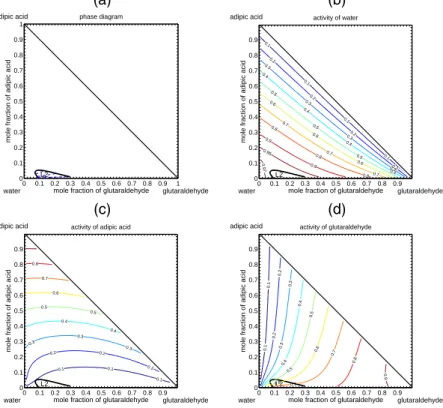
Phase diagrams for the system water/adipic acid(X2)/glutaraldehyde(X3) are shown in Fig. 3. The model predicts the system to be mostly a one-phase mixture, with a very small two-phase region. A three-phase equilibrium does not exist in this system.
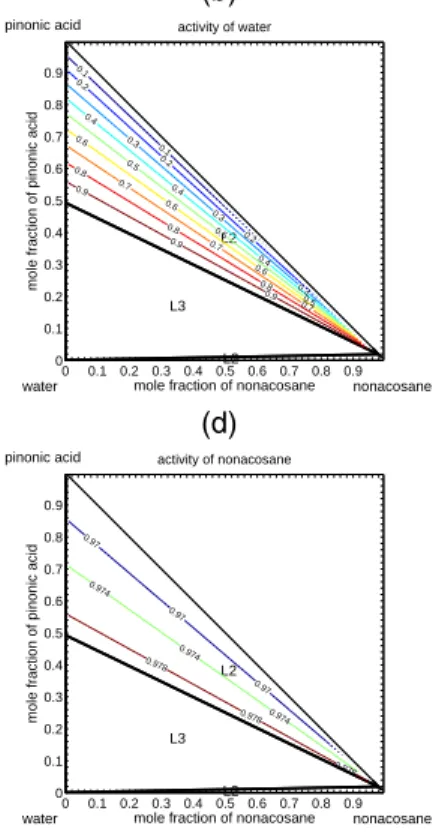
Figure 4 presents the phase diagram for the water/pinonic acid(X8)/nonacosane(X6)
10
system. A three-phase region (L3) is predicted in between three two-phase (L2) re-gions. Again, a third two-phase region, which is a narrow strip bounded between the left edge of the triangular shaped L3 region and the y-axis, is of negligible size and is not visible at the scale of Fig. 4a, but can be deduced from the phase diagram of water/X8 in Fig. 1d.
15
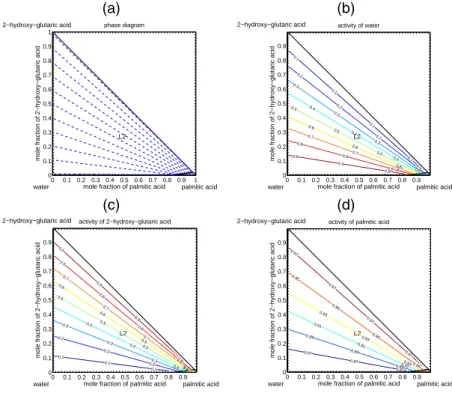
Figure 5 presents the phase diagram for water/2-hydroxy-glutaric acid(X1)/palmitic acid(X4). The system is predicted to be largely a two-phase mixture, bounded by a small one-phase region at a mole fraction of palmitic acid above 0.85 and a mole fraction of 2-hydroxy-glutaric acid approaching 0 and a one-phase region of negligible size, which is a narrow strip bounded between the left edge of the L2 region and the
20
y-axis, and is not visible at the scale of Fig. 5, but can be deduced from the phase diagram of water/X1 in Fig. 1a. There is no three-phase equilibrium predicted for the system.
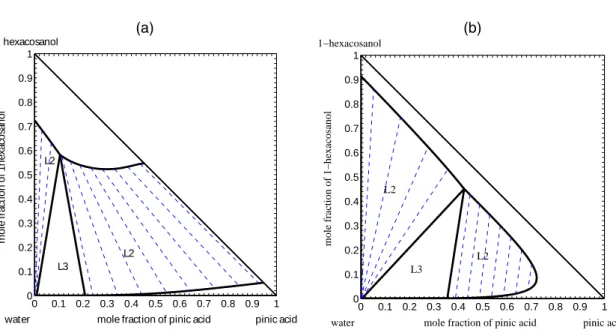
The sensitivity of the predicted phase equilibrium to Peng and UNIFAC-LL parameters for the ternary system water/1-hexacosanol/pinic acid is illustrated in
25
Figs. 6a and b. By comparing Figs. 6 and 2a, the overall change of the liquid phase equilibrium prediction by UNIFAC-Peng and UNIFAC-LL can be assessed. One would expect that UNIFAC-LL should be most accurate for the condensed phase calculation in this study, as the UNIFAC-LL parameters have been determined using liquid-liquid
ACPD
7, 8709–8754, 2007 UHAERO: organic systems N. R. Amundson et al. Title Page Abstract Introduction Conclusions References Tables Figures ◭ ◮ ◭ ◮ Back CloseFull Screen / Esc
Printer-friendly Version Interactive Discussion
EGU
equilibrium data. Although UNIFAC parameters were determined using vapor-liquid equilibrium data, it is the most widely used set of parameters, allowing comparison between different models. We return to a more in-depth analysis of the sensitivity to the choice of activity coefficient model in Sect. 5.
4 Effects of organic phase equilibria on inorganic deliquescence 5
The inorganic system that has been most widely studied with respect to atmospheric gas-aerosol equilibrium and aerosol state is that of sulfate, nitrate, ammonium, and water. Particles consisting of these species can be fully aqueous, fully crystalline, or consist of liquid-solid mixtures, depending on the relative concentrations of the compo-nents, RH, and temperature. An important question is the extent to which the presence
10
of organic species influences the deliquescence and efflorescence phase transitions of salts in this system. We now present results of application of UHAERO to com-putation of the inorganic phase diagram of this system in the presence of organic species. To construct deliquescence phase diagrams of the five-component system SO2−4 /NO−3/NH+4/H+/H2O, we use theX and Y composition coordinates as in
Amund-15
son et al (2006c) and define:
X = Ammonium Fraction = bNH + 4 bNH+ 4+bH+ , (7) Y = Sulfate Fraction = bSO2− 4 bSO2− 4 +bNO − 3 , (8)
where the system feeds bSO2−
4 , bNO
−
3, bNH+4, and bH+ are subject to the constraint of
electroneutrality. Thus, for a fixed (X, Y ) coordinate, we can define a non-unique feed
20 composition asbSO2− 4 = Y 1+Y,bNO−3= 1−Y 1+Y,bNH+4=X , and bH+=1−X .
ACPD
7, 8709–8754, 2007 UHAERO: organic systems N. R. Amundson et al. Title Page Abstract Introduction Conclusions References Tables Figures ◭ ◮ ◭ ◮ Back CloseFull Screen / Esc
Printer-friendly Version Interactive Discussion
EGU
also introduce the fractions fNH+4= bNH+4 bNH+4+bH++(1 + Y )bH2O , (9) fH+= bH+ bNH+4+bH++(1 + Y )bH2O , (10)
which, together withfH2O=1−(fNH+4 + fH+), are the barycentric coordinates of the unit
tri-angle with vertices (1+Y )H2O, NH+4 and H+. Thus, for a fixedY , the fraction coordinate
5 (fNH+4, fH+, fH2O) givesX = fNH+ 4 fNH+ 4+fH+ andbH2O=1+Y1 fH2O
1−fH2O. Therefore, the two-dimensional
(2-D) phase diagrams for fixedY values can be generated in two coordinate systems: (X , RH) and (fH+,fNH+
4), which can be chosen on the basis of computational or graphic
convenience.
For the system that includes the organic species ORG1, . . ., ORGno with feeds
10
bORG1,· · ·, bORGno, we introduce the fractionsfORG2,. . ., fORGno
fORG2= bORG2 Pno i =1bORGi , · · · , fORG no= bORGno Pno i =1bORGi , (11)
which, together withfORG
1=1−(fORG2+ · · · +fORGno), are the barycentric coordinates
of the (no− 1)-dimensional unit simplex with vertices ORG1, . . . , ORGno. We also need
to specify the inorganic/organic mixing ratioR,
15 R= Pno i =1bORGi Pni i =1bINORGi+ Pno i =1bORGi , (12) where Pni i =1bINORGi=bNH+4 + bH++bSO 2− 4 +bNO − 3= 2+Y
1+Y. Thus, for a fixed Y , the ratio
R and the fraction coordinate (fORG1, . . . , fORGno) givebORG1=fORG1
R
1−R2+Y1+Y,. . .,
ACPD
7, 8709–8754, 2007 UHAERO: organic systems N. R. Amundson et al. Title Page Abstract Introduction Conclusions References Tables Figures ◭ ◮ ◭ ◮ Back CloseFull Screen / Esc
Printer-friendly Version Interactive Discussion
EGU
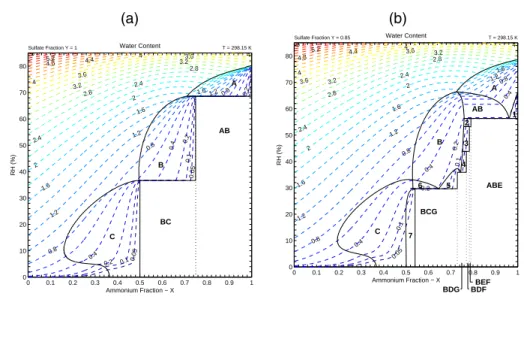
Figures 7a and 7b show the computed phase diagrams in the (X , RH) co-ordinate, with tracking of the presence of each solid phase, for the system (NH4)2SO4/H2SO4/NH4NO3/HNO3/H2O at 298.15 K and fixed sulfate fractions Y =1
and 0.85, respectively. For each region of space whose boundaries are marked with bold lines, the existing solid phases at equilibrium are represented, where the
5
seven possible solid phases are labeled as A through G. A denotes ammonium sul-fate, (NH4)2SO4 (AS); B denotes letovicite, (NH4)3H(SO4)2 (LET); C denotes
am-monium bisulfate, NH4HSO4 (AHS); D denotes ammonium nitrate, NH4NO3 (AN); E denotes the mixed salt, 2NH4NO3·(NH4)2SO4 (2AN·AS); F denotes the mixed salt,
3NH4NO3·(NH4)2SO4 (3AN·AS); and G denotes the mixed salt of ammonium nitrate
10
and ammonium bisulfate, NH4NO3·NH4HSO4 (AN·AHS). In Fig.7a, for the regions
la-beled as AB and BC, the system is fully crystalline and consists of the two solid phases A+B and B+C, the mutual deliquescence RHs of which are 68.57% and 36.65%. In Fig.7b, for the regions labeled as AB and numbered as 1 through 7, the system consist of aqueous-solid mixtures, where the two solid phases at equilibrium are A+B, A+E,
15
B+E, B+F, B+D, B+G, B+C, and C+G, respectively; for the regions labeled as ABE, BEF, BDF, BDG, BCG, the system is fully crystalline and consists of the three solid phases A+B+E, B+E+F, B+D+F, B+D+G, B+C+G whose mutual deliquescence RHs are 56.31%, 53.21%, 43.84%, 35.89%, 29.65%. Labels on the contours (–) present the relative water content in the system as a function ofX and RH. The relative water
20
content is defined as the ratio Pni bH2O i=1bINORGi
of the water content bH2O at a specific
RH and (X ,Y ) composition with respect to the inorganic contentPni
i =1bINORGi of the
same (X , Y ) composition at the “dry-state”.
For Fig. 7a, if one starts at an ammonium fraction, X =0.6 and increases RH from 0 to 80 (i.e. going up the phase diagram vertically atX =0.6), the system starts with
25
a fully crystalline two solid mixture of B ((NH4)3H(SO4)2) (with 40% of mole fraction)
and C (NH4HSO4) (with 60% of mole fraction). At RH=36.65%, solid C fully dissolves, then the system consists of an aqueous electrolyte solution of B and C in liquid-solid
ACPD
7, 8709–8754, 2007 UHAERO: organic systems N. R. Amundson et al. Title Page Abstract Introduction Conclusions References Tables Figures ◭ ◮ ◭ ◮ Back CloseFull Screen / Esc
Printer-friendly Version Interactive Discussion
EGU
equilibrium with solid B, where the relative water content is labeled on the contours. When RH reaches about 62%, the system passes the boundary where solid B fully dissolves and the system changes into a single-phase aqueous solution. Similarly for Fig. 7b, now with a sulfate fractionY =0.85, the system starts with a fully crystalline three solid mixture of B (13.3%) + C (56.7%) + G (NH4NO3·NH4HSO4) (40%) at X
5
=0.6 and RH=0. At RH=29.65%, the system enters the region labeled 6, where G fully dissolves and the aqueous solution is in liquid-solid equilibrium with two solids B + C. The system passes the boundary around RH=34%, C dissolves and it is now an aqueous solution in equilibrium with a single solid B. When RH reaches about 58%, the system becomes a single-phase aqueous solution.
10
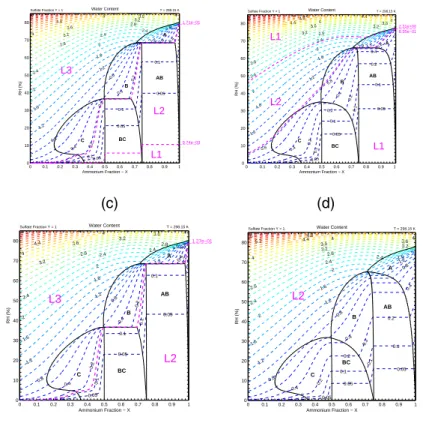
Figures 8 and 9 show the corresponding deliquescence phase diagrams of (NH4)2SO4/H2SO4/NH4NO3/HNO3/H2O when the system also includes two organic
species, with sulfate fractions (Y ) of 1 and 0.85. In the presence of organic species, the system can exhibit a mixture of multiple liquid and solid phases, depending on the relative composition of inorganic and organic species, RH, and temperature. However,
15
a fully crystalline state of the system is not permissible. Each region that is marked with bold dashed lines delineates the existing liquid phases at equilibrium. The regions of one liquid phase, two liquid phases, and three liquid phases at equilibrium are labeled as L1, L2 and L3, respectively. Labels on the contours represent the relative water content. The bold dashed lines separating different liquid regions are contours of the
20
relative water content taking a value given on the side of the figures.
Figure 8a shows the phase diagram including 1-hexacosanol (ORG1) and pinic
acid (ORG2) with the organic/inorganic mixing ratio R=0.2 and the organic fractions
fORG1=0.5 and fORG2=0.5. The molar mixing ratio of R=0.2 corresponds
approxi-mately to the organic/inorganic mass mixing ratio of 65%. Labels on the contours (–)
25
present the relative water content (defined as the ratio Pni bH2O i=1bINORGi
) as a function of X and RH. The bold dashed lines separating different liquid regions are contours of the relative water content, with the values of 0.171 and 0.00974. Region L3 covers
ACPD
7, 8709–8754, 2007 UHAERO: organic systems N. R. Amundson et al. Title Page Abstract Introduction Conclusions References Tables Figures ◭ ◮ ◭ ◮ Back CloseFull Screen / Esc
Printer-friendly Version Interactive Discussion
EGU
the fully liquid region and the regions of one solid phase at equilibrium. Region L3 consists of one aqueous phase and two organic phases, where the organic contribu-tion to the activity of watera(wo) is constant anda(wo)=0.997=1−10003 (Table 4, UNIFAC
column and water/X5/X7 row). Thus, the locations of contours of the water content in regions L3 are shifted three per thousand in the upward direction, compared to the
5
locations of the corresponding contours in Fig. 7 a where the system only includes inorganic species. In the L3 region, the addition of organic species has a negligible effect on the hygroscopic properties of the inorganic electrolytes; the phase diagram and water update in this region are almost identical in the presence and absence of organics (Fig. 7a). However, for most of the two solid regions, the phase diagram and
10
water uptake are quite different as compared to those of the system without organics. L2 covers mostly the two-solids region, and it consists of two liquid (water + organics) phases in equilibrium with two solids (A+B or B+C). The system consists of one liquid (water + organics) phase in equilibrium with two solids in the region that L1 covers. The original fully crystalline phase no longer exists owing to the presence of organics.
15
Also, instead of a straight horizontal line corresponding to the mutual DRH (Fig. 7a), the “deliquescence” RH is now curved (Figs. 8 and 9). Due to the presence of organics, the originally crystalline system now is in equilibrium with at least one liquid phase. The water content in the system is not negligible and increases with RH. Salts “deliques-cence” at a value of RH, with the water content now also a function of the ammonium
20
fraction, causing the curving of the boundaries.
If a similar analysis is carried for Fig. 8a as that for Fig. 7a, the system atX =0.6 starts at RH=0 in a L1 region, where there is a single mixed organic (1-hexacosanol and pinic acid) + little water (as RH is low) with some dissolved ions of B and C in equilibrium with the solids B and C. When the system crosses the phase boundary between Ll
25
and L2 (indicated by a dashed line), the system consists of two mixed organic + water phases with some dissolved ions B and C, and two solid phases B and C that are in equilibrium with the two liquid phases. When the RH reaches∼36%, the system enters the L3 region and a region with a single solid phase B. Within this region, the system
ACPD
7, 8709–8754, 2007 UHAERO: organic systems N. R. Amundson et al. Title Page Abstract Introduction Conclusions References Tables Figures ◭ ◮ ◭ ◮ Back CloseFull Screen / Esc
Printer-friendly Version Interactive Discussion
EGU
consists of two organic phases (each containing some amount of water and dissolved ions B and C) and an aqueous phase (with some amount of organics and dissolved ions B and C), which are all in equilibrium with solid B. As RH increases to about 62%, B dissolves and the system is in a three liquid phase equilibrium (two organic phases with some amount of water and dissolved ions and an aqueous phase with
5
some amount of organics and dissolved ions). No solid salt is present in system within the L3 region at a RH>∼62%. Figure 8b shows the phase diagram with adipic acid (ORG1) and glutaraldehyde (ORG2) with the organic/inorganic mixing ratioR=0.2 and the organic fractionsfORG
1=0.15 and fORG2=0.85. The model predicts a two-phase
region (L2) in between two L1 regions. Most of the one-solid and all of the two-solids
10
regions are covered by L1; the system consists of a single liquid (water + organics) phase in equilibrium, either with one solid (A, B, or C) or two-solids (A+B, or B+C). L1 covers part of the liquid region, and the system is in a single-phase equilibrium. L2 covers the rest of the liquid region and parts of the one-solid region. There is no L3 region in this system. A slight decrease of the “deliquescence” RHs for A, B and C can
15
be observed. The “deliquescence” RHs shown in Fig. 8b for A, B and C are∼77%, ∼66% and ∼34%, while the original values in Fig. 7a are ∼80%, 68.57% and 36.65%. Figure 8c presents the phase diagram with pinonic acid (ORG1) and nonacosane
(ORG2) with the organic/inorganic mixing ratio R=0.2 and the organic fractions
fORG1=0.5 and fORG2=0.5. The phase diagram for this system is similar to that of
20
1-hexacosanol and pinic acid (Fig. 8a). L3 covers fully the liquid region and most of the one-solid regions. L2 covers fully the two-solids region; however, there is no L1 region predicted in this system.
Figure 8d shows the phase diagram with 2-hydroxy-glutaric acid (ORG1) and palmitic
acid (ORG2) with the organic/inorganic mixing ratio R=0.2 and the organic fractions
25
fORG1=0.5 and fORG2=0.5. The entire phase diagram is labeled as a L2 region. A
change in the “deliquescence” RHs of A, B and C can also be observed. The approx-imate values shown in Fig. 8d are 78% for A, 66% for B, and 32% for C, whereas the original values in Fig. 7a are 80%, 68.57%, and 36.65%.
ACPD
7, 8709–8754, 2007 UHAERO: organic systems N. R. Amundson et al. Title Page Abstract Introduction Conclusions References Tables Figures ◭ ◮ ◭ ◮ Back CloseFull Screen / Esc
Printer-friendly Version Interactive Discussion
EGU
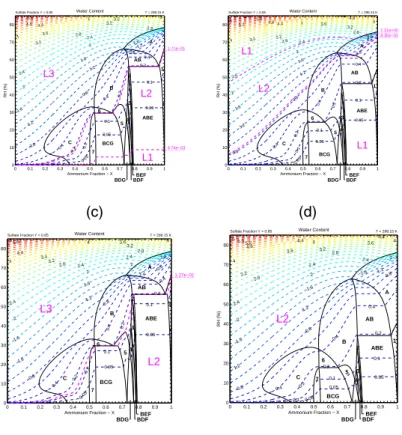
The phase diagrams of (NH4)2SO4/H2SO4/NH4NO3/HNO3/H2O for the same
four ORG1/ORG2 combinations are given in Figs. 9a–d, at a fixed sulfate fraction (Y )
of 0.85. Similar to the panels in Fig. 8, the horizontal boundaries corresponding to the mutual deliquescence RHs for the fully crystalline solid phases in Fig. 7b are now curved in Fig. 9. In the L3 regions of Fig. 9a and c, the addition of organic species
5
has a negligible effect on the hygroscopic properties of the inorganic electrolytes. In general, the phase diagrams follow a structure similar to those shown in Fig. 8. Com-paring Figs. 8 and 9, it can be seen that the same number of L1, L2, and L3 regions are predicted, covering similar regions of the phase diagram. Figure 9a shows the system including 1-hexacosanol (ORG1) and pinic acid (ORG2). The L3 region fully
10
covers the liquid region and the one-solid regions, with the addition of the two-solid region AB and region 6 (B+C). The L2 region covers most of the two-solids and three solids regions, and L1 covers small parts of the two-solids and three-solids regions. In Fig. 9b, a similar distribution of the two L1 and L2 regions is observed, as compared to Fig. 8b. However, the mutual “deliquescence” RH of ABE and BCG in Fig. 9b is
15
significantly lower than that in Fig. 7b. The “deliquescence” RHs for ABE and BCG in Fig. 9b are <∼46% and <∼24% (compared to the original values of 56.31% and 29.65% in Fig. 7b). In Fig. 9c, L3 covers the entire liquid region, most of the one-solid region (A, B, and C), and the two-solid region AB and 6 (B+C). L2 covers the rest of the two-solid regions and all the three-solids region. In Fig. 9d, the L2 region also covers
20
the entire phase diagram, as in Fig. 8d. However, significant a decrease of the mutual “deliquescence” RHs can be observed for ABE, BEF, BDF, BDG, BCG. For instance, the “deliquescence” RH for ABE is<∼34% (in Fig. 9d), while the original DRH for ABE in Fig. 7b is 56.31%. The “deliquescence” RH for BCG is shown to be <∼18%, but the original value in Fig. 7b is 29.65% in Fig. 7b).
ACPD
7, 8709–8754, 2007 UHAERO: organic systems N. R. Amundson et al. Title Page Abstract Introduction Conclusions References Tables Figures ◭ ◮ ◭ ◮ Back CloseFull Screen / Esc
Printer-friendly Version Interactive Discussion
EGU 5 Effect of the version of UNIFAC on predicted liquid-liquid equilibria
The interaction parameters listed in Table 2 contribute to the residual term of the UNI-FAC equation (Fredenslund et al., 1977) through the energy interaction term, Ψmn: Ψmn=exp(−Amn/T )
whereAmn (K−1) is the energy interaction parameter between groupsm and n. There
5
are two interaction parameters for each pair of functional groups m and n, Amn and Anm, where Amn 6= Anm. Changes in the parameters from UNIFAC (Hansen et al., 1991) to UNIFAC-Peng (Peng et al., 2001) and UNIFAC to UNIFAC-LL (Magnussen et al., 1981) and their effects on the interaction terms are summarized in Table 5. Since the interaction term, Ψmn or Ψnm, is the exponential of the negative of the interaction
10
parameter Amnor Anm, respectively, an increase/decrease in the interaction parameter, Amn or Anm, leads to a decrease/increase in the interaction term, Ψmn or Ψnm. The overall change in the interaction between groupsm and n is approximately related to the sum of the changes of Ψmn and Ψnm. For example, the overall change in the interaction between groups OH and H2O in UNIFAC-LL vs. UNIFAC is a decrease, due
15
to the sum of the changes of ΨOH,H2O(of value 0.6) and ΨH2O,OH(of value−1.0) being −0.4.
Figure 6 shows the liquid phase equilibrium predictions for the system water/1-hexacosanol(X5)/pinic acid(X7) using UNIFAC-Peng and UNIFAC-LL parameters. With all else equal, the changes between Figs. 6 and 2a can be roughly explained by
20
the changes in the energy interaction parameters. The group-group interactions in the system include CH3, CH2, OH of 1-hexacosanol and CH3, CH2, CH, C, COOH of pinic
ACPD
7, 8709–8754, 2007 UHAERO: organic systems N. R. Amundson et al. Title Page Abstract Introduction Conclusions References Tables Figures ◭ ◮ ◭ ◮ Back CloseFull Screen / Esc
Printer-friendly Version Interactive Discussion
EGU
5.1 UNIFAC vs. UNIFAC-Peng
In UNIFAC-Peng the OH/H2O, COOH/H2O and OH/COOH interaction parameters are
modified by fitting the UNIFAC equation to experimental measurements of water-soluble dicarboxylic and multifunctional acids. Therefore, UNIFAC and UNIFAC-Peng parameters are identical except for the interactions between OH/H2O, COOH/H2O and
5
OH/COOH. According to Table 2, the interaction parameter (Amn) for OH-H2O
de-creases from 353.3 (UNIFAC) to 265.97 (UNIFAC-Peng), leading to an increase in the interaction term Ψmn. At the same time, the H2O-OH parameter changes from
−229.1 (UNIFAC) to −467.4 (UNIFAC-Peng), causing an increase in the interaction term Ψnm. The overall effect is an increase in the OH/H2O interaction. Similarly, the
10
changes in the interaction parameters for COOH/H2O from UNIFAC to UNIFAC-Peng
result in a stronger interaction, and the changes in OH/COOH lead to a weaker in-teraction (Table 5). We note that the inin-teractions between CH2/H2O, CH2/OH and
CH2/COOH remain the same, thus do not contribute directly to the changes in phase
structures predicted when replacing UNIFAC with UNIFAC-Peng. The changes
be-15
tween Figs. 6a and 2a in terms of phase structures predicted for the system water/1-hexacosanol(X5)/pinic acid(X7) using UNIFAC-Peng vs. UNIFAC parameters can be readily analyzed by comparing the phase diagrams of their corresponding binary sys-tems, namely water/X5, water/X7, and X5/X7. The change in phase structure for wa-ter/X5 can be attributed to the increasing interaction between OH/H2O, resulting in an
20
increased miscibility of X5 from 0.1016 to 0.2754 when replacing UNIFAC by UNIFAC-Peng. The miscibility is the value of the water fraction of the organic phase that is in equilibrium with the aqueous phase, and is derived from the values listed in Ta-ble 2. The increased miscibility of X5 when using UNIFAC-Peng leads to a reduced L2 (two-liquid) region that is bounded between the left edge of the triangular shaped L3
25
region and they-axis where the mixtures separate along the tie-lines into two phases: an almost pure water phase and a mixed organic phase with the concentrations of 1-hexacosanol (mole fractions ranging from about 0.582 to 0.725) being lower when
ACPD
7, 8709–8754, 2007 UHAERO: organic systems N. R. Amundson et al. Title Page Abstract Introduction Conclusions References Tables Figures ◭ ◮ ◭ ◮ Back CloseFull Screen / Esc
Printer-friendly Version Interactive Discussion
EGU
compared to the corresponding values by UNIFAC (mole fractions ranging from about 0.609 to 0.894). Similarly, the change in phase structure for water/X7 can be attributed to the increasing interaction between COOH/H2O, resulting in an increased miscibility
of X7 from 0.6345 to 0.7924 when replacing UNIFAC by UNIFAC-Peng, thus leading in turn to a reduced L2 (two-liquid) region (not visible in the present scale) that is bounded
5
between the left edge of the triangular shaped L3 region and thex-axis. The combined effect of the increased miscibility of X5 and X7 is also reflected by the shifts of the two vertices (corresponding to the positions of equilibrium phases 2 and 3) of the trian-gular L3 region from (x(3)s
3, x (3)) s2 =(0.219, 0.609) in Fig. 2a to (x (3) s3, x (3)) s2 =(0.105, 0.582) in Fig. 6b and from (xs(3)
3, x (3)) s2 =(0.372, 0.00233) to (x (2) s3, x (2)) s2 =(0.209, 0.000181), re-10
spectively. Therefore, the L3 region decreases in area and shifts to a relatively higher water concentration. On the contrary, the change in phase structure for X5/X7 can be attributed to the decreasing interaction between OH/COOH, resulting in decreased miscibility between X5 and X7 when replacing UNIFAC by UNIFAC-Peng with the two-liquid region enlarged from (0.5367, 0.9334) to (0.4528, 0.9465) in terms of the mole
15
fraction of X7. The combined effect of the increasing interactions between OH/H2O and
COOH/H2O and the decreasing interaction between OH/COOH leads to an increased
L2 (two-liquid) region that is bounded between the right edge of the triangular shaped L3 region and the off-diagonal axis where the mixture separates along the tie-lines into two mixed organic phases, one (1-hexacosanol dominating organic phase) of which
20
includes higher concentrations of 1-hexacosanol and the other (pinic acid dominating organic phase) of which includes slightly higher pinic acid when replacing UNIFAC with UNIFAC-Peng.
5.2 UNIFAC vs. UNIFAC-LL
Unlike the UNIFAC interaction parameters, which are fitted to vapor-liquid equilibrium
25
data, the UNIFAC-LL interaction parameters were determined using liquid-liquid equi-librium data. For example, the interaction parameter (Amn) for OH-H2O decreases from
ACPD
7, 8709–8754, 2007 UHAERO: organic systems N. R. Amundson et al. Title Page Abstract Introduction Conclusions References Tables Figures ◭ ◮ ◭ ◮ Back CloseFull Screen / Esc
Printer-friendly Version Interactive Discussion
EGU
353.3 (UNIFAC) to 28.73 (UNIFAC-LL), leading to an increase of value 0.6 in the inter-action term Ψmn. Concurrently, the H2O-OH parameter changes from -229.1 (UNIFAC)
to -122.4 (UNIFAC-LL), leading to a decrease of value 1.0 in the interaction term Ψnm. The decrease in the Ψmn (OH-H2O) is greater than the increase in Ψnn (H2O-OH) in magnitude, so the overall effect is a decrease in the interaction between OH/H2O.
5
Similarly, changes in the interaction parameters from UNIFAC to UNIFAC-LL cause an overall increase in the COOH/H2O interaction, and a negligible decrease in the OH/COOH interaction, as shown in Table 5. Different from UNIFAC vs. UNIFAC-Peng, in addition to the OH, COOH, H2O group-group interactions, there are also differences
for UNIFAC vs. UNIFAC-LL in the CH2, OH, COOH, H2O pair-wise interactions. In
sum-10
mary, the effect on CH2/OH and CH2/H2O of changing from UNIFAC to UNIFAC-LL is a
decrease in the interaction, while the interaction between CH2/COOH increases. The
changes between Figs. 6b and 2b in terms of phase structures predicted for the sys-tem water/1-hexacosanol(X5)/pinic acid(X7) using UNIFAC-LL vs. UNIFAC parameters can also be analyzed by comparing the phase diagrams of their corresponding binary
15
systems. The competing effects of an increasing interaction between OH/H2O (with
a weight of value 1 being the number of OH groups in X5) and decreasing interac-tions between CH2/OH and CH2/H2O (both with a weight of value 25 being the number
of CH2 groups in X5) results in a slightly decreased miscibility of X5 from 0.1016 to
0.0858 when replacing UNIFAC by UNIFAC-Peng. Similarly, the competing effects of
20
increasing interactions between COOH/H2O (with a weight of value 2 being the number
of COOH groups in X7) and CH2/COOH (with a weight of value 4 being the product of
the numbers of COOH groups and CH2 groups in X7), and a decreasing interactions between CH2/H2O (with a weight of value 2 being the number of CH2 groups in X7)
results in a negligibly increased miscibility of X7 from 0.6345 to 0.6492 when
replac-25
ing UNIFAC by UNIFAC-Peng. Also, the effect of the increasing interaction between CH2/COOH (with a weight of value 50 being the product of numbers of CH2 groups
in X5 and COOH groups in X7) overweights the combined effect of decreasing inter-actions between CH2/OH (with a weight of value 2 being the product of the numbers
ACPD
7, 8709–8754, 2007 UHAERO: organic systems N. R. Amundson et al. Title Page Abstract Introduction Conclusions References Tables Figures ◭ ◮ ◭ ◮ Back CloseFull Screen / Esc
Printer-friendly Version Interactive Discussion
EGU
of CH2 groups in X7 and OH groups in X5) and OH/COOH (with a weight of value 2 being the product of the numbers of COOH groups in X7 and OH groups in X5), result-ing in a drastically increased miscibility between X5 and X7 from a partial miscibility to a full miscibility, leading to the formation of a new (and larger) single phase region that covers all the points with high organic mole fractions of X5 and X7. At the points
5
when the mole fraction of water is not small (>0.1), the effect of the decreasing inter-action between CH2/H2O (with a weight of value 27 being the sum of the number of CH2 groups in X5 and X7) balances the effect of the increasing interaction between
CH2/COOH, results in a partial miscibility between X5 and X7 in the presence of
non-negligible water, leading to a shift of the vertex (xs(3)3, xs(3))2 , which corresponds to the
10
equilibrium phase 3, from (0.219, 0.609) in Fig. 2a to (0.424, 0.451) in Fig. 6a. With an increase in COOH/H2O interaction and decrease in the OH/H2O interaction,
three-phase separation occurs at the region of lower mole fractions of 1-hexacosanol and higher mole fractions of pinic acid. In addition, the L2 region on the left expands in area. With the similar range of 1-hexacosanol mole fraction, the L2 region in Fig. 6a
15
extends to include a mixture with a maximum pinic acid mole fraction of 0.424, instead of the original pinic acid mole fraction of 0.219. Within this L2 region, the solution sepa-rates into a mixed organics (with some amount of water) phase and a nearly pure water aqueous phase. The increase in CH2/COOH interaction between the 25 CH2groups of 1-hexacosanol and the 2 COOH groups of pinic acid is expected to be greater than
20
the decrease in CH2/OH interaction between the 2 CH2groups of pinic acid and 1 OH
group of 1-hexacosanol, causing an increased interaction between 1-hexacosanol and pinic acid. Hence, the L2 region is extended to a higher mole fraction of pinic acid.
Since most of the parameters between UNIFAC and UNIFAC-LL differ, and the effect is often competitive, the phase diagram predicted using UNIFAC-LL significantly varies
25
ACPD
7, 8709–8754, 2007 UHAERO: organic systems N. R. Amundson et al. Title Page Abstract Introduction Conclusions References Tables Figures ◭ ◮ ◭ ◮ Back CloseFull Screen / Esc
Printer-friendly Version Interactive Discussion
EGU
6 Conclusions
Presented here is the extension of the UHAERO aerosol thermodynamic model to or-ganic/water systems. Special attention is paid to calculating the liquid phase equilibria occurring in relatively complex mixtures of organics and water. Through a merging of the inorganic and organic modules of UHAERO, we calculate inorganic/organic/water
5
phase diagrams that show the effect of mixtures of organics on inorganic deliquescence behavior. Since the fundamental chemical information required to construct phase di-agrams for such systems is the component activities, we show the sensitivity of one of the calculated phase diagrams to the choice of activity coefficient model; differences in the phase diagrams are related to differences in interaction parameter values in the
10
different versions of the UNIFAC model. The method presented here affords a rigor-ous computation of inorganic/organic/water phase equilibria. While such liquid/solid phase equilibrium computations may not be necessary in a 3-D atmospheric chemical transport model, the results of the UHAERO model are a benchmark to which more approximate thermodynamic models may be compared.
15
Acknowledgements. This work was supported by U.S. Environmental Protection Agency grant
X-83234201. The third author acknowledges the support by the NSF under Grant No. DMS-0511611.
References
Amundson, N. R., Caboussat, A., He, J. W., Seinfeld, J. H., and Yoo, K. Y.: An optimization
20
problem related to the modeling of atmospheric inorganic aerosols, C. R. Acad. Sci. Paris, Ser. I, 340, 683–686, doi:10.1016/j.crma.2005.01.025, 2005a.
Amundson, N. R., Caboussat, A., He, J. W., and Seinfeld, J. H.: An optimization problem related to the modeling of atmospheric organic aerosols, C. R. Acad. Sci. Paris, Ser. I, 340, 765–768, doi:10.1016/j.crma.2005.04.018, 2005b.
ACPD
7, 8709–8754, 2007 UHAERO: organic systems N. R. Amundson et al. Title Page Abstract Introduction Conclusions References Tables Figures ◭ ◮ ◭ ◮ Back CloseFull Screen / Esc
Printer-friendly Version Interactive Discussion
EGU
Amundson, N. R., Caboussat, A., He, J. W., Seinfeld, J. H., and Yoo, K. Y.: Primal-dual active-set algorithm for chemical equilibrium problems related to the modeling of atmospheric in-organic aerosols, J. Optimization Theory Appl., 128(3), 469–498, doi:10.1007/s10957-006-9030-y, 2006a.
Amundson, N. R., Caboussat, A., He, J. W., and Seinfeld, J. H.: Primal-dual interior-point
5
method for an optimization problem related to the modeling of atmospheric organic aerosols, J. Optimization Theory Appl., 130(3), 375–407, doi:10.1007/s10957-006-9110-z, 2006b. Amundson, N. R., Caboussat, A., He, J. W., Martynenko, A. V., Savarin, V. B., Seinfeld, J. H.,
and Yoo, K. Y.: A new inorganic atmospheric aerosol phase equilibrium model (UHAERO), Atmos. Chem. Phys. 6(4), 975–992, 2006c.
10
Amundson, N. R., Caboussat, A., He, J. W., Martynenko, A. V., and Seinfeld, J. H.: A phase equilibrium model for atmospheric aerosols containing inorganic electrolytes and organic compounds (UHAERO), with applications to dicarboxylic acids, J. Geophys. Res., in press, 2007.
Ansari, A. S. and Pandis, S. N.: Water absorption by secondary organic aerosol and its effect
15
on inorganic aerosol behavior, Environ. Sci. Technol., 34(1), 71–77, 2000.
Clegg, S. L. and Pitzer, K. S.: Thermodynamics of multicomponent, miscible, ionic solutions: generalized equations for symmetrical electrolytes, J. Phys. Chem., 96, 3513–3520, 1992. Clegg, S. L. and Seinfeld, J. H.: Thermodynamic models of aqueous solutions containing
elec-trolytes and dicarboxylic acids at 298.15 K 1. the acids as nondissociating components, J.
20
Phys. Chem., 110, 5692–5717, 2006a.
Clegg, S. L. and Seinfeld, J. H.: Thermodynamic models of aqueous solutions containing elec-trolytes and dicarboxylic acids at 298.15 K 2. systems including dissociation equilibria, J. Phys. Chem., 110, 5718–5734, 2006b.
Clegg, S. L., Pitzer, K. S., and Brimblecombe, P.: Thermodynamics of multicomponent,
misci-25
ble, ionic solutions. mixtures including unsymmetrical electrolytes, J. Phys. Chem., 96(23), 9470–9479, 1992.
Clegg, S. L., Seinfeld, J. H., and Brimblecombe, P.: Thermodynamic modelling of aqueous aerosols containing electrolytes and dissolved organic compounds., J. Aerosol. Sci., 32, 713–738, 2001.
30
Clegg, S. L., Seinfeld, J. H., and Edney, E. O.: Thermodynamic modelling of aqueous aerosols containing electrolytes and dissolved organic compounds: ii. an extended Zdanovskii-Stokes-Robinson approach, J. Aerosol Sci., 34, 667–690, 2003.