Rinse, Repeat
Paratextual Poetics of Literary Twitter
Collage Retweeted
Laura Piippo
Résumé
Cette étude examine ce qui se passe avec les règles d’un texte d’abord écrit pour une plateforme numérique, puis mécaniquement transférée à un autre support littéraire, celui d’un livre publié sous forme papier. Au cœur de l’analyse se trouve une œuvre conceptuelle de l’auteur finlandais Karri Kokko, Retweeted (2016), un texte numérique imprimable sur demande, qui plonge à la fois dans les traditions du livre imprimé comme celles de la plateforme numérique Twitter. L’analyse s’attache aux propriétés médiatiques de Twitter comme du roman conceptuel qui s’approprie Twitter. Elle se propose de mettre en lumière les qualitiés poétiques des matériaux produits et diffusés par Twitter, la dimension affective de la plateforme elle-même ainsi que les conséquences de la transposition au support livre. L’article démontre qu’en examinant la poétique des collages numériques et des médias sociaux on général, on doit toujours avoir à l’esprit : 1) la logique de l’écriture et du profit propre aux plateformes numériques, et 2) le paratexte des plateformes aussi bien que des livres.
Abstract
This essay studies what happens to the poetics of a text that was first written on or for a certain internet platform when it is later copy-pasted to a different literary medium – that of an edited and printed book. The main target of the discussion is Finnish author Karri Kokko’s conceptual literary work Retweeted (2016), a print-on-demand book, the roots of which are firmly in both the traditions of print media and the digital interfaces of the social media platform Twitter. The analysis pays close attention to the medial qualities of both Twitter and the conceptual novel that draws material from it. The essay aims to highlight the poetic qualities of the material produced and circulated on Twitter, the affectivity of the platform itself, and the effects the transposition into the codex format has on these phenomena. The essay argues that when investigating the poetics of internet-based collages, and social media platforms more generally, one must be mindful of 1) the logics of writing and revenue on internet platforms, and 2) the paratextuality of both the original online platforms and the book at hand.
Keywords
poetics; collage; codex; print-on-demand; internet; social media platform; interface; Twitter; paratextuality; affect; Retweeted; Karri Kokko
To retweet is to curate, compile, edit, commend, recommend, underline, advertise, agree, disagree, point out, produce, direct, redraft. (Retweeted, 513) Our contemporary time, culture and literature are profoundly influenced by, shaped by, and discussed on the internet. We are currently living in a period of ubiquitous algorithms and media interfaces, which are “steadily making their way toward invisibility, imperceptibility, and inoperability”, as Lori Emerson writes in her book Reading Writing Interfaces (2014, 1). She then continues that we need an antidote against this development, and suggests that digital literature, which courts “difficulty, defamiliarization, and glitch” (ibid., 2), might well function as such cure. In this essay, I will argue that literature in the form of a codex, a printed and bound book, could also act as a similar antidote. In order to demonstrate this argument, I examine Finnish author Karri Kokko’s conceptual literary work Retweeted, a print-on-demand book, the roots of which are firmly in both the traditions of print media and the digital interfaces of the social media platform Twitter.
Contemporary aesthetics, especially the ones related to the internet, rely heavily on recycling, reusing and reframing found material, which is not always recycled, reused or reframed by a human agent. In literary terms, the algorithmic internet has brought back and reframed the concept of collage as well as the usage of
found material. The former technique stresses the acts of cutting and re-arranging, whereas the latter method
emphasizes placing, or creating a new finished surface or work of art (Joensuu 2012, 152; Joensuu 2016, 14). The new text-oriented tools – such as personal computers, similar devices, and their text and data processing software – amplify these old methods of cut-up and multiply the sources available to the writer (see also Bajohr 2018, Goldsmith 2011). This might also alter the concept of the author slightly: rather than “a writer” the author becomes something of “a literary curator” (Kuusela 2015), and their actions start resembling what Lori Emerson calls readingwriting:
Now that we are all constantly connected to networks, driven by invisible, formidable algorithms, the role of the writer and the nature of writing itself is being significantly transformed. Media poetics is fast becoming a practice not just of experimenting with the limits and the possibilities of writing interfaces but rather of readingwriting ‒ the practice of writing through the network, which as it tracks, indexes, and algorithmizes every click and every bit of text we enter into the network is itself constantly reading our writing and writing our reading. This strange blurring of and even feedback loop between reading and writing signals a definitive shift in the nature and the definition of literature. (Emerson 2014, 163–164)
Communication via Twitter is currently a widely researched topic, and this research mostly seems to focus on the contents of tweets, on marketing, on politics, and on wider societal impact in and of Twitter (Koskela & Sihvonen 2018, Murthy 2013; Hardin 2014; Jungherr 2014). There is also an interest in social media platforms as places or forms of storytelling (Georgakopoulou 2007; Page 2018; Mäkelä 2019). My analysis complements these approaches by paying closer attention to the medial qualities of both Twitter and Kokko’s conceptual work, which draws its material from Twitter. This analysis thus highlights the poetic qualities of the material produced and circulated on the platform, the affectivity of the platform itself, and the effects the transposition into the codex format has on both of these phenomena. As mentioned above, cut-up and collage are by no means “new” literary techniques, but there is still much to be said about their contemporary applications and implications, that is, the contemporary poetics of paratextuality in the context of
In this essay, I investigate what happens to the poetics of a text that was first written on or for a certain internet platform when it is later copy-pasted to a different literary medium, that of an edited and printed book. What is being transferred; what changes or re-renders itself; and what is being created? First and foremost: do these kinds of transposed literary works possess the potential for acting as the kind of antidote Emerson claims our internet-immersed culture requires? I base my argument on my reading of Retweeted’s
poetics – a term that here refers to the creative principles or techniques informing literary construction. This
definition of poetics also applies to other cultural constructions, including various internet platforms, like Twitter. Thus, it brings a wider scope of (human) interaction and meaning-making into play. In striving to make sense of the nonsense of Retweeted, I argue that, when reading the poetics of internet-based collages, one must pay close attention to 1) the logics of writing and revenue on internet platforms, and 2) the paratextuality of both the original internet platforms and the book at hand.
Reading Retweeted
Karri Kokko (b. 1955) is a Finnish poet and writer, who has been active since 1982 and whose portfolio of over 20 works includes collections of poems, experimental and conceptual works as well as asemic writing.
Retweeted: 15.3. – 31.5.2014, which is his 16th work, is a nearly 600 pages thick, multilingual, excessive literary collage filled with utmost heteroglossia and random wordplay. The layout is the same on every page: the stream of text almost fills the width of the entire page, without any paragraph or chapter divisions.
Due to the topical and retroactive nature of Twitter, there are occasional continuous strings of thought or recurring themes and topics. This is no surprise since, as a platform, Twitter has often been connected to such widely discussed issues as catastrophes, journalism, politics, activism, terrorism, corporeal and organization communication, celebrities and health (Murthy 2013). As a whole, however, the work verges on being unreadable (Goldsmith 2011) or nonsensical, to say the least. There are, of course, hilarious, touching, concerning and witty parts, but put together, the text mostly seems to generate much ado about nothing:
Why we love love. They use robots to write poetry. Toinen esimerkki. All bad things are a mirror of your mind. Your books sit alone at home. Rinse, repeat. There is another Russia. Nuori, älä hae taidekouluun, vaan tee taidetta. After ’orgy,’ ’orhamwood.’ This is Hell as far as you can see. Runous on tiukka laji. You are more than a sexual fetish. Töölö–Napoli all nite lång. When Germany looks at the situation in Ukraine, this is what they see. Kvällens program: Lotto. Hengitys lakkaa, asioista tulee litteitä ja mitäänsanomatttomia. Tarkista privaattilaatikkosi. Crimea has Russian oligarchs panicked. My date tonight. (Retweeted, 7)
Kokko writes in the postscript that he, like so many others, started to use Twitter more actively at the time of the protests in Moldova, in order to keep himself up to date with the situation1. Then, after a period of having
a relatively inactive relationship to the platform, he suddenly found himself mesmerized by it. The author describes the joy of following the constant and unending stream of miscellaneous tweets, of “condensed ideas with unlimited audience”. He started his archiving process, “the adaptation of the collective choir work that was Twitter into a codex, a part of the literary culture” by setting himself a timeline of approximately three months, during which he believed he would be able to gather a “representative enough” body of text. He “hand-picked” every single tweet included in the book from his own Twitter feed, which, according to his estimation, required roughly 8–10 hours of screen time each day (Kokko 2016, 555–556).
The author also describes the book’s editing process in the postscript. In general, he kept editing to minimum. The order of the tweets was not changed. Most of the usernames were deleted in order to underline the notion of “a choir instead of a multitude of soloists” (Kokko 2016, 557–558). This seems to resonate with the current times: the same topic is explored in a choral work “Myriad” by Osmo Tapio Räihälä, which was composed in 2015, commissioned by Finnish Radio Symphony Orchestra, and premiered in 2016. Much like the contents of Retweeted, “Myriad’s” text has mostly been derived from the multilingual stream of Twitter. According to the composer, the text describes the world in which we live, a world that is “ugly and beautiful, confusing, incredibly multi-layered and powerful” (Kahila 2016). He then continues: “We don’t know what is real and what is fake, there are protests both for and against hate and love. Acts of terror are being both committed and watched in the news, and all the time there is a desperate need to comment on it all and be present.” (ibid.)
Even though the text of Retweeted seems to lack a main narrative or storyline, and even though conceptual works are not necessarily supposed to be read closely, there is still plenty to read and interpret. The most striking quality of the opening passage is, in fact, its richness. Even though the sentences from different tweets do not form a narrative, they definitely resonate with each other, and there are clearly recurring themes
1 Protests against the results of the April 2009 Moldovan parliamentary elections took place in largest Moldovan cities right before
the official election results were announced. Some of the protesters gathered and organized using Twitter, hence the moniker used by the media, the "Twitter Revolution". The protests have been interpreted as a clash between stances towards EU and Russia (Harding 2009) and as a generational clash (Barry 2009).
that connect the disparate elements to one another: love and lust, literature (“Poetry is a tight sport”), nature, looming crises (“This is Hell as far as you can see. [– –] Check your private inbox”), a longing for distant lands, exoticism of foreign languages, and hints of a coming-of-age-story (“Youngster, don’t apply for art school, make art”). All of these topics are, in fact, quite literary. Together, the sentences create a sense of a virtual stage, where the actors address an audience, rather than each other. There is also subtle humour and sadness embedded in the image of a lustful night (‘orgy’) withering into a lone walk among the grey elm trees (‘orhamwood’), even though the sentence in question might also refer to the order of words in a dictionary.
The second sentence of the excerpt quoted above, “They use robots to write poetry”, alludes to Christian Bök, a Canadian conceptual poet, who usually frames the links he shares on Twitter with a foreword starting with the pronoun “they”2. In this instance, the uncreative conceptual writing procedure of Retweeted, which
mostly involves the removal of usernames and direct copying of the hypotext, reproduces another uncreative conceptual writing procedure, which connects Kokko’s work with a certain author and his particular work. The personification of books in a subsequent sentence also draws one’s attention to the literary connotations of “after the orgy”: it could refer to Jean Baudrillard’s essay “After the Orgy” (1993), in which he discusses the demise of modernity. Alternatively, it could refer to the humorous What Are You Doing After the
Orgy? (1962) by Henny and Jim Backus, which the dust cover summarizes as “the hilarious adventures of a
pair of not-too-innocents abroad”.
Every one of Retweeted’s nearly 600 pages allows for the emergence of these kinds of sceneries and interpretational spaces. Often, one wants to skim back and forth, to look for a good or especially excessive passage, where one could resume reading. Yet, there is also the option of proceeding linearly, from one page to the next, through the entire work. Even though reading Retweeted in this way is rather laborious, the kinds of associations and assemblages as the ones described above may still lure the reader into continuing, at least for a few more pages, and then some. However, reading an especially long passage in one sitting is liable to erode the pleasure the text is capable of generating and leave the reader exhausted.
One could also ask whether Retweeted is actually a collage. On the one hand, the algorithm does most of the work, while the author functions merely as a copy machine between the hypotext and the manuscript. On the other hand, copying is a vital function of computers, and one that enables human–machine interactions. As David Shields puts it: “As computers retrieve images from the web or displays from a server, they make temporary, internal copies of those works. Every action you invoke on computer requires a copy of something to be made.” (2010, 29.) I would like to argue – along the lines of N. Katherine Hayles (2017, 11–12) – that there is, however, a distinction between the conscious cognitive agency of the human author and the non-conscious functioning of the algorithm: they perform the often laborious processes of retrieving, copying, rearranging and replacing the materials of the collage differently, no matter how dynamic or greedy the algorithm is. Moreover, Kokko’s editing process is undeniably a vital part of the composition of Retweeted. For example, most @ and # -signs were removed because Kokko felt that, on paper, they have the tendency to obstruct reading. To be precise, he left 247 @-signs and 357 hashtags in Retweeted, and edited all the sentences so that they start with a capital letter and end with a full stop. In addition, other minor corrections and revisions were made and some insignificant tweets removed. (Kokko 2016, 557–558). The author does
2 These they-tweets have also been collected into a Tumblr-post. As such, they form another work of conceptual literature:
not disclose what kinds of tweets these actually were, but it is interesting to know that some of the tweets were regarded as insignificant in terms of adding to the whole of the work. These processes of choosing, evaluating and editing enhance the human author’s authorship of this literary collage.
The conceptual nature of the book ensures that the reader remains very aware of the former context of the textual material: there is no immersion to a narrative, nor is there a storyworld to explore; there is only the twitter and babble of the wall of text that is now still and offline. The literary buzz and noise of the tweeted texts becomes a backdrop or, rather, a platform for sequences of highly personal notes that emerge from the textual mass. “@ haartman w/ reality” – and later, “@ laakso w/ reality” – appear altogether eight times and relate to specific real-life events, whereby these recurrences form their own narrative. As explained in the postscript, these phrases mark the times the author visited his father, who was terminally ill at the time and spent the very last months of his life in a hospital. This storyline also relates to the dedication printed on the first pages of the book: “To my father, Yrjö 19.3.1933 – 31.5.2014”.
Dedications are paratexts par excellence: they often refer to relations and happenings that take place outside of the book, or its fictive world, and display feelings of gratitude, appreciation, or even indebtedness (Genette 1997, 126). In Paratexts: Thresholds of Interpretation Gérard Genette writes:
In fact, it seems to me significant that, on the contrary, the dedications of homodiegetic narratives are very often signed with the name or initials of the (real) author, as if to avoid all equivocation. [– –] The dedication always is a matter of demonstration, ostentation, exhibition: it proclaims a relationship, whether intellectual or personal, actual or symbolic, and this proclamation is always at the service of the work, as a reason for elevating the work’s standing or as a theme for commentary. (Ibid., 134)
This applies to Retweeted as well. Even though the dedication does not include initials, the possessive case, “to my father”, clearly marks the author as the dedicator, especially if the dedication is read in connection to another paratext, the postscript. It reveals that the father passed away in late May, and that Kokko wrote a poem for him on the same evening; it “seemed like a good place to stop”. The last lines of Retweeted with the telling typography read as follows: “Through the world / and through darkness / faster than time.”3 The
novel thus becomes a background or milieu for this very personal narrative, which emerges from the thresholds of the collage; the book object itself becomes a monument with an epitaph inscribed on it.
Retweeted may have been intended as an archive or a monument for Twitter’s playful, and sometimes
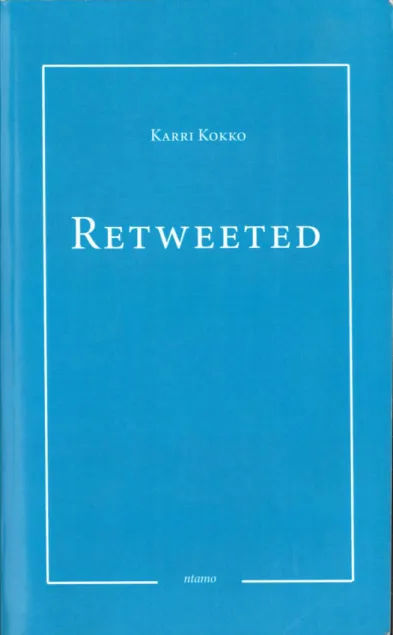
spiteful, heteroglossia, frozen in a certain point in time, but ultimately, its main narrative is found etched into its paratextual elements, rather than emerging from the actual textual material. The choir does, indeed, sing, but it does not sing a song of itself; rather it sings in lament of the author’s late father. At the same time, however, some of the key paratextual elements of the original material – the usernames, the hashtags and the design of the user interface – have been left outside Retweeted. Only a few scattered hashtags remain, along with the blue hue of Twitter’s logo, which is replicated in the novel’s covers.
Fig. 2. The cover page of Retweeted (Kokko 2016)
Furthermore, there is no trace of visual or audio-visual material typical to digital media. I will return to this notion later, because it is crucial for the analysis of the novel’s paratextuality.
Another chorus or theme emerges from the choir of tweets, however. Twitter, tweets, tweeters or tweeting are mentioned over 1060 times – even if one leaves deictic references out of the count. This outnumbers all the other recurring words or themes. Thus, in the light of Retweeted, the topic that most often emerges on Twitter seems to be Twitter itself (Wilkinson & Thelwall 2012). However, the omission of usernames, hashtags, (audio-)visual content and the structure of the feed lays bare the textual material shared on Twitter, or at least one corner of it. There is, thus, a clear tension between the importance Retweeted’s poetics place on its own paratexts and the omission of the source material’s paratextual elements – a tension that is further strained by the source material’s keen interest in its original platform. This draws attention, paradoxically, to paratextuality, especially in the context of Twitter, and calls for a closer examination of the production of the textual material used in the making of Retweeted.
Paratextuality in Twitter and Retweeted
Paratexts are generally known as the thresholds of the text, or signifiers that give sense and meaning to the textual whole. Gérard Genette defines them as “those liminal devices and conventions, both within and outside the book, that form part of the complex mediation between book, author, publisher, and reader” (Genette 1997, 5–6). They can be divided into epitext, which includes texts placed far from the main text, such as reviews and the author’s commentary, and peritext, which refers to texts placed near or around the main text, such as the typography, the name of the author, the cover, the titles as well as possible prefaces, dedications and postscripts (Genette 1997, 5–6, 34). Recently, the importance of paratextuality has gained prominence in discussions on the post-postmodernist novel (Pignagnoli 2018). This possible shift in literary paradigm has been catalysed by, for instance, the internet (Huber 2014). Paratextuality as a concept has been coined in the context of and for the use of print media (Green 2014, Pignagnoli 2014, Tavares 2017), whereby transferring it into the context of digital or computational (Hayles 2017) media – where the texts that are both visible and invisible to the reader are in constant flux (Aarseth 1997, 62) – might require slight adjustments to the term and its use.
First, we must differentiate between the paratextual elements of an individual tweet and the paratextual elements of the entire Twitter feed, which are both closely entwined with the design of the user interface (UI)4. I will begin the analysis by examining the peritext of a single tweet and the related aspects of the UI, since their relationship is also paratextual. After that, I will proceed to the epitexts.
The peritext of a tweet consists of hashtags (#), the user handles marked with @, and the UI, which surrounds and enables both the reading and writing of a tweet. Hashtags are probably the most significant feature of Twitter. According to Merja Koskela and Tanja Sihvonen (2018, 32), they function as 1) metadata, 2) a form of special language, and 3) an arena for linguistic creativity. In sum, they serve as means of connecting, collecting and sharing, and they can be used to note a subject, an event, or an occasion (Murthy 2013, 3). All these functions are utilized in Retweeted as well: repeated hashtags clearly mark ongoing discussions and active topics, but many of the featured hashtags also display self-reflexive wordplay and irony.
4 Here, I diverge a little from book historian Johanna M. E. Green’s (2014) insightful account of Twitter’s paratextuality. She
analyses both Twitter feed and single tweets as digital pages, and thus contributes to the discussion whether or not digital texts are as worthy of analysis as printed books and manuscripts. Green categorizes Twitter feed’s paratextuality as follows: tweets, with all their medial features, constitute the text proper; the rest of the user interface surrounding the feed comprise the epitext; and everything not visible on the screen but still related to Twitter could be considered the peritext. She also applies these categories to single tweets as they appear in the context of the user interface. In this case, the text written by the user is surrounded by epitext that consists of:
1. The avatar of the user
2. Their Twitter handle (i.e. username) 3. The other users they reference 4. The links and images they include
5. Epitextual elements included in the tweet by the platform, rather than by the author, including such options for interaction (or annotation) as the ‘reply’, ‘retweet’ and ‘favourite’ buttons
6. Information on other users’ interaction with the message (Green 2014).
My deviation from Green’s analysis concerns, first, the replies and, second, the other tweets appearing on the user’s timeline. These two elements are excluded from her analysis (she simply names them “annotations”), whereas I categorize them as parts of the feed’s and a single tweet’s epitexts, due to their reframing function. In addition, they are visible in the UI as much as all the other elements mentioned above.
The brevity of a single tweet has its roots in both telegrams and text messages (Murthy 2013, 2–3, 14–16). Historically, new media have often been viewed as threats to their predecessors: telegrams were feared to make letters obsolete, and telephones were to do the same to telegrams. However, instead of replacing them completely, the new medial forms actually seem to highlight the qualities and affordances of the older media (Murthy 2013, 16). The original length of a single tweet, 140 characters, derived from the length of another form of messaging, the SMS. An SMS has space for 160 characters, but the 20 characters differentiating these two formats were reserved for the tweeter’s unique username. The origin of this length limitation put on the SMS is actually quite arbitrary: it was suggested by the inventor of the SMS, Friedhelm Hillebrand, who simply considered it an adequate length for any message he could imagine himself sending (Milian 2009). The SMS also has another father candidate, Finnish engineer Matti Makkonen, who always detested the title, however, as many other people on his team worked to develop the technology as well. Makkonen expected the character limit on the SMS to develop language, and in terms of privacy, he compared the SMS to the preceding medium of letters. (Kelion 2012.) Based on all this, the origins of the SMS – and Twitter – are saturated with the ideals of co-creation, multilingualism, and the evolution of language and its mediums, all of which are also embedded in the idea of uncreative writing (Goldsmith 2011).
One of the key functions of paratexts is naming the authorship, and on Twitter, this function is connected to the user handles. These usernames are often associated with verifiable and transparent identities, but they can also be aliases or connected to bogus accounts or bots. Authorship carries a lot of interpretational weight. Even though the power invested in the message of the text by the author is usually significant, the lack of authorship (i.e. the omission of most Twitter handles) in Retweeted reveals another approach: the more time we spend skimming through the content, the more we start to pay attention to the repeated words, wordings, themes and affects, while the context provided by the author’s name fades into the background. It is also worth noting that, in the context of Twitter, some of the elements Genette considered to be parts of the epitext actually become peritext, or even parts of the actual text. A good example of this is a retweet that is complemented with an added commentary by the retweeter.
In the genre of literary collages, the homogeneity or heterogeneity of the used material is another important variable affecting the perception of authorship (Piippo 2018): what kind of sources are used, how many sources are there, and what is their relation to each other? Twitter has been described as the medium of the elites (Murthy 2013, 109–110) because its user profile boasts a high number of journalists, politicians and various kinds of influencers, while the total number of users is significantly smaller than, for example, on Facebook or Instagram (Isotalus, Jussila & Matikainen 2018, 12–13).
Varjofinlandia (2005) – another literary collage from Kokko’s internet-inspired series of works – uses
depression-themed blogs by various authors as its main sources. The blog format does not set many restrictions on writing, but the blog posts in question share the same topics, and their similarities in writing style also help to create a coherent mood for the work. In Retweeted, there are multiple (former or initial) writers, topics and styles as well, but the writers are all using a very restricted writing platform (Green 2014), which also steers them toward a certain kind of behaviour (Mäkelä 2019). This same observation applies to Kokko’s Das Leben der Anderen (2010), which is assembled from material collected from the author’s own Facebook newsfeed. In both Retweeted and Das Leben der Anderen, many of the recurring topics thus revolve around the platform in question, and the textual material utilized in these works have a tendency to address a limited audience, whereas the material in Varjofinlandia seems to construct a much broader, less defined audience.
Interfaces are central to understanding the analysis of Twitter’s paratextuality. The same applies, of course, to the codex, the interface of Retweeted, since “[f]ar from being a transparent or neutral vehicle, the codex can have a typological identity that affects the way we read and understand the texts it presents” (Nichols & Wenzel 1996, 1–2). The interface can thus be considered a liminal text, something residing on the boundary of the actual text (Galloway 2009). This connects user interfaces to Genette’s concept of the paratext, which shares the same attributes (Tavares 2017, 18). The UI, however, is never singular, but plural, for they tend to incarnate as various versions over the years and across different devices. Twitter’s main platforms are iOS, Android, and the web (Newton 2016), all of which feature slightly different user interfaces, and all of which are typically used in significantly different contexts, in the office or on the move. In 2011, Twitter changed its web interface by switching the feed to the right-hand side. This left other parts of the interface, such as lists of popular or ‘trending’ hashtags and the user’s own short bio, on the left-hand side – which, of course, is usually the starting point for reading Indo-European languages, and thus crucial for interpretation. It has also been observed several times that the new layout fits the golden ratio, which is generally considered pleasing to the eye. In 2017, Twitter also rounded the user icons and changed the font slightly, which was, again, meant to provide a more amicable and unobtrusive appearance to the site.
The mechanics of the feed – the hypotext of Retweeted – have undergone some changes as well. Until 2015, Twitter’s feed was not based on any kind of an algorithm but simply presented the tweets in reverse-chronological order. After that, Twitter has gradually introduced an algorithm-based feed (Newton 2016), which exploits the users’ actions, enactions, networks and engagements. In 2018, the company brought back the option to use the old non-algorithmic, more up-to-date and in-the-now feed (Newton 2018). The biggest change so far has been the transition from the limit of 140 characters to enabling tweets that are up to 280 characters long. Like all the previous updates, this change, implemented in 2017, was largely met with displeasure and even outrage from the users’ part. Be that as it may, all these changes, whether significant or rather insignificant, have mostly been forgotten quite fast, as the users adapt to the new versions of the interface. This suggests that the readerwriters of Twitter do not pay much attention to the paratextual elements of the design of the user interface. It is also noteworthy that the textual material used in Retweeted was collected in a period of time that predates most of these changes. Therefore, the book carries traces of past, and partially forgotten, features of the UI.
The coming together of diverse elements from different media (such as paratexts) within one congested interface has been named hypermediation by David Bolter and Richard Grusin (1999). Game statistics or scoreboards superimposed on television broadcasts of football matches are one example of this, as is the ubique presence of ‘like’-buttons under Facebook posts and tweets. The concept could also be applied to the user interface surrounding the space where one can type their tweet on Twitter. At the same time, these elements of the interface are subject to immediation, another coinage of Bolter and Grusin, which refers to the process where the user becomes so accustomed to the interface that it becomes invisible. The same happens to the paratextuality of the icons indicating likes, retweets and replies: although they are situated under the posts and tweets, they blend into the actual message.
Paratexts thus become both invisible and unquestioned. According to Bonnie Mak (2011, 34), “readers rarely regard the title of a book with suspicion, or interrogate its chapter divisions”. “The paratext says, ‘The text is thus,’ as if it were a statement of fact. Authorized by its own presence, the paratext is trusted because it exists”, Mak sums (ibid.). However, this very paratextuality of different platforms affects the material that users write and publish on them. Therefore, the steering power of paratexts is also pertinent to the literary
collage of Retweeted, which reproduces this material. In general, the distinction between textuality and paratextuality seems to leak when the shared and referred texts and sources are embedded in the same interface.
According to Genette, commentary is a paratextual element – so, how should a retweet with elaborate foreword be treated? Here, the authorship over an action in the context of the platform and the design of the user interface become important; the reading context defines the paratext. This logic also affects other elements that, in another context, could be understood as discussion rather than as communicative acts attributable to one author. Comments, whether they are made by authentic users or generated by bots, become the paratexts that surround the main texts and, thus, have an impact on individual tweets’ significance and tone, and – even more importantly – take part in forming the affectivity of the entire platform. In the book, the tone is created by the text, on Twitter it is created by the paratext.
Rinse and Repeat: Removing and Replacing Affectivity
Reading a codex is often regarded as a solitary act, whereas a sense of sharing and being connected have been considered characteristic of internet-based social media platforms. However, both the readable content and the variables of the reading situation – the place, the reading order and the time spent with the text – always differ from one user to another, as literary scholars well know. For example, what we call a “feed” appears different to every viewer due to the algorithms behind it. In this sense, there is no single platform called “Twitter”, but a multitude of affective environments of readingwriting and meaning-making. Due to their affectivity, paratextuality and context influence the writing of a tweet in important ways, but they are not retraceable or transparent to the reader-writer who encounters the tweet next in the line of sharing. Social media platforms offer and assume both undetermined and highly segregated audiences (Bozdag 2013), and many of them set restrictions related to length of the texts. These restrictions also mask, unmask and shape social relations and hierarchies, as well as logics and relations of the production of revenue. For instance, social media platforms tend to encourage and reward highly affective and easily relatable and appreciable narratives (Mäkelä 2019).
The contemporary semiocapitalism (Guattari 1996) is, indeed, characterized by the constant circulation of quantifiable and reinvested exchanges that produce further exchanges (Colebrook 2002). This is the economy of affects. Affects and affectivity are at the core of social media platforms; they make the users’ hearts race and blood boil, and they form the experiential spheres that encompass all the texts, paratexts, and readingwriting situated in these platforms. Affective tweets or updates also tend to translate into more screen time, more reactions, more retweets and clicks, which, in turn, generates more money for the companies who own the platforms (Nealon 2012, Paasonen 2018). As Susanna Paasonen puts it:
[I]n return for access to the connections and functions that a site or app offers, users give it the rights to – and indeed the ownership over – the content that they produce by posting, commenting and sharing, as well as to the data that the platform automatically generates and stores of people’s social connections, consumer and lifestyle preferences, travels and visits, interests, values and beliefs. (Paasonen 2018, 1)
Affectivity is also closely tied to reverberation, which Adi Kuntsman (2012, 2) defines as “a concept that makes us attentive to the simultaneous presence of speed and stillness in online sites; to distortions and resonance, intensification and dissolution in the process of moving through various digital terrains”. Reverberation thus makes visible what Sara Ahmed calls “affective economies” (2004). In these systems of exchange, the power of emotions, often including hatred and hostility, accumulates through the circulation of texts. Thus, using Twitter as a source for a literary work is not mere wordplay but an act that has affective implications. One of paratexts’ inherent functions is to serve as recommendations (Tavares 2016, 18), which enhances and obscures the meaning-making systems embedded in different platforms. However, as many have remarked, previous research on Twitter has largely concentrated on the shared content, rather than on the affective mechanics of sharing and co-creating (Koskela & Sihvonen 2018, 31), possibly because affectivity and reverberation make conducting such research very difficult.
Retweeted highlights these problems in a passage that begins with ethical questions but soon turns into
something else: heteroglossia slides into cacophony and, at the same time, the topic of ethics becomes distorted. Here, the still text printed in the codex gives the reader insight into the affections that skimming the Twitter feed typically inspires:
The ethical questions that arise when journalists source from Twitter. And March puts down her coat of ice. The beautiful ruins of an ancient Armenian ghost town. Here’s what Jason Segel will look like as David Foster Wallace. How many types of orgasm can women really have? Don’t try this at home: How to start a conspiracy theory on Facebook. How old is too old to crash on your buddy’s couch? The main thing that has caused companies to fail, in my view, is that they missed the future. My latest take on how to deal with Putin. The Pointlessness of Unplugging. The sex that helped us survive: Love and defiance in an Iranian prison. (Retweeted 30–31)
The ethos of capitalism is to overcome old boundaries and expand into foreign territories. In the contemporary semiocapitalism, this means expansion into affective human behaviour. It seems that the contemporary “excess of life”, or excess of information, is so overwhelming that, instead of embracing the movement embedded in the excess, we start to limit ourselves and narrow the image of the self with organized patterns of behaviour. In other words, we repress the excess and other disruptions to life, the creative force and encounters that transgress its boundaries. When internet-based social media platforms promise us “more”, they actually mean “more of the same”, rather than, for example, greater diversity. Retweeted underlines this notion. In the absence of clear narrators, characters or referents, all the deictic words included in the work start building an imagined referent (Mäkelä 2019, 167–168; Anderson 2006/1983) – or an imaginary stage or scene as discussed above. Immersing oneself in Retweeted makes the supposedly wide-open web feel a tad constrained, self-conscious and parochial.
What happens in Retweeted in this regard is, in fact, quite eye-opening. According to Matti Kangaskoski (2019), the codex allows the reader to spend time with the text, to re-read and double read, to compare and juxtapose its elements freely, which enables “a meticulous reading of the whole totality with the background notions of unity, coherence and intentionality”. Retweeted challenges this notion of coherence and, partially, the idea of intentionality as well, in spite of unfolding its narrativity and affectivity in the offline context of a codex. Due to these qualities of a printed work, it can no longer react to the users’ interactions, nor can it
be rearranged, commented on or shared within its medium. The strategies of uncreative (Goldsmith 2011) or procedural writing aim to dismantle and deconstruct both the myth of the author as a creative genius and the supposedly close connection between writing, experience and authenticity.
When the design of the interface, including the like buttons and other medium-specific features, are omitted along with the usernames, which would indicate the identities of various tweeters and retweeters, the paratextuality of Twitter is lost. As a result, the platform becomes demediated. In its original art-historical sense, demediation denotes something that happens when a book is “tampered with” and at least partly “detexted”, so that “a transmissable text or image is blocked by the obtruded fact of its own neutralized
medium” (Stewart 2010, 413, original emphasis), which results in a singular book object. In a broader sense,
demediation can refer to (intentionally achieved) dysfunctionality of the medium or its affordances (Keskinen 2019). In the case of Kokko’s book, this process could also be described as remediation since it transfers the textual material, its contents and its effects from the medium of a social media platform to the medium of codex. From another angle, this could also be categorized as demediation, since demediation usually includes some sort of remediation. In experimental literature, demediation can affect either the mediating function of the medium itself or the semiotic level of the text, although it is not always easy to make a clear distinction between the two. In any case, it is rare that either of them would be demediated – that is, suspended, blocked or suppressed – completely.
Retweeted applies demediation in the sense that it destabilizes and undermines the traditional medium of the
codex by filling it with textual matter that verges on unreadability (Goldsmith 2011, 16). More importantly, however, it demediates the platform of its hypotext – the Twitter feed. On Twitter, and on social media platforms in general, the ongoing commentary, appropriation and reframing always create an ever-present sense of change and flux. As discussed above, these platforms are not so much meant to convey the semiotic content of the posts as the affects and reactions they can produce. As a codex, Retweeted halts this productive feedback loop of affects, affections and reactions, which is an inseparable part of Twitter’s materiality, mediality and logic. By reproducing (most of) the semiotic textual contents of the tweets but combining them into an “unreadable” whole, Kokko’s book erases Twitter’s paratextual elements and halts its medial affordances. In this regard, demediation seems to offer better insight into the transformative potential of the collage codex than remediation does. I argue that the texts collected in Retweeted have been demediated as social media texts due to the author’s act of “hand-picking”, and then remediated into a literary collage that is published in the form of a codex. This new medium seizes the paratextuality of both the source material and the codex, and uses it to build new meanings and narratives, as I have demonstrated. To misquote
Retweeted, this whole process could, indeed, be described as follows: “pick, rinse and repeat”. The question
that remains, however, is: what is being thrown out with the bathwater?
The meaning-making logic of Retweeted differs significantly from that of a single user’s Twitter feed: there are no names, no indicators of social status, no clickable links nor screen time statistics that the platform’s algorithms could analyse and the company then utilize. Since the affectivity of Twitter is so closely intertwined with its paratextuality, removing paratextual elements “rinses off” a significant portion of the texts’ affectivity – and relevance. Kokko’s printed collage and the uncreative writing procedure behind it thus seem to bend and partially break the revenue-producing logic of online platforms. The codex is delightfully offline and idle. It is relevant to note that printed literary collages are often print-on-demand publications – this is the case with Retweeted – or limited-edition artists’ books (Keskinen 2016, 86). Hence, one can assume that there is no great financial profit of mass-production to be gained from producing such
books.5 On the contrary, the print-on-demand format renders concrete many of the themes discussed above. According to Whitney Anne Trettien (2013), the print-on-demand system rearranges “the boundaries between books, facsimiles, electronic files and databases and, in the process, reconfigur[es the] relationships between readers, authors and editors”. This is a crucial point to consider when discussing literary works’ critical or counter-cultural potential in relation to the overwhelming economy of affects.
Conclusion
There is no particular point at which the internet stopped being free, diverse, or promising in the sense that it actually never was. One can, however, pinpoint one significant change: the time when the three giants, Facebook, Google and Amazon, leapt forward and practically seized the ownership over the internet. It is interesting how fast we forget how things used to be, or how the internet used to look like. Facebook and Twitter, for example, have had several different layouts across different versions of their user interfaces. As a printed, analog, offline object, Retweeted is a time capsule for some of the content that was read, written and shared at a certain point in Twitter’s history. This preserved content also bears traces of the affectivity and logics of social media platforms from that time.
The codex does not enable the monitoring of screen time as digital media does. It offers its users (at least relative) freedom to choose the time they spend reading it – and whatever choice the reader makes, it does not have consequences for the codex itself. Retweeted allows observing the close-knit relationship between affectivity and paratextuality in social media. Through both creative and uncreative artistic practice, it builds a narrative, which makes use of paratextuality in an unexpected way. All this could – and, as I have argued, should – be applied to the reading and interpretation of Twitter as a platform as well. Paratexts can take over the meaning-making process, and they can fool us: not all usernames refer to authentic authors, and not all tweets stem from authentic experiences, no matter how affective the experience of reading them may be. The critical, creative, interpretive and antidotal potentiality of printed analog collages resides precisely in their ability to rinse and repeat – to dismantle, rearrange and recreate textual, especially paratextual, relations. This phrase, “rinse and repeat” is, after all, an imperative, a prompt to experiment and replicate. As Retweeted (513) muses: “Don’t ask what Twitter can do for you. Ask what you can do to Twitter.”6
5 Mark McGurl (2016) has argued that print-on-demand publishing can also be motivated by the prospect of financial profits, but mostly in the case of genre fiction.
Bibliography
Aarseth, Espen. 1997. Cybertext: Perspectives on Ergodic Literature. Baltimore: Johns Hopkins University Press.
Ahmed, Sara. 2004. “Affective Economies.” Social Text 22:2, 117–139.
Anderson, Benedict. 2006/1983. Imagined Communities: Reflections On the Origin and Spread of
Nationalism. Revised ed. London: Verso.
Bajohr, Hannes. 2018. “Infrathin Platforms. Print on Demand as Auto-Factography.” In Brillenburg Wurth, Kiene, Kári Driscoll, and Jessica Pressman (eds), Book Presence in the Digital Age. New York, NY: Bloomsbury Academic.
Barry, Ellen. 2009. “Protests in Moldova Explode, With Help of Twitter”. The New York Times Apr 7 2009. https://www.nytimes.com/2009/04/08/world/europe/08moldova.html
Bolter, David & Richard Grusin. 1999. Remediation: Understanding New Media. Cambridge, MA: MIT Press.
Bozdag, Engin. 2013. “Bias in Algorithmic Filtering and Personalization.” Ethics and Information
Technology 15:3, 209–227.
Colebrook, Claire. 2002. Gilles Deleuze. London: Routledge.
Emerson, Lori. 2014. Reading Writing Interfaces: From the Digital to the Bookbound. Minneapolis: University of Minnesota Press.
Galloway, Alexander R. 2009. “The Unworkable Interface.” New Literary History 39:4, 931–955. Genette, Gerard. 1997. Paratexts. Thresholds of Interpretation. Trans. Jane E. Lewin. New York and
Melbourne: Cambridge University Press.
Georgakopoulou, Alexandra. 2007. Small Stories, Interaction and Identities. Amsterdam: John Benjamins Publishing Company.
Goldsmith, Kenneth. 2011. Uncreative Writing. Managing Language in the Digital Age. New York: Columbia University Press.
Green, Johanna M. E. 2014. “‘On þe nis bute chatering’: Cyberpragmatics and the Paratextual Anatomy of Twitter.” Studies in Variation, Contacts and Change in English, vol. 15.
http://www.helsinki.fi/varieng/series/volumes/15/green/
Guattari, Félix. 1996. Soft Subversions. Trans. David L. Sweet and Chet WienerNew York: Semiotext(e). Hardin, Marie. 2014. “Moving Beyond Description: Putting Twitter in (Theoretical) Context.”
Communication & Sport 2:2, 113–116. https://doi.org/10.1177/2167479514527425
Harding, Luke. 2009. “Moldova forces regain control of parliament after 'Twitter revolution'” The Guardian Apr 8 2009. https://www.theguardian.com/world/2009/apr/08/moldova-protest-election-chisinau
Hayles, N. Katherine. 2017. Unthought. The Power of the Cognitive Nonconscious. Chicago: University of Chicago Press.
Huber, Irmtraud. 2014. Literature after Postmodernism: Reconstructive Fantasies. Basingstoke: Palgrave Macmillan.
Isotalus, Pekka, Jari Jussila & Janne Matikainen. 2018. ”Twitter viestintänä ja sosiaalisen median ilmiönä”. In Pekka Isotalus, Jari Jussila & Janne Matikainen (eds.), Twitter viestintänä: ilmiöt ja verkostot. Tampere: Vastapaino, 9–30.
Joensuu, Juri. 2012. Menetelmät, kokeet, koneet: proseduraalisuus poetiikassa, kirjallisuushistoriassa ja
suomalaisessa kokeellisessa kirjallisuudessa. Helsinki: Osuuskunta Poesia.
Joensuu, Juri. 2016. Vuoden 65 mania? Suomalaisen kirjallisuuden hullu vuosi. Poesiavihkot 6. Helsinki: Osuuskunta Poesia.
Jungherr, Andreas. 2014. “Twitter in Politics: A Comprehensive Literature Review”. Social Science
Research Network (SSRN). doi: 10.2139/ssrn.2402443
Kahila, Satu. 2016. ”RSO kantaesittää Osmo Tapio Räihälän kuoro-orkesteriteoksen.” YLE Apr 12, 2016. https://yle.fi/aihe/artikkeli/2016/04/12/rso-kantaesittaa-osmo-tapio-raihalan-kuoro-orkesteriteoksen Kangaskoski, Matti. 2019. “Affordances of Cultural Interfaces: Reading Print and Digital Poetry in
Stephanie Strickland’s ‘V-Project’.” Image and Narrative 20:2.
Kelion, Leo. 2012. “Texting SMS pioneer Matti Makkonen 20 years on”. BBC Technology News Dec 3, 2012. https://www.bbc.com/news/technology-20555620
Keskinen, Mikko. 2016. “Facsimile: The Makings of the Similar in Graham Rawle’s Collage Novel
Woman’s World.” Image and Narrative 17:1, 86–100.
http://www.imageandnarrative.be/index.php/imagenarrative/article/view/1102/889
Keskinen, Mikko. 2019. “Narrating Selves amid Library Shelves: Literary Mediation and Demediation in S. by J. J. Abrams and Doug Dorst.” Partial Answers: Journal of Literature and the History of Ideas 17:1, 141–158. https://doi:10.1353/pan.2019.0008
Kokko, Karri. 2016. Retweeted. Helsinki, Finland: ntamo.
Koskela, Merja & Sihvonen, Tanja. 2018. ”#Hashtagin funktiot Twitterissä.” In Pekka Isotalus, Jari Jussila & Janne Matikainen (eds), Twitter viestintänä: ilmiöt ja verkostot. Tampere: Vastapaino, 31–50. Kuntsman, Adi. 2012. “Introduction: Affective Fabrics of Digital Cultures.” In Athina Karatzogianni & Adi
Kuntsman (eds), Digital Cultures and the Politics of Emotion: Feelings, Affect and Technological
Change. Basingstoke: Palgrave MacMillan.
Kuusela, Hanna. 2015. ”Neroja ja promoottoreita: kirjalliset kuraattorit nykykirjallisuudessa.” Avain 2015: 2, 35–48. https://doi.org/10.30665/av.74984
McGurl, Mark. 2016. “Everything and Less: Fiction in the Age of Amazon”. Modern Language Quarterly 77:3, 447–471. https://doi.org/10.1215/00267929-3570689
Milian, Mark. 2009. “Why Text Messages Are Limited to 160 Characters.” Los Angeles Times, May 9, 2009. https://latimesblogs.latimes.com/technology/2009/05/invented-text-messaging.html Murthy, Dhiraj. 2013. Twitter: Social Communication in the Twitter Age. Cambridge: Polity. Mäkelä, Maria. 2019. “Literary Facebook Narratology: Experientiality, Simultaneity,
Tellability.” Partial Answers: Journal of Literature and the History of Ideas 17:1, 159–179. Nealon, J. T. 2012. Post-postmodernism, or, The Logic of Just-in-Time Capitalism. Stanford, California:
Stanford University Press.
Newton, Casey. 2016. “Twitter Begins Rolling out Its Algorithmic Timeline around the World.” The Verge, Feb 10, 2016. https://www.theverge.com/2016/2/10/10955602/twitter-algorithmic-timeline-best-tweets
Newton, Casey. 2018. “Twitter is Relaunching the Reverse-Chronological Feed as an Option for All Users Starting Today.” The Verge, Dec 18, 2018. https://www.theverge.com/2018/12/18/18145089/twitter-latest-tweets-toggle-ranked-feed-timeline-algorithm
Nichols, S. G. & S. Wenzel. 1996. The Whole Book: Cultural Perspectives on the Medieval Miscellany. Michigan: University of Michigan Press.
Paasonen, Susanna. 2018. “Affect, Data, Manipulation and Price in Social Media.” Distinktion: Journal of
Social Theory, 20:1, 77–100. https://doi.org/10.1080/1600910X.2018.1475289
Page, Ruth. 2018. Narratives Online: Shared Stories in Social Media. Cambridge: Cambridge University Press.
Pignagnoli, Virginia. 2014. Paratexts 2.0: New Perspectives on Twenty-First Century Literary Narrative. Venice: Università Ca' Foscari Venezia.
Pignagnoli, Virginia. 2018. “Narrative Theory and the Brief and Wondrous Life of Post-Postmodern Fiction.” Poetics Today 39:1, 183–199. https://doi.org/10.1215/03335372-4265131
Piippo, Laura. 2018. “Aperitiffin perintö. Esimerkkinä Jaakko Yli-Juonikkaan Neuromaani.” In Mikko Keskinen, Juri Joensuu, Laura Piippo & Anna Helle (eds), Avoin Aperitiff: kirjoituksia Kari
Aronpuron kollaasiromaanista Aperitiff – avoin kaupunki. Tampere: Tampere University Press,
165–185. http://urn.fi/URN:ISBN:978-952-03-0747-9
Shields, David. 2010. Reality Hunger: A Manifesto. London: Penguin.
Stewart, Garrett. 2010. “Bookwork as Demediation.” Critical Inquiry 36:3, 410–457.
Tavares, Sérgio. 2017. Paramedia: Thresholds of the Social Text. Jyväskylä Studies in Humanities. Jyväskylä: University of Jyväskylä.
Trettien, Whitney Ann. 2013. “A Deep History of Electronic Textuality: The Case of English Reprints John
Milton Areopagitica.” Digital Humanities Quarterly 7:1.
http://digitalhumanities.org/dhq/vol/7/1/000150/000150.html
Wilkinson, David & Mike Thelwall. 2012. “Trending Twitter Topics in English: An International
Comparison.” Journal of the American Society for Information Science and Technology 63:8, 1631– 1646. https://doi-org.ezproxy.jyu.fi/10.1002/asi.22713
Laura Piippo is currently finalizing her doctoral dissertation on the experimentalism, poetics and affects
of the prominent Finnish novel Neuromaani (2012) by Jaakko Yli-Juonikas at the University of Jyväskylä, Finland. Her research seeks to formulate a coherent reading strategy for excessive, materially complex and “unreadable” contemporary literary works. Her articles on these topics have been published or are forthcoming in such international publications as Reading Today (UCL, 2018) and Humanities, Provocateur (Bloomsbury Academic).