Dynamic QoS Resource Allocation in Bluetooth Piconet
by Gaurav Tuli
Submitted to the Department of Electrical Engineering and Computer Science in Partial Fulfillment of the Requirements for the Degree of
Master of Engineering in Electrical Engineering and Computer Science at the Massachusetts Institute of Technology
February 6, 2001
Copyright 2001 Gaurav Tuli. All rights reserved. BARKER The author hereby grants to M.I.T. permission to reproduce an MASSACHUSETTS INSTITUTE
OF TECHNOLOGY distribute publicly paper and electronic copies of this thesis
and to grant others the right to do so.
JUL
LIBRARIES
Author
Department of Electrical Engineering and Computer Science February 6, 2001 Certified by_
Gopal Krishnan VI-A Company Thesis Supervisor
Certified by
Accepted by
Professor Kai-Yeung (Sunny) Siu
TheaU_uervisor
Arthur C. Smith Chairman, Department Committee on Graduate Theses A I
Dynamic QoS Resource Allocation in Bluetooth Piconet
byGaurav Tuli
Submitted to the Department of Electrical Engineering and Computer Science in Partial Fulfillment of the Requirements for the Degree of
Master of Engineering in Electrical Engineering and Computer Science at the Massachusetts Institute of Technology
February 6, 2001
ABSTRACT
The purpose of this thesis was to address the issue of resource allocation in the bandwidth-constrained environment. We focus on the provisioning of resources to adaptive multimedia applications that can change coding schemes based on available resources. We explore the issues behind designing a general call-level QoS system that reserves paid-for resources for these applications. Our primary contribution is in the algorithms for network admission control. Here we introduce a dynamic resource negotiation scheme that not only allows for adaptive flows during traffic execution, but also for QoS re-negotiations with existing flows at the point of admission decision for a new flow. Results show noteworthy increases in call acceptance rates and average number of users receiving their requested QoS.
VI-A Company Thesis Supervisor: Gopal Krishnan
Title: Chief Architect, Motorola, Semiconductor Products Sector M.I.T. Thesis Supervisor: Kai-Yeung (Sunny) Siu
Acknowledgments
This work would not have been possible if it were not for Gopal Krishnan, my supervisor at Motorola, who never ceased to amaze me with his ideas, insight and dedication. Thank you to Professor Siu for providing the essential academic perspective and reviewing our drafts. I owe my sincerest thanks to my family for their endless love and support, and instilling into me their wonderful appreciation of education. And finally, thank you to those people who have remained so close to me, you know who you are, and without you I would never have reached where I am today.
Table of Contents
I Introduction
1.1 Motivation and Introduction 1.2 Main Contributions
1.3 Thesis Structure
2
Background
2.1 Quality of Service (QoS) 2.2 Mobility
2.3 Bluetooth
2.4 Available Bit Rate Applications 2.5 Dynamic QoS Management
3
Problem
3.1 Problem Statement 3.2 Solution Overview
4
Design
4.1 QoS Framework
4.2 QoS Parameter Selection 4.3 Utility Model
4.4 Literature Survey of Dynamic Schedulers
4.5 Dynamic Admission Control Algorithm 4.6 Interval Maintenance System Overview
5 Simulation and Results 5.1 Simulation Environment 5.2 Results 5.3 Analysis 6 Conclusion Bibliography
CHAPTER 1 INTRODUCTION
1.1 Motivation and Introduction
Short-range wireless connectivity is seeing an emerging demand in consumer and enterprise markets as handheld devices are growing in usage and popularity. Both business and personal users are feeling the increasing need to have effortless, instantaneous connections to local area networks wherever they are. Additionally, they are demanding ad hoc (instantaneous) connections between their personal devices to exchange information with other users and/or to synchronize data between their own electronic devices. Enterprise users are realizing the benefits of replacing the traditional tethered Ethernet in their offices with wireless connections. According to market research firm Frost & Sullivan, this wireless local area network (WLAN) market in the United States will see a 20.7% compound annual growth rate from 1996-2003 and Yankee Group projects $1.3 billion in revenue in the WLAN space by 2002 [YAN00].
Many business trends are leading the way for the need for wireless connectivity. First and foremost, there has been significant growth in mobile infrastructure for communications. Companies depend even more on real-time information for their employees. Users' productivity increases dramatically when they can communicate easily with coworkers. Additionally, employees are working more frequently from many
different locations: home, office, and on the road. Virtual private networks and public access stations are becoming more vital.
For many small devices it will be essential to offer wireless connectivity because without it, the benefits of mobility are lost. Products such as cell phones and personal uigial as istans (rIAs) UCU111 111Ldasingly useful a synchronizatin amngsL edLa other and with laptops/desktops can occur wirelessly and instantaneously. Beyond just these devices, wireless solutions offer the convenience of reaching networked appliances that cannot be tethered easily. Companies are designing network-enabled appliances such as washing machines and microwaves for which a wireless network connection would be most applicable [YANOO]. An entire home can be networked without the clutter and labor needed for wiring Ethernet.
Wireless connectivity is an alternative to traditional tethered Ethernet and new technologies such as HomePNA (a home-networking kit that allows PC's to network through traditional phone jacks). For homes with fewer phone jacks or regulations surrounding their use (such as in Europe), wireless networking is the obvious solution. In offices, the convenience of moving a laptop from one local area network to a conference room to another local area network while retaining a video conference call is invaluable. Corporate users can bring their work home more easily by having their office laptop instantly attach itself to their home network when they arrive home. These future personal area networks (PANs), where PDAs, laptops and cell phones are all communicating wireless, are expected to transport a broad spectrum of traffic including audio, video, pictures and data.
As a response to this growing demand, many proposed standards have emerged to offer this kind of connectivity to consumers. These include, among others, Bluetooth and IEEE 802.1 lb and HomeRF. The Bluetooth protocol aims to be the lowest cost and most robust solution to short-range wireless connectivity. Bluetooth was conceptualized by Ericsson and developed by the Bluetooth Special Interest Group as a cable replacement technology primarily for low-cost mobile devices. The first release of the protocol came in 1999 with very low power consumption and data rates of up to 1 Mbps. The range varies from 10 meters for low power to 100 meters for the full power device. For Bluetooth enabled devices, the key feature is its ability to instantaneously connect devices when they are within transmitting distance of each other. A user's PDA will automatically synchronize itself with his laptop when he brings them close together. Two Bluetooth laptops can also instantly network with each other to allow for file exchange when they are near one another. The technology supports up to 8 nodes per piconet and uses a Frequency Hopping Spread Spectrum scheme in the 2.4 GHz range. The emergence of the scatteret concept will allow a greater number of devices in a Bluetooth network. A noticeable feature for voice/data convergence is that Bluetooth can support up to 3 simultaneous voice channels while still running 5 other data flows [BLU99].
One of the major problems facing this technology however, is the fair handling of heterogeneous traffic to guarantee a specified level of quality of service (QoS). The proposed Bluetooth standard attempts to addresses this issue, however we believe many improvements can be made in the manner Bluetooth handles real-time traffic such as voice telephony and streaming video.
Support for such multimedia applications over the Internet is presently in very early stages. Real-time traffic can run seamlessly in corporate environments where bandwidths range from 1 Mbps to 100 Mbps, however an environment where bandwidth is constrained and inconsistent poses a large barrier for these applications. In public access networks for example, the guaranteeing or reservation of resources in a highly contentious, low resource environment is a very difficult problem. The Internet Engineering Task Force (IETF) has been developing recommendations towards issues related to security, pricing and guaranteeing of services in the Internet. Because of the best-effort nature of packet transmission in the Internet, IETF has devised protocols to expand the ability of public access networks to handle real-time traffic. These include the Resource Reservation Protocol (RSVP), Internet Protocol version 6 (IPv6), and Real-Time Transport Protocol (RTP).
QoS in Bluetooth faces similar issues as public access networks. It was designed as a low-bandwidth, low-power consumption protocol ideal for mobile environments. Thus, available resources are changing rapidly as users move in and out of a Bluetooth network, making maximum resource utilization a difficult task.
1.2 Main Contributions
The primary focus of this research is to address the issue of resource allocation in the bandwidth-constrained, mobile, Bluetooth environment. For our study, resource allocation consists of three distinct functions: admission, scheduling and maintenance. We focus on the provision of resources to adaptive multimedia applications that can
designing a general call-level QoS system that reserves paid-for resources for these applications. We hope the research is applicable in most mobile environments where available resource conditions are changing frequently. Our key contribution and focus is in the algorithms for Bluetooth network admission. Here we introduce a dynamic resource negotiation scheme that not only allows for adaptive flows during traffic execution, but also for QoS renegotiations with existing flows at the point of admission decision for a new flow.
More specifically, our main contributions include:
* Recommendations on a QoS signaling framework suitable in the mobile environment
. A selection of essential QoS parameters with negotiable parameter windows
. A versatile model of resource utilization in a paid-for-resource environment
. A survey of dynamic scheduling routines
. Algorithms for optimal bandwidth provisioning at admission control . Stochastic simulation of network at point-of-admission decision . Recommendations for QoS interval maintenance routines
1.3 Thesis Structure
The remainder of this thesis is arranged as follows:
. Chapter 2 provides background information on many of the important issues related to our research including quality of service, mobility, Bluetooth
technology, adaptive rate multimedia applications and dynamic
QoS
management.
* Chapter 3 presents our problem statement, proposed approaches and the solution overview.
utility. We survey dynamic schedulers and detail and justify our admission algorithms. Additionally we discuss options for interval maintenance routines.
- Chapter 5 discusses the simulation environment and results of our research in admission algorithms.
* Chapter 6 offers concluding remarks and an overview of directions for future work in this area.
CHAPTER 2 BACKGROUND
2.1 Quality of Service 2.1.1 QoS Overview
Future personal area networks (PAN) are expected to reliably transport a broad spectrum of traffic including audio, video, pictures and data. Each of these traffic types places a different set of requirements on the network carrying it. Digital audio and video streams found in modem multimedia applications for example, demand a level of service quality that is not necessarily attainable by traditional "best effort" networks. The nature of this type of data requires that networks provide for low delay, jitter and packet loss so that a continuous and timely data stream is received at the destination. Multimedia data can often tolerate a certain level of loss or corruption, but its delay requirements are often stringent so that the stream remains uninterrupted. On the other hand, data traffic (such as FTP transfer), which is more latency tolerant, requires a strict level of data reliability.
The varying requirements of different data types leads to the need for a measure
of service quality so that each type of traffic can define its requirements. The traditional
measures of service quality are delay, jitter, bandwidth and reliability [FH98]. Delay is the length of time elapsed from transmission to arrival. For interactive network applications, long delay is undesirable. Jitter is the variation in delay experienced by the receiver. High levels of jitter result in a discontinuous stream, which is inadequate for
audio and video. Bandwidth is the maximum transfer rate associated with a transmission channel. Multiple flows may occupy the channel and share a given bandwidth. Some applications require low bandwidth, such as the transmission of control information, whereas others demand high bandwidth, such as video streams. Finally reliability is a meiSUr 0f a 11twU.Lrk's error rate. 1111s inL1tUes osing packtLs UUe L) congestion or retransmitting due to corruption. An unreliable voice stream may sound broken and "crackly" at the receiver.
These measures of service quality can be used to broadly categorize traffic into two classes summarized in the table below:
Class I Class II
Name Real-time Non-real-time
Examples Voice & video Data services
Delay Bounded Unbounded
Jitter Bounded Unbounded
Bandwidth Guaranteed Not guaranteed
Reliability Loss-tolerant Zero-loss
Time Probably defined Not defined
Time Slots Defined N/A
Table 2.1: Traffic Classes
Having defined measures of service quality we can now use the following definition of quality of service (QoS):
A network that provides QoS differentiation for applications must also be able to reliably deliver this QoS consistently and predictably [FH98]. There are 3 primary approaches in guaranteeing a given set of QoS parameters. The first method treats all traffic equally by simply assigning a maximum packet delay that can be guaranteed. The other two methods rely on the fact that the data being transmitted is either class I (time-bounded) or class II (not time-(time-bounded). Method 2 gives highest priority to class I services and allows them to run to completion before class II services can begin transmitting. Method 3 allows both classes to transmit simultaneously, however if class I services are not meeting their QoS guarantees because class II is also transmitting, then class II will be temporarily delayed towards transmission of data within the latency tolerant interval. Method 3 obviously has the best bandwidth efficiency of the three in heterogeneous traffic but may require a complex algorithm to allow for arbitration between Class I and Class II packets [SET98].
2.1.2 QoS Survey
Because most of our work involves the provision of QoS in some manner, we provide here a brief survey of existing QoS systems. We divide the mechanisms of delivering QoS by the network stacks/layers.
Quality of service is a set of the measures of service quality a given application requires for proper operation.
2.1.2.1 Physical layer
We view the physical layer as the lowest level of hard-wired paths within a network where the primary concern is the delivery of bits (in whatever form they are
rLCe1VeU 1r1m hihe 1ayers) intR d channel. T1us aL tMs 1ayr, pruvisioing Of
Q03
canonly be done through providing multiple paths (multiple frequencies / tones for Digital Subscriber Lines and multiple time slots for Bluetooth) to destination. In this form, the QoS provided is termed differentiated services. Traditionally, the creation of multiple paths has been for backup purposes, as would be needed in the case that a primary link fails, but with TDM based services the multiple paths are increasingly aimed at QOS convergence. However, if the two paths offer different physical characteristics that result in distinct bandwidth and delay properties, higher layers protocols can transmit data through either path depending on the QoS requirements of the data.
Problems with this method are two-fold. First, higher layers implement signaling systems so that the receiver can determine traffic parameters. Unless intelligent signaling is implemented, the feedback mechanism between the sender and receiver will result in the lowest quality of service link in multiple paths to shape the flow. This removes the
effectiveness of having multiple paths at the physical layer. Secondly, asymmetric send/receive paths could result in ineffective signaling where the receive path acknowledgments may give inaccurate measures of link latency.
The link layer frames data for point-to-point, error-free transport through the physical layer. QoS is implemented in this layer in Asynchronous Transfer Mode (ATM) networks and proposed by IEEE 802.1p for Ethernet LANs. ATM provides a very broad but complex virtual circuit system to provide QoS in its networks. It differentiates traffic into 4 requirement sets and guarantees service in some form for each of them. Constant Bit Rate (CBR) applications require a constant level of bandwidth and maximum delay bound. These include voice and some video applications and are given virtual circuit treatment by ATM. Real-time and non-real-time variable bit rate traffic (rt-VBR and nrt-VBR) are treated as applications that transmit at variable rates through the lifetime of their connection. Rt-VBR traffic is categorized as multimedia streams that can tolerate some cell loss or impaired cells. Because of the delay requirements of the flows, when cells rt-VBR traffic become excessively delayed, they become of little or no value to the receiver. Nrt-VBR traffic is targeted for transaction-based applications where traffic is expected in bursts. In such traffic, a bandwidth guarantee is required for the applications to run effectively, though delay is not a necessary component. Available bit rate (ABR) applications dynamically modify their coding scheme to adjust to the available resources in the network. ATM provides feedback to the originators of this traffic class so that they can fully utilize the network for their service. Finally unspecified bit rate (UBR) applications are essentially best effort. Flow control and time synchronization between the source and destination do not occur. This type of handling is appropriate for data transfers, such as with FTP.
The primary problem associated with ATM QoS handling is its complexity and as a result, network administrators have been hesitant to use its diverse features. Added to
this problem however, is that ATM is not widespread enough to have these QoS implementations be useful. For true end-to-end QoS in an ATM system, the entire connection must have ATM at the link layer. This is a rare case however. More often than not, ATM only provides the link layer at a small segment of the larger traffic path. As a rcsult, thc cnd-to-end characteristics are what shape the flow and the effectiveness of the QoS implemented in ATM is significantly reduced. Additionally, higher layer protocols that manage flow and congestion control in their own way will force ATM to receive inaccurate information on its own portion of the flow.
IEEE 802.1p provides mechanisms for prioritized traffic in an Ethernet or token ring environment. At the link layer, it defines a user priority field that offers up to 8 different priority levels. Specialized queuing systems ideally would be able to map this priority field into a relative queuing order in LAN switches and routers.
2.1.2.3 Network Layer
At the network layer in the global Internet, we look to TCP to provide any mechanisms for quality of service. For reliable, adaptive rate transmission (this does not necessarily imply adaptive-rate applications as in ABR traffic), TCP provides several end-to-end procedures for congestion avoidance. In an attempt to find a stable point where the sender and receiver are performing at optimal and equal rates, TCP uses two mechanisms. First TCP slow start incrementally injects traffic at a higher rate (by increasing TCP window sizes) until congestion in the network is seen. When this occurs, the second mechanism, congestion avoidance, significantly (often halving) reduces the
avoidance works well in most situations. However, where many flows are simultaneously existing, an unstable state can be reached when all are hitting congestion at the same time on a consistent basis.
Other network layer mechanisms are:
. Resource Reservation Protocol (RSVP) provides a signaling mechanism for notification of necessary allocations
. Prioritized packet discarding in queues based on Internet Protocol's (IP) Type of Service parameter
. Scheduling algorithms that provide preferential treatment towards
differentiated services (e.g. priority queuing, weighted fair queuing)
2.2 Mobility
The introduction of mobility into personal area networks introduces problems and complexities not found in traditional stationary networks. A mobile ad hoc network is characterized as a distributed system of independent mobile nodes connected through a wireless medium. These nodes act as both hosts and routers in an ever-changing network topology. Mobile ad hoc networks are often relatively low-bandwidth (as compared to stationary LANs) and are dynamically interference prone. Because mobility allows freedom to move over short distances, network conditions can change frequently and drastically. Users in a mobile environment can move in and out of the ad hoc network as they wish, and thus available resources within the network are changing unpredictably. Thus, the issue of predictable response to this changing environment is an essential
problem to QoS in a mobile system. Such networks require highly adaptive architectures to maintain a reasonable level of network utilization.
The impact of mobility on QoS has two key components:
. Link type
L 1-in~k opertbIIs in moiesys-tems C are signifLicanly different WhaI
traditional cabled networks because of low bandwidth and higher unreliability. Modem wireless systems are often an order of magnitude less in bandwidth than fixed networks. Therefore, multimedia applications which can have bandwidth requirements on the order of Mbps may run seamlessly in a wired Ethernet, but will face considerable obstacles in the wireless environment. Therefore, in providing QoS, mobile systems must try to dynamically utilize as much of the available resources as possible.
. Movement
As devices move from one mobile network to another, a handoff occurs so that the flow may continue uninterrupted. This puts stringent requirements on the QoS management system because it must either predict mobility or face frequent connection blocking. Because movement causes variation in the available resources of a particular link, QoS systems must provide operational ranges rather than hard allocations. Movement also adds the requirement that the mobile QoS architecture must accommodate the frequent entrances and exits of devices. However
2.3 Bluetooth 2.3.1 Overview
The Bluetooth protocol is an open standard for mobile wireless connectivity between PCs and communication devices. It is an industry-backed development targeted for voice and data transfer amongst devices over short-range (approximately 10m). It operates in the unlicensed 2.4 GHz Industrial-Scientific-Medical (ISM) band where it performs coordinated frequency hopping. Initially created as a cable-replacement technology, its applications were meant to include simple ad hoc networking between PCs and peripheral devices (such as PDAs and cell phones). Because of low-cost and low-power consumption projections, the 9mm by 9mm Bluetooth chip's applications have expanded to also include home networking and advanced network-enabled wireless appliances. Additionally, the protocol benefits by connectivity that does not require line-of-sight and works well through most walls and objects.
The Bluetooth Special Interest Group (SIG), the certification and standardization body for the protocol, consists of 2000 member companies and was founded by Ericsson, IBM, Intel, Nokia and Toshiba. Additionally, primary supporters include Motorola, Microsoft and Lucent. By using the resources and expertise of each of these companies, the technology has grown to be a robust and rapidly growing protocol. In its present form, it supports 780 Kbps in asymmetric mode (721 Kbps down-link, 57.6 Kbps up-link) and 432.6 Kbps in symmetric form. Additionally, it can support one asynchronous data channel with 3 synchronous voice channels simultaneously or a single voice/data
channel. With these facilities, applications such as hands free headsets and automatic synchronization with personal devices are intended to work seamlessly.
2.3.2 Network Profile
Tle 1uet-oohLII dU IaUL; and stationary networking scheme allows Ror grouping of
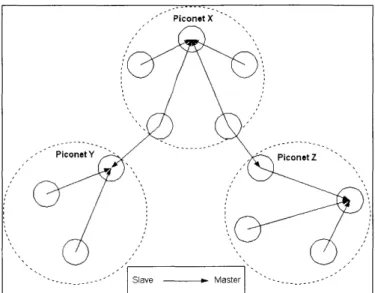
clients into piconets and the extension of piconets into Scatterets. Devices can exist standalone or as members of a piconet as they move within and out of range. Piconets grow in an ad hoc manner from 2 members, to include up to one master and 7 slaves. Although all members have equivalent device specifications for Bluetooth, a master is designated to synchronize the clock and frequency hopping pattern amongst piconet members. Additionally, a client can be a slave in 2 piconets or the master in one and a slave in another. This allows for scatterets, or several interconnected piconets (see Figure 2.1). Each non-parked member of a piconet has a 3-bit active member address to distinguish it from other clients. Sniff and hold modes are also low-power modes (similar to park), however members retain their addresses and still participate in the network periodically. Clients enter a piconet from standby mode when they are in range of another Bluetooth device by either sending or receiving an inquiry or page instruction.
Figure 2.1: Bluetooth Scatternet 2.3.3 Architecture
The Bluetooth architecture, for our purposes, can be generally categorized into 5
roles. The RF unit operates the antenna and Bluetooth frequency hopping scheme. The Link Controller (LC), or baseband, manages the low-level link responsibilities and provisioning of data and voice channels for higher layers. The Link Manager (LM) directs the management and creation of baseband links. The Logical Link Control and Adaptation Layer (L2CAP) is responsible for providing connection oriented and connection-less links to higher layers. Finally, above L2CAP are additional interface protocols to the application layer.
2.3.3.1 RE
The RF control hardware operates the Bluetooth radio at 2.4 GHz using a 0 dBm antenna which results in very low power consumption. It uses a frequency hopping spread spectrum scheme to hop between 2.402 GHz and 2.480 GHz. Using hops of 1
Piconet X
P ic o n e t Y - - -Z P ic--
Piconet YPiconet Z
.--
----MHz, it can achieve hopping rates up to 1600 hops/sec. This results in a 625 pis time-slot. Bluetooth has a maximum symbol rate of 1 Mb/s.
2.3.3.2 Link Controller
The Link Controller is the baseband operations of Bluetooth devices. Bluetooth LC provides physical layer link specifications for two link types. Both use Time Division Duplex (TDD) schemes and support 16 different packet types. The packet types provide a variety of services including various levels of error checking, relative packet prioritization and multiple time-slot packets (1, 3 or 5 time-slot lengths). The link types may change at any point during transmission. The two link types are:
. Synchronous Connection Oriented Link (SCO)
SCO links are point to point, connection-oriented links, primarily used for time-constrained voice applications. They offer no packet retransmission but have reserved time-slots for ordered and timely packet delivery. The link is symmetric and both the master and slave can transmit without polling. Slaves can have up to 2 SCO connections to different masters. The master can have up to 3 simultaneous SCO links outgoing to slave(s). . Asynchronous Connection-less Link (ACL)
ACL links provide packet-oriented connection-less transmission primarily for data applications. The master designates link bandwidth and transmission is selected on a per-slot basis. The link can be asymmetric and slaves can only transmit when polled by the master. Link integrity is
protected with packet retransmission. Broadcast messages are also supportable over this type of link.
The baseband also provides mechanisms for error correction and security: . 1/3 and 2/3 rate forward error correction (FEC) coding
The FEC can be selected as needed based on the quality of the link. This provides some flexibility for bandwidth utilization at this layer.
. Automatic repeat request (ARQ) with time-outs
Bluetooth utilizes an unnumbered stop-and-wait protocol for transmissions. The receiver is expected to acknowledge a packet receipt in the next time-slot if the header error check and cyclic redundancy check both pass.
. Security
The Bluetooth LC allows one-way, two-way or no authentication based on a challenge-response system. This allows for personal device authentication. Additionally, encryption is provided to protect individual connections through a multi-bit stream cipher.
2.3.3.3 Link Manager
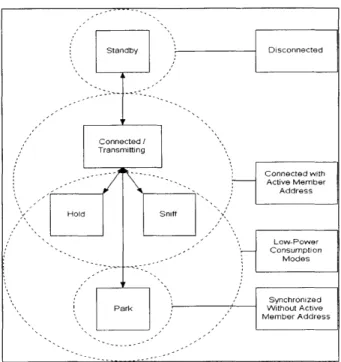
The Link Manager directs the Link Controller state machine shown in figure 2.2. It is a signaling mechanism that handles baseband link construction and destruction, security levels and control. It provides link abstractions to higher layers by communicating with other device Link Managers using the baseband protocols. It
negotiates the link types as well as monitoring of these links. Within the links, it designates frame types on a per-packet basis. It provides authentication and encryption to higher layers using the mechanisms in the baseband described in the previous section. Finally the LM is responsible for setting devices into the various active and low-power m-d-s:
11'UUU6.
. Sniff Mode
Sniff mode is a low-power setting for Bluetooth devices where it is only required to listen for transmissions at a specified time interval (negotiated by the LM). At only these time-slots, the master can transmit to this slave.
. Hold Mode
In Hold mode, a device turns off its receiver for all packets except specific notices to reactivate the connection. Either the slave or master can send this notice. Extended periods where the receiver is off will save power for the client.
- Park Mode
Park mode allows devices to remain synchronized with the piconet but requires them to give up their active member address. They do not participate in the piconet but are alert for page commands.
Standby Disconnected Connected / Transmitting --- -- - -- Connected with Active Member Address Hd Sniff Low-Power Consumption Modes Synchronized Prk ithout Active Member Address
Figure 2.2: Device Mode State Machine
2.3.3.4 Logical Link Control and Adaptation Protocol
The L2CAP layer provides 3 types of channels to higher layers using the LM to setup baseband links. These are:
1. Command signaling channels
2. Connection-oriented, bi-directional, symmetric or asymmetric channels for point-to-point communication
3. Connection-less, unidirectional, point-to-multipoint channels
These channels allow for several key features of the L2CAP layer. Specifically, L2CAP manages higher-layer protocol multiplexing, signaling, and data segmentation and re-assembly. These essential tasks are handled at this layer because lower layers have no protocol ID's within packets and have very small transmission units. The L2CAP layer
provides an interface for larger packet sizes to be passed in and segmented packets to be sent to lower layers.
2.3.3.5 Additional Interface Protocols
Aove L2CAPlie adiional inerface protls to the application layer. These include, amongst others, the Service Discovery and Association Protocol (SDAP). SDAP is a mechanism for clients to find out what Bluetooth services are available on a specific device. Each device can run a SDAP server that can be queried for available services. To use SDAP, a client searching for a service will set up a L2CAP channel to a remote Bluetooth device. Next it will perform a query for services, asking for either a class of services or a specific service. The SDAP will respond with instructions to connect to the chosen service. Because SDAP's services are now complete, the client may connect through a separate channel to the specific service requested.
2.4 Available Bit Rate Applications
Many modem applications have redefined themselves to accommodate the lack of prevalent QoS systems in public networks. Because the resources available to a multimedia application can change over time (even more so in a mobile environment as noted previously), some real-time applications have become adaptive. The simple, inefficient solution to variable rate applications is over-provisioning resources to accommodate peak rate bandwidths and other requirements. This will waste significant resources that are very valuable in mobile environments.
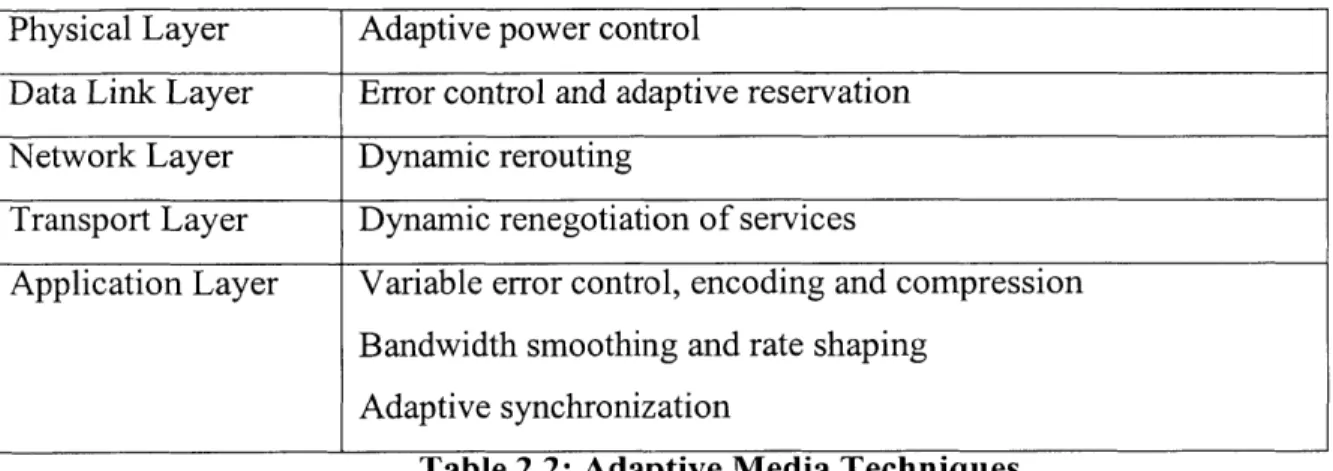
Many methods of accommodating or designing adaptive multimedia applications exist, and at various layers in the network [VANOO]. The following table summarizes the techniques used:
Physical Layer Adaptive power control
Data Link Layer Error control and adaptive reservation Network Layer Dynamic rerouting
Transport Layer Dynamic renegotiation of services
Application Layer Variable error control, encoding and compression Bandwidth smoothing and rate shaping
Adaptive synchronization
Table 2.2: Adaptive Media Techniques
Application layer techniques can be categorized into active or passive methods. Active methods will dynamically redefine the applications traffic characteristics to fully utilize the available network resources. Passive techniques have pre-prepared mechanisms of adapting to changing traffic conditions. Two available active techniques we would like to highlight are rate shaping and adaptive error control. Rate shaping is the dynamic adjustment of video encoding schemes to adapt to variable network conditions. The adaptable parameters include frame rate and quantization level. Adaptive error control is a technique where a variable forward error check is used to match resource availability with user's error service requirements [BT98, BFT99]. A popular example of many of these techniques is found in MPEG compression standards and Real Networks audio and video packages.
Dynamic QoS management addresses the changing nature of QoS requirements of traffic sources and the available system resources. Allocated resources are adjusted based on the current level of performance achieved. Such a mechanism is necessary when applications are given control of network usage. For instance, variable bit-rate
applicAationsL h1aVe_ %,1ang6ing bandILwidth needsU thRVUghl ther 111C 01 their connections. Therefore, many dynamic QoS methods exist for catering to these changes by monitoring and updating a set of QoS parameters associated with each flow [GVSS96, ROMW, FR97, ACH98, LB99, BS].
The following table summarizes some of the existing dynamic management methods:
In [BDDM93] flows are distinguished into several classes as characterized by their
QoS
specifications. By monitoring the number of refused connections and cell loss, bandwidth is dynamically updated.
In [FR97] heuristics are used to determine the amount of change for real time bandwidth adjustments based on assessment of the actual verses requested loss ratio.
In [ZK95] flows are individually divided into segments because of the variable requirements of real-time traffic. Thus QoS requirements are renegotiated on a per-segment basis for all traffic flows.
In [GVSS96] required bandwidth is estimated by counters kept at both the sender and receiver and these amounts are used to compute an adjustment value.
In [BS] the allocated resources for a flow are dynamically modified as a function of the current delay and loss performance achieved.
The major deficiency in most dynamic QoS management schemes is their inability to renegotiate the level of service provided to existing flows during the time of admission of a new flow. In other words, attempts to downgrade services provided to other flows, within the negotiated boundaries, during the consideration process of admitting a new flow, are currently not being performed. Rather, a new flow, which can not be accommodated based on current resource utilization, is immediately rejected.
Research has been done on dynamically updating the conservativeness of the admission decision as a function of the system's present ability to provide the desirable QoS specifications in the network [BS]. Inaccuracies in the methods of estimation however, may exclude flows that could otherwise be admitted if existing flows were to relax their given QoS. Additionally, such schemes cannot fully utilize bandwidth if flows may be rejected even though resources are available.
CHAPTER 3 PROBLEM
3.1 Problem Statement
The provisioning of quality of service to multimedia applications is a complex problem due to many factors related to the applications themselves and the networks they operate in. Their stringent requirements in terms of bandwidth, delay, jitter and reliability coupled with the lack of effective QoS systems in public networks results in often unpredictable service quality. The added effects of mobile environments require a more robust and complex QoS system to handle such applications.
With this research, we attempt to provide recommendations towards a QoS system for the mobile Bluetooth piconet. Deficiencies exist in the proposed Bluetooth standard because only SCO links can efficiently handle Class I traffic. With the restriction of only 3 SCO links on a piconet, an ad hoc LAN will not be able to efficiently support multimedia traffic for all users on the piconet. If one were to transmit Class I traffic on an ACL link, then it is very difficult to guarantee an efficient QoS because all data is treated equally.
Another problem that arises and must be resolved to provide QoS is the response mechanism in Bluetooth. Currently, a master is not required to respond to a slave request in the next available time slot. The master can service other slaves first before responding. This becomes a problem when dealing with Class I services because there is no guaranteed consistency in delivery delay.
QoS maintenance gets increasingly difficult when the Bluetooth device is placed in a mobile environment. For example, if the device moves from one piconet to another piconet and wants to maintain its Class I connection, the new piconet will have to remodify all client QoS guarantees in order to accommodate this new member.
i-,LtoUnLU1a1Ly, Lh UIU pic;UIIU Will haVe ALSS eSUMUCes that shuuiu be reUisLnDUtLeU. We see deficiencies in applying existing QoS management systems to such a mobile environment because current dynamic QoS management schemes lack the ability to renegotiate the level of service provided to existing flows at the point of admission decision of a new flow. The demands of mobility imply a strong effort by the QoS management system to accommodate as many users as possible in a changing environment. We feel that current systems do not attempt to downgrade or even evaluate the services realized by other flows so that a new flow can be accommodated. Thus new flows, for which resources can not be readily found, will be immediately rejected rather than further examined.
We also see the need for a robust notification mechanism that can provide for QoS management in both upstream and downstream directions. The notification system is necessary for a dynamic QoS scheme where changes in guarantees are continuously occurring. Clients can notify the master of their minimum acceptable bandwidth (or other QoS parameters) and the master can then take control by negotiating a realizable
QoS
with that client. All clients of the same master can be notified of changes in their realizable QoS. These changes can occur frequently as clients move between transferring different types of traffic. Additionally, when multiple clients are in a network, arbitrationclient (Cl) has an outgoing buffer full of pre-formatted data and a new client (C2) joins the network and requires an unrealizable QoS, then the master must be able to renegotiate with C2 or delay C2's acceptance into the network.
Because many modem multimedia applications are showing a general trend towards having adaptive rate mechanisms, we focus our work on the class of available-bit-rate applications that can dynamically adjust coding schemes in response to changing network conditions. Such applications can most benefit from a dynamic QoS system in an environment where allocation of resources may be ever-changing.
Therefore, our goal is to propose a new Bluetooth QoS architecture. For this system, we will make recommendations or contributions towards:
. Recommendations towards the underlying QoS signaling system . QoS parameter selection
. User utility model
. Recommendations towards dynamic scheduling techniques . Dynamic admission control algorithms
" Recommendations towards interval maintenance techniques
3.2 Solution Overview
To facilitate the new method of dynamic resource allocation, we begin with the need to introduce a modified set of QoS parameters. Upon request for admission, a client must present to the admitting node more descriptive information regarding the type of flow they request. Using these new parameters, we should be able to create an "image" of near-term traffic conditions that can help determine if and how to admit a new client.
With these parameters in consideration, we now present our system objective:
To allow maximum utilization of the network by admitting the maximum number of users and maximum, fair bandwidth to each user.
The consequences of this objective imply that our system will treat all flows equally, so that dynamic adjustments on QoS will be done in a fair manner. Our approach towards the admission decision is to develop an algorithm that ensures fairness in dynamically redistributing resources upon admission and during execution of network traffic. This algorithm will make tradeoffs amongst clients so that the most number of users can enter the system. The algorithm developed will maximize a utility function of the given parameters so that degradations still attempt to maximize user utility. The issue we face in the design of this algorithm is achieving optimal utilization for given network
conditions.
For example, if a user requests entry into the system with a bandwidth requirement of 200 kbps, however the available bandwidth in the network is only 150 kbps, then the admitting node will attempt to renegotiate with the existing flows. Using
the description of the flows presented at admission, the master will attempt to fairly re-distribute other flows so that they can still operate in an agreeable region.
The concept of user utility we will develop will have the potential to be used for other purposes as well. Upgrading realized QoS can occur fairly using this utility function. If a flow leaves the network, then the remaining resources can be redistributed among the existing flows by using the same utility function to compare flows.
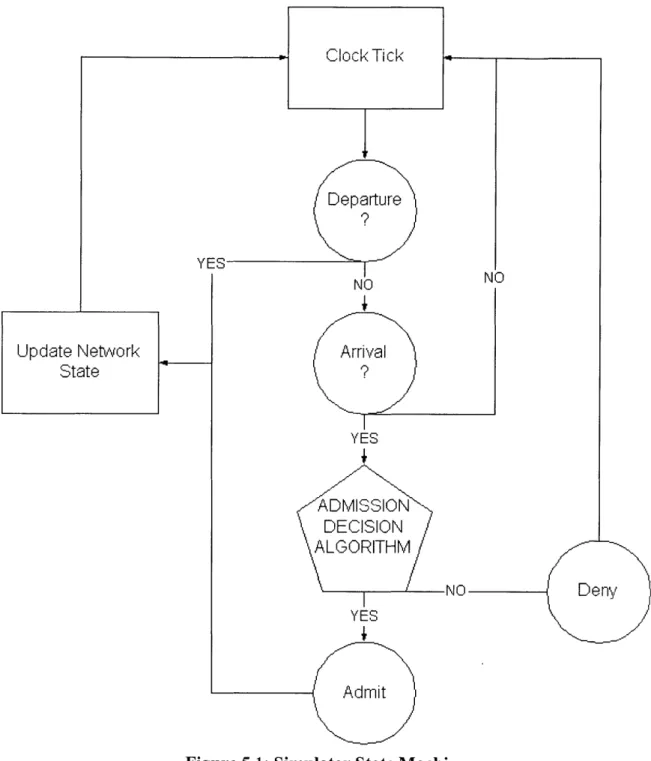
In addition to the development of the algorithms for optimal admission control, we also present surveys of existing dynamic scheduling techniques and make recommendations towards an effective interval maintenance system. Finally, we test the admission algorithms in a MATLAB simulation environment to see expected results in mobile networks.
Our goal in this work is to provide a robust mechanism for QoS management in Bluetooth systems. However, we feel our work can be extrapolated in to most mobile architectures because of its general nature and the similarity of Bluetooth to other mobile environments. Our work in QoS parameter selection and utility are particularly relevant in mobile systems and with the advent of available-bit-rate applications, our algorithms for admission control will be very valuable as well.
CHAPTER 4 DESIGN
4.1 QoS Framework
A quality of service framework forms a modular system of individual components that work together to provide QoS in a network. Developing a QoS framework allows for the integration of QoS methods at various network layers and the separation of tasks within them. This additionally provides an integrated system for end-to-end quality of service that is essential in any distributed network.
For our purposes, we design our QoS framework to include two primary divisions: QoS specifications and QoS mechanisms. QoS specification at the higher layers allows applications to indicate user requirements or flow characteristics in the form of higher-layer resources. Integrated into our definition of QoS specifications is also the QoS mapping phase, where these high level resources are translated into QoS parameters (such as bandwidth and delay) that can be regulated and monitored by the QoS system.
QoS mechanisms are responsible for using the QoS specifications to provide a realized service quality to a given user. The mechanisms needed can be broadly categorized as:
. QoS Provisioning
The provisioning task in QoS mechanisms is responsible for establishing a flow properly. It will perform admission testing to determine if the available resources can provide the requested QoS by a flow and resource
reservation to designate the end-to-end ownership of requested and deliverable resources.
. QoS Control
QoS control techniques provide real-time traffic administration at traffic time-scales. For example, flow control is a passive technique that uses either deterministic agreements with the flow or a feedback system (like ABR applications) to control the flow of data leaving a source. Flow shaping is the enforcement of a specific data injection pattern of a source. Using flow shaping in conjunction with flow scheduling, the process of ordering the forwarding of packets, performance guarantees can be made.
. QoS Management
The goal of QoS management is to insure the agreed upon service levels with a flow are being met. These key tasks include QoS monitoring and QoS maintenance. Monitoring on either an end-to-end or individual node basis is the process of assessing the level of service quality received by a flow at that location. QoS maintenance is the process of fine tuning the monitored parameters versus the requested ones.
. QoS Signaling
QoS signaling is an essential task because it is the underlying mechanism to a QoS framework that provides a communication system between nodes and layers for building, demolishing and renegotiating links. Such a system is invaluable in a mobile environment where links are frequently
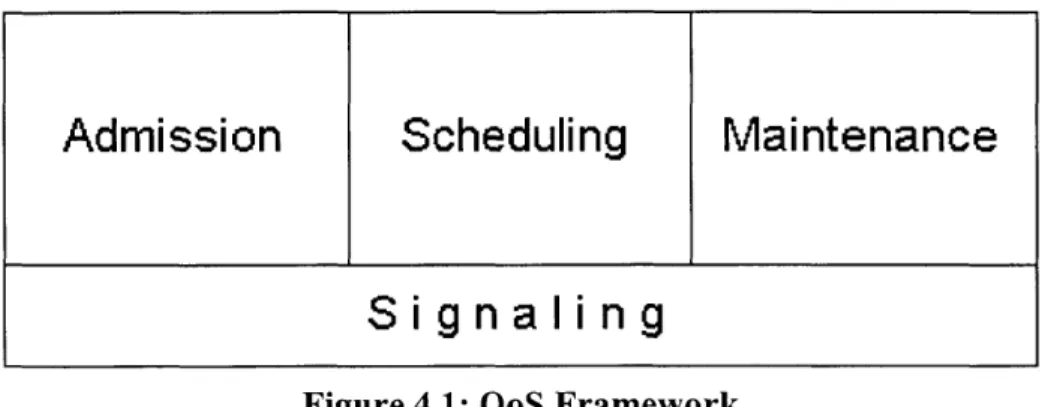
Our simplified QoS framework is depicted in figure 4.1.
Admission
Scheduling
Maintenance
Signaling
Figure 4.1: QoS Framework
The signaling mechanism used in our QoS framework must be comprehensive and robust enough to address the issues of mobility within a Bluetooth piconet. We seek for a signaling system that can accommodate available bit rate applications with a protocol for adaptive service. Thus the protocol must provide a communication mechanism so that applications can adapt to time-varying network resources. Additionally, it should offer signaling capabilities so that monitored conditions can be reported through various nodes in the system. Finally, it should offer mechanisms for fast reservations and recovery from broken links, as these occur frequently in mobile systems.
Although many signaling systems exist, we highlight one that we feel would be very applicable for the mobile Bluetooth environment. The INSIGNIA project [LZCOO] is a QoS framework for adaptive services in mobile ad hoc networks. Within the framework is a very powerful and robust signaling system that would be a good choice for the highly dynamic Bluetooth piconet. Its key features include:
. Adaptive services with max/min bandwidth designation and scaling commands
. Soft-state resource management - maintains flexible, temporary end-to-end connections
. VOS reporting
Using a signaling protocol such as that which underlies INSIGNIA, we can overlay admission control, scheduling routines and maintenance algorithms. In our framework, we create a conservative admission algorithm for paid resource reservation. Users request a specified level of service as described by the QoS parameters presented in the next section. These requests are measured against available resources by the admission algorithm. If admitted, scheduling routines provide QoS control for the sharing of a single channel by multiple flows. Finally the maintenance schemes will offer fine tuning to ensure realized and requested QoS levels agree. We do not concern ourselves with the payment schemes or cost structure.
4.2 QoS Parameter Selection
QoS parameters vary at different layers of the protocol stack. As noted previously, QoS mapping procedures are responsible for translating higher level requests in to the pertinent parameters at each layer. In a broad sense, all parameters can be characterized in to 5 categories. Performance parameters quantify received resources such as bandwidth, delay, etc. Format parameters specify rates, data formats and compression techniques. Synchronization parameters describe coupling between various
levels. User preference parameters may be particular opinion-based descriptors of received service, such as image or sound quality.
To facilitate a robust method of dynamic resource allocation targeted for available bit rate applications, we introduce a modified set of QoS parameters. Upon request for admission, we propose that a client present to the master the following information for the requested flow:
* Maximum and minimum bandwidth (B)
These parameters reflect the highest level of bandwidth the application could use while still increasing its utility and the lowest level of bandwidth the application can tolerate to still function properly.
. Acceptable bit error rate (E)
This parameter defines the application's flexibility in terms of bit errors in the data. A highly tolerant application such as voice would have a very different BER requirement than would a data application.
. Transfer size (T)
This parameter may be used by data or multimedia applications that can accurately estimate transmitted file size before connecting.
. Maximum and minimum tolerable delay (D)
This parameter is essential for interactive applications where a long delay between sending a request and receiving a response is not acceptable. An average delay window allows clients to specify acceptable delay levels.
Therefore, each requesting flow submits the following set {B, E, T, D} and for each admitted flow the master maintains this set for the given flow until the flow halts. In
addition to these parameters, the master also keeps track of total bandwidth usage (at current time), the current bandwidth usage of each flow in the piconet, and the length of time each flow has been active.
"4.3 Utility Model
In this section we introduce a concept of user utility. When multiple QoS resources are available to users, comparison of these resources amongst multiple users becomes challenging. Alternatives such as higher bandwidth and high error rate may be better than low bandwidth and low error rate. These distinctions are dependent on application type or user preferences. Therefore we must define user utility, a systematic method of measuring the relative quality of service a user is receiving versus what he or she requested. Summing the user utility for all users gives an approximation to total satisfaction in the network, a value which should be optimized for best system performance.
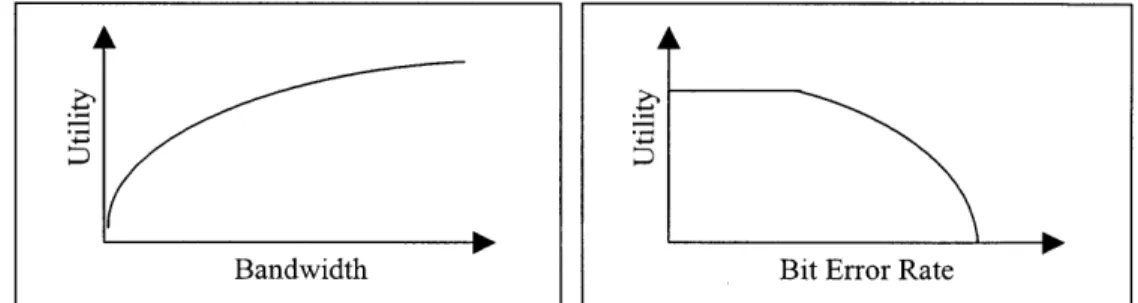
To understand utility on a per resource basis, we look first at bandwidth as an example. Holding other resources constant, a user's utility (satisfaction) as a function of increasing bandwidth may look like figure 4.2.
Figure 4.2: Utility Functions
Bit Error Rate
... .... ...
.. ..... ... ...
... .. ....
This is derived from an application which performs better as bandwidth increases, however as received bandwidth becomes very high, performance is only marginally improved (such as in video applications). Other applications may receive no performance benefit unless a given bandwidth is achieved and beyond that bandwidth, there is no added utility benefit. This situation is true for some real-time applications that can not adapt to changing network conditions.
Error rate on the other hand has the inverse effect on user utility as is seen in figure 4.2. At a high error rate, the utility is zero because the application cannot operate over such a high BER channel. As the error rate lowers however, utility increases until a point where lowering the error rate further has no effect on the application. For example, voice and video applications can tolerate reasonable error rates because humans cannot notice the improvement after a certain BER is achieved.
Our linear utility model is presented below:
* Assume all users receiving minimum QoS requested * Userj is receiving QoS = {Dje, Ej, Bj, Tj1 }
Djqmin Dj, Djq,max
D-DP], min EUi= Ej-c
L-util = - m ____
q, max-Dii/q, mn Ejq
% Delay Performance Beyond % Bit Error Performance Beyond
Minimum Requested Quantity Requested
Sjq,max TjTk T
B, Bjc-Bgn Tclock- Tic
Btti Bg, max-Bg, win Tiui-
Tq
% Bandwidth Allocation Beyond % Requested Size
Minimum Requested Transferred
We further define a total user utility that is based on the weighted sum of delay, error and
bandwidth utilities. The transfer size parameter is not included because we view it as a supplementary parameter that will be useful towards fair resource distribution techniques. Assigning weights allows users to differentiate their own emphasis on a given QoS
parameter. For example a user who values bandwidth more than delay (such as in a data application) would have a relatively higher bandwidth weight versus delay weight. We
feel the value of these weights can either be assigned directly by the user at call-request or assigned from a lookup table, by the process of declaring an application type. Thus we have:
aELAY
% weight of delay utility
C/ERROR 00
weight of error utility
=
% weight of bandwidth utility
Uj
= [(aDELAyxDjUt1) + (a ERROR xEiuti)
(aBW xBjuti;Having defined user utility and total system utility, we now present its uses in the process of admission decision and interval QoS updating or monitoring. In the admission process, when a user can not be clearly admitted (i.e. Bjq,min < Bavail) an admission
decision must be made. We can use the user utility function to determine how well existing clients are being treated in comparison to their requested QoS and one another. From this evaluation, we can further detennine which clients should be downgraded and by how much in order to admit new members. In the process of interval QoS updating, upgrades and downgrades may be necessary to ensure clients are realizing their
QoS
requests. The individual user utility quantities for each QoS variable, in conjunction with the weightings, can be used to determine how tradeoffs should be made internal to a client's QoS levels. The total user utility quantities can be used to determine which clients should be modified if the system is overloaded.4.4 Literature Survey of Dynamic Schedulers
We present a survey of existing QoS based scheduling mechanisms with an emphasis on dynamic schedulers. Most scheduling techniques can be categorized into the following groups:
. Priority-based . Latency-based . Rate-based
. Dynamic Resource Allocation
Priority-based schedulers order packets based on pre-assigned, relative priorities. Latency-based algorithms transmit packets based on their delay requirements.
Rate-I-- - - -A --1- _ - -41- , -11- 4 -- 4-1-- _*__- 4-1- - - _
uaseU agihMsIiiin give miu11niUm dLUL1c11 L users shindlilg the SaMC rCSOUiUCs.
Dynamic resource allocation schemes use changing network conditions as feedback for dynamically adjusting resource sharing.
4.4.1 Priority-based Scheduling
Priority-based scheduling approaches use relative priorities to give preferences to different flows. Traditional priority scheduling at a buffer, involves transmitting highest priority packets first before lower priority packets are serviced. If a flow is given highest priority, then all of its packets currently at a switch are transmitted in a FIFO ordering before the next priority flow is allowed to transmit. Some schemes offer preemption as well, which will interrupt a lower priority flow's transmission if a higher priority packet arrives and is ready to be sent. Priority scheduling has been shown to have significantly better delay performance for higher priority flows, however it performs poorly for lower priority transmissions because they can be indefinitely set-aside for higher priority packets.
A solution to the previous problem is priority jumping [PTW88]. If each priority is viewed as a separate queue, then each queue can be associated with a given set of delay bounds. Then as packets in lower priority queues have experienced a certain amount of
This provides a delay bound for lower priority packets as well as higher priority ones. This method can not only guarantee average delay bounds, but it can also serve statistical loss ratios for different priorities.
4.4.2 Latency-based Scheduling
Many real-time applications have stringent delay requirement for individual packets. If these requirements are not met, then some packets may be deemed useless by them. Therefore, latency-based schedulers order packets based on the delay they are experiencing or requesting. A simple mechanism for ordering packets is Minimum Laxity Threshold (MLT) [CKT89]. For each packet, this system computes the amount of time the server can spend serving other packets before this one must be served to meet its delay requirements. Then all packets are ordered based on this calculation as they enter the switch. MLT has been proven to provide highest utilization for flows with strict delay requirements. A variation of MLT is Shortest-Time-To-Extinction. This mechanism drops over-delayed packets in such a way as it minimizes the number of total packets that do not meet their delay specifications. FIFO+ is a scheduling algorithm that offers predicted delay by ordering packets based on their expected arrival times. It compares the average delay along each link of the traversed path to the experienced delay to set an ordering such that packets receive closer to the average delay.
Latency-based algorithms experience problems similar to prioritization schemes. When packets of high MLT times are in the presence of many low-MLT packets, they may never achieve their desired QoS requests because they will be rarely served. This becomes a problem when flows have diverse QoS requests such that some have firm
requirements and some have looser requirements. The firm requirements will be met well, but the less stringent requirements may not be met at all.
4.4.3 Rate-based Scheduling
Rate-based algorithms use resource reservation to guarantee a minimum bandwidth to sources that behave well. Flows use descriptors to characterize their traffic. These parameters are often peak rate and burstiness. The General Processor Sharing (GPS) scheme divides network capacity amongst flows in a weighted manner. It has been shown that in conjunction with leaky bucket flow shaping, GPS can guarantee an upper bound to packet delay. At a packet level, Weighted Fair Queuing (WFQ) and VirtualClock are well known GPS approximations. They isolate flows to guarantee a delay bound on individual packets as well as provide an average throughput for each flow. Rate-based schemes have been shown to utilize resources poorly for very bursty traffic.
4.4.4 Dynamic Resource Allocation
Dynamic Resource allocation attempts to efficiently match the changing QoS needs to the time-varying network conditions. In chapter 2 we presented dynamic QoS management techniques and here we will further detail mechanisms focused specifically on resource allocation. Dynamic resource allocation schemes are generally responsive to either QoS feedback or changes in presented traffic. One method that responds to QoS feedback is found in [BOL93]. This scheme categorizes flows by their QoS requests into