HAL Id: hal-00726962
https://hal.archives-ouvertes.fr/hal-00726962
Submitted on 31 Aug 2012
HAL is a multi-disciplinary open access
archive for the deposit and dissemination of sci-entific research documents, whether they are pub-lished or not. The documents may come from
L’archive ouverte pluridisciplinaire HAL, est destinée au dépôt et à la diffusion de documents scientifiques de niveau recherche, publiés ou non, émanant des établissements d’enseignement et de
Reconstructing Native American population history.
David Reich, Nick Patterson, Desmond Campbell, Arti Tandon, Stéphane
Mazières, Nicolas Ray, Maria V Parra, Winston Rojas, Constanza Duque,
Natalia Mesa, et al.
To cite this version:
David Reich, Nick Patterson, Desmond Campbell, Arti Tandon, Stéphane Mazières, et al.. Recon-structing Native American population history.. Nature, Nature Publishing Group, 2012, 488 (7411), pp.370-4. �10.1038/nature11258�. �hal-00726962�
Reconstructing Native American Population History
David Reich1,2,*, Nick Patterson2, Desmond Campbell3, Arti Tandon1,2, Stéphane Mazieres3,4, Nicolas Ray5, Maria V. Parra3,6, Winston Rojas3,6, Constanza Duque3,6, Claudio M. Bravi3,7, Graciella Bailliet7, Daniel Corach8, Tábita Hünemeier3,9, Maria-Cátira Bortolini9, Francisco Salzano9, María Luiza Petzl-Erler10, Victor Acuña-Alonzo11, Samuel Canizales-Quinteros12,13, Carlos Aguilar-Salinas12, Teresa Tusié-Luna12, Laura Riba12, Maricela Rodríguez-Cruz14, Mardia Lopez-Alarcón14, Ramón Coral-Vazquez15, Thelma Canto-Cetina16, Julio Molina17, Ángel Carracedo18, Antonio Salas18, Carla Gallo19, Giovanni Poletti19, David B. Witonsky20, Gorka Alkorta-Aranburu20, Rem Sukernik21,Ludmila Osipova22,Sardana Fedorova23, René Vasquez24, Mercedes Villena24,Damian Labuda25, Ramiro Barrantes26, Laurent Excoffier27, Gabriel
Bedoya6, Francisco Rothhammer28, Jean Michel Dugoujon29, Georges Larrouy29, David Pauls30, William Klitz31, Judith Kidd32, Kenneth Kidd32, Anna Di Rienzo20, Nelson B. Freimer33, Alkes L. Price2,34 and Andrés Ruiz-Linares3,*
1
Department of Genetics, Harvard Medical School, Boston, Massachusetts, USA 2
Broad Institute of MIT and Harvard, Cambridge, Massachusetts, USA 3
Department of Genetics, Evolution and Environment. University College London, UK 4
Anthropologie Bioculturelle, UMR 6578, Université de la Méditerranée/CNRS/EFS, Marseille, France
5
EnviroSPACE Laboratory, Climate Change and Climatic Impacts, Institute for Environmental Sciences, University of Geneva, Carouge, Switzerland
6
Laboratorio de Genética Molecular, Universidad de Antioquia, Medellín, Colombia, 7
: Instituto Multidisciplinario de Biologia Celular, La Plata, Argentina 8
Servicio de Huellas Digitales Genéticas, Universidad de Buenos Aires, Argentina 9
Departamento de Genética, Instituto de Biociências, Universidade Federal do Rio Grande do Sul, Porto Alegre, Brazil
10
Departamento de Genética, Universidade Federal do Paraná, Curitiba Brazil 11
National Institute of Anthropology and History, Mexico City, México 12
Unit of Molecular Biology and Genomic Medicine, Instituto Nacional de Ciencias Médicas y Nutrición, México City, México
13
Department of Biology, Facultad de Química, Universidad Nacional Autónoma de México, Mexico City, México
14
Hospital de Pediatría, Centro Médico Nacional, MSS, México City, México. 15
Sección de Posgrado, Escuela Superior de Medicina del Instituto Politécnico Nacional & C.M.N. 20 de Noviembre-ISSSTE, México City, México.
16
Laboratorio de Biología de la Reproducción, Departamento de Salud Reproductiva y Genética,
Centro de Investigaciones Regionales, Mérida Yucatán, México 17
Centro de Investigaciones Biomédicas de Guatemala, Ciudad de Guatemala, Guatemala 18
Instituto de Ciencias Forenses, Universidade de Santiago de Compostela, Fundación de Medicina Xenómica (SERGAS), CIBERER, Santiago de Compostela, Galicia, Spain. 19
Laboratorios de Investigación y Desarrollo, Facultad de Ciencias y Filosofía, Universidad Peruana Cayetano Heredia, Lima, Perú.
20
Department of Human Genetics, University of Chicago, Chicago, USA 21
Laboratory of Human Molecular Genetics, Institute of Chemical Biology and Fundamental Medicine, Siberian Branch of the Russian Academy of Sciences, Novosibirsk Russia.
22
Institute of Cytology and Genetics, Siberian Branch of the Russian Academy of Sciences, Novosibirsk Russia.
23
Department of Molecular Genetics, Yakut Research Center of Complex Medical Problems, Yakutsk, Sakha (Yakutia), Russia
24
Instituto Boliviano de Biología de la Altura. La Paz-Potosí, Bolivia. 25
Département de Pédiatrie, Centre de Recherche du CHU Sainte-Justine, Université de Montréal, Montréal, Quebec, Canada
26
Escuela de Biología, Universidad de Costa Rica, San José, Costa Rica 27
Computational and Molecular Population Genetics Lab, Institute of Ecology and Evolution, University of Bern, Switzerland
28
Facultad de Medicina, Universidad de Chile, Santiago and Instituto de Alta Investigación, Universidad de Tarapacá, Arica, Chile
29
Anthropologie Moléculaire et Imagerie de Synthèse, CNRS UMR 5288, Université Paul Sabatier Toulouse III, Toulouse, France
30
Center for Human Genetic Research, Massachusetts General Hospital, Harvard Medical School, Boston, Massachusetts, USA
31
School of Public Health, University of California Berkeley, and Public Health Institute, Oakland, California, USA
32
Department of Genetics, Yale University School of Medicine, New Haven, Connecticut, USA. 33
Center for Neurobehavioral Genetics, University of California Los Angeles, Los Angeles, California, USA
34
Departments of Epidemiology and Biostatistics, Harvard School of Public Health, Boston, Massachusetts, USA
* To whom correspondence should be addressed: E-mail: [email protected] (D.R); [email protected] (A. R.-L.)
There is intense debate about whether all Native Americans stem from one migration or multiple waves of migration from Asia. In addition, little is known about the principal settlement routes and patterns of population diversification within the Americas. We assembled a dataset of 55 Native American and 19 Siberian populations typed at over 370,000 polymorphisms, the most comprehensive survey of genetic diversity in Native Americans to date, and masked out segments of recent European or African ancestry. Along with providing genetic support for controversial linguistic evidence for three episodes of migration from Asia, the data provide strong evidence for a southward population expansion (facilitated by the coast) with sequential splits and little gene flow after divergence. An important exception to this pattern is the history of
Chibchan-speakers around the Panama isthmus, who our data suggest derive from a >5,000 year old mixture of South American and North American lineages, highlighting the isthmus as a region of genetic interaction between both hemispheres. Our results refute recent interpretations of mitochondrial DNA (mtDNA) positing a single settlement wave. They also highlight how genome-wide analyses of data directly accounting for the confounder of non-Native admixture can be used to document previously unknown historical events.
The initial peopling of the Americas occurred at least 15,000 years ago1-3 through Beringia, a land bridge between Asia and America that existed during the ice ages, but there is controversy about whether Native Americans descend from a single4-8, or multiple waves of migration9-14, and even less is known about subsequent population movements. Most continent-wide analyses of Native American genetics have examined mtDNA4-7 and the non-recombining portion of the Y-chromosome11-13, but studies of large numbers of loci simultaneously can provide a much higher resolution view of history. We assembled samples of Native American populations from Canada to the southern tip of South America15, genotyped them, and merged with five previously collected datasets. The final dataset consisted of >370,000 SNPs genotyped in 55 Native American populations with the lowest density being in the United States and
Canada (475 samples; Figure 1 and Table S1), 19 Siberian populations (255 samples) (Figure S1 and Table S2) and 58 other populations (1,626 samples) (Note S1).
An immediate complication in studying the genetic history of Native Americans is gene flow from European and African immigrants in the last 500 years (Figure 1B and Figure S2). To address this confounder, we used the data to infer ancestry at each segment of the genome and
“masked” segments with non-Native American ancestry (Figure S3)8
; the resulting dataset shows no evidence of African or European ancestry (Figure 1B; Figure S2). We applied a similar procedure to 19 Siberian and 2 Greenland Inuit populations (we did not apply it to the Aleutian populations who we found to be too admixed and thus excluded them from subsequent analyses) (Note S2). A potential concern is that the masking could bias the subsets of the genome we used for our analysis. Encouragingly, when we repeated a key analysis (population mixture in people around the isthmus of Panama) using unmasked data in which we explicitly modeled
post-Colombian admixture, we obtained qualitatively identical inferences (Figure S4), encouraging us in the used of the masked data for subsequent analyses.
We first built a tree based on allele frequency differentiation (FST distances) between all pairs of populations (Table S3). This demonstrates remarkable agreement with geographic and linguistic classifications (Figure 1C). The first split (A) separates Asian populations from all New World populations along with the Siberian Inuit (Naukan). This monophyly agrees with mtDNA, Y-chromosome and other single-locus studies16 that have identified pan-American variants of relatively recent origin, and is consistent with some shared Asian ancestry for all Native Americans4-8. Within the New World, an early split (B) separates Inuit from all other Native Americans. Among non-Arctic Native Americans, there follows a series of splits in an approximately north-to-south sequence, starting with a northern North American cluster and ending in a large group including four clusters from major geographic/linguistic subdivisions in lower Central America and South America. The first (#1) consists of Andean populations except the Inga. The second (#2) comprises populations from the Chaco region in southern South
America. The third (#3) includes Equatorial-Tucanoan and Ge-Pano-Carib populations of eastern South America. The fourth (#4) includes predominantly Chibchan-Paezan-speaking populations of the Isthmo-Colombian area. This sequence of splits suggests settlement in a North-to-South expansion, which is also supported by a negative correlation between heterozygosity and distance from the Bering Strait (r =-0.37, P=0.04). The correlation strengthens using “least cost distances” that consider the coasts as facilitators of migration17-19
(Note S3; Figure S5). A second striking feature of the tree is the long population-specific branches, reflecting strong genetic drift. Analysis of linkage disequilibrium (LD) suggests recent bottlenecks explain part of the
Bifurcating trees provide a simplified view of history, in that they do not allow for the possibility of mixture across clades in the tree. To test whether the Neighbor Joining tree of Figure 1C provides an accurate description of the population relationships, we used the 4
Population Test20, which evaluates whether allele frequencies in any set of four populations are consistent with a proposed tree. We first tested the commonly held view that Native American and East Asian populations have a common origin with no migration since their split from Europeans and Africans by testing the tree ((Yoruba,French),(Han,Native American)) (Figure 2A). We reject this tree with high statistical significance for all 55 Native American populations: |Z|>6.0 (P < 2×10⁻⁹), with the sign of the 4 Population Test statistic indicating that Europeans are more closely related to Native Americans than to East Asians. The values of the statistic are very similar for the 52 non-Arctic populations (0.027 ± 0.002), indicating that the signal does not reflect gene flow in the Americas (and hence we do not focus on it in this study), but instead, within Eurasia itself. Future studies that model the joint demographic history of Europeans, East Asians and Native Americans21 need to take this complexity into account.
We next used the 4 Population Test to evaluate whether Native American populations descend from a single, discrete, migration event4-8. We studied all possible pairs of 55 Native American populations, testing whether they represent sister groups after splitting from carefully chosen outgroups (Figure 2B). First, we evaluated whether the Inuit descend from the same Asian migration as all other Native American populations by testing ((Yoruba, Han),(Native American, Inuit)), and reject it at |Z|>4.5 for all pairs of Native American and Inuit populations that we tested, indicating that the Inuit are more closely related to Asians (Han) than the Arctic Native Americans (Figure 2B). Second, we evaluated whether data from the 52 non-Arctic Native Americans are consistent with descending from a discrete migration from Asia with no subsequent gene flow, by applying the 4 Population Test to the tree ((Outgroup1,
Outgroup2), (NativeAmerican1, NativeAmerican2)), using 10 different pairs of Asian and Arctic
outgroups (Figure 2C and Table S5). The 47 most southern Native American populations are consistent with descending from a single peopling event (all statistics |Z|<3; Table S5). However, 5 Northern Native American (NNA) populations—Ojibwa, Cree, Algonquin, Cheyenne and Chipewyan—have Z-scores 3-6 standard errors from expectation, and are also outliers in
population structure analyses (Figure 1B and Figure 2). Further examination of the values of the
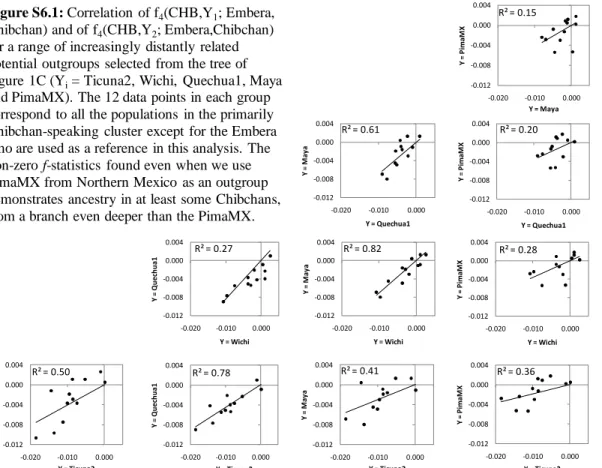
Asian populations among these 5 NNA groups. The statistics for four of the NNA (Cheyenne, Cree, Ojibwa and Algonquin) are highly correlated (average r2=0.72; Figure S6) and indicate a closer relationship of these populations to the Inuit than to any Asian group (Figure 2B and Table S6). By contrast, statistics involving the Chipewyan are not correlated to the other four NNA (r2=0.05; Figure 2C; Table S6), suggesting distinct gene flows with Asians. Globally, these findings show that Native Americans break into three broad groups: the 47 Native American populations from Meso-America southward, the Inuit along with 4 NNA populations with whom they appear to have exchanged genes, and the Chipewyan who speak a Na-Dene language. This is consistent with the controversial22 three migration wave model of Greenberg which views Inuit and Na-Dene languages as markers for distinct migrations from Asia9, although not with the purest form of that model which would specify that the Inuit and Chipewyan represent sister groups to some Siberian populations, whereas in fact they cluster with Native Americans (Figure 1C), consistent with subequent admixture within the Americas. Intriguingly, Greenberg’s
hypothesis that Na-Dene marks a distinct migration with Asia has been supported by recent linguistic work that shows that Na-Dene language have a link with Siberian Yeniseian
languages23. The group of Siberian populations with which the Chipewyan show the strongest genetic affinity includes the Ket, the sole living speakers of Yeniseian (Table S6).
We next sought to determine the timing of the migrations. While it is difficult to estimate dates of population splits using SNP array data subject to ascertainment bias, we obtain a
minimum date for Inuit migrations by studying the decay of admixture LD in the Cheyenne, the Inuit-admixed NNA population with the largest sample size allowing the most accurate
inference24. The extent of LD corresponds to a minimum of 1,500 years ago (95% confidence) (Note S5 and Figure S7), indicating the Inuit had already mixed with the NNA by that time.
To better understand the history of the 47 Native American populations from Meso-America southward who are consistent with a single founding event, we used Admixture Graphs (AG), which are generalizations of phylogenetic trees that allow for the possibility of discrete unidirectional population mixture events20 (Note S6). We first identified a subset of populations with less evidence of admixture—to serve as a backbone for the AG—by applying the 4
10 correspond to a cluster of largely Chibchan speakers from the Isthmo-Colombian area. From the 32 populations with no evidence of admixture, we selected a subset that were geographically dispersed, included at least 4 samples, and remained a fit to the data when assessed using our more stringent AG fitting procedure (Note S6). We then added in populations modeling the possibility of a single admixture event involving other populations from the graph. The resulting AG of 18 populations provides an excellent fit to the data, in the sense that only 2 of the 11,781 statistics measuring patterns of allele frequency correlation predicted by the model are >3 standard errors from expectation (Note S6).
Three features of the AG are striking. First, the data suggest that some populations in Meso America have not experienced strong bottlenecks since arrival in the region. For example, the genetic drift between the Zapotec and the ancestors of all South Americans is estimated to be 0.004. Second, we fit a higher proportion of South American than Meso American populations using the AG approach. Specifically, we had difficulty fitting a Meso American population from a linguistic/geographic group into the AG once we had included another representative from that same group, but in South American populations, we were often able to fit multiple populations from any group. We hypothesize that this reflects “Isolation-by-Distance”, in which populations bidirectionally and continuously exchange genes with neighbors, which is not modeled by AGs which specify unidirectional and discrete admixture events. The less extensive evidence for gene flow that we observe in the New World, and especially in South America, contrasts with
analyses of the Old World where migration is prevalent25. Thus, cultural diffusion may have played a greater role in the spread of agriculture over long distances on the American continent than in the Old World where the long distance spread of farmers played a major role26,27.
The third striking finding is detection of population mixture events, demonstrating the power of genome-wide analyses of masked data to discover previously unappreciated events in Native American history. For example, the Inga can be modeled as having both Amazonian and Andean ancestry, consistent with speaking a Quechuan language but living in the eastern Andean slopes of Colombia with known exchanges with neighboring Amazonian lowlands. The Guarani and the Guahibo can be modeled as stemming from the admixture of differentiated strands of ancestry in eastern South America (Figure 3). The most finding is in diverse Chibchan-speaking populations from the Isthmo-Colombian area, who can only be fit into the AG if they are
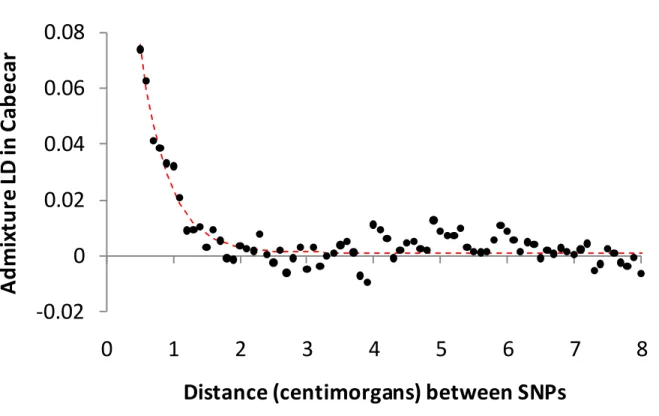
more ancient than the separation of the Mexican Pima. Populations carrying this signal are present both to the north (Cabecar, Guaymi, Teribe, Zenu, Maleku and Bribri) and to the south (Kogi and Arhuaco) of the Panama isthmus, suggesting that the admixture occurred prior to the diversification of Chibchans and their spread across the isthmus (Note S6). For the Cabecar, the Chibchan-speaking group with the largest sample size, we used admixture LD to obtain a minimum 95% confidence date is >5,000 years ago (Figure 4) (consistent estimates were obtained for other Chibchan-speakers) (Figure S7; Table S7; Note S5). This is an entirely novel set of observations suggesting a major gene flow event across the Panama isthmus after the initial colonization of South America and before the advent of agriculture. It is also consistent with geography, emphasizing as it does the role of the Isthmo-Colombian region as a point of contact between the northern and southern hemispheres. As the origin of Chibchan culture is already the subject of long-standing controversies28,29, existing linguistic and archaeological data may benefit from reanalysis in the light of this finding.
This study is the most comprehensive survey of genetic diversity in Native Americans to date, and also the first that directly accounts for the potential confounder of non-Native
admixture. The approach taken here to account for recent admixture will also be applicable to whole genome sequences, which will provide data that is free of “ascertainment bias”, thus for example allowing inference of divergence times and population size changes. Although here we focused on ethnically well-defined Native American populations, we believe that our approach is potentially applicable to other highly admixed populations that exist across the Americas30. Such work could increase the resolution of evolutionary analyses of the Americas, filling sampling gaps and allowing the study of regions where as a consequence of admixture no ethnically defined Native populations exist.
Methods
DNA Samples: The samples analyzed here were collected for previous studies over several
decades using a range of informed consent and oversight procedures that were institutionally approved at the time each study was carried out. Ethical approval for the use of these samples in population genetic analyses was obtained prior to this study at Université de Montreal,
University of California Berkeley, Universidad de Antioquia, Universidad Nacional Autonoma de Mexico, Centro de Investigaciones Biomédicas de Guatemala, Universidad de Costa Rica, Universidad Peruana Cayetano Heredia, Universidad de Chile, : Instituto Multidisciplinario de Biologia Celular and Universidad de Buenos Aires Argentina, Universidade Federal do Rio Grande do Sul, Universidade Federal do Paraná, Comitê Nacional de Ética em Pesquisa-Brazil, Universidad de Santiago de Compostela, CNRS - Université Paul Sabatier Toulouse 3 and Yale University. Special review panels convened at the request of the NIH re-reviewed some of the oldest collections genotyped for this study31 and approved the use of the samples for population genetic studies. Ethical approval for the joint analyses of these data was provided by the NHS National Research Ethics Service, Central London REC 4 (Ref # 05/Q0505/31) after reviewing the proposed study as well as the informed consent and ethical review documents provided by the institutions contributing the samples. This study was also approved by the Harvard Medical School Institutional Review Board (protocol M11681-104). All DNA samples have been anonymized.
Genotyping: Genotyping was performed using Illumina arrays and standard protocols as
detailed in Note S1. A subset of samples for which only small amounts of DNA were available were whole genome amplified using the Qiagen REPLI-g midi kitprior to genotyping.
Data curation: We required >95% completeness of genotyping for each SNP and >90% for
each sample. We merged the data with five other datasets. We further removed samples that were outliers in PCA relative to others from their group, showed an excess rate of heterozygotes compared to the expected rate from the frequency in the population, or had evidence of being a second degree relative or closer to another sample in the study (Note S1).
Removal of genomic segments that might contain non-Native American ancestry: For each
Native American individual in turn, we use HAPMIX 32 to model their haplotypes using two ancestral panels: (i) “Old World” populations, a pool of 392 Europeans and 134 West Africans, and (ii) “New World” populations, a pool of 628 Native Americans that were in our data set prior to our most aggressive filtering. Haplotype phase in the ancestral panel, which is necessary for HAPMIX, was determined by phasing both pools of samples together using fastPHASE 33. We removed segments that had an expected number of more than 0.01 non-Native American
chromosomes according to HAPMIX (SOM). For the PCA analysis of samples with non-Native American ancestry segments masked, we restricted to populations with at least 4 samples, and then filled in missing data based on the average genotype in the population.
Population structure analysis, FST and Neighbor Joining tree: We used EIGENSOFT to carry
out PCA and compute FST34. Clustering was performed using ADMIXTURE 35. A Neighbor Joining 36 tree based on FST was computed using POWERMARKER 37.
Admixture Graphs: We used the Admixture Graph framework 20 to fit models of population separation followed by mixture to the data. An Admixture Graph makes quantitative predictions about the correlations in allele frequency differentiation statistics (f-statistics) that will be
observed among all pairs, triples, and quadruples of populations 20, and these can be compared to the observed values (along with a standard error from a Block Jackknife) to test hypotheses about the topology of population relationships (Note S6).
Estimating dates of admixture events: We used ROLLOFF 24 to estimate dates of population mixture. For each population in which we attempted to date admixture, we identified two other populations (or pools of populations) that we used as surrogates for the ancestral populations, guided by Figure 1C or Figure 3 (the surrogates that we used are listed in Table S7). We then binned SNP pairs by their genetic distance separation, and studied the correlation between the LD statistic and the expectation based on the frequency differences across populations if the LD was due to admixture. Dates were inferred based on the spatial scale of the decay of this
jackknife over chromosomes. We determined 95% confidence intervals as the estimate ±1.96 standard error, and multiplied by 29 to convert from generations to years 38.
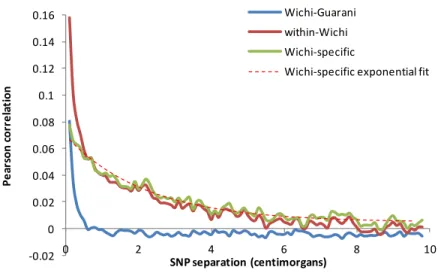
Estimating dates of founder events: To estimate the dates of population founder events, we
used correlation of allele sharing as a measure of LD. We subtracted the LD within samples from a population to that between a population and a close relative (based on Figure 1C and Figure 3), thus identifying population-specific LD, and fitted the decay with an exponential (Note S4).
Correlating geography with population diversity: Euclidean distances from the Bering Strait
(64.8N 177.8E) and the location of each population (Table S1) were calculated using great arc distances based on a Lambert azimuthal equal area projection of the American continent. Least-cost distances between the same points were computed using PATHMATRIX 17, and a spatial cost map incorporating the coastal outline of the Americas. We compared the following coastal/inland relative costs: 1:2, 1:5, 1:10, 1:20, 1:30, 1:40, 1:50, 1:100, 1:200, 1:300, 1:400, and 1:500. Pearson’s correlation coefficient was estimated between mean heterozygosity for each population and their least cost distances from the Bering Strait (Note S3).
References
1 Goebel, T., Waters, M. R. & O'Rourke, D. H. The late Pleistocene dispersal of modern humans in
the Americas. Science 319, 1497-1502 (2008).
2 Dillehay, T. D. Probing deeper into first American studies. Proc. Natl. Acad. Sci. U. S. A. 106,
971-978 (2009).
3 O'Rourke, D. H. & Raff, J. A. The human genetic history of the Americas: the final frontier. Curr.
Biol. 20, R202-207 (2010).
4 Kitchen, A., Miyamoto, M. M. & Mulligan, C. J. A three-stage colonization model for the peopling
of the Americas. PLoS ONE 3, e1596 (2008).
5 Mulligan, C. J., Kitchen, A. & Miyamoto, M. M. Updated three-stage model for the peopling of
the Americas. PLoS ONE 3, e3199 (2008).
6 Tamm, E. et al. Beringian standstill and spread of Native American founders. PLos ONE, 1-6
(2007).
7 Fagundes, N. J. et al. Mitochondrial population genomics supports a single pre-Clovis origin with
a coastal route for the peopling of the Americas. Am. J. Hum. Genet. 82, 583-592 (2008).
8 Wall, J. D. et al. Genetic variation in Native Americans, inferred from Latino SNP and
resequencing data. Mol. Biol. Evol. (in press).
9 Greenberg, J. H., Turner, C. G. & Zegura, S. L. The Settlement of the Americas - A Comparison of
the Linguistic, Dental, and Genetic-Evidence. Curr. Anthrop. 27, 477-497 (1986).
10 Cavalli-Sforza, L. L., Menozzi, P. & Piazza, A. The History and Geography of Human Genes.
(Princeton U.P., 1994).
11 Karafet, T. M. et al. Ancestral Asian source(s) of new world Y-chromosome founder haplotypes.
Am.J.Hum.Genet. 64, 817-831 (1999).
12 Lell, J. T. et al. The dual origin and Siberian affinities of Native American Y chromosomes. Am
J.Hum.Genet. 70, 192-206 (2002).
13 Bortolini, M. C. et al. Y-chromosome evidence for differing ancient demographic histories in the
Americas. Am. J. Hum. Genet. 73, 524-539 (2003).
14 Ray, N. et al. A statistical evaluation of models for the initial settlement of the american
continent emphasizes the importance of gene flow with Asia. Mol. Biol. Evol. 27, 337-345 (2010).
15 Ruhlen, M. A Guide to the World's Languages. (Stanford University Press, 1991).
16 Schroeder, K. B. et al. Haplotypic background of a private allele at high frequency in the
Americas. Mol. Biol. Evol. 26, 995-1016 (2009).
17 Ray, N. PATHMATRIX: a geographical information system tool to compute effective distances
among samples. Mol. Ecol. Notes 5, 177-180 (2005).
18 Wang, S. et al. Genetic variation and population structure in native Americans. PLoS Genet. 3,
e185 (2007).
19 Yang, N. N. et al. Contrasting patterns of nuclear and mtDNA diversity in Native American
populations. Ann Hum Genet 74, 525-538 (2010).
20 Reich, D., Thangaraj, K., Patterson, N., Price, A. L. & Singh, L. Reconstructing Indian population
history. Nature 461, 489-494 (2009).
21 Gutenkunst, R. N., Hernandez, R. D., Williamson, S. H. & Bustamante, C. D. Inferring the joint
demographic history of multiple populations from multidimensional SNP frequency data. PLoS Genet 5, e1000695 (2009).
24 Moorjani, P. et al. The history of African gene flow into southern Europeans, Levantines and Jews. PLoS Genet. 7, e1001373 (2011).
25 Novembre, J. et al. Genes mirror geography within Europe. Nature 456, 98-101 (2008).
26 Diamond, J. & Bellwood, P. Farmers and their languages: the first expansions. Science 300,
597-603 (2003).
27 Bramanti, B. et al. Genetic discontinuity between local hunter-gatherers and central Europe's
first farmers. Science 326, 137-140 (2009).
28 Barrantes, R. et al. Microevolution in lower Central America: genetic characterization of the
Chibcha-speaking groups of Costa Rica and Panama, and a consensus taxonomy based on genetic and linguistic affinity. Am.J.Hum.Genet. 46, 63-84 (1990).
29 Barrantes, R., Smouse, P. E., Neel, J. V., Mohrenweiser, H. W. & Gershowitz, H. Migration and
genetic infrastructure of the Central American Guaymi and their Affinities with other tribal groups. Am. J. Phys. Anthropol. 58, 201-214 (1982).
30 Bryc, K. et al. Colloquium paper: genome-wide patterns of population structure and admixture
among Hispanic/Latino populations. Proc. Natl. Acad. Sci. U. S. A. 107 Suppl 2, 8954-8961 (2010).
31 Cann, H. M. et al. A human genome diversity cell line panel. Science 296, 261-262 (2002).
32 Price, A. L. et al. Sensitive detection of chromosomal segments of distinct ancestry in admixed
populations. PLoS Genet. 5, e1000519 (2009).
33 Scheet, P. & Stephens, M. A fast and flexible statistical model for large-scale population
genotype data: applications to inferring missing genotypes and haplotypic phase. Am J Hum Genet 78, 629-644 (2006).
34 Patterson, N., Price, A. L. & Reich, D. Population structure and eigenanalysis. PLoS Genet. 2,
2074-2093 (2006).
35 Alexander, D. H., Novembre, J. & Lange, K. Fast model-based estimation of ancestry in unrelated
individuals. Genome Res. 19, 1655-1664 (2009).
36 Saitou, N. & Nei, M. The neighbor-joining method: a new method for reconstructing
phylogenetic trees. Mol.Biol.Evol. 4, 406-425 (1987).
37 Liu, K. & Muse, S. V. PowerMarker: an integrated analysis environment for genetic marker
analysis. Bioinformatics. 21, 2128-2129 (2005).
38 Fenner, J. N. Cross-cultural estimation of the human generation interval for use in
Acknowledgments. We are grateful to the volunteers who donated samples, to M. Metspalu, R.
Villems and E. Willerslev for facilitating sharing of data from Siberian and Arctic populations, to C. Stevens for assistance with genotyping, and to P. Bellwood, K. Bryc, J. Diamond, T. Dillehay, R. Gonzalez-José, P. Moorjani, M. Ruhlen, and A. Williams for comments on the manuscript. Support was provided by NIH grants NS043538 (A.R.-L.), NS037484 (N.B.F.), GM079558 (A.D.), GM079558-S1 (A.D.) and GM057672 (K.K.K. & J.R.K.), an NSF HOMINID grant 1032255 (D.R.), a Canadian Institutes of Health Research grant (D.L.), a Universidad de
Antioquia CODI grant (G.B.), a FIS grant PS09/02368 (A.C.), a Wenner-Gren Foundation Grant ICRG-65 (A.D. and R.S.), Russian Foundation for Basic Research Grants 06-04-048182 (R.S.) and 02-06-80524a (L.O.),. a Siberian Branch Russian Academy of Sciences Field Grant (L.O.), a CNRS grant (J.-M.D.), and discretionary funds from Harvard Medical School (D.R.) and the Harvard School of Public Health (A.L.P.).
Author contributions. D.R., N.B.F., A.L.P. and A.R-L. conceived the project; D.R., N.P., D.C.,
A.T., S.M., N.R. and A.R-L. performed analyses; D.R. and A. R.-L. wrote the paper with input from all the co-authors; and all other authors contributed to collection of samples and data.
Figure Legends
Figure 1: Geographic distribution and simple genetic analyses. (A) Sampling locations of 55
Native American populations based on the coordinates in Table S1, with colors corresponding to the linguistic categories of Ruhlen15. The numbered ellipses refer to the South American
population groupings discussed in the text. (B) Masking of segments of non-Native American ancestry is allows examination of the relationship among Native American populations prior to European contact. We used HAPMIX 32 to filter out segments where the estimate of the number of non-Native American alleles was >0.01. Cluster-based analysis (k=4) using ADMIXTURE35 shows evidence of Indo-European- and some Yoruba-related ancestry in most Native Americans prior to masking (top), but little afterward (bottom), and also hints at Siberian-related ancestry in some North Amerind-speaking groups. (C) Neighbor-Joining tree relating Native American to selected non-American populations (sample sizes in parentheses). All Native American and Siberian data were analyzed after masking of potentially non-Native American segments (except for the Aleutian Islanders), and branch lengths are proportional to FST (Table S3). The
underlining indicates Native American populations that are a grossly poor fit to the tree, and red letters and numbers denote population splits or clusters discussed in the text.
Figure 2: Migrations associated with the peopling of the Americas. Application of the 4 Population Test reveals three complexities associated with the ancestry of Native Americans. (A)
We first tested the hypothesis that Native Americans and East Asians are sister groups, but Europeans are significantly more closely related to Native Americans than to East Asians, invalidating many prevailing models of demographic history. (B) We found that 5 Native North American (NNA) populations do not form a clade with more southern Native Americans relative to diverse Asian and Arctic populations, as revealed by significantly non-zero 4 Population Test f4
statistics. The quantitative values of these statistics are highly correlated across the Cheyenne, Ojibwa, Cree and Agonquin, with the largest f4 statistics seen when testing proximity to Inuit,
suggesting that the pattern is due to gene flow from Inuit into the ancestors of these groups. (C) Principal Component Analysis shows that the 5 NNA are outliers relative to the 47 more southern Native American populations, with the Chipewyan being distinct from the other 4 NNA. 4
(uncorrelated test statistics). The Asian populations to which the Chipewyan show particular proximity are the Chukchi, Inuit, Nganasan and Ket (Table S6).
Figure 3: Admixture Graph analysis detects 4 novel population mixture events. This AG
with 18 populations is the largest ever built and provides an excellent fit to the data as only 2 of the 11,781 f-statistics testing allele frequency correlations predicted by the model deviate >3 standard errors from expectation. Genetic drift estimated on each lineage is given in units proportional to 1000×FST, and mixture events (dotted lines) are denoted by the inferred
percentage of ancestry. The Arhuaco and Kogi (circled in green) are well modeled as a mixture between a strand of ancestry from eastern South America and a deep strand of Native American ancestry that is more ancient than the separation of the Mexican Pima (similar findings are obtained for other Chibchan-speakers; Note S6). The Inga (yellow) are modeled as a mixture of Andean and Amazonian ancestry; and the Guarani (blue) and the Guahibo (red) as mixtures of separate strands of ancestry from eastern South America. (Empty ellipses indicate ancestral populations that are inferred by the Admixture Graph model.) The colored lines indicate uncertainty: we show alternative insertion points for lineages involved in the four admixture events which are equally good fits.
Figure 4: Ancient admixture in the Cabecar >5,000 years ago. We binned SNPs based on
their genetic distance separation, and computed the correlation of the observed LD to the sign that would be expected from mixture of a North American lineage (represented by a mixture of Pima, Maya, Cheyenne and Zapotec), and a lineage related to other populations in the primarily Chibchan-speaking clade of Figure 1C. We detect admixture between ancient North and South American lineages, with an extent of LD corresponding to 241 ± 41 generations (1 standard deviation), or 5,000-8,900 years ago assuming 29 years. (Black dots show the data; red line shows the fitted exponential decay.) No decay of admixture LD is detected when we do not use a mix of North and South American populations as surrogates for the ancestral populations.
Figure 1
A
B
C
Figure 2
A
B
C
Yoruba
Native American
Han Chinese
French
Siberian
Inuit
Nat. North. American
Native American
f4 : A lg o n q u in f4: Cheyenne f4 : C re e f4: Cheyenne f4 : O ji b wa f4: CheyenneChinese
Chipewyan
Native American
Eastern
Siberia/Ket
f
4: C
h
ip
e
wy
an
P
C
2
(N ga n as an 2 ↔ N au ka n ) Chipewyan 4 NNA Other Native AmericansFigure 4
-0.02
0
0.02
0.04
0.06
0.08
0
1
2
3
4
5
6
7
8
A
d
mi
xt
u
re
LD
in
C
a
b
ec
a
r
Supplementary Materials
Reconstructing Native American Population History
Table of Contents 1
Note S1 – Preparation of the data set 2-6
Note S2 – Masking segments of potential European or African ancestry 7-8 Note S3 – Correlation of genetic diversity with geographic distance from the Bering Strait 9-10
Note S4 – Dates of founder effects 11-13
Note S5 – Dates of admixture events 14-16
Note S6 – Inference of population relationships incorporating admixture 17-21
Figure S1 – Sampling locations of 19 Siberian and 5 East Asian populations 22 Figure S2 – PCA demonstrates the effectiveness of masking of non-Native American ancestry 23 Figure S3 – Examples of masking of segments of non-Native American ancestry 24 Figure S4 – The evidence of ancient admixture in Chibchans is not an artifact of masking 25 Figure S5 – Heterozygosity and geographic distance from the Bering Strait 2 Figure S6 – Native North Americans have a distinct relationship to Eurasians 27 Figure S7 – Dates of admixture events from the decay of admixture linkage disequilibrium 28-29
Table S1 – Summary information for 55 Native American populations 30
Table S2 – Summary information for 19 Siberian populations 31
Table S3 – FST for populations used to build the Neighbor Joining tree (masked data) 32
Table S4 – Estimates of bottleneck dates based on decay of allele sharing 33 Table S5 – Z-scores from 4 Population Tests of the tree ((Out1,Out2), (NatAm1, NatAm2)) 34 Table S6 – f4 statistics from 4 Population Tests of the tree ((Zapotec, NNA), (Out1,Out2)) 35
Note S1
Preparation of the data set
(i) A merged dataset derived from six sources
We merged six datasets from samples genotyped on various Illumina SNP arrays (Table S1.1).
Table S1.1: Genotyping data sets that we merged for this study
Name of dataset N Comments
“Ruiz-Linares”
(Native American and Siberian)
373
We attempted to genotype 509 samples from 49 populations on an Illumina 610-Quad array, and initially filtered out 3 samples that were genotyped twice, 9 samples due to inconsistency with a previous DNA fingerprint n the same sample, and 120 samples based on a call rate of <90%. We removed 59,163 SNPs with a call rate of <95% or no physical position.
“Kidd”
(Native American and Siberian)
316
Genotyping was performed on an Illumina 650Y array, and we initially removed 16 samples that overlapped with the CEPH-HGDP samples or were outliers relatives to others from the same population in PCA.
“DiRienzo”
(Siberian) 64
These data consisted of genotyping of 4 Siberian populations by Anna DiRienzo’s laboratory on either an Illumina 610-Quad array (Nganasan and Yukaghir) or an Illumina 650Y array (Naukan and Chukchi1).
“Willerslev”
(Arctic ) 176
Previously published data2. We analyzed 12 Eurasian and 3 Native Arctic populations genotyped on an Illumina 650Y array (all from ref. 2 except for Na-Dene which did not have permissions appropriate for this analysis).
“HapMap3”
(Worldwide) 1,184 Previously published data
3
. Genotyping was done on an Illumina 1M array.
“CEPH-HGDP”
(Worldwide) 936
Previously published data4. Genotyping was done on an Illumina 650Y array. We restricted to individuals inferred to be unrelated up to 2nd degree relatives5.
(ii) Data curation - Removal of Native American outlier samples
We performed data curation steps to remove outlier samples. This was important for the Native Americans, as there has been substantial mixture in the last five hundred years, both due to migration from Europe and Africa and due to recent gene flow among geographic neighbors. We first ran HAPMIX (Note S2) to identify segments of the genome in Native Americans (excluding Arctic populations) that are of potentially West Eurasian or African ancestry. We subsequently treated the genotypes in these segments as if they were missing data. This
―masking‖ prevented us from discarding all samples that had evidence of some post-Colombian European or African ancestry (if we had done this we would have lost the great majority of the samples). The estimates of non-Native American or non-Siberian ancestry, and the proportion of the genome that was masked in each population, is presented in Table S1 for Native American and Table S2 for Siberian populations. We then applied the following filters:
(2) 33 samples were removed due to a high proportion of West Eurasian or African mixture
We removed samples with <22% of their genomes inferred to be of entirely Native American ancestry based on the masking analysis of Note S2.
(3) 80 samples were removed due to excess or deficiency of heterozygotes vs. expectation
In the Kidd dataset, all the Karitiana and most of the Ticuna had a significant excess of heterozygous genotypes compared with the allele frequency computed in the same samples (violations of Hardy-Weinberg equilibrium). We removed these populations. We also removed a handful of additional samples due to heterozygote excess or deficiency.
(4) 28 samples were removed due to evidence of being at least a 2nd degree relative to others
It was already known that the Surui sample contained relatives6
. For all pairs of individuals in all populations that had evidence for >22% of their genome being shared, we removed one of the pair (in general we chose to remove the one with more missing data). For this purpose, we used the SMARTREL program, part of the EIGENSOFT package7
.
(5) 36 samples were removed as PCA outliers relative to others from the same population
To prepare the dataset for PCA-based outlier removal, we restricted to Native American populations with at least 3 samples, as outlier removal is impossible with fewer samples. Because many samples had substantial missing data (due to masking segments of potentially non-Native American ancestry), we filled in missing data at each SNP based on the mean allele frequency of other samples from the same population. For the PCA, we did not include SNPs that had entirely missing data for any of the population included in a particular PCA.
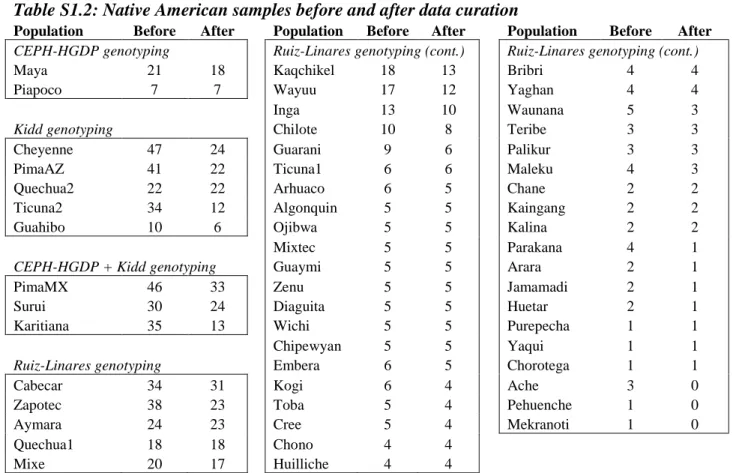
We divided the Native American populations into 5 geographic groupings (to make the visual inspection of the PCA plots tractable): North Americans, Meso-Americans, Andeans, North West South Americans and Eastern South Americans. We then performed PCA using EIGENSOFT6. We plotted samples on all eigenvectors that were statistically significant, as assessed using a Tracy-Widom distribution6. We iteratively removed samples that were outliers relative to others from the same population until the samples from each population appeared homogeneous. Some populations, such as the Cabecar, showed an over-dispersion in the PCA, likely reflecting recent admixture with neighboring populations affecting a substantial proportion of samples. We did not remove any samples in such populations. The number of Native American samples in the merged dataset (excluding Siberians and Arctic Native Americans) before data curation was 623 and after was 451 (Table S1.2 reports results by population). Importantly, we performed the data curation entirely by visual and computational analysis of clusters in PCA, searching for individuals that were outliers with respect to their own population. Thus, if our data curation introduces bias, it would be to make populations more homogeneous, not to introduce correlations in ancestry across groups. In other words, we do not expect our curation to bias inferences about the topology of population relationships.
(iv) Data curation - Removal of Siberian and Arctic North American outlier samples
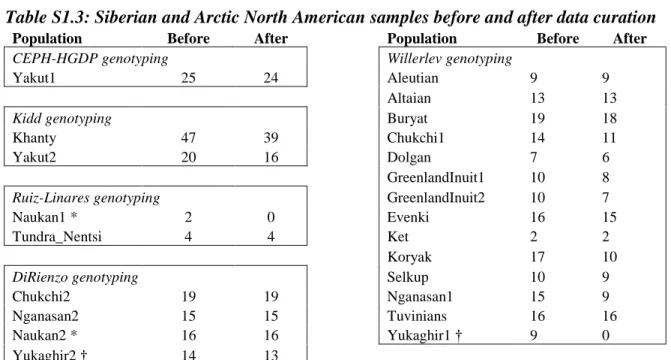
We performed a similar analysis in the 21 Siberian and 3 Arctic North Americans populations, after applying a similar masking procedure as for the non-Arctic Native Americans (Note S2; Table S1.3). This resulted in 19 Siberian and 3 Arctic North American populations, after we removed the Naukan1 and Yukaghir1 populations because so few samples were left from each after the data curation.
(1) 11 samples were removed due to evidence of being at least a 2nd degree relative to others
For all pairs of individuals that had evidence for >22% of their genome being shared, we removed one of the pair (in general we chose to remove the one with more missing data). For this purpose, we use smartrel, which is part of the EIGENSOFT package6.
(2) 17 samples were removed due to being outliers in PCA relative to others from the same population. Since many samples had substantial missing data (corresponding to masked
segments containing potential non-Native American ancestry), we filled in missing data at each SNP based on the mean allele frequency for others in the same population.
(3) 19 samples were removed due to less than 28% of the genome being available after masking.
We removed samples from populations with limited data after masking, except for Aleutian Islanders where so much data was removed that we used unmasked data.
Table S1.2: Native American samples before and after data curation
Population Before After Population Before After Population Before After
CEPH-HGDP genotyping Ruiz-Linares genotyping (cont.) Ruiz-Linares genotyping (cont.)
Maya 21 18 Kaqchikel 18 13 Bribri 4 4
Piapoco 7 7 Wayuu 17 12 Yaghan 4 4
Inga 13 10 Waunana 5 3
Kidd genotyping Chilote 10 8 Teribe 3 3
Cheyenne 47 24 Guarani 9 6 Palikur 3 3
PimaAZ 41 22 Ticuna1 6 6 Maleku 4 3
Quechua2 22 22 Arhuaco 6 5 Chane 2 2
Ticuna2 34 12 Algonquin 5 5 Kaingang 2 2
Guahibo 10 6 Ojibwa 5 5 Kalina 2 2
Mixtec 5 5 Parakana 4 1
CEPH-HGDP + Kidd genotyping Guaymi 5 5 Arara 2 1
PimaMX 46 33 Zenu 5 5 Jamamadi 2 1
Surui 30 24 Diaguita 5 5 Huetar 2 1
Karitiana 35 13 Wichi 5 5 Purepecha 1 1
Chipewyan 5 5 Yaqui 1 1
Ruiz-Linares genotyping Embera 6 5 Chorotega 1 1
Cabecar 34 31 Kogi 6 4 Ache 3 0
Zapotec 38 23 Toba 5 4 Pehuenche 1 0
Aymara 24 23 Cree 5 4 Mekranoti 1 0
Quechua1 18 18 Chono 4 4
Mixe 20 17 Huilliche 4 4
(v) Data curation - Removal of outlier samples from other populations
We also performed PCA to remove some outlier samples from Native American and non-Siberian populations. This analysis removed the entire MKK population3 (Masai from Kenya from HapMap3) because of many statistically significant eigenvectors that were difficult to interpret. We also removed 71 other samples that were outliers relative to their own populations.
The Karitiana from the Kidd genotyping were dropped because of evidence for heterozygote excess (see above). PCA showed systematic differences in the two Yakut datasets, potentially reflecting a chance subdivision of the Yakut sample collection (which involved several urban collections of a small number of individuals). Therefore, both datasets were kept separate, and denoted Yakut1 and Yakut2. PCA indicate that the two Surui and PimaMX datasets were indistinguishable based on PCA, and so we merged them6. The labels we used were:
―PimaMX‖ (to designate Kidd PimaMX and the CEPH-HGDP Pima) ―Surui‖ (to designate Kidd Surui and CEPH-HGDP Surui)
We did not find evidence for relatives in these merged samples, as expected because smartrel had already been used to remove duplicate samples and close relatives across the entire data set. There were six other examples of populations where there were two different sample collections, and we did not merge these either because PCA showed systematic differences or because we wished to separate the samples for historical reasons (e.g. the HapMap3 YRI and HGDP Yoruba were kept separate). Any observed genetic differences among these samples could reflect
genuine substructure within these populations. The six pairs of populations in this category were: Ticuna (―Ticuna1‖ and ―Ticuna2‖)
Quechua (―Quechua1‖ and ―Quechua2‖) Pima (―PimaMX‖ and ―PimaAZ‖) Yoruba (―Yoruba‖ and ―YRI‖)
Mongolian (―Mongolian‖ and ―Mongola‖) Nganasan (―Nganasan1‖ and ―Nganasan2‖)
Table S1.3: Siberian and Arctic North American samples before and after data curation
Population Before After Population Before After
CEPH-HGDP genotyping Willerlev genotyping
Yakut1 25 24 Aleutian 9 9
Altaian 13 13
Kidd genotyping Buryat 19 18
Khanty 47 39 Chukchi1 14 11
Yakut2 20 16 Dolgan 7 6
GreenlandInuit1 10 8
Ruiz-Linares genotyping GreenlandInuit2 10 7
Naukan1 * 2 0 Evenki 16 15
Tundra_Nentsi 4 4 Ket 2 2
Koryak 17 10
DiRienzo genotyping Selkup 10 9
Chukchi2 19 19 Nganasan1 15 9
Nganasan2 15 15 Tuvinians 16 16
Naukan2 * 16 16 Yukaghir1 † 9 0
Yukaghir2 † 14 13
* The reduction in the number of Naukan1 samples due to data curation was so severe that only one was left, and we removed this sample from the dataset entirely and henceforward refer to ―Naukan2‖ as ―Naukan‖.
† The reduction in the number of Yukaghir1 samples due to data curation was so severe that only two were left, and we removed these two samples from the dataset and refer to ―Yukaghir2‖ as ―Yukaghir‖.
(vii) Removal of SNPs with inconsistent or potentially problematic genotyping
(1) 16 SNPs were removed due to an excess or deficiency of heterozygous genotypes
6 SNPs in the Ruiz-Linares data, 6 in the Kidd data, 3 in the Willerslev data, and 1 in the CEPH-HGDP data, showed an excess or deficiency of heterozygotes compared with expectation given the frequency in their own populations (their chi-square statistics were visual outliers from the tail).
(2) 15 SNPs were removed due to inconsistency in frequency across data sets
For all SNPs, we compared the frequency across populations of similar ancestry. We found 9 SNPs from the Ruiz-Linares data set, and 6 SNPs from HapMap3, which were consistently much more differentiated from the other data sets than would be expected from the tail of the chi-square distribution, suggesting genotyping problems. These SNPs were removed.
(viii) Creation of merged datasets for analysis
We created two merged datasets. The first, ―merge5,‖ consists of all data except the Siberian populations from the Di Rienzo dataset for which there were substantially fewer SNPs typed. The second, ―merge6,‖ consists of all data (Table S1.4). Both the ―merge5‖ and ―merge6‖ datasets have two versions: ―.unmasked‖ and ―.masked‖. The ―unmasked‖ version is the dataset after the data curation steps above. The ―masked‖ dataset was obtained after running HAPMIX to define segments of potential African or West Eurasian ancestry due to admixture in the last few hundred years (Note S2). SNPs in such segments were then treated as missing.
Table S1.4: Merged datasets generated for this study
Name Samples Autosomal SNPS Nat. Am. populations Siberian populations Other populations merge5 2,289 470,949 55 14 58 merge6 2,356 378,659 55 19 58
Note: Each dataset has ―.unmasked‖ and ―.masked‖ versions. X chromosome data is included only for ―merge5.unmasked‖.
References for Note S1
1 Hancock AM, Witonsky DB, Alkorta-Aranburu G, Beall CM, Gebremedhin A, Sukernik R, Utermann G, Pritchard
JK, Coop G, Di Rienzo A (2011) Adaptations to climate-mediated selective pressures in humans. PLoS Genet. 7, e1001375.
2 Rasmussen M. et al. Ancient human genome sequence of an extinct Palaeo-Eskimo. Nature 463, 757-762 (2010). 3 International HapMap 3 Consortium. Integrating common and rare genetic variation in diverse human populations.
Nature 467, 52-58 (2010).
4 Li J.Z. et al. Worldwide human relationships inferred from genome-wide patterns of variation. Science 319,
1100-1104 (2008).
5 Rosenberg NA. Standardized subsets of the HGDP-CEPH Human Genome Diversity Cell Line Panel, accounting
for atypical and duplicated samples and pairs of close relatives. Ann Hum Genet. 70, 841-847 (2006).
6
Calafell F, Shuster A, Speed WC, Kidd JR, Black FL, Kidd KK (1999) Genealogy reconstruction from short tandem repeat genotypes in an Amazonian population. American Journal of Physical Anthropology 108,137-146
Note S2
Masking segments of potential European or African ancestry
Most Native American samples have inherited segments of their genomes from European and African ancestors who were immigrants to the New World since 1492. Since this study focuses on the pre-Columbian history of the Americas, these segments are confounders for our analyses.
To restrict analyses to segments of the genome that are likely to be of entirely Native American ancestry, we used methods that can infer the probability of different ancestral origins for each segment of the genome. We masked segments that are inferred to have a substantial probability of being of non-Native American ancestry (that is, we restricted analyses to segments of the genome that are inferred to be homozygous for Native American ancestry)1. The success of such a method relies on three ingredients: (i) admixture has occurred recently enough that there are multi-megabase genomic segments where it is possible to confidently infer ancestry; (ii) we have dense enough genotyping data to perform local ancestry inference over these segments, and (iii) appropriate methods are available for carrying out local ancestry analysis.
To perform local ancestry inference, we employed HAPMIX2, which uses a haplotype Hidden Markov Model to model each segment of the genome as a mixture of two ancestral panels of haplotypes provided by the user. Our ―non-Native American‖ ancestral panel consists of 526 samples representing both the European and African ancestral populations (24 Basque, 46 Bedouin, 112 CEU, 28 French, 12 Italian, 46 Palestinian, 28 Sardinian, 88 TSI, 8 Tuscan, 113 YRI and 21 Yoruba), and our ―Native American‖ ancestral panel consists of 628 Native
American samples. This is larger than the 451 samples that we had left after data curation (Note S1), because the masking procedure was performed prior to our most severe round of data curation including removal of outliers and removal of poorly performing samples. HAPMIX requires that the samples from the ancestral panels are phased2, and to achieve this we pooled all the samples in the parental panels and ran the fastPHASE software3.
We ran HAPMIX on each of the Native American samples in turn, using the remaining Native American samples (all but the one being analyzed) as one parental panel and the 526 European and African samples as the other. For each sample, we used software settings corresponding to a prior hypothesis of an admixture proportion of 5%, and a number of generations since mixture of 10 (these prior hypotheses have minimal effect on ancestry inference for admixture in the last handful of generations2, which is the scenario that applies to Native Americans). The inferred proportion of non-Native American ancestry averaged over all loci is very similar to that
generated by the ADMIXTURE clustering software when run with k=3 clusters4 (corresponding to European, African and Native American). The main exceptions are Native North American populations where ADMIXTURE produces higher estimates of non-Native American ancestry, likely reflecting complex gene flows with Siberian populations as discussed in the main text.
At each locus, HAPMIX infers the probability that an individual has 0 (p0), 1 (p1) and 2 (p2)
alleles of non-Native American ancestry. Thus, the expected number of non-Native American alleles at any locus is E = p1 + 2p2. Running HAPMIX on the Native American samples, it infers
across the genome and samples) (we note that this differs from the 14% of loci reported in the main text, because it was computed prior to removing samples with an extremely high proportion of non-Native American ancestry). We also explored using a less stringent threshold for the posterior estimate of the number of non-Native American alleles, but found that this only marginally increased the amount of loci (for example, increasing to E ≥ 0.1 increases the amount of data we could analyze by only about one percent). Because we wished to be as confident as possible that we are analyzing Native American segments for studying history—and because we only lose a small amount of data by discarding segments with even a small probability of non-Native American ancestry—we chose the more stringent threshold. We also inspected the local ancestry inference for diverse samples, and found that in many cases, there were substantial stretches where HAPMIX confidently inferred no non-Native American ancestry (Figure S3).
It is likely that there are some biases in the segments of Native American genomes that we are successfully masking (or failing to mask). For example, it is likely that we are more often masking out segments at the telomeres where there is less confident ancestry inference. In addition, it is likely that there are segments of the genome where the haplotype structure is such that there is variable success in inferring local ancestry. In practice, what is important is whether such biases confound inferences of population relationships among Native Americans. The 4
Population Test results reported in the main text, as well as the PCA and ADMIXTURE analyses
reported in Figure 1B and Figure S2, suggest that after our local ancestry inference procedure, we have removed the great majority of non-Native American ancestry segments, to the point that we can perform meaningful population genetic analyses of the masked data.
References for Note S2
1 Bryc K, Velez C, Karafet T, Moreno-Estrada A, Reynolds A, Auton A, Hammer M, Bustamante CD, Ostrer H
(2010) Colloquium paper: genome-wide patterns of population structure and admixture among Hispanic/Latino populations. Proc Natl Acad Sci USA 107 Suppl 2, 8954-8961.
2
Price AL, Tandon A, Patterson N, Barnes KC, Rafaels N, Ruczinski I, Beaty TH, Mathias R, Reich D, Myers S (2009) Sensitive detection of chromosomal segments of distinct ancestry in admixed populations. PLoS Genet. 5, e1000519.
3 Scheet P, Stephens M (2006) A fast and flexible statistical model for large-scale population genotype data:
applications to inferring missing genotypes and haplotypic phase. Am J Hum Genet. 78, 629-644
4 Alexander DH, Novembre J, Lange K (2009) Fast model-based estimation of ancestry in unrelated individuals.
Note S3
Correlation of genetic diversity with geographic distance from the Bering Strait
For exploring the correlation of genetic diversity to distance, we used the ―merge6.masked‖ dataset. We computed the observed heterozygosity for each individual and averaged across all individuals for each population. To reduce sampling variation, only populations with five or more individuals were included. Distances from the Bering Strait were computed using great arc routes from an Anadyr start point at 64.8N 177.8E, with the location of each population specified by the coordinates in Table S1. We computed a Pearson correlation coefficient between the mean observed population heterozygosity and the distance from Beringia. We evaluated statistical significance by using a t-distribution transformation (using the R-package1).
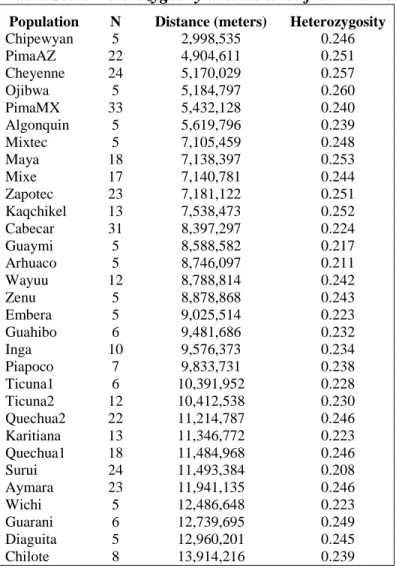
Table S3.1: Heterozygosity and distance from the Bering Strait
Population N Distance (meters) Heterozygosity
Chipewyan 5 2,998,535 0.246 PimaAZ 22 4,904,611 0.251 Cheyenne 24 5,170,029 0.257 Ojibwa 5 5,184,797 0.260 PimaMX 33 5,432,128 0.240 Algonquin 5 5,619,796 0.239 Mixtec 5 7,105,459 0.248 Maya 18 7,138,397 0.253 Mixe 17 7,140,781 0.244 Zapotec 23 7,181,122 0.251 Kaqchikel 13 7,538,473 0.252 Cabecar 31 8,397,297 0.224 Guaymi 5 8,588,582 0.217 Arhuaco 5 8,746,097 0.211 Wayuu 12 8,788,814 0.242 Zenu 5 8,878,868 0.243 Embera 5 9,025,514 0.223 Guahibo 6 9,481,686 0.232 Inga 10 9,576,373 0.234 Piapoco 7 9,833,731 0.238 Ticuna1 6 10,391,952 0.228 Ticuna2 12 10,412,538 0.230 Quechua2 22 11,214,787 0.246 Karitiana 13 11,346,772 0.223 Quechua1 18 11,484,968 0.246 Surui 24 11,493,384 0.208 Aymara 23 11,941,135 0.246 Wichi 5 12,486,648 0.223 Guarani 6 12,739,695 0.249 Diaguita 5 12,960,201 0.245 Chilote 8 13,914,216 0.239
The distance and heterozygosity values that we used are shown in Table S3.1 and suggest a negative correlation between heterozygosity and distance from the Bering Strait (Figure S5, r = -0.37, P=0.04). Averaging heterozygosity for populations from major regions summarizes the trend: North Amerind: 0.253, Meso America: 0.249, North West South America/Lower Central America: 0.223, Andean: 0.241, Chaco: 0.242, East South America: 0.22.
A noticeable exception is the populations from North West South America/Lower Central America, which have a heterozygosity that is lower than expected based on geography. The low heterozygosity is consistent, however, with the tree of Figure 1C, which indicates that these populations are most closely related to populations from eastern South America, and thus may represent one of the last major population splits in the region. This agrees with a settlement model for South America involving an early migration southward along the Pacific coast, followed by a migration northward on the eastern side of the Andes and culminating in northern south America and the settlement of the Caribbean islands. Excluding the North West South America/Lower Central American populations from the analyses results in an increase of the heterozygosity-distance correlation to -0.481 (P=0.01). This correlation increases further when considering the coasts as facilitators of migration.
To include the effects of coasts, we also computed ―effective‖, or ―least-cost path‖ distances2. Compared to the standard geographic great arc distances, effective distances incorporate the effects of one or several landscape components. They are computed as least-cost paths on the basis of a spatial cost map that incorporates these landscape components. The effective distance is computed as the sum of costs ( ―cost distance‖) along the paths. Because the relative cost of landscape component is somewhat arbitrary, we tested a range of combinations. For example, a ratio of 1:10 coastline/land means that it is ten times more costly to go through land than through coastline. In addition to simple great arc distances, we used the following coastline/inland cost combinations: 1:2, 1:5, 1:10, 1:20, 1:30, 1:40, 1:50, 1:100, 1:200, 1:300, 1:400, 1:500.
The correlation peaks at -0.61 for a coastline/inland ration of 1:10 (Figure S5A,B). Excluding the 5 NNA populations with evidence of more recent gene flows from Asia/the Arctic (notes) the negative correlation persists (-0.40, P=0.076) and this correlation increases further when effective distances are considered (Figure S5C,D). These observations confirm that the trends observed in the full dataset are not solely the result of the higher diversity of the 5 NNA, which could be influenced by the more recent gene flows that has affected these populations.
References for Note S3
1
R Development Core Team. R: A language and environment for statistical computing. (Vienna, Austria, 2010).
2
Ray N (2005) PATHMATRIX: a geographical information system tool to compute effective distances among samples. Molecular Ecology Notes 5, 177-180.